




Abstract
We extend prior research on leader power by examining why and when leader referent and expert powers influence team members’ organizational citizenship behaviors directed at other individuals (OCBI) from the multilevel perspective. We propose that leader referent and expert power perceptions operate at both individual and team levels and lead to OCBI through distinct motivational mechanisms. Drawing upon social identity theory, we suggest that team-level leader referent and expert powers facilitate social identification as salient team features and in turn promote team members’ OCBI through collective team identification. On the other hand, at the individual level, leader referent and expert powers are experienced discretionarily and affect members’ OCBI through dyadic exchange relationships with a leader–member exchange (LMX) based on the reciprocity norm. Furthermore, collective team identification is hypothesized to moderate the relationship between LMX and OCBI. Findings from 465 employees in 80 teams show that team-level leader referent power enhances collective team identification and OCBI beyond expert power but not vice versa. At the individual level, both referent and expert powers have positive indirect impact on OCBI via LMX. The moderating effect of collective team identification is supported in that team members convert high-quality LMX into OCBI only when collective team identification is higher. Theoretical and practical implications of these findings are discussed.
Keywords
Power is an essential element of effective leadership (Farmer & Aguinis, 2005; Pfeffer, 1992). Although misused leader power sometimes results in tyranny (Ashforth, 1994; Stuppy & Mead, 2016) or abusive supervision (Thoroughgood, Tate, Sawyer, & Jacobs, 2012), leaders must exercise power to elicit desired behaviors from their followers (Anderson & Brown, 2010). For example, perceived leader power is known to positively influence employee job performance (Sheridan & Vredenburgh, 1978), job satisfaction (Martin & Hunt, 1980), and knowledge sharing (Liao, 2008). It also acts as a proxy for benefits followers receive, such as the quality and quantity of support and resources available (Farmer & Aguinis, 2005), reputation (Marrone, 2010), and control over important decisions in an organization (Zhou, Wang, Chen, & Shi, 2012). Prior studies suggest that employees work harder under a powerful leader because they anticipate a greater chance of achieving success due to the resources a powerful leader provides (Rahim, Antonioni, & Psenicka, 2001; Williams, 2014).
Yet, these studies do not clearly explain why and when employee perception of leader power leads to other-oriented behaviors that are not directly related to their own success. For instance, we still have a limited understanding of why employees want to help other teammates or prioritize collective interests when they perceive their team leader to be powerful (Reiley & Jacobs, 2016). Given the increasing significance of citizenship behaviors in team effectiveness (Nielsen, Bachrach, Sundstrom, & Halfhill, 2012) and a leader’s role in fostering citizenship behaviors (Yaffe & Kark, 2011), the relationship between leader power and employee citizenship behaviors warrants a closer examination. Our incomplete understanding of the relationship is partially due to the fact that power is a multidimensional construct that arises from diverse sources, each of which elicits different attitudes and behaviors from followers (Fedor, Davis, Maslyn, & Mathieson, 2001; French & Raven, 1959; Raven, 1965). French and Raven (1959) proposed five bases of social power which leaders use to influence followers: reward power refers to the ability to manage rewards to achieve desired outcomes; coercive power is the ability to administer punishment for those who do not comply; legitimate power stems from an established belief that a leader has a right to influence followers who, in turn, have an obligation to accept the influence; referent power comes from a leader’s personal attractiveness that elicits followers’ desire to be approved by or become closely associated with the leader; and expert power is derived from a leader’s skills and expertise. We speculate that leader referent and expert powers—powers that are derived from personal attributes and qualities rather than formal titles—have particular implications for employee citizenship behaviors because they are effective in eliciting affective reactions (Rahim & Afza, 1993; Rahim, 1989), which are essential to prosocial behaviors. In contrast, a leader’s use of legitimate, reward, and coercive powers is often constrained by organizational structures, job descriptions, and policies (Bowerman & Van Wart, 2011; Cogliser & Schriesheim, 2000) and largely relies on employees’ obligatory obedience (Phillips & Gully, 2011).
Specifically, we contend that leader referent and expert powers encourage organizational citizenship behaviors directed at other individuals (OCBI)—“behaviors that immediately benefit specific individuals and indirectly through this means contribute to the organization” (Williams & Anderson, 1991, p. 602)—through distinct motivational mechanisms at both individual and team levels. Scholars have pointed to the multilevel nature of leader power, suggesting that leader power perceptions can be socially shared and exist as a collective construct distinct from individually perceived power (Cogliser & Schriesheim, 2000; Farmer & Aguinis, 2005). Taking the multilevel approach, we propose that team-level leader referent and expert powers promote OCBI by transforming collective attitudes toward the team, whereas individually perceived leader referent and expert powers enhance OCBI primarily through dyadic social exchanges with the leader. This dual mechanism mirrors Hackman’s (1992) ambient and discretionary stimuli in that a leader influences employee behavior simultaneously through distinct team- and individual-level motivational processes in a team setting (Chen & Kanfer, 2006). At the team level, leader referent and expert powers can be regarded as ambient inputs which are presented to all members and characterize the team. Social identity theory posits that individuals seek to satisfy their self-esteem needs by identifying with a social group with salient features valuable to their self-definition (Ashforth & Mael, 1989; Hogg & Terry, 2000; Tajfel & Turner, 1979). As such, team-level leader referent and expert powers, as the team’s positive distinctiveness, can trigger collective team identification processes because they increase the value and utility of team membership. Higher collective team identification, in turn, promotes OCBI as team members share a sense of oneness (Van der Vegt & Bunderson, 2005). At the individual level, on the other hand, leader referent and expert powers are experienced discretionarily and thus elicit individual reactions. If a member perceives a leader to have resources central to his/her self-values, he/she should be more emotionally attached to and motivated to interact with the leader (Farmer & Aguinis, 2005), which increases the quality of leader–member exchange (LMX, Graen & Uhl-Bien, 1995). Thus, it is likely that individually perceived leader referent and expert powers affect OCBI through LMX.
We further note that individual behavior is often determined by the conjoint effect of team- and individual-level stimuli, rather than in isolation (Hackman, 1992; Walumbwa, Hartnell, & Oke, 2010) and propose that collective team identification would interact with LMX to influence OCBI. Because LMX reflects an individual’s attachment to a leader—rather than other teammates—members need motivational impetus to convert their high-quality LMX into citizenship behaviors that also benefit other teammates. Thus, we reason that members are most likely to engage in OCBI when they feel attached to and identify with their leader as well as their team. When team identification is low, members may be less motivated to engage in team-oriented helping behaviors even when they individually perceive their leader to be powerful; instead, they may focus solely on appeasing their leader. We limit our focus to OCBI, not including organization-oriented citizenship behaviors, because we intend to investigate leader referent and expert powers in a team context and their impact on helping behaviors that directly benefit teammates rather than an organization in general.
This study contributes to the existing literature in several ways. First, we reinvigorate scholarly interest in leader power, highlighting the effects of leader referent and expert powers on employee discretionary behaviors in a team context. Leader power has long garnered attention from researchers and practitioners due to its practical significance in management (Brass & Burkhardt, 1993; Hinkin & Schriesheim, 1994; Pfeffer, 1992). Yet, the shift to team-based structures in organizations and resultant emphasis on team leader roles in team effectiveness (Kozlowski & Bell, 2003) present a need to examine leader power recognizing its implications for the team as a whole as well as individual employees. To that end, we focus on leader referent and expert powers—which tend to significantly vary across different teams—and investigate their distinct impact on OCBI.
Second, we extend previous research by simultaneously testing team- and individual-level motivational mechanisms through which leader referent and expert powers lead to OCBI. Although previous studies on leader power have been conducted predominantly at the individual level (e.g., Rahim et al., 2001), we contend that perceptions of leader referent and expert powers can be shared and emerge as a team-level input that plays a distinct role in motivational processes. Our multilevel approach enables us to explore social identity implications of leader power on OCBI at the team level while simultaneously examining the social exchange perspective of the relationship between leader power and OCBI at the individual level.
Lastly, we contribute to the literature by examining a more comprehensive model. This study provides a broader picture that explains why and when leader referent and expert powers lead to team-oriented helping behaviors from the multilevel perspective. In particular, an examination of the cross-level interaction between collective team identification and LMX on OCBI responds to the call to further explicate synergistic and complimentary processes in which team-level (i.e., ambient) and individual-level (i.e., discretionary) inputs interplay (Chen & Kanfer, 2006). Figure 1 depicts the hypothesized model. Hypothesized model.
Literature Review and Hypothesis Development
Team-Level Leader Power: A Social Identity Approach
Social identity theory posits that group memberships and characteristics serve as the primary sources of self-definition and shape attitudes, feelings, and behaviors (Van Knippenberg & Hogg, 2003). Because group membership becomes an essential part of the self, individuals constantly seek groups with favorable and distinct features to build positive social identities (Hogg & Terry, 2000). For example, people strive to enhance their self-esteem by associating with high-status or high-power groups rather than low-status and low-power groups (Chattopadhyay, George, & Lawrence, 2004). Group success (Ellemers, De Gilder, & Haslam, 2004), procedural justice, and economic outcomes (Blader & Tyler, 2009) were also found to make group membership attractive and positively contribute to self-concept.
In team-centered organizations, team leaders may also play a key role in social identification processes because their roles are not limited to managerial functions: they act as group representatives who embody team goals and values (Giessner & Van Knippenberg, 2008; Van Knippenberg & Van Knippenberg, 2005) and boundary spanners who scout resources, glean information, and coordinate intergroup activities (Marrone, 2010). Leaders’ differential capabilities and influence become the team’s strategic assets and an indicator of team success (Mehra, Dixon, Brass, & Robertson, 2006). Thus, it is plausible that leader power acts as a salient team feature that satisfies member self-enhancement needs.
This social identity approach to leader power differs from the social identity perspective of leadership (Hogg, 2001; Hogg & Terry, 2000; Van Knippenberg & Hogg, 2003) as the latter focuses on leader prototypicality. The social identity perspective of leadership suggests that leaders are also members of the groups they direct, and thus leadership effectiveness is contingent on the degree to which leaders are representative of their own groups (Van Knippenberg, 2011). Sharing the emphasis on social identification and collective self-definition, our framework sheds light on leader referent and expert powers as potential salient team characteristics that make team membership appealing and foster social identity processes.
Team-Level Leader Power, Collective Team Identification, and OCBI
The social identity approach to leader power enables us to delve deeper into the motivational processes through which leader referent and expert powers translate into members’ citizenship behaviors in a team. When team members detect salient team features, and thus find team memberships indispensable, they go through social identity processes in which they merge their own with the team’s interests and become emotionally attached to the team (Van Knippenberg & Hogg, 2003). Such social identification processes can be heightened at the team level because members share information and reinforce shared psychological states through reciprocal interactions (Dietz, Van Knippenberg, Hirst, & Restubog, 2015). As members are exposed to the same cues of leader referent and expert powers, they similarly experience prestige or saliency of their team membership and mutually go through social identification processes (Simon & Stürmer, 2003), which emerges as collective team identification.
Collective team identification refers to “the emotional significance that members of a given group attach to their membership in that group” (Van der Vegt & Bunderson, 2005, p. 533). According to Ashforth and Mael (1989), team identification is more definite and proximal to individual behaviors than organization-based identification because the latter can be a composite of multiple identities in a complex organization. When members share a high level of team identification, they are more committed to the team’s goals and willing to exert themselves for collective interests (Somech, Desivilya, & Lidogoster, 2009; Van der Vegt & Bunderson, 2005; Van der Vegt, Van de Vliert, & Oosterhof, 2003).
Despite the importance of collective team identification in eliciting team-oriented attitudes and behaviors (Giessner, Van Knippenberg, Van Ginkel, & Sleebos, 2013), very little has been documented about the relationship between leader power and collective team identification. Because leader power and status are often closely associated with team performance and reputation (Mehra et al., 2006; Sauer, 2011), we believe leaders with high referent and expert powers cause members to identify more closely with the team by increasing emotional attachment to the team and the payoff of team membership (Doosje, Ellemers, & Spears, 1995; Ellemers, Kortekaas, & Ouwerkerk, 1999). Members may take pride in being a part of a distinguished leader’s team as such identification validates their self-worth (Weldon & Weingart, 1993). More specifically, members may become more appreciative of—and emotionally engaged in—the team when the leader is technically proficient because team success is often contingent on the leader’s knowledge and skills (Zaccaro, Rittman, & Marks, 2001). If team members experience continuing recognition by virtue of their leader’s expertise, they should be more motivated to identify closely with the team to maintain elevated social identities. Leader referent power also reinforces collective team identification because referent power is essentially conducive to emotional engagement by making members feel valued and accepted (Rahim & Afza, 1993). Social influence and prestige gained from referent power would make team membership (i.e., official affiliation with the leader) positively reflect on a member’s social identity (Van Prooijen & Van Knippenberg, 2000). Thus, we hypothesize the following:
Collective team identification is further expected to mediate the relationships between team-level leader referent power, expert power, and OCBI across levels. In a team with high collective team identification, especially when it is triggered by shared experiences, team members are more likely to share a sense of oneness with other teammates (Dietz et al., 2015). As more members identify with a team, they feel more comfortable and motivated to offer help and seek ways to improve team processes, even sometimes at the expense of self-interest, because they are confident other teammates pursue common interests (Schaeffner, Huettermann, Gebert, Boerner, Kearney, & Song, 2015). We, thus, hypothesize that collective team identification mediates the relationships between team-level leader referent power, expert power, and OCBI.
Individual-Level Leader Power, LMX, and OCBI: A Social Exchange Approach
Independent of team-level leader power, each team member can form his/her own perception of leader power. Members have different needs for support and resources and tend to appreciate the significance of leader power accordingly (Farmer & Aguinis, 2005). Thus, we contend that leader referent and expert powers, as discretionary stimuli, evoke varying individual actions and reactions. Scholars have similarly noted that a contextual construct encompasses both ambient and discretionary inputs that distinctively influence individual behaviors (Chen & Kanfer, 2006; Liao & Chuang, 2007).
First, we expect that leader referent and expert powers are positively associated with LMX. From the social exchange perspective (Blau, 1964), members should be more inclined to build good relationships with powerful leaders because they are attractive exchange partners. Leaders with referent power can provide emotional support and boost self-esteem, whereas leaders with expert power are better able to provide their followers with resources and information needed for success (Rahim et al., 2001). The greater the perceived value of leader referent and expert powers, the more a member respects and trusts the leader and strives to fulfill the leader’s expectations, which turns into high-quality LMX (Van Knippenberg, Van Knippenberg, De Cremer, & Hogg, 2004). In contrast, members who do not perceive their leader to have referent or expert power will be less interested in maintaining high-quality LMX as expected returns are relatively insignificant.
Furthermore, team members should be more motivated to build high-quality LMX when the leader has referent and expert powers because they can better perform their roles by virtue of superior resources and support, and thus maintain or reinforce positive identities in the workplace (e.g., high-performing employee) (Farmer & Aguinis, 2005). Farmer and Aguinis (2005) mentioned that leaders are “key potential providers of these identity-verifying resources” (p. 1072). If a leader has abilities to make members feel valued and approved (i.e., referent power) and possesses valuable resources and knowledge (i.e., expert power), members should be more likely to become emotionally attached to the leader and merge their values and beliefs to the leader’s, which constitutes higher-quality LMX. Together, we hypothesize positive relationships between leader referent power, expert power, and LMX.
We next suggest that LMX mediates the positive effects of leader referent and expert powers on OCBI. The positive relationship between LMX and citizenship behaviors has been well established in the literature based on the norm of reciprocity (Gouldner, 1960; Ilies, Nahrgang, & Morgeson, 2007; Martin, Guillaume, Thomas, Lee, & Epitropaki, 2016). Expanding the knowledge, we suggest that leader referent and expert powers enhance OCBI through LMX. In high-quality LMX, members feel more obligated to engage in behaviors that benefit the leader as they view the leader’s goals and values as their own (Huang, Wang, & Xie, 2014). Especially when the exchange relationship is enhanced by the leader’s differential referent and expert powers, members would be more motivated to go beyond their job expectations and display team-oriented behaviors to appease the leader (Wayne, Shore, & Liden, 1997). Thus, we hypothesize the following:
Collective Team Identification as a Cross-Level Moderator
Team- and individual-level inputs affect individual behaviors in synergistical ways; disregarding the interplay misses an opportunity to examine an essential aspect of motivational processes (Chen & Kanfer, 2006; Hackman, 1992). We thus lastly hypothesize that collective team identification moderates the individual-level indirect effects of leader referent and expert powers on OCBI via LMX, respectively. In other words, we suggest that collective team identification serves as a motivational climate that encourages team members’ high-quality LMX to transform into helping behavior toward other teammates. When members share a sense of attachment and belongingness to the team, they feel more obligated to reciprocate benefits received from the leader in a way that favorably treats other teammates as well. In contrast, when collective team identification is low (i.e., members’ overall emotional attachment to the team is weak), members may choose to repay favorable treatment by focusing more exclusively on advancing their leader’s interests (e.g., demonstrating loyalty to the leader or passing information to the leader) rather than teammates’ interest.
The interactive effect of collective team identification and LMX on OCBI also can be explained in part by optimal distinctiveness theory (Brewer, 1991) which extends social identity theory. According to optimal distinctiveness theory, individuals strive to optimize their identities by simultaneously fulfilling the need for inclusion and the need for distinctiveness (Leonardelli, Pickett, & Brewer, 2010). When the two competing needs are met, individuals tend to be more involved at work and display greater citizenship behaviors (Wombacher & Felfe, 2017). The same motivational mechanism applies to a team context (Farmer, Van Dyne, & Kamdar, 2015); members seek both uniqueness and assimilation within a team. As such, collective team identification satisfies inclusion needs, whereas high-quality LMX satisfies distinctiveness needs by according differentiated attention and support. We therefore speculate that team members are most likely to engage in OCBI when collective team identification and LMX are both higher. Taken together, we hypothesize the following:
Method
Participants
We collected data from a medium-size business conglomerate in South Korea. The conglomerate runs 10 companies in different industries, including chemistry, construction, information technology, and biotechnology. Although the companies operate in different industries, they are governed by a single president and the same HR systems and practices. Employees are recruited and hired conjunctionally and assigned to different departments based on the assessment results. All employees across levels have regular opportunities to interact across companies through joint training sessions and social events. They are able to transfer to sister companies on their own or at the company’s request. After multiple meetings with the HR director and the review of HR practices, we were assured that there was sufficient homogeneity across the companies.
Based on their eligibility (i.e., full-time employees) and shift schedules, 485 employees (30%) in 84 teams (79%) across the 10 companies were invited to participate in the survey. They were informed that their participation would be voluntary and confidential. After a detailed briefing about the research objectives and processes, employees were asked to complete paper surveys and mail their sealed responses directly to the authors through enclosed envelopes. A team identifier was printed on each survey to match responses by teams. In total, 469 employees in 84 teams completed the survey, yielding a response rate of 96%. Yet, four teams were excluded from our final analyses because only one member responded. Thus, a total of 465 members in 80 teams provided usable responses.1 Team size ranged from 2 to 10 members, with the average team size being 6.8 team members.
Measures
Because the survey was conducted in South Korea, the original items were translated from English to Korean following Brislin’s (1980) translation–back translation procedure. All measures were rated using a seven-point Likert scale (1 = strongly disagree to 7 = strongly agree).
Leader referent and expert powers
We used eight items from the scale developed by Hinkin and Schriesheim (1989) to measure perception of leader referent and expert powers (four items for each power base). Sample items included “I feel my manager can make me feel valued (referent power)” and “I feel my manager can give me good technical suggestions (expert power).” Cronbach’s alphas were .97 for referent power and .93 for expert power.
Team-level leader referent and expert powers
We aggregated individual leader referent and expert power values to the team level. For leader referent power, the median interrater agreement coefficient (rwg(J); James, Demaree, & Wolf, 1984) across the teams was .91. One-way analysis of variance result showed that the mean of leader referent power significantly differed across teams, F(79, 385) = 1.55, and p < .01. In addition, interrater reliability indices supported aggregation, ICC(1) = .09, and ICC(2) = .35. Aggregation of leader expert power was also justified (median rwg(J) = .93, F(79, 385) = 2.00, p < .01, ICC(1) = .15, and ICC(2) = .50).
Collective team identification
We measured participants’ team identification using a four-item scale used by Van der Vegt et al. (2003). Sample items included “I strongly identify with the other members of my work team” and “I would like to continue working with my team.” Cronbach’s alpha was .80. We aggregated team identification to the team level (median rwg(J) = .91, F(79, 380) = 1.98, p < .01, ICC(1) = .15, and ICC(2) = .49).
LMX
LMX was assessed using a seven-item scale adapted from Graen and Uhl-Bien (1995). Participants were asked to evaluate their working relationships with their leaders that encompass trust, respect, and obligation. A sample item was “How well does your leader understand your job problems and needs?” Cronbach’s alpha for LMX was .94.
OCBI
OCBI was assessed using a seven-item scale developed by Williams and Anderson (1991). Sample items included “I help others who have been absent” and “I assist supervisor with his/her work (when not asked).” Cronbach’s alpha was .84.
Control variables
Drawing upon previous studies, we controlled for leader age and gender in our analyses. Previous studies found that followers tend to evaluate male leaders’ power more favorably than female leaders’ (Ragins & Sundstrom, 1989). Also, younger leaders are often considered to have low status and thus weaker influence on followers than older leaders (Buengeler, Homan, & Voelpel, 2016).
Common Method Variance Check
Because our variables were bound by a common method, we utilized a conducted a marker variable analysis (Lindell & Whitney, 2001). We used performance avoid goal orientation (PAGO) which refers to tendency to take defensive behaviors to avoid negative evaluations (Brett & VandeWalle, 1999) as a marker variable for it was not theoretically associated with other variables modeled in the study. PAGO was assessed using the four-item scale by Brett and VandeWalle (1999) and Cronbach’s alpha was .80. Following Lindell and Whitney’s (2001) procedure, we adjusted the correlations among variables by the lowest positive correlation between the marker variable and other variable (i.e., correlation between PAGO and leader referent power), r = .12. Even when common method variances were controlled, the correlations among variables remained significant, which indicates that the correlations are less likely to be accounted for by common method variances.
Analytical Strategy
Because employees were embedded in different teams, we conducted hierarchical linear modeling (HLM) to test hypotheses except for Hypotheses 1a and 1b, which were tested utilizing hierarchical regression. Following Hofmann and Gavin’s (1998) recommendation, we group-mean centered Level 1 explanatory variables (i.e., referent power, expert power, and LMX) and grand-mean centered all Level 2 variables (i.e., leader age, leader gender, team-level leader referent and expert powers, and team identification) before HLM analyses. This approach enabled us to ensure that a cross-level interaction (i.e., interaction between LMX at the individual level and team identification at the team level) was not compounded by a possible team-level interaction between LMX and team identification. We further obtained 95% bootstrapping confidence intervals (CIs) for multilevel mediation effects using Mplus 8.0 (Muthén & Muthén, 1998-2017).
Results
Descriptive Statistics, Correlations, and Factor Analysis
Means, Standard Deviation, and Correlations.

Note. N = 465 individuals, N = 80 teams; LMX = leader–member exchange; OCBI = organizational citizenship behaviors directed at individuals. Cronbach’s alphas are reported in the parentheses on the diagonal.
**p < .01, two-tailed.
Male was coded 0 and female was coded 1.
Comparison of Measurement Models.

Note. CFI = comparative fit index; RMSEA = root-mean-square error of approximation; SRMR = standardized root-mean-square residual; LMX = leader–member exchange, OCBI = organizational citizenship behaviors directed at individuals.
**p < .01, two-tailed.
Hypothesis Testing
Hypotheses 1a and 1b predicted that team-level leader referent and expert powers are positively related to collective team identification, respectively. Because all variables involved in the hypotheses were at the team level, we used hierarchical regression to test the relationships. When team-level leader referent and expert powers were simultaneously entered, referent power was positively associated with collective team identification (R2 = .53, β = .74, p < .01) but expert power was not (β = −.02, n.s.). The results indicate that leader referent power explains collective team identification beyond expert power but not vice versa. Thus, only Hypothesis 1a was supported.
Hierarchical Linear Modeling Results.
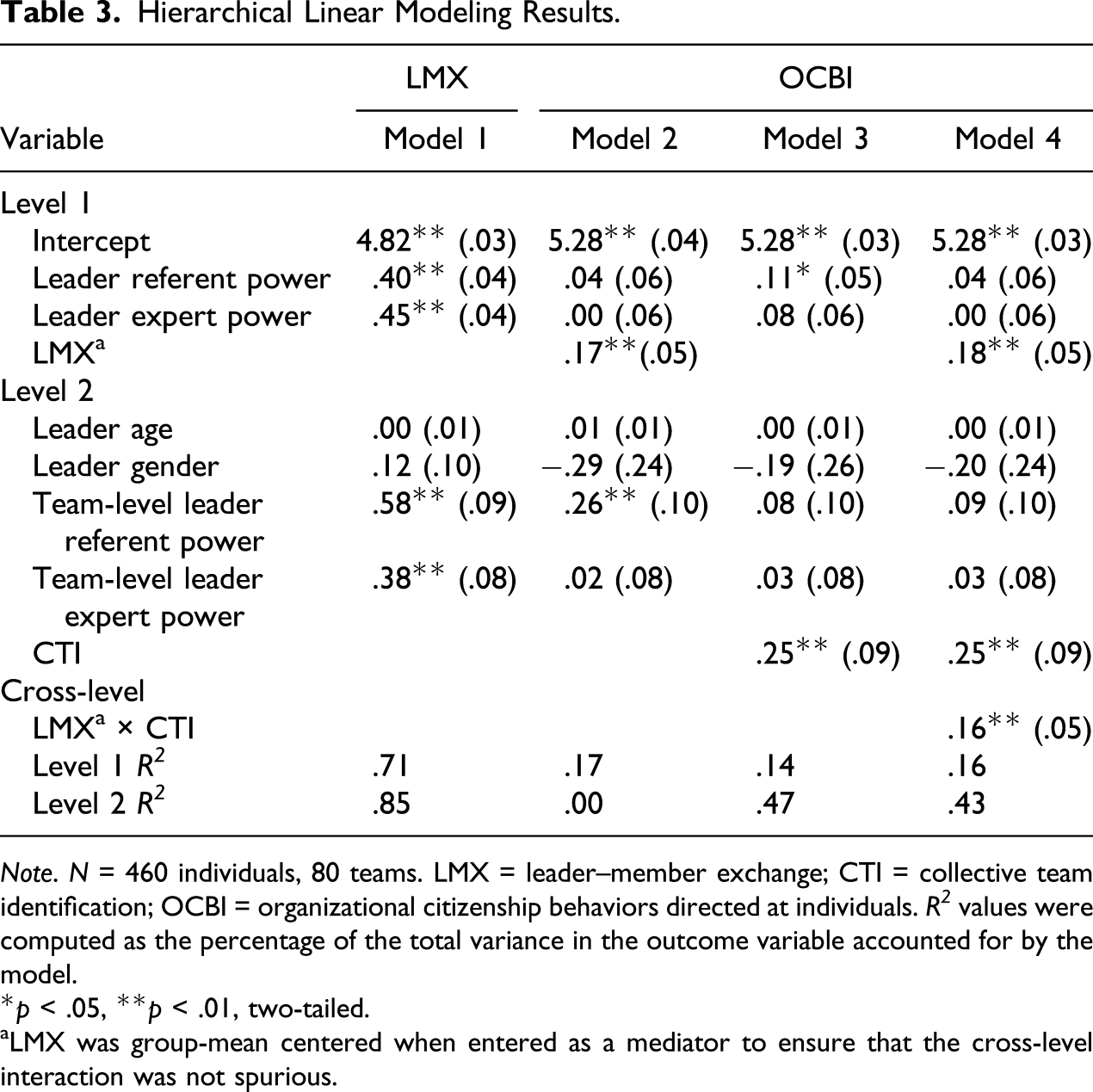
Note. N = 460 individuals, 80 teams. LMX = leader–member exchange; CTI = collective team identification; OCBI = organizational citizenship behaviors directed at individuals. R 2 values were computed as the percentage of the total variance in the outcome variable accounted for by the model.
*p < .05, **p < .01, two-tailed.
LMX was group-mean centered when entered as a mediator to ensure that the cross-level interaction was not spurious.
Hypotheses 3a and 3b proposed that leader referent and expert power are positively related to LMX at the individual level. As shown in Model 1 of Table 3, both leader referent and expert powers were positively related to LMX (referent power, γ = .40, p < .01; expert power, γ = .45, p < .01). At the individual level, leader referent and expert powers accounted for LMX beyond each other. Thus, both Hypotheses 3a and 3b were supported.
Hypotheses 4a and 4b stated that LMX mediates the relationship between leader referent power and OCBI and the relationship between leader expert power and OCBI, respectively. We used Preacher and Hayes’ (2008) approach again. The first step was satisfied in testing Hypotheses 3a and 3b. When leader referent power, expert power, and LMX were added to the analysis (Model 2), LMX remained significant (γ = .17, p < .01) and leader referent and expert powers were no longer significantly related to OCBI. These results satisfied the second step. As the last step, we obtained 95% CIs for the indirect relationship between leader referent power and OCBI via LMX ([.027, .112]) and the indirect relationship between leader expert power and OCBI via LMX ([.028, .131]). Both 95% CIs did not include zero. These findings were consistent with Hypotheses 4a and 4b.
Lastly, Hypotheses 5a and 5b stated that collective team identification moderates the individual indirect effects such that the relationship between LMX and OCBI is stronger when collective team identification is higher. As shown in Model 5, after entering all explanatory variables, the interactive term between LMX and collective team identification remained positively significant (γ = .16, p < .01). To facilitate our interpretation, we plotted the interaction in Figure 2 following Aiken and West (1991). A simple slope analysis revealed that the slope in the high condition of collective team identification was positive and significant (b = .27, p < .01). The slope in the low condition of collective team identification was nonsignificant (b = .09, n.s.). The findings were consistent with 95% CIs that we obtained following Bauer, Preacher, and Gil (2006). The 95% CIs for the indirect effect of leader referent power on OCBI via LMX as well as the indirect effect of leader expert power on OCBI via LMX did not include zero when collective team identification was high ([ .042, .284] for referent power and [.105, .286] for expert power); however, the 95% CIs for both paths included zero when collective team identification was low ([–.163, .118] for referent power and [−.109, .044] for expert power). Together, these results provided support for Hypotheses 5a and 5b. Interaction effect of leader‐member exchange (LMX) and collective team identification (CTI) on organizational citizenship behaviors directed at individuals (OCBI).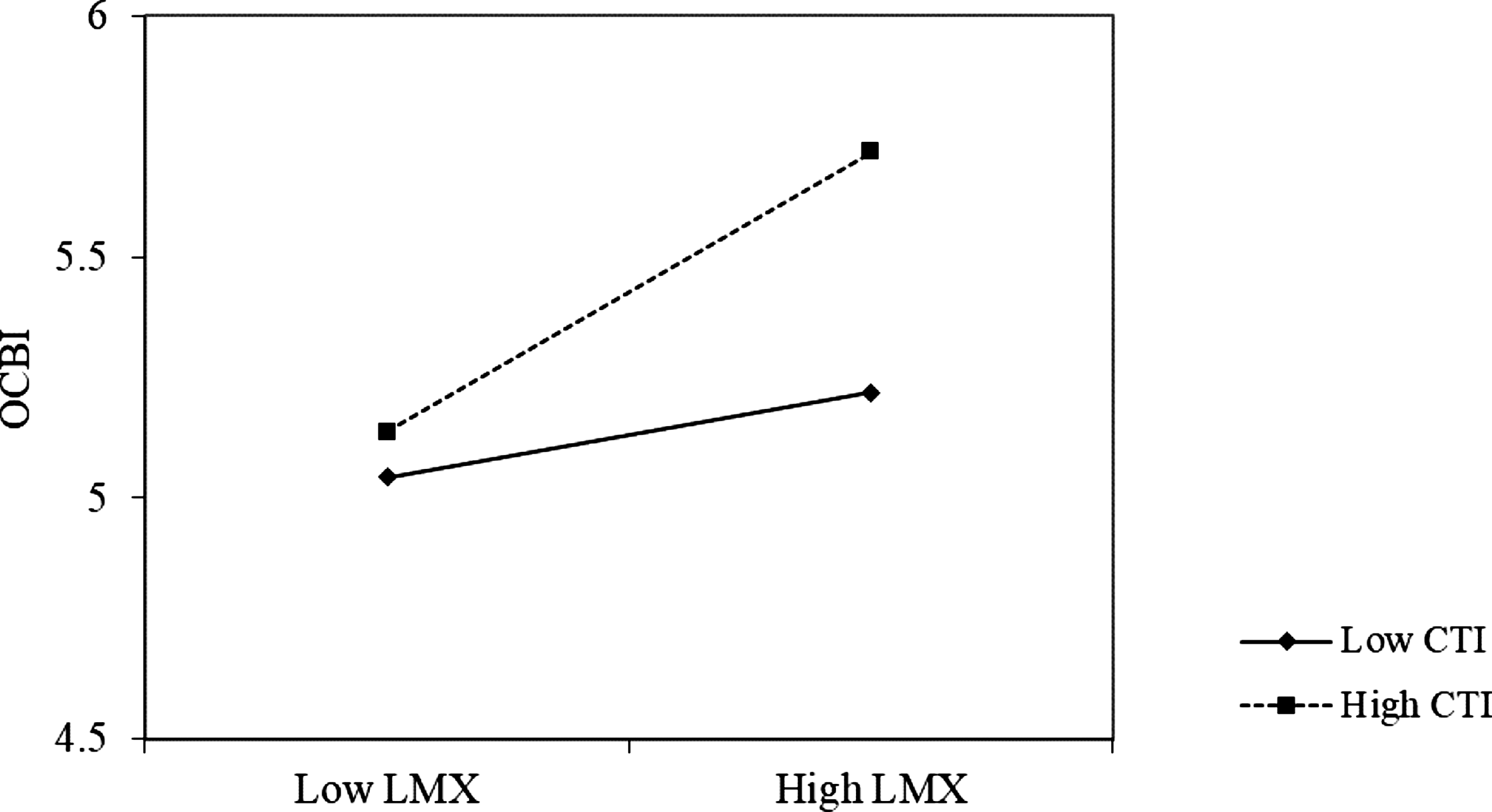
Discussion
The goal of this study was to understand why and when leader power promotes team members’ OCBI. Despite the importance of power in leadership (Pfeffer, 1992), relatively little is known about its impact on follower citizenship behaviors (Reiley & Jacobs, 2016) let alone the motivational mechanisms. Focusing on leader referent and expert powers, we investigated the mechanisms from the multilevel perspective and tested distinct mediators drawing upon social identity theory (Ashforth & Mael, 1989) and social exchange theory (Blau, 1964). As hypothesized, team-level referent power had a positive indirect effect on OCBI via collective team identification. Team-level expert power however was not related to collective team identification beyond referent power. At the individual level, both leader referent and expert powers had distinct indirect relationships with OCBI via LMX. Collective team identification moderated the individual-level indirect relationships, such that the relationship between LMX and OCBI was stronger only when collective team identification was higher.
Theoretical Implications
Our findings provide several important implications to the existing literature. First, this study reveals that leader referent power, when examined as a shared perception, plays a critical role in facilitating social identity processes and eliciting OCBI. This finding extends prior research on leader power which examined leader power primarily as a predictor of individual subordinate’s attitudes and work outcomes (e.g., Martin & Hunt, 1980; Rahim & Afza, 1993; Sheridan & Vredenburgh, 1978). Recognizing the multilevel nature of leader power and its potential role as a team attribute, we demonstrated that a leader’s ability to induce members' admiration and personal liking of the leader (Rahim et al., 2001) is critical to the degree to which members identify with—exert effort for—the team. Furthermore, we revealed that leader referent and expert powers had differential impact on collective team identification. Team-level leader referent power was positively related to collective team identification beyond expert power but not vice versa. These findings indicate that a leader’s ability to make members feel valued and approved are more critical than the leader’s professional knowledge in enhancing members’ emotional attachment and commitment to the team as a whole. The results are consistent with previous findings that leader referent power, of five power bases, had the strongest effects on subordinate affective attitudes (Cogliser & Schriesheim, 2000; Rahim & Afza, 1993). This social identity approach to leader power extends our knowledge of leadership, suggesting a need to further investigate leader power in a team setting and its cognitive and emotional implications for team members.
Second, the finding that LMX mediated the relationships between leader referent and expert powers and OCBI after controlling for team-level leader referent and expert powers demonstrate that leader power affects member attitudes and behaviors in discretionary ways as well, regardless of team-level reactions. As predicted, team members were more likely to develop higher-quality LMX and in turn engage in greater OCBI when they perceived their leader to have referent and expert powers. This finding corroborates Cogliser and Schriesheim’s (2000) recommendation that a leader needs to exercise referent and expert powers to increase the quality of LMX with team members as well as promoting positive perceptions of the team as a whole. Our study further shows that, at the individual level, both referent and expert powers were significantly related to LMX beyond each other, whereas team-level leader expert power was not related to collective team identification beyond team-level referent power. In dyadic social exchanges, referent and expert powers can be equally important because members seek not only emotional support but also practical guidance and knowledge from their leader (Sparrowe & Liden, 1997).
Lastly, the cross-level moderation effect of collective team identification on the relationship between LMX and OCBI demonstrates that members need shared social identification for positive perspectives of a leader to result in greater team-oriented behaviors. Previous studies have suggested several contextual conditions where LMX is more likely to lead to OCBI. For example, employees tend to display greater citizenship behaviors as a result of LMX when they collectively share a sense of empowerment (Zhong, Lam, & Chen, 2011) or fairness (Sun, Chow, Chiu, & Pan, 2013). From the social identity perspective, team members need a shared psychological state that gives them a sense of oneness and emotional connection to convert personal attachment to their leader into prosocial behaviors toward other teammates. Indeed, the indirect effects of leader referent and expert powers on OCBI were not significant when collective team identification was low. These findings also contribute to LMX research by indicating that LMX alone—particularly when it is built on a leader’s personal influence and prestige—may not be sufficient to promote team-oriented behaviors.
Practical Implications
This study provides practical implications to managers and team leaders. First, this study proposes crucial factors (i.e., leader referent and expert powers) that motivate employees to become “team workers.” Although leader power has traditionally been regarded as a means to encourage individual achievement (Fiorelli, 1988; Rahim & Afza, 1993), this study reveals that leader referent and expert powers are also effective in eliciting team-oriented attitudes and behaviors. Since team identification or commitment is crucial to team effectiveness (Giessner et al., 2013; Somech et al., 2009), our findings advise managers to constantly communicate or demonstrate their unique knowledge, skills, and affective attention to employees so they can have accurate knowledge of resources and support available. If employees fail to correctly perceive leader power due to barriers, such as personality, demographic differences, and lack of social interactions (Lord, Phillips, & Rush, 1980), they may underestimate the value of team membership and become less attached to their team.
Second, this study informs managers of the importance of creating a team climate that connects members to a collective unit to promote behaviors that are in the best interest of the group. Because citizenship behaviors are inherently relationship oriented and involve prosocial motives (Takeuchi, Bolino, & Lin, 2015), it is imperative to create a social context that provides motivation to merge personal interests with those of others. To that end, managers may use strategies such as communication training, social gatherings, and team-building events to promote a sense of understanding and community.
Limitations and Future Research Directions
Our findings and implications should be interpreted in the light of a few limitations. First, all perceptual variables were measured by employees, which prevents us from entirely ruling out the potential influence of common method bias (Podsakoff, MacKenzie, Lee, & Podsakoff, 2003). Although we conducted a marker variable analysis (Lindell & Whitney, 2001) and found that the correlations among variables remained significant after controlling for potential common method variances, we would encourage future research to use multiple sources to minimize potential contamination by common method variances. Second, the cross-sectional design did not allow us to conclude the causal relationships among the variables modeled in the study. Although we grounded all hypothesized relationships in strong theoretical foundations to mitigate this concern, a longitudinal design that uses temporal separation between variables would help us infer causality. Third, our data were collected in South Korea where the national culture is characterized by a relatively large power distance and high collectivism (Hofstede & Bond, 1988; Triandis & Gelfand, 1998). Further examination of how prosocial behavior is influenced by leader referent and expert powers in individualistic cultures with small power distances would provide a more nuanced understanding of leader power. Moreover, we strongly encourage future research to explore other contextual factors that could influence the effect of leader power on employee team-oriented behaviors. For example, a leader’s relative status and power compared with other leaders or members’ shared leadership (Carson, Tesluk, & Marrone, 2007) may influence the degree to which members appreciate and respond to their leader’s power. It would be also interesting to utilize other sources of leader informal power such as network size (Mehra et al., 2006) in examining the relationships hypothesized in this study. Lastly, as leaders are often considered to be the representative of a formal organization (Wayne et al., 1997), it would be interesting to investigate whether perceived leader power also extends to helping behaviors toward the organization as a whole.
Footnotes
Declaration of Conflicting Interests
The author(s) declared no potential conflicts of interest with respect to the research, authorship, and/or publication of this article.
Funding
The author(s) disclosed receipt of the following financial support for the research, authorship, and/or publication of this article: This research was supported by the Institute of Management Research at Seoul National University.

Note
Associate Editor: Deanna Kennedy