



Abstract
For employees with stigmatized concealable identities, the decision to disclose or not disclose represents a critical workplace experience. Moreover, employees enact their disclosure decisions by engaging in identity management (IM) strategies. Although multiple conceptual frameworks exist related to disclosure decisions and IM strategies, none of these frameworks consider the relationship between these two phenomena. In addition, empirical work surrounding disclosure decisions often positions disclosure as a dichotomous decision, rather than considering disclosure as occurring along a continuum. In this study, we use in-depth interviews to investigate the nuances of concealable IM using a sample of stigmatized employees, namely, those with depression. Through inductive thematic analysis, a continuum of disclosure decisions emerged (non-disclosure, partial disclosure, and full disclosure) as well as eight distinct IM strategies that participants used to enact their disclosure decisions. Our results extend the knowledge of concealable IM in multiple ways. First, we map specific IM strategies onto the disclosure continuum to provide a more robust understanding of the IM process for employees with depression. Second, we identify specific IM strategies related to partial disclosure and full disclosure, thereby extending existing conceptual frameworks. Additionally, we expand the definitions of the concealing and signaling IM strategies. Lastly, our study exposes the lived experiences of a group of employees that have traditionally been underrepresented in applied organizational research, those with depression.
At work, people maintain multiple social identities, with some being more readily detectable (e.g., race and gender) and others being less visible (e.g., sexual orientation and mental illness). Employees, therefore, must make decisions about the extent to which they wish to carry their non-work identities into their working environment (Ramarajan & Reid, 2013; Phillips, Rothbard, & Dumas, 2009). These decisions can be especially critical for employees with stigmatized concealable identities (Follmer, Sabat, & Siuta, 2020). Stigmatization occurs when an individual is perceived to have an identity that is devalued, discredited, or tainted (Goffman, 1963) and subjects the person to negative stereotyping and prejudice (Krupa, Kirsh, Cockburn, & Gewurtz, 2009). Importantly, stigmatization in the workplace often results in serious interpersonal (e.g., social isolation and discriminatory treatment) and economic (e.g., reduced career mobility) consequences for employees (Arena & Jones, 2017; Beatty & Kirby, 2006; Follmer & Jones, 2017). For employees with concealable disabilities (such as having depression), stigmatization may also create a dilemma in which employees fail to seek needed workplace accommodations (to which they are entitled under the Americans with Disabilities Act of 1991 and the Americans with Disabilities Act Amendments Act of 2008) as they must disclose in order to receive them (Follmer & Jones, 2018; Santuzzi & Waltz, 2016).
Thus, knowledge that one’s concealable identity is stigmatized may elicit the need to “manage” this identity (Steele, Spencer, & Aronson, 2002) at work in order to reduce the likelihood of mistreatment and other negative outcomes (Clair, Beatty, & Maclean, 2005; Ragins, 2008).
Existing conceptual models have detailed the identity management (IM) process for individuals with concealable identities (for a review, see Follmer et al., 2020). These models broadly focus on two distinct aspects of IM: disclosure decisions and IM strategies. Disclosure decisions refer to an individual's choice to disclose or not disclose a concealable identity in the workplace (Chaudoir & Fisher, 2010; Clair et al., 2005; Croteau, Anderson, & VanderWal, 2008; Ragins, 2008). Importantly, disclosure decisions are not “all or nothing”; rather, Ragins (2008) argued that these decisions occur along a continuum. These disclosure decisions are enacted through identity management strategies in which individuals engage in behaviors that enable them to disclose or conceal their identity (Clair et al., 2005; Croteau et al., 2008; Jones et al. 2016). Hence, the way a person enacts disclosure or non-disclosure may differ depending on the behaviors the person chooses to engage in at work.
Although the existing conceptual models are helpful for illustrating how IM decisions and behaviors unfold in the workplace, empirical support for these models has important limitations. First, the greater part of empirical investigations related to disclosure decisions has focused on predicting the antecedents and consequences of disclosure decisions (Martinez, Sawyer, Thoroughgood, Ruggs, & Smith, 2017; Quinn & Chaudoir, 2009) by comparing individuals who have disclosed to those who have not. By examining disclosure as a dichotomy, rather than a continuum, these studies fail to capture the experiences of employees who are “in-between” full disclosure and non-disclosure. Second, relatively few studies have empirically examined IM strategies among individuals with stigmatized identities (Jones et al., 2016; Little, Major, Hinojosa, & Nelson, 2015; Lynch & Rodell, 2018). The extant research has generally assumed that the same IM strategies can be broadly applied to all identity groups (Lynch & Rodell, 2018) despite evidence that IM processes may vary across social identity groups (Follmer et al., 2020). Indeed, the extent to which an identity is stigmatizing depends on characteristics of the stigma itself (Jones et al., 1984), such as how much it disrupts interactions with others, how controllable it is, and whether or not the stigma can cause harm to others. This suggests that IM strategies may differ based on the stigma characteristics of the identity and the implications of disclosing that identity in the workplace. Without studying the emergence of IM strategies within specific groups, it is difficult to fully understand whether the existing conceptual IM strategies accurately represent the nuances of these employees’ experiences. Lastly, disclosure decisions and IM strategies are distinct but related phenomena even though they are often discussed as interchangeable in the extant literature (Croteau et al., 2008). Thus, more work is needed on the integration of disclosure decisions and IM strategies.
Taken together, there is a clear need to further study the disclosure continuum and the associated range of IM strategies among specific stigmatized identity groups. The current study aimed to address these gaps in the concealable IM literature by investigating the disclosure decisions and specific IM strategies utilized by employees who are particularly vulnerable to stigmatization—namely, those with depression. Because of the pernicious stigma associated with depression, this population enables the research team to more fully understand how individuals navigate disclosure surrounding an identity that is highly devalued in the workplace (Krupa et al., 2009).
Due to the aforementioned limitations of the existing empirical work, this study employed a qualitative methodology to explore concealable IM among stigmatized individuals by simultaneously investigating disclosure decisions and IM strategies. Qualitative research is useful when “all of the concepts pertaining to a given phenomenon have not been identified… and further exploration on a topic is necessary to increase understanding” (Corbin & Strauss, 2012, p.7). Thus, using a qualitative methodology, we set out to explore participants’ IM lived experiences, thereby enriching the extant knowledge related to disclosure and disclosure-related behaviors.
Literature Review
Concealable Identities and IM
Concealable identities and stigma
According to social identity theory, individuals classify themselves into distinct social groups to which they have an emotional attachment or have ascribed value (Abrams & Hogg, 1990; Tajfel & Turner, 1985). The specific social category “into which one falls, and to which one feels one belongs, provides a definition of who one is” (Hogg, Terry, & White, 1995). Social identities may be visible (e.g., race) or concealable (e.g., mental illness) depending on the characteristics of the identity, and this visibility affects the extent to which others are able to categorize individuals as part of a distinct identity group. Identities may be work or non-work related, and employees must maintain all of them while at work. Whereas individuals bring their non-work identities with them into the workplace, the ways in which individuals allow their non-work identities to manifest vary (Ramarajan & Reid, 2013). Both organizational and internal pressures alter whether employees fully display their non-work identities in the workplace (Ramarajan & Reid, 2013), including the extent to which their non-work identity is stigmatized.
According to Link and Phelan (2001), stigmatization occurs in a four-part process: (1) an individual is labeled as belonging to a particular social group, (2) the labeled social group is associated with negative stereotypes, (3) the labeling of the social group results in an “us vs. them” mentality, and (4) the labeled individual experiences status loss and discrimination due to their membership in the social group. In summary, when a person maintains a devalued identity and that identity becomes salient to others, they are likely to experience exclusion and mistreatment by others (Rüsch, Angermeyer, & Corrigan, 2005). Employees who maintain a stigmatized social identity must therefore decide how they will manage this identity in the workplace (Clair et al., 2005; Ragins, 2008; Ramarajan & Reid, 2013), including the extent to which they will disclose it to others and through what behaviors disclosure will happen.
Disclosure decisions
IM encompasses two distinct phenomena: disclosure decisions and IM strategies (Croteau et al., 2008). Disclosure decisions involve choices surrounding whether to tell others about one’s concealable identity. Ragins (2008) conceptualized disclosure as occurring along a continuum of non-disclosure, partial disclosure, and full disclosure. Non-disclosure reflects an individual’s decision to conceal a stigmatized identity from all others in the workplace, while partial disclosure represents the choice to disclose the identity only to select individuals or to reveal partial information about one’s identity. Finally, full disclosure reflects a general openness about and sharing of one’s identity with others. Importantly, full disclosure does not assume that an individual has told every person about their stigmatized identity, but rather are willing to share their identity with others when an opportunity to do so presents itself. Although disclosure is characterized as a continuum (Croteau et al., 2008; Ragins, 2008), it has traditionally been measured as a dichotomy in which researchers attempt to understand the antecedents and consequences of discrete disclosure decisions. In other words, researchers have focused a great deal on parsing out differences among those who have fully concealed or fully disclosed, but have not adequately covered the space in-between. When partial disclosure decisions have been studied, they have generally been measured by counting the number of people to whom an individual discloses—a practice that has been identified as inadequate for capturing this unique type of disclosure (Croteau et al., 2008). As a result, researchers know very little about how partial disclosure operates in practice due to the fact that it is often overlooked in empirical investigations.
IM strategies
IM, however, involves more than just making a one-time disclosure decision. As a process, IM involves the use of specific behavioral tactics that enable employees to manage the extent to which they manifest their identity at work. Clair and colleagues positioned passing and revealing as dominant IM strategies and identified sub-strategies associated with each of these decisions (Clair et al., 2005; Jones & King, 2014). Passing involves suppressing one’s stigmatized identity and masquerading as a member of a non-stigmatized identity group. Individuals enact passing through concealment (e.g., hiding information about one’s identity), fabrication (e.g., providing false information about one’s identity), and discretion (e.g., avoiding queries about one’s identity). Revealing occurs when employees intentionally tell other individuals about their stigmatized identity or speak openly about their identity, which “undeniably confirms the invisible identity” (Jones et al., 2016, p. 3). IM strategies associated with revealing include signaling (e.g., dropping hints about one’s identity), normalizing (e.g., minimizing differences between one’s identity and others), and differentiating (e.g., highlighting differences between one’s identity and others).
In an integration of the IM strategy typologies, Jones and King (2014) positioned signaling as its own higher-order strategy such that it occurs as a middle ground between passing and revealing, rather than as a subcategory of revealing. Signaling straddles both revealing and concealing as it allows individuals to share information with others, gauge their reactions, and subsequently decide whether or not to further disclose or to backtrack (Jones & King, 2014). With signaling, individuals provide hints or clues that relate to their concealable identity, but do not openly confirm their identity to others (Clair et al., 2005).
Although these existing frameworks have identified IM strategies specific to concealable IM (Clair et al., 2005; Jones & King, 2014), few studies have examined the extent to which these behaviors are actually performed by employees (cf. Little et al., 2015; Jones, 2017). Of the predominant frameworks related to concealable IM, none have utilized the lived experiences of a stigmatized group to generate the behavioral strategies; rather, strategies are identified through integrated reviews of interrelated literatures. The resulting frameworks, though helpful in the continued study of individuals with concealable identities, tend to be broad in scope and assumed to apply universally across identity groups (Lynch & Rodell, 2018). Thus, to advance the literature, inductive research is needed to organically identify the IM strategies that employees utilize in the workplace. Furthermore, the existing IM frameworks tend to examine disclosure decisions and IM strategies independently. Though distinct, these phenomena are interrelated and require additional exploration to identify how specific behavioral strategies are mapped onto the disclosure continuum. That is, how do individuals utilize specific strategies to support their disclosure decision? The current study addresses this question by focusing on employees with depression.
Depression as a Concealable Stigmatized Social Identity
Depression is a mental illness that affects more than 17 million US adults each year (National Alliance on Mental Illness, 2017), many of whom are actively involved in the workforce. Multiple estimates indicate that depression is on the rise globally among adults and is likely to onset at an age when an individual would need to work to support themselves (median age of onset is 32.5 years; Anxiety and Depression Association of America, 2021), suggesting that employees with depression represent a sizable workforce demographic. Depression is considered a unique social category as it shapes how individuals think, feel, and behave at work (Follmer & Jones, 2018). Individuals with depression experience a range of emotional (e.g., sadness and irritability), cognitive (e.g., distractibility), and physical symptoms (e.g., sleep disturbance). Because symptoms manifest differently across individuals and can present in non-stereotypical ways (e.g., individuals may not necessarily appear sad or cry all the time), generally it is not possible to detect that an individual has depression simply through observation. As a result, employees must decide for themselves how they will manage this identity in light of the stigma associated with mental illness in an employment context (Krupa et al., 2009).
Indeed, ample research has demonstrated that depression is a highly stigmatized identity, with individuals perceived as crazy, dangerous, and incompetent, as well as personally responsible for the onset of their disorder (Follmer & Jones, 2017; Martin, 2010). Furthermore, depression has been associated with decreased job performance and absenteeism (Lerner & Henke, 2008). These characteristics of depression are incompatible with the ideal worker image, which makes employees with depression more vulnerable to workplace discrimination and mistreatment, including exclusion from job opportunities and social interactions (Krupa et al., 2009). Disclosure, therefore, presents employees with a unique conundrum. By disclosing, individuals can obtain workplace accommodations, seek support for their depression, and be their authentic selves at work (Ahmad, Sabat, & King, 2018). Yet, disclosing also poses a risk that individuals will be marginalized because of their disorder (Follmer et al., 2020). Individuals must therefore decide the degree to which they desire to disclose their depression to others as well as choose a strategy that allows them to enact their disclosure decision.
IM and Depression
Depression and disclosure decisions
The disclosure decisions of individuals with depression have primarily been pursued in fields outside of management and applied psychology. As a result, much of what is known about depression disclosure is focused on broad disclosure decisions that are not contextualized to the workplace environment (Jones, 2011; Pahwa, Fulginiti, Brekke, & Rice, 2017). This is important because disclosure decisions and their related IM strategies may vary between workplace and personal contexts (Ragins, 2008), particularly because individuals maintain both work and non-work identities (Ramarajan & Reid, 2013). Further, the necessity of work for maintaining one’s lifestyle (e.g., income and access to healthcare) can make disclosure decisions and risks of stigmatization within this context higher in stakes compared to disclosure decisions made in other contexts. As a result, the decisions individuals make regarding IM outside of the workplace are likely different than those they make inside of the workplace.
Of the existing research studies, most have been descriptive in nature focusing on disclosure frequency and counting the number of individuals to whom someone has disclosed (Jones, 2011). Findings indicate that when disclosure occurred, individuals reported selectively choosing disclosure targets (Michalak, Yatham, Maxwell, Hale, & Lam, 2007) and, at times, only revealed partial information about their disorder (Dinos, Stevens, Serfaty, Weich, & King, 2004). Disclosure can therefore be understood as a complex decision that varies across individuals. However, much of what is known about depression disclosure has been gleaned from studying individuals with mental illness in general, rather than depression specifically. Lumping mental illnesses together can be problematic because the disclosure patterns of individuals with depression can differ from individuals with other mental disorders (e.g., schizophrenia and learning disorders) such that those with depression tend to disclose less often (Banks, Novak, Mank, & Grossi, 2007). These findings indicate that individuals with depression may enact different degrees of disclosure though more research is needed to investigate the disclosure continuum.
Depression and IM strategies
Relatively little research has examined the IM strategies utilized by individuals with depression though Ilic and colleagues (2012) identified and developed a measure of ten behavioral strategies individuals employed to manage their mental illness. This study is helpful in broadening the understanding of IM among individuals with mental illness and there was overlap between Ilic’s strategies and components of the prominent IM frameworks within the management literature. Specifically, Ilic’s strategies of “secrecy” and normalization are similar to the IM strategies of concealment and normalization (Clair et al., 2005), while “selective disclosure” aligns with the partial disclosure concept from Ragins’s (2008) model. However, some of the identified behaviors did not fit the definition of IM strategies as individuals did not use the behaviors to manage their disclosure but rather used the behaviors to cope with the stigma of mental illness. For example, the strategy of “information seeking” included behaviors of reading books about psychiatric topics or gathering information on the internet—although these behaviors may be helpful to the individuals, they are not relevant for enacting disclosure decisions in the workplace. Similarly, the strategy of “community involvement” included attending public meetings about mental illness or joining self-help groups. This strategy aids in coping with one’s mental illness but does not directly reflect how one chooses to enact their disclosure decision. These findings illustrate the fact that disclosure decisions and IM strategies are often examined interchangeably rather than as distinct, but related phenomena (Croteau et al., 2008). On balance, disclosure decisions and IM strategies represent complex processes that require additional research to represent a more comprehensive range of IM strategies associated with the continuum of disclosure decisions for this stigmatized group.
Current Study
The current study contributes to the IM literature by addressing major gaps in the extant literature. Specifically, this study utilized a grounded theory approach (Glasser & Strauss, 1967) to unpack the ways in which individuals manage a concealable identity, using a sample of employees with depression. This approach is appropriate given the lack of prior inductive, “ground up” investigations of concealable IM. Grounded theory has been described as one of discovery as the researcher examines concepts and processes as they unfold throughout the research process (Corbin & Strauss, 1990). Not only does this approach align with the purpose of the research study, it also addresses calls for the use of more sensitive research methods as they relate to diversity research (Roberson, Ryan, & Ragins, 2017). Based on the review of the literature presented above, the following questions were used to guide the research process: What is the range of disclosure decisions made by employees with depression? What IM strategies do employees with depression use to enact their disclosure decisions?
Method
Intensive interviewing represents a distinct qualitative method which “permits an in-depth exploration of a particular topic with a person who has had the relevant experiences” (Charmaz, 2006, p. 25). Accordingly, intensive interviews allow participants to tell their stories, reflect on earlier events, and share significant experiences, as well as express thoughts and feelings disallowed in other settings (Charmaz, 2006). Through intensive interviews, the interviewer enables the participant to reflect on and describe his or her experiences. As a result, the interviewer poses questions but does not offer opinions or judgments, thereby allowing the participant to engage in most of the talking.
Sampling
This study utilized purposeful sampling techniques (Miles & Huberman, 1994), in which participants were selected based on their potential to provide answers to the research questions. To reach employees with mental illness, we recruited participants from local psychological service providers’ offices as well as circulated study information through two statewide agencies that provide support to individuals with mental illness. These strategies enabled the research team to specifically target individuals who had been diagnosed with depression.
Individuals with depression may, however, elect not to seek treatment for their disorder or may not participate in public support groups. To help reach individuals who were diagnosed with depression but not active in support groups or treatment, we also utilized convenience sampling techniques. First, we recruited from an online introductory psychology course at a large Mid-Atlantic university. The student base for the online course historically includes individuals who are older, are geographically dispersed, and have extensive employment experience as compared to traditional resident students. Second, recruitment fliers were posted at local businesses including grocery stores, gas stations, and coffee shops.
Study participants were selected according to theoretical sampling techniques in that the researcher selects participants that aid in identifying significant variations in the data (Corbin & Strauss, 2008, p. 158). In other words, the data become more robust when comparisons are drawn between persons in different sites or contexts. To this end, the researchers sought participants that represented varied occupations and education levels, age ranges, and genders to ensure that multiple perspectives were accounted for in the data collection and analysis processes. For example, the average education level in the study’s geographic area was quite high; thus, the research team was careful to include participants who had limited or no higher education experience. Across all participants, inclusion criteria required individuals to be 18 years of age or older, employed at least 20 hours per week, and have received a formal diagnosis of depression.
Participants
Participant Demographics.
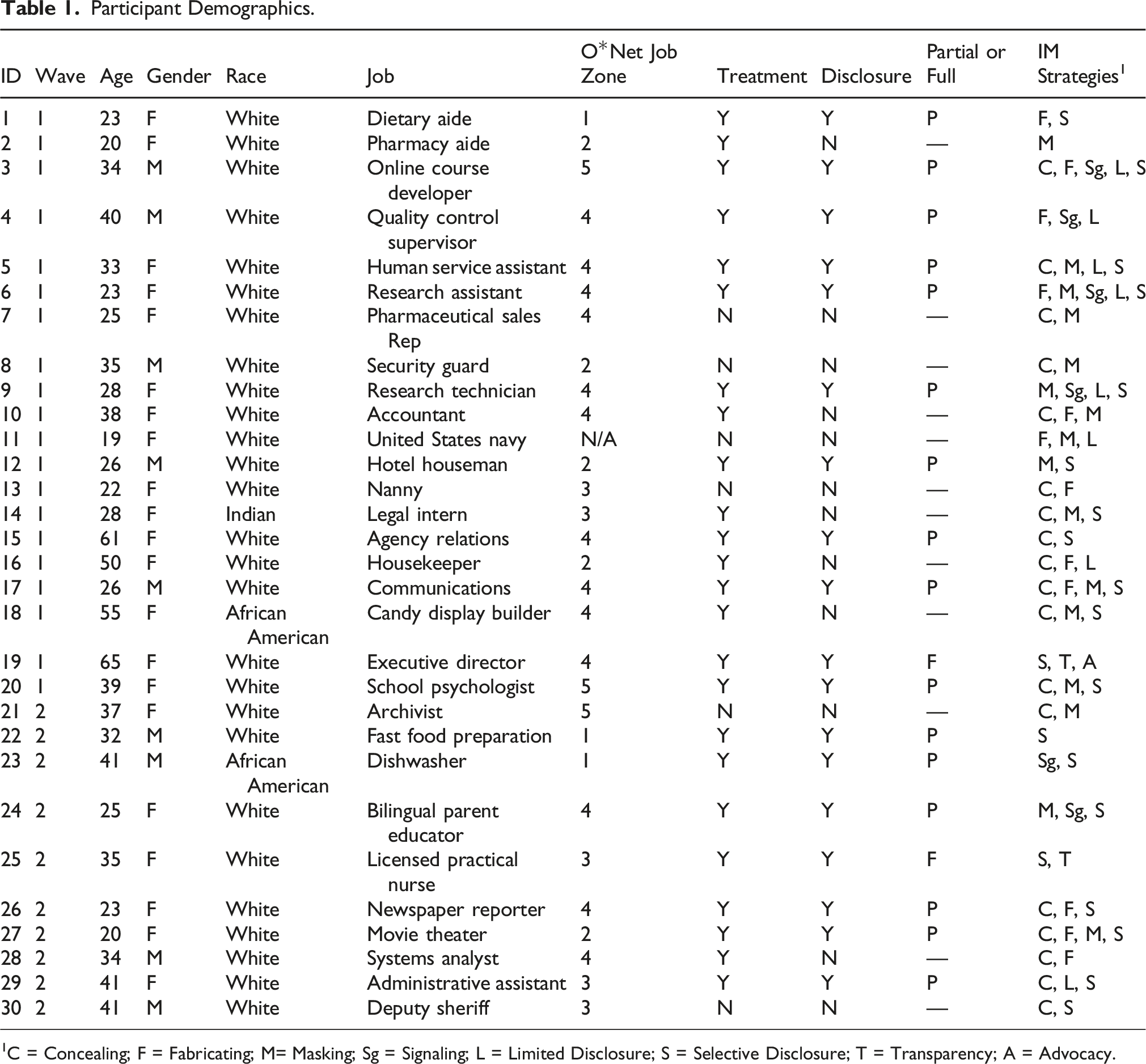
1C = Concealing; F = Fabricating; M= Masking; Sg = Signaling; L = Limited Disclosure; S = Selective Disclosure; T = Transparency; A = Advocacy.
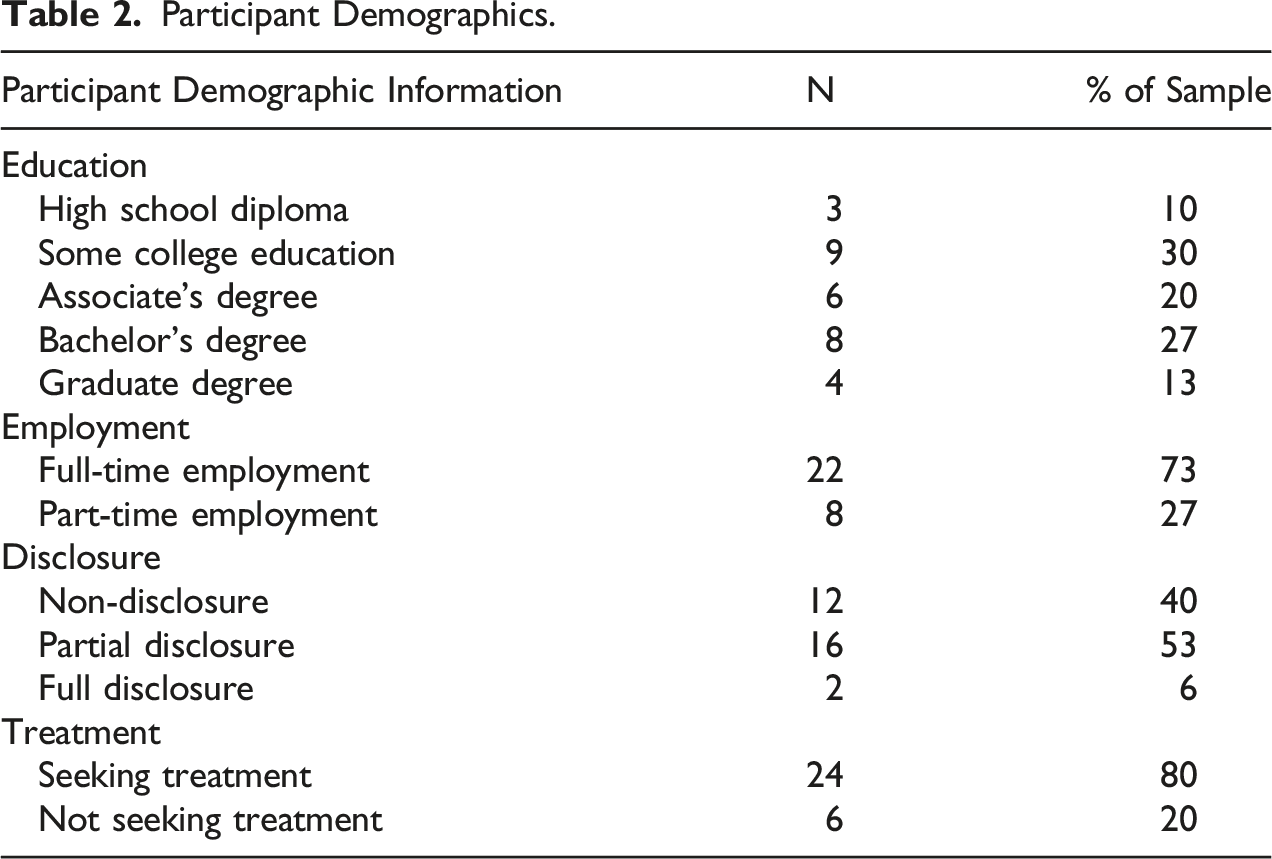
Participant Demographics.
Procedure
Individuals who were interested in participating in the study were instructed to contact the first author via email. Upon contacting the researcher, individuals completed an online survey that assessed their qualifications according to the inclusion criteria. The introductory survey also asked participants about their current employment situation, including hours worked each week, industry, and job. Participants were then selected for the study based on their demographics, job status, and occupation, thereby enacting theoretical sampling techniques. According to Corbin and Strauss (2008), theoretical sampling allows researchers to “follow the analytic trail” (p. 7) and to strategically identify participants who can contribute to the concepts of interest. All of the interviews for this study were completed over the phone and lasted approximately one hour. Phone interviews have been shown to be effective means for collecting qualitative data (Sturges & Hanrahan, 2004) and are especially useful when conducting research on sensitive topics as they maintain participants’ anonymity and allow them to complete the study in a comfortable, safe environment (Trier-Bieniek, 2012). Each interview was audio recorded for later transcription, coding, and analysis.
Participants first gave verbal consent to participate in the study and then were asked a series of questions as outlined in the interview protocol. The researchers followed a semi-structured interview protocol, which provided a systematic procedure for data collection, yet allowed the researcher to follow up on participants’ responses for clarity or elaboration purposes. At times, this involved asking participants to give more details regarding their experiences or to elaborate upon their initial responses, especially when questions were initially answered with only one word or shortened phrases. The semi-structured interview was organized into four broad sections: (1) general background information (e.g., age, education level, and employment information), (2) general experiences with depression (e.g., age diagnosed and treatment experiences), (3) disclosure decisions (e.g., did the participant disclose and to whom they disclosed), and (4) IM strategies (e.g., did the participant hide their depression at work; did the participant present themself authentically at work). After completing the phone interviews, participants were thanked for their participation and compensated with a $25 gift card to a major national retailer.
The intensive interviews were conducted in two waves across a period of 12 months, with iterative changes incorporated into the interview protocol across waves. Phase 1 interviews included participants 1 through 10, and Phase 2 interviews included participants 11 through 30. All of the identified major themes emerged after the first 25 interviews were completed. After conducting an additional five interviews and failing to generate to new codes, the data collection process was concluded.
Data Analysis
Each interview was recorded and transcribed prior to data analysis which resulted in 595 pages of total text. The interviews were transcribed by a team of undergraduate research assistants. After each interview transcription was complete, a second undergraduate research assistant was assigned to read through the transcription for accuracy to ensure that the participants' words were correctly represented. Coding and data analysis were completed using the Dedoose (Version 7.5) software and began as soon as the first interview was transcribed (Glaser & Strauss, 1967).
Our approach to data analysis was based on the tradition of inductive thematic analysis (Braun & Clarke, 2006) which involves “identifying, analyzing, and reporting patterns within data” (p. 6). Inductive thematic analysis shares similarity to grounded theory and has emerged as a prominent method for analyzing qualitative data, especially in the field of applied psychology and organizational studies (Braun & Clarke, 2006; Clair et al., 2016; Johnson & Joshi, 2016). The outcome of inductive analysis is to derive categories from the data and to arrange these categories into a framework that “summarizes the raw data and conveys key themes and processes” (Thomas, 2006, p. 240).
The inductive thematic analysis process unfolded across five stages. Stage 1 involved becoming familiar with the data, which was achieved by reading and rereading the interview transcripts. At this early stage, the first author made notes regarding important ideas and experiences that stood out, but did not begin formal coding. In Stage 2, initial codes were generated using microanalysis, a method whereby data is subjected to line-by-line coding (Corbin & Strauss, 2008). This step is similar to first cycle coding (Miles, Huberman, & Saldaña, 2020) or open coding (Charmaz, 2006) processes, in which relevant data are “tagged” with short words or phrases (Terry, Hayfield, Clarke, & Braun, 2017). Importantly, these codes are meant to be reflective of the actual data (e.g., representative of the participants’ actual words) and should not invoke preexisting or a priori concepts. For example, the codes of “calling in sick” and “make something up” emerged early in the coding among participants who had not disclosed their depression at work. As each code was derived, it was entered into a coding dictionary—a master list of all codes identified from the coding procedure. At this stage, the first two interviews and the coding dictionary were independently reviewed and coded by both authors. This allowed the researchers to examine possible differences in interpretations as well as identify missed codes. Any discrepancies in coding were discussed between the two researchers and the transcripts were reread until agreement regarding the codes was reached. The resulting coding dictionary was then used to analyze the remaining eight interviews from Phase 1. After the first 10 interviews were coded, the authors made minor revisions to the interview protocol to expand the line of questioning surrounding certain disclosure experiences and to remove questions that were no longer yielding unique insights (e.g., asking about the impact of depression on one’s personal life). The revised protocol was used to conduct interviews with participants 11 through 30. Phase 2 interviews were coded using the coding dictionary derived from Phase 1, and new codes were added to the coding dictionary as they were uncovered in the data.
Stage 3 involved searching for themes across the coded data. This step is similar to second cycle coding, focused coding, or axial coding (Miles et al., 2020) in which initial codes are clustered together into second-order themes. In essence, multiple codes are combined to form overarching themes, and the researcher begins to analyze the relationship between codes and themes (Braun & Clarke, 2006). For example, the second-order theme of “false information” emerged to encompass participants’ experiences of having to lie to cover up their depression (such as when calling in sick or making up excuses for doctor’s appointments). In Stage 4, all of the codes within a theme are reviewed to ensure that the codes are conceptually similar, and the themes themselves are compared to ensure that they are conceptually distinct. Lastly, Stage 5 involved naming and defining the themes. Here, the researchers organized the themes and subthemes hierarchically to help provide meaning to the data. Specifically, the authors identified three broad disclosure decisions and situated specific IM strategies within each of these decisions. In this final stage, relevant literatures were used to help further inform the data and associated themes, aligning with recommendations to conduct the literature review after first completing an independent analysis of the data (Braun & Clarke, 2006). Specifically, reviewing existing research related to IM (Chaudoir & Fisher, 2010; Clair et al., 2005; Jones & King, 2014; Ragins, 2008) aided in the naming of themes and the refining of the findings. In this final stage, the authors compared the themes derived from the data with existing IM strategies to help determine the extent to which the resultant themes aligned with prior conceptual frameworks. As a result, some of the themes share names with IM strategies that have been recognized in prior work. For example, the second-order code “false information” was conceptually similar to the “fabrication” strategy first identified in the framework by Clair et al. (2005). Thus, we used “fabrication” as the overarching strategy name in our final results.
Results
Support for Disclosure Continuum
In this study, we sought to better understand employees' workplace disclosure decisions, including the strategies utilized to enact these decisions. The results revealed that 13 participants had not disclosed to anyone at work, 15 participants disclosed some information or to only certain individuals at work (i.e., partial disclosure), and two participants indicated full disclosure of their depression at work (see Table 1). Importantly, participants demonstrated variability in the ways in which they enacted their disclosure decisions. That is, they used distinct strategies to help support their non-disclosure, partial disclosure, and full disclosure decisions. Table 1 includes a breakdown of what strategies were enacted by participants in their past and current jobs.
Specific IM Strategies
Eight distinct IM strategies emerged from our analysis of the data, and these strategies were linked to specific disclosure decisions. Figure 1 situates the IM strategies within the disclosure decision continuum (Ragins, 2008), thereby mapping the strategies onto specific disclosure decisions. The strategies were differentiated based on who the participant told (i.e., no one, some people, or everyone); what was told (i.e., some information or all information), and the accuracy of the information told (i.e., accurate or inaccurate). Importantly, participants often engaged in more than one strategy and at times, described strategies from both prior and current jobs.
1
In the sections that follow, each IM strategy is described and illustrated with direct quotes from the interviews. Disclosure continuum and identity management strategies.
Non-disclosure
Nearly half of the participants (N = 12) reported engaging in non-disclosure strategies. Although all of these participants chose not to disclose their identities to others in the workplace, non-disclosure emerged in three distinct ways: concealment, fabrication, and masking.
Concealing
The concealing strategy occurred when employees hid their depression from others while at work. This strategy involved hiding both information and behaviors from their coworkers and supervisors so that others did not know they had depression. When individuals concealed information, they failed to acknowledge or discuss their disorder with coworkers or supervisors and avoided conversations related to mental health. This allowed them to keep their diagnosis to themselves. As stated by one female participant employed as an accountant, “I don’t talk about it even with my friends – my closest friends outside of work, so I definitely wouldn’t talk about it with anybody at work” (Informant 10). Put differently, one informant said, “You don’t get support, you don’t tell anybody. Nobody knows” (Informant 18). Another individual indicated that she skirted the topic of mental health, saying, “I’ve avoided conversations about mental health in the workplace with coworkers and supervisors” (Informant 14). For some individuals, concealing depression was akin to keeping a secret: “I almost feel like I have a secret that nobody else knows about because it’s not like I go around talking about it” (Informant 29).
Concealment also occurred through covering up behaviors related to one’s depression and symptomatology. Specifically, this strategy involved hiding behavioral manifestations of their depression, such as bouts of crying or agitation. These employees were able to hide their depression by removing themselves from a situation or limiting contact with others at work. For example, one participant explained, “It’s really difficult. You know, when you have depression at work your thoughts aren’t clear. Your mind’s not clear ... there’s moments of crying and you’re trying to hide from people when you’re crying... So it can be very difficult” (Informant 16). One informant who worked as a school psychologist said, “I’ve had like…actual like crying bouts…which I don’t have much anymore, but I have and then yes, I would go into my office or you know, not be around people” (Informant 20). A male participant employed as a systems analyst said he was able to hide his depression “through seclusion” because “I have to watch myself because I will become more agitated, um, a lot easier… so I try on a daily basis to reduce contact [with others]” (Informant 28).
Importantly, when participants engaged in concealment, they expressed the belief that others at work did not know about their depression. One male participant employed as a deputy sheriff said, “When I’m at work, I can usually hide or cover up any depression symptoms, um, I think pretty decently; I don’t know if anybody would suspect that I have an issue” (Informant 30). Another participant, employed as a nanny, shared a similar experience by explaining that her clients were unaware of her depression: “It’s [depression] not something I would ever tell anyone… because people want whoever is taking care of their child to be like a very emotionally stable person … and if people thought you dealt with depression, they wouldn’t want you to be the person that’s making all these decisions in their children’s lives… So my clients see me as someone who is stable and as someone who can handle myself … they don’t see the depression (Informant 13).
Fabrication
Through the fabrication strategy, individuals went beyond withholding information about their depression by providing false information to others as a means to cover it up at work. When describing the use of this strategy, participants cited a need to explain behaviors that resulted from their depression, such as missing work or appearing despondent. Rather than disclosing their depression as the reason for the behavior, they instead chose to give veiled, vague explanations. In the case of a graduate student who needed to take a leave of absence to manage her depression, she explained her absence by telling others, “I got really sick and wasn’t able to work” (Informant 6). For another employee, it was necessary to take breaks at work to help manage the emotions of his depression and anxiety. When using the designated break space, he would tell others “Hey, I’m not feeling well” (Informant 4) rather than attributing his behavior specifically to depression. Another employee said this strategy worked because others did not question her absence when it was medical in nature: “If I … lie and say ‘oh I’ve been throwing up all night,’ they don’t question [my absence]. But in reality, it’s because I just can’t handle, I can’t handle today” (Informant 10).
In some instances, participants explained away their behavior or need to leave work for treatment (e.g., psychiatrist appointments) by giving excuses for conditions that were less stigmatizing than depression (e.g., migraines and carpal tunnel). For one woman employed as a dietary aide, it was necessary to miss work on several occasions to go to doctor’s appointments. Through fabrication, she was able to deflect questions about her need for time off. As she explained, “I would say you know ‘Well I have an appointment I have to go to’ and they’d be like ‘Well, [who] do you have to see?’ and I’d be like ‘Oh, well, you know I have migraines and they go do studies on my head’” (Informant 1). Another participant explained that when depression affected her work performance and others commented about it, she would respond, “I’m having a bad day” (Informant 27) instead of revealing her disorder.
Using false information to cover up one’s depression can add up over time, which became problematic for some employees. In one instance, an informant shared how she frequently called off work by saying she was sick which became harder to explain as the absences accrued. “I’ll be calling in like once a week and all of a sudden like people start to get angry and they’re expecting all of these doctors notes and everything, like, when I realize that that’s happened, like it becomes too much pressure for me to try and like to come a reasonable solution and just seems a lot easier to just, like, quit and I’ll quit in like really weird … like one time I quit a job and I like told them that my aunt died and I told them that I had to not work anymore because I had to go help out with like taking care of her kids and that was when I was working in a restaurant. But it was just kind of like random kind of things that are just kind of lies that I make up to make the situation seem a lot easier” (Informant 13).
Masking
The final way participants enacted their non-disclosure decisions was through masking—a strategy whereby participants changed their workplace personas as a way to cover up their depression. These participants often described “putting on a mask” so that their depression was not visible to others with whom they worked. For example, one participant stated, “I basically put on a mask and didn’t want anybody to know exactly what was going on and how I was feeling” (Informant 8).
Many individuals who decided not to disclose their depression at work recounted the need to make an outward display of happiness or normalcy, even when such behaviors were incongruent with their internal emotion state. One participant described this behavior as "being on autopilot" (Informant 18). The masking strategy allowed individuals to display emotions and behaviors they believed were expected of them. “It’s almost like I’m making an effort to present who I was, rather than present someone totally different. It’s, you know, working to hide who I feel like I am now by presenting who everybody thought I was before. It’s just as fake, it’s just a fake person that everybody knew (Informant 10).
The masking of depression was physically and emotionally exhausting for employees and was frequently cited as challenging to execute. In the case of one pharmaceutical sales representative, masking enabled her to get through work-related sales calls: “you know you just kind of suck it up and smile” but afterward “you get out in the car and you just shut down again” (Informant 7). For another female informant employed as a pharmacy aide, masking allowed her to manage her depression at work but resulted in poor emotional outcomes: “I kinda really bottle things up, like, pretty much everything, and keep, like a very easy-going, calm exterior and then sometimes it just becomes too much and I have episodes, I guess you would say, where things just get to be way too much for me and I just can’t handle all the feelings anymore so I like, I think if I were to able to like express the feelings a little bit more, I wouldn’t, you know, after, be as – have as much drastic as a release then I guess. Um, in general I would say bottling things up works pretty well, just to be able to keep that exterior as happy and everything together” (Informant 2)
This strategy proved particularly difficult for employees because they were often attempting to cover clinical levels of negative emotions and emotional pain. As described by one human services assistant, “When I’m at work, I kick everything to the curb, put it to the back of my mind, and not deal with my things at work, um I don’t want to bring up things at work or emotions, so I just put on a happy face like my mom always told me to, and I forget it ever happened, I forget I have feelings; I will just make jokes and I will just smile, even though I’m hurting inside and feel like part of me is dying” (Informant 5).
For the pharmacy aide who frequently worked face-to-face with customers, “you just have to fake it till you make it. Smile, even though you have no reason to smile, and even though inside you feel empty” (Informant 2).
Over time, putting on a mask became almost automatic for employees. One female informant who worked in agency relations put it this way, “You get to a point, I think, with depression when you’re trying very hard to maintain your presence, your...your work persona and how people view you. I think you become a really good actor. And it’s what you have to do to survive, and as long as you can do that, you usually get through it, somehow or another” (Informant 15).
Similarly, another employee said of masking her depression at work, “it’s just a way of life now” (Informant 5), indicating that over time putting on a façade became a habitual way of managing one’s depression.
Concealing despite consequences
One interesting phenomenon that emerged from the interview data was that of individuals continuing to engage in non-disclosure IM strategies even when it may have benefited them to do otherwise. At times, individuals shared they had faced punishment or negative judgments at work due to performance decrements related to their depression. These individuals described instances of being questioned about or reprimanded for their poor work performance; yet, even in these instances, they chose not to disclose their depression to coworkers or supervisors. Rather than using depression to explain their absences or reduced work output, these individuals were willing to experience consequences at work.
Reasons for the continued non-disclosure included a fear of the stigma associated with depression. One informant employed as a sheriff’s deputy said he did not disclose even when his attendance became a problem because “I know there’s a shift happening – but, you know, depression and things like that have a certain stigma to them … like a weakness” (Informant 30).
Another employee perceived his poor performance to be of his own personal responsibility. When asked why he continued to hide his depression despite negative consequences, he said, “I might have done myself a disadvantage. However, I am not a supporter of excuses. You know, it’s my choice… maybe if I was on medications again it wouldn’t have happened. Maybe if I saw a psychiatrist or psychologist more often, maybe it wouldn’t have happened. There’s so many variables in that … and all of them essentially come down to my choice” (Informant 28)
Participants managed others’ questions or concerns by agreeing to work harder or improve their future performance. For example, one participant responded to her boss's concern about her work behaviors in this way, “I just accepted my responsibility and buckled down and worked harder” (Informant 14), while another told others she would “do better” when questioned about changes in her performance (Informant 27). When depression manifested visibly such that others became attuned to changes in the employees' behaviors or performance, these individuals expressed feelings of vulnerability and fear of being found out. One participant recounted being approached by her manager regarding her failure to meet her sales goals, which prompted her to work harder in order to continue to conceal her depression. She said, “It is kind of embarrassing, too, because when someone catches on like that you’re like ‘Oh, I gotta be more careful. I’ve gotta stay safe. I’ve gotta make up for this’” (Informant 7).
Partial disclosure
Employees who engaged in partial disclosure were neither fully concealed nor fully open about their depression. In our sample, more than half of the participants (N = 16) described using partial disclosure strategies. These individuals selectively revealed some information about their depression or disclosed only to some individuals. These employees straddled non-disclosure and disclosure decisions by enacting disclosure at times while enacting non-disclosure at other times. Partial disclosure was represented through three distinct strategies: signaling, limited disclosure, and selective disclosure. The signaling (Clair et al., 2005; Jones & King, 2014) and selective disclosure (Ilic et al., 2012) strategies aligned with prior findings, while limited disclosure is unique to this study.
Signaling
Signaling occurred as a way for employees to allude to or hint at their depression without actually disclosing their diagnosis. Our analysis revealed that individuals engaged in two types of signaling: passive and active.
Passive signaling occurred when the symptoms and behavioral manifestations of their depression were visible to others at work, and these manifestations were outside the explicit control of the employee. In other words, for some participants, passive signaling occurred involuntarily when they were unable to hide their depressive symptoms. According to one participant employed as a research technician, she had not disclosed her depression but believed her boss knew about it anyway because “I cried in front of her” (Informant 9). One male informant who was employed as a dishwasher did not explicitly tell his boss about his depression but he assumed his behavior was noticeable to others. As he stated, “I’m sure that now being around me or from, you know, this amount of time, that they probably know. Like, ‘Okay, maybe he’s not a happy camper’ you know? They probably know” (Informant 23). Through passive signaling, employees believed others could infer they were suffering from depression based on their behaviors at work. One male participant employed as a quality control supervisor described how he would go to work in the middle of the night and sometimes left work in the middle of the day due to symptoms of his depression and that it was possible his coworkers had noticed these behaviors. “At times, I feel like the behavior I emit is odd and that people – not everyone, but some people – are in-tune enough to pick up on things. Some people are like, perceptive to changes in behavior” (Informant 4). In these examples, employees were not volitionally trying to signal their depression diagnosis to others, yet they were unable to hide some of their symptoms, which led them to believe others already knew about their depression. Because participants did not actively change their outward dispositions or behaviors to cover up their diagnosis, they believed it was noticeable to other people if they were adequately attentive and informed enough to look for it.
At other times, employees engaged in active signaling in which they dropped hints about their depression by alluding to personal challenges or difficulties without actually disclosing their depression diagnosis. Again, these individuals assumed others knew about their depression diagnosis even though they had not formally disclosed. For instance, signaling could occur by mentioning other negative life events as in the case of an online course developer, who stated, “my supervisor knows about my divorce, and she probably, you know… I’ve never explicitly said, you know…what’s going on. I’ve never said, like, you know, ‘I have depression and anxiety’ – I think I’ve mentioned therapy, like at the beginning” (Informant 3). In another instance, an employee indicated that her coworkers “probably could have figured it out because they’re kind of my sounding board for when I have negative thoughts or feelings” (Informant 24), in which case talking about negative thoughts became a proxy for disclosing depression.
In other cases, employees signaled that they were having a difficult time without attributing those troubles directly to depression. As explained by a graduate research assistant, “I mostly just revealed it to my advisor. I didn’t come out and say it explicitly, but I was just sharing kind of what I was going through and she kind of caught on with what I was saying” (Informant 6).
Limited disclosure
With the limited disclosure strategy, participants told others at work about some aspects of their depression but did not disclose full information. This strategy concerns the amount of information that individuals chose to share regarding their depression. Individuals often shared enough information with others to explain their circumstances or behaviors, but did not divulge full details. This allowed individuals to disclose their depression diagnosis without needing to share details regarding the severity or longevity of their depression. Importantly, with this strategy, participants’ disclosure included information specific to mental health or mental illness; however, individuals were able to control the amount of information shared. Often times, participants would disclose a diagnosis or struggles with mental illness but were able to leave out some details of that diagnosis such as taking medication or past hospitalizations.
In recounting experiences of limited disclosure, informants described sharing information about their mental health struggles by softening the language they used in their disclosures. For instance, a naval employee said she was more comfortable sharing having anxiety, rather than the extent of her underlying depressive condition: “I’ve been a lot more forthcoming with being like, ‘I really struggle with anxiety sometimes’ or, like, social anxiety… I think that’s easier for some people to relate to” (Informant 11). When a graduate research assistant needed to take a leave of absence, she had to request it from her department chair. Referring to her disclosure experience, “I said I had some emotional, mental health concerns. I didn’t go into much specifics” (Informant 6). These disclosures allowed participants to indicate they were having mental health–related challenges but did not involve providing detailed information about their diagnoses. By controlling the amount of information shared, individuals were able to disclose enough to help them explain their behaviors without having to provide details with which they were uncomfortable telling others.
Limited disclosure also allowed participants to downplay the severity of one’s depression. In the case of a research technician, she disclosed her depression to her boss; however, in the words of the participant, “as far as she knows it’s just post-partum depression” (Informant 9). In this way, the participant’s boss knew she was depressed but did not know the extent to which she had been experiencing depression. The participant explained that her boss “was thinking that I was just starting treatment – like I was going to the psychiatrist, not as a checkup, but as like the first time for treating the post-partum depression.”
Through the limited disclosure strategy, employees could share some of their experiences with others while also keeping the more sensitive details hidden. For example, one administrative assistant described her disclosure experience as brief and said of the disclosure, “It didn’t really go into, like, a long conversation.” Her own disclosure came from sharing information about her children’s mental health diagnoses with a coworker in which case she “just sort of mentioned that I, you know, suffered from it as well… And I don’t remember if I told her I took medication for it” (Informant 29). Using the limited disclosure strategy, employees could disclose a diagnosis of depression without being fully open about the severity of their depression or the symptoms associated with their diagnosis. These disclosures enabled others to know that the employee had a mental illness diagnosis but did not involve transparent discussion of the full experiences surrounding the diagnosis.
Again, stigma arose as a reason for only disclosing limited information about one’s depression. One employee had both depression and a substance abuse problem which contributed to performance problems in the workplace. Although the employee did disclose both disorders to his employer, he stated that he chose to focus more on the substance abuse disorder as he felt it was less stigmatizing than depression. “I honestly focus more on the alcoholism part, because I feel like...I don’t know why, but personally I feel like there’s less of a stigma for being an alcoholic and trying to seek help, because everyone, I feel like, knows somebody who has an alcohol problem. But I feel like there’s such stigma associated with depression that people aren’t as open talking about it, and because of that, there’s more – I feel like it’s hard to bring up, and...I mean, I disclosed both, but I kind of downplayed the depression a bit more” ( Informant 17)
Taken together, when using the limited disclosure strategy, participants chose to disclose some information to others at work but they limited disclosure to information that was easy to understand or perceived as socially acceptable. In this way, the participant was able to be out about their depression without having to share all of the details surrounding their diagnosis or experiences.
Selective disclosure
The selective disclosure strategy occurred when individuals told only certain individuals at work about their depression. At times, participants would disclose to a coworker, a supervisor, or human resources, but would not do so with everyone in the workplace. In essence, individuals were able to manage their identities by being open about their depression with specifically chosen colleagues.
Employees often chose to selectively disclose after they had established a relationship with others at work. For example, a hotel houseman reported disclosing to several of his coworkers because “I know them from working with them for a while, I’ve gotten to trust them” (Informant 12). When asked why she chose to disclose to only one of her colleagues, another informant said, “I am not as close to the other three people and their jobs are a lot different than mine, although, you know, we’re in the same office. Um, I don’t have the relationship with them that I have with her” (Informant 29). Another participant explained that she took a year to tell her coworker about her depression because “over time, her and I got to know each other … and I wanted somebody who is in my normal life that I see regularly to know and somebody that I’m already close with so just to, like, have that support there” (Informant 26).
Individuals who selectively disclosed as a way to gain social support generally disclosed only to other coworkers and not to their supervisors. When asked whether he had disclosed, one participant said, “Not [to] my employer, not my boss or anything. But, uh, I shared it with one of the cooks back there, cos’ he … struggle[d] with depression too” (Informant 23). The separation between telling a coworker and telling a supervisor emerged from several participants’ experiences. One legal intern said, "[I disclosed] because another coworker disclosed to me that she was bipolar, and I felt an affinity with her because she disclosed, so I disclosed too… But I would definitely never, ever tell a work supervisor" (Informant 14). As a possible explanation for selectively disclosing only to coworkers, the hotel houseman said, “My supervisors are not bad people, once again. But … well, basically there’s a hierarchical degree of separation between my supervisors and myself” (Informant 12).
However, disclosure to a supervisor was not unheard of, as explained by one participant who said he disclosed, “to my supervisor and the general manager for the company… I had missed work, and I had to explain. I mean, I wouldn’t have chosen to disclose that, but I had to explain myself and why I missed work” (Informant 17). Generally, individuals reported disclosing to a supervisor when needing to explain their behavior or making a request that required supervisor approval (such as asking for time off from work). One employee tried to call off sick from work and was told by his supervisor that he was going to need a note to excuse the absence. As a result, the employee ended up disclosing only to the supervisor, who was then able to help the employee seek assistance for his depression. “I called him back, and I ended up starting to cry on the phone with him. So he kicked everybody out of his office, he talked to me for a while, he said ‘I’m gonna get you in contact with our peer support’… Um, and what I did was I just took a week of vacation. Um, so nobody at work knew, other than my supervisor” (Informant 30).
In another scenario, an employee needed to be hospitalized to manage her depression, which required taking time off from work. As a result, she chose to tell only her manager about her depression. “I was gone for a week and my bosses were perfectly okay with it, and they didn’t tell any of my coworkers. So, whenever I came home, they had no idea, they just thought I was away on a family emergency for a week” (Informant 1).
Taken together, the selective disclosure IM strategy allowed participants to disclose their depression to a subset of specific individuals. Our analyses demonstrated that these individuals disclosed to different individuals for different reasons, generally as a way to seek either social support or to minimize workplace consequences associated with their behavior.
Simultaneous use of non-disclosure and partial disclosure IM strategies
Informants who partially disclosed faced a predicament not encountered by non-disclosers or full disclosers: they utilized signaling, limited, or selective disclosure strategies with some individuals at work, but continued to use non-disclosure strategies when interacting with other individuals. While these individuals had disclosed some information or to some individuals, they still felt the need, at times, to utilize concealment strategies in certain circumstances. As a result, these employees experienced precarious work situations where they were neither fully concealed nor fully revealed.
For instance, upon her return from a leave of absence, one graduate student described how she used distinct strategies for managing others’ questions about her absence. At times, she engaged in non-disclosure with some of her peers. “I was very paranoid and worried that they’d be asking me about things. Um, for the most part it was mostly ‘oh, we’re glad you’re back,’ which was very helpful and appreciated rather than being like ‘oh, what was wrong with you, why were you gone?’ And most of the time, depending on how close I am, I will just say ‘I was really sick, I got really sick and wasn’t able to work’ and I don’t go into too much detail” (Informant 6)
Yet, with other peers, she engaged in selective disclosure, telling them more details about her depression and situation. She stated, “But, if I’m close and I feel more comfortable with the person and we’ve had a little more time, then I go into a little more depth. Um, I usually share a little bit about what else was going on around that led to that situation” (Informant 6). Another employee worked at a movie theater and chose to disclose to two of her coworkers. Yet, on a day-to-day basis, she still engaged in the masking strategy: “you just go in and … put on a show, like everything’s great” (Informant 27). A similar experience was shared by a research technician who had engaged in signaling and limited disclosure behaviors. Although she was partially “out” at work, she still engaged in non-disclosure strategies when interacting with others at work. As she described, “If I have to talk to people, you know, especially for recruitment I just, I flip that switch and I become the fake me… who’s cheery and confident and stuff like that… You know, smiling definitely helps. Like, smiling helps me get into that mindset. Um, maybe kind of thinking about how they perceive me and imagine that they perceive me like a happy, normal person. And then I can act like that” (Informant 9).
In summary, partial disclosure did not mean someone was “out” at work regarding their depression. Rather, employees revealed only limited information or told only select individuals about their depression which meant that at other times they still felt the need to conceal their depression in the workplace. This tendency to go back and forth between disclosure strategies (from partial to non-disclosure) was unique to the individuals in the partial disclosure group.
Full disclosure
The third type of disclosure decision was full disclosure, which involved telling multiple individuals at work about one's depression. While it is not feasible to tell every single person about one's depression, both of our respondents who engaged in full disclosure were comfortable disclosing if the situation arose, consistent with Ragins’ (2008) conceptualization. Full disclosure was the least frequently cited disclosure decision within our sample (N = 2). However, among the two participants who described being open about their depression at work, two unique strategies emerged: transparency and advocacy. Although full disclosure has been cited in existing models of disclosure, specific strategies related to full disclosure have not been identified.
Transparency
The transparency strategy emerged from participants' discussion of telling anyone they worked with about their depression. One of the participants who used the transparency strategy said she disclosed to “everybody that asks, or that’s interested. Coworkers, providers, anybody. Everybody knows it” (Informant 25). Here, the participant did not try to force her disclosure onto others, but when asked or when the topic emerged in conversations at work, she was willing to share her own experiences with others. The second participant who utilized the transparency strategy worked for a mental health advocacy group said the following of her disclosure experiences: “I don’t have to [conceal my depression] here. We all have a diagnosis of one thing or another. We’re a consumer run organization. So, that means that you have a diagnosis, you come to work here or you can have a family member, but everyone here now has a diagnosis” (Informant 19).
Advocacy
Both respondents who engaged in full disclosure went beyond simply telling others about their depression—these individuals also engaged in advocacy by helping to educate others about depression. With the advocacy strategy, the goal was to improve the experiences of others who experienced mental illness or depression. This strategy involved more than a willingness to talk about one's experiences—it emphasized education and social change for a greater good. In her role as executive director, one participant said, “I’m a person with depression and I kind of use that when I do speaking engagements … because it can help to stop stigma…” (Informant 19). Another participant used her role as a nurse to help educate patients about the prevalence of depression, saying, “I don’t want anybody to feel the way I felt when I was depressed, and that’s why I talk about it and I want to educate more people” (Participant 25).
Fluidity of Disclosure Decisions and IM Strategies
A key finding from the analysis of the interviews was the fluidity of disclosure decisions and IM strategies both within and across jobs and as a function of the severity of employees’ depression symptomatology.
Fluctuating disclosure decisions
What emerged first was the phenomenon of individuals making different disclosure decisions and utilizing different IM strategies across job contexts. Often informants described disclosure decisions in prior jobs that did not align with their current disclosure decisions. For example, one legal intern reported that she had selectively disclosed to a coworker in a prior position, but in her current job she did not disclose. When asked if she planned on telling her coworkers, she said, “I don’t really feel the need to” (Informant 14).
The informant who worked as sheriff’s deputy had disclosed to his previous boss over the phone, which enabled him to enter a peer support program. However, in his new job, he decided not to disclose his depression. When asked about why he chose non-disclosure, the participant explained that stigma kept him from sharing: “I think it’s still cos’ there’s that stigma attached to it… everybody has – seems to have – the tendency to do the worst case scenario if they find out something, you know, your, ‘dirty little secret’” (Informant 30).
For some individuals, prior negative experiences with disclosure influenced their subsequent disclosure decisions. The participant employed as a candy display builder had previously worked in a hospital where she disclosed to her supervisor and to human resources. When asked to describe her disclosure experience, she said, “I didn’t even think to ask for accommodations at the hospital, you know, ironically that is the place where I did disclose and that, um, supposedly had a policy in place and it was completely the opposite. I mean, it was really, um…it was very eye-opening. Really, really very eye opening. I mean they appear to be very accepting, but um, they really weren’t” (Informant 18).
In her current job, this participant did not disclose and when asked why she decided not to disclose, she explained, “I wanted to keep that personal, first of all. You know it’s not….and, um, and I don’t see a purpose to it…and there’s still, there’s a lot of stigma attached to mental illness, there just is. But, I don’t feel close to anyone, close enough to really talk about anything that personal, mainly I guess” (Informant 18).
These experiences illustrated that individuals may not have a default disclosure plan and that decisions to disclose varied across job contexts.
Fluctuating IM strategies
In addition to enacting different decisions across jobs, participants also explained that their strategies varied within their current jobs. This generally occurred when individuals initially disclosed to someone at work but then decided to pursue non-disclosure strategies afterward. In the case of an employee working at a fast food restaurant, he explained, “[I told] maybe a couple, maybe like 3 or 4 people. I don’t talk about it with anyone. I don’t think it’s good practice for me to mention that anymore. So maybe, like, the first year I was there I told a couple people. Since then I haven’t told anyone” (Informant 22).
Another employee shared that she had disclosed selectively to close coworkers and to her supervisor. When describing her experience of disclosing to her supervisor, she said she did not receive a positive response: “He just looked at me. With this look like, that was supposed to be understanding. But it wasn’t... he’s someone who I don’t think has time for weakness.” This disclosure occurred approximately 10 years prior but when asked if she continued to talk about her depression with her supervisor, she said, “We have not talked about it, per se… And if I had it to do over again, probably I would not have disclosed” (Informant 15). Thus, even though the employee originally disclosed to her supervisor, she later reverted back to concealment strategies.
Although there were few individuals who fully disclosed at work in our sample, one licensed practical nurse indicated that her disclosure experience actually shifted from partial to full disclosure. She started with selective disclosure to a coworker because “she reminded me of myself and I talked to her about how I felt and how I am now feeling.” This participant has since made the decision to fully disclose, perhaps, in part, due to her coworker’s positive response to her disclosure: “We talked about it and I think it was a good experience for me cos’ she didn’t judge me in any way. Um, that’s the way I feel. And she validated my feelings and maybe that’s another reason why I talk about it, because I haven’t had any – nobody has ever told me that depression is something bad and that it’s a made-up disease” (Informant 25).
Changes in IM strategies also occurred based on the severity of employees’ depressive symptomatology. Specifically, among informants who had not disclosed their depression, the extent to which they engaged in non-disclosure IM strategies depended on fluctuations in their symptoms. For example, the pharmaceutical sales representative described variations in the efforts made to mask her depression: “It would depend on how I would be feeling that day. Like I said, you know, the highs and lows, it comes and goes. It would depend, like um, if it were a specifically rough day, then it is like okay, I really gotta work to push this deep inside. Other times it’s like ‘you know, it’s not so bad, I can do this’. So it kind of fluctuates” (Informant 7).
When symptom severity was heightened, employees described increased efforts needed to conceal. For example, a newspaper reporter said, “I think kind of in the beginning I did [hide it], but I would say not as much [now]. It was much worse than it is at this present moment” (Informant 26). A similar experience was reported by an archivist who explained that in the past summer “I had a pretty serious go of things. Um, with you know, feeling down about everything,” and when asked if she had to hide her depression at work, she said, “I did this summer” (Informant 21).
Taken together, participants’ experiences revealed that disclosure decisions are not a “one and done” event. Rather, employees make disclosure decisions that vary across job contexts as well as shift over time within their current workplaces. Importantly, the IM strategies employees used to enact their disclosure decisions also shifted over time, particularly as they experienced changes in the severity of their depressive symptomatology. Thus, employees not only are faced with repeated disclosure decisions but they also continually engage in and alter the strategies used to enact those decisions.
Discussion
Theoretical Contributions
Using in-depth interviews, this study aimed to empirically investigate the disclosure decisions and IM strategies used by employees with concealable identities. We examined our research questions using a sample of employees diagnosed with depression. The results yielded important theoretical insights regarding concealable IM within a workplace context.
Our analyses resulted in the integration of existing concealable IM frameworks by mapping specific IM strategies (Clair et al., 2005; Ilic et al., 2012; Jones & King, 2014) onto the disclosure continuum (Ragins, 2008). Although most existing empirical work on IM has tended to focus on either disclosure decisions or IM strategies, we integrate them both in order to demonstrate that employees enact their disclosure decisions through various IM strategies. We draw specific attention to partial disclosure decisions which have largely been omitted from empirical work on concealable IM (Beals, Peplau, & Gable, 2009; Ragins & Cornwell, 2001; Sabat et al., 2017). In addition, the results underscore that employees may make similar disclosure decisions, but the strategies they use for enacting those decisions can vary as a function of their personal circumstances and organizational contexts. By studying disclosure decisions and IM strategies simultaneously, we are able to capture the person-specific nuances that are inherent to the IM process.
The use of inductive thematic analysis allowed IM strategies to emerge organically from the data, rather than specifying strategies a priori. Through this analysis, we uncovered eight IM strategies. Of these, concealment (Clair et al., 2005), fabrication (Clair et al., 2005), masking (Goffman, 1963), signaling (Clair et al., 2005; Jones & King, 2014), and selective disclosure (Ilic et al., 2012) aligned with strategies that had been included to some extent in existing conceptual IM frameworks. Our results provide an integration of multiple IM frameworks by situating previously identified disparate strategies onto one disclosure continuum. Rather than drawing on multiple frameworks to piece together IM strategies, our updated model integrates the prior conceptual frameworks using the lived experiences of those with a concealable identity, providing parsimony to the IM literature. We also identified three new IM strategies that have not previously appeared in the IM frameworks: limited disclosure, transparency, and advocacy which are helpful in the continued study of partial disclosure and full disclosure decisions.
Related to the emergent IM strategies, this study provides novel insights regarding the ways in which individuals choose to manage their stigmatized concealable identity at work. For example, the concealment strategy has previously been operationalized as hiding personal information about one’s identity (Clair et al., 2005). However, in our study, we found that individuals at times concealed information but at other times concealed behaviors related to their identity. These findings are particularly interesting in the context of depression as our participants not only suppressed information but also made attempts to hide behavioral manifestations of their identity (e.g., crying). Such a distinction is important in understanding the mechanisms and motivations underlying non-disclosure through the concealment strategy, especially as it pertains to the nature of stigma characteristics. Importantly, while knowledge of an identity may be concealable, some of the behavioral patterns associated with a given identity may not be easily concealed. Simply refraining from talking about one’s identity may not be enough as individuals might need to make active attempts to cover their identity-related behaviors as well. In the case of our participants, concealing behaviors included hiding behavioral symptomatology of their depression. Other examples might include employees experiencing infertility hiding the administration of their medications at work or individuals with certain religious orientations hiding their prayer behaviors at work. Indeed, these results underscore that the IM strategies and motivations for those strategies may vary across identity groups depending on the characteristics of the identity (Follmer et al., 2020) and that a universal disclosure model may not adequately capture the experiences of distinct identity groups.
Additionally, this research identified three strategies related to partial disclosure (i.e., signaling, limited disclosure, and selective disclosure), thereby unifying existing models of IM while also adding increased specificity about how these strategies manifest among employees with depression. Prior frameworks categorized signaling as a form of revealing behavior (Clair et al., 2005). Our study further refines the construct of signaling by linking it to partial disclosure. When individuals engage in signaling, their concealable identity is neither fully revealed nor fully disclosed. Signaling has previously been described as an active attempt to “test the waters” of disclosure (Jones & King, 2014) in which individuals drop hints or provide clues to their identity. Our findings revealed that signaling could take two distinct forms: active or passive. With passive signaling, individuals acknowledged that certain characteristics of their depression (e.g., mood swings, crying, and inconsistent behavior) were involuntarily on display for others to observe. Importantly, participants believed that others knew about their depression even though they had not openly disclosed their disorder. Such experiences have also arisen in the study of lesbian, gay, and bisexual employees in which individuals are assumed to be non-heterosexual even though they did not outwardly disclose (Sabat et al., 2017). Specific to our study, employees who engaged in passive signaling did not attempt to cover their depression (which distinguishes it from concealment) but also were unable to control these characteristics (which distinguishes it from the active signaling strategy). As researchers continue to study IM processes, it will be useful to further probe which type of signaling an employee enacts and the reasons underlying those decisions. Passive signaling might again be specific only to certain concealable identities in which the identity is characterized by behavioral manifestations that are outside the individual’s control. Examples might include compulsive behaviors associated with obsessive–compulsive disorder or pregnancy symptoms such as morning sickness. Importantly, the utility of the signaling strategy should also be examined; that is, from an observer’s standpoint, are there differences in affective reactions to passive versus active signaling?
Beyond extending the conceptual definition of signaling, this study also identified limited disclosure as a unique strategy related to partial disclosure. Prior work on partial disclosure has tended to focus on the number of individuals to whom one discloses their concealable identity. Limited disclosure, however, underscores the fact that partial disclosure can also occur in terms of the depth or degree of information shared with others. Going forward, researchers can use this information to inform the types of measures used to assess partial disclosure such that it will be necessary to assess not only the number of individuals to whom one discloses but also the amount of information about their concealable identity that is shared.
This study also uncovered two strategies associated with full disclosure decisions: transparency and advocacy. Prior studies involving disclosure tend to measure disclosure decisions dichotomously; in doing so, they fail to capture the unique ways in which individuals might enact full disclosure (Follmer et al., 2020). The two participants who engaged in full disclosure did so through two strategies: having an open mindset about sharing their identity (i.e., transparency) as well as assuming an advocacy role to educate others about and support individuals with depression. In the current study, both participants engaged in transparency and advocacy. However, it remains unclear the extent to which these two strategies occur independently or jointly; that is, more research is needed to understand whether employees routinely use both or just one of these strategies in the workplace as well as to identify individual and organizational factors that encourage full disclosure. Future research of those who fully disclosed at work might also uncover additional strategies that were not identified among our participants. While our sample of participants who fully disclosed was small, the results show promise in continuing to expand the understanding of the IM process.
An interesting finding that emerged from the analyses was the variability in employees’ disclosure decisions and IM strategies across jobs as well as within jobs. While prior work has demonstrated that past disclosure experiences can influence future disclosure experiences (Chaudoir & Quinn, 2010; Ragins, Singh, & Cornwell, 2007), less work has examined fluctuations within a single work environment. Jones (2017) found that pregnant employees’ strategies changed across time; however, the nature of pregnancy is that it becomes gradually more visible over time. Our results indicate that employees also change their IM strategies even when visibility does not change, highlighting that IM is a complex, fluid process that may change day to day or week to week, thereby necessitating more sensitive measurement methods. Furthermore, the study of IM would benefit from investigating how disclosure decisions evolve over time; that is, how do past decisions and IM strategies influence subsequent decisions and are there underlying relationships across the IM strategies?
These results regarding fluctuating disclosure decisions also indicate that situational factors influence the ways in which employees allow their concealable identities to manifest. Workplace norms and culture are embedded in multiple theoretical models of IM (Lyons, Zatzick, Thompson, & Bushe, 2017; Ragins, 2008), suggesting that norms and values signal to an employee whether or not it is safe to disclose their identity (Lyons et al., 2017; Ragins) and influence the stigma surrounding a given identity in the workplace (Martin, 2010). A recent review of disclosure related to concealable stigmatized identities (see Follmer et al., 2020) explained that organizational culture and climate significantly influenced employees’ decisions to disclose. For instance, organizations that were perceived as supportive, had policies and procedures related to concealable identities, and had congruence between policies and actions resulted in more positive disclosure decisions for employees. On the other hand, employees who worked in hostile environments or were fearful of being mistreated were more likely to conceal their identities at work. In order to fully understand any one employee’s disclosure decisions, it is necessary to consider the context in which those decisions are being made, such as the structure and mission of the organization as well as the position one holds within an organization. For instance, more research is needed to understand how individuals in leadership positions navigate disclosure and how such disclosures influence the perceptions of followers and other stakeholders.
Related to the importance of context, our study uncovered an interesting phenomenon whereby some individuals chose to conceal their depression even when disclosing could have helped them avoid punishments or criticisms at work. While our results were not able to fully address why these individuals resisted disclosure even when facing consequences, our analysis did suggest that participants were influenced to some extent by the pervasive stigma attached to depression (Follmer & Jones, 2020). As motivations for disclosure decisions and IM strategies are further explored by researchers, it will be necessary to consider the role stigma plays in these decisions as well as how individuals overcome the fear of stigma when choosing to disclose. Additionally, researchers may consider alternative motivations underlying the phenomenon of concealing despite consequences such as differences in personality, financial pressures, or self-acceptance.
Taken together, our results add further nuance to the study of concealable IM. We demonstrate that disclosure decisions do not all manifest in the same way and that individuals choose distinct strategies to support their decisions. In addition, we link specific strategies to partial and full disclosure decisions, which has not previously been done in the extant literature, while also expanding the conceptual definitions of concealing and signaling behaviors. Lastly, we highlight the fluidity of disclosure decisions both across jobs and within jobs.
Practical Contributions
The results of this study provide practical insights for both employers and employees. Notably, the concept of stigma emerged throughout the interviews with our participants. Prior research has shown that mental illness is a highly stigmatized identity in the workplace (Follmer & Jones, 2017; Krupa et al., 2009), and our participants demonstrated that they are both aware of and affected by this stigma. Fear of stigmatization often kept individuals from disclosing their depression to others in the workplace, exposing them to workplace consequences and reducing their access to social support. Organizations can take several steps to help minimize the stigma associated with mental illness (Follmer & Jones, 2020), such as providing opportunities for stigma-reduction training (Szeto & Dobson, 2010) and offering policies that support individuals with mental illness (Memish, Martin, Bartlett, Dawkins, & Sanderson, 2017). In addition, organizations should actively foster a climate for inclusion such that individuals with concealable identities feel safe and respected in their work environments. When the climate is inclusive, individuals will feel supported and included regardless of whether or not they choose to disclose their at-work identity.
Participants shared multiple insights into their IM decisions, including past negative disclosure experiences. Managers should not only be trained to understand concealable social identities, but also to create strategies for reacting to disclosures in positive and supportive ways. Understanding that disclosure involves a social risk and can make a stigmatized employee feel vulnerable is paramount to responding to disclosures with empathy. Additionally, the results from this study underscore that employees often engage in selective disclosure, which means that individuals are not fully out in the workplace. As such, when a disclosure is made, it is imperative that the target of the disclosure maintains the privacy and confidentiality of the individual so as not to out the person to others.
Finally, multiple participants in our study shared experiences of receiving workplace consequences due to their depression-related behaviors. Rather than disclosing their depression diagnosis, these individuals continued to conceal their depression due to fears surrounding stigmatization and perceptions of self-blame. Managers, therefore, would be well advised to check in on employees who demonstrate changes in work-related behaviors prior to administering consequences (e.g., poor performance evaluations). By simply asking questions about the employee’s well-being and staying attuned to their behaviors and demeanor, managers may be able to identify employees who are experiencing depression (Dimoff, Kelloway, & Burnstein, 2016) and to refer them to available support resources.
Limitations
Despite the contributions this study provides, it is not without its limitations. First, inherent to conducting qualitative research is the idea that the researchers’ own biases and perspectives may affect how the data are interpreted. However, several steps were taken to minimize the extent to which the authors’ perspectives and opinions were incorporated into the results. First, interviews were limited to only one per day, and after each interview, the first author engaged in memo writing to capture her thoughts about the interview and the emerging codes. Such memo writing allowed the researcher to engage in reflexivity in which she was able to evaluate the extent to which her own assumptions and interests were present in the data (Corbin & Strauss, 2008). In addition, during the interviews, the researcher asked participants to verify if she had adequately understood or interpreted their shared experiences. By asking participants to clarify as well as to evaluate the researcher’s interpretations of their words, it aided in minimizing the extent to which she introduced bias into the data analysis process.
Next, the majority of the participants who completed the interviews identified as female or Caucasian, thereby limiting the diversity of individuals studied. The gender disparity may be due, in part, to the fact that women are twice as likely as men to experience depression (Brody, Pratt, & Hughes, 2018). Additionally, evidence has shown that racial/ethnic minorities are less likely to seek treatment for their depression compared with non-Latino white individuals (Alegría et al., 2008). Differences in seeking treatment may extend to differences in willingness to discuss one’s depression or to engage in research studies. In the future, targeted recruitment strategies should be employed to specifically engage racial/ethnic minority participants as their experiences may be uniquely affected by managing dual stigmatized identities (Salter, Sawyer, & Gebhardt, 2020).
The intent of qualitative research is to understand the lived experiences of individuals, which often requires in-depth investigation using small samples. As a result of the small sample size, the findings from this study cannot be generalized to the broader population. Additionally, only two participants in the current study reported full disclosure behaviors which limits the extent to which the researchers were able to fully investigate the IM strategies associated with full disclosure, especially compared with non-disclosure and partial disclosure strategies. Due to the small sample of full disclosures, care should be taken when interpreting the findings. Future research that focuses specifically on individuals who fully disclosed in the workplace is warranted and may shed additional light on the strategies used by these individuals.
Lastly, this study conducted in-depth interviews over the phone which protected participants’ anonymity and allowed them to control the interview setting (Trier-Bieniek, 2012) but precluded the researchers from observing characteristics of the participants’ workplaces. Because it is likely that workplace characteristics influence, to some extent, employees’ disclosure decisions and IM strategies, additional work is needed to investigate how workplace factors (e.g., work sector, employment type, and job characteristics) predict the IM decisions made by employees with concealable identities. Prior work has suggested that individuals make IM decisions about bringing their non-work identities to work, in part, based on organizational/occupational pressures (Ramarajan & Reid, 2013). For instance, job/role norms that send messages to employees with depression that they have to be strong or that discourage emotionality may represent exclusionary pressures that discourages employees from bringing their depressive identity into the workplace.
Future Directions
Through the use of in-depth interviews, participants were able to freely describe their strategies as well as the emergence of novel strategies. As researchers seek to more fully understand employees’ disclosure decisions and IM strategies, it will be necessary to create and validate measures that accurately capture these distinct constructs. Employing quantitative measures will enable researchers to empirically investigate both antecedents and consequences associated with the distinct disclosure decisions and IM strategies. For example, future research is needed to more thoroughly understand not only what decisions employees make, but also why employees choose to engage in non-disclosure, partial disclosure, or full disclosure. Examining the motives that underlie employees’ decisions to utilize specific IM strategies will help to build upon existing theoretical models of disclosure (Clair et al., 2005; Chaudoir & Fisher, 2010).
The results from this study showed that some participants chose to tell only some individuals about their depression. Our analysis provided some initial insight into why individuals disclosed to coworkers (e.g., to obtain social support) and supervisors (e.g., to access resources). Going forward, examining factors that influence disclosure decisions such as social support, trust, and shared identities (Ragins, 2008) may be helpful in further understanding to whom an individual chooses to disclose. Our preliminary results also revealed that power dynamics are also central to the decision to disclose, especially decisions involving supervisors. These decisions may be further compounded by individuals’ cultural values (Taras, Steel, & Kirkman, 2012). For instance, in cultures characterized by high power distance, employees may feel less comfortable disclosing to a supervisor compared to those in low power distance cultures.
Although this study did not examine the workplace outcomes associated with each IM strategy, this would provide a fruitful avenue for future research. Understanding the ways in which IM differently predicts critical employee outcomes (e.g., turnover, burnout, and authenticity) could help researchers and practitioners to better support employees as they make disclosure decisions related to their depression. In addition, advanced quantitative methodologies would be useful in measuring the nuances associated with the IM process, such as tracking changes in IM strategies across time as well as short-term and long-term satisfaction with the use of specific strategies.
Lastly, our study focused specifically on how disclosure decisions and IM strategies emerged in a workplace context, but did not evaluate disclosure in non-work settings. Prior work has acknowledged that disclosure decisions may vary across work and non-work contexts, rather than employing a universal strategy across life domains. Future research is needed to understand the reciprocal relationship between disclosure decisions made at work and in one’s personal life.
Footnotes
Acknowledgments
The authors would like to thank Drs. Jake Follmer, Alicia Grandey, Samuel Hunter, and Stan Gully for their assistance with reading and revising early drafts of this manuscript. We also would like to extend our sincerest gratitude to the Pennsylvania Mental Health Consumers’ Association and the Mental Health Association in Pennsylvania for their assistance in distributing information about our study to participants.
Declaration of Conflicting Interests
The author(s) declared no potential conflicts of interest with respect to the research, authorship, and/or publication of this article.
Funding
The author(s) received no financial support for the research, authorship, and/or publication of this article.

Note
Associate Editor: Yannick Griep