



Abstract
This study investigates whether and how knowledge-intensive HRM systems (KIHRS) impact the performance of knowledge-intensive teams (KITs). We integrate the ability-motivation-opportunity theory with the knowledge management literature to hypothesize that KIHRS affect KIT performance through team knowledge exploration and knowledge exploitation processes. A total of 543 responses (408 team members and 135 team leaders) from 135 KIT of 119 firms were collected in two waves with a time lag of 3 months. The findings indicate that KIHRS relate positively to KIT performance. Furthermore, team knowledge exploration and knowledge exploitation work in a sequence to mediate the relationship between KIHRS and KIT performance.
Keywords
Introduction
The advent of a knowledge economy and knowledge-based competition has marked the critical role of knowledge-intensive teams (KITs) in creating a knowledge-based competitive advantage for organizations (Chuang, Jackson, & Jiang, 2016; Jackson, Chuang, Harden, & Jiang, 2006). A KIT refers to a team of knowledge workers who apply theoretical and analytical knowledge to address complex knowledge gaps and problems pertaining to organizations' innovation and knowledge-based competitive advantage (Chuang et al., 2016; Gardner, Gino, & Staats, 2012; Swart & Kinnie, 2013). Examples of KIT include (cross)functional teams of knowledge workers in research and development (R&D), strategy, product, project, consulting teams, and so on, in a knowledge-intensive context (Majchrzak, More, & Faraj, 2012; Sarin & McDermott, 2003). Knowledge-intensive teams are different from other types of teams in terms of knowledge-based composition, input resources, processes, and performance outcomes. Specifically, KITs perform knowledge-intensive tasks such as formulating strategies, designing innovative products, and developing marketing plans (Reus & Liu, 2004). Further, the tasks that KITs perform are often multifarious, non-routine, and uncertain, which require unique collaborative and transformative knowledge structures and processes to generate and utilize critical knowledge (Faraj & Sproull, 2000). Lastly, KITs are often involved in the creation of new knowledge and the development of innovative products and services (Chung & Jackson, 2013; Jiang & Chen, 2018). On the contrary, other teams such as those working in assembly lines or administrative procedures may be composed of members with existing (cross)functional knowledge or technical expertise to address known, routine, operational, or product-related issues that are less knowledge-intensive (Bijlsma-Frankema, de Jong, & van de Bunt, 2008; Huang & Cummings, 2011). Having said so, the differences between KITs and other teams can vary by degree in terms of knowledge intensity, task dimensions, and knowledge creation.
In recent decades, there has been a surge in the use of KIT in knowledge-intensive industries and organizations, and so has been the interest of scholars and practitioners in the performance dynamics of these teams (e.g., Bijlsma-Frankema et al., 2008; Chuang et al., 2016; Hoogeboom & Wilderom, 2020; Yeo, 2020). Although this stream of literature provides valuable insight concerning how teams operate and perform in knowledge-intensive contexts, opportunities remain to shed light on the distinguished processes and dynamics of KIT performance. Given that KITs undergo unique team processes and form distinct responses to contextual factors (Janz, Colquitt, & Noe, 1997), what constitutes effective "team processes" or "team performance" for KITs may be different from other teams (Gardner et al., 2012). This study, therefore, aims to investigate the particular drivers and processes of KIT performance (Chuang et al., 2016; Horwitz & Horwitz, 2007; Swart & Kinnie, 2003).
First, scholars have recently embarked on research about the influence of human resource management (HRM) systems on KIT (Chiang & Shih, 2011; Chuang et al., 2016; Collins & Smith, 2006). Such studies, however, are few and far between and often do not present a comprehensive picture of how firm-level knowledge-intensive HRM systems (KIHRS) influence KIT processes and, subsequently, performance at the team level. For instance, in their study of 162 R&D teams, Chuang et al. (2016) found a positive impact of HRM systems on knowledge acquisition and sharing among KIT. However, they did not examine whether such HRM systems and knowledge processes eventually contributed to team performance. Chiang and Shih (2011) investigated the impact of knowledge-oriented HR configuration on team learning and new product performance. However, they did not include recruitment and selection of knowledge workers as part of the core HRM system (Jiang, Lepak, Hu, & Baer, 2012b; Lepak, Liao, Chung, & Harden, 2006). Furthermore, they used a market-based indicator to assess team performance, which could pose an exogeneous issue as the success of a product on the market may depend on contextual factors beyond the prerogative of product development teams.
To address the gap in the literature about how firm-level HRM shapes team-level knowledge processes to influence KIT performance (Valio & Gonzalez, 2019), we integrate the ability-motivation-opportunity (AMO) framework (Appelbaum, Bailey, Berg, & Kalleberg, 2000) with the knowledge management literature to argue that KIHRS, a set of strategically targeted HRM practices for the knowledge-intensive context, will influence the performance of KIT through team knowledge processes. We define KIHRS as a bundle of integrated and complementary knowledge-intensive ability-, motivation-, and opportunity-enhancing HRM practices including recruitment and selection, training and development, performance evaluation and compensation, career development, and job design that aim to develop knowledge-based resources, competencies, processes, and competitive advantage of the organization (Chuang et al., 2016). KIHRS ensure that members of a KIT possess the necessary capabilities, motivation, and opportunity to interact and collaborate internally and externally to carry out innovative yet cost-effective solutions to organizational knowledge-related problems (Chuang et al., 2016; Jackson et al., 2006).
Second, opportunities remain to better understand the underlying mechanisms that explicate the HRM systems—team performance link in the knowledge-intensive context. Scholars have primarily emphasized "knowledge acquisition" and "knowledge sharing" as two main knowledge processes for effective teamwork (see Cheung, Gong, Wang, Zhou, & Shi, 2016; Chuang et al., 2016; Ma, Long, Zhang, Zhang, & Lam, 2017; Ryan & O’Connor, 2013). Nonetheless, studies also indicate that even after accounting for the acquisition and sharing of knowledge, teams vary in performance gains mainly due to the lack of the ability to create, transform, and utilize knowledge to make novel decisions or solve problems in complex and dynamic contexts (Gardner et al., 2012; Hackman & Katz, 2010; Thompson, 1967; Van De Ven, Delbecq, & Koenig, 1976). To this end, we focus on team knowledge exploration and knowledge exploitation as two comprehensive KIT activities that capture the underlying mechanisms between HRM systems and team performance.
The conceptual and empirical literature has widely acknowledged exploration and exploitation as distinct and complementary knowledge processes (Bernal, Maicas, & Vargas, 2019; Gibson & Birkinshaw, 2004; Jansen, Tempelaar, Van den Bosch, & Volberda, 2009; Lavie, Stettner, & Tushman, 2010; Lubatkin, Simsek, Ling, & Veiga, 2006; Raisch & Birkinshaw, 2008) associated with sustainable competitive advantage (Sabidussi, Lokshin, & Duysters, 2021) and superior team performance (Kostopoulos & Bozionelos, 2011; Gonzalez, 2019). In line with the existing literature, we refer to knowledge exploration as the process of developing new knowledge resources, which may include both knowledge acquisition as well as knowledge creation and development; and knowledge exploitation as the process for leveraging/utilizing existing knowledge resources to address organizational knowledge gaps and problems, which may include not only knowledge sharing but also knowledge combination and application to manage the viability and commercialization of existing knowledge (Kostopoulos & Bozionelos, 2011; Levinthal & March, 1993; Sousa, Li, & He, 2020; Tzokas, Kim, Akbar, & Al-Dajani, 2015). Team knowledge exploration and exploitation improve KIT performance by offering greater development, combination, and application of knowledge critical for achieving the team’s goals (Gino, Argote, Miron-Spektor, & Todorova, 2010; Sung & Choi, 2018).
Two streams of literature provide theoretical justification for including knowledge exploration and exploitation as the underlying performance mechanisms of a KIT. The first stream argues that a comprehensive knowledge management process, which includes both knowledge generation and knowledge utilization, is necessary to achieve sustainable performance gains (Nonaka & Toyama, 2015; Osiyevskyy, Shirokova, & Ritala, 2020). Empirical evidence suggests that exploratory knowledge activities such as the acquisition and creation of knowledge do not suffice the knowledge requirements of organizations and teams, and thus, exploitative knowledge activities such as the refinement, transformation, and application of knowledge are needed to achieve knowledge-based competitiveness gains (Gibson & Birkinshaw, 2004; Gilson, Mathieu, Shalley, & Ruddy, 2005; Jansen et al., 2009; London & Sessa, 2007; Raisch & Birkinshaw, 2008; Vorhies, Orr, & Bush, 2011). The second stream signifies the co-existence of exploratory and exploitative processes that can be operated jointly at the team level with the support of specialized HRM systems (Chuang et al., 2016; Gonzalez & de Melo, 2018; Ma, Long, Zhang, Zhang, & Lam, 2017). The extant literature has mostly emphasized the knowledge exploration processes, and thus, it is less known as to how exploitation works in tandem with exploration in KITs to achieve performance gains.
In sum, in this study, we integrate the AMO theory with knowledge management literature to propose that KIHRS develop knowledge exploration and knowledge exploitation capability of KITs to achieve performance gains (Grant, 1996; Torugsa & O’Donohue, 2016). In doing so, we aim to make several contributions to the strategic HRM and KIT literature. First, we attend to the recent calls for multi-level conceptualizations of organizational-level factors that influence team-level outcomes (Chuang et al., 2016; Gooderham, Fenton-O’Creevy, Croucher, & Brookes, 2018; Ma et al., 2017; Shen, Messersmith, & Jiang, 2018; Takeuchi, Chen, & Lepak, 2009) by examining the cross-level influence of HRM on KIT team processes and outcomes. Second, we contribute to the strategic HRM literature by conceptualizing and analyzing the influence of an AMO-based and strategically targeted HRM system—KIHRS—on KIT performance. To our knowledge, no study has investigated the relationship between strategically targeted KIHRS and KIT performance (Jiang, Takeuchi, & Lepak, 2013; Ma et al., 2017). Third, we explore the underlying differential mechanisms (black box) of how KIHRS influence KIT performance. Both strategic HRM and team researchers have called for an investigation of the impact of HRM systems on team-level processes underlying team performance (Jiang et al., 2013; Ma et al., 2017; Mathieu, Maynard, Rapp, & Gilson, 2008). Team knowledge exploration and exploitation represent two comprehensive knowledge activities that explain the influence of KIHRS on KIT performance. Finally, we enrich the strategic HRM and team literature with insight from a developing country’s knowledge-intensive context, which is important yet largely understudied in the literature (Liu, Gong, Zhou, & Huang, 2017). Our empirical study conducted in Pakistan offers meaningful implications for other countries in the South Asian region in terms of enhancing KIT effectiveness through targeted HRM systems. Figure 1 presents the theoretical model, which we explain next. Conceptualized model.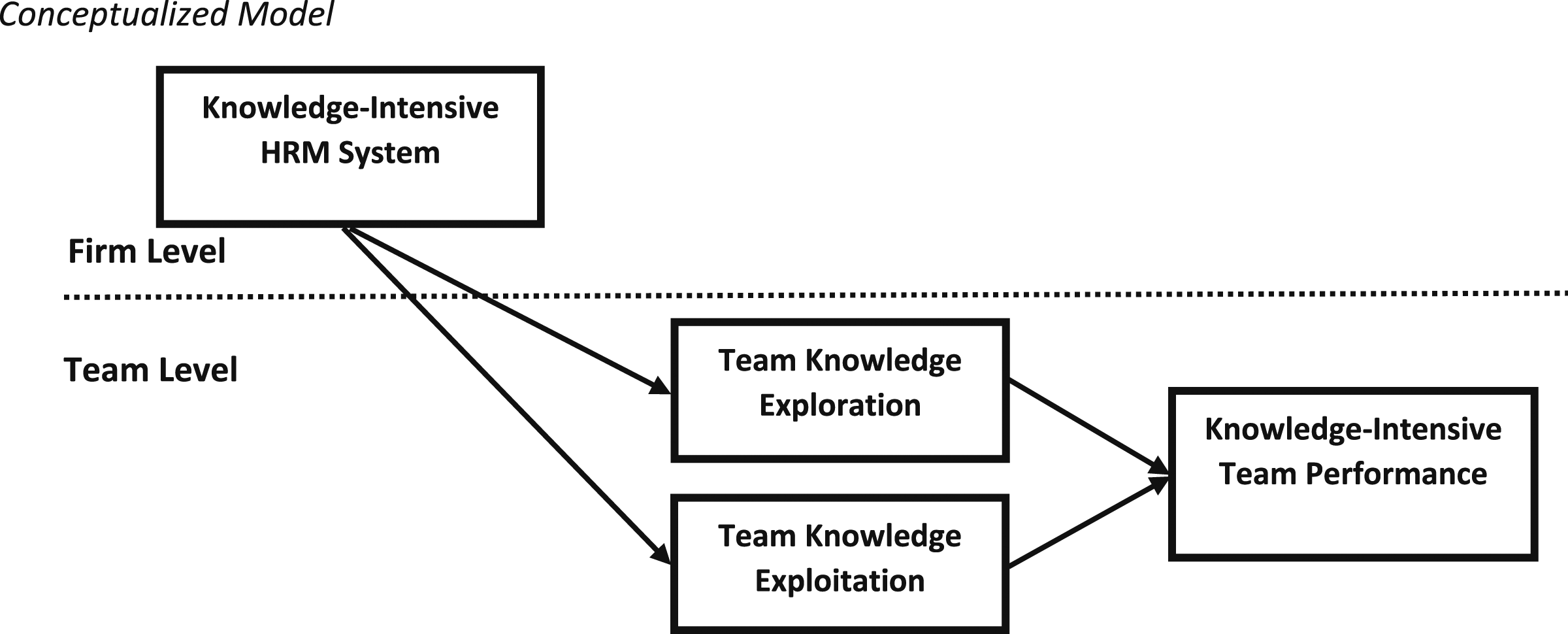
Theoretical Framework and Hypotheses Development
The AMO framework by Appelbaum, Bailey, Berg, & Kalleberg (2000) has been widely used by strategic HRM scholars (Almutawa, Muenjohn, & Zhang, 2016; Jiang et al., 2012b; Shahzad, Arenius, Muller, Rasheed, & Bajwa, 2019; Van Waeyenberg & Decramer, 2018). With respect to HRM for KIT, the framework indicates that the performance of teams is a combined function of team members' ability, motivation, and opportunity to effectively perform knowledge-based tasks and roles which are shaped by HRM systems (Chuang et al., 2016; Jackson et al., 2006). Ability includes human capital, that is, the knowledge, skills, and ability (KSAs) that team members possess to perform specific knowledge tasks. Motivation refers to members' willingness and desire to apply knowledge/competencies to perform. Opportunity reflects the availability of an enabling climate that encourages members to contribute to team and organizational strategic agendas. These three components work in tandem and complement each other in the performance enhancement process, and therefore, the absence of any component may negatively affect the overall performance of teams (Almutawa et al., 2016; Bos-Nehles, Renkema, & Janssen, 2017). Based on the AMO framework and building on Chuang et al. (2016) and Gardner et al. (2012) 's work, we conceptualize KIHRS as a bundle of knowledge-intensive ability-, motivation-, and opportunity-enhancing HRM practices that are designed specifically to facilitate knowledge-based resources, processes, activities, and behaviors in KIT.
KIHRS and Team Performance
Complexities involved in the generation and application of knowledge demand the design of targeted HRM systems that develop, motivate, and allow employees to effectively contribute to knowledge-intensive tasks and activities (Alavi & Leidner, 2001; Cabrera & Cabrera, 2005). Drawing from the notion of “bundle” or “systems” perspective of strategic HRM, researchers have recently begun to explore the impact of HRM systems on knowledge-based behaviors and teamwork (Kianto, Sáenz, & Aramburu, 2017), albeit with a more general orientation such as high-performance, high-involvement, and high-commitment (see Chiang, Shih, & Hsu, 2014; Han, Liao, Taylor, & Kim, 2018; Jørgensen & Becker, 2017; Ma et al., 2017) as opposed to a knowledge-intensive orientation. While these studies offer important insight into HRM and KIT, the seminal literature on strategically targeted HRM systems (e.g., HRM systems that are oriented for safety, service, and ethics performance) underscores the importance of implementing a targeted bundle of HRM practices that aim to achieve knowledge-intensive performance or behavioral outcomes in the organization (Jiang et al., 2012a; Van Waeyenberg & Decramer, 2018). In other words, the HRM practices in KIHRS target building employees' ability to absorb and create knowledge, motivation to collaborate with internal and external knowledge workers, and opportunity to utilize and generate knowledge, which is more likely to yield immediate performance gains for KIT than HRM practices that are geared toward general performance. One exception was Chuang et al.’s (2016) study that has taken a targeted approach to investigate the link between knowledge-based HRM systems and KIT, although they did not include team performance. In what follows, we integrate KIHRS with the knowledge management literature to elaborate on how KIHRS may work specifically to facilitate KITs to achieve superior performance outcomes.
Knowledge-intensive teams perform fundamentally complex and non-routine knowledge-based tasks that require sense-making, judgment, and decision-making to execute knowledge activities (Eckardt, Skaggs, & Lepak, 2018). This requires team members to be creative, flexible, adaptive, risk-taking, and tolerant of uncertainty and ambiguity (Bajwa, Kitchlew, Shahzad, & Rehman, 2015; Madsen & Ulhøi, 2005). Ability-enhancing practices of KIHRS such as recruitment, selection, and training ensure the identification, hiring, and development of knowledge workers with skills to work in diverse teams, perform non-routine and complex tasks, continuously learn and adapt to an uncertain and dynamic environment, and work on tasks that require intensive sense-making and creativity (Salvato & Vassolo, 2018).
Motivation-enhancing practices of KIHRS ensure that members of KITs engage whole-heartedly in collaboration with internal and external knowledge networks to develop and utilize knowledge resources. KIHRS can boost motivation by recognizing the knowledge-based contribution (i.e., knowledge creation, sharing, and application) of members through a formal performance management system and by rewarding such knowledge behaviors through financial rewards, promotions, and social recognition (Cabrera & Cabrera, 2005; Donate & Guadamillas, 2015). Furthermore, KIHRS may design performance management and compensation policies and practices around collective behaviors to reward and promote teamwork, collaboration, participation, and discretionary team behaviors (Chiang & Shih, 2011).
Opportunity-enhancing practices of KIHRS provide a fair and equal opportunity for members to participate in decision-making and knowledge management processes. Teamwork in an uncertain and dynamic environment requires flexibility, sense-making, decision making, and initiatives enabled by flexible job design and freedom to undertake risks and experiments to develop creative ideas and solutions. Also, teamwork requires exposure, social interactions, and collaborations with external and internal entities. KIHRS provides such opportunities as job rotation, flexible job design and structures, participation in decision making, a secure working environment, and a promising career. A psychologically safe and career-progressive climate develops a conducive environment for experimentation, risk-taking, collaborations, and knowledge exchanges in teams and organizations (Watson & Hewett, 2006; Wu, Hsu, & Yeh, 2007).
We provide a summative table of the AMO dimensions and HRM practice focus of KIHRS in Supplemental Appendix A. We posit that the three AMO dimensions work in an integrative and complementary manner to achieve KIT work behaviors and performance. Consistent with the arguments of the potential of strategically targeted and bundled HRM systems to achieve team-level performance outcomes in organizations (Chuang et al., 2016; Liao, Toya, Lepak, & Hong, 2009), we propose the following: H1: Knowledge-intensive HRM systems (KIHRS) relate positively to knowledge-intensive team (KIT) performance.
Mediating Role of Team’s Knowledge Exploration and Exploitation
The existing literature has highlighted the important role of knowledge-based capabilities and processes for KIT performance (Griffith & Sawyer, 2010), including knowledge identification, acquisition, sharing, assimilation, transformation, and implementation, which have been summarized as two distinct categories—knowledge exploration and knowledge exploitation (Gupta, Smith, & Shalley, 2006; March, 1991). Knowledge exploration involves the “creation/generation” of new knowledge, which requires team members to engage in continuous search, discovery, and experimentation processes and activities. Knowledge exploitation, on the other hand, encompasses the team’s ability to “leverage/apply” existing knowledge to produce novel ideas and solutions. Both represent distinct and complementary knowledge processes in teams to achieve performance gains (Gilson et al., 2005; Gonzalez, 2019; Kostopoulos & Bozionelos, 2011; London & Sessa, 2007).
There has been a debate in the literature regarding the relationship (mutually exclusive or complementary) between knowledge exploration and exploitation (Gupta et al., 2006; March, 1991). Recent literature considers them as distinct yet complementary and scalable knowledge processes that must be managed simultaneously to achieve sustainable performance outcomes (e.g., Gonzalez, 2019; Jansen et al., 2009; Kostopoulos & Bozionelos, 2011; Raisch & Birkinshaw, 2008). Scholars also assert that exploration–exploitation should be viewed as a continuum rather than a trade-off (Lavie et al., 2010; Rothaermel & Deeds, 2004) as organizations go through a successive transition from exploration to exploitation and vice versa. For instance, organizations in the exploration process experiment with new technologies and ideas; however, to repeat these experiments or institutionalize new knowledge and learning, organizations need exploitative routines such as refinement and implementation (e.g., Lavie et al., 2010). Despite recognizing the importance and complementarity of exploration and exploitation in teams (Gardner et al., 2012; Kostopoulos & Bozionelos, 2011), the literature lacks insight into how these processes relate to HRM systems to influence KIT performance (Gonzalez & de Melo, 2018).
Based on the previous literature, we argue that team knowledge exploration and exploitation will relate to KIT performance. Knowledge-intensive team’s collective capability to understand, interpret, and make sense of environmental uncertainties and complexities (McNamara, Luce, & Tompson, 2002) precede the development, evaluation, and implementation of novel solutions (Han & Williams, 2008). Exploratory and exploitative knowledge processes can be challenging in the KIT context as team members possess diverse knowledge and cultural backgrounds, which pose language, social, and cognitive barriers (Myers, 2021; Von Hippel, 1994). The ambiguous and unprecedented nature of problems and uncertainty about the usefulness of generated solutions can also obscure these knowledge processes (Szulanski, 1995). Thus, teams' ability to accurately identify, assimilate, and commercialize new knowledge becomes a necessary component of team performance (Cohen & Levinthal, 1990). On the contrary, a team that lacks this exploratory and exploitative ability "will be less likely to recognize the value of new knowledge, less likely to assimilate that knowledge, and less likely to apply it successfully to commercial ends" (Szulanski, 1995, p. 438).
KIHRS, through the knowledge-intensive ability-, motivation-, and opportunity-enhancing practices, can develop KIT’s capability to explore and exploit knowledge. KIHRS first develop the team’s exploratory and exploitative ability through knowledge-intensive selection and training practices. Knowledge-intensive selection identifies and acquires knowledge workers with the potential to generate, transform, and utilize new knowledge pertaining to innovation and problem-solving (Jiang et al., 2012b; Lepak & Snell, 2002). Furthermore, selection may consider candidates' ability to work in diverse teams and knowledge networks (Chung & Jackson, 2013; Phelps, Heidl, & Wadhwa, 2012). The selection process also ensures the congruence between individual and organization’s knowledge and learning values (Kristof, 1996; Leonard-Barton, 1992), which facilitates exploration and exploitation processes in teams (Cabrera & Cabrera, 2005).
Similarly, knowledge-intensive training and development practices may develop teams' overall knowledge management capacity and optimize the fit between members' and the organization’s values (De Winne & Sels, 2010). Regular training builds and maintains the depth and breadth of members' knowledge competencies, which can deteriorate over time due to rapid technological and market changes. As such, continuous updating and revalidating are required to discard outdated knowledge and avoid knowledge overload that can potentially obstruct teams' ability to act on new information (Manz & Glick, 1998) and respond to critical environmental changes (Jackson et al., 2006). Training can enhance members' system thinking, critical evaluation, and creativity which help teams explore advanced technological knowledge as well as develop innovative strategies and routines to exploit emerging opportunities (Salas, Cooke, & Rosen, 2008).
Second, KITs also require motivation to engage in necessary knowledge networks, collaborations, and social processes to search for new knowledge and ideas and fully exploit knowledge required for innovation and problem solving (Andreeva & Kianto, 2012; Sung & Choi, 2018). Knowledge-intensive performance evaluation and compensation that explicitly include roles and behaviors required for knowledge exploration and exploitation can motivate team members' experimentation, innovation, learning, self-development, and implementation of new ideas (Chiang & Shih, 2011). Furthermore, appraisals and rewards need to target the team’s collective performance (Camelo-Ordaz, Garcia-Cruz, Sousa-Ginel, & Valle-Cabrera, 2011; London & Smither, 1999; Nonaka & Takeuchi, 1995; Von Krogh, 1998) and contribution to organizational strategic goals (Donate & Guadamillas, 2015). Teams are also provided with developmental feedback (Lepak & Snell, 1999, 2002) to help them identify knowledge gaps between the actual and desired performance (Shipton et al., 2006), which encourages employees' higher-level learning and self-development (Jiang et al., 2012b; Stiles, Gratton, Truss, Hope-Hailey, & McGovern, 1997). As such, performance appraisal and compensation based on knowledge-based roles, behaviors, and performance motivate teams by clearly identifying, monitoring, and rewarding exploratory and exploitative learning activities and behaviors (e.g., Alavi & Leidner, 2001). Empirical evidence suggests that performance-based evaluation and compensation motivate employees to explore and exploit knowledge resources (e.g., Andreeva & Kianto, 2012; Chen & Huang, 2009; Fey & Furu, 2008; Kamhawi, 2012).
Third, KIHRS create opportunities for exploration and exploitation processes through flexible and autonomous job design, rotation, and career development practices. Foss, Minbaeva, Pedersen, and Reinholt (2009) assert that flexible and broadly designed jobs provide employees with autonomy and flexibility to learn and apply new knowledge, which in turn affects knowledge creation, distribution, interpretation, transformation, and implementation. Flexibility and autonomy in performing jobs encourage participation and experimentation among members (Leonard-Barton, 1992; McGill & Slocum, 1993), which are positively associated with knowledge processes (Foss et al., 2009; Nonaka & Takeuchi, 1995). Team members' active participation in interpretation, sense-making, and decision-making processes can foster exploration and exploitation of new knowledge and ideas (Chen & Huang, 2009; DiBella et al., 1996). Learning and career development opportunities such as rotations and promotions also foster the exploration and exploitation of new knowledge (Leonard-Barton, 1992). In the light of these conceptual and empirical arguments, we propose that: H2: Knowledge exploration in teams mediates the relationship between KIHRS and KIT performance. H3: Knowledge exploitation in teams mediates the relationship between KIHRS and KIT performance.
Method
Sample and Procedure
We collected multi-wave, multi-source data of KITs in the service sector of Pakistan between July and December of 2019. In particular, we used the theoretical guidelines of Robertson and Hammersley (2000) and Starbuck (1992) to develop a list of around 2500 knowledge-intensive organizations operating in five major service industries of Pakistan. We then sent emails to HR managers/directors of 500 randomly selected organizations to seek their consent to participate in the study. We provided the HR staff with a clear description of KIT and its characteristics, based on which HR located team(s) in their respective companies. Briefly, a team could be considered KIT only if: (a) it is composed of knowledge workers, (b) members use their theoretical and analytical knowledge to accomplish tasks, and (c) the team addresses knowledge-related gaps and problems related to the organization’s ability to achieve knowledge-based competitive advantage. Teams that were identified as KITs contained strategic planning/decision-making teams, problem-solving teams, innovation/R&D teams, digital marketing teams, vision 2030 development teams, knowledge strategy/systems development teams, internationalization teams, technology development and implementation (especially digitalization) teams, and high-performance culture development teams, etc. Then surveys were administered in two waves. In the first wave (Time 1), data were collected from team members about their perceptions of HRM practices in their organizations and the extent to which they engaged in knowledge exploration and exploitation activities in their teams. In the second wave (Time 2), after a time lag of 3 months (based on the typical tenure of knowledge teams expected by the experts), team leaders rated the performance of their teams. In total, we received 543 individual-level valid responses from 135 teams of 119 firms, which yielded a 23.8% firm-level response rate. As information about the number of KITs that the HR staff approached in each firm was not available, the response rate at the team level could not be calculated.
On average, 4.02 members from each team and 1.13 teams from each firm responded to the survey. The average size and age of teams were 7.2 members and 12.4 months, respectively. 68% of respondents were male; 76% of teams were majority male. 82% of respondents had master’s degrees or above; all had bachelor’s degrees or above. Regarding industry distribution, 34% of teams were from software development, 26% from consultancy and training, 18% from education service, 12% from media and advertisement, and 10% from telecommunication.
Measures
Given that the literature was fragmented on measurement scales of KIHRS, knowledge exploration and exploitation, and KIT performance (Donate & Guadamillas, 2011; Gonzalez & Melo, 2018; Kostopoulos & Bozionelos, 2011), we followed the guidelines suggested by Churchill (1979) and Colquitt, Sabey, Rodell, & Hill (2019) to select survey items. We adopted the measures using the following procedure: (a) we extensively reviewed the existing literature to develop a conceptual understanding of each construct; (b) we selected items from a conceptually relevant and validated pool of measures; (c) we engaged a panel of experts (two relevant PhDs, one industry expert, and a focus group of working professionals) to refine and contextualize the items of each construct; and (d) we pilot tested the items among a small group of knowledge workers to ensure clarity and appropriateness of items (Tzokas et al., 2015). The main objective was to identify items that best suit the knowledge-intensive context of the study of HRM systems, team knowledge processes, and performance. We counted mainly on the expert panel and kept them on board for the selection, refinement, and finalization of the scale items.
Knowledge-intensive HRM system
To measure KIHRS, we identified a list of 17 AMO-enhancing HR practices from prior HRM studies that adopted the AMO framework (Appelbaum et al., 2000; Chuang et al., 2016; Collins & Smith, 2006; Donate & Guadamillas, 2015; Kianto et al., 2017; Lepak & Snell, 2002; Lopez-Cabrales, Pérez‐Luño, & Cabrera, 2009). Two items were dropped in light of feedback provided by the expert panel and the pilot study on account of face-validity issues. The final 15-item scale for KIHRS consists of six items for ability-, four for motivation, and five for opportunity-enhancing KIHR practices (see Supplemental Appendix B for all items). Following previous studies (e.g., see Chuang et al., 2016; Kehoe & Wright, 2013; Wright, Gardner, Moynihan, & Allen, 2005), we employed a unitary HRM index by combining all HR practices, which was supported by the one-factor exploratory analysis (which explained 64% variance with eigenvalue greater than 1), as well as a confirmatory factor analysis (CFA) (χ2/df = 1.69; CFI = .96; TLI = .95; RMSEA = .07) (α = .87).
Knowledge exploration and exploitation
The extant literature related to the measurement of exploration and exploitation was diverse and complex. Specifically, for measurement at the team level, the existing scales were limited in conceptualizing the spectrum of exploratory and exploitative processes concerning the particularities and unique dynamics of teams (e.g., Edmondson & Nembhard, 2009; Im & Rai, 2008; Mathieu et al., 2008; Mom, Van Den Bosch, & Volberda, 2007). Consequently, following the recommended procedures (Nunnally & Bernstein, 1994), we adapted six items from prior works by Gonzalez and de Melo (2018), Kostopoulos and Bozionelos (2011), and Tzokas et al. (2015) to measure knowledge exploration and knowledge exploitation. The scale measures each dimension with three items selected to fit closely with the definition of knowledge exploration—the research, discovery, and experimentation of new knowledge and knowledge exploitation—the application of knowledge into ideas and products/services. We conducted a content validation analysis using 25 naïve EMBA students following Colquitt et al. (2019) recommended best practices and found that for knowledge exploration items, the p sa was .88, .92, and 1, the c sv was .76, .84, and 1; for knowledge exploitation items, the p sa and c sv were consistently 1. Further, the htc were .94, .95, and .97 for knowledge exploration items and .84, .92, and .99 for knowledge exploitation items. This provides evidence of content adequacy (Colquitt et al., 2019). Moreover, we conducted construct validation analysis which indicated that the two-factor model fitted the data well (χ2/df = 2.11; CFI = .98; TLI = .96; and RMSEA = .09), with all factor loadings significant (p < .001) and greater than .80, providing evidence for construct validity (Bagozzi, Yi, & Phillips, 1991).
Team performance
To measure the performance of KIT, by consulting with the expert panel, we employed eight items mainly drawn from Ancona and Caldwell (1992) and Pearce and Sims (2002). Team leaders were asked to rate the performance of their team related to output, team knowledge processes, creativity and innovation, adherence to resources, strategic contribution, work excellence, and overall performance (see Supplemental Appendix B). The 8-item scale yielded a good single-factor model fit (χ2/df = 1.49; CFI = .99; TLI = .98; RMSEA = .06) with all factor loadings being significant (p < .001) and greater than .80 (α = .89).
Control Variables
We controlled for several variables that could potentially affect the results of the study. At the organization level, we included the size (1 = < 250 employees; 2 = 250 to 1000 employees; 3 = > 1000 employees) and age (1 = < 2 year; 2 = 2–5 years; 3 = 5–10 years; 4 = 10–15 years; 5 = > 15 years) of the firm; at the team level, we considered the size (number of team members) and age (average member tenure measured by month) of the team. In addition, we included a dummy variable (1 = male-majority team; 0 = others) to control for team gender composition as team gender diversity has been identified as an important factor influencing teams' efficiency and innovation (Xie, Zhou, Zong, & Lu, 2020). These factors could potentially affect the relationship between HRM systems, knowledge management processes, and team-level outcomes (Chuang et al., 2016; Shahzad et al., 2019). The HR staff of each firm provided data on these control variables. Finally, we entered four industry dummies (software development, consultancy/training, education service, and media/advertisement) as controls 1 .
Data Aggregation
Data about KIHRS, knowledge exploration, and knowledge exploitation evaluated at the individual level were aggregated to the firm (HRM system) and team levels (knowledge processes) for analysis. To ensure the reliability of the aggregated indices, we calculated the Intraclass Correlation Coefficients (ICC1 and ICC2) and inter-rater agreement (rwg) (Bliese, 2000; LeBreton & Senter, 2008). The rwg(J) values for the firm-level KIHRS ranged from .86 to .92, with a mean of .90, and ICC(1) and ICC(2) values were .38 and .91, respectively. The rwg(J) values for the team-level knowledge exploration ranged from .84 to .91 with a mean of .89, and ICC(1) and ICC(2) values were .49 and .89, respectively. For team-level knowledge exploitation, the rwg(J) values ranged from .87 to .93 with a mean of .91, and ICC(1) and ICC(2) values were .43 and .91, respectively. Taken together, the values of rwg(J), ICC(1), and ICC(2), all exceeding the recommended thresholds, justified the aggregation of individual responses to form team/organizational level measures.
Analyses
Addressing common method bias
As with all survey research, the variables in our study were measured with subjective assessment. To reduce the impact of common method bias, we carried out several corrective procedures during the design and execution stages of this study. We collected data from two sources (i.e., team leaders and team members) at two different times, which is considered appropriate to mitigate the potential common method bias (Podsakoff, MacKenzie, Lee, & Podsakoff, 2003). Further, we empirically assessed the possibility of common method bias by including one common latent factor (CLF) and a post-hoc marker variable (Richardson, Simmering, & Sturman, 2009). We compared the standardized regression weights of all items for models with and without CLF. The minimal differences (<.20) in these regression weights supported the validity of our measures and suggested that common method bias was unlikely to threaten the validity of the findings. This procedure is considered an appealing approach to assess method bias (Podsakoff et al., 2003). To rule out response bias (Armstrong & Overton, 1977), we compared initial and last responses through a one-way analysis of variance (ANOVA) and found no significant difference between both groups.
Assessing measurement validity
Confirmatory Factor Analysis for Model Validation.

Notes. df = degrees of freedom, CFI = comparative fit index; TLI = Tucker–Lewis index; RMSEA = root mean square error of approximation.
Six-factor = three AMO dimensions of KIHRS, knowledge exploitation and exploration, and KIT performance.
Four-factor = KIHRS as a unified factor, knowledge exploration and exploitation, and team performance.
Three-factor = combined knowledge exploration and exploitation into a single factor, KIHRS, and performance.
Two-factor = combined performance and knowledge processes into one factor, and KIHRS.
Results
Descriptive Statistics, Correlations, and Reliability of Study Variables.

Note. N = 135 at the team level; N = 119 at the firm level. Values in parentheses indicate reliability.
** p < .01.
Random Coefficient Modeling Results.

Note: Coefficient estimates are based on 135 groups in 119 companies. Table entries represent unstandardized coefficients with standard errors in parentheses.
† p < .10. * p < .05. ** p < .01. *** p < .001.
Hypotheses 2 and 3 proposed team knowledge exploration and exploitation as mediators between KIHRS and KIT performance, respectively. We first investigated the effects of both knowledge exploration and exploitation on KIT performance. Model 3 in Table 3 shows that while knowledge exploitation was significantly and positively associated with KIT performance (γ = .40, p < .01), the relationship between knowledge exploration and KIT performance, when controlling for knowledge exploitation, was non-significant (γ = .13, n.s.).
Mediation Results.

Note. Control variables include firm size, firm age, industry software, industry consultancy/training, industry education, industry media/advertisement, team size, team age, and male majority team.
Supplementary Analysis
We investigated the pattern of correlation and regression results and found that while HRM is more related to exploration, KIT performance is more related to exploitation. Additionally, our findings revealed differentiated mediation relationships via knowledge exploration and exploitation. These observations prompted us to investigate additional theoretically plausible models. The literature indicates that KITs are usually formed to solve novel and complex problems through innovative solutions that require new knowledge and capabilities (Jackson et al., 2006). Therefore, the first task for KITs is to generate and absorb significant knowledge through exploration. However, the new knowledge developed through exploration activities may not be sufficient for achieving breakthrough innovation—knowledge exploitation is then required to refine and integrate new and existing knowledge for later commercialization to bring innovation to market (Gibson & Birkinshaw, 2004; Gilson et al., 2005; Jansen et al., 2009; London & Sessa, 2007; Raisch & Birkinshaw, 2008). In light of this theoretical rationale, we explored whether knowledge exploration and knowledge exploitation work in sequence to unleash the power of KIHRS for enhancing KIT performance. In particular, we examined another indirect effect with knowledge exploration and exploitation serving as two sequential mediators, drawing on Hayes and Preacher’s formula (Hayes, Preacher, & Myers, 2011) to construct CIs for indirect effects. As shown in Table 4, this sequential mediation path was significant (indirect effect = .198, 95% CI [.085, .311]).
This post-hoc analysis indicated that team knowledge exploration and knowledge exploitation might work sequentially in linking KIHRS to KIT performance. KIHRS promote team knowledge exploration, which further leads to team knowledge exploitation which eventually enhances the performance of KITs. This makes sense because exploration alone may not produce innovative outcomes; KITs performance also hinges on exploitative activities that turn knowledge into final products and outputs. This final modified model is presented in Figure 2. We will extend more discussion in the next section. Final sequential mediation model.
Discussion
Groups and teams researchers have called for more studies to integrate myriad lines of research to explain why some groups and teams perform better than others (Gardner et al., 2012; Hackman & Katz, 2010; Huang & Cummings, 2011; Mierlo & Hooft, 2020). On the one hand, contemporary team researchers have underscored the importance of KIT and the role that both exploratory and exploitative knowledge processes play in team performance (Krausert, 2014). On the other hand, strategic HRM literature has emphasized the importance of KIHRS in managing knowledge-based resources and processes in teams (Cabrera & Cabrera, 2005; Camelo-Ordaz et al., 2011; Chuang et al., 2016). However, the literature still lacks a comprehensive understanding of how organizations implement HRM systems to improve knowledge-based processes and performance in teams. Toward this goal, this study tested a model of whether and how KIHRS facilitate the knowledge exploration and exploitation processes and performance of KITs. The central tenet of this study was that teams and organizations operating in a knowledge-intensive context could achieve greater performance gains from HRM systems that are targeted at the unique knowledge needs and performance requirements of KITs (Chen & Huang, 2009; Chuang et al., 2016; Gardner, Wright, & Moynihan, 2011). As shown in Figure 2, the final model depicts that KIHRS relate positively to KIT performance via team knowledge exploration and knowledge exploitation. Furthermore, knowledge exploration and knowledge exploitation mediate the relationship between KIHRS and KIT performance in a sequential manner. The findings of this study, especially the sequential mediation, provide important implications for theory and practice.
Theoretical Implications
First, our study extends the previous studies that adopted a general approach of HRM systems by examining the effect of a strategically targeted HRM system in the knowledge-intensive context on team performance. Specifically, most prior studies have used a general or best-practices HRM systems approach, such as HPWS, commitment-oriented HRM system, and innovation-oriented HRM system, to explore its impact on team outcomes. Advocates of strategically targeted HRM systems, however, argue for the notion of bundles of HRM policies and practices that are designed specifically for some targeted outcomes such as knowledge (Chuang et al., 2016), service (Liao, Toya, Lepak, & Hong, 2009), and safety (Zacharatos, Barling, & Iverson, 2005) performance. Given that KITs are formed to perform knowledge-intensive team tasks, HRM systems need to be designed to develop necessary knowledge capabilities, processes, and behaviors that will contribute to the knowledge-based competitive advantage of organizations. Although Chuang et al. (2016) took the first step to link knowledge-based HRM systems with knowledge-intensive teamwork, we extend this pioneering study by investigating how KIHRS influence team-level performance outcomes. These results add to the outcome-best-fit approach by empirically validating that KIHRS can boost KIT performance with its bundle of ability-, motivation-, and opportunity-enhancing HRM practices targeting KIT work.
Furthermore, we explored the underlying mechanism through which KIHRS enhance KIT performance. We found that both knowledge exploration and knowledge exploitation processes are critical and sequentially mediate the cross-level impact of KIHRS on the performance of KITs. In other words, KIHRS promote knowledge exploration, which further facilitates team knowledge exploitation, which eventually enhances KIT performance. This finding delineates how organization-level HRM systems orchestrate the sequence of team-level knowledge processes to influence performance. It also offers important insight into the debate about the complementarities between knowledge exploration and exploitation processes by suggesting a sequential interdependence (Chen, 2017; Osiyevskyy et al., 2020). Nonetheless, we acknowledge that our findings are somewhat exploratory and thus should be taken as a small step in responding to the contemporary debate on the simultaneous or sequential pursuit of exploration/exploitation (Sabidussi et al., 2021; Mathias, Mckenny, & Crook, 2018). As such, future theoretical frameworks of knowledge processes and performance of KITs can further examine the sequential complementarities of exploration and exploitation. Chen (2017) asserted that the sequential presence of exploration and exploitation could be effective at the project level, the context of which is relevant to KITs. By explicitly modeling the sequential trajectories of knowledge exploration and exploitation processes loop, team researchers can develop a more nuanced and impactful theory of team effectiveness in the knowledge-intensive context.
Overall, the positive effect of KIHRS on KIT performance through team knowledge processes in Pakistan is consistent with the extant strategic HRM research conducted in Asia (Bae, Chen, David Wan, Lawler, & Walumbwa, 2003; Budhwar & Debrah, 2009). This establishes an increasing awareness of knowledge-based competition and the adoption of knowledge-centered HRM frameworks by Asian enterprises to compete successfully (Shahzad et al., 2019). As team scholars have pointed out repeatedly (e.g., see Hempel, Zhang, & Han, 2012; Mathieu et al., 2008; Stewart, 2010), advancement in our understanding of how contextual factors influence team performance is sorely needed and this study is a small step in that direction.
Managerial Implications
Knowledge-intensive organizations increasingly rely on KITs to achieve knowledge-driven performance and competitive advantage. Our findings suggest that investment in KIHRS will pay off in this regard as it helps KITs deliver performance outcomes. KIHRS, designed to develop knowledge-intensive ability, motivation, and opportunity among team members, are desirable for KITs performance because such an HRM system facilitates both knowledge exploration and exploitation processes in teams. Although KIHRS mainly pertain to organizational-level investment in knowledge-intensive HRM, it is also possible that a small subset of these practices can be implemented by groups/teams if such an organizational system is not in place.
Specifically, for ability-enhancing KIHRS, organizations need to adopt a knowledge-intensive recruitment and selection process to identify, select, and develop knowledge workers capable of performing knowledge-intensive work in teams (Hong, Zhao, & Snell, 2019). Candidates should be selected based on their overall knowledge management potential and fit with the company’s knowledge vision (and potentially the team’s knowledge values). Organizations should design targeted training programs to enhance members' knowledge management capabilities to continuously explore and exploit critical knowledge to achieve knowledge goals. For motivation-enhancing KIHRS, performance evaluation and compensation practices implemented at the organizational (and potentially team levels) should recognize and reward individuals as well as teams' knowledge-based contributions (Hu & Randel, 2014). For opportunity-enhancing KIHRS, HR leaders should consider investing in developing knowledge communities by providing technical support, budgets, and rewards, etc., to promote knowledge creation and sharing activities (Laursen & Mahnke, 2001). Besides, job rotation and encouragement for cross-functional career paths should be provided to employees for the purposes of broadening their knowledge management schemas, developing teamwork mental models, and improving knowledge exploration and exploitation capacity (Chow & Gong, 2010). It is also important for organizations (and teams) to develop a psychologically safe environment where knowledge workers can experiment and implement their ideas (Shahzad, Bajwa, Siddiqi, Ahmed, & Sultani, 2016).
Limitations and Future Research
The study results should be understood in light of some limitations, which also offer opportunities for future research. First, the data were collected from a relatively small sample comprising 135 teams. A larger sample is recommended to further verify the studied relationships. Second, we included KIHRS as a determinant and team knowledge exploration and exploitation as mediating processes toward team performance. The previous literature has identified several other factors such as leadership and team emergent state (e.g., efficacy) that can influence team knowledge processes and behaviors. For example, prior work has stressed the importance of leadership in facilitating/moderating knowledge teamwork processes (Chuang et al., 2016; Jiang & Chen, 2018). Due to the scope of the current research, we could not collect information about leadership styles or team emergent states. Future studies could include more predictors and intermediary factors to investigate the underlying mechanism.
Third, although we attempted to minimize common method variance by collecting data from different sources at different time points, the independent variable (KIHRS) and mediators (knowledge exploration and exploitation) were rated by team members in the same wave. Such a research design reduces but cannot rule out potential method and rating bias. Further, our attempt at free modeling to explore the sequential mediation between variables of this study warrants further investigation. A longitudinal study can be conducted where knowledge exploration is measured before knowledge exploitation to establish evidence of temporal precedence. For that, researchers need to focus on some specific type of knowledge, that is, product development, technology adoption, etc., to establish the sequential causality between exploration and exploitation of that knowledge. Although the utilization of team leaders' time-lagged ratings as a measure of team performance reduced the probability of common method bias between independent and dependent variables, using more “objective” indexes of performance and a time-series measurement of independent and mediating variables in the future may offer a more robust test of the relationship between KIHRS, team knowledge processes, and team performance.
Conclusion
This study shows that knowledge-intensive organizations are increasingly required to invest in specialized HRM systems that facilitate the knowledge processes and performance of KIT. Knowledge-intensive HRM system increases the performance of KITs by increasing their ability to explore and exploit critical knowledge. Furthermore, the knowledge processes of exploration and exploitation work in a sequence to impact team performance. This study specifically offers insight for knowledge-intensive organizations to understand the sequential process through which KIHRS affect KIT performance via facilitating knowledge exploration and knowledge exploitation in teams.
Supplemental Material
sj-pdf-1-gom-10.1177_10596011211063667 – Supplemental Material for Knowledge-Intensive HRM Systems and Performance of Knowledge-Intensive Teams: Mediating Role of Team Knowledge Processes
Supplemental Material, sj-pdf-1-gom-10.1177_10596011211063667 for Knowledge-Intensive HRM Systems and Performance of Knowledge-Intensive Teams: Mediating Role of Team Knowledge Processes by Khuram Shahzad, Ying Hong, Yuan Jiang and Hina Niaz in Group & Organization Management
Footnotes
Acknowledgments
All authors contributed equally to this work.
Declaration of Conflicting Interests
The author(s) declared no potential conflicts of interest with respect to the research, authorship, and/or publication of this article.
Funding
The author(s) received no financial support for the research, authorship, and/or publication of this article.

Supplemental Material
Supplemental material for this article is available online.
Notes
Author Biographies
References
Supplementary Material
Please find the following supplemental material available below.
For Open Access articles published under a Creative Commons License, all supplemental material carries the same license as the article it is associated with.
For non-Open Access articles published, all supplemental material carries a non-exclusive license, and permission requests for re-use of supplemental material or any part of supplemental material shall be sent directly to the copyright owner as specified in the copyright notice associated with the article.
