



Abstract
Research on the topic of stressful workplace demands (stressors) has a long and rich history in psychology and management. Today, the challenge-hindrance stressor framework (CHSF) represents one of the key theoretical models of stress through which scholars understand workplace stressors and their effects on individuals with respect to a broad array of proximal and more distal criteria. Although the CHSF has been used in over two decades of research on issues surrounding the effects of stressors, and despite several meta-analyses which have quantitatively summarized and theoretically extended this work, we lack an integrated picture of how the findings from all this research fits together. This not only thwarts the accumulation of knowledge, but it also masks important issues in need of study and hinders the application of knowledge to improve practice. The purpose of this review is to provide a broad overview of the CHSF, and to facilitate a more cohesive understanding of the literature. The review synthesizes the literature to produce an integrative heuristic, speaks to criticisms of the CHSF in light of research evidence, and presents a road map for future research.
Following Kahn et al.’s (1964) classic treatment of role conflict and role ambiguity, scholars identified and explored the nature and functioning of many different types of work stressors, defined here as demands that tend to evoke the feeling that one’s capacity to cope is stretched (Kahn & Byosserie, 1992). This research concluded that although stressors tend to be positively associated with a range of strains—such as anxiety, exhaustion, and burnout—associations with positively valenced outcomes—such as job satisfaction, commitment, motivation, and performance—are much less consistent. One contemporary explanation that has been advanced for these inconsistent associations is the challenge-hindrance stressor framework (CHSF), first articulated by Cavanaugh et al. (2000).
Essentially, the CHSF proposes that our understanding of the effects of stressors necessitates consideration of how people tend to think and feel about them (Cavanaugh et al., 2000). Hindrance stressors refer to work-related demands that tend to engender the belief that achievement is being constrained unnecessarily, which in turn, manifests in strains, as well as negative job attitudes and behaviors. Examples of hindrance stressors include role conflict and role ambiguity. In contrast, challenge stressors refer to work-related demands that tend to give rise to the belief that coping will facilitate growth and achievement. Thus, although challenge stressors are strain inducing, they tend to manifest in positive job attitudes and behaviors. Examples of challenge stressors include time pressure and responsibility. The basic propositions of the CHSF have been supported in primary research (e.g., Boswell et al., 2004; LePine et al., 2004). The framework has also been leveraged in meta-analyses that clarified inconsistent associations between specific stressors and outcomes that have been observed in prior research (e.g., LePine et al., 2005; Podsakoff et al., 2007). Spurred by this foundational work, a great deal of subsequent research has been conducted over the last decade or so, and today the CHSF represents one of the key theoretical models of stress in workplace settings (Bliese et al., 2017).
Although the literature on the CHSF is robust and has been impactful (Horan et al., 2020; O’Brien & Beehr, 2019), several issues need to be addressed before clarity is achieved with respect to how the framework could be applied in ways that have positive impacts on workers, organizations, and society more generally. First, there have been criticisms regarding key tenets and implications of the CHSF (e.g., Mazzola & Disselhorst, 2019). Although some of these concerns are easy to address with clarification (e.g., sampling error will always manifest in a range of effect sizes, some of which appear inconsistent with hypotheses), others are more foundational, and thus, require more careful analysis and consideration (e.g., the basis for categorizing stressors). Second, although several meta-analyses have applied the CHSF to summarize the expansive empirical literature that has accumulated, each has been focused on a somewhat different issue, and consequently, we lack a broad view that speaks to the validity of the framework and the foundational assumptions, the nature of the stressor concepts, and how they are operationalized and studied. Finally, although propositions of the CHSF have been widely supported, there remains variability in effect sizes (e.g., LePine et al., 2005; Podsakoff et al., 2007) that may be explained by factors such as the study setting, sample, or time period. Thus, exploring the role of context in the stress process could enhance our understanding.
In summary, and considering the issues noted above, the purpose of this integrative conceptual review is to critically evaluate the CHSF with respect to theoretical assumptions, the underlying nature of the stressor constructs, and the role of context in the stress process. An understanding of these issues will enable research to assess and manage the positive and negative effects that stress has on performance, growth, and well-being more judiciously. I begin by providing an overview of the CHSF. I then critically evaluate the framework in terms of the three issues noted above and provide readers with a heuristic and roadmap for future research.
Overview of the Challenge-Hindrance Stressor Framework
The genesis of the CHSF can be traced to a very practical question, Why do managers seek and engage in stressful developmental experiences? From discussions and interviews with executives who had gone through these experiences, M. A. Cavanaugh (now known as M. A. LePine) and her colleagues observed that with certain stressful demands there do not appear to be any perceived benefits, and in some cases, there is perceived loss or harm, while with other stressful demands, there are perceived benefits, especially in terms of growth and development. Researchers at the time, who were interested in the broad effects of job-related stress, predominantly used measures that included items regarding a broad array of demands that might exist in the job, work unit, and organization (e.g., Bretz et al., 1994). Cavanaugh et al. (2000) reasoned the failure to find consistent empirical associations between work-related stress and positively valenced criteria may be due to the use of stress measures that confounded fundamentally different types of stressors.
Early Empirical Research on the CHSF
Using Lazarus and colleagues’ work on the transactional theory of stress and the appraisal of stressors as the conceptual basis (Lazarus & Folkman, 1984), Cavanaugh and colleagues proposed that stressful work demands are reflected in two broad dimensions. The authors’ review of the management development literature (e.g., McCall et al., 1988; McCauley et al., 1994) revealed that time pressure and responsibility, among other demands, are qualitatively different from demands such as hassles, conflict, ambiguity, and politics, because they tend to engender feelings of challenge and hope rather than dread and despair. Items from existing stress measures were then examined and categorized by the authors as reflecting a challenge (work-related demands or circumstances that, although potentially stressful, have associated potential gains for individuals), hindrance (work-related demands or circumstances that tend to constrain or interfere with an individual’s work achievement and that do not tend to be associated with potential gains for the individual), both, or neither. The authors found support for their hypotheses regarding the unique functioning of the two stressor dimensions (i.e., differential associations with job satisfaction, job search, and turnover) in a sample of managers.
The question then became, Would the framework generalize to other samples or are managers’ and their stress experiences unique? To answer this question, scholars applied the CHSF in samples comprised of university staff (Boswell et al., 2004) and university students (LePine et al., 2004), and found differential relationships for challenge and hindrance stressors across several outcomes (e.g., motivation to learn, learning performance, job search, and intent to quit), while having similar relationships with strain (i.e., both positively related to anxiety and emotional exhaustion) as hypothesized.
Leveraging the CHSF to Reconcile Inconsistent Empirical Findings
Summary of meta-analytic corrected correlations (ρ, corrected unless otherwise specified) and meta-analytic regression and path analysis parameter estimates (β, direct effects unless otherwise specified) with specific criteria.

aMeta-analytic regression or path analysis was not conducted.
bindirect effect.
cno artifact corrections-bare bones.
dMediators were not significant, so the relationship was not tested.
eThere were not enough studies to examine the relationship.
First, in an effort to reconcile inconsistent stressor-performance relationships, LePine et al. (2005) content analyzed measures of specific stressors, and examined relationships among stressors categorized as challenges or hindrances on the one hand, and strains, motivation, and performance on the other. They found that while both types of stressors are positively related to strains, they are differentially related to motivation and performance in the hypothesized direction (β Table 1). Second, Podsakoff et al. (2007) sought to reconcile inconsistent stressor-retention-related criteria findings. They developed and tested a multi-step mediational model based on Schaubroeck and colleagues’ (1989) theory that proposes an indirect relationship between role stressors and turnover intentions through their effects on strains, job satisfaction, and organizational commitment. They found that while challenge and hindrance stressors both engender strain, there are significant differential associations with job satisfaction, commitment, turnover intentions, and turnover (β Table 1). Finally, Crawford et al. (2010) used the CHSF in an effort to clarify inconsistencies in associations observed in research on the Job Demands and Resources (JD-R) model (Demerouti et al., 2001). Their meta-analytic path analyses revealed that while challenge and hindrance demands are both positively associated with burnout, they are differentially associated with engagement (β Table 1).
Together, these meta-analyses illustrated how the CHSF could be used to provide a theoretically grounded explanation of inconsistent associations among different stressors and performance, retention-related criteria, and engagement. Subsequent meta-analyses focused on associations with other outcomes both inside and outside the workplace (safety: Clarke, 2012; recovery: Bennett et al., 2017; well-being: Lerman et al., 2020; and work-family conflict and enrichment: Webster & Adams, 2020). Generally, this body of research indicated that challenge and hindrance stressors are differentially related to the outcomes, with challenge stressors being less detrimental than hindrance stressors across several of the criteria (β; Table 1).
Primary Research Examining the CHSF
The meta-analyses described above clarified associations that have been central to stress scholars, and which have been examined in a large number of primary studies that were not grounded in the CHSF. Subsequently, there has been primary research conducted on aspects of the CHSF itself, and relationships that are based on the CHSF logic, that has advanced our understanding of the nature and functioning of the stress process.
Challenge and Hindrance Appraisals
One important elaboration to the early CHSF research were studies that explored the role of stress appraisals as mechanisms that transmit the effects of challenge and hindrance stressors to outcomes. Indeed, the CHSF is based on the assumption that individuals tend to appraise certain work stressors as challenges and other work stressors as hindrances, because of economic rationality (i.e., the likelihood and implications of coping with the different demands). Although the differential associations observed in prior work had supported this assumption indirectly, research that examines the mediating role of appraisals was needed to provide a more direct examination of the underlying theoretical logic.
Research on appraisals began with Webster et al.’s (2011) seminal work examining challenge and hindrance appraisals of work demands that had previously been categorized as challenge or hindrance stressors. Their results revealed that although workload was predominantly appraised as a challenge and role conflict and role ambiguity were predominantly appraised as hindrances, they could simultaneously be appraised as both, a finding that is consistent with the transactional theory of stress (Lazarus and Folkman, 1984). In examining the effects of appraisals as mechanisms that transmit the effects of challenge and hindrance stressors to outcomes, this research represents a direct test of the transactional theory roots of the CHSF.
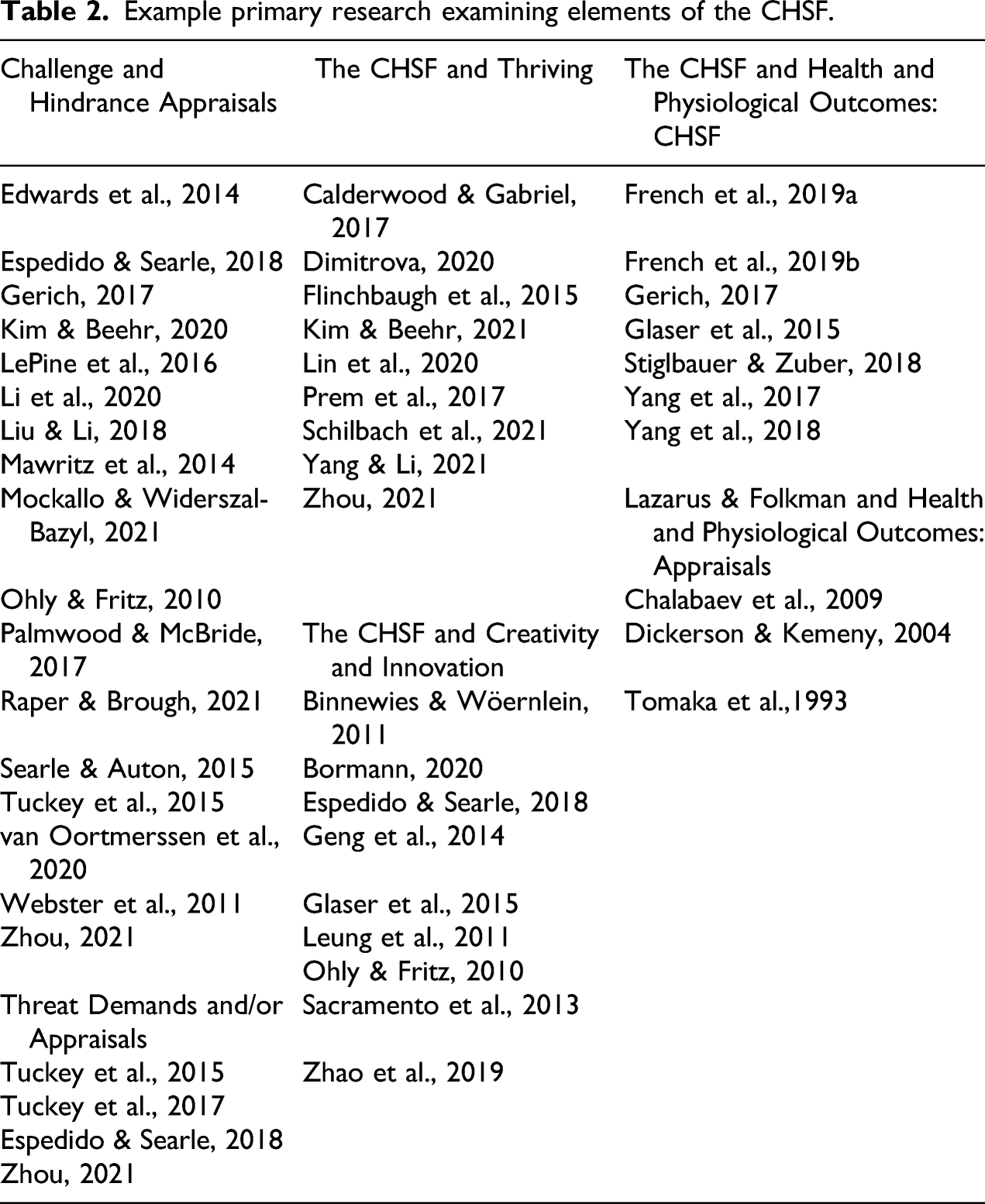
Example primary research examining elements of the CHSF.
Threat Demands and Appraisals
Another important stream of primary research on the CHSF has been to distinguish threats from hindrances (see Table 2). In particular, Tuckey and colleagues proposed that a distinction between threat stressors and hindrance stressors would further our understanding of the nature of stressors and their effects on individuals and organizations (Tuckey et al., 2015). Grounded in Lazarus and Folkman’s (1984) concept of threat appraisal (the perception of personal loss or harm), their results supported the 3-factor threat-challenge-hindrance stressor structure. Threat stressors were conceptually and empirically distinct from challenges and hindrances, with threat stressors having a substantial effect on distress and emotional exhaustion. These findings represent an important area for future research.
Outcomes with Differential Relationships
Finally, researchers have applied the CHSF to develop and test theory regarding associations with a wide range of important criteria. A few important streams of research for which the CHSF has been instructive are thriving, creativity and innovation, and health and physiological outcomes (see Table 2 for an expanded list of references). Important for its impact on growth and development is research on thriving at work (Spreitzer et al., 2005). As one example, Prem et al. (2017) revealed that both time pressure and learning demands (challenge stressors) significantly impacted the learning component of thriving (directly and indirectly through challenge appraisal). Hindrance appraisals played a small role in a negative indirect relationship between learning demands and vitality.
This review of the literature provides an instructive map of where the CHSF originated and where it is today. In the next section, I discuss three fundamental issues that are important for developing an integrative understanding of workplace stressors, with an overarching focus on the performance, growth, and well-being of workers. In other words, the next section describes the challenges to enlarging the map so that it provides direction as to where we go next.
Three Fundamental Issues Guiding Future CHSF Research
Theoretical Assumptions
Elements of the CHSF have been tested empirically, have received support, and have been extended in important ways. However, the research I described above suggests that elaborating on key elements of the framework and the framework’s underlying assumptions could help move our understanding forward. Figure 1 provides a heuristic that organizes the various aspects of the CHSF, and thus serves as a guide to areas where future research may be worthwhile. As previously discussed, the CHSF is grounded in the transactional theory of stress (Lazarus & Folkman, 1984), which presumes that appraisals are a function of the environment and the individual. However, the CHSF presently focuses almost exclusively on the environment (i.e., work-related demands). This focus is, however, limited in that individual differences may impact (directly and jointly with the environment) the appraisal process, explaining additional variance in outcomes beyond the work demands alone. Theory and recent research suggest that the CHSF may benefit from the addition of challenge and hindrance appraisals as well as threat demands and appraisals to the model. Revised challenge-hindrance stressor framework.
Stressor Appraisals
A cornerstone of the transactional theory of stress, upon which the CHSF is based, is that individuals appraise stressors in terms of the degree to which they are irrelevant, benign-positive, or stressful, and if stressful, whether the appraisal involves harm/loss (damage has already been sustained), threat (harm or loss is anticipated), or challenge (a potential gain or growth is anticipated; Lazarus & Folkman, 1984). The CHSF takes this idea, and argues that because of economic rationality, certain stressors “tend” to be appraised as challenges (potentially beneficial with respect to personal growth and development) and other stressors “tend” to be appraised as hindrances (potentially thwarting personal growth and development). Importantly, the CHSF recognizes that appraisals are not universal, they do not follow lockstep from exposure to the stressors, and in fact, are a function of the situation, individual differences, and experiences (e.g., Podsakoff et al. 2007, p. 438). In fact, this is precisely why scholars position appraisals as probabilistic outcomes of stressors rather than isomorphic operationalizations. Interestingly, some have characterized the CHSF as assuming that challenge stressors and hindrance stressors are always, under all conditions, appraised accordingly (e.g., Mazzola & Disselhorst, 2019). Although provocative, this view does not comport with the foundational literature. However, this characterization does suggest a number of possibilities that may be important to address. For example, scholars could investigate the situational factors and individual attributes that influence the degree to which employees appraise certain stressors as challenges or hindrances, and most importantly, they can examine the malleability of these appraisals, as such an understanding is important and necessary for future research both theoretically and practically to determine the potential positive impact of stressors on the performance, growth, and well-being of workers.
With respect to the first issue regarding the situational factors and individual attributes that may impact stress appraisals, there is evidence which suggests that certain stressors may be perceived differentially across various occupations (e.g, Bakker & Sanz-Vergel, 2013). Because of the importance of this issue, I will discuss job context in a later section of the paper. However, a variety of other situational factors and their impact on the appraisal process have been studied, including leadership, fairness, and perceived support (e.g., Janssen, 2000; LePine et al., 2016; Richardson et al., 2008). Leadership and perceived support are discussed below in more detail.
Leadership has been examined as a potential moderator of the stressor-outcome relationship (LePine et al., 2016). As an example, Zhang et al. (2014) drawing from the transformational-transactional theory of leadership (Bass, 1985) and social exchange theory (Blau, 1964) examined how leadership plays a role in how stressors are interpreted with regard to fairness. They hypothesized that transactional leaders emphasize compliance and expectations of performance that convey that stressful demands are a part of the job, and thus a part of the social exchange relationship. As a result, the authors suggest that followers appraise challenge and hindrance stressors as being consistent with the norms of social exchange, and more fair. In contrast, transformational leaders emphasize purpose and empower followers to perform beyond expectations. Thus, the authors suggest that followers likely appraise hindrance stressors as less threatening, view challenge stressors as “stretch” assignments that are worth the extra effort, and perceive both as fair and part of the social exchange relationship. Their findings varied by leadership style. Transactional leaders reduced the negative effect of hindrance stressors on job performance because they weakened the negative relationship between hindrance stressors and justice perceptions. In contrast, transformational leaders enhanced the positive effect of challenge stressors on job performance because they strengthened the positive relationship between challenge stressors and justice perceptions.
Perceived support has also been studied as a factor that influences how stressors function. As an example, Wallace et al. (2009) based their hypotheses on organizational support theory (Eisenberger et al., 1986) suggesting that high levels of organizational support provide additional resources that assists employees with meeting challenges and buffers them from hindrances. The authors found that organizational support moderated the relationship between challenge stressors and role-based performance, such that the relationship was stronger and more positive with higher support. In contrast, organizational support did not moderate the relationship between hindrance stressors and performance.
With respect to individual attributes, some attributes are thought to provide resources (e.g., ability to manage the stressor, view the stressor in a positive light, ability to effectively cope with the stressor), which impact the appraisal process due to their impact on personal significance of the stressor and expected outcomes (Lazarus & Folkman, 1984). To the extent that the expected outcomes are personally significant and positive, the stressor will likely be appraised as a challenge. In contrast, to the extent that the expected outcomes are personally significant and negative, the stressor will likely be appraised as a hindrance. Indeed, Kilby et al. (2018) found in their review that challenge appraisals are engendered in individuals with higher emotional intelligence, emotional stability, extraversion, and positive beliefs about the consequences of feeling stressed. They also found that threat appraisals are less evident with individuals who have higher emotional intelligence, emotional stability, agreeableness, extraversion, openness, beliefs that the world is a just and fair place, and greater perfectionistic striving. Other research suggests that trust, psychological capital, resilience, and regulatory focus (e.g., Byron et al., 2018; Flinchbaugh et al., 2015; Khliefat et al., 2021; Mockallo & Widerszal-Bazyl, 2021; Sacramento et al., 2013) provide resources that impact the role that stressors play in influencing appraisals.
Research on contextual factors and individual differences is just beginning to contribute to our understanding of under what conditions employees may appraise stressors as challenges or hindrances (or threats). Additional research is needed to fully understand the complexity of these findings with respect to the resources that are provided and the impact the resources have on the challenge and hindrance appraisal process.
As far as insights into the second question regarding the malleability of appraisals, situational factors and individual attributes may provide answers to that question as well. In a direct examination of this issue, research on stress mindset has found that a manipulation to create the belief that “stress-is-enhancing” improves responses to both challenging and threatening stress in that a stress-is-enhancing mindset was related to a sharper increase in positive affect, heightened attentional bias towards positive stimuli, and greater cognitive flexibility, whereas a stress-is-debilitating mindset produced worse outcomes (Crum et al., 2017; Jamieson et al., 2018).
Understanding the moderating conditions that impact the relationship between stressors and appraisals will unlock the key to understanding how stressors can be better managed across a variety of situational and individual differences. Although the study of the stressor-to-appraisal relationship may not be necessary across all studies to increase understanding of the stressor-outcome relationship, it is proposed that this relationship should be carefully considered when conducting research utilizing the CHSF. Figure 1 includes the demands, appraisals, and potential situational and individual factors that may moderate the appraisals.
Threat Demands and Appraisals
As previously discussed, Tuckey and colleagues have been at the forefront of research on threat-related demands and appraisals, specifically finding utility in distinguishing hindrances and threats. Given this research, it may be important to examine challenge, hindrance, and threat demands and appraisals to fully understand the nature of these stressors and how they impact performance, growth, and well-being. With our increased attention on threats in the workplace (e.g., abusive supervision, discrimination, bullying) the distinction between hindrances and threats has become even more important (Michel et al., 2016; Palmwood & McBride, 2017; Zhou 2021) and adds to our overall understanding of the important stressors that may impact individuals differentially within the workplace. Indeed, very little is known about whether different groups of individuals perceive challenges/hindrances or hindrances/threats differentially, and how this may impact individual and organizational outcomes. Although there is evidence of disparities with respect to general stress assessments (e.g., people with low income and racial/ethnic minorities report higher levels of stress and more traumatic stress experiences; APA, 2017), research is needed to determine if disadvantaged social groups (e.g., women, People of Color, LGBTQA+; Meyer et al., 2008) perceive stressors more negatively with higher levels of hindrance and threat appraisals and lower levels of challenge appraisals, and as a result undergo greater losses and fewer gains across the life course (Williams, 2018). Recent research conducted by Thoroughgood and colleagues (2020) explores these issues. The authors discuss that although there are subtle differences in theoretical explanations, there is agreement among transactional models of stress (Lazarus & Folkman, 1984) and stigma researchers (e.g., Hatzenbuehler, 2009) that discrimination represents a social stressor “…that undermines well-being by depleting targets’ psychological resources as they attempt to cope with the perceived threats.” (p. 49). Adopting a positive psychological approach, Thoroughgood et al. (2020) sought to determine for whom discrimination (a threat stressor) is more or less impactful and found that trait mindfulness buffers the negative impact of discrimination against paranoid cognition and emotional exhaustion. The CHSF with the inclusion of threats demands (such as discrimination) and threat appraisals may provide additional insights into the impact of discrimination and other threat demands on performance, growth, and well-being. As shown in Figure 1, demands have been extended to include threat demands, and appraisals have been extended to include threat appraisals in recognition of the importance of this research to the CHSF.
Presumed Mechanisms
Although the appraisal process described in the transactional theory of stress (Lazarus & Folkman, 1984) provides the conceptual foundation for the CHSF, the mechanisms through which the stress effects occur need to be critically examined. The previous section raises the issue of whether the appraisal of stressors is based solely on perceived gains, constraints, and losses or harm, and whether mechanisms, such as contextual and individual factors, may impact the appraisal process and provide avenues for the manipulation of perceptions that could lead to beneficial practices that reduce strains and improve worker well-being (Crum et al., 2017; Jamieson et al., 2018; LePine et al., 2016; Zhang et al., 2014). In this section, I examine the mechanisms through which the appraisals are translated into behavior (e.g., integrating COR Theory; Hobfoll, 1989). In particular, I consider explanations based on motivation (e.g., Crawford et al., 2010) and resources (e.g., COR Theory; Hobfoll, 1989).
As shown in Figure 1, I propose that appraisals lead to the affective/motivational response of engagement or disengagement of the individual followed by the gain or loss of important resources. This aspect of the “black box” of the CHSF has its roots in COR theory. According to COR theory (Hobfoll, 1989), individuals are motivated to acquire and protect resources such as energy, time, and personal characteristics. As resources are acquired, they are invested to gain additional resources, most often within the same domain. Researchers have examined this process across the work-family domain showing that work engagement leads to higher work-family interference as a result of engaging in additional work behaviors, such as citizenship behaviors, or expending more resources within the work domain (Halbesleben et al., 2009). I also propose that the same process that motivates individuals to expend additional resources in the domain in which they are engaged will also motivate individuals to expend additional resources in the domain in which they are experiencing challenge stressors. Engagement, as a result of challenge stressors, will result in longer hours and more energy devoted to that domain (Baethge et al., 2018). Although this process increases positive affect and the building of resources, it may also result in the depletion of resources if recovery is ignored. Recent research supports this proposition. Bennett et al. (2017) found that challenge stressors have stronger significant negative relationships with recovery experiences than hindrance stressors, and challenge stressors have positive direct and indirect effects on fatigue as well as a significant positive direct relationship with vigor and a significant negative indirect effect with vigor through the recovery experiences (β; Table 1). Hindrance stressors and threat stressors, in contrast, have detrimental relationships through disengagement, the taxing of resources, and depletion (Bennett et al., 2017; Crawford et al., 2010; Tuckey et al., 2015). Thus, different affective-motivational processes may be at play for challenges versus hindrances as explained more fully in the next section.
Offsetting Effects
Critics of the CHSF, most recently, Mazzola and Disselhorst (2019) (see O’Brien & Beehr, 2019, for the counterpoint) have argued that although there are some differential relationships between challenge and hindrance stressors (e.g., performance and engagement), both challenges and hindrances are related to an increase in strains and other health complaints (see Table 1 for a full list of outcomes examined in their bare bones meta-analysis based on studies that directly tested the CHSF). However, this assertion is entirely consistent with the CHSF, and in fact, it is what makes the CHSF unique and different from previous research that has examined other constructs such as eustress (most closely related to a challenge appraisal and often expressed as negatively related to strains and burnout; Le Fevre et al., 2006; Selye, 1956) and distress (most closely related to a threat appraisal).
Indeed, LePine et al. (2005) and Podsakoff et al. (2007) address this point in their meta-analyses, both by theorizing positive relationships between both challenge and hindrance stressors and strains, and by recommending that strain-reducing activities (e.g., training, support, and time-off) could be used to help ameliorate the negative effects of challenging job demands which are satisfying and sought out. As workers consider the growth benefits of job crafting (see Tims et al., 2012 for the development and validation of a job crafting scale that incorporates challenge and hindrance demands) and organizations invest in wellness programs to attract and retain top talent, improve employee health, and increase productivity, understanding the interplay of the motivational and the strain aspects of challenge stressors is crucial (Widmer et al., 2012).
To examine this important interplay, I integrate the literatures on COR (Hobfoll, 1989), the Effort-Recovery Model (Meijman & Mulder, 1998), the JD-R Model (Demerouti et al., 2001), and thriving at work (Bakker et al., 2010; Prem et al., 2017; Van den Broeck et al., 2008) to provide insights and theoretical support for a proposed mechanism of these off-setting effects.
As Figure 1 illustrates, the mechanism that drives hindrance and threat outcomes is more simplistic than that of challenge outcomes. Hindrance and threat stressors elicit a hindrance and threat appraisal, respectively, with disengagement as the likely proximal affective/motivational response. Disengagement negatively impacts performance, growth, and well-being, and indirectly impacts the outcomes through taxing important resources as a result of frustration, anxiety, and anger. In contrast, challenge stressors elicit a challenge appraisal with engagement as the likely proximal affective/motivational response. Engagement directly positively impacts performance, growth, and well-being, but has offsetting indirect effects through resources. On the one hand, engagement increases resources through increased energy. On the other hand, as suggested by the effort-recovery model, if that increased energy is not sufficiently maintained and balanced, a loss of energy and focus can occur through a lack of recovery which eventually leads to a depletion of resources (Meijman & Mulder, 1998). In a way, individuals can become so consumed by the challenges that they forget to “take their foot off of the gas.” Thus, the process by which challenge stressors relate to exhaustion and fatigue, via depletion and lack of recovery, should be considered directly. To positively promote challenge stressors within the workforce, a deliberate and sustained focus on the need for recovery is essential (Bethune, 2021).
The Nature of the Challenge Stressor and Hindrance Stressor Concepts
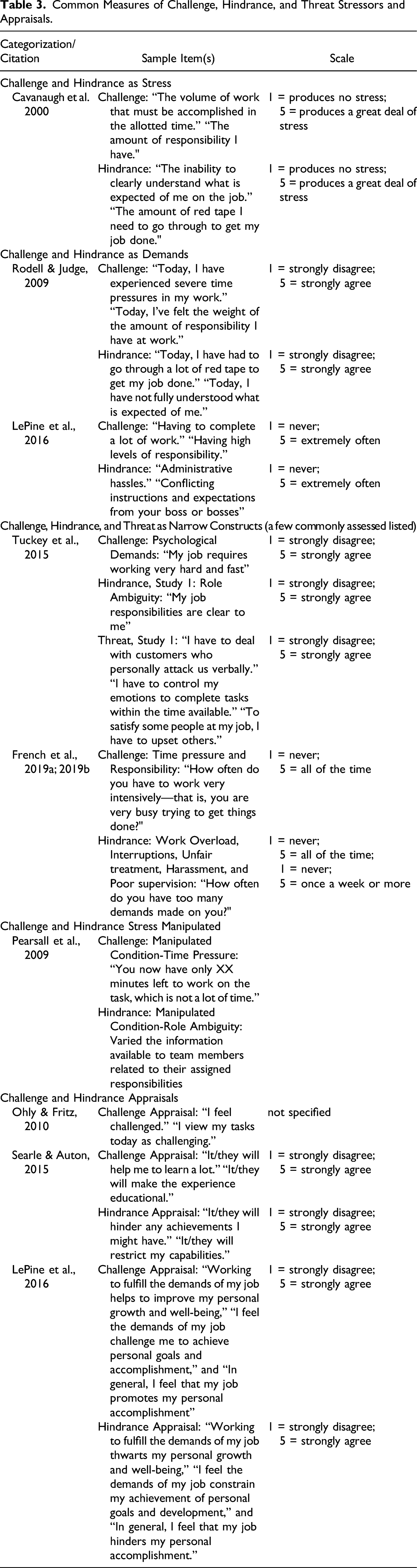
Common Measures of Challenge, Hindrance, and Threat Stressors and Appraisals.
Measurement with Challenge and Hindrance Scales
Cavanaugh et al. (2000) developed the first instrument to measure challenge and hindrance stressors. It asks respondents to evaluate demands (from existing measures) with respect to the amount of stress they produce (See Table 3 for sample items). Today, this measure represents the most widely used instrument to assess challenge and hindrance stressors, although while researchers have used the original scales (e.g., Boswell et al., 2004; Byron et al., 2018; Wallace et al. 2009), others have adapted them in various ways (e.g., Webster et al., 2010)
Rodell & Judge (2009) based their scales on a series of previously validated scales (Cavanaugh et al., 2000; Ivancevich & Matteson, 1980; LePine et al., 2004; Rizzo et al., 1970). In contrast to the Cavanaugh et al. (2000) measure, respondents were asked to rate the extent to which they agreed with the challenge and hindrance demand statements (see Table 3 for examples). The Rodell & Judge scales represent the second most widely used measure of challenge and hindrance stressors.
Later work on the challenge and hindrance dimensions provided measures that represented the construct in a more comprehensive way (LePine et al., 2016; Zhang et al., 2014). For example, LePine et al. (2016) utilized a refined measure of challenge and hindrance stressors to more fully capture recent research on the dimensions of the challenge and hindrance stressors (Podsakoff et al., 2007). The items are measured with respect to frequency of the demand rather than the amount of stress produced by the demand.
Measurement of Narrow Stressors
In addition to measuring challenges and hindrances holistically, several researchers have relied on individual measures of stressors categorized by previous researchers (Cavanaugh et al. 2000; LePine et al., 2005; Podsakoff et al., 2007) as challenges and hindrances. Table 3 provides a sampling of some of the more commonly assessed stressors. As Table 3 indicates, there has been a great deal of variety in both the stressor represented as well as the measurement of that stressor. The extent to which this variability has affected key findings is currently unknown.
Few studies have examined specific threat stressors within the tradition of the CHSF. Tuckey and colleagues (2015; 2017) are the exception. In their 2015 study, their measure of threat stressors comprised three dimensions: extreme customer-related social stressors (CSS), emotional demands, and role conflict. Additional work is needed to determine threat stressors within the workplace that are distinct from hindrance stressors.
Challenge and Hindrance Stressor Manipulations
A few studies have manipulated challenge and hindrance stressors in laboratory settings. As one example, Pearsall et al. (2009) manipulated the challenge stressor of time pressure and the hindrance stressor of role ambiguity. Edwards et al. (2014) manipulated a condition of gains to simulate a challenge stressor and of loss to simulate a hindrance stressor.
Measurement of Challenge, Hindrance, and Threat Appraisals
There have been a number of challenge and hindrance appraisal measures developed over the years and a variety of ways in which appraisals have been utilized (see Table 3 for details). Searle and Auton (2015) developed and validated challenge and hindrance appraisal scales that were generated from published definitions of challenge and hindrance (especially Cavanaugh et al., 2000 and Lazarus & Folkman, 1984), taking care to minimize conceptual or semantic overlap with work characteristics or emotional or behavioral stress responses. The Searle and Auton scales are the most widely used challenge and hindrance appraisal measures in the literature to date. A more recent measure of challenge and hindrance appraisal was developed by LePine et al. (2016) based on descriptions of the appraisal process described by Lazarus and Folkman (1984) and the items used by LePine and colleagues (2005) for their content validity check.
Threat appraisals have only recently been used within the CHSF. The most common measure appears to be the three items developed by Feldman et al. (2004) and used by Tuckey et al. (2015) and Espedido and Searle (2018). Additional construct development is needed to determine a clear distinction between hindrance and threat appraisals.
The Role of Context in the Stress Process
Finally, I overview the importance of context in the challenge-hindrance stress and appraisal process. As previously noted, research suggests that context impacts the appraisal and consequences of stressors. Not only is a subset of challenge stressors (e.g., work pressure) sometimes perceived as more hindering than challenging, but a subset of hindrance stressors (e.g., emotional demands) are sometimes perceived as more challenging than hindering (e.g., Bakker & Sanz-Vergel, 2013) across some occupations. A closer examination of the causes and consequences is necessary to support the growth, development, and well-being of workers.
For example, Bakker and Sanz-Vergel (2013) found, in a study with home healthcare nurses, that work pressure (typically categorized as a challenge stressor) undermined the effect of personal resources on weekly well-being, while emotional demands strengthened the effect. As another example, Stiglbauer and Zuber (2018) found, in a sample of schoolteachers, that time pressure was rated as a hindrance stressor rather than a challenge stressor. Work and time pressure may be unique in that their focus is on task completion, and not necessarily on relationship building within the work environment. A common coping response to work and time pressure is working faster and/or longer. In a study conducted by Baethge et al. (2019), working faster and longer in response to time pressure impacted the effects of time pressure on irritation and engagement. Specifically, time pressure was positively related to irritation only under conditions of working faster. Moreover, time pressure related positively to engagement only when employees did not work longer. These findings may indicate that work and time pressure undermine relationship building (patient and student care) through the need to work faster and longer, thus neglecting important relationship building activities.
Future research is needed to expand on the role of context in the CHSF to determine demands that may be uniquely important for performance in subsets of jobs (e.g., relationship building for nurses) that may impact the appraisal of challenge and hindrance demands.
Future CHSF Research Summary
In summary, Figure 1 provides a roadmap for future research that builds upon assumptions of the CHSF, the underlying nature of the stressor constructs, and the role of context in the stress process to provide guidance for how the stress process impacts the performance, growth, and well-being of individuals. As highlighted above, research on the appraisal of job demands may be important for understanding the impact demands have on the affective/motivational response to those demands. Although research has concluded that the appraisal process can be positively or negatively impacted by situational factors and individual attributes, we are in the infancy of understanding these moderating conditions and how perceived personal resources may alter the outcome of the appraisal process. Researchers should not only continue to uncover potential moderating factors, the personal resources they provide, and their boundary conditions, but should examine the potential malleability of the demand-appraisal relationship with respect to these moderators to uncover new insights into positively impacting the appraisal process and thereby positively impacting engagement and resource gain while counteracting disengagement and resource loss at the outset of the demand.
Moreover, although recent research has provided valuable insights into the affective/motivational resources associated with appraisals, research is needed to further explore the “black box” of resource dynamics to more directly examine the impact of the gain of resources through engagement that positively impacts performance, growth, and well-being and loss of resources through disengagement and/or depletion that negatively impacts performance, growth, and well-being, and the interplay between the two. Although hindrance and threat appraisals appear to be more straightforward with respect to affective/motivational responses and resource dynamics, we have little understanding of the complexities of the offsetting motivating and depleting effects of challenge demands and appraisals. Research indicates that challenge demands are positively related to positive motivational forces that drive performance (e.g., LePine et al. 2005) and growth (e.g., Kim & Beehr, 2020; Prem et al., 2017), but given that challenge demands are positively related to strains, the link to well-being is complex. Research that examines depletion the occurs from lack of recovery may be particularly important for understanding these effects (Bennett et al., 2017). Research should examine these complexities to provide guidance on how to enhance the gains and minimize the losses of challenge demands to positively promote the performance, growth, and well-being of individuals.
With respect to the underlying nature of the stress constructs and their appraisal, the extension of the CHSF to include threat demands and appraisals is an important development. Indeed, incorporating threat demands and appraisals may be needed to understand how abusive supervision, discrimination, and bullying in the workplace can have a greater negative impact on outcomes than the more mundane hindrance demands. Threat demands are a part of the workplace that may disproportionally impact certain segments of the population more than others (e.g., women, People of Color, LGBTQA+). Developing validated measures of threat demands and appraisals, examining the situational factors and individual attributes that impact perceptions of loss or harm, and studying the impact these perceptions have on affective and motivational responses will shed a spotlight on the detrimental impact of threat demands and provide potential solutions for removing, managing, or overcoming threat demands that impact the performance, growth, and well-being of individuals.
Lastly, a better understanding of the role of context may provide additional insights into the relative importance of certain demands unique to one’s job (e.g., relationship-building). The impact that uniquely important demands may have on the appraisal process and the affective/motivational response will provide a more nuanced understanding of the potential impact of the demand on performance, growth, and well-being.
In conclusion, the topic of workplace stress is as important as ever. For over 20 years, our understanding of the nature and functioning of the demands which are believed to ignite the stress process has been guided by the CHSF. However, as I have illuminated in this integrative conceptual review, although research on the CHSF has produced many important insights, our understanding of workplace stressors as viewed from this lens, is far from complete. This review and heuristic model provide a set of reasonable steps needed to clarify the CHSF and the processes by which stressors are differentially related to important individual and organizational outcomes.
Footnotes
Declaration of conflicting interests
The author(s) declared no potential conflicts of interest with respect to the research, authorship, and/or publication of this article.
Funding
The author(s) received no financial support for the research, authorship, and/or publication of this article.
