




Abstract

Several years ago, I (Diane) was talking to a then-Editor of the Academy of Management Review. We were jointly commiserating about some issue in the field that frustrated and baffled us both. I jokingly said that I wished a journal was brave enough to host a section called “What’s Up With That?”—a place where authors could point out (or vent about!) something problematic in the field. Well, … it seems like Group & Organization Management has answered that wish—although they’ve come up with a much better title … GOMusings.
In an earlier Musing, Kevin Cruz (2021) called attention to external validity and appealed for more work generalizing results to multiple organizations, industries, professions, and groups. In this Musing, we want to call attention to something that has bothered us for years—namely, the lack of empirical research showing sex differences in organizational citizenship behavior (OCB). Our contention is that, due to being developed on predominantly male samples, our OCB scales are gendered—disproportionately representing stereotypically male citizenship behaviors.
I (Diane) initially became interested in this topic as a graduate student when two female professors gave me a transcript of a keynote speech (Huff, 1990) from a women and work conference called “Wives – of the Organization.” It was about how women seem to take on the “wifely” role in organizations and attend to the large subset of invisible, but needed, organizational maintenance activities. This is the same phenomenon described in recent popular press articles about “office housework” (e.g., Carpenter, 2017; Corbett, 2021)—including one published in the New York Times (Grant & Sandberg, 2015). They all describe the time-consuming ways that women help at work—assisting others, serving on committees, organizing events—activities that take time and often go unnoticed and unrewarded. Any academic who knows the literature knows that these articles are talking about organizational citizenship behavior (Organ, 1988; Smith, Organ, & Near, 1983). Clearly, the term isn’t sexy enough for the Times (which we totally get) but that’s what it is. We know that OCB makes groups and organizations more effective (MacKenzie, Podsakoff, & Podsakoff, 2018) and that such helpful employees are referred to as “good soldiers” (Bateman & Organ, 1983; Organ, 1988).
If Everything You See in the World Runs Counter to a Set of Research Results, Then Maybe It’s Time to Question the Research
When I (Diane) started working in the area of OCB, there was only one small (55 studies) meta-analysis (Organ & Ryan, 1995) showing no sex differences in OCB. I always rolled my eyes at that finding. Any semi-conscious human being can look around the workplace and see that women do more OCB than men. In fact, that’s the reason I became interested in OCB—I saw the cost to women’s careers all around me. In academe, the most helpful faculty members (generally female) had fewer publications than their male counterparts 1 and took longer to be promoted. In consulting, it was the female consultants who were doing a lot of helping—which came at a cost to their billable hours and kept them from advancing as quickly as their male colleagues (with the ironic twist that their OCB often benefitted these same male colleagues).
Sex Composition of Measure Development Samples Used in Common Organizational Citizenship Behavior Scales.
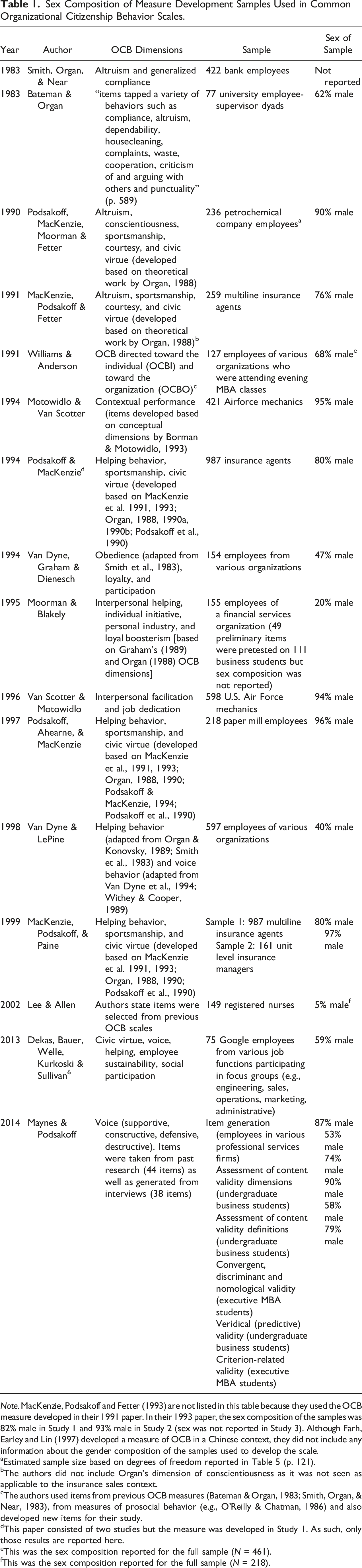
Note. MacKenzie, Podsakoff and Fetter (1993) are not listed in this table because they used the OCB measure developed in their 1991 paper. In their 1993 paper, the sex composition of the samples was 82% male in Study 1 and 93% male in Study 2 (sex was not reported in Study 3). Although Farh, Earley and Lin (1997) developed a measure of OCB in a Chinese context, they did not include any information about the gender composition of the samples used to develop the scale.
aEstimated sample size based on degrees of freedom reported in Table 5 (p. 121).
bThe authors did not include Organ’s dimension of conscientiousness as it was not seen as applicable to the insurance sales context.
cThe authors used items from previous OCB measures (Bateman & Organ, 1983; Smith, Organ, & Near, 1983), from measures of prosocial behavior (e.g., O’Reilly & Chatman, 1986) and also developed new items for their study.
dThis paper consisted of two studies but the measure was developed in Study 1. As such, only those results are reported here.
eThis was the sex composition reported for the full sample (N = 461).
fThis was the sex composition reported for the full sample (N = 218).
Here’s what I (Kylie) found … One of the original OCB scales 2 (P. Podsakoff, MacKenzie, Moorman & Fetter, 1990) was developed in a petrochemical company with a sample composed of 90% men. Later OCB scales (e.g., MacKenzie, Podsakoff, & Fetter, 1991; P. Podsakoff & MacKenzie, 1994) used the same scale items with samples that were 76% and 95% male, respectively. Motowidlo and Van Scotter (1994) developed their measure of contextual performance, often used to measure OCB, on a sample of Airforce mechanics that was 95% male. The Van Scotter and Motowidlo (1996) scale was developed on a sample of mostly male (94%) Airforce employees. Williams and Anderson’s (1991) measure of OCBI (OCB directed toward individuals) and OCBO (OCB directed toward the organization) pulled from prior OCB scales (e.g., Bateman & Organ, 1983; Smith, Organ, & Near, 1983) and was based on a sample with 68% males. Lee and Allen (2002) developed a measure based on a mostly female sample (95%) but they used existing OCB scale items and didn’t qualitatively explore women’s OCB. A new (er) employee voice scale (remember that voice started as a dimension of OCB) continued this biased pattern and developed items from qualitative interviews with a … you guessed it! … 87% male sample and continued with mostly male samples in their scale development process (Maynes & Podsakoff, 2014). Here’s where we’d like to give a shout-out to Linn Van Dyne. The two OCB scales developed with the most gender-balanced samples were the original measure of voice (40% male, Van Dyne & LePine, 1998) and a less-used measure of OCB (47% male, Van Dyne, Graham, & Dienesch, 1994).
Theoretical Reasons for Women’s Greater Organizational Citizenship Behavior
Alice Eagly’s social role theory (Eagly, 1987; Eagly & Wood, 2012) provides the most compelling theoretical case that women do more OCB than men. Society’s gendered division of labor means we expect people to behave in ways that align with their biological sex. Because women are overrepresented in caretaking roles (both in terms of family roles as well as in occupational roles such as teaching and nursing), society ascribes communal characteristics (e.g., being helpful, supportive, altruistic, sensitive) to women (Eagly, 1987;Diekman & Clark, 2015; Eagly & Wood, 2012). Because of this, we expect women to care for the emotional and personal needs of others, to deliver routine types of personal service, and to support others in reaching their goals (see Diekman & Clark, 2015 for a review; Eagly & Crowley, 1986). We know that women face higher OCB expectations than men (Allen & Rush, 2001; Kidder, 2002) and are expected to engage in more time-consuming types of OCB (Allen & Rush, 2001; Farrell & Finkelstein, 2007; Heilman & Chen, 2005). By the way, we know that some people can get frustrated with the field’s focus on theory—but this is exactly why theory is important. We can be overly swayed by research results—even when they run counter to what we see all around us.
If we still haven’t convinced you, here’s some empirical work that supports our contention. Women tend to be higher on characteristics (i.e., empathy, communality) associated with OCB and other helping behaviors (Eagly, 2009; Eagly & Crowley, 1986; Eagly & Diekman, 2003; Diekman & Clark, 2015). The empathy-altruism hypothesis (Batson, 1997, 2011) is exactly as it sounds … if you’re more empathetic, you’re more likely to engage in OCB and other helping behavior (see meta-analysis by Eisenberg & Miller, 1987; Joireman, Kamdar, Daniels & Duell, 2006; McNeely & Meglino, 1994; Mehrabian & Epstein, 1972). Women receive more requests for help than men do (e.g., Babcock, Recalde, Vesterlund, & Weingart, 2017; Mitchell & Hesli, 2013). In one study, women reported receiving 378 new work activity requests across a period of 4 weeks compared to 118 for men (O’Meara, Kuvaeva, Nyunt, Waugaman, & Jackson, 2017). Oh … and guess what? If you’re wondering why women don’t ‘just say no’—there are reasons for that too. Beyond being less rewarded for OCB than men (Allen, 2006; Allen & Rush, 2001; Lovell et al., 1999), women also face negative repercussions when they don’t help (e.g., Heilman & Chen, 2005). And, when women try to say no, others make it difficult—often repeating the request in a more insistent or forceful way (Eckert & McConnell-Ginet, 2013; Misra, Lundquist, Holmes & Agiomavritis 2011).
Organizational Citizenship Behavior and the Terrible, Horrible, No Good, Very Bad Scales
Yes, … that’s a nod to Viorst’s (1972) classic children’s book. No, it’s not that the scales are horrible but there are a lot of no good, very bad things that result from using poor scales. Sigh. We don’t have the space to go into great depth so we’ll mention just a few … #1 is construct validity, which is whether the operationalization measures the intended construct (Cook & Campbell, 1979; Cronbach, & Meehl, 1995); it determines whether we can draw valid conclusions from the research (Cronbach & Meehl, 1955; Hinkin, 1995). This is a BIG deal (Schwab, 1980) and the item generation stage is critical to “adequately capture the specific domain of interest …” (Hinkin, 1995, p. 969). Problems with construct validity snowball with regard to other types of validity (Schwab, 1980). For instance, the excluded part of OCB represents systematic bias (i.e., systematic error), which is a serious problem (Fiske, 1982) and can lead to misleading conclusions (Campbell & Fiske, 1959)—such as the lack of sex differences in OCB! Another issue is that criterion-related validity (i.e., the relationship between OCB and other independent or dependent variables) is also affected—which means that our current research does not adequately capture the consequences for women, such as negative career outcomes (e.g., Bergeron, 2007; Bergeron, Ostroff, Schroeder & Block, 2014; Bergeron, Shipp, Rosen & Furst, 2013) or work-family conflict (Bolino, Flores, Kelemen & Bisel, 2022). Finally—and what’s really frustrating—is that our current literature gives a skewed and inaccurate picture of how men and women contribute to organizations. At a minimum, this is yet another domain (e.g., Joshi, Son & Roh, 2015) in which women are undervalued for their work. 3
Current Organizational Citizenship Behavior Scales—What Might Be Missing?
Hinkin (1995) notes that an important issue impacting scale development is the sample, “… which should be representative of the population that the researcher will be studying in the future and to which results will be generalized” (p. 971). While we recognize that measurement scales are not designed to capture every behavior, they are expected to capture a representative slice of the behaviors under investigation with a sample that is representative of the population of interest (Ghiselli, Campbell, & Zedeck, 1981; Hinkin, 1998). Given what we’ve said above, it seems that women’s specific types of OCB are largely absent from most OCB measures. So, as Nunnally (1967) noted, “ … the problem is not that of searching for a needle in the haystack, but that of searching for a needle that is not in the haystack” (p. 97, emphasis added).
Here are a few ideas about what might be missing … First, we noticed that several OCB measures have items such as “participation in meetings” or “attendance at functions or events” (Lee & Allen, 2002; P. Podsakoff & MacKenzie, 1994; P. Podsakoff et al., 1990; Williams & Anderson, 1991). But none of the scales distinguish between attendance at events and the organization and planning of such events—which women are more likely to take on (Babcock et al., 2018; Bergeron, Cooper, & Rochford, 2018; Grant & Sandberg, 2015; Jang, Allen, & Regina, 2021; Williams, 2014). Is showing up to an event for an hour or two equivalent to the days, weeks or months spent planning and organizing such an event? We think not. Second, current OCB measures seem focused on task-related OCB. However, women are more likely than men to engage in non-task-related OCB, particularly behaviors around supporting interpersonal relationships and building community (Bergeron et al., 2018; Carpenter, 2017; Corbett, 2021; Huff, 1990). Only two current scales include items related to social support (i.e., Lee & Allen, 2002; Williams & Anderson, 1991). Finally, women seem to take on more of the workplace drudgery—serving on time-consuming, low-ranking committees, coordinating often-unrecognized mentoring or internship programs, and other actions that make up an “invisible workload” (Babcock et al., 2018; Miller, 2020; Williams, 2014).
Here’s something else we have to point out. You would think (wouldn’t you?) that since most of the scales were developed on predominantly male samples (i.e., biased toward men and therefore overrepresenting men’s OCB), that meta-analyses would show sex differences in favor of men, right? But is that the case? No. No, it’s not. There are NO sex differences in the scales. This means that women are not doing less OCB—despite the fact that current scales do not capture their specific types of OCB. In fact, it seems to suggest that women do all of the OCB that men do—as well as the types of OCB engaged in mostly by women. And yet, because the scales are biased, that fact isn’t recognized. Isn’t that crazy? It reminds us of the well-known quotation “Teach us to give and not to count the cost” (which might have been St Ignatius but it also could have been from a Dilbert cartoon). Regardless, we think it’s time to start “counting the cost” because women bear far too much of the “helping” burden in organizations and in society.
So … Where Do We Go From Here? A Call to Action
Between 1983 and today, thousands of articles on OCB have been published—many of them using sex-biased OCB scales. As a field, we may need to come to terms with the fact that we have spent decades building a foundation of OCB knowledge using unsound bricks. Our purpose in this Musing is to point out a methodological problem that has hindered research on gender and OCB for decades and to issue a call to action. Have we done everything we’ve wanted in this area yet? No—not even close. But that’s one of the reasons why we feel this Musing is so important. It can at least “get the word out” so that other frustrated scholars can act. As a first step, we need qualitative work 4 to explore women’s OCB—both in terms of quality and quantity—and that work needs to include women of color. 5 Developing a gender-balanced scale should be a priority for those interested in citizenship behavior. As Korman (1974) observed, “the point is not that adequate measurement is ‘nice.’ It is necessary …. Without it, we have nothing” (p. 194). Although OCB research has been ongoing for decades, we still have yet to answer the question of whether or not there are sex differences in OCB. Although the empirical results won’t be in for a while, we’d bet our money that “organizational wives” do more OCB than “good soldiers.”
Footnotes
Acknowledgments
We would like to acknowledge Dr. Lucy Gilson and the helpful comments of two anonymous reviewers.
Associate Editor: Thomas Zagenczyk
Declaration of Conflicting Interests
The author(s) declared no potential conflicts of interest with respect to the research, authorship, and/or publication of this article.
Funding
The author(s) received no financial support for the research, authorship, and/or publication of this article.
