



Abstract
A central idea in the leader-member exchange (LMX) literature is that leaders, due to the limited organizational and personal resources available to them, often struggle with developing and maintaining high-quality exchange relationships with all of their members. As a natural consequence, leaders typically form high-quality relationships with a select few members—often those who seem likable or are similar to the leader—while maintaining formal and distant relationships (i.e., low-quality LMX) with others. This form of differentiated treatment of members creates tensions in team dynamics. In this paper, we propose that leaders can mitigate the downsides of leader-member exchange differentiation (LMXD) for team dynamics by being more purposeful and strategic in how they differentiate in their treatment of members. Specifically, we posit that when leaders strategically develop high-quality LMX relationships with key members—individuals occupying influential positions in team social networks—such key members will engage in behaviors that buffer the negative impact of LMXD on team dynamics. Our framework integrates LMX theory with perspectives from social networks research to illustrate how strategic differentiation influences task and relational team dynamics. Finally, we discuss recommendations for empirically testing, theoretical extensions, and practical implications of this framework.
Leader-member exchange (LMX) theory provides important insights into the benefits of high-quality leader-member relationships (Martin et al., 2016; Whitney et al., 2022). LMX, from a relational perspective, is generally understood as the member’s perception of the relationship quality between the leader and member (Dulebohn et al., 2012; Gottfredson et al., 2020). When members have high LMX with their leaders they are part of the leaders’ in-group and share mutual trust, respect, loyalty, openness, honesty, and obligation. In contrast, when members have low LMX with leaders, they are part of the leader’s out-group and their relationships are more socially distant and primarily based on formal employment contracts focusing on immediate reciprocation of material resources, benefits, and pay (Liden et al., 1997). Although the benefits of high LMX are apparent and leaders should strive to develop strong relations with all team members, a core premise of LMX theory is that leaders are often unable to develop high-quality relationships with every member; this is largely based on: (a) the reality that members bring varying levels of skills, drive, and eagerness to work and to the relationship, and (b) the limited personal (e.g., time, social, emotional) and organizational resources that leaders have to invest in relationship development (Erdogan & Bauer, 2014; Henderson et al., 2009). Consequently, leaders form interpersonal relationships with members that vary in their quality. Such variability in LMX quality among team members, i.e., LMX differentiation (LMXD), is known to have downsides for team dynamics (Yu et al., 2018), stemming from team members’ innate drive towards social comparisons with similar others (Festinger, 1954; Martin et al., 2018). That is, leaders’ preferential treatment towards certain team members may trigger perceptions of unfair treatment of others and negatively affect team members’ emotions (e.g., jealousy and contempt; Tse et al., 2013), self-efficacy (Tse et al., 2012), and team satisfaction (Hu & Liden, 2013), thereby hindering effective task completion and disrupting interpersonal dynamics (Liu et al., 2014). Indeed, this assertion finds support in a prior meta-analysis on LMXD (see Yu et al., 2018).
Scholars contend that LMXD is “a fact of organizational life” (Erdogan & Bauer, 2010, p. 1105) and more of a rule than an exception in the workplace (Erdogan & Bauer, 2010, 2014; Liden & Graen, 1980). Given this reality, it is important that scholars and organizational leaders alike obtain an understanding of how to mitigate the downsides of LMXD while also realizing its upside potential. In this paper, we integrate theories of LMX and social networks to explicate how this can be achieved. Although team dynamics are influenced by leaders developing differentiated relationships with members—high-quality relationships with a select few members while maintaining more formal, arm’s-length relationships with others—we theorize that the downsides of such differentiation for team dynamics can be mitigated if leaders strategically select and develop high-quality relationships with individuals who hold positions of influence in their team’s social networks (henceforth referred to as key members). We argue that leaders can mitigate the detrimental effects of LMXD through purposefully and strategically developing high-quality LMX with key members who are themselves well-connected in teams (i.e., high prestige) and who serve as links between team members who are otherwise weakly connected or unconnected (i.e., high brokerage). Overall, by being more strategic in determining with whom they develop high-quality relationships, leaders can not only maximize the utility of their limited and valuable resources but also alleviate the problematic consequences of LMXD for team processes (see Figure 1 for our theoretical framework). Theoretical Framework.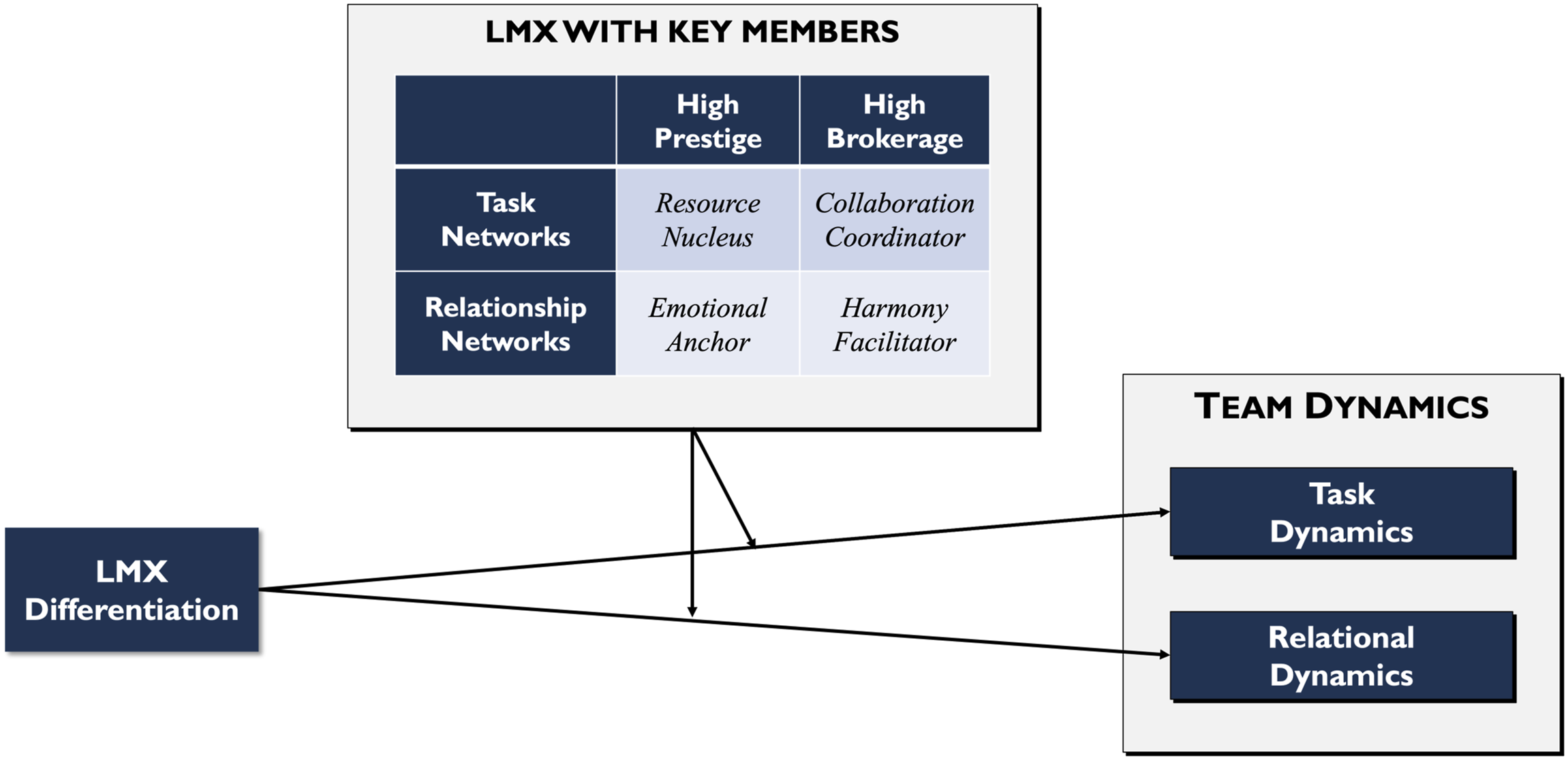
Our theoretical framework makes important contributions to the literature. First, we expand the boundaries of theorizing on LMXD by moving beyond just the degree of differentiation but focusing on with whom leaders develop high LMX within teams, echoing the notion that “not all differentiation is the same” (Seo et al., 2018, p. 479). To date, much of the literature on LMXD focuses on either the amount or degree of LMXD and discusses whether leaders should differentiate (i.e., how much differentiation matters) (Buengeler et al., 2021; Martin et al., 2018). Although this line of inquiry provides valuable insight into the phenomenon, it fails to explore how leaders should differentiate by examining the specific pattern or distribution of LMX relationships within teams. This is important because even with the same amount of LMXD (i.e., the same mathematical values), different patterns of LMXD in teams can change the degree to which LMXD influences team processes (Buengeler et al., 2021). For instance, recent research found that LMXD has stronger negative impacts on teams when teams are split into two comparable sizes (Li & Liao, 2014; Seo et al., 2018) because the us-versus-them mentality becomes more salient (Lau & Murnighan, 2005). Our approach advances the how of LMX differentiation to explore the who of LMXD—it not only matters how leaders differentiate but also with whom they form high-quality relationships. We challenge the implicit assumption in the LMXD literature that leaders develop high-quality LMX relationships with members who can carry forward their agenda; this assumption is tenuous as leaders may naturally develop and maintain high-quality relationships with members they like and are similar to them (homophily effect) (McPherson et al., 2001). Instead, we theorize this as a pivotal aspect in determining whether LMXD positively or negatively affects team dynamics.
Second, we take a social networks approach to portray how intra-team member relationships that surround leader-member dyads in teams impact the degree to which LMXD influences team dynamics, thus answering the call by scholars (e.g., Carter et al., 2015; Sparrowe, 2014) to integrate social networks and leadership (LMX) literature. Third, though team-level research often treats team members as a collective of undifferentiated individuals that can be activated and influenced by leaders’ traits and behaviors (Weber & Moore, 2014), our research follows the example of recent studies highlighting that certain team members may exert disproportionally stronger impacts on team dynamics (Humphrey et al., 2009)—especially those occupying key positions in intra-team social networks (Sherf et al., 2018). We highlight the theoretical and practical implications of treating team members as differentiated individuals and examining impactful members’ (i.e., key members) roles in influencing team dynamics.
Theoretical Background: LMXD and Team Dynamics
LMXD is defined as the degree of within-team variation in leader-member relationship quality that exists when leaders form different quality LMX relationships with different team members (Erdogan & Bauer, 2010). We therefore situate our theoretical framework at the team-level to explore LMXD’s influence on team dynamics. Teams are intricate social systems that consist of members working together towards a collective goal (Ilgen et al., 2005; McGrath et al., 2000). Task-focused team dynamics consist of transition processes (wherein teams identify their mission, determine and prioritize both broader and smaller objectives, and formulate strategies to achieve their objectives) and action processes (wherein teams directly engage in activities that accomplish goals, such as monitor their goal progress, coordinate task flows, and offer feedback and instrumental support). Concurrently, teams must also contend with relational dynamics within them which consist of interpersonal processes including conflict management, cohesion and motivation building, and affect management (Marks et al., 2001).
LMXD and Task-Focused Team Dynamics
When it comes to task-focused team dynamics, teams typically begin with transition processes which are then followed by action processes, though, teams may move back and forth between these processes when accomplishing team goals (Marks et al., 2001). As such, team communication and coordination are crucial during this stage. However, for teams with high LMXD, instead of coordinating and communicating, team members may be motivated to compete. This is because the unequal treatment from leaders often means that there will be uneven distributions of resources and rewards (Liao et al., 2018). Such circumstances create an incentive for individuals to excel beyond others’ performance and compete for a greater portion of resources and attention (Tjosvold, 1986). When faced with infighting within a team, individuals are prone to prioritize tasks and goals that benefit their personal performance and interests over collective goals that would benefit the team as a whole (Sinclair, 2003). Members may develop divergent work values, different interpretations of the mission, as well as varying opinions regarding what the team’s real goals and tasks ought to be and how team tasks should be prioritized and achieved (Jehn & Mannix, 2001). Team members may subconsciously or deliberately inhibit others’ performance by passively not cooperating, not sharing valuable feedback, or withholding information (Zhao et al., 2019). In extreme cases of differentiation, team members may even actively interfere, obstruct, and sabotage other members’ work to appear more effective than other team members (Tjosvold, 1986). Instead of looking out for others and monitoring resource availability for the team, team members may act in self-serving ways in trying to procure resources for themselves. Hence, high LMXD in teams may hinder progression towards team goals and altogether disrupt task-related dynamics.
LMXD and Relational Team Dynamics
All the while teams are working on their day-to-day tasks, they must simultaneously contend with the relational dynamics of the team as these too play an important role in team success. Relational dynamics describe the processes and activities through which teams resolve conflict and disagreements, maintain harmony, and develop a sense of cohesion and shared commitment towards each other (Courtright et al., 2015; Marks et al., 2001). However, because individuals are innately motivated to compare themselves with similar others around them (Festinger, 1954), leaders’ preferential treatment towards certain members is likely to disrupt social harmony and induce negative sentiments (e.g., evaluation, attitudes, emotions) toward one another. This may eventually introduce relational boundaries between in-group and out-group members, creating higher levels of relationship conflict tensions (Choi et al., 2020; Xu et al., in press). When comparing themselves to high-LMX members, low-LMX members may feel mistreated, neglected, and disrespected especially when they “fail” the competition for resources and receive fewer benefits from the leader (Erdogan & Bauer, 2010; Liden et al., 2006; Tse & Troth, 2013). Low-LMX members may perceive the differential treatment as unfair and experience emotions such as envy, depression, jealousy, shame, hostility, and resentment towards high-LMX members as a result of upward social comparison (Choi et al., 2020; Matta & Van Dyne, 2020). This type of social comparison, in turn, harms social integration and cohesion of the team (Kabanoff, 1991). Meanwhile, high-LMX members may experience downward social comparison tension that induces emotions such as contempt (Tse et al., 2013), schadenfreude (Dvash et al., 2010), pride (Webster et al., 2003), and delight in superiority (Lockwood, 2002), especially when a team member perceives that he/she is quite different from a referent colleague (e.g., a low-LMX member) (Matta, 2016). Therefore, when LMXD is high and team members are competing for the benefits of high-LMX relationships, members are likely to experience negative sentiments towards one another and experience higher levels of team conflict and negative emotions.
A Strategic Approach to LMXD: Incorporating Social Networks Perspectives
Our preceding discussion on the consequences of LMXD for team dynamics highlights its potential downsides. Although leaders should strive to establish high-quality LMX with every member, they may find that it is often not possible to do so (Erdogan & Bauer, 2010). Instead, because of the finite personal and organizational resources available to them to invest in their interpersonal relationships with team members, leaders naturally progress towards developing distinct exchanges with each team member resulting in LMX differentiation (Gottfredson et al., 2020; Yu et al., 2018). Given this reality, we posit that leaders who are strategic in the way that they differentiate are likely to be more effective at leading their teams. More specifically, we argue that leaders can benefit from being strategic in their choice of members with whom they develop high-quality LMX relationships and, in doing so, can mitigate some of the downsides associated with LMXD. It is important to note that we are not suggesting that leaders should disregard the rest of the team; rather, given the constraints that leaders face, the framework we propose provides a more realistic and reasonable approach to LMXD in real team settings.
To build our framework, we depart from traditional thought on team processes wherein scholars treated teams as a collection of undifferentiated or interchangeable individuals, each consisting of members ostensibly having identical levels of influence on their teams (Humphrey et al., 2009). Instead, we take a social networks approach to team dynamics which argues that certain members may be more critical and valuable to their teams by exerting a stronger influence on team outcomes (Sherf et al., 2018; Weber & Moore, 2014); this influence stems from certain individuals occupying powerful positions in their team’s social network. We refer to these individuals as key members and define them as those who hold influence among team members due to their advantageous positions in team social networks, independent of their relationship with the leader. Occupying advantageous structural positions allows key members to gain access to novel information and control over valuable resources (Burt, 2004; Pfeffer, 1981), thus providing the foundation for key members to exert strong influences on their teams (Brass & Burkhardt, 1993).
The idea of certain members having disproportionately higher contributions to, or influence on, their teams and colleagues is not entirely new to the literature. For instance, the literature discusses star employees who have disproportionately higher performance, visibility, and social capital than other members of the team (Call et al., 2015). Being designated as a star employee, however, often comes with the precondition of superior individual performance; this departs from our operationalization of key members who may or may not be exceptional performers but are nevertheless deeply connected to the flow of information and influence in teams. Furthermore, partly due to their superior performance standards, research suggests that star employees may be less willing to cooperate or share information that would ultimately help the group (Groysberg et al., 2011; Overbeck et al., 2005). Therefore, star employees may not be ideal candidates to help leaders communicate vision, seek alignment, and foster cohesion among their team members.
In another line of research, scholars have explored the role of surrogates (Galvin et al., 2010) and squires (e.g., Weber & Moore, 2014)—team members who utilize their relationships with leaders to help shape distant followers’ positive perceptions of leaders through enacting surrogate behaviors. Examples of this include making positive statements about the leader’s capabilities and past behaviors and expressing support for the leader’s strategic goals and long-term vision. Surrogates may also defend the leader by providing context to the leader’s hard decisions, and, if necessary, even concealing the leader’s deficiencies. Finally, surrogates may model followership by being committed to leaders’ requests and displaying loyalty (Galvin et al., 2010). We adopt the surrogate behaviors framework to discuss the role of key members in team networks, though, our conceptualization of key members differs in one critical way—by introducing the possibility of negative behaviors (e.g., sabotaging members’ perception of leaders), which could occur when key members feel undervalued, delegitimized, or slighted. Following our definition of key members, we incorporate social networks research and consider both the types of networks as well as the network position a member occupies.
Incorporating Social Networks: Types of Networks
Reflecting the task-related and relational dynamics in teams, social network scholars often distinguish between two broad types of social networks: (a) task-related networks consisting of instrumental ties, and (b) relational networks consisting of expressive ties (Umphress et al., 2003). Task-related networks arise from formal task positions and sequence of work (i.e., one task must be done before initiating another task) or in an organic way based on how members decide to distribute work among themselves (Crawford & LePine, 2013). Therefore, task networks depict the relationships and social interactions through which members exchange job-related resources, information, professional advice, expertise, knowledge, ideas, political access, and materials (Ibarra & Andrews, 1993). Distinct from task-networks, relational networks usually form based on liking, similarities, intimacy, and emotive exchange, and therefore are less restricted by workflow (Zagenczyk et al., 2010). Through relational networks, team members can seek and provide social support, express personal feelings and interpersonal affect, and create a sense of belongingness with others (Umphress et al., 2003).
Incorporating Social Networks: Network Positions
We focus on two kinds of network positions that are particularly relevant to understanding the influence of key members in team dynamics. The first is prestige which is often operationalized using degree centrality—the number of direct ties—in social networks (e.g., Balkundi et al., 2009). Prestigious members (Member A in Figure 2) in task networks enjoy high levels of popularity, reputation, and influence (Chiu et al., 2017) and are frequently nominated by other members as individuals they would approach for task-related advice, information, resources, and support (Wasserman & Faust, 1994). Being integral to other members’ effectiveness allows prestigious key members to acquire novel information about team members’ work activities (Knoke & Burt, 1983; Reinholt et al., 2011), a more comprehensive picture of each team member’s expertise (Reagans et al., 2016), as well as greater control over the diffusion and flow of critical task-related resources (Schilling & Fang, 2014). Key members with high prestige in relational networks have the ability to directly provide social and emotional support to others and can help others access coping resources (Porter et al., 2019). Therefore, these individuals are effective not only in detecting weak spots in others’ work (Balkundi et al., 2009), but also in providing prompt solutions directly to team members. Example of Key Members in Team Social Networks.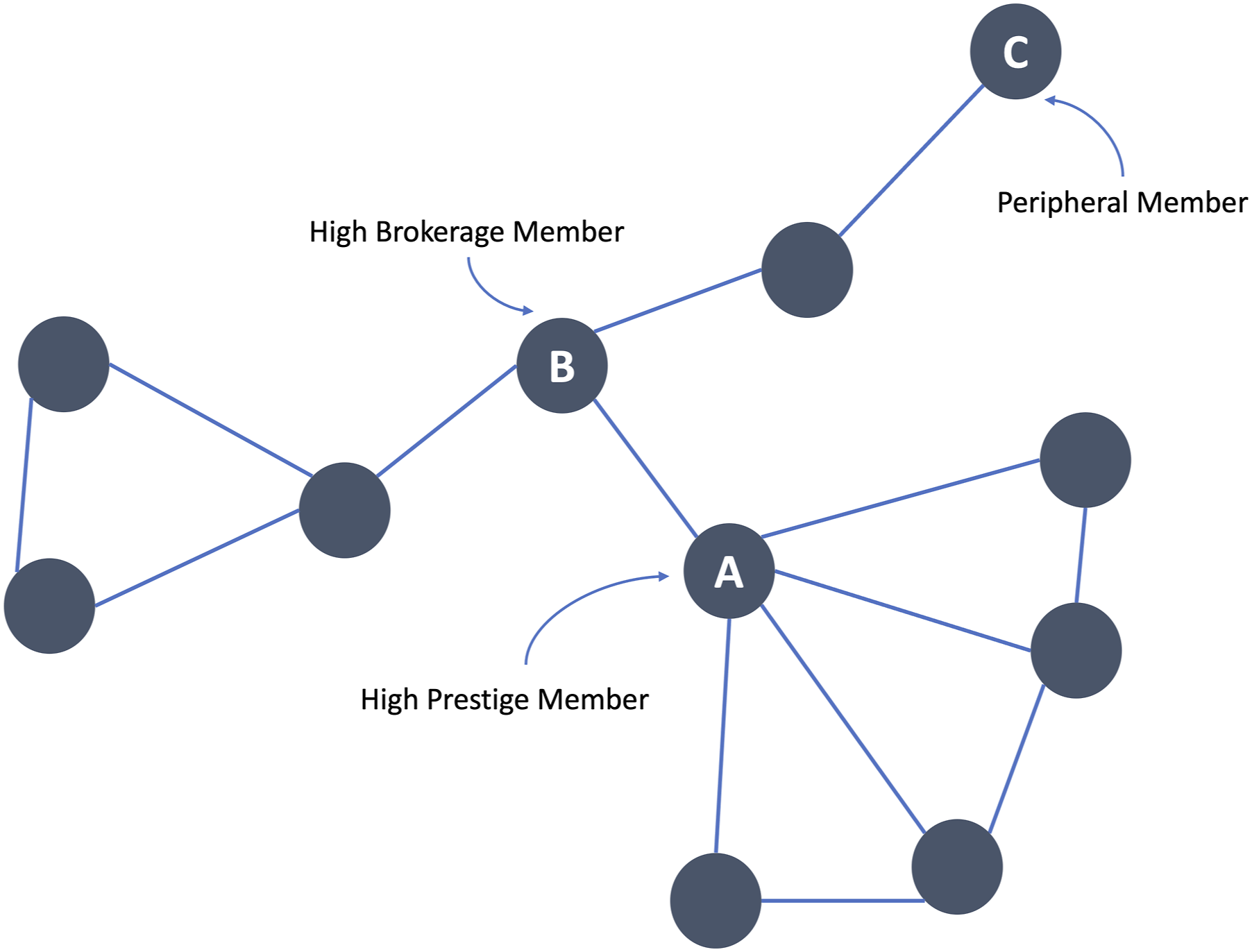
The second highly relevant network position is brokerage, which can be assessed using (the absence of) constraint, effective size, and betweenness centrality in social networks (Burt, 2015; Burt et al., 2013). Brokers (Member B in Figure 2) occupy bridging positions between individuals who are loosely connected or unconnected (Burt et al., 2013; Stovel & Shaw, 2012). In task networks, they can utilize information (e.g., advice, feedback) and incentives (e.g., resources, rewards) to connect team members with complementary expertise, goals, and interests and avoid the redundant use of resources (Li et al., 2018). They are also apt to influence how members interpret team events and interact with one another by transmitting and/or coordinating the flow of information in the team (Halevy et al., 2019; Kwon et al., 2020). Such activities make brokers critical in facilitating and integrating new ideas in teams (Lingo & O’Mahony, 2010). In relational networks, brokering members, as conduits of information, can control or distort the flow of gossip in teams (Feinberg et al., 2012). They also play a crucial role in monitoring emotional states and conflicts in teams and can intervene as mediators of others’ relationships “to save the group unity from the danger of splitting up” (Simmel, 1950, p. 154), help resolve conflict, and strive to maintain harmony in the team (Halevy et al., 2019).
In summary, by taking into account both the type of social network (task vs. relational) and the network position occupied by key members (prestige vs. brokerage), we put forth a 2 × 2 typology that highlights the strategic roles that key members are capable of playing as surrogates to mitigate the adverse effects of LMXD on team dynamics. The four types of key members include the resource nucleus (high prestige in task networks), collaboration coordinator (high brokerage in task networks), emotional anchor (high prestige in relationship networks), and harmony facilitator (high brokerage in relationship networks) (see Figure 1). In the following sections, we discuss why it is important to build high (as opposed to low) quality LMX with such key members.
LMX with Key Members
Prior research suggests that merely holding a favorable network position within a team does not guarantee that key members will engage in behaviors that benefit the leader or have a positive influence on their teams (Adler & Kwon, 2002; Anderson, 2008; Kehoe et al., 2018). We argue that two conditions must be met for key members to exert positive influence in their teams: (a) they must have the motivation to do so, and (b) they must have access to information and resources that can be leveraged to create value (Kehoe et al., 2018)—these can be realized when leaders develop high LMX with key members. 1
First, key members should have the motivation to engage in surrogate behaviors (Anderson, 2008; Reinholt et al., 2011). Key members possess significant influence over the flow of information and resources in the team’s social fabric based on their network position; this means that they have a great propensity for doing good, or, for doing harm (Uhl-Bien & Maslyn, 2003). Developing high-LMX with key members secures the likelihood that members will reciprocate their favorable treatment with surrogate behaviors that help the leader lead more effectively (Galvin et al., 2010; Harris et al., 2014). High-LMX relationships are characterized by high mutual trust, positive interactions, support, and great access to formal and informal resources (Graen & Uhl-Bien, 1991; Liden & Maslyn, 1998). High-LMX members also typically receive more training opportunities and core assignments from the leader (Wayne et al., 1999). Such favorable treatment from leaders establishes a sense of obligation among high-LMX members to reciprocate the positive benefits they receive (Uhl-Bien & Maslyn, 2003; Wilson et al., 2010). In contrast, low-LMX relationships tend to be more transactional in nature with interpersonal exchanges being largely impersonal. Members in low-LMX relationships receive fewer rewards and resources, have lower expectations from leaders, and suffer from lower trust and support (Anand et al., 2010). Such deprivation of benefits may motivate them to respond to the unfavorable treatment they experience with more harm and instigate negative reciprocity among low-LMX key members (Eisenberger et al., 2004; Uhl-Bien & Maslyn, 2003).
Second, key members are more effective as surrogates when they have access to additional resources and information that may be otherwise unavailable to other members and that can be leveraged to create value—this too is facilitated by high-quality LMX. Key members who have high-quality LMX relationships (compared to their low-quality LMX counterparts) share higher levels of mutual trust with the leader. As a result, leaders may feel comfortable delegating these members significant responsibilities that align closely with the strategic core, as well as involving them in crucial conversations and decisions shaping the team’s trajectory (Bauer & Green, 1996; Scandura et al., 1986). In other words, cultivating high-LMX with key members ensures that they possess the necessary resources and information needed to create value for the leader and that can be disseminated in a timely manner. For instance, when leaders experience pressure to make difficult and undesirable decisions, key members with high-LMX can offer more context regarding this when communicating with team members as they will have access to information about leaders’ decision-making.
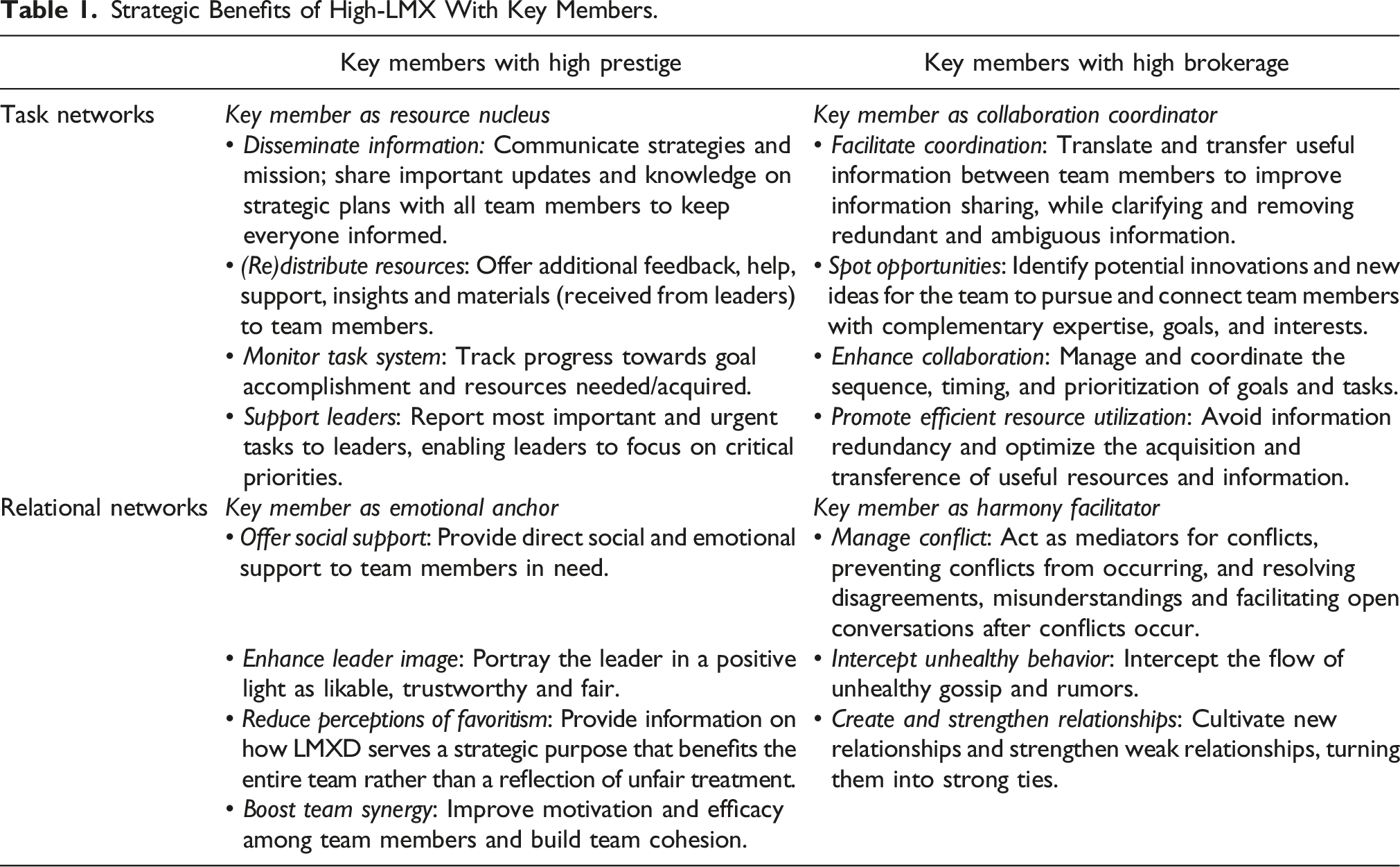
Strategic Benefits of High-LMX With Key Members.
Implications of Developing High-LMX With Key Members in Task Networks
As shown in the top row of Table 1, we posit that the negative impacts of LMXD on task-related team dynamics can be mitigated when leaders develop high-quality relationships with key members in team task networks. When leaders develop high-LMX with key members, it not only serves as a justifiable action in the eyes of team members (Han et al., 2021) but also signals to team members that leaders acknowledge and value key members’ influence; this should strengthen members’ trust in key members and legitimize their position as integral members of the team. In addition, developing high-LMX with key members secures the likelihood that members will reciprocate their favorable treatment with surrogate behaviors (Galvin et al., 2010) that help leaders facilitate resource flow and coordination efforts.
Resource Nuclei
Key members who are well-connected in the team’s task network (i.e., high degree centrality) are recognized by their peers as the “go-to” sources for task-related advice, expertise, feedback, and job-related information, irrespective of the leader’s influence (Wasserman & Faust, 1994). We refer to these key members as resource nuclei. A major consequence of LMXD, that ultimately hinders task dynamics, is resource and information asymmetry between leaders’ in-group and out-group members (Li & Liao, 2014). Leaders, constrained by their finite personal and organizational resources, often find themselves with limited bandwidth to fully communicate their vision, provide comprehensive support, and offer in-depth advice to each team member. Developing high-LMX with resource nuclei helps overcome such challenges as these key members are well-connected in the team’s task network. As reputable sources for task-related advice, information, and resources, resource nuclei have the means and potential to partake in surrogate behaviors and effectively facilitate adoptions of norms (Lacetera et al., 2004), improve collaborations among team members (Grigoriou & Rothaermel, 2014), and disseminate valuable resources and information conducive to productivity (Baldwin et al., 1997). When they receive critical insights from leaders, these members can be particularly helpful in quickly sharing information and resources among team members or influencing members’ opinions directly and quickly. Coming to the leader’s aid, resource nuclei with high-LMX can disseminate “insider” information to help team members make sense of leaders’ strategic decisions and vision.
In addition to facilitating information and resource dissemination in the team, establishing high-quality LMX with resource nuclei also allows leaders to gain valuable insights and feedback about the team. Being highly central in the team’s task network means that resource nuclei are able to acquire novel information about team members’ work activities (Knoke & Burt, 1983; Reinholt et al., 2011), allowing them to be effective at monitoring task systems (e.g., team members’ task progress, availability, expertise, and work preferences) and detecting weak spots in others’ work (Balkundi et al., 2009). To reciprocate their favorable treatment, resource nuclei can act as intermediaries, informing leaders about task issues based on urgency and criticality (Weber & Moore, 2014). This helps leaders optimize their decision-making, prioritize their attention to core tasks, and provide support to members who need it the most (Graen & Uhl-Bien, 1995), thereby further mitigating the negative impacts of LMXD on task dynamics.
Collaboration Coordinators
Key members occupying positions with high brokerage not only control the flow of information within the team but also typically possess extensive knowledge about the specific tasks and activities in which various members are engaged (Greer et al., 1954). Additionally, they are likely to be aware of individuals who have knowledge and expertise that can be utilized by other team members (Cross & Prusak, 2001). When engaged in high-LMX with their leaders, such key members will be inclined to exhibit surrogate behaviors and leverage their advantageous network positions to act as collaboration coordinators, aiding leaders in achieving improved task dynamics. Operating as conduits and information brokers, collaboration coordinators facilitate the smooth and timely transfer of information, advice, and resources between members (Cross & Prusak, 2001). Moreover, they may intervene to address redundant and inaccurate information, clarifying contradictions, and ensuring a more effective and streamlined collaborative process (Balkundi & Kilduff, 2006; Burt, 1992; Halevy et al., 2019; Kwon et al., 2020).
Furthermore, by virtue of their high-LMX with the leader, collaboration coordinators possess comprehensive understanding of both the leader’s vision and the various tasks being undertaken by team members. This understanding allows them to effectively coordinate and prioritize goals in a way that not only aligns with the leader’s vision, but also avoids redundancy and potential cannibalization of efforts where one team member’s decision undermines those of another (Crawford & LePine, 2013; Hollenbeck et al., 2011). They can also be particularly effective at identifying new opportunities for innovation, connecting team members with complementary expertise and knowledge or facilitating collaboration by bringing team members together (Burt, 2004; Kwon et al., 2020). Overall, brokering key members are effective in facilitating team coordination by connecting team members who can help each other, acting as conduits to transfer resources and advice from one member to another, and avoiding the exchange and use of redundant resources.
Implications of Developing High-LMX With Key Members in Relational Networks
LMXD is disruptive to team relational dynamics because it induces social comparisons and upsets social harmony such that team members may develop negative attitudes towards their leaders (Anand et al., 2010). However, leaders can mitigate the negative influence of LMXD on team relational dynamics if they can strategically develop high-quality LMX with key members in relational networks. These members, through engaging in surrogate behaviors, play a crucial role in facilitating interpersonal processes, such as affect management and conflict resolution (Table 1 bottom row).
Emotional Anchors
Key members in emotional networks (e.g., friendship, emotional support, and trust networks) are likely to be involved in informal conversations with team members regarding both positive and negative experiences within the team. These key members—whom we refer to as emotional anchors—not only serve as reliable confidants for team members to express their sentiments but also as direct sources of motivation, encouragement, and various forms of social support (Baldwin et al., 1997). When leaders develop high-quality LMX with emotional anchors, such members are likely to feel obligated to reciprocate the high-LMX they experience through surrogate behaviors (Galvin et al., 2010). Specifically, emotional anchors with high-LMX can leverage their influence in relational networks to mitigate the negative sentiments about LMXD by portraying the leader as a likable, trustworthy, and fair person. Additionally, they can promote the leader’s image by emphasizing his/her positive attributes and also defend the leader by providing details on the decision-making process and additional contextual information (Galvin et al., 2010). By virtue of high-quality LMX and having access to additional insights into leader’s decision-making process, high-LMX key members can also aid with justifying leaders’ differentiated treatment of members as a strategic move to create clearer division of labor and structure rather than simply showing favoritism to a selected number of team members, thus reducing negative perceptions towards LMXD. These behaviors likely help maintain other members’ job satisfaction and motivation. Further, experiencing high LMX and high centrality simultaneously indicates that key members are more likely to worry about and be sympathetic toward other members. They may also proactively engage in conversations and actively listen to their peers’ complaints and frustrations, taking these opportunities to alleviate team members’ antagonistic attitudes and encourage team members (Matta, 2016).
Harmony Facilitator
Being a broker in relational networks means that key members are more likely to be aware of team members’ personal opinions about both the good and bad things they encountered at work; their positional power in the team’s relational network gives these key members significant influence over the flow of such information within the team. If engaged in high-LMX with leaders, these members may feel obligated to act as harmony facilitators by monitoring and resolving team conflicts in a timely manner through facilitating open conversations and agreements. Furthermore, as a way to promote the leader, harmony facilitators with high-LMX may also intercept the flow of gossip and rumors about leaders. These can help with conflict management as well as fostering team cohesion. In addition, harmony facilitators can help strengthen weak ties between members or create new ties between unconnected members, thus turning weak ties into strong ties and facilitating team-member exchange (Kwon et al., 2020; Seers, 1989). Therefore, high-LMX with harmony facilitators can help buffer the dysfunctional aspects of LMXD by making team members feel less neglected, disrespected, mistreated, or depressed and, by extension, experience fewer negative emotions (e.g., jealousy, envy, contempt, and resentment) towards the leader and other members.
Implications of Developing Low-LMX With Key Members
We posit that when leaders fail to develop high-LMX with key members, they not only forgo the chance to alleviate the negative impacts of LMXD on team dynamics but may also inadvertently exacerbate it. Key members are hubs in their respective team networks which means that they are often nominated and accepted by others as informal leaders who are capable of providing timely resources and support (Wasserman & Faust, 1994). However, being in the team leader’s outgroup means that low-LMX key members may not have access to adequate resources or timely information that they could then quickly pass on to the team, leading to a lack of coordination between formal and informal leaders in teams that can hinder team dynamics (Mehra et al., 2006). Furthermore, because they are hubs in their team’s network, key members are often looked to for guidance on task-related matters; not having the support and resources from their leaders may result in low-LMX key members experiencing greater role overload and role ambiguity (Örtqvist & Wincent, 2006). This may also dampen key members’ ability to sustain their strong ties with their colleagues, making it more difficult for key members to thrive in their roles (Cullen et al., 2018). In addition, prior research suggests that when there is a lack of agreement and reciprocation of relationship quality between formal and informal leaders, team members are likely to perceive the formal leader as less effective (Balkundi et al., 2015). Therefore, when leaders fail to develop high-LMX with key members, it could reduce key members’ effectiveness in reducing LMXD or even amplify the negative influence of LMXD.
Furthermore, if leaders fail to develop high-LMX relationships with key members, it may be seen as delegitimizing. Key members may interpret their own less favorable treatment by the leader as a sleight that could instigate negative reciprocity by which key members use their influence to cause more harm in the network (Vriend et al., 2020). The discrepancy between their (lack of high) LMX with the leader and their social status among peers may trigger the key members’ felt need to fend for themselves by eliminating competition through counterproductive behaviors such as withholding their expertise and knowledge, obfuscating leaders’ expectations when communicating with peers, stalling or intercepting the flow of critical resources, spreading gossip, and general ill-treatment of others (Matta, 2016; Sparrowe, 2014; Webster et al., 2008). Low-LMX key members may even frequently express negative opinions about leaders’ unfair treatment and draw attention to leaders’ mistakes and wrong-doings (Gundlach et al., 2003). Altogether, such actions undermine the morale and cohesion in teams ultimately leading to a loss of members’ trust in the leader. Collectively, these aspects associated with developing low-LMX with key members amplify the deleterious effects of LMXD on team dynamics due to an increased risk of low-LMX key members engaging in negative reciprocity.
LMX with Peripheral Members
With an eye towards improving team dynamics, our theorizing till this point focuses on leaders strategically developing high-LMX with key members. However, we also recognize that there are strategic benefits that leaders may be able to realize from developing high-LMX with peripheral members, though the implications of doing so for team dynamics are not clear. Peripheral members (see Member C in Figure 2) can be individual contributors who are specialists in their work (Cross & Prusak, 2001). In other words, their (lack of) integration into the team may be purposeful such that they are unencumbered by the demands from other team members (Cross & Prusak, 2001). Peripheral members may have external expertise that may not be central to the core team’s functioning but can still provide significant value to meet the team’s overall objectives (Pertusa-Ortega et al., 2010). Because they are not as tightly woven into the team’s social fabric, these individuals may be able to provide unbiased opinions that are free from group think (Venkataramani & Tang, 2024). In many cases, peripheral members are newcomers to the team and therefore they are yet to be integrated into the team’s social fabric. Nevertheless, prior research generally supports that central team members tend to be both more powerful in exerting influences and more effective in acquiring information than peripheral members (Reinholt et al., 2011; Wang et al., 2017). Overall, developing high-LMX with peripheral members will not hurt the team but may not yield as much strategic benefit for team dynamics as would purposefully developing high-LMX with key members, especially in terms of extending leader’s influence to the entire team. Indeed, prior research shows that team members are more likely to effectively reciprocate the high-quality LMX they experienced when they occupy central positions in team networks (Regts et al., 2019).
Additional Considerations for an Empirical Examination of the Conceptual Framework
Network Measures
Scholars seeking to test the ideas presented in this paper have several avenues forward. This paper incorporates ideas that are rooted in social networks and, therefore, we recommend that future research carefully consider appropriate network measures when identifying key members and assessing team processes. For example, if scholars wish to explore the effects of LMXD on task-focused team dynamics (i.e., transition and action processes such as team coordination and collaboration on various tasks), then they may consider identifying key members in task-related networks consisting of instrumental ties such as advice, information sharing, and task flow networks. If scholars are more interested in relational team dynamics (i.e., interpersonal processes such as negative emotions or relationship conflicts), then they may consider measuring relational networks such as networks of friendship, emotional support, and gossip that consist of expressive ties. The content of each question asked (e.g., “I seek advice from this team member”) corresponds to one social network and so a closer alignment between network type and the phenomenon of interest is important. In addition, scholars should consider the response scales for each question carefully; it is likely that a Likert-scale may capture nuances (e.g., asking respondents how often they seek advice from each member rather than using a binary “yes/no” answer) (see examples in [Cross et al., 2001]). Of course, scholars still have the option of dichotomizing network ties based on these responses (e.g., a tie only exists if member A seeks advice from member B more than 4 times a month). The directionality of ties may be another factor to consider depending on the type of network (see examples presented in [Crawford & LePine, 2013]). From here, scholars can then identify prestigious members through degree centrality and identify brokers through constraint (reverse), effective size, and betweenness centrality (Burt, 2015; Burt et al., 2013).
LMX Measures
Researchers also have options in choosing and operationalizing LMX with key members. Experiencing a high-quality LMX relationship means that there is a high level of mutual trust and respect between leaders and members; indeed, this is a key tenet of LMX theory (Graen & Uhl-Bien, 1995). However, research suggests that leaders’ and members’ perceptions of relationship quality do not always converge (Sin et al., 2009). That is, although one party may perceive a strong relationship quality with the other, the other party may not necessarily reciprocate such feelings, which is suggestive of parties evaluating the relationship using different criteria (Schyns & Wolfram, 2008). For instance, whereas leader-rated LMX may be indicative of the degree to which leaders delegate, share critical insights, and provide support to followers with the expectation of superior performance, member-rated LMX may instead be indicative of members’ interpretation of their work situation and how they feel about their leaders. Given these operationalizations, scholars may choose the appropriate source of LMX ratings that suits their research objectives. Extending this further, scholars may benefit from measuring LMX from both leader and follower perspectives (which is more directly related to the idea of “exchange” or explore the level of agreement in LMX ratings across sources as more appropriate indicators of relationship quality when assessing our research framework (Gottfredson et al., 2020; Sin et al., 2009). Additionally, given recent criticism on existing measures of LMX (see Gottfredson et al., 2020), future research should also consider alternative measures that capture the actual exchange or directly measure surrogate behaviors (see Galvin et al., [2010] for potential items) when empirically testing this framework. Scholars can also measure relative LMX (i.e., an individual’s perception of his/her own LMX compared to the team average LMX (Henderson et al., 2008) and LMX social comparison (i.e., an individual’s LMX compared to that of each individual member (Matta, 2016; Vidyarthi et al., 2010) to understand how these perceptions (as opposed to absolute LMX) drive behaviors impacting team dynamics.
Discussion
Considering that LMXD is seemingly unavoidable, the aim of this research is to offer leaders a possible solution to mitigate the negative effects of LMXD on team dynamics. Indeed, leaders have limited resources at their disposal and are therefore often unable to develop high-LMX with all members of their team. When leaders develop and maintain high-quality relationships with some but not all members, the favorable treatment of select members may trigger perceptions of unfair treatment among others; this can lead to unfavorable team task and relational dynamics. Although leaders are apt to develop high-LMX with members they like and/or are similar to them, our conceptual framework suggests that when they go about building relationships with team members using a more strategic and purposeful approach—i.e., by identifying key members who have already earned the respect and recognition from team members or occupy key structural positions in team social networks—they can mitigate the downsides of their differentiated treatment of team members and, in some cases, maybe even realize some upsides. Our framework incorporates perspectives from social networks research to depict how strategic differentiation impacts team dynamics, thereby offering a more realistic and practical guide for leaders to build relationships in teams.
Theoretical Extensions
Individual Characteristics
One implicit assumption in our theoretical framework is that experiencing high-LMX motivates and enables key members to engage in surrogate behaviors (Galvin et al., 2010). However, there may exist other factors, in addition to the relationship quality between the leader and key members, that impact the degree to which key members are motivated to engage in surrogate behaviors as well as how effective they can be as surrogates. For instance, key members’ individual characteristics—personalities, self-efficacy, cultural values, experience, etc.—may all play a role in affecting whether key members would be willing and able to engage in surrogate behaviors.
Virtuality
Distributed work arrangements have exploded in popularity post-pandemic and the degree of virtuality/intensity of remote work in teams is likely to influence the theorizing in our framework. Central to LMXD is the notion that team members partake in social comparisons when they observe leaders’ differential treatment towards certain team members. However, one’s ability to observe or assess leaders’ differential treatment of select members may be impaired when team members work remotely rather than when they are co-located. Nevertheless, team members may still be able to pick up on cues regarding how leaders treat them as well as different team members, and future research should explore the alternative ways that team members gather information on LMX (or LMXD) and how LMXD impacts different team dynamics in remote work settings. In addition, because communication in distributed teams is likely to take place over leaner media (e.g., emails, calls, texts; Sias et al., 2012), which are known to be less effective at conveying informational and contextual cues as well as social presence (Daft & Lengel, 1986)—leaders and key members alike may struggle to develop stronger bonds with others (Gajendran et al., in press). Furthermore, these characteristics of leaner media may also mean that a greater number of testing episodes may be required to build high-quality relationships between leaders and key members as well as among team members (Graen & Scandura, 1987). Overall, future research should explore our framework in the context of virtual work.
Team Evolution and Long-Term Effects
Teams are intricate social systems characterized by constant change and evolution. Within a team, relationships between members can strengthen or weaken, team composition can change with people joining or leaving, and team members continuously develop and adapt in their roles. These ongoing changes have the potential to affect both the task-related and interpersonal dynamics within the team, which, in turn, can influence who holds a central position in each team network. Even the practice of strategically building high-LMX with key members will likely provoke changes to the team’s social fabric (Hanaki et al., 2007). Considering the dynamic nature of teams, it is essential for leaders to adopt the practice of closely monitoring the shifting dynamics within their teams. This proactive approach should help leaders stay informed about who holds a central or key role within the team. By doing so, leaders can adapt their leadership strategies and resource allocation to align with the evolving needs and dynamics of the team, ultimately contributing to the team’s success and cohesion. Future research should explore the efficacy of this approach as well as explore the long-term implications of building high-LMX with key members.
Practical Implications
Our paper provides important practical insights for leaders and their teams. First, while leaders often form diverse relationships with team members, our proposed framework offers a strategic approach to guide this process. Specifically, by identifying and nurturing high-LMX with individuals holding key positions within the team’s social networks, leaders can potentially mitigate the drawbacks of differential treatment and possibly even reap some advantages. Second, our proposed framework provides guidance to leaders seeking to address issues pertaining to both task and relational issues in teams. Third, depending on their strategic goal, our framework offers precise advice to leaders regarding the types of key team members with whom they should prioritize building high-LMX. For example, if leaders aim to swiftly communicate their vision or secure buy-in and support from a significant portion of the team, they should focus on establishing high-LMX with prestigious member(s) in the team’s task and relational networks, respectively. If, however, their objective is to promote collaboration among team members with diverse expertise and knowledge, or to minimize team conflicts and gossip, leaders should direct their efforts towards building high-LMX with individuals who act as brokers in the team’s task and relational networks, respectively.
Conclusion
In summary, this conceptual framework provides new perspectives on resolving a long-standing debate in the LMX literature by challenging several commonly held assumptions and shedding light on several avenues for future research. Although the benefits of high-LMX seem apparent, leaders are often unable to maintain high-LMX with every member, making LMXD a natural byproduct. Our research provides a new strategic and purposeful perspective for leaders so that they can most efficiently use their time and resources when building relationships with team members, and be more effective in their leadership by mitigating the negative effects of LMXD. We hope this theoretical framework will provide guidance and inspire new research on interpersonal dynamics between leaders and team members.
Footnotes
Acknowledgments
We would like to express our gratitude to Walter Davis, our Action Editor, and three anonymous reviewers for their insightful and constructive feedback, which has played a crucial role in enhancing and refining this paper.
Declaration of Conflicting Interests
The author(s) declared no potential conflicts of interest with respect to the research, authorship, and/or publication of this article.
Funding
The author(s) received no financial support for the research, authorship, and/or publication of this article.
