




Abstract
Individuals’ networks are multiplex—bundles of roles, interactions, and exchanges—in which the boundaries between work relationships and non-work relationships are often blurred, or integrated. Surprisingly, though, there is a paucity of research that explicitly integrates the work-nonwork literature and the social networks literature. In this paper, we advance theory on cross-domain multiplexity—multifaceted relationships that occupy a blended work–nonwork role space by superimposing work and nonwork interactions, roles, and exchanges. Specifically, we draw from work-family border theory to propose that cross-domain multiplex relationships represent a qualitatively unique form of multiplexity that involve distinct norms, drivers, and tensions. We advance the conversation around social network analytics and work-nonwork boundary research by presenting a theoretical model of cross-domain multiplex relationships that unpacks their components, as well as their unique antecedents, outcomes, and dynamics. We also review three methodological approaches that scholars can employ to analyze our propositions. Given recent theoretical and methodological advancements in both arenas, we propose that employing social network analytic methodology can inform how scholars theorize and design research around the work-nonwork interface, expand the methodological toolkit applied to these research questions, and resolve inconsistencies in whether multiplex relationships are enriching or depleting.
Keywords
A body of literature loosely labeled “boundary theory” explores ways people manage boundaries between work and personal domains, which were historically considered independent and associated with distinct rules, thought patterns, and behaviors (Ashforth et al., 2000; Clark, 2000; Nippert-Eng, 1996). Boundary management strategies involve how people create and maintain physical, temporal, or cognitive boundaries, or “mental fences,” between work and personal domains (Edwards & Rothbard, 2000; Zerubavel, 1991). These strategies range on a continuum from segmentation to integration (Ashforth et al., 2000; Clark, 2000; Kreiner, 2006). Individuals can segment work and nonwork domains by compartmentalizing cognitions, behaviors, and physical objects into mutually exclusive role characteristics, or they can integrate by allowing these role characteristics to intermingle across domains (Ashforth et al., 2000). Segmentation and integration tactics can be employed to help simplify and order individuals’ environments to prevent conflict between potentially competing domains (Greenhaus & Powell, 2003), or to enhance enrichment between potentially complementary domains (Greenhaus & Powell, 2006). Along these lines, recent work drawing from boundary theory considers a high degree of integration between work and nonwork domains as “blending” (Smith et al., 2022).
In a parallel stream, research shows that individuals’ work and personal networks are multiplex—multifaceted bundles of interactions, roles, and exchanges (Kuwabara et al., 2010)—in which the boundaries between their work and nonwork relationships are often blurred, or integrated. Indeed, individuals develop friendships with their coworkers (Ibarra, 1992; Methot et al., 2016; Shah et al., 2017), mentors (Cotton et al., 2011; Kram & Isabella, 1985), and supervisors (Bridge & Baxter, 1992); own and operate companies with their spouses (Marshack, 1994) or family members (Gomez-Mejia et al., 2001; Li & Piezunka, 2020); compete at work with friends (Ingram & Roberts, 2000); and serve as caregivers to family members (Bainbridge & Broady, 2017). Multiplex relationships have been linked to key individual and organizational outcomes, including enhancing organizational identification and job performance (Bullis & Bach, 1991; Ertug et al., 2023; Methot et al., 2016; Shah et al., 2017), easing access to divergent perspectives and advice (Marineau et al., 2018), hindering role transitions (Li & Piezunka, 2020) and team performance (Hood et al., 2017), and curtailing unethical behavior (Brass et al., 1998).
Despite developments in each stream and their complementary foundations, alongside increased attention to the phenomenon of multiplexity over the past two decades (Ertug et al., 2023; Kuwabara et al., 2010; Methot & Rosado-Solomon, 2020), there is a paucity of research that explicitly addresses cross-domain multiplexity—multifaceted relationships that occupy a blended work–nonwork role space by superimposing work and nonwork roles, interactions, and exchanges (Barthauer et al., 2018). But, we see several reasons to integrate this phenomenon into both the social networks and work-nonwork interface literature more intentionally. First, to date, research on multiplexity in general has been less privileged compared to its unitary (one-dimensional) counterparts (Ertug et al., 2023; Methot & Rosado-Solomon, 2020). While scholars frequently gather data on multiple types of network ties—such as advice, support, helping—they analyze these networks independently, rather than determining the proportion of dyads that report having multiple types of ties simultaneously. In fact, most network studies explore a small number of ties that are almost exclusive to the workplace and assume that they drive outcomes. If scholars do not take the step to construct multiplex networks during analysis, their potentially multidimensional nature is masked by or confounded with the analysis of uniplex relationships, and causal inferences may be inaccurate (Ibarra, 1993; Methot et al., 2016; Shah et al., 2017). In the context of cross-domain multiplexity, this could, for example, result in misattributing protégés’ career outcomes to the formal relation with a mentor without determining and accounting for whether the dyad also has a close friendship outside of work.
Second, there is a lack of consensus about what types of interactions, exchanges, or social relations are meaningful to account for when studying multiplex relationships, in general (Methot & Rosado-Solomon, 2020). A byproduct of this inconclusiveness is that is it unclear what tie content is most relevant when theorizing about, constructing, and analyzing cross-domain multiplex ties. Given the extensive potential combinations of characteristics, all relationships could be considered multiplex in some form or another. For instance, if two friends (i.e., a social relation) are having small talk at work (i.e., an interaction), does this constitute a meaningful multiplex relationship? Identifying specific forms of multiplexity can help to codify the phenomenon and strengthen its theoretical and empirical footprint.
Third, while it is relatively common for studies to examine friendship as one strand of a multiplex tie (e.g., Cotton et al., 2011; Ibarra, 1993; Methot et al., 2016; Schinoff et al., 2020; Shah et al., 2017), only a small handful of studies examine the coexistence of nonwork ties (e.g., friendship, family) and work ties through the lens of the work non-work interface (see Ashforth, Kreiner, Fugate, & Johnson, 2001a, 2001b; Barthauer et al., 2018; Clark, 2002; Li & Piezunka, 2020). Yet, cross-domain multiplex relationships are qualitatively distinct from other forms of multiplexity because they (1) implicate relational norms, expectations, and hierarchies across both the work and nonwork domains, (2) are uniquely situated in the liminal space between work and nonwork domains, and (3) require intentional management of these norms to maintain stability and balance. Thus, they likely have distinct drivers, tensions, dynamics, and outcomes. However, results are equivocal in terms of whether these relationships may be enriching or depleting. This begs the question: does the multi-dimensionality inherent in cross-domain multiplex ties “strengthen the overall tie” (Cotton et al., 2011, p. 18) or “create conflicts of interest and expectations that weaken relationships” (Kuwabara et al., 2010, p. 245)?
From this perspective, isolating cross-domain multiplexity from other forms of multiplexity presents unique theoretical and methodological opportunities and can help resolve inconsistencies we see in studies related to the effects of centrality in friendship and advice networks (Methot et al., 2016; Scott et al., 2018), as well as studies on social influence that attempt to show influence or contagion (Zagenczyk & Powell, 2023). We theorize that multiplex relationships can occupy a blended work–nonwork role space—or a “borderland” (Clark, 2000), whereby aspects of the work and nonwork domains are simultaneously activated—and that they can have enriching and depleting effects. We present a model of cross-domain multiplexity and associated propositions that unpack the antecedents and outcomes related to co-existence of work and nonwork networks, and their coevolving dynamics. We also present three methodological approaches that can advance the types of research questions that can be posed in this area.
Our model and associated analytical approaches advance both the social networks and work-nonwork interface literature. First, our framework can help contribute to understanding what types of interactions, exchanges, or social relations are meaningful to account for when theorizing about and analyzing cross-domain multiplex relationships. Second, accounting for how relationships can exist in the work-nonwork borderland allows us to “mov[e] away from the more traditional approach of treating work and nonwork domains as separate, unrelated entities with merely spillover effects between them” (Smith et al., 2022, p. 4), while also directly tapping into the social context of the work-nonwork interface. Finally, by incorporating principles of micro-dynamics of social networks, we address calls for “research that better captures the dynamic nature of boundary management” (Allen et al., 2014, p. 116). Taken together, we propose that adopting a social network analytic perspective can help inform how we theorize and design research around the work-nonwork interface, and resolve inconsistencies in whether, when, and why cross-domain multiplex relationships have beneficial or detrimental outcomes.
Blended Work-Nonwork Experiences
Traditional perspectives on the work-nonwork interface were rooted in the notion that work and nonwork roles and experiences existed in opposing domains. Organizations historically “sought to optimize employee performance by designing tasks and workspaces to eliminate nonwork-related interruptions in order to facilitate greater efficiency, rationality, and control” (Smith et al., 2022, p. 560). In considering what features define, or constitute, work and nonwork domains, characteristics have generally centered on time, physical objects or spaces, behaviors, skills, knowledge, cognitions, activities, emotions, or attitudes (Greenhaus & Beutell, 1985). This led to the identification of how these characteristics can blur, or create conflict, such as time schedule conflicts, household and care-giving responsibilities, marital conflict, communication technology interference, and community involvement (e.g., Barnett, 1998; Butts et al., 2015).
With the onset of virtual work (Kossek, 2016), family-friendly human resource management policies (Rothbard et al., 2005), and younger generations who value opportunities for leisure activities (Twenge et al., 2010), work and nonwork domains are increasingly blended for many employees (Gabriel et al., 2020; Greenbaum et al., 2022; Liang, 2018; Petelczyc et al., 2018; Rothbard et al., 2022; Smith et al., 2022). The rise of both social media and remote work are likely driving forces in this shift, transforming the role that traditional authority figures and coworkers play by blurring boundaries between professional and personal domains (Delanoeije et al., 2019; Ollier-Malaterre et al., 2013; Rothbard et al., 2022). What’s more, the COVID-19 pandemic disrupted the scaffolding around domain boundaries, forcing employees to adapt to and manage these boundaries (Adisa et al., 2022) by transitioning to and crafting more beneficial domain balance (Vaziri et al., 2020) or concealing, detaching, or sacrificing connections within and to these domains (Kossek et al., 2021). Therefore, quite often, employees’ interactions and experiences are “impacted by the ways traditional boundaries between work and nonwork life have been muddled” (Gibson, 2018, p. 570).
Role blending occurs when there is a great deal of permeability and flexibility around borders (Clark, 2000) and often exists when “two dissimilar roles with divergent expectations for appropriate or desired behaviors…are combined into a singular experience” (Gabriel et al., 2020, p. 1340). Role blending can involve uncertainty or difficulty in distinguishing one’s work role from one’s nonwork role (Desrochers et al., 2005; Glavin & Schieman, 2012). Recently, the literature on role blending has focused on formal versus informal domain features by homing in on work and leisure task and activities, such as organizational play, workplace fun, industrial recreation and exercise, and work breaks (see Smith et al., 2022 for a review).
Importantly, employees manage boundaries between—and make sense of and create meaning from—their work and nonwork roles by interacting with others. This suggests that the boundaries between domains are “socially constructed” (Ashforth et al., 2001a, 2001b, p. 261) and that blended experiences may at times be interpersonal in nature (Clark, 2002; Kirby & Buzzanell, 2014; Smith et al., 2022). For example, the industrial revolution “resulted in a major segregation of roles between workers and non-workers, with ‘work’ being spatially, temporally and, to some extent, socially distinct from ‘non-work’ (e.g., family, community, religion, politics and education)” (Geurts & Demerouti, 2002, p. 279). Indeed, boundaries are negotiated and defined with other people in each domain—termed “border keepers” (Clark, 2000)—who help determine which behaviors, objects, activities, and interactions “belong” in a particular domain; where the boundary between domains are demarcated; and the strength of the boundaries (Clark, 2000, see also Allen et al., 2020; Park et al., 2020). For example, supervisors act as border keepers in the work domain, and family members act as border keepers in the home domain.
Thus, the past several decades of research on the work-nonwork interface acknowledges how vital the social context is, revealing that individuals “simply have multiple obligations and responsibilities to various others, both in their work domain (e.g., their employer, superior, colleagues, subordinates) and in their non-work domain (e.g., spouses, children, relatives and friends)” (Geurts & Demerouti, 2002, p. 281). Thus, we propose that cross-domain multiplexity represents a blending of work and nonwork roles, emotions, cognitions, and behaviors. Cross-domain multiplex relations exist in the work-nonwork borderland by simultaneously activating work and nonwork roles in employees’ minds through interpersonal interaction (Clark, 2000) and, in turn, implicating emotions (e.g., pride, jealousy) and cognitions (e.g., sensemaking about work and nonwork expectations) that blur across domains (Ashforth et al., 2000; Methot et al., 2017). So, these multiplex relationships cannot exclusively be attributed to the work or nonwork domain and therefore lack “lines of demarcation between domains” (Clark, 2000, p. 756).
How Can We Conceptualize Cross-Domain Multiplexity?
Social networks are comprised of a set of actors and ties connecting them (Borgatti & Foster, 2003). These ties function as conduits through which resources such as advice, support, and information flow; they also function as prisms through which people gather signals and make inferences that help shape perceptions (Podolny, 2001). A common way to categorize the types of ties studied in network analysis is Borgatti et al.’s (2009) analytic typology that divides ties, or relations, into four types: (1) social relations, including role relations—a socially constructed relationship between two people associated with distinct norms and expectations for role-related behavior (e.g., marriage, friendship, kinship, boss)—and affective relations and cognitive relations—thoughts and feelings in the minds of individuals directed at others (e.g., liking, hatred, or trust), (2) interactions, behaviors that occur between actors (e.g., communication, advice, help, incivility), (3) flows, an enduring opportunity to obtain resources, beliefs, or information from another (e.g., support, information), and (4) similarities (e.g., shared location, club membership, demographic attributes). Importantly, each type of tie offers the building blocks for distinct theories, and they are not mutually exclusive (Kitts, 2014; Kitts & Quintane, 2020). The pattern of these ties in a network (i.e., how actors are connected) yields a particular structure, and actors occupy positions within this structure.
From this perspective, it is not simply important to account for the social nature of domains, but also to explicitly articulate which ties are relevant and how they can blend. When conceptualizing cross-domain multiplexity, the composite of ties necessarily coexists across work and nonwork domains. Drawing from Clark’s (2000) concept of the borderland, we propose that cross-domain multiplex relationships are conceptualized as a combination of ties that simultaneously activates roles, interactions or flows where at least one tie content originates from the work domain, and one tie content originates from the nonwork domain. To aid in construct correspondence—a theoretical perspective suggesting that to achieve predictive potential, constructs of interest should be conceptualized and measured within the same conceptual category (Methot & Rosado-Solomon, 2020)—we recommend that scholars conceptualize cross-domain multiplexity as a composite of ties within corresponding content categories (e.g., a work role tie and nonwork role tie) versus across categories (e.g., a work role tie and a similarity). However, there are cases where cross-category multiplexity may be theoretically meaningful and simultaneously activate the work and nonwork domains (e.g., a work colleague providing parental advice). Thus, the specific combination of work and nonwork ties should be driven by theory and aligned with the respective research question.
Typology of Cross-Domain Network Ties.

Note. Tie contents in each category are examples informed by existing research. The combinations are not mutually exclusive; each work content example can be paired with any nonwork example within a corresponding category (e.g., mentor/friend) or across categories (e.g., coworker/parental advice). The example studies do not necessarily explicitly adopt a multiplexity or networks approach or work-nonwork interface perspective.
While some flows, interactions, or similarities may involve both formal—work-oriented—and informal—socially-oriented—exchanges, they may not necessarily be considered “cross-domain.” For example, a colleague can provide both career support (e.g., strategizing, advice, feedback) and emotional support (e.g., encouragement, acceptance) (see, e.g., Cotton et al., 2011), but this form of multiplexity does not necessarily activate both the work and nonwork domains simultaneously. Similarly, colleagues can attend a social function together, but this does not establish a cross-domain network tie. So, a defining feature of cross-domain multiplexity is that individuals are pulled between two domains—in other words, their decisions, emotions, behaviors, are implicated as a direct function of the blending of boundaries.
A Model of Cross-Domain Multiplexity
To build a scaffold for understanding the drivers, outcomes, and dynamics of cross-domain multiplex relationships, we draw from Jacobsen and colleagues’ (2022) model of network dynamics. This model provides an organizing framework for predicting the likelihood that individuals will have cross-domain multiplex ties, how cross-domain multiplex ties may provide unique conditions for the contagion of emotions, cognitions, and behaviors in a network, and how cross-domain multiplex ties may coevolve with distinct outcomes (see Figure 1). Model of Cross-domain Multiplexity Antecedents, Outcomes, and Dynamics. 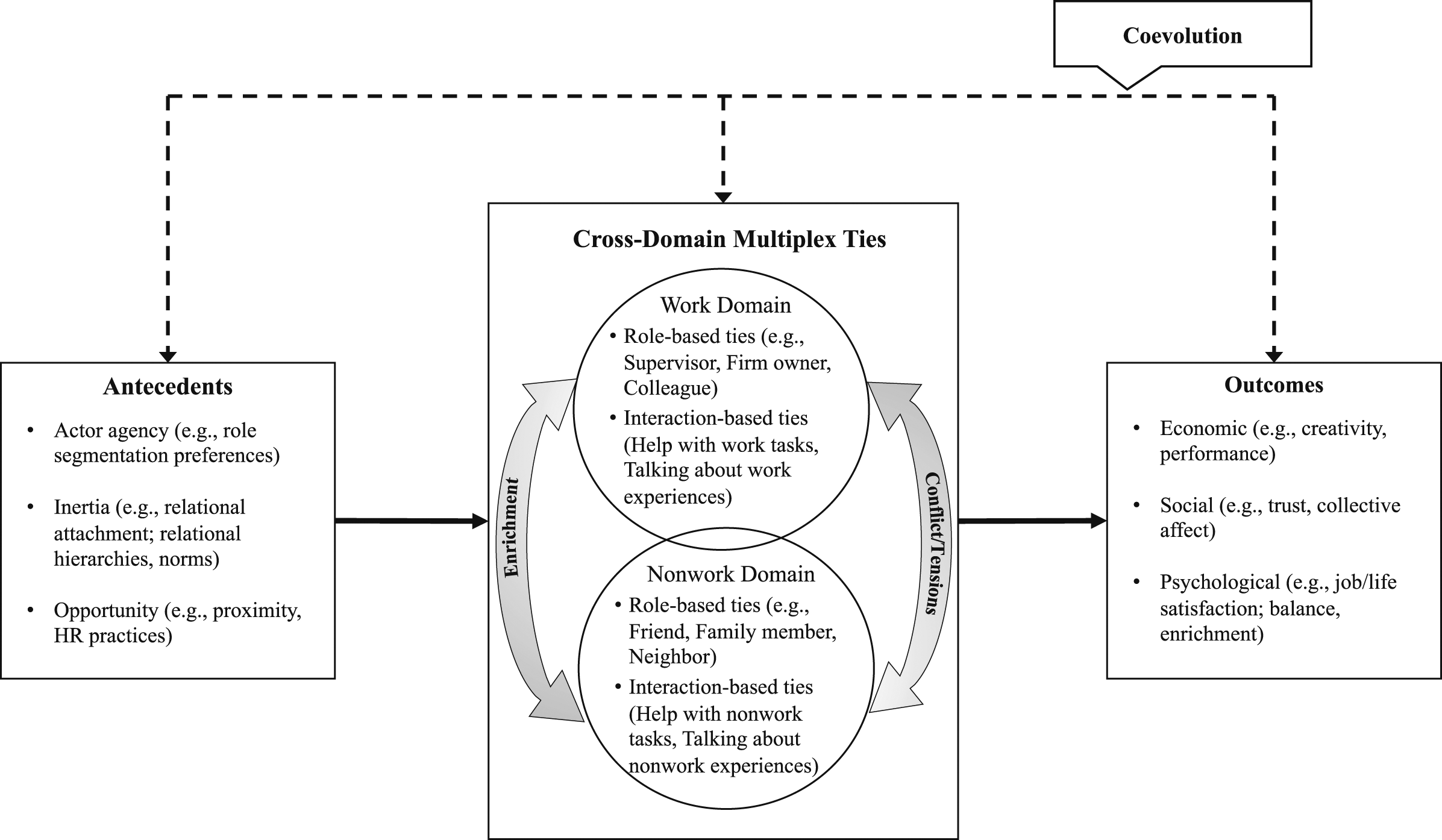
The boundaries between work and nonwork domains and individuals’ networks are dynamic systems that are constantly adapting and evolving. In developing a framework for cross-domain multiplexity, we touch on effects across various levels of analysis (see Figure 2): at the tie (or, dyad) level, including the likelihood of individuals in a dyad having (versus not having) cross-domain multiplex ties; outcomes of cross-domain multiplexity, which can manifest at dyadic, individual, and network levels (i.e., the influence of cross-domain multiplex ties or positions in multiplex networks on economic, social, and psychological outcomes and contagion through networks); and network-level dynamics (e.g., the formation or dissolution of work and nonwork ties over time and how these networks co-evolve with outcomes). We examine each part of the model in turn. First, we focus on antecedents of cross-domain multiplex ties; then their outcomes; and finally, the dynamics and coevolution of cross-domain multiplex network ties and emotions, cognitions, and behaviors. We also present analytic approaches associated with each respective part of the model and its propositions to provide concrete examples and guidance for scholars interested in examining these questions in empirical research. Cross-domain multiplex ties across dyadic, individual, and network levels of analysis.
Importantly, the most salient and theoretically driven experiences of cross-domain multiplexity occur through the blending of roles (e.g., Ashforth et al., 2000; Barthauer et al., 2018; Clark, 2000; Li & Piezunka, 2020; Verbrugge, 1979) and behavioral interactions (e.g., Clark, 2002). What’s more, many of the other types of tie contents (e.g., flows or similarities) are embedded within, or complement, role relations and behavioral interactions. For example, coworkers who are also volunteers in corporate programs share a combination of roles that also represent a set of similarities (shared firm and volunteering organization) and set the stage for combinations of flows (e.g., work-focused and nonwork-focused information). Therefore, for parsimony, we develop propositions around the role relations and behavioral interactions categories (e.g., family businesses, workplace friendships, helping with work and nonwork tasks, provision of work and nonwork advice).
Antecedents of Cross-Domain Multiplex Ties
Research on the micro-foundations of social networks (Ahuja et al., 2012; Jacobsen et al., 2022; Tasselli et al., 2015) suggests that network ties, in general, are driven by three foundational antecedents: (a) agency, (b) inertia, and (c) opportunity. We propose that cross-domain multiplex ties involve unique considerations and combinations of network drivers.
Individual Agency
Agency captures individuals’ motivation and ability to shape their networks by creating mutually beneficial ties or dissolving less valuable ones (Ahuja et al., 2012). Research suggests that people are active agents in crafting their networks (Casciaro et al., 2014; Porter & Woo, 2015) and drawing and managing boundaries between domains (Methot & LePine, 2016). Work-nonwork boundary dynamics concern the socially constructed lines of demarcation between work and family roles, and the ways in which individuals actively maintain, negotiate, and transition across the lines created (Ashforth et al., 2000; Clark, 2000). Sturges (2012) referred to boundary management techniques as “crafting” behaviors because they are proactive, self-initiated, and goal oriented, and they allow people to “create their ideal level of and style of work-home segmentation or integration” (Kreiner et al., 2009, p. 704). Specifically, relational crafting tactics include managing work and nonwork relationships (e.g., using relationships with colleagues or family to facilitate work-family balance), building a support system (e.g., getting help from others), setting expectations (e.g., informing others about expectations in advance of boundary violations), and confronting violators (e.g., telling violators of boundaries during or after a boundary violation). This is consistent with research suggesting that, while individuals’ networks are, in part, a function of who is accessible to connect with, they also have “discretion to exercise choice” (Kleinbaum, 2012) and are “purposive under social constraint” (Burt, 1982, p. ix). In this way, individuals are active agents in the composition of their social networks, such that they purposefully and instrumentally make decisions to pursue some relationships and forgo others independently of the structures in which they are embedded (Tasselli & Kilduff, 2021).
In the context of cross-domain multiplexity, we proposed that the individual trait role segmentation preferences—the desire to create and maintain physical, temporal, or cognitive boundaries between work and nonwork domains (Edwards & Rothbard, 2000; Kreiner, 2006)—should drive the likelihood of having a cross-domain multiplex tie. Research suggests that “people shape their worlds” (Clark, 2000, p. 748; Snyder & Ickes, 1985) by integrating or segmenting their relationships across their work and non-work domains and negotiating with border-keepers to maintain these boundaries (Clark, 2000). Specifically, proactive boundary management refers to the decisions to enter into in a new work or non-work domain (Methot & LePine, 2016), reflecting the efforts of individuals to actively manage the boundary between work and non-work to align with their segmentation preferences (Eckenrode & Gore, 1990; Kreiner, 2006; Powell & Greenhaus, 2010). Compared to other forms of multiplexity (such as the combination of informational and emotional support), cross-domain multiplex relationships uniquely occupy the liminal space—or, borderland—between work and nonwork domains; thus, preferences to segment the work and nonwork domains is a driver that is specific to this form of multiplexity. For example, while they did not explicitly examine multiplexity, Methot and LePine (2016) found that participants with higher preferences for segmentation are less inclined to accept jobs where their significant other is employed in the same organization, and to initiate a romantic relationship with a coworker. Therefore, we expect that individuals with lower preferences for segmentation will be more likely to form role-based cross-domain multiplex ties.
Inertia
Inertia captures pressures for tie persistence that result from routines and norms (e.g., Kim et al., 2006); for example, when relational attachment constrains focal actors from terminating a relationship (Dahlander & McFarland, 2013). With respect to multiplex ties, specifically, network scholars have asserted that the more relational elements (e.g., friendship and work colleague) linking one person to another, the stronger and more positive the link (Brass, 1992; Ibarra, 1993). From this perspective, because multiplex relationships are ‘thicker,’ “each strand tends to reinforce the other, thus strengthening the overall tie” (Cotton et al., 2011, p. 18). Multiplex relationships necessarily involve a greater amount of emotional intensity, time, mutual confiding, and reciprocity (Granovetter, 1973) and, thus, are considered “close, stable, and binding relative to weaker, more superficial links lacking emotional investment” (Ibarra, 1993, p. 62). Research suggests, then, that compared to uniplex ties, multiplex ties may be relatively inert, as they are “stickier” and more durable over time (Ahuja et al., 2012; Dahlander & McFarland, 2013).
Research suggests inertia in cross-domain multiplexity may be driven by unique features, including relational norms, identification, and schemas. Indeed, compared to one-dimensional relationships, multiplex relationships contribute more significantly to individuals’ identities through their deeper and more encompassing affiliation patterns (Methot et al., 2018). Further, multiplex relationships present more complex relational schemas—cognitive structures representing regularities in interpersonal relatedness (Baldwin, 1992)—that interact with each other across domains. For example, Li and Piezunka (2020) theorized that role-based cross-domain multiplex ties in the form of family-business ties are resistant to change because transitioning into a new role in one domain frequently disturbs existing role schemas and hierarchies in the other domain.
Opportunity
Opportunity captures the notion that individuals form network ties according to the logics of convenience and proximity—in other words, they form ties to those who are more accessible, such as when attendance at a social event increases the likelihood of creating new friendship relationships (Giese et al., 2020). We consider two examples that present opportunities for individuals to form cross-domain multiplex ties: formal Human Resource Management (HRM) practices and workspace design.
HRM practices are the policies and practices required to manage human capital—the stock of individuals’ knowledge, skills, and abilities in an organization (Nyberg et al., 2014), including recruitment, selection, performance management, compensation, and exit management. Importantly, these practices not only create value for organizations based on individual contributions, but they also complement, cultivate, and subsidize networks of employee relationships and fundamentally alter the internal social structure of organizations (Kaše et al., 2009). Indeed, as interactions become recurring patterns of behavior, informal networks evolve across functional and geographic boundaries (Brass, 1992; Krackhardt & Hanson, 1993). Thus, research suggests that HR practices may have unintended and unobserved effects on informal network structure generally, and on the formation of cross-domain multiplex ties, specifically. HR practices set the stage for individuals to have the opportunity to get to know one another in areas unrelated to the performance of work tasks. For example, employee relations practices (e.g., social and family events, team-building opportunities), hiring in cohorts, and team-based performance appraisals can promote cross-domain multiplexity by encouraging informal socializing and self-disclosure and rewarding collegiality (Lee, 2019; Methot et al., 2018), thus facilitating behavioral interactions such as helping and advice seeking.
With respect to workspace design, the past several years have witnessed significant changes to physical office spaces to accommodate the changing nature of work (e.g., flexibility, interdependence) and the changing nature of employment (e.g., remote work, telecommuting, contract and gig work) (Ashkanasy et al., 2014). Research demonstrates that office space design can impact the formation and development of relationships (Khazanchi et al., 2018). For example, reconfiguring the workspace to increase physical proximity between previously separated peers increases exploration and learning (Lee, 2019). Similarly, research shows that when individuals are paired to work together on project teams and become more interdependent, they are more likely to create informal role relationships and have social interactions (i.e., friendship and advice ties) (Yakubovich & Burg, 2019). Thus, the structure of the workspace can impose modifications to both discretionary and nondiscretionary relationships (Grant & Parker, 2009; Nadler & Tushman, 1989) that set the stage for role-based (e.g., coworker friendships) and interaction-based (e.g., work and nonwork advice) cross-domain multiplex relationships to form.
Analytic Method to Explore Antecedents of Cross-Domain Multiplexity
Applying network analysis to the work-nonwork interface can help understand microfoundations that underlie multiplex networks. An increasingly popular analytical approach is exponential random graph models (ERGMs) (Robins et al., 2007). ERGMs predict the existence (or not) of ties in a network and are analogous to a logit model. They can model two networks simultaneously, which allows us to examine the interrelationship between configurations of work and nonwork networks. A simple ERGM includes variables that capture network configurations such as arc (i.e., if there is a tie between two actors); reciprocity (i.e., if A nominates B, B also nominates A); degree distributions (i.e., to account for some people having more incoming or outgoing ties than others); and different types of triads (i.e., where two actors have a third party in common; Robins et al., 2009). In addition, ERGMs can incorporate whether individual attributes such as age or gender are related to individual agency, or opportunity structures, such as whether two people participating in an HRM initiative predicts the likelihood of a tie being present.
Several recent studies in the management literature have used ERGMs to predict the occurrence of multiplex ties in organizations. For example, Brennecke (2020) examined whether actor characteristics of rank, tenure and unit predicted multiplex ties that are simultaneously deemed “difficult relationships” and sources of “problem solving assistance.” Further, Rank et al. (2010) examined the link between network tendencies (e.g., entrainment, reciprocity, transitivity) in a formal cooperation structure on advice and friendship ties and found that, whereas an organization’s formal structure had limited influence on the structural patterns of cooperation, friendship ties were embedded in managers’ advice networks.
ERGMs require data on one or more networks. For the purposes of understanding the work-nonwork interface, we are interested in analyzing connections both work networks (e.g., coworker, providing work advice) and nonwork networks (e.g., friend, providing nonwork advice). ERGMs can also include control variables (e.g., data on characteristics of the actors, such as gender, age, work location, marital status) and specific individual characteristics such as personality traits which can underlie agentic behavior (Yan et al., 2022) or proximity in the workplace (Sailer & McCulloh, 2012).
ERGMs allow us to test which network configurations are more likely to occur in the data. For our purposes, this would be the extent to which cross-domain multiplex relationships are likely to occur; in other words, the tendency toward the co-occurrence, or entrainment, of ties. Entrainment is characterized by a multiplex linkage between two actors (Lusher & Robins, 2013), where the presence of one type of tie (e.g., work) is interdependent with the presence or absence of another type of tie (e.g., nonwork). We can examine questions such as: what is the likelihood that having a role-based work tie (e.g., owner/employee, leader/subordinate, coworker) coincides with having a role-based nonwork tie (e.g., friend, family member); what is the likelihood that having a work behavioral interaction (e.g., helping with work tasks) coincides with a nonwork behavioral interaction (e.g., helping with nonwork tasks); what attributes predict cross-domain multiplexity (e.g., segmentation preferences, gender)? We can also examine if cross-domain multiplex relationships are more likely to be reciprocal, or whether they are more likely to occur in the form of triadic configurations, suggesting that people form clusters of multiplex ties to have balanced network relationships (Cartwright & Harary, 1956; Heider, 1946) or because individuals are more likely to introduce their multiplex relationships to each other. In summary, ERGMs allow us to examine the existence (or not) of cross-domain multiplex ties in a dyad or network and how they are predicted by attitudes, behaviors, or characteristics of individuals and the opportunity structures in which they work and live.
(a) Individual agency (e.g., role segmentation preferences) (b) inertial forces (e.g., norms) and (c) opportunity factors (e.g., HR practices) will impact the likelihood of having a cross-domain multiplex tie comprised of at least one role relation (e.g., colleague/leader) or behavioral interaction (e.g., helping with work tasks) from the work domain and at least one role relation (e.g., friend, romantic partner) or behavioral interaction (e.g., helping with nonwork tasks) from the nonwork domain.
Outcomes of Cross-Domain Multiplex Ties
The existence (or absence) of cross-domain network ties can produce a variety of outcomes. These can be categorized as economic, such as creative performance (Perry-Smith & Mannucci, 2017), psychological, such as job satisfaction (Krackhardt & Porter, 1985), and sociological, such as interpersonal trust (Frey et al., 2019) and collective affect (Quinn & Baker, 2021). One way that these outcomes can manifest is through social contagion processes, which explains how network structure affects emergent social pressures to conform, and occurs when emotions, cognitions, and behaviors spread through a network, say, from those around an individual to the focal individual.
While a virus can spread from one person to another based upon proximity, there are several additional factors that increase the likelihood of the spread of emotions, cognitions, and behaviors through a network. These include the number of people in an individual’s network that have a specific behavior, emotion, or cognition thus creating multiple pathways (Centola, 2018), or the strength of the tie between two individuals, where multiplex ties can represent stronger bonds between individuals. For example, the transfer of work-based advice from high performing individuals to a focal individual is more likely to occur when the relationship is also embedded in a friendship tie because an individual will have more reason to share knowledge with a friend (Lazega & Pattison, 1999). This enables individuals to develop creative solutions to problems and ultimately see their personal performance increase.
While networks of relationships generally can provoke contagion (Piedrahita et al., 2018), the multidimensional nature of cross-domain multiplex ties suggests that individuals in these relationships will be highly susceptible to social contagion (Becker et al., 2020; Hartman & Johnson, 1989). On one hand, research suggests that the blending of work and nonwork domains can be beneficial—i.e., generate enrichment, energy, and positive spillover—for individuals and broader networks. For example, according to theory on role expansion (Marks, 1977), whereby “every assumed role creates more energy than it consumes and that resources that are provided by roles are expandable rather than a limited unit” (Barthauer et al., 2018, p. 2140). This is consistent with research suggesting that “multiplex ties among network partners (e.g., supplier, friend, community member) reveal interests and enlarge the pie of negotiable outcomes” (Uzzi, 1997, p. 51). Along these lines, Putnam (1995, p. 677) explained that collective nonwork social activities such as bowling leagues and bridge clubs that allow employees to jointly participate and share norms “creates a thrust for collective action and influences communities’ vitality and functioning.” When employees engage in social activities with one another, the activities can facilitate the development of strong social ties among employees (Hunter et al., 2010; Nahapiet & Ghoshal, 1998; Sørensen & Spoelstra, 2012), thereby producing beneficial collective outcomes (Smith et al., 2022) that can spread through the network. What’s more, multiplex ties enable people to transpose, or appropriate, one type of interaction or exchange to another to overcome challenges that arise. The breadth of association brings experiential “variety” to the dyad, increasing the spread of emotions, attitudes, and behaviors, and making it more likely to produce advantageous outcomes (Dahlander & McFarland, 2013).
On the other hand, research suggests that multiplex relationships that blend work and nonwork domains can be harmful—i.e., generate conflict, depletion, and negative spillover. Indeed, work-family border theory suggests that role blending can be “dangerous” if the domains are very different (Clark, 2000, p. 757). For example, cross-domain multiplex relationships foster “confusion and anxiety about which role identity is or should be most salient…if one is required to juggle or simultaneously enact the roles” (Ashforth et al., 2000, p. 481). Since the coexistence of multiple elements in a social relationship can create incompatible roles and expectations, it is possible that cross-domain multiplex relationships are more likely than uniplex ones to “create conflicts of interest and expectations that weaken relationships” (Kuwabara et al., 2010, p. 245) and, thus, feel depleting. In their study of multiplex friendships with coworkers, Methot et al. (2016) proposed that a “work friend” uniquely implies the integration of the private, discretionary, informal role of a friend with the more public, nondiscretionary, and formalized role of coworker, which can magnify tensions between roles and sap time and resources necessary to cope with disagreements. They found that multiplex workplace friendships are difficult to maintain because they foster conflict regarding which role to prioritize (Bridge & Baxter, 1992). Further, attempts to change a relationship in one domain can often disrupt the entire relationship. Indeed, transitions between roles in one domain are frequently difficult because they “often disturb the alignment of role hierarchies across domains [by] engender [ing] a hierarchy that is now inconsistent with—or even the reversal of—the one they occupy in another domain” (Li & Piezunka, 2020, p. 315).
This conflict and depletion can spread through a multiplex network. For example, Meredith et al. (2020) found that multiplex ties (i.e., the coexistence of task information ties and personal support ties) were positively associated with burnout contagion among secondary school teachers. What’s more, negative emotions, attitudes, and behaviors can travel through positive (i.e., multiplex) ties. Along these lines, research suggests turnover is a social process, such that “turnover itself causes more turnover” (Krackhardt & Porter, 1985, p. 50). In this case, individuals in strong multiplex relationships may rely heavily on each other both for a positive social environment and task support, so their departures may create turnover contagion. Further, Parker et al. (2023) found contagion in emotional job demands, such that the higher the aggregated emotional job demands of an employee’s work based social ties, the more likely their own emotional job demands would increase.
Analytic Method to Explore Outcomes of Cross-Domain Multiplexity
Autologistic Actor Attribute Models (ALAAMs) allow for modelling different social contagion mechanisms to help us understand how behaviors, cognitions, and attitudes spread through a network (Daraganova & Robins, 2013). Specifically, ALAAMs position network ties as predictors of individual-level economic outcomes such as performance or leaving an organization, social outcomes such as trust, or psychological outcomes such as job and life satisfaction (Parker et al., 2022; Robins et al., 2001). ALAAMS can also account for other actor-specific attributes that are predictors of contagion, such as gender, age, or organizational unit.
In an ALAAM, we can specify whether the social contagion, or transfer, of an attitude, cognition, or behavior—e.g., perceptions of the organization, life satisfaction, turnover—occurs directly from one person to another; whether it requires reciprocal ties between parties in a close dyadic relationship; or whether it involves being in a triadic cluster. Individual attributes can also be introduced into the model (Daraganova & Pattison, 2013). For example, ALAAMs can examine if life satisfaction is more likely to transfer through direct contacts of the same gender than through direct contacts of different genders. “Mutual contagion” is a stronger form of contagion that concerns the presence of a specific attribute such as life satisfaction when individuals are connected by a reciprocated relationship. ALAAM models can also account for mechanisms where there is no direct relationship between two individuals, such as those who are structurally equivalent (Boorman & White, 1976; Burt, 1987; Lorrain & White, 1971; White et al., 1976). In this case, where actors are not directly connected to each other, but are connected to the same individuals, they are more likely to have similar attributes, such as high or low life satisfaction (for further discussion on contagion configurations see Parker et al., 2022).
ALAAMs can examine how cross domain multiplex networks are associated with the spread of economic, social, and psychological outcomes. For example, does performance or job satisfaction only diffuse from one individual to another if they have both a work tie and a nonwork tie? What is the likelihood that having a work behavioral interaction (e.g., helping with work tasks) that coincides with a nonwork behavioral interaction (e.g., helping with nonwork tasks) is associated with the spread of a psychological outcome such as work-nonwork balance? Is trust more likely to diffuse through one type of tie (work versus nonwork)? Further, it is not necessarily the case that the social contagion of economic, social, and psychological outcomes occurs through the same type of network configuration. For example, different ALAAMs can be specified for high and low work-nonwork balance, where low work-nonwork balance might diffuse through triadic clusters of cross-domain multiplex ties with shared norms having developed around the importance of work over nonwork. In contrast, high work-nonwork balance might diffuse through nonwork ties where the absence of a work relationship allows for a greater focus on the importance of work-nonwork balance.
Cross-domain multiplex ties comprised of at least one role relation (e.g., colleague/leader) or behavioral interaction (e.g., helping with work tasks) from the work domain and at least one role relation (e.g., friend, romantic partner) or behavioral interaction (e.g., helping with nonwork tasks) from the nonwork domain exhibit contagion effects that predict (a) economic outcomes (e.g., creativity, performance) (b) social outcomes (e.g., trust, affect), and (c) psychological outcomes (e.g., work-nonwork balance, job satisfaction).
Cross Domain Multiplexity Dynamics and Coevolution
A burgeoning stream of research recognizes that organizational networks are dynamic systems that continuously emerge and evolve over time, and that these changes have meaningful implications for firms and the people in them (Rivera et al., 2010). At the tie level, networks can change both with respect to the existence of a relationship (e.g., its formation or dissolution) and its content (e.g., the multifaceted nature of resources flowing through it) (Ahuja et al., 2012; Jacobsen et al., 2022). Recent research suggests that multiplex ties are subject to these changes (e.g., Methot & Cole, 2023).
A valuable perspective on network change, and one that is particularly relevant to cross-domain multiplexity, is how the network and its outcomes can coevolve—the process by which network and actor attributes, cognitions, or behaviors influence each other through reciprocal and dynamic relationships over time (Chen et al., 2022). Coevolution models examine two different processes: (a) the coevolution of a network and attributes, cognitions, or behaviors and (b) the coevolution of multiple networks. The first type of coevolution model examines how actor attributes coevolve with networks. For example, in a longitudinal sample of 135 employees from an R&D department, Parker and colleagues (2023) found that job demands and individuals’ networks coevolve—specifically, individuals with high emotional job demands are more likely to develop work based social ties and are more likely to form connections with others who also have high emotional job demands (i.e., homophily). This is consistent with research suggesting that entrainment in teams affords greater memory (Cronin et al., 2011)—the capacity for a team to retain the effects of past experiences. In this case, memory induces coevolution between interactions and outcomes because what happens next depends on current conditions, and these evolve and impact each other over time. The second type of coevolution model examines how two different types of networks coevolve with each other. For example, Ellwardt et al. (2012) demonstrated that the exchange of gossip between two employees increased the likelihood of future friendship tie formation. Similarly, Tröster and colleagues (2019) examined the coevolution between the advice network and the friendship network, where having a tie in one network increased the likelihood of a tie in the other network. A third type of coevolution involves the combination of the two forms to model the coevolution of two networks while simultaneously examining how each network coevolves with actor attributes, cognitions or behaviors. For example, Tröster and colleagues (2019) hypothesized that an employee’s intention to quit and the social network around that individual shape each other over time.
With respect to cross-domain multiplexity, Clark (2000) theorized that people are largely proactive or enactive—“that they moved back and forth between their work and family lives, shaping each as they went by negotiation and communicating” (p. 751). Indeed, individuals can, over time, alter the borders between domains to fit their needs (Ashforth et al., 2000; Methot & LePine, 2016), and these adjustments often involve negotiating the scope, boundaries, and definition of one’s relationship with others (Clark, 2000). This suggests that individuals’ networks are constantly evolving, and that these dynamics impact, and coevolve with, their emotions, attitudes, cognitions and behaviors, which ultimately spark further adaptive changes in their networks. Thus, as individuals are actively crafting boundaries to adjust to their segmentation preferences, environmental demands, network preferences and constraints, and organizational policies (Methot & LePine, 2016; Rothbard et al., 2005), their networks will necessarily evolve as well (Methot et al., 2018).
This perspective can also advance the literature on individuals’ assessments of global balance—a unidimensional attitude capturing individuals’ appraisals of “harmony, coexistence, fit, or integration” across work and nonwork roles (Vaziri et al., 2022, p. 665; see also Casper et al., 2018). For example, research suggests people use their assessments of balance to drive integration or segmentation between work and nonwork interactions (e.g., Clark, 2002). However, research also suggests the degree to which work and nonwork roles are blended may have a direct impact on the extent to which individuals feel global balance (Vaziri et al., 2022). Thus, scholars can examine whether appraisals of balance and entrainment of work and nonwork network ties coevolve, such that as appraisals of balance increase, cross-domain multiplex ties are more likely to persist, perpetuating or compromising downstream appraisals of balance.
Taken together, both the boundaries between work and nonwork domains and individuals’ networks are dynamic systems that are constantly adapting, reshaping, and evolving. Thus, we expect that (1) work ties and nonwork ties will coevolve over time and (2) cross-domain multiplex ties will set the stage for the coevolution of networks and economic, social, and psychological outcomes.
Analytic Method to Explore the Coevolution of Cross-Domain Multiplexity and Outcomes
A useful method for examining changes in network ties and outcomes is through stochastic actor-orientated models (SAOMs). Whereas both ERGMs and ALAAMs examine cross-sectional data, SAOMs examine longitudinal data (Kalish, 2020; Snijders et al., 2010). SAOMs take as the starting point the networks of individual actors and then use simulations to understand how networks change over time to examine if and how actors change their outgoing ties. For example, do actors add ties, drop ties, maintain ties, or not form a tie (Kalish, 2020)? In the model, the probability of tie change is partly endogenous through the network structure (e.g., reciprocal ties, degree distributions, and triadic configurations), and partly exogenous through the characteristics or attributes of the individual actors—for example, how likely are economic factors such as performance, social factors such as trust, and psychological factors such as life satisfaction to result in an actor adding new ties (Kalish, 2020)? SAOMs simultaneously examine how characteristics of the network effect individual outcomes such as behaviors, cognitions, and attitudes of individual actors (Steglich et al., 2010). For example, does having more versus fewer multiplex work-nonwork ties increase or decrease an economic factor such as performance or a psychological factor such as life satisfaction? Additionally, the model can also capture contagion. For example, if the multiplex network of an individual includes high performing actors, does this result in the focal actor increasing their level of performance?
There are a number of questions that can be applied to the coevolution of cross-domain multiplexity and outcomes. For example, if we focus on a psychological factor such as assessments of global balance, this type of model can predict if people with higher balance tend to create more/fewer work or nonwork related ties than those with lower balance over time. SAOMs can also examine the effects of having multiplex ties on outcomes. For example, this method can be used to examine if an outcome such as perceptions of balance increases or decreases over time depending on the number of multiplex work and nonwork ties, or whether only one type of tie results in a change in balance. This enables us to understand whether multiplex ties have an enriching or depleting effect as well as if it is one type of tie that has an independent effect on balance. Together, the findings allow us to understand if there is a positive/negative spiral whereby higher/lower balance leads to more/fewer network ties and in turn whether more/fewer network ties leads to even higher/lower balance.
Multiplexity in work and nonwork relations can also be examined to see if one type of tie is more likely to result in the formation of the other type of tie (i.e., entrainment) or whether transitive relationships between actors are made up of different types of ties. For example, does an actor have nonwork ties to two others who themselves have a work-related tie? In summary, stochastic actor-oriented models (SAOMs) allow us to understand how networks and economic, social and psychological outcomes related to individuals coevolve. It is the most flexible of the three models we have discussed, but it does require data collected over two or more time points. Therefore, we can use SAOMs to understand whether the combination of work and nonwork networks drive changes in traditional work-life outcomes such as life satisfaction, work-nonwork conflict, balance, or enrichment; whether these factors drive changes in networks; or whether the association co-evolves (Tasselli et al., 2015).
Over time, work networks comprised of at least one role relation (e.g., colleague/leader) or behavioral interaction (e.g., helping with work tasks) and nonwork networks comprised of at least one role relation (friend, romantic partner) or behavioral interaction (e.g., helping with nonwork tasks) will coevolve with each other.
Over time, cross-domain multiplex ties comprised of at least one role relation (e.g., colleague/leader) or behavioral interaction (e.g., helping with work tasks) from the work domain and at least one role relation (friend, romantic partner) or behavioral interaction (e.g., helping with nonwork tasks) from the nonwork domain will coevolve with (i) economic (e.g., creativity) (ii) social (e.g., trust) and (iii) psychological (e.g., balance) outcomes.
Discussion
In response to calls for research to expand our understanding of the connections between work and the host of other roles in life (Allen et al., 2021; Powell et al., 2019; Rothausen, 2011), we spotlight cross-domain multiplex relationships—those that simultaneously activate roles and behavioral interactions across work and nonwork domains—and theorize that they occupy a blended work-nonwork role space (Clark, 2000). We propose that cross-domain multiplex relationships are qualitatively distinct from other forms of multiplexity because they (1) implicate complex relational norms, expectations, and hierarchies across the work and nonwork domains, (2) are uniquely situated in the borderland between work and nonwork domains, and (3) require intentional management of these norms to maintain stability and balance.
Theoretical Contributions
Importantly, while social network analysis has become an integral paradigm for management and organizational scholarship, it has been plagued by several persistent criticisms (for reviews, see Borgatti et al., 2014; Kilduff & Brass, 2010; Methot et al., 2022). In developing our conceptual framework, we address several of these criticisms to help advance both the work nonwork interface literature and the social networks literature.
First, the networks literature has historically been criticized for prioritizing methodology over theory. Granovetter (1979) suggested there is a “theory gap” in network analysis, and Salancik (1995, p. 348) argued that network research was powerfully descriptive, but not theoretical. While progress has been made to establish seminal and emerging theories (Borgatti & Halgin, 2011), we advance the theoretical perspectives that can be applied to social networks. Specifically, the work-nonwork interface literature has been largely dominated by studies that consider two different ways in which experiences are carried over from the work to the family domain: spillover and/or crossover. Spillover refers to the within-individual transmission of demands and consequences across domains (either from work to nonwork, or from nonwork to work) (e.g. Byron, 2005); for example, when strain individuals experience at work spills over into their feeling strain at home. In contrast, crossover involves the transmission of experiences across individuals, whereby demands and their consequent strain crossover between people who are closely related (Bakker & Demerouti, 2009). Scholars have hinted at complementarities between the work-nonwork interface and social networks (e.g., Ashforth et al., 2000) and how these domains can blend (Smith et al., 2022), but we explicitly build theory around cross-domain multiplex relationships by conceptualizing them as existing in the work-nonwork borderland. Clark (2000) proposed that individuals cross work and nonwork borders on a daily basis, and that their relationships with others are a vital feature of the ability to successfully navigate these domain boundaries. While organizational studies have examined numerous examples of overlap between work-related and socially-related network ties (see Ertug et al., 2023; Methot & Rosado-Solomon, 2020 for reviews), only a small few to our knowledge have explicitly adopted a work-nonwork boundary lens (c.f., Ashforth et al., 2000; Barthauer et al., 2018; Clark, 2002; Li & Piezunka, 2020). Our framework suggests that cross-domain multiplex ties might facilitate the crossover of cognitions, emotions, attitudes, and behaviors, such that they are more likely to promote contagion compared to uniplex ties or within-domain multiplex ties. Spillover and crossover theories should inform—and be informed by—the consideration of cross-domain ties more prominently, and should serve as a jumping off point for achieving more consistent findings across studies in social networks.
A second criticism is that networks research has traditionally focused on structure—the configuration or pattern of relations among actors in a network (i.e., how actors are connected); yet, scholars also acknowledge that networks are defined by their content (e.g., the quality and features of a tie) (Tasselli et al., 2015). In our case, we spotlight the importance of clearly articulating the content of network ties involved in cross-domain multiplexity (e.g., task support and emotional support) to ensure it aligns with theory. In doing so, our conceptual framework addresses calls for construct correspondence (Methot & Rosado-Solomon, 2020) and for collecting both personal and workplace ties to understand phenomenon like perceived organizational support (Zagenczyk et al., 2010) and burnout (Zagenczyk et al., 2020).
Finally, the social network literature has been criticized for privileging a “static” view of networks and, therefore, overlooking network dynamics. We contribute to theory around the temporal dynamics of employees’ networks generally (Chen et al., 2022; Jacobsen et al., 2022), and multiplex networks more specifically (Methot & Cole, 2023). In particular, we propose that work and nonwork networks coevolve over time and are likely to become entrained (i.e., multiplex), and that cross-domain multiplex ties produce and coevolve with economic, social, and psychological outcomes. This helps uncover new questions about dynamics in cross-domain multiplex ties. For example, we integrate theory suggesting that individuals engage in an ongoing process of adapting their networks to improve domain balance, and our discussion of stochastic actor-oriented models allow for testing these novel propositions.
We want to note that, while we touch on the topic of levels of analysis for cross-domain multiplex networks, we encourage future research on social networks and work-nonwork interface to consider this more deeply. There are calls for work-nonwork theories to “incorporate significant interdependencies across multiple levels of analysis… that recognize that employees’ well-being is best understood in the context of the society and community they live in, the employer they work for, the supervisor they report to, the work team they are embedded in, and the other people outside of work whose lives intersect with their own” (Powell et al., 2019, p. 61). Social networks are inherently multilevel, spanning inter-individual (connections between people), inter-unit (connections between teams, divisions), and inter-organizational (connections between strategic partners, competitors) levels of analysis (Brass et al., 2004). For example, the network level can be an organizational unit or the whole firm. From a work-nonwork interface perspective, ego networks—which capture where an individual is positioned in their personal network of direct connections—can involve both nonwork (e.g., family, friendship, emotional support) and work (supervisor, colleague, advice, task-related information) roles and exchanges that can be superimposed to uncover multiplex relationships crossing domain boundaries. In the networks literature, multilayered analysis is a framework that captures both the notion of multilevel analysis and multiplex relationships (Kivelä et al., 2014). Importantly, multiplexity has been broadly defined as the “layering of different types of exchanges within the same relationship” (Hoang & Antoncic, 2003, p. 169) and can be extended to capture the layering of exchanges across multiple relationships (e.g., Shipilov, 2012). Considering various levels of analysis is critical to advance an integrative perspective of multiplexity and the work-nonwork interface because people are simultaneously embedded in different kinds of cross-domain relationships, these relationships and networks are interdependent, and this interdependence influences individuals and organizations (Brass et al., 2004; Shipilov, 2012).
Methodological Contributions
We make several contributions to the conceptualization, measurement, and analysis of multiplex networks. First, we continue the emerging dialogue around construct correspondence in multiplexity research by recommending that scholars first clearly define the components of the multiplex network (i.e., which combination of network tie contents best aligns with the research question?) and, second, ensure that these components are derived from corresponding relational categories. For example, if researchers are interested in examining whether communicating about work experiences or events with a colleague increases the likelihood that the relationship will expand over time to include conversations about nonwork experiences and events (e.g., Clark, 2002), they can pose network questions related to behavioral interactions, such as work communication ties and nonwork communication ties, then assess their coevolution over time.
Second, and relatedly, this approach informs how scholars construct multiplex networks. There are a handful of established procedures (see Methot & Rosado-Solomon, 2020 for a more detailed review). One approach is to simply count the number of ties in each relationship and consider relationships with more ties to be stronger than relationships with fewer ties (e.g., Haythornthwaite & Wellman, 1998; Shipilov & Li, 2012). A second approach is to gather data on two or more independent matrices (e.g., advice and friendship) and join the data to produce a single summary matrix that isolates uniplex advice ties and uniplex friendship ties from multiplex ties (e.g., Grosser et al., 2010; Methot et al., 2016). While these two approaches are “indirect” measures of multiplexity that combine reports into a single metric, multiplexity can also be assessed directly by, say, asking participants about relationships that include two or more ties or observing multiplex relationships in archival data (e.g., Dobrow Riza & Higgins, 2019).
Finally, to encourage future research to explore our propositions related to the existence, outcomes, and dynamics of cross-domain multiplexity, we present three social network analytic techniques. First, we suggest ERGMs are useful for predicting the likelihood of cross-domain multiplex ties as a function of various antecedents such as role segmentation preferences, relational norms, and HR practices, as well as whether the presence of a work tie (e.g., task advice) is interdependent with the presence or absence of nonwork tie (e.g., friendship). Next, we suggest ALAAMs are useful to examine whether cross-domain multiplex ties are associated with various economic, social, and psychological outcomes. Prior research presents equivocal evidence regarding whether the blending of social relationships across domains is enriching or depleting. This approach can help unpack whether a key driver for positive or negative outcomes is a function of the contagion of emotions, attitudes, and behaviors through work and nonwork networks. Last, we suggest SAOMs are a valuable method to capture cross-domain multiplexity dynamics, where “network dynamics is concerned with processes underlying how and why networks change and how and why that change translates into certain outcomes” (Jacobsen et al., 2022, p. 855). We focus on how work and nonwork networks may coevolve over time to produce multiplex networks, as well as how cross-domain multiplex ties may coevolve with economic (e.g., performance), social (e.g., trust), and psychological (e.g., job or life satisfaction) outcomes.
Taken together, we propose that employing social network theoretical perspectives and associated analytic methodologies can help inform how scholars theorize and design research and around the work-nonwork interface, expand the methodological toolkit applied to these research questions, and resolve inconsistencies in whether multiplex relationships are enriching or depleting. These techniques offer a unique lens through which to theorize and test novel research questions around the phenomenon of cross-domain multiplexity that advance both the social networks and work-nonwork literature.
Footnotes
Declaration of Conflicting Interests
The author(s) declared no potential conflicts of interest with respect to the research, authorship, and/or publication of this article.
Funding
The author(s) received no financial support for the research, authorship, and/or publication of this article.
