




Abstract
Personal initiative is an influential individual-level construct but less is yet known about team initiative’s functioning and influence on team performance. This work addresses the nature and function of team initiative—a form of proactive behavior that is self-starting, future-focused, and intended to overcome barriers to goal achievement to solve team problems or facilitate team success—and how it relates to team performance. Drawing from the human capital resources perspective, we argue that team initiative only enhances team performance insofar as team members’ personal initiative efforts can be integrated into team processes and transformed into valuable team resources. Based on this perspective, we posit team coordination as the key emergence-enabling mechanism between team initiative and team performance. We also argue that teams can experience “too much of a good thing” with respect to team initiative and theorize that teams have a diminishing capacity to coordinate initiative to resolve team task demands. We test these expectations using satellite-derived player heat map data and team passing network matrices from the 2014 and 2018 FIFA Men’s World Cups. Our findings reveal that team coordination mediates the relationship between team initiative and team performance, but with diminishing marginal benefits of increased team initiative.
Teamwork is inherently complicated (Guzzo & Dickson, 1996; Kozlowski & Bell, 2003). Because of the myriad challenges that teams encounter, particularly in dynamic environments, the personal initiative of team members—a form of proactive behavior that is self-starting, future-focused, and intended to overcome barriers to goal achievement (Frese & Fay, 2001)—is a vital component of team effectiveness as such behaviors can be crucial to team goal achievement (Kirkman & Rosen, 1999; Lisbona et al., 2021; Williams et al., 2010). Yet, while prior scholarship reveals a link between perceived team-level initiative and team performance (Lisbona et al., 2021), and between team-level proactive personality and team performance (e.g., Chen & Liu, 2020; Shin & Eom, 2014; Zhang et al., 2021), existing scholarship has relied on perceptual variables—individuals’ beliefs about their own individual proactivity and their team’s ability to effectively integrate those behavioral inputs—rather than the actual, observed behaviors of individuals and teams themselves. Though useful, the accuracy and validity of such perceptual measures is often dubious (Cho et al., 2020) and we assert that perceptions of one’s behavioral tendencies are not always in agreement with an individual’s actual behavior. Until we understand how the behaviors themselves influence team functioning, our knowledge of team initiative remains incomplete.
Understanding how initiative behaviors influence team functioning is important because, contrary to the direct relationship observed at the individual level, the inherent complexity of teamwork necessitates that individual contributions to team success must be transformed to team-level resources before they can be useful to the team (Ployhart & Moliterno, 2011; Thomas et al., 2010; Tornau & Frese, 2013). That is, individual efforts such as initiative are not likely to have a bearing on team performance if those efforts are not converted into useful team-level resources. The complicated nature of managing individual inputs across team members for the team’s collective gain also implies that team members’ cumulative initiative behaviors can overwhelm the team’s ability to coordinate those efforts beyond a certain point, yielding a “too much of a good thing” effect (Pierce & Aguinis, 2011). Indeed, prior work supports a curvilinear relationship between initiative and performance at the team level (cf. Barnes et al., 2008; Zhang et al., 2021); what is less clear, however, is why this effect may exist.
We address these issues by empirically testing team coordination as the key mediating mechanism between behavioral team initiative and team performance. In order to do so, we articulate the nature of initiative at the team level, examine its wholly-mediated relationship with team performance, and investigate the “too much of a good thing” effect of team member initiative in its relationship with team coordination. Using the human capital resource (HCR) framework (Ployhart et al., 2014; Ployhart & Moliterno, 2011) as the basis for our hypotheses, we predict effective team coordination, as an emergence-enabling process, transforms aggregate team members’ initiative into a human capital resource that has a positive but diminishing effect on team performance. By emphasizing team coordination—one of the four key team behavioral processes in executing work in organizations (Marks et al., 2001)—we test the emergence-enabling nature of team coordination and demonstrate that team initiative, in its behavioral rather than perceptual form, positively influences team performance only through team coordination. Moreover, we predict and demonstrate that this relationship is curvilinear such that it levels off and no longer positively contributes to team performance after a point. We test our expectations using player heat map and passing centrality data from World Cup soccer competitions. These data allow us to unobtrusively (Hill et al., 2014) assess team initiative and team coordination in a high-fidelity team setting by observing the extent to which teams convert team members’ aggregate behavioral initiative into a performance-enhancing human capital resource via team coordination.
This study contributes to teams research in a number of important ways. First, we conceptually and empirically clarify the nuanced relationship between team-level initiative and team performance using observed behaviors. Specifically, we shift the focus from individuals’ attitudes (i.e., perceptions) of their own tendencies to be proactive and observe team members’ actual behaviors, demonstrating that the accumulated initiative of team members can be transformed via the emergence-enabling process of team coordination into a team-level human capital resource that facilitates effective team performance. Second, we extend the large and expanding body of individual-level proactivity research (see Crant, 2000; Parker & Bindl, 2017; Tornau & Frese, 2013) by articulating the structure and function of team members’ specific proactive behaviors (in the form of personal initiative) when considered as a team-level phenomenon. In so doing, we demonstrate boundary conditions of proactive behavior at the team level that do not necessarily occur at the individual level. This opens promising avenues for future team-level research on the causes and consequences of team proactive behavior, offering the HCR framework as a useful theoretical basis. Finally, we extend lab-based research on the effects of narrower sets of initiative behaviors within teams (i.e., backing up behavior; Barnes et al., 2008) by considering team initiative more broadly and by doing so in a non-contrived field setting with real consequences for team success or failure. In other words, this study demonstrates the complex relationship between initiative and team outcomes as observed among bona fide teams. This adds realism to the study of team initiative while also contributing nuance through the examination of mediation and non-linearity. We next elaborate on the team-level nature of initiative and then discuss its connection with team performance, introducing the HCR framework that serves as the theoretical basis for our hypotheses.
Team-Level Initiative
Individual or personal initiative is specific type of proactivity that is defined as a work-oriented behavioral pattern that manifests as an active and self-starting approach to work goals, marked by anticipation of problems and opportunities, persistence in overcoming barriers, and a focus on changing the environment for the better (Fay & Frese, 2001; Frese et al., 1996, 1997). Within a team context, initiative manifests as discretionary and anticipatory behaviors a team member enacts to solve team problems or facilitate team success (Grant & Ashford, 2008; Griffin et al., 2007; Hirschfeld et al., 2008; Strauss et al., 2009). When considered at the team level, initiative is the extent to which a team takes an active, self-starting approach toward solving problems and achieving goals (Kirkman & Rosen, 1999; Las-Hayas et al., 2017; Williams et al., 2010).
To simplify our behavioral focus in this research, we examine team initiative as a specific and observable subset of team proactivity. Although team-level proactivity is theorized in behavioral terms, the construct is typically operationalized as aggregated individual perceptions of the team’s proactivity or proactive personality (from either insiders or knowledgeable outsiders) rather than the actual accumulated behaviors of team members (e.g., Chen & Liu, 2020). By focusing on perceptions, however, and relying on agreement among team members to justify aggregating these perceptions, measuring team proactivity in this way reduces it to the team’s belief that they are proactive rather than the team’s actual proactive efforts—an opinion of proactivity rather than its behavioral manifestation. Focusing on team proactivity in terms of team members’ accumulated behavioral initiative, on the other hand, is consistent with the reality that the “behavior” of any team is ultimately the combined behaviors of individual team members (Morgeson & Hofmann, 1999) rather than perceptions of those behaviors. That is, if team initiative is the emergent phenomenon that it is theorized to be (Kirkman & Rosen, 1999; Williams et al., 2010), then its existence at the team level is best conceptualized as the accumulation of team members’ behavioral initiative.
Because we conceptualize team initiative as a cumulative pattern of a specific proactive behavior within a team, this begs the question of how such patterns emerge at the team level. One explanation is simply that when initiative is prioritized and expected by team leaders and among team members, common patterns of behavioral initiative are likely to emerge at the team level in response (Beus et al., 2023). Additionally, given the interdependence that team members inherently share as they work toward common team goals, it is important to recognize that an individual team member’s initiative rarely occurs in a vacuum. The interdependent team setting in which initiative is enacted can set in motion “event cycles” as the team member’s actions affect other team members and can then accumulate within the team to create behavior patterns at the team level (Morgeson & Hofmann, 1999). For instance, witnessing another team member take initiative to solve a team problem should make the observing team member more likely to engage in similar behaviors (Gioia & Manz, 1985), particularly if the behavior appears to be reinforced by the rest of the team (Bandura, 1977; Salancik & Pfeffer, 1978). Such sequences may be repeated throughout the team, ultimately establishing a pattern of initiative that reflects a team-level phenomenon.
Taken together, we extend theoretical and empirical treatment of the nature of team initiative by conceptualizing and assessing the construct as the accumulation of team members’ behavioral initiative, consistent with recommendations in multilevel theory development (Morgeson & Hofmann, 1999). With the structure of team initiative articulated, we next discuss its function by introducing its connection with team performance and the role of team coordination as a necessary mediating mechanism in that relationship.
Team Initiative and Team Performance
Although a robust body of individual-level research has empirically examined the connection between personal initiative and individual performance (see Fay & Frese, 2001) and between individual proactivity and individual performance (see Crant, 2000; Parker & Bindl, 2017; Thomas et al., 2010), fewer studies have focused on either proactivity or initiative at the team level (and most have done so in the form of team proactive personality; e.g., Chiu et al., 2016; Lam et al., 2018; Wang et al., 2017; Zhang et al., 2021). While it would seem natural to expect a homologous, positive connection between initiative and performance across levels of analysis, some team-level research indicates that team initiative may, at times, be more harmful than helpful. In their study of backing-up behavior in teams (a narrower subset of initiative), Barnes et al. (2008) found that team members’ attempts to assist (or backup) overloaded fellow team members adversely affected team performance. However, these “too much of a good thing” effects were demonstrated in a laboratory setting with a team video game where proactive backing-up behavior necessarily came at the cost of completing one’s own tasks. Thus, any personal initiative directed at solving workload imbalances resulted in neglected taskwork that directly harmed team success. Although it is still reasonable to expect a “too much of a good thing” effect between team initiative and team performance, with similar findings being demonstrated elsewhere in management research (Pierce & Aguinis, 2011), we assert that the team-level connection between these variables is more complex than is indicated in individual-level research or by Barnes et al.‘s laboratory findings. For instance, though a team may be adversely affected by team members who take the initiative to help others while neglecting their own work, a more realistic team-level explanation (without an individual-level corollary) is that the intended benefit of initiative-taking breaks down due to a failure to effectively coordinate team members’ proactivity. As stated by Williams et al. (2010, p. 302), “individuals within a team might behave proactively…but unless this effort is coordinated, the team itself might not be proactive.” Accordingly, we use the HCR framework to explain how team initiative, as a specific behavioral manifestation of proactivity, is connected to team performance via team coordination.
The Mediating Role of Team Coordination
Ployhart and Moliterno (2011, p. 128) define human capital as “a unit-level resource that is created from the emergence of individuals’ knowledge, skills, abilities, and other characteristics.” Initiative is a manifest outcome of such individual KSAOs—a behavioral outgrowth of an individual’s ability to anticipate needs and take a self-starting approach to resolving those needs. As initiative is rooted in ability and tied specifically to overcoming task-related challenges (Fay & Frese, 2001), initiative is a context-dependent, non-cognitive resource. The fundamental assertion of the HCR framework is, however, that these individual-level resources must be transformed to become useful at the unit level. As opposed to the individual level—where an individual’s efforts directly contribute to their own performance—team processes are more complex such that individual-level contributions to team success must be integrated at the team level through an emergence-enabling process for the resources to help the team achieve its goals (Ployhart & Moliterno, 2011).
Importantly, Ployhart et al. (2014, p. 390) noted that “human capital resources are capacities for action, but they are not the action itself.” Yet, Moliterno and Nyberg (2019, p. 6) added the qualification that “for the HCR to be a valuable resource, individuals must perform.” In essence, human capital is contained within the KSAOs of individuals, but in the form of potential energy. To usefully contribute to team functioning, though, that potential energy must at some point be converted to kinetic energy (i.e., behavioral action) and, in the multilevel realm, that kinetic energy must be “combined and amplified” (Ployhart & Moliterno, 2011, p. 133) across team members through a unit-level emergence-enabling process—a behavioral mechanism by which individual efforts are transformed into useful unit-level human resources. Our intent is to investigate the nature of a primary emergence-enabling process, coordination, in transforming cumulative behavioral initiative across team members into value for the unit.
Team coordination reflects team members’ efforts to combine and utilize inputs in a manner that facilitates team success (Kozlowski & Bell, 2003; Marks et al., 2001). When team tasks are complex and highly interdependent, coordination is key for effectuating success (Kozlowski & Bell, 2013; Marks et al., 2001; Sui et al., 2016) as it enables the team to integrate team members’ individual contributions into something greater than the sum of their constituent parts (Gorman, 2014). Conceptually, the extent to which a unit effectively coordinates the efforts of its members as they respond to task demands determines the extent to which individual efforts become complementary (Ployhart & Moliterno, 2011). For instance, while there is likely some inherent value for members of a firefighting crew who take initiative when working to extinguish a structural fire (e.g., clearing a perimeter around the structure, checking rooms for inhabitants), such individual efforts are unlikely to realize their intended benefits when performed without being coordinated with the actions of the rest of the crew. In this case, there may be effort duplication or overlooked responsibilities that prevent the combined initiative of crew members from becoming a unit-level resource that aids the crew in achieving its goals.
Coordination is thus the emergence-enabling mechanism by which the accumulation of team members’ behavioral initiative becomes a human capital resource that can then be applied toward the team’s successful performance. We assert that initiative is a manifest outcome of individual KSAOs applied to resolving unit-level goals, and that these actions depend upon the emergence-enabling process of team coordination to rise to the level of human capital resources and meaningfully contribute to team performance. Prior work indicates teams that effectively coordinate inputs enjoy improved performance (e.g., Courtright et al., 2015; Sui et al., 2016; Summers et al., 2012). Given this, we expect that team efforts to coordinate team members’ cumulative behavior is the key linking step between initiative and team performance. Taken together, with the HCR framework as our basis (Ployhart et al., 2014), we propose that team initiative becomes a resource that benefits team performance only once it is properly coordinated at the team level. Thus, we expect team coordination comprehensively mediates the relationship between team initiative and team performance.
Team coordination mediates the relationship between aggregate team initiative and team task performance.
The Too Much of a Good Thing Effect with Team Coordination
As discussed, we expect team coordination to completely mediate the influence of team initiative on team performance because the HCR framework predicts that resources that are not converted into Human Capital Resources through the team’s emergent processes do not contribute to team performance. Building from that logic, we further expect that team initiative exhibits a “too much of a good thing” effect in its relationship with team coordination because there is likely to be a natural limit to how much of a given input a team is able to coordinate.
We expect team initiative to be positively associated with team coordination, all else being equal, because initiative involves aligning with the goals of the broader organization or unit and affecting the environment to facilitate success (e.g., resolving a problem that helps a teammate improve his/her performance) while coordination transforms these inputs into useful resources for team functioning. However, we do not expect that team initiative and coordination relate to each other in a strictly linear fashion.
Coordination, as a resource-combining and amplifying process, can be hindered when the volume of resources outstrips the unit’s capacity for integrating and synchronizing those inputs. Particularly in highly complex contexts, individual KSAOs and actions that cannot be successfully coordinated by the unit—that cannot be combined with other resources and actions to resolve unit-level goals—amount to wasted or unused potential as they are not applied toward resolving unit-level goals. This effect has been discussed and demonstrated in other team-level contexts, as well: Buengeler et al. (2017) discuss how the benefits of diversity amount to unused resources when the team’s composition is not supportive of diverse informational resources; Espitia-Escuer and García-Cebrián (2010) demonstrate that a team’s ability to efficiently utilize resources is more important than the sheer volume of resources; and a growing body of research investigates team coordination breakdowns (e.g., van Eijndhoven et al., 2023)—a state in which a team’s ability to effectively coordinate inputs is diminished and team performance suffers. In these and other cases, individual KSAOs and actions that the team seeks to utilize via coordination are not effectively coordinated into team processes and, therefore, do not become human capital resources. Consequently, those inputs amount to wasted resources that do not positively influence team functioning and performance. Because of this, the team’s ability to effectively coordinate team members’ initiative—particularly in highly interdependent contexts—may be overwhelmed to the point where coordination can no longer function as an emergence-enabling process for the team. In other words, if team members’ accumulated behavioral initiative exceeds the team’s ability to manage it, then coordination will begin to break down, creating redundancies, taskwork conflicts, or other such inefficiencies. Consequently, we expect to observe the “too much of a good thing” effect in the relationship between team initiative and team coordination such that team initiative facilitates team coordination up to a point after which additional team initiative contributes marginally less or may even harm team coordination.
Team initiative has a curvilinear relationship with team coordination such that the magnitude of the positive relationship decreases as team initiative increases.
Method
Sample and Setting
We assessed our hypotheses using unobtrusive archival measures from the 2014 and 2018 FIFA Men’s World Cups 1 , the international soccer competition held every four years. A key advantage of such archival data over data obtained via more traditional survey or interview methods is that they allow for behavioral observation without interfering in the research context, thus eliminating potential contamination concerns or other such threats to validity (Hill et al., 2014). Further, the World Cup is an ideal sample for this research in many ways. First, soccer teams are uniquely well-suited for investigating team-related hypotheses as many of the behaviors that organizational teams rely on to succeed are the same behaviors a soccer team depends on, such as planning and coordination (Cannon-Bowers & Bowers, 2006; Day et al., 2012). Additionally, soccer players occupy defined roles on the team with generally similar role responsibilities across teams. However, they still have enough latitude and opportunity to engage in behaviors that are above and beyond their typical role expectations—such as assisting other teammates with their responsibilities—which creates an ideal setting for observing team initiative. Lastly, the data available from this sample provide a simultaneously fine-grained and objective means for stringently testing the proposed relationships. Our sample consists of two years’ data from the group stages of the 2014 and 2018 World Cups 2 . In each year, 32 national soccer teams play three games each in the group stage, yielding a total of 192 team-level observations. Due to missing data for one game, our effective team-level sample size is 190.
Measures
Team Initiative
We used variability in starting outfield player 3 spatial positioning (i.e., the total area covered, in squared meters, on the field in relation to the player’s starting position), normalized by player position, as our measure of behavioral initiative. This is an appropriate behavioral gauge of behavioral initiative for several reasons. For one, soccer is fundamentally a game about space. Much as a basketball player depends on creating space to create a shooting opportunity, or an American football player needs space to create a receiving opportunity, success in soccer is highly contingent upon manipulating the spatial positioning of the other team’s players. Thus, a player merely occupying the wrong space (i.e., being out of position, or outside of the space that position is responsible for) can create a potential scoring opportunity for an opposing offense, or a turnover opportunity for an opposing defense. Thus, a player’s spatial positioning is highly important in this specific context, and a player that is frequently out of position without producing positive results is not likely to see much game action 4 .
By assessing player position variability, we capture the extent to which a given player was involved in game action beyond (or less than) the space normally assigned to his position, and, consequently, the extent to which the player was involved in helping achieve team goals beyond his specific responsibilities by becoming involved in additional game action. We specifically consider the variance in area covered by each relevant team member on a soccer field during the course of a game. That is, we capture, in squared meters, the total area of the soccer field over which a player was involved in “game action” during the course of a game. To quantify this variable, we analyzed player position heat maps (for an example heat map, see Figure 1) generated by advanced video and GPS tracking during World Cup games that display player movements as a 2-dimensional shaded-surface plot, with larger shaded areas representing locations on the field where a player was more frequently active. We used Matlab to identify the colors of the individual pixels on these heat maps and converted the data into numerical matrices containing the 2-dimensional coordinates of player locations. We then scaled the data from pixels to meters and computed the mean position of the player on the field. Next, using principal components analysis, we identified the eigenvectors and eigenvalues for the two primary axes of movement from the mean position. Taking the square root of the two eigenvalues yields standard deviations of player movement about the mean along both axes (Moura et al., 2015), which we then used to compute the player’s area of coverage (in square meters) by applying the formula for the area within an elliptical space (A = π ∗ σ1 ∗ σ2). We then standardized variability scores by both sample year and player position group (i.e., central defender, wingback, central midfielder, wide midfielder, striker for both years of sampling). This produces standardized scores for each year and position group to account for differences in the physical space on the field that different position groups are responsible for, as well as any differences in competitive dynamics between competitions. Then, consistent with our aggregate conceptualization of team initiative, we summed these values to the team level for all outfield players in each team-game instance to form an additive composition model of team initiative (Chan, 1998). Example player heat map.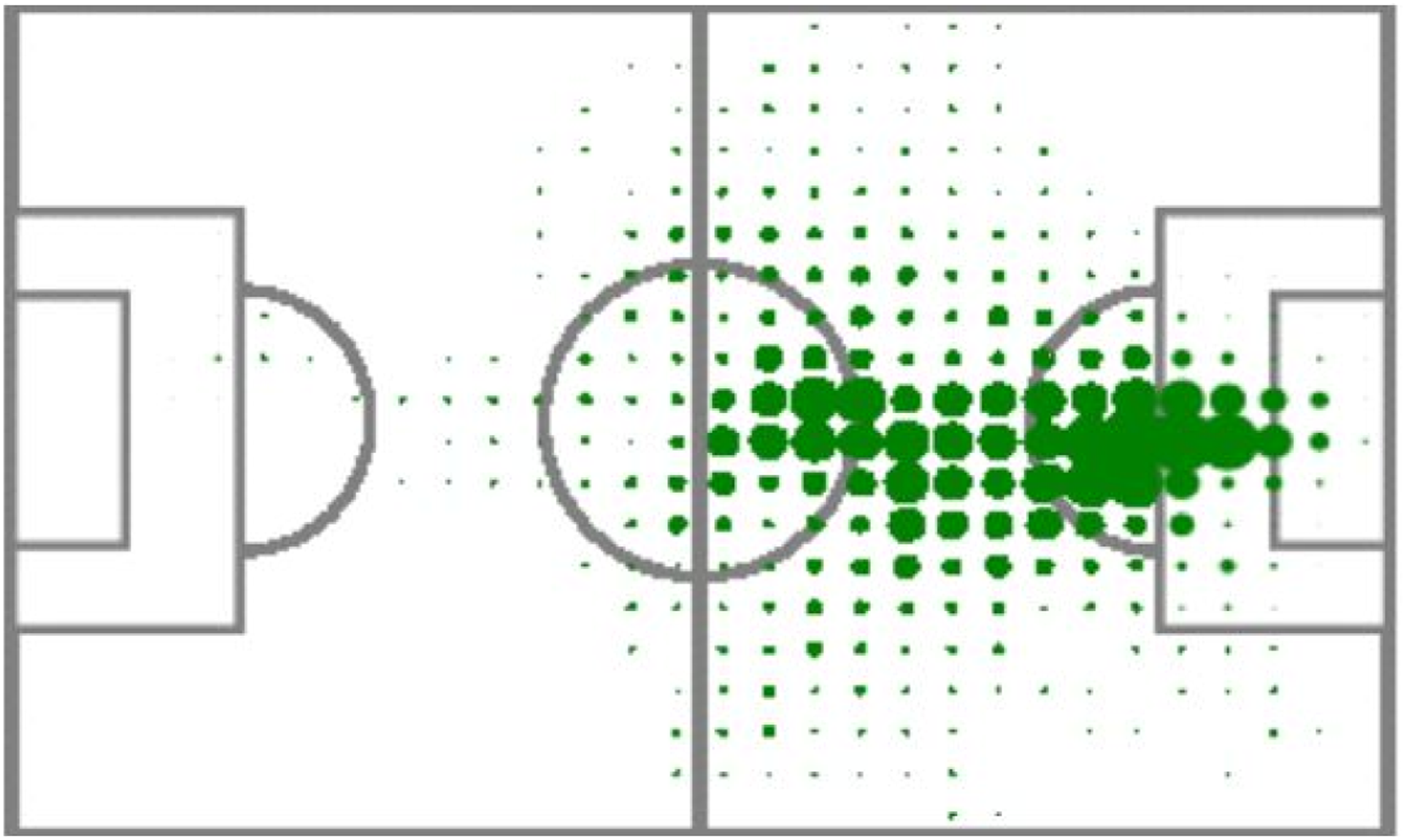
Team Coordination
We use a network variable representing a team’s overall effectiveness and efficiency in passing among all players as our measure of coordination, specifically an inverse betweenness centrality value that communicates how dispersed key network nodes are; a higher inverse betweenness centrality suggests that multiple “nodes” are actively involved in the network, implying more players are actively contributing to the team’s passing coordination. We adopted this measurement because a critical way in which a soccer team utilizes the combined KSAOs of its members is for the team to pass the ball effectively. Much as a police force, for example, relies on strategically-placed units and efficient exchange of information among those units, a soccer team’s success is heavily influenced by the strategic distribution of players on the field and the ability of the team to move the ball among those strategic positions. Consequently, we used a team’s level of passing network centralization to measure team coordination. To compute this coefficient, we used the passing matrix of each team, which reveals the number of successful passes each team member received from and made to all the other players on his team (including the goalkeeper since goalkeepers are typically involved in the passing game). We then computed a network centrality score based on the passing matrix of the 11 starting players on each team. Since the network data derived from the passing matrices are bidirectional (i.e., include both input and output), we used a “betweenness centralization” measure of centrality to capture the extent to which a node lies on the path between other nodes. That is, betweenness represents the degree of influence of a given node by that node’s relative influence or control over exchanges between other nodes. Thus, a player with a high level of betweenness centrality is an important link between other players, much as an airline hub is an important link between other airports. A visual example of a team’s betweenness network is displayed in Figure 2. The overall level of betweenness centralization reflects whether a network is dominated by one or a small number of nodes, or whether exchange is spread fairly evenly across the entire network. As we are interested in the even distribution of exchange across the entire network, we used the multiplicative inverse of Freeman’s (1979) formula for betweenness centrality such that a lower value represents a higher degree of centralization and a higher value represents more even dispersion of exchanges among all team members, with high values thus reflecting a higher level of team coordination. Example network centrality map. Note. GK is goalkeeper, CB is central defender, WB is wide defender, CM is central midfielder, WM is wide midfielder, and ST is striker. Shorter lines of exchange represent higher frequencies of exchange, and placement nearer the center of the network represent higher levels of influence, or centrality.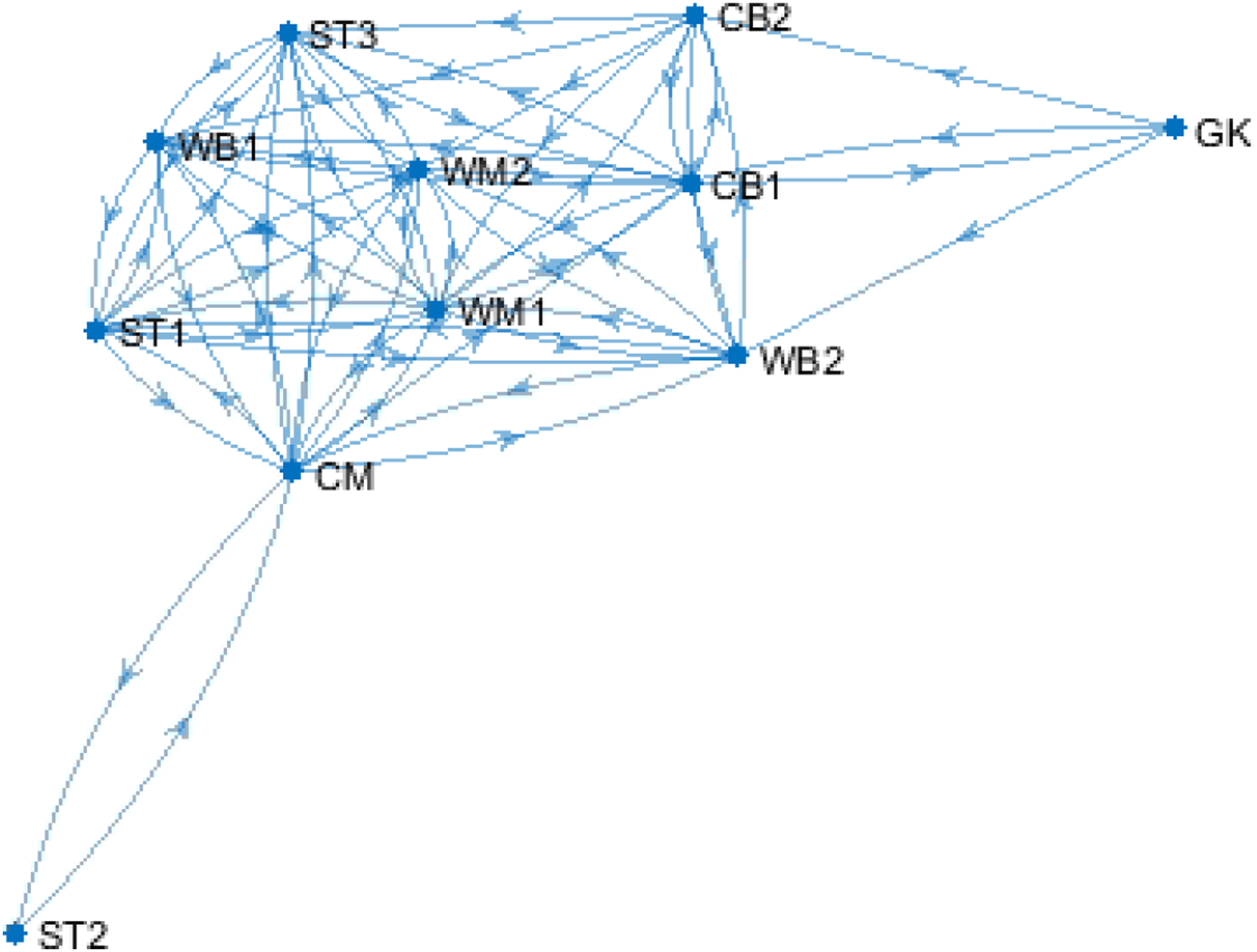
Supplemental Validity Evidence
Because our measures are novel, we sought to establish validity by following the guidelines of Hill and colleagues (2014) and surveying a sample of subject matter experts (SMEs). Specifically, we contacted individuals with high-level soccer expertise and asked them to respond to a short online survey evaluating how well our measures match corresponding construct definitions on a Likert scale ranging from 1, strongly disagree, to 5, strongly agree. We received 18 responses (Female = 55%; average age = 29.7, SD = 8.97) from individuals reporting experience in one or more of the following roles: intercollegiate soccer player (N = 9) or coach (N = 4), television or radio soccer commentator (N = 3), professional soccer coach (N = 3), and one former professional soccer player. We also asked SMEs to rate their level of soccer expertise as compared to an average citizen. The sample mean on this question was 9.86 out of 10 (SD = 0.36). SMEs rated the extent to which a players’ position variability over the course of a game represents proactive 5 behavior [a representative item includes “In soccer, a player who covers a wide range of the field during the course of a game (while maintaining the responsibilities of his/her position) is demonstrating proactive behavior”]. The mean score across 6 items was 3.69 (SD = 0.51; t (17) = 5.74, two-tailed p < .001). SMEs also rated the extent to which a team’s passing distribution reflects team coordination across 6 items (a representative item includes “When a team passes the ball between many different positions in the course of the game, the team is demonstrating a higher level of coordination”). The mean score across these items was 3.80 (SD = 0.22; t (17) = 15.4, two-tailed p < .001).
Although these SME responses support our measures, qualitative responses from SMEs may explain why scores were not higher than was observed. For example, one respondent noted that player position variability “shows that they are willing to go the extra mile to help the team” but is a “bad indicator in the sense that goalies rarely leave their box so it wouldn’t apply to them.” We note that we excluded goalies from our operationalization of initiative but did not make this clear to SMEs 6 . Other qualitative comments were more favorable, with one respondent noting regarding our measure of team initiative: “It is generally a good indicator as the ground covered usually indicates anticipatory thought. It is hard to be proactive on the soccer field without moving in some fashion.” Regarding our measure of coordination, one respondent said it was a good measure because it shows “the chemistry and interconnectedness of a team.” Likewise, another said that taking the distribution of passing into account “helps get more at the complexity of coordination.” Taken together, we believe these supplemental findings offer sufficient support for the validity of our team initiative and team coordination measures.
Team Task Performance
The primary objective for a soccer team engaged in a game is to win by scoring the most goals. Consequently, we measured team performance as the team’s goal differential from a game, which is computed by subtracting the opposing team’s score from the focal team’s score.
Covariates
We include game number as a factor variable to account for potential differences in tactics later in the group stage. Specifically, as the group stage progresses, some teams ensure their advancement before the final group-round game is played, while other teams can find themselves in danger of failing to advance from the group stage after the first or second game. Consequently, teams may adopt more conservative or aggressive styles in different games, potentially influencing the extent to which players are compelled to take initiative. We also include the confederation to which the team belongs as a Level 2 factor variable control. Each team belongs to one of six confederations that roughly correspond to continental alignments (e.g., Australia competes in the Asian confederation rather than the Oceania confederation in which New Zealand competes). Much like traditional organizations, each World Cup team has a bespoke strategy, but, just as isomorphisms in strategy are observed within traditional industries (DiMaggio & Powell, 1983), teams within a confederation tend to display similarities in strategic and tactical styles (Kvas-Cabral et al., 2022; Tuo et al., 2019). Thus, as a further control of differences in strategy and tactics, we include confederation as a Level 2 covariate. For the mediation analysis, covariates are included in all equations.
Analysis
We employ multilevel mediation modeling to test our hypotheses. Specifically, we model the main study variables—team initiative, team coordination, and team performance—at Level 1: team-game. Confederation is modeled as a covariate at Level 2: team-year. We treat teams in each year of the competition as distinct from each other (i.e., 2014 England and 2018 England are treated as two distinct teams) as significant changes typically occur in a team’s make-up and strategy between World Cups. To wit, the 2018 England team had a different manager and tactical approach than in 2014, and only two players appeared in 67% or more of England’s match action across both World Cups. Thus, the teams are more different than similar from one World Cup to another, and we model them in this way, namely with team-year as the Level 2 nesting variable (ICC’s: coordination = 0.13; performance = 0.14). We analyzed our mediation hypothesis via multilevel modelling with random intercepts for Team in Stata version 18 (StataCorp, 2021) using the ml_mediation package, which adapts Krull and MacKinnon’s (2001) mediation approach.
Results
Means, Standard Deviations, and Intercorrelations of Study Variables.
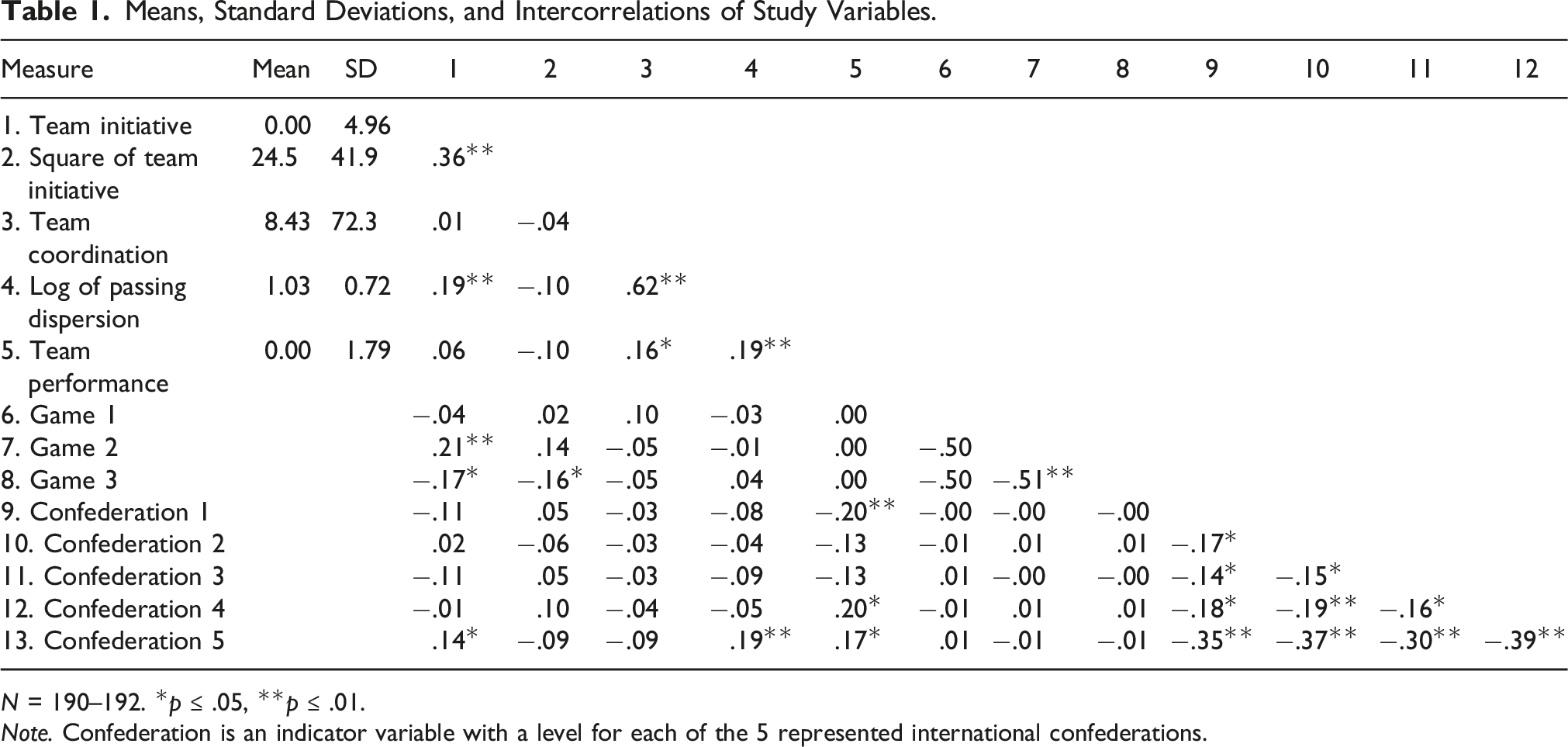
N = 190–192. *p ≤ .05, **p ≤ .01.
Note. Confederation is an indicator variable with a level for each of the 5 represented international confederations.
Results of Multilevel Mediation Predicting Team Performance.
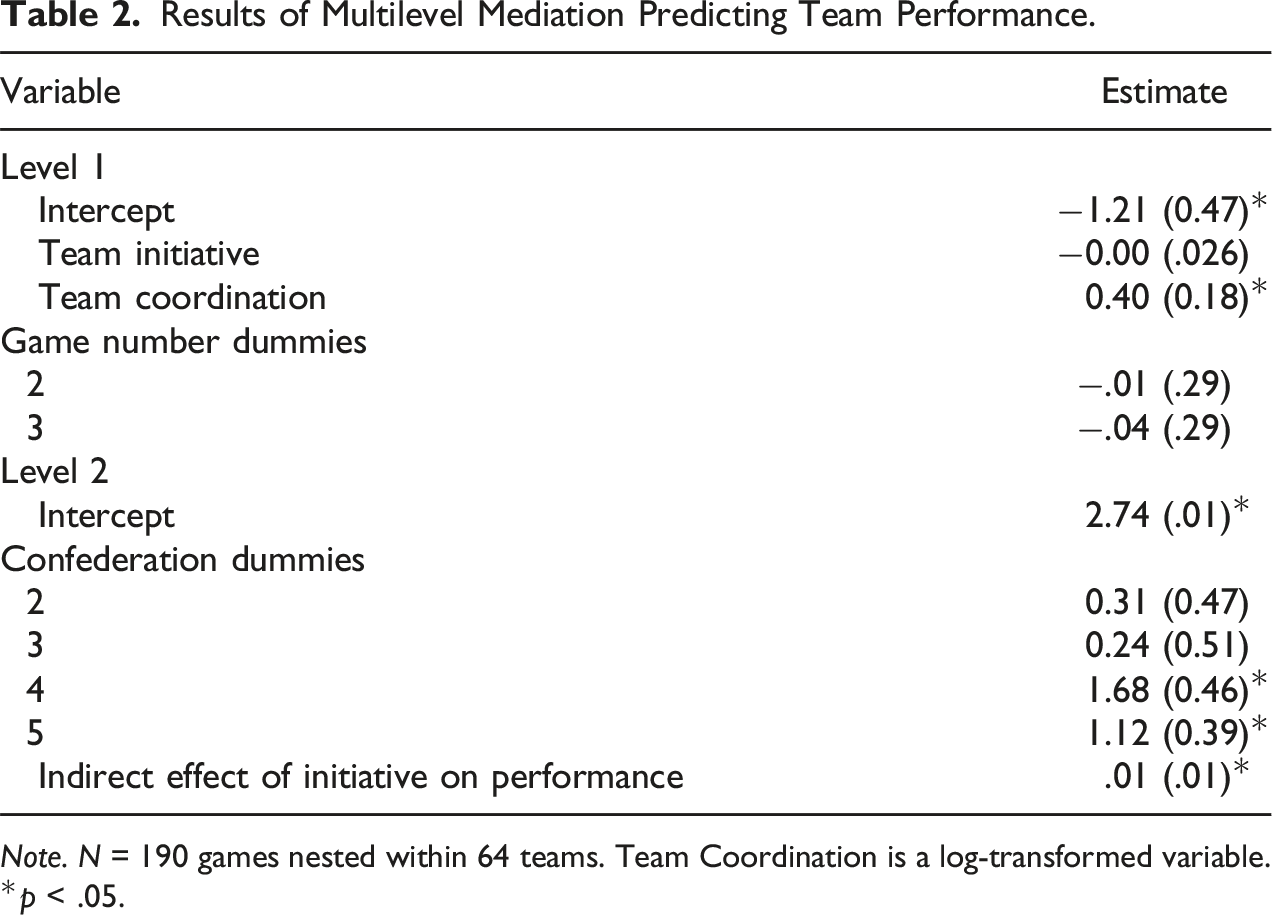
Note. N = 190 games nested within 64 teams. Team Coordination is a log-transformed variable.
*p < .05.
To assess Hypothesis 2—that there is a curvilinear relationship between team initiative and team coordination—we first compared the results of the random intercept-random slope model to that of the random intercept-fixed slope model. Likelihood ratio tests revealed no difference between the two models (χ2 (2) = 0.09, p = .955), indicating that slopes did not meaningfully vary across team-games. Correspondingly, we proceeded with a random intercept for team and a fixed slope for team initiative and regressed the linear and quadratic values of initiative on the logged variable for team coordination. This produces significant direct (γ = .05, S.E. = .01, 95% CI = [.03, .07]; t (185) = 4.42, p < .001) and polynomial associations (γ = −.004, S.E. = .001, 95% CI = [−.01, −.001]; t (185) = −3.15, p = .002), confirming that the nature of the hypothesized relationship is nonlinear. The curvilinear effect is consistent at both at one standard deviation below the mean level of team initiative (γ = −.004, S.E. = .001, 95% CI = [-.01, −.001]; t (185) = 3.15, p < .001) and one standard deviation above the mean (γ = −.004, S.E. = .001, 95% CI = [−.01, −.001]; t (185) = 3.15, p < .001). To probe the specific shape of the polynomial relationship, we tested a cubic interaction on initiative. With the cubic term, the model still returns a significant direct effect (γ = .03, S.E. = .01, 95% CI = [.01, .06]; t (184) = 2.38, p = .017) and significant square interaction (γ = −.01, S.E. = .002, 95% CI = [−.01, −.00]; t (184) = 3.30, p < .001) but a nonsignificant cubic interaction (γ = .0002, S.E. = .0001, 95% CI = [−.0006, .0004]; t (184) = 1.49, p = .136). In light of this, we observe a stable direct relationship and a stable square interaction but the absence of higher-order effects, together suggesting a curvilinear relationship. As the coefficient of curvilinearity is negative, we conclude that its shape is such that increasing levels of initiative have decreasing marginal effects on performance, supporting Hypothesis 2.
Supplemental Mediation Analysis
As a supplement to our hypothesized model, we also tested a curvilinear model of mediation in a simplified, single-level mediation model. We used a single-level mediation model (i.e., with confederation modeled at Level 1 rather than Level 2) due to the complexities of multilevel mediation with curvilinear effects; this is consistent with the approach of Hayes and Preacher (2010). Using 5000 bootstrap samples, we observe a negative coefficient for the curvilinear effect in the mediation model with a confidence interval that does not contain zero (b = −.003, SE = .001, 95% CI = [−.006, −.001]). Specifically, the relationship begins as a moderately positive one that becomes less positive before effectively leveling off to no relationship at higher levels of initiative. Examining the indirect effects at different levels reveals that the effect is strongest for teams with initiative levels that are 0.50 standard deviations above the mean (indirect effect = .01, 95% CI = [.000, .023]), suggesting teams that have elevated but not excessive levels of initiative experience increased performance. This effect diminishes at higher levels, however, and tapers off at lower levels until becoming non-influential at 0.5 standard deviations below the mean. Thus, the hypothesized “too much of a good thing” effect was also detected in the mediated connection between team initiative and team performance.
Discussion
Teamwork is clearly vital for organizational success (Cannon-Bowers & Bowers, 2006; Gully et al., 2002). Because of this, team members’ accumulated efforts to take initiative are often essential for teams to achieve organizational objectives. Although a robust body of research supports this positive relationship at the individual level (see Crant, 2000; Parker & Bindl, 2017; Thomas et al., 2010), prior work on team-level initiative has generally relied on perceptual measures of team initiative rather than actual, enacted initiative. We advance the team initiative literature by assessing how team initiative relates to a team’s performance—namely, via the emergence-enabling process of team coordination—in a real-world context with objective behavioral data. Drawing from the HCR perspective, we theorized that a team’s initiative efforts must be effectively coordinated by the team for initiative to be transformed into a human capital resource that the team can utilize to accomplish its goals. In support of this expectation, our findings suggest that team initiative’s relationship with performance is mediated by team coordination. Additionally, we demonstrate the “too much of a good thing” effect of team initiative’s connection with team coordination, revealing that exceptionally high levels of initiative appear to overwhelm the ability of teams to integrate and coordinate those behaviors into relevant human capital resources. We next discuss the theoretical and practical implications of these findings.
Theoretical Implications
This study contributes to teams scholarship in a variety of ways. First, in addition to focusing on observed behaviors rather than perceptions, we provide a more stringent test of the guiding logic of proactivity, namely that it is a goal-supporting behavior within the team context. This work extends prior work with perceptual variables by demonstrating that enacted initiative does not positively influence team performance unless the team can effectively transform initiative into a unit-level human capital resource via coordination. For future investigations of the outcomes of team initiative, this highlights the need to assess team coordination as a key emergence-enabling process. Yet, as our results indicate, the ability of the team to coordinate these inputs can be overwhelmed at higher levels of team initiative, producing diminishing returns of team initiative on team performance. This finding demonstrates that the effectiveness of team initiative is wholly dependent on the team’s proper coordination of team member inputs. This both clarifies and amplifies prior work (cf., Barnes et al., 2008) by showing the “too much of a good thing” effect with team initiative and indicating that it is apparently possible to engage in excessive amounts of initiative in teams such that it ceases to be beneficial or can even become a detriment for the team.
Second, this study contributes to the proactivity literature by detailing the nature of a specific subset of proactive behaviors (i.e., initiative) as a team-level phenomenon. Following multilevel theory, we conceptualized team initiative in terms of its behavioral manifestation, representing the accumulation of individual initiative within a team. This is theoretically consistent with the expectation that initiative is an emergent phenomenon in teams (Kirkman & Rosen, 1999; Williams et al., 2010) and that “team behavior” is ultimately reflected by the pattern or combination of similar behaviors among team members (Morgeson & Hofmann, 1999). Given this, we encourage team proactivity researchers to consider behavioral measures of team proactivity, including team initiative, as such measures are more conceptually proximal to the construct of team proactivity than are perceptions of the behaviors that reflect team proactivity. Additionally, our findings respond to the call for investigating proactivity’s homology across levels (Cai et al., 2019). Specifically, our results suggest that proactivity in the form of initiative is not homologous at the individual and team levels. Rather, in contrast to the individual-level relationships of proactivity and initiative, respectively, with performance, the team-level relationship appears to depend on team processes (i.e., coordination) to properly integrate team members’ initiative such that they can facilitate team performance. When considering the team-level manifestation of proactivity as the accumulation of team members’ proactive behaviors, this lack of homology makes sense as there is a need to manage the varying instances of initiative among teammates to achieve the same benefit that personal initiative has on one’s own performance. In short, the between-person dynamics that must occur at the team level to channel the benefits of initiative simply do not have an individual-level corollary, resulting in a lack of homology.
Our behavioral assessment of proactivity in this investigation of team-level initiative stands in contrast to the more common practice of assessing team-level proactivity by aggregating individuals’ perceptions to the team level. While behavioral assessment is not always feasible, and perceptual measures may sometimes be necessary, we maintain that behavioral measures reflecting proactivity in action more closely represent the construct of team proactivity than do perceptions of those very behaviors. Perceptual measures may also be limited since the aggregation threshold required for team-level analyses implies that teams will only recognize themselves as proactive insofar as there are shared perceptions that proactivity seems to contribute to the team’s effective goal accomplishment. For example, the team proactivity item “If members of my team see something they don’t like, they fix it” (e.g., Shin & Eom, 2014) refers to actions that are likely to be perceived as proactive only if they achieve the desired consequence. Put differently, team members are only likely to perceive “fixing” something as a proactive behavior insofar as it contributes to the team’s tasks; if the team member is fixing things that do not require immediate attention or that detract from the team’s primary goals (e.g., re-arranging the team’s workspace), team members are likely to perceive these actions as counterproductive rather than proactive. Consequently, studies relying on perceptual measures may mask the true effects of team proactivity as dictated by the HCR framework. We thus encourage future team proactivity research to use behavioral measures, such as utilized here with initiative, whenever possible.
Third, we contribute to the HCR framework by including team members’ initiative behaviors as a relevant manifestation of human capital that can be converted into a team-level human capital resource via team coordination. Since teams are the basic unit of modern organizations (Mathieu et al., 2017) and the critical link between human capital and firm-level competitive advantage (Ployhart & Chen, 2019), understanding coordinated team initiative as a human capital resource draws an important line of connection between teams and strategic organizational outcomes. With initiative manifesting in adaptive and change-oriented behavior, teams that are able to coordinate that initiative to enhance team performance are also likely to be more adaptive and change-oriented. For organizations with strategic elements rooted in change and adaptability—such as firms pursuing innovation strategies, firms in highly-dynamic environments, or firms experiencing high levels of structural change in their operating environments—teams that are able to convert individual initiative into team-level human capital resources via effective coordination may contribute directly to the firm’s successful adaptation to changing environmental conditions. While future work will be necessary to investigate this potential connection, considering team initiative as a critical element in converting human capital into firm-level competitive advantage holds promise.
Practical Implications
Given the increasing importance of teams in working life, this study has important implications for organizations. First, managers must be mindful that initiative requires effective team coordination to contribute to team outcomes. That is, while it is natural to encourage team members to take initiative in helping to achieve team objectives, in the team environment, where resources are often more limited than in the broader organizational environment, initiative above and beyond the team’s ability to coordinate inputs is wasted energy. Absent the emergence-enabling coordination process, or at levels of initiative that overwhelm the coordination process, additional proactive effort is likely to be fruitless. It is likewise critical for organizations to understand that even when team initiative is appropriately coordinated, it will cease to be beneficial once the behaviors exceed the team’s capacity to manage and integrate them. In the context of this study, soccer players’ initiative is good, but only insofar as the team is capable of integrating those behaviors in a way that is strategically useful. We expect that this is true of other teams as well.
To better understand the practical magnitude of our findings, we converted the reported value of team initiative’s association with the log of passing centrality back to the original units of team coordination. This analysis reveals that a one unit increase in the level of team initiative results in a 3% increase in team coordination across all cases. Of course, the identified curvilinear association indicates that the magnitude of the relationship varies at different levels of initiative. Indeed, teams with initiative levels of up to 1 standard deviation above mean levels experience a 9.7% increase in coordination for every unit increase in initiative, while teams with initiative more than 1 standard deviation above the mean experience no additional meaningful gain in coordination. When converting this relationship to a common language effect size (McGraw & Wong, 1992), we observe that for teams whose initiative levels are no higher than one standard deviation above the mean, there is a 60% likelihood that they will experience better team coordination, while teams with higher levels of initiative are equally likely to experience higher or lower levels of coordination. These findings provide some indication to managers of the value of team initiative but also the degree to which there may be a “too much of a good thing” effect.
Limitations and Future Research
Our conclusions should be interpreted in light of some study limitations. One potential limitation is the generalizability of our findings to other contexts. World Cup soccer teams are unique in a number of respects: they are typically composed of very high performers working in a high-visibility context with clearly defined roles and finite work episodes. While we acknowledge these unique features of the sampling context, we believe sports teams generally—and soccer teams in particular—share as many commonalities with “typical” work teams as they do differences. Soccer teams are comprised of paid employees, are susceptible to losing key team members to turnover, frequently experience changes in leadership, and can experience both functional and dysfunctional conflict just as more traditional organizational work teams do. Furthermore, like work teams in many other contexts, although a soccer team’s objectives are clear, the means of attaining them often are not. Instead, multiple paths exist for achieving team objectives and teams often have latitude in determining how best to achieve those objectives. Additionally, sports teams share a number of similarities with a number of common organizational teams that involve integrating disparate KSAOs (e.g., action teams), adverse working conditions (e.g., oil derrick inspection teams), and spatial responsibilities (e.g., flight attendant teams). Nevertheless, future research in more diverse team settings may help to clarify and extend the generalizability of this study’s findings.
A related limitation stems from unmeasured variables that may influence our results. Leadership, for instance, influences the manifestation of team proactivity and team initiative (Chiu et al., 2016; Lisbona et al., 2021; Strauss et al., 2009; Williams et al., 2010) but is not measured in our study, which may influence our findings. Reflective of this, leaders in a soccer context (i.e., team managers) are charged with setting team strategy, and some teams may adopt strategies that favor a particular style or favor a particular player in a way that affects manifestations of team initiative in our findings. One manager may, for instance, implement a style that requires players to maintain a pre-determined proximity to their playing zone, while another may leverage a particularly talented player by allowing that player to “roam” across the full field without constraint. While we acknowledge this limitation, we assert that it is unlikely to greatly limit generalizability from this context. For one, our tests were specified with random intercepts to account for systematic differences across teams in this sample. We also note this is not unlike teams in organizations that may be built around a particularly high-performing member (e.g., Groysberg et al., 2008), such as a legal defense team composed of a seasoned trial lawyer who captains a team of junior attorneys and paralegals playing support roles. Likewise, the degree of latitude team members are granted is also dictated by leadership, and, like soccer teams, workplace teams can be successful in both highly-constrained environments as well as when team members are given high autonomy (Erickson, 2012). Consequently, we do not believe this factor substantially limits the generalizability of these findings relative to other contexts.
Relatedly, though our data are robust with respect to the accuracy of player actions during a game, they are not with regard to time as all main variables were measured at the game level. Thus, we cannot lay claim to a causal relationship. We do test theoretically-causal relationships and find that the theory holds with these data, but the directionality of these relationships is only theoretically inferred rather than mathematically confirmed. Future research capturing variables unmeasured in this study and utilizing experience sampling methods will be better able to probe the nature of these relationships. Likewise, as the level of complexity inherent in teams is central to the “too much of a good thing” effect of initiative’s positive indirect contribution to team performance, it may be the case that varying levels of team complexity demonstrate varying degrees of diminishing marginal returns. Additional research into the relationship among teams with varying degrees of complexity would be enlightening.
An additional study limitation is the coarseness of our outcome variable. Despite the high fidelity of our predictor measures and the clear objectives pursued by a soccer team, measuring performance in terms of goal differential is imperfect. To illustrate, 24% of games in this sample ended in a draw. For some teams in certain situations, a draw represents a success while for others it is a failure. As such, the achieved outcome may be more or less valuable to the team depending on factors that are not measured in this study. While we acknowledge this limitation, the high degree of fidelity available in the predictor variables represents a strength of these data, even in the face of a low-resolution outcome variable. Nevertheless, a number of variables are not easily studied in such samples, such as team transactive memory and shared mental models. Likewise, little is known yet about the nature of environmental factors affecting how and when personal initiative arises within a team, and how those individual-level behaviors specifically influence team-level outcomes. Future research considering these constructs and their mediating or causal influence on team initiative may help advance our understanding of the relationships uncovered in this study.
In addition to these clarifications, our results point to several promising avenues of future inquiry for team proactivity and team initiative research. Given our finding that team initiative depends on additional behaviors (i.e., coordination) to contribute to team performance, and that too much initiative harms the team’s ability to coordinate inputs, additional research into the conditions that facilitate or limit team member initiative would enhance our knowledge of these phenomena. One promising area is the social context within which the team is located. Organizationally-provided resources, external leadership dynamics, and team member individual differences (e.g., proactive personality, trust, motivation) all contribute to a team’s social context and may influence the emergence and manifestation of team initiative. For example, prior work suggests that high levels of proactive personality among team members creates an environment in which members are more likely to feel that being proactive is encouraged and rewarded (Wang et al., 2017). Indeed, higher levels of proactive personality within a team produce positive linear effects on team proactivity, but diversity among levels of proactive personality within a team limits team proactivity (Williams et al., 2010). What remains unclear is the extent to which factors like proactive personality—and its compositional manifestations at the team level—likewise affect the enabling process of team coordination and thus the extent to which a team is able to benefit from the cumulative initiative of team members.
Relatedly, additional constructs may also facilitate or limit initiative and its effectiveness. For example, what factors influence a team’s ability to coordinate inputs? The complexity of a task, the adequacy of staffing levels, and the capabilities of team members could all contribute to a team’s capacity to coordinate behavioral initiative. We encourage proactivity researchers to test these and other factors as moderators of the connection between team initiative and team coordination. It is also conceivable that a team’s capacity to manage initiative varies based on when those behaviors occur. For example, as indicated by Humphrey et al. (2004), who found that team resources, such as attentional focus, vary based on the stage of project completion, it may be the case that teams have less capacity to coordinate at late stages of task completion when more attention and team resources are devoted to meeting a deadline. Thus, time may also be an important consideration when gauging a team’s capacity for coordinating team initiative. Additionally, accounting for the relationship between goal-supportive behaviors (e.g., initiative) and goal-disruptive behaviors (e.g., social loafing) may yield additional insights regarding the role of coordination. This work shows, consistent with theory, that an emergence-enabling process is crucial for converting individual-level contributions into resources that can be deployed by the team. Yet, goal-disrupting processes may have a more direct impact on team functioning and performance (e.g., Carpenter et al., 2021; Taylor et al., 2017), potentially influencing how goal-supportive processes are transformed into human capital resources. Future research is needed to consider these factors.
Another contextual factor related to team composition is team membership change. Although teams research tends to focus on teams as static entities in organizations, the reality is that teams can be as dynamic as the environments in which they operate. Prior scholarship demonstrates that changes in team membership negatively influence coordination and, subsequently, performance (e.g., Summers et al., 2012). This is because membership changes can alter a team’s available resources (e.g., LePine, 2005), either changing the team’s propensity to engage in initiative or the team’s ability to manage initiative. Future research investigating how initiative is affected by such change would advance our understanding both of team change and team initiative.
Conclusion
Initiative is a strong predictor of effectiveness at the individual level (Fay & Frese, 2001) but at the team level, our results indicate that the relationship is less straightforward. Drawing from the HCR perspective, we theorized that a team’s ability to coordinate the behavioral initiative of its team members is the key linking mechanism between team initiative and team performance. Since team initiative only becomes a human capital resource if it is relevant and accessible to the team for resolving team goals, team members’ accumulated initiative only becomes useful when the team is able to coordinate the pooled initiative to the resolution of team task demands. By analyzing the aggregate positional variability of World Cup soccer players and the degree of centrality of the teams’ passing networks, our results demonstrate that team coordination mediates the relationship between team initiative and team performance. Moreover, we observe a “too much of a good thing” effect whereby initiative at very high levels ceases to generate increases in team coordination and can actually become a detriment to the team. This work elucidates the complex nature of initiative as a team-level phenomenon, opening up promising avenues of inquiry that we encourage future research to expand upon.
Supplemental Material
Supplemental Material - Channeling personal initiative through team coordination: A heat map analysis of soccer players’ aggregate behavioral initiative
Supplemental Material for Channeling personal initiative through team coordination: A heat map analysis of soccer players’ aggregate behavioral initiative by Erik C. Taylor and Jeremy M. Beus in Group & Organization Management.
Supplemental Material
Supplemental Material - Channeling personal initiative through team coordination: A heat map analysis of soccer players’ aggregate behavioral initiative
Supplemental Material for Channeling personal initiative through team coordination: A heat map analysis of soccer players’ aggregate behavioral initiative by Erik C. Taylor and Jeremy M. Beus in Group & Organization Management.
Footnotes
Acknowledgments
A previous version of this paper was presented at the Southern Management Association Annual Meeting, Norfolk, October 2019.
Declaration of Conflicting Interests
The author(s) declared no potential conflicts of interest with respect to the research, authorship, and/or publication of this article.
Funding
The author(s) received no financial support for the research, authorship, and/or publication of this article.
Associate Editor: Deanna Kennedy “AE”

Data Availability Statement
All data generated or analyzed during this study are included in this published article [and its supplementary information files].
Supplemental Material
Supplemental material for this article is available online.
Notes
Author Biographies
References
Supplementary Material
Please find the following supplemental material available below.
For Open Access articles published under a Creative Commons License, all supplemental material carries the same license as the article it is associated with.
For non-Open Access articles published, all supplemental material carries a non-exclusive license, and permission requests for re-use of supplemental material or any part of supplemental material shall be sent directly to the copyright owner as specified in the copyright notice associated with the article.
