



Abstract
High rates of residential separation of fathers and children in South Africa demand reliable methods of collecting data on the parenting practices of nonresident fathers. Using questionnaire data from matched mother–father pairs, we assessed the reliability of mother’s reports of father’s involvement in infant care as a proxy for father’s own reports. Agreement between parental reports was reasonable for father’s financial provisioning and time spent with the infant, but poor for father’s engagement in direct caregiving, decision-making responsibility, and assistance with household chores. Across a range of activities, fathers reported higher levels of involvement than were acknowledged by mothers. Disagreement over definitions of the underlying parenting practices being assessed and definitions of the response categories on the questionnaire appeared to contribute to low levels of overall agreement. Mother and father reports should not be treated interchangeably in research on father involvement. Ideally, future research will incorporate data from multiple observers.
Keywords
Fathers’ contributions to the care and well-being of children continue to be of considerable interest to researchers and policy makers (Lamb, 2000). This interest has been promoted by social and demographic changes in the contexts of childrearing, including more equal participation of women in work outside of the home and increasing rates of extramarital childbearing (Tamis-LeMonda & Cabrera, 1999). In high-income countries, credible evidence suggests greater involvement of fathers in caregiving is associated with improved behavioral, cognitive, and socioemotional developmental outcomes for children (Sarkadi, Kristiansson, Oberklaid, & Bremberg, 2008). More equitable involvement of fathers in the work of caring for children also has potential to benefit mothers and fathers themselves.
Most research on father involvement has been conducted in high-income countries, but similar research in low- and middle-income countries is needed (Desmond & Hosegood, 2011). In particular, demand exists for research on men’s care roles in many Southern African countries where the generalized HIV epidemic, rapid urbanization, and high rates of unemployment are challenging the traditional strategies by which families meet the needs of children. Detailed, population-level data on father involvement could be used to inform family-strengthening interventions to promote child-wellbeing in these settings (Richter et al., 2009).
South Africa, with its well-developed research infrastructure, is a promising country for conducting research on fathers (Hosegood & Madhavan, 2012). However, a lack of validated tools for measuring the range of ways fathers can be involved in their children’s lives has limited quantitative research on fathering (Hosegood & Madhavan, 2012). Another factor complicating research on South African fathers is that less than half of all children below age 15 live with their biological father (Posel & Devey, 2006). Therefore, it is necessary to evaluate methods for collecting reliable data on the contributions of nonresident fathers. Because children are twice as likely to live with their biological mother than their father (Statistics South Africa, 2015), using mothers as proxy sources of information about fathers is one possible strategy. Studies in high-income countries have generally found low agreement between mothers’ and fathers’ reports of father involvement (Coley & Morris, 2002; Mikelson, 2008). Similar research in the South African setting would be useful given that recent large national surveys have begun using proxy respondents to collect information about fathers’ contributions to children (Southern Africa Labour and Development Research Unit, 2016). In addition, it would helpful to understand whether levels of father–mother agreement are similar for questions addressing conceptually distinct forms of father involvement. To address these questions, we conducted a study assessing the extent of agreement between father and mother reports of fathers’ involvement in caring for newborn babies in the Western Cape Province of South Africa. Anticipating low agreement, we also quantitatively explored the sources of disagreement using strategies from the medical interrater agreement literature (Uebersax, 1992).
Conceptual Framework
Our study was conducted within a theoretical framework that recognizes fatherhood—that is, “the public meanings associated with being a father” (Dermott, 2009, p. 7)—as socially constructed (Marsiglio, Day, & Lamb, 2000). Fatherhood ideals vary over time and are influenced by the diverse and shifting social circumstances in which men and women are embedded (Pleck & Pleck, 1997; Townsend, 2002). These ideals inform societal expectations of fathers, and the expectations they have of themselves, with respect to the appropriate types and amounts of involvement in their children’s care. However, the actual parenting practices of many fathers may not be consistent with the dominant fatherhood ideals in their societies (LaRossa, 1988).
The Context of South African Fatherhood
In precolonial Southern African societies, fatherhood ideals were linked to images of “the patriarch”—whose power and prestige stemmed, in part, from having many children (Hunter, 2008; Lesejane, 2006). Fathers were expected to take responsibility for their families’ affairs and provide for their material needs. They were also seen as models of appropriate behavior, particularly for adolescent sons during the transition to manhood (Lesejane, 2006). Because these societies followed a system of agnatic descent (i.e., descent from the father’s lineage), fathers were important for providing children with membership in an extended kin network, which could support the child in times of need (Russell, 2003). Conversely, children’s day-to-day care was viewed as the responsibility of the mother and other female kin (Lesejane, 2006).
In South Africa, traditional African ideals of fatherhood were systematically undermined during colonialism and apartheid (Lesejane, 2006). Colonial taxation and land appropriation forced increasing numbers of Africans into migrant labor (Horwitz, 2001). Apartheid-era “Pass laws” further entrenched the migrant labor system by preventing most Africans from living in cities except for work. Together with short-term labor contracts, these laws resulted in (mostly male) laborers migrating cyclically between permanent family homes in rural areas and temporary accommodation near urban places of work (Budlender & Lund, 2011). Most laborers’ families remained at rural homes. It is proposed that, as a result of these pressures, the role of the father as economic provider assumed supremacy in fatherhood ideals (Lesejane, 2006). Long periods of absence further limited opportunities for fathers to directly care and model behavior for children.
Since the abolishment of pass laws and the transition to democratic government, permanent migration to cities has become more common than cyclical migration (Budlender & Lund, 2011). However, enduring declines in marriage rates among Black Africans, with only modest increases in co-habitation, mean that large percentages of children still reside separately from their biological fathers (Hosegood, McGrath, & Moultrie, 2009). Despite residential separation being a common feature, researchers have found that many contemporary young Black fathers desire to be, and are, involved in their children’s lives in numerous ways, including caregiving (Makusha, Richter, & Bhana, 2013; Swartz & Bhana, 2009). However, financial provisioning still appears to be a primary component of the fatherhood ideals of these men (Swartz & Bhana, 2009). A high unemployment rate, together with increased entry of women into the paid labor force, threatens the ability of many poor, Black men to attain this traditional ideal.
The evolution of Southern African fatherhood ideals is similar to that described for North America and Europe (Irvine & Klocke, 2001; LaRossa, 1988; Pleck & Pleck, 1997). What is particularly noteworthy about the South African context, though, is the profound influence of racial discrimination on African family formation and functioning. Previous authors have noted the similarity with the situation of African American families (Hosegood & Madhavan, 2012).
Conceptualizing and Measuring Father Involvement
To capture the diverse, positive ways fathers can be involved in their children’s lives, recent models treat father involvement as a multidimensional construct (Lamb, 2000; Marsiglio, Day, & Lamb, 2000). The questionnaire used in this study was developed from a conceptual framework that distinguishes three modes by which fathers may influence their children’s well-being (Marsiglio, Day, & Lamb, 2000): Caregiving, Material Provisioning, and Supporting mothers (and other caregivers).
Caregiving is the most direct form of father involvement. It has been conceptualized as consisting of three somewhat distinct domains of activity: Engagement, Accessibility, and Responsibility (Lamb, Pleck, Charnov, & Levine, 1985). Engagement is defined as direct interaction with a child, for example, during physical care activities and play. Accessibility includes being available to and supervising the child but involves less direct interaction. Responsibility is taking a primary role in recognizing and making arrangements for a child’s needs. Material Provisioning includes ensuring children’s needs for nutritious food, clean drinking water, and adequate clothing and shelter are met. Support for mothers may be emotional or practical, such as giving information or advice or doing household chores (Marsiglio et al., 1997).
We justify our use of Lamb et al.’s model in this study in two ways. First, in the absence of validated theoretical models of South African father involvement, Lamb et al.’s model has the benefit of distinguishing similar components of father involvement to those emphasized in the available qualitative descriptions of South African fatherhood ideals (reviewed above). Second, this model has been used extensively in other cultural settings, thereby potentially facilitating cross-cultural comparison of our data. We acknowledge that the North American context in which this model was developed shapes the forms of father involvement emphazised in the model and their associated culture-specific meanings. By identifying aspects of the model over which South African fathers and mothers agree poorly, this study is able to suggest areas needing further conceptual development in this setting.
Sources of Disagreement Between Observers
In comparing father and mother reports of father’s parenting, neither set of reports can be treated as the objective “truth.” Each is likely to be influenced by personal perceptions about the adequacy of the father’s parenting. In turn, these perceptions may be informed by an array of individual, interpersonal, and societal factors. Nevertheless, efforts to identify individual questions, or sets of related questions, that elicit consistent responses from both observers are still worthwhile. Such evidence would increase our confidence in the validity of responses for these items and would suggest that mothers could be used as reliable proxy respondents for fathers. In contrast, reliability and validity are questionable for item responses with low levels of father–mother agreement because at least one parent’s responses must differ from the father’s true practices.
For measurements involving ordered-category ratings, which include all of those on our questionnaire, two sources of disagreement can be distinguished: respondents may disagree about the definition of the fathering practice being assessed; in addition, they may disagree about the specific rating levels (Uebersax, 1992). The latter type of disagreement can occur because, during the design of the questionnaire, variables that are originally continuous (e.g., the frequency the father performed a particular care practice) were artificially divided into discrete response categories. Because the divisions are somewhat subjective, individual respondents may vary in how they apply the categories.
In this study, we describe agreement between father and mother reports of father’s involvement in the five modes of paternal influence described by Lamb and colleagues (Lamb et al., 1985; Marsiglio, Day, & Lamb, 2000). We also assessed for the presence of the above-described sources of disagreement. To our knowledge, this is the first study to quantify the agreement between reports of father’s involvement from matched father–mother pairs in South Africa. Our analysis builds on previous research involving parents in the United States by examining agreement on both direct and indirect modes of father involvement in a single dataset. Finally, by identifying sources of disagreement, we can suggest strategies for improving inter-observer agreement in future applications of the questionnaire.
Method
Study Design and Setting
The Mother Infant Health Study (MIHS) Fathering substudy was a longitudinal cohort study involving families living in Kraaifontein, a suburb of Cape Town. Although located in a wealthy city district, relative to other suburbs in the district, Kraaifontein has above average percentages of low-income households, adults with less than high school education, unemployment, and laborers in unskilled occupations (van Heyningen, 2007). The majority of dwellings are formal, stand-alone houses, but some “informal settlements,” consisting of high concentrations of dwellings “not erected according to approved architectural plans or on planned sites . . . ” exist (Statistics South Africa, 1998; van Heyningen, 2007). Residents of informal settlements have limited access to basic services (van Heyningen, 2007).
The study protocol was approved by the human research ethics committees at Stellenbosch University, South Africa (Reference number: S12/01/009), and the Children’s and Women’s Health Centre of British Columbia, Canada (Reference number: H12-01181). All participating mothers provided written informed consent. Participating fathers gave verbal informed consent over the telephone.
Sample
The MIHS consisted of a convenience sample of infants and mothers enrolled at delivery at the Kraaifontein Community Health Clinic between July 16, 2012, and June 28, 2013 (Slogrove et al., 2017). At enrollment, mothers were asked to take an introductory letter to the infant’s father. The letter explained the Fathering substudy and invited the father to participate. The sample for the Fathering Substudy included all mothers who completed the first MIHS study visit at 2 weeks postdelivery, and their infant’s biological father. For a father to be eligible, the mother had to complete the 2-week study visit and provide consent for us to contact the father. Fathers were enrolled and consented by telephone when infants were 2 weeks old. Parents of infants who acquired HIV were excluded from the Fathering substudy to align the sample with that of the principal MIHS study.
Fathering substudy visits were completed when infants were 2 weeks, 16 weeks, and 6 months old. Mothers and infants attended study visits at our research clinic in a tertiary-level hospital approximately 20 km away from Kraaifontein. To maximize participation of fathers, we offered them a choice between completing substudy visits by telephone or in-person at the study clinic. At each visit, fathers and mothers separately completed an approximately 30-min fathering questionnaire with a trained interviewer of similar racial and cultural background.
The questionnaire was professionally translated from English into isiXhosa and Afrikaans, the two most common languages in Kraaifontein. Before beginning data collection, questionnaires were back translated by study staff members and reviewed by an investigator (G.D.M.) to ensure questions retained their original meaning. Interviewers administered the questionnaire to participants in their choice of the three languages. After completing questionnaires with the first five to 10 participants, the questionnaires were revised to improve clarity of a small number of questions.
Fathering Questionnaire
The fathering questionnaire was constructed by drawing from a pool of survey items originally developed for the Developing a Daddy Survey (DADS) project in the United States (Bronte-Tinkew, Moore, & Halle, 2002). Based on Lamb and colleagues’ framework, it included items intended to measure a father’s level of Engagement, Accessibility, Responsibility, financial contribution toward the infant’s material needs (Material Provisioning), and involvement in household chores (Practical Support for Mother; Marsiglio, Day, & Lamb, 2000). The questionnaire also included questions developed by the DADS project to assess respondents’ personal beliefs about fatherhood. Supplementary Table 1 presents the complete list of items included in our questionnaire together with percentage frequency distributions of mothers’ and fathers’ responses on each item.
Engagement
Engagement was measured using 10 ordered polytomous (i.e., ordinal) items asking respondents to rate how often the father performed different infant caregiving activities (such as soothing, bathing, changing diapers, and singing songs or nursery rhymes) since the birth. Frequency was rated on a 6-point scale from 1 (never) to 6 (more than once a day).
Accessibility
Accessibility was measured using eight dichotomous (yes/no) items and a pair of ordered polytomous items. The dichotomous items assessed whether the father spent any nights away from the infant’s house and whether the father typically spent an hour or more with the infant in the morning, afternoon, and evening on workdays and non-workdays. The ordinal items asked how often the father typically spent an hour or more with the infant on a scale from 1 (never) to 6 (6 or 7 days each week), and how often the father looked after the infant while the mother did other things on a scale from 1 (never) to 4 (everyday or almost everyday).
Responsibility
Responsibility was measured using a single ordered polytomous item and five unordered polytomous (i.e., nominal) items. The first item asked respondents to rate how often the father talked to the mother about the infant on a scale ranging from 1 (never) to 4 (everyday or almost everyday). The unordered items asked which caregiver (father, mother, both father and mother, or someone else) took responsibility for things like deciding the infant’s name and taking the infant to the health clinic.
Material provisioning
Material provisioning was measured using three unordered polytomous items which asked respondents to identify the person who mainly paid for each of the following: (a) child care items (like diapers and wet wipes), (b) clothing for the infant, and (c) food for the infant’s household. A fourth item asked how the mother and father shared expenses for the child. The following responses options were available: “mainly father pays,” “mainly mother pays,” “father and mother pay equally,” and “mainly someone else pays.”
Practical support for mother
Practical support was measured by asking respondents how often the father did each of a list of five household chores including cooking a meal, repairing something that was broken, and washing household members’ clothes. Ratings ranged from 1 (never) to 4 (everyday or almost everyday).
Fatherhood beliefs
Respondents were asked to rate how strongly they agreed with four statements about fatherhood from 1 (strongly disagree) to 4 (strongly agree). Beliefs assessed included, “It is less important for a father to spend time with his children than it is for him to provide financially for them” and “It is difficult for men to express affectionate feelings toward babies.” These items differ from the all of the previous ones in that mothers were asked to indicate their personal agreement with the statement, rather than reporting about the father.
Statistical Methods
The analyses presented here used 2-week fathering questionnaire data from all pairs of mothers and fathers who completed the 2-week study visit. Mother–father pairs were excluded from the analyses for a given item if either parent had a nonvalid response for that item (i.e., a “don’t know” or missing response). For analyses involving six-category ordered polytomous items, we collapsed responses of “rarely” and “once or twice since birth” and responses of “once or twice a week” and “about once a day,” because of low response frequencies for these categories. Similarly, because of consistently low response frequencies for some categories, we recoded the nominal Material Provisioning and Responsibility items as dichotomous variables indicating whether the father had a primary level of involvement in the item versus not (1 = no, 2 = yes). Fathers reported to be mainly involved or involved together with the mother were recoded as having primary involvement. If it was reported that mainly the mother or mainly someone else was responsible for the item, fathers were coded as not having a primary level of involvement.
Raw indices of agreement
For each item, we calculated the proportion of cases for which fathers and mothers agreed (termed the proportion of overall agreement [OA]). We also calculated the proportion of cases in each response option that agreed (the proportion of specific agreement [SA]; Cicchetti & Feinstein, 1990). We calculated 95% confidence intervals for these agreement indices using the non-parametric bootstrap method with 1,000 simulated datasets.
Agreement on definitions of the underlying modes of paternal influence
We estimated the correlation between father’s and mother’s item total scores to quantify their agreement on the definition of each mode of paternal influence. Item total scores were obtained by summing each parent’s responses on items purportedly measuring the same mode of influence. We calculated the Cronbach’s alpha accompanying each item total score to assess whether the items had acceptable internal consistency. (A more complete psychometric analysis of the questionnaire will be described in a subsequent publication.) The correlation between mothers’ and fathers’ item total scores was estimated using the Pearson correlation coefficient.
Agreement on response threshold definitions
We compared fathers’ and mothers’ propensities to choose each response option by testing for homogeneity of the marginal response rates on each item. To test for departures from marginal homogeneity that were greater than expected by chance, we used the McNemar test for dichotomous items and the Bhapkar test for polytomous items (Agresti, 2013).
Next, to evaluate whether mothers and fathers agreed over the definition of the response options for the ordered polytomous items on the questionnaire, we calculated tests of threshold equality and tests of overall bias (Bishop, Fienberg, & Holland, 1975). Briefly, these tests involve applying modified versions of the McNemar test to cross-tabulations of mother and father responses.
We did not adjust the Type I error rate for multiple comparisons because we were interested in identifying patterns of agreement for sets of related items rather than in the results of significance tests for individual items.
Sensitivity analyses
To assess the sensitivity of our findings to the influence of father–mother co-residence status and time elapsed between when matched fathers and mothers completed their questionnaires, we performed two sensitivity analyses. First, we reran all of our analyses after excluding father–mother pairs who were reported by the mother to be non-coresident at the 2-week visit. Second, we reran our analyses after excluding father–mother pairs who completed their 2-week visits more than 14 days apart.
All of the above analyses were performed using SAS software version 9.4 (SAS Institute, Inc., Cary, NC, USA). Bhapkar tests were performed using a third-party SAS macro program, “MARGHOMG” (Dunnigan, 2013).
Results
Description of the Sample
In total, 176 mothers and infants participated in the MIHS Fathering substudy. The fathers of 71 infants (40.3%) participated. This report focuses on the subsample of 71 matched father–mother pairs. Supplementary Table 2 compares the paired subsample with the complete cohort on parental relationship, demographic, and socioeconomic characteristics reported by mothers at the first study visit. The paired subsample was reasonably representative of the complete cohort except for the larger percentage of fathers who were residing with the mother and infant (74.7% vs. 56.8%, p = .009). Almost all fathers in the sample were in either a marital or an exclusive, nonmarital relationship with the mother in the study. Just over one third were first time fathers and a further one third had a child with a previous partner.
Description of Mother and Father Questionnaire Responses
Table 1 presents results of agreement analyses for each fathering questionnaire item, arranged by mode of paternal influence measured. Means and standard deviations of fathers’ and mothers’ responses are also shown. Both fathers and mothers reported that the most common forms of paternal engagement were holding, soothing, and talking to infants. Whereas washing and taking infants for walks were the least common forms of engagement. The majority of fathers reported they were involved in making important decisions about the infant’s care. According to mothers, about half of fathers were doing this. In contrast, approximately half of fathers and only 14.1% of mothers reported the father had decided when the infant needed to be taken to the health clinic, and about one third of fathers and 4.2% of mothers reported the father had taken the infant to the clinic. The majority of fathers and mothers reported the father paid for the infant’s material needs. Of the household chores examined, tidying and washing dishes were most frequent and doing laundry was least frequent by both father and mother report.
Measures of Agreement Between, and Means of, Father’s and Mother’s Fathering Questionnaire Responses at 2-Week Visit, Mother Infant Health Study Fathering Substudy, 2012-2013.
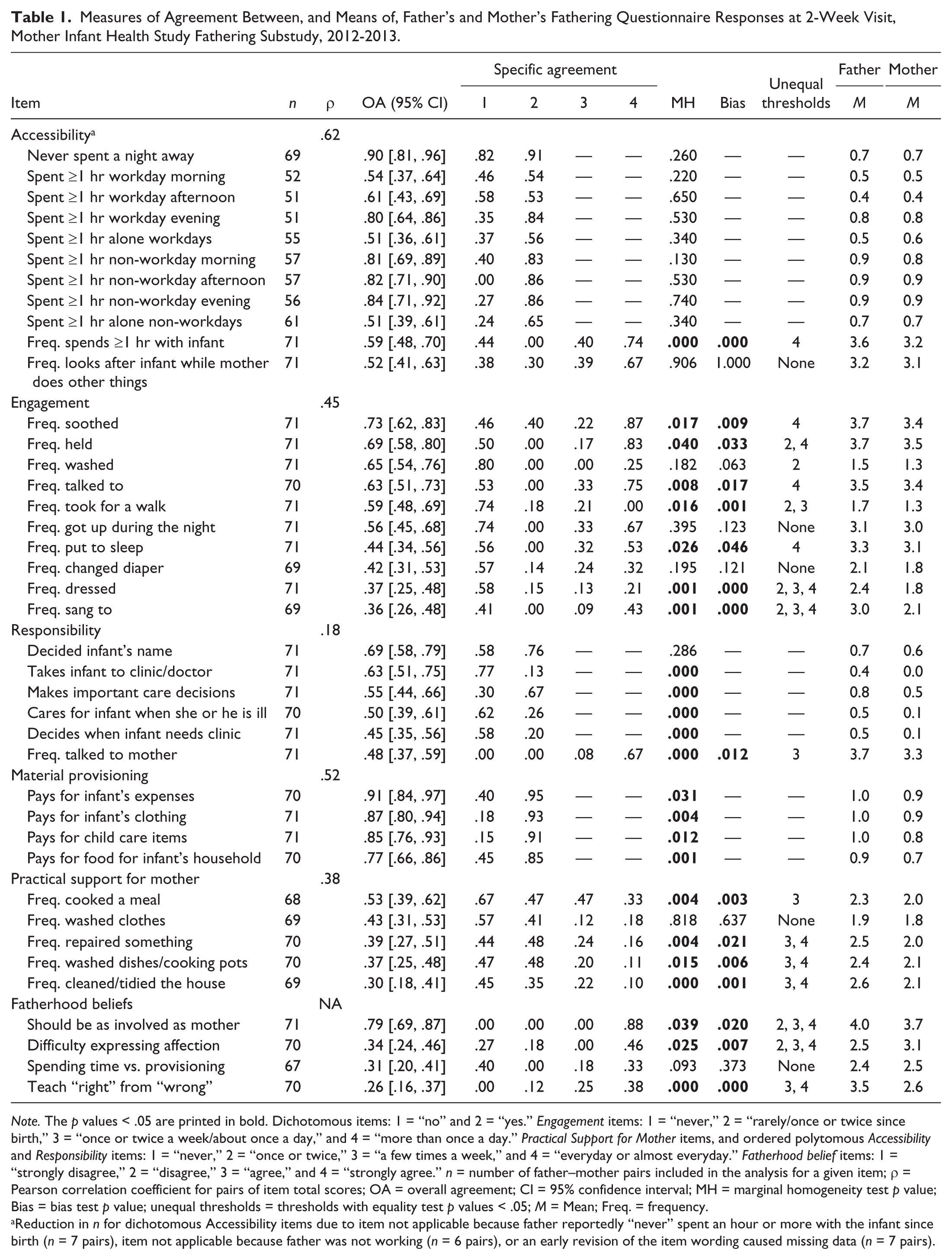
Note. The p values < .05 are printed in bold. Dichotomous items: 1 = “no” and 2 = “yes.” Engagement items: 1 = “never,” 2 = “rarely/once or twice since birth,” 3 = “once or twice a week/about once a day,” and 4 = “more than once a day.” Practical Support for Mother items, and ordered polytomous Accessibility and Responsibility items: 1 = “never,” 2 = “once or twice,” 3 = “a few times a week,” and 4 = “everyday or almost everyday.” Fatherhood belief items: 1 = “strongly disagree,” 2 = “disagree,” 3 = “agree,” and 4 = “strongly agree.” n = number of father–mother pairs included in the analysis for a given item; ρ = Pearson correlation coefficient for pairs of item total scores; OA = overall agreement; CI = 95% confidence interval; MH = marginal homogeneity test p value; Bias = bias test p value; unequal thresholds = thresholds with equality test p values < .05; M = Mean; Freq. = frequency.
Reduction in n for dichotomous Accessibility items due to item not applicable because father reportedly “never” spent an hour or more with the infant since birth (n = 7 pairs), item not applicable because father was not working (n = 6 pairs), or an early revision of the item wording caused missing data (n = 7 pairs).
Raw Indices of Agreement
Across the questionnaire as a whole, the proportion of OA between father’s and mother’s responses tended to be moderate-to-low, but varied widely. Items measuring Material Provisioning tended to have high OAs (all higher than .70), whereas items measuring Responsibility and Practical Support for Mother tended to have low OAs (all lower than .70). Items that measured Accessibility and Engagement varied in OA. Few items had high proportions of SA for all response categories. In part, this was due to the “skewness” of mothers’ and fathers’ marginal response distributions, which resulted from certain response options being used infrequently (Supplementary Table 1). For infrequent response options, proportions of SA were estimated with low precision. Nevertheless, the presence of low proportions of SA for most items implies that, even where OA was high, it was usually driven by agreement on the one or two most frequently used response options. For example, high agreement specific to the “yes” category appeared to drive the high levels of OA for items measuring Material Provisioning.
Sources of Disagreement
For most items on the questionnaire, mothers and fathers differed significantly in their propensity to use each of the response options available. For example, for all Material Provisioning items, McNemar tests showed significant differences between mothers’ and fathers’ marginal response probabilities (Table 1). Similarly, Bhapkar test results suggest significantly different marginal response rates for all Engagement items except those measuring the frequency the father washed the infant, changed diapers, or got up during the night. The Accessibility items were the exception: mothers’ and fathers’ marginal response rates were found to be homogeneous for all but one item in this set.
For the majority of dichotomous items, lack of marginal homogeneity resulted from a tendency for fathers to use the “yes” response option more frequently than mothers. Similarly, for most ordered polytomous items, fathers and mothers differed in their definitions of the thresholds between available response options (as demonstrated by tests of overall bias and threshold equality, Table 1). The frequencies fathers’ reported doing most Practical Support for Mother and Engagement items were significantly higher relative to frequencies reported by mothers.
For all but one Practical Support for Mother item, fathers and mothers had significantly different thresholds for the higher response options (i.e., “a few times a week” and “everyday or almost everyday”). Similarly, on Engagement items that fathers tended to do frequently—such as soothing and talking to the infant—mothers and fathers differed significantly over the threshold for the highest response option (i.e., “more than once a day”). Whereas, for the Engagement items that fathers did relatively infrequently—such as washing or taking the infant for a walk—there was significant disagreement over thresholds for the lower and middle response options (i.e., “rarely/once or twice since birth” and “once or twice a week/about once a day”).
Similar to the findings for the individual items, the mean item total score based on fathers’ reports was higher than the mean score based on mothers’ reports for all modes of paternal influence except Accessibility (Supplementary Table 1). As shown in Table 1, the correlation between father’s and mother’s item total scores, which gives an indication of the strength of their agreement over the definition of the underlying mode of influence, was highest for Accessibility (ρ = .62) and lowest for Responsibility (ρ = .18). Low internal consistency of fathers’ responses to items measuring Material Provisioning (α = .07) and of both fathers’ and mothers’ responses to items measuring Responsibility (α = .63 and .52, respectively) indicate that these items may not have been effectively measuring a single, common construct. Therefore, the item total score correlations for these modes of influence should be interpreted cautiously.
Concordance of Fatherhood Beliefs
There was wide variation in belief about whether (a) “it is less important for a father to spend time with his children than it is for him to provide financially for them,” (b) “it is difficult for men to express affectionate feelings toward babies,” and (c) “the father more than the mother should be the one to teach their children ‘right’ from ‘wrong’” (Supplementary Table 1). The percentages of OA were very low for these items (ranging from .26 to .34; Table 1). Fathers tended to more strongly agree that they should be the ones to teach right from wrong, and more strongly disagree that it is difficult for men to express affectionate feelings toward babies. Although there was variation of opinion about whether financial provisioning is more important than spending time with children, this variation was similar across fathers and mothers, resulting in no difference between fathers’ and mothers’ propensity to endorse each of the available response options (p = .373; Table 1). Finally, although most mothers and fathers strongly agree that “a father should be as heavily involved as the mother in the care of their children,” mothers were significantly more likely than fathers to endorse the disagree and strongly disagree options (p = .020).
Results of Sensitivity Analyses
Our results were robust to excluding father–mother pairs who were not co-residing (n = 18) and whose interview dates were more than 14 days apart (n = 11; data not shown). In the analyses involving only co-resident father–mother pairs, item total correlations for all modes of influence were considerably lower than in the original analyses. However, Accessibility and Material Provisioning scores were still more strongly correlated than those of the other three modes.
Discussion
Extending existing South African household surveys to include items measuring father involvement is an efficient way to collect population-level data on fathers. However, these surveys do not have a mechanism for collecting data from individuals who are not residents of the sampled dwellings. This is a significant limitation in light of the high percentage of fathers who reside apart from their children. Alternative study designs are possible (see, for example, Madhavan, Townsend & Garey, 2008) but resource intensive. One possible solution is to use other household members as proxy respondents for nonresident fathers. This study assessed the agreement between mother and father reports of father’s involvement in infant care with the aim of exploring whether mothers could be used as reliable proxy respondents in future fathering research.
A strength of this study is that we examined agreement separately for items measuring conceptually distinct sets of parenting practices. Overall, our findings indicate that fathers and mothers should not be treated as interchangeable sources of data in research on father’s parenting practices. This agrees with previous research involving paired samples of American parents, which generally found that fathers report greater levels of involvement than are acknowledged by mothers (Coley & Morris, 2002; Mikelson, 2008). Prior to our study, no comparable research had been conducted in South Africa. However, findings from two previous South African studies did anticipate that mother–father agreement would be poor. In an analysis of data from unpaired fathers and mothers in the Cape Area Panel Study, children were more likely to be reported to be receiving financial support from their father when it was the father answering the questionnaire than when it was the mother (Clark, Cotton, & Marteleto, 2015). A separate qualitative study exploring agreement between mother, father, and child accounts of father’s financial support and accessibility concluded that, when parents were in a romantic, co-residential relationship, the mother’s reports of father’s involvement tended to be more positive and to align more closely with those of the father and child (Makusha et al., 2013). In contrast, mothers in nonresidential relationships or who were separated from their child’s father tended to report lower levels of father involvement than did children and fathers.
In our study, mother and father ratings of father’s involvement agreed only modestly. This was true across all modes of paternal involvement examined. Although overall levels of agreement were reasonably high for items measuring Material Provisioning and spending time with the infant, this was driven by high positive agreement (i.e., agreement that the father was providing/accessible), whereas negative agreement (i.e., agreement that the father was not providing/accessible) was low for these items. This implies that mothers could be used to reliably identify fathers who would report themselves as providing financially or spending time with the infant. In contrast, mothers’ reports could not be used to reliably identify fathers who would report themselves as not providing or not spending time with the infant.
Across all modes of paternal influence except Accessibility, fathers consistently reported their involvement at higher levels than did mothers. Interestingly, this discrepancy was greatest for items assessing father’s Responsibility, particularly as related children’s health care. Mothers rarely agreed that the father decided when the infant needed to be taken to a health clinic, attended health clinics with the infant, or cared for the infant when she or he was ill. This points to a need to better understand mothers’ and fathers’ perceptions of the father’s role in ensuring infant health needs are met.
To our knowledge, this is the first study to have separately examined disagreement over parents’ definitions of different forms of paternal involvement and disagreement over the thresholds between different levels of involvement. Our findings suggest that both of these are important in producing moderate-to-low levels of OA. Rewording the questionnaire to provide more specific definitions of the parenting practices being assessed and to use less subjective response options for the ordered polytomous items might improve the consistency of father and mother responses. However, because fathers consistently rated their involvement higher than mothers, we suggest that subjectivity in the questionnaire wording is not the only factor causing parents to differ in their interpretations of the items and thresholds between rating levels. We propose that the following may also have played a part: (a) the availability of accepted norms of parenting for fathers, and (b) the observability of the parenting practices under question.
Individual perceptions about what constitutes appropriate types and amounts of paternal involvement are, in part, shaped by cultural and social norms (Marsiglio, Day, & Lamb, 2000). Previous in-depth research into the fatherhood ideals of low-income, Black South Africans identified clear norms governing fathers’ financial responsibilities (Montgomery, Hosegood, Busza, & Timaeus, 2006; Swartz & Bhana, 2009). Cultural expectations about father involvement in more direct types of child care have been found to be less well defined, possibly leading fathers’ nonmonetary contributions to be under-reported (Montgomery, Hosegood, Busza, & Timaeus, 2006). The availability of definite expectations about paternal material provisioning may explain why we observed higher levels of parental agreement on items measuring material provisioning than on items measuring other modes of care.
It is also recognized that mothers are able to report more easily on objective, directly observable fathering behaviors than on those that are subjective, private, or primarily cognitive or emotional (Marsiglio, Amato, Day, & Lamb, 2000). Items on our questionnaire measuring father’s engagement and accessibility were more observable than items measuring responsibility, which could have contributed to the higher levels of OA seen for the former compared with the latter items. Among Engagement items, the item measuring the frequency fathers sang to their children had the lowest OA and the largest positive bias between father’s and mother’s reports. It is possible that singing to children is something that fathers do more often in private than other caregiving items, making it a more difficult item for mothers to report. The fact that a greater percentage of mothers than fathers in our sample agreed with the statement that it is difficult for men to express affectionate feelings toward babies could suggest either that fathers tend to express their affection in private or that mothers tend not to recognize when fathers express it.
Limitations of our study include the unknown generalizability of the findings and the small sample size, which precluded statistical inference about factors contributing to the observed low levels of agreement. Participants in this study were recruited from a single, urban community hospital. The majority were Black African, isiXhosa-speakers, which means mother–father agreement may be more homogeneous in our study than in a national sample. Our sample of matched mother–father pairs also included greater percentages of co-resident fathers than in the general South African population (Posel & Devey, 2006). If agreement generally is worse for unmarried, non-coresident parents (Makusha et al., 2013), our findings might be considered a conservative (i.e., upper limit) estimate of the levels of agreement that could be expected in a national sample. Our sensitivity analyses indicated that low levels of father–mother agreement could not be attributed to the influence of the non-coresident parents in the sample. However, limited sample size prevented us from examining whether other aspects of parental relationship quality influenced agreement.
In summary, the findings of this study corroborate work from high-income countries showing that fathers and mothers should not be treated as interchangeable sources of data in research on South African fathers’ parenting practices. Remaining to be determined are the reasons for parents’ disagreement over father involvement. This study suggests some hypotheses but research dedicated specifically to this question is called for. Ultimately, relying on a single respondent to provide data on father involvement may not be sufficient. Researchers doing future work in this area should consider including multiple sources of information. In research involving fathers of older children, the children themselves are a logical source of information. Alternatively, researchers could include direct observations of fathers’ interactions with their children, either during structured laboratory situations or naturalistic observation. Not only would these approaches afford a separate source of data, they could also be used to assess the quality of father–child interactions, something that is difficult to do using questionnaires. Additional research is needed to explore methods of combining data from multiple observers so as to obtain measurements of father involvement that are valid with respect to their ability to predict beneficial child outcomes.
Footnotes
Acknowledgements
The Mother-Infant Health Study (MIHS) Project Steering Committee consists of - David Speert, Monika Esser, Julie A. Bettinger, Mark Cotton, and Amy Slogrove. We thank the mothers, fathers and infants who generously donated their time to the MIHS study and without whose participation the study would not have been possible. We gratefully acknowledge the expert assistance provided by the staff at FAMCRU, Department of Paediatrics and Child Health, Tygerberg Academic Hospital, Stellenbosch University, Cape Town, South Africa and the Vaccine Evaluation Center, BC Children’s Hospital, University of British Columbia, Vancouver, Canada.
Declaration of Conflicting Interests
The author(s) declared no potential conflicts of interest with respect to the research, authorship, and/or publication of this article.
Funding
The author(s) disclosed receipt of the following financial support for the research, authorship, and/or publication of this article: This work was supported by a Major Thematic Grant from the Peter Wall Institute for Advanced Studies, University of British Columbia, grant number F0906208. GDM is supported by a Canadian Institutes of Health Research Vanier Canada Graduate Scholarship and a CFRI-CIHR-UBC MD/PhD Studentship Award. JAB is supported by a Career Investigator Award from the Michael Smith Foundation for Health Research.
Author Biographies
References
Supplementary Material
Please find the following supplemental material available below.
For Open Access articles published under a Creative Commons License, all supplemental material carries the same license as the article it is associated with.
For non-Open Access articles published, all supplemental material carries a non-exclusive license, and permission requests for re-use of supplemental material or any part of supplemental material shall be sent directly to the copyright owner as specified in the copyright notice associated with the article.
