



Abstract
In Jordan less than 1% of preschool teachers are male. This study investigated a sample of mothers and female preschool teachers about their perceptions of male preschool teachers. A survey was developed to collect data from the participants. Results showed that participants perceive the work of men in preschools as being acceptable, yet they were of the opinion that preschool teaching is the work of females. Mothers agreed that children gain diverse experiences when taught by males or females. Female schoolteachers disagreed that male teachers have more control over their student during field trips. Most notably, female schoolteachers ages 19 to 29 were more accepting of the idea of male preschool teachers than other age groups.
Keywords
Globally, females have long dominated the preschool education field because it requires the nurturing of very small children, which is often regarded as an extension of what mothers do (Fagan, 1996; Murray, 1996). About 3% of preschool teachers are male (Brody, 2015; Heikkilä & Hellman, 2017). Studies in Norway, Denmark, and Turkey show 5% of the teacher population is male, but in most other countries the male teacher population is less than 3% (Oberhuemer, Schreyer, & Neuman, 2010; Organisation for Economic Co-Operation and Development [OECD], 2014). The low percentage may be attributed to the prevailing idea that men are less suitable to childcare (Heikkilä & Hellman, 2017). However, recent research has shown that adding more male teachers creates a more balanced workforce and helps dismantle gender barriers (Burn & Pratt-Adams, 2015). Although traditionally a field dominated by women, there are an increasing number of men in preschool education (Cameron, 2001; Sandberg, Pramling-Samuelsson, 2005; Sumsion, 2005). This is despite the perception by family and friends that a male preschool teacher is strange or unusual (Cohen, 1992; Skelton, 1991; Sumsion, 2000). There is a generally negative perception about men teaching at the preschool level (Akman, Taskin, Ozden, Okyay, & Cortu, 2014; Barış, 2013). Negative attitudes range from surprise to suspicion, including the belief that the man must be gay or a pedophile, and the fear that he may be dangerous and abusive around children (Williams, 1995). Male preschool teachers have reported difficulties of overcoming the suspicion that they were child molesters (Penn, 1996).
The idea of recruiting men for roles in early education is not new. There are many studies on the benefits of male teachers in early childhood education (Brownhill, Warin, & Wernersson, 2015; Heikkilä & Hellman, 2017; Johnson, 2011; Peeters, 2007; Rentzou, 2011; Sexton, 2017; Warin & Gannerud, 2014). Over the past few decades, the perception of men in early childhood education has become favorable (Peeters, Rohrmann, & Emilsen, 2015). There is a popular idea that a strong male figure would serve as a welcome counterpoint to the feminine environs of a preschool (Burtt, 1965; Johnston, 1970; Kendall, 1972; Kyselka, 1966; Peltier, 1968; Sciarra, 1972; Triplett, 1969). Moreover, there is recent specific research on the parental attitudes regarding males as preschool teachers. A study of parents in Greece found that parents felt it was a good idea to recruit more male schoolteachers. They also recognized that the profession is difficult for men to enter (Rentzou, 2011). However, it has been noted that just the presence of more males in the educational system does not guarantee a better education for children (Fulton, 2005). Some studies found that male teachers tend to focus more on male children and reward children that display what are considered masculine behaviors (Etaugh, Collins, & Gerson, 1975; Lee & Wolinsky, 1973).
Nevertheless, with the rise of single-parent homes, blended and multigenerational families, and homes where both parents work, the debate that originated is related to children, particularly boys, needing male role models (Weaver-Hightower, 2011). Many young children do not have as much contact with men on a regular basis and only know what they see in the media—violent or angry men, not nurturing, thoughtful men (Piburn, Nelson, & Carlson, 2011). To combat this, it has generally been considered that more male teachers in the classroom would be a benefit to children. Yet, there is no agreement on what makes an ideal male teacher (Jones, 2006). What should constitute “masculinity” is ultimately a normative, or cultural, issue (Jackson, 1996). Education policy-makers in most English-speaking countries, and many academic articles have given explicit support for recruiting more men to the field (Biddulph, 1995; Cunningham & Watson, 2002; Cushman, 2007, 2008, 2009, 2010; Drudy, 2008; Johnson, 2008; Mulholland & Hansen, 2003; Porter, 2008; Queensland, 2002; Teachers’ Federation, 2002). The argument generally is that children need both female and male role models in school (Carrington, Tymms, & Merrell, 2008; Martino, 2008; Rice & Goessling, 2005; Silverstein & Auerbach, 1999; Sokal, Katz, Chaszewski, & Wojcik, 2007; White, 2011).
Context of Early Childhood Education in Jordan
In 1994, the Ministry of Education of Jordan established a preschool sector to increase the development of free preschools in an otherwise largely self-pay private sector. Although its role for the private sector was to monitor and license private schools, it has also established more than a 1,000 state-run preschools that are free (UNICEF, 2009). Considering both private and public preschools, only one teacher was male in the public sector, and none was male in the private sector (Ministry of Education [MOE], 2013). The lack of male educators in Jordan could be due to many factors. Jordan is a predominately Islamic country and it is easy to think that religious values play a role in why so few males are in early childhood education. However, the Quran does not specify gender roles, at least in early childhood education. Certain social roles are gender-typed, but specifics vary based on the sect or geographic region (Ul-Haq, 2014). That variance is notable in the present study. The geographic region in which this study took place shows less than average adherence to traditional gender roles.
Significance of the Present Study
The present study examines the global trend of few male preschool teachers in the specific country of Jordan. No study currently exists that surveys the perception of male schoolteachers in Jordan preschools. There may be no studies because no one has thought to ask the question before. Women being preschool teachers have always been the societal norm. There is a persistent idea that women are better caretakers than men for no other reason but because they are women (Noddings, 1984; Peeters et al., 2015). We gathered responses from women to see if they agree with the cultural notion that women are the “natural born” caretakers, and therefore this profession is not appropriate for men. The study examines whether women agree with this view, or whether they would be comfortable with men as preschool teachers. As argued, international research indicates that women may view male teachers as a cause for suspicion (Martin & Luth, 2000; Williams, 1995). A study in Pakistan found that gender roles for boys and girls are established at a very young age, and the lack of presence of male teachers reinforces the idea that school is not the place for grown men to work. The culture influenced what was viewed as a gender-appropriate career. Female teachers in the Pakistani school reinforced the patriarchal dominance notion where boys are assertive and girls are passive (Pardhan & Pelletier, 2017).
Female preschool teachers may have a different view than mothers. Female teachers may be more receptive to the idea of male teachers because they actually work in the field and can more easily see the benefits of male role models in the classroom (Weaver-Hightower, 2011). Teachers have studied early childhood education as a profession, where likely the mothers have not. From a professional standpoint, teachers may see male teachers as a contribution to a more diverse workforce (Burn & Pratt-Adams, 2015) and a way to achieve gender equality in the workplace (Icken [2012] cited in Peeters et al., 2015).
We focus on the following questions:
How do mothers and female preschool teachers perceive the work of men in preschools?
Is there any significant difference between mothers and female preschool teachers in their perceptions of men working in preschools based on the nature of the work and age?
Method
Participants
There were 195 participants in the study: 117 mothers and 78 female preschool teachers. All were from Al-Zarqa city in Jordan, ranging 19 to 59 in age. All participants were Muslims, with educational levels presented in Table 1.
Participants’ Educational Level.

Data Collection
To examine participants’ perceptions regarding men working in preschools, a survey instrument was developed. The benefit of using a survey instead of interview method was to gain perspectives from more participants (Brown, 1988; Driscoll, 2011).
Although a survey is more dependent on the respondent’s honesty and ability to respond, it does allow the researcher to examine a larger sample size and gather data from a larger number of people (Driscoll, 2011).
The instrument used to collect data in this study was composed of 22 items and divided into three sections. The first section was instructions to the participants as to how to answer the questions and where to write their answers on the instrument and the second section was a demographic questionnaire inquiring about the characteristics of the participant members, such as the nature of work (homemaker or female preschool teacher) and age. The third section was rated using a 5-point Likert-type scale, with 5 indicators: (a) strongly agree, (b) agree, (c) neutral, (d) disagree, and (e) strongly disagree.
Four female research assistants collected the data from the mothers of children and from female preschool teachers. One had a master’s degree in education and the other three each had a bachelor’s degree in early childhood education. Fifty preschools (out of a total of 118) preschools in Al-Zarqa city were selected at random to collect the data. The assistant researchers asked the mothers, picking up children from preschools, if they would be willing to participate in the study. The researchers explained the purpose of the study, and mothers who agreed to participate were given a survey to complete and return. Similarly, female preschool teachers were asked if they are willing to participate after the research assistants explained to them the purpose of the study. The teachers who agreed filled out a survey and returned it to the researchers.
Validity and Reliability
Researchers prepared the survey in English and translated it to Arabic. Both copies were proofread by a language specialist. The researchers proved logical validity of both language versions by having the surveys reviewed by six referees specializing in early childhood education at several Jordanian universities. The referees confirmed the accuracy and clarity of the items. Their recommended changes were presented to a validation panel and after a pilot test; modifications were implemented. The items decreased from 34 to 22. To estimate the reliability of the survey, internal consistency measures were computed using the Cronbach’s alpha method. The reliability coefficient was 0.85, reflecting an acceptable level of internal consistency.
Data Analysis
All responses of participants were analyzed using the Statistical Package for Social Sciences (SPSS). The t test for an independent sample and one-way analysis of variance (ANOVA) were used.
Findings
First Research Question
The first research questions aimed to examine the mothers and female preschool teachers’ perceptions regarding men working in preschools. Means (M), standard deviations (SD), and ranks were used to assess the results. After sorting the items from high to low, the scale used to determine the sample’s responses was divided into three categories; low level with a mean range of (1-1.99), average (2.12-3.95), and high (4.02-5.00). Results showed that the overall mean score for all participant responses was 3.07, which is in the average range. For mothers it was 3.06 and for female preschool teachers it was 3.1. The average score means that mothers and female preschool teachers perceive the work of men in preschools as normal and socially acceptable.
Most important items rated by participants
To determine the most and least important factors regarding the work of men in preschools as identified by mothers and female preschool teachers, means and standard deviations were obtained. Table 2 shows the five most frequent items that were rated by participants regarding their perceptions of men working in preschools. As shown in Table 1, the participants have similar perceptions of men working in preschools. They both consider male presence in preschools as beneficial for their children because the children can gain different experiences. Male preschool teachers can offer a more well-rounded education experience. Conversely, both groups still regarded preschool teaching as accessible only for females. In addition, responses from mothers indicated that they believed men felt uncomfortable teaching in preschool because their coworkers would all be female. Female preschool teacher responses indicated that male preschool teachers would serve as good role models for boys. The most notable finding as indicated in Table 1 is that mothers strongly agreed that children gain diverse experiences when both male and female preschool teachers instruct children. Moreover, female preschool teachers strongly agreed with the idea of male preschool teachers in their school.
The Five Most Frequent Items That Were Rated By Participants Regarding Their Perceptions of Men Working in Preschools.

Note. SD = Standard Deviation; M = Mean.
Least important items rated by participants
Table 3 shows the least important factors when mothers and female preschool teachers consider males as preschool teachers. They disagreed to the ideas of the preschool teacher vocation being less prestigious, that children learn courage from male preschool teachers, that it adjusts children to the presence of male teachers throughout their academic career, and that it is acceptable only to see males at higher levels of educational instruction. The least agreed-to item for mothers was that they did not think that the existence of male preschool teachers was a way to achieve workplace gender equality. Mothers also strongly disagreed that male schoolteachers held less prestige because of their profession. For female preschool teachers, the least agreed-to item was that male preschool teachers have better control over their students. They also strongly disagreed that male teachers instill courage in their students.
The Five Least Agreed-to Items That Were Rated by Participants Regarding Their Perceptions of Men Working in Preschools.
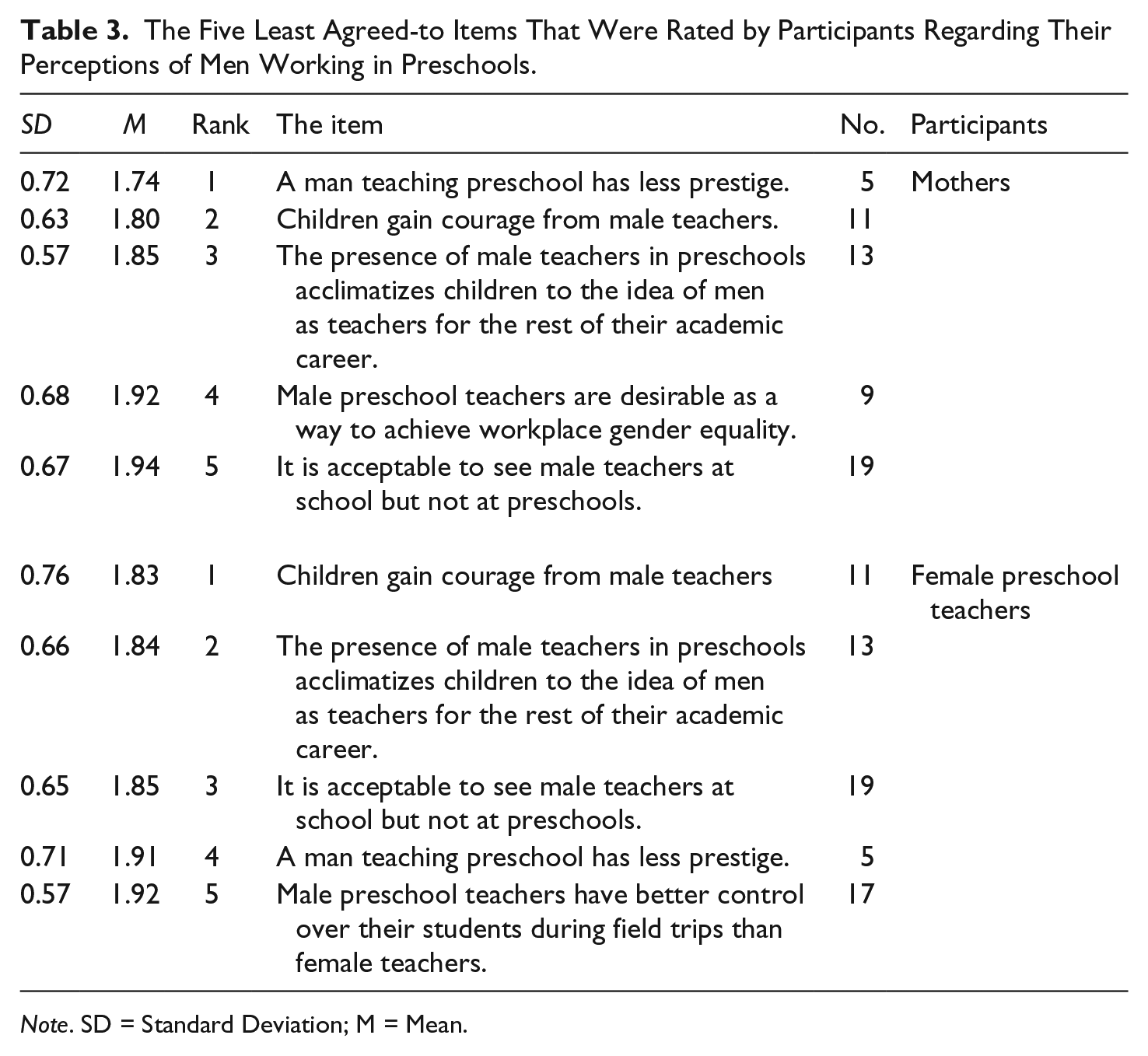
Note. SD = Standard Deviation; M = Mean.
Second Research Question
The second research question aimed to examine whether there are significant differences between mothers and female preschool teachers in their perceptions of men working in preschools based on the nature of the work and age. To examine if there are significant differences in mean scores in this regard, an independent sample t test was used. Results revealed that there was a significant difference in the mean scores for preschool teachers (M = 3.1, SD = 0.10) and mothers (M = 3.06, SD = 0.11) favoring female preschool teachers; (t (202) = −2.55, p =.01). Moreover, to examine if there are significant differences in mean scores between mothers and female preschool teachers due to age, age ranges were divided accordingly: 19 to 29, 30 to 39, 40 to 49. Next, a one-way ANOVA was utilized. Results show statistically significant differences between mothers and female preschool teachers in their perceptions, in favor of female preschool teachers (F [284] = 3.55, p =.03).
Finally, post hoc comparisons using the Tukey honest significant difference (HSD) test indicated that the mean score for the female preschool teachers age 19 to 29 (M = 3.14, SD = 0.11) was significantly different than for ages 40 to 49 (M = 3.07, SD = 0.07) and ages 30 to 39 (M = 3.07, SD = 0.10). In contrast, the difference in mean scores for the ages 30 to 39 and 40 to 49 did not significantly differ from each other. Female preschool teachers ages 19 to 29 have the most positive perception of male preschool teachers.
Discussion
We aimed to examine the perception Jordanian mothers and female preschool teachers have about male preschool teachers. Results showed that the two groups have moderate or neutral perceptions, as shown by the median of 3.07. This is considered a reasonable and positive result because of the novelty of male preschool teachers in Jordanian culture. Our results contrast with some of the observations and results of previous studies on the same topic. Some studies have shown that female preschool teachers have a negative perception of male preschool teachers (Barış, 2013). The traditional, or most common sentiment found in previous studies is that women are by nature better at teaching and caring for young children (Cunningham & Dorsey, 2004; Sanders, 2002).
We have found the opposite to be true. The women surveyed did not, in general, have a negative perception of men as preschool teachers. It may be because the women surveyed are more open-minded. Although the respondents live in an Arabic region, it is less strict than other regions when it comes to adhering to traditional gender roles. There is a more accepting and progressive attitude toward less mainstream ideas. The location of the previous studies—rural culture, conservative environment—may serve as a predictor to the outcome of the survey responses. The same survey taken in a rural area of Jordan may produce different results. Indeed, findings from previous studies conducted in cities of western countries are similar to our own. Those studies discovered that no one of either gender found men in the education field was unacceptable (Mukuna & Mutsotso, 2012; Robinson, Skeen, & Coleman, 1984). Another study showed that men in preschool teacher roles were not regarded as effeminate and that the men felt accepted by their colleagues and school community (Brown, 1984). Moreover, parents at one school preferred to send their children to a mixed-gender school as a show of support for gender equality (Cameron, Moss, & Owen, 1999). In the present study, too, there was a neutral perception of the presence of men as preschool teachers rather than a strong opposition to their presence. The perception of preschool teaching as a woman’s vocation is common throughout past studies, and this one as well. Although participants in our study reported that they felt the presence of males in preschools was acceptable and that it benefitted the children, they also considered the work only for females. This dual result is consistent with many other research studies, where people state preschool teaching is a woman’s job, but is not opposed to the idea of male preschool teachers (Anliak & Beyazkurk, 2008; Fagan, 1996). In a study that also surveyed mothers on their perception of male preschool teachers, results showed that the mothers did not state they were against males in the role, yet still regarded the job as “women’s work” (Akman et al., 2014). This may suggest that negative perceptions of males in early childhood education are waning and other studies have found that the community accepted the idea of male preschool teachers (Brown, 1984; Robinson et al., 1984).
The results of this study showed that female preschool teachers believe male preschool teachers would serve as good role models for the male children in the classroom. Previous research has found this also to be true, where male teachers were stated to be desirable as a source of role modeling, particularly for boys (Cameron, 2001; Martino, 2008; Skelton, 2003; Sumsion, 1999). The results indicated that mothers and female preschool teachers believe children gain different experiences when there are male preschool teachers present in the school. Other studies have corroborated the same belief—that male preschool teachers enhance children’s development of social and emotional skills (Sak, Sahin, & Sahin, 2012). On the other hand, there are studies showing that mothers prefer their children to be taught by females who will “mother” their children. They feared male teachers would lack patience and be too harsh as disciplinarians, and though they recognized the importance of a male role model, this was not enough to overcome discomfort with the idea of male preschool teachers escorting their young children to the bathroom or trusting them to be with their young daughters (Mukuna & Mutsotso, 2012).
In addition to disagreeing with the idea that men would give up prestige, mothers and female schoolteachers also disagreed with the idea that the men would teach courage by emboldening children to engage in activities that are unfamiliar or beyond the children’s comfort zone. This may be because the prevailing cultural view in Jordan is that teachers are authoritative figures for learning. So the title teacher carries the weight of respect and authority. Moreover, teachers are not meant to be responsible for physical activities. Teachers are meant for enriching children’s minds. In preschools of Jordan, physical activity is ancillary and less emphasized.
Mothers strongly disagreed that gender equality could be achieved with the presence of men as teachers in preschools (see item # 9 in Table 3). This contrasts with a previous study where parents supported men as preschool teachers because they thought it promoted gender equality in the workplace (Cameron et al., 1999). It seems that the women believe it will take more than males in preschool teaching positions to overcome the great gender inequality that exists in Jordanian culture.
With regard to the overall perception of men working in preschools, there was not much of a significant difference in the mean score between preschool teachers (M = 3.1, SD = 0.10) and mothers (M = 3.06, SD = 0.11). This may be because both the teachers and mothers are residents of Al-Zarqa city and share the same exposure to a more progressive culture. Although they were generally the same, female preschool teachers were still slightly more in favor of the idea than mothers were. The result could be because female schoolteachers readily recognize how a male presence in the school could be beneficial. Female preschool teachers are familiar with the preschool environment because they work there and they can see the importance of exposing children to a diverse set of experiences. Female preschool teachers understand the demands of the job and may recognize how the traits of a man could meet those demands in ways that are different, but still beneficial to the children. Other studies have agreed that men in the classroom alongside female teachers provide a balance (Budge, 1995; Burn & Pratt-Adams, 2015). It may be that female preschool teachers are better educated than the mothers and have more progressive viewpoint on gender equality in the workplace. The Jordanian mothers may come from a more traditional background where they stay home and raise children, but the teachers have higher education and earn a salary. Their view on gender roles is different because of it.
Interestingly, the 19 to 29 aged female preschool teachers were the ones that most positively perceived males in the classroom. The fact that younger female preschool teachers were more receptive to the idea of male schoolteachers in preschools may be because these women are not yet set in their ways of teaching. They are open-minded to the idea that males in the classroom could provide balance and add a new learning experience for the children. They perceive the male in the classroom as a role model that can show children how to interact with both genders and how men can be just as caring and nurturing as women. Moreover, it may be that the younger generation has grown up in a more liberal environment, where strict gender rules have loosened. Gender segregation has been de-emphasized in their own schooling, so they do not expect strict adherence to gender roles in the workplace. Although there is no study on the correlation of age to types of responses, a study in Turkey did show the same results as this study. The younger respondents at a state university in Turkey responded more favorably to the idea of male teachers (Sak et al., 2012).
Conclusions, Implications, and Recommendations
Results from the present study showed that mothers and female preschool teachers accepted the idea of male preschool teachers but at a moderate level. The most common agreed advantage of men as preschool teachers was that it offers children different experiences and a more well-rounded education. Results from this study indicated that both mothers and female preschool teachers have a median of 3.07 in their perception of a male as a preschool teacher. This result is reasonable given the general uniqueness of male preschool teachers in Jordan. Our results are inconsistent with the results of other studies of similar research, which showed female teachers as having a negative perception about male preschool teachers (Barış, 2013). The limitations of the present study were the geographic region from which the participants were chosen and the small number of participants that responded to the survey. Because of this, extensive comparisons and broad generalizations are discouraged.
Overall, our investigation did reveal that both mothers and preschool teachers perceive as beneficial the presence of male preschool teachers because it offers children a different learning experience. They hold this belief even though they still consider preschool teaching a female job. A younger set of female preschool teachers seems more receptive to the idea of male preschool teachers. Support from mothers and female preschool teachers, as well as from the greater community, would positively influence the perception of males as preschool teachers by decreasing the gender stereotype (Drudy, 2008; Sak et al., 2012; Thornton, 1999). It would also give men confidence in their work (Fu & Li, 2010).
Implications for Practice
Education administrations can encourage male teachers in early childhood education by promoting it as a way to achieve diversity. They can downplay the gender stereotype, presuming instead that men are just as capable as women to perform the tasks of the job. More than one man should be hired at a time, so as to provide support and avoid the “tokenism” of hiring just one man in the school. To avoid isolation, these men should be encouraged to join professional organizations where they can see other men in the same profession (Chusmir, 1990).
Recommendations for Future Research
A larger sample of mothers and female preschool teachers could be used. The survey could be given to fathers for their opinions. Male schoolteachers could be interviewed to gain insight into their reasons for choosing the profession, and what they perceive as advantages and disadvantages to the nature of their male role in the job.
Footnotes
Declaration of Conflicting Interests
The author(s) declared no potential conflicts of interest with respect to the research, authorship, and/or publication of this article.
Funding
The author(s) received no financial support for the research, authorship, and/or publication of this article.