




Abstract
This study examines the ways men who identify as stay-at-home fathers in the United States (N = 40) both resist and comply with traditional expectations of masculinities. Through the use of qualitative, in-depth interviews and analysis using grounded theory, participants discuss their desires to change gendered expectations around caregiving while continuing to partake in some of the power and privilege associated with masculinities. Associated contradictions are analyzed through participants’ discussions of the use of feminine terms such as “Mr. Mom” or babysitting, participating in mother-only spaces, and gendered expectations of caregiving. Actions of these stay-at-home fathers simultaneously challenge and affirm aspects of hegemonic masculinities. Although by staying home, in some ways, these stay-at-home fathers continue to challenge traditional gender expectations around caregiving, in many ways, they continue to benefit and affirm the power and privilege associated with masculinities.
Although still relatively small, the number of stay-at-home fathers in the United States continues to grow (Fields, 2003; U.S. Census Bureau, 2012). As more fathers leave paid work to assume the primary caregiving role, the impact of these changing gendered expectations around parenting is a critical area of study. In the lives of stay-at-home fathers, both resistance and compliance with traditional masculine expectations are evident throughout their interactions with family, friends, other parents, and strangers (Doucet, 2006). In this context, resistance is defined as the complicated moments of tension between rejecting traditional notions of gendered caregiving roles and participating in gendered assumptions about parenting (Medved, 2009). Situated within discussions of the complex nature of masculinities (Doucet & Merla, 2007), below I examine how stay-at-home fathers create a distinct identity associated with fatherhood and masculinities that is different from the stay-at-home mother role. Through the creation of this separate identity, participants in this study both resist traditional gendered expectations, particularly those associated with fatherhood and financially providing for the family, and create spaces to conform to these expectations by separating themselves from motherhood and femininities. Within the context of fatherhood and masculinities, this article examines how stay-at-home fathers create a distinct identity that, while challenging traditional notions associated with fatherhood, is also distinctly associated with masculinities and fatherhood. Particularly, I analyze how social location and economic status influence the discussions participants have around masculinities and fatherhood.
When discussing the experiences of stay-at-home fathers, it is important to understand expectations and pressures associated with fatherhood and masculinities. Central to this discussion is the construction of hegemonic masculinities. Hegemonic masculinities are the ideal forms of masculinities that establish men’s dominant role within the patriarchal society of the United States (Connell, 1995). They do not articulate a static position or ideal; rather, they are based on current constructions that continue to perpetuate patriarchy and, therefore, the position of power for some men (Connell & Messerschmidt, 2005). It is important to note that constructions of gender and gender practices are subject to change, creating new understandings of the ideal forms of masculinities. Particularly for stay-at-home fathers, expectations of fatherhood and masculinities have changed over time moving away from a stoic, provider role into expectations of involvement in the daily lives of children (Johansson & Klinth, 2008). Therefore, hegemonic masculinities are relational, constructed not only at structural levels but also through friendships and relationships with other men and women (Greif, 2009). In addition, hegemonic masculinities are also constructed in opposition and in relation to other masculinities and femininities (Connell, 1995). For stay-at-home fathers, this is apparent in their comparative references with working fathers and other stay-at-home mothers.
Femininities are constructed as subordinate to all masculinities; therefore, according to Connell (1987), there is not a parallel version of hegemonic masculinity within femininity. Femininities are important to this study because many times masculinities are subordinated based on their feminine characteristics. The use of terms, such as sissy, which tends to be used in a derogatory manner associated with feminine characteristics, can be used to put men in a subordinate position, even when used as a typology of different types of masculinities (Heasley, 2005). For stay-at-home fathers, the construction of masculinities in comparison with femininities is important because many times associations are made between stay-at-home fathers and motherhood and femininities (Doucet, 2006).
Hegemonic masculinities are important to understanding how stay-at-home fathers interpret their role as the main caregiver and their responses to femininities. Particularly for men in this study, whose social status within in the United States tends to allow them more power and privilege (Hill Collins & Bilge, 2016), the complex nature of participating and resisting of dominant masculinities is important. The present study aims to contribute to the current literature on stay-at-home fathers by analyzing how this homogeneous group of stay-at-home fathers participates and resists dominant expectations of masculinities through their discussions around labels and spaces traditionally associated with mothering.
Stay-at-Home Fatherhood in the United States
Extant research (Kramer, Kelly, & McCulloch, 2015; Rochlen et al., 2008; Zimmerman, 2000) with stay-at-home fathers and mothers reports on the multiple ways in which mothers and fathers similarly construct the role of the stay-at-home parent. Fathers and mothers have expressed personal satisfaction as a benefit to taking on the role of primary caregiver (Rochlen et al., 2008). In both stay-at-home father and stay-at-home mother families, Zimmerman (2000) found that parents reported feeling satisfied in their position as stay-at-home parents as well as satisfied in their family arrangement and marriage. By providing care full time, fathers and mothers are able to take care of their family (Dillaway & Paré, 2008). Although fatherhood is associated with providing for the family through breadwinning, by assuming the role of the full-time caregiver, both fathers and mothers express feelings of providing for their families (Chesley, 2011).
Although stay-at-home fathers share some similar experiences with stay-at-home mothers, fathers are differentiated by the reasons they give for becoming the main caregiver, the societal expectations they confront about their ability to take care of children, and perceptions about their inability to live up to the breadwinning provider role (Doucet, 2006; Zimmerman, 2000). One of the most common reasons fathers give for their decision to assume the main caregiving role is economic (Chesley, 2011; Doucet, 2006; Latshaw, 2011). Although Zimmerman (2000) suggested that mothers who become the main caregiver for their children also sometimes consider finances, overwhelmingly fathers talk about this decision in relation to their economic situation. Stay-at-home father/career mother couples reported that the decision for the father to become the main caregiver was almost solely based on the mother’s salary and benefits. In comparison, for stay-at-home mother/career father families, the decision was more likely based on religious or family influences, and many times, this decision was discussed even prior to marriage and children. Similarly, Chesley (2011) also found that job conditions play a significant role in the decision for fathers to become the main caregiver for their children. These fathers based their decision on economic forces that allowed or forced them into the caregiving role, rather than making the decision like the mothers in Zimmerman’s (2000) study to assume this role based on religious views or family influences.
Also, unlike mothers, who are continually looked to as experts in child care, fathers who identify as stay-at-home parents and the main caregiver of their children tend to be seen in two ways: exceptional for taking on this traditionally feminine role or questioned for not living up to masculine expectations as the breadwinner and financial provider (Doucet, 2006). When fathers take on the responsibilities of caring for children and the household labor, many times, others act surprised and commend fathers for the work they are doing (Smith, 2009). Whereas mothers are rarely commended for their work as stay-at-home mothers, fathers are viewed as exceptional for taking on this position (Dillaway & Paré, 2008; Smith, 2009). Women are expected to sacrifice for their children and family’s well-being and, therefore, are not receiving the same positive attention that stay-at-home fathers sometimes experience (Coltrane, 1996; Dillaway & Paré, 2008). Whereas some men do gain positive attention for caring for their children, stay-at-home fathers also tend to experience some negative feedback for their position as stay-at-home parents. Many times, stay-at-home fathers are faced with societal pressures that suggest that men biologically are not suited to care for children (Solomon, 2014). Furthermore, fathers are viewed as incompetent as caregivers, and the children of these stay-at-home fathers are put at risk of dysfunction (Smith, 2009). The experiences of stay-at-home fathers with others and their decisions around becoming the main caregiver for their children are important to understand in the larger construction of gender expectations.
Fatherhood, Caregiving, and “Doing Gender”
Significant to the theoretical framing of this study are the multiple ways in which gender is continually constructed by individuals through interactions with others and society. West and Zimmerman’s (1987) “Doing Gender” has heavily influenced our understanding of the social construction of masculinities. Gender is constructed through the daily interactions with other individuals and in the context of culture and society rather than biological differences based on sex. Specifically, West and Zimmerman assert that gender is not just a label assigned to individuals but something that we are constantly doing in interaction with and in response to others. Gender is not an essential characteristic associated with being male or female; rather, it is constructed through a constant “doing” of gender. In this way, masculinities are constructed through individuals’ interactions with each other as well as media and society within a particular historical time and place (Connell, 2000). Masculinities then are not static identities associated with only males but a gender construct and ongoing process that are constantly reinforced through societal interaction. Therefore, within this study, hegemonic masculinities are a useful framework for understanding the complexities of the social constructs that stay-at-home fathers use in both resisting and conforming to traditional expectations of masculinities.
Also, important to the discussion of stay-at-home fathers is the construction of fatherhood within the United States and the ways participants continue to construct fatherhood in their own lives as stay-at-home fathers. Normative concepts of fatherhood within the United States are defined in relation to motherhood and the family (Kimmel, Hearn, & Connell, 2004). Traditionally, fathers are expected to be breadwinners, working outside the home, and leaving the caregiving and daily running of the household to mothers. In recent years, reactions to the feminist movement and men’s movements focusing on fatherhood and men’s rights have changed some of the expectations for fathers in the United States (Crowley, 2008). In many ways, this new construction of fatherhood continues to value the same characteristics of traditional fatherhood. Fathers are expected to play a more active role in the household and the care for children while still expected to provide for the family, with the income of their female partners seen as an addition, regardless of her income level (Bolak, 1997; Dillaway & Paré, 2008; Harrington, Van Deusen, & Ladge, 2010). Fathers’ involvement goes beyond just the marriage and breadwinning to also include focusing on the personal relationships with their children (Marsiglio & Roy, 2012). These images and expectations of fathers are not always consistent across class, race, or location; however, they are cultural images associated with fatherhood in the United States (Johansson & Klinth, 2008). In this context, stay-at-home fathers are of particular interest. By giving up their role as the financial provider for the family, stay-at-home fathers may be contributing to the changing construction of fatherhood. In addition, by taking on a traditionally feminine role as the stay-at-home parent, they are blurring the lines between normative expectations of motherhood and fatherhood.
Data Collection and Method
This study uses 40 in-depth interviews to examine and understand how stay-at-home fathers both resist and comply with traditional masculine expectations. Participants were recruited through current and former stay-at-home fathers, parenting groups, and the National At-Home Dad Network, a national organization for stay-at-home fathers. To include a diverse population of participants, a targeted recruitment for men of color and varying religious affiliations was utilized; however, most participants were White.
Table 1 highlights several key demographics important in understanding this sample of stay-at-home fathers. The average age at the time of interviews of participants is 39.2 years with a range from 26 to 50 years. The average age for participants in this study at the birth of their first child was 32.6 years, which is almost 5 years older than the average for father in the United States (Stykes, 2011). Also, important in understanding stay-at-home fathers in relation to access to privileges associated with dominant forms of masculinities is race and education. Ninety-three percent of this sample of stay-at-home fathers is White, whereas 5% identify as Asian and 1% identify as Other. Whereas about 30% of these stay-at-home fathers finished high school or had some college, 70% of this sample earned at least a bachelor’s degree. Thirty percent of these participants earned graduate degrees. In comparison with national data, only 12% of adults above the age of 25 years have earned a graduate degree (Ryan & Bauman, 2016). Overall, this sample of stay-at-home fathers is overwhelmingly older, well-educated, and almost all White. These characteristics allow these fathers to participate in privileges associated with masculinities in ways that other groups of men may not access based on race and social status. Because of this, this study presents a unique look into this particular group of stay-at-home fathers.
Participant Demographics.
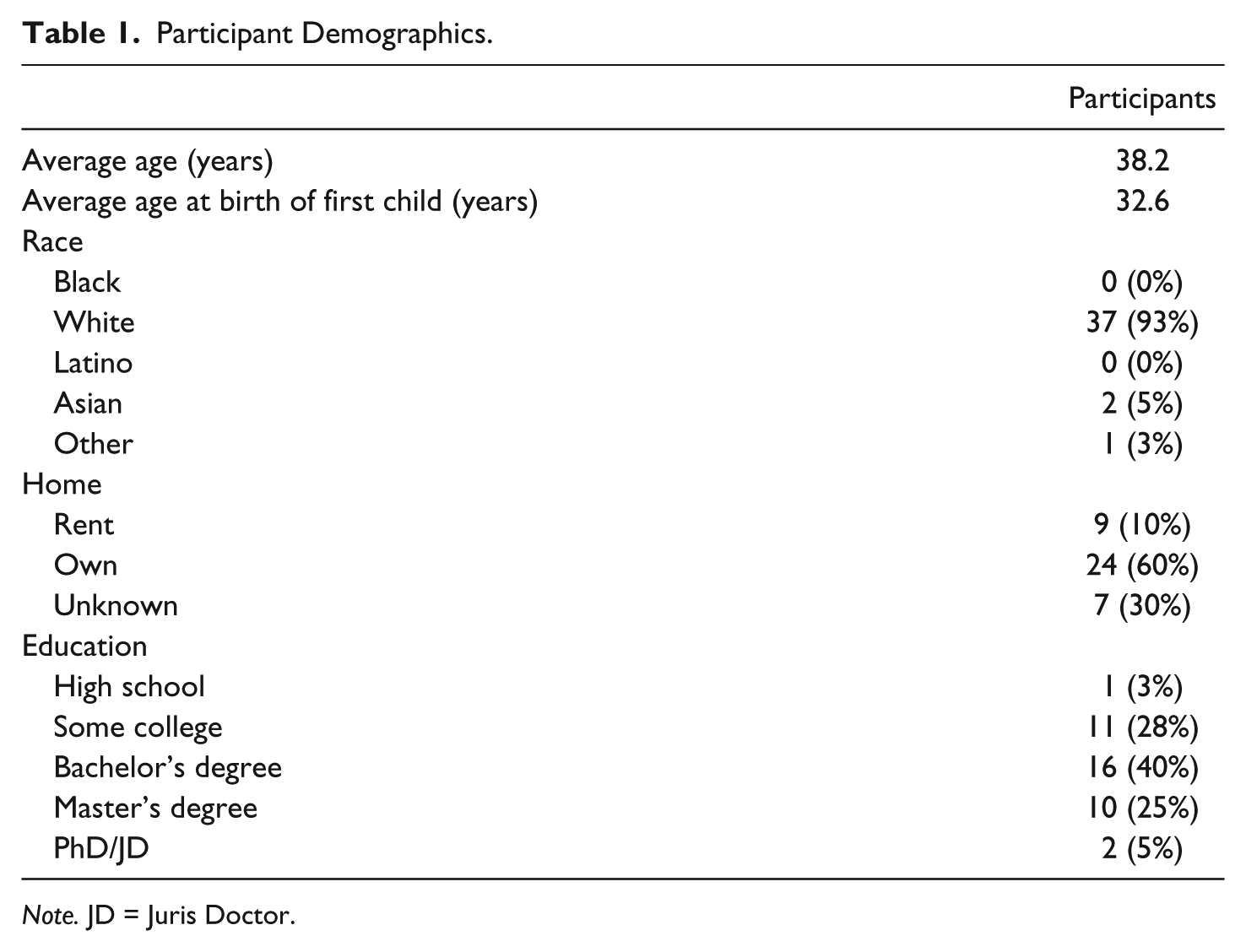
Note. JD = Juris Doctor.
Interviews were conducted either in a public location of the participant’s choice or via phone or video call. As a stay-at-home parent, participants have various schedules and availability, so to accommodate a father’s ability to participate, interviews were conducted both in person and over the phone. This also allowed fathers to control the environment in which they participated in the study. By giving participants the option of meeting in person or over the phone, I believe I was able to create an environment that allowed fathers to be comfortable and open throughout the interviews.
I utilize the methods of grounded theory to examine the ways in which the isolation, resistance, and the division of household labor play into the construction of masculinities by these stay-at-home fathers. In this context, grounded theory is defined as a method that “consists of systematic, yet flexible guidelines for collecting and analyzing qualitative data to construct theories ‘grounded’ in the data themselves” (Charmaz, 2006, p. 2). Specifically, I use a constructivist approach, articulated by Kathy Charmaz (2006), that highlights the importance of the meanings individuals attribute to the focus of the study. I am interested in the participants’ thoughts, feelings, and viewpoints as well as the ways they create their own narratives of their position (Mills, Bonner, & Francis, 2006). Data collection began in October 2014 and continued through May 2015, ending because saturation was reached within the study sample. Informed by Strauss and Corbin (1990), data analysis began while data were still being collected to help direct participant interviews. Interviews and observational data were read several times, to identify unifying themes. Codes were created and continually reevaluated to assure data were continually being evaluated (Corbin & Strauss, 1990). Line-by-line coding was also employed. In addition, codes were then systematically evaluated and grouped into larger unifying concepts. Coding and analysis were guided by strategies outlined by Saldaña (2013) in The Manual for Qualitative Coding. The qualitative research analysis software Dedoose was utilized to organize interview and observational data, themes, codes, and codebook.
Findings
Many times, throughout discussions with these stay-at-home fathers are examples of both resistance of societal norms and pressures around their role as stay-at-home fathers while participating in expectations of masculinities. Specifically, for fathers who define themselves in opposition to mothers or stay-at-home mothers, this is a way for fathers to differentiate and possibly normalize what they are doing while creating a more masculine space around a traditionally feminine role. In this study, I examine how fathers resist being associated with femininities, reject labels associated with motherhood, and explore spaces created specifically for stay-at-home fathers. Through the analysis of these themes, this study shows how stay-at-home fathers are both participating in masculinities and resisting expectations and pressures associated with their role as stay-at-home fathers.
Resisting Femininities
Participants discuss the ways they reject roles associated with being feminine despite participating in the main caregiving role, a traditionally feminine task. There are several instances where participants express shock and anger in response to negative comments, specifically from other men attempting to regulate hegemonic masculinities for these fathers. Although participants suggest that negative responses to their position as the main caregiver are normal, they continue to be surprised when faced with opposition. Important in this discussion is the access to power these stay-at-home fathers experience based on their social location and status in society. As primarily middle-class, White, married men, these have access to power and social status that many men and women do not within the United States (Connell, 2005). As stay-at-home fathers, these men are sometimes challenged because they are participating in the traditionally feminine act of caregiving resulting in feelings of shock and surprise. This questioning and feelings of shock are exemplified in a story told by Mason, a father of two school-aged children.
So, I’m at the soccer game, my son’s soccer game, my daughter’s beside me, there are mostly women around me with their kids. My son was done, and I was packing up and two guys showed up behind me, lawn chairs with umbrellas and coolers, the whole thing. They were way more outfitted than anyone else there. They’re seeing me pack up and when I see guys anywhere, the first thing I say is are you a full-time at-home dad? Because I not only want to know for me but want to let them know about the network. So, I asked them and one Guy A, said “Oh no, I wish,” but not in that way that he actually did. More like “I wish I had a cushy thing like that, so I wouldn’t have to work.” That was more, definitely what he meant. And Guy B said “No.” So I said I’m a member of this network, thinking if I tell them that maybe a) it will raise awareness and b) maybe they know someone or will know someone. So, Guy B says “Do you, like, do everything? Do you cook? Do you clean?” And I was like “Yeah, I do the whole ball of wax. That’s what my job is.” And he said, “Well, I would not let the women find out about that.” And I’m thinking what he’s about to follow that with is because then they’ll make me do it or think I should be doing it or something like that. But his follow-up line was “That is really unattractive.” I should not have been blindsided by that but that’s sort of another example where I was like, “Wow.”
In this experience, these two men suggest that Mason’s role at home would make him unappealing to women. These men deem Mason unattractive to women for taking on roles that traditionally have been associated with women, such as cooking. Although he recognizes that caregiving is not normally associated with fatherhood or masculinities and expects to hear comments from other fathers, he is taken aback by their assumption that he would not be attractive to other women because of his role within the home. The questioning of his masculinity by these two men also challenges Mason’s understanding of himself as masculine. Another participant, Logan, a father of twin girls, has a similar experience when caring for his girls at the playground.
The playground is across the street. The school with the playground is across street. The girls will be playing there so I’ll run across to them and bring out the water. I’ll have fresh cut watermelon or water or lemonade. I’ll go ahead and bring out something. I get razzed for that. Like “Oh, Mike, go whip something up or put on your apron.”
Like Mason, Logan’s masculinity is questioned by other fathers because he is providing drinks for the children on the playground. In both narratives, there is a strain between traditional expectations for men and the expectations of the role of the stay-at-home parent. These fathers are ridiculed because of actions viewed as feminine. Lucas, a father of two children, also talks about reactions from other fathers.
You will go up to a few dads at the playground and asked them if they stay home or work from home to get them to try and join the group. One guy said I don’t even understand why you would even do that. Other people flat out reject even the concept. Other guys have said things like, “Do you actually cook? Do you actually clean?”
As with Mason, these fathers are clearly questioning Lucas around his relationship to hegemonic masculinities. Negative reactions from other men bring to the forefront assumptions about masculinities and fatherhood. In addition, these reactions make fathers question the ways hegemonic masculinities are being constructed within their own lives despite their position as stay-at-home fathers. Benjamin, a father who participates in a local stay-at-home group, touches on his struggle with feeling masculine in this discussion about his brother.
I have another brother who is a much more of a . . . masculine, American type, you know, football loving. Gotta be the bread winner. He’s driving a truck, you know, born country kind of guy—kind of guy. I think that, you know, he’s the one who told me—he’s like, “I can’t imagine ever doing this, it just freaks me out just thinking about it” and I think that in-intellectually he understands it and supports me but, you know, he—and he has—he has a—his partner is a stay-at-home mom. You know, he’s very comfortable with that but I don’t think that um (pause) there’s a whole lot of pride, you know, in like saying that his brother is a stay-at-home dad.
All four of these examples highlight the complexities around masculinities. Benjamin’s quote exemplifies some of the reactions these fathers have faced from other men. Although he does not explicitly say that it challenges his sense of masculinity, his brother’s lack of pride in Benjamin suggests that being the main caregiver is not viewed as a positive role. All four of these fathers discuss how other men question these father’s masculinities because of their role as caregivers. Participants do not back away from their role as a stay-at-home; however, they are challenged by others because of their participation in feminine tasks. Through these interactions with others, participants’ masculinities are policed by other men, causing these participants to grapple with their own masculinities within the context of being a stay-at-home father.
Participants also discuss labels such as “Mr. Mom,” as a way others regulate their role within the home and masculinities. Rather than just discussing these labels as they do with other reactions, fathers discuss their strong dislike for terms that associate them with mothers. Fathers’ dislike for terms such as “Mr. Mom” is a way these fathers are attempting to set themselves apart from both femininity and motherhood.
Mr. Mom
One way fathers explicitly define themselves as different from mothers was through the rejection of the label “Mr. Mom.” In interviews with stay-at-home fathers, the dislike for the term “Mr. Mom” is discussed repeatedly. Participants talk about being called “Mr. Mom” by acquaintances, friends, and strangers at the grocery store. When asked about reactions from others, Liam, a father of six children, said, “You still get the ‘Mr. Mom’ comments. No, not so much. Actually, I’m a dad. I don’t try to be Mom.” Here, he suggests that there are distinct differences between his role as a father and the role of mothers. Similarly, Noah, the father of a son, explains the reasons behind his rejection of the “Mr. Mom” label: That’s why stay-at-home dads are against being called “Mr. Mom.” You may have heard that we hate that term. And some people will never think about it, about the fact that when you are calling a stay-at-home dad “Mr. Mom,” you are saying that they are doing a woman’s work. We don’t use terms associated back to women. We don’t say, “Oh, Mrs. Dad.” You’d be very quickly called out if someone was, you know, was saying a woman working wasn’t her place. Whereas if the man is not working, we sort of automatically feminize him. That bothers us.
Here, Noah explicitly states that his reason for rejecting the term is because he sees it as feminizing. Both Noah and Liam separate themselves from the feminine role of mothering and, by doing this, suggest that they are participating in a role that is specifically masculine. In addition, the term “Mr. Mom” is seen as an insult because of its association with women and femininities. Ethan, a stay-at-home father for 12 years to three children, exemplifies this when he says, When I first started staying home, people were like “Oh, you’re just Mr. Mom. When are you going to get a job?” or “What do you really do?” They weren’t very understanding of what it is. It’s partly a cultural thing, I think.
Again, the term “Mr. Mom” is used to regulate the masculinities of these fathers as they participate in a traditionally feminine role as the stay-at-home parent. The rejection of this term by these fathers suggests that they too see it as a negative label. Ethan goes on to talk about his interactions with reporters around his experiences as a stay-at-home father.
I say this all the time to reporters. Turn around anything you’re thinking about and say the same kind of thing about a woman that you’re going to say about me. Then ask yourself, if you would get fired for that. Like, would you ever say in an article about my wife that she is a Mr. Dad? Because she is a woman who’s working? No, you would never say that. So why would you call me Mr. Mom?
Ethan suggests that he should be treated similarly to his wife in the workforce. Missing from his discussion are the implicit expectations on women to act masculine in the workforce, to not be seen as weak or incompetent (Rutherford, 2014). Also missing from fathers’ discussions and frustrations with the term “Mr. Mom” is the recognition that by rejecting this term, these fathers are participating in furthering the power associated with masculinities. As within the workforce, these fathers see being associated with this feminine, mothering role as weak. By rejecting this term, they suggest being called “Mom” is undesirable.
Overall, these fathers continue to reject the term “Mr. Mom” and the feminine expectations that come with the term. By rejecting what is considered feminine about this role, these fathers are attempting to reconstruct the role of the stay-at-home father as masculine. Rather than suggesting that parenting is not gendered, these fathers are attempting to show that what they do as caregivers is masculine. These reactions highlight the complexity in which these fathers understand and discuss masculinities. Similar to Doucet and Merla’s (2007) work with Canadian and Belgium stay-at-home fathers, participants are not fully resisting hegemonic masculinities but participate in some aspects while rejecting others. They are continuing to affirm a gendered binary within parenting by creating a role that is specifically for fathers while redefining expectations around fatherhood and masculinities. In addition to rejecting this term associated with mothering, fathers also suggest that it is important to create spaces that are specifically for stay-at-home fathers.
Mom “Spaces”
Another aspect stay-at-home fathers discuss is their experiences in mother-only spaces and participation in parent–child groups consisting of mostly mothers. Fathers report varied experiences with stay-at-home mother groups including feeling welcomed by everyone, continuing to participate despite feelings of being rejected by some of the mothers in the group, and feeling completely rejected and not participating in these groups. The ways these fathers talk about these experiences highlight their experiences with stay-at-home mothers, expectations mothers have for these stay-at-home fathers, and the ways in which these fathers reject societal expectations placed on them because of their status as stay-at-home fathers.
Sebastian, a father to two children, ages 3 and 7 months, talks about his experiences with other stay-at-home mothers as positive and encouraging. Throughout his time at home with both his children, he has experienced several different groups including groups geared at play as well as for learning Spanish for children. Sebastian characterizes his experiences in these groups as positive and inviting. Although he was the only man in the group, he speaks highly of his time spent in the group and mentioned that he continues to spend time with these mothers. Sebastian’s positive experiences with these mothers speak to both his comfort in his role and the reactions to his position as a stay-at-home father.
Despite speaking highly of his experiences and acceptances with other stay-at-home mothers, he also talks about not always feeling “100 percent comfortable” in these group settings.
I mean there’s—there’s certain conversations that would take place that I could participate sometimes via my wife’s experience, presenting that, or—I mean one—the—eventually in the first 4 months it was really like a get together and like talk and, you know, digest what your 6-week-old was doing or, you know, 2-month-old and how to deal with getting them to sleep or, it was all that kind of stuff. Just kind of vent a little bit and get some tips from other people and maybe give out a tip or two. Then it morphed into the play group, but I would say . . . you know . . . you know, it—so the only thing that—that—2 things that were like um where I really felt like “Okay, I’m—I’m the only guy here.” Some of the conversations where there was—really kind of on feminine things. I mean, nursing—I’ve got a—whatever, whatever that happens to you—but, you know, or—or, I don’t know, you can—I can’t remember what they were but just nursing—I think just nursing itself and I was like, “Okay, I’m trying to be respectful here.” We navigated that fairly well, but I mean honest—to be frank that was certainly . . . not the most comfortable experience probably for . . . anybody. It was a little bit . . . in fact, you know, if there were—if it were . . . because I was—I think it was exacerbated by being the only male in the room. If it were like, you know, a group of 15 people and it was, you know, 8 and 7 or 7 and 8 or whatever, I mean um it wasn’t a bit—I mean but—but kind of those kinds of things but other than that and—and I mean and that wasn’t like that dramatic or anything it’s just a little bit, yeah, it’s a little bit different for—I mean and, you know . . . everybody survived including me, so.
In this narrative, Sebastian describes the awkwardness he felt when discussions turned to topics such as breastfeeding in the all-mothers’ group. As evidenced through the way he stumbles through describing his experience, these conversations were awkward for both him and the mothers participating in the group, even though he personally experienced many of the same issues these women were talking about with his female partner. Although he has had secondhand experience with topics such as breastfeeding via his wife, he does not have the embodied experiences that these women have experienced. By acknowledging the awkwardness of his presence during these discussions, Sebastian also is forced to acknowledge his differences in this group made of primarily women. He recognizes that this space may not be a welcome space for him at all times but is aware of his own power in the situation by attempting to respect the women’s need to discuss these personal topics.
Casper, a father of one son, also talks about his experience with stay-at-home mothers while talking about personal aspects of breastfeeding or childbirth. Casper’s experiences with these groups, however, vary greatly from Sebastian’s. Rather than being accepting, the mother’s group that Casper had joined informed him that he would not be able to participate because of the personal nature of their conversations. When describing this situation, he stated, I tried to join a local playgroup online, they were like it’s only for women because we talk about vaginas. That was like are you kidding me? I got an e-mail that said we can’t let you in the group because sometimes we talk about lady things and lady parts. And I was like, “I know what they are. I have a child so obviously I know they are.” But that’s the dumbest thing ever heard, this is playgroup.
Different from Sebastian, Casper was unaware of his position within the group. Like Sebastian, he has experiences with breastfeeding and childbirth via his wife’s experiences but not embodied experiences such as these women. Casper, like most men in this group of fathers, has not been excluded from most groups because of his privileged position in the patriarchal society of the United States. His reactions highlight this surprise and shock of being challenged.
Both men tried to participate in stay-at-home mother groups and both experienced discussions around breastfeeding and childbirth. However, they were received differently and had very different reactions to their experiences. Sebastian, although awkward when describing the conversations around female bodily functions, attempted to give them space and was concerned about respecting their discussions. Casper, however, was rejected from the group because of their conversations. He reacts out of surprise and dismissal of the group’s concern. His statement, “This is the dumbest thing I have ever heard,” attempts to turn his surprise at being rejected from the group into dismissing the women’s concerns as unreasonable and “dumb.” Both men’s reactions highlight masculine expressions in different ways. Sebastian’s discomfort with the discussions suggest that he himself felt like an outsider or, in some way, was not supposed to be part of the discussions because he was a man. His awkwardness around the discussions set him apart from his female counterparts and suggests that he sees himself as different from these mothers. Casper’s reaction to discussions around female bodily functions and being left out of the group because of his status as a man left him frustrated. Later, in his interview, he talks about starting a stay-at-home father group to counteract this rejection. Casper also was singled out because he was not a mother. His reaction suggested that he thought that the women who voiced their concerns were unfounded and being “ridiculous.” Rather than thinking about their concerns or feelings, he reacted in a way that questioned their saneness.
Other men talked about feeling comfortable in some situations but not in larger groups of stay-at-home mothers. George relies heavily on other stay-at-home mothers in his high school friends group. However, when trying to join a larger stay-at-home mother group, he was met with opposition.
There have been a couple of times where I’ve tried to become a part of a larger stay at home mom network kind of on Facebook or stuff where they have play dates and that sort of thing and I’ve kind of given up on those because they generally end up pretty awkward. I feel like the moms don’t know how to connect with me. We have trouble finding things to talk about.
Although the mothers in his small group are accepting, he finds it hard to connect with other stay-at-home mothers. One difference between his small group of stay-at-home mother friends and larger groups of stay-at-home mothers is his relationship with the smaller group. Rather than meeting these stay-at-home mothers as a stay-at-home father himself, like with the larger group of stay-at-home mothers, these are friends from high school. The association with this small group of mothers is more than finding commonality around being the main caregiver. Because of this relationship, George’s comfort may not be associated with some stay-at-home mothers but not all. Instead, this small group of women happen to be stay-at-home mothers, but their friendship is not based on that alone. Again, George, similarly to Sebastian and Casper, felt that he was different from the other mothers and had less in common with them, despite being a stay-at-home parent. Although these fathers are caring for their children much in the same way the mothers in these groups are doing, both mothers and fathers set these men apart because they are men.
Although several men spoke about attempting to participate in groups of stay-at-home mothers, several other fathers talk about their dislike for these mothers’ groups. Fathers cite multiple reasons for avoiding stay-at-home mother groups, including not feeling accepted by other mothers, feeling more comfortable with other fathers, or wanting to focus on conversations that mothers do not. Several fathers talk about not feeling accepted by other mother groups. As Casper and George discuss, many times the spaces created for mothers were not as open to men. Noah, the father of a 5-year-old boy, also points out how language can create spaces intended for parents feel like they are mother exclusive. Citing his church parent group as an example, he talks about the parent/child gym time at his church as being labeled a “Mommy and Me” group. When asking about being able to attend, his pastor was shocked that he would not think he would be accepted because the group was intended to be for all stay-at-home parents. Noah had to point out that as a father, it was unclear whether he was allowed to participate, despite being a stay-at-home parent. By pointing out the word choice, Noah was able to show how his presence as a man in these groups was not always encouraged or welcomed.
Other fathers focus on participating in groups that were only for stay-at-home fathers. When talking about their interaction with these other fathers, Kevin, a father of two elementary school–aged children, talks about his interactions with both stay-at-home mothers and stay-at-home fathers.
Well everybody kind of ends up being a stay-at-home dad for very different reasons. Most often it’s because of a career stall or layoff or a job change that didn’t work out or they are underemployed or unemployed and it becomes this default role. It’s not one that they choose to do because they feel very strongly about being a parent. It’s like everything else in life, when you go into something, ass-backwards, by default, you’re going to be lousy at it and you don’t approach it with a real commitment to doing it right or well. So, for the most part, I saw that in a lot of stay-at-home dads around me. But I also saw it, to an even greater extent, in a lot of stay-at-home moms. It was interesting that the roles were, there were a lot of similarity between how dads and moms struggle with not working, not being part of productive America, not being a part of adult life but they handled it very differently. I think that ultimately, men, because they are so much more independent and private, they end up internalizing it and they become, they just become depressed and disconnected. Women reach out to other women to find some commonality. So, there will be play groups that are generated by stay-at-home moms, but stay-at-home dads don’t do that. Or they try to do it because it seems like the way to handle the issues that they are facing but it doesn’t quite work well unless they become friends very quickly and they can bond around something that is very guy orientated, like sports for example. Play dates with guys with young kids very quickly start looking like Monday night football and the kids very quickly are left to their own devices and the parenting kind of goes out of the window.
He suggests that both women and men struggle with some of the same issues, including grappling with not contributing financially to their families or the working world. However, he proposes that there are differences between the ways that fathers grapple with these issues. He suggests that, without knowing other stay-at-home fathers in similar situations, men tend to struggle with being disconnected and depressed. He further criticizes fathers for focusing too much on themselves and less on their children within these groups. In this example, Kevin points out that many times fathers are looking for more of a connection with other fathers in a similar position and may not put their children’s needs first. In the end, he suggests that because he chose to stay at home with his children and does not focus on the interaction aspect that many mothers and fathers need, he is able to better parent his children than both stay-at-home mothers and stay-at-home fathers.
Fathers talk about their experiences with stay-at-home mother groups and mother-centered spaces in slightly different ways. However, the majority of fathers highlight their feelings of discomfort and frustrations with being excluded from these spaces. Their reactions to being left out or choosing to not participate in these spaces help construct the stay-at-home father role as separate from the role of stay-at-home mothers. Their frustrations associated with being left out of these groups also highlight the tensions associated with being in this role and the power most of these men feel being associated with masculinities.
Discussion
The sample for this research consists of almost all professional, White, and married fathers. In addition, participants became fathers later in life compared with the average age of fathers at the birth of their first child in the United States (Khandwala, Zhang, Lu, & Eisenberg, 2017), giving them time to experience working outside the home before assuming the role of the main caregiver for their children. These aspects gave participants access to power and privilege within the United States, not available to all men (Connell, 2005). As stay-at-home fathers, participants are challenged by others because they are men participating in a traditionally feminine role. Specifically, participants are not welcomed into mother-centered groups because of their gender, creating a situation that is new to many of these fathers. Because of their social location, participants not only challenge those who question their role at home but also create new organizations for other fathers such as themselves. By fighting labels such as “Mr. Mom,” participants distance themselves from femininities and establish themselves as men participating in dominant forms of masculinities. In addition, some participants discuss rejecting stay-at-home mother spaces such as at-home groups to establish themselves as different from stay-at-home mothers. However, fathers also reject caregiving as associated only with mothering, signifying that they are also resisting dominant expectations of masculinities. In many ways, participants in this study both resist and comply with traditional expectations around masculinities and fatherhood. By focusing on a group of fathers with similar racial, educational, and economic backgrounds, this study addresses how privilege plays into participants’ abilities to resist and participate in masculinities and fatherhood.
Limitations and Future Research
Although this research is limited by the characteristics of the sample and cannot make comparisons within the study around race or sexuality, it does allow a unique opportunity to analyze how power and privilege influences how these men constructed the role of the stay-at-home father. For participants in this study, their position as a White man within the United States created few instances where their position is challenged (Hill Collins & Bilge, 2016). As a stay-at-home father, many of these men have experienced being questioned or not allowed in a particular space because of their status as a man. By having a homogeneous sample, I am able to examine how participants’ reactions are influenced by their access to power and privilege.
Future research should also include more interviews with a diverse group of fathers to add to the discussion of power and privilege in this study. This future research is important because it highlights the larger population of stay-at-home fathers than currently is reported by the U.S. Census and other reports. Not only is there a larger population of fathers who are the main caregiver and care for their children, their experiences may be more varied than is currently represented.
In addition, including fathers in same-sex relationships along with fathers who are single or cohabitating may add more to our understanding of changing gender expectations around caregiving and household labor. In this study, I examined how gender roles are challenged in heterosexual married couple families. Including a more diverse sample of family formations would allow for further discussions around gendered expectations.
Finally, longitudinal research with stay-at-home fathers would also shed light on several aspects of how fathers identify and construct their role as a stay-at-home father. As fathers continue in their role as a stay-at-home father or return to work part time or full time, longitudinal research would highlight the complex nature of this role and caregiving. It could also help examine how gendered tasks change over time within these families. Longitudinal research would also allow for more analysis of the changes for these fathers and families when the father reenters the workforce.
Contributions
This study contributes to current research about stay-at-home fathers in several ways. First, this research questions how these stay-at-home fathers both challenge and conform to gendered expectations. By giving up some or all outside work to care for their children, participants challenged traditional expectations for fathers. Rather than focusing on breadwinning and economically supporting their family, these fathers prioritized caring for their children while their female partners work outside the home (Smith, 2009). In this way, they challenged current tenets of traditional fatherhood. However, in many ways, these fathers continued to participate in normalized expectations around fatherhood and masculinities. Fathers compared themselves with mothers, suggesting that they play rougher with their children and encourage them to explore than mothers. Fathers also allowed more distance and encourage their children to take physical chances that may endanger themselves that mothers would not allow. Encouraging their children to explore and take chances is constructed as positive aspects of parenting that is missing when mothers are the main caregiver. Participants suggest that they do this because they are fathers, distinguishing themselves as separate and, in some ways, as better than stay-at-home mothers. In addition, although some expectations around caregiving and fatherhood may differ outside of the United States, the complexity associated with participating in and resisting dominate masculinities while the main caregiver is relevant. Stay-at-home fathers outside the United States continue to participate in activities that are associated with masculine identity even after becoming the main caregiver (Doucet & Merla, 2007). Participants’ discussions and frustrations of terms such as “Mr. Mom” or babysitting also highlighted how fathers were resisting terms that associate them with being feminine. They are creating a role that is masculine and specifically for fathers. Through the analysis of how fathers were also conforming to traditional expectations of masculinities and fatherhood, this research is contributing to the current literature on stay-at-home fathers.
Conclusion
Through discussions of their daily lives and their experiences as stay-at-home fathers, participants in this study highlight the ways they both contribute to, and resist, dominate masculinities. Although fathers continued to conform to some aspects of gendered expectations, in many ways, they are also challenging what it means to be a father. Despite their struggles and tensions surrounding their role within the home, participants spoke highly of their job as the stay-at-home father for their family. This sense of opportunity and love for their role within the home was evident throughout narratives of and conversations with these stay-at-home fathers. Even with the challenges of navigating the complex nature of masculinities, participants continually stressed the importance of their role within their family and society.
Footnotes
Declaration of Conflicting Interests
The author(s) declared no potential conflicts of interest with respect to the research, authorship, and/or publication of this article.
Funding
The author(s) received no financial support for the research, authorship, and/or publication of this article.