




Abstract
Men’s involvement in the antiviolence and women’s rights movements has increased in recent decades, but men’s groups still struggle to recognize difference among men. This study is based on a year-long participant observation and interview study with two gender justice groups directed toward men of marginalized communities. A third group, Men Stopping Violence (MSV), played a paradoxical role that elucidates some dynamics and difficulties of intersectional organizing: MSV’s training and resources were crucial for both groups, but MSV’s failure to organize intersectionally was as important in their formation. From these examples, I theorize three categories of ways that mainstream organizations fall short of intersectional inclusion—organizational elements that are culturally unacceptable to marginalized communities, necessary elements that are absent, and environmental comfort—and make suggestions for intersectional social movement praxis.
Men’s involvement in the antiviolence and women’s rights movements has increased in recent decades, with state and nongovernmental organization (NGO) funders increasingly calling for projects that engage men; existing men’s groups work on projects like public education campaigns, marches, newspaper editorials, political advocacy, and fundraising for women’s organizations (Casey & Smith, 2010; DeKeseredy, Schwartz, & Alvi, 2000; Flood, 2005, 2011; Messner, Greenberg, & Peretz, 2015). These antiviolence institutions, however, struggle to find, involve, and retain men allies, and this problem is compounded when trying to work across difference (Casey, 2010; Flood, 2005, 2011). As intersectional feminists have shown, when antiviolence efforts fail to attend adequately to overlapping axes of oppression and the structured differences in women’s lives that are created by them, they fail to serve entire communities of women and tend to benefit women of relative privilege (Baca Zinn & Dill, 1996; Collins, 1990; Crenshaw, 1991). The same problem applies when engaging men in gender justice activism—that is, failing to attend to differences among men when engaging men as allies means failing to sufficiently engage marginalized men in gender justice work and thereby failing to serve entire already-marginalized communities—but both theory and praxis regarding engaging men intersectionally are still in their early stages.
This article investigates how intersectionality shapes the formation of men’s gender justice organizations and thereby contributes to the literatures on intersectionality, social movements, and men as feminist allies. It is based on findings from a year-long participant observation and interview study with two men’s gender justice groups that are specifically directed toward and draw membership from socially marginalized communities: Muslim Men Against Domestic Violence 1 (MMADV) focuses on Muslim communities, and the Sweet Tea Southern Queer Men’s Collective (Sweet Tea) focuses on gay/queer men. The majority of the members of both groups are Black men, and both groups received early training from a third group, Men Stopping Violence (MSV). MSV is a nationally known men’s anti-gender-violence group that focuses on a community accountability model of violence prevention, running a 24-week educational program for men (court-ordered and otherwise) to explore masculine socialization and violence, as well as an internship program for men who wish to become further engaged (Douglas, Bathrick, & Perry, 2008; Douglas, Nuriddin, & Perry, 2008). In studying the formation of MMADV and Sweet Tea, I find that MSV played a crucial but paradoxical role that elucidates some dynamics and difficulties of intersectional organizing. While MMADV and Sweet Tea relied on MSV for early training and resources, it was actually the failure of MSV to organize intersectionally that prompted the formation of these other groups; MMADV and Sweet Tea were shaped by both MSV’s successes and its shortcomings.
Following a review of the literature and methods, I describe the formation of MMADV and Sweet Tea. I then draw links between these groups and MSV, describing three categories of ways groups can fall short of intersectional inclusion: first, elements included in MSV’s work that are culturally unacceptable and therefore ostracize members of marginalized communities; second, features that are absent MSV’s programming that marginalized communities find necessary; and finally, comfort for marginalized group members in the group environment. I conclude with some suggestions for navigating the logistical and political difficulties of intersectional organizing in social movement institutions.
Men’s Gender Justice Engagements in Intersectional Perspective
Since the beginning of women’s rights work in the United States, there have been some men present, involved, and supporting women (Kimmel & Mosmiller, 1992; Tarrant, 2009). With the feminist revolution of the late 1960s and 1970s, men in the United States saw that changes in the gender order were effecting their lives, and while many reacted negatively, with antifeminist backlash or masculinist protectionism, some embraced feminism (Messner, 1997). This last group of men were often told to work on themselves or to go work within their own group, teaching other men about sexism and admonishing them to be less sexist (Messner et al., 2015). Groups such as Rape and Violence End Now, Men Against Sexist Violence, and MSV were formed from this advice, and similar groups have become institutionalized and professionalized in the years since. Internationally, engaging men for gender equality has become a major trend in international development work since the mid-1990s (Barker, Ricardo, & Nascimento, 2007; Bojin, 2013; Esplen, 2006; Flood, 2005, 2011). NGOs such as Promundo in Brazil, Men’s Action for Stopping Violence Against Women in India, and Sonke Gender Justice in South Africa do creative public education work to change the gender norms in their countries, to foster more gender-equitable relationship norms, reduce relationship violence, and slow the spread of HIV/AIDS (Dworkin, Fleming, & Colvin, 2015; Ravindra, Sadani, Geetali, & Mukund, 2007; Verma et al., 2006). These organizations are built around the idea that men can be allies to women’s movements in their efforts toward gender justice. Allies are activists who work to end systems of oppression that are not typically understood as targeting their own identities (e.g., White anti-racist activists; heterosexuals who work for gay rights). While allies are generally welcome and widely recognized as necessary for effective organizing, allyship is neither simple nor unproblematic, with issues of accountability and unexamined privilege commonly causing concern (Bojin, 2013; Bridges, 2010; Flood, 2005, 2011; Macomber, 2015; Messner et al., 2015; Tarrant, 2009).
Existing understandings of allyship in activism are limited, however, because they often lack an intersectional analysis. Born of the lives and analyses of women of color, intersectionality is the idea that various social differentiation categories like race, class, gender, and sexuality are co-constitutive, inseparable forces that work to structure human experience (Baca Zinn & Dill, 1996; Collins, 1990; Crenshaw, 1991). This conceptualization of difference not only means that one cannot speak of categories like women, gays, or the working class as unified groups with similar experiences but it also means that each axis of difference is experienced differently based on one’s status among the other axes (Collins, 1990). Black women, for example, experience gender (and gendered oppression) differently than White women, and race (and racial oppression) differently than Black men; women of color have been marginalized both in feminist and antiracist movements, and strategies deployed by either movement are unlikely to adequately address concerns that are central to them (Crenshaw, 1991; Davis, 1982). Social movement organizations and institutions specifically for women of color, as well as intersectionality as a concept and analytical framework, have been formed as a partial response to this marginalization (Davis, 1982).
If intersectionality critiques the use of “women” as a unitary category, it also calls into question any claims about men as a unified group: It has proven to be a useful lens for analyzing the different ways men experience gender and calls us to look at how these social movement issues affect men’s gender justice organizations (Alcalde, 2014; Messner et al., 2015; Peretz, 2017; White, 2006, 2008; White & Peretz, 2010). When institutionalized efforts to engage men as allies are insufficiently intersectional, treating straight White middle-class Christian men as a stand-in for all men, they will fail to engage men from marginalized communities, and thereby leave the women of those communities underserved and disproportionately vulnerable (Peretz, 2017). There are multiple analytical frameworks that derive from the intersectional turn; the present article is based in “paradigm intersectionality. . . , a justice-oriented analytical framework for examining persistent sociopolitical problems” (p. 282), in this case the problem of engaging men in gender justice work, and specifically in engaging men from marginalized and multiply marginalized communities (Hancock, 2013).
Early writing on men’s anti-sexist involvement hinted at an overrepresentation of Jewish and gay or bisexual men among male activists, suggesting that intersecting identities factor into men’s gender justice engagements (Brod, 1988; Christian, 1994; Messner, 1997). One descriptive study surveying attendants of a national conference of profeminist men found that “gay men constituted nearly half of the respondents and bisexual men accounted for nearly 20%” (Shiffman, 1987, p. 301). Recent studies, however, often fail to adequately attend to the importance of men’s other intersecting identities, either by ignoring other axes of inequality from analysis or because of overly homogeneous samples. In her study of boys doing gender equity work, for example, Coulter (2003) spoke with 10 boys, all of whom identified as heterosexual and nine of whom were White. Casey and Smith’s (2010) study of men’s pathways to engagement was based on interviews with 27 men, 26 of whom identified as White, and the sexuality of participants was neither reported nor discussed in the analysis. The authors note that their results “largely reflect White men’s antiviolence ally development” and assert that a “glaring gap in both the findings presented here and research about male antiviolence allies more generally is the experiences of men of color” (Casey & Smith, 2010, p. 970). Intersectionality usually goes unremarked unless the study is specifically about one group, such as Latino men (Alcalde, 2014) or Black men (Douglas, Nuriddin, & Perry, 2008; White, 2006, 2008; White & Peretz, 2010).
In theorizing masculinity politics, Messner (1997) emphasizes the tension between focusing on men’s institutionalized privileges, the costs of masculinity, and the differences and inequalities between men. He describes a triangular “terrain of masculinity politics,” where focusing on one or two of these themes pulls away from devoting attention to the remaining ones (Messner, 1997). In other words, institutions primarily focused on critiquing the benefits men receive from sexist social structures or providing space for men to open up about their gendered pain may pay insufficient attention to the differences among men. Recent writing on the involvement of men in women’s rights work argues that “adopting an intersectional approach is urgent,” but there is still little research on how men’s groups navigate and are shaped by intersectional difference among men (Dworkin et al., 2015, p. 134; see also Alcalde, 2014; Flood, 2005, 2011; Peretz, 2017; White & Peretz, 2010).
Method
Both the methods and the groups for this study were selected to integrate intersectional analysis with existing knowledge on men’s feminist engagements. Group selection criteria included anti-sexist/anti-gender violence aims (as defined and stated by the group), real-world activities (not only online) to allow for participant observation, and a stated focus on men of a specific marginalized identity. I created an initial shortlist from online research and existing knowledge of men’s profeminist networks. After initial contact via their Internet presences, some groups were rejected as logistical challenges, insufficiently active, or insufficiently independent from a women’s organization. The remaining groups were MMADV and Sweet Tea (see Note 1). Both are small grassroots groups (membership fluctuated between three to eight members) located in Atlanta, GA.
The study began with participant observation, which informed the interviews by suggesting topics of interest and appropriate language to use with interviewees. From October 2011 through May 2012, I attended all group meetings, conference calls, and public events, such as the annual Muslim day against domestic violence and a community celebration of queer social justice organizers called Queers Run Amok. I also regularly reviewed the groups’ online presences and spoke with individual members privately. I assisted with organizing and preparing events and group meetings and appeared publicly as a member of each group. I took jottings during field visits and wrote fieldnotes soon afterwards; in both groups, I acted as secretary during meetings to take notes less conspicuously.
I conducted 12 semistructured theorized life-history interviews, eight with Sweet Tea members and four with MMADV members. I interviewed all four current members of Sweet Tea and four previous members, three of the four current members of MMADV and one previous member. To understand these groups within the context of Atlanta’s anti-sexist field, I also visited other organizations that came up through my work with MMADV and Sweet Tea, attended their events, and in some cases interviewed people related to them. In this capacity, I conducted interviews with three employees of MSV and one former employee, interviewed the coordinator of the Baitul Salaam Network, which initially sponsored MMADV, and conducted other interviews that do not bear on this article. Of these 17 interviews, 15 were conducted in person, one was begun in person but concluded by phone, and one was conducted via video call. The interviews ranged from 1.5 to 4 hr in length, with an average time of about 2.5 hr, and were recorded with permission. Informed by participant-observation experiences, interviews covered a broad range of topics, including personal life history with social justice organizing and issues of sexism and gender-based violence, engagement with and experiences within the group, motivations, intersecting identities, and masculinity.
Of the 12 interviewees who were members of MMADV or Sweet Tea (see Table 1), 10 were Black, one was White, and one was of South Asian descent. The MMADV interviewees were mostly middle-aged, working-class Muslim men (mean age of 47.5), and all were heterosexually married; with the exception of one childless member, all had three or more children. Most MMADV members had been involved with the group for a few months to a few years; a few had previous organizing experience, although usually not related to gender or sexuality. Sweet Tea members tended to be younger professionals (mean age 37.5) with no religious affiliation. All identified as gay or queer, most were single, and one had an adopted daughter. All of the Sweet Tea members had been involved with the group since its inception several years before, though one had left the group relatively early for personal reasons, and four left at different times due to geographic relocation. All had been involved previously and intensively in social justice organizing, sometimes professionally, and often in fields related to gender or sexuality (e.g., HIV/AIDS services; reproductive justice; gay/queer community groups).
Demographics of Interviewees.
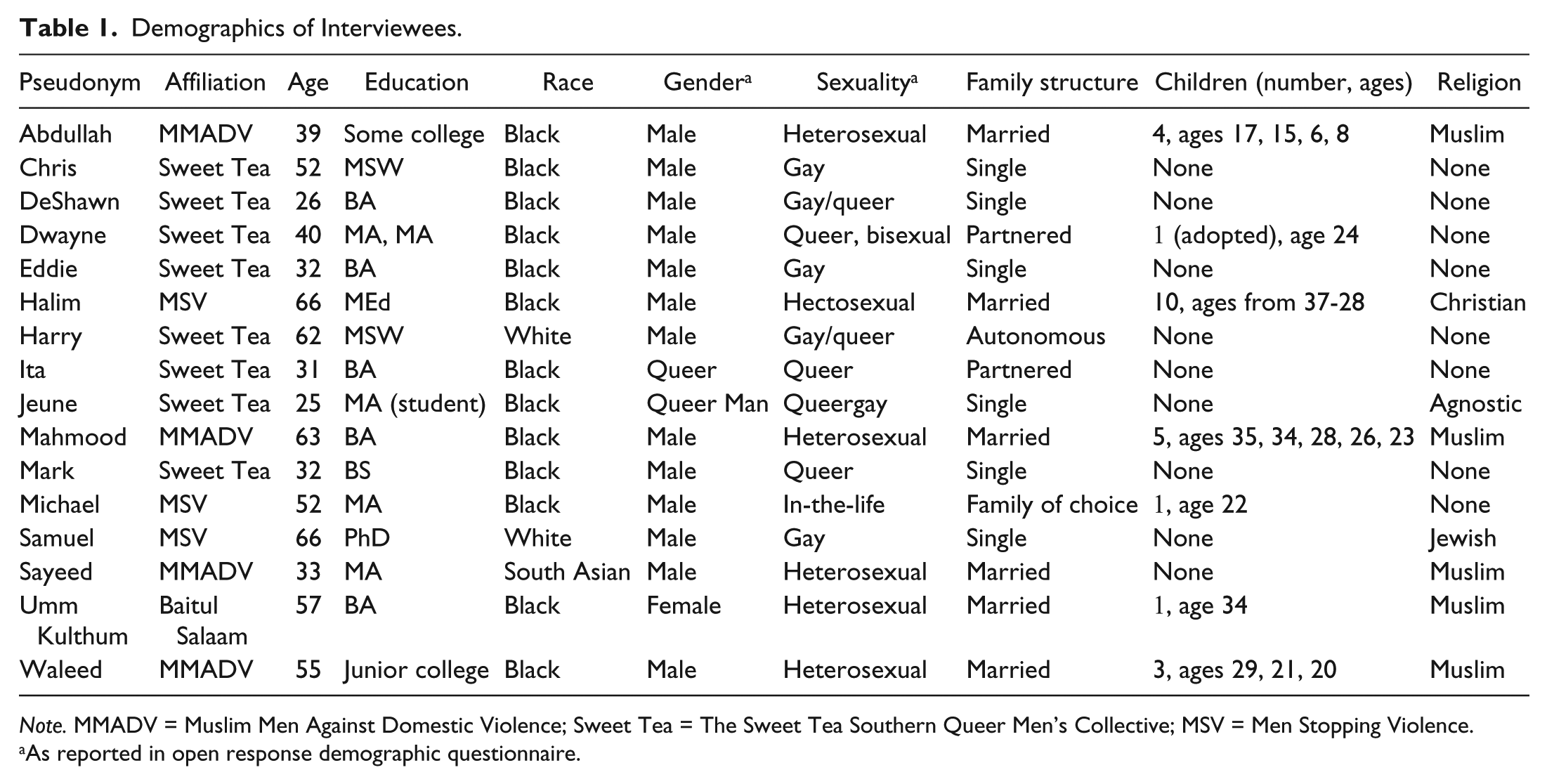
Note. MMADV = Muslim Men Against Domestic Violence; Sweet Tea = The Sweet Tea Southern Queer Men’s Collective; MSV = Men Stopping Violence.
As reported in open response demographic questionnaire.
Intersectionality as a research paradigm requires asks questions left unanswered by single-variable or additive approaches, and requires attention to multiple categories and the intersections between categories, diversity within groups, time dynamics, and the relationships between individuals and institutions; it is ideal for examining complex causality (Hancock, 2013). An intersectional feminist approach informed the research design, including the research questions, the selection of groups, and my specific awareness and focus on individual–institutional relationships including how race, class, gender, sexuality, religion, and age came up and interacted with each other, both during fieldwork and while analyzing the results (Collins, 1990). I conducted data analysis using grounded theory techniques, and four member checks were used to increase trustworthiness (Strauss & Corbin, 1998). My own experiences as a male in feminist spaces affected and informed the collection, analysis, and interpretation of the data. Because of our shared commitments to men’s anti-sexist activism, interviewees may have been more likely to identify with me or to have felt more comfortable telling me about their experiences. Similar to other researchers of men’s engagements in anti-sexist work, I found my respondents quite eager to share their ideas and experiences (Coulter, 2003). The small and local sample of this study means the results are illustrative, not representative, and sampling limitations constrain generalizability. That said, social movement groups often stay small and local, especially those formed by multiply marginalized populations, as evidenced by the nationwide search required to find the two example in the present study. Therefore, it is important to learn what we can from small sample sizes; indeed, it is a crucial step in encouraging the growth, longevity, and impact of such groups.
“I Really Appreciate Having the Road Smoothed Out”: The Formation of MMADV
Umm Kulthum is the coordinator of Baitul Salaam, a nonprofit Muslim community organization that works on issues surrounding domestic abuse, from shelter housing for survivors and referral services for medical and legal services to employment assistance and toy drives for Muslim holidays. Because MMADV is “an initiative of” this organization, I asked her to speak with me about their formation. “From 1997-2000,” she told me, “there were times I felt, in our community, I couldn’t say or do anything right.” She felt her efforts were “just be[ing] ignored, for many years. Not unlike other communities, it’s [seen as] a woman whining.” Being disregarded is detrimental enough when your organization emphasizes awareness and education, but there was also backlash that hurt her emotionally, made her work more difficult, and impinged on her personal life, because it “was not unusual for many years for my husband to receive numerous complaints about what I was doing.”
Recognizing that she was not being listened to specifically because of her gender, Umm Kulthum decided to recruit and train men to become public voices within the Muslim community. Recruiting men to support and assist her reduced backlash and eased her work, because “the fact that there’s this male presence, it completely wipes out [the idea] that this is an all-women’s thing, this is possibly some women trying to bring something anti-Islamic into Islam. It helps.” Although both Baitul Salaam and MMADV sometimes still struggle to be heard and taken seriously, no one could remember an incident of active backlash in years, and many people are easier, in our community, to approach now and talk with, since there are some men who are actually identified as working with us . . . and I really appreciate having the road smoothed out ahead of me sometimes.
While forming MMADV, Umm Kulthum met an employee of MSV named Halim, who told her “just have your people come through and do our internship and see what works for you.” MMADV began in 2008, though in the beginning “the organization was on paper only, with the core group of men . . . , on a very informal basis.” Because no one could be found to take a leadership role, Umm Kulthum still had to do all of the logistical and organizational labor for the group until 2009. That was when she recruited Sayeed, the first official facilitator of MMADV. He went through the MSV training program and was “the one who really helped us organize,” according to Umm Kulthum.
When I talked to Sayeed about his time as the facilitator of MMADV, he spoke proudly and excitedly about the work he did with the group. He was enthusiastic about furthering Umm Kulthum’s project “to get men in the Muslim community involved in the conversation, to talk about domestic violence, to not be afraid to confront other men.” During his tenure as facilitator, the group became more active, but remained informal: There wasn’t like a formal membership, people didn’t have to pay money—if you came to the meeting, you were a member, that’s it. I had these big excel sheets with people’s names on them, imams and different people who were interested, some men, a few women as well, but it wasn’t a lot of people. I had a Facebook group for a while, that’s basically what it was . . . like any organization, oftentimes if you’re very passionate about it, sometimes it’s an organization of one . . . I had to organize a lot of the events and I had to take on that responsibility.
Under MMADV’s auspices and in the group’s name, Sayeed gave “probably . . . 20 or 30 talks across the United States,” at masjid, mosques, and universities. He kept the fliers from many of these, which describe the presentation as confirming the existence of domestic violence in Muslim communities, arguing for men’s “important role” in prevention, interpreting the Qur’an and Sunnah’s messages about domestic violence, and proposing “community solutions.”
Sayeed and another MMADV member, Waleed, were both trained at MSV, as Umm Kulthum had initially planned. However, though they appreciated MSV’s analysis, they felt alienated during the meetings and did not believe they could take the MSV training directly to Muslim communities. As detailed below, MSV could not provide religiously informed analysis of gendered issues, their perspective on ideal masculine behavior varied significantly from the norms encouraged in scripture and Muslim cultures, and their discussions included dating and premarital sex and lesbian/gay issues. Even things as simple as their scheduling and space arrangements could make it difficult for a Muslim man to feel comfortable—if, for example, there was no time or space available for unrolling a prayer mat at the prescribed times. Therefore, MMADV focused specifically on Islamic ways of educating and advocating around domestic violence and assisting women who are victim/survivors. Their activities included giving Khutbah (sermons) against domestic violence, co-organizing an annual Muslim day against domestic violence, producing and wearing t-shirts with antiviolence messages, and providing financial and logistical support to women leaving abusive relationships.
“I Remember There Was This Spark”: The Formation of Sweet Tea
Sweet Tea formed in the Spring of 2008 because queer and gay men wanted a space to discuss the problems of sexism within their community in a way that would honor and directly address their specific community concerns. Ita, a young Black queer college student who was interning at MSV, found the discourse there to be “very heterosexual-centric.” MSV’s discussions of male privilege and violence against women occurred exclusively within the context of romantic relationships, while male privilege, gender-based violence, and the specifics of domestic violence in LGBTQ (lesbian, gay, bisexual, transgender, and queer) communities were overlooked (as detailed below). Ita felt that it did not allow him to critique the ways sexism manifested in his life as a Black queer man, or in Black queer communities more generally.
For the required MSV internship project, Ita wanted to do more to analyze the particular ways that he saw “cisgendered queer men embodying sexism” and reinforcing gender inequality. He reached out to Eddie, a gay Black student “who was really well known in the community and also a really recognizable Black feminist,” and together they brainstormed. Ita recalls that his idea for Sweet Tea’s early meetings was heavily influenced by women’s consciousness-raising circles in the early days of feminism . . . We got together, we talked about issues, we addressed those issues, supported each other—I think that’s one way in which I really see [women’s influence] reflected, [in the] models of organizing of women of color particularly.
With this in mind, they put together a list of names and sent invitations to an initial meeting at Ita’s home.
The first meeting was framed as a roundtable, with no specific outcome goals and no agenda beyond getting to know each other, beginning a conversation about sexism in gay men’s communities, and seeing what would come of it; as Ita said, “initially we weren’t sure what we wanted to do.” When they first arrived, everyone knew Ita, and while some people knew one or two other people and may have recognized others from social and activist circles, they “all knew [Ita] better than we knew each other, early on,” according to Mark. The way Mark described that first meeting, the members found a shared sense of purpose in collective experience, and it felt “amazing! It started as this really exciting, beautiful—I remember the first meeting lasted probably five, six hours . . . it just felt so good. I remember there was this spark, this energy.” Chris was similarly effusive in describing his excitement at the first meeting: It was the first discussion, it was the honesty and the openness and the commitment. Those men there were just real authentic. . . People at times disagreeing, or adding different shadings to the arguments—and I mean argument like, you know, a logical argument—but no shade,
2
and no bruised ego!
By the end of this energetic and extended meeting, the members had become a group and decided their first project would be to write a proclamation. After the completion of Sweet Tea’s queer feminist men’s manifesto, the group produced a “Coming Out” event to debut the manifesto, which led speaking in women’s studies classes and organizing related community events. These included potluck brunch events where gay/queer men would discuss male privilege, a celebration of queer intersectional activism in Atlanta, and, after a major earthquake in Haiti, a fundraiser to support people there, presumably gay men of color, who would be struggling to access HIV medications in the aftermath of the tragedy.
When I asked Ita why it was important to create an all-male group, he told me it was because we were investigating our own privilege. . . There’s something really important about us as queer men being able to be in a space alone and being able to address our privilege. . . There’s a commonality and nourishment [we] can give each other, and also a challenge [we] can give each other.
Ita immediately brought sexuality back into the conversation, showing how intersectionality is implicated in the name and purpose of the group. This clear and unambiguous identification as men is especially interesting given that two members gave their gender identifications, on demographic questionnaires, as “queer” and “queer man” (and at least two others occasionally perform contextual non-normatively-masculine gender presentations). 3 It seems that the use of “men” in the name was not so much a personal gender-identification that was individually important to the members—we want people to know that we are men, despite being queer and despite working to end sexism—but was another political statement about men as a group, men as a category with a particular, unfairly privileged location in a sexist social structure.
“The Analysis Was Not an Intersectional One”: MSV and the Formation of Other Groups
Formed in the early 1980s as a batterer intervention program, MSV’s central program is a 24-week educational program during which an all-male group (men court-ordered as partial or total fulfillment of their sentence for a gender-violence-related criminal charge as well as self-referring men) investigates their own masculine socialization and how they use violent or aggressive behavior in their relationships with women. Those who wish to become more involved following this program can become interns and create an individualized “Community Empowerment Project” (as Sayeed and Waleed of MMADV and Ita of Sweet Tea did). All of my interviewees who discussed MSV spoke of it positively, and though often mixed with criticism, their praise for MSV was always first, strong, and genuine. Sayeed, for example, said that he believed no “other experience has changed me more than my involvement in MSV” and that his MSV internship “was probably more educational than my bachelors degree or master’s degree or any graduate work” he had done. During a conference call meeting with MMADV, Waleed told us he had been training with Men Stopping Violence . . . They’re a pretty good organization . . . It’s a pretty eye-opening program, you hear some pretty awful things these men did, but you also realize . . . I’ve got some of my own demons, too.
During their MSV work, both Sayeed and Waleed engaged in profound self-critique that changed their worldview, and learned skills and information that formed the foundation of their later gender justice work.
I interviewed four members of MSV’s past or present staff, to understand their perspective on the organization’s programming and struggles with intersectionality. They generally believe they have developed “a high degree of competency when we work with African American men” because “several of us on staff are African American, we live in those communities, we’ve engaged for a long time.” Once a week, MSV hosts a group meeting that is specifically for African American men, which serves as evidence of their efforts in this regard (Douglas, Nuriddin, & Perry, 2008). At one point in its history, there was a proposal to create a similarly focused project to work with gay men, but “the conclusion was, we’re not equipped.” The staff member who told me about this proposal initially presented it as a simple pragmatic issue of resources and organizational strengths, but when I asked for more detail about the decision-making process, he acknowledged that “the analysis was not an intersectional one . . . I don’t think the knowledge was really there.”
MSV has been changing over time to become more responsive to intersectional critique, but these revisions are not necessarily smooth or uncomplicated. MSV employees must pragmatically decide which intersectional concerns are things they desire and are able to address, and must be able to justify their decisions to not address the other ones or face continued criticism. While MSV is clearly working to include intersectionality in its operations more thoroughly, some members of the staff feel that the group cannot and should not become competent with all communities of men. “The idea that any one organization can adequately speak to, address the nuances, realities of all racial, ethnic, sexual groups,” one employee told me, “I think anybody who thinks that is irresponsible, frankly speaking. I just think that the resources that are required, the organizational structure that’s required, I just don’t think it’s possible.” Although they are working on it, MSV’s employees still struggle with intersectional issues and identities—one staff member told me that intersectional work is “really complex . . . it gets really maddening!”
This “maddening” struggle to work intersectionally within a mainstream institution—that is, one not specifically directed at marginalized communities—is not overblown. It is notable, for example, that while one primary critique Sweet Tea’s members made of MSV was that their analysis is too heterocentric, MMADV members worried that any inclusion of lesbian/gay relationships would repel Muslim communities. MSV is therefore pulled in opposing directions. Like many other men’s engagement programs, MSV employees often make the pragmatic decision to “meet them where they’re at”; that is, to avoid alienating men who have been socialized in a sexist social structure, they are generally willing to begin working with men in ways that are comfortable and legible to them (even if this comfort and legibility comes at the expense of maintaining consistently feminist positions), before challenging them to move in the direction of gender justice (Casey, 2010). The diversity within men makes this challenging, however, as meeting gay/queer men where they are may look very different from meeting Muslim men where they are, thus putting MSV into an untenable position where no solution can be simultaneously effective for these multiple constituencies.
MSV’s struggles to include their constituents’ intersectional identities and experiences are crucial in understanding the creation of both MMADV and Sweet Tea. MSV provided crucial training and knowledge to key members of both groups (Sayeed and Waleed from MMADV, Ita and Chris from Sweet Tea). MSV’s framework for understanding gender violence contributed substantially to how both groups view their work, contributing concepts like patriarchy, male privilege, and violence as a tactic used to gain power and control (Douglas, Bathrick, & Perry, 2008; Douglas, Nuriddin, & Perry, 2008). Simultaneously, however, it alienated them and made them feel that a separate project was needed to better address the needs and characteristics of their communities. In the case of Sweet Tea, this was a very direct process, as Ita explained: As a queer person in that [MSV] internship . . . I recognized that the work they did, while wonderful, was often very heterosexual-centric, and so as a part of my internship project I wanted to really delve into the unique ways in which I saw queer, gay, cisgendered queer men embodying sexism and contributing to a culture of violence against women.
For Waleed, it was more that “with MSV, there are things in their teachings that I can’t incorporate into the Muslim community, but there are things I can modify to take to the Muslim community.” In both cases, the strengths of MSV’s educational programming were necessary to form the group, but it was the limitations of MSV’s analysis that made the group necessary.
This is the central paradox, then, in the relationship between MSV and the Atlanta-area groups that focus on the sexism in marginalized communities: Both their successes and their shortcomings were necessary factors in the formation of the other two groups. On one hand, both MMADV and Sweet Tea formed, in part, because they did not see MSV as capable of or willing to address their particular community concerns, but on the other, MSV’s resources and conceptual framework were crucial in the formation process of both groups. MSV’s internship program led Ita to form Sweet Tea. It helped Sayeed feel comfortable taking on a leadership role and becoming MMADV’s first male coordinator, and Umm Kulthum’s initial concept for the group was “just literally to copy their program.” However, as MSV cannot sufficiently address this within-group diversity among men, it is likely to leave men like Sayeed feeling that they are “getting the mixed signals, what it means to be a Muslim man versus a [Men Stopping Violence] man,” and needing a place to work through this disconnect and envision an anti-sexist masculinity for themselves.
The next sections detail three ways MSV’s model falls short and alienates some men; this is not done to critique MSV itself, but to build on this knowledge in the hopes of providing a framework for thinking about intersectional inclusivity concerns in men’s anti-sexist organizations. I discuss three categories of difficulties; first, elements included in MSV’s work that are culturally unacceptable and therefore ostracize members of marginalized communities; second, features that are absent in MSV’s programming that marginalized communities find necessary; and finally, generalized comfort for marginalized group members in the group environment.
Unacceptable Features Included
“MSV is not for everyone,” as Sayeed told me in a private phone call: “They, obviously, do a lot of good, but they also do some things we disagree with as Muslims.” He told me mostly about ways that MSV’s model contained elements that conflicted with Islamic traditions. He struggled to resolve MSV’s worldview with Islam’s, because according to MSV, if I go to a restaurant with my wife and I chose what we’re having for dinner, that’s a controlling behavior. If my wife doesn’t drive and I do all the driving, that’s a controlling behavior. If I work and my wife doesn’t work, that’s a controlling behavior. If I am the only earner and my wife doesn’t earn, then that’s a controlling behavior. And yet in Islam, the emphasis is on the man taking responsibility and doing those things. So in Islam, it’s not that women can’t work—there are plenty of women who work—but Islamically, my income is supposed to provide for myself and for my wife, and anything my wife earns is just for her . . . [and] my wife wants me to order at a restaurant. My wife doesn’t want to learn how to drive . . . so am I exhibiting controlling behaviors, or are they controlling behaviors [only] as defined by MSV? Because from an Islamic perspective they’re not controlling at all.
The appropriate norms for romantic relationships, in terms of division of labor, financial and parental responsibilities, and acceptable relationship models (in terms of dating/cohabitation versus marriage and also sexuality), are different between MSV and Islam. It is important to note that the relationship norms Sayeed labels as “Islamic” do not represent all Muslims, but are one way of interpreting scripture; neither Sayeed nor the other members of MMADV showed much awareness of the internal debates about these gendered interpretations or of the Muslim women reinterpreting Qur’an, ahadith, and sunnah in more affirming and progressive ways (i.e., Wadud, 1999). Still, because of the differences between MSV’s position on these issues and the position he sees as “Islamic,” Sayeed felt that Muslim men’s experiences could not be adequately addressed using MSV’s framework: “To presume that all violence and all relationships and all men fall under their model doesn’t work.” The tensions created by this distance between MSV’s model and Muslim community norms led to the perceived need for a separate group for Muslim men.
Waleed tried to modify MSV’s model for use with the Muslim community but struggled with issues of sexuality. In the ended, he decided that whereas “MSV touches on . . . gay and lesbian issues,” he could not “bring that kind of thing to the Muslim community, it just doesn’t apply
4
and people won’t want to hear about it.” Sayeed struggled with this tension between Islamic perspective on sexuality and MSV’s credo as well, though he seemed to arrive at a different conclusion: “I agree with the MSV model about sexuality, but I’m supposed to disagree with it as a Muslim man . . . I’m pro-gay, but I’m Muslim, so I’m not supposed to be pro-gay.” According to Abdullah, the set of relationship types that MMADV should discuss is even smaller. He told me he thinks MSV is a decent organization, but they also have a component where they go into more of a partnership, like boyfriend and girlfriend living together and what have you. Since we don’t believe in that . . . We try to stay within the frameworks of marriage . . . that’s one key thing.
The discussion of cohabiting and nonheterosexual relationships in MSV programming make Abdullah and Waleed uncomfortable and in their opinions, make the material inappropriate and ineffective for Muslim audiences.
Sweet Tea founder Ita also found that MSV’s programming contained elements that made it unwelcoming for the queer community, because “the political framework that they operate with is a framework that oftentimes invisible-izes sexual orientation”: It’s very “men’s violence against women,” with the assumption of heterosexuality built in . . . Like for instance, “as a man, you don’t have to worry about what you wear being connected to you being potentially assaulted sexually or being a victim of rape,” which I thought was so bizarre to me. I’m like, “are you serious? I’m a queer person, yes, that does make a difference to me!” That kind of discourse, which is very blanket heterosexual . . . was just kind of commonplace in the space.
MSV’s understanding of men tends to disregard the possibility of their own sexual victimization, and though this may make sense for the ways they interact with abusive heterosexual men, 5 it clearly ignores queer men’s experiences of relationship and sexual abuse at the hands of other queer men and of being targets of violence due to their sexuality or gender presentation. Queer men like Ita are likely to feel “kind of alienated in the space” that seems to deny or be ignorant of these realities in their lives.
Necessary Features Absent
Men from marginalized communities may also not want to rely on MSV or similar groups to serve their community’s needs if they believe there are key discussions or strategies that their community would benefit from which MSV cannot address or offer. For MMADV, the obvious one was an ability to draw Islamic scripture into the conversation. Abdullah told me one of the primary strengths that makes MMADV unique is that they try to use Islamic guidelines and an Islamic perspective to address certain key issues. For example, Prophet Muhammed, may Allah’s peace be upon him, he stated that the best among you is he who is best to his wives . . . , As Muslims, we try to use Muhammed as our role model or our example, and he was never known to abuse his wives . . . These other groups, they might not address it like that, they come from a secular view . . . and some Muslims may feel that they’re not speaking to us from our perspective.
In the key issue of domestic violence, then, non-Muslim groups may not be equipped or informed to speak to Muslims “from our perspective”; MSV would not have scripture or examples from Muhammed’s life on hand, would not be able to credibly counter claims of religious sanction for marital violence, and would not be able to have conversations in a way that reaches larger Muslim audiences.
Ita also found MSV unable to address the issues that were central to him “because there are particularly unique ways in which I interact with women that are different than the ways in which heterosexual-identified men do. I’m not in romantic relationships [with them].” Ita not only said this misrecognition alienated him from the organization but also pointed out that there were a number of ways in which as a queer person, I was embodying sexism in ways that that space wasn’t able to hold me accountable to, because it invisible-izes it . . . and MSV is very representative of a lot of the profeminist men’s organizations.
Sweet Tea members regularly mentioned this idea of specific ways that gay men’s sexism occurs, such as their sense that some gay men feel entitled to touch and comment on women’s bodies because this harassment does not come from a place of sexual interest, taking over queer spaces and making them unwelcoming to women and non-cisgender men, and using slang terms that derive from derogatory terms for women or women’s body parts (e.g., “bitch,” “cunt,” “fishy”).
Chris also spoke to this lack of accountability for gay men at MSV when I asked why he was interested in joining Sweet Tea. He saw Sweet Tea as an opportunity for me to be with peers around this, and learn some things and get naked around my male privilege in a different way. I had served as an intern, and before that I had been a supporter and a fan of Men Stopping Violence [he told me]
showing his appreciation for the group before adding that MSV didn’t provide much of a queer analysis . . . I’m not the usual suspect, right? As a gay man among heterosexual men, who’s not in a sexual or romantic relationship with a woman, there’s a way in which they were not necessarily looking to challenge me around my sexism they way they were challenging each other.
Whereas Abdullah believed MSV would not be able to talk about sexism in a way that connected with Muslim audiences, Ita and Chris found MSV’s analysis blind to the ways sexism occurs in their lives and community. They wanted an organization that could hold them accountable to the particular ways that they reproduce sexism “as a queer person” and “as a gay man,” but found MSV unable to do so.
Environmental Comfort
Finally, there is an issue of personal comfort, a sense of being able to open up and be one’s whole self, that MSV cannot provide for all men. Halim, a long-time educator at MSV, told me that a key part of his work and of MSV’s approach involves creating safe space for men, a place where men can feel safe to speak their truth, to take the risk of being vulnerable and not worry about being labeled or degraded or disrespected or humiliated. [It is] an opportunity for them to open up and drop the shackles of patriarchy.
This level of comfort and ability to open up and honestly discuss one’s life is foundational to the ways MSV engages men. However, it is not equally available to all men. A different staff member told me about gay men who have come into the classroom and, when discussing their romantic relationships, had to “say Kesha instead of Kevin . . . [playing] the pronoun game very carefully, and [for their] self-worth and self-esteem, it’s a terrible thing.”
Although none of my interviewees described this level of discomfort, they did have their own critiques that centered around comfort and ability to bring their complete selves. A member of Sweet Tea who had some experience with MSV chose not to do the internship because he found the organization too “wedded to second-wave feminism.” He told me “I love them with all my heart”—a coded, Southern way of simultaneously expressing appreciation and frustration—before saying he had not felt comfortable with the ways MSV focused on “this very victim-centered notion of women. You only see them as victims. What about agency? and I just didn’t hear that enough.” Waleed told me one of his primary reasons for wanting to modify MSV’s programming for the Muslim community is that a lot of Muslims wouldn’t feel comfortable in that kind of setting . . . they’re already feeling uncomfortable talking about it [gender-based violence], so I want them to at least be around people that look like them, sound like them, have some commonalities.
This concern for comfort and “commonalities” is especially salient given the hypervisibility and scrutiny Muslims face around issues of gender inequality and violence.
Conclusion
MSV was formed before intersectional analysis was common in social justice praxis, and they, like many other organizations, are in the process of integrating an intersectional framework into their existing programming. It still struggles to see and address men in ways that are not based on understanding men as a unified group, thereby leaving some men out. The factors that caused the men of MMADV and Sweet Tea to feel that MSV was inappropriate for their communities and concerns can be divided into three categories: features that are present but unacceptable to and therefore ostracize members of marginalized communities; features that are absent in MSV’s programming that marginalized communities find necessary and therefore must go elsewhere to access; and finally, generalized comfort for marginalized group members in the mainstream institutional environment. Clearly none of this means that MSV is an ineffectual, or worse, inimical, organization. They can, however, serve as an example to help us understand how intersectionality, social movement organizing, and men’s engagements with gender justice work.
Both MMADV and Sweet Tea relied on the MSV analysis and programming in their own formation; it is entirely possible that these two would not exist were it not for MSV’s internship program and position as a hub of resources and training. However, MSV’s model is limited and works best with a specific subset of American men, and must be modified by outside sources for use in engaging men outside of this scope. This paradox is central in understanding the relationship between mainstream organizations still struggling to include intersectional analysis and groups targeting marginalized communities; Waleed, for example, told me that he was planning on continuing my training with MSV, and I’ll be doing some training with Project Sakinah as well . . . because they were dealing specifically with the Muslim community, where MSV, they’re dealing with everyone, it’s not a specific religious organization.
He finds enough value in working with MSV that he wants to continue learning from the organization, but feels that he also needs more training from a specifically Muslim organization.
To their credit, MSV is clearly self-critical and attempting to learn from the experiences and critiques of intersectionality. Ita told me that as he was concluding his internship, during the time Sweet Tea was writing their proclamation, “we presented to MSV the work that we did. I think that impacted their analysis, how they saw sexuality and gender operating.” The staff I spoke to said that they had “seen the model grow over the years.” They have been working on details such as not assuming heterosexuality during intake interviews, and the staff itself has become more diverse 6 ; the weekly African American men’s groups are a part of this growth. When hiring a new executive director recently, they “searched particularly for a young woman of color to lead the organization and to bring that voice in.” Even the harshest critic among the men I interviewed told me “I have nothing but respect for the work that they do. And they’ve begun in more recent years to really work actively on homophobia and heterosexism, in a very profound way. And race, they do great work around that.”
Still, it is probably logistically impossible for any social change institution to organize in way that works for every marginalized community, as the example of Sweet Tea and MMADV’s opposing concerns regarding same-sex representation in MSV’s model illustrates. In most social justice work, resources are thin, compromises are made, and creativity and pragmatism are both required. The common refrain of “meet them where they’re at” is an example of this pragmatism, and the compromise made between some imaginary ideal feminist masculinity and the men they are interacting with. This pragmatism and creativity must also be present when applying an intersectional lens to their work.
This study therefore also provides some ideas for creative praxis. The first is that it reminds us of what can be lost when intersectionality is overlooked—very enthusiastic and engaged activists left MSV to work separately because they felt unwelcome or ineffective within the organization—while also giving a suggestion for effectively navigating these issues. MSV’s weekly meetings for African Americans and their efforts in hiring and programming changes illustrate how an organization can alter its existing programs, while the community empowerment projects provide a way for multiply marginalized men to benefit from, alter, and critique the program, encouraging its improvement and creating groups that address their concerns more directly. In future, established mainstream organizations could improve on this by working closely with smaller groups in marginalized communities, to support and learn from each other; a synergistic relationship can be formed where the larger organization provides resources, stability, and institutional knowledge, while the smaller one provides community-specific knowledge and access to audiences that might otherwise be inaccessible, and where necessary takes the shared goals and framework into marginalized communities in ways that are more comfortable and effective for them.
Still, there may be a limit on how much MSV and similar groups can realistically accomplish, in terms of inclusion; one MSV employee was concerned that in trying to include so much diversity, the organizational resources will be spread too thin, and indeed resource limitations are an enduring concern of social movement groups. Organizations must be careful in balancing intersectional praxis with resource limitations, and strategies for navigating this concern should be studied and shared.
Footnotes
Acknowledgements
My gratitude to Michael Messner, Michael Kimmel, Shari Dworkin, Allen Furr, my reviewers, Muslim Men Against Domestic Violence (MMADV), Sweet Tea Southern Queer Men’s Collective (Sweet Tea), Men Stopping Violence, and the late Aaronette White.
Declaration of Conflicting Interests
The author(s) declared no potential conflicts of interest with respect to the research, authorship, and/or publication of this article.
Funding
The author(s) received no financial support for the research, authorship, and/or publication of this article.
Notes
Author Biography
 ), co-written with Michael Messner and Max Greenberg. His latest research looks at how intersecting race, class, religious, and sexual identities shape men’s gender justice organizing.