



Abstract
This article examines the extent to which minority Indian male managers engage in identity work in their efforts to gain career ascendancy in the private sector in South Africa. Indian male managers occupying diverse management posts at middle management and senior management levels in various sectors were interviewed. Results indicate that Indian men worked and reworked their managerial and cultural identities to form coherent identities which they were comfortable enacting in corporate South Africa. Race hierarchy in some workplaces placed Indian males at a disadvantage related to promotional opportunities. There is no simple solution to the problem as race hierarchy still dominates corporate South Africa, and Western norms still prevail.
Keywords
What are the challenges faced by Indian male managers in their upward mobility in the private sector in corporate South Africa? This is not a simple question to answer as being a male manager from a minority racial group in South Africa poses many challenges, challenges that have not been addressed in-depth by organizational scholars. Since 1994, the South African democratic government has tried to erase the legacy of the apartheid era which was riddled by racial divisiveness through various pieces of labor legislation (Littrell & Nkomo, 2005). The intent was to promote previously disadvantaged individuals (one such group being Indian males) into management posts that were previously occupied by White males (Carrim, 2012). However, management posts within the South African private sector are still dominated by White males and females and to a lesser extent by African males and females (Department of Labour, 2014). The enthusiasm with which the Employment Equity Act has been implemented in South African organizations has diminished, and many organizations have not reached their targets in placing suitably qualified non-White people such as Indians in top managerial positions (Carrim, 2012).
Feminist scholars have expressed a need to conduct intersectionality research as a way of understanding individuals within organizations (Holvino, 2010). However, researchers indicate that intersectionality remains at the margins of organizational research (Mulinari & Selberg, 2013) even though it has been recognized as reproducing intersectional inequalities (Acker, 2012). One area in which intersectionality can be understood is through the use of identity work as a theoretical lens through which everyday experiences of self-identification can be explained (Atewologun, Sealy, & Vinnicombe, 2016). Identity work is defined by Sveningsson and Alvesson (2003, p. 1165) as work that people engage in when forming, repairing, maintaining, strengthening, or revising the constructions that produce a sense of coherence and distinctiveness. Thus, identity work emphasizes a dynamic approach and ongoing struggle in acquiring a sense of self and answering the questions, “who am I?” and “what do I stand for?” (Sveningsson & Alvesson, 2003, p. 1165).
Intersectionality research in organizations focuses predominantly on women’s experiences, rendering men as “invisible gendered subjects” and placing them on the margins of analysis (Slutskaya, Simpson, Hughes, Simpson, & Uygur, 2016, p. 165). Recently, intersectionality research within organizations has begun to focus to a greater extent on the experiences of minority men (Sidanius & Pratto, 1999). Intersectionality research related to minority males draws attention to their privileged position that result from their gender in relation to minority women (Berdahl & Moore, 2006; Settles, 2006) and their subordination due to their racio-ethnic identities. Past organizational research has also focused on minority males being privileged due to their gender but subordinated as a result of their sexual orientation (Steinbugler, Press, & Dias, 2006). However, much of the intersectionality research related to minority men is focused on the experiences of males at lower levels within organizations (Coston & Kimmel, 2012; Veenstra, 2013), with minimal focus on those in management. One exception is the study of Atewologun and Sealy (2014) that focuses on senior male and female employees’ privileges in a U.K. organization. Considering the sparse research on minority male managers’ privileged and/or subordinated positions at the intersection of their gender, racio-ethnic, and managerial identities, the current study fills this gap.
Context is an important element for intersectionality (Riza Arifeen & Gatrell, 2013; Shields, 2008) as well as for identity work researchers (Grandy, 2008; Watson, 2008) who acknowledge the dynamic interactions within and between identity categories and how social as well as self-identities evolve over time (Corlett & Mavin, 2014). Acker (2012) also proposes that intersectionality interrogation of subordinate identities should embrace an inequality regime approach at a particular time within a specific historical context. The majority of intersectionality research within organizations is based on minority males’ experiences from Western perspectives, such as Europe, United States, United Kingdom, and to a lesser extent Canada. Research conducted in these contexts has focused on the challenges experienced by minority males in European workplaces in terms of race/ethnicity, age, immigration, class, education, income (Annandale, 2013; Bursell, 2014; Hankivsky, 2012), subordination and stereotyping of Black males in U.S. organizations (Collins, 2004; Steinbugler et al., 2006), discrimination experienced by minority males in corporate settings in Canada (Veenstra, 2013), and the experiences of minority males in U.K. companies (Atewologun & Sealy, 2014). Research on the challenges faced by minority males in organizations in developing economies that have recently undergone social and political transitions is sparse.
Research from an intersectionality and identity work perspective is increasingly gaining prominence. Researchers posit that a process approach to intersectionality and identity enables scholars to investigate how identity is worked and reworked in diverse social contexts (Corlett & Mavin, 2014). For example, Simpson (2014) shows how different social contexts result in identity work. Atewologun and Sealy (2014) explore the ethnic, gender, and senior organizational identities of males and females in U.K. organizations. As regards research on intersectionality and identity work, a researcher needs to be mindful of specific historical and contextual meanings and the meaning of certain social identities (Corlett & Mavin, 2014). For example, within the South African context, the meaning attached to being an Indian male currently is influenced by the specific male’s position during the apartheid era (Corlett & Mavin, 2014). Considering the fact that little research has been conducted on the intersectionality and identity work of minority males in organizations in developing countries, it can be stated that the current study fills this gap.
Below I focus on how the gender, racio-ethnic, and professional identities of minority males place them in positions of privilege in certain situations and in subjugated positions in other instances. Racio-ethnic identity is a term coined by Cox (1990) to indicate both a biologically and/or culturally distinct group. In the current study, both race and racio-ethnic identities are considered to be socially constructed. As race is a basis on which South Africans are classified, Indians are regarded as both a racial and an ethnic group with their own distinct culture.
For this study, I drew on intersectionality and focused on identity work as a theoretical lens through which everyday experiences of self-identification could be explained (Atewologun et al., 2016). As indicated by Rodriguez, Holvino, Fletcher, and Nkomo (2016), although the workplace is regarded as a place that re(produces) intersecting inequality, intersectionality has not been fully used to explore structures of discrimination and systems of inequality and power. I focus on the experiences of Indian male managers in middle and senior management posts in the private sector in South Africa and how they navigate their upward mobility in relation to their masculine and racio-ethnic identities in corporations where race plays a central role in all aspects of organizational life and impacts on their identities. The data obtained from the participants I interviewed in the study indicated that the participants experienced tremendous identity work as they oscillated between privileged identities (due to their management positions) and subjugated identities (as a result of their racio-ethnic identities which placed them in a lower class hierarchy compared with their White counterparts).
In this article, I review the case for identity work and outline the intersectionality perspective. In doing that I explain the theoretical underpinning of my case and proceed with detailing the method I used, the data collection technique I followed, and the findings I reached. The focus of my study is on the following two questions:
In the next section, I focus on the theoretical underpinning of my study.
Background
Identity Work
With an increase in the prominence of research in identity, scholarship in various fields of identity work is also gaining importance (Brown, 2015). Since the 1960s, there has been a growing belief that individuals bring their own opinions and values to the workplace. This assertion has challenged the notion that individuals are fixed entities with specific personalities that change minimally over time. Evidence has been obtained that identities within a workplace are always caught up in a state of contradictions, tensions, and struggles (Watson, 2008). Thus, individuals choose to ascribe certain identities to themselves, and these are influenced by institutional structures and historical backgrounds (Webb, 2006). On one hand, theorists maintain that identities are a product of individual choice where actors play identity games and constantly recreate themselves accordingly to suit diverse relationships and expectations (Brown, 2015; Gergen, 1991). Foucault (1972) on the other hand states that identity work is directed through action and that expectations are prescribed. Identity is therefore regulated (Alvesson & Willmott, 2002) and individuals produce “engineered” selves of themselves by controlling their identities (Brown, 2015).
However, identities are neither chosen nor allocated but are the outcomes of identity work that takes place at the intersection between resistance and domination (Brown, 2015). That is, employees may accept the identities provided to them, or they may adjust them or distance themselves from such identities, or even resist them (Fleming & Spicer, 2003). As Watson (2008) indicates, individuals adopt various personas within organizations. These personas may differ from the ones they adopt in other areas of their lives, which may result in identity tension. However, individuals constantly have to work and rework these identities to adapt to changing global, societal, and organizational circumstances. Watson (2008) further posits that managers especially cannot “be themselves” at work as they have to be the face of the organization and have to display competence and take control of situations to maintain credibility. Nevertheless, having a managerial identity is only one aspect of their identity as their personas comprise multiple identities that are influenced by various aspects of their personal lives. Discounting these then results in a reductionist perspective of only focusing on what goes on in the organization and ignoring the role that culture, family, and the political situation may play in their lives.
Another opinion related to individuals undergoing identity change is the notion of how identity work occurs on a daily basis within organizations. That is, individuals in organizations are in a liminal state characterized by ambiguity and a state of in-betweenness as they oscillate between less and more desired context-appropriate selves (Brown, 2015). For example, Beech (2011) conducted a study of a male and a female manager in two organizations that had undergone mergers and downsizing. The study focused on how both participants reconstructed their identities and were in a state of in-betweenness where they were constantly in the process of negotiating their identities. Their identity work became intense as the mergers and downsizing in their respective organizations were accompanied by major changes in management and organizational structures. This state of in-betweenness was also experienced by Indian women managers whom Carrim and Nkomo (2016) studied. Indian women managers were caught in a liminal space due to their racio-ethnic identities which they had to negotiate to fit Western organizational expectations.
The concept identity work comprises ontological beliefs related to masculinity as formed through experience and being linguistically coded. Within this perspective, masculinity is not only biologically determined but intricately constructed through gendered practices that are diverse, paradoxical, and relational (Connell, 1987). Connell’s (1987) notion of masculinity in the wider framework of gender and power is an important theoretical point of reference in this respect. For Connell (1995), there are multiple forms of masculinity within a particular society. However, one position is hegemonic, and that is men’s domination over women and their power and control over minority males. Thus, males from minority racio-ethnic groups are subjugated and silenced as hegemonic masculinity disregards the values of this group as legitimate and current (Jewkes & Morrell, 2017). This is illustrated in Atewologun and Singh’s (2010) study on Black males in the United Kingdom. The results of their study indicated that Black males were stereotyped and used agentic tactics to get ahead in their careers.
Although masculinity is dynamic and fluid, men in many parts of the globe still practice hegemonic masculinity even when there are changes in the socio-political landscape (Jewkes & Morrell, 2017). Thus, the hegemonic concept of men’s gender identity and also their masculinity are regarded as being dominant in a patriarchal society. Connell’s (1987) concept of the hegemonic male has been criticized because hegemonic masculinity changes over time and across cultures: masculinity is a fluid identity that is negotiated and renegotiated based on race, power, age, and culture (Graham, 2014). However, within communities and societies, there are dominant markers of what it is to be a man; in other words, there are particular characteristics of what constitutes masculinity (Graham, 2014). Hence, what it means to be a White male differs from what it means to be an African male in an organizational context in a particular country.
Most research on identity work has focused on how males become managers and on the challenges they experience within their roles without taking into account the concept masculinity (Andersson, 2010; Watson, 2009). Although individuals are always in a state of tension as they attempt to reconcile their personal identities with their organizational identities (Alvesson, Lee Ashcraft, & Thomas, 2008), little is known about how minority males experience this identity struggle, especially, when they come from a patriarchal society and are subjugated within the workplace. Research has mainly focused on the experiences of racio-ethnic minorities and the reconciliation of their cultural identities with the pressure they face to fit into the dominant organizational culture (Slay & Smith, 2011), and it has not considered other variables such as masculinity and racio-ethnicity.
Also, identity work research is based on the experiences of White males, whereas little regard has been paid to how minority males engage in identity work. For example, Watson’s (2008, 2009) studies focused on how White male managers constructed and reconstructed their managerial identities. Research related to how racio-ethnic minority males engage in identity work is minimal. One study that did investigate this was the study of Atewologun and Singh (2010), which focused on the identity work of Black male professionals in the United Kingdom.
As there is a dearth of research relating to how minority males engage in identity work that is related to their racio-ethnic and masculine identities, the current study fills this gap.
Intersectionality
Intersectionality has been used in the past as an approach to examine the intersections of gender and race related to the challenges that ethnic minority women face (Crenshaw, 1991). Recently, there has been a shift in focus as scholars have indicated that intersectionality analysis should include diverse groups and not only one subordinated group when examining multiple social phenomena (McCall, 2005). The reason provided is that no one group or individual is exclusively privileged or oppressed (Jordan-Zachery, 2007). As Yuval-Davis (2006) argues, being oppressed, for example, as a Black person, is always created by and entangled in other social aspects such as geography, disability, and immigration status. Hence, gaining an understanding of the conflicting aspects of inequality requires being aware of where unmarked categories of power and privilege “cluster” (Choo & Ferree, 2010, p. 133). Hancock (2007) argues that intersectionality can be applied to study contexts, social groups, and relations and that it should not focus only on the experiences of non-White women. Lately, the concept has therefore been expanded to include the intersection of diverse axes of differentiation (Brah & Phoenix, 2004) that can create hierarchies of differential access to multiple resources that include cultural, economic, and political aspects (Yuval-Davis, 2006). One area of study that has incorporated intersectionality research and analysis is that of masculinities (Connell, 1995).
Acker (2012) points out that the majority of studies based on race and gender inequalities focus on one or two categories without studying them as mutually opposing or supporting processes. Focusing on one category conceals the underlying complexities generated by other categories. Acker (2012) adds that besides gender, race and class also create inclusions and exclusions within the workplace. Thus, hiring decisions could be based on race and could also be dependent on gender and class. Furthermore, workplace interactions could be based not only on race stereotyping but also on gender and class stereotyping. As Phoenix and Pattynama (2006) argue, mainstreaming intersectionality allows for a deeper ontology than approaches that reduce people to one category at a time. Also, in line with this view of intersectionality, social interactions are treated as relational, and the multiple positions found in everyday life and power relations pivotal to these are made visible (Dhamoon, 2011). Very few studies have focused on how multiple categories intersect, but one such study is that of Adib and Guerrier (2003) where gender was examined in relation to class, nationality, race, and ethnicity. The results of the study indicated that at different instances in their work situation certain identities became salient, whereas others were suppressed. Thus, gender is not always the central identity in working women’s lives. However, many scholars criticize using multiple identities in intersectionality research. The reason is that examining too many intersecting identities results in individual rather than group identities becoming the focus of research. The critics therefore call for specific locations and sites to be used as the focus of such research (Calás, Ou, & Smircich, 2013).
Dimensions of age, race, and culture are complicated and may be mutually constitutive yet inclusive of dynamic relationships (McDuie-Ra, 2012). These dimensions may relate to what it means to be a minority male manager from a particular race group and may contribute to how masculinity is performed in the workplace (Fine & Kuriloff, 2006). However, what it means to be a minority male manager may differ across racial groups due to the intersection of identities, for example, gender and sexual orientation, which may result in differential power status for different individuals. Recent research has indicated that Western concepts of race and gender are not meaningful in non-Western contexts (Calás et al., 2013).
Ashcraft and Flores (2003) point out that the meaning of masculinity changes over time as a result of local context, culture, and the person. Thus, what it means to be a male manager in South Africa may differ from what it means to be one in Australia for example, the reason being that race, age, culture, personal interests, and national conditions play a role in such differentiations across contexts. Hence, universal concepts of what it means to be a minority male across countries becomes a problem as such a blanket approach cannot be used due to different local conditions. Purkayastha (2012), in her research on Indian and Ugandan immigrant women in the United States, showed how they could be racially marginalized. Yet, when they returned to their home countries, they were treated differently, depending on whether they were part of the privileged group or the subjugated minority. Hence, race categorisations in non-Western contexts do not fit in with those prescribed in Western contexts (Calás et al., 2013).
Alvesson (1998) indicates that masculinity is not a straightforward arrangement of domination and subordination but includes complex levels of power hierarchies. Diverse narratives of manhood also proliferate simultaneously, and the predispositions and traditions they create are different and significant executions of resistance and power. More especially, intersectionality theory impels us to recognize that masculine identities do not exist in isolation but are influenced by race (Crenshaw, 1991) and impacted on by other forms of exclusion and inequality as well (Acker, 2012). Petersen (2003) indicates that there are socially constructed differences between men and how masculinity is constructed as hegemonic. He adds that the unitary concept of masculinity has been replaced by a pluralized concept of masculinity as scholars have recognized that there are power hierarchies among men and that power relations among men are intricate and complicated. Thus, various notions of masculinity, which contain contradictory behaviors, can refer to a single individual at a specific time.
Acker (2012) points out that racial inclusions and exclusions are created in the same way that gender inclusions and exclusions are created in the workplace, which results in a complex depiction of inequities and differences. For example, promotional opportunities may be based on gender and race identities, whereas social interactions may be based on religious stereotyping. Acker (2012) further posits that race is anchored in different subtexts to those of gender. Race subtexts can be traced to colonialism and the apartheid system in South Africa. Petersen (2003) argues that the historical and social construction of masculinity has to be taken into account. Therefore, in the current study, colonialism and the apartheid era under which South African masculinities were formed should be taken into account. Colonialism and apartheid were justified in the name of White superiority (Carrim, 2012). Although South Africa has undergone a transition from the apartheid state to a democratic republic, Whites still dominate economically in the country (Carrim & Nkomo, 2016). Minority male inequality is invisible in organizations as it is hidden in management and bureaucratic discourses (Acker, 2012, p. 219).
Hence, in the current study, the intersection of racio-ethnic and masculine identities is important in considering intersecting identities.
The next section deals with the methodology I used.
Method
Method and Interview Data
A qualitative, interpretivist approach was used to gain an in-depth understanding of how the participants in my study negotiated intersections between their gender and racio-ethnic identities in their upward career mobility. I conducted interviews with 19 Indian men in middle and senior managerial positions from various South African organizations. Participants were selected through a combination of purposive and snowball sampling.
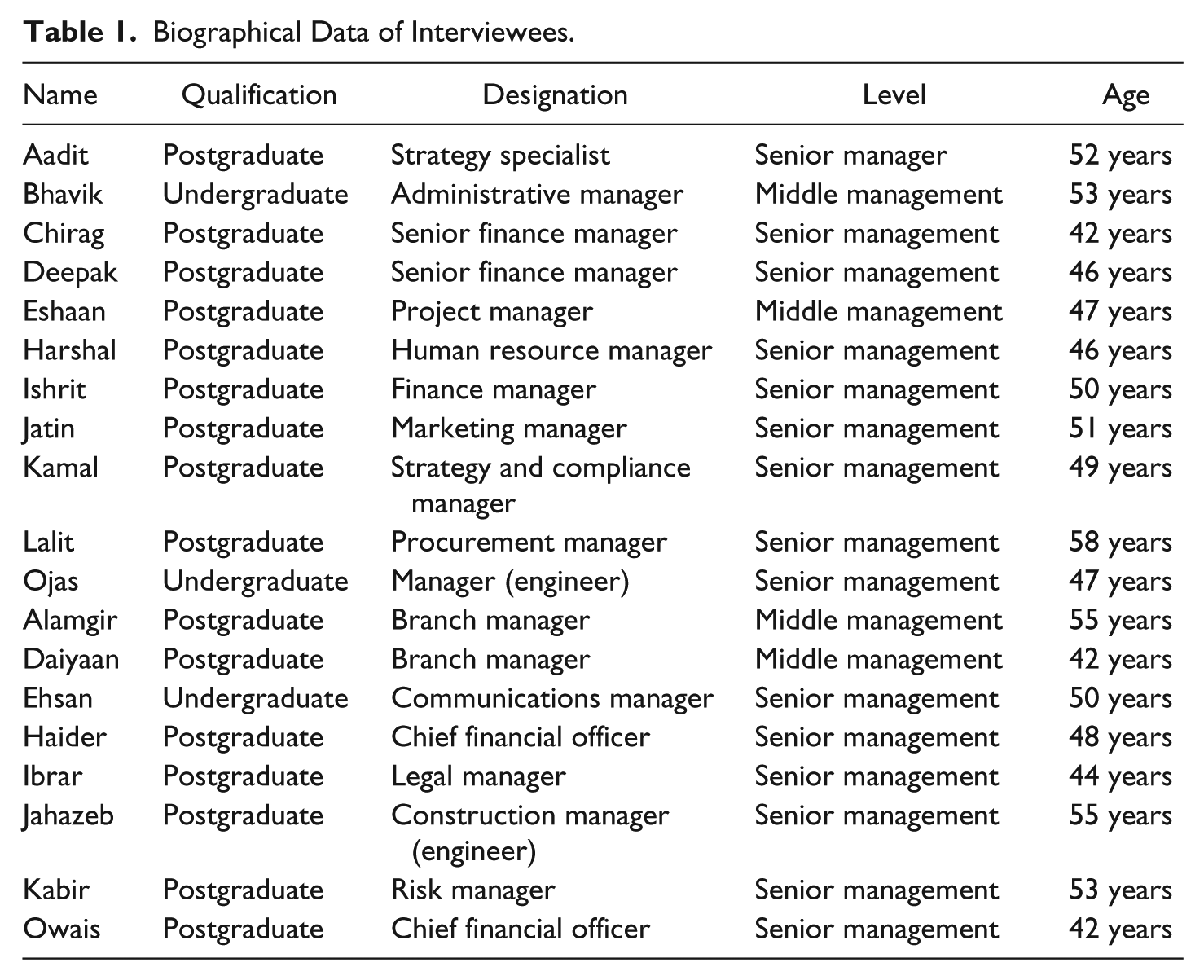
All participants were provided with pseudonyms to maintain confidentiality. The men’s ages ranged from 42 to 55 years. On average the men had 17 years of work experience, a minimum of 6 years of experience in middle management and 3 years in senior management. All men were highly qualified with a majority holding postgraduate degrees. The participants were born and raised during the apartheid era and grew up in demarcated Indian townships. All participants were from the Gauteng region, in particular, from the cities of Johannesburg and Pretoria. They were all from middle class families and their forefathers were passenger Indians who had come to South Africa to establish businesses in the late-19th and the early 20th centuries. All were educated in designated Indian schools and universities. Except for two of the men who had been divorced at the time of the interviews, all were married. Table 1 provides participants’ pseudonyms and biographical profiles.
Biographical Data of Interviewees.
A historical perspective of Indian South Africans is important as it enables an understanding of their struggles within the South African context. The history of South African Indians indicates that there were two groups who came to the country at the end of the 19th century. In Natal, indentured laborers came to work on sugarcane plantations for British landowners and were recruited from two areas in India. The first group came from Calcutta and were Hindi speaking, and the second group were from Madras and were Tamil-speaking and Telegu-speaking Hindus (Bhana, 2008). A small number of traders came to South Africa to cater for the needs of the indentured laborers. Some of them were from upper middle class families in India, but the majority were from peasant families. The passenger Indians (who paid their own passage) came to start their own businesses. Others came to the country and worked for established businesses as clerks/shop assistants. Much later still, a small number of accountants, teachers, lawyers, priests, and others entered South Africa. These people were heterogeneous: some were Gujarati-speaking Muslims, some were Hindis from Surat, Porbandar, and Kathiawar, and a small number were Urdu speakers and Marathis (who saw themselves as commercial bourgeoisie). Unlike the indentured laborers, Hindus maintained their caste division and consciousness (Ginwala, 1985).
Data Analysis
The data obtained from the interviews were analyzed in an iterative manner to create and confirm themes for data analysis. Specific focus was given to understanding how Indian male identities intersected with race and culture as well as how family, the socio-political background, and the community played a role in shaping their identities. Such an analysis requires a close, line-by-line reading of the text compiled based on the interviews. My analysis moved from first-order coding of statements relating to specific categories to identification of theoretical categories and dimensions and ultimately to relationships among these dimensions. I ensured that I was thoroughly conversant with each participant’s life story. My goal was to derive a collection of themes that had enough particularity to be grounded and enough abstraction to be conceptualized.
My discussion and analysis of the findings are anchored on the identity tensions Indian male managers experienced in a corporate environment.
Findings
The Macro Environment
The aim of the study was to focus on the status of Indian males in the wider macro environment as well as in their respective communities and on how they negotiated their identities in their respective workplaces. Their life stories indicated that the macro environment, namely, the apartheid era within which they had been raised, played a major role in their lives. Their lives had been profoundly impacted by the apartheid era, during which the colonial oppression of non-White races continued (Bhana, 2008). A class hierarchy was established in South Africa according to which Indians were placed above their African counterparts but below White and colored race groups. White supremacy, especially, White male hegemony, dominated all spheres of work during the apartheid era, from government posts to corporate positions (Radhakrishnan, 2005). Kabir, a risk manager, indicated as follows: During the apartheid era we did not have any status. We were treated poorly by Whites. We could not enter government and banks from the same doors as White people. White administrative staff would treat us badly when we went to their offices for business. It was a tough period in our lives.
However, Indians enjoyed more privileges compared with Africans but were disadvantaged in relation to Whites. Like other Black race groups, Indians were confined to their own demarcated townships; they could not travel freely in the interior and were restricted to certain career choices. As White workers perceived cheap Indian labor as a threat, they used their political power to protect their jobs and work opportunities (Carrim, 2012). Due to political pressure, and with the aim of providing employment for the growing number of Whites and on the premise that no Black person was entitled to any employment while White unemployment existed, government departments systematically substituted White workers for Black workers after 1926. Private industry followed suit under pressure from White public opinion and trade unions (Ginwala, 1985).
Partly as a deliberate attempt to divide labor, and partly through historical development, South African labor legislation discriminated against Indian, African, and colored labor in varying ways, with African workers having no rights at all. The Job Reservations Act of 1926 protected White skilled workers and limited Indians’ access to skilled work and to obtaining certificates of competency. Through employment in industry, Indian workers acquired experience and skills in clerical and supervisory functions. When the demand for labor in secondary industry grew, Indian employees easily moved into semiskilled and supervisory positions (Maharaj & Maharaj, 2004).
The establishment of separate administrative machinery and the inclusion of Indian education, together with the extension of local government to Indian towns and group areas, resulted in the employment of a number of Indians in government departments and corporations. The number employed in the police also increased, and a small number were incorporated into a special section of the Navy. Indian males also worked as accountants and engineers in multinational enterprises in the late 1980s when the cracks in the apartheid system became visible (Ginwala, 1985).
Participants indicated that many Indian males operated small family businesses, some entered the medical and legal professional fields, others became teachers in Indian schools, and still others managed their businesses in Indian townships as finding jobs in White organizations was difficult. The majority of the participants indicated that their fathers operated family businesses as they did not have the opportunity to work in corporate South Africa. Sons would assist fathers in family businesses while they were growing up, as was the case with the participants. After completing their schooling, the majority of the participants pursued tertiary education but were restricted in their career choices to information technology, accounting, and engineering if they wanted to work in the corporate environment. Bhavik, an administrative manager, commented as follows: During the apartheid era we had few career opportunities. Most of my friends became pharmacists, dentists, lawyers and teachers. I on the other hand completed a commerce degree and started working.
Bhavik added, Those who couldn’t afford to study further entered their fathers’ businesses . . . . Some worked in government departments in Indian areas.
However, career advancement by Indians were subject to the limitation that they were not allowed to be placed in positions of authority over White workers even in areas and institutions that were allocated for Indians. For example, an Indian civil engineer was denied employment in building projects in the Indian designated area of Actonville as the White town council deemed that it would not be advisable for an Indian to supervise Whites engaged in junior positions (Ginwala, 1985). The majority of the participants indicated that they could not move beyond supervisory positions during the apartheid era. Even when they were placed in supervisory posts, they were in charge of non-White employees. Ojas, an engineer, commented as follows: During the apartheid era, they had no choice but to promote me. Although I was in a supervisory post, I could only oversee Black employees.
Forming Managerial Identities
It is important to understand that the participants in this study were still constantly struggling to overcome the cultural norms instilled in them at an early age. Racial domination together with cultural values resulted in the men being raised in multilayered insular environments where Indian cultural values were deeply entrenched in them. Kamal recalls what he was taught as a young boy: As young males we were taught to respect our elders and not to challenge authority.
Being confined to Indian townships due to the racialization process of apartheid resulted in Indian males being in a privileged position. As per the cultural prescripts, Indian males dominated in their respective homes and businesses, whereas women were in the background and fulfilled subservient roles. However, Indian males found themselves in juxtaposed situations as they enjoyed a privileged position within their families and communities but experienced subordination in the wider society, as was the case with all Indians. At the same time, Indian males exercised authority over African employees whom they employed in their businesses. In addition, in some institutions and workplaces Indian males also supervised Africans. Alamgir explained his paradoxical status as follows: As an Indian male, we are used to being in charge in our homes, communities and businesses. The minute you move out of that confined state, you lose all your power because now your race plays a major role in who you are as a person and you become a nobody.
The first democratic elections of 1994 resulted in the entry of an increased number of Indian males into various occupations in corporate South Africa. The majority of Indian males were promoted to managerial posts in the late 1990s due to the introduction of Employment Equity Act of 1998 (South Africa, 1998). However, being confined to Indian townships and being exposed to their fathers’ businesses, Indian males were not accustomed to managing in corporate South Africa, which was based on autocratic and paternalistic Western White male management practices. Eshaan, a project manager, indicated as follows: I was promoted to a middle management post in 1999. It was very difficult for me to operate at a management level as I was used to managing staff in my father’s business and they were more like family members than employees. The management style in my father’s business was informal and here White men are very domineering.
Moreover, those who were in supervisory posts in the corporate environment were only accustomed to managing Black employees. Although they were able to exercise power over Black employees without fear of repression, assertiveness was not something that they could display with White employees. Owais indicated as follows: I feel like being a supervisor in a municipality and managing Indians did not prepare me for what lay ahead in the corporate environment where I was placed in charge of people from different race groups. My father always warned me against standing up against my White managers and said that they have power and I would lose my job.
Daiyaan confirmed the difficulty of managing in the corporate environment: For me the worst was having to supervise White males and females. Firstly, they were not accustomed to taking instructions from Black managers. They would resist and would run to my White superior to complain about me. Second, I was not guided and mentored on how to supervise them. Instead of giving them instructions, I would do the work myself. I always felt that it was not my place to instruct them.
The difficulties that participants experienced came from messages that they had received from their fathers. The apartheid repressive forces instilled a fear for Whites in the hearts of Black races. Black people found it impossible to stand up to White people in their personal capacity, and, as the participants indicated, their fathers projected these “fears” onto their sons. The result was that the majority of the participants found it difficult to give directives to White employees when they first entered management posts. Ibrar spoke about his “fear” of supervising Whites: When I entered management, I had no confidence around my White employees. I was afraid of stepping on their toes. I was taught by my dad that I should never cross a White because the consequences for such actions would be dire.
Some participants indicated that they initially mimicked White male management styles to fit into the corporate management space as most of them did not have any prior exposure to Indian male manager role models who worked in the corporate environment at higher management levels. However, with the passage of time, they adapted their managerial styles and identities to incorporate cultural elements into their approaches. Participants rejected the command and control styles that of typified White males and introduced more inclusive approaches that were alien in corporate South Africa. Their “learnt” managerial identities were negotiated once they were comfortable in management roles and realized that they were able to exercise some power related to their managerial identities although it conflicted with normalized White male managerial identities. Haider indicated as follows: While I was in a junior position I watched how my White male supervisor used to manage us. During those times I was one of three Indian males in the company. We were all in junior positions. So we didn’t have anybody to coach us in how to manage the workforce. But I watched and I learned. His manner was very commanding and forceful. I was not comfortable with that style and used a more inclusive style.
However, the discomfort that participants experienced, their inclusive management style, and the respect that they showed employees actually were detrimental to their careers. Their childhood socialization of displaying respect toward others was regarded as a sign of submissiveness and weakness, especially, by White employees. Also, such behavior elicited back-chatting from older White employees. Although a managerial post placed them in a higher position in the workplace compared with many White employees, their racio-ethnic identity placed them in a lower position and they were not accorded the respect that goes with such a post. Participants therefore renegotiated their identities and became more forceful in their interactions with employees. However, participants indicated that such management styles created dissonance in their personal identities as it was against the way they were socialized in their homes and communities. Daiyaan voiced his opinion as follows: Although I was a manager, my White staff still did not respect me. They see us Indians as not fit to occupy such positions. I eventually had to become very hard on them. But I was not comfortable with such an approach as we are raised to be polite and respectful in our families and homes.
Resistance
Adopting managerial identities prescribed in corporate South Africa did not shield the participants from experiencing exclusion and discrimination and having their upward career mobility thwarted. The participants’ narratives revealed that they were excluded from informal networks, and their competence was constantly challenged. They also did not totally integrate into the workplace culture. For example, many of the participants would not attend social events due to observing religious prayers. Haider indicated that his religious practices were very important to him: Our management team usually go to play golf on Fridays. I made it clear to them that I would not be able to attend these social outings, as Friday prayers are important to me. I do realise that major decisions take place during these times but to me my religion is important as well.
Another reason for nonparticipation in social events was that many participants believed that networking was not the key to getting ahead in one’s career and that it played a minimal role in career progress. They mentioned various other factors that played a role in career progress. Lalit, a procurement manager, expressed the following opinion: I think networking does play a part but not absolutely because there are so many other factors that come into play, and I think that depends on where the job is being advertised and where the vacancy is and where the person is applying. Sometimes it just depends on knowing somebody in an organisation or knowing somebody that is at management level will help but doesn’t necessarily address the issues that the company has or the employer will have. So, experience, qualifications, having high work standards are not always the correct ingredients. Being the “right” race and in the case of Whites being male will get you ahead in the corporate environment.
Participants, however, indicated that Indian men who adopted White male lifestyles seemed to get ahead in their careers in some organizations compared with those who resisted corporate cultural values. Chirag, a senior finance manager, commented as follows on adopting White male management styles: Some Indian males have adopted the life styles of White managers. They drink with White managers; they go to the same parties as them and are far removed from the Indian culture. I find they are today in top management positions compared to those who hold on more to their culture.
An interesting finding was that although South African law favors the career advancement of women over men, the participants indicated that Indian males were promoted ahead of Indian women in their organizations but they found it difficult to be promoted ahead of White women. Most participants indicated that White females tended to network with males who were prepared to groom them for promotion to higher management posts. Harshal’s observations revealed the following: If I look at our management structure, Indian and African women find it difficult to progress to top management posts. White women surpass Indian males and this is because White females network with all the big bosses to get ahead. White women unlike Black women never miss any parties.
The majority of the participants still live in Indian townships and adhere to many cultural prescripts. For example, in the majority of cases, participants indicated that they wanted their children to be raised observing Indian cultural norms and therefore had requested their wives not to pursue careers but to stay at home and care for the family. Kamal expressed the strong wish that his children should adopt Indian cultural values: After my wife gave birth to our first child we discussed her going back to work. We decided that it would in the best interest of our family unit that she stays at home and cares for the children and inculcates Indian ways in them.
The participants indicated that their abilities were not automatically acknowledged by their White peers and managers. They had to prove their abilities for a few years before White males and females took cognizance of what they said. When they were promoted, the process of proving themselves started all over again. It can be said that this continuous cycle of having to prove their worth undermines their power basis. Jahazeb, a construction manager, complained about having to constantly defend his position: With White people it’s an automatic acceptance that they are competent in their jobs. With African people, Whites are too afraid to speak out against them and they are provided special treatment in getting ahead. Their opinions are also valued more than an Indian person’s opinions. I have to prove myself for at least five years or longer before colleagues and people at the top acknowledge my opinions. This has happened over and over again in every position I have so far occupied.
Discussion
In this article, I focused on the experiences of minority men who were reduced to “invisible gendered subjects” and were marginalized when it came to organizational studies (Slutskaya et al., 2016, p. 165). At the same time, I wanted to demonstrate how categories of difference, that is, minority masculine identities, intersected with racio-ethnic and managerial identities within a specific socio-economic political context—aspects that had not been considered in previous studies (Holvino, 2010). The results of the study indicated how Indian men engaged in working and reworking their identities over time. Their identities had not only been affected on by the apartheid system (which had had a major impact on their lives) but were also being impacted on by the organizations they worked in.
Being raised in insulated environments resulted in strong adherence to cultural values. Entry into management posts was initially daunting as there was a lack of race-specific role models at higher-level management posts. As the majority of the participants were the first cohort of Indian males to reach senior and top management posts, they became the trailblazers for others to follow. Initially, it was a challenge for them to negate their cultural values and adopt Western cultural mores, and they found it difficult to negotiate. The men realized that mimicking the management styles of White males was not in harmony with their cultural values and upbringing. To attain a level of comfort and to avoid giving up their cultural values entirely, these men worked and reworked parts of their identities until they reached a certain comfort zone without compromising their cultural norms (Carrim, 2012). However, even after negotiating their cultural identities, they found it difficult to gain the respect of White male and female employees. These findings imply that individuals have certain social identities that cannot be separated from their work lives and therefore have to be taken cognizance of in organizational settings (Watson, 2009).
Living in insulated environments also resulted in these men being in privileged positions. However, these privileges were limited as they pertained only to their immediate insular environments and to some extent only to African males and females in the corporate setting. However, they were not afforded this privileged position within the macro environment or within their organizational settings or across all race groups as racial status was determined in terms of specific hierarchical structures through legislation (Arkin, Magyar, & Pillay, 1989). Although their managerial positions gave them some privileges, unlike their White male counterparts, they were expected to prove themselves and were not automatically accepted as authorities in their respective fields, which once again pointed to their status within the racial hierarchy.
Changes in the political dispensation resulted in Indian, African, and colored males and females being able to navigate their way to be appointed to management posts. However, the corporate environment that Indian males entered belonged to White men who still dominated and took the final decisions in terms of promotions. This was evidenced by the results of the current study that indicated that White females in the private sector were promoted ahead of Black males and females. This implies that race still plays a role in promotional decisions as gender is not considered when comparing the status of White and Black employees. Moreover, Black males are still placed below White females in the new dispensation. Furthermore, White males still dominate management posts, followed by White females, and thereafter by Black males and females. This situation lends support to the assertion of Rodriguez et al. (2016) that the workplace re(produces) intersecting inequality and that it consists of structures of discrimination and systems of inequality that render minorities powerless.
Conclusion
Having identified a gap in the knowledge of minority males’ identity work, I set out to explore how Indian male managers worked and reworked their masculine and racio-ethnic identities in corporate South Africa. Drawing on interviews with Indian male managers, I have identified that the intersection of masculinity with racio-ethnic identity plays an important role in Indian male managers’ identity work. My data indicate that colonial notions of Indian male identity still prevail and that, despite having the experience and know-how of their jobs, Indian males still need to prove their worth in corporate South Africa. Also, promotions are based on race and not on merit. Although my study is not without its limitations, I provide an understanding of how context influences the identity work that Indian male managers have to engage in.
The major limitation of the study is that it was focused on the first cohort of Indian males and did not take into account the experiences of younger Indian males. Another drawback of the study is that participants were from the passenger Indian background and their fathers were businessmen. More research is required into the experiences of Indian males from indentured laborer backgrounds. Also, it would be interesting to find out about the experiences of Indian males who are in top management posts and more Western in their approach and how they have navigated to those positions. Human resource practitioners and diversity personnel in organizations need to be aware of how race impacts on the experiences of minority individuals’ upward career mobility because this knowledge can assist them in retaining their talent base.
Footnotes
Declaration of Conflicting Interests
The author(s) declared no potential conflicts of interest with respect to the research, authorship, and/or publication of this article.
Funding
The author(s) disclosed receipt of the following financial support for the research, authorship, and/or publication of this article: The article formed part of the Research and Development Project funding (RDP) which the author obtained from the University of Pretoria.