




Abstract
Nerd masculinity is in the midst of a cultural rebirth. Podcasters the McElroy Brothers—Justin, Travis, and Griffin—are exemplars of how nerds queer contemporary masculinity discourse. Their podcasts’ multidimensional characters, bodily practices, and inclusive language reconstruct a nerd masculinity that does not pine for hegemonic masculinity as nerd media of the past. However, while the Brothers’ performance of masculinity may illuminate new frontiers for the inclusion of gender and sexual diversity, it yet retains an inextricable connection to their Whiteness. Thematic analysis of 41 episodes across three of the McElroy’s properties shows how the Brothers reconceptualize nerd masculinity while highlighting their lack of transformative attention to matters of race.
When someone tells you, “Hey, what you did just hurt me,” you have two options. One is to say like, “You’re wrong, and I didn’t do anything wrong.” Or your other option is to say, “Okay, well if you feel that way, let me take a step back and really look at what I did.” Do the second one every time.
I think doing anything that has a big enough audience these days becomes a lesson in empathy. The show and me, Griffin, a person, have gotten so much better since those lessons have come pouring in. I love having that relationship with our audience, and I genuinely think it’s funnier to not say no to shit, or not slam people instead of getting on board with them. I think that’s the funnier thing 100% of the time.
It’s harder, but it’s always funnier. (Lewis, 2017)
Masculinity, or the relational means through which men constitute the gender order (Connell, 1992), is facing a crisis of sorts where traditional scripts of what it means to “be a man” are largely incompatible with the gendered realities of modern society (Kimmel, 2013). As such, many men whom may have identified with hegemonic masculinity, or “the pattern of practice [that]. . . embod[ies]the currently most honored way of being a man” (Connell & Messerschmidt, 2005, p. 832), are reconstructing their understanding and practice of masculinity to further broaden their sociocultural repertoires (McCormack, 2012). Although such emerging masculinities may not wield the same influence as hegemonic masculinity, as they do not overtly access the same promise of privilege and resources, they nonetheless may have the ability to shift our collective understanding of what masculinity is, does, or should be (Connell & Messerschmidt, 2005; Halberstam, 1998).
Brothers Justin, Travis, and Griffin McElroy are long-running comedy podcast hosts who have a well-developed relationship with their audience (Genzlinger, 2017) and consciously embrace a nerd identity (J. McElroy, McElroy, McElroy, & McElroy, 2016). All three identify as White, are married to women, and originally hail from Huntington, West Virginia. Given their origins, one might assume the McElroy Brothers’ podcasts would be another media option that primarily caters to (heterosexual, White) men: trading barbs at one another in a game of social one-upmanship. However, the Brothers’ approach makes some notable departures from preexisting, hegemonic insult scripts (Connell, 2009; Kimmel, 2009; Pascoe, 2007)—departures that may facilitate their ability to speak to audiences beyond White, geek-identified men (Enlow, 2018). The Brothers’ multiple media properties have a wide range of influence despite—or even because of—their nerd 1 status, making their media properties an intriguing case study for the transformation of geek masculinity as transmitted through new media. In the interview quoted above, the Brothers speak about how important it is to them that their media be inclusive, even when that may mean revisiting some of their missteps in portraying various identities across their media properties.
The Brothers’ redeployment of geek masculinity is of interest for two reasons. First, it is intelligibly queer, which is a novel occurrence at the intersection of masculinity and nerd culture. The Brothers all identify as heterosexual, further compounding that identity through referencing their children and their committed relationships with opposite-sex partners. Although straight people are able to deploy queer narratives (Pfeffer, 2014; Schlichter, 2004), such deployment on the part of overtly heterosexual men with a strong connection to nerd culture remains rare. Nerdiness and queerness are not historically associated with success, influence, or admiration in American society (Kendall, 2011; Renold, 2004). Both queerness and nerdiness, though, are experiencing a renaissance evident through the proliferation of media that celebrates the queer, nerd, and queer nerd communities (Jahromi, 2017; Morgan, 2014). As nerd culture has become paradoxically both more mainstream and queerer, it is finding it necessary to reconcile itself with the more pernicious elements of masculinity, such as cyberbullying and misogyny (Chess & Shaw, 2015; Kendall, 2011; M. Salter, 2017; A. Salter & Blodgett, 2012). The Brothers’ success also runs counter to much of the historic discourse surrounding nerdiness in that it embraces rather than marginalizes minority identities (Elkins, 2014). I argue that the Brothers show a knack for using their cachet to engage in social action through their media properties, demonstrating how men who perform alternative masculinities are able to emerge as inclusive, prominent media influencers.
Second, despite their efforts to contest many forms of privilege, the Brothers’ media properties’ deployment of masculinity mirrors much existing geek media in its replication of Whiteness as normative (Elkins, 2014; Kendall, 2011). Unlike overtly racist and sexist outlets, the McElroy’s narratives indicate a deep desire to create racially inclusive and representative media (Lewis, 2017; G. McElroy, McElroy, McElroy, & McElroy, 2017a). Nevertheless, the Brothers’ attempts to engage with racial boundaries is less nuanced than their approaches to gender and sexuality diversity. The Brothers’ humor may hold the promise to contesting the hegemonic masculine nerd narrative in pop culture, but yet requires critical interrogation to create a truly inclusive media space (Weitekamp, 2015).
I use the McElroy Brothers’ two joint podcast efforts and their short-run television show to explore how they have been able to use the cultural zeitgeist to contribute meaningfully toward the redefinition of White, heterosexual, nerd masculinity in the United States. Through a thematic analysis of their cultural artifacts, I explore how the Brothers craft comedic personae that contest hegemonic masculinity. Through their contestation, they are able to access the promise of a new, reconstructed geek masculinity with intelligible queerness at the fore. However, I also interrogate how their new masculinity is mutually constituted by race, which yet limits the radical emancipatory potential of their brand of geek masculinity.
Thematic Analysis of New Media
I employ thematic analysis to illustrate in what ways the Brothers’ comedic properties engage with queerness, Whiteness, and the intersections thereof. Thematic analysis “move[s] beyond counting explicit words or phrases and focus[es] on identifying and describing both implicit and explicit ideas within the data” (Guest, MacQueen, & Namey, 2012, p. 10). Much like content analysis and other qualitative approaches, the researcher’s role is to “tell an interpretive story” (Clarke & Braun, 2014, p. 6626), combining subjectivity, data, and theory to highlight compelling themes. However, there is an important distinction between the content analysis and thematic analysis: whereas content analysis uses a grounded approach to let themes emerge more organically from the data and focuses on patterns of words, thematic analysis allows the researcher to make sense of narrative strands of interest (Vaismoradi, Turunen, & Bondas, 2013).
Podcasts’ reciprocal relationship with their audiences presents a novel opportunity to apply qualitative techniques to analyze new media (Skalski, Neuendorf, & Cajigas, 2017). Because podcasts engage with and post content for their audiences at a more rapid pace with fewer intermediaries as compared with traditional media, content producers can form more intimate relationships with their communities of listeners. Content analysis, thematic analysis, and other qualitative approaches have been applied by several scholars to provide critique of new media forms (Morgan, 2014; Paterson, Thoma, Milne, Lin, & Chan, 2015; M. Salter, 2017).
Clarke and Braun (2014) outline six steps of thematic analysis: familiarization with data, generating initial codes, searching for themes, reviewing themes, naming themes, and reporting themes. The first step, familiarization, came from my personal engagement with the Brothers’ media properties as a fan. My personal interest in the Brothers and their humor means that I run the risk of bias interfering with my ability to analyze the data; however, using qualitative approaches while facing, engaging with, and critically examining one’s subjectivity can lead to an enhanced appreciation for the data, far from rendering it meaningless or compromised (Clarke & Braun, 2013).
After determining a thematic pattern of interest between properties and in multiple episodes, I generated initial codes that sought references to queerness or race in episodes sampled. I developed a strategy to identify these themes, be they explicit or implicit, in a planned close listening of episodes of the Brothers’ media. I engaged in a critical re-listening of episodes, noting where I felt queerness or race were present in the narrative. I searched for clips from episodes using a deductive approach; a strength of thematic analysis is that it can be used deductively, where themes are chosen before analysis or, inductively, where themes are emergent from the data (Clarke & Braun, 2014). After reviewing and naming the themes, I then chose vignettes and quotes most indicative of the themes I identified.
Source Material: The Brothers and Their Media Properties
The McElroy Brothers host several podcasts, live shows, and other media engagements, be it altogether, with their spouses, or separately. Here, I analyze three of the Brothers’ joint endeavors. The first media property, My Brother, My Brother and Me, hereafter MBMBAM, bills itself as “an advice show for the modern era” (J. McElroy, McElroy, & McElroy, 2017a). MBMBAM is the Brothers’ oldest and longest running media property. The show’s format typically involves the three brothers providing humorous responses to questions that are submitted by listeners or found online via public sites such as Yahoo! Answers. The McElroy Brothers’ humor on their MBMBAM podcast largely relies on conjuring both pop and niche nerd cultures with copious references back to nostalgic elements for youth of the 1980s and 1990s. The brothers, all now in their early-to-mid-30s, have been posting their podcast near-weekly on Maximum Fun, a comedy podcast hosting site, since 2011.
Starting in late 2014, the Brothers introduced a spin-off podcast, The Adventure Zone, hereafter TAZ. TAZ revolves around the Brothers playing a game of Dungeons & Dragons, a popular dice-based role-playing game, along with their father, Clint McElroy. TAZ retains much of the trademark humor of MBMBAM, but focuses on the Brothers’ construction of a collaborative narrative. From 2014 to 2017, the Brothers and their father completed one campaign—that is, a complete narrative comprised of smaller story arcs—called “The Adventure Zone: Balance.” Under dungeon master 2 Griffin, the remainder of the family took on fantasy alter egos in pursuit of seven grand relics that hold the key to saving the world from an encroaching darkness. After Balance’s narrative conclusion, the Brothers started engaging in more experimental short-form role-playing games in preparation for another longer, multi-year campaign. In addition to episodes where the Brothers and their father engage in developing their fictional world, TAZ is unique in its development of episodes in which the McElroys engage in meta-analysis of their own engagement in the narrative process through answering listeners’ questions regarding the TAZ universe. Such episodes are referred to as “The The Adventure Zone Zone,” or TTAZZ hereafter.
The final property included in the present analysis is the Brothers’ short-lived television version of MBMBAM. The show ran for six episodes in early 2017 via the online platform SeeSo, a comedy streaming channel owned by NBC-Universal, until SeeSo was shuttered in mid-2017. Thereafter, all episodes of the MBMBAM television show were ported to VRV, another streaming service, for free viewing. The television show relies on much of the same humor as the podcast with the addition of visual gags and more scripted sections.
I conducted thematic analysis on 41 episodes of three of the Brothers’ media properties. My analysis includes all episodes of the MBMBAM podcast from the beginning of 2017 through August 1, 2017; the first episode MBMBAM television show; and TAZ from the beginning of 2017 through August 1, 2017. I also include three episodes of TTAZZ, from March 17, 2016; March 30, 2017; and August 24, 2017. TTAZZ proved to be rich grounds for thematic analysis given the Brothers’ overt engagement with issues of race and sexuality in their constructed narrative. I excluded episodes of the MBMBAM podcast that were live shows or other prerecorded segments, as they were fewer in number and had a distinct narrative structure as compared with the podcast and television show. Table 1 summarizes the content included in the present analysis and the themes identified in each episode.
Thematic Analysis of McElroy Media Properties.
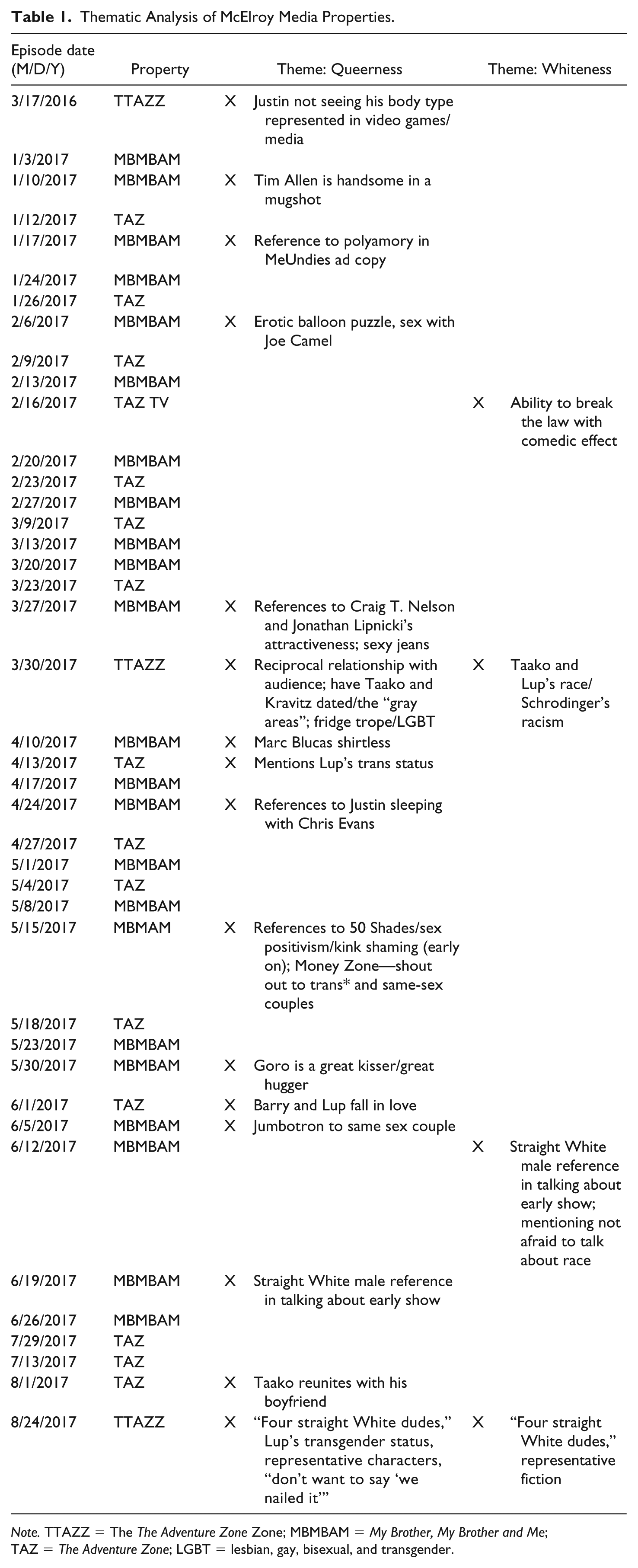
Note. TTAZZ = The The Adventure Zone Zone; MBMBAM = My Brother, My Brother and Me; TAZ = The Adventure Zone; LGBT = lesbian, gay, bisexual, and transgender.
Queering Nerd Masculinity
The intellectual act of queering is “to look at [something]. . . as if it were odd or queer. As soon as we start thinking about what we regard as normal we find how peculiar the ‘normal’ is, leading us to ask: Why are things this way?” (Ford, Harding, & Learmonth, 2008, p. 92). A queer approach stems from theorists who examined the inability of common language to explain extant social phenomena, such as Foucault’s (1978) exploration of social reactions to homosexuality and Butler’s (2004) discussion of how some people’s bodies complicate arguments that gender is binary. Queer approaches problematize normative assumptions, which can give voice to new potential social realities (Fine, 2017b). Informed by queer theory, the thematic analysis here considers how geek masculinity as performed by the McElroys troubles the normative discourse of hegemonic masculinity. The Brothers’ queered performance of masculinity highlights some ways in which a new geek masculinity can choose to resist particular elements of hegemonic masculinity, thus reconstructing a more expansive understanding of what it means to be a (male) geek.
One way in which the Brothers queer nerd masculinity is through eschewing its endemic misogyny, homophobia, and transphobia. A preponderance of literature related to (White) male geekdom frames it as discriminatory, embattled, lonely, and particularly toxic (Kendall, 2000; A. Salter & Blodgett, 2012). The recent Gamergate controversy, in which predominately White male fans of video gaming protested media outlets’ perceived disproportionate coverage and support of female content creators as a double-standard, is a poignant example of some of the worst elements of White male nerd culture (Braithwaite, 2016; M. Salter, 2017). Although Gamergate may exemplify stereotypes of nerd subcultures mirroring the misogyny of hegemonic masculinity, other scholars have explored how geek masculinity conversely may provide space for alternate gender scripts, thereby legitimizing subordinate geek masculinity to greater culture. Morgan (2014) explores how the popular American television show The Big Bang Theory has succeeded in bringing geek subculture to a larger audience and portraying it as largely desirable. The resurgence of board games as a popular medium, propelled in large part by web series such as Wil Wheaton’s TableTop, continues to introduce stereotypically geeky pastimes to the mainstream (Guth & Wheaton, 2017; Jolin, 2016). Although masculinity—including geek masculinity—may have pernicious aspects, the Brothers’ media properties’ active queering may represent a more inclusive form.
Queering Through Narrative and Language
The McElroy Brothers are careful in crafting a narrative that is both explicitly and implicitly inclusive of queer audiences. Explicitly, the Brothers make frequent reference to queer characterizations and the inclusive dynamic they strive to craft. The Brothers’ Dungeons & Dragons podcast TAZ counts among its non-player character (NPC) cast Lup, a transwoman who is the twin sister of Justin’s elf mage character Taako. A major plot twist toward the end of the campaign reveals that Lup is in fact a major character in the story although she has gone largely unmentioned to this point in the narrative. Griffin, the dungeon master, and Justin, who plays Taako, talk about adding a transgender NPC with a major role in the plot to the adventure in a way that uses inclusive language and avoids misgendering Lup in construction of a backstory:
One thing I kind of want to make clear—we’re going to learn a lot more about Lup during this session, and—pretty much on through the rest of the campaign. But I wanted to say, as long as we’re talking about your backstory, is that the two of you are twins and that Lup was assigned male at birth, but at like a fairly young age, she transitioned and identified as a, um, female elf. . .
So we’re clear, and at the risk—so I’m clear not to misgender Lup, can we make the assumption that the things that we’re talking about took place after she transitioned so that. . .
Yeah, yeah, yeah.
So that if I’m referring to Lup. . .
Yeah. That’s her pronoun. (G. McElroy, McElroy, McElroy, & McElroy, 2017b)
In a social context that has few social scripts for how to make sense of transgender bodies (Butler, 2004; Halberstam, 2005), the addition of transgender characters has the potential to be sensational, maintaining a social boundary between transgender people and the supposed normality of cisgender and heterosexual media consumers (Schilt & Westbrook, 2009). The Brothers’ conversation about Lup, however, does not read as sensational, but rather as complex: the desire to create a multilayered character who can serve as a form of representation for nonbinary listeners. Speaking about Lup, Griffin explores his motivation for introducing a trans character into the narrative, as well as the challenges of doing so as a cishet
3
man: G: It’s important to me that this show has, like, good representation, ’cause, like, that’s important to me and I know it’s important to our listenership. And I feel like—and I try to do that with the characters, the NPCs that y’all come across. (G. McElroy et al., 2017a)
The Brothers’ queering of media goes beyond the simple inclusion of non-binary Lup or multiple same-sex couples in the narrative; through playing with the structure of narrative, they deploy alternative storylines in a way that trouble norms of masculinity and gender. In a TTAZZ episode where the Brothers and their father meta-analyze their storytelling decisions, the McElroys explore the role that the audience plays in helping to co-create the narrative arcs and character personalities, including visual representations through fan art. Reflecting on these creative endeavors, the Brothers admit that the storytelling of TAZ not only exceeds the family members themselves but also bleeds over into the fan community. Justin explains: J: The weird thing about the show getting bigger is that, in a way, I feel less ownership now. Like, in a good way, I think. In a healthy way. But I think that all these different permutations of Taako, and he’s still a character that I made up, and that’s cool. But I also think it’s cool that other people have their own spin on Taako and their own sort of take on him. And I think that’s really neat. I want to encourage that. . . .The decision is yours, it’s up to you. . . .As a creator now, I find it really cool to let that space exist. (G. McElroy et al., 2017a)
Queer artistic spaces can be created through a troubling or lack of adherence to normative narrative structures (Halberstam, 2005). As such, the structure of a cooperative storytelling game like Dungeons & Dragons is ripe for the McElroys to engage in a queering of typical narrative-based media forms. However, art also is subject to interpretation by multiple audiences. The McElroy’s approach to TAZ takes on a queer character is their willingness to live in ambiguous artistic spaces that simultaneously critically engage with their audience to co-create narratives.
Implicitly, the McElroy Brothers frequently use inclusive language in their comedic efforts, which has the effect of creating a queer space with their listenters. On an episode of MBMBAM, someone asks the Brothers how they should approach their girlfriend about the fact that she does not rinse the dishes after applying dish soap. The Brothers are careful to make sure that they use the word “partner” in crafting a response, even when the question-asker specifies his significant other’s gender, to make the answer have broad relevance to multiple listeners.
Let me say this, first off: [not rinsing the dishes after you wash them is] utterly baffling human behavior. But one thing we should understand going into this is that—I don’t know if this question-asker is a man, or a woman, or a non-binary person—it doesn’t really matter. Telling your partner they don’t wash the dishes good [sic] is never gonna be good optics. . . .
Do you want to wash the dishes by yourself forever? (J. McElroy, McElroy, & McElroy, 2017b)
The above quote is one example of many of the Brothers consciously employing inclusive, gender-neutral language. Crafting a response in this way not only maintains their joke’s comedic integrity but also signals to listeners who may be in same-sex relationships or relationships with nonbinary people that their contexts are intelligible to audience and artist alike.
Queering the Nerd Body
Bodies are sites of performance on which social norms are placed and through which said norms are enacted (Butler, 1993; Halberstam, 2005; Ladkin & Taylor, 2010). Similarly, the nerd body is socially constructed as a weakened, inferior subordinate to hegemonic masculinity’s ideal body (Kendall, 1999; Weitekamp, 2015). Many nerd comedies, such as Family Matters and Revenge of the Nerds, have plot points that center on their geek protagonists striving toward the bodily ideal of hegemonic masculinity. In contrast, the Brothers—and the Brothers’ properties—find ways of including multiple types of bodies in their modern conceptualization of the nerd, thereby troubling—queering—normative constructions of the nerd body. Travis is known for electing to use nail polish on his fingernails, noting that the Brothers’ audience has responded well to his embrace of his bodily queering: “I’m going to do a nail care [and] nail painting stream, because that has been in demand” (J. McElroy, McElroy, & McElroy, 2017c). Justin discusses how the absence of body types like his in various fantasy media led him to consider how to play with body types in TAZ:
Anytime you play a video game, you don’t make it look like a Justin.
I just don’t see the point in that. Like, what’s the point?
You can be Justin every day.
Can I be honest? A lot of it deals with the fact that, in almost all character generators, I can’t make an overweight character. And I don’t feel like—if I’m gonna try to recreate myself, I don’t want to create, like, an idealized fake-ass version of myself. (J. McElroy et al., 2016)
Justin goes on to talk about how the experience of role-playing as bodies that did not match his own gave him empathy for other people who may not see themselves represented in various media. Instead of striving for the hegemonic ideal, the Brothers provide alternative scripts for nerd embodiment through their media.
Because bodies are the nexus of the individual and the social—the delineation of an individual person that simultaneously is the form through which social interaction with others must take place—others’ bodies are a site where social norms are made manifest (Butler, 1993), including desire (Speed, 2010). Most heterosexual male scripts around bodily desire center on the primacy and agency of men’s sexuality and the objectification of women; historically, nerd media has upheld this discourse (Kendall, 1999; Speed, 2010). MBMBAM co-opts the sexual agency of hegemonic scripts in the following exchange, but turns the specter of homophobia on its head in a way that is humorous, inclusive, and distinctively nerdy. Discussing an attempt to attract celebrity Marc Blucas to guest star on their show, the Brothers turn to Google to research him, while waxing about how charming and attractive they find the actor:
Just mostly a lot of pictures of Marc Blucas, if I’m being honest. . . . I have, quote, Mark Blucas, end quote, minus, quote, shirt, end quote.
[laughter] Griffin McElroy does not understand Boolean, but he understands sweet abs.
Marc Blucas—set shirt to no. To off. . . . Marc Blucas, shirt equals false. . . .
[laughter] Marc Blucas, minus shirt, plus smile, equals yes!
You know, I’m gettin’ Blucas, but he’s shirted in all of them, so dammit.
[laughter] Try a different Boolean! (J. McElroy, McElroy, & McElroy, 2017d)
The above exchange could be read as homophobic, the traditional practice of men accessing hegemonic masculinity through indicting other men’s heterosexuality (Pascoe, 2007). However, listening to the quote in context, I read it as a fascinating juxtaposition of nerd culture (a joke that relies on knowing what Boolean operators are and do) with an admiration of another man’s attractiveness. Instead of coming off as homophobic, the Brothers’ banter engages in a playful repartee that allows heterosexual men to acknowledge, and even play with, forms of queer masculinity as sited on the body (McCormack, 2012). In admiring another man’s body, the Brothers are shifting discourse related to geek masculinity from one of clearly delineated heterosexuality to a queerer form where the admiration can be decoupled from sexualization.
The Brothers and Whiteness
Pranks and MBMBAM’s White Masculinity
A danger of presenting the Brothers’ media works as representative of a kind of new masculinity is their type of “progressive masculinity” (Jupp, 2013, p. 413) is yet anchored in their Whiteness. Hegemonic masculinity has a well-documented connection to normalizing Whiteness (Connell, 2009; Kimmel, 2013; Newton, 1998; Ward, 2008). Mass media properties frequently reinforce the connection between Whiteness and masculinity. Brayton’s (2007) analysis of MTV’s Jackass franchise explores how the stars of that television show contribute toward norms of masculinity as sadomasochistic and irreverent. A parallel with a closer thematic bent would be Cartoon Network’s Adult Swim programming block, as discussed by Elkins (2014). Elkins argues that Adult Swim, which shows late night cartoons, also reifies norms of White masculinity as both the cultural default and irreverently counter-cultural. Adult Swim’s programming simultaneously serves the function of helping its audience (of presumably young White heterosexual men) to feel that they can access some of the benefits of hegemonic masculinity while identifying with critiques of it.
At times, the Brothers perform masculinity in a way that is distinctly White. Men may use buffoonish behavior to perform masculinity (Pascoe, 2007), but White men have the privilege of being able to engage in pranks to transgress rules while still being viewed as harmless as compared with men of color (Brayton, 2007; Speed, 2010). In the premiere episode of their television show on SeeSo, the Brothers attempt to help one of their male viewers convince his female romantic partner that he should be able to own a tarantula in their shared home (J. McElroy, McElroy, McElroy, & Amato, 2017). Filming in their hometown of Huntington, West Virginia, the McElroys use the help of a public relations firm to determine that the real problem with tarantulas is branding: if spiders had a better image, then perhaps the partner could be convinced to let a tarantula into the home. Part of the episode’s humor derives from an interaction with the mayor of Huntington. When the Brothers approach the mayor with a request to obtain a permit for a parade celebrating tarantulas, the mayor flatly declines. Undeterred, the McElroys decide that a clandestine parade without official sanction from the city will still achieve their aims while going largely unnoticed by the city anyway. The mayor gets wind of the Brothers’ disobedience, though: we soon hear sirens, and the Brothers hurriedly urge the participants to disperse—“but not all in the same direction, because then it’s still a parade” (J. McElroy et al., 2017).
In actuality, Huntington’s local newspaper, the Herald-Dispatch, reported that the parade had a police escort, meaning that the city was aware of the Brothers’ plans (Lavender, 2016). Although this show would not be the first to have reality and what is shown on television to conflict with one another, the Brothers’ choice to pursue this comic narrative is telling. Given the historically fraught relationship between people of color, particularly Black Americans, and local law enforcement (Feagin, 1991; LeCount, 2017), one may wonder what a similar bit would look like if it were pulled off by three Black brothers in their West Virginia hometown—and how it may be received. The stereotype of White men as pranksters is reified through the Brother’s comedic choices in their interactions with political power structures. Despite the Brothers’ efforts to queer narrative spaces in some ways, their humor may not yet be able to grip with some of the racial realities in which it is nested.
“Schrödinger’s Racism”
Another fascinating example of the Brothers’ properties being intertwined with their Whiteness, however inadvertently, emerges in a discussion of Lup in an episode of TTAZZ. The Brothers took great pains to be sensitive to gender and sexual diversity issues in their construction and deployment of the character. However, earlier narrative decisions regarding Taako’s character—whose name Justin developed from a humorous misspelling of the eponymous Mexican food—creates an awkward result when combined with the symbiotic nature of the podcast with its strong fan community. Following Griffin’s decision to create a pivotal NPC who is also the twin sister of Justin’s character Taako, the McElroys discuss how they found themselves uncomfortable with the racist ramifications of their initial naming convention:
At the time . . . Justin wasn’t making a Latinx character and then naming them after a Tex-Mex dinner food. That would be pretty racist, pretty problematic. It was just, “This is a silly name to name somebody.” Okay. When I had this idea for a twin he could not remember, I followed the same naming convention, and thought, “Well, of course his name would also be named after a Tex-Mex food,” and so I came up with Chalupa and shortened it to Lup. . . So fast forward to like, now, and I think we’re a whole lot more cognizant of how people consume the show and how they have head-canons for basically how every character looks. And we encourage that, right?. . . And there are a lot of people now who have this head-canon for Taako being a Latinx dude. Thereby, as an extension, his sibling would also be Latinx. Now, all of a sudden, if that is your head-canon, having two characters named Taako and Chalupa, who that’s how you interpret them? That sucks, right? . . .
Sucks! . . . And just to be clear, it doesn’t suck BECAUSE they are Latino. . .
No, no! That sucks because—we’re all, fuckin’, four White dudes!. . . And it does create kind of a Schrödinger’s racism? [laughter] Where if you interpret these characters—if you interpret these characters as Latinx, then those names are problematic. If you don’t, then it’s just like, “Oh, what silly names.” (G. McElroy et al., 2017)
Referring to Austrian scientist Schrödinger’s classic thought experiment used to explain the simultaneity of quantum states, Griffin makes sense of the naming conventions he and Justin use as concurrently racist and not racist. He argues that the naming of characters after tacos and chalupas may be racist in impact, although not racist in intent, thereby absolving the Brothers of culpability—especially as it is some in the fan community and not the Brothers themselves envision Taako and Lup as non-White characters. Although the Brothers may not have perpetuated racism intentionally, however, it does not mean that their initial decision to name the characters after Mexican foods reproduces the very problematic connection to Whiteness their humor espouses.
It is important to note the ways in which the Brothers’ behavior may leave other social structures in place even while creating new, transformative media spaces. The examination of the role of race in constructing the Brothers’ new masculinity also gives a deeper context to the ways in which it might simultaneously trouble and reify elements of discourse while being progressive in other ways (Jupp, 2013).
New Media, New Frontiers for Masculinity
The Brothers’ media properties deploy new, exciting narratives that trouble conventional (White) (geek) masculinity, creating space for alternative ways of being. Perhaps more exciting, this redefined, queered White geek masculinity appears to have cultural cachet. Their continued popularity seems to indicate that diverse representation in media continues to matter (Halberstam, 2005), and that people from dominant identities can yet engage in powerful work to make space for multiple identities in their works (Nelson, 2017). Although subordinate masculinities have long constructed alternative ways in being to differentiate themselves from dominant, hegemonic masculinity; the typical pattern has seen subordinate masculinities; and geek masculinities, specifically, cling to the more pernicious elements of misogyny, racism, and one-upmanship. The Brothers have found that the current geek zeitgeist is one that both celebrates and demands alternative representation. A group of White cishet men could rely on tired misogynist or homophobic comedy clichés, but the Brothers instead carefully incorporate queer representation into their storytelling media.
At the same time, the McElroy’s queered masculinity yet has a problematic relationship with the maintenance of Whiteness. Despite the Brothers’ queering of many of the norms surrounding gender and sexuality, their deployment of humor still calls their Whiteness into relief. By relying on the trope of White masculinity as prankster, the Brothers’ deployment of masculinity relies on a gentle ribbing of existing power and authority structures that they are able to challenge because their race may insulate them from meaningful consequence. Meanwhile, paradoxically, their media’s counter-establishment ethos positions them in greater levels of media influence. The Taako/Lup naming convention in TAZ further demonstrates how the Brothers fall short of a meaningful indictment of racism in their efforts to be inclusive.
Pointing out how the Brothers may fall short in their efforts to transform geek masculinity is not to say that their intent is malicious. Indeed, compared with many other masculinities, the form the Brothers espouse appears willing to entertain the effect their racial identities have on their content and relationship to their audience. However, given the Brothers’ overt commitment to issues of representation, inclusive language, and audience engagement, these episodes that emphasize existing racial power regimes highlight problematic discourses present in their otherwise-groundbreaking media narratives. Engaging in a frank discussion about their positionality and choices in naming Lup and Taako after Tex-Mex dishes demonstrates the Brothers’ capacity to further queer cishet nerd masculinity in such a way that it contests not only gender and sexual norms but its inherent racialized nature as well.
There is one glaring limitation to the analysis of the Brothers’ queered masculinity that bears mentioning: the media properties are analyzed assuming the Brothers largely choose to deploy authentic selves across their media platforms. Authenticity is performative in the sense that one need not necessarily be an “authentic self” so long as their presentation is interpreted as authentic by others (Fine, 2017a). Ascertaining authenticity is particularly complicated in media where self-presentation married with audience demands can obscure the “true” intent of the artist. Therefore, the work here being premised on the McElroys making statements regarding their work that are interpreted as a genuine reflection of values could come off as muddled—are the Brothers playing a role, or do they espouse the beliefs that are under scrutiny here? Meta-narrative podcasts, such as TTAZZ, lead me to believe that although the Brothers are indeed performative, the approaches to masculinity of their comedy personae are consistent with their personal beliefs. It is also worth noting that authenticity may matter little when considering the Brothers’ continued normalization of Whiteness in their deployment of queer geek masculinity, as they yet leave its racist underpinnings largely unchallenged. Nevertheless, despite a limited ability to perceive intent, I argue the Brothers’ properties yet create a cultural narrative where nerd masculinity may be reimagined—and, perhaps someday, even its assumption of Whiteness.
The Brothers’ media properties demonstrate how geek culture is able to expand and contest masculinity in ways that allow for increased social space. Simultaneously, the McElroy’s work yet illustrates the potential for further expansion of inclusive masculinity discourse through a needed reconciliation with Whiteness. Given the influence of the geek zeitgeist, the Brothers’ work represents a singular opportunity to continue to transform potentially pernicious elements of geek masculinity to create radical new media spaces.
Footnotes
Acknowledgements
Many thanks to Danielle Chaloux and Matthew Yates for their feedback on earlier drafts, and to Trevor Geisler introducing me to the Brothers’ media properties.
Declaration of Conflicting Interests
The author(s) declared no potential conflicts of interest with respect to the research, authorship, and/or publication of this article.
Funding
The author(s) received no financial support for the research, authorship, and/or publication of this article.