



Abstract
Men’s conformity to masculine norms, such as stoicism and self-reliance, has been shown to be associated with a range of negative psychological outcomes. We developed Man Up—a three-part documentary that examined the link between masculinity, mental health, and suicide for men in Australia. We conducted a multifaceted evaluation that included a randomized controlled trial (RCT) and a web survey. RCT participants and web survey respondents were asked how their views of the term “man up” had changed since watching the documentary. This article provides feedback from the 306 men who responded to this question. Participants commented on how the documentary prompted them to rethink stereotypes of masculinity. The findings suggest that the documentary had a positive impact on men.
This study is based on a poststructuralist understanding of masculinity with an emphasis on how masculine subjectivity is articulated through social and cultural institutions, practices, and discourses (Itulua-Abumere, 2013). Masculine subjectivity is understood to be socially and historically specific such that multiple masculinities exist at any time (Thompson & Bennett, 2015) and are always in process (Itulua-Abumere, 2013). Thus, masculinities can be seen as multiple, fluid, and dynamic (Jewkes et al., 2015). Connell has theorized that multiple masculinities can be broadly categorized into hegemonic masculinity and a range of subordinated masculinities. Hegemonic masculinity is the set of norms and behaviors that legitimizes and provides access to men’s dominant position in society (Connell, 2005). However, this system comes at a cost for men in terms of their health and quality of life (Jewkes et al., 2015). It has been argued that the hegemonic masculinity both historically and currently present in Australia reinforces the masculine norms of stoicism, independence, invulnerability, and avoidance of negative emotions (Rice, Fallon, Aucote, & Moller-Leimkuhler, 2013). Men who do not adhere to hegemonic masculinity can face negative consequences, including being censured, marginalized, and feelings of conflict (Lomas, Cartwright, Edginton, & Ridge, 2016). However, men’s alignment with masculinity has largely been shown to be associated with a range of negative outcomes, including depression, other mental health problems, alcohol and substance abuse, and suicidal thoughts and behaviors (Australian Bureau of Statistics, 2017; Coleman, 2015; Easton, Renner, & O’Leary, 2013; Pirkis, Spittal, Keogh, Mousaferiadis, & Currier, 2017; Wong, Ho, Wang, & Miller, 2017).
The association between some aspects of masculinity and negative health outcomes is of great concern given that mental disorders and substance abuse are common in men, with 18% of Australian males aged over 16 experiencing mood disorders, anxiety disorders, and/or substance use disorders in a given year (compared with 22% of females) (Slade, Johnston, Oakley-Browne, Andrews, & Whiteford, 2009). While rates are somewhat lower than for women, these rates may be an underestimation of the actual prevalence among men given their tendency to minimize their health concerns and the possibility that diagnostic criteria used to establish mental health disorders are less sensitive to men (Oliffe & Phillips, 2008). This has led to the proposal of a male subtype of depression which is characterized by externalizing symptoms such as aggression, substance abuse, and risk-taking (Addis, 2008; Rice et al., 2014). Consistent with this proposal, both in Australia and globally, men report lower rates of depression and anxiety than women, but higher rates of substance abuse and suicidality (Australian Bureau of Statistics, 2008; Steel et al., 2014).
The mechanisms by which masculinity exerts its negative impact on mental health, suicide, and substance abuse is an emerging area of knowledge. It is likely that there are multiple pathways which may include attitudes, intentions, and behaviors; symptom type and expression; and type of treatment and coping strategies used (Galdas, Cheater, & Marshall, 2005; Houle, Mishara, & Chagnon, 2008; Levant et al., 2013; Siedler, Dawes, Rice, Ollife, & Dhillon, 2016)
It has been argued that health attitudes and behaviors are one of the ways in which masculinity and femininity are enacted. Health behaviors are used daily in social interactions to establish and maintain gender and power (Courtenay, 2000). For example, help-seeking, especially in regard to mental health problems, is often seen as a feminine activity, whereas self-reliance is often revered as masculine. Indeed, many health behaviors, such as self-care, expression of emotion, and help-seeking, contrast sharply with dominant masculine attitudes (Addis & Mahalik, 2003). Courtenay (2000) goes so far as to argue that rejection of multiple masculinities is needed to carry out any positive health behavior.
Consistent with this supposition of a gendered expression of health attitudes and behavior, men report higher levels of stigmatizing attitudes toward mental health than women (Cotton, Wright, Harris, Jorm, & McGorry, 2006; Swami, 2012; Wang, Fick, Adair, & Lai, 2007; Wang & Lai, 2008) and more negative attitudes toward help-seeking for mental health (MacKenzie, Gekoski, & Knox, 2006). Not surprisingly then, men are less inclined to seek help than women, even at similar levels of psychological distress (Kapur et al., 2005). Men often minimize their health concerns and delay approaching professional services, preferring instead to self-monitor and self-treat before seeking help, such that when they do seek help their symptoms are more severe (Oliffe & Phillips, 2008). Strong support has been found for the negative mediating role that masculinity plays in the barriers to help-seeking experienced by men (Moller-Leimkuhler, 2002; Yousaf, Grunfeld, & Hunter, 2015). In contrast, Harding and Fox demonstrated several ways that masculinity can have a positive impact on help-seeking attitudes. They found that Australian men were more amenable to seeking help if there was an opportunity to reciprocate the help. They also found evidence for the importance of help-seeking modeling by other significant males, such as sportsmen (Harding & Fox, 2015). These findings suggest that men may seek help if they are able to do so in a “masculine” way that is endorsed by “masculine” men.
It should be noted that attitudes toward health and help-seeking are only part of the picture. Knowledge also contributes. Men report lower levels of mental literacy than women and are also less likely to recognize nonspecific feelings of distress as emotional problems (Cotton et al., 2006; Kessler, Brown, & Broman, 1981; Swami, 2012; Wang & Lai, 2008).
The relationship between masculinity and suicidal thoughts and behaviors is even more complex. This is partly because the etiology of suicide is complex and individual. However, it does seem that masculinity plays a key role. Self-reliance (a component of masculinity) has been found to be uniquely associated with suicidal thoughts (Pirkis et al., 2017). It is not hard to imagine how self-reliance could contribute to suicidal thoughts if men are reluctant to look to others for help when experiencing emotional or personal problems. Other research has found that masculinity also indirectly exerts its influence through life experiences. The findings of a retrospective study of college students in 2014 found that adherence to masculine norms led to exposure to painful and provocative life events through a tendency to be impulsive and aggressive and to take risks. Males then became habituated to events that increased their capacity for behaviors that are implicated in some suicides (Granato, Smith, & Selwyn, 2014).
In sum, although our understanding of the phenomenon is still developing, it seems that masculinity is a factor in the etiology of men’s mental health problems and suicidality. If true, this suggests that by tackling harmful aspects of masculinity, there is potential to improve men’s mental health and reduce their risk of suicide. However, Connell (2005) warns that abolishing hegemonic masculinity risks abolishing not only negative aspects of masculinity but also the positive culture around masculinity. Interventions should therefore seek to modify negative aspects of masculinity and allow men to move between categories of masculinity, without abolishing masculinity altogether. Little is known about how men define themselves in relation to masculine norms and whether it is possible to encourage redefinition against some of the more potentially harmful norms (Gibbs, Vaughan, & Aggleton, 2015). There are early suggestions that men can engage with positive forms of masculinity within hegemonic masculinity (Lomas et al., 2016). Further work is needed to understand how the impact of negative aspects of masculinity, such as stoicism and self-reliance, can be lessened.
There are a number of interventions in Australia that are attempting to overcome men’s stoicism, self-reliance, and reluctance to seek help with some success. The Men’s Shed program, that seeks to reduce social isolation by bringing men together (i.e., meeting in a shed over work projects), is an example of a successful intervention. Men’s Sheds have been shown to have positive health and well-being outcomes by allowing nontraditional masculine practices, such as sharing emotions, for retired or unemployed men (Waling & Fildes, 2017). For younger males, the “Silence Is Deadly” suicide prevention school-based intervention seeks to improve help-seeking intentions through a focus on role modeling and legitimization of help-seeking (Calear et al., 2017).
There is also some evidence that interventions that specifically target masculine norms can be successful in bringing about positive changes to health behaviors in relation to violence and the spread of HIV (Dworkin, Fleming, & Colvin, 2015). Other interventions internationally are attempting to bring about positive change for men regarding mental health through a focus on gendered social roles. “HeadsUpGuys” in Canada (an online resource about depression for men) and the “Real Men. Real Depression” Campaign in the United States (a campaign about men’s depression including videos, public service announcements, fact sheets, website, and telephone and email hotlines) are two examples (Ogrodniczuk, Oliffe, & Beharry, 2018; Rochlen, McKelley, & Pituch, 2006). However, there is little evidence regarding the potential of interventions like these to bring about change regarding help-seeking for mental health concerns.
We were interested in exploring the utility of a media-based intervention to bring about changes in both masculinity and health behaviors, specifically help-seeking. The media is an ideal vehicle for an intervention targeted at a social norm, as these are often reinforced through the media (Bandura, 2001). The media has a strong influence on men’s perception of masculinity, acting as a means of affirming and policing masculinity (Giaccardi, Ward, Seabrook, Manago, & Lippman, 2017; Ging, 2005; Kivel & Johnson, 2090). Boys use media to negotiate their transition into masculinity (Ging, 2005; Millington & Wilson, 2010). However, the media often presents a restricted view of masculinity that can serve to reinforce negative aspects of the hegemonic masculinity (Johnson, Richmond, & Kivel, 2008). Media use has been found to be associated with greater adherence to masculine ideology (Giaccardi et al., 2017).
The media provides us with an ideal vehicle for public health interventions given its strong impact on masculinity and ability to reach men who are typically reluctant to seek help. There have been few rigorous evaluations of the efficacy of the media to affect population health behaviors. While much research has focused on the negative impacts of media, there are suggestions that the media can be harnessed to bring about positive changes regarding mental health. For instance, a review of research found that knowledge, attitudes, and behavior can be changed through the use of mass media campaigns and documentary films (Pirkis & Franics, 2012). Media depictions of people coping positively with suicidal ideation have also been shown to result in decreased suicides (Niederkrotenthaler, 2017), and positive reports of depression and anxiety in newsprint media have been found to be associated with increases in males’ use of telephone helplines (Machlin, King, Spittal, & Pirkis, 2017). A recent review of 12 suicide prevention campaigns found that mass media campaigns, across multiple media platforms, were successful in positively impacting suicide deaths and/or attempts (Torok, Calear, Shand, & Christensen, 2017). We are not aware of any studies that have examined the potential of a media intervention to have positive impacts on masculinity.
With this background research in mind, and with funding from the Movember Foundation, we collaborated with independent filmmakers Heiress Films to develop the Man Up initiative in Australia. The cornerstone of the Man Up initiative was a three-part made-for-television documentary called Man Up. Man Up sought to challenge the traditional masculine norms of invulnerability and self-reliance, normalize men’s emotional experiences, and encourage men to seek help from family, friends, and professional sources. The title of the documentary, Man Up, was deliberately chosen to be an ironic twist on a phrase that has traditionally been used to instruct men to be tough, invulnerable, and independent. Man Up followed Gus Worland, a well-known Sydney radio and television personality, as he tried to understand the relationship between masculinity and suicide. He visited various locations, including a boys’ secondary school, a telephone crisis line (Lifeline Australia), a support group for veterans, a barber, a rural radio station, an outback cattle station, a men’s fashion magazine, a speed dating night, and a naked yoga class. He spoke to everyday men (and women), farmers, ex-servicemen, men’s health experts, and others. Throughout Man Up, expression of emotion and help-seeking were normalized. Man Up was screened over 3 weeks in October 2016 on Australia’s national public free-to-air broadcaster, the Australian Broadcasting Corporation (ABC). A digital campaign was run alongside the documentary. At the center of the campaign was a Man Up website that acted as the hub for information and resources related to the documentary.
We have been undertaking an evaluation of the Man Up initiative through a series of studies, including a randomized controlled trial (RCT), a web survey housed on the Man Up website, a social media evaluation of data downloaded from Facebook and Twitter, and an evaluation of website usage (King, Schlichthorst, Spittal, Phelps, & Pirkis, 2018; King, Schlichthorst, Reifels, et al., 2018; Schlichthorst, King, Spittal, et al., 2018; Schlichthorst, King, Turnure, et al., 2018). Each of these studies contributes to the growing knowledge of the impacts of the Man Up initiative.
To address the clear gap that exists in current knowledge about how less adaptive elements of masculinity might be redefined, this article reports analysis of existing qualitative data from the RCT and the web survey. We were interested to know whether Man Up changed men’s views of masculinity, both in general and with respect to themselves, and if so, how. To this end, we asked male viewers to reflect on their views of masculinity whether and how these had changed since viewing Man Up. This article presents the views of 306 males who provided their reflections through either the RCT or the web survey. The specific research question was, “How did watching the Man Up documentary affect men’s views of masculinity?”
Method
The analysis sits within a constructivist paradigm. An inductive analytical approach was adopted in which there was no preconceived hypothesis, and interpretation of emerging themes was informed by theories of masculinity. The aim of the analysis was to explore men’s descriptions of masculinity and to discover concepts that explain social processes, actions, and interactions (Skeat, 2010). Cross-sectional survey data were the focus of the study. These data provide insights into participant reflections on Man Up at one point in time and may not predict future behavior (Graham, 2010).
Sample
Data were drawn from our RCT and web survey. The RCT was conducted prior to Man Up being screened and before any website or social media activity occurred. Males aged 18 or more who were not at active risk of suicide were recruited through multiple avenues. We sent advertisements through the project’s advisory group. We also distributed advertisements via email to university staff and student newsletters and placed advertisements on university noticeboards and in local newspapers, retail stores, sporting clubs, local school parent newsletters, and local community “buy, swap, sell” Facebook pages. Three hundred and thirty-seven males took part in the RCT and were randomized to watch Man Up (n = 169) or a control documentary (n = 168). They completed questionnaires at baseline, immediately after viewing their allocated documentary and at 4-week follow-up.
The web survey was available for completion in two different versions, a prescreening version which was available online for 8 weeks before the Man Up documentary was aired and a postscreening version available on an ongoing basis launched after the first episode was shown. The survey was available to anyone who visited the website. We downloaded data from 1,287 Australian male respondents on May 18, 2017. In total, 619 of these had viewed Man Up, 476 completed the prescreening survey prior to having the opportunity to view Man Up, and 192 completed the postscreening survey but had not viewed the documentary either.
Data Analysis
Our analysis includes data from the follow-up survey administered to the 169 RCT participants who viewed Man Up during the trial and data from the web survey completed by the 619 respondents who viewed Man Up when it was screened on television (i.e., 788 males in total). Both the RCT follow-up questionnaire and the web survey included the following question: “Did watching the documentary change the way you view the term ‘man up’?” RCT participants were provided with response options “Yes” and “No.” Web survey respondents were provided with three response options: “Yes,” “Unsure,” and “No.” In both cases, all participants were asked the free-text question: “If Yes, how?” This question was designed to prompt men to think about the meaning of masculinity to them. We received ethics approval for the RCT and the web survey from the University’s Human Ethics Sub-Committee (ID: 1545590.4 and 1647844.1).
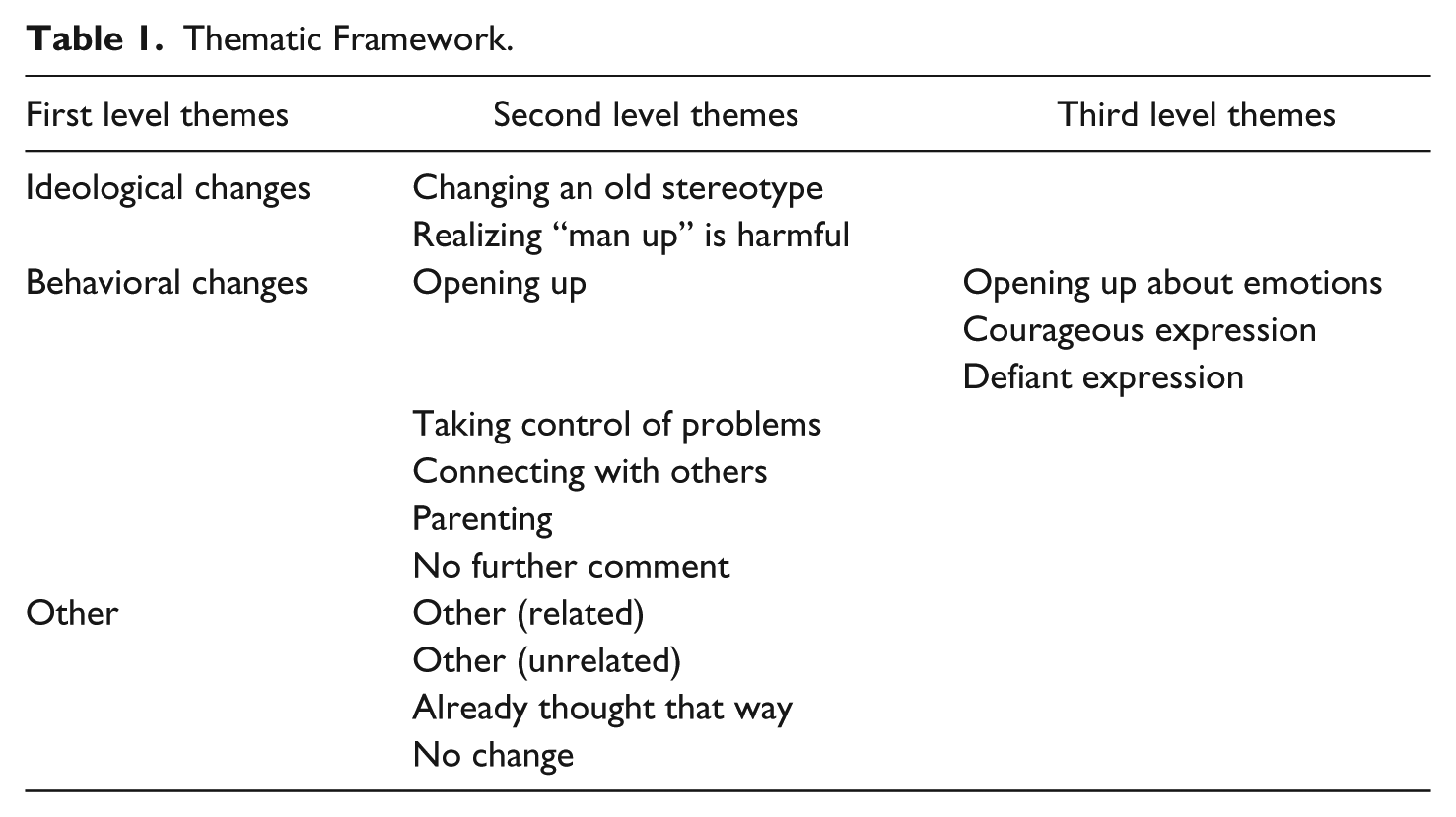
Responses to the open-ended question were analyzed for those participants who responded “Yes” or “Unsure” to the closed-ended question. We undertook inductive thematic analysis (Green & Thorogood, 2014) of the responses to the open-ended question presented in the RCT questionnaire and the web survey, considering all responses together. Two of our authors (K.K. and L.K.) collaboratively developed a coding framework that captured the full range of comments, and conducted a framework analysis informed by theories of masculinity, to order the themes into an overarching framework to make sense of the emerging themes (Green & Thorogood, 2014). The same two authors independently coded 10% of responses from each data source and determined the level of agreement on coding the data. The coding framework was further refined to address areas of disagreement, and a further 10% of each data source was double-coded. A 95% agreement on coding was obtained and K.K. coded the remaining data using the final coding framework. Each comment was coded to only one theme, which was decided based on the theme represented by the greatest number of words in each comment. The final thematic framework used in analysis is shown in Table 1.
Thematic Framework.
We conducted a series of Fisher’s exact chi-square tests to determine whether there were differences on the sociodemographic characteristics and the key themes that emerged in the qualitative analysis.
Results
In total, 683 participants answered the question about the way they viewed the phrase “man up” (169 RCT participants; 514 web survey respondents). Of these, 423 (62%) indicated that watching the documentary had changed the way they viewed the term (96 [57%] RCT participants; 327 [64%] web survey respondents). In total, 306 (72%) of the 423 participants who reported that they had changed their view of the phrase “man up” expanded on this via a free-text response (57% RCT participants; 41% web survey respondents).
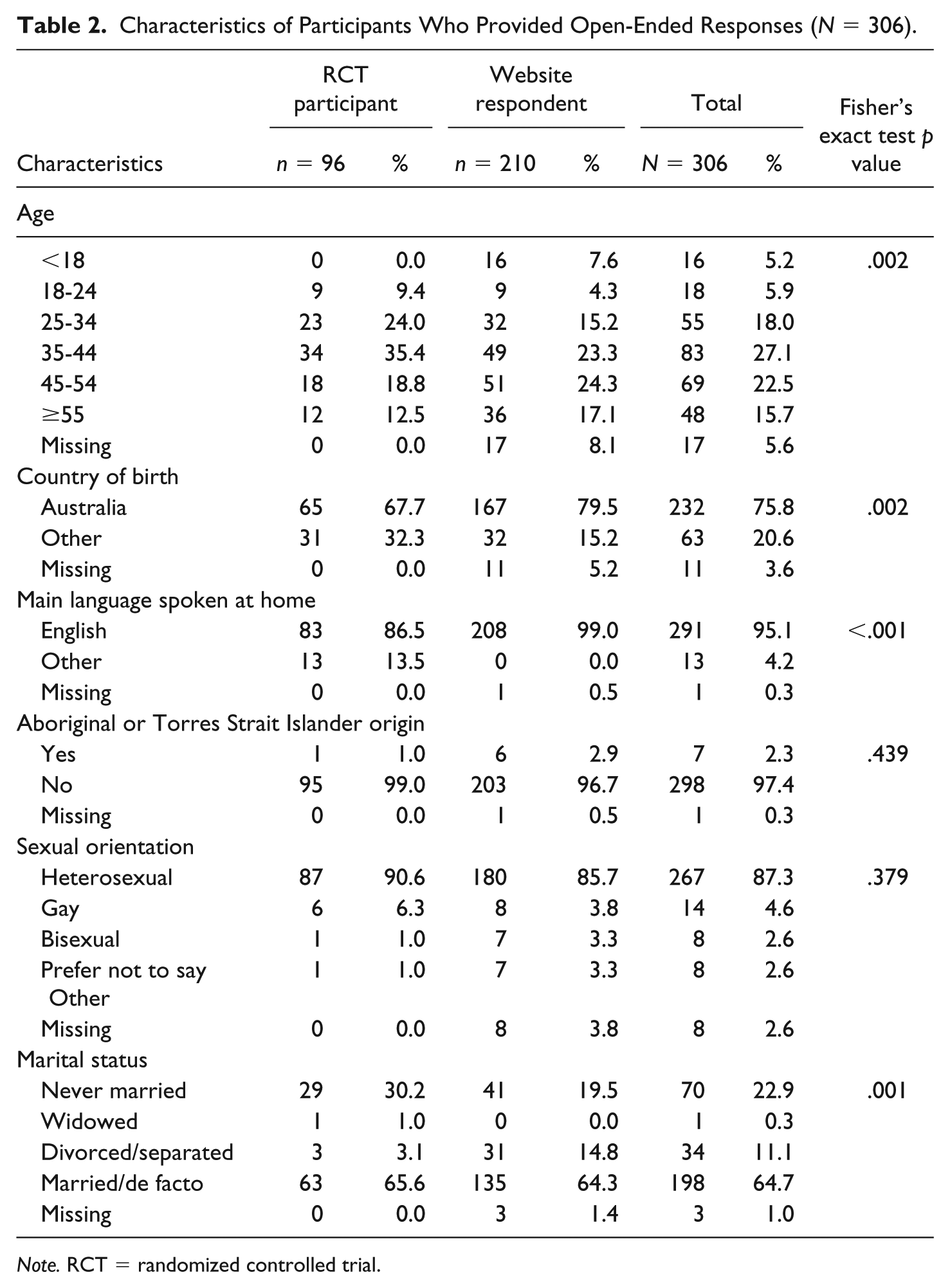
Table 2 lists the demographic characteristics of the participants who provided a free-text response. There were differences between RCT and web survey groups in terms of their age, country of birth, language spoken at home, and marital status. RCT participants were more likely than web survey participants to be aged between 25 and 44, to be born outside of Australia, to speak a language other than English at home, and to have never been married.
Characteristics of Participants Who Provided Open-Ended Responses (N = 306).
Note. RCT = randomized controlled trial.
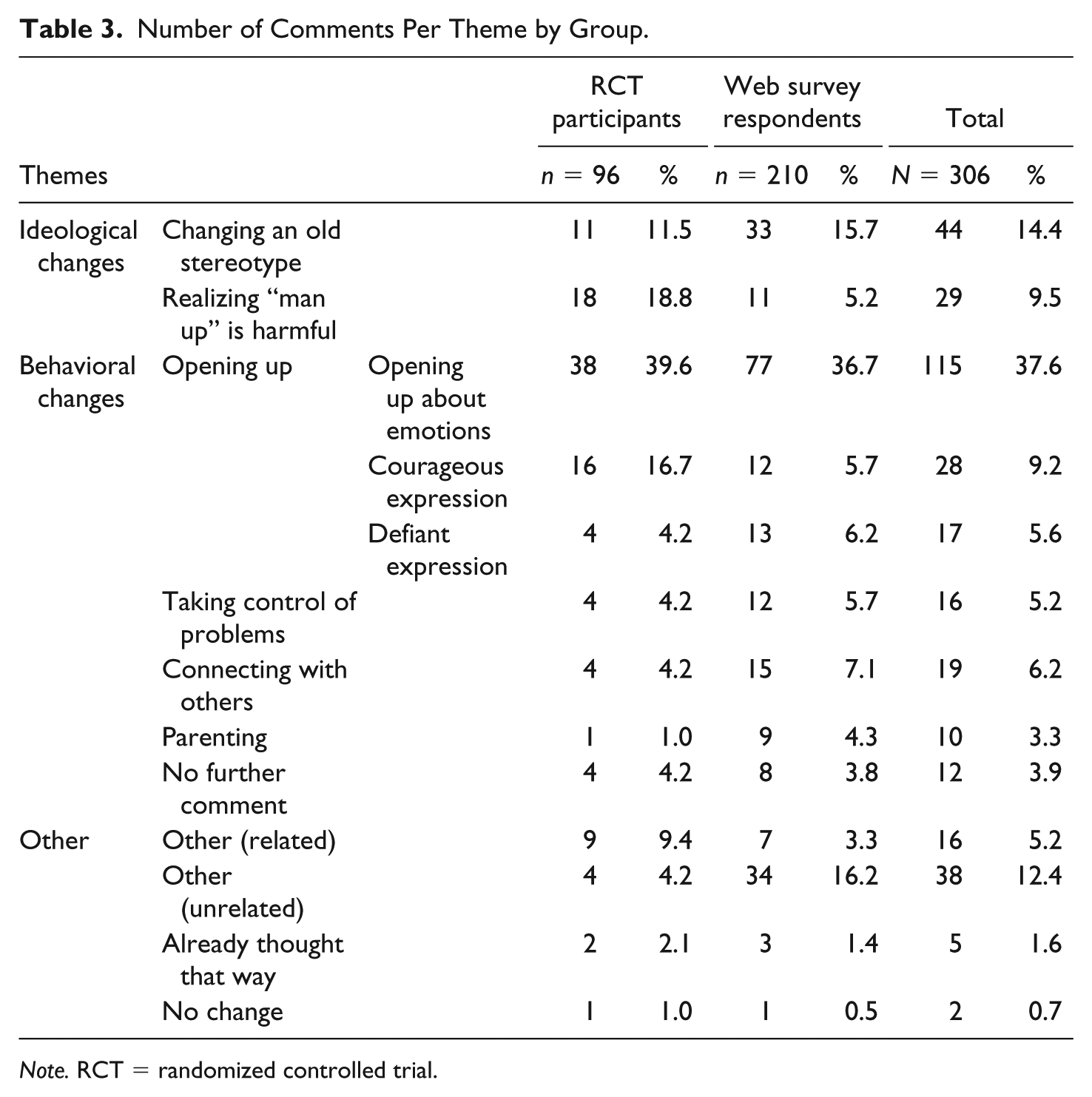
As shown in Table 3 two major themes emerged from the free-text responses: “ideological changes” and “behavioral changes.” Within the “ideological changes” theme, the subthemes of “changing an old-stereotype” and “realizing “man up” is harmful” emerged. Within the “behavioral changes” theme, the subthemes of “opening up,” “connecting with others,” and “parenting” emerged. In addition, another theme including “other comments” was identified. These comments either could not be described by a unifying theme, or the meaning of the comment was indeterminable. The counts in the table refer to number of people who made a comment related to each theme. We ran Fisher’s exact tests on the five key themes (excluding the “other” theme category) to determine the degree of difference between the two groups on comment counts per themes. Counts for these themes were mutually exclusive, that is, each comment was only coded to one theme. The theme represented by the most number of words in each quote was selected. The test revealed no difference between the two groups (p = .016). Two themes, “courageous expression” and “defiant expression,” emerged during analysis and overlapped with content in other themes. As they were therefore not exclusive of other themes, a separate Fisher’s exact test was undertaken on these two themes. This test also revealed no difference between the two groups (p = .035). Themes are now described in detail for the overall sample given the lack of significant differences between the two groups in terms of counts per theme.
Number of Comments Per Theme by Group.
Note. RCT = randomized controlled trial.
Ideological Changes
Participants commented on the way that viewing Man Up had caused them to reflect on their previous understanding of the phrase “man up” and their views of masculinity more broadly. They revealed a new awareness that multiple masculinities can exist, that these can be in contrast to more traditional views of stoic masculinity, and that men can choose their masculinity. Participants spoke about the need to change the old stereotype of masculinity and a new realization that the phrase “man up,” which invoked the old stereotype, was potentially harmful.
Changing an old stereotype
A new awareness of a need to move away from the narrow traditional stereotype of being a “tough, emotionless, strong” man was mentioned by 14.4%. They talked about the need to move away from narrow, limiting definitions of “what a man should be” to a recognition that there are many ways to be a man. They commented about ways that they were challenging this ideology both internally and publicly. They were thinking about ways that they could defy this ideology and act in ways that were free of societal expectations: I no longer up hold the assumed/expected ideas of what a man should be/act/feel and when it is seen in media or spoken from family or friends I point out the inconsistencies in that way of thinking in 2016. (RCT participant) When I hear “man up” now I think of the documentary. I hear it and think about being “man” enough to express yourself - have the courage to defy social norms or the status quo. (RCT participant) Broaden our perceptions of what manliness is. And allow myself to know the man is within, irrespective of society’s views, demands or expectations. (Web survey respondent) The term has historic negative connotations. BUT in this documentary it could be seen to symbolise the importance of conversations, active listening, that there are an array and diversity of views, in being a man in today’s society. (Web survey respondent)
Realizing “man up” is harmful
Following men’s growing awareness of the need to challenge old restrictive masculine stereotypes, 9.5% of participants commented about how they now realized that the use of the term “man up” is harmful. They had a new awareness of how this phrase pressures men to conform to a certain type of masculinity that might be harmful: It made me realize to a greater extent the negative impact such a term could have. (RCT participant) The term “man up” is an outdated and even harmful expression. (Web survey respondent)
Behavioral Changes
Participants spoke about the ways they had made changes in their lives consistent with a new understanding of masculinity that allowed them to be more emotionally expressive. They spoke about ways in which they had been opening up with others, connecting with others, and parenting. These changes contribute to our understanding of how masculinity is enacted for these men and which behaviors most powerfully speak to a more positive version of masculinity for them.
Opening up
“Opening up” was the strongest theme, with 37.6% of all participants talking about it. Subthemes identified within the “opening up” theme were “opening up about emotions”, “taking control of problems”, “courageous expression”, and “defiant expression”.
Opening up about emotions
Participants commonly wrote about the fact that they now saw the term “man up” as including a call to action for men to be more open about their emotions. They spoke candidly about the ways they had changed their thinking. It was clear that men were aware of their emotions but had not been expressing them for fear of negative consequences such as embarrassment. They now understood that expressing their emotions could be helpful for themselves and the people around them, and by doing so they could create a change in the culture that pressures men to suppress emotions. The documentary in some way allowed men to consider this aspect of their masculinity in a new light: Men can be emotional and we need to let it out and not hold on. (RCT participant) It made me realize that I shouldn’t be embarrassed to talk about my emotions and issues and talking about my own feelings would help others feel more comfortable with talking about their own. (Web survey respondent)
Men viewed emotional expressiveness in relation to masculinity in different ways. Some men saw emotional expressiveness as consistent with traditional masculine norms of strength and courage, while others saw it as defying these norms.
Courageous expression
Some men integrated emotional expression into traditional masculinity stereotypes by reframing it using language related to the traditional male qualities of strength and courage when describing how the documentary had encouraged them to view “man up” as being about openly expressing emotion: Man up means having the courage to talk about my emotional issues. (RCT participant) We are taught to me brave but sometimes the gutsiest thing to do is speak up and show emotion. (Web survey respondent)
Defiant expression
Other men spoke about how being open about emotions was about defying the “tough” masculine norm and how this allowed expression of a more genuine self. They recognized emotional expressiveness was counter to societal expectations around masculinity: It doesn’t have to mean being tough, it can mean being true to yourself and open about who you are and what you want and feel. (RCT participant) Men are all different and deal with situations differently and every bloke should be able to cry and feel emotion. It’s called being normal. Rough and tough is not the way to be. (Web survey respondent)
Taking Control of Your Problems
A few participants commented on how, as a result of the documentary, they now associated “man up” with being open about their problems and getting help. They talked about how they previously thought that they should suppress their personal problems and deal with them alone, whereas now they saw the how potentially harmful this could be. They now saw that dealing with their problems was “the manly thing to do”: Now I see that phrase as different. Before it was like not be like a girl. Now it is more like be responsible of your problems and actions, do not cover up this problems with things as “I am man, I do not need to think about that.” (RCT participant) It means taking control of problems rather than burying them. Confronting mental health as an issue is the manly thing to do. (Web survey respondent)
Connecting with others
Comments about how the phrase “man up” now meant thinking about and connecting with other people were made by 6.2% of participants. They spoke about the need to support each other and how they now saw this as part of being a man: That we are all different and should support everyone despite our differences. (RCT participant) In the past “man up” was the equivalent of “suck it up, princess” whereas I now think of it as stand up and be supportive of other men (which I already was, but the meaning of the term has changed for me). (Web survey respondent)
Parenting
Comments about how the term “man up” now prompted participants to consider the role they played in parenting their children and how they might teach their sons about a different type of masculinity were made by 3.3% of participants. They talked about how they previously instructed their children to suppress their emotions but how now they wanted to encourage children to be open with their feelings. Many of these comments talked about the importance of emotional expression for their sons, but some also mentioned the importance for their daughters as well. There was a desire for a nongendered approach to parenting, recognizing individual variability in emotional expressiveness and pathways to well-being more generally. Participants wanted their children to find their own way in life, rather than being influenced by societal expectations: It was a term that I used with my son, who is quite a sensitive kid. He cries a lot (and for some very minor things), and my response was always “toughen up.” Now I talk through things with him to build his resilience to help him “toughen up” on his own terms - and I’ll do the same for my daughter when she starts to go through this stage as well. (RCT participant) I think we often use the throw away line “toughen up,” I do it with my sons sometimes. I feel as though they need to remain resilient, but should be encouraged to always express their feelings. (Web survey respondent)
Other Comments
Other comments were provided by 17.6% of participants. As mentioned previously, these comments either could not be described by a unifying theme or the meaning of the comment was indeterminable. About 12% of comments overall did not address the question. Many of these comments provided positive general feedback about the documentary. However, two web survey respondents provided negative comments about how the documentary “demonized” and “denigrated” men: I resent the idea that manhood is up for public discussion. (Web survey respondent)
A very small number of participants (1.6%) explained that their view had not changed very much because they had already thought about the phrase in a way that was consistent with the way presented in the documentary: It didn’t change the way, but more so strengthened the way I was feeling about the whole issue. (Web survey respondent)
Discussion
This article presents the analysis of the responses of 306 men who provided their reflections on how their views of masculinity had changed since viewing the Man Up documentary. Almost two thirds of participants reported that the documentary had caused them to think differently about the phrase “man up.” These participants commented on how the documentary had caused them to rethink and challenge stereotypes of masculinity and to consider the inclusion of a wider diversity of attitudes and behaviors in relation to “being a man.” They reported seeing the possibility for multiple masculinities and that they had a choice to enact a masculinity that was more genuine and positive for them. When they spoke about parenting, they desired that their children could live in a way that was free of societal expectations. Many participants commented that they now saw “man up” as a call for men to be open about their emotions and connect with others. Many participants used language that was consistent with traditional masculine norms, such as bravery, strength and courage, to describe their new view of “man up,” and some made comments about how their new view of masculinity was not consistent with a stereotypical view of “tough” masculinity and expressed a desire to let go of this norm. Regardless of whether men viewed expression of emotion and connection with others as consistent or inconsistent with masculinity, it seems most were willing to incorporate it into their future definitions and relax their attitudes toward characteristics such as stoicism and self-reliance. These changes are important given the known association between these characteristics and negative psychological outcomes, including suicidal thoughts already discussed (Pirkis et al., 2017; Rice et al., 2013; Wong et al., 2017).
There were few negative comments in response to the question. A small number of men made negative comments about the portrayal of men in Man Up. This opposing voice is a reminder of the importance of ensuring that interventions do not paint men, and masculinity, in negative terms.
The impacts for men were experienced across sociodemographic differences and regardless of whether they saw the documentary in the controlled environment of the RCT or in their own environment (with exposure to the website and possibly other aspects of the social media campaign). This suggests that a media-based intervention such as Man Up has the potential to change males’ attitudes, and potentially behaviors, linked to gender norms and help-seeking for emotional issues in a wider population and under real-world conditions. The findings highlight the importance of attending to sociological factors, such as masculine norms, when attempting to generate behavior change, in this instance emotional openness. However, it should be acknowledged that these men sampled for this study are likely to be biased toward those ready for change, given that they had either chosen to take part in a study about men’s well-being or had been motivated to visit the documentary’s website. Men more wedded to hegemonic masculinity, and receiving regular reinforcement and reward for their adoption of hegemonic masculinity are likely to be more resistant to these messages. It should also be acknowledged that participants’ age, sexuality, or ethnicity were likely to be affecting men’s views of masculinity; however, analysis of these variables was outside of the scope of the study.
Just over a third of participants reported that they had not changed their view of the term “man up”. Unfortunately, the reasons for this are not known. In hindsight, a question could have asked for more information about this. Interviews could have also been used to obtain richer data. However, this was beyond the scope of the current project. Despite the limitations of open-ended survey data, given the large number of participant responses and the fact that participants utilized an opportunity to contribute their opinions and experiences, these findings provide a useful starting point for further research on efforts to engage men on reflecting on the consequences of masculine norms.
We were also unable to determine whether observed positive changes in attitudes were sustained over time. Cross-sectional data provide only a snapshot of participants’ views. In-depth qualitative interview data collected before and after viewing, and perhaps at some other time after viewing, could have provided more insight into how change happened. This is very important given that masculinity is a social phenomenon, affected by norms, expectations, and social sanctions about what it is to be a man who pressures men to operate in way that is consistent with the hegemonic masculinity of their time and place (Connell, 2005). An individual who makes changes to their enactment of masculinity may therefore experience pressure from their social context to return to a practice of masculinity consistent with the dominant masculinity (Lomas et al., 2016). Connell (2005) argues any reconstruction of gender therefore requires a move toward collective practice. Future research should therefore focus on exploring how changes in individuals’ masculinity are integrated and sustained into broader social contexts over time and how interventions could assist with this process. The findings presented here are in relation to individuals, although arguably the Man Up initiative is also contributing to broader social change. For example, the evaluations of the Man Up social media campaign showed that the initiative had a positive impact on public conversations around masculinity, suicide, and help-seeking (Schlichthorst, King, Turnure, et al., 2018).
Shifting the way people think about themselves and their behavior is notoriously difficult (Kelly & Barker, 2016), and hitherto little has been known about the possibility for redefinition of masculine norms. Our work here suggests it is possible. It highlights the importance of continued efforts to bring about positive change for men through a focus on gendered social roles (such as the “HeadsUpGuys” and the “Real Men. Real Depression” campaign mentioned earlier (Ogrodniczuk et al., 2018; Rochlen et al., 2006).
The Man Up documentary had significant impacts on men’s views of masculinity. The majority of participants reported changes that included an increased awareness of the potential negative impacts of stoicism and a challenge to be more emotionally expressive. These changes are likely to have positive impacts for men, given the known association between emotionally restrictive aspects of masculinity and mental health outcomes. These findings demonstrate the huge potential for the media, and gender-targeted interventions, to bring about positive changes in men’s views of masculinity that will also hopefully lead to positive changes in their well-being as these are integrated into their lives and into society more broadly.
Footnotes
Acknowledgements
The authors would like to thank the Movember Foundation for supporting the development and evaluation of Man Up. They would also like to thank Heiress Films for producing the documentary and associated social media campaign, and the Australian Broadcasting Corporation for screening the documentary. The authors are grateful to the Advisory Group that provided guidance at various critical stages in the project. They would also like to acknowledge Gus Worland and everyone else who appeared in the documentary and the men who took part in the study reported here.
Declaration of Conflicting Interests
The author(s) declared no potential conflicts of interest with respect to the research, authorship, and/or publication of this article.
Funding
The author(s) disclosed receipt of the following financial support for the research, authorship, and/or publication of this article: Funding for Man Up was provided by the Movember Foundation. Funds supported the development of the documentary and associated social media campaign, as well as their evaluation. The Movember Foundation had no role in the design or conduct of the study reported here; in the collection, management, and analysis of the data; or in preparation of this manuscript.
