




Abstract
This article is a poetic narrative in the spirit of resistance. It is based on an experience of sexual harassment I had at a dentist’s office in Antigua, Guatemala while conducting ethnographic research. I share an autoethnography, which is analyzed through feminist and historical lenses to highlight how the colonial patriarchal system and its coloniality of power continue to provide fertile ground for everyday forms of sexual harassment in Guatemala. In addition, I explore how power relations are malleable, dynamic, and even unpredictable depending on the bodies we inhabit as researchers. This is an invitation to look within and expand our discussions about the implications of experiencing sexual harassment while conducting research whether we are “in” or “out” of the field. Acknowledging these complexities is crucial to our searches for decolonial practices within the field of ethnography and within the process of academic knowledge production.
Keywords
My mouth wide open My whole body is stiffed in a defensive position I don’t want to be here, but I don’t have another option I have to endure Old man cologne mixed with the smell of tobacco all over my body He is on top of me His hands His face His eyes Digging in my mouth I feel nauseous He is so comfortable invading my space Looking, looking and looking I feel his eyes Up and down Up and down I can’t stand him Hovering all over me I am worried he will touch My shoulders My arms My breast He talks and talks So much This is hard work. Look at this tooth in terrible condition Why did you let it get to this point? So you are still a student What are you studying Indigenous people for? So you speak English? What a waste of time to learn Kaqchikel… So you are single Why aren’t you married? You are so beautiful So young You need to take better care of your teeth Beautiful young women like you must have beautiful teeth To smile My mouth is wide open, yet I can’t say a word I can’t respond to any of his sexist, racist and classist statements One after the other He asks if I need to spit I think of my state of anger, impotence and vulnerability I think of all the answers I would give him I feel powerless I can’t spit on his face. -Antigua, Guatemala June 27th, 2019
Guatemala is a territory historically permeated by different manifestations of patriarchal violence, such as sexual harassment. These expressions of gender-based violence are often perceived as part of everyday life due to a well-established culture of impunity. It is only a matter of reading the news to realize the precarity and fear women live in Guatemala. Consider the latest statistics in which, within the first 4 months of 2021, there have been 161 femicides, and more than 20,000 complaints of violence against women, including 3000 rapes reported (Oliver, 2021). Violence against women in Guatemala has been a latent social problem that has often intensified in periods of conflict. For example, many feminist scholars have theorized the relationship between the violence lived during the Guatemalan internal conflict (1960–1996) and the current levels of gender violence with a particular emphasis on femicidal violence (Carey & Torres, 2010; Sanford, 2008). In addition, access to reproductive healthcare is limited, and abortion is criminalized by the legal system and socio-cultural institutions, as well (Guevara-Rosas, 2018). In sum, Guatemala is one of the highest-ranking countries regarding violence against women and feminicide (U.N. Women, 2013).
The poem that opens this article was a way of processing my experience at the dentist in Antigua, Guatemala, which I wrote as part of an ethnographic note. At the time, I did not know what to do with it, but still documented this instance because I thought it said so much about the coloniality of power that continuous to be present in Guatemalan society. I thought this dentist was the true embodiment of colonial patriarchal systems intersecting with everyday forms of violence that often shape many Ladina/Mestiza 1 and Indigenous women’s lives. This point was my main motivation for documenting such awful experience. However, it was not until I shifted my perspective from reading it as an ethnographic note to an exercise of autoethnography, that I realized this man had sexually harassed me. And this too, was a form of violence and abuse. I analyze this experience to illustrate how everyday forms of violence are intertwined with colonial patriarchal systems in Guatemala. Cecilia Menjívar’s conceptual framework of multisided violence emphasizes how structural, political, symbolic, every day, and gender violence are intertwined while examining Ladina women’s lives in Guatemala (Menjívar, 2011, p. 62). This framework helps demonstrate how everyday forms of violence are inseparable from other forms of violence. In this particular case, multisided violence is constitutive of colonial patriarchal systems. This is a crucial element in the analysis of my autoethnography to further contextualize the historical, structural, and symbolic forms of violence that continue to perpetuate experiences of sexual harassment as a daily event, a normal thing that just happens.
I understand autoethnography as a research method where stories about the self are told in order to understand or reflect on cultural beliefs, practices and behaviors. “Autoethnographic stories are artistic and analytic demonstrations of how we come to know, name and interpret personal and cultural experiences” (Adams et al., 2014, p. 1). Instinctively, poetry has always been a sort of alchemy laboratory where I can transform strong emotions into self-awareness and deep wounds into healing practices. I have to constantly remind myself that this too is valid knowledge. Per my advisor’s suggestion, I wrote everything down—descriptions of places, people and feelings—as a way to embrace ethnographic work as a research method.
In this article, I explore how critical and embodied autoethnographic exercises can help us understand how sexual harassment is experienced within and outside the field and serve as a tool to decolonize knowledge production while conducting/producing ethnographic work. I use my experience at the dentist’s office to explore how power relations are malleable, dynamic, and sometimes even unpredictable. Depending on the bodies we inhabit as researchers, our experiences can be shaped by historical, political, economic, racial, sexual, and religious contexts. This is an invitation to myself and others to think about what it means to experience harassment while conducting our fieldwork, not by participants, informants, and/or communities, but rather within the same systems of oppression that we seek to understand from our research participants’ perspectives. Furthermore, how can we acknowledge that some of us may also embody marginalized identities in multiple contexts as researchers? For instance, in my case, as a young Mestiza woman whose body can easily be sexualized and racialized in different contexts due to hegemonic forms of patriarchal violence. Moreover, how can this critical approach and exercise of self-reflexivity serve as a tool to decolonize our own histories, bodies, minds, and processes of knowledge production?
In an effort to decolonize knowledge production, it is imperative to look within. It requires questioning who we are, our purpose, and what guides our academic paths. It also means acknowledging how our own personal and family histories have internalized colonial, sexist, racist, and classist systems of oppression. Decolonizing our analysis of autoethnography goes beyond interpreting social and cultural dynamics based on a personal story. It is also an opportunity to dive within the self and recognize how oppressive beliefs also inform our own perceptions and reactions. So, how do we work to dismantle the oppressive structures that live within us? I believe autoethnographic methods allow us to do this difficult work of looking within honestly and compassionately. In this process, we are vulnerable and recognize our own limitations. Simultaneously, we forgive ourselves for that, learn from it, and do our best to produce knowledge that can serve others make sense of complex structural problems and power dynamics.
In this essay, I first explore what it means to be a Mestiza researcher in Guatemala and my subject position in relation to the experiences of sexual harassment. Then, I share an autoethnography that is broken down into three main parts. I analyze and unpack different concepts, such as embodied dissonance, the hacienda system, the right to pernada, colonial patriarchy, coloniality of power, and everyday forms of resistance rooted in women’s knowledge. These concepts help me draw the intertwined nature of colonial patriarchal violence in relation to sexual harassment and everyday forms of violence.
A Mestiza Researcher: Sexual Harassment In and Out of the Field
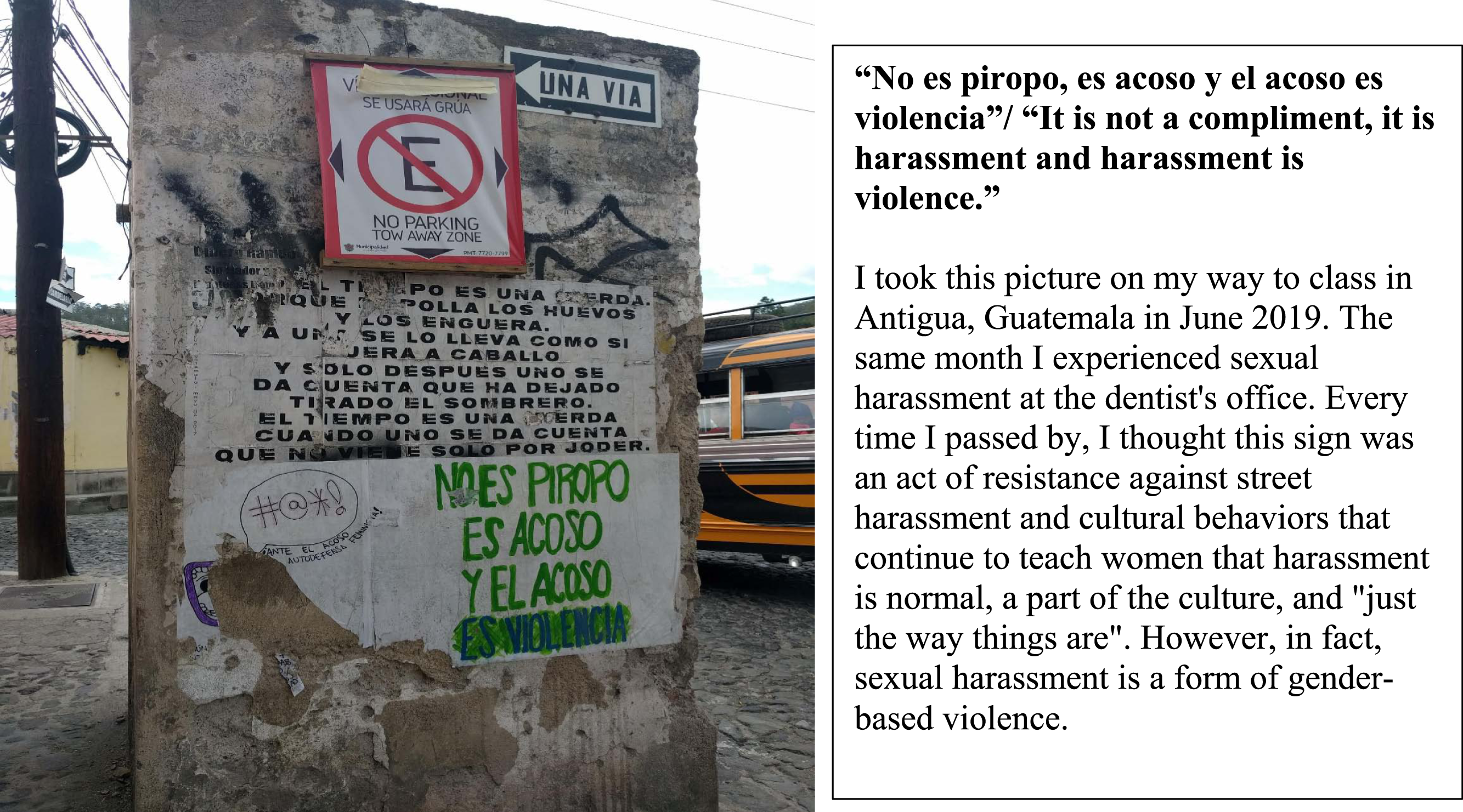
I am a Salvadoran-American Mestiza 2 researcher who has been academically trained in the United States. Phenotypically, I still resemble my Indigenous ancestors with a small/petite frame, dark hair, and light brown skin. I also embody the project of Mestizaje in Central America through my family lineage and our assimilation into mainstream Mestizo culture. In addition, I am cisgender and fairly feminine in my gender expression. Within this context, I am aware of all the forms of privilege I am granted in certain spaces of society as part of “the norm” in terms of ethnicity and gender expression. However, I must also acknowledge that as a young woman who can be sexualized and racialized under colonial and patriarchal systems, my position of privilege can at times be easily shifted, as it did at the dentist office where I was at risk to experience a form of gender-based violence, sexual harassment in particular. Stereotypes are representational practices that have been historically used to categorize groups of people to maintain the social and symbolic order (within and between cultures) and to separate the “normal” from the “deviant,” the “desired” from “the other” (Hall, 1997). Identity markers and power relations are dynamic, malleable, and sometimes unpredictable. Even if I, a cisgender woman, prepared as much as possible and anticipated multiple scenarios to keep myself safe in the field while conducting research, my body can still be read and treated according to systems of power established in particular contexts.
As a researcher trained in ethnographic methods by feminist sociologists and anthropologists, I prepared myself before fieldwork by thinking about positionality, privilege, research ethics, rapport with informants, and embodied experiences. I also spent countless hours being hyper-aware of my own privileges as a highly educated Mestiza woman, economically independent, and U.S. citizen—all the privileges that give me significant power vis-à-vis the Guatemalan Mestiza and Indigenous women I collaborate with. From June 2019 to June 2020, I spent an entire year in Guatemala to collect data for my dissertation project titled “Curanderas: Maya Women Resisting Violence through Theater that Heals”. With this goal in mind, I conducted multi-sited ethnographic work. I interviewed members of two theater groups, one in each location. I lived in Antigua and constantly traveled between cities and followed their rehearsals and presentations. I also engaged in participant observation with the artists, their theater process, and everyday lives, as well. Simultaneously, I was learning the Maya Kaqchikel Language through a Foreign Languages Area Studies (FLAS) fellowship.
My dissertation project seeks to analyze the ways in which Maya Kaqchikel women use theater and performance to denounce multiple forms of violence while also advocating for personal and collective healing. I use performance analysis to unpack the ways that dominant discourses of violence continue to shape their experiences of gender-based violence through an intersectional lens (acknowledging that race, ethnicity, class, and religion are interconnected). However, my qualitative research looks closely at how women use theater-making to resist patriarchal colonial violence, on and off the stage. My theoretical framework mostly relies on performance scholar Diana Taylor’s work and her conceptualizations of scenarios as “meaning-making events” that, through their repetition, create socio-political discourses that ultimately shape our ways of understanding and behaving in the world (Taylor, 2006). I also use this framework to make sense of the story I share in this article.
Aware of historical power relations within ethnographic research, I spent all my energy figuring out how not to reproduce violence in my own ethnographic practice, my relationships with participants, and my everyday interactions with them. However, I did not spend much time thinking about how I could also be at risk of being racialized and sexualized within the context of patriarchal and colonial violence. I want to reclaim any power that this harassment experience might have taken away from me and use it as an opportunity for “productive rage” to denounce violence and to grow professionally and personally.
Sexual harassment has been documented by scholars in different areas of life, in the workplace, in sports, and in academic and accademic settings (Bisgaard & Stockel, 2019; Herbenick et al., 2019; Moylan & Wood, 2016; Shrier, & Refstyled, 1996; Witte et al., 2006. Especially when it comes to docummenting sexual harrassment while conducting fieldwork (Hanson & Richards, 2019). Most recently, the #MeToo movement has brought to light how widespread and permissible sexual harassment has been, even in one of the most glamorized industries, Hollywood. The multiple accusations against Harvey Weinstein, for example, demonstrate that sexual harassment can be found across socio-economic strata. However, when it comes to providing conceptual frameworks to understand what sexual harassment is and how it should be addressed, there are still different analytical approaches offered from a legal standpoint. In the Latin American context, legal scholar Gaby Oré-Aguilar has explored diverse legal frameworks used to understand harassment and finds the concept rather limiting if only taken as part of anti-discriminatory labor laws (Oré-Aguilar, 1997). Furthermore, she advocates for International and Domestic laws to use a Human Rights violation framework where sexual harassment is understood to go beyond labor discrimination and is rather defined as a form of gender-based violence. Oré-Aguilar argues: “In all of its forms, sexual harassment is a demonstration of power on the part of the aggressor aimed at subordinating the victim, thereby violating her (their) human rights” (Oré-Aguilar, 1997, p. 642). I understand sexual harassment as a form of gender-based violence, which does not only include cisgender women, but also LGBTQ people, sexualized and racialized people, and any group that does not fit into the hegemonic roles stipulated by binary systems. I borrow from the following definition: Sexual harassment may be "sexual," as with unwanted sexual attention or requests to engage in sexual acts. However, sexual harassment is more often gender-based or "nonsexual." This includes derogating someone based on their gender/sex or violations of their gender/sex norms, as with sexual minorities, nonsexual heterosexual men, or sexually agentic women, etc., and gender-based insults, jokes, and discrimination. Sexual harassment may be physical or verbal… (Hernenick et al., 2019, p. 998).
In the case of Guatemala, sexual harassment is highly present even in the most common aspects of quotidian life, such as public spaces. According to the Guatemala Safe City and Safe Public Spaces program, which took place in 2017, every woman who participated in the survey “acknowledged having suffered sexual harassment at some time during her life on public streets. At least 44% said it happens daily” (U.N. Women, 2021). I provide this background to contextualize gender-based violence in the form of sexual harassment in Guatemala, not to overemphasize the imaginary of Guatemala as a dangerous and violent place, but rather to point out the material and symbolic implications of gender inequality. There are many other countries and contexts in which I could also experience sexual harassment and many other form of gender-based violence. However, in this case, I am attempting to unpack this specific experience, in this country and with this body.
A Moment of Precarity Leads to Embodied Dissonance
On a rainy and hot June afternoon in Antigua, Guatemala, I find myself with an unbearable tooth ache. I am in the middle of my first summer intensive program learning the Maya Kaqchikel language at Oxlajuj Aj. I inform the instructors I won’t be able to attend the afternoon activities because I desperately need to see a dentist. I don’t know anyone in this city, so I ask around and then realize that there is a dentist around the corner from the apartment I am renting at the moment. I tell myself “me va a costar un ojo de la cara”
3
. After all, it is Antigua, Guatemala, a tourist town targeted to primarily U.S. White Americans and White Europeans. However, this is a sacrifice I am willing to make because the pain is too much, and I cannot eat at this point. I go into the office and explain my situation to the receptionist. She is a Ladina woman. She is short, curvy and her hair is dyed blond. She must be in her late 30s. She greets me with a smile, and we start talking. I asked if I can see the doctor that same day, and she finds a spot for me. I come back for my appointment later that day. The receptionist receives me, and we start talking because the dentist is finishing up with someone else. She tells me how the doctor and his son both own that clinic, and it is nice because it is a family business. She then proceeds to ask the usual. Where am I from? What am I doing in Antigua? And, am I married? The doctor walks into the middle of our conversation. He is a sixty-something-year-old man with thick grey hair and tanned skin, a strong Indigenous phenotype. A pair of big glasses hide half of his face. He checks me out, looks at me from top to bottom, and says, "What's a young and beautiful woman like you doing here?" I am immediately uncomfortable. The receptionist looks at me and smiles like this is the highest compliment I can receive. Then, she proceeds to tell him that I am his next client. He tells me, “So it seems the pain is too much that the mouse came out of the cage.” I give him a nervous smile. Then, he continues to ask all the routine questions: Where are you from? And, what are you doing here? I tell him I am from El Salvador. I live in the U.S., and I am a student. He immediately asks, What are you studying? I reply with the usual, I am an anthropologist working with Maya Kaqchikel women who are theater-making artists, but I am now focusing on learning the Maya Kaqchikel language. He looks at me with disappointment, a face that intersects the sentiments of surprise and disgust. Looking down at me he says, “Oh! you are one of those…” I ask “One of those?” To what he replies, “Yes, those researchers who study the Indigenous people…Are you studying Tikal and all that" My jaw drops … before I can come up with a response, he proceeds to the next question, “Why are you learning Kaqchikel for? What a waste of time.” I am caught off-guard and think really carefully about how to respond to this whole situation. At this point, I have decided I do not like this man, but I don’t have another option. It’s too late.
Research preparedness and site awareness are crucial to fieldwork. Academic training and institutional policies often require researchers to become familiarized with the places and communities involved in the study. My institution required me to fill out a high-risk form, read about Guatemala’s social, economic, and political context, and even call experts to discuss my travel plans, including mobility within the country and housing. Guatemala is considered a high-risk zone according to the U.S. advisory board, so I followed all the protocols in addition to relying on my family networks and cultural knowledge. I have traveled to Guatemala from an early age, and I am familiar with socio-cultural practices and travel precautions, as well. I felt confident about living in Antigua for a year while conducting research. I diligently planned for everything: a safe place to live, a structured routine, nurtured connections, and built strong relationships with my main informants. I discussed my research plans with my academic committee, family, and on-site participants.
Most of my academic training and research has focused on violence against women in Central America, which shaped my research questions and design. In addition, I lived my childhood and adolescent years in El Salvador, surrounded by similar social norms, so I am hyper-aware of gender-based violence and sexual violence against women in the region. Despite this risk, I was determined to conduct ethnographic work, participant observation, and in-depth interviews. My familiarity with these issues through personal and professional experience became the greatest motivator to take all possible precautions to protect myself from dangerous situations while conducting research. I engaged with feminist ethnographic discussions about sexual harassment in the field, which has been recently raised as a legitimate concern by women ethnographers. In Towards a Fugitive Anthropology, authors document and examine personal and collective accounts of sexual harassment and gender-based violence while conducting research (Berryet al., 2017). Their contributions to anthropology and activist research exposed the ways racialized, gendered, and sexualized bodies are often vulnerable to harassment and even sexual violence by the very communities and/or informants researchers collaborate with to create political alliances and carry out politically engaged research. Their experiences of sexual harassment and gender-based violence in the field brought to light the often taken for granted “institutionalized notion of fieldwork as a masculinist rite of passage or an exercise of once endurance” (Berry et al., 2017, p. 538). For this reason, I was extra careful as I planned my project in order to protect myself from being exposed to sexual harassment in the field.
Groundbreaking research by sociologists Rebecca Hanson and Patricia Richards has offered an in-depth analysis of women researchers’ experiences of harassment in the field. In their research, they exposed the ways embodied ethnography affects the process of knowledge production and the integral well-being and safety of women researchers. Often, stories of sexual harassment are brushed to the side and continue to be taboo within academic settings due to the fear of being perceived as “not legitimate or successful ethnographers.” The authors identify three main practices, which they call contemporary ethnography “fixations”—solitude, danger, and intimacy—as the standard for the “best” ethnographic practice within the field of sociology (Hanson & Richards, 2017, p. 2).
Based on the knowledge offered by these readings and the experiences of women scholars in anthropology and sociology, I thought I had already “addressed” each of these ethnographic fixations in order to protect myself. The fixation on solitude stipulates that the “real anthropologist/ethnographer” goes to the field by himself as part of the “adventure.” I did the opposite. I first went to “the field” with my mother and stepfather. Both of them are from El Salvador, and we met with the theater group members and other people who were part of my social networks in Guatemala. This gave a sense of familiarity. Most importantly, it showed that I was not alone but could count on the protection of family and friend networks. I purposely disrupted the whole notion of the intrepid anthropologist who adventures into the unknown in solitude. In my experience, social and family ties are a remarkable resource while conducting fieldwork. I addressed the danger fixation by strategically choosing a topic where I was able to interact mostly with women who were already part of my networks. I did not put myself in danger to collect data and be closer to my collaborators. I rented a small apartment in San Pedro El Alto, a gated community between Antigua and Santa María de Jesús. I made friends everywhere and only took the bus when the sun was out. I let my host mother know where I was at all times. In addition, I conducted all my interviews in public places—the market, parks, and coffee shops. I made sure to get to know everyone at the markets and surrounding shops, so they knew who I was and what I was doing in the community. I felt safe all the time I spent traveling, interviewing, and conducting ethnographic work in the different sites due to the friendships and professional connections I established. I never felt the urge to compromise my safety for the “data.” Instead, I told myself that whatever I was able to gather was what I needed to explore in my research projects.
In terms of intimacy, the relationships I was able to cultivate with major informants were most valuable for conducting research. Women opened up their homes to me, their families, and communities embraced me because they believed in the potential of my dissertation. And they were invested in the end results. I was able to be part of their everyday life by going to their workplaces when possible to help them out. Sometimes, we would prepare and share meals together. I even ended up giving free dance classes in one of the communities, where we were able to move our bodies, laugh, and even join happy hour after our class. I am aware that my gender, age, interests, and cultural familiarity opened up spaces for me to create strong connections with the women. In short, I felt welcomed and protected by the women who participated in the research process and even the ones who did not, but joined my dance class. These were Maya Kaqchikel and Mestiza women whose ages ranged from 20 to 60 years old. Most of the younger women were single, heterosexual, and overall very few were legally married or in a relationship. I achieved good rapport and even ethnographic intimacy with most of them. Ethnographic intimacy refers to establishing intimate and prolonged relationships with participants who consent to be part of the study. However, there is often a risk due to the ethical guidelines and the practical reality of fieldwork (Pérez-Y-Pérez & Stanley, 2011). I did not develop any romantic or flirtatious relationships with any of my research collaborators or within my research sites. I did engage with intimate conversations about love and sexuality with my research participants as part of the interviewing process and life histories approach, but never felt uncomfortable and/or threatened in the process.
As a woman of color in the U.S. academy, I am aware that my strategies to conduct ethnographic work in Guatemala might be looked down upon by White cisgender men anthropologists who live for and potentially enjoy the adventure and danger of the field. However, I kept reminding myself: I inhabit a different body, a different story, and different goals and purposes for conducting ethnographic research with Maya and Mestiza women in Guatemala. As Hanson and Richards argue that “silences surrounding sexual harassment is both motivated by and reproduce androcentric norms that valorize certain types of fieldwork” (Hanson & Richards, 2017, p. 3). As a result, I did what it took to keep myself and my collaborators safe and joyful while conducting fieldwork research.
Now, I return to the dentist harassment story. I focused my energy on avoiding possible experiences of harassment and gender violence in the field, but I was not prepared to encounter it in a moment of personal need or vulnerability. My intuition told me that something did not feel right from the first exchange of words with this man, but he was the only dentist I had access to. In order to continue my research plans, I had to be healthy, and the pain was too intense. I had to endure this uncomfortable situation for a few hours in order to execute my research agenda.
As a teenager from San Salvador, I experienced sexual harassment everywhere—at school, in the streets, at church, you name it. In fact, it is popular knowledge that this intense looking up and down is described as “the dirty looks” or “eating you up with their eyes.” The dentist was doing precisely that, from the moment I stepped into his office. At the beginning of our conversation, when I said I was studying in the United States, he came across as being impressed. However, once I said I was an anthropologist who collaborated with Maya women’s artists, he lost all interest and became judgmental, instead. He said, “Oh you are one of those” “Yes, those researchers who study the Indigenous people”. It was evident that his imaginary of the White anthropologist “studying” the Indigenous people was being challenged by my very existence. He said something along the lines of studying the “Mayan past” as if the Indigenous people only existed in “the past”. He could not wrap his head around me, a woman with my phenotype and Mestizo working-class background, choosing to study anthropology, much less wanting to learn from Maya women artists. Then, he realized another problem with this picture: “What are you learning Kaqchikel for? What a waste of time.” This logic reflects mainstream Ladino people who often do not value Indigenous languages due to colonial, capitalist, and neoliberal socio-economic structures. The more one is able to distance oneself from Indigenous cultures, languages, and worldviews, the more likely one is to succeed and gain socio-economic status. This belief is key while thinking about how the Ladino identity operates in Guatemala, at its core. The Ladino/a identity is particular to the Guatemalan context. It has been historically used to describe anyone who is not Indigenous. In Yolanda Aguilar’s words, Ladino “it is an identity marker that does not tell us who we are, but rather who we are not" 4 (Aguilar, 2019, p. 132). It does not matter if he has prominent Indigenous phenotypic features within this paradigm. His socio-economic status as a professional and wealthy man separates him from any association to Indigeneity. It places him in the Ladino patrón category. So, why wouldn’t I, as a Mestiza woman, choose to go on this same life path?
The dentist’s reactions illustrate what Aura Cumes discusses in one of her essays about Indigenous researchers often perceived as subalterns. Based on her personal experience, she explores what it means to conduct social research as a young Maya woman (Cumes, 2015). In her reflections, Cumes exposes how colonial legacies in both anthropology (as a discipline and profession) and social stratification of Central America, have created an inherited imaginary for most Guatemalans, which determines “who is in a position of authority and who is the subaltern” (Cumes, 2015, p. 148). Within this imaginary, Indigenous men and women are compartmentalized into specific roles. For example, Indigenous men are associated with peasants, land workers, day laborers, bulk loaders, construction workers, and low-rank police officers. Indigenous women often are stereotyped as domestic workers, peasants, land workers, market merchants, and artisanal workers (Cumes, 2015, p. 148). Many of these socially devalued, stereotypical oficios or forms of unskilled labor are expected to be occupied by Indigenous people, in part, because of their lack of knowledge and Spanish language skills. The dentist shares this limited and colonized worldview, and he cannot comprehend why someone would want to learn the Maya Kaqchikel language. It is even more confusing for him to think that I am interested in learning from Maya women as theater-making artists and subjects of knowledge production.
Another compelling argument addressed by Cumes is the following: “The social structures inherited from the colonial period automatically transform foreigners and White Guatemalans into authority figures, and they are treated as such” (Cumes, 2015, p. 150). Even though I am not an Indigenous woman from Guatemala, I am not a White foreigner anthropologist, either. I am also not Ladina because I am not from Guatemala. In this dentist’s social imaginary, it made more sense to fit me into the subaltern category based on the often dominant colonial patriarchal framework where a body like mine is highly sexualized and racialized. There is no space for negotiation, and there are no grey areas. There are only two boxes to be filled in the colonial binary still present: the foreign white anthropologist as authority figure OR the subaltern young Mestiza woman who is trying to step out of the narrative and must be put in her place.
The Hacienda system and Colonial Patriarchy: “Sólo hablo Q’eqchi para mandar a los mozos de la finca”
The receptionist starts laughing and tells the dentist: “But doctor, tell her. You speak Q’eqchi, don't you?" His chest expands, and with an air of superiority, he declares, "Yes, I do. I only speak Q’eqchi to command over my workers at the farm."
5
He proceeds to tell me how he owns a big farm in Alta Verapaz where all the workers on his land are Indigenous, and they do not speak Spanish. Only Q’eqchi. Therefore, he was forced to learn the “dialect” to tell them what he wanted and how he wanted it done. His tone implies that this is the only reasonable explanation for learning an Indigenous language. I look at the receptionist in disbelief, but she is having the time of her life smiling and enjoying this conversation like normal business. Everything is problematic about this scene. I want to run away. My tooth hurts. I feel nauseous.
At the moment, I did not know how to react or respond to his comments, harassment, and violence. This did not change until I read my notes again and spoke with two of my feminist mentors. One of them encouraged me to think about the following: What makes this man think he had access to your body and sexual interest? And what is the relationship between this entitlement to your body and his comment about speaking Q’eqchi with the only purpose to command and exert his power over his farmworkers?
The intersections of gender violence, sexual harassment, racial discrimination, and labor exploitation can be traced back to the patriarchal hacienda systems inherited by Spanish colonization in Guatemala, as in most Latin American countries. “The term hacienda can be described as a type of formal organization in which the landowner is always at the top, and the various social dimensions of laborers are underneath.” (Yarbrough, 2012, p. 43). Within the hacienda system, the landowner is at the top of the social-economic order, which creates complex power dynamics between the hacienda owner—el hacendado—and his workers, their families, and anyone who lives in his hacienda. The hacienda includes the land/territory owned by the hacendando/landowner. Anyone who lives there owes loyalty and labor to el patrón, another word commonly used for hacendado. In the hacienda system, the labor relations are extended to social, cultural, and even intimate forms of relationality. For example, the workers' loyalty and respect to their patrón in all life areas is expected, extending beyond labor relations.
Looking at the roots of the hacienda system in Latin America takes us back to medieval Europe and the feudal system. The Spanish conquerors brought these socio-cultural practices to impose new economic systems of domination over the territory and the people indigenous to this land. The feudal lords of Europe and the hacendados in Latin America had the same property rights over their subjects which led to different forms of authoritarianism facilitating different forms of power abuse. This model of the feudal lord and hacendados as the moral, political, social, and economic authority permeated different areas of life. One of them for instance, is the family. For example, “when thinking about authoritarianism, there are many parallels to be drawn between parental and hacendado authority. The degree to which landlord’s power influenced residents’ social behaviors was similar to the impact that parents and other adults had on shaping the lives of children” (Yarbrough, 2012, p. 46). Similarly, Gloria González-López, in her research on incest in Mexico, further develops this connection as follows: “The hacienda owner had the property rights over his campesinos—his peasants. El padre de familia has his property rights over his daughters, his family” (González-López, 2015, p. 55). In this context, “the family as the hacienda” permits the sexual abuse of girls and women who are seen as the patriarch’s property.
This idea of the father having “property rights over his daughters’ bodies” sparked my curiosity to dive deeper into the roots of the dentist/hacendado sense of entitlement to the bodies of women in his space. This echoes González-López’s reflection about el derecho de pernada—the right to the first night. As a “patriarchal kinship reassignment” within the family as an hacienda where the patriarch justifies the sexual access to his daughters’ bodies. So, what is el derecho de pernada? Where does it come from? And why is it relevant to my experience at the dentist’s office?
El derecho de pernada: From Medieval Spain to Contemporary Guatemala
El derecho de pernada is a practice that can be traced to medieval Europe under the feudal system where the feudal lord/landowners had the right to have sex with the bride on her wedding night as a way to exert his power over his subjects, groom, bride and the extended family. In his essay “Rite and Rape: The Right of Pernada in the Late Middle Ages" 6 Carlos Barros makes a compelling argument on how el derecho de pernada was the feudal system’s way to protect noble men—señores feudales—from rape crimes in Spain. He describes how the feudal lords had power over women’s bodies as men and as lords of the lands. The rite of derecho de pernada sends a clear message: the woman must obey her husband, but only after obeying the feudal lord. He is above all the family’s patriarchs, fathers, brothers and even husbands. Similarly, the men pledge their loyalty and submissiveness to the one and only source of power, their feudal lord, who owns everything and everyone. The right to the first night reflects a complex form of selective power and control mechanism involving the Subjects (men) and the objects (women) living in that territory. It was blatant rape covered up by socio-political customs (Barros, 1993, p. 3). In addition, Barros argues that this abuse of power became extended in two ways (1) beyond the privilege of the lord or master—el amo—and it was stretched out to delegates, soldiers and other men in power, and (2) beyond the nuptial night, to any day (Barros, 1993, p. 5). In fact, once the right to pernada loses its ritualistic and elitist nature, it becomes widely identified as plain rape where the main perpetrators continue to be the men in power, and it slowly becomes socially unacceptable. Based on archival evidence of oral histories in three main Spanish cities, Barrios argues that somewhere between 1458 and 1467 the right to pernada started to lose its social acceptance in Galicia and even ignited peasant revolts. The feudal lords—grandes señores—were now described as rapists (Barros, 1993, p. 13). Barros’ findings shed light on the transferability of the right of pernada as a feudal ritual to exert and maintain the patriarchal power of the landowners above all.
The transferability of the right of pernada practice becomes a tool of power and control of colonial patriarchy under the hacienda system in the Spanish-speaking Americas where the hacendado assumes a role similar to that of the feudal lords of the Middle Ages in Spain. As a result, within the hacienda system where the hacendado owns everything and everyone within his territory, the distorted concept of the right of pernada becomes a transferable socio-cultural practice of power to maintain the social order.
Another form of social acceptability of this historical practice of patriarchal violence can be found in Catherine Komisaruk’s analysis of Colonial Guatemala’s judicial records of sexual violence. Komisaruk examines the testimonies of sexual violence found in the secular court records of Colonial Guatemala, where she finds that sexual violence tended to be disregarded by social attitudes and judicial practices (Komisaruk, 2008, p. 371). Even though she found a few records of sexual violence, the five recorded cases Komisaruk analyses in her article are from what is now Antigua and Ciudad de Guatemala and share the following commonalities: (1) They were all rape accusations from powerful adult men against girls and young women, and (2) they were “deflowering cases,” not rape itself as at this time; the concept of rape was limited to taking women’s virginity, as opposed to forced/non-consensual sex. Due to the social position of the perpetrators (criollo men in their thirties and forties property owners) and the victims (girls between 11 and 14 years old—Mestiza and Indigenous women—who often lived in the perpetrators’ house as extended family, servants, or laborer workers). In these trials, the court never ruled in favor of the victims. From the five cases of deflowering, only one is against a 40–50-year-old Indigenous man accused of deflowering an 11-year-old girl. He received “25 lashes at the public whipping post in addition to the prison time already served—just under two months—” (Komisaruk, 2008, p. 379). These examples demonstrate how race, class, ethnicity, and gender shaped power relations, the legal protection of rape perpetrators, and the further victimization of girls and women.
How are these historical references relevant to this discussion about colonial patriarchy and present-day forms of sexual harassment? Well, first, I borrow a concept from Anibal Quijano, the coloniality of power. He explains this term as a system of profound inequality which was set up in the colonial period in Latin America. Within this system, the “racial distribution of forms of work and exploitation” that were established in the past, continue to be reproduced to the present time (Quijano, 2000, p. 217). Quijano provides a useful framework to understand how racism and Euro-centric forms of capital and labor distribution operate within colonial capitalism in Latin America. The idea I want to emphasize here is that we still live within the structures of the colonial, social, economic, and political order. Economic power and its association with Euro-centric values of whiteness, superiority, and authority are what gives the dentist in this story the entitlement of owning his Indigenous workers' lives, grants him the right to sexualize women’s bodies, and gives him social permission to harass single young women—who are all fair game—under his worldview. He is still the colonial patriarch, the hacendado, the patrón, the land and capital owner who has complete authority and ownership over everything and everyone who inhabits his material and symbolic territory.
Furthermore, Maria Lugones expands on the concept of the coloniality of power and proposes the coloniality of gender. Lugones argues that within the coloniality of power and mainstream feminism, only white bourgeois women are part of the category “women.” However, colonized non-white-bourgeois women, mainly Afro-descendants and Indigenous people, became people without gender. They became racialized females—hembras racializadas—who were exploited for Eurocentric global capitalist expansion (rape, labor, property, domestic servitude, birthing, etc.) (Lugones, 2014, see p. 69). The dentist’s comments, behaviors, and attitudes towards Indigenous people, and especially towards young women, seem to be rooted in the basic concepts of the derecho de pernada where he embodies the hacienda owner as a college educated business owner in a territory with a painful history of colonization. Within this context, social imaginaries are constructed, perpetuated, and maintained through the coloniality of power and coloniality of gender, which have organized social life for centuries. Thus, the dentist has learned to enjoy an unchecked/unquestioned strong sense of patriarchal entitlement over the bodies of women who happen to be “in his territory.” This access to women’s bodies can be interpreted as symbolic, physical, and even sexual, where his patriarchal rules must be accepted, even if they are deeply anti-Indigenous, racist, classist, and sexist. I may not be the first or the last woman to experience sexual objectification and harassment in his territory—office and hacienda.
I think about his secretary, what is it like to work for him? What about Q’eqchi’ women who live in his farm? And the countless women clients he must have? How do they cope with it? What sort of tools and knowledge do they use to resist everyday forms of harassment from the colonial patriarch? In my case, as an ethnographer, I choose to narrate this story from a historical perspective to illustrate how past and present colonial patriarchal violence is connected with everyday forms of harassment. Even though these ideas of racialized and sexualized bodies might seem antiquated as they belong to the colonial period, they still have symbolic and material repercussions in the current social imaginary. This allows for particular forms of power abuse and violence to become permissible and naturalized, in this case, young women’s sexual harassment and sexual violence.
The Feminist Ethnographer Resisting Patriarchal Scripts
I feel his dirty looks all over my body. He tries to touch me every time he gets under the façade of being "friendly". He touches the receptionist in the shoulders and the waist. He tries to do the same with me. I keep moving away and away. I tell him I can hear him very well, and he does not need to get so close to me…. I want to run away. I am sitting in the dentist's chair. My mouth is wide open and unable to move. His face is so close to mine. I feel his heavy breathing. I smell his old man cologne. I can tell he smokes by his body odor. He gets closer and closer. I feel his whole body on top of me. My tooth pain is not my biggest concern anymore. I am constantly worried that he will touch my arms, shoulders, and breast. He is so comfortable invading my space for what I have experienced this far. He says, "I will close the door," and I quickly tell him I want the door open because I find comfort in having the receptionist assist him. I tell him I am afraid of the dentist, but this is not true. I am afraid of being left alone with him. He leaves the door open, and she comes in and out. I do not want to be left alone with him. He tells me how terrible my teeth are, and he cannot believe that I walk around with this tooth problem. He needs to work hard on this one to make sure I keep a nice smile since he reminds me "eres una jovencita tan bonita—you are such a beautiful young woman”. He finally gets to work, but finds every opportunity to let me know that I am too pretty to have bad teeth. I am too pretty to be learning a Mayan language. I am too pretty to be in my 30s and not to be married… My mouth is wide open, and yet I cannot say a word. I cannot respond to any of his sexist, racist and classist statements. He keeps asking if I need to spit. And all a keep thinking is how I cannot spit on his face. I pay my bill and cannot wait to get out of there. The dentist continues to get close to me. He asks me how long I am in Antigua for? Where am I staying? Do I need a ride? I respond quickly and as vague as possible. I tell him I need to leave now. He follows me to the door, tries to touch me again. I walk fast. He holds the door and asks me: "Do you need me to take you home?" I feel his intense eyes undressing my body. I respond. “No. Thank you. My friend is picking me up around the corner." I walk fast, look back to make sure he is not behind me. I can still feel his eyes on me. I hold the keys between my fingers, and think how I would use every single stone encrusted in the streets of Antigua if that man ever comes close to me. Just like that, I am reminded that it doesn’t matter if I am a researcher, financially independent, knowledgeable about power dynamics, a U.S. citizen. My height is still 5′1. My body is still small. I still look young. Still brown enough. Still single. Still alone. Still a woman.
As a feminist ethnographer, I was mostly preoccupied with my privilege as a foreign Mestiza woman, a highly educated U.S.-born woman who has lived in the United States her whole adult life. I revisited Under Western Eyes by Chandra Mohanty to be reminded of the geopolitical power of knowledge production and the reproduced colonial violence in narratives about women from the “third world”. Mohanty denounced how Western white feminism often homogenized and “othered” third-world women as oppressed, uneducated victims and unaware of their own domination (Mohanty, 1988). I also engaged with Central American women scholars who have provided excellent analysis regarding Mestizaje as a White supremacist nationalist project deeply rooted in anti-Black (Hooker, 2014) and anti-Indigenous (Aguilar, 2019) sentiments and how it is often normalized in Central America.) These authors invited me to expand my concerns and commitment to engage with decolonial feminist knowledge and practices. I intentionally engaged the writings of Maya Kaqchikel women scholars from Guatemala, such as Emma Chirix and Aura Cumes. Both scholars have assertive analysis and contributions regarding Indigenous women’s subjectivities in Guatemala and a strong critique of the White/Ladina feminists who often reproduce race and class violence in their interactions/relationships with Indigenous women (Chirix García, 2019; Cumes, 2009). Hegemonic forms of feminism are not exempt from colonial forms of violence, mostly centered on racial, ethnic, and class inequalities that are highly internalized.
Throughout my research process, I consistently revisit my positionality to think about my own privilege and complicity in the way I embodied Mestizaje, as a state project centered on desired whiteness vis-a-vis anti-Indigeneity and anti-Blackness in Central America. Through my readings and conversations with Emma Chirix and her interpretation of Indigenous women’s bodies as sites of colonial and state violence (Chirix García, 2013), I was forced to confront how I too had internalized colonialism, starting with my own body, my own desires, and my own ways of gender and sexual expressions. I had to find ways to decolonize my body, mind, heart, and spirit. Furthermore, I borrowed from feminist scholar Yolanda Aguilar and her advocacy for the Ladina-Mestiza identity, which she describes as “a political identity that is proposed for those who assume that ladino implies recognizing that we come from a history of racism, of which we have been part, and mestiza as a political re-signification of what we have denied” (Aguilar, 2019, p. 67–68). This is a painful, but necessary exercise for those of us who are “othered” in some contexts, in the United States, for example, but also have a complicit forms of privilege in other contexts, as a Central American Mestiza, in my case. There is a constant need to revisit our positionality concerning socio-political contexts in conversation with our own backgrounds, life stories, family histories, and internalized oppressive beliefs. Again, a reminder that power relations are malleable and need to be constantly reflected upon.
As previously noted, during my preparations to conduct ethnographic work in collaboration with Maya Kaqchikel women, I overly emphasized my position as oppressor in relation to that of my research participants. However, I overlooked how, at times, many of us are selectively both oppressors and oppressed in contrastingly different contexts and circumstances. My experience at the dentist’s office was a reminder of such power differentials and the ways in which my gendered, sexualized, and racialized body is still inscribed with colonial patriarchal violence. However, I also have tremendous privilege regarding access to resources: mainly intellectual and economic. As a highly educated feminist, a doctoral student in a prestigious program at a U.S.-based university, and as a researcher, I have conceptual tools and intellectual/activist networks that helped me make sense of what happened to me that day. I was able to write about it, share it with feminist mentors, and access publications that discuss similar circumstances. Being able to transform this experience of harassment into knowledge is a form of privilege and protection against this situation escalating to higher degrees of violence. With this said, I am also encouraged to think about how less privileged women assert their own agency by using different tools, forms of knowledge, and practices to resist colonial forms of patriarchal violence. For example, the graffiti on the wall denouncing sexual harassment as a form of violence, the women fighting sexual harassment in public spaces, and the theater-making of Maya Kaqchikel women denouncing multiple forms of violence. All these forms of resistance contribute to a cultural shift advocating for the eradication of gender inequality and violence against women. In my case, an autoethnography exposing colonial legacies of violence against women and the exercise to deconstruct my own Mestiza body is a gesture to decolonize processes of ethnographic reflexivity.
One of the main theoretical frameworks I draw from in my dissertation work with Maya and Mestiza theater-making artists in Guatemala is from performance scholar Diana Taylor (2006, 2003). She understands performance as history and also as the means of transmitting knowledge through embodied acts (2003). In her analysis, she explores the scenarios, which she defines as “meaning-making paradigms that structure social environments, behaviors, and potential outcomes” (Taylor, 2003, p. 28). The constant repetition of these scenarios creates specific social imaginaries that create embodied forms of knowledge and ways of understanding the world. For example, the repetition of the scenario of gender-based and sexual violence against women’s bodies, and the impunity of the perpetrators under colonial and patriarchal systems, has created a social imaginary where this is permissible and even normal—just another part of life. At first, I thought that what happened to me at the dentist’s office was normal based on my own life experiences. Not being able to read this experience as a form of gender-based violence immediately shows how I too, have internalized colonial and patriarchal forms of abuse in my own body and my own life. It took a lot of time, emotional and intellectual labor to come to this realization.
My experience at the dentist’s office was an embodied form of a patriarchal narrative: I was objectified into his patriarchal script. He felt entitled to exercise power and authority over my sexualized and racialized body. This was his way to “put me in my place” and to remind me that I am just like any of the women living and/or working in his hacienda. Even though I am not an Indigenous woman, my body fits within this colonial imaginary and in his script. It did not matter that I am a U.S. citizen, an independent and autonomous woman, economically privileged, and a feminist anthropologist researcher in Guatemala. None of these social markers or identities protected me from the dentist, I identified in this story as the colonial patriarch. In his script, I was still an object/property up for grabs, a young woman in his hacienda/territory, an inferior subaltern subject that owed him obedience.
I kept thinking about all the answers I could have given, to confront his colonial thinking, deeply racist comments, and misogynist demeanor. Why did I not confront this man on the spot? To be honest, I do not have a definite answer to this question. I was desperate to fix my tooth problem, and he was the only option available at the moment. In part, I chose to wait and see if the situation would escalate, from intention to actual harm. I was somehow confident that I could defend myself if this happened. I also did not understand the magnitude of the situation at the moment it was happening. Instead, it was an afterthought where I forced myself to understand why I was feeling angry, agitated, and even scared after my dentist visit. I just remember my visceral feeling, which was that of fleeing his office as soon as possible. However, it took a lot of self-reflection and time to process this experience and to identify it as sexual harassment, which shows how I, too, have internalized mild forms of violence to a certain extent.
Final Reflections
I share this deeply personal and intimate experience, not to evoke victimhood or pity for what happened to me, but rather as an opportunity to embody what Emma Chirix calls cuerpos en resistencia—bodies in resistance (Chirix García, 2013, p. 324). Colonial violence has been imposed on our bodies and consciousness through social norms, institutions, and family histories. Most of us have internalized it and are often the product of it. We might not have control over these areas of our lives, but we have complete control over what we choose to do with our experiences. We—Mestiza, Afro-descendant, Indigenous women from the Aby Ayala territories—are agents of social change. We are capable of decolonizing our own bodies, hearts, knowledges, and actions. Honoring the decolonial feminist spirit, in this essay, I seek to produce embodied ethnographic knowledge to decolonize the ways we often think about ourselves within and outside “the field.” To understand that power relations are dynamic, everchanging, and contextual, Carrillo Rowe calls it moving relations (Carrillo Rowe, 2005). There are limits to our alliances, empathy, and the type of knowledge we produce based on our embodied experiences. However, there are also common grounds from which we create political alliances to transform violent systems and create opportunities for situated knowledge production. In the dentist’s chair, I felt vulnerable and impotent. This is my way to place my body in resistance, speak back, and spit on what this experience represents.
I want to close by emphasizing that this narrative is not only about the colonial patriarch who tried to put me in my place, but it is also about how the qatit qamama’—ancestors—, my fellow feminist colleagues and mentors, and the Maya and Mestiza women I collaborate with, continue to resist and heal from multiple forms of violence. They continue to protect me with their knowledges, experiences, support, and resistance strategies. This is a story about a brave gesture to decolonize complex systems of oppression, starting with the self. These fragmented stories remind us of our power to disrupt violent scripts, stand in our power, and transform painful wounds into healing practices. May we continue to walk in unity towards a praxis rooted in fugitive anthropology 7 (Berry et al., 2017, p. 560).
May we protect and remind one another that we are not alone. Matyöx nimaläj taq ixoqi’ chajinela’—Thank you to the sacred women who protect us. 8
Footnotes
Acknowledgments
The author wishes to thank Gloria González-López, Jane Collins, siri gurudev, and the anonymous reviewers for their insightful, encouraging, and kind comments on earlier versions of this manuscript.
Declaration of Conflicting Interests
The author(s) declared no potential conflicts of interest with respect to the research, authorship, and/or publication of this article.
Funding
The author(s) disclosed receipt of the following financial support for the research, authorship, and/or publication of this article: This work was supported by the FLAS Fellowship (Foreign Languages and Areas Studies Fellowship Program).
