




Abstract
This article presents a scoping review of academic literature discussing men and masculinities in the context of both digital and analog gaming. Through our qualitative and quantitative exploration of 422 works published between 1973 and 2024, we identify the empirical and theoretical basis for our understanding of men and masculinities in gaming and point out gaps in the current literature. We note four key issues for further consideration: a proliferation of masculinity types, a strong presence of hegemonic masculinity theory, research not connecting to existing men’s studies work, and a relatively limited body of work on men’s gendered experiences. We discuss the implications of our findings for our understanding of gendered gaming culture.
Historically, gaming cultures have been seen and constructed as a men’s domain, with women and other genders ignored and actively sidelined (Dashiell, 2022b; Salter & Blodgett, 2012; Taylor et al., 2009). Whether in digital or analog gaming, the target demographic for game design and marketing has historically been white, cisgender, heterosexual boys and young men. Many gaming environments can be seen as masculinised social spaces (Maloney et al., 2019): while all genders participate, men nevertheless dominate these spaces and discourses in and around them 1 .
Men’s enforcement of gaming as a masculine space has resulted in a range of problematic practices such as sexist conduct and harassment. The mid-2010s Gamergate event, in which feminist scholars, journalists, and game designers were targets of a harassment campaign disguised as a struggle for ethics in game journalism (for detailed accounts, see Braithwaite, 2016; Gray et al., 2017; Mortensen, 2018) was a particularly visible example and drew unprecedented attention also from non-gaming media. However, the harassment conducted and views presented were not exceptional but instead rendered visible and exacerbated common discriminatory practices and views recognised in gaming cultures both long before (e.g., Bryce & Rutter, 2003) and since (e.g., Vergel et al., 2023). Against this backdrop it is easy to see why research addressing gender in gaming has primarily focused on women’s participation in gaming cultures and the adversity they have faced and continue to face. Researchers have looked both at individuals’ experiences (e.g., Cote, 2017; Gray, 2018) and events and phenomena that illuminate gendered hierarchies and discrimination in game cultures (e.g., Friman & Ruotsalainen, 2022; Salter & Blodgett, 2012).
This is not to say that men have been underrepresented in gaming research. Much of research on gaming is research on men’s gaming. Because men are overrepresented in many game culture domains from miniature wargaming (Körner & Schütz, 2021) to esports (Darvin et al., 2021), they make up the majority of participants in many studies. However, they commonly feature primarily as a demographic, not as gendered beings: as players who happen to be men, instead of men who play games. This has served to construct ‘man’ as the normative agent in gaming and establish men as, in a sense, genderless (see also Brod, 2015; Hearn, 2004; Kimmel, 1993).
There is, however, a volume of research that casts light specifically on the topic of men and masculinities in game culture. These intersections have been studied since at least the 1970s, and research has been conducted in a wide range of disciplines on a wide range of topics from men’s experiences of playing pinball (Manning & Campbell, 1973) to gender swapping in games (Huh & Williams, 2010) to performances of masculinity in gaming videos (Maloney et al., 2018). Although previous literature reviews (Jenson & de Castell, 2010; Lopez-Fernandez et al., 2019; Rogstad, 2022) have examined different dimensions of gender in game culture, to our knowledge research focusing on men and masculinities has not been previously compiled and looked at as a whole.
In this scoping review we examine over 50 years (1973–2024) of English language research on men and masculinities in the context of digital and analog gaming. We identify how men and masculinities have been studied, establishing both narratively and quantitatively an overall view of research approaches and perspectives. Our review sheds light on historical research trends on the topic and informs future work by pointing out knowledge gaps and dominant paradigms.
Method and Data
This study is a scoping review, “a form of exploratory yet systematic literature review that aims to broadly capture a research subject, topic, or field of study” (Seaborn, 2023). Scoping reviews are optimal for determining the range and coverage of research on a particular topic, and for summarising and disseminating research findings, and identifying research gaps in the existing literature (Arksey & O’Malley, 2005; Munn et al., 2018; Tricco et al., 2018). Like systematic reviews, scoping reviews rely on rigour, transparency, and replicability, but do not aim to validate the compatibility of the variables and contingencies of the different studies (Arksey & O’Malley, 2005; Višić, 2022). For this reason, scoping reviews are particularly useful in research areas that have not previously been mapped out in detail, and where the body of research is diverse and based on a variety of methods and data sources (Arksey & O’Malley, 2005; Munn et al., 2018).
Since research on games and masculinity is a cross-disciplinary endeavour, a scoping review was evaluated as appropriate for our study. Rather than assess current evidence on different aspects of the phenomenon, our goal was to provide a broad overview of research to date, with a focus on methods and theoretical groundings used, to provide a platform for future studies on the topic. In our review, we followed Arksey and O’Malley’s (2005) five stage approach to conducting scoping reviews detailed below.
Stage 1: Identify the Research Question
This scoping review examines how the connections between game culture, men, and masculinities have been studied to date. To uncover themes, perspectives, and theoretical and methodological approaches within the literature on the topic, and to identify potential gaps in the research, we formulated our research question as follows:
Stage 2: Identify Relevant Studies
We started with thorough searches in Google Scholar and Scopus, using the search terms men, masculinity, and game as well as different combinations and permutations (e.g., masculin*; *game; man and men). Following the iterative approach of the scoping method (Arksey & O’Malley, 2005), we added the search terms arcade*, boy*, and esport* after initially finding indications within the original sample that these terms would also yield relevant hits. We concluded our search when we estimated that we had reached a saturation point, and new searches were returning either previously identified items or work with little relevance to our review.
Stage 3: Study Selection
Inclusion and Exclusion Criteria
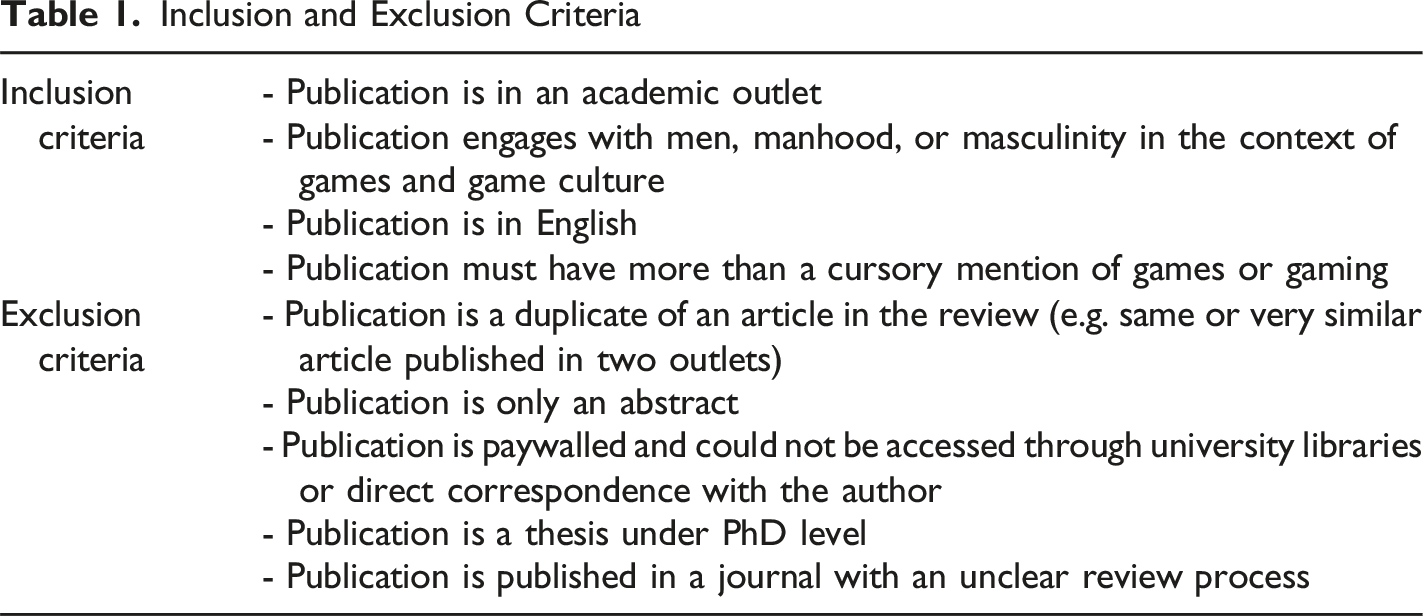
Following these criteria resulted in a selection of 422 items: 293 peer reviewed journal articles, 49 anthology chapters, 32 PhD dissertations, 31 full conference papers, and 17 academic monographs. We elected to exclude theses under PhD level (master’s or bachelor’s theses); although they may produce new and relevant academic knowledge, they typically do not go through a process of professional peer-review and revision. Because of this, they are not commonly accepted as academic sources in our national research cultures, for example.
The item selection process consisted of multiple rounds of review, during which each item was assessed by two researchers to determine its suitability for inclusion. If the two researchers disagreed in their assessment, all four researchers discussed the item in question until agreement was reached to either include or exclude the item. The final selection of items was collected in a spreadsheet, recording the article’s title and authors, the type, venue, and year of publication, research methods and data used, as well as article keywords and abstract where available.
Publications were most commonly published in media and communications studies journals (N = 76), followed by game studies journals (N = 61). As games research has a clear multidisciplinary orientation, it is not surprising that the third largest category was journals with an explicit multidisciplinary focus (N = 34). Other prominent disciplines were sociology (N = 26), computer science (N = 23), and psychology (N = 22). Research also appeared in journals located within other disciplines within the social sciences and humanities, such as arts and creativity, history, literary studies, performance studies, geography, and marketing.
Analysis
Corresponding to stages 4 (charting the data) and 5 (collating, summarising and reporting the results) in Arksey and O’Malley’s framework (2005), we present an analysis of the body of literature. We first provide a qualitative chronological overview of the works, followed by a categorisation of the works into central and peripheral ones, and explore the theoretical approaches in works we consider central.
The second half of our analysis is a quantitative breakdown of the distribution of works in terms of focus, perspective, and methodology. Together these two halves enable us to answer our research question and demonstrate the empirical and theoretical basis of our current understanding of men and masculinities in gaming.
Qualitative Overview
Academic literature on men, masculinities and gaming has grown and diversified over time, following the growth of both game studies and studies of men and masculinity. Research on men’s gaming – and gaming in general – was very limited in the 1970s, 1980s, and 1990s; of the 422 articles in the review, only 10 were published before the year 2000 (Figure 1). This is in part because of our limited access to early literature but also reflects the smaller cultural impact of gaming. Publication distribution by five-year increments until the first quarter of 2024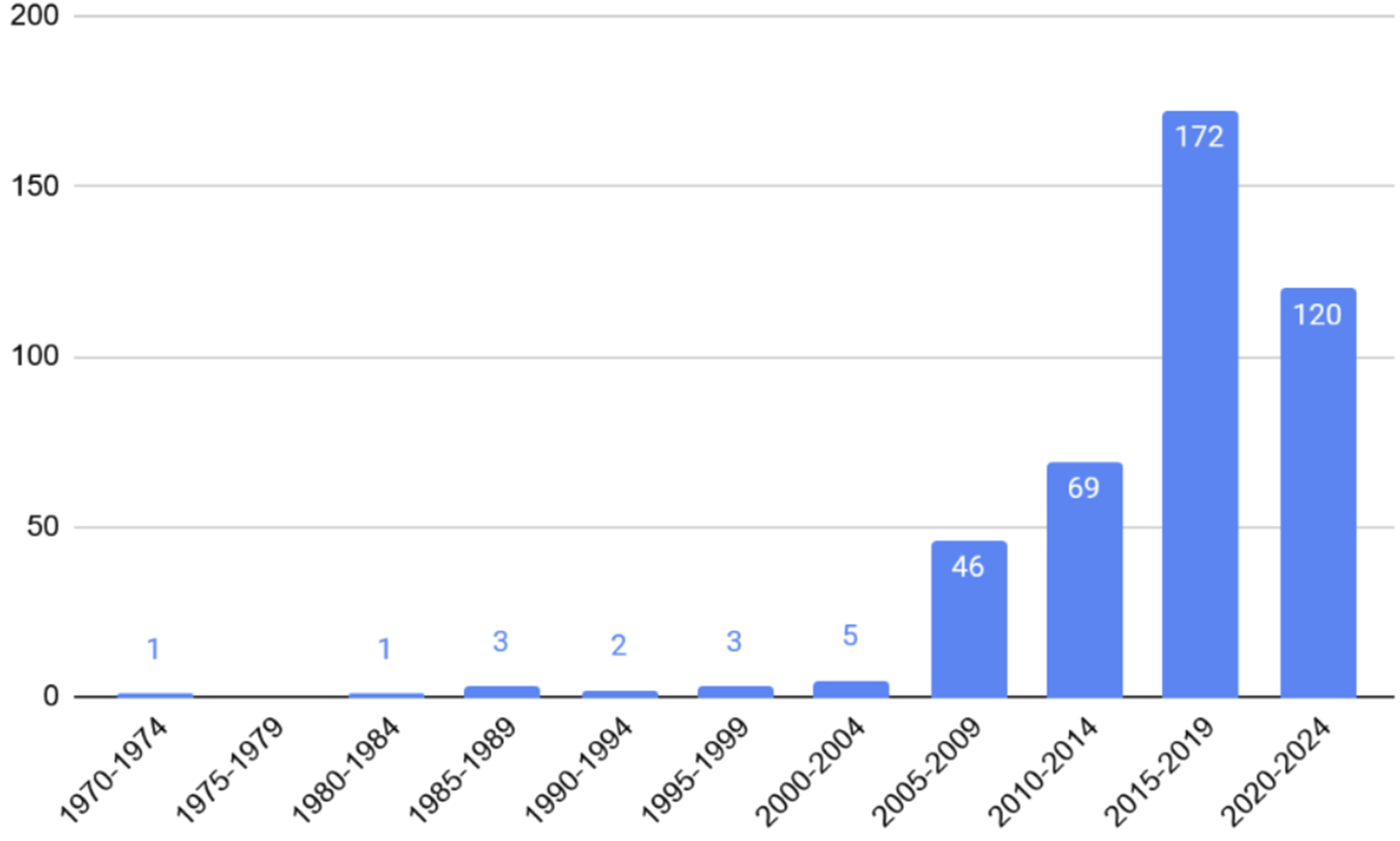
The earliest paper in this review was “Pinball as Game, Fad and Synecdoche” by Peter K. Manning and Bonnie Campbell (1973). The authors discuss the masculine traits their respondents assign to pinball, and explicitly connect men, masculinity, and gaming: “Pinball is a microcosm of life insofar as the attributes said to be required by a man to be successful are the same in both” (p. 345). This first publication stands out with its sociological focus on the social meaning of players’ experiences, but during the next two and a half decades, publications on games and masculinity were anchored in the effect studies tradition in media psychology. While some of these publications were published in outlets outside of the field of psychology (e.g., Alloway & Gilbert, 1998; Jantzen & Jensen, 1993), publications in this era reflect a discourse of worry about the potential harms of emerging gaming technology. The relation between masculinity, aggression, and gaming was in particular focus, although the research results were ambivalent about their connections (Dominick, 1984).
While certain studies address gender differences relating to attitudes towards videogames and new technology (Braun et al., 1986; Breakwell et al., 1986), others concern gender only because men were the only participants (Nelson & Carlson, 1985). Other studies address masculinity more explicitly through its association with aggression (e.g., Alloway & Gilbert, 1998; Dominick, 1984).
A shift from a psychological to a sociological perspective on gender and masculinity in gaming can be traced from the 1990s onwards. In their 1993 article, Jantzen and Jensen (p. 368) state that the computer game, unlike most of the other electronic media, is a distinctly gendered medium. … We are dealing with a medium that almost exclusively appeals to and is used by boys and young men.
Although their claim is ahistorical (see Kirkpatrick, 2017), the observation about the gendered nature of digital gaming is critically important and their exploration of gaming as a masculine pleasure is a marked departure from earlier research. The 1998 publication of From Barbie® to Mortal Kombat: Gender and Computer Games (Cassell & Jenkins, 1998) warrants a mention, as in addition to its groundbreaking addressing of gender in the context of digital gaming, it demonstrates a recurring phenomenon: the exploration of digital gaming as gendered focuses for the most part on the experiences of women, with a culture dominated by men as the context (see also Jenson & de Castell, 2010).
The 2000s saw a considerable increase in game scholarship, corresponding with the declaration of game studies as a discipline (see Aarseth, 2001). Following the discipline’s interest in the socio-cultural aspects of games, issues of gender were one of the first topics to spark an interest from a sociological perspective, especially with a focus on women. In terms of our review, there was a dramatic increase in the literature, with over 50 publications and much more diverse topics, such as the intersection of race and masculinity (Chan, 2005), masculinity in tabletop role-playing gaming (Fleischer, 2007), and representations of men and masculinity in games (Kirkland, 2009).
In the 2010s, research on men and masculinity in gaming continued its rapid growth, as part of an increasing understanding of gender diversity in game culture and connecting to broader societal discussions of men and masculinity, such as those spurred by the #MeToo campaign that gained considerable traction from 2017 onwards. In gaming, the much-publicised #Gamergate harassment campaign that started in 2014 made gendered harassment and discrimination particularly visible and invited increased research on gendered online abuse and the role of masculinity in it (e.g., Braithwaite, 2016; Salter, 2018), not least because women scholars within the game studies community were also attacked (Chess & Shaw, 2015; Mortensen, 2018; Mortensen & Sihvonen, 2020). Gamergate became an important reference point: over ten years after the event, work on gender in gaming commonly refers to the campaign as a key negative example of the intersections of gaming, men, and masculinity (e.g., Tomkinson, 2025).
The late 2010s saw the publication of several books that have become widely cited. Anastasia Salter’s and Bridget Blodgett’s Toxic Geek Masculinity in Media (2017) and Megan Condis’ Gaming Masculinity (2018) discussed the increasingly contested environments of geek and gaming culture and the gendered structures underlying Gamergate and other similar events. The collected volume Masculinities in Play (2018), edited by Nicholas Taylor and Gerald Voorhees, explored the many interwinings of masculinity and gaming culture and explicated the pessimism permeating much of the research on the topic, while Christopher A. Paul’s The Toxic Meritocracy of Video Games (2018) discussed how structural elements of masculine video game culture amplify gendered hostility.
In the 2020s the study on men and masculinities in gaming still appears to be increasing. In the first quarter of 2024, we identified 120 works on the topic published during the first half of the decade, pointing to continued interest. The work on men’s diverse identities has continued with explorations of for example trans and queer men’s gaming experiences (Brenner-Levoy, 2021; Medina, 2021). Growing interest in gaming phenomena has invited more gender perspectives on for example esports (Taylor & Stout, 2020) and excessive gaming (Gelūnas, 2023). As there is now a history of several decades for contemporary gaming culture, research on historical perspectives and nostalgia has also increased (e.g., Dashiell, 2022b).
Central and Peripheral Works
To focus our analysis, we have divided the corpus into central and peripheral works. In central publications (N = 225), understanding men and/or masculinities is the main motivation for the research, for example explicitly mentioned in the research question or otherwise being central to the empirical or analytical part of the research. An example is the article “The Meanings of Racist and Sexist Trash Talk for Men of Color: A Cultural Sociological Approach to Studying Gaming Culture” by Stephanie Ortiz (2019a), directly exploring men’s experiences through empirical data.
In peripheral publications (N = 197), men and masculinities are studied indirectly or as part of the context. An example is the article “Blurring the Boundaries: Using Gamergate to Examine ‘Real’ and Symbolic Violence Against Women in Contemporary Gaming Culture” by Kishonna Gray, Bertan Buyukozturk, and Zachary Hill (2017): it illuminates how a culture of masculine dominance negatively influences women in gaming.
The central/peripheral divide is also a factor in the quantitative analysis later in this review. The division into central and peripheral does not imply the academic quality or importance of these works, but their relevance in relation to the goal of this review.
Theories and Conceptualisations of Men and Masculinity
To understand the theoretical foundation of the body of research, we examined what theories and concepts related to masculinity and gender were present in the works. We focused on central works (N = 225), as we considered these particularly important in defining and guiding the theoretical basis for research on the topic. We excluded 8 review articles, for a final total of 217. One author identified the concepts and theories used by searching the documents using the search term masc*. If nothing surfaced with that search term, gender* was used next. If utilising a search tool was not possible, relevant sections (e.g., background, theoretical framework) were read by two of the authors. We identified 64 different types of masculinity, although with some unclarity over whether individual masculinity labels were intended as theoretical tools, a literary device, or a descriptive shorthand.
Our examination revealed the prominence of the theory of hegemonic masculinity in the literature. Starting in 1998 (Alloway & Gilbert, 1998) nearly half (N = 106) of the works mentioned hegemonic masculinity, although its use ranged from offhand mentions to publications structured around the theory (see Messerschmidt, 2012). Raewyn Connell’s influential theory (Connell, 1987; Connell & Messerschmidt, 2005) suggests that there are multiple masculinities and hegemonic masculinity is the dominant configuration of desirable traits and qualities for securing the continuation of patriarchy and men’s dominance over women. Hegemonic masculinity is not a static set of traits; what constitutes hegemonic masculinity varies and can be contested by other forms of masculinity and other genders (Connell & Messerschmidt, 2005). Extremely influential in men’s studies (Mellström, 2023; Wedgwood, 2009), the theory has also been extensively debated and criticised for example for categorising masculinities into absolutes (Waling, 2019a) and for focusing on the concept of masculinity over men’s practices (Hearn, 2004).
In our corpus, hegemonic masculinity was first mentioned in 1998 (Alloway & Gilbert, 1998). It was subsequently consistently utilised throughout the years, often coupled with different kinds of subordinate or resistant masculinities, for example geek (Trammell & Crenshaw, 2020), nerd (Young, 2014), or gamer masculinity (Dashiell, 2022a). These masculinities were seen as a way to transform and adapt hegemonic masculinity in the context of gaming without challenging men’s hegemonic position (see Bridges & Pascoe, 2014). Additionally, a plethora of other masculinities were identified in relation to gaming, used both together with hegemonic masculinity and without. These included, but were not limited to, toxic (Maclean, 2016), militarised (Mirrlees & Ibaid, 2021), sporting (Witkowski, 2013), and neoliberal masculinity (Voorhees & Orlando, 2018).
Games, game characters, and game cultures were also often (N = 52) described via the concept of hypermasculinity. The term has its roots in psychology, in the work Donald L. Mosher and Mark Sirkin (1984). Hypermasculinity is often “identified within macho assemblage, expressed as stoicism, hardness, forcefulness and rebelliousness” (Hickey, 2016, p. 1), with features such as having “calloused sex attitudes toward women”, seeing “violence as manly”, and finding “danger as exciting” (Mosher & Sirkin, 1984, p. 150). In sociology, rather than a fixed trait, hypermasculinity is a storyline or image of extreme masculinity that individuals perform to different degrees depending on situations; certain products of popular culture can also be hypermasculine (Hickey, 2016). In our corpus, the concept was usually used without referring back to any particular use or theory. When references were used, these were usually to other works examining hypermasculinity and games. The first mention of hypermasculinity in our corpus was by Henry Jenkins (1998) in the book From Barbie® to Mortal Kombat (Cassell & Jenkins, 1998), and the term was consistently present in our corpus throughout the years.
Another key theoretical framework that was repeatedly (N = 29) mentioned was Judith Butler’s (1990) gender performativity. A key poststructuralist gender theory, gender performativity suggests that gender is socially constructed through repeated gendered acts. The first mention of gender performativity in our corpus was in a 2005 research article by Caroline Pelletier (Pelletier, 2005). Gender performativity was present in the corpus in particular before 2019, after which it featured less prominently.
In 29 publications, masculinity and gender were not explicitly defined through any theory or concept. It was also unclear whether some concepts, such as toxic masculinity, were intended to be theoretical formulations or if they were mainly descriptive shorthands.
Quantitative Overview
Quantitative Overview of Publications
Focus
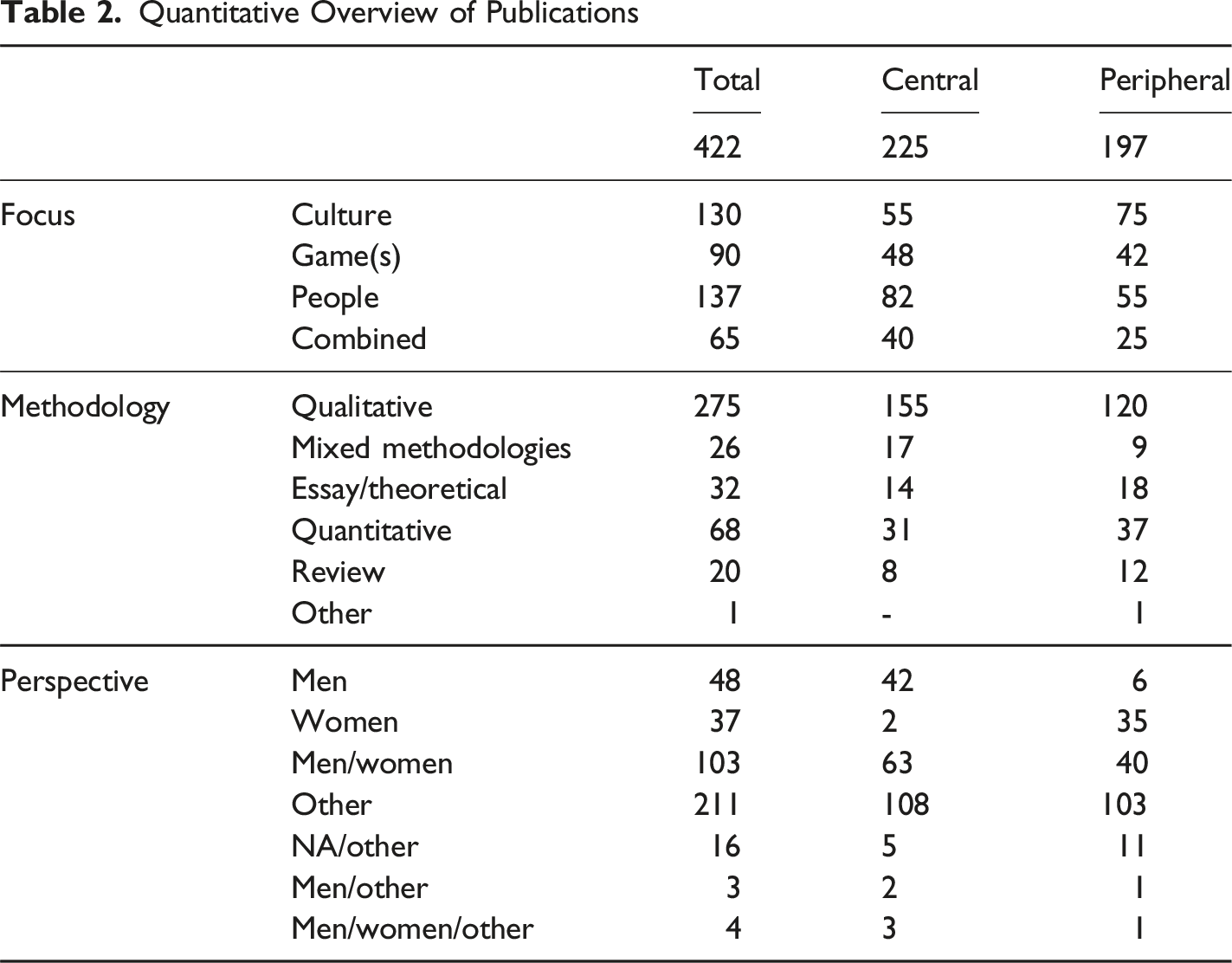
We identified whether each individual paper primarily focused on people, games, culture, or a combination of these. The people category (N = 137, 32.5%) indicates a focus on questions of how people, typically players, address issues related to men or masculinity in gaming. The games category (N = 90, 21.3%) focuses on games and their representations of gender and masculinity. The culture category (N = 130, 30.8%) concerns research on the influence and presence of men and masculinity in gaming culture, as well as the impact of aspects of gaming on culture more broadly. A number of studies (N = 65, 15.4%) combined multiple foci.
Methodology
Research was overwhelmingly qualitative with nearly two-thirds of the works (N = 275, 65.2%) featuring qualitative methods. What we have labelled qualitative are empirical studies covering research approaches such as interviews, participatory observations, and qualitative content analysis and discourse analysis. Quantitative studies cover surveys and psychological experiments (N = 68, 16.1%). Mixed methodologies combine quantitative and qualitative methods (N = 26, 6.2%), while essay/theoretical are either argumentations and analyses drawing on existing research instead of original research data, or academic commentaries on cultural trends and phenomena (N = 32, 7.6%). Reviews are studies that analyse and consolidate existing research (N = 20, 4.7%). 1 publication (0.2%) was categorised as “other”, as it did not fit any of the categories above.
Perspective
Perspective indicates the viewpoint from which the research was conducted. The categories men, women, and men/women indicate whether men’s, women’s, or both genders’ experiences form the central empirical basis 2 . Examples of research featuring such perspectives are interviews, surveys, and autoethnographies.
The category other indicates that the research is based on something other than empirical data on people’s experiences, such as essays and theoretical research, as well as textual analysis and discourse analysis 3 . In this category we have also placed studies in which the observed participants have not been allowed to articulate their experiences. The categories men/other and men/women/other indicate studies where a combination of perspectives has been used, most typically player experience data in combination with textual analysis. We have placed studies where human generated data is used but the gender of the participants is unclear in the category NA/other. An example of this are discourse analyses of pseudonymous social media data.
In our corpus, studies based on other data sources dominate with 211 (50%) publications. 158 (37.4%) studies drew on men’s experiences in combination with women’s experiences or other data, while 48 (11.4%) publications were based on men’s experiences alone. 37 (8.8%) of the studies were based on women’s experiences. The corpus also includes 16 (3.8%) studies in which the sources’ gender is unclear.
Central Works on Men and Masculinities
Focus, Perspective, and Methodology in Central Works on Men and Masculinities in Gaming
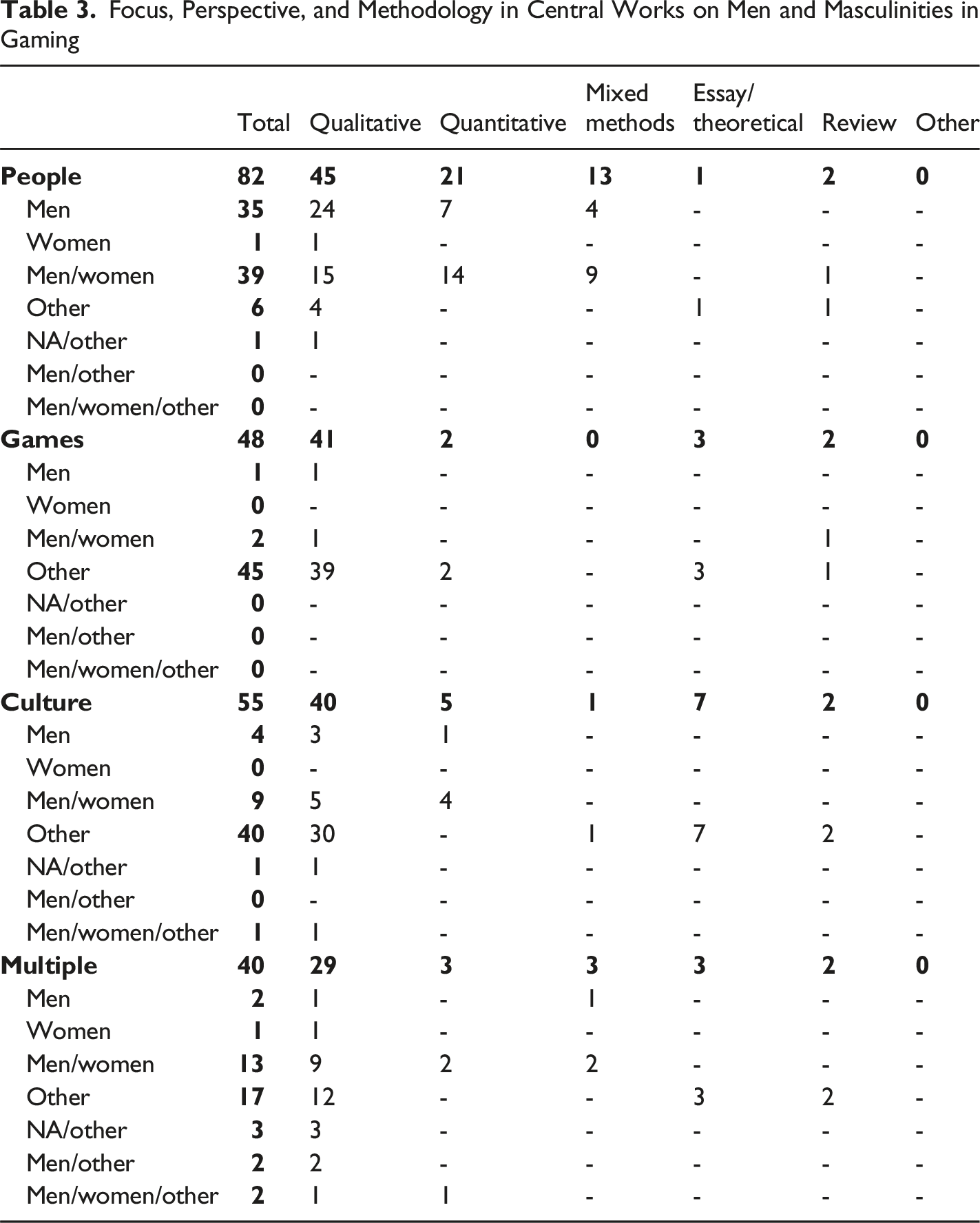
In a multidisciplinary field spanning the humanities, social sciences, and beyond, it may not be surprising that half of the research is based on analysis of texts and secondary data, while the other half is based on human research. We next look at the granularity of the data to better understand this finding.
When considering the men’s gendered experiences, the people category is the most relevant; this body of research focuses on questions directly relating to how men engage with issues of manhood and masculinity in gaming. Over a third (N = 82, 36.4%) of the central publications are in this category, and of these, the vast majority (N = 74) feature men’s experiences either exclusively (N = 35) or in combination with women’s experiences (N = 39).
The games (N = 48, 21.3%) and culture (N = 55, 24.4%) categories are similar in size, both heavily leaning on textual and discourse analyses. This is also the case with the multiple category (N = 40, 17.8%), although the category also features several (N = 13) studies that feature both men’s and women’s perspectives.
In terms of methodology, qualitative studies are by far the most frequent (N = 155, 68.9%), followed by quantitative studies (N = 31, 13.7%), mixed methods (N = 17, 7.5%), essays (N = 14, 6.2%), and reviews (N = 8, 3.5%). While studies are widely distributed across methods, the three most prevalent types are qualitative studies of games using non-human data (e.g., close readings of games), followed by qualitative studies of game culture using non-human data (e.g., textual analyses of gaming media), and qualitative studies focusing on men (e.g., interviews of gaming men).
While men and masculinities in gaming are broadly studied using a wide range of approaches, the low numbers (1–3) of occurrence in many categories suggest that there are still considerable gaps in the research. The clustering of qualitative studies centered on people likely reflects the fact that this research comes out of the human and social sciences and an epistemological tradition that strongly supports the idea that people can best be understood through their own experiences.
Peripheral Works on Men and Masculinities
Focus, Perspective, and Methodology in Peripheral Works on Men and Masculinities in Gaming
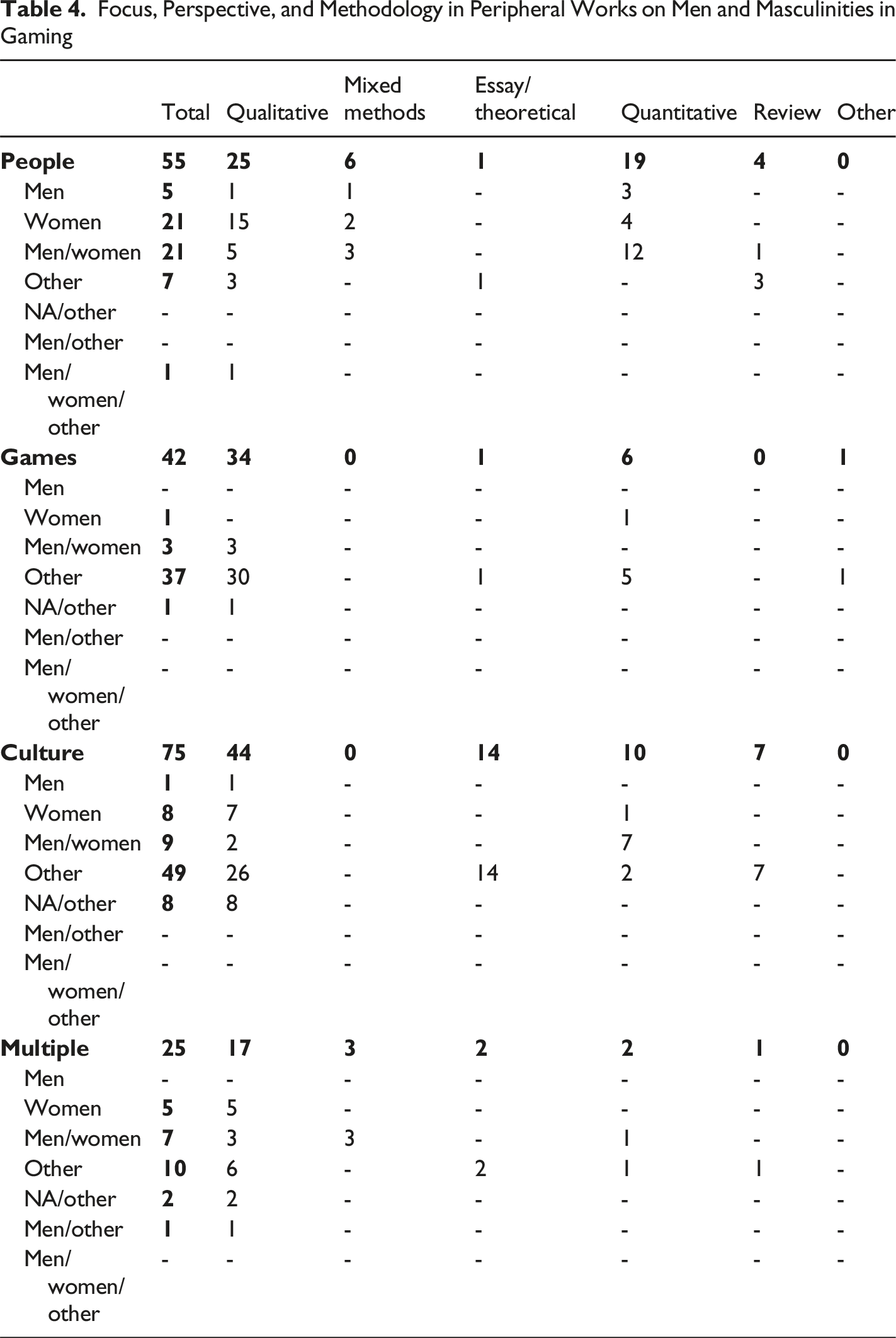
Over a third of the publications (N = 75, 38.7%) are in the culture category, followed by people (N = 55, 27.9%) and games (N = 42, 21.3%). Finally, 25 publications (12.7%) combine multiple categories.
The prominence of the culture category is unsurprising since most publications here are grounded in an understanding of gaming as a masculine domain. Within this category, a single study focused on men’s experiences, compared to 49 studies utilising other approaches and 9 that included both men’s and women’s perspectives. Within the people category, only 6 of the studies feature only men’s perspectives, compared to 22 publications that combine men’s and women’s perspectives and 21 that are based on women’s experiences. In the games category, there are a few individual studies utilising human data, with the rest being mainly game analyses.
As with the central works, qualitative methods were the most frequently used by a wide margin (N = 120, 60.9%), followed by quantitative studies (N = 37, 18.8%), essays and theoretical works (N = 18, 9.1%), reviews (N = 12, 6.1%), and mixed method studies (N = 9, 4.6%). Similarly to central works, peripheral works were widely distributed among methods.
Discussion
As discussed in the introduction of this article, men have long been not just the dominant demographic in gaming, but, more importantly, the norm when it comes to gender in game culture. Despite and because of this, men’s gender has remained essentially invisible while they have been ubiquitous in empirical player research. Historically, gender-focused research on gaming culture has focused on women, a group initially invisible and perennially under the most pressure. This focus also explains why men and masculinities have been at the periphery of, rather than excluded from, the research: men’s practices and masculine gaming cultures form the backdrop for most game culture participation, and studies of women in game culture have repeatedly indicated that these factors are central to the problems women encounter.
Since the 1970s, scholarly interest in the intersections of men, masculinity, and gaming has steadily grown alongside – and as part of – the broader field of men’s studies. The increasing relevance of online environments, the growth of the gaming industry, the growing diversity of game culture and pushback against it, concerns over young men’s reactionary views, and prominent discussions of men and masculinity in mainstream media are all factors that make the topic both timely and increasingly relevant for game and gender scholars alike.
Based on our review, the empirical basis for our current understanding of men and masculinities in gaming consists of a wide range of research with diverse methods, data, and foci, from qualitative analyses of games and gaming media to surveys and interviews of players of different genders. The topic is neither marginal nor particularly prominent: 422 English-language publications, of which we consider 225 to be central, is a notable body of literature. However, when we consider that these publications are spread out over five decades and take into account the sporadic nature of the research, it is obvious that there are still considerable gaps in our knowledge. Furthermore, we wish to draw attention to four features of the literature that in our view warrant further consideration.
The first feature is the plurality of masculinity concepts and types. With over 60 different masculinities mentioned in the corpus, the current body of research provides rich insight into different masculinities as sets of practices and power structures that permeate and shape men’s life in the context of gaming. Although this plurality of masculinities indicates a richness of perspectives and intellectual diversity, men’s studies scholars have also criticised the practice of creating and recreating new, sometimes vaguely defined, models and typologies of masculinity, with Michael A. Messner noting the risk of constructing ever more granular categories with diminishing explanatory value over two decades ago (Messner, 2004). In more recent scholarship, Andrea Waling (2019b) has noted masculinity categories may result in men’s conduct being framed as being determined by the practices of a given type of masculinity, disregarding men’s agency and emotional reflexivity, while Jonathan A. Allan (2022), drawing on the work of Eve Kosofsky Sedgwick, has pointed out that typology approaches may lead masculinity scholars to close off any possibility of surprise when observing phenomena, resulting in reductive and diagnostic understandings of masculinity.
The second feature concerns the theoretical basis for our understanding of men, masculinities, and gaming. Our review reveals the prominence of Connell’s highly influential and broadly adopted theory of hegemonic masculinity. The frequent appearance of the theory, present in some way in nearly half of the central works, is unsurprising given the strong position it holds overall in men’s studies (Mellström, 2023; Messerschmidt, 2012; Messerschmidt & Bridges, 2024). A more detailed and comparative analysis would be required to discern whether the theory is particularly prominent in game scholarship on gender, or if it simply reflects the field of men’s studies overall. Future studies could also explore in detail how commonly the concept of hegemonic masculinity is at the core or peripheral to studies that utilise it (see Messerschmidt, 2012); our findings point to this distinction in the literature, but a detailed analysis is beyond the scope of this review.
While the above caveats need to be taken into account, our review warrants the question of whether research on men, masculinities, and gaming is overly reliant on a single theory and its derivatives, especially as we know that, in men’s studies overall, hegemonic masculinity theory is often used inconsistently (Messerschmidt, 2012) and the concept of hegemonic masculinity is muddied by interpretations that sometimes grossly deviate from Connell’s original intent (Connell & Messerschmidt, 2005; Messerschmidt, 2012; Messerschmidt & Bridges, 2024). We wish to stress that this is not a criticism of hegemonic masculinity theory nor do we advocate abandoning it. However, from the perspective of theory diversity, research on men and masculinities in gaming could benefit from a broader range of theoretical approaches moving forward (see also Allan, 2022), whether used instead of hegemonic masculinity theory or alongside it. For example, Todd Reeser and Lucas Gottzén (2018) point to the importance of acknowledging affect when trying to understand contemporary masculinity, which could be a fruitful direction considering the high affective load often present in both the act of gaming and game culture more broadly (Meriläinen & Ruotsalainen, 2024). Queer theory could not only help interrogate the experiences of marginalised gaming men, but also find ways to disrupt, escape, and dismantle constricting masculine norms and gendered hierarchies in gaming (e.g., Harper et al., 2018). Claire Duncanson’s (2015) suggestion of hybrid masculinities as a necessary step in the dismantling of gender hierarchy also offers a new perspective compatible with much of previous literature considering its grounding in the theory of hegemonic masculinity.
Third, it is notable that more than one in ten central works did not engage with existing theories and concepts of men and masculinity despite explicitly focusing on these topics. This suggests that masculinity (and perhaps gender at large) is somewhat undertheorised in game scholarship. Another potential explanation for this are different disciplinary conventions: while we are looking at men and masculinities in gaming, not all the work in our corpus falls within the discipline of game studies. Depending on the given discipline or research tradition, evoking theories of men or masculinity might not be within scope or convention (see Breslin & Wadhwa, 2018). This highlights the interdisciplinary nature of the study of games and gaming. Regardless of the motives, this observation highlights the need for systematic theorisation in relation to games, men, and masculinity.
Finally, what we also consider could be improved upon going forward is the currently limited research on men’s lived experience of gendered game culture participation. Although there is an impressive diversity of academic work on the many ways that masculinity and gaming intersect, whether in game narratives, the representations of men’s bodies, or the gendered meritocracy of gaming communities, there is a knowledge gap between our understanding of masculinity as a set of practices and how it is experienced as part of men’s lives (see Waling, 2019b). Research on masculinity as practice and structure is crucial to understanding the deep imprint of masculinity on gaming and how it shapes both gaming culture and individuals’ experiences of it. However, it is our view that this research would benefit from complementary research approaches that further explore masculinity as embodied and the many complex negotiations that this entails.
While masculinity is much more than embodied experiences, these experiences are a core part of it (e.g., Connell & Messerschmidt, 2005) and can provide considerable insight when we seek to understand the interplay of men, masculinity, and gaming culture. Overlooking this aspect may inadvertently limit the potential for novel readings of men and masculinities, especially if it is combined with a typology approach as discussed above (see Allan, 2022). For example, Jeremy Brenner-Levoy’s (2021) study on trans men’s gaming experiences complicates our understanding of marginalised men in gaming, illustrating how, despite structural oppression, gaming can provide a sanctuary for trans men in which to experiment with idealised selves and more easily present as men. Stephanie Ortiz (2019b) demonstrates how masculinity expectations influence how men of colour cope with everyday racism in games, while Kristina Bell, Christopher Kampe, and Nicholas Taylor (2015) show how gameplay can be leveraged to interrogate and discuss masculinity. Approaches such as these render men into complex agents instead of only beneficiaries or victims of masculinity (see Waling, 2019b), and, consequently, illustrate the complexities, both positive and negative, of the intersection of men, masculinities, and gaming.
In our view, a further benefit of exploring men’s experiences is that it renders men’s gender more visible and plausibly shifts more responsibility onto them for addressing gendered game culture problems such as gender discrimination. If research on gender in gaming only positions marginalised groups as active agents, it risks further reinforcing the notion that dominant men and their conduct simply exist governed not by choice but by the mechanics of masculinity. This approach can disembody men from masculinity (see McCarry, 2007), absolving dominant men of responsibility and pushing the responsibility for changing game culture on marginalised groups. As per Kimmel (1993), the invisibility of masculinity perpetuates gender-based inequality both between men and women and between dominant and marginalised groups of men. This is particularly important to note when considering the common notion among gaming men that offline identities do not matter in digital settings (Condis, 2015; Siutila & Havaste, 2019) as well as the history of invisibility of men’s gender in game scholarship.
We agree with the notion that if we wish to understand gendered power relations, it is necessary to study the powerful (see Messerschmidt, 2005), and, despite increasing diversity over the years, in most domains of game culture this currently means men. There are considerable differences in the game culture experiences of different groups of men based on for example gender identity, sexual orientation, and race (e.g., Brenner-Levoy, 2021; Medina, 2021; Ortiz, 2019a,b), and even in dominant groups of gaming men there is great variety in views and experiences grounded for example in different life histories and socioeconomic variables (e.g., Meriläinen & Ruotsalainen, 2023). This diversity needs to be teased out to understand and address questions of gender in gaming culture; the hypermasculine cultural norms that oppress marginalised game culture actors also constrain and police men and their gender performance. To quote Connell and Messerschmidt (2005, p. 852), “Without treating privileged men as objects of pity, we should recognize that hegemonic masculinity does not necessarily translate into a satisfying experience of life.”
Strengths and Limitations
Our review presents a comprehensive account of the research on men and masculinities in gaming to date. Our research question was intentionally broad to capture as much relevant literature as possible, and we are confident that our study presents a realistic overview of the topic and identifies key facets. All of the authors have academic expertise in game studies and gender in game culture, which allowed us to draw on a broad, contextualised understanding on the field.
Although we followed a clear, systematic process in our review, there are inevitably works that we have missed during our research. Our review also only addresses English language literature, leaving a body of literature in other languages, including our native languages, unexplored. The review also does not include works that were not available digitally.
The form of scoping review we opted for is a descriptive account of existing literature and thus does not assess the quality or claims of individual studies or attempt to provide a synthesis of their results (see Arksey & O’Malley, 2005). Going forward, many topics in our review should be explored in depth, such as the role and relevance of hegemonic masculinity theory in game scholarship. Our approach is also evident in the lack of granularity in some sections: detailed breakdowns and analyses of categories such as “people” or “culture” could well constitute review articles of their own. Finally, while we have been transparent about our review process, following a systematic reporting convention such as PRISMA-ScR (Tricco et al., 2018) would have further improved the quality of our reporting.
Conclusions
Through a review of existing literature between 1973 and 2024, we have demonstrated that the research concerning men and masculinities in the context of game culture has grown steadily throughout this time period, and there is great diversity in research methods, topics, and data. In terms of theory, research on the topic has followed broader trends in men’s studies, with an emphasis on the theory of hegemonic masculinity and theories derived from it, but there is also potential conceptual unclarity stemming from a wide range of masculinity concepts. Although understandable in light of the broader field of men’s studies, we suggest considering the potential risks stemming from lack of theory diversity and masculinity typologies to ensure research diversity and renewal going forward. Furthermore, a portion of research that does not connect to men’s studies theorisation points to a relative lack of familiarisation with existing work on the topic.
Finally, it is our view that the topic would benefit from more studies utilising empiria on men’s experiences of game culture, to build a more complete picture of men’s game culture participation. We suggest that scholars diversify research in terms of both theory and empiria for a more comprehensive understanding of men, masculinities, and gendered dynamics in game culture.
Footnotes
Acknowledgments
The authors would like to thank the anonymous peer-reviewers for their valuable comments.

Ethical Considerations
Ethical approval was not required for this review study as per the authors’ national guidelines.
Funding
The authors disclosed receipt of the following financial support for the research, authorship, and/or publication of this article: this work was partially supported by the Research Council of Finland (grant numbers 353265, 353267, 363869) and the Research Council of Norway (grant numbers 332643, 335530).
Declaration of Conflicting Interests
The authors declared no potential conflicts of interest with respect to the research, authorship, and/or publication of this article.
Data Availability Statement
The review data can be requested from the corresponding author and will be made publicly available.