




Abstract
A multiple baseline across participants design was used to examine the functional relation between the Self-Determined Learning Model of Instruction (SDLMI) intervention and the on- and off-task behaviors of high school students with emotional and behavioral disorders (EBD). The results showed that all four students significantly increased on-task behaviors and decreased off-task behaviors and all four participants maintained the increase of on-task behaviors and the decrease of off-task behaviors after the intervention was withdrawn. All four students made progress toward their goal of implementing on-task behavior in the classroom and generalized on-task behavior to a second general education classroom. The study provides evidence of effective self-determination instruction that supports students to improve their behavior in a general education classroom. Implications for practice and future research are provided.
Students identified with emotional and behavioral disorders (EBD) face significant challenges in school and during the transition to adulthood (Mooney, Epstein, Reid, & Nelson, 2003; Rivera, Al-Otaiba, & Koorland, 2006). Compared with their peers with other disabilities, these students experience higher rates of absenteeism and course failure and lower grade point averages (Benitez, Lattimore, & Wehmeyer, 2005; Wagner & Blackorby, 1996; Wagner, Newman, Cameto, Levine, & Garza, 2006). Research has suggested that not completing high school is a predictor of poor adult outcomes (Mooney et al., 2003; Wagner & Blackorby, 1996), and students with EBD have a dropout rate between 43% and 61% (U.S. Department of Education, 2004; Wagner et al., 2006) and an incarceration rate of 43% within 5 years of graduation (Wagner et al., 2006).
The in-school and post-school challenges faced by students with EBD have not gone unnoticed (Lane & Carter, 2006). Lane and Carter (2006) suggested that limited social, behavioral, academic, and vocational skills impact the outcomes of students with EBD; other researchers cite the strong relationship between high absenteeism, poor academic outcomes, and problematic behaviors (e.g., off-task behavior, inappropriate communication, aggression) for students with EBD. Another leading factor often cited as contributing to the poor academic and post-school outcomes for student with EBD is a lack of preparation in high school for adult life (Lane & Carter, 2006; U.S. Department of Education, 2004; Wagner & Blackorby, 1996). Planning for life after high school (transition planning) should include both vocational training and college preparation. Both are positive motivators for keeping students with EBD in school and strong indicators of positive life outcomes for this population (Carter, Lane, Pierson, & Glaeser, 2006; Lane & Carter, 2006). Increasingly, researchers have cited the importance of self-determination (Carter et al., 2006) and active student involvement in Individualized Education Program (IEP) or transition planning meetings (Arndt, Konrad, & Test, 2006; Powers et al., 2001; Snyder & Shapiro, 1997) as key components of transition planning and the achievement of valued adult outcomes for students with disabilities, including EBD. However, research also suggests that students with EBD tend to experience lower levels of self-determination and receive inadequate instruction in this area (Carter et al., 2006).
Wehmeyer (2005) defined self-determination as “volitional actions that enable one to act as the primary causal agent in one’s life and to maintain or improve one’s quality of life” (p. 17). Self-determined behavior is characterized by four essential characteristics: (a) acting autonomously, (b) engaging in self-regulated behavior, (c) responding to events in a psychologically empowered manner, and (d) acting in self-realizing manner (Wehmeyer, 1999, 2005). Students develop self-determined behavior over time as they acquire key skills and attitudes associated with self-determination, including choice-making skills, decision-making skills, problem-solving skills, goal-setting and attainment skills, self-management skills (i.e., self-monitoring, self-evaluation, and self-reinforcement skills), self-advocacy and leadership skills, self-efficacy, self-awareness, and self-knowledge.
To teach the skills associated with self-determined behavior, a number of instructional strategies and curricular models that (a) focus on teaching specific skills such as choice making or self-advocacy or (b) focus on self-determination globally and teach multiple skills concurrently that lead to self-determined behavior (decision making, goal setting, self-management skills, etc.) have been developed. Researchers have suggested that students with EBD may particularly benefit from developing self-regulation skills, particularly self-management skills (Benitez et al., 2005). One intervention that has received attention in the literature is the Self-Determined Learning Model of Instruction (SDLMI; Wehmeyer, Palmer, Agran, Mithaug, & Martin, 2000). The SDLMI targets all of the component elements of self-determined behavior, in particularly self-regulation skills (Wehmeyer et al., 2000). The SDLMI can be overlaid on any curricular area and used to teach students a self-regulated, problem-solving process that they can apply to setting a goal, taking action toward that goal, and evaluating their progress. Wehmeyer et al. (2000) used the SDLMI with students with intellectual disability, learning disabilities, and EBD in a special education setting. Students learned to use the SDLMI to set and take action on goals targeting social skills, behavioral issues, and academic needs, and they made significant progress on achieving their goals. In another study using an adaptation of the SDLMI, The Self-Determined Career Development Model (SDCDM) Benitez et al. (2005) implemented the SDCDM with students with EBD in an alternative school setting to teach students to self-manage their progress toward career and employment goals. Students learned to use the SDCDM to increase their on-task and reduce their off-task behaviors in work settings.
Researchers have suggested the importance of teaching self-determination skills to students with EBD directly or by incorporating self-determination into the curriculum (Benitez et al., 2005; Martin et al., 2003; Test, Fowler, Brewer, & Wood, 2005). They assert that self-determination is a critical factor in efforts to address the poor school and postschool outcomes of all students with disabilities—citing the impact of self-determination interventions on academic, behavioral, and transition outcomes in other disability populations (Algozzine, Browder, Karvonen, Test, & Wood, 2001; Carter et al., 2006). Recent reviews of the literature suggest that students with disabilities, including EBD can learn and apply self-determination skills (Algozzine et al., 2001; Chambers et al., 2007). However, Algozzine et al.’s (2001) meta-analysis found that past research was primarily focused on students with learning disabilities and intellectual disability. Very few self-determination studies have included participants with EBD. More recently, Chambers et al. (2007) cited only three studies that contained students with EBD in their review of the literature on global self-determination. And, in the small body of research that has targeted students with EBD, the dependent variables have been limited and no studies have explored teaching students with EBD to use the SDLMI or SDCDM in a typical school setting.
Therefore, the purpose of this study was to extend current research and examine the effects of teaching self-determination skills to adolescent students with EBD on behavior outcomes in typical school and classroom settings. Specifically, we examined the impact of teaching self-determination skills to adolescents with EBD in a public school setting using the SDLMI. The SDLMI incorporates instruction in key skills associated with self-determination, teaches students a self-regulated problem-solving process (Wehmeyer, 1999), and can be used to target a variety of student goals, including behavioral goals. Specifically, the study investigated the following research questions:
Method
Participants
Four adolescent students with EBD were recruited from two high schools within a single midsize suburban school district in the Southwest. Two students were enrolled in each high school. The school district designated the high schools that participated and the student participants were selected from a pool nominated by the special education teachers at each campus according to the following criteria: (a) a diagnosis of EBD based on a Full and Individual Evaluation (FIE) conducted by a Licensed Specialist in School Psychology (LSSP) and determined by the Multi-Disciplinary Team (MDT) to need special education instruction; (b) received instruction in a self-contained resource room for at least one period of the day; (c) received instruction in at least one core academic area in a general education classroom (e.g., math, science, English, social studies) and received instruction in at least one additional general education classroom (e.g., foreign language, drafting, art) where they exhibited difficulties with meeting classroom behavioral expectations; (d) maintained minimum attendance requirements necessary to attain core academic credits in the State of Texas (attend 90% of days offered) during the present semester; and (e) consent forms were signed by a parent/guardian and assent forms signed by the student.
Charles was a 16-year-old 10th-grade Caucasian male. He had an IQ of 118 (Woodcock–Johnson III Battery [WJIII]) and was eligible for free and reduced lunch. Charles carried secondary educational diagnosis of specific learning disability in basic reading, math calculation, math reasoning, and written expression. He had never been retained and took no prescribed medications during this study. Charles had a Behavior Intervention Plan (BIP; see Table 1 for target behavior and strategies) that was not implemented in the general education classrooms during the researcher’s observations.
Behavior Intervention Plan.
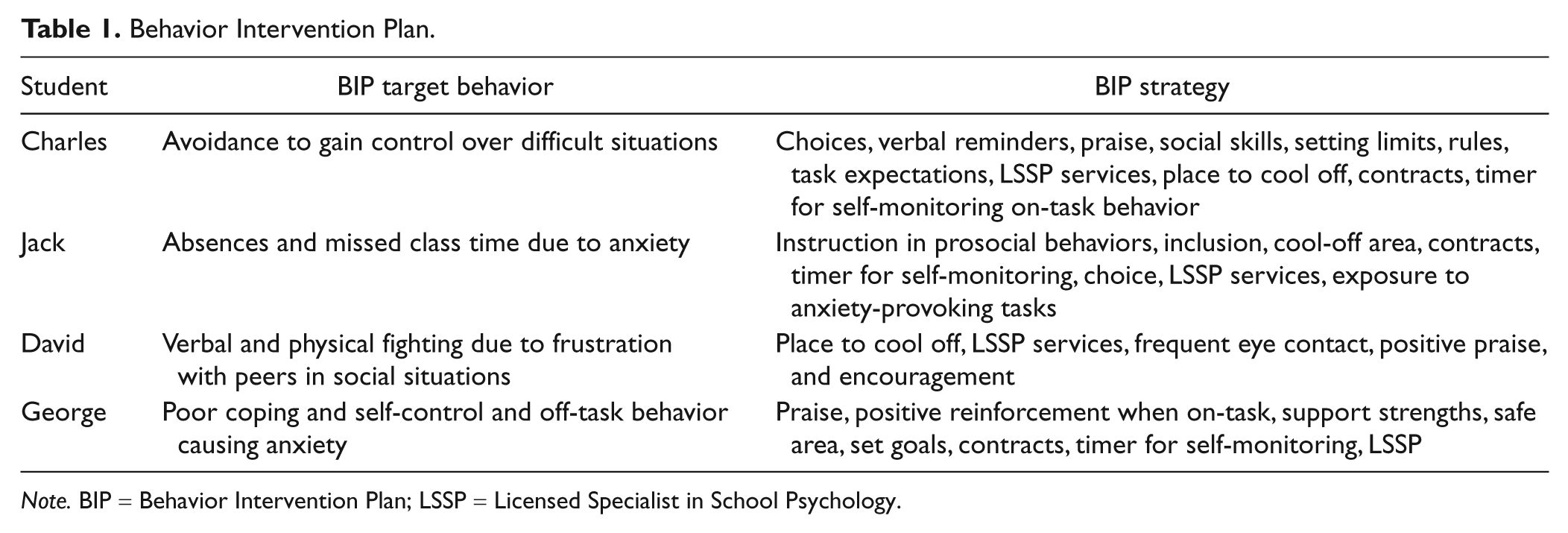
Note. BIP = Behavior Intervention Plan; LSSP = Licensed Specialist in School Psychology.
Jack was a 16-year-old 10th-grade Caucasian male with an IQ of 105 (WJIII). He was not eligible for free and reduced lunch and had no history of being retained. A psychiatrist diagnosed Jack with depressive disorder, anxiety disorder, and cognitive disorder–processing speed discrepancy. The psychiatrist indicated that Jack might have schizophreniform disorder due to paranoid thinking and occasional auditory hallucinations. Jack was on a number of medications for depression and attention-deficit disorder (ADD). Jack’s BIP (see Table 1 for target behavior and strategies) was only partially implemented in the general education classroom. The researcher observed Jack accessing the “cooling off” area and receiving psychological services.
David was a 9th-grade 14-year-old Caucasian male. He had an IQ of 89 (Wechsler Intelligence Scale for Children III [WISCIII]), was eligible for free and reduced lunch, had no history of retention, and was on no medication. David had a secondary educational diagnosis of specific learning disability in basic reading, reading comprehension, math calculation, math reasoning, and written expression. An academic evaluation conducted by the school during this study indicated that David functioned on a kindergarten level in reading and writing. As a result, David was moved from general education to resource English. David’s BIP (see Table 1) was not observed to be regularly implemented in the general education classroom.
George was an 11th-grade 16-year-old Caucasian male. George had an IQ of 104 (WJIII), was not eligible for free and reduced lunch, and had no history of retention. George had a history of seizures as a child and was on prescription medications including Zoloft for his anxiety and another medication for a nerve problem in his leg that was unrelated to his anxiety or EBD. George had a BIP (see Table 1 for target behavior and strategies) that was not routinely implemented in the general education classroom based on the researcher’s observations.
Setting
A midsize suburban school district in the Southwestern region of the United States served as the site for this study. The special education director granted the researcher permission to conduct this study. The special education transition coordinator was designated by the director to coordinate the research activities and make recommendations to the researcher on possible sites and personnel. Two high schools and two special education teachers who served as campus behavior specialists agreed to participate in the study. All assessments and SDLMI student instruction were conducted in a quiet corner of the self-contained behavior support classroom where students received pull-out services. Data collection occurred in a targeted and nontargeted (generalization) general education classroom.
Dependent Variables and Measures
To address the research questions, three dependent measures were employed.
On-task behavior
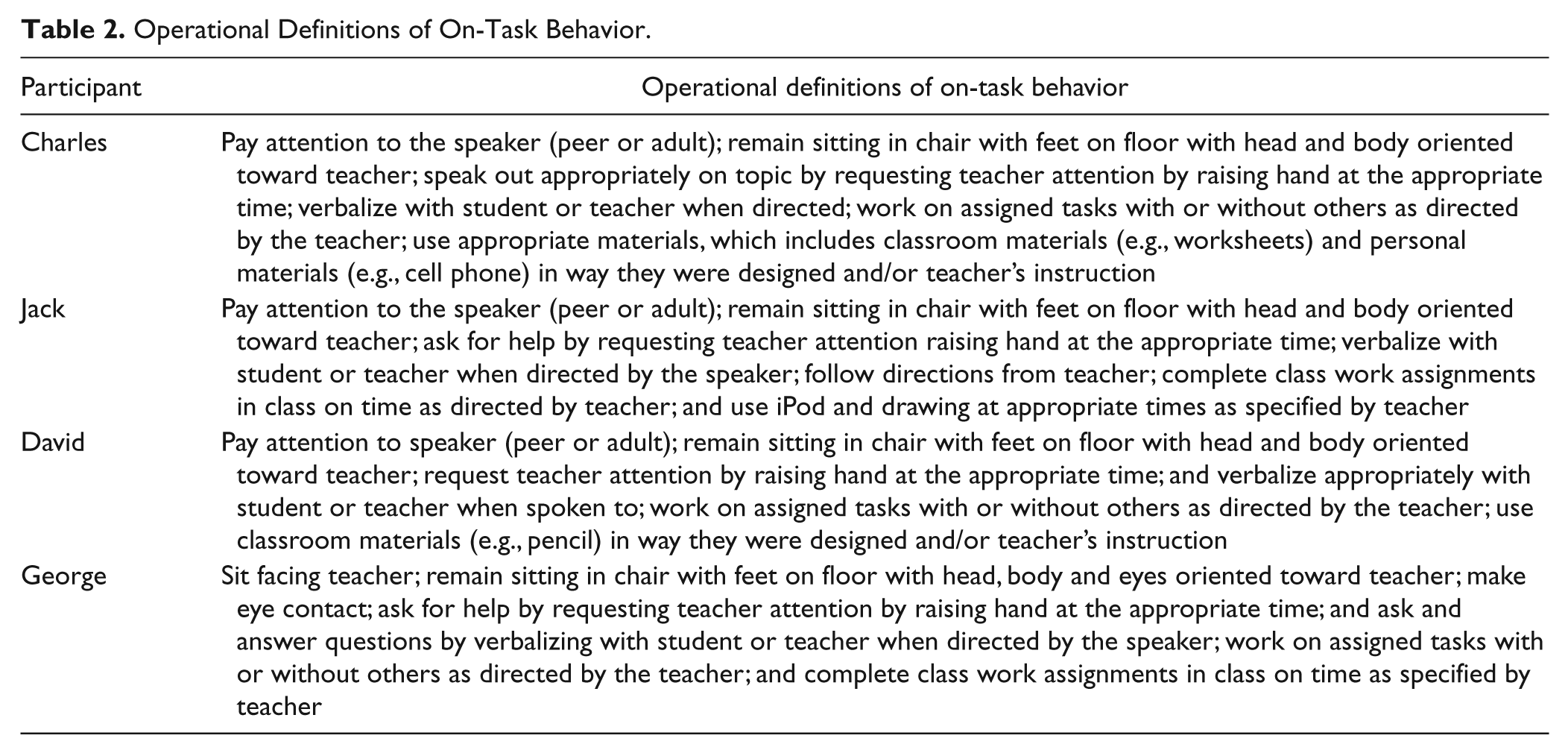
The primary dependent variable for all participants was on-task behavior. On-task behavior was selected because it is a common desirable behavior for students with EBD (Bramlett, Murphy, Johnson, Wallingsford, & Hall, 2002) and it has been consistently used in the literature as a positive behavior indicator that is highly relevant in a classroom setting (general or special education) with diverse populations (Beck, Burns, & Lau, 2009; Damon, Riley-Tillman, & Fiorello, 2008; Gilbertson, Duhon, Witt, & Dufrene, 2008; Sutherland, Wehby, & Copeland, 2000). On-task behavior was defined individually for each student. The general education teacher was interviewed and the researcher conducted direct observations in the classroom to identify on-task behaviors that were expected of all students in the classroom. A list of on-task behaviors and operational definitions for each participant was generated and reviewed with the student and teacher in an iterative process until agreement was reached. Operational definitions of each student’s on-task behavior are found in Table 2.
Operational Definitions of On-Task Behavior.
Off-task behavior
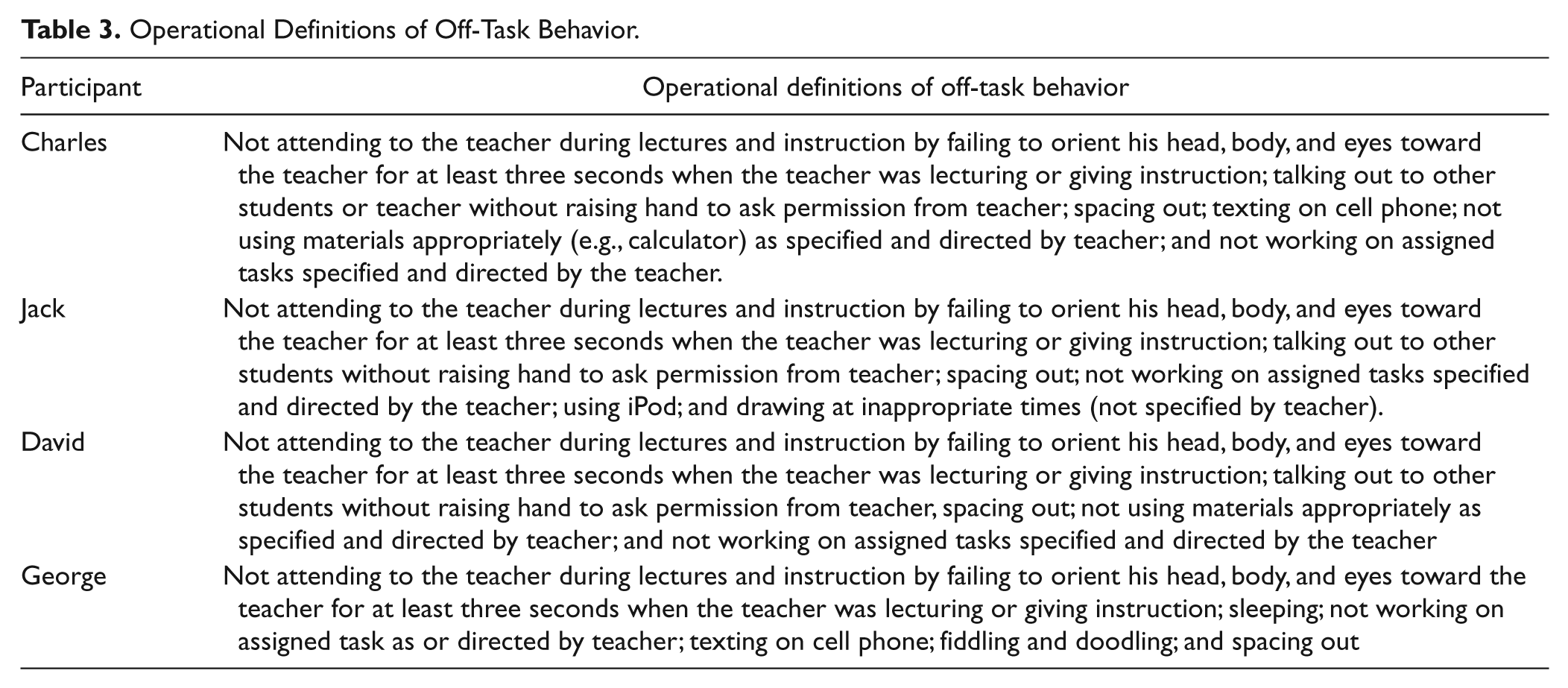
Data were also collected on student off-task behavior in the targeted core general education classroom. The general education teacher was interviewed and the researcher conducted direct observations in the classroom to identify off-task behaviors demonstrated by the participant. As with on-task behaviors, a list of off-task behaviors and operational definitions for each participant was generated and reviewed with the student and teacher in an iterative process until agreement was reached. Specific behaviors and definitions for each participant are provided in Table 3.
Operational Definitions of Off-Task Behavior.
Goal attainment scaling (GAS)
The GAS process (Kiresuk, Smith, & Cardillo, 1994) was used to measure student progress toward attaining a self-selected behavioral goal utilizing the SDLMI intervention (described below). GAS has been successfully implemented in a number of self-determination intervention studies with other disability populations (Shogren, Palmer, Wehmeyer, Williams-Diehm, & Little, 2012; Wehmeyer et al., 2000). The process involves generating a goal and specifying a range of outcomes or behaviors that signify progress in achieving this goal (Carr, 1979). For the purposes of this study, the students were encouraged to develop an on-task behavior goal. After the goals were established, the teacher and student (with support from the researcher) identified five possible outcomes for reaching the goal. These outcomes served as a continuum for discerning and scoring a student’s progress from the least favorable to the most favorable outcome on a 5-point scale. The midpoint of the scale is the expected outcome and is what the teacher and student would consider acceptable. GAS raw scores are converted to standardized T-scores with a mean of 50 and a standard deviation of 10 using a raw score conversion developed by Cardillo (1994). Standardized GAS scores range from 30 to 70; scores lower than 50 indicate the student did not achieve an acceptable outcome and scores of 60 and above indicate that the student’s progress exceeded expectations. GAS scoring occurred weekly, beginning in Phase 2 of the study (described below).
Data Collection and Recording Procedures
Each student was videotaped in his targeted general education classroom 2 to 3 times a week at the same time of day to collect data on his on- and off-task behavior. The number of observations per week varied because of block scheduling (i.e., each subject is taught every other day) at the high school campuses. Videotaping began immediately after the class bell rang and continued until a 10-min segment of teacher classroom instruction was recorded.
Data collectors watched the 10-min segments and used 10-s partial interval recording to estimate the occurrences of on- and off-task behavior. Specifically, if the student exhibited any one of the behaviors associated with being on-task at any time within a 10-s interval, the interval was scored as on-task. If the student demonstrated an off-task behavior at any time within the same 10-s interval, the interval was scored as off-task. On- and off-task behaviors were not considered mutually exclusive during a given interval, which allowed on- and off-task behavior to be coded in the same interval regardless of which behavior occurred first. The percentage of intervals with on- and off-task behavior was calculated by summing the number of intervals with on-task behavior and dividing by the total number of possible intervals, multiplied by 100. Data were collected over a 25-week period from October to April.
During each phase of the intervention (described below) a generalization probe was taken in a nontargeted general education class to assess the generalization of the effects of the SDLMI to a nontargeted classroom. For 1 day, during each phase, the student was video recorded in his nontargeted general education classroom in the same manner as the targeted general education classroom. In addition to data collection on the on- and off-task behavior, after Phase 1 of the SDLMI was completed (described below) and a GAS rubric established, each week the special education teacher and the student independently scored their own GAS scoring rubric.
Observer training and interobserver agreement (IOA)
Data collectors (the researcher and three graduate students in special education) were trained in data collection procedures using videos of the general education classroom with the target student present that were recorded prior to baseline data collection. Training continued until all observers reached 80% agreement on the occurrence of on- and off-task behavior over two consecutive sessions. The researcher reviewed the criteria with the data collectors every 3 weeks to protect against observer drift.
The researcher and at least one additional data collector independently observed between 36% and 41% of all sessions for each participant. Agreement was scored when both observers recorded an occurrence or nonoccurrence during a given interval. A disagreement was scored when there was a discrepancy. IOA for on- and off-task behavior was then calculated separately for each session using the following formula:

The mean interobserver agreement combined across all sessions for on-task behaviors, off-task behaviors, and participants was 93% (range = 89%–97%). For Charles, the mean IOA for on-task and off-task behavior was 97% and 94% respectively; Jack’s was 96% for on-task and 93% for off-task; David’s was 94% and 91%; and George’s 92% and 89%.
Independent Variable
The SDLMI (Wehmeyer et al., 2000) is an instructional model that teaches skills associated with self-determined behavior, including choice-making skills, decision-making skills, problem-solving skills, goal-setting and attainment skills, self-management (self-monitoring, self-observation skills, self-evaluation, and self-reinforcement skills), and self-advocacy and leadership skills (Wehmeyer, 1999). In this study, the SDLMI was used as a framework to guide instruction and support each student’s engagement in self-regulated problem-solving strategies in a core general education classroom. SDLMI instruction was composed of three problem-solving instructional phases. Each phase presents a problem in the form of a question to be solved by the student: What is my goal? What is my plan? What have I learned? Each of the three phases contained 4 supporting questions for a total of 12 questions. For the purposes of this study, each student was taught by the researcher how to utilize the 12 questions in a problem-solving sequence to set his own behavior goal, to develop and implement an action plan to attain the behavior goal, and to execute self-directed learning strategies (e.g., self-monitoring, self-evaluation, self-management) that allowed him to evaluate his progress toward his goal.
Experimental Design and Condition
A multiple baseline across participants’ design was employed to evaluate the effects of the SDLMI instruction. A multiple baseline was chosen because it was believed that the learning associated with the SDLMI could not be reversed with a return to baseline (Kennedy, 2005). Experimental conditions included baseline, SDLMI instruction, and maintenance.
Baseline
During the baseline data collection phase, each participant’s performance of targeted on- and off-task behaviors was observed in his targeted general education classroom. Typical classroom instructional practices continued with no modifications during baseline. The first student at each school who exhibited a steady state of on-task behavior over multiple data points (five or more) with no extreme variability moved to the intervention condition, SDLMI instruction, whereas the remaining students stayed in baseline (Horner et al., 2005). A generalization probe of on-task behavior was also conducted during baseline for one period in a nontargeted general education classroom.
SDLMI instruction
The independent variable was delivered to each student by the researcher in a self-contained classroom where the student normally received academic and behavior support for one period. SDLMI instruction sessions lasted between 60 and 90 min. SDLMI instruction began when each student left baseline. SDLMI instruction took between 6 and 10 sessions to complete. The content of the sessions are described below. Because the SDLMI is a highly individualized intervention, some students required more time in a phase than others. A generalization probe was also conducted during the SDLMI intervention phase for one period in a nontargeted general education classroom.
Phase 1: What is my goal? The instruction for Phase 1 consisted of a series of structured conversations between the researcher and the student around four prescribed questions: What do I want to learn? What do I know about it now? What must change for me to learn what I don’t know? What can I do to make it happen? The answers enabled each student to identify his behavior goal and define the on-task behaviors he believed would help him be successful in the classroom. Charles’s goal was to focus in class to improve his performance as a student to make better grades and stay on the wrestling team. Jack wanted to increase his focus in the classroom to make better grades. David chose to implement on-task behaviors to be a better student and pass his courses. George decided to become a better student in the classroom so he could have a better future. Phase 1 took between one and three instructional sessions. Teachers began GAS scoring after the students identified their targeted on-task behaviors.
Phase 2: What is my plan? Once the student stated his goal and defined his on-task behaviors, he entered Phase 2, which requires students to complete two major tasks: develop an action plan and implement a self-monitoring strategy. The action plan was a list of specific activities he performed every day to meet his goal. The participants answered four questions to develop their action plans: Where do I start? What is in my way? How can I get these things out of my way? When do I start? Once the action plan was developed, various support strategies suggested by the SDLMI model were used by the researcher to encourage students to utilize his action plans in attaining his goal. Specifically, the researcher worked with students to design and implement a self-monitoring system to support their action plan. Jack and George recorded their behaviors immediately after class using a Likert-type recording sheet they designed that allowed them to rate the percentage of on-task behavior they demonstrated over a 60-min class period. Charles and David chose to record their behaviors on their self-monitoring sheets during class. Each was cued, Charles in 10-min intervals and David in 5-min intervals, by an electronic timer to circle the on-task behavior they exhibited during each interval—a percentage of intervals was then calculated and recorded. Students graphed their results and selected a target percentage of on-task behavior they hoped to achieve. All the participants, except Jack, selected 80%, who chose 85%. Each student then implemented the self-monitoring strategy in his targeted general education classroom. GAS scoring began in Phase 2 for both the teachers and students. The teachers’ GAS scoring began as the student entered Phase 2, and the participants’ GAS scoring began once each student initiated use of his self-monitoring sheet. Phase 2 took a total of three to six sessions to fully implement.
Phase 3: What have I learned? After Phase 2 was completed, students were taught to evaluate their progress in obtaining their goals. Students answered the following questions: What actions have I taken? What barriers to success have I removed? What has changed about what I don’t know? Do I know what I want to know? Participants’ response to these questions elicited direct comparisons between their actions and their current level of goal achievement—making adjustments as needed. This self-regulation activity was facilitated by the visual evaluation of the researcher and students’ graph of their on-task behavior. Phase 3 instructions took one to two sessions per student. Participants had to demonstrate an 80% success rate for performing their targeted on-task behaviors for three consecutive sessions before moving into the maintenance condition of this study. GAS scoring continued weekly in Phase 3.
Maintenance
During maintenance, observations of on- and off-task behavior continued for four sessions over 2 to 4 weeks. GAS scoring also continued. However, no additional training occurred and no specific praise or feedback was given to participants. Generic praise was provided on occasion in the classroom to participants for being on-task. One generalization probe was taken in a nontargeted general education classroom.
Treatment Fidelity
To ensure integrity of the implementation of the treatment, a trained graduate student observer monitored approximately 25% of intervention sessions across phases. A checklist for each phase was developed that consisted of a list of instructional objectives from the SDLMI. Using a paper-and-pencil method, the fidelity observer checked-off each instructional objective met by the researcher by watching videotapes of each session. The percentage of instructional objectives implemented by the researcher during each intervention phase was calculated by dividing the number of objectives completed by the number of objectives specified in the instructional protocol checklist and multiplying by 100. Treatment fidelity was 100%.
Social Validity
At the end of maintenance condition, a structured interview was conducted with teachers and participating students to assess their perspectives of the intervention and its impact on academic and behavior outcomes. The researcher read each of the questions aloud and recorded responses verbatim. Students were asked what they had learned, if they would use the skills they learned in the future, and how they felt about the intervention. Both the targeted classroom teacher and the special education teacher were asked whether they felt the program had made an impact on student academic and behavior outcomes and how they felt about the intervention.
Data Analysis
The percentage of on-task and off-task behaviors was graphically displayed with a regression trend line for each condition. Graphs were analyzed for changes in level, trend/magnitude, and variability around the trend line to determine whether a functional relation had been established between the independent variable, the SDLMI, and on- and off-task behaviors. Descriptive analysis was utilized to assess changes in GAS scores.
Results
On- and Off-Task Behaviors
Figures 1 and 2 display the on- and off-task behavior of the four high school students during baseline, intervention, and maintenance. All four students made gains in on-task behaviors and had a reduction in off-task behaviors following introduction of SDLMI instruction.

Percentage of 10-s intervals of on- and off-task behavior during 10-min classroom observations for Charles and Jack across conditions.

Percentage of 10-s intervals of on- and off-task behavior during 10-min classroom observations for David and George across conditions.
Charles’s data found in Figure 1 suggests an immediate intervention effect for both on-task and off-task behaviors. The difference between the mean levels during baseline and intervention was 65% (baseline M = 7%, range = 0%–15%) for on-task behavior and 53% (baseline M = 96%, range = 92%–100%) for off-task. There was no overlap for on-task behavior between baseline and intervention and overlap of only one point (20%) with off-task behavior. Despite the variability in on- and off-task behavior during the intervention, there was a difference of 29 percentage points between the mean level of on-task behavior (M = 72%, range = 18%–95%), and the mean level of off-task behavior (M = 43%, range = 20%–92%) during the intervention phase. The increasing trend in on-task behavior appears to correspond to the declining trend in off-task behavior. Charles continued to increase his on-task behaviors (M = 93%, range = 90%–95%) and diminish his off-task behaviors (M = 16%, range = 7%–10%) during maintenance.
Jack showed an immediate and rapid effect of the intervention on both on- and off-task behaviors (see Figure 1). The difference between the mean levels during baseline and during intervention was 81% (baseline M = 11%, range = 0%–30%) for on-task behavior and 78% (baseline M = 91%, range = 60%–100%) for off-task behavior. The intervention effect was immediate with no overlap with baseline for both variables. The increased level of on-task behavior corresponded with the decrease in off-task behavior with a difference of 79% between the average level of on-task (M = 92%, range = 82%–100%) and off-task behavior (M = 13%, range = 3%–23%) during the intervention phase. There was considerably less variability for both on-task and off-task behavior during intervention. Maintenance conditions for both dependent variables suggested that Jack continued to enhance his on-task behaviors (M = 96%, range = 93%–100%) and diminish his off-task behaviors (M = 9%, range = 0%–26%).
David’s results in Figure 2 suggest an immediate effect for both on-task (no overlap with baseline) and off-task behaviors—one data point overlap with baseline (8%). The difference between the mean levels of on-task behaviors during baseline and during intervention was 27% (baseline M = 53%, range = 42%–60%) and 29% (baseline M = 58%, range = 48%–73%) for off-task behavior. Off-task behaviors displayed variability early in the intervention phase but a clear downward trend after six data points. There is a trend continuous across conditions for both on- and off-task behavior that may be a cause for concern. However, there was a sizeable 51–percentage point difference between the mean level in on-task behavior (M = 80%, range = 66%–93%) and the mean level in off-task behavior (M = 29%, range = 17%–50%) during the intervention phase that overrides the trend. The increasing levels and upward trend in on-task behavior correspond to decreasing levels and the negative trend of off-task behavior. Maintenance data suggest that David continued to enhance his on-task behaviors (M = 88%, range = 83%–95%) and diminish his off-task behaviors (M = 19%, range = 12%–35%) after withdrawal of the intervention.
On- and off-task behavior results for George in Figure 2 shows immediate intervention effects for both on- and off-task behaviors. The difference between the mean levels of on-task behaviors during baseline and during intervention was 52% (baseline M = 30%, range = 0%–48%) and 46% (baseline M = 76%, range = 57%–100%) for off-task behavior—no overlap for both baselines. The increased level and slope of on-task behavior appears to correspond to the decrease in level and slope in off-task behavior with a 52–percentage point difference between the mean intervention levels of on-task (M = 82%, range = 58%–92%) and off-task behavior (M = 30%, range = 8%–56%). There continued to be variability in on- and off-task behavior through all three conditions. The on-task mean level was 82% (range = 70%–88%) and off-task behavior was 27% (range = 18%–33%) during maintenance.
GAS
The GAS process confirmed that students utilized the SDLMI to make progress toward attaining self-selected goals related to their on-task behavior in the general education classroom. After each observation, the special education teacher and researcher together, and the student independently, completed a GAS scoring rubric. Teachers made an average of 18 GAS ratings for student’s goals and students made an average of 10 ratings, which was lower because each student’s scoring began later in the intervention phase. GAS raw scores were standardized for comparison purposes with a range of 30 to 70 and expected outcomes of 50.
Teacher’s average rating of student goal attainment was 59, and students’ average rating of their own goal attainment was 61. On average, students met or exceeded (scores of 50 or above) teacher expectations in 86% of the ratings. Charles’s performance met or exceeded his teacher’s expected expectations for 13 of 17 ratings (76%), Jack’s met or exceeded expectations for 17 of 19 ratings (89%), David’s performance met or exceeded his teacher’s expectations for 14 of 16 ratings (88%), and George’s performance exceeded expectations for 16 of 18 ratings (89%).
The students’ ratings for their own behavior goals were very similar to the teachers’. On average, they rated themselves as meeting or exceeding their behavior expectations 87% of the time. Charles rated himself the lowest of the four students, meeting or exceeding satisfactory levels on 7 of 11 scores (64%), Jack rated himself as meeting or exceeding expectations for 6 of 6 scores (100%), David for 10 of 12 scores (83%), and George for 11 of 11 scores (100%).
Generalization
Data suggest that all four students generalized their on-task behaviors to other class settings. Charles was observed in his English class. He was on-task 17%, 63%, and 92% of intervals during the generalization probe at baseline, intervention, and maintenance conditions, respectively. Jack was on-task 13% of his baseline probe in math. His on-task behavior increased to 98% of intervals during the single observation session in intervention and remained high at 92% during maintenance. David was observed in a computer-assisted drafting (CAD) class; he demonstrated no on-task behaviors during the baseline generalization probes (0%) and 100% during intervention and maintenance generalization probes. During English, George was on-task for 40% of the intervals at the baseline probe, and increased to 92% of intervals during the intervention condition and remained on-task during 87% of maintenance probe intervals.
Social Validity
All general education teachers had favorable impressions of the effects of the intervention on their students. They reported significant transformations in their student’s attitudes and believed the intervention was responsible. Each teacher reported an increase in work completion and active participation in class, and improved attendance and grades. Moreover, all of the general education teachers believed that teaching self-determination was congruent with their goals for student learning and were interested in continuing the intervention.
The special education teachers noted improvements in behavior, reduced absenteeism, fewer office referrals, and increases in grades as a result of the intervention. One special education teacher reported that students were more aware of their off-task behaviors and the relationship between their on-task behaviors and their overall performance in the classroom. The teachers were pleased that the intervention provided the students with structure, focus, and the opportunity to take responsibility for their own actions. The special education teachers were also interested in learning more about the use of implementing the SDLMI intervention for next year.
All students indicated that they had accomplished the individual goal they set during the intervention phase and felt good about it. All of the students reached their goal of 80% on-task behaviors early in the intervention phase and indicated in the evaluation phase (Phase 3) that they were ready to move on to another goal. All students stated that learning to set goals, take action, and self-monitor, and evaluating outcomes were important skills to learn because they helped them in their classes. One student passed all of his classes for the first time and another believed it helped him get organized, which pleased his parents. Two students reported that the instruction was valuable because it helped them focus and break things down into manageable parts. All students said they would use the process in the future and recommend it to others. However, one student did say that he felt like he had developed self-determination early on and did not need to participate in the project for such a long time.
Discussion
The purpose of this study was to examine the impact of the SDLMI on adolescents’ with EBD on- and off-task behavior and goal setting. The results demonstrated a functional relation between the SDLMI and the on- and off-task behavior of all the participants. All four students significantly increased on-task behaviors and decreased off-task behaviors, maintained the increase/decrease after the intervention was withdrawn, and generalized their increased on-task behavior to a second general education classroom. Moreover, all four students made progress toward their goal. All teachers and students identified positive aspects of using the SDLMI and reported an interest in using it in the future.
On-Task Behavior
This study provides empirical evidence that students with EBD can be taught, learn, and operationalize new self-determined behaviors in the classroom. Furthermore, it supports the supposition by other researchers that self-determination may be a critical factor influencing whether students with EBD achieve positive outcomes (Martin et al., 2003). Before this study, self-determination interventions had rarely been tested experimentally with students with EBD (Algozzine et al., 2001). However, we found that students with EBD could learn to identify behavioral issues in the classroom, set a goal to improve their behavior, and develop and implement an action to address these behavioral issues. It is possible that students were becoming more cognizant of their on-task behaviors in the classroom as the SDLMI intervention progressed and saw the positive impact it had in the classroom—such as increasing teacher reinforcement (e.g., teacher praise) and assignment completion. When students were interviewed about their experiences, their responses suggested they had, in fact, internalized some of the strategies they learned. Jack reported that he was thinking about being on-task the minute he entered the classroom and monitored his own behavior throughout class. Further research is needed to explore how students with EBD learn and apply cognitive strategies such as SDLMI.
Off-Task Behavior
The functional relation between SDLMI and off-task behavior suggests that students with EBD can decrease levels of off-task behavior when they are focusing on increasing their on-task behavior. It appears that this increased on-task behavior may have replaced students’ need to engage in off-task behavior. However, off-task behavior had much more variability than on-task behavior in all three conditions. Further research is needed to explore this relationship.
GAS Goals
Each student learned to utilize the SDLMI to make progress on his self-selected on-task behavioral goal in the general education classroom as judged by teachers and the students themselves. The majority of GAS ratings suggested that students were meeting or exceeding their own as well as teacher’s expectations. The present study is one of the first to have students score their own GAS rubric in a natural setting. The findings suggest that students can accurately evaluate and self-report their goal attainment. It demonstrates the viability of using GAS in natural settings to involve students in evaluating their own behavior.
Generalization
Each participant’s on-task behavior was measured in a second general education classroom (all but one was a core academic classroom, the exception was a drafting class) once during each phase of the study. The intervention affected students’ on-task behaviors in these nontargeted classrooms. It supports other self-determination research that has demonstrated that students generalized their learned behaviors to other settings (Arndt et al., 2006; Konrad & Test, 2007; Lancaster, Schumaker, & Deshler, 2002; Snyder & Shapiro, 1997; Test & Neale, 2004), suggesting the power of self-determination interventions.
Implications for Future Practice
The findings of this study offer several implications for practice. First, the results of the study provide teachers of students with EBD evidence of an effective instructional strategy to teach self-determination skills and improve student behavior in the classroom. The SDLMI provides a direct instruction strategy that improves key self-regulation skills, an area commonly identified as a weakness for students with EBD. The SDLMI offers teachers and students a self-directed learning framework that can be used as a stand-alone program or can be used to wrap around the academic curriculum, functional behavior programs, or, as this study has shown, to change classroom behavior of students with EBD.
The study also suggests the importance of knowing students. Understanding the learning needs of EBD students is paramount to getting student buy-in and to effective implementation of the intervention. Having individual meetings and identifying behavioral needs and goals collaboratively with each student provided the researcher with knowledge of the on- and off-task behaviors the student felt would impact their work in the classroom. Also, collaborating with other professionals provided ancillary information that was critical for personalizing the instruction and developing a trusting relationship.
Implications for Future Research
Historically, there has been an interest in identifying the factors that influence academic achievement and behavior in students with EBD. The results of previous research have demonstrated a possible relationship between externalizing behavior and academic skills. However, the direction of the influence is still not clear (Benner, Nelson, Allor, Mooney, & Dai, 2008; Nelson, Benner, Neill, & Stage, 2006). Anecdotally, teachers in this study identified academic skills deficits (previously unidentified) in three of the four students after their on-task behavior began to increase and their off-task behavior began to decrease. What is surprising, however, is that on-task behavior continued to improve and off-task behavior continued to decline despite the lack of academic instruction. A possible interpretation is that the student’s off-task behavior not only served the function of masking academic skill deficits but also served additional functions for the student—functions that were addressed by the introduction of new on-task skills to manage behavior. These findings suggest the need to explore the functions of student on- and off-task behavior in greater depth in future research. For example, it would have been interesting to test the long-term sustainability of behavioral change with and without academic skill instruction targeting the newly identified deficit skill areas. Further research is also needed to explore systematically applying academic instruction after behavior has been impacted by self-determination instruction.
Limitations
There are a number of limitations that suggest a need for caution when interpreting these results. First, given the small sample size and the lack of diversity in the sample, external validity is limited. This caution is somewhat mitigated by the replication of the study across two schools. Nevertheless, there is a need for diversity in the ethnicity, gender, and socioeconomic status of participants in future studies. And, to validate the results of this study, replication is warranted. The promising results of this study suggests the need for larger studies with a control group to further explore the degree to which the changes in behavior result from SDLMI instruction, as it is possible that other factors could have led to changes in the student behavior.
Second, the significant attention and encouragement provided by the individualized instruction and researcher’s visits in the general education classroom may have influenced the participants’ behavior. Observing the students prior to baseline and extending baseline over a long period of time, which allowed the students to become accustomed to the researcher’s presence, controlled for this effect to some degree. However, the degree to which a strong, sustained relationship with an adult may influence the results is unclear. Also, students often have preferred classes and/or teachers that can also impact their level of on- and off-task behaviors. We were not able to control for this in our study. Third, schools did not provide the researcher access to attendance and achievement data. Attempts were made to collect weekly grade reports, but the student’s grade reports proved an ineffective means of measuring academic progress largely because teachers did not update grades on a routine basis, particularly when students were submitting assignments late, sometimes as part of their reasonable accommodations. When teachers did update grades, there were extreme changes that were not reflective of actual student performance. Further research is needed on effective and efficient ways to collect achievement data.
Conclusion
This study examined the impact of the SDLMI on the on- and off-task behaviors of students with EBD in general education classrooms. The results suggest that students with EBD learned self-determination skills and applied them to their behavior in the classroom. Future research should focus on replicating the findings of this study and determine whether the intervention results will generalize to other EBD populations, other settings, and other age groups. Finally, while the results of this study provided preliminary information on the relationship between academics and behavior, future research that addresses the extent of the relationship is needed before definitive statements can be made.
Footnotes
Declaration of Conflicting Interests
The author(s) declared no potential conflicts of interest with respect to the research, authorship, and/or publication of this article.
Funding
The author(s) disclosed receipt of the following financial support for the research, authorship, and/or publication of this article: Funding for this research was provided by Grant PR Award No. R324B070159 from the U.S. Department of Education, Institute of Education Sciences, National Center for Special Education Research.