



Abstract
In this study, critical situations relating to students with emotional and behavioral problems in inclusive German secondary schools were analyzed. The objective was to identify behaviors and behavioral patterns that impede or even terminate the inclusive education of students with emotional and behavioral disorders. Critical situations, their antecedent conditions, and consequences were collected using Flanagan’s critical incident technique in group discussions with teachers (N = 77). The situations were categorized using qualitative content analysis. Students’ behaviors in the critical incidents were disruptive behaviors, displays of aggression toward classmates, and behaviors perceived as unusual. A distinctive category involved situations on students enjoying special treatment because more favorable conditions for examinations were provided and misbehaviors were handled in lenient ways. This elicited feelings of unfair advantage from other students and had an adverse impact on class dynamics. A strong influential factor was parents prohibiting disclosure of information about their children’s disorder(s). Therefore, measures especially on class level are expedient, such as sensitizing processes making students understand that misbehavior and disorders lead to disadvantages and that special treatment is to compensate for these disadvantages. Moreover, individual agreements between schools and parents may be arrived at to negotiate the modalities of an information disclosure.
Fifteen years after the implementation of the Convention on the Rights of Persons with Disabilities (CRPD; United Nations, 2006), progress has been made in inclusive education, but there are problems with transforming the ideal of inclusion into practice. Although many publications agree on the concept of defining inclusive education as teaching students with and without special needs in the same class (Nilholm & Göransson, 2017), in practice, various definitions exist. In narrow definitions, inclusion refers only to students who have disabilities. In broad definitions, special needs could arise from a disability or disease, a migrant background, refugee experiences, speech deficiencies, difficult social circumstances, and so on (Ainscow et al., 2006; Nilholm & Göransson, 2017).
In this context, topics gaining attention in research and practice are a lack of social participation and linked to this, students’ behavior that is perceived as disruptive, aggressive, and frightening by others. Several studies have examined the inclusion of students with emotional and behavioral problems in general education (e.g., Fletcher, 2010; Goodman & Burton, 2010; Orsati & Causton-Theoharis, 2013; Stanforth & Rose, 2020). Findings have shown that classmates withdraw from students they perceive as aggressive (e.g., de Leeuw et al., 2018; La Salle et al., 2018). This study complements these results with findings that not only students’ aggressive behaviors lead to exclusion. Classmates’ feelings that students with emotional and behavioral problems boast about their special status in class and exploit special conditions and special treatment to get (perceived) unfair advantages have the same effect. Using Flanagan’s (1954) critical incident technique (CIT; Butterfield et al., 2005; Chell, 2004), we analyzed what critical incidents teachers reported involving students with emotional and behavioral problems in general education. Then, we present distinctive causes of and influential factors for situations involving disruptive behavior and (perceived) unfair advantage of special conditions.
Accordingly, we discuss approaches for dealing with these situations and consider students from secondary schools. Secondary schools have lower inclusion percentages and represent an underresearched area as extant research has a strong bias toward primary schools (Round et al., 2016). Thus, there is a need for specific findings for this age group. Differences between primary and secondary education are obvious, as differences exist in structure, curriculum, learning goals, teaching, and so on. These aspects interact with developmental factors, for example, with peer relations and their dynamics and their importance (Hay et al., 2004; Keay et al., 2015).
Students With Emotional and Behavioral Problems in General Education
Settings and Inclusion Percentages
In Germany, where this study was conducted, the percentage of special needs students who attend regular schools with inclusive settings decreases in upper grades; 60% of special needs students attend regular primary schools, while only 20% attend regular secondary schools (Klemm, 2015). If one considers only the group of students with emotional and behavioral disorders, the percentage is only 5%; most of these students attend special education settings (Standing Conference of the Ministers of Education and Cultural Affairs [KMK], 2019). Besides the term “students with emotional and behavioral disorders,” the term “students with special needs in emotional and behavioral development” is also used in the German education system (KMK, 1994). This term is also the legal definition, which emphasizes these students’ difficulties with forming relationships with peers and others and their need for support in forming such relationships. Furthermore, different terms are used in the literature, including “challenging behaviors” (e.g., Orsati & Causton-Theoharis, 2013), “emotional and behavioral difficulties” (e.g., Scanlon & Barnes-Holmes, 2013), and “behavioral, emotional, and social difficulties” (e.g., Pillay et al., 2013).
The German school system is characterized by highly specialized special education that provides specific settings and supports according to type of disability (Markowetz & Jahn, 2016). Special education settings for secondary students with emotional and behavioral disorders consist of small classes with teachers who have completed lengthy specialized training in teaching students with these disorders. The students are supported by both educational and therapeutic staff. The program follows the regular secondary school curriculum but is supplemented by goals to develop social abilities (Opp, 2009).
Although researchers have discussed the positive learning outcomes of inclusive settings compared with those of segregated settings (e.g., Myklebust, 2007; Wagner et al., 2005), inclusive education results for students with emotional and behavioral problems suggest a varied and complex picture as illustrated below.
Effects of Teaching Students With Emotional and Behavioral Disorders in General Education Classes on Students’ Behavior, Class Dynamics, and Teachers
One main line of discussion on emotional and behavioral disorders is that they can negatively influence a student’s ability to make friends and engage in social interactions, which may lead to peer rejection and exclusion (de Leeuw et al., 2018; La Salle et al., 2018; Nowicki et al., 2018; Pijl & Frostad, 2010; Rose & Espelage, 2012). In addition to this general finding, some studies provide differentiated insights. Rose et al. (2015) evaluated bullying among more than 1,000 students with various disabilities using the University of Illinois Bully Scale and the University of Illinois Victimization Scale, among other measures. They reported that students with emotional and behavioral disorders engaged in fighting more often than those with other disabilities or those without special needs. Higher rates of direct and relational victimization were also reported among these students. Students with emotional and behavioral disorders are more often both perpetrators and victims in the bullying dynamic than other students. This was found to be especially true in restrictive education settings, as fighting and victimization were significantly lower in inclusive settings. The authors conclude that non-inclusive environments offer students limited social experiences, especially with peers who have no disabilities, which could impede growth in behavioral functioning and social skills.
Gottfried’s (2014) study aimed at the relations between peers with emotional and behavioral disorders, classroom contexts, and socioemotional development using different methods and scales (e.g., Social Responsiveness Scale) on a nationally representative data set of elementary school children (Early Childhood Longitudinal Study, Kindergarten Cohort [ECLS-K]). One of the central results was spillover effects in terms of behavior: Having classmates with emotional and behavioral disorders may lead to an increase in externalizing and internalizing problem behaviors and a decrease in self-control, interpersonal skills, and approaches to learning. Spillover effects were also documented according to academic achievement: Using the ECLS-K, Fletcher (2010) found that children with emotional and behavioral disorders in inclusive classes can decrease their classmates’ reading and math scores by more than 10% of the standard deviation on tests. Thus, Fletcher identified students with serious emotional problems as “perhaps the most likely candidate for large negative effects of full inclusion” (p. 82).
Behavioral problems also lead to rejection by teachers. Several studies showed that concerns, anxiety, and negative attitudes toward inclusion mainly apply to students with emotional and behavioral problems (e.g., MacFarlane & Woolfson, 2013; Savolainen et al., 2012). As these students typically display behaviors such as having problems concentrating or being disruptive and disturbing, teachers must reengage the students while minimizing disruptions and providing uninterrupted lessons to the rest of the class (Goodman & Burton, 2010). Aloe et al.’s (2014) meta-analysis showed that behavioral disturbances in day-to-day school life result in emotional exhaustion for teachers, because they fail to deal with disruptive behaviors. One study investigated such findings more deeply is Goodman and Burton’s (2010) qualitative study. Many teachers complained about a lack of classroom support (such as teaching assistants), which led to severe pressure and to the need to focus the majority of their attention on preventing disruptions. Furthermore, teachers often did not have strategies for handling disruptive behaviors and complained about having to cope with them by trial and error (Goodman & Burton, 2010).
Focusing on teachers and their concerns and anxieties, Garwood and van Loan (2019) analyzed the effects of courses for educators, focusing on relationship-based approaches to positive behavior support. Results of the mixed-methods study showed that courses could influence educators’ dispositions toward inclusive classroom practices for students with emotional and behavioral disorders. The educators improved their knowledge of behavior management, focus on relationship building, and development of an inviting classroom environment. Fostering high-quality relationships between teachers and students with emotional and behavioral disorders that convey genuineness, trust, or care can increase the chances that the student will accept feedback that leads to improved social, emotional, and learning success (van Loan & Garwood, 2020). Therefore, such measures can help prevent negative views of these students as one barrier to their inclusion in general education.
Parents’ Role in Teaching Students With Emotional and Behavioral Problems in General Education
A significant factor reported as having an influence on students’ behaviors is the role of parents, who can impact students’ social roles in classes. Scholars have investigated parents’ educational backgrounds, levels of engagement, and levels of understanding and acceptance of their child’s diagnosis or their aspirations for their child’s schooling (Finnvold, 2018; Szumski & Karwowski, 2012). Goodman and Burton’s (2010) interview study indicated that many parents of students with emotional and behavioral disorders do not consider their child’s academic achievement to be important. However, such findings should not be generalized; nevertheless, it depends on parents as to how successful cooperation with the school can be (Goodman & Burton, 2010). Stoutjesdijk et al. (2016) showed directional associations between poor family functioning and children’s behavior in school. Poor communication, parents’ discordant relationship, and lack of social support were strongly associated with internalizing and externalizing problem behavior. Results also indicated that increased parental responsiveness to a child’s needs can be a protective factor against future problem behavior (Stoutjesdijk et al., 2016; see also Bradley & Corwin, 2007; Wade et al., 2011). In addition, difficult family circumstances as well teachers’ estimations to equate deprivation with difficult and traumatic family lives lead to effects on students’ behaviors (Ellis et al., 2016; Stanforth & Rose, 2020).
One can assume that additional aspects play a role, for example, from the school context. Analyzing situations in classroom practice can help identify additional significant factors and conditions. Such studies require a qualitative approach, which, in contrast to the quantitative approach, permits verbal legitimization, which CIT enables. Moreover, most of the cited findings refer to primary education. Research in secondary education is needed.
Research Questions and Objectives
This study aimed to identify and further analyze critical events involving students with emotional and behavioral problems in general education. Significant patterns were identified to show how and why students, teachers, and parents act. The overall goal was to identify behaviors and mechanisms of action to derive implications that can be used to develop approaches for dealing with such situations and creating resources. To achieve this, also the causes and antecedents that contributed to particular situations and the consequences of such events were taken into account. Each of these was considered to analyze the field on a systemic level. In our study, we involved people who are “subject-matter experts” (Blickle et al., 2011) and who have both expertise and practical experience. Therefore, we collected critical incidents from teachers in general secondary schools who teach students with emotional and behavioral problems. Thus, the main research questions were:
Method
Research Context, Procedure, and Data Collection
This study is part of the project Inclusive Education in Secondary Schools at Ludwig-Maximilians-University Munich in Germany. The higher-level project goal is to support and increase inclusive education, as well as the professionalization of teachers’ work in inclusive settings. In this study, the critical incident technique (CIT), first described by Flanagan (1954), was used. The CIT is one of the most established methods for analyzing professional fields and realistic, empirical data on behavior in concrete working situations (Koch et al., 2009) with high demands, high levels of responsibility, a need for complex problem-solving, and a high proportion of social interactions. The detailed analysis of critical incidents enables researchers to identify similarities, differences and patterns and to seek insights into how and why people engage in different activities. The overall goal is to identify behaviors and mechanisms of action that either contribute to or impede success to derive consequences that can be used to improve professional work. A well-described critical incident relates to situations that are typical, occur often, and are relevant for success within a given area. Such an incident contains three elements (Butterfield et al., 2005):
A detailed description of the incident;
Causes/antecedent information (what leads up to the incident; that is, the causes for the incident); and
A description of the outcome (consequences) of the incident.
The CIT has proven to be effective across a wide range of disciplines (Butterfield et al., 2005) and has been used to answer research questions in educational settings (see Guo et al., 2010; Stier et al., 2012). Some elements of the CIT are similar to the ABC analysis done in functional behavior analyses. Both procedures overlap in their objectives to analyze how and why students act in the classroom, to identify persons and areas involved, and to gain implications to deal with behavior.
Studies such as that by Koch et al. (2009) have shown a high acceptance level for the method. Studies examining psychometric properties reported high mean interrater reliabilities and a high quality of the CIT in practice, as the meta-analyses by Dierdorff and Wilson (2003) and Voskuijl and van Sliedregt (2002) have demonstrated. Following Sharoff (2008), validity of collected data is (partially) ensured by the fact that all participants focus on the same issue, which is achieved by structuring the course of the discussions thematically.
To identify such critical incidents, group discussions were conducted as proposed by Flanagan. Following Barbour (2007), group discussions focus on an empirical analysis of social subsystems, collective phenomena, and supra-individual behavior. Statements in group discussions that conjointly determined a collective pattern of orientation are deemed to be valid, because group discussions are not the origin of a collective pattern but provide the room for articulating patterns explicitly. In contrast to the quantitative approach, group discussions permit verbal legitimization, and more opinions emerge in group discussions than in solely quantitative inquiries as a result of mutually stimulating conversation.
Sample
We collected critical incidents from general education teachers in secondary schools who teach students with emotional and behavioral problems. Inclusive classroom settings in Germany typically include a general education teacher, who is supported by a special education teacher for some days or some hours a week (Ministry of Education of Bavaria, 2014). In a few cases, both teachers use a collaborative teaching model, for example, with joint lessons planning. But mostly, the general education teacher acts as the main instructor for all students. The special education teacher gives individual support during lessons and advises the general education teacher in teaching and handling students with behavioral and emotional disorders.
The CIT assumes that a study’s participants are “subject-matter experts” (Blickle et al., 2011) who have both expertise and practical experience in their respective fields: The criterion here is multi-annual practical experience for a minimum of 6 years. In this study, the total sample included 77 teachers from secondary schools in Germany who had experience with inclusive secondary education. The group was comprised of 56 females (72.7%) and 21 males (27.3%). Recruitment was initiated by an announcement from the project’s leader that was then forwarded to relevant departments in the school. During the selection process, care was taken to include participants from different schools and regional areas to avoid regional agglomeration (Agar & MacDonald, 1995). To achieve this, all schools in the school district very included; the school district was therefore the breakdown criterion for the recruitment of the teachers.
All teachers were working in classes in which students with emotional and behavioral problems were taught. The teachers were divided into 11 discussion groups with six to eight participants each (see Adler & Clark, 2008). The groups were arranged to consist of discussants from different schools to achieve more diverse and broader argumentations and information (Agar & MacDonald, 1995). Discussions lasted for 2 hr and the course of the discussions was structured thematically, with reference to the research questions and the elements characterizing critical incidents (Butterfield et al., 2005):
What critical incidents (involving students’ behaviors) have teachers experienced?
What causes and conditions relating to these incidents need to be taken into account?
What are the consequences of these events, and who or which areas do these consequences affect?
The data collection complied with the high professional standards and strict ethical criteria defined by the ethic committee of the department. Before the group discussions, all moderators and researchers participating in the data collection and analysis were trained during a 1-day session. Moderators were familiarized with the elements of the critical incidents, the structure of the group discussions, and the moderation requirements. Although all researchers involved in the analysis had many years of experience in qualitative content analysis, they were again trained in using content analysis specifically in the research context of this study. For both training parts, a written guideline, best practice examples, and a list with explanations, examples, and overlaps and distinctions were used.
Analysis, Interrater Reliability, and Validation
The 11 group discussions yielded a total of 55 usable critical incidents that made students’ behaviors the subject of discussions. According to Flanagan (1954), critical incidents are to be analyzed by creating categories and subcategories. Therefore, we used qualitative content analysis (Hsieh & Shannon, 2005; Mayring, 2000). The goal of content analysis is to reduce the material so that fundamental content remains and to employ abstraction to obtain a straightforward corpus that retains an image of the raw material. Thus, the displayed results follow an order showing the event itself, the antecedent conditions/causes and the consequences. Categories were created with the help of the MAXQDA program (MAXQDA, 2018). For analyzing the material, the mentioned above list was drawn up to describe each category with explanations and examples as well as overlaps and distinctions between categories. Each category was named after the incidents, causes, and consequences contained therein. In total, 26 categories were developed: four categories related to events, 10 related to causes/antecedents, and 12 related to consequences.
To verify the analysis, interrater reliability and Cohen’s kappa coefficient κ (Brennan & Prediger, 1981) were calculated. Two researchers doubly encoded all categories. First, the interrater reliability on a percentage basis was used to verify the encoding. Altogether, 382 categories (55 incidents, 153 causes/antecedents and 174 consequences) were encoded. The interrater reliability was initially .84 for all categories combined, with 321 of 382 possible matches. It exceeded .80 in some categories. To improve this, the relevant critical incidents were reconsidered and a communicative validation process was performed (Kvale, 1995). By revising these categories, a higher degree of selectivity and, thus, higher interrater reliability could be reached (.90 with 345 matches). A percentage coefficient of .70 is seen as satisfactory (Bos, 1989, p. 62). This procedure—refining the categories and distinguishing more precisely—can be illustrated through an example.
A clear distinction has to be made between symptoms students showed as a cause or a consequence. Unrest, anger, withdrawal, and so on can be either
a cause or antecedent for a critical event, for example, when a student was suffering from trauma. In such cases, the aspect was assigned to Causes/Antecedent Conditions (category Trauma): “Student from Ethiopia, [. . .], cleft lip, surgery in Germany, social withdraw, unrest, uncontrollable. She is traumatised by the rapid cultural change, the language change and the surgery” [GY_02_7], or
a consequence of a critical event, for example, when a student experienced social exclusion, he or she reacted with frustration. In such cases, the aspect was assigned to Consequences (category Frustration): “She responds with signs of frustration; she withdrew, fell silent, but nevertheless restless” [RS_08_3].
In addition, Cohen’s kappa coefficient κ (Brennan & Prediger, 1981) was calculated. In total, for all revealed categories, κ was .90; separately calculated for the events κ was .86; for the causes/antecedents κ was .89; and for the consequences κ was .89. Following Landis and Koch (1977), coefficients >.80 are characterized as “almost perfect agreement”; according to Fleiss (1981), coefficients >.75 are “excellent.”
Results
Incidents
The critical situations were assigned to three different categories. These were based on behaviors and behavioral patterns (see Table 1) that students displayed.
Codings for the Events.
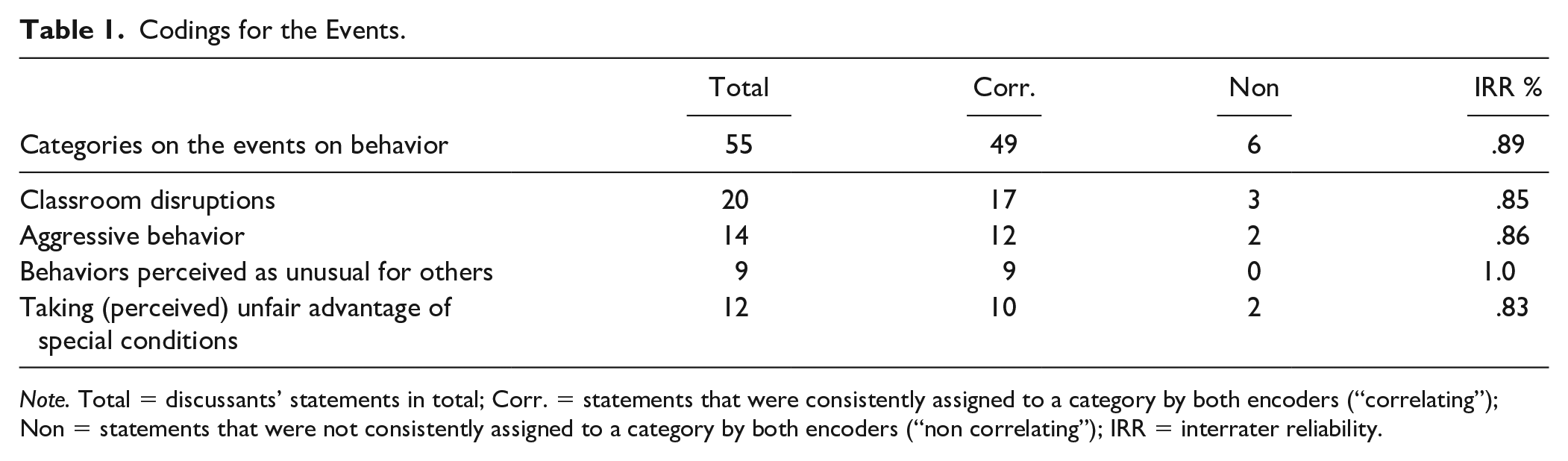
Note. Total = discussants’ statements in total; Corr. = statements that were consistently assigned to a category by both encoders (“correlating”); Non = statements that were not consistently assigned to a category by both encoders (“non correlating”); IRR = interrater reliability.
The category Classroom Disruptions included situations on behaviors, which could be defined as interrupting the flow of the lessons by talking without being asked, making noises, running around the classroom, commenting on the teachers’ actions, and so on: A student always comments loudly on the teacher’s action, mostly in a derogatory manner. [RS_08_1] The lesson has just begun when a student monotonously started to ask childish questions, such as, “Are you my teacher?” although he had known the teacher for more than five years. He did this a hundred times in a row and could not be stopped. [RS_05_3]
Aggressive Behavior, a further category, consisted of situations on behaviors which could be described as by insults, verbal abuse, threats, blackmail attempts and physical violence: A student threatened other students: “Help me to cheat on the exam; otherwise, I will rip your head off.” [RS_08_1] During the lesson, a student suddenly jumps up, throws another student to the ground and chokes him. Allegedly, the student took his ball during the break. [GY_02_7]
Another category was Behaviors Perceived as Unusual for other students. Such behaviors were defined as making unusual noises, screaming, or self-harming and appeared often to be aggressive or at least strange to others: When her ruler has been dropped, she had an outburst of anger, started to scream and could not be calmed anymore. [RS_08_5]
A special and distinctive category was Taking (Perceived) Unfair Advantage of Special Conditions. Many events reflected that students with emotional and behavioral problems held a specific status in the class because they received special treatment and enjoyed special conditions. Two different types of taking unfair advantage were documented. Some incidents focused on the fact that students received special conditions in examinations: A student has major problems in interacting with other students. His outsider role leads repeatedly to conflicts in the class. The student learns very slowly and does not actively participate in lessons. The teachers treat him with indulgence and understanding. This leads to envy and a feeling of being treated unfairly among other students. [RS_06_6] A student has more time for examinations. She boasts about this. Thus, the others complain, “She exploits the special conditions in order to gain an advantage.” [GY_01_4] Due to a medical report, teachers are not allowed to address questions to a student during lessons when other students are present in class. Allegedly, the student is afraid of speaking in front of others and refuses to do so. The problem is, he always disturbs the lessons by talking without being asked. [RS_06_3]
These events were characterized by the fact that some students received special conditions for lessons and examinations, but some of these students exploited these conditions or were accused of doing so. In the third example, the student enjoyed special conditions but behaved in a contradictory manner to the reason why he enjoyed these special conditions.
The other events involving taking (perceived) unfair advantage reflected that misbehaviors were handled in a particular way: A student with social disturbances is often aggressive, but we do not impose sanctions. Other students were brought before the disciplinary committee of the school due to minor offenses, but many students with behavioral problems were not. Some of them know that we handle them with leniency, and [they] exploit this situation. [GY_03_1] Teachers did not respond to a student’s disruptive behavior at all. Her misbehavior never had consequences, and a situation has consolidated in which her disruptive behavior became the normal case. All students in the class felt suddenly penalized for not disturbing the lessons. [RS_08_1]
All events illustrated a “balancing act of equal treatment between students with a special treatment and students without” [GY_04_5]. This was often aggravated by the fact that special conditions were associated with classmates’ perceptions that some students boasted about their “special” behavior in that way that they could get away with almost anything.
Causes/Antecedent Conditions
Students’ behaviors were, according to teachers’ reports, caused and influenced by different causes and antecedent conditions on different levels (see Table 2).
Codings for the Causes/Antecedent Conditions.
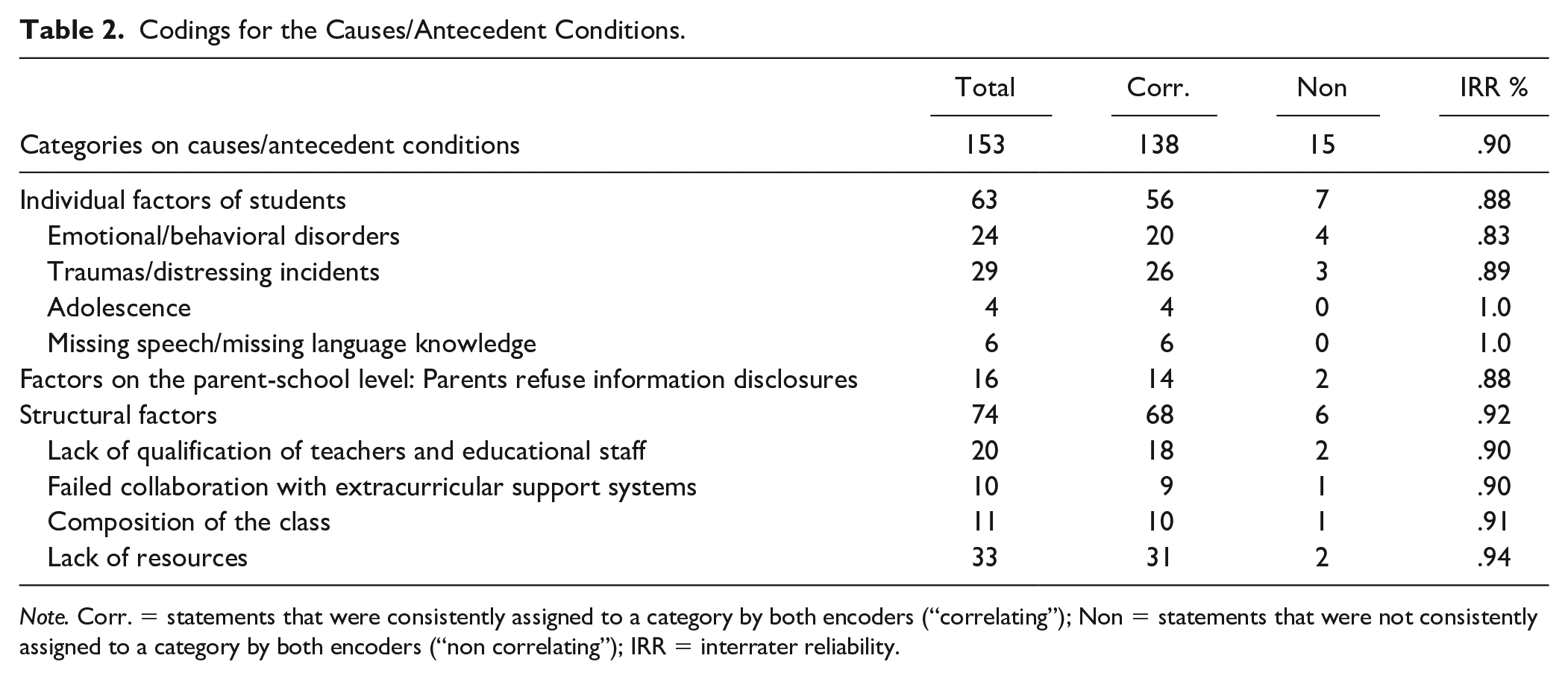
Note. Corr. = statements that were consistently assigned to a category by both encoders (“correlating”); Non = statements that were not consistently assigned to a category by both encoders (“non correlating”); IRR = interrater reliability.
The largest subcategory was Individual Factors of Students. Displaying disruptive, aggressive, or unusual behaviors was seen as part of Emotional and Behavioral Disorders students have. However, teachers stressed that many behavioral disturbances may not have involved intentional malice: “Due to his anxieties and compulsions, he could not endure a complete school lesson. He was overwhelmed, reacted hysterically and came into conflict with others” [RS_08_6].
Interrelated with emotional and behavioral disorders and their symptoms, other influencing factors were reported as significant. Traumas, as influencing conditions, were described as being caused by refugee experiences or other distressing incidents in the students’ environments (“traumatizing separation of the parents . . . after violent conflicts” [GY_11_4]). Such negative circumstances could have adversely affected students’ behavior. Some teachers also reported that it was often hard to distinguish whether behavior was caused by an emotional and behavioral disorder or was simply normal Adolescent Behavior: “The student is easily upset. She screams and screeches. I always wonder ‘Does it go beyond adolescence?’” [RS_09_1]
Missing Speech or Missing Language Knowledge did then have an impact on behavior problems when lacking abilities to communicate and to fulfill the performance requirements result in frustration and disruptive behavior: “A student from Bosnia learns very slowly, due to a language barrier. Nevertheless, she has to fulfil the performance requirements. Student and teacher are frustrated” [RS_05_5].
Behavior could, following the teachers, have been intensified by Parents Refusing Information Disclosures, which was described 16 times: The parent prohibit disclosure of any information about the disability. They fear stigmatization and desire equal treatment. But we cannot initiate measures to effect the student’s behavior. [GY_01_3]
Events in this category showed a special effect: Teachers could not react appropriately to behaviors to prevent drawing conclusions on disorders and disadvantages due to certain specific measures. This in turn had an influence on behavior, which was either reinforced or the other students’ reactions provoked further behavior. This is especially related to taking (perceived) unfair advantage of special conditions. A lack of information meant intransparency, which led to misperceptions and false suspicions. Furthermore, when teachers were not allowed to use specific measures to prevent drawing conclusions on disorders and disadvantages, they were not able to make an impact on students’ behaviors. This created room for exploiting teachers’ lenient handling of misbehavior.
Structural Factors were also attributed to influencing students’ behaviors. Teachers recruited for this study were teachers from general education schools complaining of the Lack of Qualification of Teachers and Educational Staff. For example, one teacher expressed concern about how “to deal with disruptive behavior and to react when someone freaks out” [RS_08_5]. Moreover, assistant staff members are poorly trained, sometimes unreliable, and need extensive instruction and guidance. Lacking Resources consisted of personal bottlenecks and the lack of spatial, technical, and time resources; these influence behaviors when necessary staff are not available for supervision and support. Staff bottlenecks created room for exploiting special conditions and taking unfair advantage when staff is badly informed about emotional and behavioral problems and measures to deal with them.
Failed Collaboration with Extracurricular Support Systems (10 in total), for example, when “the collaboration between the psychotherapist and the school was not transferable to practice” [GY_03_4], also influenced students’ behaviors when necessary support for behavioral problems remained undone. The Composition of the Class contributed as well when classes included many students with diverging disabilities and disorders: “A student with a behavioral disorder in my class constantly makes noises and a student with a hearing deficiency could not bear that at all. Conflicts erupt” [RS_08_4].
Consequences
The consequences were wide-ranging and affected many different areas and groups of people (Table 3).
Codings for the Consequences.
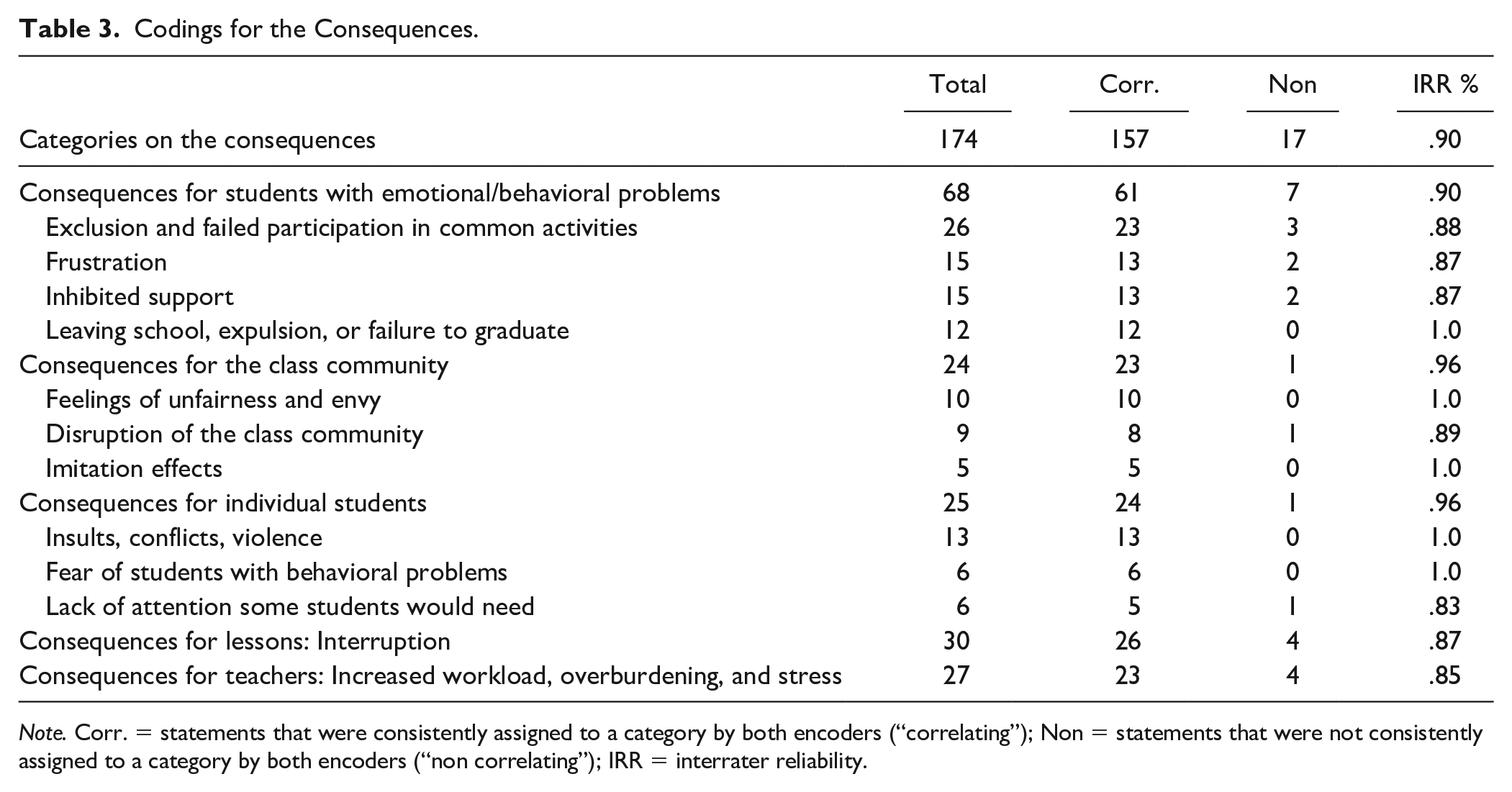
Note. Corr. = statements that were consistently assigned to a category by both encoders (“correlating”); Non = statements that were not consistently assigned to a category by both encoders (“non correlating”); IRR = interrater reliability.
By far, the largest category addressed Consequences for Students with Emotional/Behavioral Problems. Disruptive, aggressive, and unusual behaviors as well as exploiting special conditions—regardless of whether students really do that or were just accused to do so—led to Exclusion and Failed Participation in Common Activities, as described by one teacher: “Due to his behavior—the lying, the insults, the unappealing reactions—the class stamped him as a liar, making it impossible for him to be included in the class” [RS_06_2]. Another teacher reported: “During an excursion, the class obviously had fun, but the student stood on a sand hill; he was not part of the group” [RS_01_1]. In addition, other students’ perceptions of exploiting special conditions resulted in isolation because “the indulgence of the teachers led to envy and feelings by others of being treated unjustly. The student was excluded and harassed” [RS_07_4]. Classmates withdrew from students they perceived as unfair and unsocial. This was often combined with Frustration; failure, rejection, and exclusion were hard to bear and meant negative feedback for the person. Other consequences addressed Inhibited Support, when disruptive behaviors hindered a student from following the lessons and using learning offers. In many cases, Leaving School, Expulsion, or Failure to Graduate was a consequence: “He had to attend a special school for students with emotional and social disturbances although this school was unsuitable for a student” [GY_03_4].
Consequences for the Class Community were mostly Feelings of Unfairness and Envy and Disruption. Aggressive behaviors and perceived feelings of unfairness led to conflicting emotions in the class: “One student harassed others, which astonishingly led to conflicting emotions in the class, because some students felt impaired and others had compassion” [RS_05_1]. One teacher stated that “the social disturbances of one individual student determined the culture of interaction in class. The more dominant she became, the less other students dared to complain. Most of them reacted with passivity, withdrawal and demotivation” [RS_08_1]. Situations on taking (perceived) unfair advantage often caused conflicts, which went through the whole class and antagonize the whole class with his behavior. A minor subcategory addressed Imitation Effects, described as times when students without special needs imitated conduct problems because they recognized that disruptive behaviors by students with behavioral problems elicited no consequences.
Further consequences affected Individual Students. Aggressive behavior often resulted in situations in which students fall victim to Insults, Conflicts or Violence. In some events, violence was not intended. However, those instances led to Fear of Students with Behavioral Problems: “He lost control and starts to scream in physical education every time he lost in football. The other youths are intimidated” [GY_03_1]. Teaching one or more students with such behaviors in a class also meant that other students experienced a Lack of Attention Some Students Would Need, because the focus was on one or some individual student(s): “One realized too late that other students also needed help” [GY_10_2]. This happened particularly often when staff was missing.
The Consequences for Lessons were, in most cases, lessons that were interrupted for a certain amount of time or completely impossible to get through when students disrupted the class by talking, getting up without being asked, making noises, or commenting on others’ actions. Some disturbances happened intentionally, while others may not have involved intentional malice: “He feels unable to deal with the worksheet [. . .], because a figure does not exactly look like the one in the biology textbook. Attempts to calm the situation fail” [GY_10_4]. Lessons were also interrupted when discussions and conflicts about unequal treatment and unfair advantage superimposed the lessons.
Consequences for Teachers included Increased Workload, Overburdening and Stress. In particular, conflicts and other behavioral difficulties caused additional work, required additional time, and demanded a high level of collaboration: The higher communication efforts are very time-consuming. I need to interact constantly with my colleagues. There is a demand for agreements with in-school experts, such as the school psychologist, and with external institutions and partners. I do that in my free time. [GY_11_5]
Discussion
This study investigated a sensitive topic in research and practice: the behaviors of students with emotional and behavioral problems in regular education. Behaviors and behavioral patterns were identified and analyzed. Some of the identified behaviors, such as lesson disruption and aggression against classmates, are already well researched (e.g., Gottfried, 2014; Rose et al., 2015). One distinctive finding that had not been documented in previous research, however, is classmates’ complaints that students with emotional and behavioral problems boast about their special status in class and exploit their special needs for unfair advantage.
One such complaint addresses special conditions for examinations. By law, the German school system must provide additional time for examinations for students with emotional and behavioral problems as well as the option to replace written examinations with oral ones or vice versa (KMK, 1994). However, when students released from oral examinations or presentations behave in a contradictory manner—for example, by disturbing lessons by talking without permission—their peers may suspect that they have obtained special treatment dishonestly. Other students who are not granted these special conditions thus developed feelings of jealousy, unfairness, and anger.
Other student complaints suggest that teachers do not respond to disruptive and aggressive behavior from students with emotional and behavioral problems. Violating student rules of conduct (see Emmer & Evertson, 2009) typically results in punishment—by teachers in less severe cases and by the school’s disciplinary committee in more severe cases. This study documents that infractions by students with emotional and behavioral problems, however, were often handled with much more leniency than those by other students. In addition, serious violations often went unpunished or were even ignored. This alone prompted feelings of unfairness, but the situation was aggravated by students’ perceptions that their classmates with emotional and behavioral problems were aware that they could get away with almost anything and exploited this, knowing that they need not fear disciplinary action. Some students went so far as to report that they felt penalized for not disturbing lessons, as those who disturbed lessons were “rewarded” with leniency and sometimes even more favorable conditions for examinations.
Such perceptions, whether justified or not, could result in serious consequences for different groups of persons. Generally, aggressive behavior leads to classmates’ rejection and withdrawal (de Leeuw et al., 2018; La Salle et al., 2018; Rose & Espelage, 2012). The perception of unfair benefits reinforces this by further reducing their classmates’ willingness to include students with emotional and behavioral problems. Feelings of unfairness become a crucial test for the class community by threatening polarization; students who feel they have been treated unfairly may turn class opinion against classmates with emotional and behavioral problems. Furthermore, there is a risk of imagination and spillover effects (Fletcher, 2010; Gottfried, 2014) because students with no behavioral problems perceive that disruptive behavior is not penalized and may even be rewarded.
In addition, the teacher’s relationships with students are adversely affected when students feel unfairly treated. Teachers can find themselves in the difficult position of trying to meet the needs of some students while managing the negative perceptions of others. Teachers also run the risk of being rejected by those students who feel unfairly treated or unprotected from other students’ aggression.
Inclusive settings are valuable for promoting growth in behavioral functioning and social skills among students with emotional and behavioral difficulties (Rose et al., 2015). Therefore, it is necessary to develop strategies for preventing peer perceptions of unfair treatment as well as for dealing with such situations when they occur—with a focus on identifying perceived unfair advantage and any consequences for individual students and the class community.
Class Level: Dealing With Taking (Perceived) Unfair Advantage of Special Conditions
One main and novel finding of this study was classmates’ feelings of unequal treatment and complaints about students with emotional and behavioral problems boasting about their special status in class and exploiting special conditions and special treatment to get unfair advantage. This result has not been documented in literature on students with emotional and behavioral problems in general education. As described, two types of student behavior were reported that led to classmates’ perceptions of unfair advantage. Students with emotional and behavioral problems enjoyed more advantageous examination conditions, but more often, misbehavior during lessons, as well as aggressive and disruptive behavior, was handled leniently or even ignored by the teachers.
However, the analysis of the critical situations revealed important conditions and circumstances that must be considered in discussing possible interventions. In some situations, the class community was not informed about the causes for special treatment and students’ unusual behavior, because it has been neglected or parents refused to disclose information about a student’s disorder. This lack of transparency could make special conditions and assistance look like unfair advantage. Then, one implication is to make the causes of the special treatment transparent and comprehensible to the class to prevent feelings of unfairness and conflicts. This can be done with sensitizing processes in the class, making students understand that disabilities and disorders lead to disadvantages, and that special treatment is to compensate for these disadvantages—not to give someone unfair benefits. Such sensitizing processes are hard to implement because it is difficult to make comprehensible that misbehavior and aggressions against others are a disadvantage which justifies special treatment as a compensation. Explaining the causes and backgrounds of behaviors can be helpful. For example, experienced traumas or adverse family circumstances are comprehensible for classmates and create understanding and even willingness to help. However, such processes presuppose information disclosure, which is discussed below.
In addition, the perspectives of students without emotional and behavioral problems must be included. Feelings of unfairness should be taken seriously and should not be ignored. When classmates do not feel protected by their teachers from other students’ aggression, sensitizing processes and inclusive processes will not succeed and imagination and spillover effects could occur (Fletcher, 2010; Gottfried, 2014). Such a “balancing act” of equal treatment between students with a special treatment and students without is difficult to handle in practice. Thus, also teachers need support. Qualifying teachers to deal with this demand by further training and additional supervision are both expedient measures.
Parent Level: Finding Agreement With Parents to Enable Information Disclosure
Significant at the parent level in this study were family pressures, which is directly associated with students’ behavior in school (Gryczkowski et al., 2010; Stoutjesdijk et al., 2016), and parents prohibiting the disclosure of information. A sustainable teacher–parent collaboration comprises the negotiation of information disclosure about a child’s disability or disorder (Mereoiu et al., 2016). When information cannot be shared, proven measures for prevention and intervention cannot be used, and special treatment cannot be made transparent. Decision-making power lies with parents; thus, teachers must respect parents’ decisions, in addition to preventing loss of confidence. Nevertheless, parents must be convinced about the consequences of rejection as described above. The feelings of unfairness and unfair advantage illustrated severe consequences of the lack of transparency. Through personal conversations, individual agreements between schools and parents may be arrived at to determine which information, to whom, and for what reason is passed on to satisfy all parties’ concerns.
Student Level: Dealing With Students’ Behavior
The student level is discussed only briefly, because the findings for behaviors perceived as disrupting and their adverse consequences are well documented in research. Such behaviors result in social rejection by peers, thus decreasing students’ chances of making friends and participating socially (de Leeuw et al., 2018; La Salle et al., 2018) and affecting students’ participation in and success with lessons. In some cases, exclusion reaches the ultimate form when a student must leave and attend a special school even if a segregated setting is not suitable in terms of his or her abilities. However, school measures reach their limits when behaviors, intentionally or not, go to extremes, when students become physically violent and injure others (Närhi et al., 2015). Several studies have shown positive effects if schools establish educational support systems, such as positive behavioral support (Kincaid et al., 2016; Närhi et al., 2015). Nevertheless, developing such individual responses presupposes parents’ approval. When parents prohibit the disclosure of information, teachers cannot react appropriately to prevent conclusions being drawn about disabilities and disadvantages.
Structural Level: Providing Resources
First, handling students successfully and in an appreciative manner requires an appropriate qualification for general education teachers, which could be addressed through further training as well as during teacher education. A best-practice example here is the study by Garwood and van Loan (2019) that has demonstrated the positive effects of training for behavior management, relationship building, and the development of an inviting classroom environment. On the resource level, the need exists for extra hours or a flexible time quota for teaching staff, which is likely to be used for developing and implementing the aforementioned, personalized professional responses to disruptive behaviors, building collaboration with parents, and so forth. In addition, attention has to be attracted to composition of the class. Composing classes is certainly subject to structural constraints; nevertheless, one should at least attempt to establish a balanced and suitable composition of the classes of a grade. Not all students, for example, with (severe) emotional and social disorders should attend the same class. This might prevent mutual escalation.
Methodological Limitations and Research Needs
Using the CIT frequently raises questions about the extent to which individual cases can be generalized (Gremler, 2004), because the description of a critical incident and possible causes reflects the subjective perspective, that is, each person’s individual appraisal (Blickle et al., 2011). Studies such as the one by Koch et al. (2009) showed a high acceptance level for the method. In our study, we supported the process through thematically structured group discussions and a guideline for training moderators (Blickle et al., 2011). Moreover, well-known difficulties related to group discussions also exist. For example, some teachers could have avoided openly describing events that were unusual or easy to misunderstand. In addition, participants may have been overwhelmed by dominant participants. They may have feared the exposure that can result in socially desirable descriptions or in omitting details that they do not dare report (Sudman & Bradburn, 1982). Thus, the groups intentionally comprised teachers from different schools to counteract fears of exposure to one’s own colleagues. To verify and further differentiate the revealed categories, in-depth interviews with individual teachers are possible. Furthermore, emphasis should be placed on special disability areas and disorders, such as behaviors associated with those who have severe disabilities, as this student population is still underrepresented and underresearched, especially in secondary schools.
Conclusion
In sum, beyond well-known behaviors of students with emotional and behavioral problems, a novel and specific finding is reported: Students who enjoyed special conditions and treatment exploited them or were accused of doing so, which led to conflicts about perceived unfair advantage, to exclusion processes, and to adverse dynamics in the class community. Parents play an important role, as disclosing information about a student’s disorder is a significant issue. Measures especially at the class level, such as sensitizing processes, are expedient for making classmates understand that misbehavior is associated with disadvantages and that special treatment is to compensate for these disadvantages. Also the perspectives of students without emotional and behavioral problems must be included and feelings of unfairness should be taken seriously. Individual agreements between schools and parents may be arrived at to negotiate the modalities of information disclosure.
Footnotes
Declaration of Conflicting Interests
The author(s) declared no potential conflicts of interest with respect to the research, authorship, and/or publication of this article.
Funding
The author(s) received no financial support for the research, authorship, and/or publication of this article.