




Abstract
The perception of what constitutes a robot depends on both technological advances and evolving social perceptions. Here, we explore how the fictional media affect those societal perceptions and the subsequent influence on robot design to date. We then examine how these design trends can be applied to present circumstances to suggest future design directions.
Robot forms and functions depicted in science fiction find their way into real-world robotic systems and interaction with people.
In the past decade, we have seen an influx of robots into many everyday social environments. These include examples in the home, the workplace, health-care facilities, and the battlefield. Although robots have a number of task-dependent design features and functional characteristics, the majority are being developed to extend human capabilities and compensate for physical and cognitive limitations. But where does the innovation for today’s robots originate? In this article, we suggest that current robotic developments are contingent on both technical advancement and social influence through fictional media (e.g., in film, books, and TV).
As discussed in this article, fictional media can be used to create future robot design guidelines related to the importance of anthropomorphism, matching form and function, and human-robot integration.
A Brief History of Robot Design
A number of important design elements for successful robot integration into human society have already been identified. History has shown that a merging of the natural and the mechanical dictate the importance of both form and function in the development of current robotics. For example, the artificial replication of physical and functional characteristics of animals and people (biomimetic principles) stems from the earliest instantiations of robots (e.g., the Pigeon, a mechanical bird developed by Archytas of Tarentum in the third century BCE). In addition, the importance of motion also has a long-standing design history.
Whether it was by Archytas of Tarentum’s use of steam, da Vinci’s use of pulleys and cables, or the use of battery power today, movement is an essential element of robots. Without integration of their own intrinsic power source, robots never would have reached the prevalence they have today. However, the balance between human involvement and level of automation (see Parasuraman, Sheridan, & Wickens, 2000) is still a common discussion, especially as robots continue to penetrate further into the social environment.
Figure 1 depicts a nonexhaustive timeline of key technological achievements that we believe have affected current robotic design. These advances in technological capabilities have led to a demonstrated usefulness in decision making, communication, situation awareness, combat efficiency, and reduction of uncertainty in volatile situations (Adams, Bruyn, Houde, & Angelopoulous, 2003; Hinds, Roberts, & Jones, 2004; Parasuraman, Cosenzo, & de Visser, 2009). For example, one may argue that Tesla’s remote-controlled boat in 1898 set the precedent for today’s teleoperated military robots, and the Stanford Cart of the 1970s pioneered the way for autonomous navigation.

Key historical achievements in the evolution of robot design.
Robotics is now taking yet another step, specifically toward the human social domain. The current focus of robotic development is transitioning from a primarily tool-based design (as often seen in manufacturing or industrial robotics) toward the status of an integrated team member (see Chen & Terrence, 2009). As such, it is necessary to understand how the form and function of the robot facilitate appropriate social interaction with people (Duffy, 2003). Therefore, our work here illustrates the impact of fictional media on both technological robotic design and the societal perceptions of robots.
Fictional media have had a long-standing role in the field of robotics. Most predominantly, the term robot itself, in its popular modern-day use, stems from Capek’s 1921 play Rossum’s Universal Robots, or R.U.R. (although the term actually derived from robota, a word employed in the Austro-Hungarian empire for “vassal” or “worker”). Fictional media have had a major impact on human perception and understanding of robotics as well as on design. We examine the major themes and lessons derived from an overview of this fiction, including (a) the importance of anthropomorphism in design, (b) the match between form and function, and (c) integration of the human and the robot. We then examine how these design trends can be applied to the next instantiation of real-world robotics.
Robot Intention: The Importance of Anthropomorphism
DiSalvo and Gemperle (2003) suggested that the level of robotic anthropomorphism alters how individuals interact with robots. These influences include component elements, such as surface features (e.g., beveled edges, number of appendages; Sims, Chin, Yordon, et al., 2005), and facial features and expressions (Lum et al., 2007; Mohan, Calderon, Zhou, & Yue, 2008; Sims, Chin, Sushil, et al., 2005). Goetz, Kiesler, and Powers (2003) demonstrated that social cues are embodied in appearance and therefore influence how individuals perceive a robot (positively or negatively) as well as their willingness to comply with any instructions issued therefrom. In this article, we examine anthropomorphism largely in terms of human-like appearance, behavior, and cognitive capability, as opposed to similarity to other animals or living systems.
Physical appearance
Most often, anthropomorphism in fictional media is depicted through the adaptation of human-like appearance factors. The majority of fictional robots are portrayed as metallic versions of humans, with two arms, two legs, a torso, and a complete face. As technology advanced, especially in visual media, deviations in physical structure began to emerge. The evolution of the fictional robot in visual media has transitioned from the initial depiction of a robot as a metallic human replacement to that of a boxlike “man,” followed by a mobile machine. Most recently, it has returned, in contemporary times, to a surrogate human form (see Figure 2).
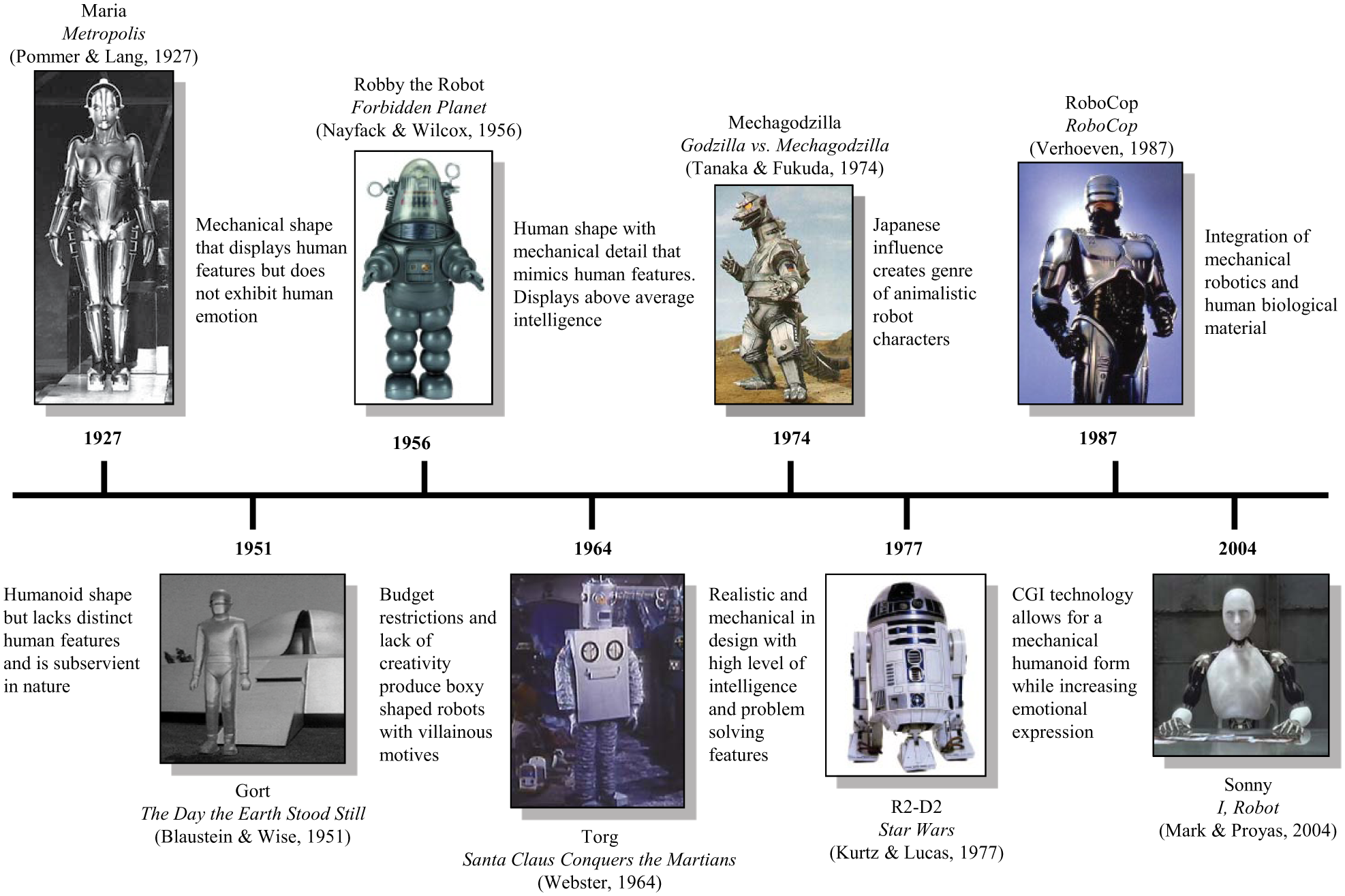
Timeline of alterations in design characteristics for robotic characters in film.
As physical appearance transitioned from a humanoid to a mobile machine, two trends became evident: Some specific features were removed, whereas others were emphasized. The process of deanthropomorphizing the physical appearance, or removal of specific features, was most obvious from the mid-1930s through the early 1950s. Robots maintained a body type that could be termed human-like, including legs, arms, torso, and head. However, their facial features, such as eyes, nose, and mouth, were often omitted. The robot Gort from The Day the Earth Stood Still (Blaustein & Wise, 1951) is perhaps the classic representation of this form. The missing features disabled any ability to express emotions or to display intent. This ominous appearance elicited a fearful response from viewers. As such, the subsequent focus on specific facial features became an essential element of advanced social interaction.
Eyes and eyebrows are used to portray human-like emotions or purpose. The linked emotional state to eye color has remained constant when designing robots for fictional media (see Johnny Five in Short Circuit, Badham, 1986). Humans in general connect specific colors to emotions (e.g., sadness is associated with “feeling blue,” and anger is associated with “seeing red”). For example, in the Japanese television program Robot Detective (Ishinomori, 1973), the robotic character’s eyes are yellow when in a calm emotional state, red when displaying anger, and blue when expressing sadness. A more in-depth examination of emotive design features (Schaefer et al., 2012) has generated a best-practices approach for integrating emotional dynamics into robot design.
Behavioral indictors
Human-like behaviors have also been shown to be essential in determining purpose and intention during the integration of robots into society. A key example of integrating human behavior and morals into robotics comes from Isaac Asimov’s original Three Laws of Robotics (Asimov, 1950; Hamilton & Hancock, 1986). These laws focus on, first, minimizing harm to humans, then self-preservation, followed by obeying orders.
For example, Robby the Robot (from both Forbidden Planet, Nayfack & Wilcox, 1956; and the TV series and subsequent movie Lost in Space, Allen, 1965; Koch & Hopkins, 1998) was designed to abide by these specific laws and is known as a protector and an arbiter of fairness. Two prime examples of human-like behavior are represented in the automated vehicles K.I.T.T. and K.A.R.R. from the TV series Knight Rider (see Figure 3) as well as Commander Data and his twin brother, Lor, from Star Trek: The Next Generation.

A visual comparison of K.I.T.T. and K.A.R.R. from Knight Rider.
In both cases, the physical appearance was similar, if not identical. Thus, K.I.T.T. (Knight Industries Two Thousand, or more recently named Knight Industries Three Thousand) and Commander Data were designed to assist and protect human life, whereas K.A.R.R. (Knight Automated Roving Robot, or the more recently named Knight Auto-Cybernetic Roving Robot Exoskeleton) and Lor were designed to prioritize self-preservation. Thus, Commander Data and K.I.T.T. emphasize the first law over the second (as Asimov directed), whereas Lor and K.A.R.R. reverse this priority and are often characterized as the “evil” twin. Additional explanations about these characters and their relationship to human–robot trust have been given by Hancock, Billings, and Schaefer (2011).
Perhaps the first instantiation of a robot in fictional media stems from Greek mythology in the third century BCE; that is, Talos, a bronze man who protected Crete from pirates. Talos has a human-like appearance and protective behaviors. A number of these robot-like protectors are described in literature and have found their way into visual media (see Jason and the Argonauts; Schneer & Chaffey, 1963). For example, many children’s movies and television shows (e.g., The Iron Giant; Townshend & Bird, 1999) illustrate robots as protectors that frequently take the role of defender from “evil” and often eventually sacrifice themselves for the good of humankind.
Cognitive capabilities
Human-like language and cognitive capabilities also have been featured in fictional media as a means of integrating robots into human society. Similarly, robotics research (e.g., machine learning, communication, and perceptual interpretation) has more recently transitioned to include a stronger focus on the importance of these cognitive capabilities in design.
The transition from purely navigation-based functionality to the integration of cognitive functioning was seen in fictional media in the 1940s and 1950s. Prior to this time, authors favored robots that functioned as companions or tools that had either limited or no cognitive abilities (e.g., the Prague myth of the Golem from the mid-1840s; Dekel & Gurley, 2013). As a result, very little emphasis was placed on the concept of robots that were able to function autonomously.
Phillip K. Dick was one of the primary authors who helped transition the emphasis to a cognitively aware robot through his novella The Last of the Masters (Dick, 1954). In that work, the robot, Bors, exhibited psychological complexity and cognitive capabilities through its knowledge and capability to rule society in a utilitarian way. Bors also exhibited multiple human-like personality traits, including fear, neuroticism, and paranoia.
Cognitive functionality provides the ability to process information in a way that enables the robot to make decisions and solve problems. Subsequently, the ability of machines to learn from their mistakes, the environment, and humans became a common theme in fictional media. To accomplish these cognitive-based functions, robots have to be able to understand humans and communicate ideas using their language, imagery, and other modes of communication. Although the primary mode of fictional communication is usually speech, the process of communication can be generalized in real-world robotics across numerous modalities. For example, Marvin from The Hitchhiker’s Guide to the Galaxy (Adams, 1979) depicts emotions – typically, depression – through vocal patterns and prose.
In addition, whereas certain areas of knowledge can be programmed, a vast number of social and cultural cues are developed through interaction with humans. For example, the robotic character Andrew Martin, from the novella The Bicentennial Man (Asimov, 1976), displays advanced cognitive abilities through the identification of human social cues. This ability allows it to become progressively more acceptable to humans because it can mirror full human appearance (e.g., wearing clothes and replacing his original form). The end result is a robot that becomes vastly more human, largely through its increased ability to communicate and integrate with society.
Matching Form and Function
Starting in the late 1970s, improvements in cinematic special effects ushered in a new species of robots, which brought the integration of form and function to the forefront of science fiction. Led by Star Wars (Kurtz & Lucas, 1977), robot cast members were now introduced, designed, and animated without the need for a costumed human to portray them. No longer did filmmakers have to rely on human form and features when designing robotic portrayals; more attention was spent on creating robots that could realistically carry out the functions for which they were nominally designed (see Figure 4).
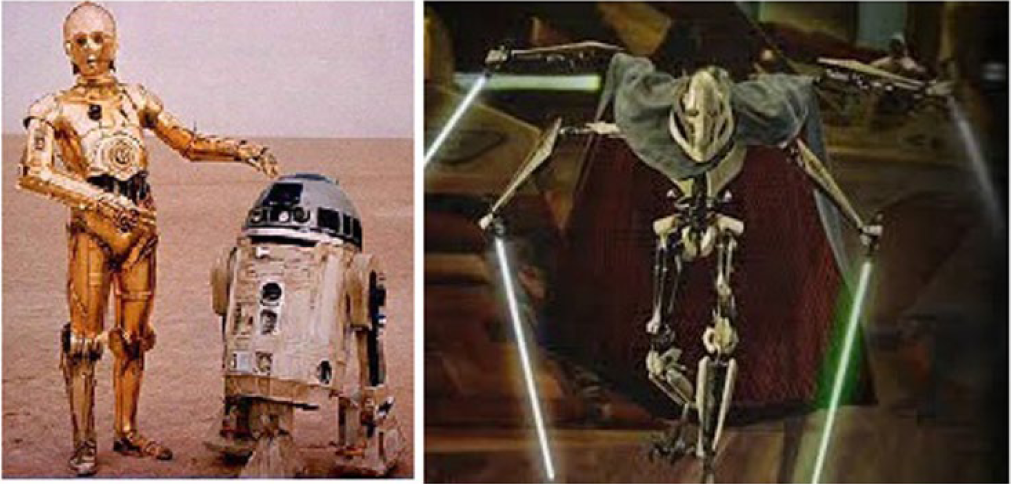
A visual depiction of matching form and function represented by R2-D2, C-3PO, and General Grievous from Star Wars.
Perhaps the most famous robot character of this time was the service droid R2-D2. At first glance, R2-D2 appeared to be merely some form of trash can on wheels. However, it quickly became apparent that its design enabled complex interaction with starship computers as well as physical integration with combat star fighters. R2-D2’s physical design and technological capabilities differed from its mechanical companion, the protocol droid C-3PO. Following the paradigm that a robot’s appearance should match its function, C-3PO strongly resembled a human in both physical design and emotional output. This resemblance enabled it to assist with matters of etiquette, customs, and translation in order to facilitate meetings of different cultures (see Hancock, 2010).
As cinematic technology has advanced, so has the idea that robots should be designed with physical features that match their intended function. One of the newer characters in the Star Wars lexicon is General Grievous, a villainous battle droid with multiple arms, each able to brandish a deadly lightsaber during combat. Such improvements brought about by integrating advanced form into innovative functions in science fiction have pointed the way for the development of future designs.
Human–Robot Integration
Beginning in the 1980s, fictional media began to demonstrate a much greater degree of intimate integration of robots into the human social setting, both physically and metaphorically (see Boyce & Hancock, 2012). Human-like appearance once again became the standard for primary robot form. However, a unique addition was the integration of humans with robotic components (i.e., cyborgs). In a number of examples, robotics are added to humans for medical necessities (e.g., RoboCop; Verhoeven, 1987; Inspector Gadget; Chalopin, Heyward, Katayama, & Loubert, 1983), the optimization of human abilities (e.g., The Six Million Dollar Man; Bennett et al., 1974), and the replacement of missing limbs (e.g., Anakin Skywalker from Star Wars). As we have noted, in The Bicentennial Man (Asimov, 1976), the robot Andrew Martin becomes progressively more human over the course of two centuries by alterations to both its robot body and brain. The lengthy transformation is depicted as one of the most extreme and ambitious integrations of humans and robots.
Whereas certain visual media, such as The Six Million Dollar Man (television series), RoboCop (film), and Bicentennial Man (film) use a piecemeal approach to human–robot body integration, other forms of media posit that the entire world can be fully robotic. For example, in the poem “Organotropy,” Jason Christie (2006) emphasized robot features in a way that implies humans have the propensity to evolve simultaneously with robots in a symbiotic way. In this work, a human couple has robotic eyes and refers to nearly every item they come into contact with (mail delivery services, cameras, etc.) as robotic. The poem even goes so far as to imply that politicians running for office are trying to exterminate the human race.
Design Lessons From Media
Fictional media continue to influence real-world robotics design, not only in translating features into current developments but also in how individuals perceive such designs. Fictional media provide the greater society with the capability to form and update its mental models of robots. Yet, although fictional robots often represent extreme or exaggerated form-based or functional capabilities, these perceptions do not necessarily match current robotic design. Practical real-world designers need only to build robots that efficiently accomplish a limited range of assigned tasks. However, in future evolutions, designers also need to be cognizant of robotics in fictional media because of the widespread influence these mechanical characters have on public expectations.
The way in which people perceive machines as robots influences their subsequent behavior and quality of interaction with these systems. Thus, we present a set of guidelines established through reference to previous fictional representations in order to foster acceptance, satisfaction, and performance between coming human–robot teams in the immediate future.
Societal perception and mental models. Fictional media provide a main avenue for the general society to build perceptions about robot appearance, behavior, and cognitive capabilities. This representation may well lead to dissonance during interaction with real-world robotics. Primarily, this issue revolves around trust and the fracturing of expectations (Hancock, Billings, & Schaefer, 2011; Hancock, Billings, Schaefer, et al., 2011).
Importance of anthropomorphism. Fictional representations reinforce the importance of physical, behavioral, and cognitive anthropomorphism in robotic design, especially when robots enter the human social domain. Although it may not be essential that real-world robots have human-like form (and the majority of current designs do not), other human-like features or capabilities in terms of behavior or cognitive functioning may be essential.
Matching form and function. The majority of current robot designs focus primarily on functional capability in relation to a specific task. However, a common theme has shown that physical form should match functional design. For example, it is recommended that companion robots take on a more human-like or animal-like form (e.g., Furby), whereas tool-like service robots can have a less anthropomorphic appearance.
Advancement of technology. The advancement in reliability and predictability has been shown to be essential for the development of real-world robotics as well as the advancement of fictional media design.
Robots are multidimensional, ever-changing technological systems based on iterations that emanate from the media and then partly percolate into real-world systems. The ways in which people perceive machines are influenced by their access to both fictional and real-world technology. As such, robots can influence individuals’ subsequent behavior and quality of interaction with these systems. What was once only science fiction finds its place in reality, and that reality then founds future imaginings.
Footnotes
The research reported in this document was performed in connection with Contract No. W911NF-10-2-0016 with the U.S. Army Research Laboratory, P. A. Hancock, Principal Investigator. The views and conclusions contained in this document are those of the authors and should not be interpreted as presenting the official policies or position, either expressed or implied, of the U.S. Army Research Laboratory or the U.S. government unless so designated by other authorized documents. Citation of manufacturer’s or trade names does not constitute an official endorsement or approval of the use thereof. The U.S. government is authorized to reproduce and distribute reprints for government purposes notwithstanding any copyright notation herein.