



Abstract
We examined aerospace systems research trends in papers published in the Proceedings of the Human Factors and Ergonomics Society Annual Meeting from 1980 to 2012. We categorized articles based on authors’ affiliation type, content area, population, sample size, apparatus, and nature and specification of outcome dependent variables. Our results, available at http://erg.sagepub.com/supplemental, revealed an increase in research interests related to cognition and pilot–cockpit systems interface design. Our findings are intended to guide students, educators, and researchers by providing an analysis of these trends and a searchable online database.
Keywords
HFES Annual Meeting Proceedings form the backbone for an extensive database tracking trends in aerospace research over 30 years.
In this article, we examine aerospace research trends that have appeared in the Proceedings over the past three decades. Many of today’s modern technological innovations have emerged from aerospace systems due to the substantial allocation of funds toward research and the new boundaries often breached during the development, testing, and deployment of these systems. Major research contributions related to these various applications have been explored in the Proceedings, and here we seek to establish trends from January 1980 to August 2012.
Chronology of Aerospace Research
Our detailed analyses of chronology, content, and demographics of the included research articles are contingent on our publication source. We recognize that numerous other sources report similar research (e.g., Human Factors; Ergonomics; International Journal of Aviation Psychology; Aviation, Space and Medicine). However, we have chosen to highlight only Proceedings papers because we believe many key HF/E issues are presented at HFES Annual Meetings before they appear in Human Factors.
We analyzed articles using only the search term aerospace systems because a search on aviation retrieved 2,543 articles, which would have derived a database that would not have been as valuable and easily navigated as one based on the term aerospace systems.
Our chronology details the nature of the research articles, their content, and various demographic characteristics, as outlined next. We tabulated data to reflect trends; we were particularly interested in the progress and growth of certain research areas during the identified time span.
We analyzed 430 papers by decade (1980s, 1990s, and 2000s) and, within each decade, based on the following six domains:
Publication period
Content
Population
Sample size
Apparatus
Dependent variables
Typology of Content Areas, Issues, and Considerations
In addition to these noted screening factors, we evaluated articles for content and identified 10 specific content areas. We assigned each article to one primary content area in order to provide a crisp, definitive categorization. Figure 1 depicts the main foci that emerged from this analysis, including cockpit interface, general aviation systems, cognition, physiology, ergonomics, and anthropometry.

Aerospace research content areas by reporting decade.
As is evident in our database, researchers have paid relatively little attention to weather and other environmental concerns, although such issues may well appear in, and be the focus of, non-HF/E journals. We coded this content area, however, only if weather was the primary focus and was not superseded by issues such as cockpit or air traffic control (ATC) displays.
Although interfaces are the primary means through which aviation professionals visualize weather, several other concerns are related to HF/E and weather (e.g., weather-related decision making). Such concerns promise to provide a focus for future studies and may lead to suggestions that secondary and tertiary levels of identification could identify more subtle, complex, and long-term trends.
Taxonomy of Aerospace HF/E Research
We set another goal, to systematically determine taxonomic factors related to various population types that were studied in the reviewed articles. Although many areas of psychology and engineering enlist a wide array of participants, three professional categories stood out in these papers on aerospace systems: (a) pilots (private, commercial, or military), (b) air traffic controllers, and (c) astronauts. Participation in each of these categories has grown significantly over the past 30 years.
We also found it interesting that from the 1990s to the 2000s, the number of “other” participants (e.g., students) decreased. It would be instructive to understand whether comparable HF/E studies in other areas (e.g., military systems) present an equal focus on the use of professional subject-matter experts.
Varieties of Human Performance Measures
We identified 12 dependent variables in the included papers. The most notable were workload, situation awareness, and reflections of objective response speed and accuracy. Figure 2 also shows the areas in which relatively little research was done up to 2012.
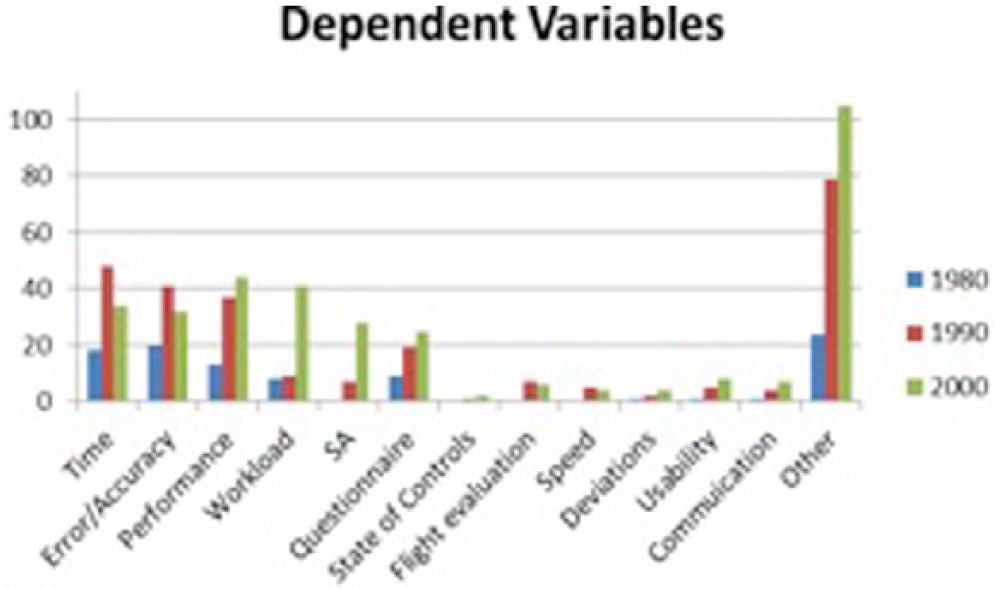
Frequency of the dependent variables by decade of occurrence.
Major Findings
Major topical trends include cognitive workload, situation awareness, and performance.
Content areas that have steadily increased since the 1980s include cockpit interface and cognitive/physiological research.
Although the number of studies has decreased in several areas, the number of content areas has increased. Domains that were featured in the 1980s and 1990s, such as ATC interface studies and an overall systems-based approach to the area, are still being investigated in the 2000s.
The number of studies enlisting pilot participants has increased, and pilots continue to be the most represented population. In addition, the inclusion of air traffic controllers has increased from only 2 studies in the 1980s to more than 25 studies in the 2000s.
Simulation continues to be the tool most frequently used in research studies.
Current and Emerging Trends
Aerospace systems have clearly evolved over the past 30 years, both in content area and application. During that time, the HFES Aerospace Systems Technical Group has become a seminal technical forum for researchers. Emerging areas of study include energetic dimensions, such as situation awareness, as well as technical advances in various simulation capacities, such as virtual and augmented reality. Other areas include human–automation interaction and associated complacency with persisting issues such as stress and operator workload. The burgeoning issue of unmanned aerial vehicles also promises to have a profound influence on this aspect of HF/E science.
Although it is difficult to predict future trends, it remains useful to gather data that can guide future research and developments. One example of this is the important NextGen research and implementation program (Federal Aviation Administration, 2012).
Database
In our effort to examine the Proceedings articles in a systematic way, we created a searchable database of more than 430 articles for students, researchers, and practitioners in the HF/E field. We hope that this resource will guide and facilitate their research endeavors in various aerospace research projects. The database includes full abstracts; author demographic information, affiliations, and country of origin; and a list of aerospace organizations.
The first three tabs in the database provide a comprehensive list of all articles published under the key term aerospace systems over the past three decades. We also list the methods used in the study, such as sample size, special populations (i.e., pilots, older adults), apparatus, and dependent variables. The fourth tab features an in-depth categorization of articles (e.g., panels or symposia). The remaining tabs describe the articles and include article counts, additional figures, and links to organizations involved in aerospace systems research.
We hope that this database will grow to reflect current and future aerospace systems research efforts, and encourage other researchers to use and expand it. The database is available online at http://erg.sagepub.com/supplemental.
Footnotes
Acknowledgements
The authors thank Sally Stader, Kevin Leyva, and Nicholas Adan for their assistance in gathering and coding the articles in the database.
References
Supplementary Material
Please find the following supplemental material available below.
For Open Access articles published under a Creative Commons License, all supplemental material carries the same license as the article it is associated with.
For non-Open Access articles published, all supplemental material carries a non-exclusive license, and permission requests for re-use of supplemental material or any part of supplemental material shall be sent directly to the copyright owner as specified in the copyright notice associated with the article.
