



Abstract
Although laboratory studies demonstrate increases in energy expenditure with the use of treadmill workstations, effectiveness and efficiency studies demonstrating improved energy expenditure in real workplaces have yet to build the evidence to support use of such workstations. Psychosocial barriers to using treadmill workstations are related to communication (noise and hierarchy), need for motivation, peer pressure, and adaptation that might affect performance. Answers to questions such as whether the institution is willing to pay more to acquire very-low-noise devices, whether it is able to tolerate low use of treadmills, and whether vendors exist with no-hassle return policies may help in properly implementing treadmill workstations.
Keywords
Consideration of usability, comfort, safety, and work productivity should be supplemented by examination of psychosocial factors in determining if treadmill workstations will be effective.
Active workstations – particularly treadmill workstations – could expand the possibilities for healthy working environments. Have ergonomists and occupational health practitioners been developing evidence that would be useful in understanding the psychosocial determinants of use for them? In this article, we would like to make the argument to carefully consider the evidence-building process and psychosocial issues as determinants of the use of active workstations in general and treadmill workstations in particular.
For this argument, we first frame the research processes that led to the current style of implementing treadmill workstations. Second, we describe the work organization and psychosocial barriers and facilitators that we have learned are associated with the use (in the dimensions of usability, comfort, safety, and productivity) of these devices. Finally, we make some recommendations to providers and buyers of these workstations to increase the chances of developing solutions that may positively affect the health of their target population.
Research Processes Regarding Treadmill Workstation Implementation
During the development of any device or process aimed at improving health, three testing stages must be passed before the device or process can be recommended as an appropriate contributor to solve a health issue. These stages are designed to build scientific evidence regarding the efficacy, effectiveness, and efficiency of the proposed solution (Glasgow, Lichtenstein, & Marcus, 2003; Glasgow, Vogt, & Boles, 1999). Right after a device – in our case, a treadmill workstation – is developed, it is tested under lab conditions (not actual working conditions) to determine whether it has the desired impact when used as planned. In the case of the treadmills, efficacy studies (see Table 1; also see Goldstein, 1992; Levine, 2002; Levine & Miller, 2007; Levine et al., 2011; Levine, Vander Weg, Hill, & Klesges, 2006) are necessary to prove the benefits to health indicators in voluntary participants under controlled conditions.
Examples of Study Types to Obtain Evidence About the Benefits of Interventions
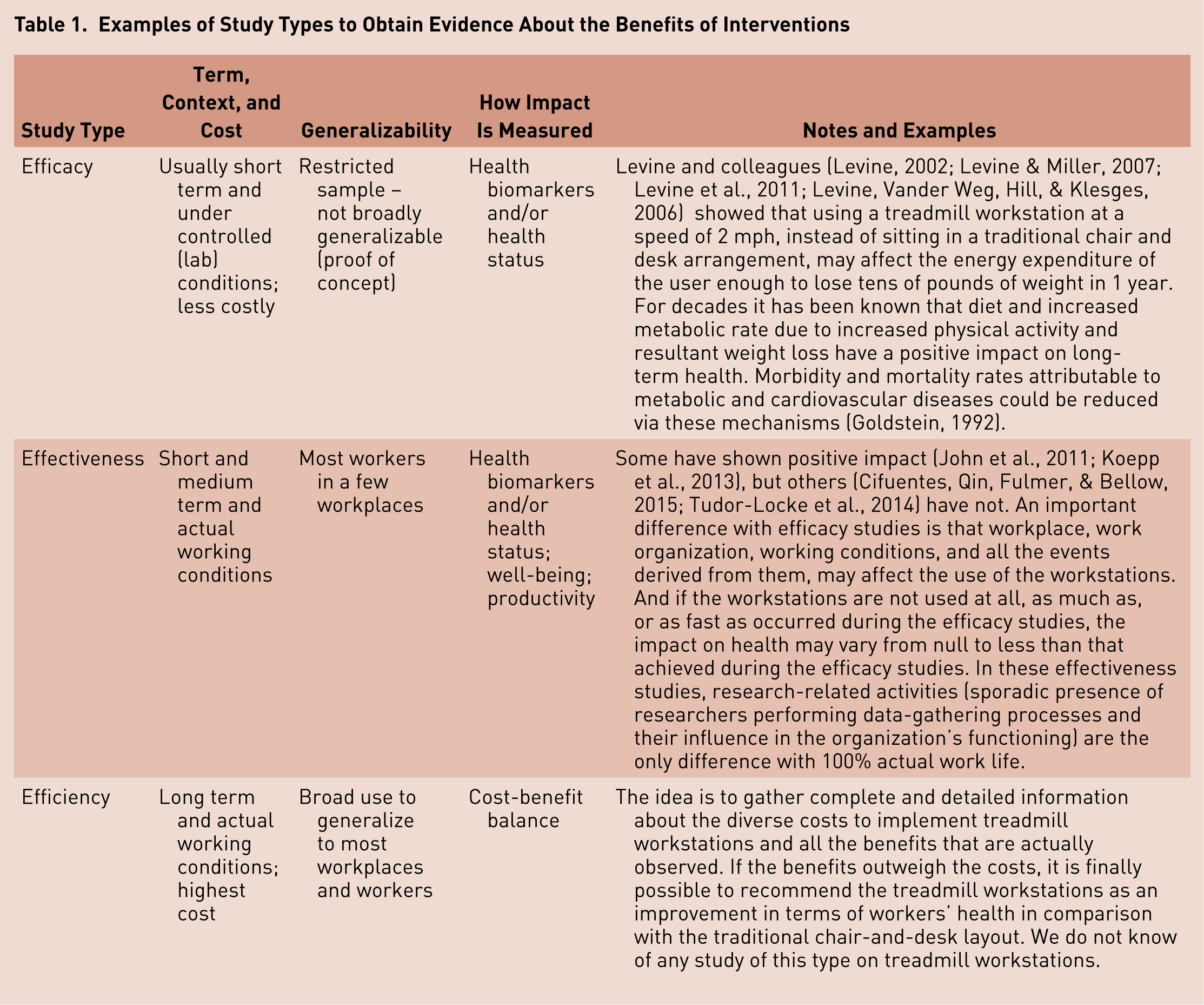
Once efficacy studies have shown a beneficial impact, as those with treadmills have done (Alderman, Olson, & Mattina, 2013; Ben-Ner, Hamann, Koepp, Manhoar, & Levine, 2014; John et al., 2011; Levine & Miller, 2007; Oppezzo & Schwartz, 2014), effectiveness studies are then necessary to test whether, in actual workplaces and working conditions, with nothing simulated, the use of the devices will achieve their promising beneficial impact. For the treadmill, this finding has yet to be clearly shown (Cifuentes, Qin, Fulmer, & Bello, 2015; John et al., 2011; Koepp et al., 2013; Tudor-Locke et al., 2014).
However, should effectiveness be demonstrated, efficiency studies would be warranted before treadmill workstations could be fully recommended (Baxter, Sanderson, Venn, Blizzard, & Palmer, 2014). The financial (return-on-investment) and core value (return-on-values) assessments play a key role, and issues such as acquisition, installation, and maintenance costs are weighed against the expected favorable impact on health, work performance, and productivity, among others. These studies are conducted with large samples and for long periods and under actual working conditions.
Organizational Commitment
For implementation to be successful, in addition to the preferences of individual workers, several organizational factors must be considered that could affect the patterns of use of a treadmill. As workers and health and safety professionals know, an underlying commitment to health and safety in the workplace has to be strongly encouraged at the highest levels of a work organization for sustainability (van Eerd et al., 2010).
A spectrum of institutional commitment can be recognized, from superficial investment in trendy equipment to a comprehensive ergonomics program. Such a program, overseen by trained and active health and safety committees inclusive of rank-and-file workers, will lead to varying organizational responses to individual wishes, desires, or needs to use a treadmill. But are those organizational responses seen as a factor in the treadmill’s effectiveness and efficiency? We believe that the answer is yes and that efficiency is a local measure, meaning that interventions must be adapted to evidence gathered at the specific institution.
These local realities might explain why some implementations are initiated despite lack of convincing evidence of their benefits. When there is not enough scientific evidence, a gradual and evaluated implementation may disentangle, when possible, the organizational- from the individual-level factors affecting the impact of an intervention program. A gradual implementation will prevent problems from reaching their maximum deleterious impact across the organization. An evaluated process of implementation will enable early identification and correction of those problems in a recursive manner.
In the typical situation, where the treadmill is not included in a list of an institution’s available office furniture, will an employee be successful in acquiring the equipment? Given that the treadmill carries a considerable cost, in terms of finances and space used, the commitment from the organization will be a factor. In return for this commitment, there would be considerable pressure for the treadmill to “pay off,” so the proper (in terms of frequency and intensity) use of the treadmill would be critical. Because we know that certain types of computer work are not conducive to treadmill use (John, Bassett, Thompson, Fairbrother, & Baldwin, 2009; Thompson & Levine, 2011), an organization should be ready to allow and support a worker’s need to vary his or her treadmill use, and the organizational support should be clear to the user. In many cases, individual performance improvement will take time to become evident.
This is where the vendors play a role. Usability might improve if treadmills were sold with trial-period allowances that would give the user time to adapt his or her work and work environment. Although it is our opinion that treadmills should not be recommended without further study, vendors might market their products with a trial period in order to increase uptake in the market and to help identify, at least partly, the local long-term impact. However, it should not be done without an explicit arrangement with the work organization to address important issues about its own organizational influence and expectations for individual use.
Psychosocial Barriers and Facilitators for using Treadmill Workstations
There is a growing trend toward conducting research that demonstrates the impact of treadmill workstations on work performance and biomarkers under actual working conditions, which places the current research in the second stage (effectiveness studies). This is the opportunity to gather information related to how and how much the treadmill workstations are used and what work life aspects affect their use and to expand knowledge on usability, comfort, safety, and productivity.
Barriers and facilitators are two sides of the same coin. Whereas barriers prevent the use of the treadmill workstation, facilitators are the conditions or events that improve work performance, enhance human interaction, or decrease anticipatory fears and therefore increase the use of the active workstation. In this sense, if something must improve from its current state, it is a barrier; if something was good enough and should be kept that way, it is a facilitator.
We have learned that when two important life facets compete, such as health and work performance, frequently the worker prioritizes work performance ahead of health (Goetzel et al., 2004). Thus a good path to follow to discover barriers to the use of treadmill workstations is to notice whether using them affects work performance (measurable by workers when they may decide not to use them). Comfort and human interaction are also very important (Elst, Baillien, De Cuyper, & De Witte, 2010). If communication or any qualities of the human interaction are affected, chances are that there will be at least some resistance to use the treadmills.
Recently we described a series of events and conditions as either barriers or facilitators (Cifuentes et al., 2015). We chose four dimensions of use (usability, comfort, safety, and productivity) to represent important ergonomics perspectives on worker interactions with treadmills. Three of the four dimensions were affected by barriers and facilitators that were psychosocial in nature (Table 2). Organizations may decide to act on some of these barriers and facilitators if their own evaluation makes it feasible and beneficial in terms of workers’ health and the company’s business goals.
Psychosocial Factors Related to Use of Treadmill Workstations by Dimension of Use Potentially Affected, and a Systematic Series of Questions That May Help to Evaluate the Organizational Readiness for Implementation
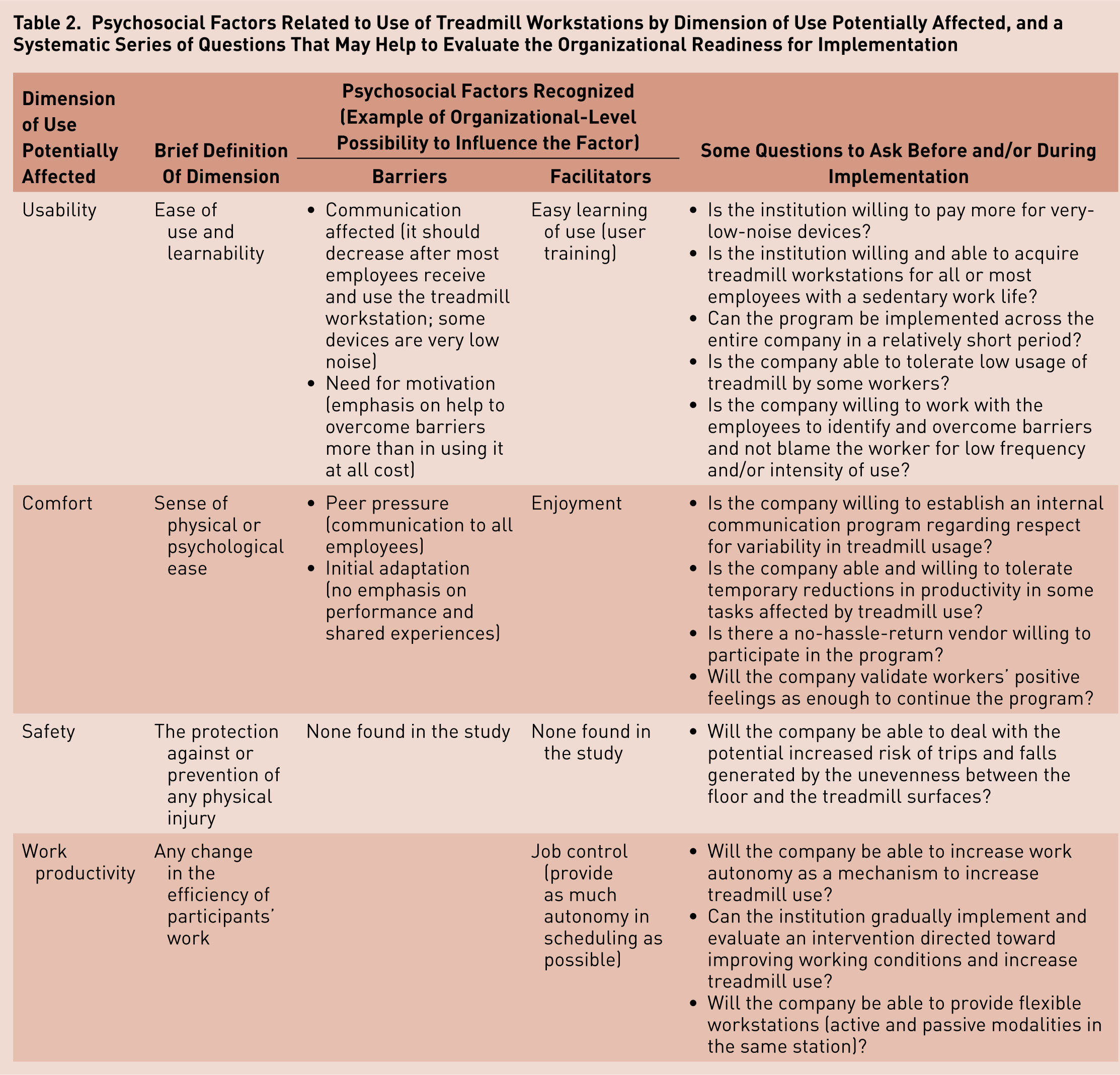
The first of these dimensions, usability, is defined as the ease of use and learnability; that is, whether the device itself was considered easy to operate (and therefore a facilitator; the definition of usability in ISO 9241-111 regarding efficiency, effectiveness, and satisfaction was regarded as too complex to operationalize for this study). We found that the setup (fitting into the existing office layout) was difficult; additionally, use affected communication with other workers. Noticeable noise was enough to interfere with phone calls because workers perceived walking on a treadmill during a work-related call as being not fully present in the conversation. Therefore, they did not walk while on the phone, despite the fact that the treadmill noise was a low-intensity and low-frequency hum and therefore not audibly interfering with the conversation.
Because being taller while on the treadmill affected the relative hierarchical appearance, workers felt disrespectful to their peers and defiant to their supervisors. They therefore preferred not to use the treadmill when another person entered their office.
Workers thought that external motivation (coaching) could help them overcome the barriers to use. Organizations may facilitate use through user training (Table 2) that emphasizes that the workers would likely enhance productivity by identifying and overcoming other barriers for using the treadmill rather than viewing their own motivation as the critical barrier above all others. Often it is the presence of other barriers or lack of facilitators that demotivates the worker to use the treadmill. Focusing on the lack of motivation as a symptom of undetected/unexpressed barriers will be more successful than just attributing the lack of motivation to an intrinsic feature of the worker. In terms of comfort, regarded as a sense of physical or psychological ease, there were, after the initial period of adaptation, reports of enjoyment while using the workstation (a facilitator).
As for the barriers, psychological discomfort increased because not all workers had treadmill workstations. This situation generated a social dynamic in which socially supportive peers expressed comments indicating that participants should more frequently use the walking modality. These comments were regarded not at face value or as a motivation but as disrespectful and derogatory. Organizations may want to decrease peer pressure by communicating how the long-term benefits are achieved by very-long-term adaptation and consistent use of the treadmill and not by activity in relatively short periods, as well as by having treadmill users share their experiences and advise one another.
It is expected that peer pressure decreases after the treadmill workstations are broadly used in the organization. Therefore, to have a program excluding many workers of similar status or condition might increase peer pressure and its negative effects. In addition, a more concerned and supportive peer attempting to improve the beneficial impact of the active workstation by cheering up his or her coworker to use it may have a negative impact by making the coworker less comfortable to use the station.
Regarding safety, trips and falls are unusual events in the office workplace, and the unevenness between the treadmill and the floor introduces exposure to a tripping hazard, which could result in an increase in acute injuries despite the intention to reduce chronic conditions resulting from inactivity at the workplace. It could be argued that high job demands might make workers more prone to walk inattentively and to trip on the treadmill.
Finally, for the dimension of work productivity, having control over one’s own job was an important facilitator for using the treadmill longer and more frequently. In general, some specific tasks were routinely accessible. Still, the impact on productivity was strongly associated with the speed of the treadmill belt. Productivity was affected by the treadmill except in the case of standing only, not walking. When having to perform tasks that require accuracy, a very slow pace or simply standing would be recommended, because treadmill walking tends to reduce accuracy.
Workers lacking job autonomy will not be able to accommodate the schedule of their work, which will force them to work as fast as they can to meet their goals. As a result, workers may elect not to use the treadmill so they can be assured of meeting their time goals. Therefore, those workers who experienced job autonomy more frequently, and could select tasks or activities or their timing, had the opportunity to use the treadmill more. The recommendation here is obvious, and potentially, it is also the most important limiting factor in how much treadmills are going to be used. Providing workers with more autonomy about how to schedule their tasks should let them prioritize and plan when and how much to use the treadmill by modifying their schedule accordingly. As noted earlier, low autonomy may also affect the scores indicating how easy or comfortable it is to use the treadmill.
Discussion
It is our opinion that current treadmill workstations have not yet been fully evaluated as to whether they will have a beneficial long-term impact on health, work productivity, and other outcomes and whether this impact will be sustainable. Most conclusive evidence to support treadmill use comes from efficacy studies, which provide evidence based on laboratory conditions, not necessarily replicated in the actual workplace. Despite this uncertainty, treadmill workstations are promoted as one proven solution to decrease sitting time and increase work-related physical activity. Although this result may prove to be true, the statement has still not been scientifically supported.
Psychosocial aspects influencing the use of workstation solutions in general, and treadmill workstations in particular, have been generally ignored. However, organizations may address most of them if local evaluations inform about the benefits. Given that the results of studies testing the impact of ergonomics solutions are local and need to be replicated to be generalizable, special attention must be paid to the context and conditions in which an evidence-providing study was performed. In general, organizational commitment to the implementation of solutions, with attention to the workplace structure and social dynamics, should facilitate the adoption of treadmill workstations given further evaluation and proof of benefit.
It is the confluence of the physical structure and mechanical properties of the treadmill and its context within the tacit rules, codes, and mores of the institution and workplace that may affect a worker’s use of a treadmill workstation. Barriers and facilitators are therefore always related to the hardware (which could be generically called “the design”) as well as to the way the work is performed and how communications and hierarchies are expressed. All this means that modifying the workstation design is always a possible means to affect its usability. It also means that other non-design-related issues (such as work organization and specific working conditions) have a simultaneous impact on usability.
Job autonomy gradient in the usability of treadmill workstation might be one of the most important factors under the current organizational paradigms. If a company acquires these workstations, workers must use them above a threshold duration and speed to obtain a meaningful beneficial impact. If workers are not provided with enough job autonomy, the investment in the treadmill will not result in benefits and, even worse, can be seen as a useless addition to a cramped office space, having a net negative impact and loss of valuable real estate. Part of this job autonomy is respecting the fact that while working, workers sometimes might like to walk, and other times they might just want to stand or sit. To implement such a solution, one must consider this flexibility and ease the transition from one modality to another. Current commercial treadmill workstations do not offer a flexible alternative, and acquiring them might force workers to walk or stand on the treadmill belt.
A low-ranking worker, with limited options in terms of job control, might see the new acquisition as an imposition instead of an opportunity. When the company “pushes” for using the walking modality to obtain the most benefits, a recipe for disaster exists. We reiterate that workers in higher hierarchical positions have greater job autonomy and therefore will benefit more from having treadmill workstations. However, the types of diseases and health events that treadmill workstations would prevent are more prevalent in the workers in the lowest part of the work hierarchy (Stringhini et al., 2010).
We conclude that at this moment and without careful local evaluation, companies acquiring treadmill workstations are expressing their good intentions supported by wishful thinking. There is insufficient evidence to confirm or rule out the potential benefits of treadmill workstations. We may anticipate that workers with high levels of job autonomy, usually high-ranking employees, will use the treadmill workstation more often and therefore will benefit the most, meaning that the impact of treadmill workstations will likely miss the population that needs the intervention the most: workers with low job autonomy and little hierarchy. Without informative data on dimensions of usability, comfort, safety, and productivity, organization might blindly accept this imbalance.
Footnotes
After 15 years of clinical work as general physician in the Chilean Patagonia and psychiatrist in Chile,