



Abstract
Human factors/ergonomics (HF/E) can play a role in improving equal opportunity in U.S. voting through the redesign of inefficient voting processes that lead to low voter turnout. This article, which derives from the authors’ winning entry in the HFES 2014 “Voting Systems of Tomorrow” competition, outlines HF/E-driven recommendations for improving the American voting process. These recommendations include a “one-stop shop” for all voting-related information, personalized voter accounts, appointment systems, and several ballot design suggestions. Implementation of these recommendations, on any level, has the potential to improve the proficiency of polling places, lower all-too-common lengthy wait times, and ensure that ballots are accessible to all voters.
Keywords
Building a comprehensive Web-based solution according to HF/E study findings aims to ensure a smooth experience for voters.
Issues related to representation span most of U.S. history, from the Revolutionary War to the civil rights movement. Voting is the most direct way in which political representation is achieved in the United States. Much has already been said about fairness with regard to gender, race, religion, and so on, but not as much has been said about how human factors/ergonomics (HF/E) can improve equal opportunity.
Statistics show that U.S. voter turnout ranks 31st out of 34 developed countries (DeSilver, 2015). According to Highton (2006), turnout problems could be due, in part, to inefficient polling stations that create long wait times. Polling station inefficiency can also be caused by problems with the act of voting itself, as highlighted by the 2000 presidential election. The poorly designed butterfly ballot (Figure 1) used in Florida that year caused 50,000 votes to be discarded, and many voters never knew that their votes were invalid because the machines were not designed to inform them of problems (Mebane, 2004).

Butterfly ballot used in the 2000 U.S. presidential election. Source: https://commons.wikimedia.org/wiki/File:Butterfly_large.jpg.

Problems deciphering ballots are not limited to the senior citizens of Palm Beach, Florida. In one study, researchers examined how different ballot types affected error rates and found that 11% of ballots cast by college undergraduates in an experiment contained at least one error (Everett, Byrne, & Greene, 2006). Furthermore, according to the Government Accountability Office (2014), ballot design can be a key factor in wait times. Clearly, HF/E has a role in ensuring that everyone is politically represented.
In 2014, the Human Factors and Ergonomics Society hosted the “Voting System of Tomorrow” competition, encouraging researchers to use their HF/E knowledge to create holistic solutions to problems in American voting. The present authors won the academic division of this competition and made the full submission available as a technical report online (Gable et al., 2015).
Through interviews, literature reviews, and creative brainstorming sessions, the team used a heuristic-driven approach to create a prototype Web site that enables citizens to gather all voting-related information and also to vote using a newly designed ballot. In this article, we outline our recommendations based on some identified voting-related problems and the HF/E principles used in the prototype to address them. These recommendations are based solely on heuristic evaluations; however, data-driven work is needed to validate a system that will inherently need to be accessible to widely diverse populations.
The following sections list the recommendations that emerged from the contest submission; the relevant HF/E principles for each recommendation are italicized.
Efficient Completion of Voting-Related Processes
The recommendations below summarize user-friendly Web site features that designers could employ to facilitate users’ performance of voting-related processes.
One-stop shop
The voting process includes many subtasks, such as registering, filling out moving-related paperwork, contacting election officials or offices, learning about election contests, determining eligibility and/or registration status, finding polling places, and practicing on mock ballots. Enabling citizens to complete every task, except for the actual voting, on one Web site would lower information access costs (e.g., Wickens, Lee, Liu, & Gordon-Becker, 2004, p. 189). At present, online voting still seems untenable because of security concerns (e.g., Jefferson, 2011), so our one-stop shop prototype did not include actual voting. However, some of the recommendations in this article could be easily adapted (e.g., electronic ballot) to a future when online voting might exist.
Voter accounts
Any voting-related Web site should enable voters to create accounts that store their data. This function could save time entering information repeatedly and lessen the burden to remember information, thus facilitating recognition rather than recall (Gerhardt-Powals, 1996; Nielsen & Molich, 1990; Shneiderman, 2010).
Appointment option
After voting registration is completed, often one part of the process lacks closure (the sense of finishing the process with no uncertainties remaining): knowing when to vote on Election Day. Every task should be designed to yield closure (Shneiderman, 2010); without closure at the end of the interaction with this interface, people may default to common voting times. For example, Spencer and Markovits (2010) found that most voters vote early (7:00 to 8:00 a.m.) or in the evening (25% of voters arrive between 5:00 and 7:00 p.m.), creating long waits. Therefore, we recommend that states implement appointment systems (see Figure 2). In such a system, voters could make appointments for an assigned times and use “priority” lines and booths designated for them, thus decreasing their wait times. Those who miss their appointments or choose not to make appointments could still vote at any time but risk longer waits.

Appointment mechanism (after a voter registers).
Even though many people do not have flexible schedules, this system could encourage those with flexible schedules to vote at low-demand times so that voter distribution would be more even throughout the day. (Voter distribution data after the system’s implementation would be useful in determining effectiveness and possibly help voters avoid long waits in the future through “prediction aiding”; see Wickens et al., 2004, p. 191.) This system would also provide a better sense of closure in the registration process and enable election officials to foresee periods of higher traffic (and react accordingly, perhaps with more staffing).
Ballot Design Recommendations
The Web site’s prototype ballot was designed in accordance with usability guidelines and design principles to improve the accuracy, fairness, and accessibility of voting.
Progress meter
Users should always know their progress while voting (e.g., votes marked so far, remaining items on the ballot). A progress meter (see Figure 3) could enhance the visibility of system status (Nielsen & Molich, 1990).
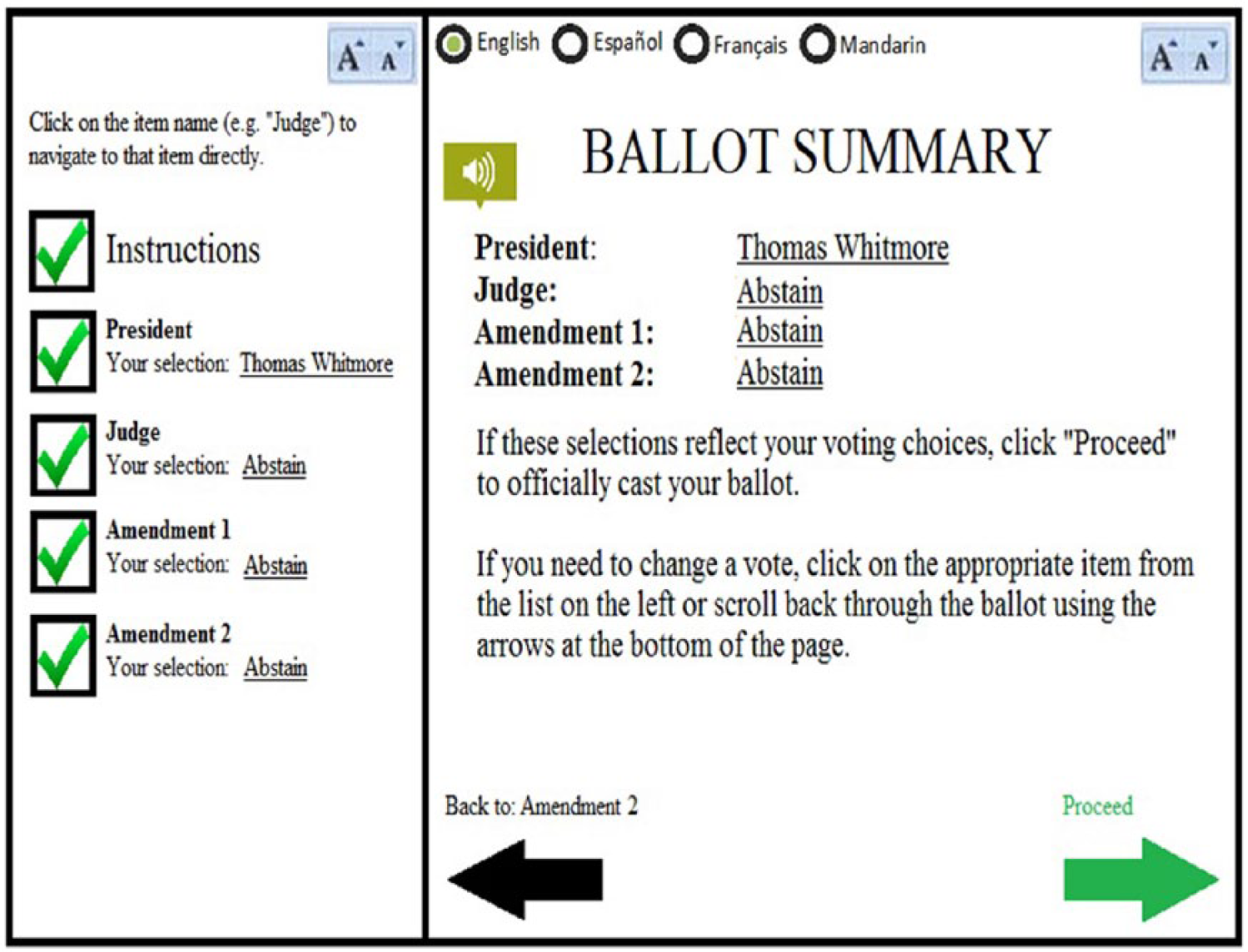
Sample screen from ballot prototype (ballot summary page).
Final check
At the end of the ballot process but before submission, a summary (see Figure 3) should be shown so that voters can see if the votes entered were indeed their desired choices. This feature should improve error prevention and facilitate error correction (Nielsen & Molich, 1990; Shneiderman, 2010).
Receipt printing
Voters should be able to print receipts of their votes; this informative feedback (Shneiderman, 2010) could serve as confirmation to voters that their votes will be counted.
Reversibility of actions
At any point before officially casting their ballots, users should be able to change votes on previous items, a feature that serves as another measure of error correction (Nielsen & Molich, 1990; Shneiderman, 2010).
Accessibility
Voters should be able to manipulate text size and language for maximum accessibility. Ballots should also accommodate people with disabilities with (a) audio options for those with vision deficiencies and (b) formats friendly to screen readers that nonsighted people might use (e.g., logical “tab order” of elements). In addition, research has shown how redundant coding of information through tactile feedback can be used to further enhance accessibility (e.g., Lederman & Hamilton, 2002) and should be leveraged in the design of voting interfaces. These features are important because making things more accessible will also likely simplify the voting process for the rest of the population (Jastrzembski & Charness, 2007).
Feedback
Each step of the voting process should contain informative feedback (Shneiderman, 2010) for user actions. For example, in the submitted prototype, green checkmarks were used to indicate successful actions. Feedback is especially important for computer-based ballots, given that actions on screens do not feel as permanent as ones on paper (Jabr, 2013).
Other examples of informative feedback are error messages that suggest actions to the user instead of merely displaying a status. For example, if a user votes for more contest items than is allowed, an error message could display the limit and instruct him or her to remove the extraneous item(s).
Layout
Each screen should have the same layout so that items on the screen (name of contest, candidates/items, progress meter, accessibility options, etc.) can be consistently located (Gerhardt-Powals, 1996; Nielsen & Molich, 1990; Shneiderman, 2010).
Practice ballot
As electronic voting becomes more feasible in future elections, it follows that voters should have access to electronic practice ballots before voting. This consistency (Gerhardt-Powals, 1996; Nielsen & Molich, 1990; Shneiderman, 2010) between steps will reduce mistakes.
Randomization of candidates/options
People generally read pages in an “F pattern” (Nielsen, 2006), which means that items listed first generally receive more attention than those listed later. According to Taebel (1975), this “ballot order effect” tangibly affects voting: Candidates listed first on a ballot garner more votes than would be expected if listed elsewhere. With technology, simply randomizing the order of candidates displayed for each voter can solve this problem, though if a voter leaves a contest and comes back to it, the order of the candidates will need to remain consistent.
Ideally, in electronic practice ballots, the order of candidates should also be randomized, and voters should be able to use a ballot in the booth with that same randomized order; however, this system would likely require some sort of voter log-in process. A simpler alternative is requiring practice ballots to be labeled clearly, with a statement for voters that the actual ballots on Election Day will contain randomized lists of contest items. Future study of the costs (possible errors due to differences between practice ballot and actual ballot) and benefits (eliminating ballot order effect) is needed.
Conclusions
Problems in voting span many research disciplines – in this article, we outline just some of the issues that can be addressed through HF/E. Non-HF/E aspects must be considered as well; for example, we also discussed transportation assistance, line walkers to help voters in line awaiting check-in (Presidential Commission on Election Administration, 2014, p. 36), and live updates from polling places.
The voting process, by its nature, is well suited for involvement from human factors/ergonomics professionals because people from all walks of life participate. However, citizens generally do not receive much training or instruction beyond sample ballots. Because of this lack of familiarity, HF/E practitioners should strive to design an easy and broadly accessible voting process.
Footnotes
Acknowledgements
We thank the HFES Georgia Tech Student Chapter members for their support during the project. We particularly thank chapter adviser Wendy Rogers for her guidance in the aforementioned competition and the present article.