



Abstract
The pilot control stations of some unmanned aircraft systems (UASs) have been plagued by poor human–machine interfaces. Human factors guidelines focused on the unique challenges of unmanned aviation will be essential if UASs are to gain unrestricted access to civil airspace. We present a systematic approach that can assist in the development and organization of human factors guidelines for UAS pilot control stations and other human–machine interfaces.
Keywords
Existing cockpit and workstation design guidelines don’t address the unique challenges of unmanned aircraft systems.
A broad distinction can be made between the smallest unmanned aircraft that are flown close to the ground, usually within direct line of sight of the operator, and larger systems that are capable of operating beyond visual range and at higher altitudes. The Federal Aviation Administration (FAA) recently released proposed rules for unmanned aircraft weighing less than 55 pounds and flown within visual line of sight (FAA, 2015).
Our focus in this article is on the pilot control stations of the second category of unmanned aircraft: those with high levels of onboard automation that are capable of reaching altitudes at or above those used by airliners, and in some cases remaining airborne for 24 hr or more. Given the capabilities of these aircraft, and consistent with the FAA (2013) plan for their integration into the U.S. national airspace system, we will refer to their operators as “pilots.”
Control Station Guidelines Must Address the Unique Challenges of Unmanned Aviation
In most countries, including the United States, regulations have not yet been developed to give larger unmanned aircraft routine access to all sectors of civil airspace. Unmanned aviation presents a unique set of human factors considerations, over and above those that apply to conventional flight (Hobbs, 2010; Kaliardos & Lyall, 2014).
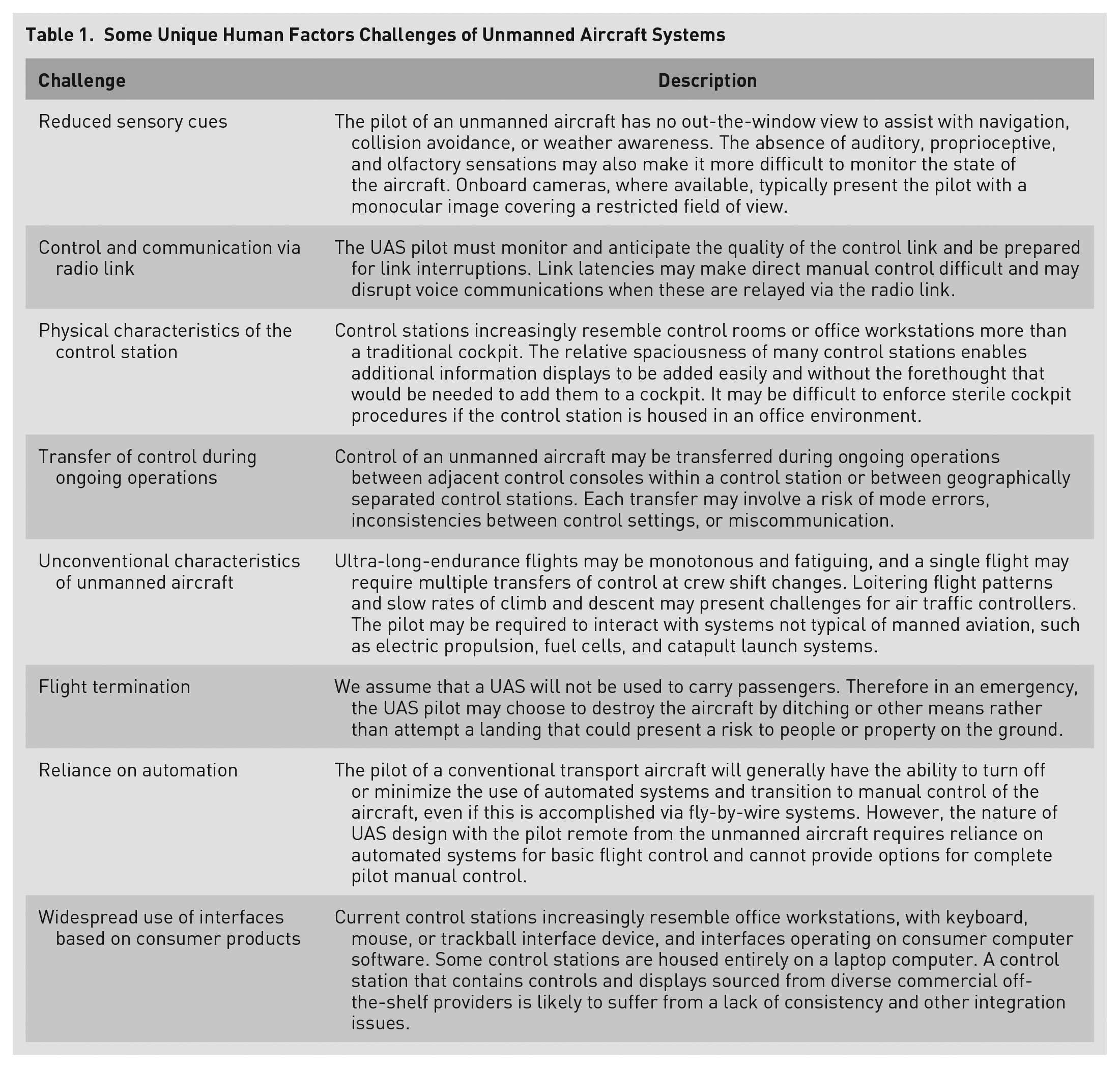
Table 1 gives an overview of some of the challenges that must be addressed for unmanned aircraft systems (UASs) to operate safely within civil airspace. A major problem is that some existing pilot control stations were apparently developed without the application of human factors design principles. The resulting design problems include the following:
Some Unique Human Factors Challenges of Unmanned Aircraft Systems
A reliance on textual presentation of information
Complicated sequences of menu selection required to perform time-critical or frequent tasks
Unguarded safety-critical controls placed in areas where they could be accidently activated
Controls that perform either critical or trivial functions, depending on the selected mode
Controls that cannot be reached from the pilot seat
Pop-up windows that can obscure critical displays
Proliferation of display screens.
Some of these design deficiencies appear to have originated in prototypes that were rushed into production to meet urgent military needs. The next generation of control stations must be designed with greater attention to human factors principles if UASs are to be integrated into civil airspace.
At present, there are no comprehensive human factors guidelines for the design of control stations of civilian unmanned aircraft, although several organizations are developing guidelines for specific applications. Standards for traffic separation displays and control links for UASs are being developed by RTCA (2014), although this advisory organization has stopped short of developing overall control station guidelines. The North Atlantic Treaty Organization (NATO; 2007, 2009) and the U.S. Office of the Under Secretary of Defense (2012) have produced useful material on the human factors of military control stations. However, this material does not specifically deal with the challenges of integrating unmanned aircraft into the civil aviation system.
Human factors guidelines serve several purposes:
They can assist system developers in identifying potential design problems or areas of human performance risk,
they can help users evaluate systems prior to acquisition,
their application can result in greater design standardization and a reduction in the likelihood of design-induced errors, and
regulatory agencies can draw on guidelines when developing regulations or advisory material and evaluating systems for operational suitability.
In some cases, existing cockpit design regulations and human factors standards (e.g., FAA Regulations 14 CFR Part 23: Normal, Utility, Acrobatic, and Commuter Category Airplanes, 2015; FAA Regulations 14 CFR Part 25: Transport Category Airplanes, 2015; Military Standard 203G; Department of Defense, 1991) are directly applicable to UAS control station design. However, as shown in Table 1, the task of piloting an unmanned aircraft introduces unique challenges and responsibilities. For example, the UAS pilot must manage control links and avoid collisions in the absence of an out-the-window view, and may be required to transfer control to another control station during ongoing flight operations. Each new responsibility changes the nature of pilot tasks and introduces new display, control, and system requirements.
Existing cockpit design standards also may not be directly applicable to control stations that increasingly resemble office workstations, with keyboards, point-and-click interfaces, and an assortment of display screens (see Figure 1). In a 2013 issue of Ergonomics in Design, Waraich, Mazzuchi, Sarkani, and Rico (2013) noted that the ANSI/HFES standard on computer workstations (Human Factors and Ergonomics Society, 2007) could be applied to the design of UAS control stations.

The control room for NASA’s Global Hawk Unmanned Aircraft at NASA Armstrong Flight Research Center. (Photo: NASA/Tony Landis)
Although we agree that human–computer interface standards are highly relevant to control station design, we also believe that a broader approach is required to identify human factors guidelines for unmanned aviation. The workplace of the UAS pilot is neither a conventional cockpit nor an office workstation, although it may partly resemble each of these. We propose an approach that can be used to develop and organize human factors guidelines for this new workplace. We make no claims to originality in our approach; rather, we draw together familiar human factors concepts and illustrate how they can help in systematically identifying human factors considerations for pilot control stations.
Five Aspects of the Interface That May Be Addressed by Guidelines
Regardless of the technology or its intended purpose, guidelines for human–machine interfaces generally consist of a blend of task descriptions, display requirements, control requirements, recommendations for specific properties of the interface, and general human factors principles.
Task descriptions
A task description can be seen as a form of performance-based standard that specifies what the human operator should be able to accomplish via the interface without defining how it will be achieved. For example, a draft standard for military UAS control stations (NATO, 2004, § HCI030) specified, “The operator shall have the ability to pass [aircraft] control … to another [control system] and monitor the status of the handover.” An advantage of task descriptions is that they tend to be independent of particular technologies or specific design decisions and are likely to remain relevant as technology evolves.
Display requirements
Display guidelines describe the information that must be provided to the human without specifying how the information should be presented. The designer can then choose how to meet the intent of the guideline, whether via visual, auditory, or other cues. For example, Military Standard 1472G (§ 5.12.3.2.3; Department of Defense, 2012) states that the UAS pilot should receive an alert if communication with the air vehicle is lost but does not define the form that this alert should take.
Control requirements
Control guidelines describe inputs that the machine must be able to receive from the human operator without specifying how the control input should be made. For example, NATO (2009, § U1743) simply states that the UAS pilot must have a control to shut off fuel to an engine in flight.
Properties of the interface
Physical properties of the interface include layout, shape, accessibility, visibility, the use of color, and the structure of specific computer interfaces, including information displays and controls. Physical ergonomics were emphasized in early standards and classic texts, such as Sanders and McCormick (1993), and are described in recent compilations of interface standards (e.g., Lyall, Harron, Wilson, Jones, & Hoffa, 2012). Yet these well-established principles have not always been applied in the design of control stations. Among the problems identified in one control station by Pedersen, Cooke, Pringle, and Connor (2006) were red graphics on a blue background, a control stick that was not sized for the human hand, and the placement of a control that activates lights adjacent to a similar control that shuts off the engine.
Functional properties relate to the operation of the interface and include the number of steps required to perform a task and the direction of movement of controls. For example, NATO specifies that if a UAS control interface includes multilevel menus, “controls that require a prompt reaction from the crew must be accessible at the first level of the menu structure” (NATO, 2009, § U1732).
General human factors principles
At the broadest level are guidelines describing human factors principles that are relevant across a range of interfaces. Examples are the general human factors design principles proposed by Shneiderman and Plaisant (2005) dealing with issues such as the internal consistency of the human–machine interface and features to prevent, detect, and recover from operator errors. Some general principles relate to the overall functioning of the system, including characteristics that emerge from the operation of all subsystems together; for example, visual clutter, display competition for attention, and the prioritization of displayed information.
Applying Our Approach to Guidelines Development
Before we can identify the tasks assigned to the human, and the interfaces needed to support these tasks, we need to understand the performance expected of the overall human–machine system. These requirements can be stated without defining whether a task will be assigned to a human or a machine. In the case of a UAS, the human–machine system might be required to avoid collisions with other aircraft or to navigate along standard instrument air routes. Figure 2 shows how system performance requirements form a foundation that underlies the five types of guidelines.
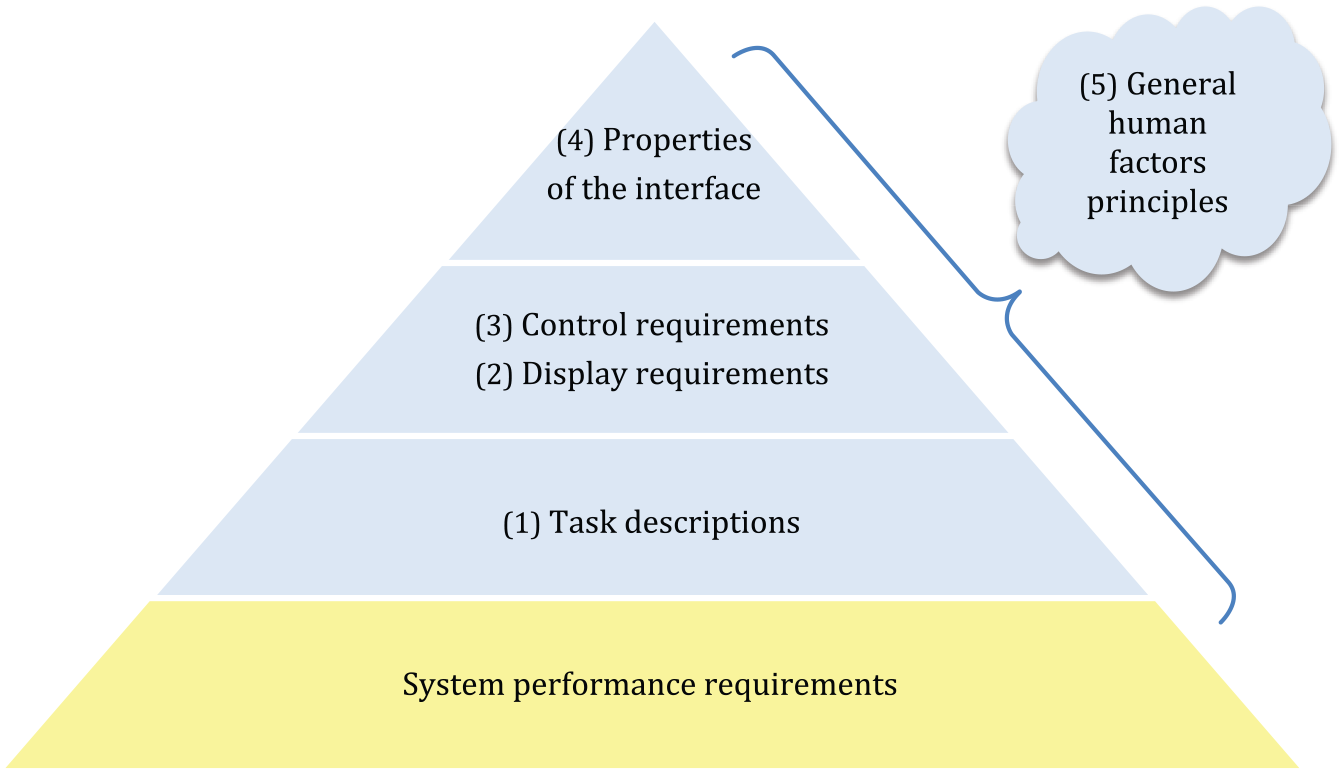
Guidelines for a human–system interface can take several forms and rest upon a base of system performance requirements.
In its UAS “road map,” the FAA (2013) identifies conditions that must be met before a UAS can operate routinely and without special accommodation in all classes of civil airspace. Despite the potential diversity of unmanned aircraft, the FAA has been able to define a set of system performance requirements and clarify the role of the UAS pilot. For example, the FAA assumes that every unmanned aircraft will have a pilot-in-command who will be able to override automation and that flights will be conducted under Instrument Flight Rules (IFR) procedures in compliance with all air traffic control instructions.
Guided by the FAA assumptions, it is possible to start considering the pilot tasks that must be supported by the control station of an unmanned aircraft flying in civil airspace, irrespective of the specific features of the aircraft (e.g., fixed or rotary wing; conventional or electric propulsion). Figure 3 depicts broad categories of tasks that a UAS pilot may be expected to perform, consistent with a functional decomposition developed by Mutuel, Wargo, and DiFelici, (2015). Some tasks are common to both conventional and unmanned aviation yet may present special challenges for the UAS pilot. Other tasks, such as transferring control from one control station to another, are specific to the UAS. For ease of presentation, flight management tasks are depicted separately, although they overlap and cut across other tasks.
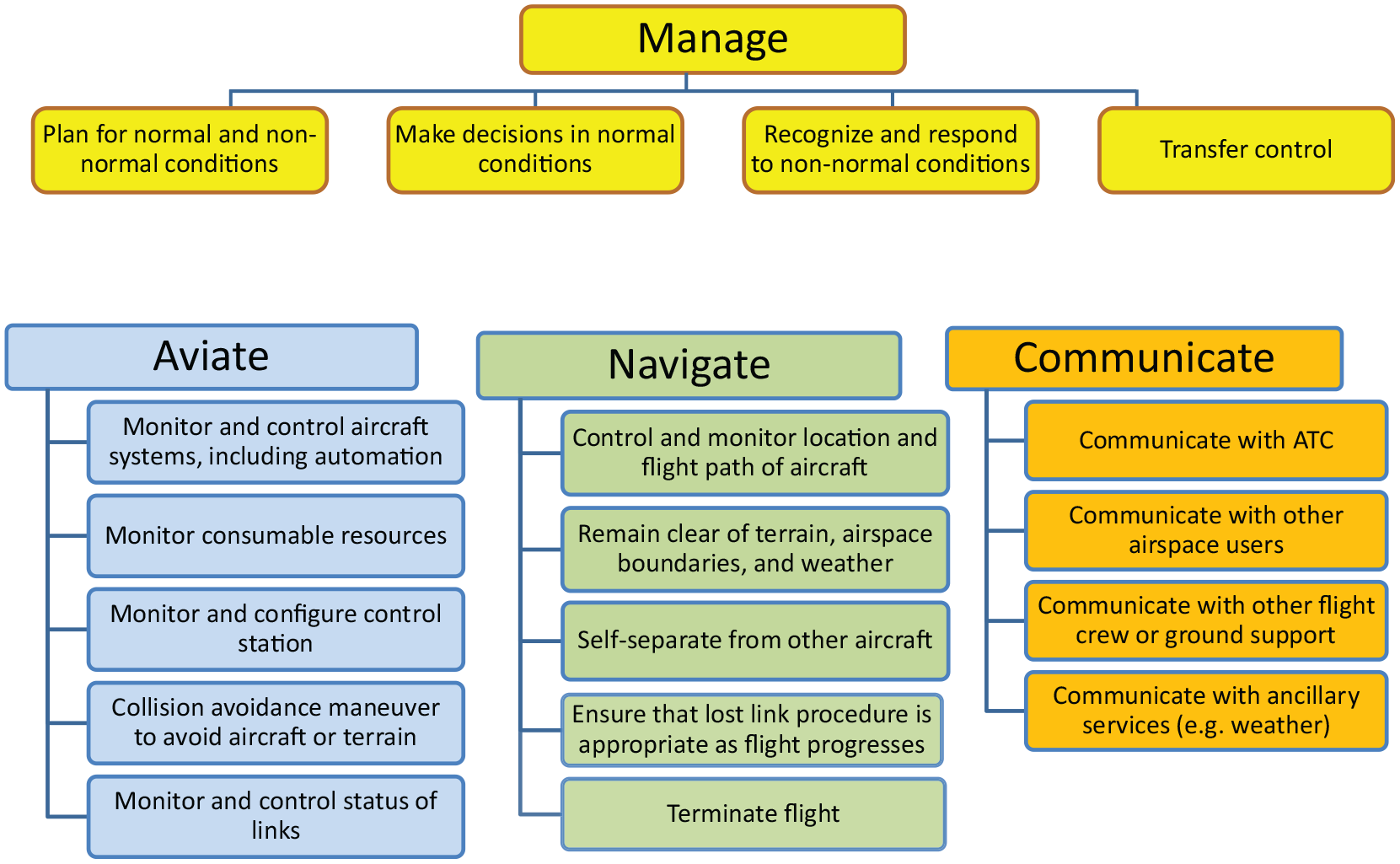
A model of the responsibilities of a UAS pilot.
For each broad task category, we can ask the questions shown in Figure 4 to identify areas where guidelines may be needed. For example, under the heading “Transfer of Control,” it is possible to identify key tasks that pilots will be expected to perform via the interface. One such task is to check the status of control settings between the giving and receiving control stations.
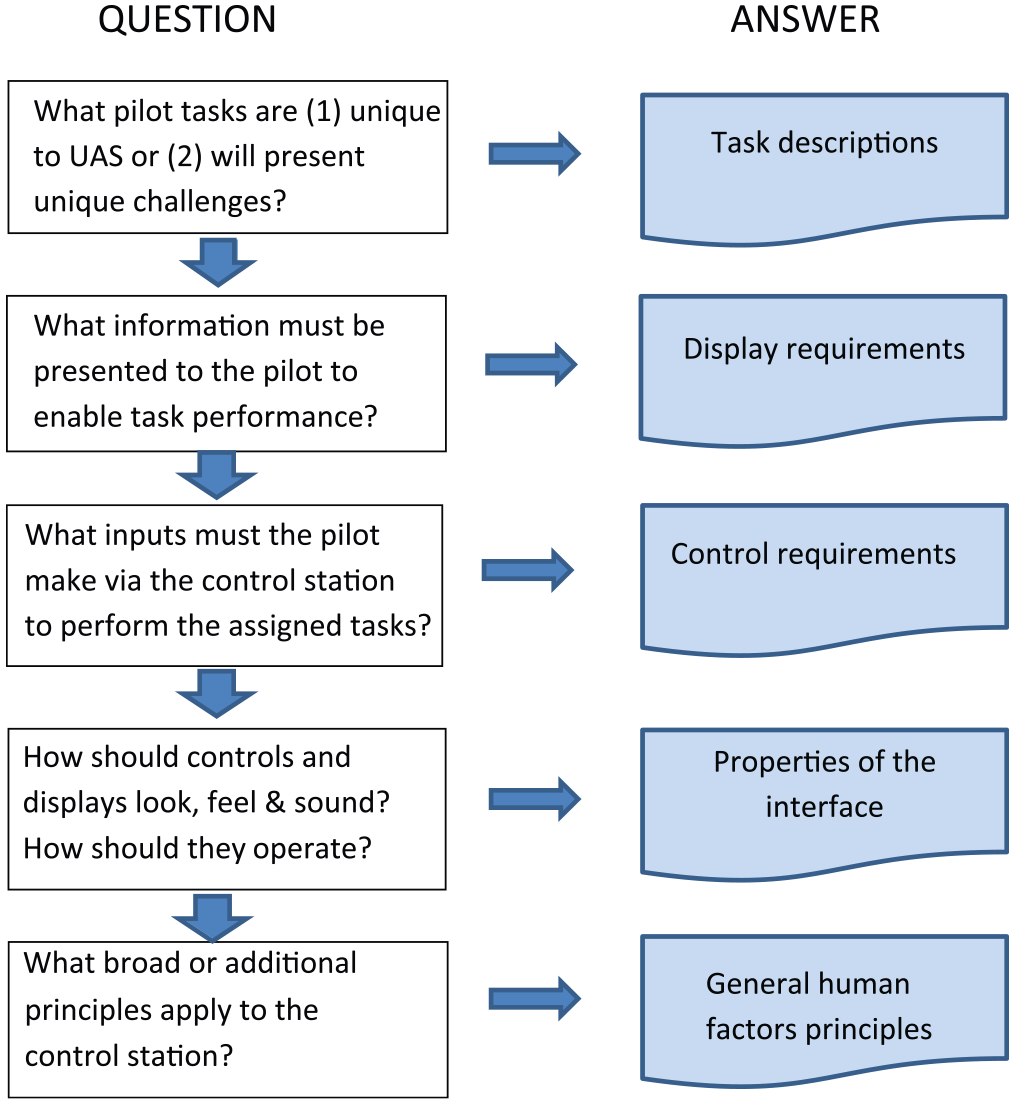
Questions that can assist in identifying topics for control station guidelines.
To perform this task, the pilot might need a display to ensure that flight-critical settings in the receiving and giving control stations are consistent. Carrying out the transfer may require controls that enable a pilot to transition from a receive-only mode, in which data are downlinked from the aircraft in preparation for the transfer, to a mode in which full control is attained. If the control transfer involves two pilots changing seats within the same control station, the display may require the property of being clearly visible to both the seated and the standing pilot to enable a handover briefing to occur.
Although a structured analysis can indicate what should happen in a human–technology interaction, early operational experiences and simulations can identify problems that were not anticipated by system designers. Failure cases are a rich source of information and can be particularly helpful in identifying general principles. For example, in one control station design, a lever that can be configured to either operate a payload camera or shut off fuel to the engine has been associated with inadvertent engine shutdowns. This finding suggests that as a general principle, payload controls should be separate from controls with safety-of-flight functions. Over the coming years, currently unrecognized principles for UAS design will almost certainly emerge from accident and incident investigations.
Conclusion
Human factors guidelines for the cockpits of conventionally piloted aircraft were developed over many years, often in response to accidents and incidents. Rather than relying solely on operational experience to highlight problem areas, we need to start developing human factors guidelines for UAS control stations now. The control station of an unmanned aircraft is a workplace that is neither a standard cockpit nor a conventional office workstation. Although existing standards for these environments will have relevance to control station design, we propose that a systematic approach is needed to develop guidelines specific to unmanned aircraft systems.
In a discussion document prepared for NASA (Hobbs & Lyall, 2015), we applied our approach to develop a preliminary set of guidelines. We have sought to supplement, rather than replace, existing human factors material, such as the ANSI/HFES standard for computer workstations and cockpit design guidelines for manned aircraft. Our set of preliminary guidelines will be periodically updated as information becomes available from research and operational experience.
Ultimately, it will be up to regulatory agencies and standards organizations to release control station design regulations and standards. We hope that the systematic and safety-focused approach we describe here will assist them in that work.
Footnotes
The authors of this article are U.S. government contractors and created the article within the scope of their employment. As a work of the U.S. federal government, the content of the article is in the public domain.