



Abstract
The purpose of the article is to identify if novel footwear design could aid in postural stability and fall prevention in workplace. Footwear design has been reported to aid the task of maintaining postural stability or balancing in an erect stance while minimizing risk of falls. Minimalistic footwear that has design features such as low mass, lower heel height, and thin midsole can positively influence postural stability. Minimalistic military footwear has been shown to lower incidences of falls with efficient muscular effort. Occupational footwear that abides by safety standards with minimalistic features can help maintain postural stability and reduce falls.
Footwear has been reported to aid the task of maintaining postural stability or balancing in an erect stance while minimizing risk of falls. Can novel, minimalistic footwear aid in workplace fall prevention?
The United States Bureau of Labor Statistics (BLS) reports that falls and fall-related injuries are one of the leading causes of both fatal and nonfatal occupational injuries. According to the BLS, just within the year of 2017, a total of 887 fatal injuries were attributed to slips, trips, and falls (BLS, 2017). These falls are due to a sudden perturbation to the body causing an imbalance or a failed fall recovery mechanism to maintain postural stability following a perturbation. Occupational falls can be triggered by environmental factors such as slippery contaminant and trip hazards leading to slips, trips, and falls and also by human factors such as muscular fatigue resulting from occupational workloads (Gauchard, Chau, Mur, & Perrin, 2001). While ergonomic design and implementation of harness systems for occupational workers who work at an altitude are effective in preventing falls to a lower level, a considerable number of occupational falls still occur at the same level. Novel design modifications to occupational footwear can aid in better postural stability and fall prevention in a workplace setting.
Occupational Safety and Protective Footwear
In occupational environments, footwear standards are set forth by the Occupational Safety and Health Administration (OSHA) and the Code of Federal Regulations (CFR) (29 CFR1910.136-foot protection) that govern the design of these safety protective footwear, complying with the regulations based on American National Standards Institute ANSI-Z41-1991 or ANSI-Z41-1991, which was updated to American Society for Testing and Materials ASTM-F2412-2005 and more recently to ASTM-F2413-11. However, specific occupations such as firefighting and military have their own revised footwear regulations. When selecting footwear for structural and proximity firefighters, their footwear should follow regulations based on National Fire Protection Association NFPA-1971 while the AR-670-1 is followed as regulations for army boots. These specifications are described in detail under each of these regulations. As general requirements, occupational footwear should offer protection from impact, compression, and puncture resistance while adding to specific requirements such as metatarsal protection, slip resistance, elevated ankle support, electrical conductive protection, electric shock protection, static dissipative protection, and so on. However, footwear that complies with these regulations can still be different in design; as such, different footwear protects from hazards in different ways. The introduction of new design features in occupational footwear that still comply with these regulations but can aid in enhancing human performance is necessary. One such new design feature is the minimalist design approach to footwear. Minimalist footwear are essentially footwear that simulate barefoot conditions as closely as possible while providing protection against thermal and puncture injuries (Gangemi, 2011; Squadrone & Gallozzi, 2009). While this minimalist approach has been successful in athletic footwear, we have not seen a large amount of research conducted on minimalist shoes, especially in an occupational setting.
Footwear’s role in postural stability and fall prevention
Our entire body mass is supported and held in erect upright stance without falling by a very narrow base of support outlined by the sole of our feet (Winter, 1995). The human body’s postural control system is tasked with the responsibility to maintain postural stability and attempting to prevent falls. Footwear serves as the interface between the environment and us and can affect our outcome of maintaining upright postural stability and aiding in preventing falls. Footwear design characteristics that influence balance performance include the boot shaft height, mass, midsole hardness and thickness, heel and midsole geometry, foot-bed shape, slip-resistant soles, and footwear material. Unlike athletic footwear, occupational footwear is designed with our safety as one of the primary functions. While occupational footwear provides safety and protection, their design may not be appropriate for efficient biomechanics, especially in preventing us from falling. Hence, there is a need for us to test newer footwear designs, such as the minimalist design, to help maintain optimal postural stability and prevent falls in occupational environments. A summary of footwear design features and their impact on postural stability and falls are listed in Table 1.
Footwear Design Features and Their Potential Impact on Postural Stability and Falls
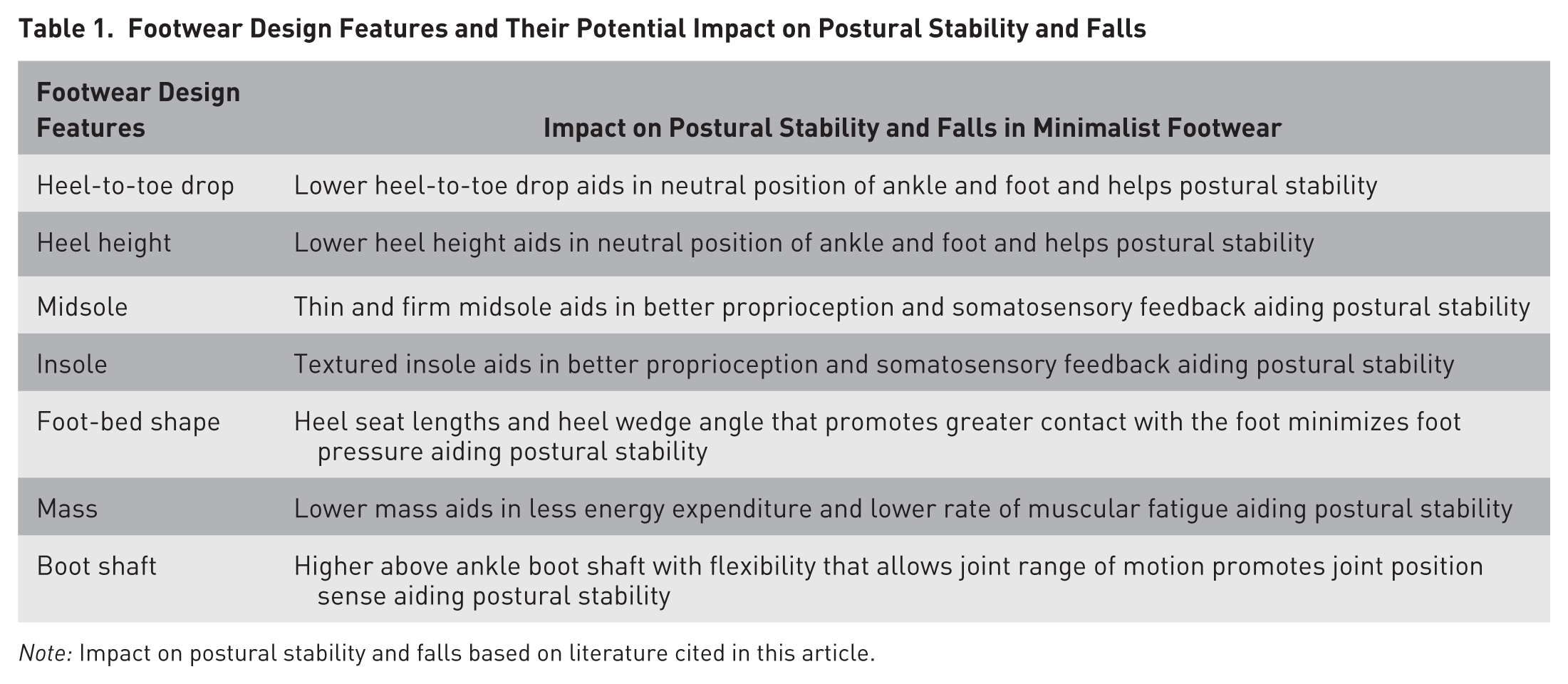
Note: Impact on postural stability and falls based on literature cited in this article.
Minimalist footwear designs that impact postural stability and fall prevention
In general, a minimalist footwear is a footwear attempting to resemble our feet in a barefoot condition, with a couple of design features used predominantly to classify them as minimalistic. The difference in height between the heel to the forefoot of the footwear is described as “heel-to-toe drop” or just as “heel drop” (Gangemi, 2011). The term zero drop is used when there are no changes in height from the heel to forefoot, as seen in barefoot conditions. For us to consider footwear as minimalistic, it has to have a heel-to-toe drop of 6 mm or less, while more typical footwear have a heel-to-toe drop greater than 10 mm. Additionally, a minimalistic footwear attempts to contour to the morphology of our feet; it is usually lighter in footwear mass and has a very thin-firm midsole and insole. These design features have been studied previously and have been shown to influence our postural stability and thereby the incidence of falls. Based on previous studies, a footwear that has an elevated boot shaft height, lower mass, thin-firm midsole, textured insole, and low heel height helps us maintain balance and prevents falls (Chander, Garner, & Wade, 2014, 2015; Chander, Garner, Wade, & Knight, 2017; Chander, Wade, & Garner, 2015; Dixon et al., 2012; Menz & Lord, 1999).
When we wear shoes with an elevated heel, it predisposes the foot and ankle segment to be in a plantar flexed position, thereby altering normal kinematic and kinetic chain biomechanics of the lower extremity and requiring us to make greater postural adjustments in maintaining upright balance. A heel height of 4 cm or higher has been shown to be detrimental to our balance performance (Menant, Steele, Menz, Munro, & Lord, 2008), while heel heights of 3 cm and 5 cm have been shown to increase our lower extremity muscle activity during sit to stand tasks (Edwards, Dixon, Kent, Hodgson, & Whittaker, 2008). Additionally, a heel height of 9 cm has been shown to significantly shift our foot’s center of pressure anteriorly toward the forefoot, while a flat heel height of 0.5 cm shifts the foot’s center of pressure posteriorly toward the hindfoot (Ko & Lee, 2013). These changes in muscle activation and foot center of pressures are a result of compensatory postural adjustments. The term foot-bed refers to region of the footwear that is in close proximity and in contact with the foot. The foot-bed shape along with its design features of heel seat length and heel wedge angle contribute to maintaining postural stability (Weerasinghe & Goonetilleke, 2011; Witana, Goonetilleke, Au, Xiong, & Lu, 2009). Previous research has reported that a heel wedge angle and a heel portion of the foot-bed that promotes greater contact with the foot can aid in better foot pressure distribution and greater comfort (Witana et al., 2009). A thinner-harder midsole and insole have been reported to enhance our balance performance compared to thick and soft midsoles and insoles as seen in traditional athletic footwear (Chander, Morris et al. 2016; Chander, Wade, Garner, & Knight, 2017). It is suggested that we receive increased somatosensory and proprioceptive feedback from the sole of the feet due to these thin, firm midsoles and insoles that help us maintain erect posture (Robbins, Gouw, & McClaran, 1992). Finally, greater footwear mass has been related to increase in our energy expenditure, with every 100 g of increase in mass causing a 0.7% to 1.0% increase in our energy expenditure (Jones, Toner, Daniels, & Knapik, 1984). Specifically, for occupational footwear, such as firefighter boots and steel-toed work boots, an increased rate of muscular fatigue and a greater energy expenditure have been previously reported (Garner, Wade, Garten, Chander, & Acevedo, 2013; Krings et al., 2018). Subsequently, heavier firefighter boots, such as rubber boots, were attributed to a decreased postural stability (Garner et al., 2013) and an increased likelihood of slip-induced falls (Chander, Wade, & Garner, 2016) compared to lighter leather boots.
The concept of using a minimalist footwear design in occupational footwear is still relatively new, specifically for identifying postural stability and fall risk. Although the design features we discussed previously have been identified to improve balance and potentially aid fall prevention, there is still more we need to learn about the impact of minimalistic occupational footwear in fall prevention. Very recently, we published four research papers that analyzed the impact of a minimalistic army footwear that follows the AR-670-1 regulations on postural stability and falls. We performed a comprehensive biomechanical analysis using 3D motion capture system, force platforms, and electromyography (EMG) muscle activation measures (Figure 1) to compare two military boots (Belleville TR101 minimal ultralight minimalist tactical military boot and Belleville 310ST hot weather standard tactical military boot) on postural stability and slip-induced fall responses before and after a physically exerting 16 kg military rucksack load-carriage task. We reported the minimalist tactical boot (mass = 500.13 ± 24.1 g; sole surface area = 235.4 ± 8.2 cm2; flexible boot-shaft height = 20 cm; heel-midfoot drop = 2 mm) performed significantly better than the standard tactical boot (mass = 801.13 ± 40.4 g; sole surface area = 288.6 ± 24.1 cm2; stiff boot-shaft height = 20 cm; heel-midfoot drop = 18 mm) in minimizing slip-induced falls (Chander, Knight, Garner, Wade, Carruth, DeBusk et al., 2018). Additionally, the minimalist boot also aided in improving balance performance in static and dynamic tasks without and with compromising visual and somatosensory feedback (Chander, Knight, Garner, Wade, Carruth, Wilson et al. 2018; DeBusk, Hill, Chander, Knight, & Babski-Reeves, 2018) as well as lowering required muscular exertion in maintaining erect balance (Hill, DeBusk, Knight, & Chander, 2017). The design features on the minimalist footwear were attributable to the significantly better performance in preventing occupational falls, especially after a load-carriage task.
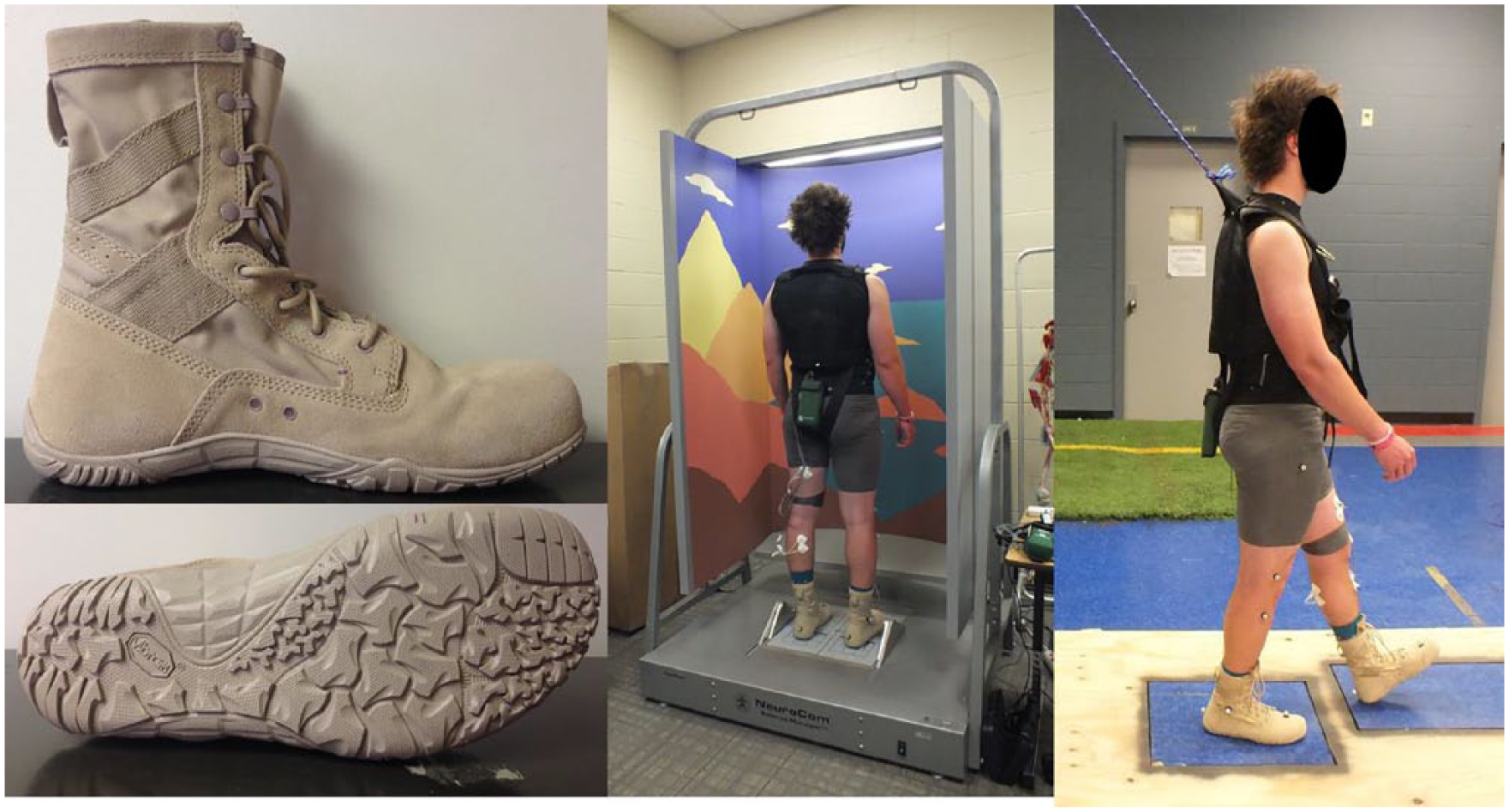
A novel minimalist army footwear (Belleville TR101 minimal ultralight minimalist tactical military boot) that was tested for postural stability and slip-induced falls based on the recent findings cited in this article.
Based on this previous but limited research, the use of minimalistic footwear design in occupational footwear for maintaining postural stability and preventing falls appears promising provided the safety regulations are met. Design features such as lower mass, elevated light-flexible boot shaft, thin midsole and insole, foot-bed shape, and minimal heel drop could be used as design suggestions for future minimalist occupational footwear to aid better balance and prevent falls and fall-related injuries in the workplace.