




Abstract
Since 2000, in the planning and development of products and services, providing users with a better experience when using products and services has become essential, resulting in a growing need for value-centered design that focuses on providing users with more attractive experience values. In this article, we introduce the value-centered product development process that has been used in the planning and development of notebook PCs, focusing on the experience value provided to the user.
Keywords
During the Industrial Revolution, the rate of mass production of products increased dramatically. In this era, product development focused on technology expansion to enhance the efficiency and function of products and to improve the material wealth of people’s lives. Giving beauty to products is the role of design in this era. However, as people’s lives became more affluent, their higher order desires increased, and thoughts of human-centered design, which emphasizes not only the technical aspects but also the perspective of product users, spread. With the enactment of ISO 13407 (now ISO 9241-210:2019), the role of design now not only centers on the beauty of products but also on the improvement of the practicality of user interfaces (UIs).
In the 21st century, the concept of human-centered design has further developed. Considering not only usability but also subjective values (experience values), such as the impressions and pleasures that users get from the overall experience of using a product, has become necessary. For example, Hancock et al. (2005) introduced the concept of “hedonomics,” which extends beyond traditional human factors and ergonomics. They mentioned the importance of considering the promotion of pleasure and personal perfection in the design of products. Nagamachi (2002) proposed Kansei engineering as a product development methodology that translates the customer’s Kansei (psychological feeling) into product design, emphasizing not only usability but also Kanseis. In the field of marketing, Pine and Gilmore (1998) and Schmitt (1999) stated that the experience users get from products and services is a significant value, and this experience value should be considered in marketing and design when providing products and services.
In these times, the concept of user experience (UX) has emerged. According to Norman, the proponent of UX, UX refers to “All aspects of the user’s interaction with the product: how it is perceived, learned and used. It includes ease of use and most important of all, the needs that the product fulfills” (Norman, 1999). The emphasis on UX has shifted from a product’s aspect, such as usability, to a user’s aspect, such as subjective experience. To provide more attractive value to users, it is crucial to provide a better UX by considering a series of comprehensive experiences that users get through products and services. In other words, there is a need for value-centered design rather than the conventional technology/function or human-centered product development.
For such a development trend, not only designers or human-factors specialists but also engineers should emphasize the value that can be provided from the UX viewpoint during product development. Some studies mention the importance of value-centered design and its design policy (Kujala & Väänänen-Vainio-Mattila, 2009). For example, Cockton (2005) proposed the design process for value-centered design. Ando (2016) proposed a design approach for enhancing UX at design touchpoints between products/services and users based on experience value. In these earlier studies, researchers discussed such UX-based design concepts, but they assumed their application to be among the upstream processes for designers rather than being addressed during the initial planning and product-manufacturing stages. They rarely mentioned specific design methodologies and processes during planning and rather saw them as integral to upstream stages of product development and specification (including design for mass production). Moreover, past discussions of application of product development are uncommon.
Another, more traditional product-development process is based on the systems-engineering approach proposed in IEEE1220 (Institute of Electrical and Electronics Engineers, 2005) and elaborated by Pahl et al. (2007). This methodology logically organizes many considerations in product design and is based on enumerated functional requirements, detailed use cases, and abstracted system models. This approach considers neither the value that the product provides to users nor the conceptualization of the product. Without rigorously defining a concept in terms of the value provided to the user, there are no criteria for evaluating the effectiveness of an idea. Furthermore, the designers end up with more alternative ideas than necessary, and criteria to evaluate whether the final proposal is good or bad may be difficult to specify in detail. Such methodologies are commonly evaluated on the basis of cost and delivery and other general criteria, which are useful only for a high-level evaluation (such as cost-effectiveness), possibly making it challenging to confirm the validity of the design and recommend areas for improvement.
Increased sharing of various practices used in the future will help establish a methodology for value-centered design. Herein, such a process that has already been applied in the planning and development of notebook PCs and other smart devices is proposed. In particular, this new methodology aims not only to examine the UX value in the upstream process but also to construct a logical process to incorporate the UX value into the detailed product design and specification. It could be useful not only for designers but also for engineers who consider technical aspects of product specification.
Defining Product Specifications with a Value-Based Structured Concept
Creating a structured concept that focuses on the user’s value to develop a product specification that delivers value to the user is necessary. Then, this value should relate to the product specification that is needed to realize it. The structured concept is a method of the concept creation used in human design technology, which is a logical product development methodology proposed by Yamaoka (2011). We create a hierarchical concept with the top and bottom items stratified according to the relationship between ends and means. The top-level concept becomes the value we want to provide to the user in the end (the end goal), and we break down the means necessary to achieve this value into subsequent hierarchies. Similarly, the means required for the second tier is the third tier. If we placed the product specification at the lowest level, we could explain why we placed the product specification at the highest level of value without any logical breakage.
In the proposed process, to create a structured concept as shown in Figure 1, we derive the experiences and scenarios that we want to provide to users based on the values we want to deliver to them as defined in the concept. Then, we study the tasks, operation flows, and corresponding values and user requirements that we want to provide to the users and extract the functional requirements necessary to realize each task and operation flow associated with the value provided to the user. Once the functional requirements are precise, we can develop a detailed product specification. One can say that the value-centered product development process is the process of creating a structured concept based on value. Figure 1 shows each hierarchy of structuring concepts from the first tier to the fifth tier, and Figure 2 and 3 shows the examples of the structuring concepts for a notebook PC and a subsystem of a PC. Furthermore, Figure 4 displays a schematic of the proposed process.

Structured concept to define the product specification based on value.
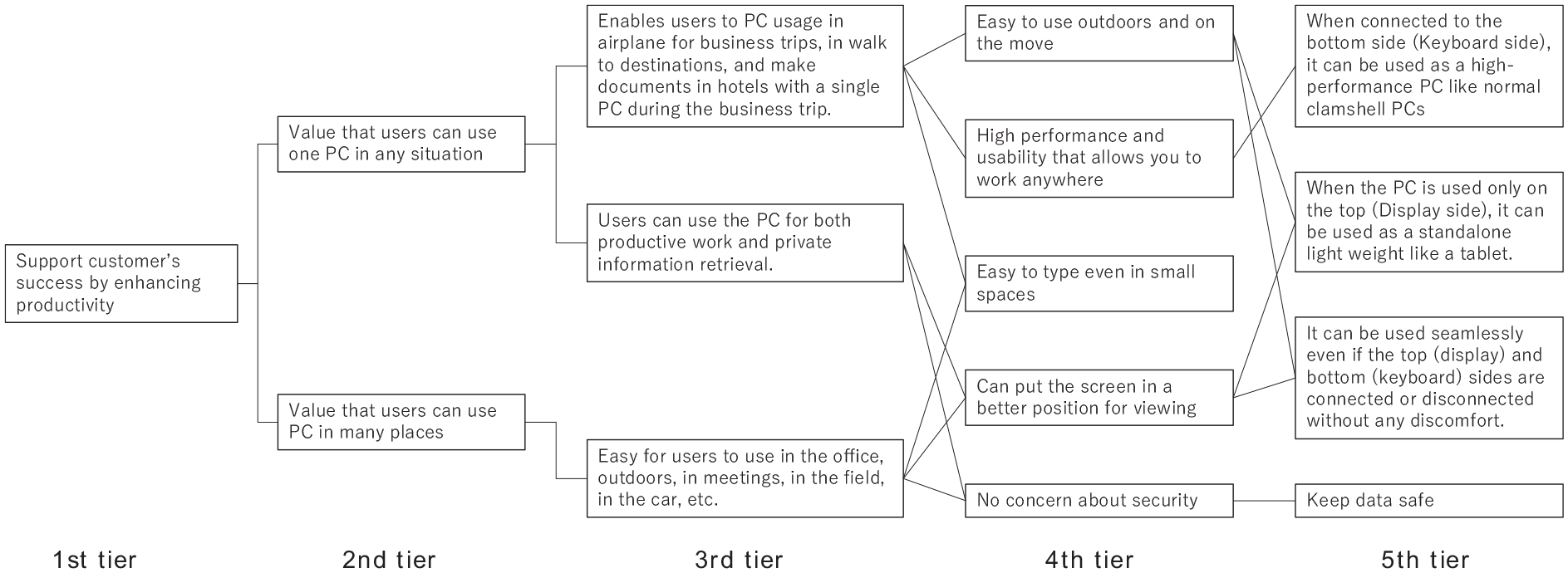
Example of a structured concept of a 2-in-1 PC.
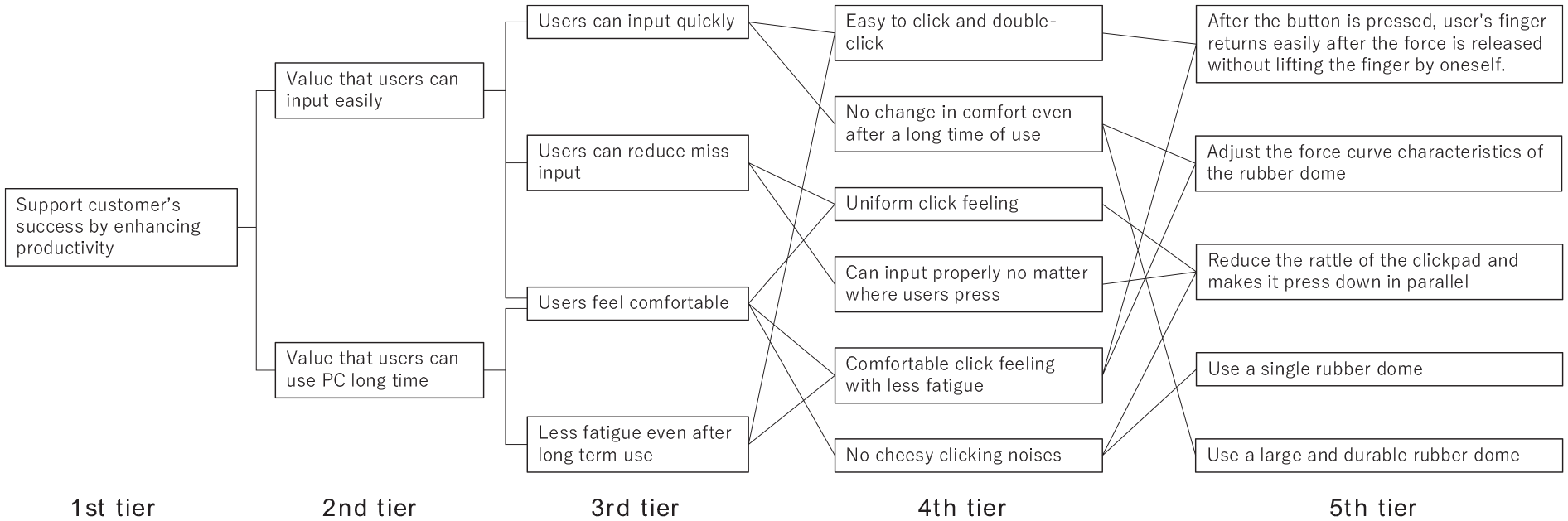
Example of a structured concept of a subsystem of a PC (a clickpad).
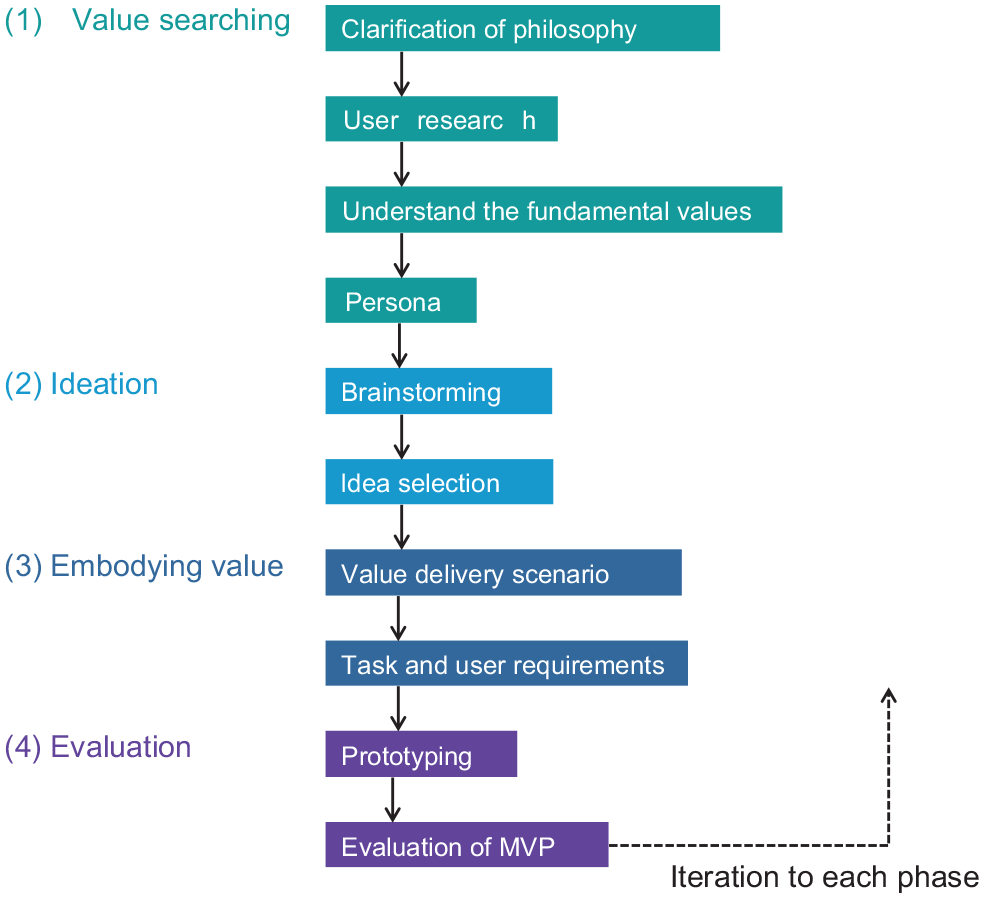
Value-centered product development process.
First Step: Value Searching
Clarification of Philosophy
The first-tier concept indicates the policy of the values to be pursued, which is also related to corporate policies, strategies, brands, and product philosophies. Since it determines the dominant direction of product development, it is necessary to reflect the philosophy of managers and developers in a top-down manner, not necessarily from user surveys. This philosophy is the first tier of the structured concept. A company’s development philosophy, such as “support our customers’ success,” is one such example. Constraints must be considered; therefore, any preconditions, such as commercial distribution, budget, schedule, collaborators, users, technology, feasibility, and cost that must be met should be clarified at this point.
User Research
We identify problems and user requirements of existing products from observational surveys (business ethnography), photo diaries, usability evaluation of existing products, collected voice of customers (VoCs), and in-depth interviews. Here, only the facts are collected. In laptop development, the results of evaluations of current laptops, observations of specific users’ use of laptops, and VoC for products on sale from customer support are used.
Understand the Fundamental Values We Provide to Our Users
From the facts (problems, good points, etc.) extracted from the surveys in the previous phase, we consider “how the user feels about these facts” (user’s feelings) and convert them into “value for the user” (read facts into values). This method is the same procedure as the KA method proposed by Asada (2006) in Japan. Ando (2016) also reported the effectiveness of the KA method to consider UX. For example, as shown in Figure 4, the grasped facts are read into the value they provide to the user. The fact, the user’s feelings, and the value delivered to the user are summarized in a single card (Figure 5) that includes the derived value summarized in an affinity diagram. We call this an experience value map. Based on the values derived in the experience value map, we can develop the second tier of the structured concept, which will need to be revised during the ideation phase.
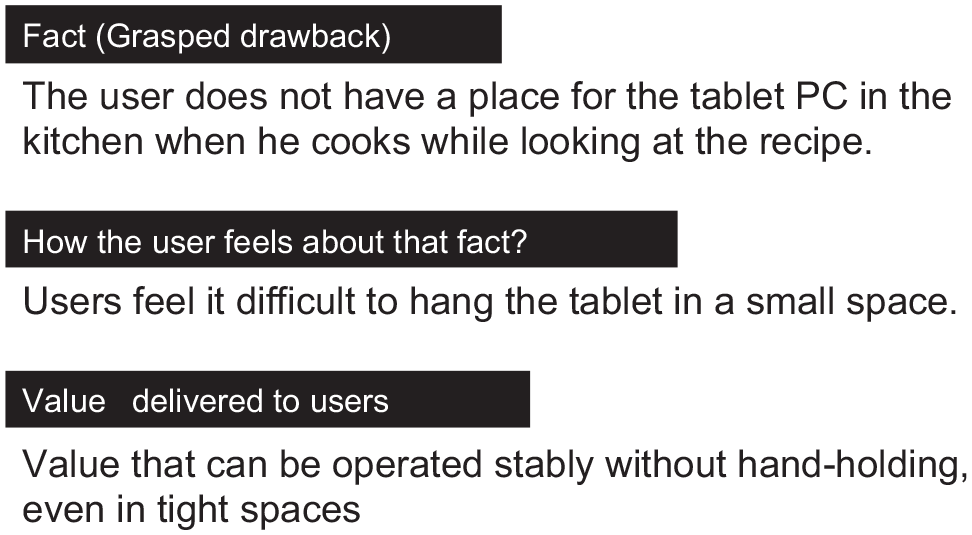
Example of the estimation of the value delivered to users based on the fact (a value card used for the affinity diagram).
Persona
A persona is an image of a target product user or related stakeholder. Multiple personas that include the following information are created based on the user research: age, gender, occupation, values and personality, usage (location, lifestyle), skills, knowledge, experience, literacy, and so on. These personas help us clarify “what kind of users we provide value to.” Especially in notebook PC development, it is essential to understand the usage context, the interest in the product, and the IT (information technology) literacy of the users by conducting a survey targeting the expected users.
Second Step: Ideation
Brainstorming
Brainstorming is based on the experience value map and personas examined in the first step. The idea generation itself is done through brainstorming. However, we should avoid deviating too far from the definition of the first step or not being able to explain what is considered as value. Therefore, ideas are generated while clearly stating the “target user,” “usage scene,” and “value.”
Idea Selection
We select an idea that will proceed with consideration of a specific product proposal from the ideas generated by brainstorming. In terms of idea selection, the following viewpoints extracted from the three attributes of the product (Yamaoka, 2003) are used: usefulness, convenience, and attractiveness. The value of the ideas selected here forms the second tier of the structured concept. The third tier is made up of the value delivery scenarios that can be provided by the ideas.
a. Usefulness: The value that can be provided to the user, relevance to the user, and business context, performance, and functionality.
b. Convenience: Feasibility, side effects, and applicability of the new elemental technology.
c. Attractiveness: Relevance to the company’s philosophy. Is it innovative or eye-catching?
Third Step: Embodying Value
Value Delivery Scenario
We study typical usage scenarios, as well as the kind of experience and value we can deliver to the personas at each touchpoint. The scenarios in each scene are described along with the time series. If necessary, paper mocks and storyboards can be made so that the scenarios can be more clearly explored. The scenarios embodied here make up the third tier of the structured concept.
Task and User Requirements
The above user scenarios are further refined, and the task and UI operation flow to realize the scenarios are studied. Task analysis, a method in ergonomics, is used to identify what tasks and subtasks are required. Also, using methods such as cognitive walkthroughs, specific values and user requirements corresponding to each task and subtask are clarified.
Functional Requirements
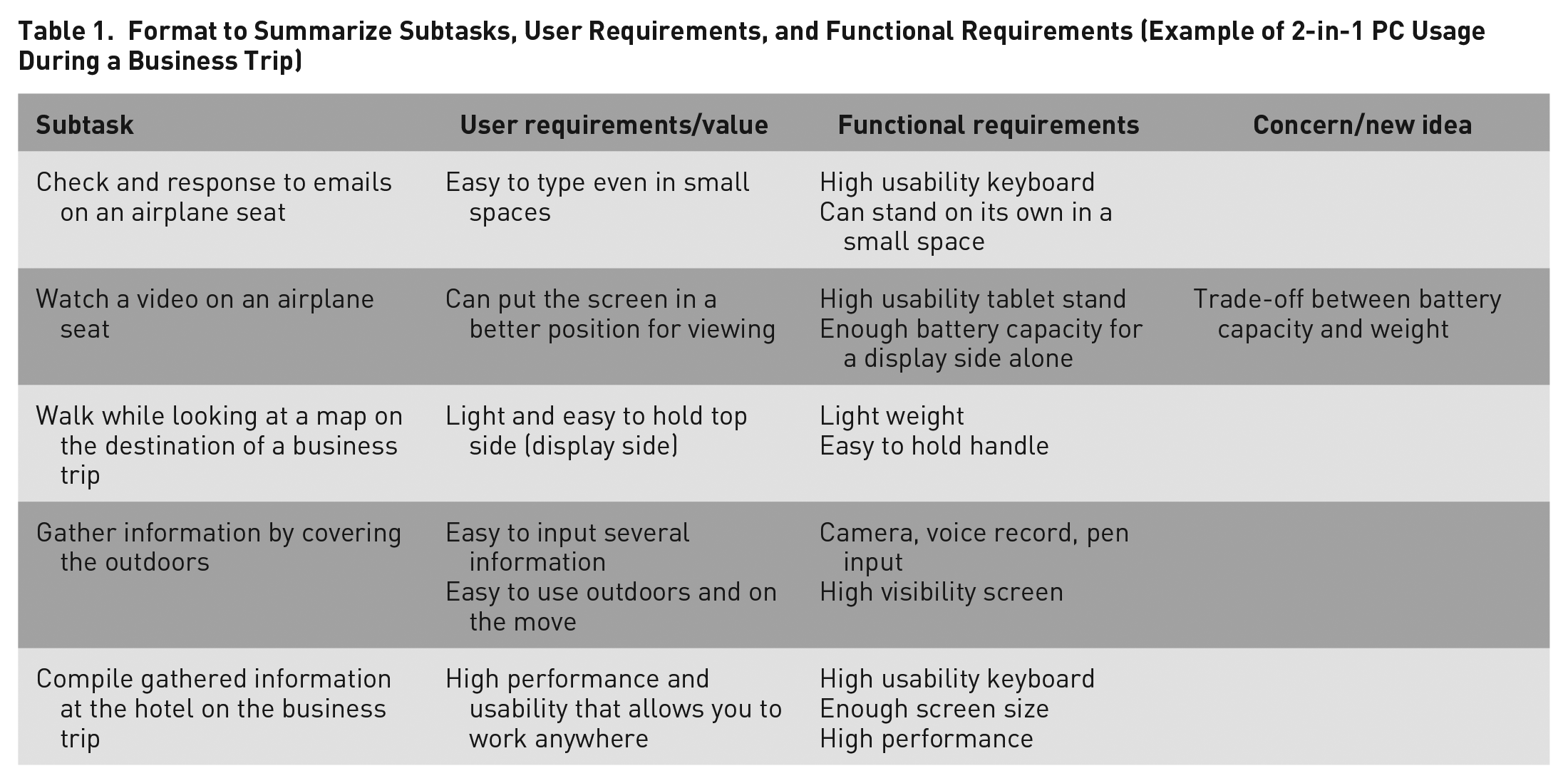
For the tasks in each studied scenario, we extract what functions are required and what kinds of issues are considered to realize them. In the format shown in Table 1, we summarize the items we have considered so far and aim to examine them in detail for each value delivery scenario. Since trade-offs and technical issues that cannot be solved at the moment may occur, the tasks will be allowed to proceed while mutually examining concepts, user scenarios, and functional requirements. Trade-offs can be resolved by assigning importance to each value as a concept. In doing so, an exhaustive set of design principles can be considered together to avoid overlooking fundamental and ergonomic issues.
Format to Summarize Subtasks, User Requirements, and Functional Requirements (Example of 2-in-1 PC Usage During a Business Trip)
Fourth Step: Evaluation
Based on the specifications derived so far, prototyping is performed. We create a minimum viable product for lean UX and evaluate it. The evaluation is performed from two perspectives: (1) verification, which evaluates whether the design follows the concept, and (2) validation, which confirms whether users accept the proposed concept. Verification tests evaluate the user’s impressions and perceived values via the in-depth interview, the repertory grid, the semantic differential method, and so on. Validation tests evaluate the effectiveness of the products by comparing them with competing products and measuring the performance and subjective rating.
Such verification test should clarify whether testers perceive the UX value as envisioned in the original concept. Accordingly, we investigated users’ impressions of the prototype. After they operated the prototype, an interviewer asked in-depth questions about its good and bad points, utilizing a depth interview. An affinity diagram summarizes the obtained interview results. If the users’ perceived values summarized by the affinity diagram are consistent with the values in the structured concept (second tier) and user requirements (fourth tier), the prototype can be considered to have satisfied the concept. Conversely, if the obtained opinions are not consistent with the concept, relevant modifications to the prototype must be considered. In addition to the depth interviews, conducting user tests for each requirement to verify whether the user requirements of the fourth tier are met is also useful.
The validation test should also reveal whether the prototype is effective in fulfilling the purpose of the system. Therefore, an overall index is calculated to evaluate the general satisfaction and effectiveness of the developed prototype. The effectiveness of the proposed product and its acceptance by users are assessed using the index to compare conventional products and competing products. The System Usability Scale (Brooke, 1988) and Net Promoter Score (Reichheld, 2006) can be used for subjective evaluation. Moreover, if the prototype is functionally complete, objective performance can be measured by usability tests.
Based on the results of the evaluation, it might be necessary to return to the previous phase and make corrections as appropriate. It is necessary to make the initial prototyping as simple as possible and to increase the accuracy through repeated iterations gradually. If there is a prototype with a high degree of completion and a surplus in the product development schedule, evaluating not only the temporary evaluation based on user tests in the laboratory but also the medium- and long-term use in the field is important. However, in many cases, it is difficult to conduct mid- to long-term evaluations during product development due to schedule and cost limitations. It is realistic to continue these evaluations after the product launch and reflect their results in the planning and development of the next-generation products.
Iteration and Mass Production Design
To develop a product with a focus on the value provided to the user, it is essential to confirm “what kind of value the user feels.” This discussion is difficult to articulate in a single process. Therefore, it is crucial to iterate back and forth between the phases of the proposed process, reflecting the evaluation results and continuously improving. In product development, a variety of people are involved, including UX researchers, designers, managers, and engineers. It is necessary to clarify the outputs of each phase in the form of structured concepts so that all the parties involved can have a common understanding. Once the functional requirements have been embodied through repeated iterations and the validity of the value provided to the user has been confirmed, the process of mass production design begins.
Conclusion
In this article, we reported on the value-centered design process that has been applied to the planning and development of notebook PCs and other smart devices in the past. This process has been applied to the planning and proposal of new smart devices, the planning of tablet PCs and laptops with new shapes, and the product development of minor updates that improve the problems of existing laptops. In both cases, we were able to obtain precise results, such as adoption for development or patent acquisition. In the project described here, we worked in a cross-functional team that included not only designers and human factors experts but also engineers from various fields to study functional requirements and product specifications. This methodology allows engineers and designers to collaborate to examine the value provided to the user and the technical specifications of the product in a unified manner.
In the future, discussing the effectiveness of this process in terms of the evaluation of products and services in the market is necessary. Also, we would like to generalize the knowledge by applying it not only to electrical appliances, such as notebook PCs and smart devices, but also to other products and services.
Footnotes
 .
.