




Abstract
Academic programs benefit from the addition of a formalized peer mentorship program to help undergraduate and graduate students achieve academic success, social and psychological wellbeing, and career development. This article describes a peer mentorship program developed in the Human Factors and Ergonomics (HF/E) program at Embry-Riddle Aeronautical University (ERAU) where students study human factors at the bachelor’s, master’s, and doctoral levels. We describe the steps taken to develop, maintain, and evaluate the program, along with lessons learned.
Keywords
Peer mentorship programs among university students have been shown to benefit student mentees and mentors (Asgari & Carter, 2016; Lorenzetti et al., 2019; Snowden & Hardy, 2012). Programs that foster student mentoring and networking are often formalized by pairing a more experienced student (mentor) with a less experienced student (mentee) and encouraging communication between the two. A recent systematic review by Lorenzetti et al. (2019) found that student mentors’ and mentees’ academic success, social and psychological wellbeing, and career development were positively affected by involvement in their peer mentorship program. Students’ self-confidence increased, as well as their academic skills, knowledge of their domain, scholarly output, and motivation, while their feelings of stress and isolation decreased. Peer mentorship has also demonstrated positive effects on student retention and academic success (Asgari & Carter, 2016; Snowden & Hardy, 2012). The effect on student mentors specifically has been very positive as well, as mentors have reported increased perceptions of self-efficacy, problem solving, skills and content knowledge, as well as more positive relationships with other students, faculty, staff, and the institution as a whole (Elliot et al., 2020; Spaulding et al., 2020). Many academic programs, specifically Human Factors, could benefit from the addition of a peer mentorship program.
Human Factors is a multidisciplinary field with emphases from areas such as psychology, engineering, biomechanics, industrial design, user experience, and anthropometry. Undergraduate and graduate students may know they enjoy the topic of Human Factors and Ergonomics (HF/E) but may be unsure on which area(s) to focus. It is important for students to explore many areas of Human Factors. This can be done with an established peer mentorship program, as these programs have been shown to increase students’ academic skills and knowledge (Snowden & Hardy, 2012).
Embry-Riddle Aeronautical University’s (ERAU) Human Factors and Behavioral Neurobiology program is unique in that it includes a degree in Human Factors at the bachelor’s (BS), master’s (MS), and doctoral (PhD) levels. Prior to the current mentorship program, no formal process for mentorship was in place at the BS or MS level. At the PhD level, new students were informally paired with more experienced PhD students who would answer questions and provide guidance on how to get involved with extracurriculars (e.g., the student chapter of Human Factors in Ergonomics Society (HFES)). We discovered a need for a more formal mentorship experience that benefited students at all levels. To promote academic and professional skill development, increase research involvement, create connections between students in the department, and distribute knowledge of the different types of Human Factors work being done in the department, the student presidents of our HFES and Psi Chi (International Honor Society in Psychology) student chapters developed the ERAU HF/E peer mentorship program (Rickel & Chaparro, 2021).
This article provides an overview of the steps taken to develop, maintain, and evaluate the ERAU HF/E peer mentorship program to inform other academic institutions who may be considering the development or revitalization of their own peer mentorship program.
Program Development
We developed the ERAU HF/E peer mentorship program over the 2019–2020 academic year. Developing the program included distributing an interest survey, hosting a brainstorming session, establishing the program’s purpose and roles, determining how to match students with one another, and piloting program activities.
Interest Survey and Brainstorming Session
Our first steps in developing the program were to distribute an interest survey and host a brainstorming session to collect program suggestions from ERAU HF/E graduate students, who we believed were most likely to volunteer as student mentors. We generated ideas for immediate next steps, recruited student leaders, and learned the importance of incorporating flexibility within the program. The interest survey and brainstorming session shed light on hesitations graduate students had for participating in the program (e.g., concerns about the time-commitment and limited experience mentoring other students). To address these hesitations and to encourage participation by accommodating students’ busy schedules and diverse interests, we actively looked for ways to implement opportunities for flexibility. This included allowing students to choose whether they wanted to be a mentor or a mentee instead of assigning them a role and having mentors indicate the number of mentees they felt comfortable advising.
Establishing Program Purpose and Roles
The interest survey and brainstorming session facilitated the establishment of program purpose statements and roles. We decided to achieve our general goal of promoting students’ academic and professional growth by pursuing three key objectives: 1) building student networks, 2) informing students about HF/E skills, research topics, and career opportunities, and 3) improving student leadership and communication skills.
We established three program roles: 1) mentor, 2) junior mentor, and 3) mentee. Because we allow students to choose their role, we created role descriptions to help students decide which role is the best fit for them. Mentors are expected to be willing and able to share their academic and professional experiences, as well as to be knowledgeable about ERAU HF/E faculty and their research areas. Mentees are expected to be interested in learning more about HF/E topics from a student mentor and excited to make new HF/E connections. Junior mentors are effectively a combination of both mentor and mentee roles. Junior mentors are matched with a mentor (and would fulfill mentee expectations under their mentor), as well as a mentee (and would fulfill mentor expectations for their mentee). To help students choose an appropriate role, we recommended lower-level undergraduates to sign up as mentees, while upper-level undergraduates, master’s, and doctoral students were encouraged to sign up for any role that complemented their past experiences.
Determining How to Match Students
Once we established program roles, we had to determine how mentors, junior mentors, and mentees would be matched. We decided to base matches on academic and professional goals, as well as on relevant interests and experiences. To determine which students had the potential to successfully match with other students, we created a matching survey. The matching survey collected demographic information, mentorship preferences, interest in various HF/E topics (e.g., consumer products, driving, gaming, sensation and perception, teamwork, and UX/usability) and career domains (e.g., academic, government, and industry). Respondents were also asked to describe their professional and academic experience, to list three goals they had as a participant in the program, and to provide any suggestions they had for the program.
Piloting Program Activities
The remainder of the 2019–2020 academic year involved piloting and refining several program activities, including information sessions, “speed mentoring” exercises, matching surveys, match-making processes, workshops, and feedback surveys.
Program Maintenance
The steps to develop the program during the 2019–2020 academic year solidified our foundation in creating a sustainable program for peer mentorship. Since Fall 2020, we have adhered to the same general outline of events each academic year (see Figure 1). Process diagram of program events.
Inform: Information Session
Every fall semester begins with an information session that is open to all students interested in learning more about the program. Information sessions begin with a presentation on the program’s purpose, roles, requirements and expectations, and timeline for the matching process (e.g., deadline for completing the matching survey and expected date for announcement of matches). Then, we shift to a social activity to facilitate quick introductions between attending students. We call this activity “speed mentoring” as it is modeled after “speed dating” procedures. “Speed mentoring” involves seating preselected HF/E student leaders at different tables (or, if the activity is being hosted on a virtual meeting platform, by putting them in different breakout rooms) with a handful of other attending students. Student leaders are given a predetermined amount of time (usually around 7–15 minutes, depending on the number of groups) to present their academic and professional backgrounds, and to answer any questions from attending students. After the allotted time, student leaders are asked to switch to a new group of attending students and to repeat their presentations. These rotations continue until all attending students meet all student leaders. Following the activity, all students are instructed to fill out the matching survey if they wish to be paired with a student mentor or mentee.
Match: Matching Survey Opens/Closes
The matching survey opens on the date of the information session. In the past, many students chose to submit their matching survey responses immediately after the information session ended. Following the information session, we email copies of the presentation slides and a link to the matching survey to all HF/E students to ensure that students who were unable to attend the information session are aware of steps they needed to complete if they want to join the program. We also post flyers on-campus within the HF/E department with a QR code to the slides and matching survey. We typically leave the matching survey open for at least 2 weeks before closing it to establish matches.
Match: Matches Established and Announced
After the matching survey closes, program leaders meet to review the survey results and match respondents based on similar academic and professional interests. This process involves screening out respondents who do not plan to participate in the program through the rest of the fall semester. We also note any mutual listings for preferred mentors/mentees (i.e., cases in which a mentee listed someone as their preferred mentor, and that mentor also listed the mentee as their preferred mentee). Then, we review respondents’ mentorship preferences, as well as their top three HF/E interests, prior and/or desired experience, and established and/or desired faculty member connections. We use this information to map potential matches by listing respondents’ names on a whiteboard and/or spreadsheet and by drawing arrows between them to signify their connection. Typically, establishing matches requires one to 2 hours of drawing and redrawing connections between respondents.
Once matches are established, program leaders distribute a “soft” announcement of matches by emailing all matched respondents individually with information about their prospective matches and next steps. Respondents are given a few days to confirm their commitment to participate in the program and accept their prospective match. Next steps generally involve reviewing a program expectations document, which includes guidelines for establishing effective mentor/mentee communication. Next steps also include prompting mentors to send a brief biography to their mentees and instructing mentees to send their mentors a list of goals they want to achieve during their time in the program. Following the “soft” announcement, a formal announcement of matches is distributed to all program participants.
Educate: Workshops
Program workshops were developed to promote mentor/mentee communication and skill development. Our one-hour workshops are structured to include informational presentations and interactive activities. Workshop topics typically originate from program leader brainstorming sessions and program participant feedback survey responses. Once a workshop topic is selected, program leaders collect resources on that topic, create presentation slides that summarize collected resources, and develop activities that encourage direct interaction between mentors and their mentees. We aim to host at least two workshops per semester. Examples of prior workshops topics and activities include: Creating resumes/CVs/websites, which included mentors and mentees exchanging their prepared resumes/CVs/websites for a review activity; interviewing for HF jobs, which included a mock interview activity; and crafting your elevator pitch, which involved students structuring an elevator pitch (i.e., prepared, quick descriptions of concepts that can be understood by a variety of audiences) with the aid of a program-developed worksheet and delivering this elevator pitch to their mentor/mentee.
Program Evaluation
We assess program participants’ experience in the program and request ideas for improving the program by administering feedback surveys. We distribute two types of feedback surveys to all program participants (i.e., mentors, junior mentors, and mentees): 1) check-in surveys, and 2) exit surveys.
Evaluate: Feedback Survey Content
Check-in surveys are administered mid-semester. These surveys aim to gauge the quality of mentor/mentee pairings and to provide program participants with a confidential avenue for relaying feedback related to the program and/or their pairing. We ask participants to indicate their name and role, whether they have initiated correspondence with their mentor/mentee, and how satisfied they are with their mentor/mentee communications and with the workshops. Respondents who confirm they have initiated correspondence with their mentor/mentee are asked to indicate correspondence frequency and to list all methods they use to correspond with their mentor/mentee (e.g., email, phone call, and text). Respondents are also prompted to reflect on areas of success and improvement in their mentor/mentee communication, as well as to suggest ideas for future program activities (e.g., workshop topics and other activities).
Exit surveys are distributed at the end of the spring semester. These surveys aim to capture program participants’ holistic and final perceptions of the program. Exit surveys include questions from the check-in survey, such as method and frequency of correspondence, as well as satisfaction with mentor/mentee communications. Exit surveys also collect participants’ satisfaction with program leadership communication and overall program satisfaction. Additionally, respondents are asked to indicate the extent to which the program improved their professional and academic skills, as well as their likelihood of continuing communication with their mentor/mentee and their likelihood of recommending the program to another HF/E student. Finally, respondents are asked to indicate their interest in participating in the program during a future academic year.
Evaluate: Feedback Survey Results
In general, the majority of respondents reported satisfaction with the program, indicated they would be interested in participating in the program in the future, and indicated they would recommend the program to another HF/E student. Most respondents also reported satisfaction with their mentor/mentee match, as well as with mentor/mentee and program leadership communication. The most popular forms of correspondence between mentors and mentees were email, in-person, and virtual meeting platforms (especially after COVID-19 restrictions limited in-person meetings). Figure 2 displays year-one results regarding whether the program improved respondents’ various professional and academic skills. Based on these results, most respondents agreed the program facilitated introductions to students they did not already know, regardless of whether they met in-person or used virtual meeting environments. However, respondents did not feel they were introduced to faculty with whom they did not already have a connection. Subset of year-one feedback survey responses regarding the extent to which the program improved respondents’ professional and academic skills.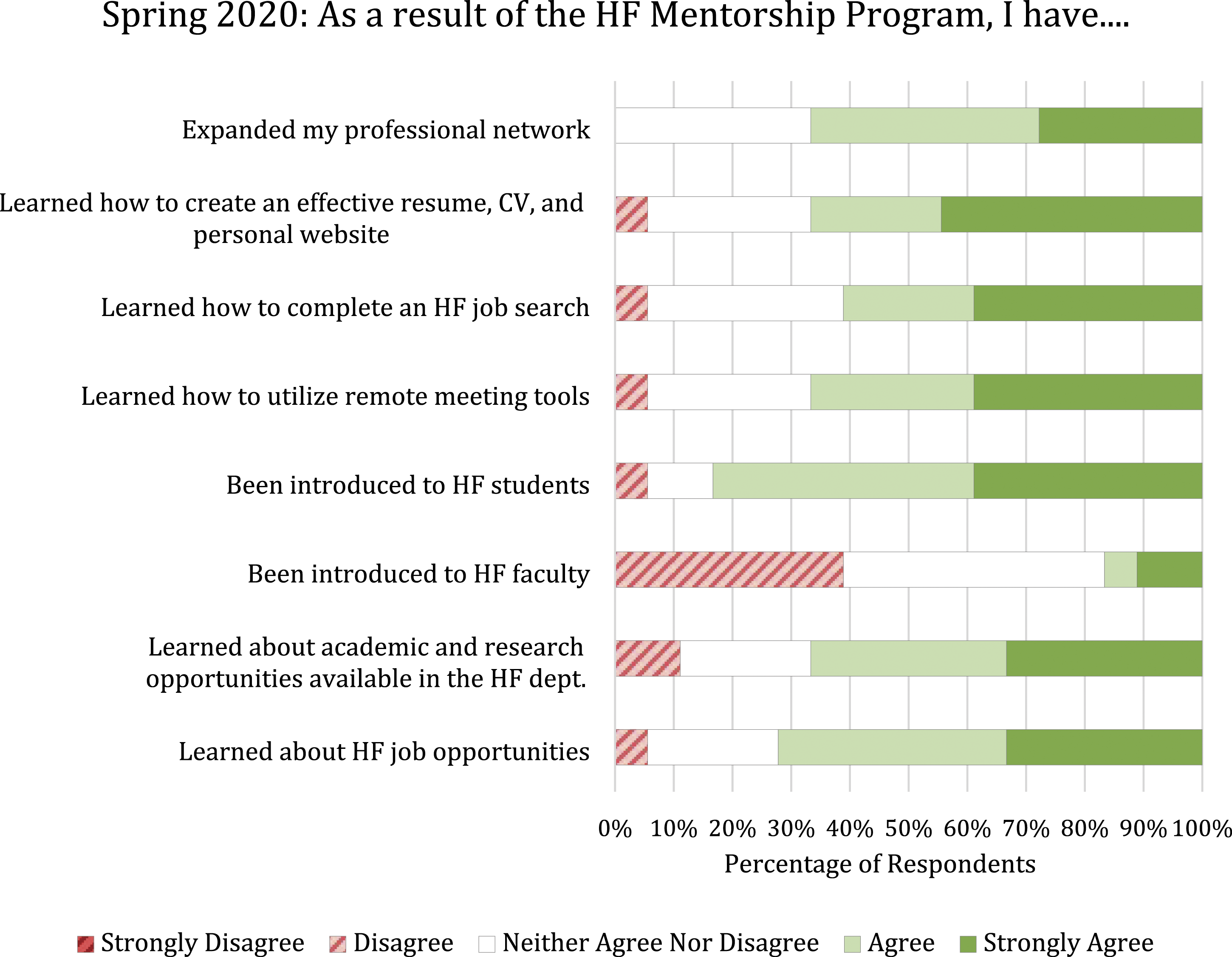
Note. We had 36 program participants in Spring 2020 (BS, 50%; MS, 19.44%; PhD, 30.56%). This is equivalent to 20.8% of students enrolled in any ERAU HF degree program. Results are shown for all 18 feedback survey respondents (50% program participant response rate). No respondents answered “strongly disagree.”
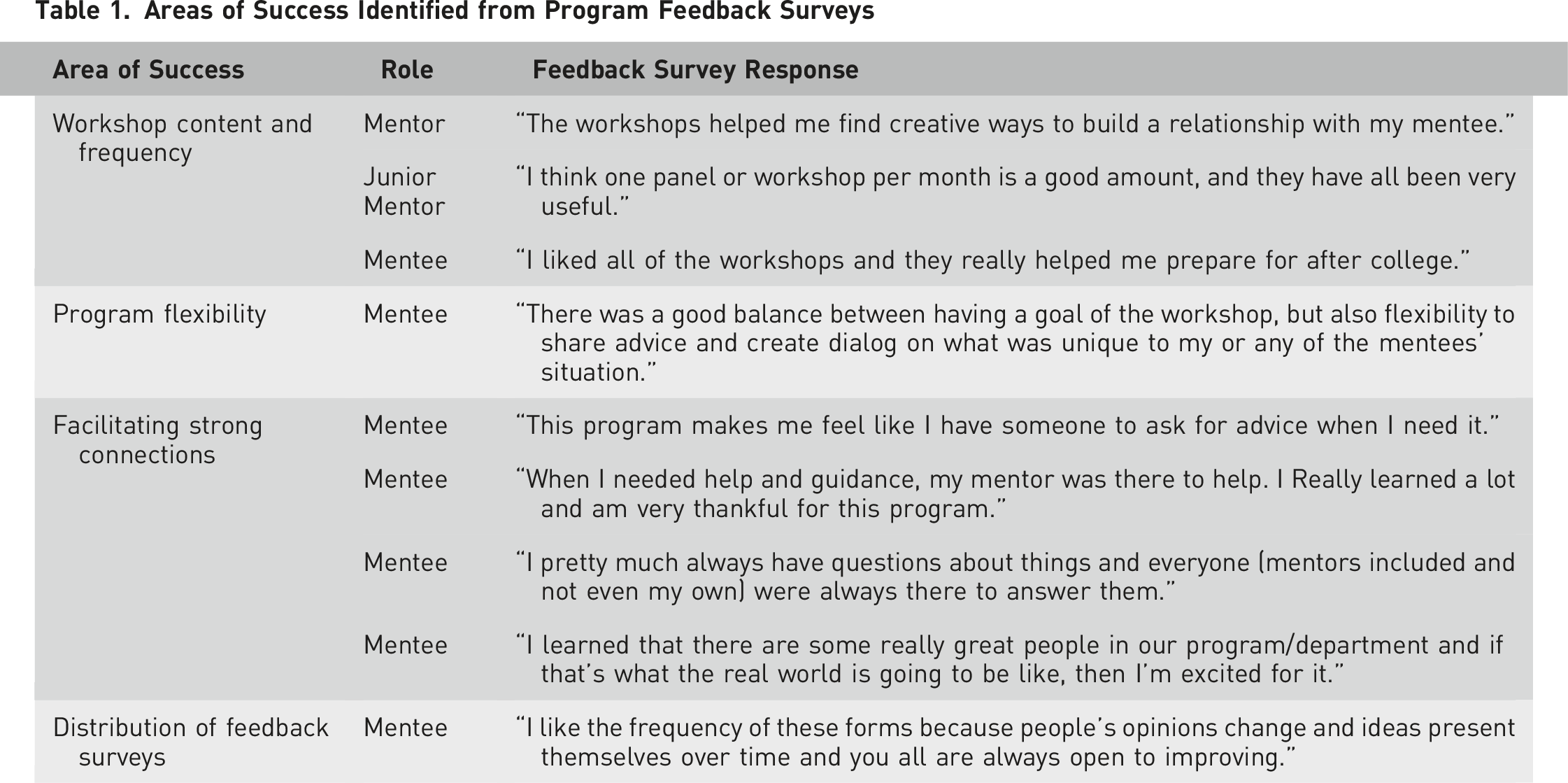
Areas of Success Identified from Program Feedback Surveys
Areas of Improvement Identified from Program Feedback Surveys

Recent and Planned Initiatives
For Fall 2021, we implemented new initiatives that incorporated feedback from previous check-in and exit surveys. Our biggest initiative was the introduction of alumni mentors (i.e., individuals who graduated from ERAU and volunteer to mentor a current student). Adding alumni mentors has strengthened the program by offering current students networking opportunities with established HF/E professionals while also providing students’ insight into successful job search practices and practical applications of HF/E concepts learned in class. We also created a resource repository to house important information for the current semester, along with presentations and activities associated with prior workshops. Additionally, we implemented a policy for unsuccessful matches whereby program leadership investigates the nature of the mismatch and makes recommendations for improvement or an alternative match.
During future semesters, we aim to better leverage faculty connections and expertise by enlisting their assistance in recruiting additional alumni mentors and by inviting them to be guest speakers during workshops, where they can also provide an overview of their research interests and lab projects. We also intend to advertise the program through faculty courses, instead of continuing to rely on email and flyer advertisements. Additionally, we plan to create a program continuity document to ease the transition between current and future program leaders.
Lessons Learned
Through the development of our own peer mentorship program, we have learned some important lessons that are key for success. First, a lot of upfront work must be completed before matching students to make the program experience as optimal as possible. We found it was important to talk to potential program participants to get their feedback on how to build the program, and that doing so made participants more comfortable in joining the program from the start and in continuing their involvement. We recommend holding a Q&A or brainstorming meeting with potential program participants to give them an opportunity to ask questions and/or provide feedback even before the program begins.
Second, we learned that we needed to include enough activities to keep program participants engaged. Mentors and mentees are encouraged to meet on their own, however, as the semester progresses and more course deadlines approach, and mentor/mentee meetings may become more infrequent—especially if mentors and mentees are at a loss for a meeting topic. So, we decided to host workshops where mentors and mentees can learn about a topic, and then discuss it among themselves. Based on feedback from our program participants, and our Fall/Spring two semester academic terms, we found that it was best to have activities once a month to encourage engagement.
Third, is the importance of frequently assessing both the matching and program activities to ensure that mentors and mentees are meeting and satisfied with their match. Our check-in and exit surveys help us gauge areas of success and improvement that can be used to refine the program in future semesters. We suggest distributing a check-in survey approximately a month after matches have been made to ensure that mentors and mentees have been in contact with one another. Exit surveys should be distributed after the last planned event of the semester to account for all activities and correspondence with mentee/mentor pairs.
Fourth, we learned that we must plan for program maintenance and continuity. When creating a peer mentorship program led by students, the students who created the program will eventually graduate and others will take their place. A plan should be set into place so that future program leaders can successfully keep the program going. This could include leadership shadowing opportunities, a step-by-step guide of activities that are done every semester, an online folder with resources, or even a written document, like the one here, that provides details about the program’s goals, achievements, and necessary activities to keep it running.
Footnotes