




Abstract
We conducted a cognitive task analysis to provide input on the curriculum and technology currently used to train parachute descent procedures in the Naval Aviation Survival Training Program. Subject matter experts provided insight into the correct decision-making thought processes used in parachute descent. Techniques for analysis included focus groups, interviews, and a think-aloud procedure involving a parachute descent simulator at a Naval Aviation Survival Training Center. Results and findings inform the instructional design process to improve the training pipeline’s development, implementation, and evaluation.
Keywords
A pilot’s ability to safely operate a parachute to descend and land following emergency egress from an aircraft may be the difference between life and death. Accordingly, the use of parachute simulation devices for training date back to World War II (Hogue & Pelz, 2008).
Emergency descent training is covered in all military branches within the U.S. and other countries (e.g., Singapore) and has applications beyond the armed forces (e.g., smokejumping; U.S. Department of Agriculture, 2018). Due to the hazardous nature of emergency bailouts and ejections, the psychological fidelity of the training is critical (e.g., Ragan et al., 2010; Stone, 2008).
In this article, we provide a brief overview of the process followed to obtain subject matter expert (SME) information about the tasks and decision-making involved in parachute descent procedures (PDP) in the Naval Aviation Survival Training Program (NASTP), with a focus on the use of virtual environments to train for high-risk events. We also discuss approaches used to assess the training’s psychological relevance to real-world applications and how the U.S. Navy can use the results to develop strategies to train PDP.
Virtual Environments as a Training Tool
Virtual training environments (VTE) have gained popularity in a wide array of work areas, from motor-skills training in medical settings (Gallagher et al., 1999) to soft skills training for teachers (Stavroulia et al., 2018). VTEs allow trainees to learn necessary skills in a safe environment where the cost or dangers of real-world training are high. The use of VTEs has increased significantly for several reasons: (1) simulations allow the environment to be reproduced under the control of the training designer/developer, (2) behaviors are too complex to be safely executed by a trainee, (3) instructor-led controlled environments allow trainees to exercise gained knowledge and conduct scenario-based training while receiving feedback from the instructor and simulator in real-time, and (4) simulation efforts are often cost-effective when compared to using on-the-job equipment (Goldstein & Ford, 2002).
Virtual Training Environments and Skills Transfer
The effectiveness of a virtual environment’s ability to train complex decision-making skills depends on the system’s psychological fidelity. Psychological fidelity requires the trainees to practice the mental processes and behaviors observed in the operational setting (Goldstein & Ford, 2002). When psychological fidelity is high, positive transfer is more likely to occur and facilitate correct behavior patterns similar to real-world performance. Several studies have demonstrated the transfer of spatial skills and procedural learning from a virtual environment to a real environment (e.g., Aurich et al., 2009; Brooks, 1999).
The necessity of psychological fidelity underscores the importance of human factors input in designing VTEs, as advanced technological capabilities alone are insufficient for learning and skills transfer (Stone, 2008). In fact, International Standard ISO 9241–210, Human-Centered Design Processes for Interactive Systems (2010), outlines how the application of human factors and ergonomics methods to interactive systems enhances the system’s effectiveness and efficiency. Stone (2008) suggested that even a robust training program can be completely undermined if content and fidelity are not adequately considered when creating interactive technologies.
The present paper reports on our use of a cognitive task analysis (CTA) to document the mental processes required by Navy pilots and aircrew to perform PDP successfully. These protocols can be used for training and incorporated into the development phase of VTEs.
Background on Cognitive Task Analysis
Task analysis is the most widely used approach to identifying worker behavior (Cannon-Bowers et al., 2013; Klein, 1995). The overarching goals of task analysis are to detail interactions between individuals and their working environment and to decompose jobs into tasks and subtasks (Cannon-Bowers et al., 2013; Stone, 2008). A CTA provides more comprehensive results by asking questions about the interrelations amongst tasks, knowledge, and skills in situations that involve less visible behaviors (e.g., decision-making; Goldstein & Ford, 2002). CTA includes a family of techniques used to elicit the cognitive processes that distinguish expert from novice performance on complex tasks (Clark et al., 2008; Klein, 1995) with a significant focus on goals, strategies, and decisions (Crandall et al., 2006; DuBois et al., 1998). CTA has been used successfully in various settings for training purposes. For example, in the context of medical procedures, Cannon-Bowers et al. (2013) used CTA to generate training requirements, performance metrics, training scenarios, and simulator requirements for combat casualty care techniques. Similarly, Johnson et al. (2006) used CTA to identify and describe the decision-making and physical actions required in core interventional radiology procedures. Given researchers’ prior success in implementing CTA in various domains, we expected the same methodologies to successfully identify the cognitive processes executed during PDP.
The Application Domain
Pilots view ejection as a last-ditch strategy. Nevertheless, pilots must be prepared to act when things go horribly wrong with the aircraft, such as combat damage or total engine failure. Of course, ejection is not as simple as pulling a lever and gliding peacefully to the earth. Pilots face possible turbulence, canopy malfunctions, and serious bodily injury, among other hazards.
The U.S. Navy requires pilots and aircrew to complete Aviation Survival Training before flying in a naval aircraft and every 4 years thereafter. PDP training is a component of the curriculum intended to teach aircrew and pilots the processes and decision-making strategies necessary to survive an ejection. To properly evaluate this training, it is crucial to accurately and completely describe the tasks and decision-making involved in PDP. Thus, a CTA was implemented to (1) identify the tasks, knowledge, skills, and abilities (KSAs) required for successful PDP training, (2) create performance metrics, and (3) evaluate parachute descent training simulators on their ability to train the required KSAs (Cannon-Bowers et al., 2013). This information was subsequently used to inform an iterative design process for an emerging training simulator and improve training design and implementation.
Context of Simulated Training
Navy pilot and aircrew training focuses on teaching the KSAs required for safely ejecting from an aircraft to touching down on land or water. Prior to practicing PDP in the simulators, trainees are required to complete a 30-minute classroom lecture. Once in the simulator, trainees must successfully demonstrate all components of PDP training. Navy PDP training involves four major categories: canopy malfunctions, IROK (Inflate, Release, Options, Koch Fittings), steering, and parachute landing fall (PLF) position. The IROK acronym reminds trainees to inflate the life preserver unit (LPU), release the survival kit or raft, decide on options (i.e., removal of gloves, oxygen mask, visor), and disconnect canopy release fittings. In simulated scenarios, trainees are required to perform corrective procedures for two canopy malfunctions and IROK procedures. Trainees must also understand parachute canopy steering mechanisms and operate the parachute canopy steering system. Finally, trainees must successfully identify the correct body position and procedures for PLF.
The Simulator Assessment
Participants and Procedure
Before participating in the study, SMEs completed an informed consent form. An Institutional Review Board approved the study protocol. We began the CTA by conducting a document analysis and observing Navy PDP training. Additional information was collected from Martin-Baker, a company that manufactures ejection seats for the Department of Defense. Martin-Baker’s Web site contains a section labeled Ejection Tie Club, which describes scenarios from real-world aircraft ejection experiences. This initial stage identified emergency bailout KSAs and provided the foundational knowledge required for protocol design in subsequent CTA steps (Clark et al., 2008).
Numerous knowledge elicitation methods exist for CTA, and when multiple methods are employed, researchers may gain significantly more insight (Crandall et al., 2006). Accordingly, this study utilized a multi-method approach to overcome the elicitation challenges inherent in emergency responses (e.g., limited SMEs, non-typical circumstances). First, we conducted interviews and focus groups with 10 SMEs, including Navy parachute descent instructors (n = 7), professional skydivers (n = 2), and a former pilot who had experienced an emergency ejection. Core questions, asked of all SMEs, revolved around standard descent procedures. We asked additional interview questions to leverage differences in SME expertise. For example, instructors described Navy PDP action sequences and essential KSAs, while skydivers provided unique perspectives on parachute malfunctions and protocols in atypical circumstances. The pilot with emergency ejection experience provided invaluable insight into the judgments and decisions required in a real-world event.
Next, nine SMEs participated in a three-phase think-aloud procedure while completing simulated descents, three of whom participated in the focus groups and interviews. SMEs included Navy PDP instructors (n = 6), pilots with experience in emergency bailouts (n = 2), and a free-fall jump master (n = 1). Instructions encouraged SMEs to verbalize everything on their mind as they completed tasks. While no formal practice on think-aloud protocols was conducted during this study, the first run-through was open-ended, with researchers providing minimal prompting to help guide SMEs through this process. This session allowed SMEs to familiarize themselves with the simulator and thinking aloud. In the second run-through, SMEs were instructed to complete the simulated descent while responding to questions about critical cues and decision points. In the third and final run-through, SMEs were asked to think aloud about differences between experts and novices in task completion, consequences of common errors, and observable trainee behaviors. Note takers and video recordings captured all relevant data (Figure 1). Parachute descent training simulator used for CTA.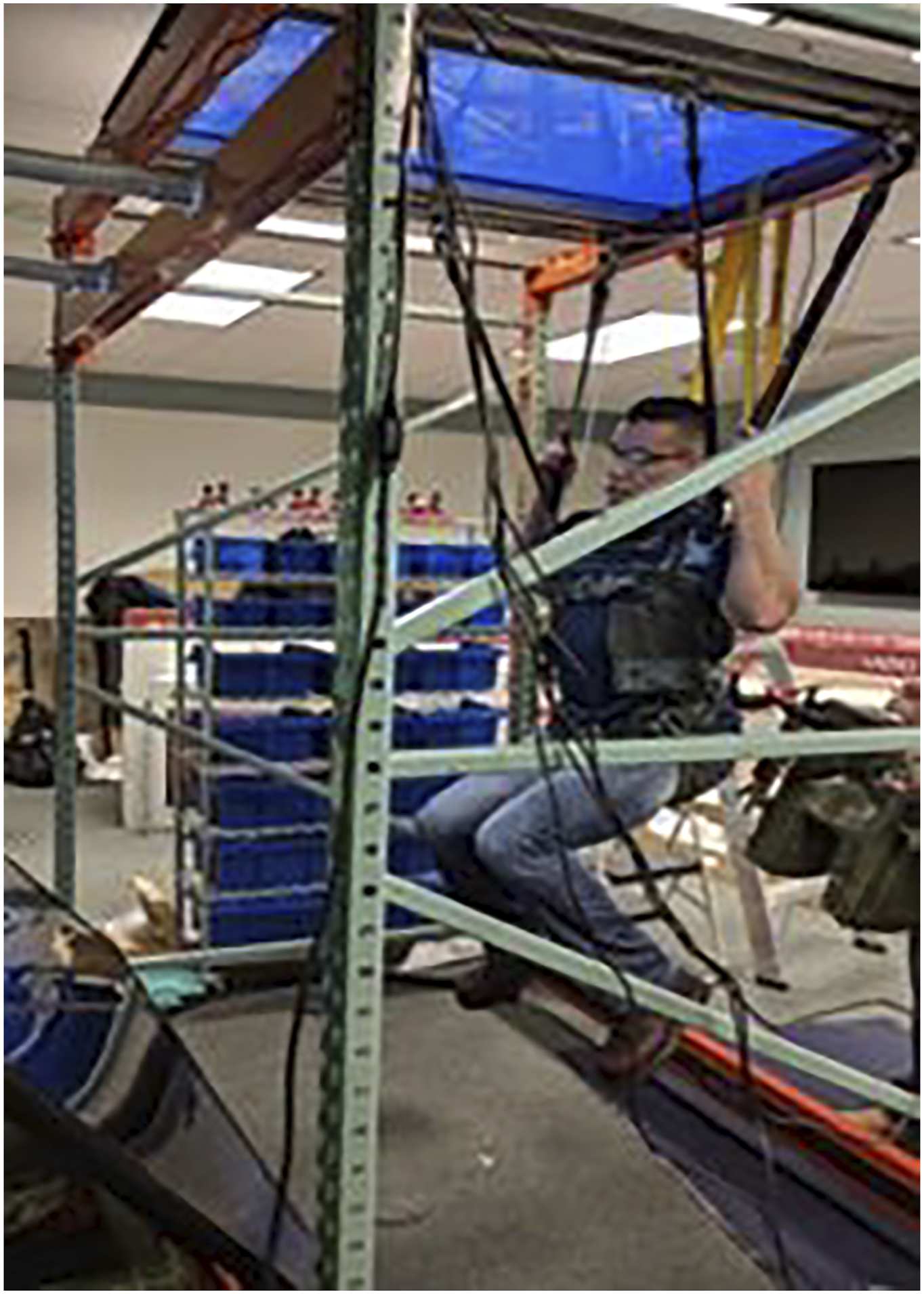
During the second and third run-throughs, the simulation was paused at specific points to ask questions and repeat critical steps to elicit as much information as possible from SMEs. The pauses were essential because the task is not self-paced and, therefore, could prevent SMEs from verbalizing all aspects in real-time. Further, pauses also helped minimize cognitive overload that may result from completing a complex task while simultaneously providing verbal evaluation (Koch et al., 2019).
Throughout the simulated descents, each SME experienced various task/environmental conditions, including ejection altitudes, times of day, wind and weather conditions, terrain, and canopy malfunctions. Analogous to the interviews and focus groups, we asked all SMEs a core set of questions in rounds two and three of the think-aloud procedure. We asked additional questions depending on variable settings and SME insights. For example, in the second run-through, we prompted SMEs with parachute experience to consider both real-world and simulator cues; in the third run-through, we asked instructor SMEs questions related to determinants of successful task completion.
Results
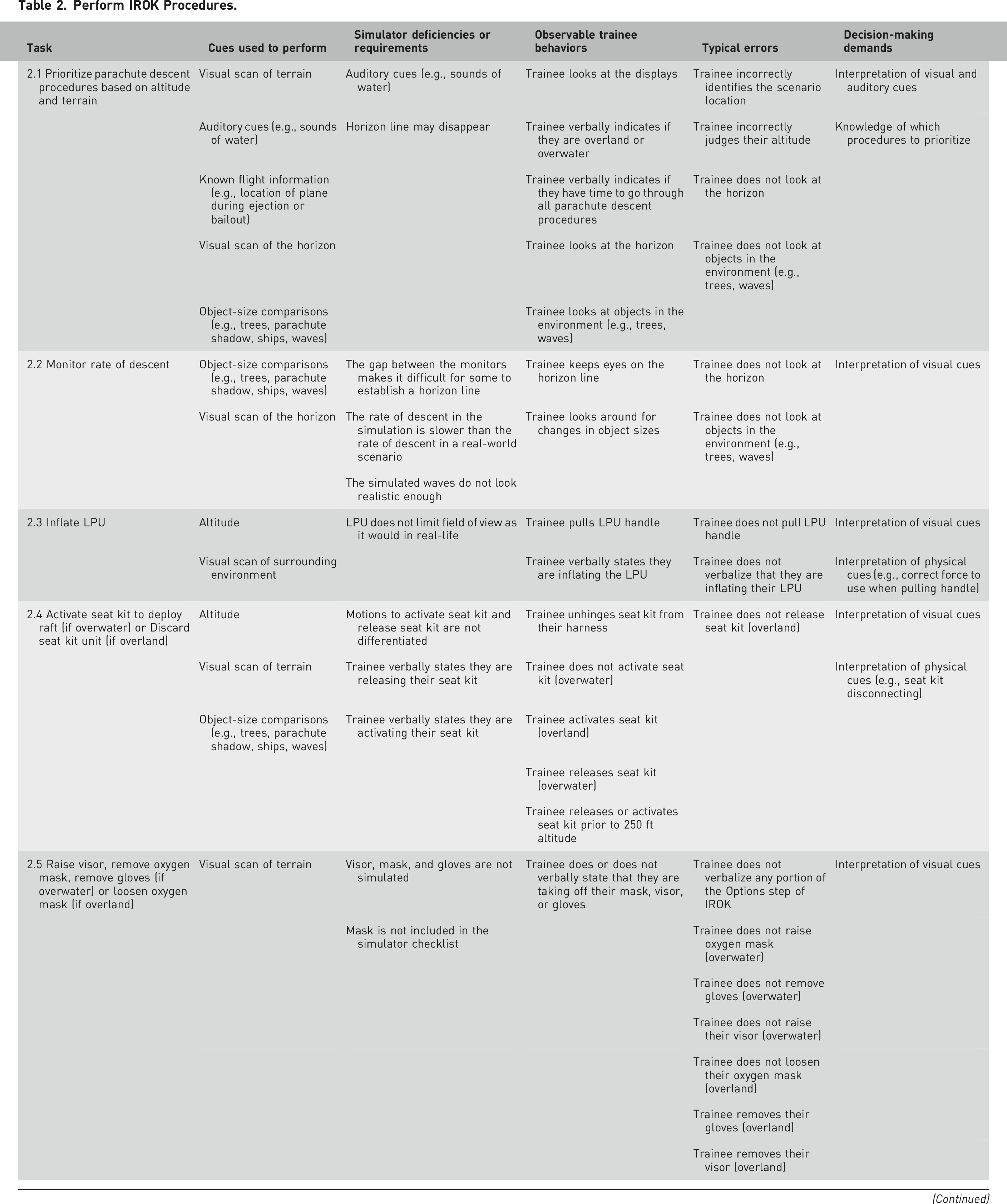
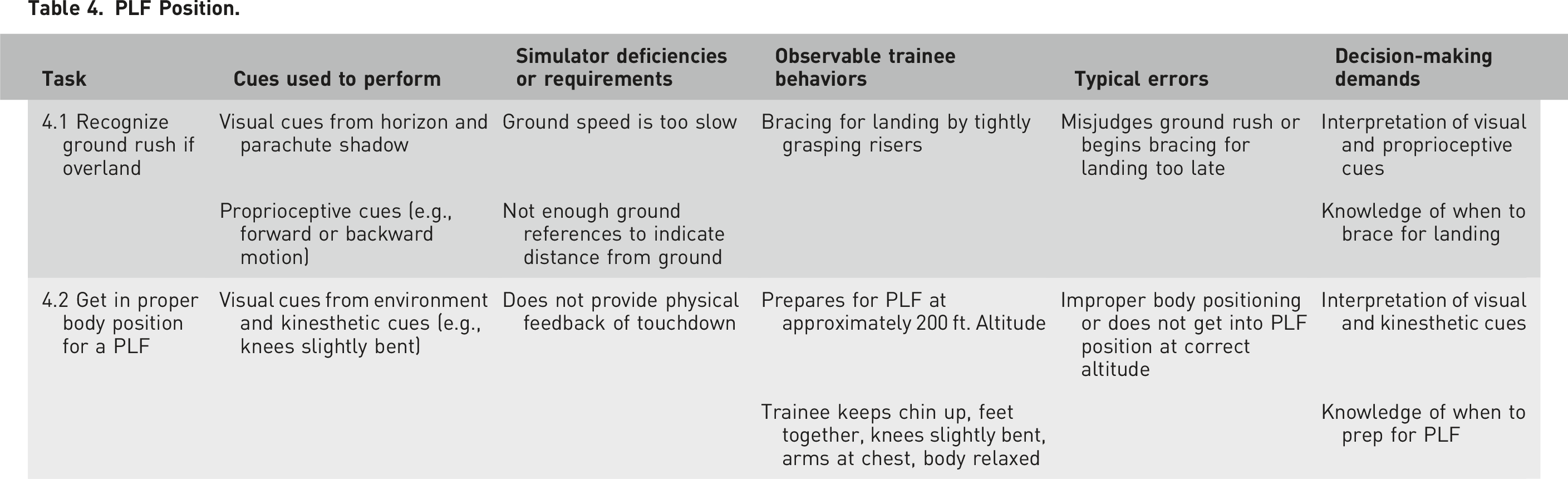
Cognitive task analysis results are reported separately for each of PDP’s four main objectives: Correcting canopy malfunctions, IROK, steering, and PLF. Following the design outlined by Cannon-Bowers et al. (2013), we sorted responses and observations for each training objective into tables with the following columns: (1) tasks comprising the training objective, (2) cues used to perform the tasks, (3) the current simulator’s deficiencies or additional requirements, (4) observable trainee behaviors, (5) typical trainee/novice errors, and (6) decision-making demands.
Correcting Canopy Malfunctions Results
Correct Canopy Malfunction.

IROK Results
Perform IROK Procedures.
Steering Results
Steer Parachute.
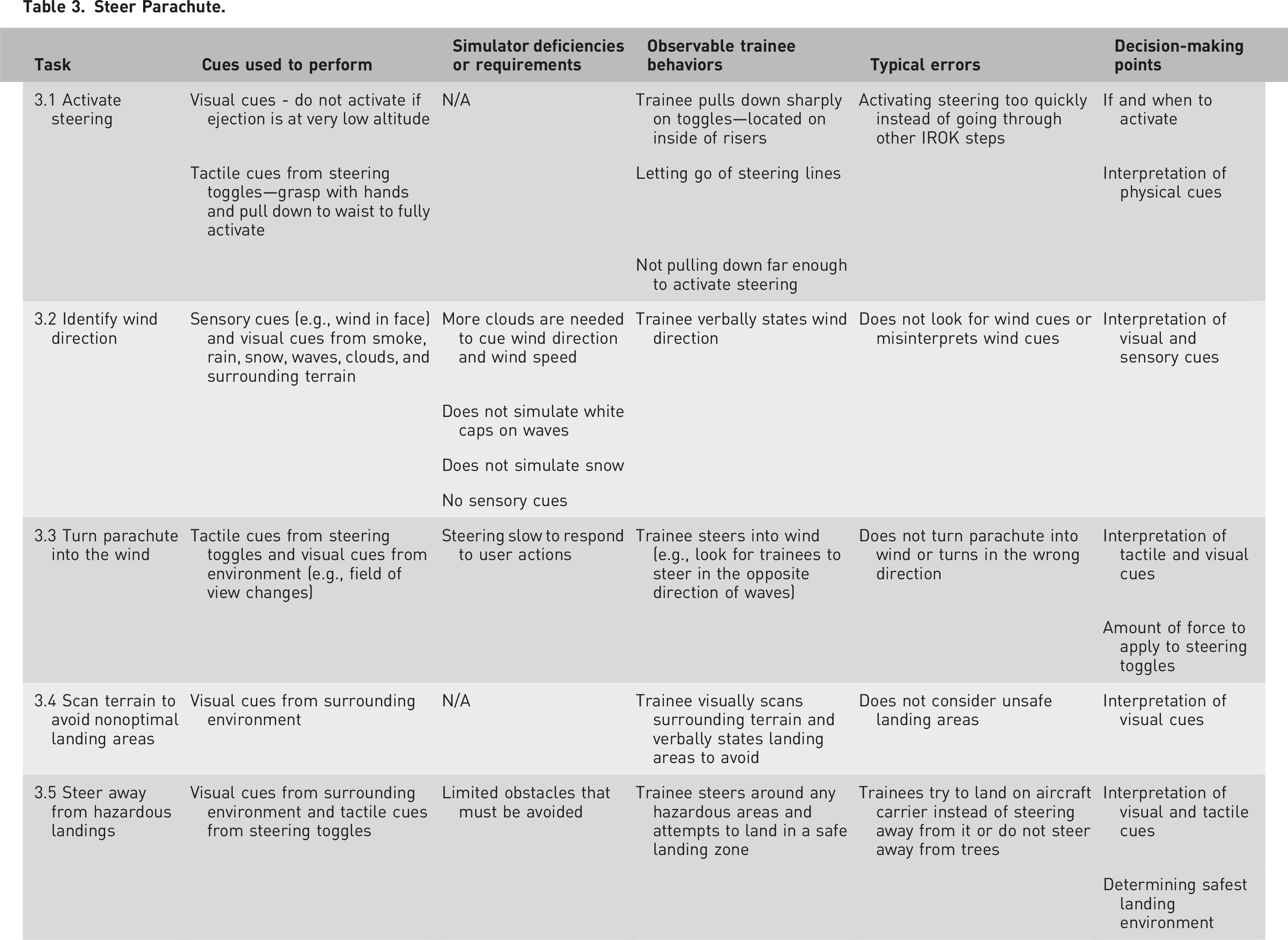
If it is necessary to activate steering, the most significant cue available to pilots is wind. This cue is essential because pilots and aircrew are trained to steer into the wind to reduce their descent rate. Correspondingly, simulators should provide sufficient wind cues such as movement in the surrounding terrain and sensory feedback. Results also revealed the importance of steering away from obstacles (e.g., trees) to land safely. Trainees will not meet this objective without a functional understanding of steering components. Therefore, training programs and simulators should create realistic cues regarding steering capabilities and limitations. Observable trainee behaviors include trainees sharply pulling down on loops inside the risers, visually scanning the surrounding terrain, and steering around hazardous areas. Typical trainee errors include forgetting to activate, activating pre-emptively, and not steering into the wind. Metrics could include activating steering by a specific altitude, steering into the wind, and knowledge of steering behaviors.
Parachute Landing Fall Position Results
PLF Position.
Significance of Improving Virtual Environment Training Systems
While methods such as analysis of incident and accident reports can yield recommendations for training (e.g., Taber, 2014), leveraging a CTA produces more comprehensive results that can inform various training-related domains (e.g., training needs, performance metrics, simulator capability requirements). In the realm of instructional design, particularly instructional design for high-risk training, CTA is nearly essential. Training programs are most efficient when the mental models, strategies, and skills required for successful task performance are considered early in the design phase.
Several findings of this study were implemented in the design and development of a novel parachute descent training simulator. Specifically, the simulator developers augmented graphical images to include various depth cues that aid in malfunction identification and altitude determination and added additional automated performance metrics. Further, a virtual reality (VR) headset was integrated to allow for an evaluation of monitor versus VR display in a follow-up study. In addition, the CTA identified essential training elements, including typical errors, decision-making demands, and performance metrics. Resulting improvements in the psychological fidelity of critical cues in the simulator are likely to contribute to more effective learning of PDP in the United States Navy.
Like prior studies involving CTA for high-level skills (e.g., Cannon-Bowers et al., 2013; Koch et al., 2019), very few individuals have experienced a real-world emergency bailout with a canopy malfunction. Due to this limited expert pool, recruiting individuals with real-world experience to serve as SMEs proved challenging. Illustrating this issue, Newman (2013) found that out of 562 low-level ejections, 274 were fatalities, resulting in a survival rate of 51.2%. To address the sample size restrictions, PDP training instructors served as SMEs, per the strategy of Cannon-Bowers et al. (2013), which brought the total sample to 16 SMEs. In such a specialized sample, potential outside influences could exist yet remain undetected. For example, there may be slight variations in the ejection process depending on the aircraft and parachute system. Although we sought a diverse set of opinions and used triangulation techniques to improve the validity of our results, a follow-up study could explore such issues in greater depth. With access to a larger sample, researchers could stratify by aircraft platform and participant experience to improve generalizability and coverage. Additionally, leveraging a think-aloud protocol with a pre-phase to increase familiarization with the process might increase the robustness of data responses.
To our knowledge, CTA has not previously been utilized in this domain. Results of the current CTA contributed to a more thorough understanding of the tasks comprising PDP training and how current trainers can be improved by adding more realistic task-related cues. Should the individuals that undergo PDP training experience a real-world ejection and canopy malfunction in the future, the improved psychological fidelity provided by CTAs will potentially result in transfer of training, which may mean the difference between life and death.
Footnotes
Note
Funding
The author(s) disclosed receipt of the following financial support for the research, authorship, and/or publication of this article: This work was supported by the Small Business Innovation (Navy Phase III SBIR N161-007, Subcontract No.: SC-).
The authors would like to thank Dean Jones for his early contributions to the project.
Presentation of this material does not constitute or imply its endorsement, recommendation, or favoring by the U.S. Navy or the Department of Defense (DoD). The views expressed in this paper are solely those of the authors, and do not necessarily reflect the opinions of the Naval Air Warfare Center Training Systems Division or any other Department of Defense agency, unless stated in official directives.
Small Business Innovation Research (Navy Phase III SBIR N161-007, Subcontract No.: SC-).