



Abstract
This article describes a field experiment designed to test the efficacy of get-out-the-vote (GOTV) techniques in a new context and for an understudied population. It evaluates the effectiveness of nonpartisan GOTV messages delivered via personal contact and mail in a heavily Latino community during the 2004 presidential campaign. It proposes and tests an alternative model of voter turnout based on Zaller’s receive–accept–sample model of public opinion. The findings are consistent with the authors’ predictions; mobilization efforts increase turnout, but mobilization effects vary across citizens based on their propensity to vote. There is a large increase among episodic voters but little increase among habitual or registered nonvoters.
Keywords
By using a field experiment to test the effects of a nonpartisan get-out-the-vote (GOTV) message we wish to contribute to two separate literatures. First, we add to the literature on the effectiveness of GOTV techniques. In recent years there has been a surge in field experiments testing various mobilization methods (Gerber and Green 2000a, 2000b, 2001; Gerber, Green, and Larimer 2008; Green and Gerber 2008; Green, Gerber, and Nickerson 2003a, 2003b; Michelson 2003, 2006a, 2006b; Michelson, Garcia Bedolla, and McConnell 2009; Nickerson 2008). These experiments provide evidence that GOTV can increase turnout, when implemented correctly. These previously published field experiments have been conducted, however, during nonpresidential elections when turnout has generally been low. We test for effects in the context of a presidential election where we would expect higher base turnout. Furthermore, the experimental population in most previous studies has been primarily Anglo. We add to this literature by testing for effects in a new context (a presidential election) and for an understudied population (Latino voters).
Our second goal is to propose and test a model of voter turnout. Our model takes Zaller’s receive–accept–sample (RAS) model and adapts it to the vote decision. After describing the model, we make connections between the voter turnout and mobilization literatures. Based on our turnout model we develop specific predictions as to how different types of voters (habitual, episodic, and registered nonvoters) are likely to respond to GOTV messages. Following the presentation of the results, we conclude with a discussion of implications for voter mobilization and our model of voter turnout.
Previous Mobilization Research Using Field Experiments
In recent years, a body of mobilization research has developed using field experiments. Green and Gerber (2008), who have contributed significantly to this literature, surveyed the existing evidence. The findings are consistent but not uniform. Door-to-door canvassing has a strong positive effect. Telephone calls vary considerably in their effectiveness. When delivered in a personal and engaging manner they can motivate voters to turnout, while if the delivery is wooden, hurried, and focused on simply reading a script, they are ineffective (Nickerson 2007). Direct mail effects are small, although effects appear somewhat larger for mailings that invoke social pressure to get people to the polls (Green, Aronow, and McGrath 2010), while e-mail and automated phone calling (“robo calls”) provide no detectable increase in turnout. To generalize broadly, the more personal the contact, the more effective the method. Green and Gerber suggested part of the explanation for the decline in turnout over the past few decades is the replacement of personal canvassing carried out by party loyalists with less personal and, therefore, less effective techniques such as professional phone banks and consultant-produced direct mail campaigns.
In the first of their field experiments, Gerber and Green (2000b) estimated personal canvassing increased turnout by approximately 9.8 percent, while direct mail increased turnout by 0.6 percent per mailing. Green, Gerber, and Nickerson (2003b) tested GOTV canvassing effects in six communities in the context of city council, school board, and mayoral races. They found an average increase in turnout of 7.1 percent. Nickerson (2008) used a distinct placebo design wherein half of his respondents received a GOTV message, while the other half received a message encouraging recycling. He found those receiving the GOTV message were 8.6 percent more likely to vote.
Michelson (2003) tested the effect of GOTV canvassing on voting in a school board election in a rural California community that was majority Latino. She found personal canvassing, using Latino students with a nonpartisan message, led to an increase in turnout. Her estimated treatment effects, however, were noticeably different across groups. The effect among Latino Democrats was a 12.6 percent increase, while effects were smaller and statistically insignificant for non-Latinos (3.0 percent) and non-Democratic Latinos (−2.3 percent). In a follow-up study in an urban environment, Michelson (2006a) found canvassers raised turnout among young Latino voters, an especially difficult group to get to the polls, but the effect was a modest 4.8 percent increase. All of these studies used a nonpartisan message urging people to vote. In a further replication, Michelson (2006b) used a canvassing message targeted to Latinos urging them to vote to keep open a local hospital that served the Latino community. She found this partisan message had a strong effect on Latino voters, increasing their turnout by 9.5 percent in an election where total turnout was only 12 percent.
Experimental studies of mailings generally show no effect or a small positive effect (Green and Gerber 2008). Nonpartisan mail is most likely to have a positive effect, while advocacy and partisan mailings tend toward no effect or even a negative effect. Gerber and Green (2000b) found nonpartisan mail raised turnout by approximately 0.5 percent per mailing. In later work Gerber, Green, and Larimer (2008) found a single mailing promising to publicize everyone’s voting record in the neighborhood after the election led to an amazing 8.1 percent jump in turnout; in this study a relatively benign civic duty message, used as a control, led to a noticeable 1.8 percent bump in turnout. Follow-up studies showed mailings using social pressure in other formats also raised turnout more effectively than regular mailings (Green and Gerber 2010).
Wong (2005), using last names, classified a sample of Los Angeles County voters into a series of Asian American groups. Chinese Americans received one nonpartisan mailing urging them to vote that was in both English and Chinese, and their turnout increased by 2.7 percent. Filipino, Indian, Japanese, and Korean voters received a single mailing in English only. The effects for these groups were much smaller (0.9 percent increase) and not statistically significant. These results indicate native language appeals may be particularly effective. On the other hand, Ramirez (2003) and Ramirez, Gerber, and Green (2003) found an attempt to mobilize Latino voters via bilingual mailings to be largely ineffective. Based on over three hundred thousand observations, they estimated each mailing increased turnout by 0.04 percent. Green (2004) found direct mailings to African American households as part of the NAACP National Voter Fund’s mobilization efforts were completely ineffective and had no effect on turnout. Finally, Garcia Bedolla and Michelson (2009) partnered with two Asian American community organizations during the 2006 primary and general elections to run a GOTV campaign targeting Asian Americans with a low propensity to vote. They tested a mailer designed to provide citizens with the cognitive information needed to participate and a traditional civic duty message. Neither increased turnout to a noticeable degree.
This review shows while there are a considerable number of studies, there are still gaps in our knowledge. Virtually all previous field experiments were conducted in the context of nonpresidential elections. The one study to consider statewide races (Gerber and Green 2000b) included incumbent candidates for governor and U.S. Senate who won reelection by thirty-point margins in a nonpresidential election year. Because 2004 was a presidential election year, our study provides a very different context. The difference may enhance or may weaken the effects of mobilization efforts. On one hand, voters view presidential elections as salient, consistently identifying them as the most important elections in which to participate; therefore, mobilization efforts may have a greater effect. On the other hand, it may be harder to find people whose behavior you can change. Jackson (2002, 839) found that having competitive gubernatorial or U.S. Senate races on the ballot did not increase turnout in presidential years. He argued, “A presidential race provides an overriding stimulus that gets to the polls most of those peripheral voters who can be activated.” When base turnout is 15 to 20 percent, as it is for several of the GOTV experiments, it may be relatively easy to find people who generally turn out to vote who can be coaxed to go to the polls. In a presidential election year there may be relatively few of these voters.
Texas provides a relatively rare context that makes this study possible. In states where presidential elections are highly competitive, extensive candidate canvassing is likely to drown out a mobilization experiment. In Texas, however, there was a noncompetitive presidential race and no senatorial or gubernatorial election, while in Brownsville an incumbent member of the House of Representatives faced only token opposition. Despite significant national media attention on the presidential race, there was minimal campaigning on the ground in Brownsville. 1
A second justification for this study is the experimental population in most previous studies has been primarily, although not exclusively, Anglo. Michelson’s work has been in communities with significant Latino populations, but her studies have focused primarily on local elections. Her work suggests effective GOTV efforts do increase Latino turnout (Michelson 2003, 2006a, 2006b). A study of GOTV canvassing in the context of a major election in a heavily Latino community has not been done. Such a study is warranted considering the increasing importance of Latino voters and their traditionally lower levels of turnout (DeSipio 1996; Arvizu and Garcia 1996). Latino turnout in national elections this century has been seventeen to twenty points lower than white turnout and nine to sixteen points lower than African American turnout (U.S. Census Bureau 2002, 2004, 2006, 2008, 2009). Despite lower turnout rates, Leighley and Vedlitz (1999) found the factors that affect Anglo turnout have the same effects in the Latino community. There is a negative intercept for being Latino, but socioeconomic status, political interest and efficacy, and social connectedness work in the same manner. We therefore expect the GOTV effort to have effects similar to those found in previous studies. Before turning to the research design, we introduce a model of turnout that we believe provides explanatory leverage on the effects of mobilization efforts.
An Alternative Model of Voter Turnout
GOTV efforts attempt to influence an individual’s decision to vote. As such, GOTV experiments ought to provide insight into the decision to vote. While several attempts have been made at understanding this decision, we believe rational choice (e.g., Downs 1957; Riker and Ordeshook 1968) and learning (e.g., Bendor, Diermeier, and Ting 2003; Kanazawa 1998, 2000) models do not fully capture the dynamics of voting (for critiques of rational choice models see Aldrich 1993; Blais 2000; and Green and Shapiro 1994; for critiques of learning models see Fowler 2006). One problem facing rational models in particular is the assumption that voters carefully weigh all benefits and costs. Decision-making theory characterizes decision making as costly and individuals as cognitive misers (Jones 1994; March 1994). Individuals are bombarded with decision opportunities. If one tallied all benefits and costs each time a decision is to be made, then life would be spent largely making decisions rather than acting. To deal with these costs, and the related complexities, individuals establish heuristics to cope with decision-making complexity.
Despite acknowledging these facts, the field has not been good at developing models of political action based on these less-than-heroic assumptions. This has started to change, however, as descriptions of political processes have increasingly built on models of limited cognitive processing and bounded rationality. Scholarship in this vein includes the work of Lau and Redlawsk (1997, 2001, 2006) on voting behavior, Jones on policy processes (Jones 1994; Jones and Baumgartner 2005), and Plutzer (2002) on turnout. We also see Zaller’s (1992) work on public opinion formation as in this tradition. His boundedly rational individuals use coping mechanisms to arrive at decisions. His receive-accept-sample (RAS) model falls well within the scope of such scholarship and forms the foundation for our model of voter turnout.
Zaller’s (1992, 40) RAS model is a probabilistic model of political opinion, which posits an individual samples from a pool of considerations about an issue when called on to express an opinion about that issue. For Zaller a consideration is “any reason that might induce an individual to decide a political issue one way or the other.” The person supports or opposes a policy depending on the balance of positive and negative considerations in the person’s active memory at the moment of expression. The probability a person will support a policy is Prob(support) = S/(S + O), where S and O are the number of considerations that reflect support for (S) and opposition to (O) the policy.
The RAS model is built on four axioms. The reception axiom states a person who is more cognitively engaged with an issue is more likely to be exposed to and comprehend a political message about that issue. The resistance axiom asserts individuals tend to resist information inconsistent with their political predispositions. The accessibility axiom declares the more recently a consideration has been accessed, the more quickly it and associated considerations are recalled from memory. Finally, the response axiom asserts people take a position on an issue by “averaging across the considerations that are immediately salient or accessible” (Zaller 1992, 49).
Applying this to voting, the probability a person will vote can be defined as Prob(vote) = V/(V + A), where V is the number of considerations that induce the individual to vote and A is the number of considerations that induce the individual to abstain. By applying the axioms of the RAS model and evaluating how they interact with voter type, we predict distinct differences in mobilization success. Canvassing should have a weak effect on most habitual voters. The typical habitual voter is predisposed to vote. As such, we do not expect habitual voters to resist a GOTV message. They receive the GOTV message, it becomes an additional positive consideration, and it increases the salience of the positive voting messages that are already part of their pool of considerations. It increases the probability that positive voting considerations are retrieved when the individual samples the pool of considerations before making the decision to vote or abstain. The effect of mobilizing, however, is modest because for most habitual voters the existing pool of considerations is overwhelmingly positive and large. With a large number of positive considerations already in the pool, both the numerator and denominator are high already, and adding one more positive factor to both moves the overall ratio only marginally. Habitual voters are analogous to Zaller’s attentive public. The attentive public has a rich background of political information, so their evaluations of candidates or policies are affected only marginally by new information in Zaller’s model. Similarly, in our model, adding an additional consideration to the pool has only a limited effect on overall turnout for individuals in the habitual category, albeit clearly in the positive direction.
Canvassing should have its strongest effect on episodic voters. Because episodic voters have no specific predisposition with which a GOTV message conflicts, we do not expect significant resistance to a canvassing message. Episodic voters are similar to the semiattentive public in Zaller’s model. These are people who are somewhat engaged with politics but have limited previous information. Zaller notes this is precisely the group that shows the greatest change in opinion when new information becomes available and processed. The RAS model emphasizes the costs of decision making, noting individuals are unlikely to make a complete survey of all considerations when deciding. They access and use the most salient information near the top of their memory to make up their minds. Episodic voters have relatively balanced voting considerations. Mobilization efforts add a new positive consideration and make the positive factors more accessible when individuals go through their limited decision calculus. It is also likely to be true for a significant portion of episodic voters that the count of previous considerations is smaller than for habitual voters, so a new positive consideration has a greater relative effect. In this case adding a new consideration to both the numerator and denominator has a relatively larger impact than it did for habitual voters. 2
We expect a small effect among registered nonvoters. Registered nonvoters are predisposed to abstain. We expect these individuals to receive the message only partially or to not receive it at all because of their limited cognitive engagement with politics and the limited salience of the election to them. We also expect registered nonvoters who are presented with a GOTV message to resist it. 3 Of course, a message not received or resisted exerts no influence on the balance of considerations retrieved when a deciding to vote or abstain. For a politically unengaged person, the GOTV message fails to register as a positive consideration and never makes it into the pool of considerations; neither the numerator nor denominator is moved by the GOTV appeal. Registered nonvoters mirror Zaller’s inattentive public, who do not process available political information, so new information does not change their evaluations of issues. As a result, we expect a GOTV message to increase only marginally the probability a registered nonvoter votes.
In summary, the RAS model of turnout predicts an inverted-U or parabolic relationship between voter type and GOTV efforts. Mobilization efforts should have the least effect on habitual voters and registered nonvoters. These voters have the highest and lowest propensities to vote, respectively, because of their relatively unbalanced pools of considerations regarding voting. GOTV efforts should have the greatest effect on episodic voters, who have an intermediate propensity to vote because of their relatively equally balanced pool of considerations regarding voting. This predicted relationship is consistent with Niven’s (2001, 2004) results as well as the results of Arceneaux and Nickerson’s (2009, 11) meta-analysis of eleven field experiments, which shows “the [canvassing] treatment effect follows a parabolic shape across individuals’ propensity to vote.”
In addition to explaining variation in turnout across types of voters, the RAS turnout model also provides a logical explanation for variations in success across types of GOTV techniques. The reception axiom helps explain the greater effectiveness of personal canvassing over other techniques. GOTV mail is likely to not be “received” by the overwhelming number of citizens in the sense that they do not process the message. The mail is discarded without thinking about it. Personal canvassing is more effective at breaking through the reception barrier. A canvassing message is delivered face to face, it comes with attendant social pressures, and it is more likely to be understood. Only those completely detached from politics are unlikely to receive it. Therefore, we expect personal canvassing to be more effective than mail.
Research Design and Methodological Considerations
Our field experiment was run in Brownsville, Texas. Brownsville is on the U.S.–Mexico border and has approximately 150,000 residents. The population is over 90 percent Latino, and the voting population is overwhelmingly Latino. The power structure of the city is Latino, and active political campaigning is conducted in both English and Spanish.
The Cameron County Elections Department provided a list of all registered voters for the November 2004 general election. We randomly assigned respondents to canvass, mail, and control groups with the following procedure. After stratifying the city into two sections, the older and newer portions, we randomly selected half of the precincts in each section of town. In each selected precinct individual households were randomly assigned to one of three conditions: canvass (50 percent), mail (25 percent), and control group (25 percent). We selected on households to ensure no household had residents in more than one condition. Within each household one voter was selected randomly. After the election the Cameron County Elections Department provided validated voter turnout information.
As long as randomization has been successful, the samples will be statistically equivalent. It is important, however, to confirm equivalency (Gerber and Green 2005; Imai 2005). We tested for equivalency by comparing turnout rates among the different samples for the previous eight general and primary elections and found nothing close to statistically significant differences in turnout. We continued by running logistic regressions utilizing the independent variables from the probits presented later to estimate the likelihood of being in the three different samples. The results for all three samples (p values of .82 for control, .99 for canvassing, and .99 for mail) clearly showed randomization was successful.
For individuals in the mail sample, a postcard was sent out eight days before the election. There were two separate messages (see Appendix A for the text). One emphasized increased power for Latinos if they became more politically active and vote, and the other emphasized civic duty and the closeness of the election as reasons for going to the polls and voting.
For the canvassing experiment each precinct was divided into walk lists. The canvassers were volunteers from student organizations and undergraduate classes and students working at the Center for Civic Engagement at the University of Texas Brownsville. They received course credit or credit for service obligations tied to university scholarships. Training sessions were held prior to canvassing. Students received walk lists identifying all registered voters in each residence as well as the specific individual they were to contact. We counted as a contact only actual discussion with the individual assigned to the treatment group.
Canvassers worked in teams of two or three. Over 90 percent of our canvassing teams had at least one individual fluent in Spanish, while most teams had more than one. Canvassers were asked to cue off of the respondent and reply in the language of the respondent. Each household was assigned randomly one of two scripts, either a Latino power or a civic duty and close election message, which were abbreviated versions of the mail scripts. They also informed the voter of the polling location and number of days to the election. Finally, after talking to the voter, they presented her or him with a copy of the postcard used for the mailer.
Gerber and Green (2000b, 2003) note a danger of overestimating canvassing effects if researchers consider only individuals in the treatment group who are reached successfully. This is because those more easily contacted are more likely to vote, independent of the effect of the treatment. They may have a stronger attachment to the community (e.g., home owners may be more strongly represented), and by definition they have not moved, as undoubtedly have some of the people who cannot be reached. To deal with this complication, Gerber and Green suggest two adjustments: (1) use either instrumental variable (IV) probits or bivariate probits to estimate the effect of the treatment and (2) taking their cue from medical studies, analyze canvassing by estimating an “intent-to-treat” effect. The intent-to-treat effect measures the difference in turnout between the entire treatment and control samples. This underestimates the true effect of the treatment, however, because some portion of the treatment sample is not contacted. Green, Gerber, and Nickerson note (2003b, 1085), “To estimate the actual treatment effect (b) given a contact rate (c), we must adjust the intent-to-treat effect (t) as follows: t/c = > b.” The intent-to-treat effect for the whole sample is divided by the contact rate to estimate the actual treatment effect or the “treatment-on-treated” effect. We follow this methodology.
Univariate Results
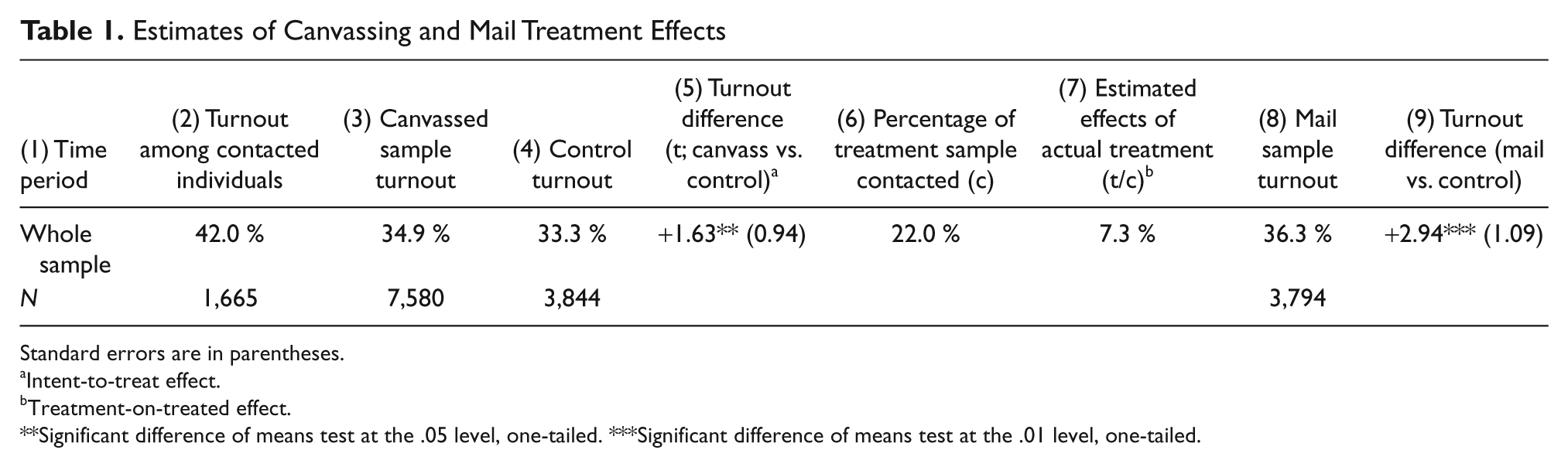
Table 1 shows our basic results. 4 The third column shows turnout for the total treatment sample. Column 5 shows the difference in turnout between the treatment and control samples. To estimate the treatment on treated effect, we need to adjust the intent-to-treat estimate in column 5 by the proportion of the sample actually contacted (column 6). Column 7 shows the estimates for the treatment-on-treated effect of canvassing, while column 9 shows the effect of the mailer on turnout. Column 7 shows the estimated effect of canvassing for the sample as a whole is 7.3 percent, which is very close to the 7.1 percent in the Green, Gerber, and Nickerson (2003b) study but slightly lower than the 9.8 percent estimate in the Gerber and Green (2000b) study.
Estimates of Canvassing and Mail Treatment Effects
Standard errors are in parentheses.
Intent-to-treat effect.
Treatment-on-treated effect.
Significant difference of means test at the .05 level, one-tailed. ***Significant difference of means test at the .01 level, one-tailed.
A noteworthy result is the limited, but statistically significant, effect of the mailing. 5 This effect is considerably stronger than that described by Green and Gerber (2008, 69). These results show that on a dollar-for-dollar basis, investment in mailings is an effective electoral tool. In this case, a single, relatively inexpensive mailer bumped up turnout about 2.9 percent.
Analyses for message effects showed no consistent differences. The civic duty message appears to be slightly more effective than the Latino power message when delivered by mail (36.9 percent vs. 35.0 percent). On the other hand, when delivered in person, the Latino power message appears more effective (44.7 percent to 40.8 percent). Based on these results, which point in opposite directions and fail to achieve statistical significance, it appears message content has limited implications for canvassing effectiveness.
Multivariate Analysis
We get a reasonably accurate estimate of effect simply by comparing mean turnout rates as in Table 1. Nevertheless, multivariate analyses have several attractive features. First, by including covariates we soak up a substantial amount of variance and get a more precise estimate of the effects of canvassing and mailing. Second, by including interaction terms we can see if the effect of the treatment varies across types of voters, which is crucial to the test of our turnout model.
In early work, Gerber and Green (2000b) used IV probits to estimate the effect of canvassing. In later work they suggest there can be complications with IV probits and instead recommend bivariate probits (Gerber and Green 2003). Greene (2003, 710-19, 852-55) and Freedman and Sekhon (2008) also state a preference for using bivariate (maximum likelihood) probits over IV probits. As such we run bivariate probits to estimate the treatment effects. 6
The RAS turnout model predicts GOTV messages will vary in effectiveness across voter types. For habitual voters we predict the message has a weak effect because the pool of considerations is dominated by positive considerations pushing these people to the poll independent of our message. For those with an equally strong tradition of not voting, our message is likely to be resisted or not received at all, and we expect it to have little impact. For those who are episodic in their voting, however, we expect the GOTV message to have a substantial impact. To test this we categorized voters by their propensity to vote.
To estimate baseline turnout prior to receiving a mobilization message, we use turnout behavior over the past eight years. Using the last four general elections and four party primaries, we identify five separate voting patterns characterized as habitual voters, regular voters, occasional voters, rare voters, and registered nonvoters (see Appendix B for a detailed description). We placed greatest emphasis on voting in general elections. “Habitual” voters voted in all four general elections or in three general elections plus several primary elections. Habitual voters make up 16 percent of our sample. Approximately 30 percent of our sample voted episodically, showing up for some elections and not for others. We further divided this group into “regular” voters (9 percent), who voted in approximately 40 to 60 percent of the pertinent elections; “occasional” voters (8 percent), who showed up for about 25 to 40 percent of the elections; and “rare” voters (12 percent), who showed up for only one or at most two of the eight elections. At the bottom, 40 percent of the sample is registered voters who have not voted in any of the past four primary or general elections. We identify these citizens as “registered nonvoters.” We categorized those registered between two and seven years based on the proportion of elections in which they voted. Finally, 15 percent of the sample registered within the past two years; these are “new voters.” Recent registrants historically have low turnout rates, but we do not have a strong prediction as to whether this is a group that will be highly influenced by contact or whether they will tend toward the registered nonvoters.
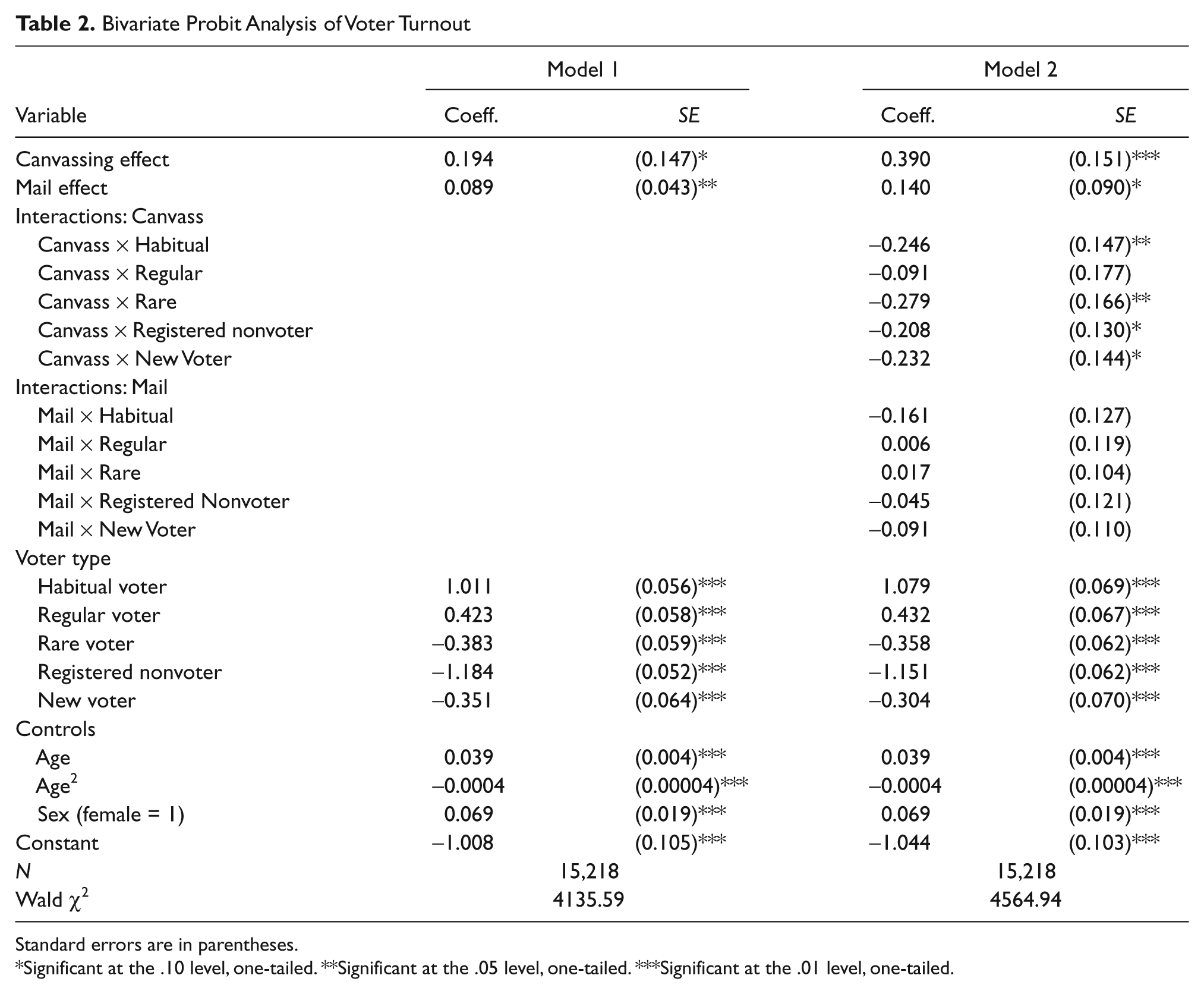
In addition to the treatment and voter type variables, we included as controls voter’s age, age squared, and sex. 7 We control for socioeconomic factors such as home ownership, which are known to affect turnout, through clustering. 8 Model 1 in Table 2 presents the bivariate probit estimates of the likelihood an individual will vote, without estimating the interactions. The controls work as expected. Furthermore, voter type has a strong and direct effect on the likelihood an individual will vote. Compared to the base category of occasional voters, habitual and regular voters are much more likely to vote, while those who are rare voters or registered nonvoters are much less likely to vote. New voters are slightly less likely to vote than occasional voters.
Bivariate Probit Analysis of Voter Turnout
Standard errors are in parentheses.
Significant at the .10 level, one-tailed. **Significant at the .05 level, one-tailed. ***Significant at the .01 level, one-tailed.
GOTV stimuli have a statistically significant effect on the likelihood of voting. The effect of the mailing is modest but noticeable; the effect of personal contact by a canvasser is strong. Under optimal conditions, Model 1 estimates the effect of the postcard is a 3 percent increase in turnout and the effect of a canvassing contact is an 8 percent increase in turnout. 9 While Model 1 explicitly assumes that mailers and canvassing have the same effects across all voters, Model 2 tests for differences across subsamples. The model includes interactions between voter type and GOTV method. The effects clearly differ depending on the voter type. The value of the canvassing dummy doubles as it changes from measuring the effect across all categories of voters (Model 1) to measuring the effect of contact only for the base category of occasional voters (Model 2). Furthermore, all of the canvassing interaction terms are negative. Consistent with our expectations, this indicates the effect of canvassing is strongest for our base category of occasional voters; the effect of canvassing is lower for both those who vote less often and those who vote more often. While the interaction terms show the effect of canvassing varies markedly, none of the interaction terms for mail are statistically significant and their effects are all small.
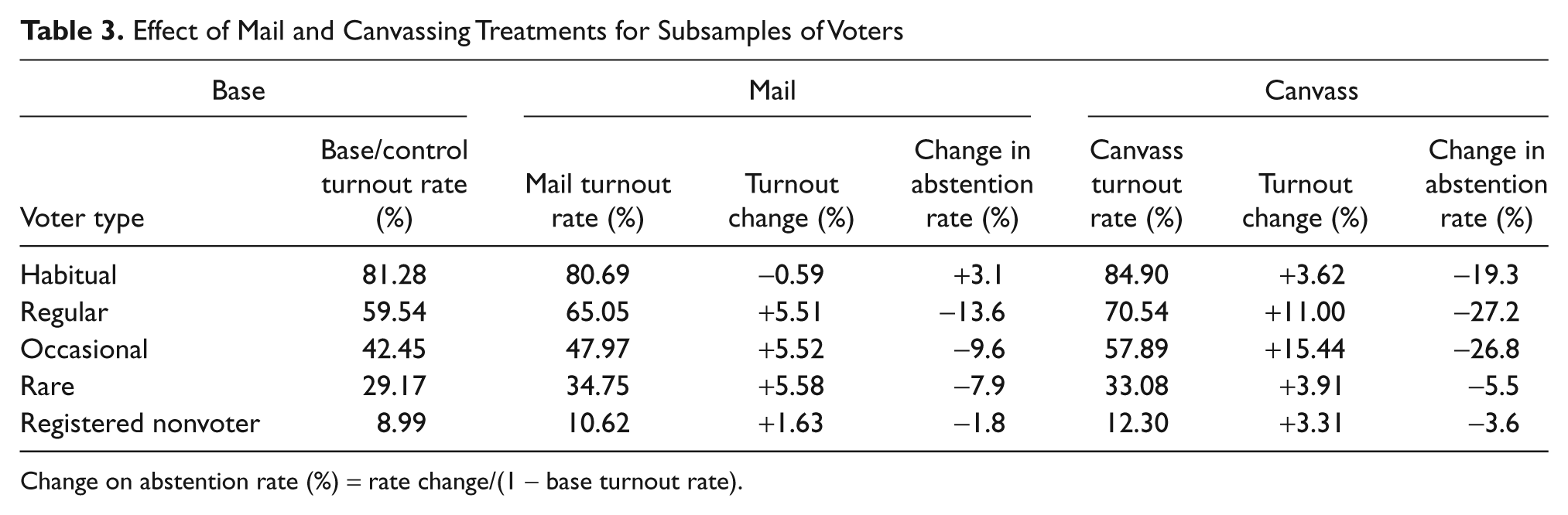
Scholars have debated the correct manner in which to interpret interaction terms in equations with binary dependent variables (Berry, DeMeritt, and Esarey 2010; Brambor, Clark, and Golder 2006; Kam and Franzese 2007). To clarify the effects of these interactions, Table 3 and Figures 1 and 2 present further analyses. Table 3 shows the estimated probability of voting based on no GOTV contact, a GOTV postcard, and contact by a GOTV canvasser for the five categories of voters. 10 We measure the effect in two distinct manners. The turnout change column shows the absolute change in turnout. The percentage change in abstention rate column shows the proportionate reduction in abstention among voters in this category. The second measure is useful to consider because there is a ceiling effect that limits the potential impact of the GOTV effort. Whether measured in absolute terms or in proportionate reduction, the results, especially for personal canvassing, show the inverted-U pattern that is consistent with our predictions.
Effect of Mail and Canvassing Treatments for Subsamples of Voters
Change on abstention rate (%) = rate change/(1 − base turnout rate).
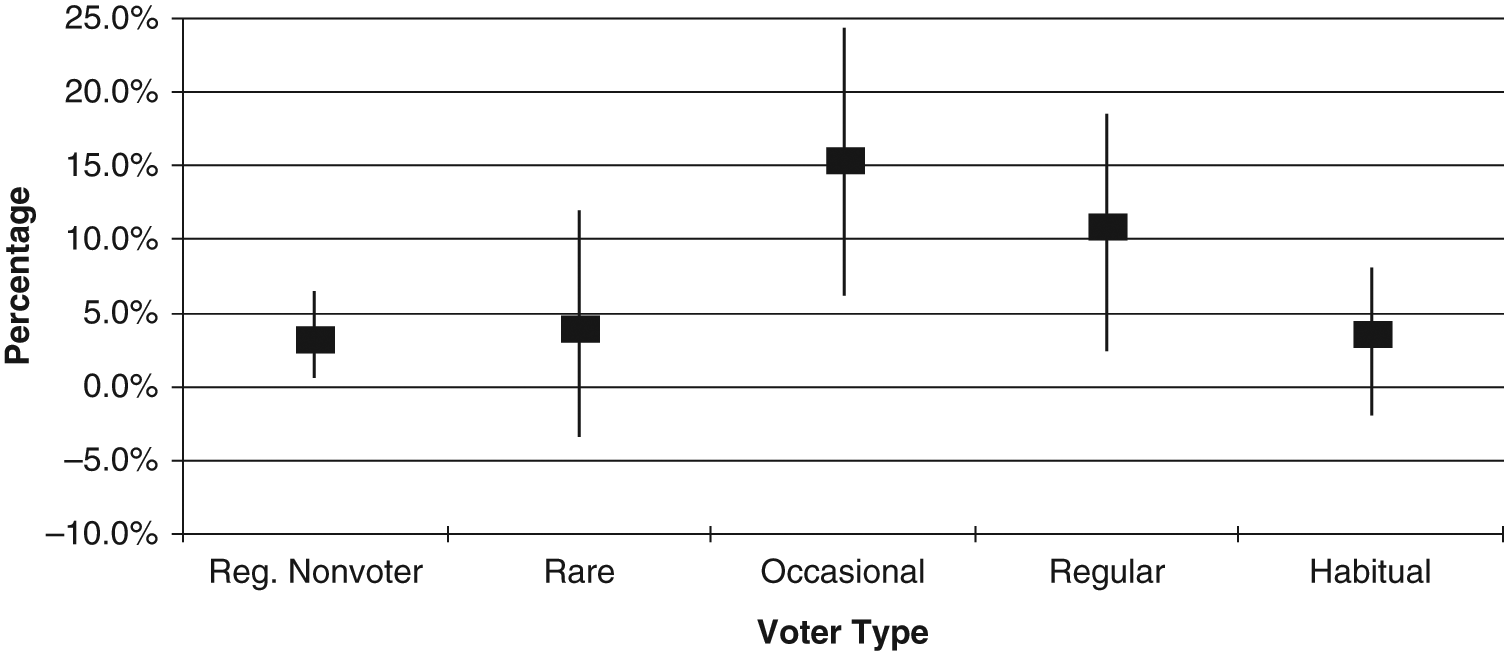
Marginal effects of canvassing across voter types
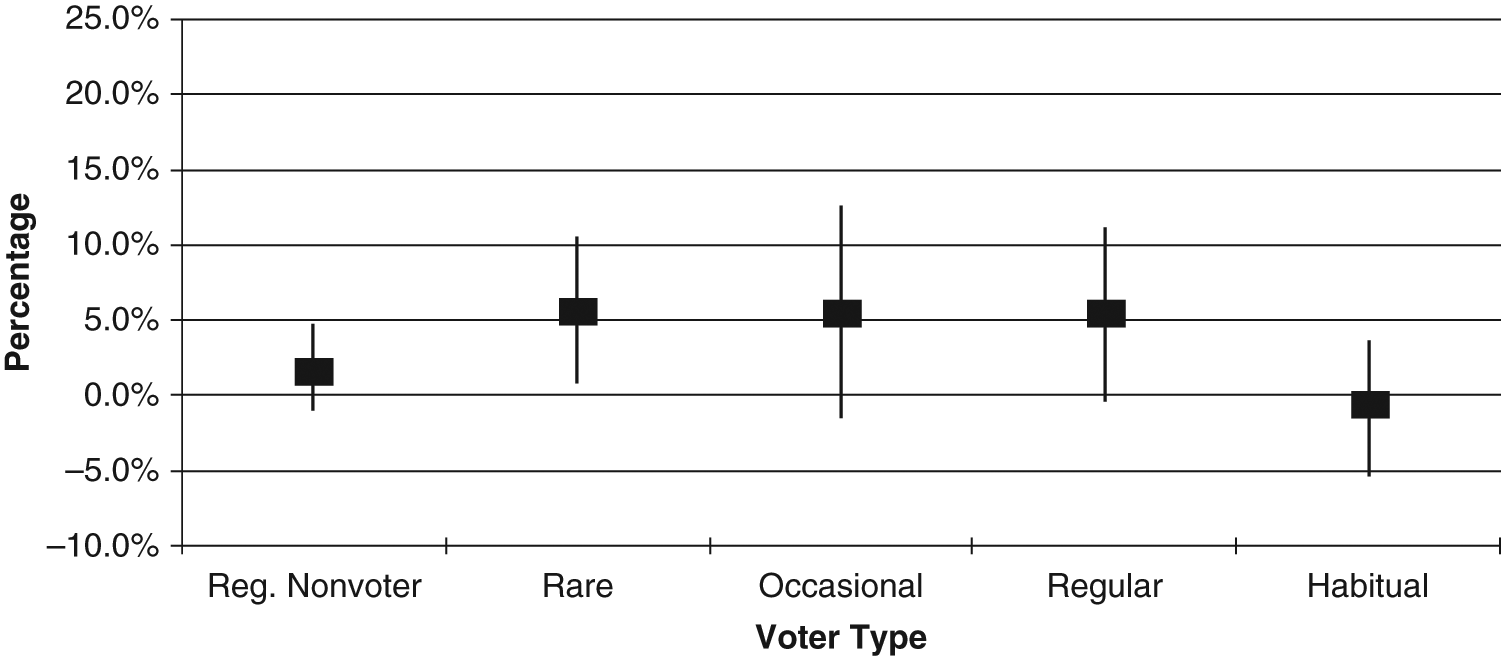
Marginal effects of mail across voter types
We expect the GOTV message to have the greatest effect on episodic voters. The absolute effect of canvassing is a striking 15.4 percent increase in turnout among occasional voters. Looking at the proportional reduction in abstention, the two strongest effects are for regular and occasional voters; both groups show a remarkable 27.0 percent reduction in abstention rates. The effect dissipates as we move to the ends of the distribution. Canvassing increases turnout by a modest 3.6 percent among habitual voters. The effect drops to 3.9 percent among rare voters and to 3.3 percent among registered nonvoters. Figure 1 presents the estimated effects of canvassing with a 95 percent confidence interval for each voter type. While all of the estimated effects are positive, the results are unambiguously significant only for occasional and regular voters.
Table 3 shows the absolute effect of the mailer is fairly uniform, with a modest effect on our three categories of episodic voters (regular, occasional, and rare voters); all show about a 5.5 percent increase in absolute turnout. The mailer has a very weak effect among registered nonvoters, however, and a small, nonsignificant negative effect on turnout among habitual voters. 11 Figure 2 shows the effect of the mailer is statistically significant, with a 95 percent confidence interval, only for rare voters. For both occasional and regular voters the point estimate is above 5 % both just dip into the nonsignificant range when we add a 95 percent confidence interval.
Conclusion
In testing mobilization in a new context and for an understudied population we confirm our expectations and some earlier experimental findings. Door-to-door canvassing can meaningfully raise turnout in a presidential election and also in the Latino community. Consistent with previous research, varying the message had no impact on message effectiveness. Apparently, receiving a personal request to go and vote is important, but the precise words are not. 12
We also present findings, however, that diverge from previous mobilization results. Direct mail has a modest, but noticeable effect that is stronger in our study than in previous studies. We suspect this is because there was virtually no local activity urging voters to the poll or political advertising on the air despite this being a presidential election. In most elections there are active campaigns that provide information and motivate people to get to the polls. In our case there was little mobilization effort, including political mail. The effect of our mailer may be visible in this environment, whereas it would not have been in a more active environment. Nevertheless, the results do confirm that mailers can be a useful tool under certain conditions.
Of greatest theoretical substance is finding mobilization efforts have strikingly different impacts across different types of voters. These results are consistent with the mobilization results of Arceneaux and Nickerson (2009) and Niven (2001, 2004), all of which closely follow the predictions of the RAS model of turnout. 13 As expected, mobilization effects were small among those who habitually vote. Furthermore, the canvassing message appears to have been resisted or not received among registered nonvoters and rare voters. These groups showed little change in behavior after being canvassed. Among occasional and regular voters, however, there were large moves. Turnout increased from 42 to 58 percent and from 60 to 71 percent respectively. Among these individuals, the decision to vote is determined by the mix of considerations sampled at the moment of the decision to vote or abstain. The considerations almost certainly include some of the factors explicated in the calculus of voting model. We do not believe, however, voters go through a full accounting of all costs and benefits. The most recently acquired information is most accessible to be sampled, and its presence is likely to make related information more salient and accessible. For episodic voters, our turnout model suggests that highlighting voting benefits shortly before a citizen decides whether to vote makes other positive considerations more salient and accessible. The canvassing message appears to have been salient for these groups of voters and to have substantially affected the considerations sampled when deciding whether to vote. For this middle group, with a relative balance of both positive and negative views on voting, canvassing is highly effective.
The RAS model also provides a logical explanation for existing findings regarding the temporal nature of GOTV effectiveness. The RAS model predicts GOTV efforts are most effective when they occur just before an election, so their message is highly accessible. Both Green, Gerber, and Nickerson (2003a) and Nickerson (2007) found the effectiveness of even high-quality phone banks was distinctly time bound, showing no effect when conducted more than one or two weeks before an election. In further support of this argument, Michelson, Garcia Bedolla, and McConnell (2009) find that follow-up telephone calls the day before or the day of an election significantly augment the effectiveness of initial GOTV contacts made at an earlier time.
While merely a first test, these results indicate the RAS model is worthy of further consideration in modeling turnout and the effectiveness of mobilization techniques. The RAS model provides an explanation that is consistent with existing knowledge of turnout. It is based on a more plausible and less heroic vision of individual decision making. Furthermore, it provides a plausible explanation for the empirical evidence we and others have found of significant variations in mobilization effects across individuals. We look forward to future field experiments to provide additional tests of the RAS voter turnout model.
In terms of the power of mobilization efforts our results present a cautionary tale. Political scientists are consistently concerned about the skewed pool of voters who make it to the polls (Bartels 2008). Our results show mobilization via canvassing can help, but it is not the least active who are mobilized via this mechanism; rather, it is the episodically interested who are most mobilized. This is true even within the context of a presidential election. We suspect the alienation to the political process of the registered nonvoters is so high that one simple request to remember to vote is not sufficient to change behavior. On the other hand, the results do provide a reason for some optimism. They confirm that conventional, reasonable mobilization efforts can increase the voting turnout of a Latino population. This politically underrepresented minority with a growing social presence and importance effectively responds to GOTV mechanisms. As the size of the Latino community continues to grow, increased use of such mechanisms is likely to increase its political power and influence.
Footnotes
Appendix A
Appendix B
Voters Who Have Been Registered for Eight Years or More
| R has voted in past: | 4 of 4 primary elections | 3 of 4 primary elections | 2 of 4 primary elections | 1 of 4 primary elections | 0 of 4 primary elections |
|---|---|---|---|---|---|
| 4 of 4 general elections | Habitual | Habitual | Habitual | Habitual | Habitual |
| 3 of 4 general elections | Habitual | Habitual | Habitual | Regular | Regular |
| 2 of 4 general elections | Habitual | Habitual | Regular | Regular | Occasional |
| 1 of 4 general elections | Regular | Regular | Occasional | Rare | Rare |
| 0 of 4 general elections | Empty set | Occasional | Rare | Rare | Registered nonvoter |
| Voters Who Have Been Registered for Six to Eight Years | |||||
| R has voted in past: | 4 of 4 primary elections | 3 of 4 primary elections | 2 of 4 primary elections | 1 of 4 primary elections | 0 of 4 primary elections |
| 3 of 3 general elections | Habitual | Habitual | Habitual | Habitual | Habitual |
| 2 of 3 general elections | Habitual | Habitual | Regular | Regular | Occasional |
| 1 of 3 general elections | Habitual | Habitual | Regular | Occasional | Rare |
| 0 of 3 general elections | Habitual | Regular | Occasional | Rare | Registered nonvoter |
| Voters Who Have Been Registered for Four to Six Years | |||||
| R has voted in past: | 3 of 3 primary elections | 2 of 3 primary elections | 1 of 3 primary elections | 0 of 3 primary elections | |
| 2 of 2 general elections | Habitual | Habitual | Habitual | Regular | |
| 1 of 2 general elections | Habitual | Regular | Regular | Occasional | |
| 0 of 2 general elections | Empty set | Occasional | Rare | Registered nonvoter | |
| Voters Who Have Been Registered for Two to Four Years | |||||
| R has voted in past: | 2 of 2 primary elections | 1 of 2 primary elections | 0 of 2 primary elections | ||
| 1 of 1 general election | Habitual | Regular | Occasional | ||
| 0 of 1 general elections | Regular | Rare | Registered nonvoter | ||
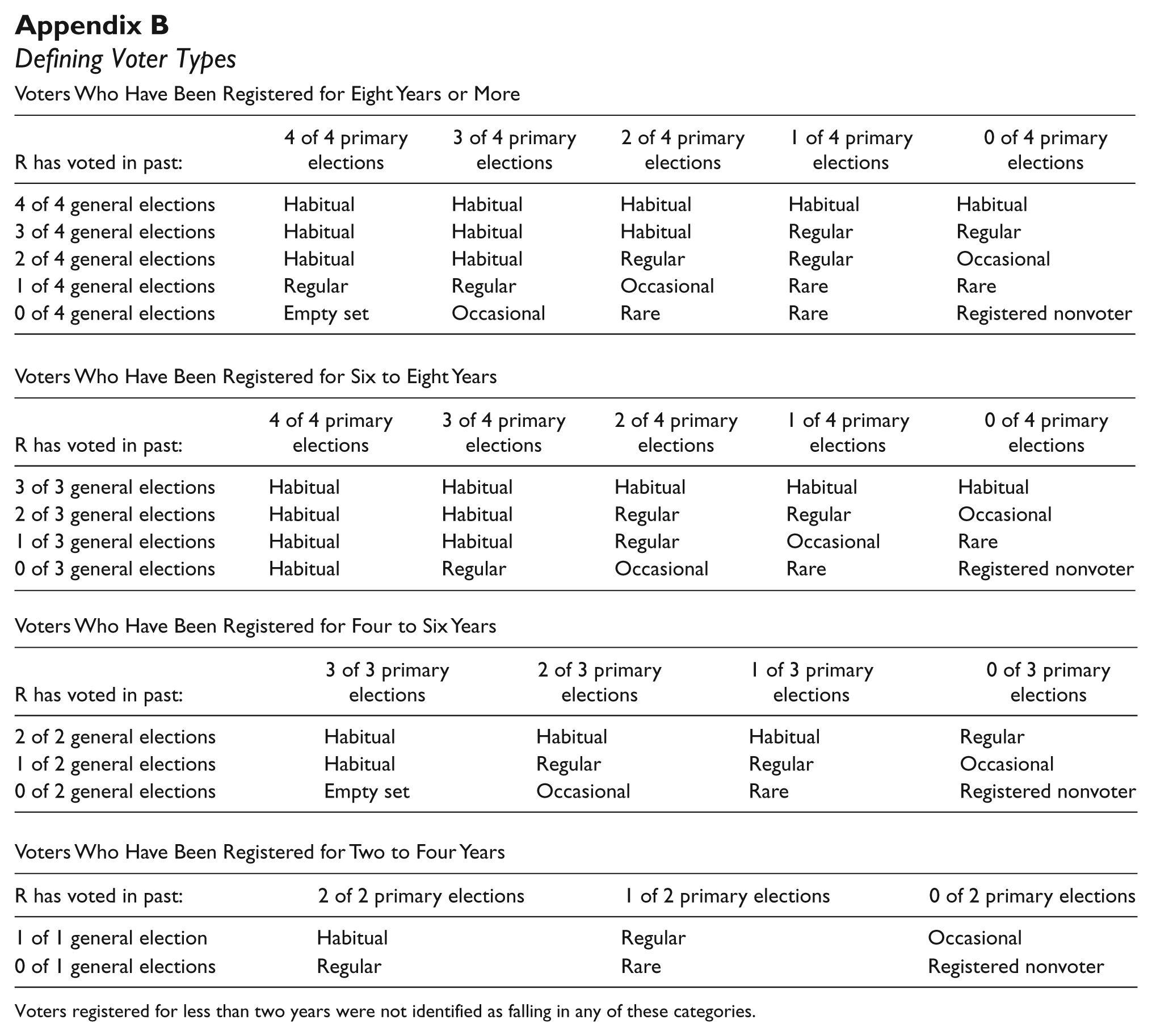
Voters registered for less than two years were not identified as falling in any of these categories.
Acknowledgements
We wish to thank the Center for Civic Engagement at the University of Texas at Brownsville and its director Joseph Zavaletta for both economic and extensive logistical support. Furthermore, the Center for Public Policy at the University of Houston and director Dick Murray provided economic support and useful advice throughout this project. We’d also like to thank Noah Kaplan, Sarah Neal, Mark Ratkovic, and the reviewers for their comments and insights. Finally, we thank the Cameron County Elections Department for their friendly, professional, and timely assistance with and responses to our data requests.
The author(s) declared no potential conflicts of interests with respect to the authorship and/or publication of this article.
The author(s) received the following financial support for the research and/or authorship of this article:
The Center for Civic Engagement at the University of Texas at Brownsville and the Center for Public Policy at the University of Houston provided economic support.