




Abstract
Using data from the American National Election Studies, this article addresses whether the Sarah Palin affected vote choice in 2008. Findings indicate not only that evaluations of Palin were a strong predictor of vote choice—even when controlling for confounding variables—but also that Palin’s effect on vote choice was the largest of any vice presidential candidate in elections examined dating back to 1980. Theoretically, the article offers support for the proposition that a running mate is an important short-term force affecting voting behavior. Substantively, the article suggests that Palin may have contributed to a loss of support among “swing voters.”
The selection of Sarah Palin as the Republican Party’s vice presidential nominee for the 2008 election was widely viewed as a stunning surprise in an election year where the last rites had already long since be given to what passed for “conventional wisdom” in a presidential campaign. Few pundits had considered Palin, who had served less than two years as governor of Alaska, to be on John McCain’s short list for the vice presidency. Instead, McCain’s rival for the Republican presidential nomination, Mitt Romney, as well as Minnesota governor Tim Pawlenty and former Pennsylvania governor Tom Ridge were generally considered to be the most likely choices. If McCain had felt a bold move was in order, Louisiana governor Bobby Jindal was one option. Alternatively, reaching over the partisan divide and putting Democrat turned Independent Senator Joe Lieberman on the ticket was also a possibility. The fact that few pundits had seriously considered Palin in the GOP’s vice presidential sweepstakes was evidenced in the hours after her official announcement on August 29 as McCain’s running mate, as many pundits on the cable news channels compared notes as to the correct pronunciation of the Alaska governor’s surname.
In retrospect, the appeal of Palin for the McCain campaign made sense in several ways. First, it stole the thunder from the Democrats just one day after Barack Obama’s historic acceptance speech as the first African American nominated by a major party. The story of the epic Democratic nomination battle had largely been framed as one of historic firsts; the party was going to nominate a candidate who was not a white man. The Republican Party now had its historic moment, the selection of its first woman candidate for the vice presidency, and—following Geraldine Ferraro in 1984—only the second occasion that a woman had been placed on a major party ticket. Second, Palin’s selection may have been an attempt to capitalize on any lingering resentment that supporters of Hillary Clinton felt having seen their candidate lose the Democratic nomination to Barack Obama. Indeed, Palin alluded to this in her first public speech noting, “It turns out the women of America are not finished yet and we can shatter that glass ceiling once and for all.” Third, Palin augmented McCain’s general election pitch as the “reform” candidate. In introducing Palin, McCain noted that the Alaska governor had “fought oil companies and party bosses and do-nothing bureaucrats and anyone who puts their interests before the interests of the people she swore an oath to serve.” Again, the theme of two “mavericks” heading the GOP ticket could be viewed as a direct counter to Obama’s message of “change” in an election year where representing the status quo was a liability. Finally, Palin’s selection can be viewed as an attempt by McCain to solidify the Republican base, particularly social conservatives, with whom McCain had often had an uneasy relationship. One story that was featured prominently highlighted Palin’s decision not to have an abortion when she discovered her baby had Down’s syndrome. The message was simple: Palin was prolife not just in rhetoric but in her actual decision to bring the baby to term. Furthermore, Palin’s own small-town roots may also have served as a means to connect the GOP ticket to those voters who may have felt slighted by the comments made by Obama in the Democratic primaries when he referred to small-town Americans as “bitter” people who cling to their guns and religion.
Despite the positives, Palin may have turned out more of a liability for the Republican ticket. Indeed, this is the central question addressed by this article. Given Palin’s less than stellar—critics may say embarrassing— performances in her only two network TV interviews and the general sense that serving less than two years as Alaska governor was no qualification to be a “heartbeat away” from the presidency, to what extent did many voters who may have been open to the prospect of supporting McCain not do so because of their feelings toward Palin? While the answer to this question will have to remain somewhat speculative—the election cannot be rerun with a different running mate—the article will examine how feeling toward Palin exerted an independent effect on vote choice. Utilizing data from the 2008 American National Election Study (NES) and the NES Cumulative File, the article proceeds in four stages. First, the potential of a “Palin effect” is placed in the broader context of the literature on whether vice presidential selections do affect vote choice. Second, a multivariate model is employed to examine whether feeling toward Palin exerted an independent effect on vote choice in 2008 above and beyond other control variables. Third, any “Palin effect” in 2008 is contrasted with the effect of vice presidential candidates in prior elections. Fourth, a fully specified model of vote choice is examined for 2008 to determine whether the “Palin Effect” simply served as a surrogate for the “values divide” in American politics and whether issues associated with social and cultural issues mediated the effect of feeling toward Palin on vote choice.
Vice Presidential Candidates and Vote Choice
A large literature has developed that suggests that presidential candidate image, whether it be evaluations of a candidate’s competence or cognitive and affective feeling toward the candidate, plays a large role in the calculus made by voters at the individual level (see, e.g., A. Miller, Wattenberg, and Malanchuk 1986; Lodge, McGraw, and Stroh 1989; Wattenberg 1991; Hacker 1995; W. E. Miller and Shanks 1996; Funk 1999). However, the effect of the vice presidential candidate on voting behavior has been subject to less scrutiny. This neglect by scholars of voting behavior is itself a partial reflection of the perceived irrelevance of the running mate as an independent determinant of vote choice. Such neglect once may have been justified, however, as Pious (2003, 225) notes, vice presidents “have been transformed from marginal figures with little to do in Washington into important presidential advisers, policy implementers, and party campaigners.” Moreover, the increased importance of the vice presidency in American politics (Cronin 1982; Goldstein 1982; Light 1984; Baumgartner 2006), together with the fact that the vice presidency has emerged as a stepping-stone for the presidential nomination, has led to some scholars to examine the effect of vice presidential candidates on vote choice.
Furthermore, while the rising salience of the vice president in administrations has been evident since the Nixon presidency, the two most recent vice presidents demonstrate just how important the office has become, and certainly go some way to warrant the further study of the effect that feelings toward the vice presidents have on vote choice. Al Gore exerted enormous influence as vice president in the Clinton administration, often being instrumental in shaping administration thinking in both domestic policy, such as on the budget deficit and welfare reform (Zelnick 1999; Maraniss and Nakashima 2000; Turque 2000) and foreign policy such as intervention in Bosnia (Rothkopf 2004). Gore’s influence as vice president was, perhaps, exceeded only by his successor, Dick Cheney, whose influence with- in the Bush administration has been well documented (Gellman 2008), especially in the area of foreign policy and as one of the key architects of the war in Iraq (Woodward 2002, 2004, 2006; Daalder and Destler 2009).
While there is now a consensus that the vice presidency is a more salient and consequential base of political power, there remain conflicting findings on the effect of vice presidential nominees as short-term forces that influences vote choice. Employing an aggregate state-by-state analysis, several studies suggest either no role or a very limited one in the ability of vice presidential nominees to carry their home state (Tubbesing 1973; Adkinson 1982; Dudley and Rapoport 1989). Holbrook (1991) also confirmed this finding, even when extending the influence of the vice presidential nominee from home state to region. On the other hand, using individual-level data Wattenberg (1995) found that vice presidential candidates are a significant factor in explicating individual level vote choice above and beyond control variables such as party identification, ideology, and presidential candidate image. However, this finding itself was challenged by Romero (2001) on the basis that vice presidential evaluations may not be exogenous to vote intention given the low salience of vice presidential nominees in campaign communication messages. And while Holbrook (1994) did find some evidence that vice presidential debates in 1984 and 1988 influenced vote intention, the effects were short term, with vote intentions moving back to the predebate levels within a week. Thus, to the extent that the debates and the other high-profile moments for the running mate—such as their initial “roll out” and convention speech—make a difference to vote choice, they should be considered “momentary blips that decay in a story centered overwhelmingly on the choice at the top of the tickets” (Romero 2001, 456).
Of course, the selection of Sarah Palin in 2008 was anything but a “routine” vice presidential pick, which almost guaranteed that she would be more than a “momentary blip.” The media frenzy surrounding Palin’s own record in office and her personal story—including the revelation at the start of the general election campaign that her daughter was pregnant and would marry the father—ensured that Palin had the potential to resonate longer in the psyche of the electorate than other vice presidential nominees. Furthermore, the fact that a deliberate effort was made for Palin to make numerous joint appearances with McCain during the general election suggested that it was the running mate who had the potential to drive the dynamics of vote intent and presidential evaluations. Indeed, a “Palin effect” is suggested by an analysis of voter intent over the course of the general election campaign by Johnston and Thorson (2009, 19). Using data from the National Annenberg Election Survey, they find a strong association between Palin and the propensity of voters to support McCain. Indeed, the effect of Palin’s evaluation on vote intent far exceeded that for other vice presidential candidates in both 2000 and 2004. Johnston and Thorson are left to conclude that “we are unaware of any theory that opens the door to serious impact from the bottom half of the ticket.”
Thus, a focus on the “Palin effect” in 2008 certainly provides for an interesting puzzle. Contrary to the conventional wisdom on the role of vice presidential nominees, did evaluations of Palin have an effect on vote choice? Or can this effect be explained away by other potentially confounding variables? It is to these questions that the article now turns.
Voter Reaction to Palin in Historical Context
As a starting place for the public’s reaction to Sarah Palin, and as a means of placing evaluations of Palin in historical context, Figure 1 presents a scatterplot showing the percentage of respondents who felt warm or cold toward each vice presidential nominee since 1972. The percentages are based on “feeling thermometer” items that the NES surveys have utilized to measure feelings toward a variety of political figures and objects. The feeling thermometer ranges from 0 to 100, with a score below 50 denoting coldness or hostility and a score above 50 signifying warmth or friendliness toward each major party’s vice presidential candidate.
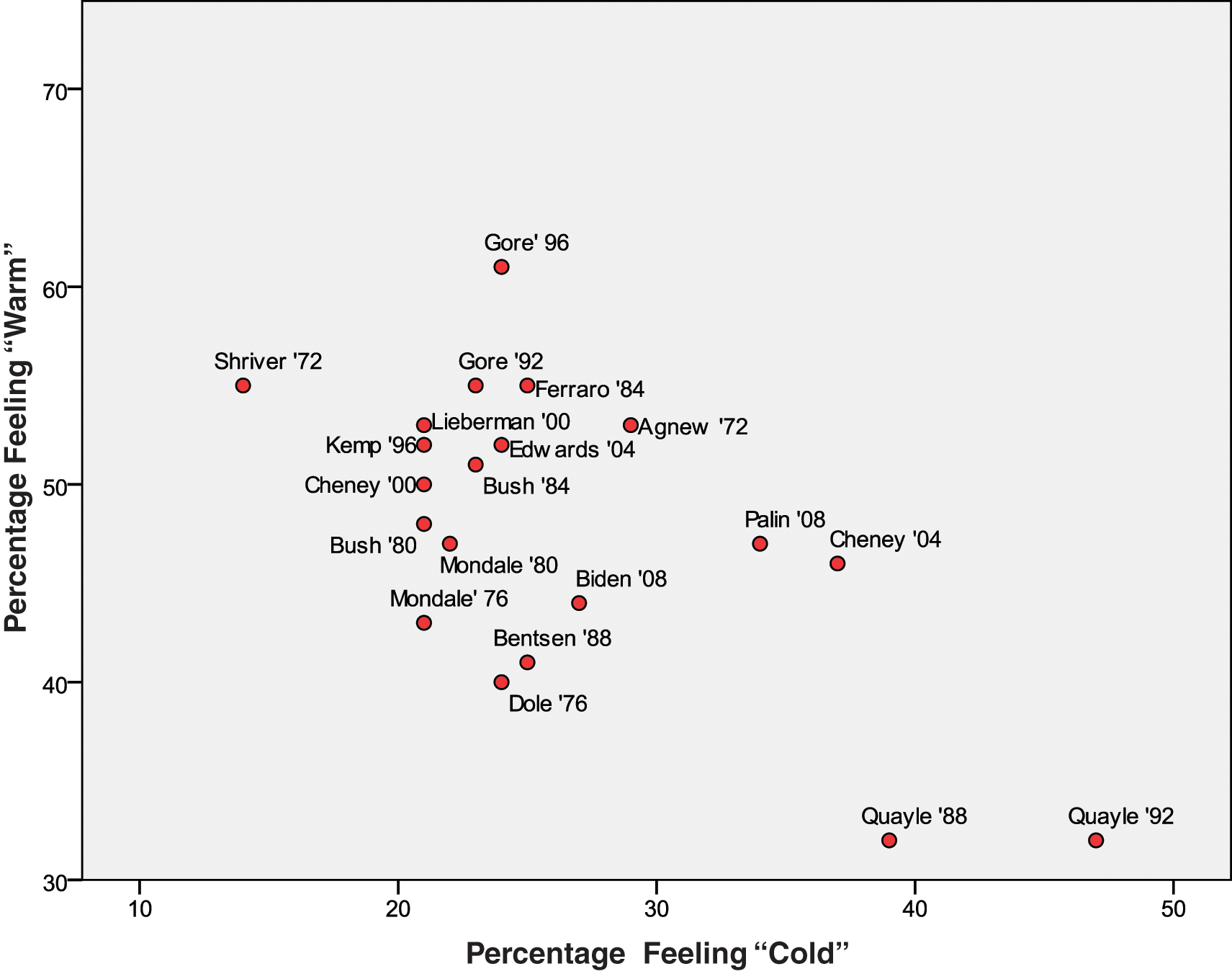
Feelings toward vice presidential candidates, 1972–2008
Figure 1 presents mixed evidence concerning voter affect toward Palin. The 47 percent of respondents who felt warm toward Palin was just a little below the median percentage for all the vice presidential candidates (49 percent). However, 34 percent felt cold toward Palin, which was quite higher than the median percentage for all vice presidential candidates (24 percent). 1
Indeed, on only three other occasions did voters express such coldness to a vice presidential candidate that exceeded that of Palin—Dan Quayle in 1988 and 1992 and Dick Cheney in 2004. Certainly, the relatively high percentage of cold evaluations indicates that Palin may have had the potential to drive some voters away from the Republican ticket, although it should be remembered that in 1988 and 2004 the GOP ticket still prevailed even with the rather cold evaluations of Quayle and Cheney.
Given that affect toward vice presidential nominees will almost certainly be viewed through the prism of partisanship, it is important to examine the evaluation of Palin controlling for party identification and to make similar comparisons for the other vice presidential nominees in prior elections. Thus, Figure 2 presents the same data as Figure 1 for those copartisans of each vice presidential nominee, Figure 3 for opposition partisans, and Figure 4 for Independents. 2
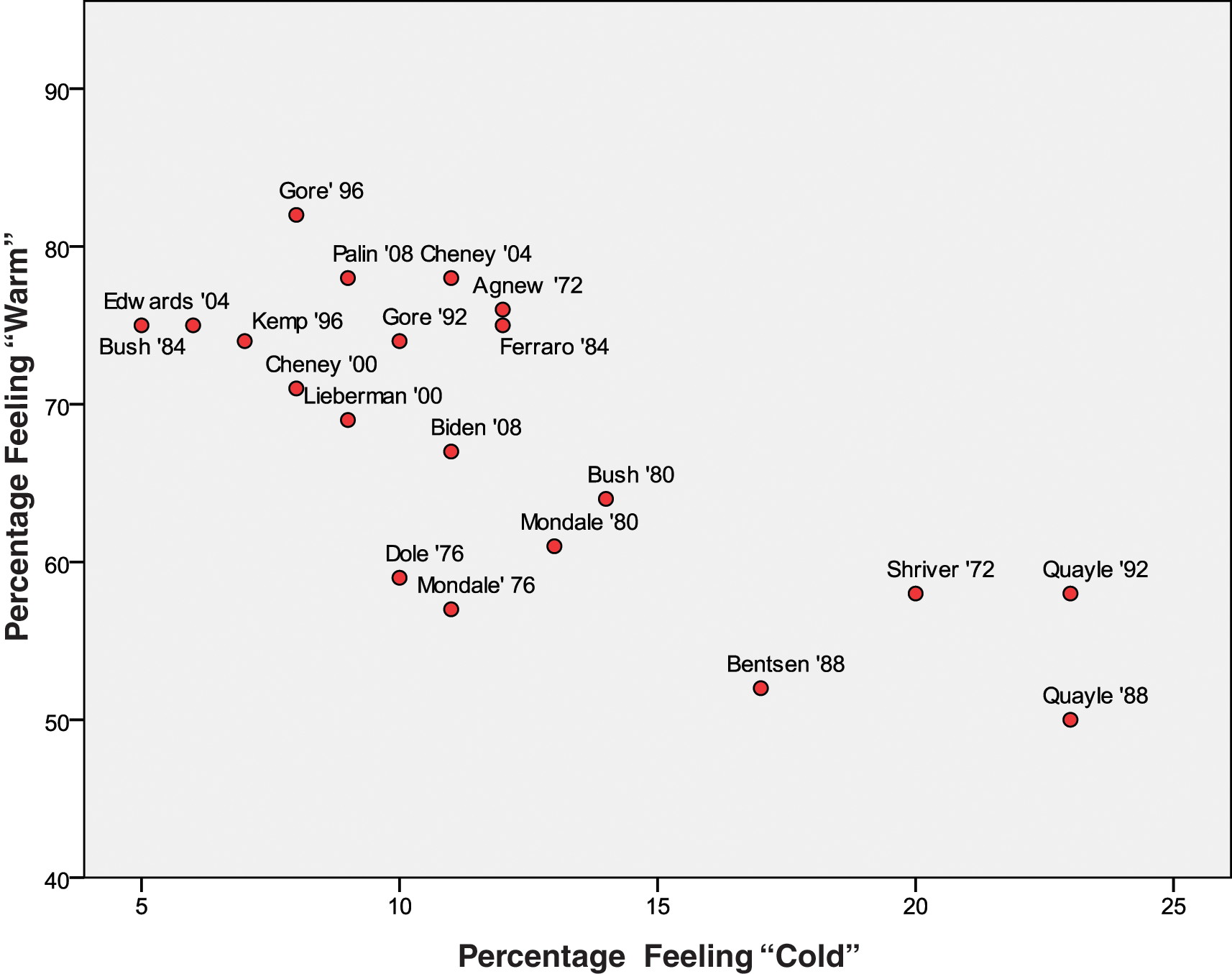
Feelings toward vice presidential candidates by copartisans only, 1972–2008
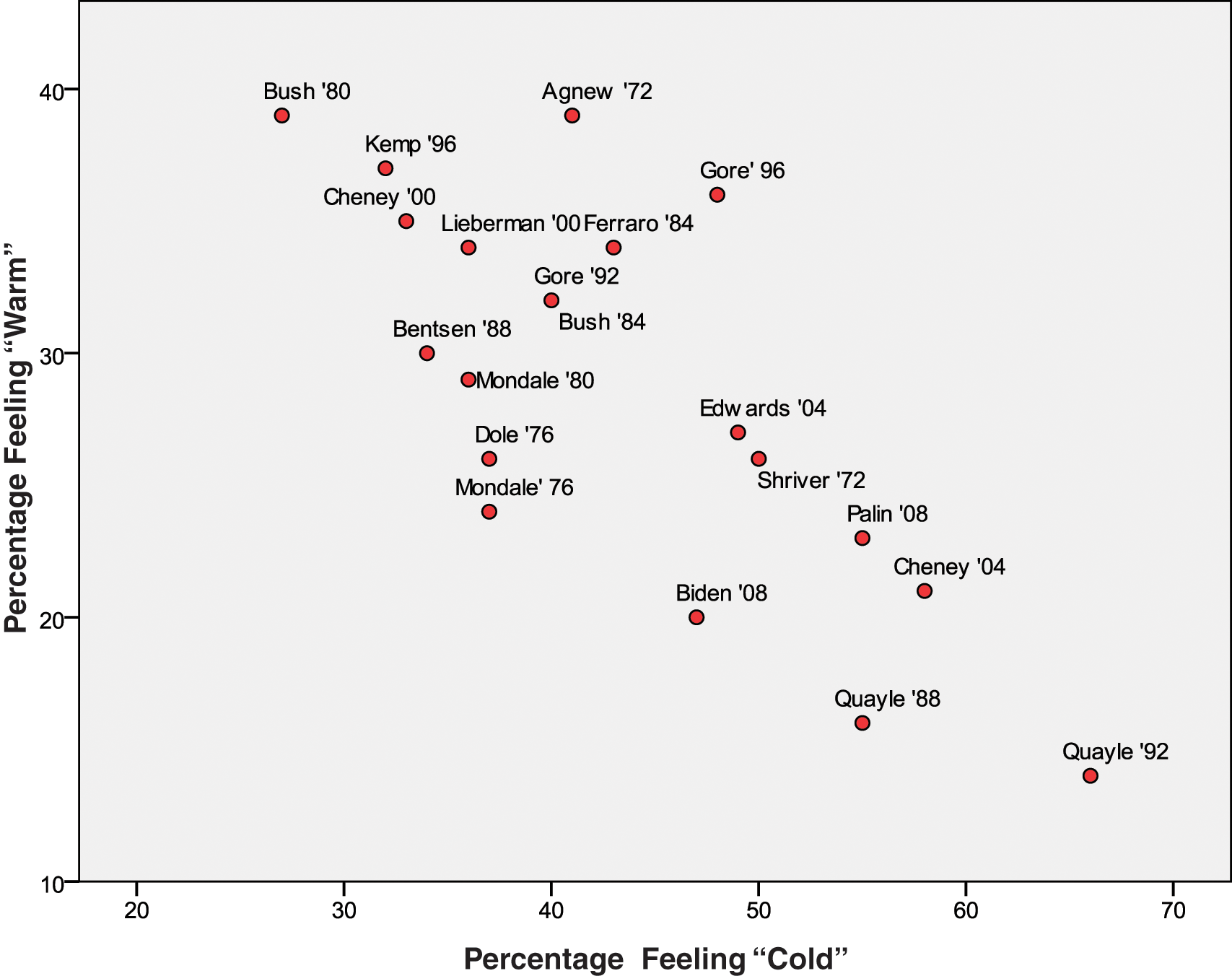
Feelings toward vice presidential candidates by opposition partisans only, 1972–2008
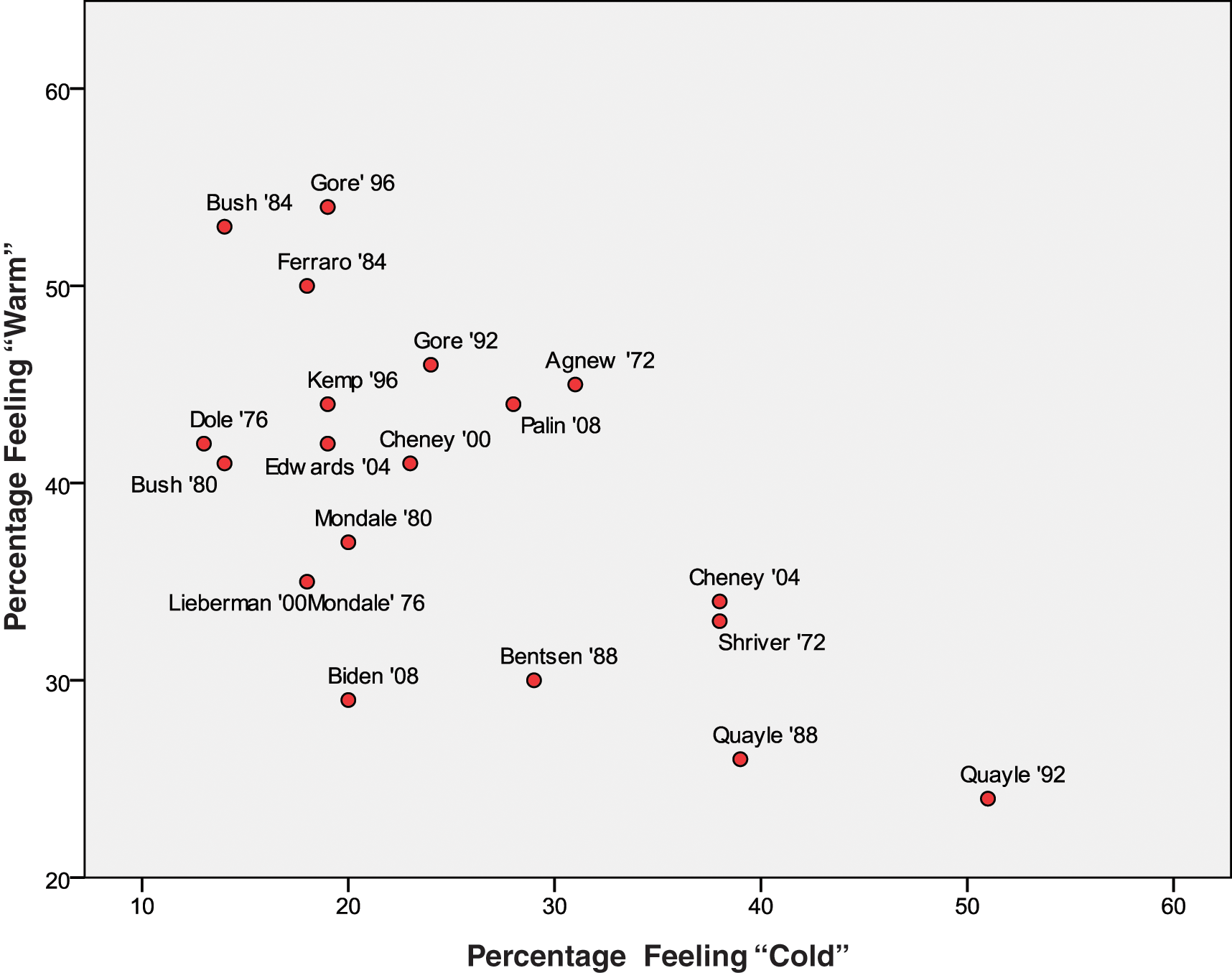
Feelings toward vice presidential candidates by Independents only, 1972–2008
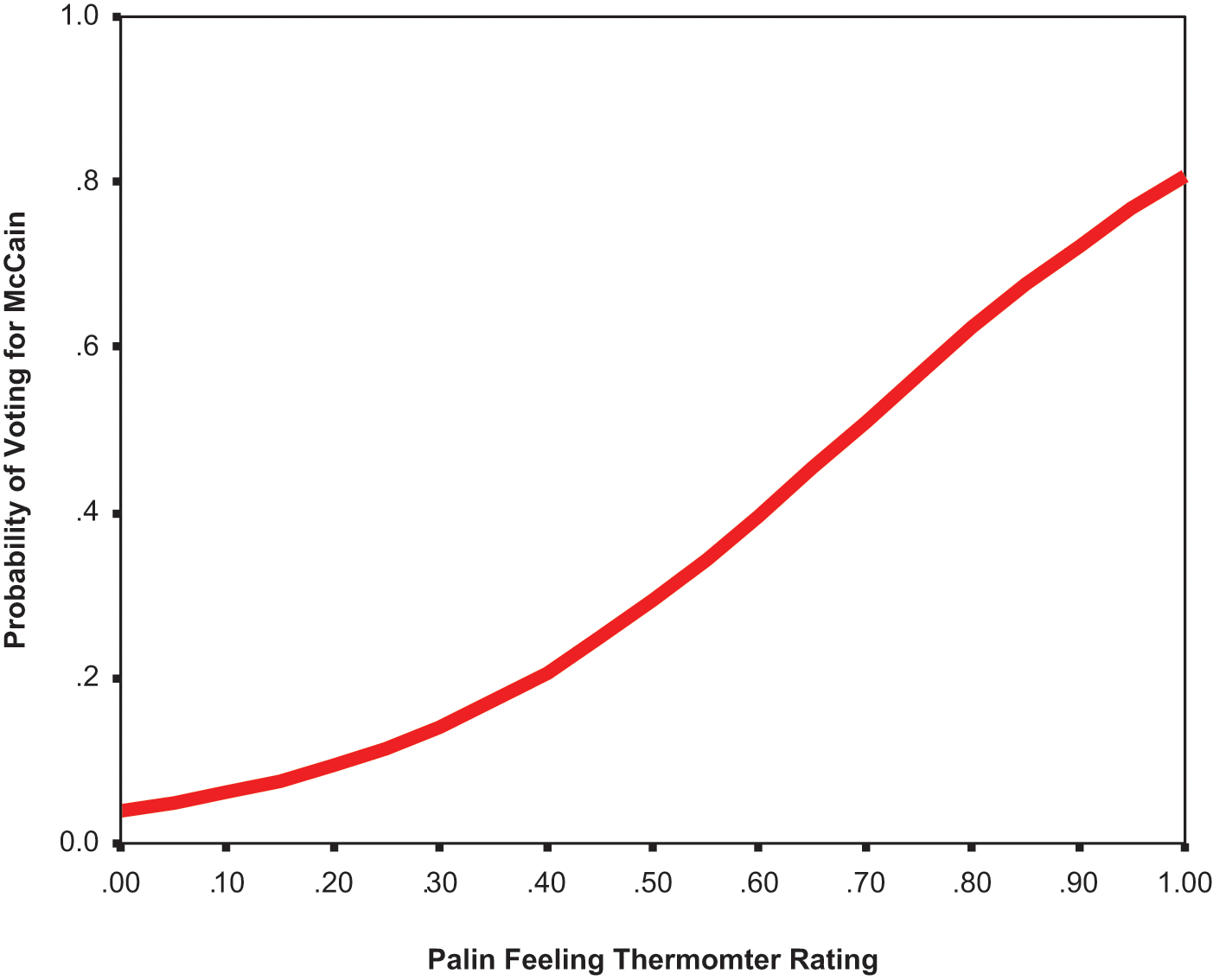
Predicted probability of vote for McCain by Palin feeling thermometer rating
These figures reveal the different reactions of the base of each party to Palin and explain why she simultaneously may have energized the bases of both parties. Figure 2 shows that Palin was widely popular among Republican Party identifiers, with 78 percent feeling warm toward her compared to just 9 percent who were cold. Indeed, the only other vice presidential nominee who was viewed more positively by copartisans was Al Gore in 1996. This suggests that the assertion that Palin was viewed negatively by a substantial part of the GOP base was greatly overstated. Indeed, more Republicans felt warm toward Palin than did Democrats toward Joe Biden. 3 Overall, Figure 2 shows that party supporters generally feel warmly toward their own vice presidential nominee, and, in this respect at least, there was nothing unusual in the evaluations of Palin.
To what extent, however, was Palin viewed as hostile by Democrats and Independents, and hence potentially costing McCain support among both groups? Figure 3 shows a decided hostility toward Palin among Democrats, with 55 percent feeling cold. This hostility felt by partisans toward the vice presidential candidate of the other party has been exceeded only twice, for Cheney in 2004 and Quayle in 1992, and was well above the median percentage (41 percent) of partisans who felt cold toward the other party’s vice presidential nominee. However, as shown Figure 4 Independents had a more favorable evaluation of Palin, with 44 percent feeling warm compared to 28 percent feeling cold. The notion that Palin turned off Independents is not supported by these descriptive statistics. While the percentage that viewed her as cold was above the median percentage for all vice presidential candidates (20 percent), the percentage viewing her as warm was slightly above the median percentage for all vice presidential candidates (41 percent).
This overview of feelings toward Palin suggests that the Republican vice presidential nominee was certainly a salient figure in the 2008 general election, when compared to not only Joe Biden but also nearly all other vice presidential nominees since 1972. Clearly in the 2008 presidential election a salient and divisive figure certainly had the potential to exert an effect on vote choice, especially given the politically polarized environment with parties playing to their political bases (see, e.g., Plouffe 2009; Heilemann and Halperin 2010).
The “Palin Effect” and Vote Choice in 2008
To establish whether feelings toward Palin affected vote choice, a multivariate model is necessary to control for other, potentially confounding, independent variables that might affect vote choice. Following Wattenberg (1995) the following variables are included: party identification, ideology, and presidential candidate image. In addition, perceptions of the economy are included in the model. All of these variables are considered to have short- to medium-term effects in the “funnel of causality” (Campbell et al. 1960, 1966; W. E. Miller and Shanks 1996).
Party identification is measured through two dummy variables, Republican Party identification (1 = Republican, 0 = otherwise) and Democratic party identification (1 = Democrat, 0 = otherwise). Independents are the excluded category captured in the constant term. Again, Independent leaners are treated as party identifiers. Dummy variables are used as the interest is in partisan direction, rather than intensity. At the same time, treating party identification in this manner avoids the problems associated with using the 7-point party identification scale, which is neither linear nor bounded at 7.
Ideology is measured through three dummy variables, liberals (1 = liberal, 0 = otherwise), moderates (1 = moderate, 0 = otherwise), and conservatives (1 = conservative, 0 = otherwise). Those who responded “don’t know” or “haven’t thought” are the excluded category. Again, dummy variables are used instead of the 7-point ideology scale. This avoids the problem of deciding how to treat the “don’t know” and “haven’t thought” categories, which often can involve a sizeable number of respondents. 4 This category is frequently coded as missing data or—and perhaps even more unsatisfactorily—collapsed in with moderates.
The most direct means of measuring presidential candidate image would have been using the feeling thermometer items. However, the presidential and vice presidential feeling thermometer items were closely correlated for McCain–Palin (r = .71) and Obama–Biden (r = .65), making multicollinearity a problem. What is required is an alternative measure that still taps candidate image but is less related to the vice presidential feeling thermometers. Fitting these criteria are the items addressing how well a variety of traits describe each presidential candidate. 5 The traits for each candidate were factor analyzed, and a candidate image scale was constructed from the resulting factor scores. 6 These candidate image scales exhibited moderately high correlations with the presidential feeling thermometer items (r = .63 for McCain; r = .59 for Obama), and thus are still clearly tapping a similar sense of affect toward the candidates but were less related to the vice presidential feeling thermometers (r = .49 for the McCain image–Palin feeling thermometer; r = .39 for the Obama image–Biden feeling thermometer). The correlation between the McCain image and Obama image variables was rather weak (r = −.191); consequently, both presidential candidate image variables can be included in the model without multicollinearity being a problem.
Given the centrality of the economy in the 2008 election, and its effect more generally on vote choice (MacKuen, Erikson, and Stimson 1992), a retrospective measure of the perception of national economic conditions in the previous 12 months was included as a control variable. An optimistic view of the economy was coded high, and a pessimistic view was coded low.
To compare the relative effect of each independent variable on vote choice, each was standardized to a metric of 0 to 1. This facilitates a comparison of the effect on vote choice of the independent variables across their entire ranges without the need to report standardized logistic regression coefficients. The dependent variable, vote choice, is dichotomous (1 = McCain, 0 = Obama), necessitating that parameters be estimated using logistic regression. Results of the logistic regression are presented in Table 1.
The Effect of Vice Presidential Evaluations on 2008 Presidential Vote Choice
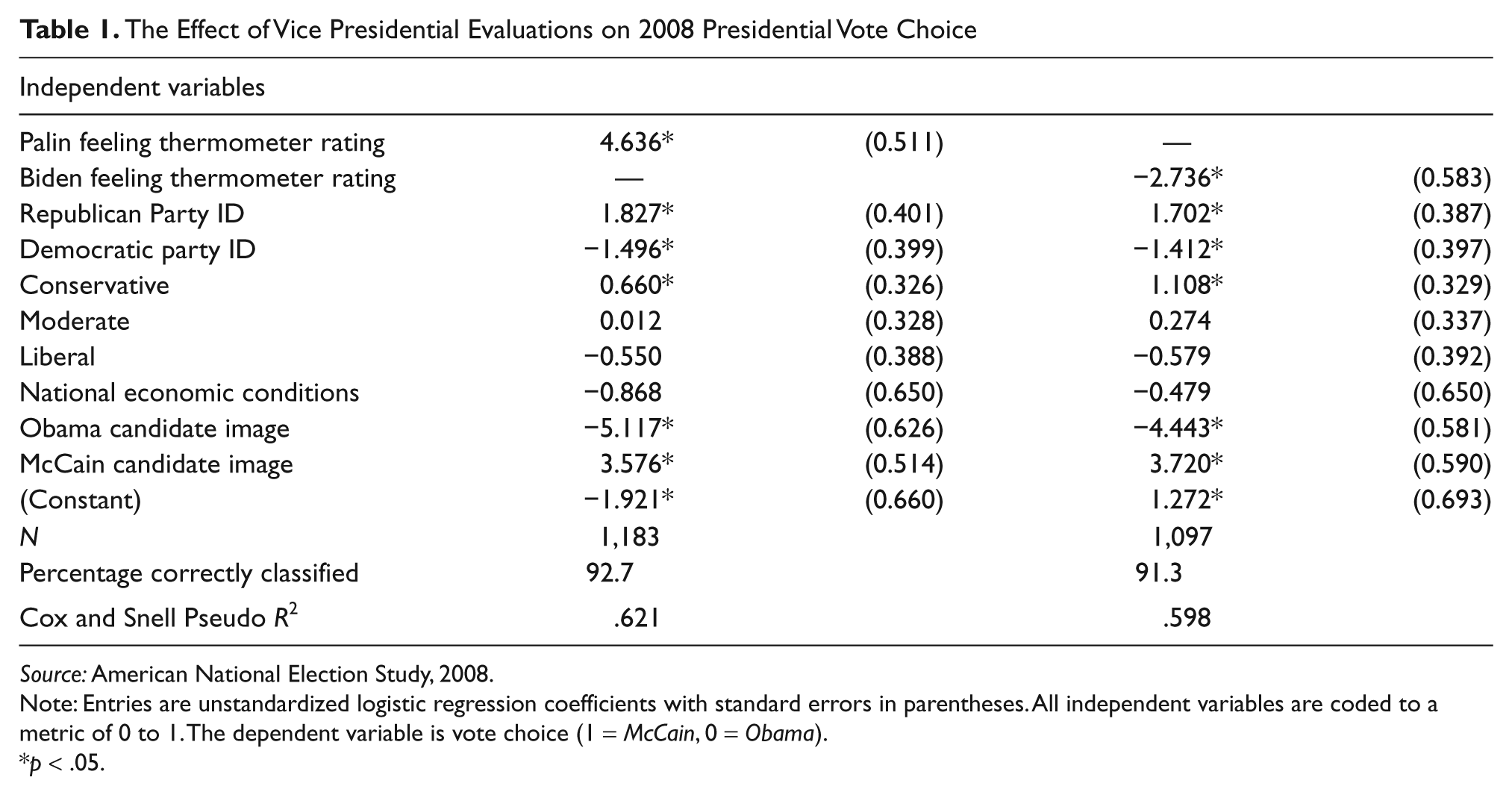
Source: American National Election Study, 2008.
Note: Entries are unstandardized logistic regression coefficients with standard errors in parentheses. All independent variables are coded to a metric of 0 to 1. The dependent variable is vote choice (1 = McCain, 0 = Obama).
p < .05.
Table 1 clearly shows a “Palin effect” on vote choice, even after controlling for other confounding variables. Indeed the magnitude of the coefficient for feelings toward Palin (b = 4.636, p < .05) exceeded that for McCain’s candidate image (b = 3.576, p < .05). Furthermore, only the Obama’s candidate image had a greater effect on vote choice (b = −5.117, p < .05) than did feelings toward Palin. To place this finding in context, the same model was estimated but instead the feeling thermometer rating for Democratic vice presidential candidate Joe Biden was swapped for Palin. While the coefficient for Biden was also statistically significant (b = −2.736, p < .05), it was over 1.5 times smaller than that found for Palin.
To provide a more substantive interpretation of the findings in Table 1, the predicted probability of voting for McCain based on manipulating the feeling thermometer rating for Palin was calculated. In calculating the predicted probabilities all of the other independent variables were set to their mean values, while Palin’s feeling thermometer rating was allowed to vary across it entire range.
As Figures 5 clearly shows, an increase in feelings toward Palin led to an increase in the probability of a vote for McCain. A comparison of two hypothetical voters who are similar in every respect—save for one feeling cold and one feeling warm toward Palin—illustrates this point. A voter with a warm rating of .75 toward Palin was 45 percentage points more likely to vote for McCain than was a voter with cold rating of .25 toward Palin. It should be noted, however, that a voter had to feel very warm toward Palin (a rating of .70) before the predicted probability of voting for McCain even exceeded 50 percentage points. Those who felt neutral toward Palin (a rating of .50) had only a 29 percentage point probability of voting for McCain; Even those who felt “lukewarm” toward Palin (a rating of .65) had only a 45 percentage point probability of voting for McCain, that is, they still had a higher probability of casting a vote for Obama. The problem for the GOP ticket is that only around a quarter of the electorate had a very warm rating of Palin (.70 and higher), the point at which the probability of voting for McCain exceeded 50 percentage points.
Party Identification and Ideology Interactions
To further explore the “Palin effect,” it seems prudent to examine the interaction effects between evaluations of Palin and both party identification and ideology. After all, it has already been demonstrated that party identification heavily conditioned the evaluations of Palin. At the same time, this allows a direct test of the hypotheses that Palin cost McCain the support of “swing voters” like Independents and moderates. Thus, predicted probabilities were estimated from models that included interaction terms between (1) feelings toward Palin and party identification and (2) feelings toward Palin and ideology. 7 The resulting predicted probabilities are presented in Figures 6 and 7.
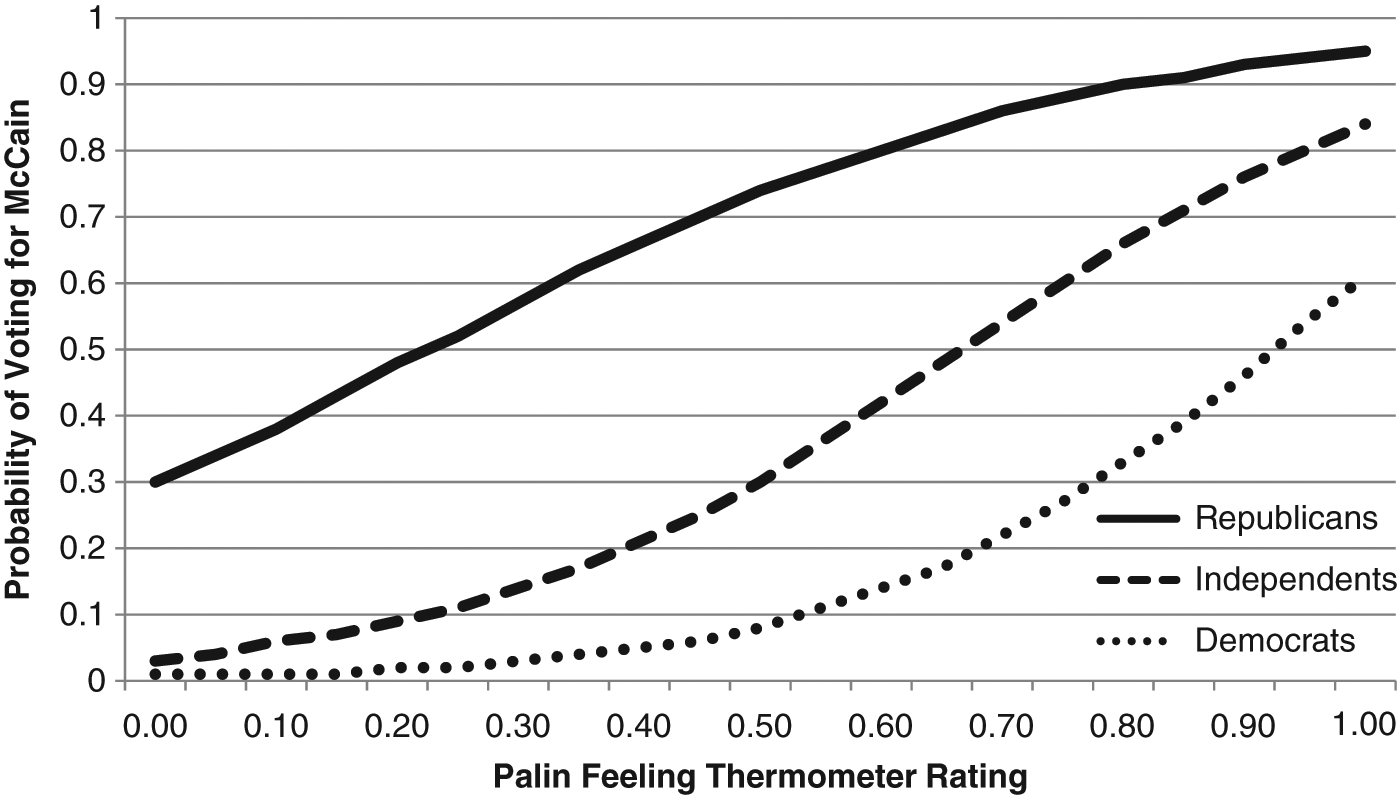
Predicted probability of vote for McCain by Palin feeling thermometer rating, by party identification
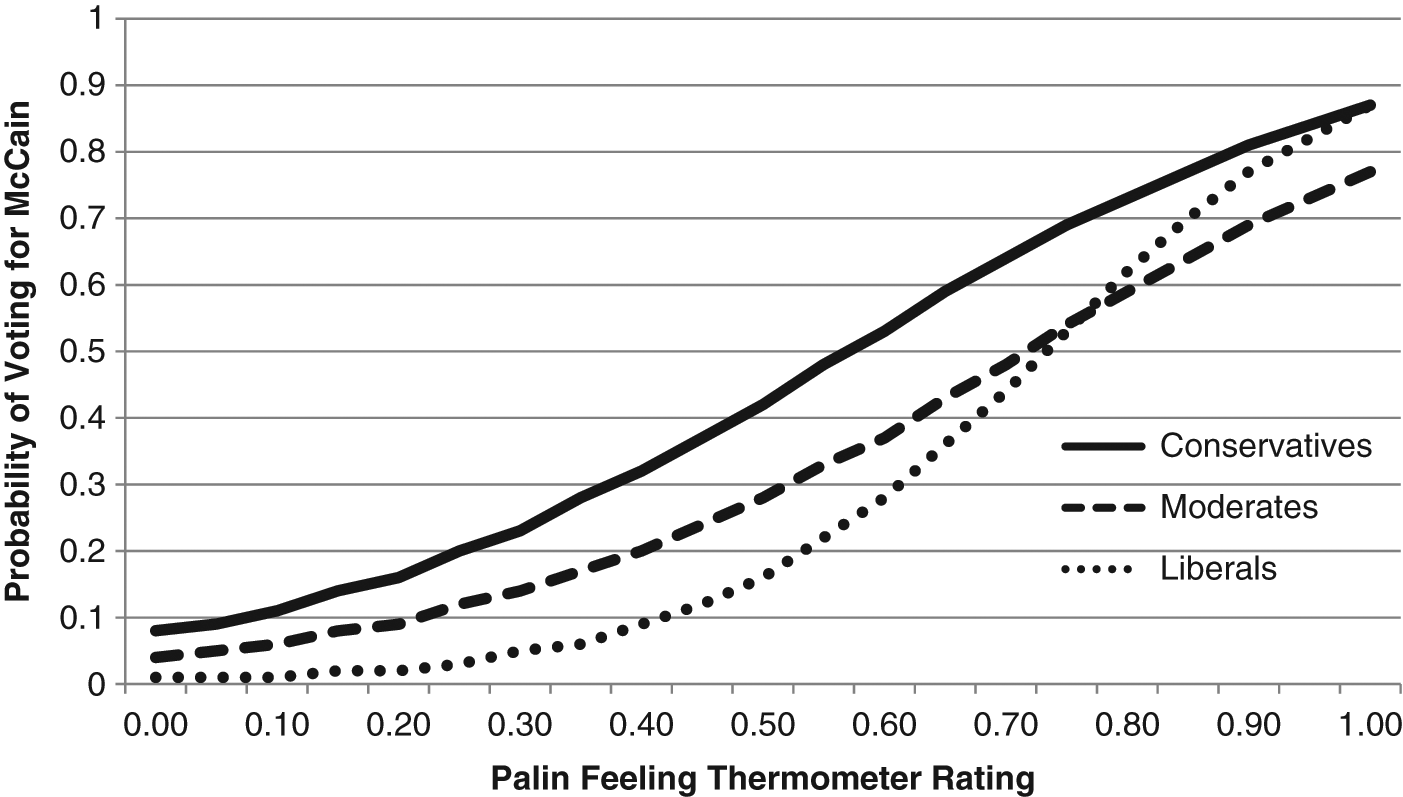
Predicted probability of vote for McCain by Palin feeling thermometer rating, by ideology
Figure 6 shows that the effect of evaluations of Palin on vote choice was heavily conditioned by party identification. For example, among Republicans, the probability of voting for McCain drops below 50 percentage points only when feelings toward Palin were at .25—a decidedly cold rating on the feeling thermometer scale. However, less than 5 percent of GOP identifiers had such very cold evaluations of Palin. Even those Republicans who had only a neutral evaluation of Palin still had a predicted probability of 75 percentage points of voting for McCain. Quite simply, as positive evaluations of Palin went up, Republican identifiers moved from being probable McCain voters to almost certain McCain voters. In this respect, the findings are suggestive that Palin helped solidify the Republican base.
The opposite is true among Democrats. It is telling that those Democrats who had a neutral view of Palin were still only 7 percentage points more likely to vote for McCain than were those Democrats who felt most hostile toward Palin. Indeed, only when Palin’s evaluations reached an extraordinarily warm .95 and higher was a Democrat more likely to vote for McCain than Obama. Yet less than 2 percent of Democrats felt this warm toward Palin.
As might be expected, it was among Independents that feelings toward Palin were most consequential in terms of the effect on the vote. An Independent with a warm rating of .75 toward Palin was 49 percentage points more likely to vote for McCain than was an otherwise comparable Independent with a cold rating of .25 toward Palin. The problem for the Republican ticket is that there were few Independents with such very warm feelings toward Palin. Indeed, only 16 percent of Independents had an evaluation of Palin of .70 or more, the point at which the probability of voting for McCain exceeded that of voting for Obama. Palin may certainly have cost McCain some critical support among Independents.
Figure 7 shows that the effect of evaluations of Palin on vote choice was less conditioned by ideology than by party identification. Indeed, irrespective of the ideological group, the probability of voting for McCain tended to increase as evaluations of Palin increased. However, given the distribution of the feeling thermometer item of Palin for each ideological group, the findings of Figure 7 are less impressive than they first appear. For example, a liberal had to have a very warm evaluation of Palin (.75) before the probability of voting for McCain exceeded that of Obama. But only 3 percent of liberals held such a glowing view of Palin. Likewise, conservatives tended to have warm evaluations toward Palin. Of some interest is the fact that the probability of a conservative voting for McCain drop below 50 percentage points at a Palin evaluation of .55 or less. Almost one-quarter of conservatives had such a score. Thus, McCain may have lost support from the larger number of conservatives who felt cold toward Palin than the miniscule number of liberals who felt warm to his running mate.
Moderates are always a critical “swing group,” and it is among these voters that McCain’s selection of Palin may have cost him votes. Only when a moderate felt very warm toward Palin (.70) did the probability of voting for McCain exceed 50 percentage points. However, only 17 percent of moderates gave Palin this or a higher rating. In fact, over half of moderates gave Palin a neutral or cold evaluation. Given the concentration of moderates in many of the critical swing states in 2008, this “Palin effect” appears to have been very costly to McCain.
The preceding analysis suggests an important “Palin effect” on vote choice. However, from a historical perspective, how unusual was it for evaluations of a running mate to exert such an independent effect on voting behavior? To address this question, identical models to that reported in Table 1 were estimated for each presidential election since 1980. As the candidate image items were not asked by NES prior 1980, this is the earliest year that can be examined. 8 Still it allows for a comparison of how previous vice presidential candidates affected vote choice over almost three decades. Figure 8 shows the size of the logistic regression coefficients for the vice presidential feeling thermometer items for each election. 9
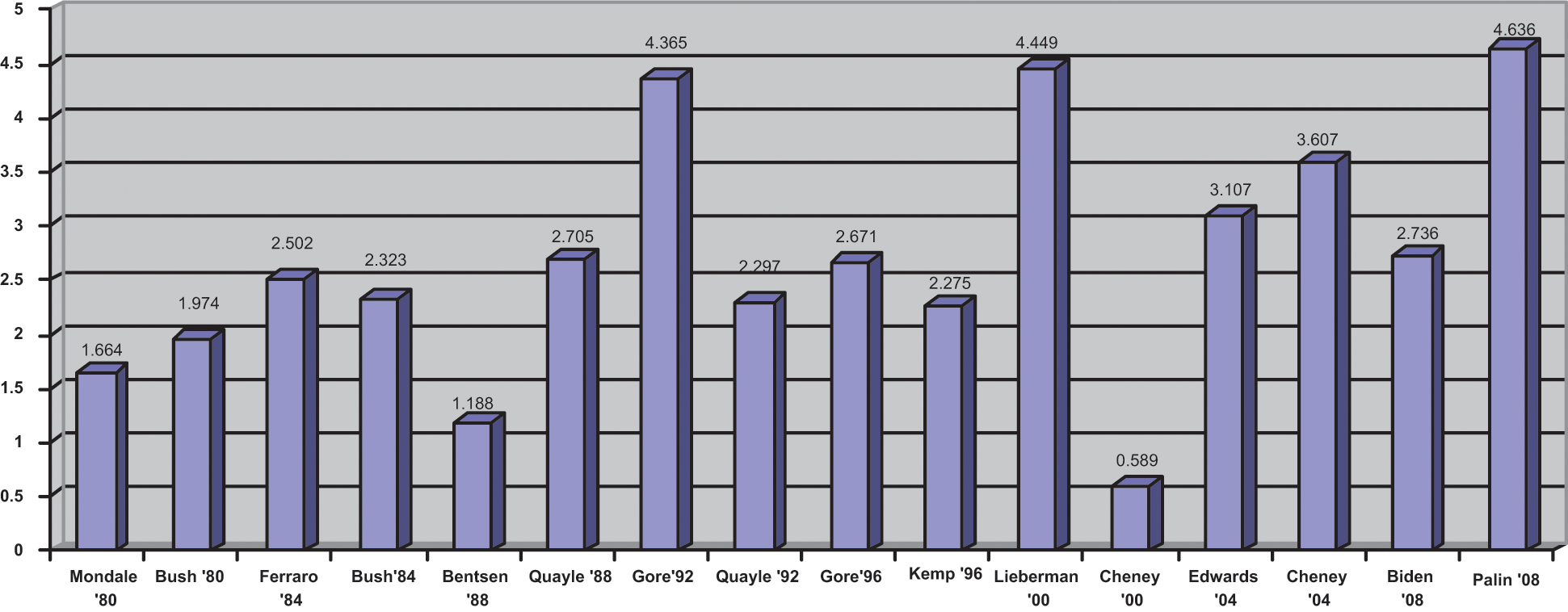
The effect of vice presidential evaluations on vote choice, 1980–2008
Not only did Palin have a significant effect on vote choice in 2008, it was the largest effect for any vice presidential candidate in the period examined. Only Gore in 1992 and Lieberman in 2000 had an effect on vote choice that rivals that found for Palin. It is quite possible that vice presidential candidates who are viewed as being “different” will generate greater media attention and hence greater salience as a possible determinant of vote choice (Ulbig 2010). 10 Obviously, Palin being the first women on a Republican presidential ticket rendered her distinguishable in this way. Likewise, the effects found for Gore in 2000 maybe reflect the fact that his selection by Bill Clinton violated the usual “balance the ticket” approach to the selection of a running mate. Gore, like Clinton, was a moderate, a baby boomer, a Baptist, and a southerner, but also a politician with a national profile in his own right. Lieberman, of course, was the first Jewish vice presidential nominee of either party and had come to national prominence having criticized Bill Clinton in 1998 at the height of the scandal surrounding the former president’s affair with Monica Lewinsky. Still it is quite remarkable that Palin, a political figure who was a virtual unknown prior to her selection as McCain’s running mate, had a greater effect on vote choice than any other vice presidential candidate in the post-1972 period.
“Palin Effect” or “Values Divide?”
The final part of the article explores the extent to which the “Palin effect” was a reaction to the Alaska governor herself or whether feelings toward Palin were the product of the social and cultural “values divide” that have been salient in recent American politics (see, e.g., Knuckey 2007; Weisberg 2005; White 2002; Layman 2001). Indeed, a major part of the rationale behind the selection of Palin as McCain’s running mate may have been to drive cultural issues into a campaign without doing so in a direct way. In many respects Palin was the embodiment of what the GOP viewed as “traditional” America. She had small-town roots, hunted moose, and was a member of the NRA. She was a conservative Christian who had brought a baby diagnosed with Down’s syndrome to term rather than have an abortion. Palin stood at the epicenter of America’s “values divide,” cast in the role of “cultural warrior” that, arguably, McCain did not want to—or could not—play.
To test this hypothesis that feelings toward Palin essentially tapped the “values divide,” the vote choice model in Table 1 is expanded to include a number of independent variables that measure social and cultural issues. These include attitudes on gun control, 11 abortion, 12 gay marriage, 13 and a more general measure of “moral values.” 14 A measure of religiosity was also created from items that asked respondents about frequency of church attendance, the importance of religion in their day-to-day life, and the frequency with which they prayed. All of these items have been used as valid indicators of religiosity in prior studies (Layman and Carmines 1997; Mockabee, Monson, and Grant 2001). 15
Although not directly a social or cultural issue, a measure of racial attitudes is also included in the model to test the hypothesis that some of the rhetoric from Palin in the general election may have been a subtle appeal to what Kinder and Sanders (1996) termed “racial resentment” (or “symbolic racism”). Palin did make frequent assertions about Obama’s association with William Ayers, a member of the 1960s antiwar group the Weather Underground. 16 While the criticism was largely one that questioned Obama’s judgment, there was also a not-too-subtle attack on Obama’s patriotism: “Our opponent . . . is someone who sees America, it seems, as being so imperfect, imperfect enough, that he’s palling around with terrorists who would target their own country . . . this is not a man who sees America as you see America and as I see America.” The notion of Obama being “different”—not quite being one of “us”—is exactly the type of campaign rhetoric that Kinder and Sanders (1996, 272) noted was likely to activate racial resentment among white voters, given “the long reach of racial resentment into diverse aspects of American opinion.” Thus, evaluations of Palin may have been affected by racial attitudes given that she was the conduit through which the McCain campaign subtly injected race into the campaign. A racial resentment scale was constructed using the four items that have been used consistently by NES. 17
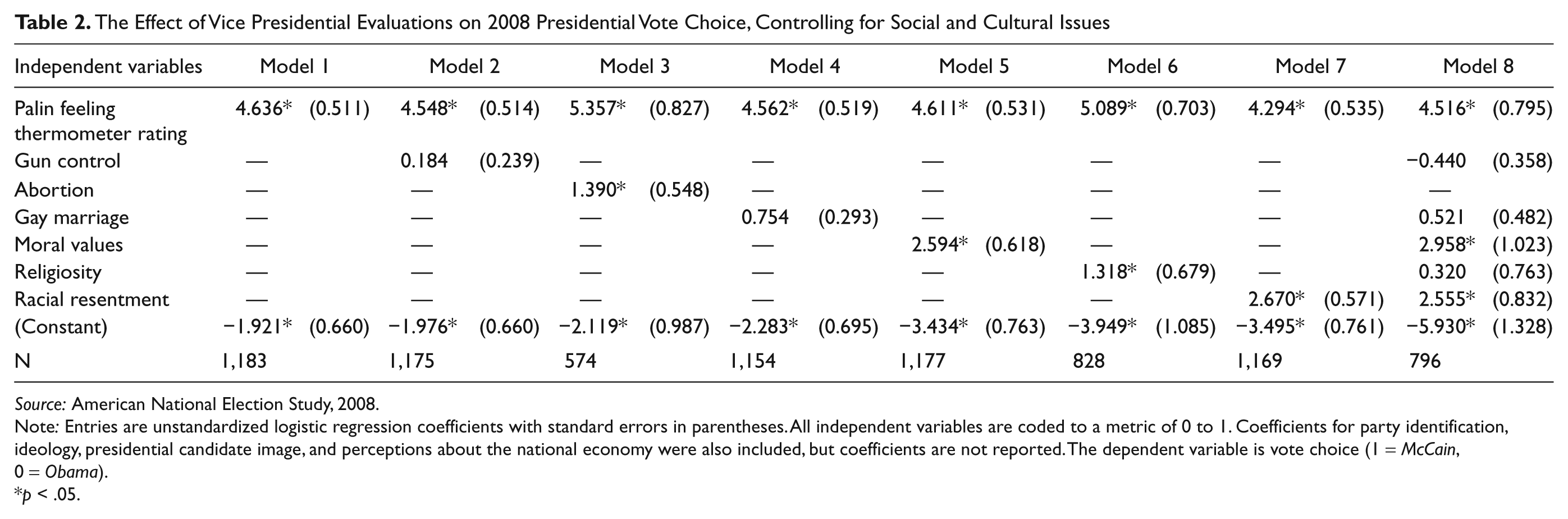
Table 2 shows the effect of each of these variables being added separately to the baseline vote choice model, which is model 1 in the table (and simply reports the Palin feeling thermometer coefficient from Table 1). The final column of Table 2 shows all of these variables added simultaneously. 18 Thus, Table 2 essentially shows the extent to which the aforementioned issues might mediate—and ultimately explain away—the “Palin effect.” For clarity of presentation, the coefficients for party identification, ideology, perceptions of the economy, and presidential candidate image are not reported.
The Effect of Vice Presidential Evaluations on 2008 Presidential Vote Choice, Controlling for Social and Cultural Issues
Source: American National Election Study, 2008.
Note: Entries are unstandardized logistic regression coefficients with standard errors in parentheses. All independent variables are coded to a metric of 0 to 1. Coefficients for party identification, ideology, presidential candidate image, and perceptions about the national economy were also included, but coefficients are not reported. The dependent variable is vote choice (1 = McCain, 0 = Obama).
p < .05.
Table 2 illustrates that the feelings toward Palin were not an effective proxy for a battery of social and cultural issues. This is true whether the issues are entered into the model one at a time or simultaneously. The magnitude of the logistic regression coefficient for Palin’s feeling thermometer hardly declines at all, and in two cases—when abortion attitudes and religiosity enter the model—the coefficient actually increases. It is remarkable that the effect of a vice presidential candidate exerted this independent effect on vote choice, even with these controls for issue preference.
Conclusion
The vice presidency has emerged as a salient office in post-Nixon administrations, and this was particularly true of the two occupants of the office immediately prior to 2008, Al Gore and Dick Cheney. The findings of this article provide some further evidence of this enhanced role by demonstrating that feelings toward vice presidential candidates exert an effect on individual-level vote choice above and beyond other independent variables. This finding confirms and updates those of Wattenberg (1995). However, the most interesting finding was that in 2008 evaluations of Sarah Palin produced a larger effect on vote choice than any vice presidential candidate in elections going back to 1980. Indeed, the only variable that had a stronger effect on vote choice in 2008 was the candidate image variable for Barack Obama. Given that voters were anything but ambivalent in their feelings toward Palin, a case could be made that Palin both helped and hindered the Republican ticket in 2008. She helped John McCain because she likely shored up his support among the GOP base. But Palin was a lightning rod for Democrats too, who were exceptionally cold in their evaluations. More damaging, perhaps, was that Palin may have eroded support for McCain among critical “swing voters” such as Independents and moderates. In this sense Palin might be viewed as both a cause and consequence of party polarization in recent American politics.
Clearly, it would be a stretch to say McCain would have defeated Obama had he chosen anyone other than Palin as his running mate. Other short-term forces—the economy, disenchantment with President George W. Bush and the GOP brand more generally—conspired to make 2008 a difficult year for any Republican candidate. However, at the margins—and this is where elections now can be won or lost in contemporary American politics—the findings are suggestive that Palin may have cost McCain support among important segments of the electorate and potentially some in key “battleground” states.
While the findings of this article clearly provide evidence to support the notion of a “Palin effect,” one lingering question remains: why did Palin have such an effect on vote choice? An attempt explain away the “Palin effect” by controlling for social and cultural issues unequivocally demonstrated that feelings toward Palin were not merely a proxy for the “values divide” in American politics. One plausible explanation might be that in 2008 voters regarded Palin as more than just a running mate. Given that John McCain would have been the oldest president in history—he would have been 72 on inauguration day—the notion of a vice president being “one heartbeat away” may have been a less than hypothetical scenario for some voters. As also noted, the media attention given to a “different” vice presidential candidate, such as Palin received, likely raised her salience in the campaign, and ultimately feelings played an important role in shaping vote choice.
In closing, the findings in this article might offer preliminary insight into Palin’s prospects for a future presidential bid of her own in 2012. There is no question that Palin resonated with the Republican base in 2008—the very voters who are likely to attend the Iowa caucus or vote in the New Hampshire or South Carolina primaries. Winning those contests would certainly produce tremendous momentum for the former Alaska governor to the point where her nomination might be unstoppable. However, given the reaction that Palin elicited from the Democratic base, and the rather limited number of Independents or moderates that gave her warm evaluations, a general election matchup against President Obama would be exceptionally difficult to win. Of course “base strategies” can work, as evidenced by Bush’s reelection campaign of 2004. But they can also lead to spectacular failure. Indeed, if the “Palin effect” was a hindrance to McCain in 2008, it could, potentially, wreak electoral devastation on the GOP in 2012.
Footnotes
The authors declared no potential conflicts of interests with respect to the authorship and/or publication of this article.
The authors received no financial support for the research and/or authorship of this article.