




Abstract
This article introduces a new method, qualitative comparative analysis (QCA), to the study of state policy choice and the role of ideas in politics. The authors hypothesize an important role for normative beliefs in state policy choice even for policies that go beyond traditional subjects of “morality” policy. Specifically, the authors find that “precautionary norms” are influential determinants of recent state environmental policies regulating chemicals, even in the face of significant economic impacts. They conclude that these results offer new theoretical ideas relevant to the state innovation and diffusion literature as well as the study of ideas in the policy process.
Keywords
Despite significant advances in theories of state policy innovation and diffusion, recent reviews of the subject have concluded that the field is ripe for new methodological approaches and theoretical concepts (e.g., F. Berry and Berry 2007). In particular, scholars are focusing more on different parts of the policy process to explain patterns of diffusion and innovation—developing different models for explaining state agenda setting, for example, versus policy enactment (Karch 2007). In response, we test a revised model of the policy enactment stage of the diffusion process using a new methodological approach: qualitative comparative analysis (QCA). Combining deep qualitative knowledge of specific cases with a more formal approach to comparison across multiple cases (Ragin 2000), QCA appears to be just the sort of bridge between single-case studies and large-N analyses called for in reviews like F. Berry and Berry’s (2007). This method allows us to illustrate the importance of an understudied causal factor, normative beliefs, in the state policy enactment process.
We test this new approach in the context of recent state policies related to chemicals and environmental risk. States have been increasingly active in environmental policymaking in the past two decades (Rabe 2004), and the literature on state policy choice includes many studies of environmental policy (e.g., Hays, Esler, and Hays 1996; Ringquist 1994; Sapat 2004). Given this growing emphasis on environmental policymaking at the state level, it seems more important than ever to understand why some states exercise regulatory authority on a given issue while others do not. Specifically, we ask in this article, Why are some states able to enact strong regulations in the face of active opposition when other states are not?
Our theoretical expectation is that normative ideas beyond basic political ideology significantly shape political outcomes at the state level—as much as or more than economic interests. Studies of what is sometimes referred to as “morality policy” have found a significant role for normative beliefs in explaining state policy choices regarding issues such as gay rights and abortion (e.g., Mooney 2001b). We expand on these findings to test if normative beliefs may be central in policy contexts beyond these hot-button social issues of moral conscience.
Based partly on prior case study research (Raymond and Olive 2009), we expect that certain normative beliefs associated with the “precautionary principle” in environmental politics can outweigh important material interests in state policy adoption. The precautionary principle encourages regulatory action in the face of scientific uncertainty regarding environmental risks (Whiteside 2006). Normative beliefs at this scale tend to be omitted from models of policy choice in favor of larger-scale beliefs like political ideology or what has recently been called “public philosophy” (Mehta 2011). In this article, we hypothesize that smaller-scale normative beliefs are an important determinant of state policy adoption. In this respect, moral beliefs about acceptable risks for women and children in particular are hypothesized to have a significant influence in policy settings not normally categorized as examples of morality policy. If confirmed, this finding would suggest that such moral beliefs may influence a broader range of policy domains than previously considered.
We investigate these relationships in a series of recent state efforts to regulate brominated flame retardants (BFRs). BFRs are a family of chemical compounds used to reduce the flammability of many household and commercial products, such as carpets, computers, and automobiles. Based on concerns about bioaccumulation and possible human toxicity, the EU began to regulate certain BFRs in 2003, and subsequently a number of U.S. states introduced bills to limit the use of these chemicals in the face of coordinated industry opposition. Although many of these legislative efforts failed, a few succeeded, thus raising the question of what factors enabled a few states to enact legislation in the face of economic opposition where others were unable to do so.
The article proceeds in three parts. We begin with a brief review of current models of policy innovation and diffusion at the state level, as well as the potential for new ideational variables like normative beliefs about precaution to improve those models. The second part of the article presents our hypotheses and explains our methodology. Finally, we discuss our findings and avenues for further research. In the end, we conclude that normative beliefs can play a vital role in the enactment of new state policies outside of traditional “morality politics” and over the strong objections of vested economic interests.
State Policy Choice: Material, Institutional, and Ideational Determinants
Why does a state adopt a new public policy? At the broadest level scholars often sort their explanations into two categories: “internal” versus “external” determinants (F. Berry and Berry 2007). Internal determinants are specific to the state considering a new public policy, and include the state’s dominant public and elite political ideologies, legislative professionalism, per capita income, degree of local problem severity, and pressure from internal interest groups (F. Berry and Berry 2007; Hays, Esler, and Hays 1996). External determinants tend to focus on models of policy diffusion between states and include economic competition among states, imitation of programs from other states, and federal pressure (F. Berry and Berry 2007).
Scholars have noted the historically limited success of models relying on these “usual suspects” as causal factors (e.g., Karch 2007, 44-45) and the trend toward combining external and internal determinants into more sophisticated, unified models of policy choice (F. Berry and Berry 2007, 247; Miller 2004). In addition, recent research has suggested that different factors may be influential at different stages of the state policy adoption process, necessitating different models and studies focused on those specific stages. For example, Karch (2007) concludes that internal factors, such as the actions and arguments of key state officials and interest groups, are most important in the process of enacting a newly proposed policy in a given state. This distinguishes models of the enactment phase from other policy stages, such as agenda setting where external factors are more important in getting new legislative initiatives introduced (Karch 2007).
Building on recent work in policy theory and comparative politics, we introduce new ideational variables in this article as a way to better understand the policy enactment process. In particular, we want to stress a greater focus on cognitive or normative factors—“ideational” variables beyond party identification or ideology—that have been shown to play an important role in determining policy choice at a national level (e.g., Berman 1998; Béland 2005; Blyth 2002; Steinmo 2003) but have been relatively neglected in existing models of subnational policy innovation and diffusion (Miller 2004), except perhaps in the aforementioned context of morality politics. In particular, we hypothesize that arguments by in-state advocates consistent with widely shared moral norms will be especially influential at the enactment stage, where public officials are seriously weighing the pros and cons of a given proposal and how to customize it to their state’s specific circumstances.
To test our hypothesis regarding the role of ideational factors, we include a number of other traditional variables used to explain state policy choice. Institutional factors commonly associated with state policy adoption include more professional legislatures, greater state financial resources, and more urbanized states (Hays 1996; Squire 1992; Daley and Garand 2005; Walker 1969). National pressure to innovate is also an important institutional factor in some cases, as states respond to federal incentives or mandates (Allen, Pettus, and Haider-Markel 2004; Lowry 1992).
Material determinants are most commonly understood as economic incentives related to a proposed policy. Sometimes thought of as “interest-based” (although as Steinmo [2003] and Hay [2011] note, ideas play an important role in constructing such “interests”), these factors reflect a state’s apparent material interests, including a policy’s economic impact on a state’s citizens, key industries, and tax revenues. The “neighbor effect” in many diffusion models relies on material interests if states are theorized to adopt policies that offer a competitive economic advantage (F. Berry and Berry 2007; Vogel 1995). For example, a state may be reluctant to regulate a given industry if surrounding states do not do the same, for fear of losing economic activity to its neighbors (W. D. Berry and Baybeck 2005; Daley and Garand 2005; but see Potoski 2001).
More generally, many models assume that states will enact policies supporting economic industries within their borders (e.g., Gormley 1983; Rabe 2004). These relationships generally follow the model of interest-group politics where the most organized and powerful groups tend to get the strongest benefits from government (Daley and Garand 2005). Usually, it is assumed that industries are likely to be most influential at the state and local level (Lowi 1979), but other interest groups can achieve substantial levels of influence at this level when mobilized (e.g., Hays, Esler, and Hays 1996; Weldon 2004).
Finally, problem severity is another common materialist explanation of state policy choice. For example, Daley and Garand (2005) argue that the more severe a state’s hazardous waste problem is (as measured by concentrations of waste sites and toxic emissions), the more likely state policymakers will respond. Like many other factors, the empirical evidence on problem severity as an explanatory variable is also mixed, with some authors (e.g., Sapat 2004; Ringquist 1994) claiming a significant causal link and others (e.g., Hays 1996; Karch 2007) rejecting the importance of this factor to state policy choice.
Traditional ideational determinants in this literature include: a state’s political ideology, contact with local or national epistemic communities, and the desire to emulate peer states. Usually expressed as an index of a state’s political liberalism, either among its citizens or its political elites, state ideology has been found to shape patterns of policy innovation and diffusion in some contexts (Karch 2006; Ringquist 1994), but not others (Daley and Garand 2005; Hays 1996). Neighboring diffusion effects are sometimes explained as a product of ideas traveling more quickly through regional networks and epistemic communities among states in close physical proximity (Canon and Baum 1981; Mintrom and Vergari 1998; Walker 1969). Evidence for these effects also remains mixed (Boehmke and Witmer 2004; Mooney 2001a; but see Shipan and Volden 2008). Finally, Grossback, Nicholson-Crotty, and Peterson (2004) argue that states tend to emulate states that are ideologically similar. On this account, any observed spatial patterns of policy diffusion probably reflect the fact that states within the same geographic region often share similar ideological perspectives.
While measures of state ideology have had some success in both internal and external models of policy diffusion, we believe that more specific ideas could provide additional explanatory power. In particular, we follow Miller’s (2004) recommendation for more attention to “specific cognitive and normative processes.” Drawing on work in comparative politics, we suggest looking more closely at what Berman (1998) refers to as “programmatic beliefs.” Narrower than expansive ideologies, such as liberalism or conservatism, but broader than specific beliefs about a single policy or issue, these beliefs are “abstract, systematic and coordinated and marked by integrated assertions, theories and goals” and serve to “provide guidelines for practical activity and for the formulation of solutions to everyday problems” (Berman 1998, 22). In many instances, these beliefs are about how the world should be or what political actors of a given identity should do. In this sense, they are “normative,” or norm-driven.
A number of studies have demonstrated the influence of normative beliefs in policy choice, especially at the national level. Skrentny (1996) documents how white male policymakers helped enact affirmative action legislation against their own self-interest because they believed it was the right thing to do, while Crawford (2009) makes a similar argument about the British rejection of the slave trade in the nineteenth century. Others have made convincing arguments describing how specific policy choices can be explained only by actors’ normative beliefs, rather than their economic or material interests (Blyth 2001; Steinmo 2003).
Studies of morality politics (Mooney 2000, 2001b; Mooney and Schuldt 2008; Haider-Markel and Meier 1996) have found a similar role for normative beliefs in state policy choice. These studies have been limited, however, to a narrow range of policies on issues such as gay rights, abortion, gambling, pornography, and capital punishment (Mooney 2001b). Comparative politics research on ideas and public policy more generally suggests that normative beliefs should influence a much wider range of policy choices at the state level, as does early work on policymaking in the U.S. federal government (e.g., Kingdon 1995).
The normative belief we examine in this article is often identified as “the precautionary principle,” a widely cited and hotly debated idea in environmental policy. A commonly cited version of the principle states: “When an activity raises threats of harm to human health or the environment, precautionary measures should be taken even if some cause and effect relationships are not fully established scientifically” (Myers and Raffensperger 2006, 14). Beyond regulating in the presence of scientific uncertainty, the principle has been interpreted as a mandate to shift the burden of proof to those introducing new environmental risks, exercise more democracy and transparency in risk management, and assess a wider range of alternatives in any policy choice. More informally, the principle is often summarized with commonsense aphorisms like “better safe than sorry.”
Previous research has shown that the precautionary principle can facilitate the adoption of new public policies, especially outside the United States (Bocking 2005; Pralle 2006). When examining the political role of the precautionary principle however, we must be careful to distinguish the rhetorical phrase from the different ideas it may represent. The principle itself has achieved some notoriety by name and is generally considered to be unpopular in the United States (Vogel 2003). Yet some ideas represented by the principle—certain “norms of precaution”—appear to have been politically influential in certain U.S. state adoptions of environmental risk regulations. One can isolate these effects by distinguishing the “rhetoric” from the “discourse” of the precautionary principle in a given policy process, where discourse is defined (following Hajer and Versteeg 2005) as an “ensemble of ideas, concepts, and categories through which meaning is given to social and physical phenomena.” Thus, precautionary beliefs can be important to getting environmental risk regulations enacted, even as precautionary rhetoric, or specific use of the “precautionary principle” by name, may be counterproductive (Raymond and Olive 2009).
In particular, precautionary concern about human bioaccumulation (concentration of a synthetic compound in human tissue, especially breast tissue, over time) appears to be a powerful political argument. This argument’s power likely stems from a norm prevalent in many societies regarding the protection of women and children. Stone (2002, 251) claims “the symbol of pregnant women and children as vulnerable evokes fears of danger in all of us” since “mothers and children symbolize the future and the importance of protecting the human species.” As Schneider and Ingram (1993, 337) explain, proponents will rally support for a policy by “showing how a proposed policy is logically connected to these widely shared public values.” Schneider and Ingram also note (1993, 340) how mothers and children are positively constructed in society, making policies intended to protect children from harm easily justified by politicians and, thus, more likely to be adopted. As a firefighter in one state considered in this study said, “How would you say no to a bill that has ‘contamination of breast milk’ in it?” 1
Therefore, to test the importance of these narrower normative beliefs in policy enactment, we look at the role of precautionary ideas and rhetoric in state efforts to regulate the BFR compound Deca-BDE, or Deca as it is commercially known. Deca is one of several BFRs that have been added to many consumer products for years to reduce their flammability and meet fire safety standards. BFRs come in many chemical combinations, but among the most common are the polybrominated diphenyl ethers, or PBDEs for short. Common PBDE formulations include Penta-BDE (with five bromine atoms), Octa-BDE (eight bromine atoms), and Deca-BDE (ten bromine atoms).
PBDEs have created environmental controversy because of their similarity to other toxic compounds such as PCBs (Eckley and Selin 2004) and their persistence in the environment and tendency to bioaccumulate in human tissue, including in breast milk. Human beings (and wildlife) can ingest PDBEs directly or can inhale the compounds through the air. (A commonly hypothesized route of exposure for infants, for example, is through ingestion of contaminated dust in homes with many PBDE-based products.) Initially scientists thought that Deca was too large a molecule to bioaccumulate in human beings (de Wit 2002), unlike the smaller Penta and Octa variations. More recent work, however, has documented evidence of Deca bioaccumulation as well (e.g., Gearhart and Posselt 2006).
Deca regulations are a good test of the role of normative ideas in the policy process for several reasons. First, the science on Deca’s health risks for humans remains somewhat uncertain. Besides growing evidence of Deca’s tendency to bioaccumulate, it is also known that the compound can cause thyroid dysfunction, learning impairment, and neurological damage in animal studies (de Wit 2002). As of 2009, however, no human studies had been conducted and Deca’s toxicology in humans remains largely unknown. Nevertheless, some states have tried to limit the use of Deca in the absence of any federal rules. As of the end of 2009, there had been fourteen bills introduced to regulate Deca at the state level, of which three were successfully enacted in Washington, Minnesota, and Maine. 2 In this article, we attempt to explain this pattern of state policy enactment using normative beliefs about precaution as a key explanatory factor.
We are most interested in the role of the precautionary principle as a normative belief. Thus, while we include a number of other standard determinants in our model, our primary hypotheses emphasize the role of normative beliefs and rhetoric, compared to explanations based on material and economic factors. Moreover, our model also moves away from general models of state policy choice toward a focus on the enactment phase. Building on Karch’s (2007) finding that different parts of the innovation and diffusion process are likely to have different causal models and explanatory variables, we do not consider here the process of agenda setting (that is, why some states introduce Deca bills and others do not). Why states initially choose to consider an issue like Deca regulation is an important question that would rely on different data and models about the role of ideas in the policy process, so we exclude it from the present analysis. Instead, our research goal is to test if normative beliefs can help explain successful regulation, even in light of strong competing material interests. After a brief explanation of our methodology, we discuss our hypotheses and their operationalization in detail.
Method and Hypotheses
Recent discussions of policy innovation and diffusion have recommended more qualitative methods to complement larger-N studies (F. Berry and Berry 2007; Nicholson-Crotty and Meier 2002; Miller 2004). Recent work on ideas in politics, by contrast, has encouraged scholars to employ “more variety in research design” and move beyond narrative and interpretive methods tending to rely on case studies (Béland and Cox 2011, 16). In both fields, institutional and interest-based variables are widely accepted and used, partly because they lend themselves more easily to quantitative methodologies. Ideas, on the other hand, “as objects of scientific inquiry, have held a beleaguered status, often derided as imprecise” (Béland and Cox 2011, 6; see also Parsons 2007). Thus, there is a need for more comparative design in the study of ideas in politics, including the use of multiple methods and more statistical or quantitative methods (Béland and Cox 2011).
This need for new comparative methods in both the literature on ideas and politics and in state policy innovation and diffusion led us to qualitative comparative analysis, a method based on Boolean algebra minimization algorithms (Ragin 1987, 2000; Rihoux 2006). Many scholars recognize QCA as an effective alternative method of accounting for causal complexity (Grendstad 2007; Ragin 1987; Ragin et al. 2003) for a larger number of cases, because it supplies multiple combinations of conditions that constitute different causal pathways to a given policy outcome. In some cases, certain conditions or combinations of conditions may emerge as “necessary” or “sufficient” for the outcome in question, at least within the set of cases under study. Users of QCA perceive it as a holistic method that allows one to account for the complexity and uniqueness of each individual combination of potentially causal conditions.
QCA goes beyond “thick description” and facilitates “modest” generalization from the systematic analysis of a smaller number of cases while preserving the process tracing and causal details that make case-study analysis valuable (Rihoux and Ragin 2008, 12). Numerous cross-national studies of policy adoption (e.g., Behan 2007; Rihoux 2006) have relied on QCA as a useful method for “medium-N” analyses considering more cases than possible in an intensive case study, but fewer than would be necessary for most quantitative modeling techniques (Ragin et al. 2003; but see Grendstad [2007] for a defense of applying QCA to larger-N data sets as well). In this respect, QCA offers a unique opportunity to extend our understanding of state policy choice through “small sample comparative designs” as suggested by both innovation and diffusion scholars (e.g., F. Berry and Berry 2007, 248) and the ideas and politics literature (e.g., Béland and Cox 2011). QCA offers much of the depth of a single-case study approach while allowing the researcher to examine a greater number of cases with attention to causal complexity.
Thus, to analyze why some states have successfully regulated Deca while others have failed, we use crisp set QCA. Our data set consists of all state legislative attempts to pass legislation limiting the use of Deca-BDE beginning with California’s initial attempt in 2003 through the 2007-2008 legislative session. Because some states considered Deca regulations in more than one legislative session, each case is defined as a legislative effort in a given state in a given session (for a similar approach to QCA case construction across time, see Behan [2007]). To identify our cases we used a multistep process relying on searches of state legislative databases and phone contacts. 3 We also confirmed the completeness of our final data set with a similar database of BFR regulations maintained by the Center for Sustainable Production at the University of Massachusetts, Lowell.
We coded policy documents from each legislative effort to regulate Deca for the presence or absence of various norms of precaution and other arguments. 4 Documents included standard legislative history materials for all cases such as hearing transcripts, committee reports, and floor debates, as well as documents from the “bill files” of bill sponsors, including letters of support and opposition from interest groups and internal discussions about how to promote the bill. In total, we read and coded more than 400 of these legislative documents across our fourteen cases. Consistent with QCA’s emphasis on deep knowledge of one’s cases, we also conducted more than thirty personal interviews with key political actors from four of the cases in our data set, using a snowball sampling technique, to better understand their perspectives on why a particular Deca bill succeeded or failed. 5 These interviews were conducted in California because it was the first state to try to regulate Deca (an effort that failed), and Washington, Minnesota, and Maine because they are the only states to successfully pass Deca regulations.
Each case is identified by a state and time period. For example, Washington attempted (but failed) to pass a Deca bill in the 2005-2006 legislative session, only to successfully regulate Deca in 2007-2008. Thus, we distinguish Washington 2005-2006 from Washington 2007-2008 as separate cases in our analysis. We define a “successful” outcome as the enactment of legislation that imposes some limit on the use or production of Deca in the state. Consistent with the rules of crisp set QCA, this is a binary outcome where 1 means the state succeeded in limiting the use of Deca and 0 means it did not. 6 Of our fourteen cases, only three were successful (and have a score of 1): Washington 2007-2008, Minnesota 2007-2008, and Maine 2007-2008.
Our research tests three hypotheses, each related to a specific variable or “condition” that we theorize as an explanation for why some states have been able to successfully regulate Deca. In general, we hypothesize that certain ideational factors will be associated with successful bills, despite the presence of competing material factors that would predict failure to take policy action. Similar to other ideational approaches, what we are looking for is “patterns of argument” and “rhetorical evidence of certain ideas” so that we are able to “infer that certain ideas are distinct causes” of policy outcomes (Parsons 2011, 137). In crisp set QCA all conditions must be binary, so we briefly explain how each condition is coded as present or absent.
Hypothesis 1: The presence of precautionary discourse will be associated with successful legislation.
As a primary hypothesis, based on prior case studies (Raymond and Olive 2009) as well as work discussed in the previous section, we expect the use of arguments invoking precautionary norms to be closely linked to successful state legislation limiting Deca. To measure the presence of these ideas we coded all documents related to each state’s legislative process for precautionary arguments. If a majority of the documents in support of the bill made specific reference to precautionary norms (e.g., bioaccumulation in women and children or the environment, shifting the burden of proof from the government to the PBDE industry, or regulating risk without scientific certainty) the condition was present and given a value of 1 (condition labeled as PD50 in Table 1). 7
QCA Truth Table: (1 = presence of condition or outcome)
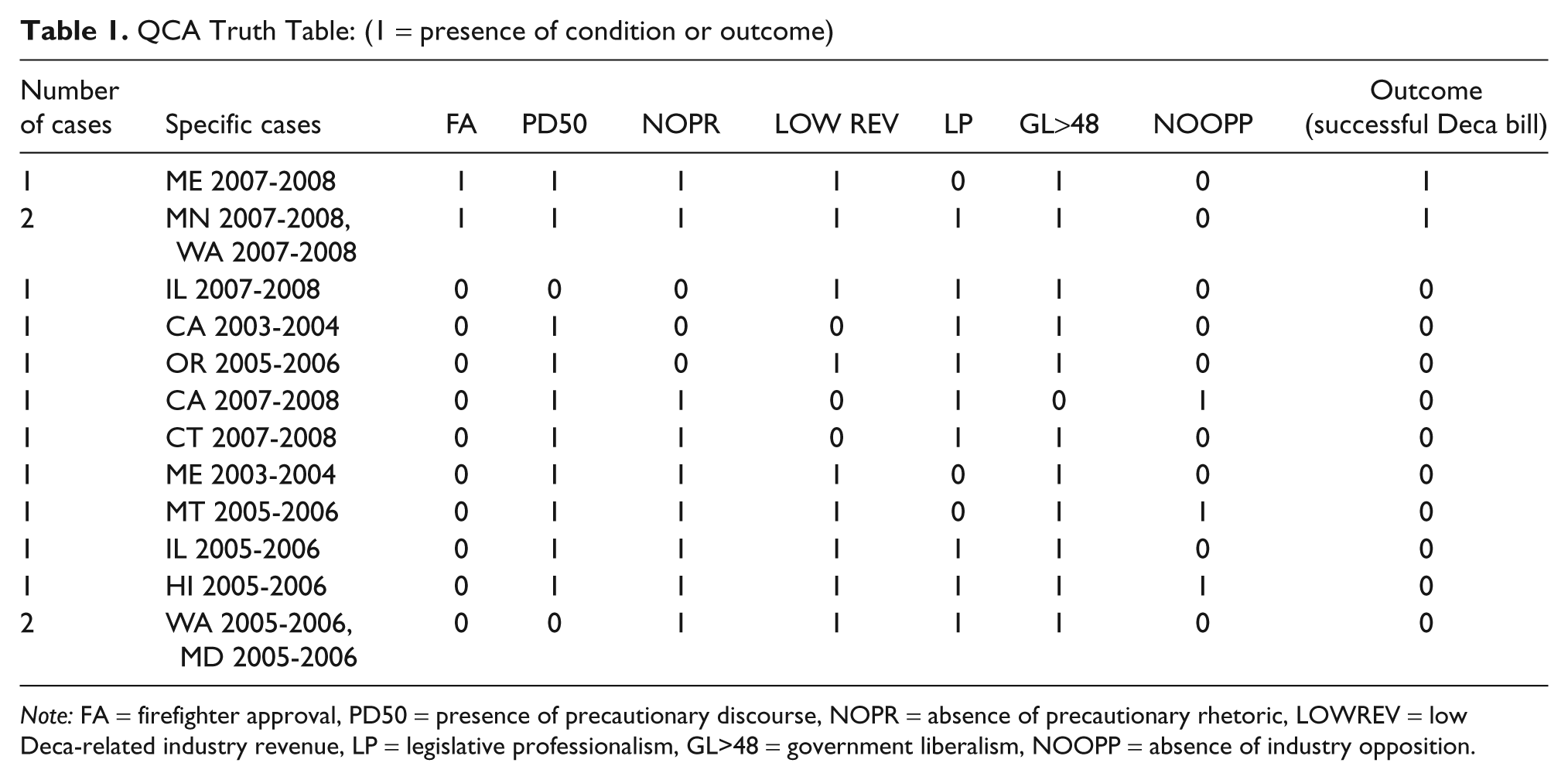
Note: FA = firefighter approval, PD50 = presence of precautionary discourse, NOPR = absence of precautionary rhetoric, LOWREV = low Deca-related industry revenue, LP = legislative professionalism, GL>48 = government liberalism, NOOPP = absence of industry opposition.
Hypothesis 2: The absence of precautionary principle rhetoric will be associated with successful legislation.
Given the unpopularity of the precautionary principle by name in the United States, and our previous individual case studies, we expect that use of the phrase will be counterproductive to enactment of Deca regulations. Thus, we hypothesize that states with no mention of the phrase “precautionary principle” in their legislative documents will be more likely to enact a bill regulating Deca. This condition (labeled as NOPR) was given a value of 1 if we found no mention of the “precautionary principle” by name in any documents from that case. Any mention in the record of the precautionary principle by any individual gave this condition a value of 0.
Hypothesis 3: The presence of significant firefighters’ support for the legislation will be associated with successful legislation, in order to counter norms of precaution against proposed Deca regulations.
It is important to remember that Deca is a compound that reduces fire risks (including risks from common household products like televisions and mattresses), a purpose that is also consistent with norms of precaution protecting women and children. We therefore expect that normative beliefs about precaution can potentially impede BFR regulation, when framed in terms of a new regulation that might create greater fire risks for families. Thus, we expect firefighter groups to play a key role in any Deca proposal. If firefighters agree that a Deca phase-out will not increase fire risks, the power of normative arguments against limiting Deca will be seriously weakened. Firefighters are likely to be seen as a more trusted source on this issue, unlike environmentalists and industry advocates who are invested in seeing the BFR bill pass or fail. Given the salience of norms of precaution for arguments about fire safety, we hypothesize that the presence of at least one major state firefighter group approving the proposed Deca legislation will be associated with legislative success, by strengthening normative arguments about the environmental risks of Deca, versus the potential fire risks of limits on the compound’s use. Thus, if at least one major state firefighter group indicated approval of the Deca bill in the legislative record, we coded the case as including the condition of firefighter approval (condition labeled as FA).
Beyond these three primary hypotheses, we consider a number of additional conditions often tested in models of state policy adoption as discussed in the literature review. These conditions include the following:
Economic opposition: An alternative model of Deca enactment might posit that such limits would only be passed in states where there was no active opposition by industry. To test this hypothesis, we included a variable measuring the presence or absence of active opposition to the proposed bill by industry. If there was no active opposition by industry to the bill, the case was assigned a score of 1 for this condition (condition labeled as NOOPP). This alternative explanation suggests that NOOPP would be associated with or required for successful bill enactment.
Economic interest: Another common hypothesis in the state policy literature is that states with less economic investment in a given industry are more likely to regulate in that area. Industry revenue as a percentage of state GDP is often used as a measure of this economic investment (e.g., Ringquist 1994; Woods 2006). Thus, if economic factors are important, states with lower economic dependence on Deca should be more likely to succeed in regulating. To estimate the total contribution of Deca-based industry revenue to state GDP, we used 2006 census data for industries that commonly use Deca, including electronics, upholstery and furniture, and plastics. 8 While not every company in these industries uses Deca, they constitute the primary area of potential economic impact. We calculated the total revenues for potentially vulnerable industries in each state and the percentage of this “Deca-vulnerable” revenue of total state GDP. If the state’s percentage of GDP in Deca-related industries was lower than the national average, we gave this condition a value of 1 (condition labeled as LOWREV).
Legislative professionalism: States with greater legislative professionalism are expected to be more likely to enact legislation in general. We coded this variable using ratings from the National Conference of State Legislatures. For our purposes “professional” and “mid-range professional” states are coded as 1 while “nonprofessional” states are coded as 0 (condition labeled as LP).
State liberalism: Typically, states with more liberal measures of government ideology are considered more likely to enact environmental regulations. Fording (2011) and colleagues assess the government and citizen liberalism of all fifty states on an annual basis, using methods outlined by W. D. Berry et al. (1998). To fully test this hypothesis, we created two measures of government liberalism capturing Fording’s assessment of states as “liberal” versus “very liberal.” Following Fording’s typology, we coded the “liberal” condition as present if the state had a score of 48 or higher (out of 100) and “very liberal” if a state had a liberalism score of 72 or higher in the year the bill was being considered (conditions labeled GL>48 and GL>72, respectively).
Citizen liberalism: This is also measured using Fording’s (2011) annual analysis, but for citizen ideology instead of the ideology of government elites. Fording and colleagues use the same scale, methodology, and categories in assessing the liberal nature of a state’s citizenry. Thus, the coding rules for citizen liberalism mirror those of state liberalism (conditions labeled CL>48 and CL>72).
Results
Initially we used fsQCA (Dos) software to test for pathways between our outcome (successful regulation) and various full sets of variables. 9 Due to disagreement in previous work about how to best capture a state’s political ideology, we tested each liberalism measure (CL>48, CL>72, GL>48, GL>72) as an “ideology” condition as part of a larger model including the six other conditions discussed previously—firefighter approval (FA), presence of precautionary discourse (PD50), absence of precautionary rhetoric (NOPR), absence of industry opposition (NOOPP), low Deca-related industry revenue (LOWREV), and legislative professionalism (LP). In this analysis, only government liberalism (GL>48) was present in all three of our successful cases, making it the logical choice to include in our final model. Consistent with QCA methodology (e.g., Behan 2007), we omit these alternative conditions from our detailed analysis and focus on the remaining conditions. 10
While there are 128 (2^7) potential combinations of these seven conditions, we only have twelve actual combinations in our data. Following QCA methods, we summarize these combinations in a truth table (Table 1). On the right-hand side of the table is the outcome, where 0 indicates no state regulation of Deca and 1 indicates state adoption of a policy limiting Deca. The next seven columns to the left represent the seven conditions discussed earlier that are hypothesized to be associated with successful policy enactment. Finally, the columns on the far left list the cases that correspond to each specific combination of conditions. For example, the second row of Table 1 indicates that Minnesota 2007-2008 and Washington 2007-2008 had the same six conditions, lacking only the absence of industry opposition (NOOPP).
Visual inspection confirms that there are no contradictions in our table—no negative cases have the same set of conditions as any of our positive cases—as is required for QCA. Boolean analysis with fsQCA software reveals that there are two sets of conditions in the data associated with successful Deca legislation: Minnesota’s 2007-2008 and Washington’s 2007-2008 combination of FA, PD50, NOPR, LOWREV, LP, GL>48, and noopp (negative conditions are designated with lowercase letters by convention in QCA) as well as a combination of FA, PD50, NOPR, LOWREV, lp, GL>48, and noopp, in the first row for Maine 2007-2008.
The next step of the QCA analysis is to logically minimize the conditions required for positive outcomes. Essentially, this is to ask: Can we reduce the number of pathways associated with successful regulation using Boolean logic, based on our detailed knowledge of the cases? The logical minimization of the two successful configurations produces the following formula of five conditions that are present for all three successful cases but no other cases in our truth table (giving it a coverage score and consistency score of 1.0, indicating it is a complete and unique solution for this data):

This can be interpreted as a causal combination (indicated by the multiplication sign “*”) of the following conditions: (PD 50) presence of precautionary discourse in at least 50 percent of the documents, (NOPR) no precautionary rhetoric, (FA) presence of firefighter approval, (LOWREV) the presence of low Deca-related industry revenue, and (GL>48) the presence of government liberalism at the threshold score of 48. Legislative professionalism drops out of the solution because two cases (MN 2007-2008 and WA 2007-2008) had “professional” legislatures, while one (ME 2007-2008) did not. Thus, the minimization process of QCA eliminated this logically unnecessary condition. 11 The absence of NOOPP was also a part of the Boolean solution, but given our theoretical expectations (and common sense) this merely indicates that “no opposition” is not required for successful enactment of a limit on Deca. Our successful state legislatures enacted their bills, in other words, despite the presence of active opposition, not because of it.
Discussion
The QCA analysis of our data supports our primary hypotheses. A prevalence of precautionary discourse (PD50) was associated with all cases of successful Deca regulation, as suggested in Hypothesis 1. This is an important finding in that it offers initial confirmation for the political influence of “midlevel” ideas such as precautionary norms about risks from synthetic chemicals, in addition to larger scale ideas such as liberal or conservative citizen ideology. Our interviews with legislators and activists also support this finding: When asked “what argument carried the most weight in the legislative process,” the most common responses centered on bioaccumulation, including statements like “fetal exposure” or “high levels [of PBDEs] in breast milk.” However, the QCA analysis also confirms that these precautionary ideas alone were not sufficient for policy adoption—many failed cases also featured a preponderance of precautionary discourse, so supporters needed more than just precautionary arguments to get a bill passed.
The absence of precautionary rhetoric is also associated with successful legislation, consistent with Hypothesis 2. Interviews with key informants in California and Maine in particular confirmed the intentional avoidance of the precautionary principle by name by Deca bill supporters. When asked if the precautionary principle was important in the process, one California activist said, “We used the argument but not the ‘precautionary principle’ because people do not understand the phrase.” 12 Similarly, a Washington activist stated: “Supporters tried to avoid the principle but invoked the discourse of precaution.” 13 At the same time, we note that many of our failed cases also lacked any precautionary principle rhetoric. Thus, our analysis shows the absence of precautionary rhetoric to be a necessary condition, but far from a sufficient one, for Deca regulation among our cases. (Indeed, it is hard to imagine how the absence of anything could be sufficient, by itself, to ensure policy adoption.)
As expected in Hypothesis 3, approval by firefighters was closely associated with Deca bill adoption: all successful cases included approval by a major firefighter group and firefighters approved of no bill that ultimately failed. This leads to a logically possible conclusion that only firefighter approval is necessary to ensure bill enactment. QCA discourages the blind reduction of any solution based only on logical analysis of this sort, however, and based on our key informant interviewing we believe that a state would need both discourse regarding bioaccumulation and firefighter approval to ensure a bill’s passage.
Indeed, as we noted in our hypotheses earlier, firefighter approval is especially important because the argument that Deca regulation might increase fire danger weakens the application of a norm of precaution against endangering women and children. For example, a Washington senator acknowledged that getting the fire community on board was vital because their support overcame the opposition’s narrative about fire risk to children. She felt that for the bill to pass “it had to show that fire safety would not be jeopardized.” 14 An advertisement featured in newspapers by the BFR industry centered on a small child in a burning home. While this is a powerful image that suggests BFRs prevent home fires, this argument appears to have been nullified by firefighter support for the bill. Support from firefighters was also important in Maine, where the fire community openly worried about Deca’s presence “in homes, women, children and amniotic fluid” as opposed to just house fires. 15 Thus, we conclude that precautionary ideas about protecting women and children played a key role in successful policy adoption in these cases, as expected in both Hypothesis 1 and Hypothesis 3, above and beyond basic firefighter approval. In our causal model, it is the presence of substantial precautionary discourse about Deca that elevated the profile of firefighter groups.
Government liberalism is also part of our solution, but it too is not enough for successful legislation. The fact that so many states in our data set scored positively for this condition suggests a possible relationship between a liberal political climate and the agenda setting stage of the process (i.e., introducing a Deca bill). At the same time, many liberal states never put Deca regulation on their agenda, so this relationship remains speculative. Therefore, we are unable with our current data to fully compare the relative influence of precautionary ideas and norms on the enactment process with the influence of government liberalism. Our qualitative research however, combined with the vital role of firefighter approval, suggests a more prominent role for precautionary norms than for ideology. The absence of stronger measures of government liberalism (GL>72 or CL>72) from successful cases also suggests that liberalism is relatively less influential. More research is needed, however, to untangle the relationship between ideology in general and specific normative beliefs.
With regard to material factors, we find that below average state revenue (LOWREV) from Deca-related industries is also associated with successful legislation. This condition is also present, however, for most unsuccessful legislation attempts. In addition, we also know that industry opposed all three successful bills, which suggests that significant economic interests felt threatened by these potential regulations even in “LOWREV” states. Indeed, we find that industry opposition is present in most attempts to regulate Deca (i.e., NOOPP has a value of 0), including all successful efforts to date. This means that every state policy limiting Deca passed despite active opposition from industry. In sum, these results confirm that the influence of precautionary ideas, including addressing worries about fire risk from Deca alternatives, was a stronger influence on this policy process than the self-perceived or objectively measured economic interests of industries threatened by Deca regulation.
Finally, our QCA analysis suggests that legislative professionalism is not required for successful enactment of regulation in this area. Maine, in particular, passed a leading Deca regulation despite not having a “professional” legislature, while several highly professional legislatures were unable to enact bills to limit Deca.
Conclusion
While our data set is relatively small, QCA confirms the importance of normative ideas in a new policy context while generating new theoretical hypotheses to be tested with larger data sets or further case studies. Our results suggest that states appear to have successfully adopted Deca-limiting policies in cases where normative beliefs about chemicals, public health, and the environment were sufficiently powerful to overcome objections based on substantial material interests. Other causal factors fail to adequately explain the pattern of state policy enactment that we observe in this range of cases. Instead, successfully framing a policy as supported by normative beliefs about environmental risk and protecting women and children from bioaccumulation of potentially toxic chemicals appears to be the most important factor associated with policy adoption in our study, especially in terms of persuading expert groups like firefighters that competing risks to women and children are less serious from any proposed regulation.
These results support the claim that ideas are an important independent variable for understanding policymaking at multiple levels, including the subnational. They also suggest that the state policy innovation and diffusion literature could benefit from more attention to normative beliefs narrower than political ideology. Finally, they suggest that normative beliefs are able to influence policies outside a limited range of issues designated as “morality politics” and can outweigh opposition to enactment based on vested economic interests. This suggests in turn that the study of morality politics and the theoretical models those scholars employ could be expanded beyond issues of primary identity (race, gender, religion) to other policy areas where debate is also deeply rooted in a person’s belief system, such as health policy and environmental risk.
Our findings also reinforce the importance of distinguishing between the role of rhetoric, or word choice, versus normative ideas and discourse in public policy (Finlayson 2004; Raymond and Olive 2009; Craemer 2009). For example, environmental policy conflicts may involve similar norms of precaution both for and against adoption of new limits on a potential environmental contaminant. While opinions will differ which risks are more serious, the fact that advocates use “precautionary” ideas both for and against a new environmental policy suggests that scholarly arguments over conflicting implications of a “precautionary principle” are spilling into the political realm (e.g., Sunstein 2005; Whiteside 2006). More generally, it seems likely that a normative idea can sometimes push policymaking in multiple directions and that models relying on ideas as causal factors will have to carefully specify their hypothesized influence in a given policy context.
At another level, we show that word choice and rhetoric used to express similar ideas can make or break the influence of those ideas on a policy initiative. It is not just how “ideas are packaged” that matters, but the way the package is disseminated and discussed (Béland and Cox 2011, 13). In this article we focus on the precautionary principle, but one can readily imagine the need to avoid (or seek out) certain rhetorical constructions in other policy areas, such as “affirmative action” or “welfare,” in policies aimed at social equality. This phenomenon is already discussed in studies of framing and word choice effects on public opinion surveys (e.g., Chong and Druckman 2007); it should hardly be surprising that rhetoric is also critical to the process of political deliberation and policy choice.
Finally, these results further illustrate the potential of QCA as a useful technique for testing hypotheses about state policy choice and the role of ideas in politics more generally. Although widely utilized in some fields, QCA is rarely if ever used in subnational policy innovation and diffusion studies, which tend to rely more on large-N statistical analyses or individual case studies. Nor is QCA commonly used in research on ideas in politics. However, the method offers unique benefits for both fields because it is well suited to theory building and causal complexity in a context of small to medium-N studies. A hybrid between quantitative and qualitative methodologies, QCA generates and tests falsifiable theories of causation with in-depth knowledge of key cases. In this respect, it represents a logically rigorous new way to implement “small sample comparative designs” recommended by F. Berry and Berry (2007, 248), and also Béland and Cox (2011), as an important complement to large-N statistical analysis and single-case studies in this field (see also Ragin 2000, 25; Rihoux and Ragin 2008, 12).
While this study confirms the influence of normative ideas in policy enactment, it also suggests a number of ideas for future work. For example, additional analysis could consider the role of exemptions in regulatory legislation on behalf of powerful economic interests. (Washington, for example, exempted Boeing from its 2007-2008 Deca bill). The issue of exemptions also suggests the value of more sophisticated dependent variables than bill adoption or “success,” a complaint that has also been lodged against large-N techniques such as event-history analysis in the literature on innovation and diffusion (e.g., Boehmke and Witmer 2004; see also Karch’s [2007] discussion of bill “customization”). Legislatures have a wide range of remedies for chemicals of concern, including partial or total and temporary or permanent limits on production, sale, or use; as well as calls for more scientific study. A study that considered multiple definitions of “successful” regulation, including potentially a QCA fuzzy set analysis (where conditions and outcomes take on values between 0 and 1), would bring additional depth to such issues. In addition, many of our interviewees suggested that states will be moving toward more comprehensive environmental risk policies in the future, rather than the current “chemical by chemical” approach. It would be valuable to see if the model and hypotheses tested here will hold for these more ambitious policies, if and when they start to work their way through state legislatures.
Finally, work on the role of normative beliefs in the agenda-setting stage of the policy process would add another important dimension to this analysis. Agenda setting is a well-studied part of the policy process, one in which ideas have already been theorized to play an important role in framing conditions and problems (e.g., Kingdon 1995) or reframing an issue in order to move a dispute to a new venue (e.g., Baumgartner and Jones 1993). Yet studies of state policy diffusion and innovation have only recently begun to consider agenda-setting stage as a distinct part of the policy process with unique determinants and causal factors (Karch 2007). Trying to establish why some states put an issue like Deca on their policy agenda, and others do not, would expand the range of cases for testing empirical hypotheses. It would also raise new theoretical questions about the political role of ideas conveyed by different actors, including the media, policy entrepreneurs, or even public opinion, rather than only in legislative deliberations and hearings on a given bill as was considered here.
This study has offered a new methodological approach for testing state policy choice and has offered new evidence confirming the importance of normative beliefs in the policymaking process, even in an area outside the traditional realm of “morality” politics. Béland and Cox (2011, 14) recently claimed that “social scientific research should strive to identify the ideas people use and show their effect on political processes and outcomes.” To that end, we conclude that normative beliefs can help us better understand patterns of state policy enactment; that is, why one state enacts a bill on a given subject when another state fails to enact a similar bill. Although we focus here on environmental risk policy, we see no reason that this new perspectives and method would not extend to many other policy issues. Thus, we suggest that this approach be tried in other policy areas where normative beliefs might shed new light on political behavior, such as policies on genetically modified foods, climate change, health care, welfare, or the many other policy areas where such beliefs are prominent.
Footnotes
Declaration of Conflicting Interests
The author(s) declared no potential conflicts of interest with respect to the research, authorship, and/or publication of this article.
Funding
The author(s) disclosed receipt of the following financial support for the research and/or authorship of this article:
Research for this project was funded under National Science Foundation Grant CBET-0523393.
Notes
References
Supplementary Material
Please find the following supplemental material available below.
For Open Access articles published under a Creative Commons License, all supplemental material carries the same license as the article it is associated with.
For non-Open Access articles published, all supplemental material carries a non-exclusive license, and permission requests for re-use of supplemental material or any part of supplemental material shall be sent directly to the copyright owner as specified in the copyright notice associated with the article.
