




Abstract
This article examines the effect of foreign armed intervention on human rights conditions in target countries. It is argued that military intervention contributes to the rise of state repression by enhancing the state’s coercive power and encouraging more repressive behavior, especially when it is supportive or neutral toward the target government. Results from bivariate probit models estimated on time-series cross-section data show that supportive and neutral interventions increase the likelihood of extrajudicial killing, disappearance, political imprisonment, and torture. Hostile interventions increase only the probability of political imprisonment. The involvement of an intergovernmental organization or a liberal democracy as an intervener is unlikely to make any major difference in the suggested negative impact of intervention.
Introduction
Foreign military intervention is a pervasive feature of international politics. 1 States frequently resort to armed forces with various self-interested and humanitarian goals. With military intervention being a popular policy tool, and potentially more risky and costly than nonmilitary strategies, a large body of research has been devoted to the possible consequences of intervention for the target state. The extant literature has examined whether foreign armed operations promote democratization (e.g., Meernik 1996; Hermann and Kegley 1998; Pickering and Peceny 2006; Bueno de Mesquita and Downs 2006; Gleditsch, Christiansen, and Hegre 2007), cease internal armed conflicts (e.g., Regan 2000; Balch-Lindsay and Enterline 2000; Stedman, Rothchild, and Cousens 2002), sustain longer term peace and stability (e.g., Diehl 1993; Doyle and Sambanis 2000; Fortna 2004; Call and Wyeth 2008), and change socioeconomic circumstances in target countries (e.g., Pickering and Kisangani 2006; Peksen 2011).
While this line of research has been insightful in understanding the possible effects of intervention, scholars have yet to fully study the human rights impact of the external use of force. There are two notable studies that partially address the connection between intervention and human rights practices. Meernik, Poe, and Shaikh (2006) examine only the U.S. military intervention cases for the period 1977-1996 and find no major effect of the U.S. interventions on human rights in target countries. Murdie and Davis (2010) show that peacekeeping interventions with a humanitarian purpose will likely improve human rights conditions. Yet they also find that humanitarian missions, at least in the short term, might adversely affect empowerment rights such as political freedom and workers’ rights. Another major finding of the same study is that the peacekeeping interventions that attempt mediation between the belligerent groups might lead to greater level of respect for human rights.
A major limitation of these studies is their focus on a single country’s use of force (U.S. military intervention) or a small subset (third-party intervention in civil wars) of intervention cases. Furthermore, these studies suffer from a serious methodological problem using one-stage econometric models where they only predict the impact of intervention on repression. By doing so, they overlook the issue of reciprocal causation (i.e., endogeneity) between the foreign interference and human rights abuses. Besides the possible human rights impact of intervention, poor human rights conditions in the target state resulting from ongoing complex humanitarian crises, violent conflicts, and other socioeconomic problems might trigger external intervention. It is therefore imperative to model the mutual interdependence between the use of force and repression to avoid biased statistical estimates and offer a more accurate analysis of the human rights effect of intervention.
Given the limited scope and methodological shortcomings of the studies, more research is needed to determine whether foreign armed interference has any major impact on human rights conditions. This study attempts to fill this gap in the literature by offering a comprehensive, systematic study of the extent to which armed intrusions affect the level of respect for the physical integrity rights of citizens. The following section develops a theoretical framework showing that military intervention is likely to deteriorate the level of human rights abuses, especially when an armed interference is supportive or neutral toward the target state. The next section discusses the model specification and reports the results from the data analysis. The article concludes with a discussion of the findings and their implications for future research and foreign policymaking.
Theoretical Framework
The use of repression (e.g., torture, extrajudicial killings, and arbitrary detention and arrests) is essentially a policy choice adopted by the government. Under most circumstances the government intentionally opts for repression for a wide range of reasons such as maintaining the status quo, undermining violent antigovernment insurgencies, and eliminating the opposition (Gurr 1986; Poe and Tate 1994; Davenport 1995; Regan and Henderson 2002). Hence, the external use of force might influence the level of respect for human rights to the extent that it changes the target state’s ability (coercive military and political capacity) and willingness (repressive behavior) to commit repression. The theoretical framework outlined below following discusses in detail how each type of intervention affects human rights conditions.
Interventions in support of the government are likely to bolster the political and military capacity of the target regime. The external intervention will likely be perceived, especially among the regime’s constituency and average citizens, as a strong “signal” of support from the international community for the government. This will broaden the political legitimacy and credibility of the ruling elites and enhance the regime’s ties with its supporters (Gurr 1988). The existence of strong support among its constituency and general public helps the regime effectively recruit supporters and extract political and material resources to augment its coercive power. Interventions on behalf of the regime also boost the military capacity of the state, shifting the balance of military power in favor of the government over key rival groups (Touval and Zartman 2001; Regan 2000). Military capacity is essential for the state to monopolize coercive power and political authority to effectively maintain the political order in the society. 2
Most target countries undergo various socioeconomic and political instabilities (e.g., ethno-political clashes, civil wars, or natural and humanitarian disasters) that initially invoke external military interference. Earlier research shows that domestic instabilities that challenge the government’s authority create more incentives for the regime to use repressive tools such as political arrests, torture, and censorship (Poe and Tate 1994; Davenport 1995; Gartner and Regan 1996). Therefore, the target regime bolstered by intervention is likely to opt for repression as a viable strategy to eliminate ongoing domestic challenges and subsequently establish its rule over the society.
Supportive military interventions might also undermine the overall impact of the pressure the government usually faces from the international community. International pressure, most especially through the “naming and shaming” activities of human rights networks, is instrumental in restricting the state’s propensity to use repression. These activities are considered influential in instigating more diplomatic pressure against the repressive regimes (Sikkink 1993; Moravcsik 1995; Keck and Sikkink 1998; Risse, Ropp, and Sikkink 1999; Murdie and Davis, forthcoming). They could also partially affect third-party states’ economic ties (e.g., foreign aid decisions and bilateral trade relations) with the targeted country (Risse, Ropp, and Sikkink 1999; Murdie and Davis, forthcoming). Hence, the naming activities might help keep the government in check and force it to make changes in prevailing domestic law and institutions to harmonize them with internationally recognized human rights norms (Keck and Sikkink 1998; Hawkins 2002). Yet because the target government is protected and enhanced by the external military support, the ruling elites will be less deterred from escalating repression by these activities. Specifically, the target regime might anticipate that the direct support by the interveners would help mitigate the possible international costs of escalating repression. Therefore, the government might also have less incentive to comply with pro–human rights conventions promoted by domestic and transnational networks. This will further deteriorate the level of respect for human rights. 3
These processes can be illustrated by a brief case study: the supportive armed interference in Lesotho by South Africa and Botswana to cease the violent anti-government demonstrations following the general elections in May 1998. The South African defense forces, supported later by the troops from Botswana, were launched in Lesotho at the official request of the Lesotho government (Likoti 2007). The armed interference, code-named Operation Boleas, was a significant symbol of the external support by the region’s two strongest countries to the newly elected government. The direct support by the regional powers helped the government enhance its political credibility in domestic politics. Another immediate impact of the military support was to boost the coercive capacity of the state. This subsequently enabled the Lesotho police and pro-government defense forces to violently suppress the opposition questioning the validity of the recent general election (Likoti 2007).
The intervening states, South Africa and Botswana, appeared to tolerate the use of repressive tools because it helped them achieve their primary mission: to maintain regional stability by ending a major domestic upheaval in a neighboring country. A number of non–state organizations, most notably Amnesty International (1998), criticized the use of repressive tools against the anti-government demonstrators. However, the ruling elites enjoying the support of the region’s two strongest countries were not deterred by the international criticism. Instead, with the help of the foreign interference, the regime escalated repression to restore order. The human rights violations reportedly included arbitrary detentions, arrests, and extrajudicial killings of the members of the opposition parties (Amnesty International 1998).
Based on the aforementioned discussion, I hypothesize that:
Hypothesis 1: Supportive interventions increase the level of human rights abuses in target countries.
As opposed to armed interferences on behalf of or against the target government, neutral interventions are less capable—in terms of leverage and credibility—of changing the local power dynamics and the state’s legitimacy among the public (Touval and Zartman 2001; Regan 2000). This is because impartial interventions are deployed to cease or mitigate the ongoing conflict rather than taking the government’s or opposition groups’ side for victory. If so, such interventions are unlikely to influence human rights conditions in the target state through enhancing or damaging the coercive capacity of the regime.
Although impartial interventions might have no significant effect on the coercive capacity of the state, they might still encourage more repressive behavior. The ruling elites might be partially restricted in their use of repressive strategies during domestic instabilities because of the anticipation of a possible belligerent response from the international community against their actions. However, once the intervening states respond to domestic turmoil in the target with the impartial operations, the government is likely to interpret it as a lack of strong will in the international community to directly challenge its authority (Carment and Rowlands 1998; Power 2002; Harff 2003; Krain 2005). Because neutral interventions are perceived as a sign of the lack of resolve from the international community, the ruling regime anticipates that the employment of more repressive strategies against its populace is unlikely to create any strong international opposition. The regime might therefore escalate repression to eliminate the ongoing domestic turmoil and establish its authority in society.
Earlier research on impartial interventions to end or mitigate ethnic violence in Bosnia, Kosovo, and Rwanda shows that the lack of determination by the international community inadvertently contributed to the escalation of severe human rights abuses (Betts 1994; Jones 2001; Kuperman 2001; Power 2002). Betts (1994), for instance, points out that the United Nations’ failure to act decisively to protect the victims of violence in Bosnia and Rwanda not only failed to deter the perpetrators but also encouraged more violent behavior. This is partially due to the perpetrators’ assumption that the international community is unlikely to punish them through military means in the event of mass murder and violence. Hence, if neutral interventions fail to deter the political leadership from ending violence and instead encourage repressive behavior, the level of human rights violations will likely increase in the target.
Based on the aforementioned discussion, I postulate that:
Hypothesis 2: Neutral interventions contribute to the rise of human rights abuses in target countries.
The target state will likely portray hostile interventions (i.e., foreign belligerent military operations against the government) as a threat to national integrity to justify human rights abuses under the guise of maintaining domestic cohesion (Gurr 1988; Poe and Tate 1994). The use of repression is vital for the regime to monopolize military, economic, and political resources effectively without any domestic challenges to cope with the external threat of force. Furthermore, several studies show that ruling elites are more likely to opt for oppression to avoid the erosion of their authority, especially when there is an increase in the level of actual or perceived threat from domestic rivals (Gurr 1986; Davenport 1995; Gartner and Regan 1996; Regan and Henderson 2002). Interventions providing military and political support to the anti-government groups will increase the elite perceptions of threat from these groups to the status quo. Hostile intervention will therefore create an incentive for the leadership to become more repressive against the opposition. This restriction of human rights and political freedoms by the political leadership also demonstrates to the general public the regime’s strength and resolve against challenges to its rule.
The negative human rights consequences of hostile military operations, however, might be minimal relative to the hypothesized effect of supportive and neutral interventions for two related reasons. First, despite the target regime’s willingness to commit human rights abuses for regime survival and maintenance of the status quo, hostile interventions might restrict the government’s capability to use repression. The target state’s ability to eliminate domestic rivals through coercive policies will be more constrained because some of the state resources and attention have to be diverted from the perceived internal threats to the defense against the external use of force. Furthermore, interventions against the target leadership (or in support of the dissident groups) might change the balance of power in favor of the opposition (Rothchild and Lake 1998; Touval and Zartman 2001). This will further restrict the state’s coercive capacity.
Major external armed interventions might result in complete collapse of the central government, as in the cases of the multilateral intervention in 1994 in Haiti that led to the overthrow of the military regime and the recent U.S.-led armed interventions against the Iraqi and Afghan governments. In most intervention cases, however, there might be no significant, immediate shift in the balance of power, especially when intervening states choose not to deploy massive military forces to challenge the regime. Even so, hostile interventions as an indication of international disapproval of the leadership might give anti-regime groups more leverage in domestic politics. This will help the opposition rally support from citizens, which might further contract the support base and coercive capacity of the state.
Second and related, the government under the threat of the armed intervention might choose to avoid committing major human rights abuses so as not to alienate the international community against its rule. Political regimes with poor human rights records become frequent targets of the “naming and shaming” activities of non–state organizations (Sikkink 1993; Keck and Sikkink 1998; Murdie and Davis, forthcoming). The shaming activities by transnational advocacy groups not only increase the diplomatic pressure from the international community but also influence economic and military aid decisions by third-party states (Risse, Ropp, and Sikkink 1999; Murdie and Davis, forthcoming). The target government would need to maintain military and diplomatic support from its allies and international organizations to survive the threat of armed interventions. If so, they might choose not to resort to severe repressive strategies to minimize the diplomatic and other forms of external pressure. Indeed, Cingranelli and Richards (1999) point out that the international community as well as the general public of most countries are much less tolerant of major human rights abuses such as political killings and disappearance. If so, the government restricted by the threat of external intervention as well as the pressure from human rights networks might opt for political imprisonment and torture, which are less costly in domestic and global politics.
Based on the aforementioned discussion, I postulate that:
Hypothesis 3: Hostile military interventions will have marginal negative impact on human rights conditions.
Research Design
To test the hypotheses, I analyze human rights and military intervention data arrayed time-series cross-section delineated by years and countries, respectively. The data analysis is for the period 1981-2001 and includes 145 countries for which the data are fully available. Although the theoretical framework developed previously suggests that military intervention is a significant predictor of the level of respect for human rights, there is a mutual interdependence between the use of force and repression because human rights abuses will likely trigger external interference resulting from the ongoing complex humanitarian crises, violent conflicts, and other socioeconomic problems in target countries. Therefore, it is necessary to account for the endogenous process between the use of force and human rights conditions to undermine any biased estimates. 4 To model this endogenous relationship, I construct a statistical model that accounts for the reciprocal relationship between intervention and human rights. Specifically, I estimate a seemingly unrelated bivariate probit model, which is a two-equation econometric model that allows the simultaneous estimation of the determinants of two binary response variables (Maddala 1983; Greene 2003). The first equation of the simultaneous model (human rights equation) predicts the covariates of the level of respect for human rights practices by the government, while the second equation (military intervention equation) predicts the determinants of military intervention.
Human Rights Equation
The human rights equation of the model uses four different physical integrity rights variables from the Cingranelli and Richards (2007) human rights data set (CIRI) as the dependent variable, including extrajudicial killings, disappearances, political imprisonment, and torture. Extrajudicial killings are “killings by government officials without due process of law. They include murders by private groups if instigated by the government. These killings may result from the deliberate, illegal, and excessive use of lethal force by the police, security forces, or other agents of the state whether against criminal suspects, detainees, prisoners, or others.” Disappearances are “cases in which people have disappeared, political motivation appears likely, and the victims have not been found. Knowledge of the whereabouts of the disappeared is, by definition, not public knowledge. However, while there is typically no way of knowing where victims are, it is typically known by whom they were taken and under what circumstances.” Torture is “the purposeful inflicting of extreme pain, whether mental or physical, by government officials or by private individuals at the instigation of government officials. Torture includes the use of physical and other force by police and prison guards that is cruel, inhuman, or degrading. This also includes deaths in custody due to negligence by government officials.” Political imprisonment is “the incarceration of people by government officials because of: their speech; their non-violent opposition to government policies or leaders; their religious beliefs; their non-violent religious practices including proselytizing; or their membership in a group, including an ethnic or racial group.” 5
Data were originally gathered from the country reports of human rights abuses prepared by the U.S. State Department and Amnesty International. Each of the four physical integrity variables is coded as an ordinal variable on a 3-point scale (0 = frequent violations, 50 or more incidences; 1= some violation, 1-49; and 2 = no violations). 6 To make the interpretation easier, all the integrity rights variables have been recoded so that higher values indicate a higher level of integrity right abuses. Because bivariate probit model requires the use of binary response variables, I dichotomized each of the three-category integrity rights variables by coding the category of frequent violation (50 or more violations) as 1 and the some or no violation categories (less than 50 violations) as 0. By doing so, I focus on frequent and systematic integrity rights violations in a country rather than any violation of the integrity rights. Intervention might be associated with any human rights abuses, but the results would be more convincing and robust especially if it increases the probability of frequent and more systematic violations. However, when I dichotomized the integrity variables to account for any integrity right violation in a given year (by coding the frequent or some violation categories as 1 and the no violation category as 0), the results are similar.
To account for the impact of armed interventions on integrity rights abuses, I gathered data from the International Military Intervention (IMI) data set, which was originally created by Pearson and Baumann (1993) for the period 1946-1988. Using the same coding guidelines, Pickering and Kisangani (2009) extended the original IMI data set for the post-1988 period. The IMI data set defines military intervention as “the movement of regular troops or forces (airborne, seaborne, shelling, etc.) of one country into the territory or territorial waters of another country, or forceful military action by troops already stationed by one country inside another, in the context of some political issue or dispute” (Pearson and Baumann 1993, 4).
In the analysis, I apply one major restriction to the IMI’s operationalization of military intervention. Fleeting air and naval incursions were excluded from the analysis since such short-term interventions are unlikely to cause any noticeable impact on the socioeconomic and political circumstances of the target country. They are also unlikely to be perceived as a major threat by the target government, as compared with “boots on the ground” interventions (Hermann and Kegley 1998; Pickering and Peceny 2006; Pickering and Kisangani 2006). 7
The hypotheses developed in the preceding section focus on the direction of intervention. Fortunately, the IMI’s direction of intervener supporting action variable offers the essential information to identify whether a foreign intervention supports or opposes the target government. It is coded as a six-category variable based on the direction of military action by the intervener: nonsupportive or neutral intervention (0), support government (including immediate restoration to abort coup) (1), oppose rebels or opposition groups (2), oppose government (3), support rebel or opposition groups (4), support or oppose third-party government (5), and support or oppose rebel groups in sanctuary (6). I created three separate dichotomous variables to determine the direction of a foreign military mission. Hostile intervention is coded as 1 for the year a hostile intervention is initiated in a target country for categories 3 and 4 of the direction of intervener supporting action variable and 0 otherwise. The categories 1 and 2, which suggest that an intervention is supportive of the target government, are included in the supportive intervention variable. The neutral intervention takes the value of 1 for the category (0) that identifies the direction of an intervention as nonsupportive of or neutral toward the target government, and 0 otherwise. I exclude the categories 5 and 6 from the analysis. The interventions included in those categories aim at third-party governments or rebel groups in sanctuary. Hence, it is difficult to determine whether they are supportive, neutral, or hostile to the target government. Overall, the data set comprises 160 intervention episodes, which include 42 hostile, 57 supportive, and 61 neutral military operations for the 1981-2001 period.
In association with each of the intervention variables introduced previously, I use a seven-year decay variable. The purpose of the decay function is to control for the assumption that the impact of a foreign intervention on the target society will be lasting yet larger in the earlier years of the intervention rather than the later years. Hence, the decay function accounts for the assertion that the impact of intervention will endure in the years following the first year but in a declining fashion over time. The decay function is created following three steps. First, I count the years since the initiation of the intervention. Second, I compute en, where e is equal to 2.71828 and n is the number of years for the intervention (n = 1, 2, 3, 4, 5, 6, 7). Finally, I divide n by en and get n/en and obtain 1/e1, 2/e2, 3/e3, 4/e4, 5/e5, 6/e6, 7/e7 (see also Pickering and Peceny 2006; Peksen 2011).
The model also includes two additional dummy variables to account for whether military missions involved by intergovernmental organizations (IGOs) or major liberal democracies (i.e., Australia, Canada, Japan, the United States, and Western European countries) influence the outcome variables. Interventions led by the regional or global IGOs such as the UN, NATO, and the Organization of African Unity, may have a significant mitigating impact on the human rights violations. Due to the existence of a multilateral commitment at the international or regional levels in IGO interventions, the ruling elites might be more restricted and unwilling to use repression against its citizens to avoid alienating the international community. Liberal democratic interveners, which have greater respect for human rights than nondemocratic regimes in their own countries, might be more considerate of the human rights conditions in the target. This might subsequently prevent the government from using repressive policies. 8
To control for the effects of other independent factors, a battery of control variables is included to minimize the omitted variable bias. A democracy variable is included in the models to control for the influence of the regime type on human rights. Democratic states tend to commit less human rights abuses because democratically elected governments are more constrained through numerous institutional mechanisms such as removal of the government through the popular vote and the enhancement of the checks and balances system (e.g., Mitchell and McCormick 1988; Henderson 1991; Davenport 1995, 1999; Poe and Tate 1994). The democracy variable is the polity score derived from the Polity IV data set (Marshall and Jaggers 2000), and each country’s democracy score ranges from −10 to 10, where 10 represents the highest level of democracy.
The natural log of GDP per capita income level (in 1995 constant U.S. dollars) is used to control for the effects of developmental differences across countries. Theoretically, countries mired in poverty that lack economic resources are more likely to experience political conflicts. To establish social control, regimes in underdeveloped states normally resort to repressive tools against popular dissent (e.g., Mitchell and McCormick 1988; Henderson 1991; Poe and Tate 1994; Zanger 2000). Log of population controls for the size of total population. In countries with a large population, there are simply more opportunities for repression by the government. Large population size may also lead to scarcity of economic resources and economic grievance, which will make the use of repression by the government more likely (e.g., Henderson 1993; Poe and Tate 1994). The data for economic development and population are from the World Bank’s (2004) World Development Indicators.
Previous research also points out that presence of a civil war in a country will increase human right violations (e.g., Mitchell and McCormick 1988; Davenport 1995, 1999; Poe and Tate 1994). As the level of threat and internal challenges rise from anti-government armed forces, the government becomes more repressive to maintain the internal security and the control over the society. I also included a dummy variable, past conflict, to account for the lingering effects of a civil war that occurred within the last five years. Involvement in an interstate war also has been claimed to be positively associated with greater incidences of human rights abuses (Davenport 1995, 1999; Poe and Tate 1994). Similar to the domestic instabilities, human rights violations by the government will be justified due to security concerns. The Correlates of War project defines an interstate war as an interstate military conflict involving at least two states in sustained combat with at least a thousand battle-related fatalities (Sarkees 2000). Note that interstate war is a much rarer type of interstate military conflict (only seven interstates war during 1981-2001). Civil war is coded as 1 if a country experiences a civil war with at least twenty-five battle-related deaths per year and 0 otherwise. Similarly, interstate war takes the value of 1 if a country is involved in an interstate warfare and 0 otherwise. The data for civil wars are from the Armed Conflict Dataset (Strand et al. 2005) of the International Peace Research Institute (PRIO). The data for interstate war were gathered from the Correlates of War (COW) data set (available until 1997) and updated and cross-checked through 2001 using the Armed Conflict Dataset.
Military Intervention Equation
The dependent variable in the military intervention equation is military intervention, a dichotomous variable that takes the value of 1 if a country experiences any type of military intervention in a given year and 0 otherwise. I include several variables in the right-hand side of the equation to account for the major predictors of intervention. State capacity is central to explaining military intervention (Pickering 2002). Countries with strong economic and military capabilities are less likely targets of military intervention. This is due to their abilities to deter adverse military interventions from neighboring states or major powers in the international system. Moreover, states with strong socioeconomic and military capabilities are more effective in avoiding domestic instabilities. Even when they face national emergencies, they are less likely to need foreign military assistance. To account for state capacity, I use the COW Composite Indicator of National Capability index, which includes total population, urban population, iron and steel production, energy consumption, military personnel, and military expenditure (Singer 1987). The state capacity variable is logged to correct for the skewness of the data.
Earlier research finds that democratic states are less frequent targets of military intervention (Pickering 2002). Liberal democratic states tend to experience fewer domestic instabilities, including ethnic or civil wars (Gurr and Moore 1997; Fearon and Laitin 2003), or humanitarian crises, such as genocides and famines (Rummel 1995; Krain 1997; Harff 2003), which reduces the possibility of military interference. Because democratic states are also often major military or economic powers due to their developed economies and superior technological capacities, they also require less external military support during national emergencies (Pickering 2002; Reiter and Stam 1998; Lake 1992). Similar to liberal democracies, authoritarian regimes might also be less frequent targets of military intervention due to their ability to repress domestic instabilities and maintain strict control over the society (Hegre et al. 2001; Fearon and Laitin 2003). Therefore, the relationship between intervention and regime is likely to be curvilinear. To account for the curvilinear relation between the regime type and intervention, the model includes the democracy and democracy-squared variables.
To account for the impact of the overall level of human rights violations, I include the human rights variable, which is the CIRI’s Physical Integrity Rights Index. Countries with significant human rights abuses are more likely to be involved in interstate militarized conflict (Sobek et al. 2006) and experience internal violent conflicts (Thoms and Ron 2007). This increases the prospect of foreign military intervention. The index variable is composed of the four integrity rights variables, including disappearance, extrajudicial killing, political imprisonment, and torture. It is a nine-point scale that ranges from a minimum of zero to a maximum of eight, where zero indicates no respect for physical integrity rights and eight indicates full respect for those rights. To make the interpretation easier, the human rights variable has been recoded so that higher values indicate a higher level of integrity right abuses.
A civil war dummy variable accounts for the presence of violent insurgencies in a country. Third-party military interventions are more likely to occur in war-torn societies to reduce the human cost of the violence, cease the conflict between the state and rebel forces, and undermine any possible negative spillover effects of civil wars threatening the regional stability such as massive population displacement (Regan 2000). The past conflict dummy variable controls for the lingering effects of a civil war that occurred within the last five years. The model also includes a Cold War dichotomous variable that takes the value of 1 for the years prior to 1990. It controls for whether there has been any significant change in the tendency to intervene in the international community following the drastic change in the structure of the international system with the disintegration of the Soviet Union. To undermine any region-specific elements, the model includes six regional dummy variables, including East Asia/Pacific, Latin American/Caribbean, Middle East/North Africa, North America/Europe (reference category), Sub-Saharan Africa, and Southeast/Central Asia.
Autocorrelation (temporal dependence) is a common issue when cross-sectional time-series data are utilized (Beck and Katz 1995). To correct for the autoregressive process in each of the human rights equations, cubic splines are calculated as suggested by Beck, Katz, and Tucker (1998). This method is widely used to correct for temporal dependence with binary response variables. A simple lagged dependent variable, which is a more common method used in the human rights literature, is less appropriate because of the nonlinear nature of binary dependent variables that does not contain sufficient information for lagging. Finally, each model includes the Huber-White estimator of variance in order to obtain robust (i.e., heteroskedasticity-consistent) standard errors (White 1980).
Findings and Discussion
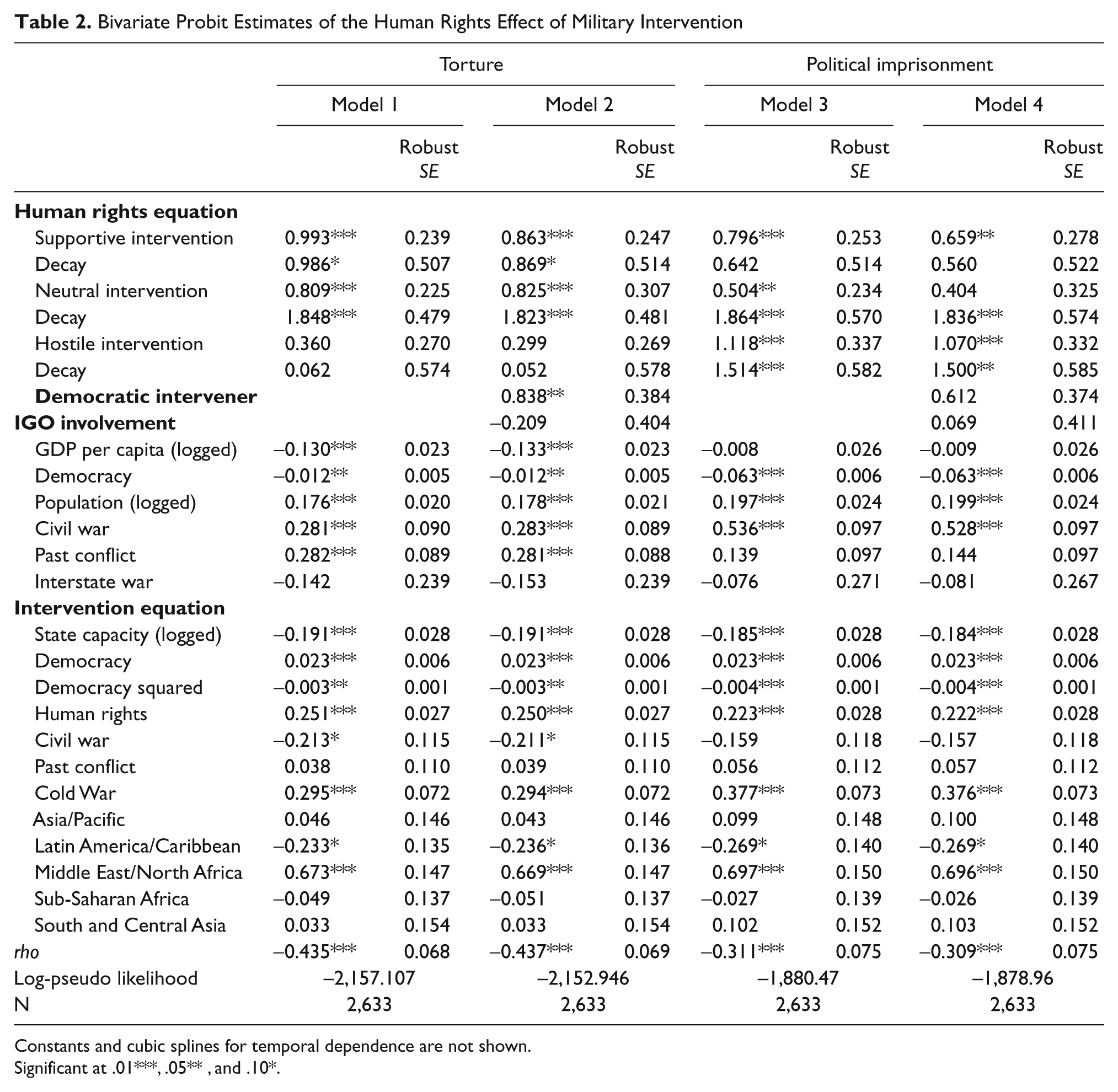
Tables 1 through 3 report the estimates of the human rights effects of intervention. As indicated by the significant
Bivariate Probit Estimates of the Human Rights Effect of Military Intervention

Constants and cubic splines for temporal dependence are not shown.
Significant at .01***, .05**, and .10*.
Bivariate Probit Estimates of the Human Rights Effect of Military Intervention
Constants and cubic splines for temporal dependence are not shown.
Significant at .01***, .05**, and .10*.
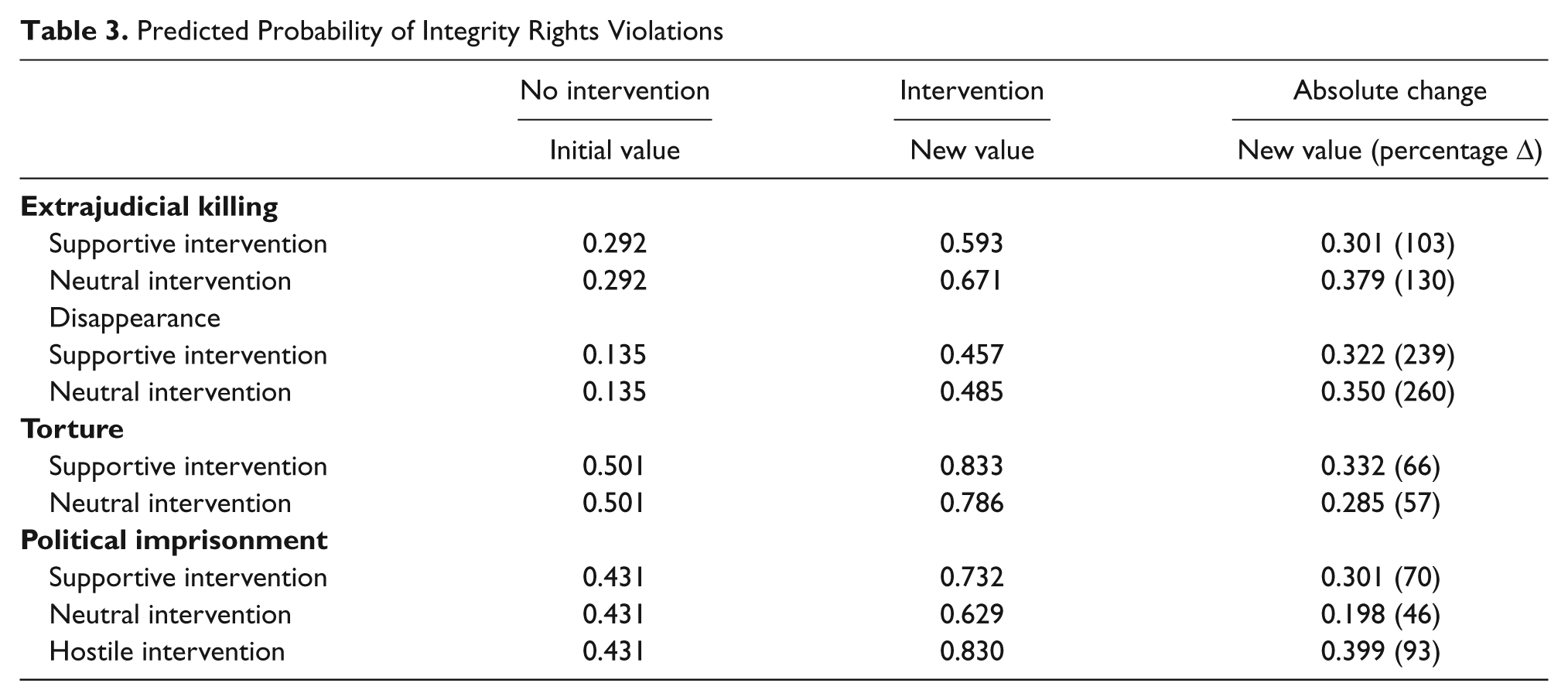
Predicted Probability of Integrity Rights Violations
The decay variables associated with the supportive and neutral intervention variables are statistically significant in the models, except in Model 4 for supportive intervention. Hence, the effect of supportive and neutral interventions on extrajudicial killing and disappearance is likely to endure with a greater impact in the earlier years of intervention. According to the results for IGO involvement and liberal democratic intervener variables in Models 2 and 4, the involvement of an IGO or a liberal democracy is unlikely to make any major difference in the probability of extrajudicial killing and disappearance.
The upper half of the first two models in Table 2 uses torture as the dependent variable. Political imprisonment is the dependent variable in the upper half of Models 3 and 4. The supportive intervention is statistically significant in the expected direction across the models. Similarly, the neutral intervention variable is significant in all models but Model 4. The hostile intervention variable is significant only in the models for political imprisonment. Hostile interventions might be significant only in predicting political imprisonment because it is the most common form of integrity rights violations and arguably less costly for the government (Cingranelli and Richards 1999). As indicated in the theory section, the general public of most countries as well as the international community in general are much less tolerant of major human rights abuses such as extrajudicial killing and disappearance. Therefore, the government restricted by the threat of external intervention as well as the pressure from human rights networks might opt for political imprisonment.
The decay function associated with supportive interventions is significant in the models for torture, while the decay variable association with neutral interventions is significant in all of the models. The decay variable associated with the hostile intervention variable, on the other hand, is significant in the models for political imprisonment. This indicates that the impact of neutral interventions on torture and political imprisonment and supportive interventions’ effect on torture are likely to endure over time, with greater impact in earlier rather than later years. Similarly, hostile interventions’ effect on political imprisonment is likely to persist over time, with greater impact in the earlier years. The IGO involvement is unlikely to make any distinguishable positive or negative impact on the likelihood of torture and political imprisonment. The results also indicate that interventions led by liberal democracies are unlikely to be different from other interventions.
How large is the effect of military interventions on physical integrity rights? The coefficients of biprobit models indicate the direction, positive or negative, of the independent variables’ respective relationships with the dependent variable. However, their absolute values are of little importance when taken alone. 9 To estimate the substantive impact of intervention, using the first model for each of integrity rights variables (Models 1 and 3) in Tables 1 and 2, I examine the change in the predicted probability of the violations of integrity rights holding the continuous independent variables at their mean values and the categorical variables at zero.
Table 3 reports the predicted probability of integrity rights violations. According to the results, the initiation of a supportive intervention is likely to increase the predicted probability of extrajudicial killing by 103 percent. Neutral interventions, on the other hand, increase the predicted probability of extrajudicial killing by 130 percent. The predicted probability of disappearance is likely to increase by 239 percent and 260 percent following the initiation of supportive and neutral interventions, respectively. The predicted probability of torture changes by 66 percent when a country is under supportive intervention. The change is 57 percent when an armed interference is neutral toward the target regime. The results also show that supportive intervention increases the predicted probability of political imprisonment by 70 percent. The predicted probability of political imprisonment goes up by 46 percent and 93 percent when the target state faces neutral and hostile interventions, respectively.
Among the control variables in the human rights equation, lower GDP per capita, large population size, and presence of civil wars and past conflict increase the probability of the integrity rights abuses across the models. The level of democracy is a key predictor of torture and political imprisonment. Interstate war, however, fails to produce any significant association with the integrity rights variables.
In the intervention equation (bottom half) across the models, the results suggest that states with strong capabilities are more likely to deter military intervention, while higher levels of human rights abuses are likely to increase the likelihood of external military operations. The democracy and democracy-squared variables are also statistically significant, suggesting that countries with liberal democratic regimes or authoritarian systems are less likely to experience external military interference. The cold war variable, on the other hand, is positively associated with the likelihood of intervention. An intervention appears to be most likely in a country located in the Middle East or North Africa. Surprisingly, the civil war and past conflict fail to show a statistically significant association with the likelihood of intervention in the expected direction in any of the models.
Conclusion
The present study offers a comprehensive examination of the human rights consequences of military intervention. The empirical evidence offers robust support for the assertion that supportive and neutral military interventions deteriorate the level of respect for physical integrity rights. Hostile interventions, on the other hand, increase the probability of political imprisonment while having no major effect on extrajudicial killing, disappearance, and torture.
Many doubt the effectiveness of military operations in promoting political stability and peace, arguing that the introduction of additional armed forces and firepower might do more harm than good due to the unfavorable domestic circumstances of target countries. Yet the political rhetoric or expectation, especially in the western capitals, has long been that the use of force might help the targeted societies restore political order and achieve more socioeconomic stability, which should in turn help human rights conditions. A value of this study is therefore to shed light on the empirical relevance of ongoing policy debates showing that interventions might inadvertently do more harm than good—at least in the case of human rights—even if they are initiated by IGOs or liberal democracies.
The most significant policy implication of the empirical evidence presented previously is that policymakers should take into account the possible negative human rights effect of interventions in weighing the costs and benefits of their decision to intervene. As military intervention becomes a counterproductive policy tool instigating more human rights abuses, the target state will likely experience more violence, humanitarian disasters, and other instabilities given the inherent link between the respect for human rights and the maintenance of peace and security. The negative human rights effect of intervention might also directly hurt the interests of intervener states and their regional allies due to the possible regional implications of human rights abuses, causing more interstate or civil wars and undermining transnational human rights movements. Accordingly, for a thorough and more accurate assessment of the efficacy of military operations for both intervener and target countries, it is imperative to consider the possible inadvertent human right impacts of intervention even when the use of force accomplishes its initial policy objective(s).
Future quantitative research and case study analyses could explore the extent to which the level of economic and political ties between interveners and target countries affects the probability of intervention and human rights conditions in the target. The interveners with strong economic and political connections with the target are more likely to intervene in response to complex humanitarian crises and socioeconomic problems. They might also have more influence in the regime’s capability and willingness to use repression. Detailed studies on specific intervention cases would be useful for a deeper examination of the actual motivations of intervener states and their impact on the overall political stability in target countries.
Footnotes
Acknowledgements
I thank A. Cooper Drury, David L. Richards, Jody C. Baumgartner, Alethia H. Cook, and three anonymous reviewers of PRQ for helpful comments.
Author’s Note
A previous version of this article was presented at the 2010 meeting of the Southern Political Science Association.
Declaration of Conflicting Interests
The author(s) declared no potential conflicts of interest with respect to the research, authorship, and/or publication of this article.
Funding
The author(s) received no financial support for the research, authorship, and/or publication of this article.