




Abstract
This study tests the common assumption that wealthier interest groups have an advantage in policymaking by considering the lobbyist’s experience, connections, and lobbying intensity as well as the organization’s resources. Combining newly gathered information about lobbyists’ resources and policy outcomes with the largest survey of lobbyists ever conducted, I find surprisingly little relationship between organizations’ financial resources and their policy success—but greater money is linked to certain lobbying tactics and traits, and some of these are linked to greater policy success.
If lobbyists for well-heeled interests in Washington are setting the agenda on the farm bill, in the energy bill, on health care legislation, and if we can’t overcome the power of those lobbyists then we’re not going to get serious reform in any of those areas. That doesn’t mean they don’t have a seat at the table. We just don’t want them buying every chair.
Both casual and professional observers of politics take for granted that the more money an interest group has, the more likely it is to get what it wants. This study relies
on new data about the resources of a broad sample of interest groups and the outcomes of seventy-seven policy proposals, combined with interviews of 776 Washington lobbyists conducted by Heinz et al. (1993). In examining a wide range of variables at the individual, group, and issue level, the study goes beyond previous examinations of mostly organization-level financial resources. The analysis shows that resources in general have little effect on the probability that lobbyists realize their preferred policy outcome—though some significant relationships do emerge. The data suggest that money alone does not buy success, but how it is spent may matter. While further research on the effects of money in policymaking is needed, the present study indicates that observers who note powerful effects of money on policy outcomes should take a more cautious and nuanced approach.
Previous Studies of Money in Politics
Concerns about unfair influence of certain interest groups have pervaded the history of interest group research. In the mid to late twentieth century, a divide emerged between those who thought American interest groups comprise a pluralist system in which every group’s unique interests are balanced out by competing groups (Truman 1951; Dahl 1961; Lindblom 1965) and those who believed some interests unfairly influence government by pushing competing groups aside (Schattschneider 1960; Olson 1965; Lowi 1969; Wilson 1973). At least three types of unfair influence have been studied in the literature and are considered here: insider advantages, campaign contributions, and financial resources.
First, the resource of personal connections—the “insider” advantage—has been the subject of democratic concern. The theory of iron triangles, or subgovernments, descibes an impenetrable relationship among bureaucrats, congressional subcommittee members, and interest groups who work together exclusively to create mutually beneficial policies to the detriment of the general public (e.g., Freeman 1955; Cater 1964; Gais, Peterson, and Walker 1984). Later work on the supposed “revolving door” (see Bó 2006 for a review) examines the extent to which people work for business and then leave for government, or vice versa, while maintaining their knowledge about, or sympathy toward, their former employer. This possibility has led to a federal law restricting the ability of new lobbyists to pressure their former colleagues in government. Still, the effects of an insider advantage appear to be limited. Heinz et al. (1993) find that more prominent lobbyists (so called notables, as well as lobbyists who know more notables) report significantly more success than non-notable lobbyists—but the difference is small. Nixon, Howard, and DeWitt (2002) show that trade associations, companies, and self-regulatory organizations—“arguably insiders”—were less likely than the whole set of commenters to receive favorable decisions by the Securities and Exchange Commission.
A second means of influencing politics with money is campaign contributions to political candidates. These contributions are generally aimed at one or more of three goals: changing the composition of the legislature (by increasing the odds that some candidates will defeat others), buying access to the politicians’ precious time and effort (Kau and Rubin 1982; Langbein 1986; Hall and Wayman 1990; Austen-Smith 1995), or buying legislators’ votes (e.g., Magee 2002; Wright 1985, 1990). The loose consensus is that campaign money does not usually buy legislators’ votes, but may be able to buy a greater level of access for contributors or greater effort by legislators on contributors’ behalf (but see Chin, Bond, and Geva 2000).
Finally, many political observers, both in the popular media and in academia, have asserted that interest groups that possess greater financial resources have unfair advantages in policymaking. Schattschneider (1960, 35) referred famously to the “upper-class accent” in the pluralist heaven, and a wealth of scholarship has followed that addresses the extent of “bias” in the interest group system (e.g., Lowery and Gray 2004). In particular, the often greater financial resources of corporations and business associations may give them the ability to influence politicians more easily than groups without comparable resources. Baumgartner and Leech’s (2001) inventory of all federal lobbying disclosure reports filed in 1996 revealed that among in-house lobbyists, businesses and trade and professional associations represented 65 percent of all registered lobbyists, lobbied on 70 percent of issues, and spent 85 percent of all reported expenditures. In Yackee and Yackee’s (2006) data set of four agencies and forty rules, 57 percent of the comments received came from business interests. And federal data show that between 1990 and 2006, political action committees (PACs) in the corporate and trade/health/membership categories together comprised 58 percent of all PACs and supplied 65 percent of all PAC candidate contributions. 3 Thus, in addition to employing more lobbyists than other types of groups (i.e., nonprofit and citizen groups, government organizations, and labor unions), business interests also dispatch more lobbyists per issue, lobby on more issues, and spend more money per group than other group types.
Considerable work has been conducted to test the proposition that greater spending by organizations results in greater policy success, with mixed results. Most of this research focuses on PAC contributions as the explanatory variable, rather than informational lobbying efforts (Kau and Rubin 1982; Welch 1980; Wright 1985; Evans 1996; Langbein 1986; Humphries 1991; Chin, Bond, and Geva 2000). At least two studies include lobbying expenditures as a predictor of policy outcomes (Drope and Hansen 2004; Baumgartner et al. 2009) and find them to be modestly effective. But other studies of the effects of lobbyists’ financial resources on their ability to get what they want out of Washington policymaking find no real relationship. Heinz et al. (1993) treat the number of lobbyists from a single organization as a proxy for the organization’s resources and find this number to be insignificant in predicting self-reported success. Mark Smith (2000) finds that despite being one of lobbying’s biggest spenders, the Chamber of Commerce is generally ineffective at achieving its policy goals. Kasniunas’ (2007) study of interest group congressional testimony finds that an organization’s budget and membership size or number of employees does not increase the likelihood that the organization is invited to testify. Even among interest group members, only 3 percent say a large budget is one of the group’s two most important resources, and 56 percent said it was one of the two least important (Schlozman and Tierney 1986).
Baumgartner et al. (2009) recently put forth a landmark study similar to this one, using entirely different data. Their interviews of 315 lobbyists and other political actors on ninety-eight issues can be compared to the Heinz et al. (1993) data set of 776 interviews of lobbyists and seventy-seven issues. Among other phenomena, the authors examine whether money may buy policy advantages for the “side” of an issue that has greater organizational wealth. To do this, they create an index of financial resources using the quantity of lobbyists, contract lobbyists, and “covered officials” (lobbyists who recently worked for the executive or legislative branch and therefore may not lobby their former employers for a period), as well as lobbying and campaign expenditures. The authors find “surprisingly low correlations between monetary resources and policy outcomes” (p. 212): the side with a higher value on the resources index wins just 8 percent more often than the lower-resourced side (223). Baumgartner and colleagues do find that resources may matter in indirect ways, such as by increasing the number of high- and midlevel government allies and having lobbyists on staff who recently worked in government, both of which make it more likely that the group will realize its preferred outcome.
The present study builds on this and other work by more fully considering the nature of the lobbying that greater resources might buy—more experienced or more educated lobbyists, better paid lobbyists, more time spent lobbying, more actions taken by lobbyists, greater access to congressional offices, and other lobbyist-specific factors. While these individual-level data were not generally included in the Baumgartner et al. (2009) evaluation, they are potentially quite important in explaining the effects of organizational resources on policy outcomes.
Hypothesis
This article argues that financial resources are not predictive of actual success in the policymaking process. Members of Congress will not keep their jobs if their constituents are dissatisfied, no matter how many campaign dollars interest groups give them nor how much time they spend with lobbyists (Fenno 1978; Denzau and Munger 1986). Bureaucrats are similarly motivated to avoid congressional and public scrutiny that could come if an agency seems more responsive to wealthier “special” interests (McCubbins, Noll, and Weingast 1987).
First we must define what we mean by money and financial resources. Money in this context refers to the revenue (for businesses) or budget (for most nonprofit groups) of an interest group. In additional analyses, I consider other financial resources, such as the amount of PAC money the group contributes to candidates, if any; whether the group represents business (since the influence of business has most often been the subject of previous studies); the number of employees working for the group; and the number of group members or customers.
I have identified two additional sets of resources, broadly defined, that may increase a group’s chances of policy success. The first is professional experience and the connections experience brings. This type of resource has been assumed to lead to greater lobbying success, especially among scholars who favor the revolving door notion, but the effects of experience and connections on policy success has seldom been tested before. Lobbyists who have government experience on Capitol Hill or at a federal agency, a long history of lobbying, or law and other graduate degrees may find it easier to achieve policy success than less experienced lobbyists do. Firm- or group-level experience variables that may matter include the age of the organization and whether or not it has a permanent arm in Washington. This set of experience variables is interesting in that there are ample reasons to believe that they would enhance policy success, and yet, it is not clear that they are unfair advantages. We might expect a lobbyist who has fifteen years of experience lobbying, who has a law degree, or who formerly worked in the White House to be more successful, and these traits are not necessarily unfair advantages. In any case, previous studies have not evaluated these subtle aspects of potential influence.
The second set of variables captures the intensity of lobbying efforts. Money may not buy policy outcomes directly, but it may buy things that help achieve policy success, such as more lobbyists spending more time lobbying in more ways. Lobbying intensity variables include the number of days per month spent in Washington, the hours worked per week, the time spent on federal policymaking as opposed to other duties, participation in the employer’s PAC, and the actions the lobbyist chooses to take on each proposal. It is logical to think that greater lobbying intensity would lead to greater lobbying success, but this study is the first to directly test this claim.
The analyses that follow test whether lobbyists working for interest groups that have greater financial resources achieve greater success in pursuing their policy objectives. The models in the first table examine the effects of financial resources along with the effects of professional experience/connections, lobbying intensity variables, and issue-specific variables such as how many lobbyists worked on the proposal. The second table compares the success of business interests to that of other types of interest groups. The final table summarizes the effects of individual lobbying variables on policy success and the effect of money on each lobbying variable.
Data
This article combines newly collected data on lobbyists’ resources and policy outcomes with existing data obtained from the largest sample of lobbyists ever interviewed by scholars—the Washington Representatives study by Heinz et al. (1990, 1993). Funded by the American Bar and National Science Foundations, the investigators and their assistants interviewed 776 lobbyists in four policy domains in the years 1977-1982, and these underexploited data contain numerous variables not available in many or any other studies. These data are merged with a large amount of new data about the resources of each group and the outcome of each policy proposal. Recent work (Baumgartner et al. 2009) finds conclusions compatible with those presented here, suggesting that the effects of money in politics are not fundamentally different today than they were in the 1980s when the Heinz et al. data were collected. The representation of different group types across this and similar data sets from different periods is also quite similar. In the Heinz et al. data, 58 percent of the in-house lobbyists represent business, as compared to 56 percent in Schlozman and Tierney’s (1986) widely cited survey, 65 percent in Baumgartner and Leech’s (2001) sample, and 48 percent of the “major participants” in Baumgartner et al. (2009).
Heinz et al. chose their sample of prominent political issues from content analysis of Congressional Quarterly and the New York Times in the months preceding the survey. These issues led to interviews with the policymakers and lobbyists mentioned, and conversations with them led to the full sample of 776 lobbyists. Selecting lobbyists who were more prominent allowed Heinz et al. to focus on issues that were salient then (and now) such as Medicare payments, immigration reform, and nuclear waste. Despite the higher salience nature of the data as a whole, considerable variance exists among the seventy-seven policy proposals: the number of lobbyists active on a given policy ranges from 2 to 263, and the percentage who report “intense” conflict ranges from 8 to 88 percent (see Table 3).
Participants were asked to select up to five policy proposals they had worked on most closely from a list of proposals in their domestic policy area (agriculture, energy, health, or labor). On each proposal, the lobbyists were asked what actions they took, their position on the proposal, the level of conflict surrounding the issue, and what portion of their objectives they achieved. Participants were additionally queried on their backgrounds, careers, and employers.
Since I have specific information on each lobbyist’s actions and judgments about a variety of policy proposals, I organize the data so that the unit of analysis is the lobbyist-proposal. Thus, each lobbyist may appear up to five times in the data set, but working on different issues and often using different techniques.
Dependent Variables
Combining the original investigators’ variables and mine, I have generated three dependent variables, each of which is a different way to measure the success of the lobbyist in achieving his or her goals on a particular policy proposal.
The first dependent variable, referred to as success, comes from Heinz et al. It is a five-point ordered measure of the portion of the lobbyist’s objectives the lobbyists says he or she achieved on a particular policy proposal. This variable may contain instances in which the lobbyist’s objectives pertained more to relationship building or the group’s reputational enhancement than strictly policy objectives. Models predicting self-assessed success are estimated using ordered logit.
The second dependent variable, side success, utilizes the position the participant took on each measure. It is defined as the average success rate for lobbyists working for the same policy outcome. As a continuous variable, it reflects the extent to which lobbyists achieved their goals and/or compromised in their policy pursuit, and it captures the many paths a proposal can take as it is amended, merged or decoupled, and otherwise evolves during the policymaking process. It also helps control the personal biases of lobbyists who may generally over- or underestimate their own success. Models predicting the average success for each side use ordinary least squares regression. 4
The third dependent variable, preferred outcome, is a result of my own research into the 77 policy proposals in the study. It is a dichotomous measure of whether the proposal succeeded in becoming law or not, either by the end of the congress or, for agency proposals, by the time at which the interviews were conducted. The variable is coded 1 if the lobbyist supported a proposal which became law or opposed a proposal which failed to become law, and 0 otherwise. This is the only truly objective measure of policy success, since the Heinz et al. data relied on the subjective opinions of lobbyists working on the issue. 6 Outcome information was obtained from Congress’s Legislative Information System database, Congressional Quarterly summaries, and news articles. 5 Analysis of this variable is done by logistic regression.
To control for correlations across lobbyists or across issues, errors are clustered according to the nature of the dependent variable: for success, errors are clustered on the individual lobbyist; for side success and preferred outcome, errors are clustered on the proposal. 6
Key Independent Variables
The key predictor is the revenue or budget available to the lobbying group. I collected this and other variables describing the group’s resources and capacity in or around 1980 (the midpoint of the timing of proposals in the study). 7 The challenge of collecting older data about the resources of organizations, many of whom were not required and had little incentive to publicize such information, meant that I was able to collect data on 64 percent of the employers in the Heinz et al. data set. The amount of data available is similar across group types, except that I have data on only 23 percent of the lobbying firms, which generally are not required to report financial information. 8 I control for this by coding every lobbyist as either in-house or on contract. The additional benefit of having more information about the financial resources of lobbying firms is questionable anyway, since it is hard to gauge how the financial resources of a lobbying firm might benefit the lobbyist’s client. (The Heinz et al. data set does not identify the client on whose behalf contract lobbyists were working when they discussed their activities on particular policy proposals.)11
I employ several alternative measures to deal with missing financial data. In one set of models, I combine groups’ sales, revenue, or budget into one category called money, and I use casewise deletion to exclude groups for which money was missing. In a second set of models, I impute simulated data for the missing observations of money using Stata 10’s impute function, which uses regression, as recommended by Harrell (2001). To select the variables on which to regress the missing values of money, I identified those that were the most highly correlated with money and that created an imputed variable with no negative observations, called imputed money. The variables used for this purpose were the number of staff who work for the organization (correlated with money at .83; also used by Kollman 1998 as a measure of interest group resources) and whether the lobbyist represents business (correlated with money at .30). I use the natural logarithm of both money and imputed money, since diminishing marginal returns could mask the effects of money (Baumgartner et al. 2009). Baumgartner et al. (2009) similarly employ missing data imputation to create indices of resources, and their findings were robust across models that did and did not use imputation. Finally, I perform various analyses that do not include money or imputed money, in which there are no missing resources data.
Alternative Independent Variables
As described earlier, in addition to financial resources are two sets of variables that may be enhanced by money: the lobbyist’s professional experience and connections and the intensity of the lobbying effort. A set of control variables focuses on the policy proposal itself and includes issue factor variables such as the number of lobbyists working on the proposal and on the opposite side, whether the lobbyist is for or against the proposal (see McKay 2011 and Baumgartner et al. 2009 who find the status quo has a predominant advantage), the actions the lobbyist took on the proposal, and the policy domain. The importance of issue-level variables is supported in other studies (e.g., Baumgartner et al. 2009; Wiggins, Hamm, and Bell 1992).
Analysis
Greater financial variables do not appear to help lobbyists’ chances of achieving their objectives or attaining their preferred policy outcome. Across the six models in Table 1, money and imputed money never achieve significance and are more often negative than positive. To address the possibility that correlated independent variables are masking the significance of the financial variables, I estimate the three success variables using only financial resources (not shown). In all six instances, money and imputed money are insignificant in predicting success, side success, or preferred outcome. Furthermore, the effect is sometimes positive and sometimes negative. (This lack of significance also indicates that a two-step model would not be appropriate for testing potential indirect effects.) In additional sensitivity analyses, I test the raw (rather than the logged) forms of money and imputed money; I also run all the reported models using bootstrapped-clustered errors (involving simulations) and no error correction (which produces smaller errors more likely to reveal significance). In none of these alternative specifications does the variable measuring financial resources significantly predict the policy success measure. This result suggests that wealthier organizations are not significantly more likely to get their way than other groups.
The Effects of Financial Resources, Experience, Intensity, and Issue Variables on Lobbyists’ Policy Success
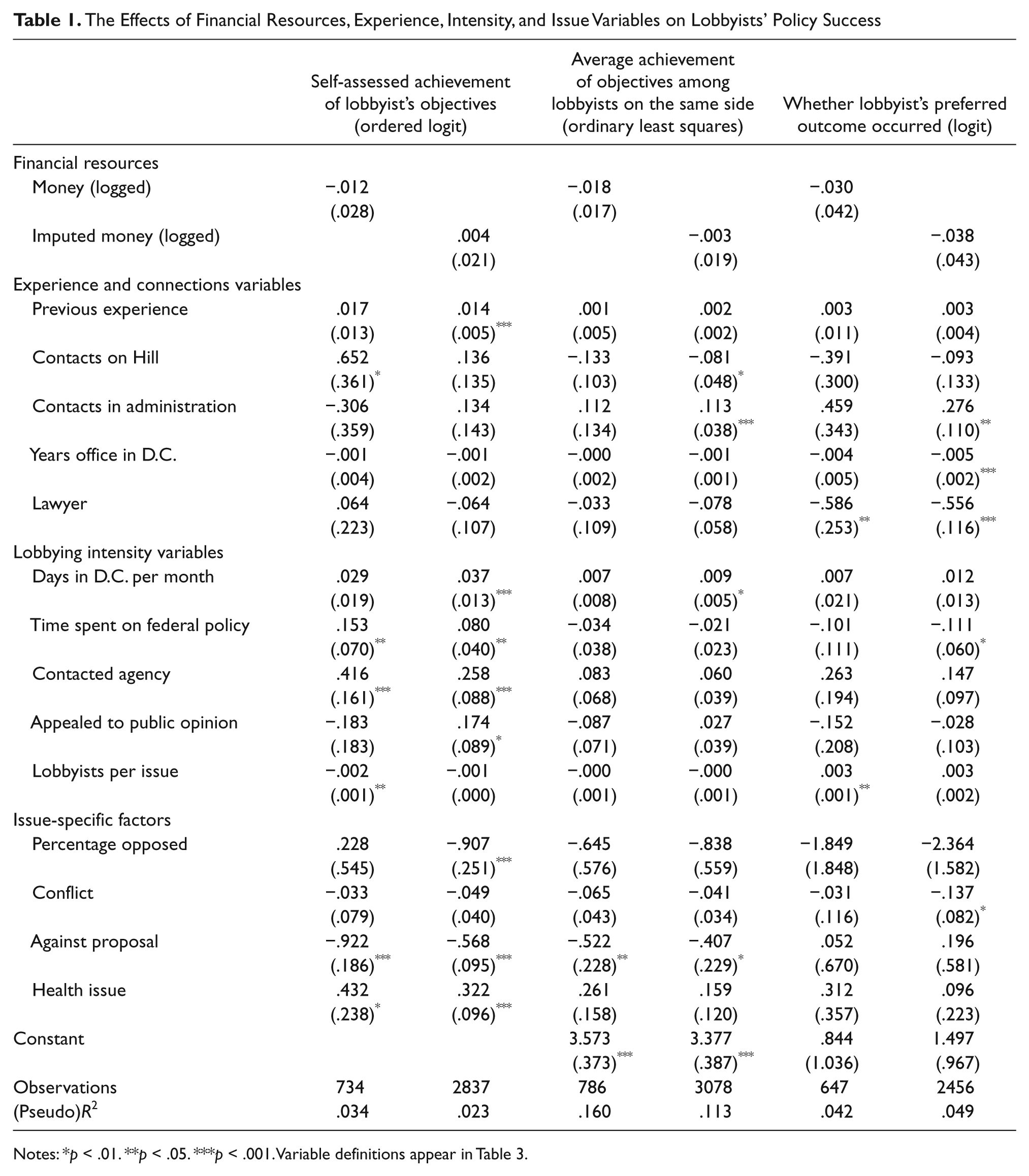
Notes: *p < .01. **p < .05. ***p < .001. Variable definitions appear in Table 3.
While the amount of money an organization has at its disposal may not determine whether it gets what it wants on a particular policy issue, perhaps the ways organizations spend their money affect their success. Several variables describing the lobbyist’s financial resources, experience or connections, intensity of lobbying effort, and the issue itself do tend to enhance or reduce the lobbyist’s success. Financial variables considered apart from money, including the number of group members, the age of the organization, whether the group has a PAC, and the spending and receipts of any PAC, do not significantly predict greater success. (These were dropped from the models in Table 1 but appear in Table 3.) The seeming irrelevance of these traits is further evidence that more money, or what might be seen as greater power or reputation, does not ensure greater policy success. In fact, groups with greater members or customers report significantly less success than smaller groups.
Regarding the lobbyist’s experience and connections, there is some limited evidence that more money can buy better experienced or better connected lobbyists who achieve greater success. Table 1 shows that having former colleagues in the presidential administration or on Capitol Hill and greater years of previous lobbying experience have positive effects on success. But lobbyists who are lawyers or whose firms have been in D.C. longer tend to have significantly lower levels of success. These negative effects suggest that lawyers and more established firms may be hired when policy goals seem more difficult to reach. Insignificant lobbyist traits include the number of years at the current organization, having a graduate degree, having been an elected official, and age. Even having congressional experience or more years of government experience does not make lobbyists more likely to realize their preferred outcome nor share in higher success for their side of the proposal, though interestingly, such lobbyists do report achieving significantly more of their objectives, in bivariate regressions as shown in the appendix).
In some cases, greater money may buy more intense lobbying efforts that produce greater policy success. As shown in Table 1, lobbyists who spend more days per month in D.C., who contact Congress or a federal agency about the proposal, and who appeal to public opinion on the proposal report higher individual and side success. And contacting an agency has a positive and significant effect on whether the lobbyist’s preferred outcome actually occurs. Insignificant intensity measures are the number of hours worked per week, the percentage of the lobbyist’s time spent on federal policy as opposed to legal representation or other duties, and whether the lobbyist lives in the D.C. area. Surprisingly, when an employer dispatches more lobbyists to work on the same issue, such lobbyists are not more likely to be successful—suggesting that flooding Congress or agencies with lobbyists is not a strategy that benefits wealthier groups.
Issue-specific factors also have an effect on lobbyists’ success. Proposals that are lobbied on by a greater number of lobbyists overall—which is an approximation of the issue’s salience—are more likely to be adopted, but the lobbyists working on higher salience proposals do not always feel more successful. This discrepancy may be explained by the compromises and concessions the lobbyist feels forced to make in order to get part of what he or she wants. Similar to the number of lobbyists working on a measure is the level of conflict lobbyists report. Consistent with previous research (Evans 1996; Price 1978; Wiggins, Hamm, and Bell 1992), the data indicate that conflict makes it harder for everyone to achieve their policy objectives. Lobbyists who oppose a policy proposal report achieving significantly fewer objectives than lobbyists who support a proposal, controlling for whether the preferred outcome occurs or not. This asymmetric relationship between lobbyists’ objectives and their success is likely because defending the status quo is generally easier than lobbying for something new (Baumgartner et al. 2009). Finally, lobbyists working in the health policy domain report greater success than those in other domains. 9
While Table 1 displays the effects of individual lobbying and issue variables, Table 2 focuses the analysis on group type. Business groups (including businesses and trade and professional associations, all of which have a profit motive in these data) are the omitted category, in order to see whether other types of groups are more successful than business groups. If business interests are better able to hire external lobbyists, or to hire lobbyists with greater experience or personal connections or to pay lobbyists more money and expect them to put in more work, these secondary factors are not controlled for in Table 2 and therefore would be seen in the effect of group type. In fact, many of the variables describing lobbyists’ experience, connections, and effort level are correlated with group type: Relative to other lobbyists, lobbyists representing business have higher incomes, spend more time on federal policymaking, have more years of government experience and previous lobbying experience, are more likely to have former colleagues in the administration or on Capitol Hill, are more likely to contribute to a PAC and participate in the PAC’s decision making, and tend to work for an office that has been in D.C. longer. But importantly, these seeming advantages do not equate to greater policy success.
The Effects of Group Type Alone on Lobbyists’ Policy Success, as Compared to Business Interests, the Omitted Category
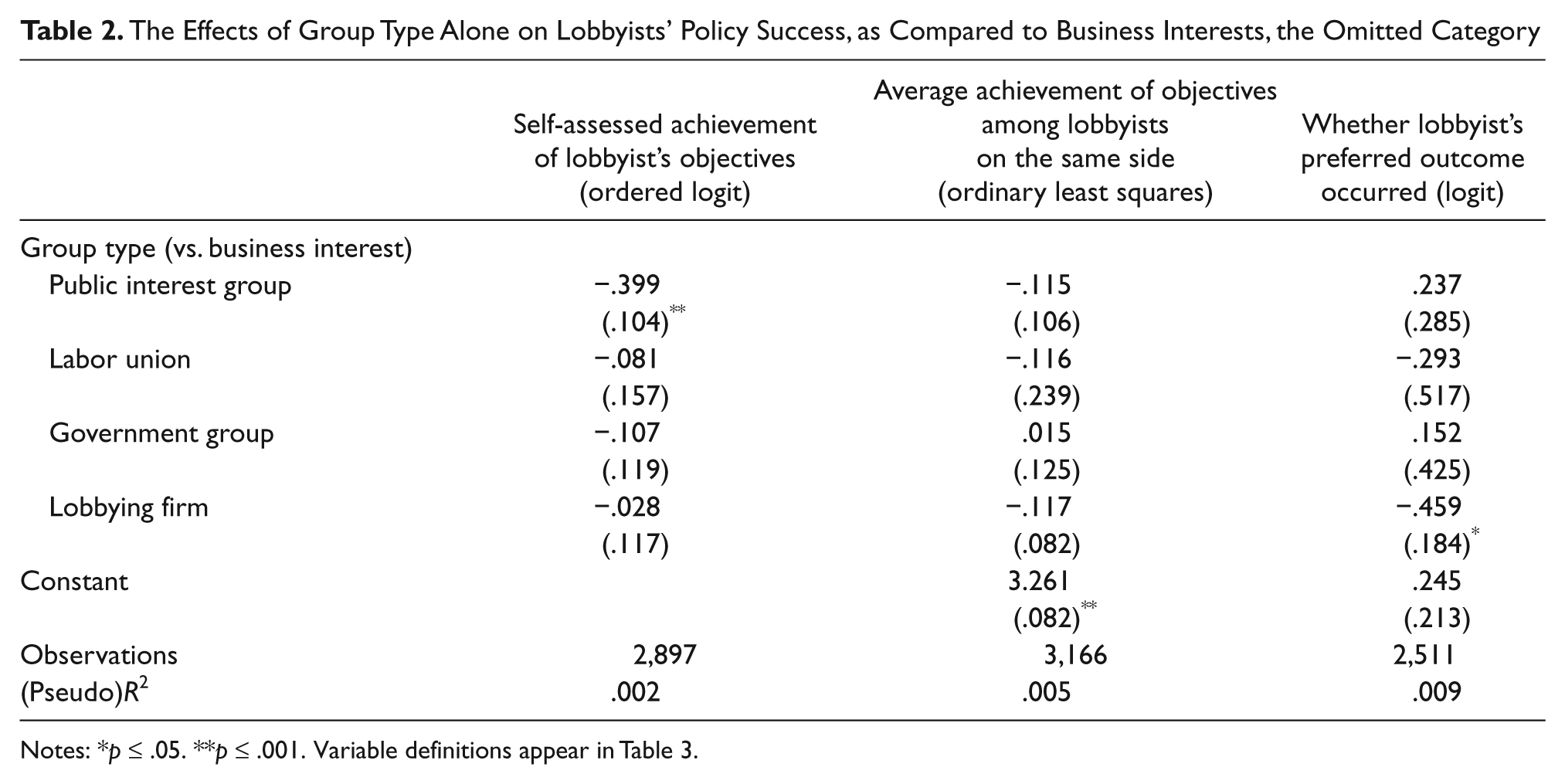
Notes: *p ≤ .05. **p ≤ .001. Variable definitions appear in Table 3.
As shown in Table 2, there are few significant differences between the success of business interests and that of other group types. The data show that public interest group lobbyists report achieving significantly fewer of their objectives than business lobbyists do, but public interest lobbyists are actually more likely than business interests to realize their preferred outcomes. Though the latter finding is not statistically significant, these results together suggest two possibilities. Public interest groups may make greater compromises than business interests do, perhaps because their broader goals—such as improving the environment—are simply harder to achieve than the small-step goals of business associations—such as a narrow provision in the tax code. Alternatively (and compatibly), public interest lobbyists may be more humble in their assessment of success than lobbyists with impressive connections who charge high salaries for their lobbying efforts. As evidence of this, lobbyists with more experience as lobbyists, in Congress, or in government; lobbyist with higher incomes; lobbyists with contacts on Capitol Hill or in the administration; lobbyists who live in the D.C. area; and contract lobbyists (those whose employer is a lobbying firm) all report higher self-assessed success than other lobbyists, as shown in Table 3.
Variable Definitions, Descriptive Statistics, and Bivariate Regression Findings

Notes: * Data were collected by the author; the remainder were collected by Heinz et al. (1993). The right-most column indicates whether, in bivariate regressions, the logged money or the logged imputed money of an organization significantly predicts the variable at p < .05, and errors are clustered on the employer. The column second from the right indicates whether any of the three dependent variables capturing policy success are significantly predicted by the variable at p < .05. The direction of significant effects is displayed in parentheses.
Regarding other group types, contract lobbyists report less individual success than business interests do. This may be evidence that interest groups hire lobbying firms when they perceive success to be especially difficult to obtain or reflects the fact that lobbying firms work for a variety of clients, including public interest groups, who generally report less success than businesses. And business interests are neither significantly more nor less successful than labor unions or government groups. Further analysis of each side of a policy proposal (not shown) indicates that neither the side with more business interests nor the side with a greater proportion of business interests is more likely to win; the relationship is neither significant nor even positive. In short, Table 2 reveals no clear advantage to being a business interest rather than a public interest group or government interest. This finding affirms the conclusions of Smith (2000) that when businesses unite on an issue, the public is more likely to mobilize against and defeat the business interest.
Testing for Indirect Effects
While Tables 1 and 2 show minimal connection between lobbying groups’ resources and their policy success, the data set sheds light on a wide array of ways in which groups may spend their money, some of which may be linked to greater policy success. To examine such potential paths to success, I create bivariate models for (1) each possible independent variable and each policy success (dependent) variable and (2) money and imputed money as they predict each independent variable. Results appear in the two right-most columns of Table 3. A few significant relationships are worth noting.
First, individual and side success are enhanced when lobbyists contact Congress, when they contact federal agencies, and when they lobby in more venues; and lobbyists whose employers have more money are more likely to contact these institutions and to lobby in more venues (i.e., Congress, agencies, courts, or the public). Thus, lobbying is more effective than not lobbying, and groups that have more money are more likely to lobby in a given venue. While these two findings are hardly surprising, they do point to an important difference in the success of interests who can afford to lobby and those who cannot, and who therefore are not captured in extant studies of lobbying (but see Denzau and Munger 1986). A second noteworthy finding in Table 3 is that lobbyists who give money to their organization’s PAC and those who participate in PAC decisions about political contributions enjoy greater side or individual success, respectively, and groups with more money are more likely to have PACs. A third significant finding is that groups with more money tend to face fewer lobbyists opposed to their position, and this condition is associated with higher self-reported success.
These three results provide some evidence that wealthier interests, particularly those who represent business (which are more likely to have PACs and which tend to lobby on narrower issues that face less opposition), are better represented and more successful than other interests. These linkages suggest interestingly that money itself may not buy outcomes, but choices about which issues to lobby on and which actions to take probably do affect success.
As an additional test of indirect effects, I sought to show whether collectively the lobbyist’s experience and connections or the intensity with which the respondent lobbied affect the lobbyist’s success. I created composite indices for experience/connections and for lobbying intensity by performing a factor analysis on each set of variables. I dropped variables with factor loadings below .00; then I repeated the factor analysis and used it to predict the two indices. The experience/connections index significantly and positively predicts self-reported success, and the lobbying intensity index predicts self-reported success and is weakly associated with success for that side of the proposal. This is credible evidence that the harder a lobbyist works and the better her connections and experience, the more success she seems to have, at least according to her own assessment. But importantly, neither the experience/connections index nor the lobbying intensity index has a significant relationship with money or imputed money—suggesting that money does not necessarily buy more experienced or better connected lobbyists, or even the ability to lobby more intensely.13 Since money does not predict these indices, the Baron-Kenny (Baron and Kenny 1986) mediation test fails to show that experience, connections, or lobbying intensity are mediating between financial resources and policy success. Finally, I also considered using factor analysis to obtain a latent variable capturing financial resources. There was no single and strong eigenvalue, and many correlations within the factor were low, so I do not use a latent variable for financial resources.
Discussion and Conclusions
This study goes beyond previous work focused on interest groups’ financial resources to consider the benefits such resources might buy, such as higher quality lobbyists spending more time lobbying in more venues. It builds on the original Heinz et al. (1993) study by adding variables that objectively measure policy success and that capture organizations’ overall financial capacity. The evidence suggests that some traits specific to the lobbyist, to the organization, and to the issue are associated with both greater organizational wealth and greater success. While the general picture shows little measurable effect of organizational wealth on groups’ policy success, the data suggest that how that money is spent can affect groups’ ability to get what they want.
The evidence that some groups’ greater wealth buys them higher quality, more successful lobbyists is weak but present. Some indicators of experience and connections are indeed associated with greater self-assessed success (i.e., previous experience as lobbyists or on Capitol Hill), while some indicators of experience or connections reduce the odds that such lobbyists are on the winning side of a proposal (i.e., lawyers, contract lobbyists, and firms that have been in D.C. longer). Lobbyists representing business interests report significantly more success than public interest lobbyists, though business interests are no more likely than public interests to achieve their desired outcome. Similarly, higher income lobbyists report greater individual success, but they are not more likely to achieve their desired outcome nor share in greater success for their side of a proposal.
We see compelling evidence that greater lobbying intensity enhances success. But less often does greater financial wealth makes greater lobbying intensity possible. Some indicators of lobbying intensity are linked to greater financial resources and predict greater success (i.e., contacting Congress, contacting agencies, lobbying in more venues, contributing to a PAC, and making decisions about how PAC contributions are distributed). Greater resources allow interest groups to lobby in more venues and participate in their employer’s PAC, and these factors are associated with greater success. Other variables describing lobbying intensity are linked to greater lobbyist success but are not associated with greater organizational wealth (i.e., having contacts on Capitol Hill or in the administration, working more hours per week, living in D.C., spending more days in D.C. per month, and a greater percentage of time spent on federal matters). Likewise, composite indices
of both experience/connections and lobbying intensity predict greater success as reported by the lobbyist; however, these indices are not significantly associated with greater organizational wealth. Thus some interest groups do more lobbying without more money and achieve success through greater lobbying intensity. But the results are not strong enough to significantly link interest groups’ financial resources to their policy success.
Some caveats should be noted. First, the sample selection mechanism means that very low-salience proposals that attract few or no lobbyists are not included. Previous scholars have suggested that low-visibility issues may be more likely to be the subject illicit pressure from campaign contributors than are issues attended to by the American public (Frendreis and Waterman 1985; Grenzke 1989). But the present study addresses lobbyists’ resources, not direct donations to politicians. Moreover, the number of lobbyists active on an issue and the level of conflict surrounding it are indicators of salience, and these variables do not have a consistent effect on the dependent variables. Further analysis of the effect of money performed at each level of conflict, and interactions between lobbyists per issue and the two measures of money, provide no evidence that the effect of interest groups’ money depends on the salience of the issue. In addition, some previous work links greater interest group influence to higher salience issues (Kingdon 1989) or has found little evidence that groups’ resources determine their success in a sample of issues that varies greatly in salience (Baumgartner et al. 2009; but see Lowery 2007).
A similar concern is that the sample of lobbyists and groups is not the universe of all lobbyists employed and active on these issues. As Baumgartner and Leech (2001) show, in 1996 the most salient issues mentioned in lobbying disclosure reports attracted many hundreds of lobbyists; in these data the maximum number of lobbyists working on a single proposal is 263. However, it is clear that interest group lobbying activity has increased notably since the 1970s and 1980s (see Petracca 1992 for a review; Berry and Wilcox 2007), suggesting that 263 was a relatively high number in 1981. Moreover, with nearly eight hundred lobbyists representing more than four hundred employers, the Heinz et al. (1993) data set covers more lobbying groups than any other study before or since, and it is striking how little the variance in resources matters in the groups’ success.
Heinz and his colleagues (1993, 351) wrote that their most interesting finding was how little variation in policy success could be explained by their many variables. Indeed, the highest R2 presented here is .16, suggesting that policymaking continues to be an idiosyncratic process fraught with normative concerns and unanswered questions. Yet this study adds to the respected body of research that indicates that for lobbyists, money alone does not buy success—but how that money is spent can affect interest groups’ ability to get what they want.
Footnotes
Declaration of Conflicting Interests
The author(s) declared no potential conflicts of interest with respect to the research, authorship, and/or publication of this article.
Funding
The author(s) received no financial support for the research, authorship, and/or publication of this article.
1.
The data used here, and all explanatory information, will be sent directly to any interested individual upon contacting the author. The Heinz et al. (1993) data set is available from ICPSR at  .
.