




Abstract
In this article, the author argues that the Progressives can be as much characterized as the antistatists of the nineteenth century as the statists of the twentieth century because their overriding goal was the destruction of the party state and not, directly, the creation of the bureaucratic state. They found in Anti-Federalist political thought a general antistatist template that they used to articulate their specific objection to the nineteenth-century party state. This template comprised a mutual commitment to simple government, the common good as a preinstitutional reality, democracy, direct and responsive government, fear of elite rule, civic education, and cultural homogeneity.
If the Federalists’ conception of federalism and the value of a central government was victorious over the Anti-Federalists’ conception—now known as “confederalism”—in 1789, the depth and scope of this victory has only expanded through the course of history (Storing and Dry 1981; MacDonald 1963). The conventional view—accurate in my opinion—is that the New Deal not only executed the Federalists’ vision of a stronger and more expansive federal government but also went beyond it, altering the balance of power between the federal and state governments and effectively ending the doctrine of “dual sovereignty” that had existed until then (Corwin 1950, 1-24; Mettler 1998). Attached to this conventional view is the interpretation that the Progressives were the forerunners of the New Dealers, partners in crime and descendants of the Federalists in their partiality to the powers of the federal government over those of the states (Mann 1963; Graham 1967; Dionne 1996; Derthick and Dinan 1999). I challenge this neat liberal–Progressive connection, a result of ex post facto reasoning, in this article.
The Progressive scholar and Pulitzer Prize winner Vernon Parrington (1927, i) freely admitted in the foreword to the first volume of Main Currents, “[T]he point of view from which I have endeavored to evaluate the materials, is liberal rather than conservative, Jeffersonian rather than Federalist.” He meant “liberal” in the eighteenth-century sense. If this observation seems odd today, it is because later generations of scholars have been too quick to draw the connection between the Progressive case for a stronger central government and the New Deal’s delivery of it. Yet if we unpacked what the Anti-Federalists were for rather than cast them in the crude terms of merely what they were against, there are striking parallels to Progressivism worth exploring.
It would be difficult to deny that the Progressives initiated the bureaucratic state-building trajectory that the New Deal would follow, but it would be equally difficult to argue that the Progressives would have welcomed New Dealism as the perfect fruition of their ideals. After all, the Progressives had their eyes set on dismantling a party state and replacing it with a more efficient and responsive one. This negative thrust of Progressivism is sometimes understated, yet here is where its debt to Anti-Federalist political thought might be discerned. If hindsight is twenty–twenty, we cannot understand the Progressives only according to what became of their ideas in the future which they could not have foreseen. It may be helpful to understand Progressivism also in terms of what they borrowed and emulated from the first Americans before themselves who had dared challenged the wisdom of the founding and Madison’s “new science.” And when we see that Progressivism traces some of its roots to the most unlikely of places, Anti-Federalism, we may come closer to unpacking its enigmatic philosophy. Here then is my two-part thesis: First, what unified the various strands of Progressive thought was its fundamental revulsion of the party state—the regnant state that preceded the modern bureaucratic state. When we focus our attention on this negative goal of Progressivism, we can then perceive its kinship to the Anti-Federalists’ antistatism of the eighteenth century that had, we sometimes forget, also rejected one state in favor of another. Second, as the Anti-Federalists appealed to precepts of classical republicanism to justify their opposition to the Federalist constitution and the structure of a new American government, so too did the Progressives in arguing for the abolition of the party state. In particular, both shared and articulated a mutual commitment to (1) simple government (rather than the complex “new science”), (2) the common good as a preinstitutional reality (rather than one that emerges from interbranch deliberation), (3) democracy (rather than a fear of it), (4) direct and responsive government (rather than indirect and representative government), (5) fear of elite rule (rather than fear of demagoguery), (6) civic education (rather than the assumption of self-interest), and (7) cultural homogeneity (rather than heterogeneity as a solution to faction in a large republic).
Anti-Federalism, Progressivism, and Antistatism
Anti-Federalism and Antistatism
The Anti-Federalists are back in vogue, but only after a 150-year hiatus. 1 Other than an isolated body of scholarship tracing the endurance of Anti-Federalist thought into the Jacksonian era (Ellis 1987; Cornell 1989; Aldrich and Grant 1993), there had been little if any work tracing their impact on American politics until scholars revived their interest in classical republicanism as a critique of postwar liberalism and offered the intellectual backdrop to the Reagan revolution (Wood 1969; Pocock 1975; Rahe 1992). In 1981, when Ronald Reagan declared that “government is not the solution to our problem” but instead that “government is the problem,” he inaugurated a political revolution that would reintroduce the repackaged Anti-Federalist ideas of “New Federalism” and the jurisprudential doctrine of “original intent” into mainstream politics. That same year, Hebert Storing published The Complete Anti-Federalist, the largest compilation of Anti-Federalist writings yet, and only the third. 2
It is unlikely that Anti-Federalist political philosophy died with Jacksonian democracy, only to be triumphantly resurrected by Reagan. Instead, it found refuge in the most unsuspected of places. Framed exactly between the founding and the Reagan Revolution, the Progressives repackaged the antistatism of Anti-Federalist thought to decry and replace the late nineteenth century “state of courts and parties” with a new bureaucratic state (Skowronek 1982). The idea that the Progressives borrowed heavily from the Anti-Federalists sounds ridiculous on first blush because of the textbook view that the Anti-Federalists were our first antistatists, and the Progressives the first statists. While not entirely incorrect, such a view also misses the uniquely American meaning of “antistatism,” which has been a bivalent idea in America as long as there were two levels of government. The Anti-Federalists, after all, were not straightforwardly against all or any state apparatus. They merely rejected the version presented by the Federalists. As Patrick Henry entreated, “We are come hither to preserve the poor Commonwealth of Virginia, if it can be possibly done: Something must be done to preserve your liberty and mine: The Confederation; this same despised Government, merits, in my opinion, the highest encomium.” 3 Similarly, A Plebeian volunteered, “The importance of preserving an union, and of establishing a government equal to the purpose of maintaining that union, is a sentiment deeply impressed on the mind of every citizen of America. It is now no longer doubted, that the confederation, in its present form, is inadequate to that end: Some reform in our government must take place.” 4 Borne of political compromise, the Federalists’ invention of the new federalism separated American antistatism from its erstwhile parent, anarchism. Henceforth, antistatism was no longer a purely negative position (as anarchism is) against the state, but a bivalent stance in which hatred for one type or level of government is counterpoised with love for an alternative type or level of government. It is in this sense that we ought to understand Progressivism’s antistatism.
Progressivism and Antistatism
It is perhaps because we forget that an old “state of courts and parties” had to be demolished before a new bureaucratic state could be built that we have underestimated that part of the Progressives’ identity that might not be unreasonably characterized as antistatist. But separating Progressivism’s negative form its positive goals may well be of use in assessing Progressivism’s mixed record. In its negative project to displace the old state of courts and parties, the Progressives were very successful; but in its endeavor to build a modern, efficient state, it was more of a “lost promise.” When we separate Progressivism’s antistatist and statist impulse, we can make better sense of a movement that was both antiestablishment on one hand and yet top-down on the other, a movement that used “Hamiltonian means for Jeffersonian ends” (Mowry 1946, 145).
The Progressives, to be sure, were partly responsible for history’s conflation of what they were for and against, for they understood that it sounds nicer arguing for something rather than against another, and that it could be more diplomatic and politically persuasive to laud efficiency, experts, and a bureaucratic state rather than to decry corruption, bosses, and the political machines. And so Herbert Croly erased the distinction between Progressivism’s positive and negative projects where he declared. “When a group of state or city officials effectively assert the public interest against the private interests, either of the machine or of the local corporations, they are acting just as palpably, if not just as comprehensively, for the national welfare, as if their work benefited the whole American people” (Croly [1909] 1989, 274).
Yet we see in Croly’s roundabout way of defining the indefinable “public interest” that Progressivism’s unifying logic lay, ultimately, in its antinomy to the party state. Like the Anti-Federalists, the Progressives were social critics before they were social reformers. As Theodore Roosevelt put it, his was the age of “a fierce discontent with evil . . . whether in industry or politics” (McGeer 2003, xiii). Hofstadter crisply articulated Progressivism’s antistatism when it announced that it was ultimately about “the complaint of the unorganized against the consequences of organization” (Hofstadter [1955] 1959, 214). The major consequence of organization that the Progressives were agitating against was the corrupt bossism of the nineteenth century. As the Progressive historian Benjamin Parke De Witt recognized three tendencies that united Progressive thought, he chose to highlight that “[t]he first of these tendencies is found in the insistence of the best men in all political parties that special, minority, and corrupt influence in government—national, state, and city—be removed” (De Witt 1915, 4, emphasis added). Or as Woodrow Wilson lamented, “The government, which was designed for the people, has got into the hands of bosses and their employers, the special interests. An invisible empire has been set up above the forms of democracy” (Wilson 1913, 35). By “invisible empire,” Wilson meant the party state, an elaborate regime of governance coordinated by political machines, lubricated by the spoils system, and enforced by the courts. What Wilson called an “invisible empire,” the Progressive Party Platform called an “invisible government”:
Instead of instruments to promote the general welfare, they [the two major parties] have become the tools of corrupt interests which use them impartially to serve their selfish purposes. Behind the ostensible government sits enthroned an invisible government owing no allegiance and acknowledging no responsibility to the people. To destroy this invisible government, to dissolve the unholy alliance between corrupt business and corrupt politics is the first task of the statesmanship of the day. (Progressive Party Platform 1912)
Almost every Progressive reform seemingly advocated in favor of the state may similarly be understood to have been animated by an antinomy to the party state. Indeed, understanding the Progressives’ antistatism can help us to understand the flip side of their more conventionally “statist” reforms. Consider the sixteenth amendment, so critical for the bureaucratic-statist agenda of New Deal liberalism and therefore easily mistaken as a reform in the Hamiltonian and not the Jeffersonian tradition. Critically, the Progressives were not hoping to expand the federal purse or the size of the federal government when they proposed and supported a constitutional amendment that would allow the federal government to levy income taxes on individuals. As Edwin Seligman, a Progressive expert on taxation and campaigner for the sixteenth amendment, freely admitted, “[T]he income tax is assuredly not needed for revenue purposes” (Seligman 1914, 635). Even if a boost in federal revenues was hoped for, it was not expected. According to Elliot Brownlee, “[V]irtually none of the income-tax proponents believed that the income tax would become a major, let alone the dominant, permanent source of revenue within the consumption-based federal tax system . . . and the idea that the tax would enable the federal government to grow significantly was far from the minds of the drafters of the 1913 legislation” (Brownlee 2004, 55).
Like so many Progressive reforms, their support of the sixteenth amendment was not motivated by a desire to increase the size of the federal coffers but to weaken the power of the political machines at the state and local levels that benefited from the extant means of federal revenue acquisition. It was titled “An Act to reduce tariff duties,” 5 and not to create the federal income tax, and the Progressives supported the latter because they believed that tariffs, the “mother of all trusts,” were an odious system of government revenue because they were the perfect implement for members of Congress playing the pork-barrel, distributive politics of the nineteenth century (Brownlee 2004, 44). There were myriad opportunities in the complex tariff schedules for members from both parties to offer subsidies (or penalties) to narrowly defined groups of constituents, and especially industrialists who were in cahoots with the politicians of the party state. 6 Incidentally, this is why the movement for tariff reform was so slow to organize from within the two major parties. The Democratic Party was quicker to cry foul only because its constituents did not benefit as much from the transfer payments and in particular the Civil War pensions the federal government, via the party machine, disbursed from its tariff receipts. 7
The Progressives also did not support a federal income tax to achieve redistributive outcomes along the lines of New Deal liberalism. Replacing the system of tariffs with state and local income taxes would have balanced the burden of taxation between the rich and the poor or the farmer and the industrialist, but doing so would also have perpetuated the power of the political bosses. Instead, the Progressives looked to placing the power of the purse at the federal level and to extend the scope of federal government so that by putting the money and the action elsewhere, the political machines could be put out of commission. As Seligman explained,
Federal administration is apt to be more successful than state administration. Not only is it easier to secure expert assistance for the larger problems involved in national expenditure, but the contact between official and citizen is not so likely to have that intimate relationship which would exist in the smaller administrative sphere. Above all, the influence of the party boss and of machine methods is obviously less pronounced in proportion as the sway of governmental operations becomes broader. (Seligman 1914, 652, emphasis added)
When the Progressives advocated “efficiency,” then, they were not counterpoising the efficiency of the government versus the efficiency of the markets, as is contemporarily understood. Instead, efficiency’s antonym at the turn of the twentieth century was corruption. Consider the seventeenth amendment, which was not motivated so much by the pull factor of democracy but the push factor of corruption, which was, according to Roger Brooks, “the greatest evil” motivating the call for direct election of senators (Brooks 1987, 200). As one scholar reported in 1916 in the American Political Science Review, the seventeenth amendment “appealed to the people now not so much as a logical extension of democracy, but with far greater force as an expedient method whereby they could exercise more complete control over their state legislatures” (Tanger 1916, 697). The Progressives understood that to dismantle the party state, they had to attack the root of the problem by divesting party bosses of their king-making power. And the problem of the Senate, according to Henry Jones Ford, was that it had become the “Diet of party lords” (Ford 1898, 270). As one advocate of the amendment, Senator Albert Beveridge, lamented, “[T]he party boss has become more potent than the legislature, or even the people themselves, in selecting United States Senators in more than one State” (Little 1991, 641). The proponents of the seventeenth amendment understood that without the gift of office, there could be no quid pro quo in spoils. They saw the amendment primarily as an assault on the party bosses who controlled the composition and preferences of state legislatures and only secondarily as an advancement of democracy. 8 Once again, the positive goal of the Progressives—in this case advocacy of direct democracy—can be understood only when set alongside its animating, negative thrust. That is why the heart of Progressivism is where it subtly parts company with modern liberalism, which is arguably more concerned with doing good than abolishing evil.
The list goes on. When the Progressives proposed direct primaries, initiatives, referenda, and recall, they were as much concerned with curtailing the nominating, agenda-setting, and tenure-administering power of the party bosses as they were with any positive goal such as the promotion of democracy. 9 Even women suffrage, Progressives believed, could deal a blow to the party state because expanding the suffrage to citizens as yet unaffiliated to the political parties would increase the common-good-seeking virtue quotient of the citizenry as a whole. This is why so many suffragists relied on the ideology of Republican motherhood to advance their petition for women’s right to vote, and why women groups paradoxically lost their political salience when suffrage was extended because women lost their claim to the moral high ground and became, like men, tainted participants of the party state (Harvey 1996).
If the Progressives were sometimes more enthusiastic about their negative project of abolishing the party state than they were with following through with their positive reforms, it could be because they were surer about what they were against than what they were for. If the conventional understanding of the Progressives has emphasized their belief in what the government can do for society, it is worthwhile to remember that they also possessed a strong sense of what society can do for government. As Herbert Croly recognized, “[T]o nationalize a people has never meant merely to centralize their government” (Croly [1909] 1989, 273). The Progressive era saw the proliferation of what Eldon Eisenach has called “parastate” institutions—churches, professional organizations, nonpartisan national magazines—to speak for “the collective ends of the national community” rather than to promote the private ends of partisans. Again, the anti-(party)-statist agenda is clear. As Eisenach observed, “Both organizationally and culturally, the institutions that consciously articulated and enforced claims of a national public good were established largely outside of formal governing institutions and in direct opposition to the most powerful informal governing institution of them all—the mass-based political party” (Eisenach 1994, 18). Indeed, the Progressives’ multipronged attack on the party state—the federal government from the top and “parastate” organizations from the bottom—reveals the structure of their priorities. As Brian Balogh has argued, “New Liberals viewed unilateral intervention into the economy by the General Government as just one of many forms of associative actions. It was rarely their first choice for such action” (Balogh 2009, 364). If the Progressives were willing to put their faith in science, in experts, in the civil service, in churches, or in the people—practically anything or anyone but the party bosses—it could be because the Progressives were more successful as the antistatists of the nineteenth century than as the statists of the twentieth century. The curious course of Progressivism and its diverse foci begin to take on a unity when set against the movement’s preeminent goal of displacing the “state of courts and parties.”
Classical Republicanism, Anti-Federalism, and Progressivism
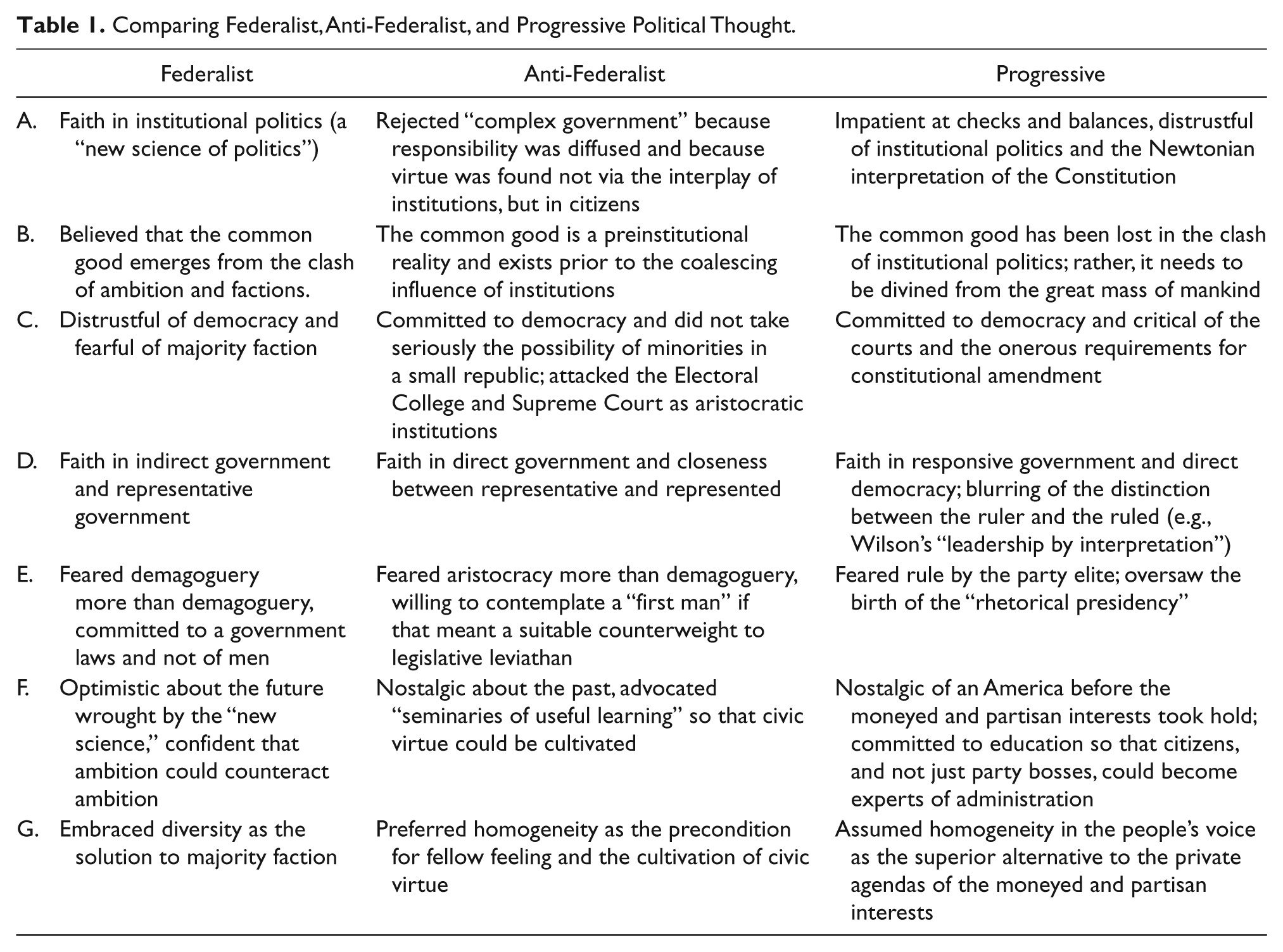
In the second half of this article, I aim to show that the Progressives launched their attack on the party state by appropriating many central tenets of Anti-Federalist political thought. They turned, in particular, to the theory of virtuous citizenship encapsulated in seven precepts that bear resemblance to the Anti-Federalists’ interpretation of classical republicanism. To aid in the points of comparison and contrast elaborated on later, Table 1 summarizes what is to follow.
Comparing Federalist, Anti-Federalist, and Progressive Political Thought.
A Simple Government
The Progressives echoed the Anti-Federalist charge that the Constitution was written by and for aristocratic interests, a condition that the patronage-oriented party state did nothing to ameliorate but only exploited. It is no coincidence that Progressive historians were among the first scholars to offer a sustained critique of the Federalists’ constitution, which they saw as the defective underlying infrastructure of which the superstructure of the arty state was a necessary part (Parrington 1927). The Progressive era was, after all, probably the first time in American politics when, on countenancing the political and economic influence of the Vanderbilts and the Rockerfellers, Madison’s hitherto ingenious argument of the benefits of “extend[ing] the sphere” in Federalist 10 had lost its previous luster. When they saw that even a large republic was no defense against powerful factions or interests groups, the Progressives became skeptics of the “new science of politics,” and reverted back to many elements of the Anti-Federalist theory of republicanism. Because Progressives were now convinced that the Federalists’ complex machinery could not do the job of promoting the common good, they proposed a return to simple responsive government, liberated from a system of checks and balances that served only to benefit the interests, to do the people’s work.
Even though the Progressives accepted the reality of a large republic, they concurred with the Anti-Federalists’ rejection of the complex government that was the brainchild of Madison et al.’s new science of politics and most famously explicated in Federalist 10, and preferred instead a simple government.
10
Denatus observed that “the constitution of a wise and free people, ought to be as evident to simple reason, as the letters of our alphabet.”
11
But in the Federalists’ constitution, A Columbian Patriot saw a “heterogeneous phantom.”
12
Like the Anti-Federalists, the Progressives had neither patience nor faith in Madison’s new science of politics for two reasons they shared. First, they opposed the Constitution’s system of checks and balances because they felt that the party state exploited the Constitution’s unwieldiness toward collective action. As A (Maryland) Farmer argued, complex governments “seem to bid defiance to all responsibility, as it can never be discovered where the fault lies.”
13
Complex government also meant irresponsible government. As Centinel argued, “[I]f you complicate the plan by various orders, the people will be perplexed and divided in their sentiments about the sources of abuses or misconduct, some will impute it to the senate, others to the house of representatives, and so on, that the interposition of the people may be rendered imperfect or perhaps wholly abortive.”
14
This lack of responsibility, for Woodrow Wilson, was the chief defect of the Constitution. He lamented, for example, that merit-based civil service reform was stymied by boss-controlled members of Congress who deployed log-rolling tricks to derail government for the common good. The imprint of Anti-Federalism on Wilson’s political philosophy is unmistakable in this conclusion:
It is, therefore, manifestly a radical defect in our federal system that it parcels out power and confuses responsibility as it does. The main purpose of the Convention of 1787 seems to have been to accomplish this grievous mistake. The “literary theory” of checks and balances is simply a consistent account of what our Constitution makers tried to do; and those checks and balances have proved mischievous just to the extent which they have succeeded in establishing themselves as realities. . . . [The Founders] would be the first to admit that the only fruit of dividing power had been to make it irresponsible. (Wilson [1885] 1901, 284-85)
The Common Good as Preinstitutional Reality
The second reason why the Anti-Federalists and Progressives opposed complex government was borne of their political-epistemological belief that the common good existed as a monolithic, preinstitutional reality and their corresponding skepticism that an invisible institutional hand could coalesce a multitude of competing interests toward the pursuit of the common good (McWilliams 1990, 22). Because the Anti-Federalists envisioned a simple and homogenous republic, they simply assumed that there would be a corresponding homogeneity of views within the polity, and hence it made sense to speak of a monolithic common good that existed prior to the coalescing influence of institutions. In contrast, the Federalists and their political descendants who have conceived of the American Constitution as a Newtonian, pluralistic entity did not believe that the common good reliably existed as prepolitical reality. As Madison recognized in Federalist 10, “A landed interest, a manufacturing interest, a mercantile interest . . . grow up of necessity in civilized nations, and divide them into different classes, actuated by different sentiments and views. The regulation of these various and interfering interests forms the principal task of modern legislation, and involves the spirit of party and faction in the necessary and ordinary operations of the government.” Federalists, the forerunners to modern “interest group pluralists,” believed not only in the reality of competing interests but in the independent value of their Newtonian interaction in delivering democratic outcomes (Lowi 1979). Madison, in Federalist 14, called the scheme of representation he proposed in the Constitution a “great mechanical power, by the simple agency of which the will of the largest political body may be concentrated.” Thus, for the Federalists, the common good had to be found. Consider the contrast in the Federalist and Anti-Federalist attitudes toward commerce. In Federalist 6, Hamilton argued that “the spirit of commerce has a tendency to soften the manners of men, and to extinguish those inflammable humors which have so often kindled into wars,” and in Federalist 12 he advocated “multiplying the means of gratification.” Although commerce was thought to be a source of antagonism and corruption for both Anti-Federalists and Progressives, the Federalists embraced it as a way of promoting virtue—which indicates that they understood the common good not as a given reality but something to be cultivated.
In contrast to the Federalists and like the Anti-Federalists, the Progressives assumed that there was such a thing as a prepolitical common good—they had to because everywhere they looked, politics and political institutions were putatively corrupt—and refused to see America as merely a conglomeration of interests, but as a moral community. Put differently, the Progressives were, like the Anti-Federalists, more hopeful about the prospect of finding virtue in citizens than the Federalists were. As we have seen, the Progressives worried about an “invisible government” because they believed that the Federalists’ relocated faith in an invisible hand had created the very conditions for the pick-pocketing hand of the party state to thrive. They could not see how an “invisible government” held together by partisan loyalties could pull together what the Constitution pulled asunder and would have agreed with the thrust of Centinel’s rhetorical question: “If the administrators of every government are actuated by views of private interest and ambition, how is the welfare and happiness of the community to be the result of such jarring adverse interests?” 15 If anything, Progressives believed that party-state politicians used the spaces created by the constitutional check and balances to play cat and mouse with the common good. This is why they rejected both the need for the Federalists’ system of checks and balances and the interest brokering operating norm of the party state. It is also why, incidentally, many Progressives parted company from the New Deal when its proliferating agencies no longer looked like a neutral regulatory state but a stakeout of organized interests and collaborating politicians (Hofstadter [1955] 1959, 302). Not even the highest science of politics could, in the Anti-Federalist and Progressive mind, turn ambition into virtue. Both believed that the complex system created by the Federalists was too smart by half.
Democracy
In contrast to the Anti-Federalists and the Progressives, the Federalists were wary of democracy; they did not trust in men enough and opted instead for a government of laws. As has often been stated, the Federalists wanted to “extend the sphere” because they feared that the majority in a small republic would tyrannize a minority; and the only way to avoid the problem was to create a republic large enough so that no majority could ever form, and to create a Supreme Court as a bulwark against majority tyranny. In striking at the central operational principle of democracy—democracy cannot work unless a mechanism of aggregating preferences can be found—Madison in Federalist 10 was dealing as fatal a blow to democracy as he could muster.
If the Federalists were skeptical about human nature and perceived the need to channel ambition via a constitutional framework to turn vice into virtue, the Anti-Federalists were more insistent than the Federalists were on the classical republican belief that there was a fount of virtue in citizens that can and ought to be tapped. Sharing the Anti-Federalist concerns about an unwieldy constitution dedicated to the preservation of aristocratic interests, and further burdened by a party state incapable of transcending petty interests, the Progressives had no other option but to take their faith in citizens to Panglossian heights.
Because of their starting premise of a small and homogenous republic, the Anti-Federalists were oblivious or indifferent to the possibility of the tyranny by the majority and were far more comfortable with democracy than the Federalists were. 16 This is why some Anti-Federalists opposed the Electoral College, and most worried about the power of the Supreme Court to defend aristocratic interests. On the Electoral College, Republicus asked, “Is it then become necessary, that a free people should first resign their right of suffrage into other hands besides their own, and then, secondly, that they to whom they resign it should be compelled to choose men, whose persons, characters, manners, or principles they know nothing of?” 17 Way ahead of his time, Cato similarly believed that “the representative of the people should be of their immediate choice” and worried that “by the manner in which the president is chosen he arrives to this office at the fourth or fifth hand, nor does the highest vote, in the way he is elected, determine the choice.” 18
A similar conviction in democracy led Anti-Federalists to warn (of the Supreme Court) that “those usurpations, which silently undermine the spirit of liberty, under the sanction of law, are more dangerous than direct and open legislative attacks.” 19 The Progressives would have agreed with Brutus’s worry about the interpretive power of the courts and the provisions for constitutional amendment: “In respect to certain fundamental provisions, which necessarily receive the most rigid interpretation on the part of the courts, it is practically unmodifiable. A very small percentage of the American people can in this respect permanently thwart the will of an enormous majority, and there can be no justification for such a condition on any possible theory of popular Sovereignty” (Croly [1909] 1989, 36).
The Progressives clearly took a page from the Anti-Federalists in their criticism of the Constitution. Even Herbert Croly, who was very sympathetic to the Federalists, criticized Alexander Hamilton, who he believed “was betrayed by his fears and his lack of faith” for believing that it was “necessary to bestow upon the central government the support of a strong special interest.” “Instead of seeking to base the perpetuation of the Union upon the interested motives of a minority of well-to-do citizens,” Croly continued, Hamilton “would have been far wiser to have frankly intrusted its welfare to the good-will of the whole people” (Croly [1909] 1989, 41). Progressives like J. Allen Smith repeated Patrick Henry’s objection to Article 5 and expressed the prevailing Progressive view that by insulating the Constitution against amendment, the “framers of the Constitution deliberately intended to dethrone the numerical majority” (J. A. Smith 1907, 48). Smith went as far as to praise the amendment procedure set up by the Articles of Confederation (J. A. Smith 1907, 57).
Clearly, what was at the heart of Progressive criticism of the Constitution was the fact that it had been roped in to perpetuate the interest-protecting and status-quo-preserving party state. Even more than the Anti-Federalists, the Progressives were wary of the power of the courts because of their belief that they were in cahoots with Congress—the spearheading branch of the party state—to simply dispose whatever the latter proposed (Link [1955] 1967, 2:115). This is why Progressives were so strongly opposed, to paraphrase Stephen Skowronek, not only to the state of parties but also to the state of courts. Correspondingly, the Progressive Party Platform of 1912 read, “The Progressive party demands such restriction of the power of the courts as shall leave to the people the ultimate authority to determine fundamental questions of social welfare and public policy.”
Direct and Responsive Government
If the Federalists were at pains to prevent a majority, the Progressives—armed not with the new science of politics but the new sciences of society—were intent on divining and representing it, as we saw in the devolution of institutional power to citizens at both the state and local levels as a result of their direct democracy reforms (Marcus 1971; D. A. Smith and Fridkin 2008). The Progressives did not fear the cacophony of heterogeneous voices in a large republic in part because they believed that the voices of citizens were drowned out by machine politics and bypassed by secret congressional committee hearings, and in part because they assumed that their leaders (such as Woodrow Wilson) possessed the ability to lead them out of their self-regarding ways. Like the Anti-Federalists, Progressives like Herbert Croly and Theodore Roosevelt tried to tie together public and private imperatives, though they did it differently under the banner of “nationalizing democracy.” They did not reify the public–private distinction (Balogh 2009, 364). Similarly, we see in the Anti-Federalist theory of representation a blurring of the public–private distinction as well as the distinction between the ruler and the ruled—in Melancton Smith’s proposal that “representatives [should] . . . resemble those that they represent” 20 —just as we find a similar blurring of these distinctions in Woodrow Wilson’s “Leadership by Interpretation” (Ceaser 1979, 190). Indeed, it was the Progressive introduction of the “rhetorical presidency” as well as the primary nominating process that would culminate in modern plebiscitary presidents who have indeed, as the Anti-Federalist theory of representation prescribed, come to closely “resemble” those that they represent (Tulis 1987).
The Federalists, in contrast, believed that frequent recourse to the people would damage the reputation of government, believing that the ends of government are not always in line with the ends of democracy. In Federalist 49, Publius argued that “frequent appeals would, in a great measure, deprive the government of that veneration which time bestows on every thing.” Before Roosevelt and Woodrow Wilson advocated their theories of moral and didactic leadership to bring together a nation of solipsistic individuals and to break the stalemate of partisan wrangling, the Anti-Federalists foresaw the need for “characters who have genius and capacity sufficient to form the manners and correct the morals of the people, and virtue enough to lead their country to freedom.” 21
Fear of Elite Rule
The closeness in the Anti-Federalist and Progressive theories of leadership can be further highlighted with an understanding that the former were not uniformly against a strong executive. The Anti-Federalist fear of an elected king who would put the country through a frivolous pursuit of empire and glory was balanced by a perceived need to guard against a potential legislative leviathan at home. Some Anti-Federalists actually supported the creation of a strong executive to stand up to what they feared would be the aristocratic tendencies of the Senate. And so as James Monroe wrote, “With an executive organized on these principles, being independent of the legislature . . . I should be well content to intrust great powers.”
22
The Federal Farmer, probably the most widely read of the Anti-Federalists, went as far as to advocate “a first man”—clearly the Anti-Federalist incarnation of the modern, Progressive presidency—to be the focal point of patriotic sentiments. He wrote,
Independent of practice a single man seems to be peculiarly well circumstanced to superintend the execution of laws with discernment and decision, with promptitude and uniformity: the people usually point out a first man—he is to be seen in civilized as well as uncivilized nations—in republics as well as in other governments. In every large collection of people there must be a visible point serving as a common centre in the government, towards which to draw their eyes and attachments. The Constitution must fix a man, or a congress of men, superior in the opinion of the people, to the most popular men in the different parts of the community, else the people will be apt to divide and follow their respective leaders.
23
The Federal Farmer’s suspicion of a government laws of disposed him in the direction of advocating a government of (even a) man; his fear of demagoguery clearly subordinate to his fear of an aristocracy. 24 Like the Anti-Federalists who saw room for a strong executive to stand up to aristocratic interests, the Progressives sought a strong executive and an expanded merit-based bureaucracy that would stand up to the political machines and their allies in the Congress. Because Progressives understood full well that a strong legislature (and House speakership) and a weak executive were design features of “the state of courts and parties,” they saw it fit to empower the executive as a weapon against the party state. Like the Anti-Federalists, they were quite willing to deliver power to “a first man” so that he could protect the people against the “interests.”
Civic Education
Madison believed, as he wrote in Federalist 10, that “the latent cases of faction are thus sown in the nature of man.” He did not, as the Progressives did, believe in moralizing lectures to persuade politicians to set aside their self-interest for the common good because he believed that the way to find the common good was via institutions. The Anti-Federalists and Progressives resisted structural solutions to political problems and placed so much responsibility on the people and the nationally elected president only because they had a correspondingly prominent emphasis on civic education and a civil religion. Mercy Warren argued that “if the education of youth, both public and private, is attended to, their industrious and economical habits maintained, their moral character and that assemblage of virtues supported . . . there is not much danger that they will for a long time be subjugated by the arms of foreigners.” 25 As the Anti-Federalists feared that an arrogant, power-hungry ruling elite in a far-flung capital would produce a subservient and degenerated polity, the Progressives believed that only a universally and well-educated citizenry can stand up to the corruption in the country’s high places. Civic education would restore and instill in citizens a commitment to the public good that had been thwarted by the modus operandi of the party state. The Anti-Federalist recommendation of “seminaries of useful learning, with professorships of political and domestic economy” could just as easily have come from a Progressive reformer. 26 Like the Progressives, the Anti-Federalist also emphasized the instruction and learning in the social sciences, on “what is useful in this world—the principles of free government . . . the sciences of morality, agriculture, commerce, the management of farms and household affairs” because they believed that self-government could only work of citizens were educated and virtuous. 27
Indeed, the Anti-Federalists and Progressives alike saw the republic itself “as a school citizenship as much as a scheme of government” (Storing and Dry 1981, 1:21). We often forget that the Anti-Federalists wanted a Bill of Rights not only to protect the states but also for its civic educative purposes. “What is the usefulness of a truth in theory, unless it exists constantly in the minds of the people, and has their assent,” the Federal Farmer asked in advocating the Bill of Rights. 28 He believed that rights had to be enumerated and codified because he valorized the “effect of education, a series of notions impressed upon the minds of the people by examples, precepts and declarations.” 29 The same reasons inspired the Progressives to codify so many their reforms in amendments to the Constitution so that citizens could transcend their private perspectives and perceive the collective ends of the community.
Cultural Homogeneity
Both the Anti-Federalists and the Progressives saw a moral declension in America and looked nostalgically to earlier days for inspiration. The moralistic tones that pervade their jeremiadic prescriptions reveal a deep commitment to an underlying, unifying civil religion. For the Anti-Federalists, the victory of the American Revolution offered not so much a chance to create a new prosperous empire equal to the ones of the Old World, but an opportunity to create a republic of virtuous citizens untainted by corruption, greed, and lust for power (Ketcham 1986, 3). And religion was key to the cultivation of civic virtue. Although the Federalists saw no need to establish a religion to support the political institutions they were creating, just as the Anti-Federalists defended the liberty of conscience, in general, toleration of religious diversity did not, in the latter’s case, typically extend to the protection of atheists. Many Anti-Federalists supported the religious establishments that existed in their states and were fearful that if the “barriers of religion” were broken, Americans would become, like the Europeans, “bent on gratification, at the expense of every moral tie.” 30
Similarly, Progressivism was “a phase in the history of the Protestant Conscience, a latter-day Protestant revival” (Hofstadter [1955] 1959, 152). Like the Anti-Federalists, Progressives sought a renaissance of an earlier America whose values had not yet become corrupted by the party state. Many of them had a religious upbringing that instilled in them strongly evangelical motivations and an aversion to the self-seeking mantra of the party state (Crunden 1982; Eisenach 1994). It was the changing face of American wrought by industrialization that caused Progressive historian Frederick Turner to “express nostalgia for the old order, for rural small-town America, for agrarian values and lifestyles.” 31 Progressivism was “the effort to restore a type of economic individualism and political democracy that was widely believed to have existed earlier in America and to have been destroyed by the great corporation and the corrupt political machine” (Hofstadter [1955] 1959, 5). Later historians like George E. Mowry argued that the social group most committed to the Progressive program was not farmers but urban elites (Mowry 1951). But whether or not the modal Progressive was a farmer or an urban elite, she or he “looked back to an older America” and “sought to reaffirm the older individualistic values in all the strata of political, economic, and social life” (Mowry 1951, 89).
The Anti-Federalist and Progressive reverence of the American civil religion meant that they were quick to diagnose tangible problems with spiritual causes. Both attributed the source of America’s problems to the deterioration of the republican spirit and in particular to those “immersed in schemes of wealth.” 32 The Impartial Examiner articulated the quintessential Progressive fear that “[i]f the nation happens to enjoy a series of prosperity, voluptuousness, excessive fondness for riches, and luxury gain admission and establish themselves—these produce venality and corruption of every kind, which open a fatal avenue to bribery.” 33 Like many Progressives, Cato believed that “the progress of a commercial society begets luxury, the parent of inequality, the foe to virtue, and the enemy to restraint.” 34 As the Anti-Federalists fulminated against the commercial spirit, critics of the party state decried the greed of the robber barons and the venality of the bosses that had caused Americans to lose sight of the common good. 35 The signature moral issue of Progressivism was, of course, Prohibition, which was passed as the eighteenth amendment in a bid to break the influence of the distilling interests on corrupt politicians—“the saloon as a social and political institution”—as well as to restore the moral fabric of society as America braced herself for the Great War (Rumbarger 1989, 72).
There was, to be sure, a darker side to the Anti-Federalists’ civil religion that derived from a theory of representation that placed a premium on “sameness.” For a system to be representative, the Anti-Federalists believed that there must be a degree of “sameness, as to residents and interests, between the representative and his constituents,” and this was possible only in a small republic. 36 As Brutus similarly argued, “In a republic, the manners, sentiments, and interests of the people should be similar. If this not be the case, there will be a constant clashing of opinions.” 37 This theory of representation, in turn, assumed and prescribed a homogenous population. The small homogenous republic envisioned by the Anti-Federalists had no place for foreigners because it would then be “composed of such heterogeneous and discordant principles, as would be constantly contending with each other.” 38 Agrippa warned that because “Pennsylvania has chosen to receive all that would come there. . . . [She] has acquired her present extent and population at the expense of religion and good morals.” 39
Even here, the Anti-Federalist legacy on the Progressives was profound. At a time when America was experiencing a new wave of immigration, the Progressives found in Anti-Federalism a ready template for articulating and justifying their own nativism. Many Progressives favored immigration restriction because immigrants were joining the major political parties in droves as they entered the country and sought a social network in which to embed themselves, thereby expanding both the purpose and constituency of the party state. This is why the Progressive sociologist Edward Ross complained that “the foreigners constitute an asset of the political machine, neutralizing the anti-machine ballots of an equal number of indignant intelligent American voters” (Ross 1914b, 275). It is also why, incidentally, most of the states that adopted direct democracy reforms—where the Progressive faith in the people was unqualified—were western states that had homogenously white populations—places that came closest to replicating the small republic (Schmidt 1989; Goebel 2002; Piott 2003).
Happily consistent with their attack on the party state, the Progressives found affinity to and utility in the Anti-Federalist theory of representation and their mutual commitment to “sameness.” Because the Progressive aspiration to nationalize democracy was effectively also to homogenize it, the assimilability of potential immigrants figured heavily in Progressive debates over immigration. Echoing the Anti-Federalists’ concern for “sameness,” the sociologist Edward Ross worried that when a country “admits to citizenship myriads of strangers who have not yet passed the civic kindergarten, questions that were supposed to be settled are reopened.” As if he were speaking directly to Anti-Federalist concerns, he called these the problems of “heterogeneity” (Ross 1914a, 397). Thus, Theodore Roosevelt supported only “immigration of the right kind” and the Immigration (Dillingham) Commission he appointed could make such conclusions as “it is evident that in the case of the Mexican he is less desirable as a citizen than as a laborer.” 40
The Progressives opposed immigration because they were trying to deprive the party state of its lifeblood, and because they needed to assume that if the bosses were corrupt and acting against the people’s interests, then the people always sang in unison. Even in the area of immigration policy, the Progressives looked rather like their father’s son.
Conclusion
We have found it difficult to define the Progressive movement because so many of its positive goals seemed inconsistent with each other. As Eisenach has observed of the Progressive era, “Democracy, nationalism, religion, social knowledge, and the march of social justice all get mixed together in ways that equally amaze and offend the modern liberal” (Eisenach 1994, 6). Yet if we focus on its negative impulse, Progressivism’s reforms take on a very coherent thrust indeed. Indeed, Irving Kristol had defined the Progressive to be “a liberal reformer with essentially conservative goals” (Kristol 1996, 114). The Progressives were not so much trying to grant new powers to the federal government as they were trying to wrestle power away from the party state—a monstrosity so powerful and so entrenched that it admittedly took what would ultimately become another behemoth state to take it down.
The Progressives “wanted to make a number of sharp changes because,” according to Henry May, “they were so confident in the basic rightness of things as they were” (May 1959, 29). And in this, they were rather like the Anti-Federalists. As the Anti-Federalists were wary of a reconfiguration of the world as they knew it, the Progressives were nostalgic of a world before the party state ruined it. Like the Anti-Federalists, the Progressives understood that if they wanted to attack a state, then the people had to be invoked. Both, then, turned to classical republicanism to highlight a theory of virtuous citizenship to contrast it against, respectively, aristocratic or corrupt institutions. If Progressivism was a “lost promise” because it was never a comfortable fit with the goals or accomplishments of modern liberalism, it is in part because Progressivism’s most prominent spokespersons, including Vernon Parrington, whose confession opened this article, were disciples not just of Publius but also of the Federal Farmer.
Footnotes
Declaration of Conflicting Interests
The author(s) declared no potential conflicts of interest with respect to the research, authorship, and/or publication of this article.
Funding
The author(s) received no financial support for the research, authorship, and/or publication of this article.