




Abstract
Even though political parties maintain control of presidential nominations, little is known about what leads individual party members to participate in the process. Party elites have a collective incentive to nominate an electorally viable and ideologically unifying candidate, and they also have personal, strategic incentives that may foster or prevent their participation in the nominating process. Using endorsement data on a subset of party elites—members of the U.S. House of Representatives—this article finds that individual members of the extended party are strategic with their decision to participate in or abstain from the nomination process.
Recent developments in the presidential primary literature indicate a special role for party elites. No longer afforded the power to make “back room” deals at party conventions or relegated to the sidelines to watch as party activists nominate extremist candidates, party elites nevertheless maintain an important role in nominating presidential candidates. Instead of merely responding to the campaign, party elites appear to be the important factor that determines nomination outcomes (Cohen et al. 2008). Given the macro-level findings that party elites have the power to influence the process by making early endorsements (Cohen et al. 2008; Steger 2007), we should expect them all to do so. 1 Yet the data are not consistent with this point; some members of the extended party attempt to lead the process while others do not. 2 This presents a puzzle: all party elites have the power to influence the presidential nomination process, but only some actually use it. This puzzling observation leads to the central questions of this article: Who are the party elites willing to lead presidential nomination battles? Why do some party elites choose to lead the nomination process while others do not?
This article argues that many of the theoretical advancements to explain legislator behavior—including reelection motives (Mayhew 1974), policy interests (Fenno 1973), ambition (Schlesinger 1966), and ideology—explain the individual decision by a specific subset of party elites to lead their party’s nomination contest. Using endorsement data from the 1996–2008 presidential primaries, this article shows that these factors, along with those identified in the nominations literature, are important predictors of the behavior of party elected officials in presidential nomination elections. These findings show that party elites have individual–as well as collective—incentives to either refrain from or actively engage in their party’s nomination contests.
The article proceeds as follows. First, I review the literature on the presidential nominations process. Second, I posit a theory to explain the strategic use of presidential primary endorsements by members of Congress. I also discuss the data employed in the statistical analyses. While the hypotheses specified in this article are particular to members of Congress, the theoretical contribution is that members of the extended party have their own strategic considerations—along with the collective incentive to protect party orthodoxy and nominate a viable general election candidate—when choosing to participate in the nomination process. Third, I describe the research design and data I use to test these hypotheses. Fourth, I provide evidence that members of Congress rely on a number of considerations when choosing to whether to lead the nomination process—consistent with the notion that members of Congress rely on a strategic decision calculus that incorporates both collective incentives and their own personal considerations. Finally, I conclude with a brief review of the contributions and implications of the findings.
Previous Research
While elites played a central role in party nomination fights before the 1960s, a series of party reforms were thought to have taken power away from elites and given control of the party nominations process to the mass public. In the 1970s, reforms to the presidential nomination process led many political scientists to argue for a minimal role for elites (Aldrich 1980; Polsby 1983). Yet following the electoral debacle of the 1972 presidential election where many party leaders and loyal party voters found the nominee unacceptable, Democratic party leaders reengaged the nomination process through the Hunt Commission in 1982, which reserved “superdelegate” status for party leaders and elected officials. This status was meant to provide a moderating effect whereby party leaders and elders could influence the nomination outcome at the convention (Crotty and Jackson 1985). Regardless of their institutionalized role in the nomination process, party elected officials retain a number of means through which they are able to influence the nomination outcome.
Party elites continue to influence the nomination process during the invisible primary period. The invisible primary period is when presidential candidates attempt to establish viable campaigns before the primary season begins with the Iowa caucuses. Presidential campaigns must establish their viability during this time period because of the costs of running a presidential campaign, the increase in multistate primary and caucus dates, and front loading in the primary calendar (Adkins and Dowdle 2001; Mayer and Busch 2004; Aldrich 2009). Party elites determine the outcome of presidential nominations by influencing the media coverage, resources, and support from the mass public given to candidates during the invisible primary period (Steger 2008). Candidates who are able to attract money, media attention, and party elite support are thus better equipped to campaign once the primary season begins.
Party elites activate networks of volunteers and contributors on behalf of their candidate of choice. Presidential candidates publicize support from party elites in advertisements, in press conferences, and on web pages (Williams, Gulati, and Foxman 2009). Candidates emphasize party elite support in fund-raising appeals (Bimber and Davis 2003), while party elites often raise money on behalf of presidential candidates. Thus, party elites are able to campaign on behalf of candidates as well as activate their personal network of supporters to support a particular candidate.
Recent developments in the literature on party nominations indicate that parties continue to control the nomination process. Using forecasting models, these works show that aggregate support from party elites influences public support for candidates during the invisible primary period (Cohen et al. 2008; Dowdle, Adkins, and Steger 2007). Steger (2007) finds that counts of endorsements influence candidate support in primaries. Similarly, Cohen et al. (2008) also find that aggregate endorsement counts are significant predictors of candidate support, fund-raising, and media coverage in the invisible primary—in fact, endorsements are the most important predictor of candidate support in the mass public. Thus, endorsements by party elites clearly have the potential to influence the outcome of presidential nomination contests.
Scholars who use the forecasting approach also offer theoretical arguments about the incentives for making endorsements by party elites. Cohen et al. (2008) and others argue that party elites have an incentive to make a collective decision on a nominee. This collective decision takes place through a conversation—of sorts—among party elites. The collective decision is not an easy one; the extended party must communicate with one another about the electoral prospects and ideological acceptability of the various candidates in an environment of extensive uncertainty. Steger (2007) provides empirical evidence for this assertion; using a median voter framework, Steger shows that candidates at the overall ideological median fail to receive party elite support but that candidates at their own party’s ideological median attract the most support. This finding indicates that party elites support candidates who will both unify the party’s constituencies and be viable for the general election. Similarly, Butler (2004) argues that party elites prefer a presidential candidate at the top of the ticket who will be beneficial to those candidates lower on the ballot, but no empirical evidence is offered. Steger (2008) finds that Republican elites are more likely to endorse, endorse earlier, and coalesce around a candidate than Democratic elites, attributing much of the cause to uncertainty within the Democratic Party about which candidate will emerge as the front-runner. Party elites are also in a unique position with respect to their role in leading the collective decision making process. Instead of responding to mass candidate support, fund-raising, or media coverage, Cohen et al. (2008, 311) conclude that endorsements “represent the autonomous judgments of a relatively small world of party members.” Thus, it appears that the collective decision reflects the judgments of party elites as to the ideological acceptability and electoral prospects of the various candidates.
While we know about the collective incentives to settle on a nominee and the collective consequences that this has for nomination outcomes, we have little knowledge about the micro-level incentives for party elites to abstain or participate in the party nomination process. Thus, the following puzzles remain: Which elites are willing and unwilling to lead their party’s presidential nomination process by making pre-Iowa endorsements? Moreover, if party elites have the ability to determine who becomes their presidential nominee, why don’t they all offer their support? In the next section, I suggest an explanation for these questions.
A Theory of Endorsements by Party Elected Officials
The literature previously reviewed indicates that party elites have the ability to influence the outcome of party nomination contests through the collective decision to settle on a nominee. The theoretical approach in previous research focuses on the incentives for party elites to make this decision by coordinating on an acceptable nominee. Regardless of whether party elites choose to coordinate in smoke-filled convention halls, as in the prereform period, or through an extended conversation during the invisible primary, this approach argues that party elites maintain control of the nomination process. By protecting the party’s ideological brand, satisfying the party’s constituent groups, and choosing a viable candidate for the general election, party elites have strong collective incentives to participate in the nominations process.
The shortcoming to this approach is that by focusing only on those party elites who care about the outcome of the nomination process and who are able to act on their preferences for the nomination outcome, little is known about those party elites who choose to abstain from endorsing. For the prereform period, this implies that fully understanding party control of nominations requires a comprehensive understanding of which party members were even allowed into the smoke-filled rooms to choose a nominee. For the postreform period, this implies that party elites have strategic factors to consider when choosing to participate in their party’s nomination process.
This article focuses on a specific subset of party elites—members of the U.S. House of Representatives—and argues that many factors that influence the behavior of members of Congress are also likely to influence their willingness to lead the party’s nomination process by making a pre-Iowa endorsement. This approach is advantageous because it provides theoretical examples of strategic considerations that a subset of the political party—members of Congress—entertain when choosing whether to participate in their party’s presidential nomination contest. Thus, instead of omitting those party elites who fail to participate, this approach provides leverage on the central questions of the article—”Who participates and why?”—by incorporating those party elites who choose to participate and those who choose to abstain.
The drawback to this theoretical approach is that it omits other members of the extended party who participate in choosing the nominee. Interest groups, former elected officials, and party activists play an integral role—along with elected officials—in selecting the party’s nominee. These other groups in the extended party are likely to be responsive to the collective incentives of ideological acceptability and electoral viability as they participate in the conversation about which nominee best serves the party’s needs. While this approach omits other members of the extended party from the analysis, the theoretical contribution of this article is broadly applicable to other members of the extended party to the extent that other members incorporate their own strategic considerations when choosing to participate in the party nomination process. For example, elected officials in both public and party office are likely to consider the security of their hold on the position in their decision to participate or abstain; this theoretical approach is broad enough to include not only members of Congress but also state party chairs and elected interest group leaders. 3 In other words, while the argument advanced in this article is focused on a particular subset of the extended party—members of Congress—the broader argument is that the collective incentives to control the nomination outcome must be considered together with the strategic incentives that both foster and impair the extended party’s participation. These strategic incentives are discussed below.
Electoral Considerations
Congressional scholarship emphasizes the role that the reelection motive has for members of Congress (Mayhew 1974). Members of Congress use advertising, credit claiming, and position taking as tools to ensure their own reelection. When making endorsements in their party’s presidential nominating contests, members of Congress are likely to rely on their own electoral considerations. Endorsements in presidential primaries afford members of Congress the opportunity to both claim credit and take positions regarding the direction of their political party. Members who endorse early (either through endorsing the eventual nominee or through endorsing the candidate who won in their district) can use this endorsement as evidence of their political acumen in fund-raising appeals to party members. Similarly, early endorsements in presidential primaries allow members of Congress to take positions on the direction of the party through choosing the most viable and electable candidate who maintains party orthodoxy.
Members of Congress who attempt to lead their party’s nomination process through making an early endorsement are putting themselves in a situation that can have both risks and rewards. While the nominations literature emphasizes that party activists, elites, the media, and candidates are the audience for endorsements, a broader audience exists as well. The members’ own constituents—including their personal, primary, and reelection constituencies (Fenno 1978)—are likely to be interested in both the timing and nature of their representatives’ endorsement. Members who endorse early in their party’s nomination battles are sending a signal to constituents that they are a loyal member of the party. If this signal about party loyalty is out of step with constituent preferences, members are likely to face electoral punishment, much as they do for out-of-step roll call votes (Canes-Wrone, Brady, and Cogan 2002). Thus, members of Congress who are without electoral security are unlikely to seek opportunities that will allow them to send further signals that they are out of step with constituent preferences.
Members of Congress who are electorally vulnerable are also less likely to endorse early simply because they focus on their own reelection. Members who face electoral risk are likely to spend more time focusing on their own campaign, including raising money and attending campaign events in the district, leaving little other time for focusing on discretionary activities like presidential primary endorsements. 4 These observations lead to my first hypothesis:
Hypothesis 1: As a member’s electoral safety increases, the member will be more willing to make an early endorsement in her or his party’s primary.
While this hypothesis was articulated in previous studies of presidential nominations (Butler 2004; Cohen et al. 2008; Steger 2008), the research designs employed in these studies made their hypothesis untested. Thus, this article presents a first empirical test of the reelection hypothesis for the decision to endorse among elite elected officials in presidential primaries.
To measure electoral considerations, I collected two measures of electoral security. First, I collected data on each House member’s electoral margin for the previous election cycle. For instance, this means that for the 1996 Republican presidential primary, I collected data on those members’ 1994 electoral margins. Second, because legislators are likely to look to their party’s overall strength in their district as an indicator of electoral security, I also collected data on presidential margins by House district for the previous presidential election. For example, this means that for the 1996 Republican primary, I collected data on the Republican presidential vote margin in each district from the 1992 presidential election. The electoral margin measures are expected to have a positive influence on the likelihood of legislators making a pre-Iowa endorsement in their party’s presidential primary.
Policy Interest and Institutional Position
In addition to reelection, members of Congress are motivated with a desire to influence public policy (Fenno 1973). Presidential nominees are seen as the face of the political party by the mass public because they set the direction of the party’s ideological positions (Herrera 1995; Petrocik 1995); thus, members with higher levels of policy interest should be more likely to care about the direction of the political party. Members use their activity within Congress to indicate their policy interests and preferences. Although roll call voting indicates the preferences of members of Congress, discretionary activities, such as bill sponsorship, cosponsorship, signing amicus curiae briefs, working in committee, and speaking on the House floor, allows members to indicate their policy interests. Members of Congress cosponsor legislation in an attempt to influence policy outcomes (Kessler and Krehbiel 1996; Koger 2003). Cosponsored legislation can indicate both substantive interest in policy as well as symbolic motivations (Rocca 2007). The contribution strategies of PACs follows the intensity of member preferences as indicated by bill sponsorship and cosponsorship (Rocca and Gordon 2009). Because discretionary activities by members of Congress are indicative of policy interest, members who are policy activists should be more likely to take an active role in selecting their party’s nominee. These observations lead to my second hypothesis:
Hypothesis 2a: As a member’s policy interests increase, the member will be more willing to make an early endorsement in her or his party’s primary.
To measure the legislator’s policy interest, I collected data on three measures of legislator policy activity within Congress. 5 First, I collected data on the number of bills the member of Congress introduced during the session of the party primary. Second, I collected data on the number of times the member of Congress cosponsored bills introduced by other members during that session. Finally, I collected data on the total number of bills introduced by the member of Congress that were signed into law by the president during that session. 6 Each of these measures are expected to have a positive influence on the likelihood that members of Congress will make a pre-Iowa endorsement in their party’s presidential primary.
Hypothesis 2b: Members’ willingness to make early endorsements in their party’s presidential primaries depends on their institutional position within Congress.
In addition, members’ institutional position is likely to influence whether they attempt to lead their party’s nomination process. First, freshmen members are likely too consumed with their own reelection and learning about the internal workings of Congress to have the time and energy to devote to leading their party’s nomination process. Thus, freshmen members are expected to be less likely to make early endorsements in their party’s presidential primaries. I use a dummy variable to indicate whether the member of Congress was a freshman during the year of the presidential primary. Second, members who have higher levels of seniority are likely to have experience with leading their party’s nomination process. Senior members of Congress are also likely to possess more policy expertise and knowledge about the candidates and more experience with the nominations process than their junior colleagues. Thus, members with higher levels of seniority are expected to be more likely to lead their party’s nomination process. To measure seniority, I use the number of years served in the House for each member of Congress.
Finally, party leaders play an important role within Congress to set the agenda and internalize electoral risk for other members of the party caucus (Cox and McCubbins 1993, 2004). On one hand, party leaders may be more willing to lead the nomination process because of their unique position of policy interest within the party. Because party leaders internalize the electoral risk of their more marginal members, party leaders are likely to be especially concerned with the outcome of nomination contests and use their endorsement powers to maximize the likelihood that the party will nominate a viable and ideologically orthodox candidate. On the other hand, party leaders may be less likely to lead the nomination process out of a desire to preserve party unity. Indeed, the 2008 Democratic nomination process included party leaders operating as referees between the campaigns. Thus, the expected effect of party leadership is uncertain. I use a dummy variable to indicate whether the member of Congress participates in the party leadership structure. 7 In sum, I argue that policy interest and institutional position within Congress are important predictors of members’ willingness to lead their party’s nomination process.
Member Ambition
Ambition is also an important predictor of the behavior of members of Congress. Ambition is important because it alters the representational interaction between legislators and constituents (Schlesinger 1966). Two types of ambition are likely to be particularly important when considering members’ willingness to lead their party’s nomination process. First, Schlesinger (1966) identifies progressive ambition, or the desire to obtain a more important office, as an important explanation for legislator behavior. Members who have progressive ambition establish a legislative record that appeals to broader constituents (Schlesinger 1966; Hibbing 1986; Herrick and Moore 1993). For many members of Congress, this means appealing beyond their personal, primary, and reelection constituents in the district (Fenno 1978) to a broader, more diverse coalition of statewide voters. If statewide voters are more moderate than the members’ district constituents, members should be less likely to make early endorsements as they need to broaden their electoral appeal to a more moderate audience of voters. To determine whether progressive ambition influences members’ decision to make early endorsements, I collected data from House members’ biographies indicating whether or not they displayed progressive ambition by running for statewide office or the presidency. These observations lead to hypothesis 3a:
Hypothesis 3a: Members of Congress with progressive ambition are less likely to lead their party’s nomination process.
Second, members not only have ambition for higher office but also have intrainstitutional ambition for positions of power and prestige within Congress (Herrick and Moore 1993). Members of Congress with intrainstitutional ambition adjust their roll call voting to indicate stronger party support (Herrick and Moore 1993) and distribute campaign contributions to their colleagues in a systematic manner to protect marginal incumbents, support candidates in competitive open seat races, and support competitive challengers to the other party’s incumbents (Cann 2008; Currinder 2003, 2009; Heberlig 2003; Heberlig and Larson 2005; Heberlig, Hetherington, and Larson 2006). These activities signal to colleagues a desire on the part of the member of Congress become a leader.
Members of Congress with intrainstitutional ambition are likely to seek out opportunities for position taking to indicate their party support; leading the nomination process through making an early endorsement is an example of such behavior. Members with intrainstitutional ambition can strategically use their endorsements to gain prestige within the extended party, mobilize activist and fund-raising networks, and increase media attention, not only for the benefit of the endorsee, but also for their own benefit. Early endorsements allow ambitious members to show their colleagues in Congress that they are willing to think as a leader by internalizing the task of protecting the party’s ideological brand and considering the electoral benefits to the party of the various primary candidates. Leading the process, rather than waiting for a clearer front-runner to emerge, allows ambitious members to indicate their willingness to be a leader within the party. Thus, members with intrainstitutional ambition use their endorsements to signal to both caucus members and other party elites that they have the political skills necessary to become a party leader. These observations lead to hypothesis 3b:
Hypothesis 3b: Members of Congress with intrainstitutional ambition are more likely to lead their party’s nomination process.
To determine whether members of Congress have intrainstitutional ambition, I collected data on the amount of money they were willing to contribute from their own campaigns to other campaigns. These data come from C-SPAN’s campaign finance database. In the statistical analysis, I adjusted these values into real 2008 dollar amounts. Following the literature on the effects of campaign finance on congressional elections (Jacobson 1980), I take the logged values of the real 2008 dollar amounts. 8 Ambitious members of Congress are likely to use endorsements in presidential primaries as a tool to signal their leadership qualities to the extended party.
Member Ideology
Ideology is an important component of presidential nomination contests (Kenny and Lotfinia 2005; Morton and Williams 2001; but see Gopoian 1982 and Norrander 1986). These spatial models use Downs’s (1957) median voter argument as a framework. Steger (2007) argues that the assumptions of the spatial model, including assumptions about voter information levels, are more applicable to party elected officials than to the mass public during the invisible primary period. Party elites are likely to have more experience with the ideological orientation of the party, are more informed about the ideological content of candidate positions, and are better able to place themselves and candidates within the party’s ideological space, making elite elected officials more likely to satisfy the assumptions of the median voter model. Because my argument is about whether members are willing to lead their party’s primary—and not necessarily about whom members choose to endorse—the role of ideology in this argument is slightly different from that argued by other nomination scholars. In my argument, members of Congress satisfy the demands of the spatial model but use these demands differently in their decision to make an early endorsement. I argue that when making an endorsement, members of Congress incorporate their ideological proximity to their most proximate candidate. Members who are closer to a candidate are likely to find the decision to make an early endorsement easier because they have an ideological ally from whom to choose. In contrast, members for whom the most proximate candidate is not close are unlikely to lead the nomination process because the choices are likely to hold unsatisfying ideological positions.
No direct method exists for comparing the ideological proximity of members of Congress to their party’s presidential candidates. Steger (2007) calculates the ideological distance between each member of Congress and their party’s presidential candidates using Poole and Rosenthal’s (1997) Common Space ideological scores. This approach requires using proxy measures for those presidential candidates who did not serve in Congress. In contrast, Cohen et al. (2008) use a panel of experts to rate the ideological positioning of each presidential candidate. 9 These observations lead to hypothesis 4a:
Hypothesis 4a: As the ideological proximity to their closest candidate option increases, members of Congress will be more likely to lead their party’s nomination process.
Steger (2007) finds that candidates at their party’s ideological center receive the most support from party elites. This implies that members of Congress at their party’s ideological center are more likely to find acceptable candidates to endorse. Therefore, I also created a measure of each member of Congress’ ideological proximity to their party’s mean ideological score using both the Steger (2007) and the Cohen et al. (2008) approaches. This leads to hypothesis 4b:
Hypothesis 4b: As the ideological proximity to their party’s center increases, members of Congress will be more likely to lead their party’s nomination process.
For ease of presentation, I include results based on the Cohen et al. (2008) measure. 10 Please see Appendix A for details on the construction of the ideological distance measures.
Other Factors
As noted above, the literature on presidential nominations identifies a few factors that are likely to influence whether elite elected officials lead the nominations process. First, voters and elites prefer candidates from their home state; similarly, members of Congress should be more likely to make early endorsements when a “native son” candidate is running for their party’s nomination. To test this hypothesis, I use a dummy variable to indicate whether the member of Congress has a “native son” candidate running for their party’s presidential nomination. Second, Cohen et al. (2008) and others find that members of Congress are more likely to support a party leader from their congressional caucus for president. This is likely because members are more familiar with their party leaders and also because they owe support to their party leader. I employ a dummy variable for those partisans who have a party leader from who to choose. 11 Third, Republicans are more likely to unify around a front-runner candidate than Democrats (Mayer 1996; Steger 2008). Thus, I use a dummy variable for members of Congress who are Republicans. Fourth, even though Cohen et al. (2008) find that in the aggregate party elites do not respond to mass-level campaign factors, individual decisions by party elected officials should use mass-level campaign factors as an indicator of the extent to which the party has a front-runner candidate. Thus, increased support for the front-runner should lead members of Congress to be more likely to make pre-Iowa endorsements. To measure support for the party’s front-runner, I use Cohen et al.’s (2008) pre-Iowa nationwide polling data. I supplemented these data, which run through 2004, using nationwide Gallup polling for both the 2008 Republican and Democratic primaries. 12 Please see Appendix B for details on the construction of these public opinion measures.
Finally, because momentum is so important during the nomination process (Bartels 1988), members of Congress are likely to be wary of the dynamics of the nomination process. In this argument, the timing of the members’ own presidential primary or caucus is central. Members for whom constituents will be able to vote in the party primary or caucus earlier in the calendar are likely to have more certainty about how the candidates will be received at home. This is because the results of polling and elite discourse are likely to be predictive of how the candidates will be received by the members’ home constituencies. In contrast, members whose constituents will be unable to vote until months after the invisible primary ends have more uncertainty about how the candidates will be received at home. While members have information about how the candidates are currently received, this information is likely to be discounted as the number of days until their own primary increases because momentum and unexpected campaign events can alter the course of the race. Members whose constituents are able to vote in earlier presidential primaries are more likely to make pre-Iowa endorsements because members can be more confident about how the candidates will be received with their home constituents; members whose constituents must wait longer to vote in presidential primaries are confronted with more uncertainty about how the candidates will be received at home, making these members less likely to lead the nomination process. To determine the amount of uncertainty facing a member of Congress about the nomination process, I include a count of the number of days from the Iowa caucus until the member’s constituents have the opportunity to vote in their party’s presidential primary.
To test my theory of early endorsements in presidential primaries, I focus on members of the U.S. House of Representatives who were running for reelection during the 1996, 2000, 2004, and 2008 elections. I focus on parties where the nomination was contested; nomination contests where an incumbent president was on the ballot are omitted. This means that I include the Republicans in 1996, Republicans and Democrats in 2000, Democrats in 2004, and both Republicans and Democrats in 2008. To collect the endorsement data for 1996, 2000, and 2004, I relied on data previously compiled by Cohen et al. (2008), who amassed early endorsement data for party elites relying on media accounts. I also supplemented the Cohen et al. (2008) data for 2000 and 2004 with data from Eric Appleman’s Democracy in Action website affiliated with George Washington University. 13 I used Appleman’s website in conjunction with a political blog, Democratic Convention Watch, to obtain endorsement data for the 2008 primaries. 14 I also conducted my own LexisNexis search of newspaper accounts of endorsements to obtain endorsement dates for 2008. Where possible, I checked to determine whether the endorsement dates were consistent across sources. These data sources were employed to create the binary dependent variable used the in analyses. 15 As the dependent variable is binary, I employ a logistic regression approach. 16
Finally, it is likely that many of these variables measure the same underlying propensity among members of Congress to engage in political activity. For example, congressional policy activity, campaign contributions to other candidates, and engaging in presidential nomination politics are likely to be activities that are highly interrelated. This is especially likely to be true given the propensity for some members of Congress to be particularly interested in politics while others are (comparatively) not. Thus, the findings reported below are consistent with the argument posited here, even though the dependent variable and independent variables are likely to capture some of the same concept.
Results
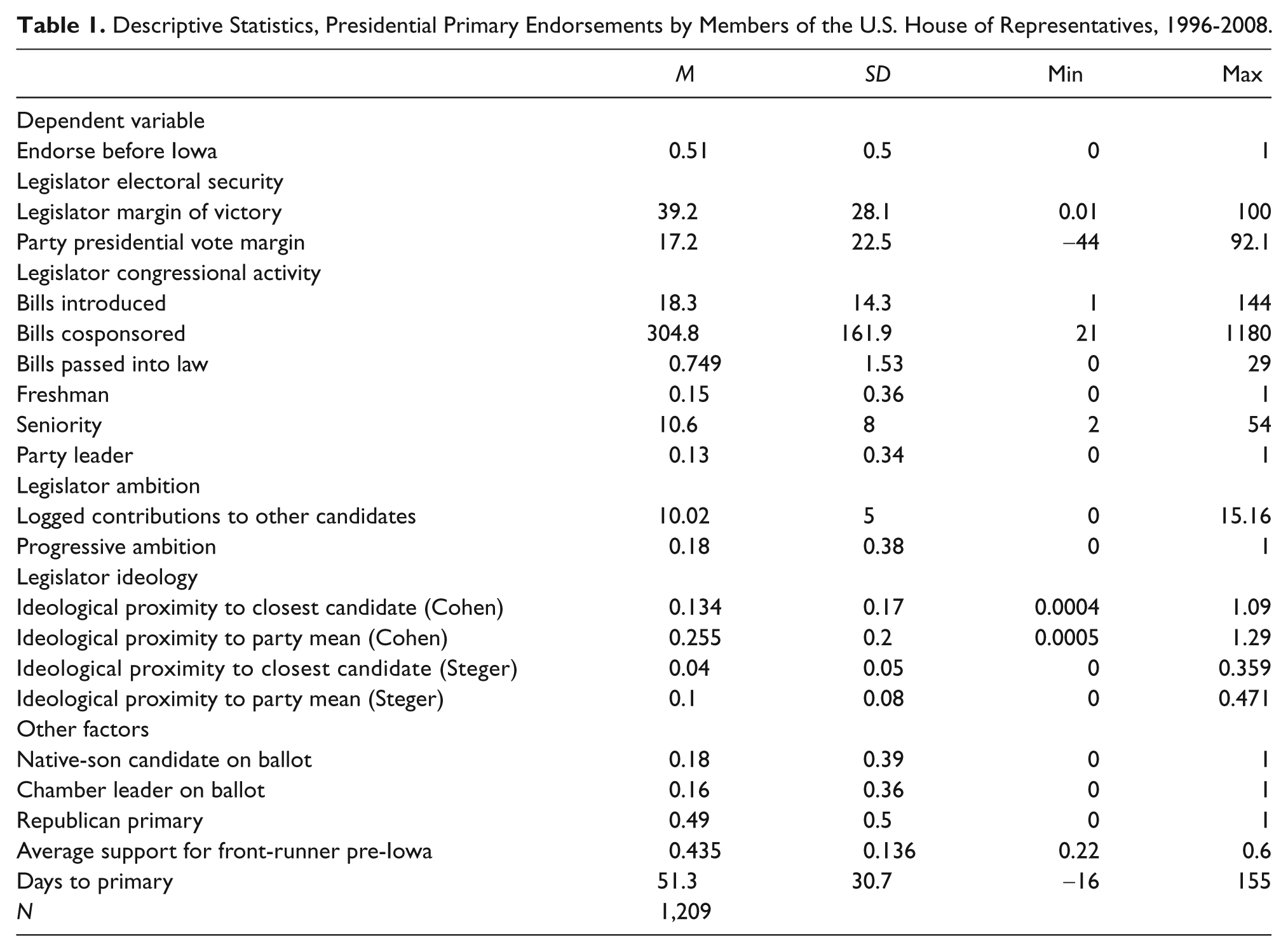
This section presents evidence that explains why members of Congress choose to lead their party’s presidential nomination process. Table 1 presents descriptive statistics of the data; Table 2 displays the results from the logistic regression pooled across all presidential primaries from 1996 to 2008. Table 2 includes the ideological proximity measures derived from the Cohen et al. (2008) method. The first column in each table displays the coefficient estimate and the standard error, while the second column shows the estimated substantive effect ranging from the minimum to the maximum of the independent variable.
Descriptive Statistics, Presidential Primary Endorsements by Members of the U.S. House of Representatives, 1996-2008.
The Determinants of Pre-Iowa Endorsements in Presidential Primaries by Members of the U.S. House of Representatives, 1996–2008.
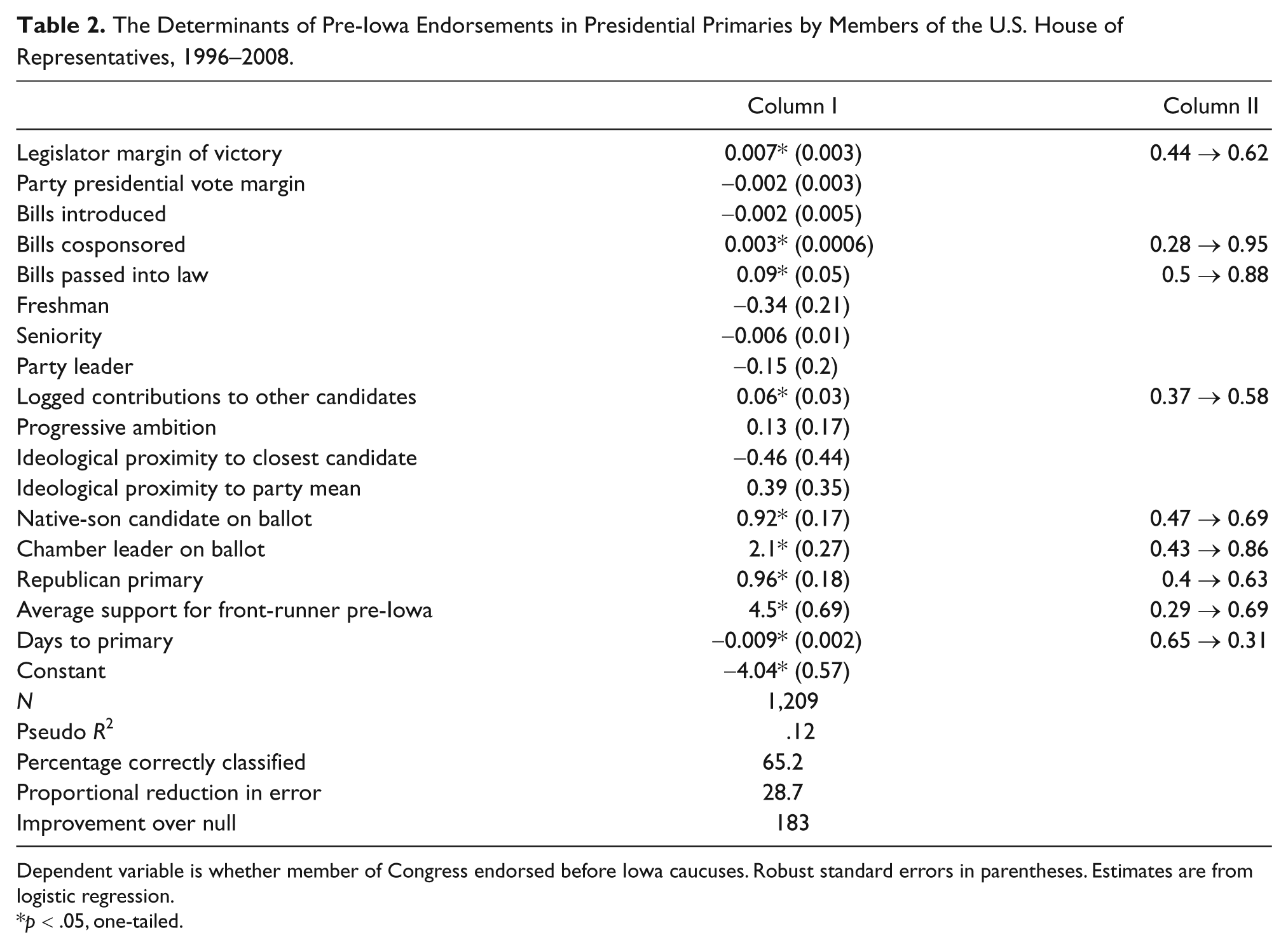
Dependent variable is whether member of Congress endorsed before Iowa caucuses. Robust standard errors in parentheses. Estimates are from logistic regression.
p < .05, one-tailed.
The Determinants of Pre-Iowa Endorsements in Presidential Primaries by Members of the U.S. House of Representatives, 1996–2008, Using the Steger (2009) Ideological Distance Measures.
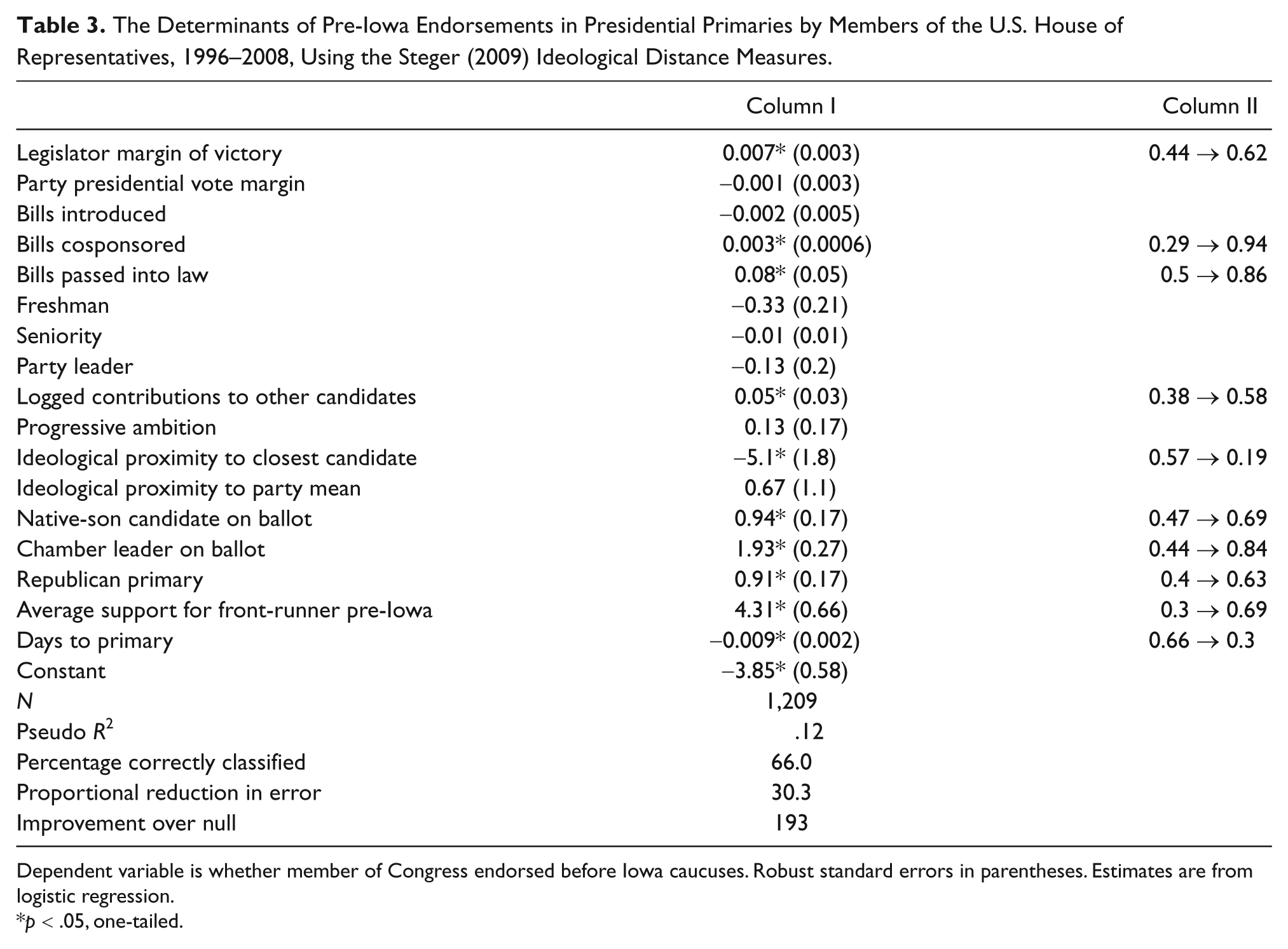
Dependent variable is whether member of Congress endorsed before Iowa caucuses. Robust standard errors in parentheses. Estimates are from logistic regression.
p < .05, one-tailed.
As noted above, Table 1 indicates that roughly half of all members of Congress endorse before the Iowa caucuses. In the aggregate, then, it would appear that members of Congress essentially “flip a coin” when deciding whether to lead their party’s nomination process. Yet the multivariate results from Table 2 indicate that members of Congress take into account a number of factors when deciding whether to lead their party’s presidential nomination process. Instead of flipping a coin, members of Congress strategically act when making pre-Iowa endorsements based on their levels of electoral security, legislative policy activity, ambition, whether a “native son” candidate is running for their party’s nomination, whether a congressional party leader is running, whether the member is a Republican, the amount of public support for their party’s front-runner, and the number of days until their own constituents have the opportunity to vote in the presidential primary.
Table 2 presents evidence for the electoral security hypothesis. While members of Congress do not rely on their party’s presidential candidate vote margin from the previous election cycle, it appears that increased personal electoral margins are positively associated with pre-Iowa endorsements. Increased electoral margins allow members of Congress to pursue other interests, including making endorsements in their party’s presidential primaries. Table 2 indicates that increasing across the values of electoral security is associated with a roughly 18 percent increase in the predicted probability of a pre-Iowa endorsement. According to Mayhew (1974), the actions of members of Congress are colored with their pursuit of reelection; the results presented here indicate that safer electoral margins are associated with acting to influence the outcome of the nomination process.
Table 2 also indicates that members of Congress who are concerned with public policy are those more likely to make pre-Iowa endorsements. Members who engage in higher levels of cosponsorship activity through supporting their colleagues’ legislation are more likely to make pre-Iowa endorsements. Table 2 shows that increasing from the minimum number of cosponsorships to the maximum number of cosponsorships more than triples the predicted probability of a pre-Iowa endorsement from roughly 29 percent to 94 percent. These findings make sense, given that patterns of cosponsorship are indicative of policy interest (Kessler and Krehbiel 1996; Koger 2003). Members who engage in discretionary activities within Congress indicate—both to their constituents and to their colleagues—that they are interested in the policy making process. This interest in policy is not only particular to their actions in the halls of Congress but also extends to their actions in shaping the direction of their party by influencing the outcome of the nomination process.
Similarly, Table 2 indicates that members of Congress who are better able to navigate the winnowing process and have their bills signed into law by the president are more likely to make pre-Iowa endorsements. Increasing from the minimum bill success to the maximum bill success increases the predicted probability of a pre-Iowa endorsement from roughly 50 percent to roughly 88 percent. Careful examination of the results indicates that extreme values are driving the findings. Three members of Congress are particularly likely to have their legislation signed into law by the president. These members are Representative Bill Young (R-FL), Representative Bob Livingston (R-LA), and Representative Charles Rangel (D-NY). Representative Young had twenty-nine bills signed into law in 2000, Representative Livingston had seventeen bills signed into law in 1996, and Representative Rangel had thirteen bills signed into law in 2008. When these extremely successful members are excluded from the analysis, the statistical and substantive significance of the findings no longer holds. While positively signed, the measure of bill passage fails to reach statistical significance. 17 Thus, these findings indicate that members who are successful at guiding their legislation through Congress to be signed by the president are no more likely to lead their party’s nomination process. 18 Indeed, these findings suggest that congressional policy activity and partisan endorsements are indicators of a broader propensity to take political action.
Members’ institutional position within Congress is expected to influence whether they choose to lead their party’s presidential nomination process. Table 2 indicates that freshmen members of Congress are no less likely to lead their party’s nomination process. While negatively signed, the coefficient for freshmen members of Congress fails to reach statistical significance (p = .11, one-tailed). Party leaders and members with increased seniority are no more or less likely to make pre-Iowa endorsements. Even though party leaders set the agenda and internalize electoral risk for the caucus (Cox and McCubbins 1993, 2004), the data here indicate that those findings are particular to their roles within Congress and do not extend to selecting a presidential nominee. 19 Perhaps the effect of party leadership in the statistical model is absorbed by the logged contributions and legislative activity measures. 20 Thus, little support exists for the second hypothesis regarding the impact of institutional positioning on the decision to lead the nomination process.
Recall that the third hypothesis pertains to the influence of member ambition on their willingness to lead their party’s nominations process. Table 2 indicates that members’ progressive ambition does not influence their willingness to make pre-Iowa endorsements. In contrast, members of Congress who have intrainstitutional ambition—those who donate more money to other candidates, PACs, and political party committees—are more likely to make a pre-Iowa endorsement. Increasing across the values of logged contributions to others increases the predicted probability of a pre-Iowa endorsement from roughly 37 percent to 58 percent. This is similar to increasing from the contribution behavior of Representative Gene Taylor (D-MS) in 2004, who failed to contribute any money to his fellow Democrats, to the contribution activity of Representative Dave Camp (R-MI) in 2008, who donated $899,500 to his Republican colleagues. The literature on ambition indicates that members who are ambitious seek out opportunities to take positions (Herrick and Moore 1993); these findings are consistent with that argument. Members of Congress’s donation patterns are indicative of ambition for power, and those who donate more are more likely to make pre-Iowa endorsements. These results provide systematic evidence that members of Congress who are ambitious are more likely to lead their party’s presidential nomination process. These findings—when taken in combination of those regarding congressional policy activity—suggest that presidential endorsements, contributions to other candidates, and congressional policy activity are likely to be indicators of a broader propensity to engage in political activity. In other words, these measures are likely to be indicators of the extent to which a member of Congress is interested and engaged in politics.
The fourth hypothesis pertains to the influence of ideology on pre-Iowa endorsements. Members of Congress who are not closely positioned to their party’s presidential candidates are hypothesized to be less likely to make pre-Iowa endorsements; while the coefficients are correctly signed, Table 2 provides no support for the ideological proximity hypothesis. 21 Members of Congress who are closer to a candidate, or who are at their party’s ideological center, are no more or less likely to make pre-Iowa endorsements. Similarly, members’ proximity to their party’s ideological center are no more likely to lead the nomination process. Thus, no evidence is provided for the fourth hypothesis.
The multivariate analysis in Table 2 also includes a number of variables found to be important in the presidential nominations literature. First, the literature on presidential primaries finds that both voters and elites support candidates from the same state; Table 2 provides further empirical support for this finding. Members of Congress who share the same home state with presidential primary candidates are more likely to make pre-Iowa endorsements. Indeed, members of Congress with a “native son” to choose from in their party’s primary are 22 percent more likely to lead the nomination process with a pre-Iowa endorsement. Second, the literature on presidential nominations consistently finds that Republicans settle on a nominee faster than Democrats (Mayer 1996; Steger 2008); Table 2 provides increased support for this literature. After controlling for other factors, the effect of being Republican increases the probability of a pre-Iowa endorsement from 40 percent to 63 percent. Third, members of Congress who are able to endorse a former party caucus leader for president are twice as likely to make a pre-Iowa endorsement; the effect increases the predicted probability of a pre-Iowa endorsement from 43 percent to 86 percent. Fourth, potential endorsers respond to the amount of candidate support among party identifiers; increases in the support for the front-runner in pre-Iowa polling are associated with an increase in the probability that members of Congress will make pre-Iowa endorsements. Increasing from the minimum to the maximum support for the primary front-runner more than doubles the predicted probability of a pre-Iowa endorsement by members of Congress from roughly 29 percent to 69 percent. 22 This finding is counter to the findings of Cohen et al. (2008) and others, who find that the endorsement decisions by party elites are not driven by campaign factors. Instead, this finding indicates that members of Congress do respond to the level of party agreement on a nominee.
Finally, Table 2 indicates that members of Congress whose constituents vote later during the primary calendar are less likely to lead their party’s nomination process. Indeed, increasing from the minimum number of days until the members’ constituents have the opportunity to vote in the primaries to the maximum number of days until their constituents get to vote decreases in half the predicted probability of a pre-Iowa endorsement from roughly 65 percent to roughly 31 percent. This is substantively equivalent to the differences in the decision to make a pre-Iowa caucus endorsement by those members of Congress from Iowa, for whom campaign factors are likely to be clear and the consequences are known, to the decision to make a pre-Iowa endorsement by members of Congress from Oregon and Kentucky, where campaign factors at the time of the early endorsement decision are likely to change by the time their own constituents have the opportunity to vote at the end of the nomination season. 23 Thus, members’ endorsement decisions respond to the timeline of the nomination process.
The substantive findings can be broadly grouped into factors that the member can influence and factors that are beyond the member’s control. For example, members’ cosponsorship activity is determined by the extent to which the member has an interest in policy and networks within the institution. This is why cosponsorship activity has such a large substantive effect on the decision to lead the nomination process. Members who have policy interests and who network in Congress are more likely to be interested in the outcome of presidential nomination contests. Similarly, the extent to which members act on their ambition for power—through contributing money to other candidates—is a function of their own willingness to be an active fund-raiser. Members who have policy interest and ambition are more likely to lead their party’s nomination process.
On the other hand, a number of factors that influence the decision to lead the nomination are beyond the members’ control. While members of Congress may have some ability to lobby their party regarding the schedule of primaries, the primary calendar is largely beyond their control. Similarly, members’ partisanship, the presence of a “native son” candidate on the ballot, or the presence of a party caucus leader on the ballot are factors that are given. Thus, even if members of Congress have ambition and policy interest, other factors specific to their status within the party and the calendar of the nomination process influence their ability to be a leader.
Finally, members of Congress have some control over the extent to which they are concerned for their electoral security. While the basic demographic and political factors in the district are largely given, members have more control over how much money they raise, the extent to which they prevent the rise of a quality challenger, their personal behavior, and their voting behavior in Congress. Members who are not motivated to take interest in policy or have ambition are unlikely to lead their party’s nomination. Other members may find the endorsement process too challenging, especially if their constituents weigh in later during the primary calendar or if the member does not have a relationship with one of the candidates. In sum, members of Congress who wish to be a leader in their party’s primary can do so—as long as they are willing to overcome some basic fundamentals of the nomination process.
Conclusion
Party elites participate in an extended conversation to pick a presidential nominee. In this conversation, party elites make a collective decision regarding which presidential primary candidate is most likely to preserve party orthodoxy and win in the general election. Yet the aggregate decision is colored both by individual decisions to participate and individual decisions not to participate. The contribution of this article is that party elites draw on their personal, strategic considerations—as well as the powerful collective incentive to influence the outcome—when deciding whether to participate in the nomination process. This article focuses on a subset of party elites—members of the U.S. House of Representatives—but the contribution of this article is generalizable to other members of the extended party. Like incumbent House members, labor unions, civil rights organizations, business groups, party activists, and other elected officials must make their own personal calculation regarding whether they should participate or abstain from choosing the party’s nominee.
The findings indicate that differential rates of endorsement participation exist among an important subset of party elites. While it is beyond the scope of the current article, an implication of these findings is that these different endorsement rates among various members of the extended party can influence the outcome of the nomination process. On one hand, members of Congress who have electoral security, ambition, higher levels of policy activity, and earlier primaries may have distinct interests and preferences within the party, which would lead them to have disproportionate influence on the nomination outcome. In other words, it is possible that these findings indicate that certain segments of the extended party—not the extended party as a whole—maintain control of the nomination outcome.
On the other hand, however, these factors do not in themselves indicate that members who lead the nomination process have distinct preferences from those who do not. Indeed, members of Congress with electoral security have interests to nominate an ideologically orthodox and viable general election candidate because they are also likely to prefer a candidate at the top of the ticket who will be beneficial to all party candidates on the ballot. Similarly, the incentives for members of Congress with ambition are to incorporate the preferences of their colleagues with their own preferences as they make an endorsement. These incentives are likely to induce ambitious members to respond to the preferences of members who do not choose to participate. In addition, members who have higher levels of policy activity are likely to be more familiar with their colleagues’ preferences and thus incorporate them into their endorsement decision. Thus, the extent to which different decisions to participate influence nomination outcomes depends on the extent to which those who choose to participate reflect the preferences of those who choose not to participate. These implications are the subject of future research.
Recent scholarship likens the nomination process to a conversation among party activists, mass party identifiers, the media, candidates, and party elected officials (Cohen et al. 2008). Yet the contours of the conversation are defined by the members of the extended party who choose to participate—and the absence of those who do not. Not all members of the extended party are in a position to participate. This article shows that segments of a subset of the extended party—members of the U.S. House of Representatives—choose to participate or abstain from the conversation for strategic reasons.
Footnotes
Appendix A
In this section, I discuss the method whereby I constructed the ideological proximity measures used in the analysis. I attempted to follow the ideological proximity measures created by Steger (2007) and those created by Cohen et al. (2008). Steger’s measures use the DW Nominate Common Space scores developed by Poole and Rosenthal (1997) for each member of Congress. For presidential candidates, Steger uses proxy measures either from when they served as members of Congress or from taking averages of the Common Space scores from the candidate’s home state. The values to calculate the ideological scores for presidential candidates are listed below:
Appendix B
In this section, I describe the process of creating the measure of public support for the party’s front-runner before the Iowa caucuses. As noted above, I used the public opinion data made available by Marty Cohen that are used in Cohen et al. (2008). I also supplemented these data with nationwide Gallup public opinion data on the 2008 Republican and Democratic primaries. The main text of the question is as follows:
Next, I’m going to read a list of people who may be running in the (Republican/Democratic) primary for president in the next election. After I read all the names, please tell me which of those candidates you would be most likely to support for the (Republican/Democratic) nomination for president in (1996/2000/2004/2008), or if you would support someone else. . . .
The dates for the surveys compiled by the author are listed below. All surveys are from Gallup.
Acknowledgements
A previous version of this article was presented at the annual meeting of the Midwest Political Science Association, Chicago, April 2009. I am grateful to Paul Kellstedt, Dave Peterson, Ken Meier, and three anonymous reviewers for their helpful comments.
Declaration of Conflicting Interests
The author(s) declared no potential conflicts of interest with respect to the research, authorship, and/or publication of this article.
Funding
The author(s) received no financial support for the research, authorship, and/or publication of this article.
Notes
References
Supplementary Material
Please find the following supplemental material available below.
For Open Access articles published under a Creative Commons License, all supplemental material carries the same license as the article it is associated with.
For non-Open Access articles published, all supplemental material carries a non-exclusive license, and permission requests for re-use of supplemental material or any part of supplemental material shall be sent directly to the copyright owner as specified in the copyright notice associated with the article.
