




Abstract
The increased availability of the Internet has led to the emergence of new forms of political participation. Opinions differ, however, on whether this has led to a reinforcement of stratification patterns or to the political mobilization of new groups in society. To address this question, the authors conducted a latent class analysis of a U.S. representative sample that indicates that online activism is indeed a distinctive type of political participation. Analysis of the sociodemographic stratification of the identified participation types confirms the mobilization thesis regarding age and gender but finds that traditional socioeconomic status inequalities are reinforced in online political participation.
There is little doubt that the Internet has been rapidly adopted as a tool for political participation. To cite but one example, in the early months of 2011, social networks like Facebook were attributed with playing a key role in the rapid proliferation of political protest in the Arab world (Lynch 2011, 307). Online opportunities for political participation have become an important avenue of citizen participation in stable democracies as well (Mossberger, Tolbert, and McNeal 2008; Oates, Owen, and Gibson 2006). The rise of online politics has been accompanied by high expectations. Given the increasing prevalence of Internet access and online opportunities for political participation, some authors have expressed hope for increased citizen participation, while others are more skeptical about the Internet’s democratic potential. For example, it has been shown that the Internet has turned out to be “a weapon of the strong” (Schlozman, Verba, and Brady 2010) since it is more commonly used by advantaged groups that dominated the participation arena well before the Internet era (Verba, Schlozman, and Brady 1995).
One can claim, therefore, that the current debate about the consequences of the political use of the Internet is still well framed by the distinction made by Pippa Norris (2000) more than a decade ago between the mobilization and reinforcement theses. Although proponents of both approaches agree that the Internet is an important tool for political participation, assumptions about the democratic consequences of Internet participation sharply differ. The mobilization thesis argues that because of the availability of new information and communication technologies, previously disengaged groups of the population are being drawn into politics. The reinforcement thesis assumes that in the best case scenario, the Internet will not change existing patterns of political participation and, in the worst case scenario, may actually widen participatory gaps between advantaged and disadvantaged populations.
In this article we test the empirical merits of both claims by using the Pew Internet and American Life Project’s August 2008 survey (N = 2,251) to determine whether online participation is distinct from offline participation. To address this question, we first use latent class analysis (LCA) to assess whether online political participation is adopted in distinctive ways in individual-level participation repertoires. We consider this a crucial first step in adjudicating between the reinforcement and mobilization theses: if those who are most active in traditional offline participation are the same individuals who are most active in online participation, this would lend strong support to the reinforcement thesis, with no need for further analysis. If a distinct type of online activists is identified, however, this could lend support to the mobilization thesis since it is possible that this group was previously disengaged and became politically mobilized through the opportunity of online engagement.
This examination of participation repertoires based on a variety of offline and online political activities is an innovation in comparison to the reliance in prior research on separate analyses of online versus offline political activities. This research design therefore heeds the call for the need to move beyond the study of “the Internet” in terms of a narrow focus on technology and toward an investigation of how technological opportunities are affecting broader historical and political patterns (Bimber 2000).
While we cannot assess over-time trends with these data to determine whether the previously disengaged are becoming politically mobilized, it can be ascertained if the different participation types identified by LCA have distinctive background characteristics. By comparing the stratification patterns of the different participation types, it can be determined if different participation types are mobilizing sociodemographic groups that have traditionally been politically disengaged. Therefore, the second analytical step in this article is to examine the sociodemographic characteristics of the identified participation types to ascertain whether stratification patterns apply. We conclude with observations about the empirical merits of the mobilization and reinforcement theses and about what the findings mean for the democratic potential of the Internet.
Literature
The medium or tools used to enable political participation have not traditionally received much scholarly attention. For example, one of the items routinely used in surveys of political participation asks whether the respondent had contacted an elected official, but until recently respondents were not asked to specify whether this contact occurred by means of a letter, a telephone call, a face-to-face meeting, a house visit, or any other means. This indifference, however, ended abruptly with the advent of the Internet era (Bimber 1999). Soon after the Internet was first introduced as a tool that could be utilized by the mass public, it was claimed that this technology could lead to more interactive forms of communication, thus providing citizens with more opportunities to have their voice heard in the political arena (Rheingold 1993).
The Internet undoubtedly provides new opportunities for political engagement that were not previously available. In terms of levels of political engagement, some studies have found minimal or no evidence of increased political participation through online channels (Baumgartner and Morris 2010; Boulianne 2009), while others have found that the Internet increases both offline and online forms of political participation (Mossberger, Tolbert, and McNeal 2008). Yet the mobilization thesis reaches beyond the claim of increased overall levels of participation and notes the potential of Internet activism to counter the traditionally stratified patterns of political participation. This formulation of the mobilization perspective is articulated by Norris (2000, 121) as follows:
The strongest claims of mobilization theories are that Net activism represents a distinctive type of political participation. . . . By sharply reducing the barriers to civic engagement, leveling some of the financial hurdles, and widening the opportunities for political debate, for dissemination of information, and for group interaction, it is said that the Net may reduce social inequalities in public life.
In other words, the mobilization thesis posits that Internet participation is a distinct type of participation that has the potential to recruit disadvantaged and traditionally disengaged populations even more than advantaged ones.
Three main causal mechanisms have been identified regarding the Internet’s potential for mobilizing disengaged groups into both offline and online forms of political activity. First, the Internet lowers the costs of gathering political information and communicating about politics, thereby potentially leading to increased participation for the disadvantaged (Tolbert and McNeal 2003). Second, the Internet is an interactive medium, and therefore it has the potential to strengthen the relationship among previously disengaged citizens, intermediary organizations, and the political world (Shah, Kwak, and Holbert 2001). Third, Internet skills have been identified as having independent influence on political participation distinct from levels of socioeconomic advantage, suggesting that increased Internet skills of the population at large could mobilize previously disengaged groups (Krueger 2002). Even without universal prevalence of Internet access and use, these mechanisms have been identified as potential supporting factors for the political mobilization of previously disengaged and disadvantaged populations.
Proponents of the reinforcement thesis do not necessarily reject these claims. However, the reinforcement thesis recognizes that the availability of the Internet may not meaningfully alter the main factors behind the stratification in participation patterns. The civic voluntarism model has demonstrated that these main factors are resources, psychological engagement, and recruitment into politics, or, formulated to inquire why people do not participate in politics, “because they can’t, because they don’t want to, or because nobody asked” (Verba, Schlozman, and Brady 1995, 15). It is clearly plausible that resources such as education and income may continue to play a role in influencing patterns of online participation, given the cognitive and technical demands of the medium. Regarding orientation to politics, it may make no difference that political information and opportunities for participation are more readily available if people are not inherently interested in politics (Margolis and Resnick 2000; Warschauer 2003), particularly given the strong self-selection effect of the Internet in comparison to traditional media (Sunstein 2001). Regarding recruitment, although the Internet decreases communications costs and may therefore reach a broader sector of society, the potential for “rational prospecting” of advantaged activists has been identified as a powerful stratifying force in offline politics (Brady, Schlozman, and Verba 1999) and may be even more powerful online (Krueger 2006).
Empirical research has not produced consensus regarding the relative merits of the mobilization and reinforcement theses. In terms of socioeconomic stratification, although some findings have shown that the Internet has the potential for mobilizing new people into politics through the unique resource of online skills (Krueger 2002), subsequent research indicated that those with the unique skills that increase online participation also tend to be more socioeconomically advantaged (Best and Krueger 2005; Krueger 2006). Evidence in favor of socioeconomic equalization of online participation has been found in the United Kingdom (Gibson, Lusoli, and Ward 2005; Ward, Gibson, and Lusoli 2003) and in Spain (Anduiza, Gallego, and Cantijoch 2010).
A number of studies of the United States, however, indicate that the Internet increases levels of political engagement, but this increase is disproportionately in favor of the most socioeconomically advantaged and politically interested, thereby replicating or perhaps even exacerbating pre-Internet participation gaps (DiMaggio et al. 2004; Mossberger, Tolbert, and Stansbury 2003; Mossberger, Tolbert, and McNeal 2008; Schlozman, Verba, and Brady 2010; Xenos and Moy 2007). Research has consistently pointed to education as a stratifying factor in offline political participation, but various studies have shown that online politics magnifies the already significant influence of education (Mossberger and Tolbert 2010, 212).
With regard to gender, early research on Internet access and use found women to be significantly less likely than men to use the Internet at all and to be less intense users of the medium for general and political purposes (Bimber 1999; Ono and Zavodny 2003). Although recent studies have noted a decrease in this gender gap in both general and political Internet use (Fallows 2005)—including a study in Finland that found that women were even more likely than men to be online activists (Christensen and Bengtsson 2011, 910)—the preponderance of recent research in the field leads us to expect that online activism will reinforce the greater political activism of men compared to women (Hooghe and Vissers 2009; Mossberger, Tolbert, and McNeal 2008). Since the usually disengaged younger population is relatively active in online participation (Best and Krueger 2005; Jennings and Zeitner 2003), age seems to be a potential mobilizing characteristic.
While these studies have contributed to our understanding of indicators of online and offline participation, they have not definitively addressed the intriguing question posed by Norris more than a decade ago: is Internet activism “a distinctive type of political participation” or not? If online participation is not a distinctive type of participation in terms of the individual-level participation repertoire of those engaged politically, one can conclude only that the high expectations for citizen participation that accompanied the rise of the Internet have been too ambitious. If, however, distinct online participation types can be identified, further research would be necessary to determine whether this group is populated by previously disengaged citizens who are newly recruited into politics or whether they have simply substituted their prior offline participatory acts with online ones. With the cross- sectional data set used in the present study, it is possible to empirically determine whether different participation types are distinctive in terms of their background characteristics. Since it is well established that those who are more active politically tend to be more sociodemographically advantaged, we would find indirect support for the mobilization thesis if the findings indicate that online activists come from less privileged backgrounds.
We are now at an opportune moment to test the empirical merits of the mobilization and reinforcement theses since Internet use has become remarkably more prevalent in recent years: in 2010, more than 72 percent of the U.S. population reported using the Internet, and 68 percent of all households were connected through a broadband connection (National Telecommunications and Information Administration 2011, 28). Yet technology access and skills are still far from universal and are characterized by inequalities that disadvantage those who are less educated, poor, racial and ethnic minorities, and elderly and residents in rural and inner-city areas (Mossberger and Tolbert 2010, 211; Mossberger, Tolbert, and McNeal 2008, 146). While increased Internet access and use may be mobilizing new groups to participate democratically, it is also possible that opportunities for online political participation may be widening the gap between those who do and do not participate. Therefore, to test the empirical merits of the mobilization and reinforcement theses, we ask two main research questions:
Research Question 1: Can online participation be empirically identified as a distinctive type of political participation?
Research Question 2: Do the background characteristics of online activists differ significantly from the background characteristics of offline activists?
Data and Method
We use data from the Pew Internet and American Life Project’s August 2008 survey (Pew Internet and American Life Project 2008), which includes a variety of questions regarding online and offline participation. This data set is based on telephone interviews conducted by Princeton Survey Research Associates International between August 12 and August 30, 2008, among a sample of 2,251 adults age eighteen and older. 1 The survey had a full response rate of 21.8 percent, and figures are weighted in accordance with 2007 data from the census bureau (see Smith et al. 2009 for survey documentation). This survey took place during the presidential campaign of 2008, during which many candidates made a dedicated effort to utilize the Internet to increase political participation, including the campaign of Barack Obama, which was particularly successful at mobilizing traditionally less engaged populations such as young people and women (Kenski, Hardy, and Jamieson 2010; Smith et al. 2009, 11-12). While this unique timing means that we must be cautious regarding the generalizability of the findings, this data set is well suited for assessing the potential distinctiveness of online political participation. Information on variable coding can be found in the appendix (at http://prq.sagepub.com/supplemental/).
To analyze this data set, we use LCA, which is an ideal technique for investigating the existence of distinct types of behavior based on categorical data (Hagenaars and Halman 1989; Magidson and Vermunt 2004). In recent years the common application of LCA as a probabilistic form of cluster analysis has become widely utilized in various fields in the social sciences and beyond. Although LCA is less well known to scholars of political participation, the technique is perfectly suited to answer our first research question of whether online participation is a distinctive type of participation. 2 As opposed to the common approach of developing separate scales for online versus offline participation (Best and Krueger 2005; Calenda and Meijer 2009; Schlozman, Verba, and Brady 2010), LCA opens an analytical window into the distinctive ways in which subgroups of the population are combining online and offline acts of participation in their individual-level repertoires.
LCA is similar to the commonly used technique of factor analysis in that it identifies latent variables on the basis of multiple empirical indicators of political participation. A primary difference between these techniques, however, is that the grouping of observed data on which the analysis rests for factor analysis is based on similarity (correlations) between indicators of participation, while for LCA the grouping is based on the similarity between people’s response patterns on the participation indicators. Standard cluster analysis has been utilized in prior research for the purpose of classifying people into distinctive participation types (Verba and Nie 1972, 76-79), but one of the standard criticisms raised against this technique is that the researcher in a rather arbitrary manner can decide on the optimal number of clusters to be identified. However, when using LCA, model choice is informed by goodness-of-fit statistics such as the Bayesian information criterion (BIC).
Once goodness-of-fit statistics and researcher judgment have been utilized to identify the preferred model, two key results for the model can be interpreted analogously to the results of factor analysis. First, the likelihood of each cluster’s positive response on each indicator is estimated in terms of conditional probabilities, which are analogous to factor loadings. In this research, the conditional probabilities indicate the likelihood for each cluster of respondents to engage in each of the participation indicators. Therefore, an empirical cluster corresponds to a subgroup of the research population that shares similar individual-level repertoires of political behavior. Second, the probability that respondents belong to each cluster is estimated, which is analogous to factor scores. The modal probability of cluster membership can therefore be estimated for each respondent.
Results I: Latent Class Analysis Findings
In line with our research questions, the empirical analysis in this article focuses on acts of explicit political participation, as distinct from research that has explored a broader array of online engagement such as political voice, civic engagement, and social capital (see, e.g., Schlozman, Verba, and Brady 2010; Shah et al. 2005; Shah, Kwak, and Holbert 2001). Table 1 details the participation acts included in this analysis. The indicators are listed beginning with the most prevalent, with offline indicators denoted by darker shading and online indicators by lighter shading. Three of the four online acts of political participation are directly parallel to offline acts: contacting, petitioning, and donating. The fourth online political indicator of starting or joining a political group through a social networking site can be understood as a parallel online activity to the offline act of having been an active member of a group that tries to influence public policy or government. In addition to these eight indicators of parallel online and offline activity, we utilize two additional offline acts that have no online parallel in the data set: attending a political rally, speech or organized protest and working or volunteering for a political party or candidate. The ordering of the indicators in Table 1 by descending means demonstrates that even though online political activities are less prevalent overall, these acts are common enough to warrant serious investigation.
Participation Indicators Used in the Analysis.

Source: Pew Internet and American Life Project, 2008 (N = 2,251).
Entries are the percentage of respondents indicating that they had performed each act during the previous twelve months. Offline political participation is denoted by a darker shade of grey, online by a lighter shade of grey.
In applying LCA, the first step is to determine the optimal number of latent classes for most accurately describing the research population. LCA can be applied in an exploratory manner by beginning with the one-class model and systematically increasing the number of classes to assess model fit. BIC is the most widely used statistic for identifying optimal solutions, and a smaller BIC indicates better model fit. 3 An additional, less formal approach that complements the more statistically precise BIC statistic is to assess the percent reduction of the likelihood ratio chi-square statistic L2 in comparison to the one-cluster model (Magidson and Vermunt 2004, 176-77). Table 2 lists the LCA model fit statistics for the analysis.
Latent Class Analysis (LCA) Model Fit Statistics for Participation Behavior.

Source: Pew Internet and American Life Project, 2008 (N = 2,251).
BIC = Bayesian information criterion; LL = log likelihood; L2 = likelihood ratio chi-square statistic. LCA findings using Latent Gold 4.0 software (Vermunt and Magidson 2005). Entries are test statistics for separate latent class analysis models, identifying one and more clusters of respondents. Bold text indicates the preferred model.
Although the absolute value of the BIC is still decreasing up through the seven-cluster model, it is evident that already after the four-cluster model there is a marginal gain in improvement in the percentage reduction of the L2. While the six- and seven-cluster solutions are clearly not preferable because of the small reduction in the L2 and increased classification error, we investigated the substantive results of both the four-cluster and five- cluster solutions and found that the five-cluster solution adds no meaningful nuance to the four-cluster solution.
Since LCA is not yet widely used in the study of political participation, we methodically introduce the graphical depiction of the findings in Figure 1 for the four-cluster solution. The x-axis includes the offline participation acts grouped on the left and the online participation acts grouped on the right, and within both groups the participation acts are ordered by ascending means in the sample population. These means are noted beneath the x-axis labels for each participation act (e.g., 8.1 percent of the U.S. population reported being involved in work for a political party). The y-axis represents the conditional probability that members of a given cluster will participate in each participation act on the x-axis. Thin lines connect these markers to draw the reader’s attention to the distinctive participatory patterns of each cluster. Given the ordering of offline and online indicators by ascending means, if the findings displayed parallel lines that did not cross, this would indicate that the different clusters merely represent different levels of overall engagement. However, since the lines in Figure 1 are not parallel either within the two groups of participation acts (online vs. offline) or overall, the distinctive characteristics of each participation type must be examined.
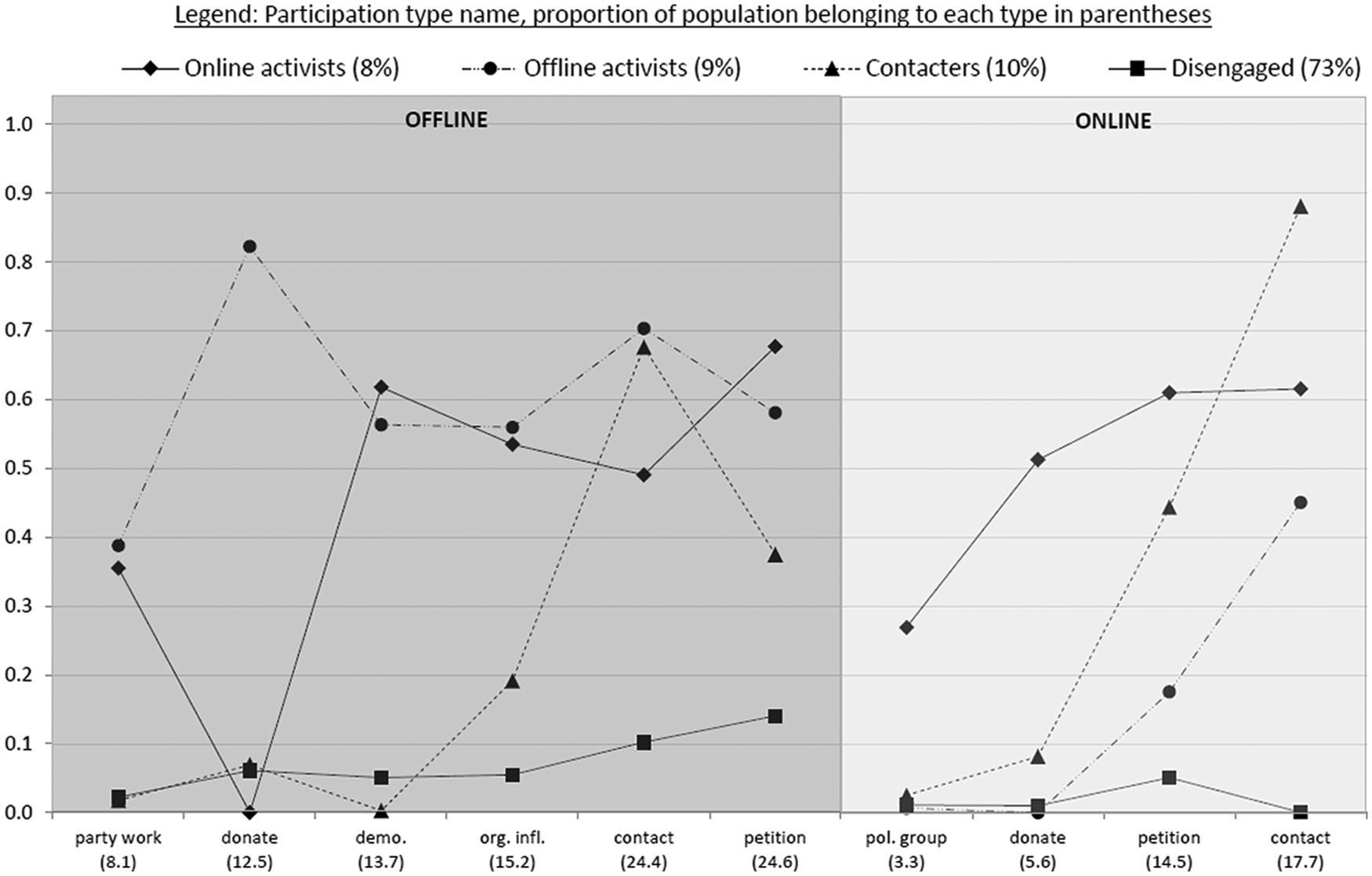
Participation for four groups of respondents.
The LCA identifies four distinct groups of respondents. The “disengaged” cluster is the most obvious one, including 73 percent of all respondents. Even though these actors are significantly less likely to engage in all participation acts in comparison to the other participation types and to the population at large, they are not completely disconnected from political activity, as is evident in the conditional probabilities reported in Figure 1. The second largest group identified by LCA is the “contacters” (10 percent of all respondents) who specialize in contacting politicians, both online and offline. This type is relatively inactive in a number of participation acts (e.g., party work, donating offline, demonstrating) or essentially on par with the general population (e.g., active member of an offline and online political or social group and online donating). Therefore, the distinctive nature of this participation type is its high probability of contacting and petitioning both online and offline in comparison to its inactivity in other participation opportunities.
Regarding the activists in the sample, the analysis identified two distinct groups. Since both of these groups are engaged in offline and online activities but with different emphases, it would be most accurate to refer to them as “hybrid and predominately online/offline activists.” Although for the sake of simplicity we refer to these groups in the following analyses and discussion as “online activists” and “offline activists,” it is essential to note that the distinction between the two is a matter of emphasis and not one of exclusive specialization in either online or offline acts of participation.
The “offline activists” (9 percent of the sample) have high probabilities of offline participation in general and relatively low probabilities of online participation. All of the offline activist type’s donating is taking place offline, and it is clear that members of this group have not been early adopters of social networking opportunities such as Facebook and Myspace for joining political groups. However, it is noteworthy that this type is petitioning online on par with the general population and is particularly adept at online contacting. Therefore, while our description of this group as offline activists is an accurate way to distinguish it from the other participation types, this type is not shunning online channels of participation altogether.
In contrast, the “online activists” (8 percent of all respondents) have a particularly high probability of starting or joining a political online group and donating online to a political organization or cause. The only indicator for which this group is less active than the sample mean is offline donating, for which it has zero probability of engagement. The online activist type’s particularly high probability of online donating (51.3 percent in comparison to 5.6 percent in the sample population) strongly suggests that this group is substituting online donating in place of offline donating. It is noteworthy, then, that for the other indicators for which there are direct online and offline parallels (contact, petition, and joining a political group), the online activists do not seem to be substituting online activities for offline ones but rather are incorporating online acts of participation along with offline activities into their individual-level participation repertoire.
The LCA findings for the four-cluster solution therefore point to four distinctive types of individual-level repertoires of participation and not merely to different levels of engagement that can be meaningfully captured by separate additive scales of online and offline participation. The identification of the four participation types reported here remains robust when voting registration is added to this ten-indicator model and when different combinations of these indicators are utilized for LCA estimation. 4
Results II: Stratification of Participation Types
The previous analysis has clearly provided a positive answer to research question 1: online participation is a distinctive type of participation, although it has to be noted that this group of activists is also active in an offline manner. Building on the presentation of the distinctive features of the political participation repertoire of each type, we therefore proceed to analyze research question 2, namely, whether online and offline participation types are also distinctive in terms of the background characteristics of type members. Multinomial logistic regression analysis is used to investigate whether new sociodemographic groups are mobilized by online participation or whether online participation reinforces the same stratification patterns as offline participation. In particular, it is investigated whether the sociodemographic characteristics of the online activists differ from the sociodemographic characteristics of the offline activists, as well as from contacters and the disengaged.
As independent variables, we include the main stratification mechanisms with regard to political participation: socioeconomic status (SES), gender, and age. In addition, we include recruitment as a control variable since it has been shown to be an important predictor of participation in general and online participation in particular (Krueger 2006). The expectation based on prior research on political participation in general is that all three of the politically engaged participation types (contacters, offline activists, and online activists) are more SES advantaged, more male dominated, and older in comparison to the disengaged type (Marien, Hooghe, and Quintelier 2010). Honing in on the comparison between the offline and online activists, prior research reviewed above would lead us to expect that these two types would have similar levels of SES advantage but that the online activists would likely be more male dominated and younger in comparison to the offline activists.
The SES index is based on a scale combining education level and family income with respondents divided into four groups of equal sizes. Additional control variables were added to the model, and analyses were conducted that separated out the SES index into the constituent education and income variables. 5 Since these additional analyses were consistent with the findings discussed below, the most parsimonious model is presented in Table 3. The odds ratios reported in this table can be interpreted as the odds of belonging to a particular type over another if a particular characteristic is present. Odds ratios greater than one indicate that people with this characteristic are more likely to belong to the investigated participation type (disengaged, contacters, offline activists) than to the online activist type. Conversely, odds ratios less than one indicate that people with this characteristic are more likely to be online activists than the other participation type. Note that an insignificant coefficient does not mean that the independent variable has no effect on the likelihood of belonging to a particular participation type; rather, it means that there is no significant difference between online activists and the investigated participation type with regard to this characteristic.
Stratification of Participation Types: Multinomial Logistic Regression Analysis.

Source: Pew Internet and American Life Project, 2008 (N = 2,251).
Results of a multinomial logistic regression analysis. Entries are coefficients with standard errors in parentheses. Reference category = online activists.
Reference category is 18–35.
Reference category is highest quarter.
p < .05. **p < .01. ***p < .001.
The multinomial logistic regression yields four central findings presented in Table 3. 6 First, age strongly influences the likelihood to belong to a particular participation type. When people older than thirty-five are compared to the youngest generation (eighteen to thirty-five), they are more likely to be offline activists, contacters, or disengaged than to be online activists. For instance, the thirty-six to fifty group is 4.7 times more likely than the eighteen to thirty-five group to be offline activists than online activists. Put another way, the eighteen to thirty-five group are more likely than all other age groups to be online activists than another participation type. 7 Second, the gender of a person does not predict whether he or she is more likely to be an online activist than to belong to another participation type. In fact, further analysis shows that there is no difference between men and women in their likelihood of belonging to any of the participation types.
Third, online and offline activists are characterized by the same SES stratification patterns. People with the lowest SES are more likely to be contacters than online activists compared to people with the highest SES. However, the odds are very large that this lowest SES group is disengaged altogether. People with a lower SES are far more likely to be disengaged than online activists, while the SES differences between online activists and the other active participation types are small or insignificant. In sum, the online activist type is an unequal participation type regarding SES, but in general it is as unequal as the other engaged participation types (i.e., contacters and offline activists).
Finally, regarding recruitment, the odds that people are disengaged are much smaller if they were recruited (received a letter, a call, an email, etc.). Furthermore, the odds of being an online activist are larger than those of being a contacter, if one is recruited.
In sum, honing in on the comparison of the online and offline activist types, the conclusion to be drawn from these results is that those belonging to the two activist types do not differ with regard to SES and gender but that these different types of activism appeal to quite contrasting age groups. The online activist type is much more likely to be populated by young people in comparison to the offline activist type.
Discussion
In this article we asked two research questions to assess the empirical merits of the mobilization versus reinforcement theses. The findings provide strong evidence in support of a positive answer to the first research question: online participation is empirically identified as a distinctive type of participation. Specifically, LCA of participation repertoires identifies online activists to be a distinct group of activists in comparison to the three other identified participation types: offline activists, a group that specializes in contacting, and a large group (73 percent of the population) that is relatively disengaged from political activity. A note is in order about the lack of an online-only specialist type in the findings. The analysis did not identify a group of respondents who are disengaged from traditional offline politics but are compensating for this disengagement by participating in new online political opportunities. Therefore, as we proceed to summarize the differences in the background characteristics of type members, it is important to keep in mind that the online and offline activists identified in this study reflect different emphases and not exclusive specialization in one kind of activity or another.
The clear conclusion is that there is a distinct type of respondents who prefer online forms of participation. Contrary to what some authors assume, however, this group is also involved in offline participation. Further research would be needed to determine whether online opportunities are recruiting this group of online activists into political activity of all kinds or whether those who would be politically active in any case are simply adding online participation to their repertoire of political activity.
The findings provide mixed evidence regarding the second research question: the background characteristics of online activists differ significantly from offline activists in terms of age, but they do not differ in terms of gender and SES. Young people’s high probability of belonging to the online activist type is relevant to the ongoing concern about the disengagement of young people from political life. The variety of ways in which young people have become disengaged from traditional party-based politics have been well documented, and online political participation has been identified since its early stages as a potential avenue for connecting young people to politics (Delli Carpini 2000). The findings in this article therefore contribute to the accumulating evidence indicating that young people are indeed taking advantage of technological opportunities to engage with politics in a new way through online means (Jennings and Zeitner 2003; Mossberger, Tolbert, and McNeal 2008; Schlozman, Verba, and Brady 2010). Future research is necessary, however, to determine the differential political impact and influence of these different types of engagement.
The lack of evidence of a gender divide for any of the participation types is an important contribution in the context of research on gender and online participation. Although recent studies have noted a decrease in the gender gap favoring men’s greater engagement in both general and political Internet use, salient gender differences have still been consistently identified (Mossberger, Tolbert, and McNeal 2008). The lack of distinction between the men’s and women’s probabilities of belonging to any of the four participation types identified in this study is therefore noteworthy, especially given the wide range of online indicators included in this analysis in comparison to prior research. This disappearance of a gender divide may be taking place because of the different ways in which men and women are taking advantage of the proliferating opportunities for more interactive and relational technologies. A review of trends of Internet usage between 2000 and 2005 indicated that women were catching up with men’s early adoption of new technologies and were focusing their online activities on deepening their relational connections (Fallows 2005). In fact, recent research indicates that women are even more likely than men to use social media in the United States (Hampton et al. 2011). The inclusion of a broader array of online participation indicators in the analysis, including political social media use, may be contributing to a new understanding of an era in which gender differences in online political participation are becoming obsolete.
Regarding SES, it is noteworthy that the socioeconomic stratification is basically the same for the online as for the offline activist type. As such, the perennial “participation gap” with regard to SES apparently is simply reproduced with regard to online activism, and this form of activism indeed can be considered one more “weapon of the strong” (Schlozman, Verba, and Brady 2010).
In sum, the findings for the two research questions examined in this article indicate that online participation does not simply reinforce patterns of offline participation across the board. A distinct group of activists is drawn to specialize in online versus offline repertoires of political participation, indicating that online political activities are not exclusively the purview of those who are most active in traditional offline activities. Yet the main stratification mechanisms with regard to political participation of age, gender, and SES do not act in unison in relation to the competing mobilization and reinforcement theses. It is clear that the mobilization thesis is strongly supported with regard to the involvement of young people as online activists. The lack of a gender gap for both online and offline participation also supports the mobilization thesis, in contrast to prior research that found that women were even less politically active online than offline. For SES, however, in contrast to the mobilization thesis, the advantaged are more active in both online and offline participation, suggesting a reinforcement of traditional education and income inequalities in online political participation. Given the salience of socioeconomic inequality in American democracy and recent findings suggesting the strong influence of the socioeconomically advantaged in influencing policy outcomes of all kinds (Bartels 2008; Gilens 2005), the reinforcement of SES inequalities certainly limits the democratic potential of the Internet for affecting patterns of political participation and participatory inequality.
Ending on a note of caution, the limitations of the survey utilized in this research in the midst of Barack Obama’s presidential campaign must be taken into account. Like those of other presidential, congressional, and gubernatorial candidates in 2008, the Obama campaign made extensive use of the Internet and proved to be particularly successful at recruiting the support of both young people and women through online and offline recruiting methods (Kenski, Hardy, and Jamieson 2010). In addition, the socioeconomic stratification of online participation found in the United States may be less applicable to other contexts. Therefore, further research in different contexts is needed, including nonpresidential U.S. elections and different national contexts, to examine the generalizability of the conclusions reached in this study.
Footnotes
Acknowledgements
The authors would like to acknowledge the helpful comments from Michael Delli Carpini, Itzhak Galnoor, Michael Shalev, Theda Skocpol, Jeroen Vermunt, and the anonymous reviewers of this journal in the development of this research.
Declaration of Conflicting Interests
The author(s) declared no potential conflicts of interest with respect to the research, authorship, and/or publication of this article.
Funding
The author(s) disclosed receipt of the following financial support for the research and/or authorship of this article: Sofie Marien acknowledges the generous funding of the FWO Research Fund Flanders-Belgium, and Jennifer Oser acknowledges the generous funding of the Hebrew University of Jerusalem.