




Abstract
The authors examine U.S. public attitudes regarding global climate change, addressing the puzzle of why support for governmental action on this front is tepid relative to what existing theories predict. Introducing the theoretical concept of relative sociotropic time horizons, the authors show that believers in Christian end-times theology are less likely to support policies designed to curb global warming than are other Americans. They then provide robustness checks by analyzing other policy attitudes. In so doing, the authors provide empirical evidence to suggest that citizens possessing shorter “shadows of the future” often resist policies trading short-term costs for hypothetical long-term benefits.
Keywords
U.S. citizens are lukewarm, at best, toward the federal government taking action to mitigate or reverse global climate change. In a February 2008 Gallup poll, Americans ranked the “environment” as only the fourteenth most important issue in determining their vote for the next U.S. president. 1 Similarly, in a January 2007 Pew Research Center survey, only 38 percent of Americans rated “dealing with global warming” as a “top priority,” thus marking it as the fourth lowest priority of twenty-three items listed in this survey. 2
Survey results like these serve as the starting point for our basic research question: why are American citizens so seemingly disinterested (relatively speaking) in addressing global climate change? This question is all the more puzzling because it cannot be answered solely in terms of disbelief in the occurrence of global warming. Indeed, as of 2008, about three-quarters of Americans believed that there was solid scientific evidence of global warming, while only a minority saw it as something they were willing to pay higher prices to address. 3 This general acceptance of global warming as a real phenomenon, coupled with a relative disinterest in addressing it, is what Jamieson (2006) has labeled the “American paradox.” 4 Although the U.S. population is not the only one within which this paradox can be observed, it is certainly the one in which the paradox is most pronounced. 5 Indeed, even if the American case did not stand out in this way, it would still deserve particularized attention given the United States’s standing as both global superpower and leader of greenhouse gas emissions.
In this regard, the extant literature does little to help explain American indifference toward fighting climate change. Macro-level theories tend to confuse the matter, as they posit that citizens living in richer, more democratic, and more ecologically vulnerable countries (such as the United States) should carry greater environmental concern, not less. 6
Micro-level analyses of public opinion have not been much help either, as they have tended to describe American attitudes concerning global climate change, rather than to explain those attitudes. One notable exception, however, is a line of research using religion to explain variation in environmental attitudes (e.g., Greeley 1991; Guth et al. 1995; Sherkat and Ellison 2007; Djupe and Hunt 2009; Djupe and Gwiasda 2010). But even within this research tradition, theories have been somewhat indeterminate and the data have been less than ideal for the purposes of isolating causal mechanisms. In this article, we step into this research stream, introducing new theoretical concepts and methodological constructs in an effort to advance collective understanding of environmental politics, religio-political dynamics, and mass political behavior more broadly.
The remainder of the article is structured into three sections. The first section develops our theoretical argument. The second section describes our empirical tests of hypotheses derived from that argument. The third section concludes by further elaborating the implications suggested by our findings.
The Argument
As mentioned above, positing a relationship between religiosity and environmental conservatism is not a novel idea. But the causal logic underlying the hypothesized relationship remains quite unclear. Lynn White (1967) offered the first prominent statement on the subject, arguing that scriptures referencing humankind’s supposed “dominion over the Earth” led Christians to view environmental protection as unimportant. 7 Unfortunately, other scholars who have sought to connect religious practices to environmental attitudes have drawn contradictory conclusions (e.g., Hand and van Liere 1984; Eckberg and Blocker 1989; Sherkat and Ellison 2007). In fact, some Christian authors have even drawn on the very same scriptural passages as used by White to refute, rather than to reaffirm, White’s basic argument. That is, these authors have suggested that the creation story as relayed in Genesis actually encourages more, not less, environmental concern (e.g., Schaeffer and Middelmann 1992; Kanagy and Willits 1993; Shaiko 1987). 8
Sherkat and Ellison (2007) provide a rich analysis that serves to sort out some of these contradictions; they distinguish between people’s beliefs regarding whether environmental degradation is a serious problem and their willingness to sacrifice for environmental protection. They also distinguish between private behavior that serves to protect the environment (recycling, etc.) and support for public policies that attempt the same. Broadly speaking, they observe that evangelicals and other traditionalistic Christians are no less likely than other Americans to view environmental degradation as a problem (once political ideology is controlled) and are sometimes inclined to support private acts of environmental stewardship, such as recycling (when their doctrinal beliefs support a “stewardship” ideology). By contrast, though, such Christians are particularly unlikely to support politically oriented environmental protection—especially when they hold inerrant views toward the Bible. Thus, Sherkat and Ellison provide a sophisticated, religiously rooted account of the “American paradox” that we mentioned earlier. However, we are still left to ask, exactly what is it about belief in an inerrant Bible that dilutes political environmentalism?
Guth et al. (1995) help to answer this question. Analyzing samples of religious and political elites, activists, and the mass public, they argued that the ambivalence (or even antipathy) toward the environment so frequently observed among many traditionalistic Christians stems mostly from doctrinal beliefs regarding the end of the world, not the beginning of it. 9
But what are these beliefs? Stated simply, end-times believers hold that Jesus will one day return to Earth and commence a series of events (e.g., the Rapture, Tribulation, and Millennial reign of Christ) that will eventually culminate in a final battle between good and evil (Armageddon). There is some disagreement among such believers about the exact timing of these foretold end-times events, but by far the most popular account of them is known as “premillennial dispensationalism” (e.g., Williams 2008)—which projects that earthly conditions must precipitously deteriorate prior to the Second Coming (marked by wars, famine, and environmental calamity). 10 This perspective has dominated evangelical thought for over seventy years but was recently popularized well beyond evangelical circles by Tim LaHaye and Jerry Jenkins in their bestselling Left Behind series.
As suggested by the popularity of the Left Behind series, many Americans appear to believe that such calamitous end-times could be right around the corner. For example, a 2010 Pew Research Center report observed that 41 percent of all respondents expressed belief that the Second Coming “probably” or “definitely” will happen by 2050, including 58 percent of white evangelicals (Kohut et al. 2010).
But two key questions remain unanswered by the extant research positing a connection between such end-times beliefs and environmental attitudes. The first of these questions is theoretical: why would traditionalistic Christian eschatology predict resistance toward policies designed fight global climate change? Addressing this question is critically important if we want to gain a greater understanding of attitude formation, writ large, from this particular relationship. The second question is empirical: does Christian eschatology actually affect public opinion in an appreciable way, or are the attitudinal consequences associated with end-times beliefs limited to the minds of political and religious elites? Given the mass public’s notorious lack of political sophistication (e.g., Campbell et al. 1960; Delli Carpini 1994), is it expecting too much of citizens to think that they typically “connect the dots” between their religious beliefs and their environmental policy attitudes in this way?
Shadow of the Future Logic
Regarding each of these remaining questions, it is important to recognize that one’s position regarding climate change policy involves an intertemporal choice, or a decision that requires an individual to make a trade-off between costs and benefits that occur at different points in time. That is, in terms of climate change policy, most of the costs associated with reducing greenhouse gas emissions (smaller automobile engines, reduced air travel, less heating in the winter, carbon taxes, etc.) must be paid and/or experienced in the near term, while the potential benefits associated with lower temperatures and a more stable climate will be realized only well into the future.
Formal theory (e.g., Loewenstein, Read, and Baumeister 2003) posits that rational actors tend to resolve such intertemporal trade-offs based (in part) on considerations pertaining to relative time horizons. In game theory, this time horizon is often termed the “shadow of the future” (SOF), which expresses how players in a repeated game will discount future payoffs relative to current ones. 11 When a player’s SOF is long, the player values future payoffs much like the current ones. But when her or his SOF is short, the value of future benefits is downgraded substantially relative to the status quo. It is not surprising that a short SOF can be problematic for long-term policy planning and cooperation in general (e.g., Axelrod 1984). For example, Slemrod (1986) showed that the threat of an imminent nuclear war was correlated with a lower saving rate in the postwar U.S. economy, presumably because people believing in imminent nuclear war have little reason to postpone current consumption to save for future needs (though this was not established definitively at the micro level).
Such temporal trade-off considerations, however, have not been operationalized in empirical studies of mass behavior. This is where end-times beliefs come in.
The Role of End-Times Theology
How do the end-times beliefs described earlier relate to SOF considerations? And how would such dynamics influence attitudes toward policies designed to address global warming? We argue that end-times believers often oppose costly policies to deal with global climate change because they have shorter sociotropic time horizons than do nonbelievers. A great deal of scholarship has demonstrated that citizens tend to think sociotropically (i.e., with an eye toward collective outcomes, rather than strictly personal ones) when considering most policy matters, especially “valence” issues such as economic performance (e.g., Kinder and Kiewiet 1981; Sears and Funk 1990). Given that environmental health is a valence issue (all else equal, no one prefers environmental degradation, just as no one prefers economic recession), sociotropic considerations should be expected to come into play when the public thinks about global warming.
We define a sociotropic time horizon as an individual’s perception of an entire community’s SOF. For most people, if the community in question is global humankind, then the sociotropic SOF would be infinite (absent worries about human-generated global devastation). However, adherence to particular religious or superstitious beliefs may shorten the sociotropic time horizon from infinite to something significantly less so. In this particular case, one might think of the variation in terms of the sociotropic time horizon as being dichotomous: infinite or finite. If the time horizon is finite, then the global community would cease to exist at some point, and so policies designed to preserve the global community, at the expense of incurring some pain now, would become less desirable.
Stated differently, end-times believers might think a little bit like actuaries. But instead of calculating the life expectancy of individuals, they calculate it for the entire planet. And they calculate that the planetary life expectancy will be much shorter than do nonbelievers. To elaborate, while non-end-times believers have little reason to doubt humankind’s infinite persistence, all else being equal, end-times believers “know” that life on Earth has a preordained expiration date, no matter what—and that all Christians will be raptured before the going gets too tough. Accordingly, it stands to reason that most nonbelievers would support preserving the Earth for future generations, but that end-times believers would rationally perceive such efforts to be ultimately futile, and hence ill-advised. As journalist Glenn Scherer (2004) has written on this point, “Christian traditionalists feel that concern for the future of our planet is irrelevant, because it [the planet] has no future.”
Some end-times believers may even believe that environmental destruction is to be welcomed—even hastened—as a sign of the coming Apocalypse. As one believer put it, “I used to think there was no real need for Christians to monitor the changes related to greenhouse gases. I assumed the nearness of the End-Times would overshadow this problem. With the speed of climate change now seen as moving much faster, global warming could very well be a major factor in the plagues of the tribulation” (Scherer 2004).
Returning to the puzzle we put forward at the beginning of this article, this sociotropic time horizon may help to explain Jamieson’s “American paradox”—the fact that (as of 2008 at least) many Americans believe global warming is real, yet do not consider slowing the phenomenon to be an important policy priority. Indeed, as Sherkat and Ellison (2007) observed, the evidence in this regard suggests that the paradox is pronounced among evangelicals (who disproportionately believe in the end-times). 12
Based on this simple sociotropic SOF logic, then, we advance the following hypothesis:
Hypothesis 1: Citizens who believe in Christian end-times theology are less likely to see global warming as a policy problem that requires immediate government action, compared to citizens who do not hold end-times beliefs. 13
It is important that our theoretical logic does not depend on Christians believing that the Second Coming is imminent. While we would certainly expect citizens who confidently expect to see Jesus in the clouds next month would be even less inclined to support efforts to stave off global warming than are those who do not have any confident expectations about the timing of the event, all genuine end-times believers consider the Second Coming to be an imminent possibility and are encouraged to prepare for it as if it would happen tomorrow. In other words, while the most prominent form of end-times thinking (dispensationalism) suggests that the Earth is in its final epoch leading up to Christ’s return, most believers would not attempt to confidently circle a date on the calendar. What is more important is that they think it is going to occur eventually and that it could very well happen tomorrow. Consequently, there is less of an imperative to try to save the planet through public policy.
The Evidence
To test our hypotheses, we analyze data from the 2007 Cooperative Congressional Election Studies (CCES), nationally representative surveys of public opinion conducted by Polimetrix, Inc., during October and November of 2007 (for details and other publications using these data, see Ansolabehere 2006). We designed the specific survey questions used to measure our primary variables of interest.
To measure our dependent variable, support for government action to curb global warming, we asked respondents to indicate the degree to which they agreed with the following statement: Global warming is a problem that requires immediate government action, in order to prevent environmental devastation and catastrophic loss of life for future generations.
We captured responses on a 4-point scale (strongly disagree = 0, disagree = 1, agree = 2, strongly agree = 3; M = 1.79, SD = 1.17). Given that this variable has ordered categories but is not continuous, we estimate our models using an ordered probit regression.
To measure sociotropic time horizons in the form of end-times beliefs, we simply asked respondents to indicate whether or not they “believe in the Second Coming of Jesus Christ—that is, that Jesus will return to Earth someday?” Of respondents, 56 percent answered yes to this question, a comparable percentage to what has been observed in other surveys. Among Republican respondents, the number of believers jumps to 75 percent. 14
Again, this is not to suggest that 56 percent of respondents, or 75 percent of Republicans, believe that the Second Coming is imminent. Based on the other surveys reported earlier with more refined measures (especially Kohut et al. 2010), we would guess that somewhere between 25 and 41 percent of all respondents, and perhaps 35 and 50 percent of all Republicans, feel confident about Jesus returning within their lifetimes. As we discussed above, though, these numbers are not particularly relevant. If someone believes the planet is ultimately doomed, and that doomsday could be at any time, then temporal discounting has the potential to come into play, even if she or he does not hold strong beliefs about the exact timing.
Accounting for Alternate Explanations
Of course, many other variables surely influence global warming policy attitudes. Accordingly, we control for as many of them as possible in our prediction models, so as to ward off threats of spuriousness. These controls correspond to four categories of alternate explanations for which we must account: other religious explanations, political explanations, information-based explanations, and interest-based explanations.
Religious explanations
First, because all end-times believers are literalists in some sense, we try to distinguish the influence of generalized biblical traditionalism (or what the religion and politics literature has tended to label “believing”) from that attributable to end-times beliefs. We provided respondents with six options from which to choose what best captured their beliefs about biblical authority. Of the sample 16 percent chose the option stating, “The Bible is the actual Word of God and is to be taken literally, word for word.” 15
Second, we must account for the sociological dynamics of “behaving” (i.e., church attendance): opinion leadership from the pulpit, personal social networks, and/or the social context associated with being part of the traditionalistic Christian community (e.g., Wald, Owen, and Hill 1988; Djupe and Gilbert 2008). We attempt to capture such dynamics in the most straightforward way, asking respondents how often they attend church or religious services on a 4-point scale (never or almost never = 0, less than once a month = 1, a few times a month = 2, once a week or more = 3; M = 1.08, SD = 1.25). We reason that the more often one is at least compelled to claim that one attends church often, the more likely one is to be exposed to at least some of the sociological influences within religious communities. 16
Third, the particular Christian tradition to which one belongs might matter. Since the early twentieth century, evangelicals have tended to place less emphasis on “worldly” endeavors (whether it be fighting poverty or global pollution) than have mainline Protestants or Catholics, with the former more focused on personal salvation. 17 Hence, we included a dichotomous control for evangelical, if a respondent reports attending a church that is traditionally considered part of the evangelical tradition (35 percent of the sample). 18 Furthermore, because many churches that are part of the historical Protestant “mainline” now function as evangelical in terms of doctrine and worship practices, and given the fact that a considerable number of Catholics identify as “born again” and are exposed to the same “Christian” messages (through bookstores, Christian radio, etc.) as are evangelicals (including end-times messages), we also consider it prudent to control for these identities. Hence, we include dummies for Catholic identity (21 percent of the sample) and mainline Protestant identity (16 percent of the sample). 19 As such, our reference category is made up mostly of secular respondents (23 percent of the sample), along with smaller numbers of Jewish Americans (3 percent) and those practicing “some other religion” (6 percent). 20
Political explanations
To account for the well-known relationship between traditionalistic Christianity and political conservatism that has been established over the past thirty years, we include a 7-point measure of party ID with more Republican being associated with larger values, as well as a 5-point measure of self-identified ideology with more conservative being associated with larger values.
Information-based explanations
As mentioned earlier, many end-times believers surely feel more apathetic about curbing global warming simply because of skepticism toward the phenomenon. Such skepticism might stem, in part, from selective exposure to and selective perception of information regarding the phenomenon. In this regard, many traditionalistic Christians are skeptical and even hostile toward “secular humanistic” sources of information, such as the mainstream media and the scientific community, and therefore tend to discount the information received from such sources (e.g., Martin 1997; Gabriel 2010). In fact, evangelicals often selectively expose themselves to news sources that they perceive to be friendly to their point of view (e.g., “new media” such as Fox News, religious broadcasting, and talk radio). Accordingly, they may hold disproportionately misinformed understandings of the evidence pertaining to global climate change (and perhaps other matters as well—see Kuklinski et al. 2000; Hofstetter et al. 1999). 21
Unfortunately, we do not have any direct measures in our survey of whether people believe that global warming is occurring or whether humankind is responsible. However, thanks to the work of Krosnick et al. (2006), we do know that belief in these phenomena (as distinct from policy concern or lack thereof) is predictable according to mass media consumption. We also know, based on the work of Zaller (1992), that political knowledge and education are more reliable measures of media consumption than are measures that directly inquire about media consumption. Accordingly, we include measures of political knowledge and education, as well as a measure of mainstream media distrust. 22 The media distrust variable is particularly useful as a control, given that, as just we mentioned, traditionalistic Christians and other political conservatives are often encouraged to distrust secular sources of information. Given this, our decision to include this control is another example of our effort to “overcontrol” for sources of religious and political conservatism. 23
Interest-based explanations
As per Inglehart’s (1977) postmaterialism theory, environmental concern may be a luxury enjoyed primarily by the relatively privileged and/or materially comfortable. Accordingly, we include controls for income (1 = < 10K, 14 = > 150k; M = 8.53, SD = 3.38), gender (female = 1; 52 percent of the sample), and ethnicity (African American [8 percent of the sample] and Latino/Hispanic [7 percent of the sample]). We also include being married (63 percent of the sample) and having children (59 percent of the sample), reasoning that those who are married or have children may be somewhat more inclined, on average, to worry about global warming and want to do something about it.
Finally, to consider the possibility that environmental concern has a generational component, with younger citizens (perhaps especially younger evangelicals) possessing greater concern than older Americans, we include a control for age, asking respondents to report their birth year and calculating the difference between that date and 2007 (range = 20–88; M = 52, SD = 13.92).
Results
Tables 1 and 2 display the findings of our prediction model designed to test our hypothesis that citizens who believe in a Christian end-times theology are less likely to see global warming as a policy problem that requires immediate government action compared to citizens who do not hold end-times beliefs.
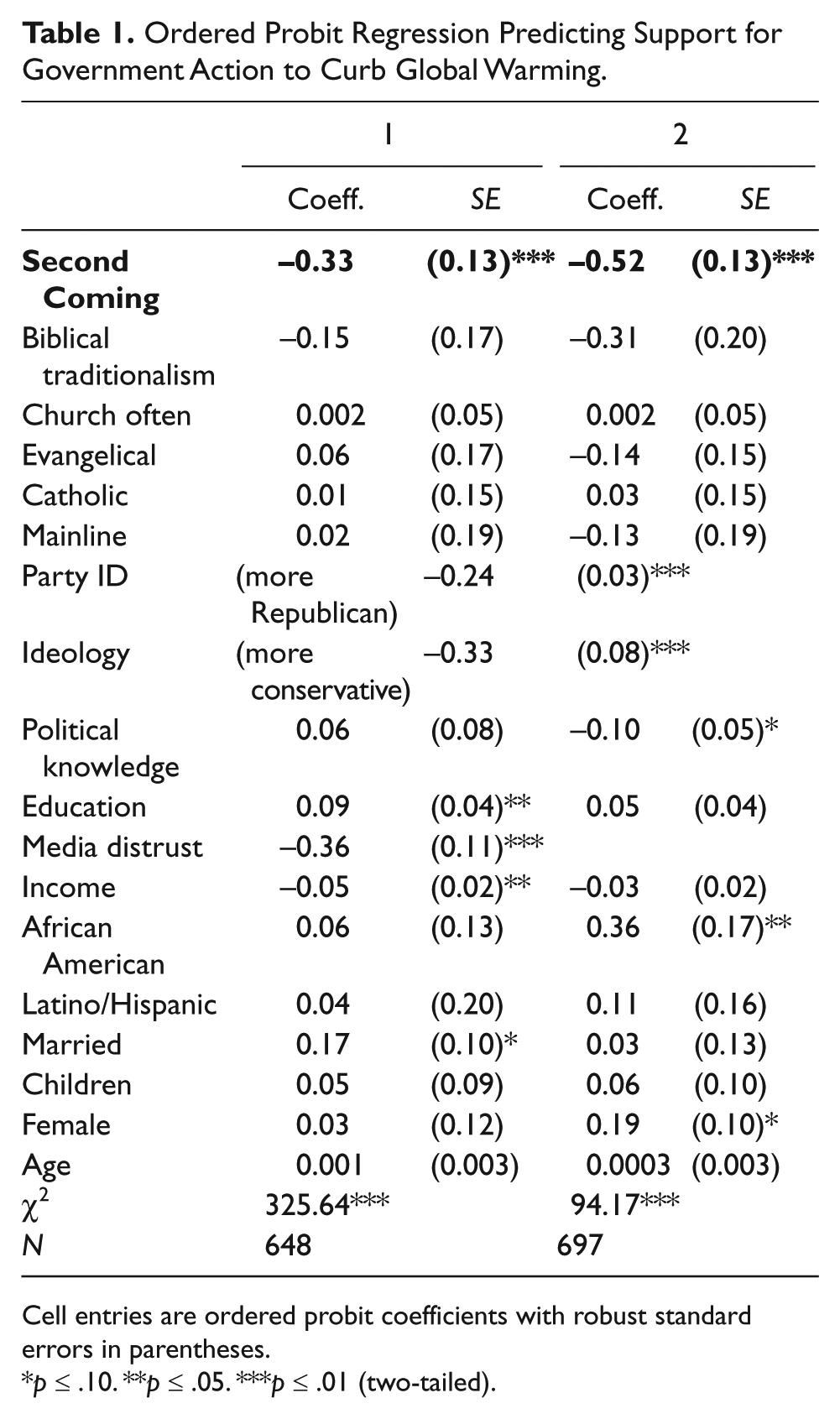
Ordered Probit Regression Predicting Support for Government Action to Curb Global Warming.
Cell entries are ordered probit coefficients with robust standard errors in parentheses.
p ≤ .10. **p ≤ .05. ***p ≤ .01 (two-tailed).
The Substantive Effects of Second Coming.

p ≤ .01 (two-tailed).
The first column of Table 1 reveals the statistical results of our fully specified model. Indeed, this model may be overspecified for reasons that will be described shortly. Focusing on the coefficient and standard error associated with the Second Coming variable, one can see that a belief in Christian end-times theology significantly predicts resistance to government action aimed at curbing global warming. Unfortunately, ordered probit coefficients are not directly interpretable in terms of substance. Thus, we used Scott Long’s procedure for converting such coefficients to changes in the predicted probabilities of the dependent variable equaling any particular category, given a unit change in a given independent variable, while holding other variables at their means (or some specified value, such as zero, which is relevant in interactive models). 24 As Table 2 displays, a belief in the Second Coming reduces the probability of strongly agreeing that the government should take action by more than 12 percent. In a corresponding manner, a belief in the Second Coming increases the probability of disagreeing with government action to curb global warming by more than 10 percent (+5.3 percent for strongly disagree and +5 percent for disagree).
In terms of the other independent variables in our model, it is noteworthy that no other religious variable achieves statistical significance. These null effects provide some additional support for the idea that it is the sociotropic SOF considerations inherent in end-times beliefs that drive traditionalistic Christian resistance to global warming policies.
Still, the strong effects associated with media distrust provide indirect evidence that resistance to global warming policies is also attributable, to a significant degree, to skepticism toward the phenomenon. This finding is not surprising. As we discussed earlier, there are reasons to suspect that such skepticism is pronounced within the traditionalistic Christian community. Indeed, when this variable is removed from the analysis, biblical traditionalism emerges as a significant predictor, suggesting that policy resistance attributable to more generalized religious “believing” is mostly manifested through increased skepticism. However, the fact that Second Coming remains a powerful predictor, in the face of this control, is noteworthy.
As one would also expect, the strongest effects are associated with political variables as party ID (more Republican) and ideology (more conservative) are strongly predictive of global warming policy resistance. But the fact that these variables could not completely overpower the effect of Second Coming is even more remarkable than the fact that media distrust could not. 25
Of course, these three control variables—party ID, ideology, and media distrust—are to some extent theoretically subsequent to religious beliefs. It is well known that in the “culture wars” era, political ideology (and thus party ID) stems in part from Christian traditionalism (see especially Layman 2001). And as we discussed earlier, accusing the “secular” mainstream media of bias is a common talking point for traditionalistic Christians. As such, while it was important to estimate one model while controlling for these variables (given that there are other factors associated with these variables that could also lead to environmental conservatism, which have nothing to do with religious beliefs), including these control variables almost certainly means that we are underestimating some of the causal impact of our religious variables because it is also observable in those political controls. Accordingly, we estimated a second model with these political controls removed, to get a somewhat more realistic estimate of the effects attributable to Second Coming as well as the other religious variables.
The second results column in Table 1, and the second row in Table 2, displays these “stripped down” results: belief in the Second Coming increases reduces the probability of strong agreement that the government should act soon to fight climate change by almost 20 percent and increases the probability of disagreement (both categories combined) by over 17 percent. We think it is reasonable to suspect that our overspecified model and our stripped-down model represent, respectively, the low-end and high-end estimates of the “real” effect associated with Second Coming. It is interesting, and somewhat surprising, that the other religious variables in the model remain statistically insignificant.
Checking Robustness by Analyzing Additional Dependent Variables
As an additional test of our proposed SOF causal mechanism—to make sure that the results we just reported were not the byproduct of some unforeseen conditions pertaining only to environmental politics—we also analyzed respondents’ policy preferences on another issue that involves an intertemporal trade-off between costs and benefits: the national debt. Specifically, we looked at the degree to which respondents agreed or disagreed (0–4, strongly disagree to strongly agree) with the following statement: The government’s accumulated debt could bankrupt the country in future generations if the government doesn’t act now to prevent that from happening.
Again, we expect that those who possess shorter sociotropic time horizons, or those who think the Earth’s life expectancy is finite and determined based on a belief in a Christian end-times theology, should be less inclined to agree with this statement. We can think of no reason, other than the SOF, that end-times believers would tend to think about this question any differently than other citizens. Indeed, we consider such fiscal attitudes to be nearly ideal for our purposes because they lack even a strong ideological or partisan component since Democrats tend to be more concerned with the debt when Republicans are in power, and vice versa.
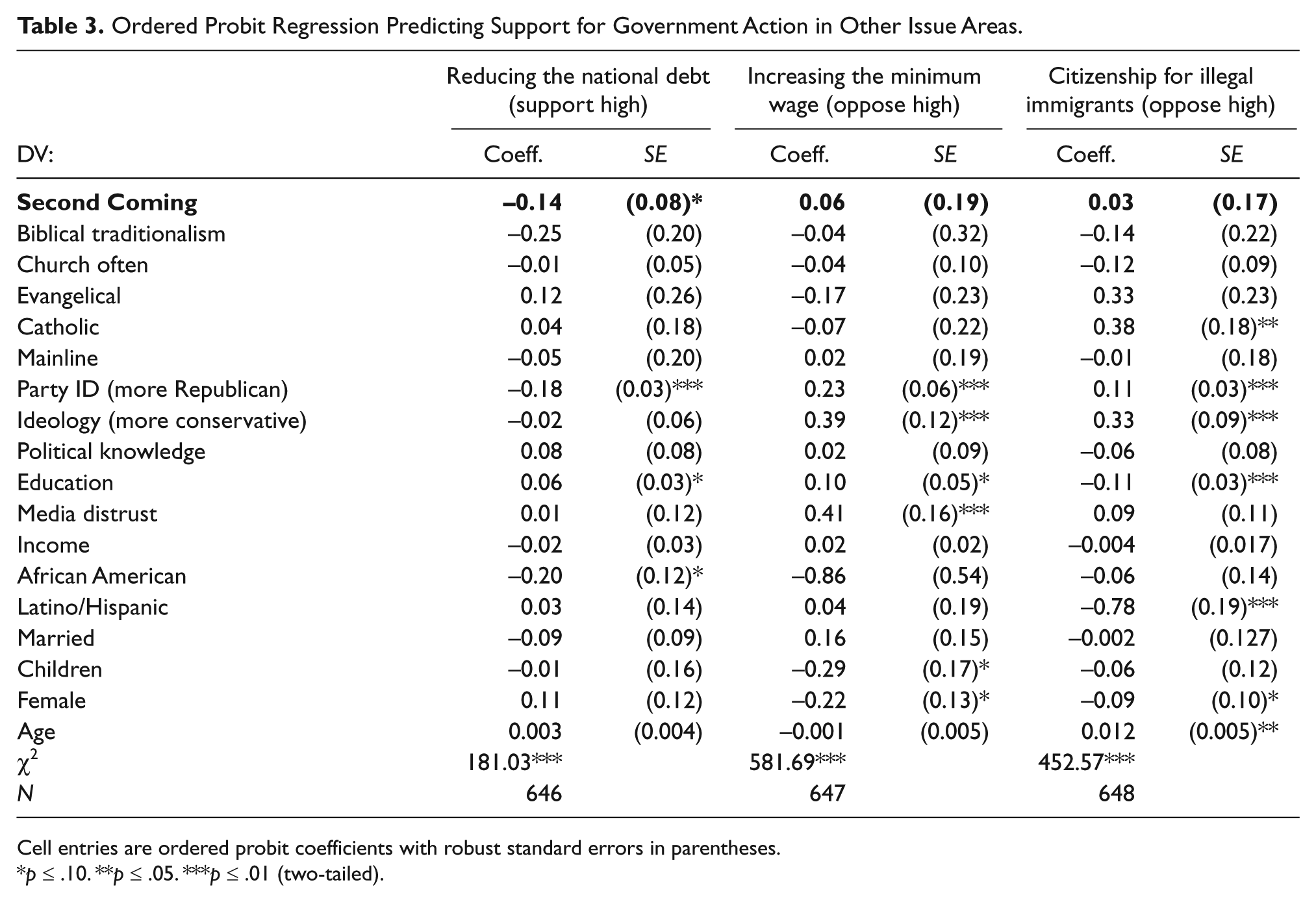
For consistency’s sake, we estimated this model using the same right-hand-side specification as was used to estimate our first model of global warming attitudes (i.e., our fully specified model). As the first column in Table 3 reveals, much the same pattern emerges from this dependent variable: a belief in the Second Coming significantly predicts less support for addressing the growing debt through public policy (p < .10 for a two-tailed test and p < .05 for a one-tailed test).
Ordered Probit Regression Predicting Support for Government Action in Other Issue Areas.
Cell entries are ordered probit coefficients with robust standard errors in parentheses.
p ≤ .10. **p ≤ .05. ***p ≤ .01 (two-tailed).
What is also reminiscent of the results in Table 1 is the fact that no other variable capturing religious identity or behavior attains statistical significance. Indeed, for this dependent variable, no other variable in the entire model attains statistical significance, except for party ID (the more one identifies with the Republican Party, the more one does not seek to address the debt, which would be expected given that Republicans had been in charge of both the executive and legislative branches in the United States from 2000 to 2006). 26 These results provide additional empirical support for our contention that shorter sociotropic time horizons are associated with less concern regarding policy issues that ask citizens to make sacrifices now in exchange for benefits occurring well into the future.
As additional tests of discriminant validity, we also estimated parallel models predicting attitudes on policy issues whose costs and benefits, unlike global warming and the national debt, are more immediate and thus do not involve an intertemporal trade-off. These policy issues include increasing the minimum wage and citizenship for illegal immigrants. Given the lack of a strong intertemporal trade-off in terms of these two policies, time horizon considerations should not be in play as they were with both global warming and the national debt. Thus, we would expect that our Second Coming variable should have no particular effect on attitudes about increasing the minimum wage or on attitudes about citizenship for illegal immigrants.
In the second and third results columns of Table 3, we report the results from two of these models (support/opposition to increasing the minimum wage and support/opposition to amnesty/citizenship for illegal immigrants). 27 As expected, Second Coming does not predict attitudes toward these two issues in any significant way. For the record, Second Coming remains statistically insignificant for these two dependent variables even when we use the “stripped-down” specification, as used in the second model in Table 1.
Discussion
Building from extant research linking American religious beliefs to environmental attitudes, we have offered a causal theory based on sociotropic SOF considerations. Our survey evidence suggests that as such time horizons shorten based on a belief in the biblical end-times, resistance toward global warming policies can be expected to increase.
Thus, while others have pointed to doctrinal beliefs as potential determinants of mass policy attitudes, this analysis is one of the first to have measured such beliefs directly within the mass public and to have put them to empirical test. The findings suggest that in some cases, religio-political cognition may not stem entirely from value considerations, group identification, or social dynamics, but may include elements of rational calculation as well.
These results also bear significant implications for the study of mass political decision making more generally. Although the SOF concept has been used fairly extensively in game theoretic formal models, it has not (to our knowledge) been previously measured and applied to empirical examinations of mass opinion. We hope that others will attempt to model SOF considerations empirically (which need not be restricted to the measures we have employed in this study) when analyzing attitudes toward any number of other policies that require short-term costs to be traded for long-term benefits. As a robustness check, we have already estimated a model predicting attitudes toward reducing the national debt, but we can imagine similar analyses of attitudes regarding a fairly wide range of other intertemporal issues (e.g., investments in science and technology, the long-term solvency of programs like social security, or even foreign policy concerns like the growing strength of China as a superpower).
Furthermore, by introducing the concept of sociotropic SOF considerations, we have provided a theoretical perspective on which others can build. Given the well-established importance of sociotropic thinking as it pertains to attitude formation, it stands to reason that time horizon considerations as they pertain to policies involving intertemporal trade-offs would also include a sociotropic component.
Finally, while it is notoriously dangerous to make any precise predictions about public policy outcomes based on trends in public opinion, it is also well known that policy direction often tracks public mood (e.g., Stimson, Erikson, and MacKuen 1995). Based on this understanding, we would now like to speculate cautiously about the public policy implications of our findings.
Classic median voter logic (e.g., Downs 1957; Black 1958) may be relevant here, given that a variety of survey instruments have consistently reported that a sizable proportion of Americans believe in the Second Coming, and thus that the Earth does have a predetermined expiration date. If really true, then it bodes ill for any U.S. public policy designed to fight global climate change because both Republican and Democratic leaders would be constrained in this direction by the contrary preferences of the so-called “median voter.” In this regard, it is perhaps noteworthy that both the Clinton and subsequent Bush administrations chose not to submit the Kyoto Protocol to the United Nations Framework Convention on Climate Change to the U.S. Senate for ratification (although the Clinton administration did the sign the treaty document in 1998), and that no meaningful legislation designed to curb climate change was passed between 2008 and 2010, even when progressives held the presidency and more seats in Congress than at any time during the last more than sixty years.
But even if median voter logic is incorrect (or does not apply to this issue area) and even if the various survey instruments tend to overstate the actual number of genuine end-times believers, strong reasons remain to think that the Second Coming beliefs described in this article could nonetheless influence U.S. environmental policy. Specifically, the fact that such an overwhelming percentage of Republican citizens profess a belief in the Second Coming (76 percent in 2006, according to our sample) suggests that governmental attempts to curb greenhouse emissions would encounter stiff resistance even if every Democrat in the country wanted to curb them. That is, because of institutions such as the Electoral College, the winner-take-all representation mechanism, and the Senate filibuster, as well as the geographic distribution of partisanship to modern partisan polarization, minority interests often successfully block majority preferences. Thus, even if the median voter supports policies designed to slow global warming, legislation to effect such change could find itself dead on arrival if the median Republican voter strongly resists public policy environmentalism at least in part because of end-times beliefs.
Indeed, even if politicians make little effort to appeal to new voters, instead focusing more on mobilization of supporters and/or demobilization of the opposition (e.g., Leege et al. 2002; Holbrook and McClurg 2005), the policy implications of our research remain and are perhaps even strengthened. This is true because the Republican base includes a large number of active white traditionalistic Christians, who by definition believe in the biblical end-times. Thus, Republican politicians (especially in the South) may get considerable mileage out of appealing to this base, thereby slowing and even blocking Democratic efforts to advance environmental public policy.
Footnotes
Acknowledgements
The authors want to thank Jamie Druckman, John Zaller, Jonathan Hurwitz, Jonathan Woon, James Guth, Steven Finkel, Jude Hays, and Kristin Kanthak for their helpful comments on earlier drafts of this article, and the anonymous reviewers for their extremely helpful insight throughout the review process. All remaining errors are, of course, exclusively ours.
Declaration of Conflicting Interests
The author(s) declared no potential conflicts of interest with respect to the research, authorship, and/or publication of this article.
Funding
Data collection for this project was facilitated by an Umberger Grant from the Department of Political Science, University of Pittsburgh.