



Abstract
Does religion or religiosity affect Muslims’ regime preferences? Developing constructivist and ideational approaches, we theorize why and how religiosity shapes regime preferences. We test our hypotheses on our novel survey data from Azerbaijan in the Caucasus and Kyrgyzstan in Central Asia. Our findings question civilizationist, rationalist, and modernizationist theories by showing that religiosity among Muslims strongly affects regime preferences for various types of democracy and political Islam. Religious affiliation, however, does not. Finally, we challenge standard measurements of democratic support among Muslims and argue for more nuanced definitions; our surveys generate significant improvements in data for studying these issues.
Religion and Regime Preferences
For several decades scholars, policy makers, and Muslim religious leaders and activists have debated two critical questions: Do Muslims want democracy? Are they inevitably prone to favor some form of political Islam? Put another way, does their religious affiliation or religiosity affect Muslims’ regime preferences, or their preferences for a certain type of democracy? These questions have enormous implications, especially as the United States attempts to influence democratic transitions in predominantly Muslim countries from Kyrgyzstan to Afghanistan to Iraq. Universalistic theories often lack systematic testing at the individual level, miss important regional variations, or fail to probe whether Muslim populations understand democracy as Western policy makers and political theorists do. This article addresses these questions in the context of two predominantly Muslim states: Azerbaijan in the Caucasus, and Kyrgyzstan in Central Asia. We developed two original surveys to explore religiosity’s effect on individual regime preferences, namely, for varieties of democracy and political Islam. The surveys are novel in distinguishing between secular democracy, as democracy has been ideally defined in Western liberal theory (Locke [1968] 1990, 15-19; Mill 1956, 11-18; Rawls 1993), and Islamic democracy, a religiously oriented democracy advocated by many Muslim activists and theorists (Nasr 2005, 13-15; Khan 2006, 154-65). Our surveys also distinguish among types of political Islam. Contrary to prevailing theories, we find a strong, consistent relationship between religiosity—the depth of individual belief, practice, and commitment to religious ideas—and regime preference.
Our findings contribute theoretically and empirically to two major and interrelated debates about religion and politics. The first is a decades-long, polarizing debate about religion’s effect on support for democracy. Huntington’s civilizationalist view (1993), as well as many culturalists, expect Islam to determine Muslims’ political preferences; Islamic theology and culture, they argue, is inherently undemocratic (Lerner 1958; Lipset 1994; Lewis 1998; Kedourie 1994). Other scholars contend that all religions are “multi-vocal” (Stepan 2000) and that Islam’s political role has varied over time (Lapidus 1992); therefore, they argue, Islam is not inherently antidemocratic (Soroush 2002). Public opinion studies consistently argue that Muslim religiosity does not affect democratic support, or that Muslims overwhelmingly support democracy (Tessler 2002; Norris and Inglehart 2004; Esposito and Mogahed 2008).
A second and related debate concerns the roots of popular support for political Islam (Islamism)—a twentieth-twenty-first century political movement [omit: phenomenon] characterized by [omit: based on] a religio-political [omit: Islamist] ideology that rejects democracy and calls for an Islamic state, law or constitution based [omit: exclusively] on shari’a, or a caliphate (Esposito 1999). 1 The civilizationist view, prominent in media and policy circles, roots political Islam in an unchanging, theocratic Islamic religion that is antidemocratic, anti-Western, and jihadist (Huntington 1993). Most political scientists have countered that neither religion nor religiosity causes popular support for political Islam. They view such support as the result of economic, political, or territorial grievances (Tessler 1997; Pape 2005). Likewise, the “religious economies” school stresses material interest, not theology or religiosity, in explaining religion’s political role (Kalyvas 1996; Gill 1998).
The above theories make different predictions about the causes of Muslim support for/opposition to democracy and political Islam, but exhibit common problems. First, their theoretical hypotheses have seldom been tested systematically. Second, these approaches generally use problematic measurements of religiosity. Culturalists reduce religiosity to ethnocultural affiliation. Civilizationists equate religion with religiosity, essentializing religion and ignoring variation and change over time. Survey work generally equates religiosity with a single practice, often associated with Arab Muslims. Third, most studies assume one conception of democracy, rather than asking whether Muslims understand democracy in the secular terms of Western liberal theory (exceptions include: Mahmood 2005; An-Na’im 2008). As Norris and Inglehart observe, “it remains unclear how far different understandings of democracy are culturally determined” (2004, 155). Yet surveys rarely distinguish between types of democracy or offer respondents nonsecular regime choices. Tessler, Moaddel, and Inglehart’s recent Iraq survey did do so and found strong support for democracy, Islamic democracy, and shari’a (2006). In four Arab countries, Jamal and Tessler (2008) found similar results. Yet both studies reject religiosity’s causal role in conditioning support for democracy in any way. Their interesting findings leave many questions unanswered.
In the former Soviet Union, a widespread religious revival—including an increase in religious practice and a growth in religious education—has taken place since 1991. This revival is striking after seventy years of Soviet atheism. Debates about secularism have occurred. Moreover, various movements espousing political Islam have appeared. Empirical trends point to religiosity as a potentially important independent variable when studying regime preferences.
As Bellin (2008) has argued, scholars of comparative politics should “explicitly explore . . . religion’s power as an independent variable in politics” (345). 2 In this article, we develop a theoretical and empirical understanding of religiosity’s effect at the individual level on regime preferences. We bring constructivist and ideational approaches to the study of religion and argue that among Eurasian Muslims, religiosity strongly shapes individuals’ regime preferences. However, mere Muslim ethnocultural affiliation does not. In doing so, we first challenge standard measurements of democratic support among Muslims; we argue that though support for democracy is strong among Muslims of Eurasia, it is lower and more ambivalent than other studies suggest. Second, we demonstrate that Muslim religiosity affects one’s regime preferences. Religiosity affects the choice of Islamic democracy over secular democracy, of a nonsecular over secular government, and of support for the caliphate, one form of political Islam. Muslim religiosity is not the only factor affecting regime preferences, but it is a strong predictor of preferences. Finally, our findings call for a reexamination of essentialist/civilizationist, modernizationist, and rationalist/economic theories about religion and politics. Our cases, as discussed below, pose hard tests for our hypotheses and easy ones for most competing hypotheses. We proceed as follows: Part II defines and discusses key theoretical concepts; Part III elaborates our own theoretical framework and hypotheses, and competing ones; Part IV presents our survey method, case selection, and the political context; Part V discusses the models and results; Part VI concludes with key theoretical implications.
Defining Regime Preferences: Variations in Democracy and Political Islam
Following the liberal tradition of comparative theorists of democracy, we understand democracy to mean liberal democracy. Liberal democracy demands free, fair, regular, and competitive elections; civilian control; a constitutional system with no domains of power for actors unaccountable to the electorate; horizontal accountability; universal suffrage; and broad, equal political and civil liberties, including religious freedom (Dahl 1982; Diamond 1999, 10). Since the Enlightenment, liberal democratic theorists have advocated secularism as essential to democracy, so that no one religion has institutionalized political power or is privileged as the basis of law (Locke [1968] 1990; Rawls 1993; Nussbaum 2008, 32-33; Rorty 2003). Strict separation has been violated in some Western democracies with established churches; however, even in such cases, no religion has institutionalized power over the state (Fox 2006). Nor is one religion considered the basis for law or the constitution. Secularism is thus a key component of liberal democracy, whether in “assertive” or “passive” form (Kuru 2007, 571). The former seeks to expunge religion from the public square (e.g., restricting public Islamic dress in Turkey). Under passive secularism (e.g., U.S.), the state seeks to maintain “neutrality” toward all religions (Kuru, 571).
Since we are interested in learning what kind of democracy Muslims prefer, namely, whether they view democracy in the secular (assertive or passive) and liberal terms that have become the ideal in Western democracies, the survey asks about support for “secular democracy” and “Islamic democracy.” These terms are widespread in these regions because Muslim scholars, religious leaders, and politicians have introduced them into the discourse about democracy and constitutions, 3 by contrasting “secular” or “Western” democracy with “Islamic democracy,” an alternative form of democracy (Nasr 2005). In order to better elucidate the survey findings, we used focus groups and interviews to assess popular understanding of these concepts. Most respondents defined “secular democracy” (or just “democracy”) as “freedom,” “freedom of religion,” and “freedom of speech.” Critics of secular democracy generally opposed both expunging religion from the public sphere (assertive secularism) and religious neutrality (passive secularism). They argued that secular democracy facilitated moral decline. As one woman said, under secular democracy “there is too much democracy and freedom.” 4
What constitutes Islamic democracy is a subject of debate (Yusuf 1990s; Khan 2006; An-Na’im 2008). There is little clarity or consensus among Islamic party leaders, theorists, and theologians, much less the mass Muslim public. Nonetheless, Islamic democracy is an increasingly salient concept and its appeal needs to be studied. Seen as an alternative to secular democracy (even passive secular democracy), Islamic democracy may be a system in which some liberal democratic principles such as women’s rights, religious minorities’ freedoms, and other individual rights are circumscribed at the expense of religious norms or laws that privilege Islam (and one interpretation of Islam). As just noted, in Azerbaijan and Kyrgyzstan the discourse among “Islamic democrats” is that secular democracy is “too free,” that “everything is allowed.” Focus group respondents favoring Islamic over secular democracy also typically favored limiting women’s work. Some even opposed women in political office. 5 One justified such a law religiously: “The Prophet even said that there will be no wealth where the leader is a woman.” 6 Some favored legalizing polygamy and restricting a woman’s right to initiate divorce. Some favored enforcing the hijab though most simply wanted freedom to wear the hijab. 7 In contrast to secular democrats, they often favored banning non-Islamic missionary activity and sometimes banning conversion from Islam to Christianity. 8 One respondent, El’vin, led other supporters of Islamic democracy in stating that religious minorities should not have the right to proselytize, because they are a threat to Islam. 9 Another respondent, Rufat, expressed a less common viewpoint among Muslim democrats in the study: “There is a hayat in the Quran. . . . Everyone is equal. Live with them [non-Muslims] as with a brother.” 10 Muslim democrats in both Kyrgyz and Azerbaijani focus groups almost universally favor Islamic education in public schools. Said one Azeri woman: “Much of the state must be Islamic. Student education must include Quranic study to prevent youth from going down the wrong path.” 11 Finally, most supporters of Islamic democracy favored at least some shari’a law, but also opposed religious leaders in the state and endorsed democratic elections. Iskender, an Azeri supporter of Islamic democracy, argued: “All law should be by shari’a . . . there should be an Islamic-shari’a constitution.” Yet, he added: “[religious leaders] must have a role in government . . . but it seems to me that the opinion of religious leaders should remain on the sidelines.” 12 He favored Islamic party competition in elections. 13 A group of women unanimously supporting Islamic democracy agreed that “an Islamic shari’a constitution is better,” because “within Islamic shari’a, are its own laws.” 14
Global survey findings reinforce this characterization of Islamic democracy from our qualitative data. Using WVS data, Fish argues that Muslims are less supportive than non-Muslims of certain liberal democratic values and rights, including women’s rights, abortion, divorce, and homosexual rights, and more strongly oppose non-believers holding public office (Fish 2011). Thus, Islamic democracy is distinct from political Islam, but is also likely to be an illiberal form of democracy. We therefore use the term Islamic democracy to refer to a regime based on some fundamental democratic institutions (e.g., elections and accountability) but allowing illiberal religious influence on the constitution and laws at the expense of state religious neutrality and some core liberal principles and individual rights. A preference for Islamic democracy over secular democracy suggests at least a strong symbolic attachment to an Islamic-oriented constitution and laws, belief that the state should help preserve Muslim morality, and rejection of the normative secular model of Western democratic theory. Some Muslim democrats do hold liberal, democratic views compatible with a passive secular democracy, much like supporters of contemporary Christian democratic parties in Europe, but many appear to support Islamic democracy as a constitutional alternative to secular democracy. 15
Political Islam (Islamism), as noted above, is a modern phenomenon that calls for “Islam as a political ideology” (Ayoob 2007, 2). There are many stripes of Islamists, and scholars and policy makers tend to use the term broadly; however, we must conceptually distinguish between those who accept democracy and fully free elections (though favoring democracy of an Islamic form, Islamic democracy) and those who reject democracy in favor of another form of Islamic state (political Islam). In this categorization, only the latter seek Islamism, or political Islamic regimes. They pursue an idealized, nondemocratic, modern Islamic state of some form, instances of which have been established in twentieth-century Iran, Saudi Arabia, Sudan, and Pakistan. Other Islamists call for returning to the caliphate, which they define as a return to the “pure” or “classical” Islamic state of the time of the Prophet Muhammad. Many scholars argue that early caliphs ruled by principles—such as “consensus”—compatible with democracy (Afsaruddin 2006), and that only in its early period (
Focus group respondents who favored the caliphate saw it as a form of political Islam. As Avaz, one caliphate-supporter stated, “Now everyone has his own head, but it’s important that there be just governing within the framework of Islam . . . all laws, legal, social, and citizenship laws should be based on the shari’a.” 16 Ilhom, another caliphate-supporter, argued: “Islam and democracy are not compatible concepts. Democracy is free speech but in Islam one must live according to shari’a.” 17 Nigora, whose opinion was seconded by the other women in the focus group, claimed, “The caliphate is a good form of government for Muslims. . . . All laws must be based on shari’a . . . but no Muslim parties should participate in elections, because in Islam elections are forbidden.” 18 Like many others, a group of Kyrgyz women favored a caliphate and also supported an Islamic state, saying: “Saudi Arabia is a good political model for Kyrgyzstan.” 19 They also supported many common Islamist ideas 20 : separate transportation for women; the shari’a’s hudud penalties for theft, and sometimes for adultery; making Judaism and/or Christianity illegal; and making Christian missionaries illegal. Said one, “it’s criminal when people [leave Islam to] accept another religion.” They favored restricting free speech and “a violent reaction” to caricatures of the Prophet, since “those Muslims who say this is free speech are wrong. If there is not a violent reaction from Muslims, there will be still more such caricatures.” 21 Those favoring a caliphate hold views consistent with many core demands of modern political Islamists.
Civilizationist, Modernizationist, and Rationalist Theories
The debates discussed in Part I inform our analysis of religion’s effect on regime preferences. The major theoretical approaches—essentialist/civilizationist, modernizationist, and rationalist/economic—offer various competing hypotheses.
First, civilizationists have proffered essentialist hypotheses about the incompatibility of Islam and democracy (Huntington 1993). 22 Many culturalists (Lerner 1958; Lipset 1960, 1994) also hypothesize that religion determines political values. They see Islam as a complete social system that has never accepted secular authority. Thus, being Muslim causes one to reject democracy and support political Islam (Kedourie 1994; Gellner 1983; Lewis 1998).
A second major hypothesis comes from the religious economies school, which articulates a rational choice view of religion (Kalyvas 1996; Gill 2001). This view expects economic or organizational interests to explain the relationship between religion and politics (e.g., the Catholic Church’s attitude toward parties and democracy). Blaydes and Linzer extend this rational choice approach to the individual level and contend that poorer women support Islamic fundamentalism because it offers financial security (2008, 580).
Modernization (Weber [1946] 1972, 303-306; Lerner 1958; Lipset 1960) and secularization theorists, typically looking at the societal level, offer a third hypothesis: modernizing processes—urbanization, industrialization, and literacy—bring societal religious decline and the rise of secular, liberal values that are favorable to democracy. At the individual level, Ciftci (2010) argues that modernization variables best predict support for democracy in the Muslim world, while religiosity has no effect; however, his analysis reveal that religiosity does have an effect in several countries (e.g., Turkey). This calls for further exploration. 23 Norris and Inglehart (2004, 149) propose a revised modernization thesis: low economic and human development—human insecurity—causes religiosity to persist in the Muslim world, but they assert: “both Muslim and Western societies are similar in their orientation toward democratic ideals” (2004, 155).
The literature on popular support for political Islam rather than democracy has several hypotheses. Some stress poverty and unemployment, especially among educated youth, as driving factors (Kepel 2002; Roy 1994). Tessler’s “political-economy” argument integrates political and economic grievances; low living standards, high unemployment, lack of access to higher education, dissatisfaction with corruption, and inadequate housing all foster support for political Islam (Tessler 1997, 93-97). A related grievance hypothesis focuses on anti-Westernism; colonialism, U.S. support for Israel, neocolonialism, and economic and cultural globalization are seen as driving support for political Islam (Esposito 1999, 50-65; Cole 2009).
A growing literature on public opinion in the Muslim world has addressed individual-level Muslim support for democracy/nondemocracy. Studies of select countries in the Middle East and Central Asia and broader Gallup Poll and World Values Survey analyses claim that democratic support among Muslims is extremely high (Rose 2002; Tessler 2002; Tessler and Gao 2006; Norris and Inglehart 2004; Inglehart 2007, 43; Esposito and Mogahed 2008). Many do not actually test the effect of religiosity. Others conclude religiosity has little or no effect on support for democracy (Tessler 2002; Hofmann 2004; Ciftci, 2010).
Finally, some significant studies hypothesize that either gender (Tessler 2002) or patriarchal (not Islamic) norms (Fish 2002, 37; Inglehart 2007, 43) undermine support for democracy and drive support for political Islam.
Theorizing Religion’s Effect
We develop a theoretical explanation of why religiosity might affect regime preferences. We first draw on insights from Americanist scholarship that asserts a “religious factor” in political preferences (Wilcox, Wald, and Jelen 2008) and offers a useful and generalizable method for assessing religion versus religiosity. We then build on constructivist and ideational theory to argue that religiosity shapes one’s identity, thus shaping one’s values and ideas about politics and legitimate regimes.
Following the 1980s political emergence of the U.S. Christian Evangelical movement, some Americanist scholars identified religion as an important predictor of party ID, voting, and moral issue positions (Jelen 1993; Leege and Kellstedt 1993; Layman 2001). While most such work adopts an ethnocultural model emphasizing ethnoreligious affiliation, Layman (2001) argues that religious commitment and doctrinal orthodoxy also affect party identification and voting (68-74). We similarly expect a difference between nominal/ethnocultural Muslims and those who practice Islam. We explore the relationship between religion, religiosity, and political preferences in Muslim Eurasia but depart from the Americanist focus on party affiliation and voting. Our focus on the link between religiosity and regime type preferences is critical for the Muslim world, where debates about transitions to democracy are ongoing.
Constructivist and ideational approaches in comparative politics have seldom examined religious identity; however, constructivist and ideational international relations theory has increasingly emphasized religious identity (Finnemore and Sikkink 2001). We integrate these approaches and Layman’s insights to treat religion as a constructed identity. Religion is a group affiliation based on a belief system—ideas about the divine, morality, and justice. Religiosity is the depth of belief, practice, values, and commitment of an individual who subscribes to a religion’s ideas. Religion and religiosity are linked, but religious affiliation alone does not mean engaging in active belief, practice or commitment. We may expect religion to affect preferences through religiosity.
First, religiosity helps form an individual’s identity by shaping his or her values, beliefs, and practices; religiosity constitutes the self. Therefore, religiosity affects one’s social and political values, outlook and preferences. Religious references, language, values, and symbols are likely to provide a source of legitimacy to active believers (Eickelman and Piscatori 1996; Wald and Wilcox 2006). Second, religion’s ideational component (Philpott 2007) sets forth values and moral codes about justice and moral government ( An-Na’im 2008). Islam, not unlike Christianity, offers a vision of a just society and government, even if the theology does not prescribe definitive political institutions (Eickelman and Piscatori 1996). These include religious teachings on justice, crime and punishment, the poor, women, and war. Higher levels of religiosity suggest greater exposure to religious and religio-political ideas, through mosque or church attendance, religious literature, religious lessons or meetings, and/or familial or community enforcement of religious norms (Mahmood 2005). As ideational approaches suggest, elites and activists—in this case, religious or religio-political ones—use these mechanisms to “carry” religio-political ideas about justice and other political matters to religious adherents (Berman 1998; Philpott 2001; Wickham 2002). Thus, we propose the following hypothesis: Hypothesis 1: Muslims who are more religious are more likely to prefer a religiously oriented regime over a secular one. By contrast, the less religious or nominal Muslims (those identifying as ethnocultural but not religious Muslims), who are less exposed to religious practice, ideas, teachings, and networks, would likely reject the influence or dominance of religious norms and laws as illiberal.
Following this logic, and contra culturalist and civilizationist approaches to Islam, we do not expect religiosity to have a consistent effect on a preference for “democracy” in the abstract, for religious respondents may be exposed to varying political theologies that construct varying interpretations of democracy and Islam. Rather, we expect an effect when respondents can explicitly choose between religiously oriented democracy and secular democracy and have the opportunity to support a normatively acceptable variant of democracy. We thus suggest Hypothesis 2: Muslims who are more religious are more likely to express a preference for a religiously oriented “Islamic democracy” over “secular democracy.”
We anticipate that a preference for Islamic democracy, as discussed earlier, suggests a preference for certain fundamental democratic institutions, such as free elections. Yet it also differs from preferring a passive secular democracy, which upholds state religious neutrality. A preference for Islamic democracy suggests a preference, minimally, for a democracy that identifies itself as Islamic, justifies itself according to Islam, and that gives Islam a privileged place in the public sphere and shari’a a privileged place in at least some laws.
Similarly, we expect that support for political Islam—a category of nondemocratic regimes that explicitly makes religion the major source of law, that may give religious leaders or parties a predominant or exclusive role in politics, and that limits free elections—is affected by religiosity. Political Islamists explicitly link the state’s justification to Islam through their political theology. A greater number of religious Muslims are thus more likely to support political Islam than ethnocultural or less religious Muslims. As we discuss below, distinguishing among various forms of political Islam can be difficult in surveys, since most Islamists call for shari’a or an “Islamic state” without articulating clear governmental institutions. However, many twentieth–twenty-first-century Islamists have specifically defined the “caliphate” as a form of political Islam. 24 We anticipate that some more religious Muslims will support its religio-political theology. This leads to the following hypothesis: Hypothesis 3: Greater religiosity is likely to make one more supportive of political Islam, defined as the caliphate.
Finally, our constructivist/ideational perspective views Islam as “multivocal” (Stepan 2000). Proponents of varied political theologies interpret doctrine and its social and political implications in different ways—some more conservative, others more liberal. They generally agree that Islam provides many solutions to justice and social order and thus favor a religiously oriented political system. Yet different groups advocate very distinct alternative options. In Islam, as in Christianity, some political theologies want to give religion a dominant state role (Philpott 2007). Others espouse a public role for religion to promote a moral economy, law, and society within democratic institutions. Thus, we expect that greater religiosity will predict support for religiously oriented regimes, but also that religious Muslims are likely to be divided in political theology, such that some prefer Islamic democracy and others supporting the caliphate or other forms of political Islam.
Survey Method
We systematically test our hypotheses against competing hypotheses by using new country data from our national surveys administered in Azerbaijan (n=1200) and Kyrgyzstan (n=1100) during 2006 (see Appendix 2). Recognizing the difficulty of conducting surveys in postcommunist and transitional or authoritarian contexts, we used multiple survey items to examine regime preferences and assess the validity and reliability of responses. Our high response rate and face-to-face interviews bolster the quality of our results. Going beyond questions about support for “democracy,” the survey asks about preferences for Islamic or secular democracy and variations of political Islam. The questions were informed by extensive focus groups so as to reflect how people discuss political alternatives (Appendix 2).
Case Selection and Political Context: Azerbaijan and Kyrgyzstan
The cases we present are particularly hard cases for our own hypotheses that religiosity will affect political preferences among Muslims. Although Azerbaijan is 99.2 percent Muslim and Kyrgyzstan is 86.3 percent Muslim (Pew 2009), Azerbaijan and Kyrgyzstan, like the rest of Muslim Eurasia, have long been considered strongly secular due both to Soviet modernization and to religious repression. Mass literacy campaigns took place in the 1930s. Significant industrialization and urbanization led to a high level of modernization and development, especially in comparison with other regions of the Muslim world (Nove and Newth 1967). Russian and other non-Muslim ethnicities furthered secularizing cultural shifts. After intense religious repression from 1928 to 1944, some mosques were reopened. Islam became legal; however, to progress in education, the party, or employment, one had to embrace scientific atheism, at least publicly. Religious knowledge and practices declined dramatically. Scholars argue that most people were secularized; many even became atheist (Shahrani 1995). Khalid argues that Soviet “nationalities policy” transformed religiosity into national “custom,” and that with rare exceptions, even the unofficial Islam that survived was limited to a handful of “cultural” birth and death rituals (Khalid 2007, 83). Hence, these cases are among the least likely cases in the Muslim world where one would find that religiosity affects political preferences.
Our cases are correspondingly easy cases for major counterhypotheses that argue that religiosity has no effect on political preferences—either on support for democracy or for political Islam. 25 Since religiosity was so transformed in twentieth-century Azerbaijan and Kyrgyzstan, the rationalist religious economies school should easily find support for its assumption that religiosity and religious ideas do not shape political preferences. Likewise, these cases should be easy tests for rationalist arguments about support for political Islam. Economic grievances abound since the Soviet collapse, particularly among youth who suffer from high unemployment and lack the free educational opportunities and housing accommodations once guaranteed by the Soviets. Older modernization theory would also expect easy support for its hypotheses in these societies, which exhibit relatively high human development; support for secular democracy should be high, especially among the urban, well-educated, and wealthier population. Revised modernization theory, by contrast, expects to find higher religiosity among those experiencing socioeconomic insecurity, as in Azerbaijan and Kyrgyzstan since 1991. However, Norris and Inglehart (2004) reject any link between higher religiosity and lower or qualified support for democracy among Muslims.
Focusing on Azerbaijan and Kyrgyzstan also allows us to examine cases in two non-Arab regions; research to date has disproportionately concentrated on the Arab states where a minority of the world’s Muslims live. Our new data expand the scope of Muslim public opinion analysis. Our cases especially shed light on political preferences of Muslims living in seven states of former Soviet Eurasia, and of Muslims living under other postcommunist, postsocialist, or formerly militantly secularizing regimes where state repression of religiosity has also been followed by Islamic revival (e.g., Turkey, Iraq).
Pairing Azerbaijan and Kyrgyzstan is also methodologically useful because they exhibit variation in levels of political and religious repression. If religiosity affects preferences across different institutional contexts, this suggests religiosity affects preferences more broadly. With two cases, we cannot test regime effects; however, we can note important political differences not captured in our model. Since 1991 Kyrgyzstan has been more pluralist and religiously free. Although generally a closed political system, it has had periods of significant openness, including mid-2005 to 2006, following the “Tulip Revolution,” when we conducted the survey. By contrast, since 1993 Azerbaijan has been ruled by a strong autocracy, which has engaged in limited religious repression and extensive surveillance of religious institutions. In 2006, during the survey, Kyrgyzstan had a Polity score of +4, and Azerbaijan a score of −7. 26
Finally, in Muslim Eurasia since the 1980s diverse political theologies have emerged. Some Salafi movements and Hizb ut-Tahrir favor a caliphate. 27 Many Shia Islamists preach an Islamic state (Yunusov 2004; Goyushov 2008). 28 Mainstream Sunnis advocate some form of shari’a to guide law and society, within or without democracy (Yusuf 1995), 29 while the Nurcu movement promotes religiously oriented democracy (Balci 2008). 30 If a constructivist/ideational perspective is correct, we should find neither overwhelming support for democracy nor unwavering support for political Islam. We should find that practicing Azerbaijani and Kyrgyzstani Muslims are divided in support of these various political theologies.
Survey Data from Azerbaijan and Kyrgyzstan
Our sample here includes only those respondents who self-identify as Muslim (1,176 and 892 observations in the Azeri and Kyrgyz cases respectively). 31 We first assess alternative measures of support for “democracy.” Then, we test our own hypotheses and alternatives in four models that examine support for regime preferences. The models formulate the dependent variable in alternative ways—democracy/nondemocracy, secular/nonsecular, secular/Islamic democracy, and the caliphate, so as to get a more robust picture of regime preferences for various forms of democracy and political Islam.
Measuring Support for Democracy
Measuring support for democracy can be problematic for two important reasons. First, most studies focus on one WVS survey item: whether respondents agree that “democracy has its problems but is preferable to all other forms of government.” While respondents may affirm democracy in that item, in responses to other items respondents also support some form of authoritarianism (e.g., rule by experts, military rule). Survey analyses often ignore this issue and include only the highly positive evaluations of democracy as a preferable form of government. In a notable exception, Mattes and Bratton report that 70 percent of citizens surveyed in twelve African countries prefer democracy to other forms of government, but calculate that of these only 48 percent can be labeled “committed democrats,” someone who responds that democracy is preferable to other forms of government and rejects all forms of authoritarianism in subsequent questions (Mattes and Bratton 2007, 194; Fish 2011). We posed the same questions. In our Kyrgyz sample, 86.6 percent of respondents tthought that a democratic political system—with no distinction made between secular and Muslim forms—is good or very good for their country. 32 Yet only 4.6 percent of the sample can be considered “committed democrats”; that is, they prefer democracy and oppose the three specified forms of authoritarian government for their country. Similarly, only 4.2 percent of Azeri respondents can be considered “committed democrats.” 33 Thus, support for democracy is more ambivalent than is often acknowledged. Yet most work simply reports that Muslims overwhelmingly support democracy (Esposito and Mogahed 2008, 63; 34 Rose 2002; Hofmann 2004; Norris and Inglehart 2004; Inglehart 2007). 35
Second, as discussed earlier, Muslim scholars and activists increasingly distinguish between “secular” and “Islamic democracy.” Support for democracy does not necessarily mean support for secular democracy (in any of its forms defined by Kuru 2007). As noted above, focus group participants overwhelmingly understood “democracy” to mean elections and freedom, yet also distinguished between Islamic and secular democracy. They discussed Islamic democracy as an alternative to secular democracy, unlike contemporary Christian democrats in Europe who typically view themselves as nominally Christian parties within secular democracy. Quantitative findings from the survey data further demonstrate the importance of studying support for Islamic versus secular democracy as we have defined these regimes above. In line with the focus group data, subsequent questions in the survey asked about preferences that suggest an illiberal, nonsecular form of democracy. For example, difference in proportion tests show those favoring Islamic democracy are significantly more likely to support mandatory Islamic education in state schools, oppose women’s right to work in any sector and right to initiate divorce (in Kyrgyzstan), support polygamy (in Kyrgyzstan), and support violent protest against blasphemous speech than those favoring secular democracy. An abstract question cannot precisely delineate how all survey respondents understand Islamic democracy. Yet the qualitative and quantitative findings above strongly suggest that “Islamic democracy” exhibits core institutional features of democracy, but is likely to be less liberal and less secular than the passive secular model.
Studies that do not find a consistent effect of religiosity on support for democracy largely do not distinguish between secular and Islamic democracy. Esposito and Mogahed’s conclusions from the Gallup poll (2008), and scholars using WVS data, are handicapped by instruments that only ask about “democracy,” not shari’a, Muslim democracy, or the caliphate. 36 Most survey studies of the Middle East and Central Asia likewise do not report such items (Rose 2002; Tessler 2002). Three recent studies of Arab states revealed significant popular support for religious leaders’ influence in politics (Jamal and Tessler 2008; Tessler, Moadel, and Inglehart 2006; Tessler and Gao 2006) but either negated or did not explore the role of religiosity in causing such views.
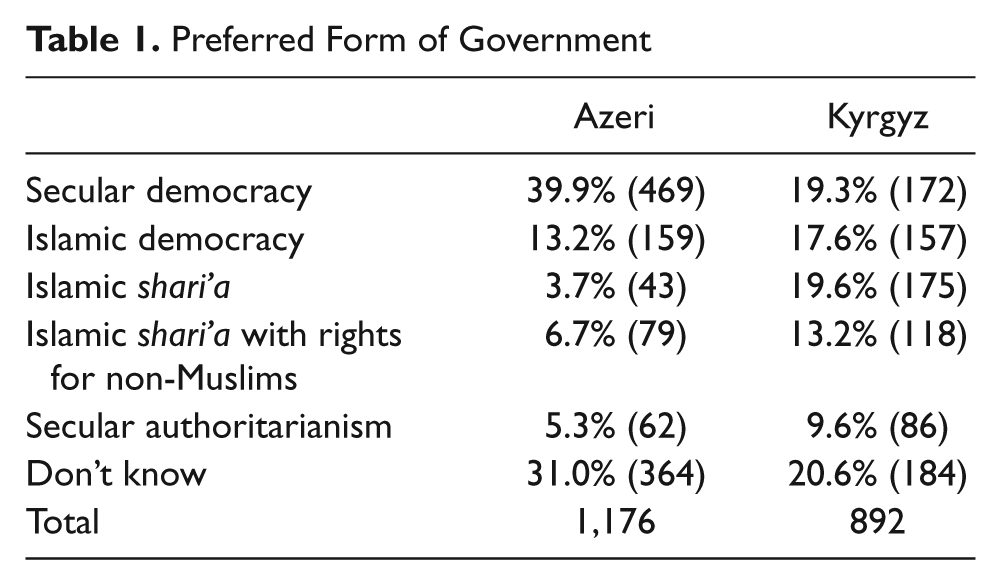
To better elucidate political preferences, we presented respondents with a range of secular and Islamic choices in several survey items. In one item, respondents were asked to express a preference for a type of constitution (secular authoritarianism, secular democracy, Islamic democracy, and shari’a with or without rights for non-Muslims) for Muslim countries. Hence, respondents could explicitly choose between secular and nonsecular regime alternatives. This question allows us to evaluate the extent to which Islamic religiosity—at the very least symbolically—matters to regime preferences. Responses are shown below in Table 1. The survey results suggest that many do favor secular democracy (39.9 percent in Azerbaijan, 19.3 percent in Kyrgyzstan), but this number is a majority in neither. Among those not choosing secular democracy, most support either Islamic democracy or some form of shari’a. Very few preferred secular authoritarianism, which focus group respondents identified with their current government or the Soviet regime. A total of 23.9 and 38.5 percent favor Islamic options in Azerbaijan and Kyrgyzstan, respectively. A large group responded “don’t know.” 37 The results demonstrate that the level of support for secular democracy—the liberal definition of democracy—is significantly lower than the literature suggests, especially in Kyrgyzstan.
Preferred Form of Government
Explaining Regime Preferences: Models and Data
We construct four models, with alternate formulations of the dependent variable, to robustly assess which competing hypotheses explain our dependent variable, regime preferences—that is, for alternative democratic and political Islamic regimes. The sample is split between the Azeri and Kyrgyz respondents to take into account national differences.
In the first two models, we use dependent variables created from the constitution question in Table 1. In model 1, we examine support for any kind of democracy (secular or Islamic) over nondemocracy. In model 2, we look at support for any secular form of government versus support for any nonsecular, Islamic alternatives.
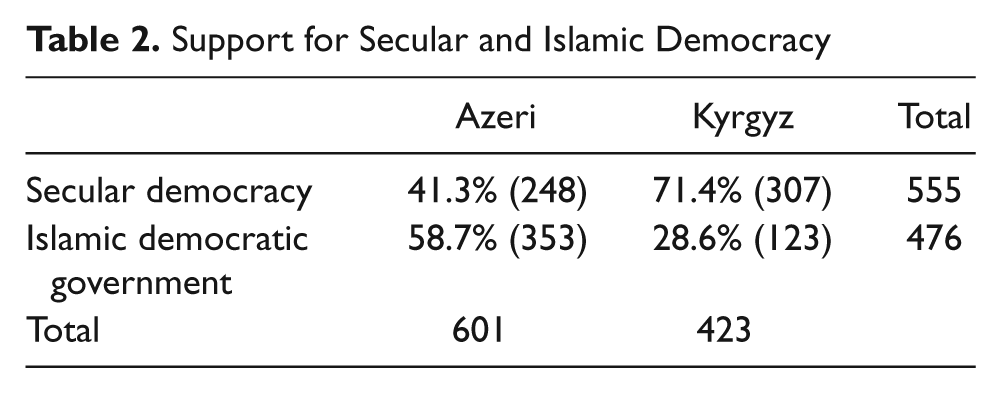
In model 3, we explain support for secular democracy versus Islamic democracy by more specifically comparing those who choose a “secular democratic state” as opposed to “an Islamic democratic state.” Model 3 uses the survey item “What is your opinion of an “Islamic democratic state?” The dependent variable in model 3 is a binary variable which equals 1 if the respondent indicated support for Islamic democracy and 0 if she or he indicated support for secular democracy. 38 We limit our sample to those expressing support for democracy, either secular or Islamic: 601 Azerbaijani and 430 Kyrgyzstani respondents, respectively. Our results are robust to various specifications of the dependent variable using this question, and to the constitution question in Table 1 (see Appendix 3, Table 1).
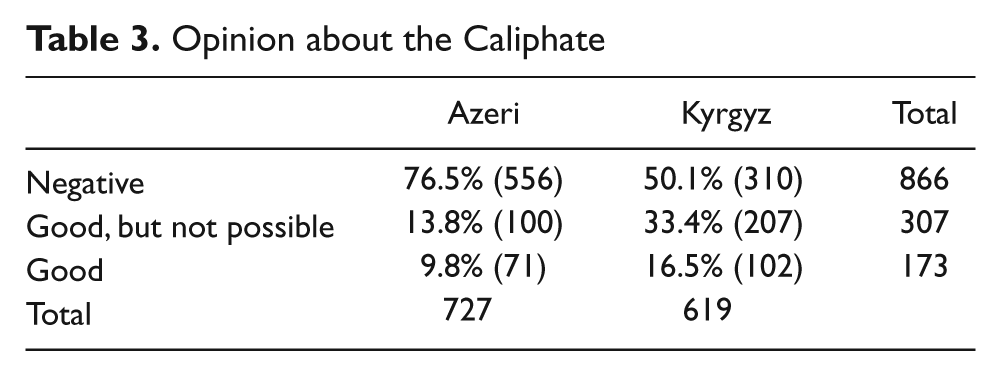
In model 4, we examine support for political Islam, using a survey item that gauges support for the caliphate. The caliphate, as discussed above, represents one form of modern political Islam. Our model does not include support for an Islamic nation-state (e.g., Iran) since focus groups revealed that interpretations of an “Islamic state” varied widely; however, participants generally understood the caliphate as defined by contemporary Islamists (see the section section, “Defining Regime Preferences”). We measure support for the idea that Muslims should live in a caliphate as an ordered categorical variable, and code as follows: 0 if the respondent reported a negative view of the idea that Muslims should live in a caliphate; 1 if the respondent reported the view that this idea would be good but not possible; and 2 if the respondent reported a positive view of this scenario. Table 3 presents the breakdown of this dependent variable. We therefore use a conservative estimate of support for political Islam, since only some of those favoring political Islam support the idea of a caliphate. Indeed, more than 75 percent of Azeri respondents have a negative view of the caliphate; just 50 percent of Kyrgyz respondents have a similar view. Nonetheless, since focus groups also indicated that caliphate supporters shared most of the same goals as proponents of an Islamist state, we use it as a proxy for support for political Islam. 39
Support for Secular and Islamic Democracy
Opinion about the Caliphate
We test the same independent and control variables in each model. We operationalize our hypotheses and the alternatives below (see Appendix).
Independent variable: Religiosity
Public opinion research format “religiosity” to italic, serif, consistent with other independent variable names on Islamic countries typically measures religiosity as frequency of reading the Qur’an or attending mosque. These measures are inappropriate in Eurasia, however, where Arabic knowledge and Qur’an reading are low due to repressive Soviet policies. Fear of being arrested for attending mosque is still substantial in Azerbaijan. Moreover, living by Islamic values, communal rituals, prayer at home, and shrine visitation—rather than “orthodox” praxis—have always been more indicative of religiosity in these regions (DeWeese 2002). Therefore, we use a survey item asking respondents to self-evaluate their religiosity. 40 We code responses on a scale from 1 (nonbeliever) to 5 (deep believer). 41 The mean level of religiosity is 3.25 and 4.37 in Azerbaijan and Kyrgyzstan, respectively. Each model’s results are robust to an index using the self-reported measure, religious practices/rituals observed, and self-identification as Muslim. 42
Control variables:
The different literatures and hypotheses discussed above suggest a variety of factors that explain support for secular democracy and political Islam. Therefore, in each model we test our hypotheses against prominent competing ones. Concern about Corruption is our proxy for political-economic grievances; asking directly about the regime is problematic in both authoritarian Azerbaijan and semi-authoritarian Kyrgyzstan, where criticizing the president is a crime. Corruption in both countries is very high and closely linked to political leaders (Collins 2006; ICG 2008). Concern with corruption is coded as a binary variable, where 1 is a “very serious problem” and 0 for all others. 43 We include a dummy variable of religious repression that equals 1 for a respondent who has personally experienced religious repression and 0 otherwise. 44 Education is a dummy variable for higher education. Urbanization is a dummy variable for living in an urban area. Economic status, based on respondents’ self-assessment, is coded from 1 (very poor) to 5 (very good). 45 Negative employment expectations is a dummy variable that equals 1 if the respondent indicated that she or he had a negative or very negative view about the possibility of finding full-time work. We then interacted this with higher education as a way of testing more nuanced grievance hypotheses. Young is a dummy variable equal to 1 if the respondent is less than 30 years old in Azeri data (28.0 percent) and less than 35 years old in the Kyrgyz data (40.8 percent). 46 Values threatened by West is a dummy variable that indicates whether a respondent feels that his or her values are under threat from the West. 47 Gender inequality is coded from 1 (most equal views–women can do any work) to 3 (most unequal views–women should only do housework and raise children). Female is a dummy variable for gender effect.
Results and Analysis
We present our four principal models in Table 4. To account for the categorical nature of the dependent variables, models 1, 2, and 3 are logitistic regressions while model 4 is an ordered logistic regression. We will briefly discuss the findings of models 1 and 2 before a more detailed examination of models 3 and model 4.
Results

Note: Standard errors are in parentheses.
p < 0.01, **p < 0.05, *p < 0.10.
Model 1 provides a close comparison with many existing studies, as it examines support for democratic versus nondemocratic regimes. Religiosity does not have a significant effect in the Azeri sample, but it does significantly decrease support for democracy in Kyrgyzstan. Our findings therefore challenge essentialist theories that predict religiosity will have a consistently negative effect on support for democracy, and rationalist theories that expect no effect. We also find—consistent with modernization theory—that being urban increases support for democracy. Our results are consistent with others studies’ findings that religiosity’s effect on support for democracy in the abstract varies by case (Ciftci, 2010). However, as we expect, religiosity’s effect here is weaker than when distinguishing between Islamic and non-Islamic forms of democracy. 48
In model 2, we examine preferences for secular versus nonsecular forms of government. We find strong support for our first hypothesis, that an increase in religiosity has a negative and significant effect on support for the secular alternative. We find no consistent support for alternative hypotheses. As in the qualitative interviews, models 1 and 2 suggest the importance of asking more nuanced questions about religious/secular regime preferences.
Therefore, in model 3, we analyze support for secular democracy versus Islamic democracy. The coding of the dependent variable limits that sample to those who indicated support for secular or Islamic democracy. We find support for our second hypothesis in both cases. Religiosity is statistically and substantively significant in determining the choice between secular and Islamic democracy. In each country, as religiosity increases, the likelihood of supporting Islamic over secular democracy increases as well. Holding all other variables at their median, an increase in religiosity from “indifferent” to “moderate believer” increases the predicted probability of supporting Islamic democracy in the Azeri sample by 0.189 and in the Kyrgyz sample by 0.366 (see Figure 1). As in model 2, this result dramatically differs from other studies of Muslim public opinion, which claim that religiosity does not affect political preferences.
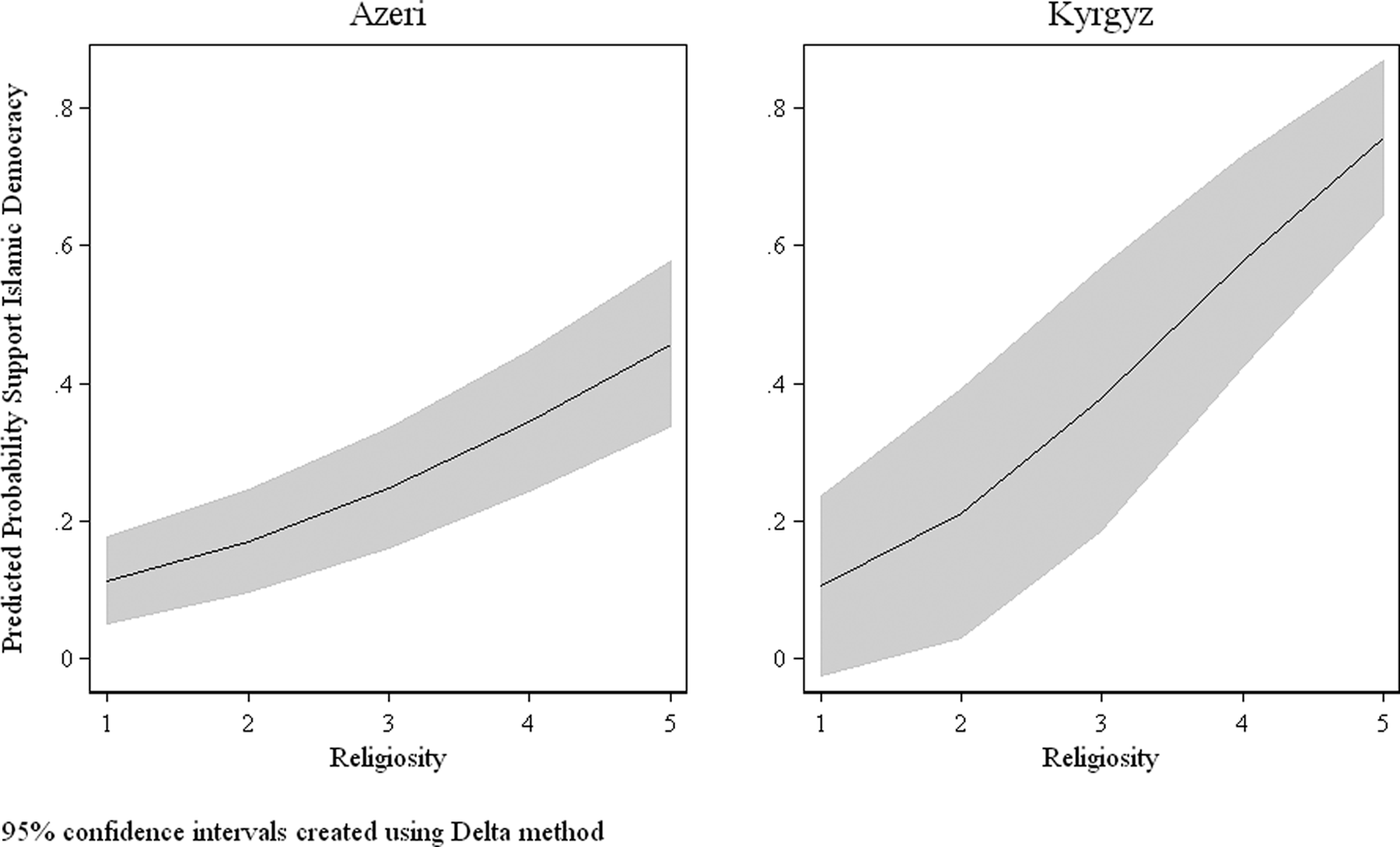
Support for Islamic democracy by religiosity
We find limited support for the literature’s prevailing hypotheses. Support for rationalist/economic hypotheses is at best mixed in each country. In some instances, there is no support in either country. In particular, having negative employment expectations (when you do not have a higher education) in fact decreases the likelihood of supporting Islamic democracy. 49 This finding applies to a majority of the population because, of those who have negative economic expectations, only 18.9 and 19.9 percent also have a higher education in the Azeri and Kyrgyz samples, respectively. Table 5 presents the differences in predicted probabilities (calculated holding all other variables at their medians). We find that in the Azeri sample, the effect of higher education among those with negative employment expectations is to increase the probability of supporting Islamic democracy, as one rationalist hypothesis expects; however, we do not find this in the Kyrgyz sample.
Interaction between Negative Employment Expectations and Higher Education on Support for Islamic over Secular Democracy

We also find that one’s economic situation has no uniform effect across the cases. Only in Azerbaijan does economic status have a positive effect on the probability of supporting secularism. Economic factors play some role but are hardly universal and determinative of support for Islamic democracy as opposed to secular democracy. Age or youth has no significant effect in either case, contrary to rationalist expectations. Support for the political economy argument is inconsistent. In Azerbaijan, corruption and religious repression have positive and significant effects on support for Islamic democracy. In the Kyrgyz sample, however, those most concerned with corruption are less likely to support Islamic democracy; religious repression has no effect. Support for the modernization/secularization literature is also mixed. Higher education has no significant effect in either sample. Being urban increases support for democracy (versus nondemocracy) in model 1, as expected by the modernization hypothesis, but does not have a consistent, positive effect on support for secular democracy in model 3. Finally, the hypothesis that patriarchal norms lead to greater support for Islamic-oriented government finds support in Kyrgyzstan but not Azerbaijan. Gender itself has no effect on support for Islamic democracy in either case.
In model 4, we examine the relationship between religiosity and support for the caliphate, a nondemocratic form of political Islam. We find support for our third hypothesis. Religiosity again has a positive and significant effect on the likelihood that one supports the idea that Muslims must live in a caliphate. The effects of most other variables are similar to those in model 3. Being urban, concern about corruption, and gender norms also have significant effects, although the direction varies by country. Contrary to the rationalist/economic hypothesis, negative economic expectations (for those without higher education) have a negative and significant effect on support for this form of political Islam.
In general, the effect of religiosity remains strong in both Azerbaijan and Kyrgyzstan, even controlling for other variables. Still, there are several striking differences in the effects of other variables between the cases in most models. Concern about corruption is very high in both countries, and has a very significant effect in almost every model; however, its effect is different in the two cases. In Kyrgyzstan, those who are more concerned about corruption are more supportive of democracy and particularly secular democracy, and less supportive of Islamic constitutions or the caliphate. In Azerbaijan, we see the reverse effect. Experience of religious repression has a significant effect in Azerbaijan in several models, where it strongly decreases support for secular constitutions and increases support for Islamic democracy. In Kyrgyzstan, by contrast, religious repression generally has no effect.
These two major differences are particularly interesting because they reflect the national political context, and particularly the nature of the regime that varies across the cases. Although we cannot test the regime’s effect in a hierarchical model, given only two cases, we can suggest some informed hypotheses about why these two political variables have significant and strikingly different effects on regime preferences. First, in Kyrgyzstan, concern about corruption is a central part of the platform of the secular democratic opposition. Moreover, that secular democratic opposition persisted under a soft autocracy, and toppled the regime in 2005 and again in 2010.The secular democratic opposition, therefore, has offered (at least for short periods) a reasonable and credible regime alternative. In Azerbaijan, by contrast, the secular democratic opposition discredited itself by its brief but disastrous rule in 1992-1993 and never regained substantial legitimacy or strength. Second, very few respondents reported religious repression in Kyrgyzstan, where significant, if incomplete, religious liberty exists. In Azerbaijan, religious repression has been much higher. Hence, our findings strongly suggest that future studies also explore the effect of regime type—and especially religious and political liberties—on secular/Islamic regime preferences.
Conclusions
The models we presented provide multiple ways of assessing the causes of alternate regime preferences and reflect our more nuanced approach to measuring religiosity and regime preferences. We could not address every possible democratic or Islamist regime type. As noted, the survey did not ask about an “Islamic state,” because such a regime is poorly defined by Islamists and too widely interpreted by the public. Despite these limitations, our findings allow us to make several theoretical and empirical contributions.
First, as constructivist and ideational perspectives suggest, religious identity and values do affect regime preferences; religion matters through religiosity, but not ethno-confessional identity. In both Kyrgyzstan and Azerbaijan, religiosity is a critical explanatory variable of regime preferences, whether formulated as democracy/nondemocracy, secular/Islamic democracy, secular/nonsecular constitutions, and the caliphate. Our findings directly challenge the prevailing wisdom in two major debates about religion and democracy and support for political Islam. We cast doubt on the dominant modernization and rationalist/economic theories. We found mixed support for the hypothesis that being urban leads to support for secular democracy. We found no support for the argument that those with negative expectations about their employment prospects or that those with lower economic status are more likely to support political Islam. We found partial support for the gender norms hypothesis, and only limited support for the effect of higher education and negative economic prospects as predictors of political Islam.
Second, our findings also challenge essentialist ethnocultural and civilizationalist models that assume merely being Muslim leads one to reject democracy and support political Islam. Even religious Muslims are divided into supporters of various types of nonsecular regimes (ranging from Islamic democracy to the caliphate). Religiosity does not determine a rejection of “democracy” in the abstract; its effect varies by case. As a constructivist focus on identity suggests, higher religiosity predicts a strong preference for various nonsecular regimes, but does not determine which nonsecular regime one will prefer. Religiosity thus reflects the “multivocality” of different “political theologies” (Stepan 2000; Philpott 2007).
Third, we found that support for democracy, and especially secular democracy, in at least some Muslim countries is more qualified than the literature typically acknowledges. Examining the level of committed democrats as well as the split between those supporting secular and Islamic democracy reveals this. Comparing model 1 with models 2 and 3 suggest the importance of understanding and defining democracy in cultural terms. Yet as we have noted, interpretations of Islamic democracy may vary. Our survey data cannot fully elucidate whether a preference for Islamic democracy is just a rejection of assertive secularism or of passive secularism as well. However, our qualitative data, as well as cross-national survey analysis (Fish 2011), strongly suggest that a preference for Islamic over secular democracy is a substantive embrace of a distinctly Islamic form of democracy. Under Islamic democracy, basic democratic institutions, such as elections, will be upheld but state religious neutrality will likely not be. It is likely that at least some religious laws, justified according to a conservative interpretation of shari’a, will create an illiberal democracy. In short, our findings suggest a more complicated relationship between religiosity and democracy than currently exists. Future work should examine this issue and the potential implications of qualified democratic support. Both scholars and policy makers promoting liberal, secular democracy in predominantly Muslim countries need to have a better understanding of these issues.
Fourth, while we do not claim to explain the regime preferences of Muslims universally, our findings and hypotheses do contribute to the development of a theory of religiosity and regime preferences. Going beyond these cases, we would expect our findings to be most applicable to other cases where individuals face conditions of state-led secularization and political repression followed by some religious liberalization. Comparable cases include Uzbekistan, Tajikistan, the Muslim republics of Russia, Turkey, and potentially Xinjiang. Evidence from Turkey reveals a similar preference by more religious Muslims for religiously oriented government (Ciftci, 2010; Hofmann 2004, 665; Yavuz and Esposito 2003). Like Azerbaijan and Kyrgyzstan, Turkey experienced twentieth-century religious repression under Ataturk’s modernizing state. Religion’s revival in the post-authoritarian era has led to the formation of religiously oriented parties.
There is reason to study our core hypothesis about religiosity’s effect on regime preferences beyond the “Muslim world” as well. Under conditions of religious threat and revival Christian religiosity may also affect political preferences. Elite anticlericalism led to Catholic support for Christian democratic parties in Europe (Kalyvas 1996). Post-communist Poland has embedded Catholic doctrine on abortion and homosexuality in the law, with much criticism from the EU. In the U.S., Christian Evangelicals have voted overwhelmingly Republican when they consider their religious values to be under threat from a liberal, secularizing state (Campbell 2006). Some Christian groups’ political demands have increasingly contested the liberal model of secular democracy (Casanova 1994, 165-66; Nussbaum 2008). Intense debates continue about the appropriate legal boundaries of Christian values and churches, with liberal theorists arguing that the Evangelical movement breaches that divide by calling for illiberal Christian-based legislation against gay marriage, abortion, embryonic stem-cell research and euthanasia, among other issues (Nussbaum 2008).
Finally, our study strongly suggests that religion’s causal role be further explored, while avoiding deterministic arguments. Scholars need a better understanding of the conditions under which religion and religiosity affect regime preferences, and what the implications might be for liberal democracy. Rather than treating the Muslim world either as inherently religious, irrational, and antidemocratic, or as secular, rational, and prodemocratic, future work should recognize that in the Muslim world, as elsewhere, religiosity often shapes political preferences, but not always in clear-cut, straightforward ways.
Footnotes
Declaration of Conflicting Interests
The author(s) declared no potential conflicts of interest with respect to the research, authorship, and/or publication of this article.
Funding
The authors(s) disclosed receipt of the following financial support for the research, authorship, and/or publication of this article: Kathleen Collins is grateful to the Carnegie Corporation of New York, the National Council for Eurasian and East European Research, the United States Institute of Peace, the University of Notre Dame, and the University of Minnesota for financial support. Erica Owen would like to thank the Niehaus Center for Globalization and Governance at Princeton University for support.
Notes
References
Supplementary Material
Please find the following supplemental material available below.
For Open Access articles published under a Creative Commons License, all supplemental material carries the same license as the article it is associated with.
For non-Open Access articles published, all supplemental material carries a non-exclusive license, and permission requests for re-use of supplemental material or any part of supplemental material shall be sent directly to the copyright owner as specified in the copyright notice associated with the article.
