




Abstract
Scholars have found that, even when a crisis creates demand for reform, a focal point is often necessary to overcome obstacles to change. I argue that, with surprising frequency, U.S. blue-ribbon commissions use their bipartisan political credibility to provide this focal point and thereby catalyze postcrisis government reform. Since commission-inspired reform is often designed to integrate or centralize policy making, I further explain that commissions can be useful presidential tools for asserting power over agencies. I test my argument on an original data set that includes new measures of commission influence.
Introduction
Blue-ribbon commissions are often derided as institutions that only help the president or Congress deflect political pressure. Commissions, according to this conventional wisdom, may take some heat off elected officials, but they do not lead to reform. As a recent Washington Post article began, “After most bipartisan commissions in Washington make recommendations on a pressing issue of the day, presidents and lawmakers have a long-standing tendency to ignore them” (O’Keefe 2012).
Yet some blue-ribbon panels have been credited with catalyzing major changes. For instance, journalists have observed that the 9/11 Commission sparked a landmark intelligence reorganization, the 1986 Rogers Commission prompted an overhaul of the space shuttle program, and the 1981–1983 Greenspan Commission shaped major Social Security reform (Kaplan and Whitelaw 2004; Sawyer 1988; Tolchin 1983).
This contrast between the conventional wisdom and the large impact of some commissions raises several questions: To what extent, in what circumstances, and how do commissions influence policy making?
I define a blue-ribbon commission as a government-authorized temporary panel that lacks formal policymaking power and includes at least one member from outside government. The existing literature on such commissions has focused on evaluating why policy makers form commissions and whether commission proposals lead to significant changes. On the former issue, scholars have identified numerous motivations for creating commissions, including to seek expertise, advance an agenda, overcome gridlock, gain political cover, conduct damage control, reassure the public, and ward off pressure for change (Campbell 2002; Filtner 1986; Johnson 2011; Kitts 2006; Wolanin 1975; Zegart 2004).
Regarding commission impact, the scholarly evidence is mixed, but indicates that commissions sometimes have substantial influence. Nearly four decades ago, Thomas Wolanin determined that half of commissions have an important proposal adopted by the president or Congress (Wolanin 1975). More recently, James Pfiffner found that most commissions have served a useful public purpose and that many have influenced policy (Pfiffner 2009). There has also been a flurry of recent scholarship on commissions that examined intelligence and other national security issues. In this research, Glenn Hastedt found that intelligence commissions have had varied impact, but have tended to narrow the range of choices considered by policy makers; Loch Johnson determined that a 1996 commission helped to bolster the intelligence community’s reputation, while influencing some elements of intelligence policy; Michael Warner and Kenneth McDonald found that several commissions led to important intelligence reforms; and Amy Zegart determined that few intelligence commission proposals were implemented during the decade prior to September 11, 2001 (Hastedt 2007; Johnson 2011; Warner and McDonald 2005; Zegart 2007). Regarding national security more broadly, Kenneth Kitts found that commissions have protected the president’s control over policy making, and I determined that commissions have catalyzed significant reforms after terrorist attacks (Kitts 2006; Tama 2011a).
In my previously published work, I also examined the factors that facilitate commission influence on policy making, finding that commissions have greater impact when they operate in the context of a crisis, are established by the executive branch (rather than Congress), and are given a relatively narrow mandate (Tama 2011a). In this article, I build on those findings and extend the literature by assessing the impact of commissions on public policy and public debate, and by evaluating whether commissions are more likely to spur certain types of reforms than others.
After explaining how commissions tend to derive clout from their bipartisan credibility, I formulate and test an original explanation of why the impact of commissions often lies in the area of government reorganization, rather than substantive policy change. In short, I argue that policy makers rarely prioritize reorganization, leaving open a window of opportunity for commission-inspired restructuring in the wake of a crisis. Since commission reorganization proposals usually promise to improve government performance, they often are endorsed by the president and key lawmakers after government breakdowns. In this way, they frequently provide the reform focal points that are necessary to drive postcrisis restructuring over the objection of turf-conscious officials. By contrast, commissions spur substantive policy changes less often, in part because such changes frequently have a partisan or ideological dimension, making it harder for commissions to agree on, or build bipartisan support for, them.
I test hypotheses derived from this argument by using several measures of commission influence to analyze the impact of all fifty-five commissions that examined national security issues between January 1981 and January 2009. Although limiting the empirical analysis to national security commissions reduces my ability to draw firm conclusions about all commissions, it enables me to evaluate in depth the impact of an entire universe of commissions over a twenty-eight-year period. The analysis provides strong support for the proposition that the bipartisan credibility of commissions often enables them to shape government reorganization in the wake of crises.
Crises, Credibility, and the Creation of Reform Focal Points
In this section I briefly explain how commissions can catalyze change following a crisis. Definitions of a crisis among leading scholars vary, with some definitions limiting crises to large-scale economic, societal, or security breakdowns, and others encompassing major breakdowns and smaller-scale disasters or scandals (Birkland 2006, 2–3; Boin, McConnell, and ’T Hart 2008, 2; Keeler 1993, 440). I follow the latter practice and define a crisis as any unexpected event that places significant political pressure on policy makers. This definition is sensible for analysis of the impact of commissions because a window of opportunity for reform can be opened by any event that places pressure on policy makers (Kingdon 1995).
In the wake of a crisis, a commission often has the opportunity to provide a focal point for public debate that drives or shapes reform. I define a focal point as a proposal or idea around which public debate revolves in a given policy area. A focal point can be necessary for reform to occur because, even during a crisis, partisanship, turf battles, and other bargaining obstacles can prevent policy makers from reaching broadly popular or beneficial agreements (Riker 1986). One common problem is that negotiations in situations of multiple equilibria sometimes only succeed if someone is able to create a focal point by publicizing an option that becomes the most salient choice (Schelling 1960, 68). Commissions excel at generating such focal points because of their strong political credibility, which derives from their independence from the permanent institutions of government, the stature of their members, and their bipartisan makeup.
Literature on congressional committees further helps to explain how the bipartisanship of commissions can enable them to establish focal points. Keith Krehbiel argues that the ideological diversity of committees enables them to provide other lawmakers with valuable signals about policy options (Krehbiel 1991). Similarly, when a commission issues a unanimous report, it indicates to people of varied political affinities that its proposals are widely acceptable.
A commission is therefore more likely to establish a focal point when its report is unanimous. This expectation is consistent with other research finding that public opinion tends to be uniform or polarized depending on whether elites are unified or divided (Berinsky 2007; Zaller 1992). In fact, many commissions do achieve consensus: of the fifty-five commissions in my data set (described below), thirty-eight of them issued unanimous reports. This track record shows the special ability of commissions to forge agreement, which stems from their small size—the median size of their membership is ten—and depoliticization. Small size benefits a deliberative group by giving each member a greater stake in the group’s work and by facilitating persuasion and negotiations (Olson 1965; Verba 1961). Depoliticization further enables deliberation (Checkel 2001). Although commissions are not free of political pressure, they are usually composed mainly or entirely of private citizens, who face less such pressure than policy makers.
Yet, not all commissions formed during a crisis have an equal chance to generate a focal point. My preceding argument implies that commissions are less likely to reach consensus if their membership is large or includes government officials. In addition, I expect—as I have found in previously published work—that commissions are more likely to catalyze reform when they are established by the executive branch or given a relatively narrow mandate (Tama 2011a). The principal advantage enjoyed by executive branch commissions is that they are created much more quickly than congressional commissions, giving them better prospects for reporting while a window of opportunity for reform remains open. A narrow mandate, for its part, helps to facilitate the reaching of agreement among commissioners, and simplifies the adoption of proposals by policy makers. 1
Summing up this section, I posit the following hypotheses about factors that influence a commission’s impact on policy making:
Regarding the initial conditions of a commission’s formation, I hypothesize that commissions have greater impact when they are established in the context of a crisis, formed by the executive branch, or given a relatively narrow mandate.
Regarding a commission’s membership, I hypothesize that commissions are more influential when their membership is relatively small, possesses great stature, and does not include government officials.
Regarding the output of a commission, I hypothesize that commission proposals are more influential when they are unanimous.
Commissions and Organizational Reform
So far, I have argued that the distinct political credibility of a unanimous commission report can be necessary to catalyze reform after a crisis, and that this impact is facilitated by a number of conditions and commission characteristics. But what type of reform do commissions tend to spur?
Glenn Hastedt has observed that commissions tend to make recommendations designed to bolster managerial effectiveness and control, and other scholars have found that commissions have shaped some of the most important organizational changes of the past century, including the creation of the Federal Reserve system, the Executive Office of the President, the Office of Management and Budget, the Department of Homeland Security, and the Office of the Director of National Intelligence (Arnold 1998; Graham 1985; Hastedt 2011; Light 1997; Pfiffner 2009; Tama 2011a). By contrast, the historical record suggests that commissions trigger major changes in the substantive content of policy less often. In this section, I draw on insights from literature on the policy process, the presidency, and government organization to develop an original explanation of why the impact of commissions is typically greatest in the area of government organization. This portion of my argument generates the following hypothesis: commission proposals are more influential when they call for reorganization.
Before proceeding, I wish to underscore that I am not claiming commissions never influence substantive policy. Indeed, just in national security affairs, many commissions have had such impact. For instance, the 1983 Scowcroft Commission catalyzed congressional approval of funding for the “MX” intercontinental missile, the 1983 Long Commission hastened the withdrawal of U.S. peacekeepers from Lebanon, and the 2006 Iraq Study Group provided the plan that Barack Obama used to wind down the Iraq war (Kitts 2006; Tama 2011a, 2011b). I am just arguing that commissions influence reorganization more often.
My argument on this point starts with the insight that the president and Congress tend to focus during a crisis on highly visible substantive measures. For instance, during the 2008–2009 financial crisis, policy makers concentrated first on bailouts, tax cuts, and stimulus spending. 2 Reorganization only occurred with the July 2010 enactment of the Dodd–Frank legislation that created the Consumer Financial Protection Bureau and several other agencies. 3 Similarly, after the September 11, 2001 attacks, policy makers focused first on overthrowing the Taliban, pursuing Al Qaeda, and giving new counterterrorism powers to the executive branch. Major homeland security and intelligence reorganization did not take place until much later. 4
Policy makers tend to prioritize substantive policy change over organizational reform during a crisis because it promises to deliver more rapid and demonstrable results, as well as greater political rewards (March and Olson 1983, 285). In addition, a substantive policy change might not generate as much friction within the government. Even when there is broad backing of the notion that some reorganization would be helpful, the opposition to any particular overhaul is almost always more intense than the support for it because it directly threatens the turf and power of some agencies and officials (Szanton 1981, 20). As a result, in the wake of a crisis, a window of opportunity for reform is likely to remain open longer in the domain of organizational change than in substantive policy areas. By the time a commission created during a crisis reports, there may already be a new stable status quo on substantive policy, but there is unlikely to be such a new equilibrium on government organization.
Commissions also tend to influence reorganization more than substantive policy because it is easier for commissions to agree on specific reorganization proposals than on concrete substantive recommendations. Many people join commissions with preexisting opinions about substantive areas of policy, but without well-defined views on how to structure the government. In addition, since most commissioners are not government officials, they do not usually have a strong vested interest in the organizational status quo. Moreover, unlike many substantive policy ideas, most reorganization ideas do not have a partisan association.
The 9/11 Commission illustrates these tendencies well. The commission’s reorganization proposals were very specific, including detailed plans for a new National Counterterrorism Center (NCTC) and Director of National Intelligence (DNI). By contrast, most of the commission’s strategy proposals were vague, such as recommendations to confront problems in the U.S.–Saudi relationship and make a long-term commitment to Pakistan and Afghanistan (National Commission on Terrorist Attacks upon the United States 2004). This vagueness reflected the difficulty of agreeing on substantive policies. As Commission Vice Chairman Lee Hamilton commented, “the policy questions can be a little harder to address politically speaking and substantively speaking.” 5 The vagueness of the Commission’s strategy proposals resulted in the media and lawmakers paying relatively little attention to them, and therefore prevented them from generating a focal point. Instead, the public and governmental response to the commission focused on the DNI and NCTC proposals, which were quickly enacted into law. 6
Yet in many cases, even when commissions agree on specific reorganization ideas, it is difficult for commissions and their allies to overcome the resistance of officials whose turf is threatened by those ideas. When commissions succeed at this, it is often by shifting the locus of decision making away from those officials (Destler 1981, 124–25). In the case of the 9/11 Commission, the Senate Majority Leader assigned responsibility for drafting implementing legislation to the Governmental Affairs Committee. This facilitated enactment because it sidelined the Intelligence Committee, whose chairman opposed creating a DNI. 7
In other instances, commissions exert influence by circumventing executive branch officials who are resistant to change. This was the case with the 2005 Commission on the Intelligence Capabilities of the United States regarding Weapons of Mass Destruction (the WMD Commission), which led George W. Bush to order the creation of a national security branch of the Federal Bureau of Investigation and a national security division of the Justice Department. Such restructuring had been opposed by top officials at those agencies, and the ideas may never have been brought to Bush’s attention if the commission had not reported directly to him. 8
Presidents tend to be receptive to commission reorganization proposals in the wake of a government breakdown because the proposals typically promise to improve government effectiveness—often by boosting the integration, coordination, or centralization of policy making. Since presidents are held accountable by the public for the government’s performance, they generally want to be able to exercise greater control over agencies and programs (Lewis 2003; Moe 1990; Pfiffner 1999). Indeed, all recent presidents have sought to centralize policy making—a trend that reached a new high point with the Obama administration’s appointment of numerous policy “czars” (Pfiffner 2011). Given this presidential predisposition to seek stronger control over the executive branch, commission proposals for enhancing centralization or integration across or within agencies are often like music to presidents’ ears—especially during a crisis, when it is politically essential for presidents to show they are in charge. In this sense, many commissions are properly seen as tools for strengthening presidential power.
Although congressional support for reorganization proposals is often more mixed, legislators also sometimes champion ideas for boosting integration and coordination because they wish to improve the implementation of policies they support (Lewis 2006). Reorganization can also be appealing to policy makers in both branches as a way to demonstrate action that does not necessarily require a large infusion of resources (March and Olson 1983; Salamon 1981).
In addition, after a disaster or scandal, the president sometimes embraces commission-inspired reorganization because it implies that the structure of government, rather than the president, was responsible for failures. This was the case with a reorganization inspired by the 1987 Tower Commission, which investigated the Iran–Contra scandal. The commission, led by former U.S. Senator John Tower, found that Ronald Reagan’s lax management style had allowed his administration to engage in illegal activity, but primarily blamed other officials and a dysfunctional policy process for wrongdoing (President’s Special Review Board 1987). Its principal proposal was to establish a new structure for the National Security Council (NSC) that involved strengthening the national security advisor’s control over NSC operations, bolstering the role of the NSC legal adviser, and changing how the NSC dealt with covert actions. Reagan quickly adopted this proposal—a change that, according to several Reagan White House officials, would not have occurred without the commission. 9 Politically, this reorganization enabled Reagan to demonstrate that he was taking action in response to the scandal.
Quantitative Data and Testing
To test my argument about commissions, I created a data set consisting of information about all fifty-five blue-ribbon commissions that reported on elements of national security policy between the presidential inauguration of Ronald Reagan in January 1981 and the end of George W. Bush’s presidency in January 2009. 10
Dependent Variables: Overall Impact and Recommendation Adoption
The data include several measures of commission impact—two of which I describe here and three of which I describe in the section below concerning impact on public debate. The first impact measure consists of ratings by commission participants and government officials who had responsibility for issues dealt with by the commissions. I interviewed 227 such people and asked each of them to rate the commission’s overall impact on policy on a scale of 1 to 5. 11 Since some interviewees served on more than one commission or had responsibility for issues addressed by multiple commissions, these surveys generated a total of 372 ratings for the commissions in my data set, with a median number per commission of six. I label this dependent variable ratings and use ordinary least squares (OLS) to estimate models using it, with observations clustered by commission. 12 To account for likely biases, I control for whether an interviewee was a commission participant, served as the commission’s chair or staff director, or dissented from the commission’s report in my statistical models. 13
My second impact measure indicates whether the principal proposals of a commission were fully, partially, or not adopted by the government within two years of the commission’s report. 14 For two of the commissions, I could not identify any principal recommendations, but for the remaining fifty-three commissions, I investigated 213 key proposals and was able to determine whether 209 of them were fully, partially, or not adopted. Of these 209 proposals, 45 percent were fully adopted, 16 percent were partially adopted, and 39 percent were not adopted. I label this three-category dependent variable adoption (0 = not adopted, 1 = partially adopted, 2 = fully adopted). I use ordered logit to estimate models using adoption, with observations clustered by commission. To test my hypothesis regarding reorganization proposals, I include in these models a binary variable indicating whether a recommendation calls for reorganization. Since the difficulty of adopting proposals varies, I also control for whether a proposal is highly specific or requires the enactment of legislation. 15
These two dependent variables complement each other well. Ratings provides a fuller assessment of a commission’s impact on policy making, whereas adoption enables the testing of proposal-specific hypotheses, such as my hypothesis about reorganization. The two dependent variables are highly correlated. When a mean interview rating and proposal adoption score is generated for each commission, the correlation coefficient (r) between the measures is .69. This strong correlation suggests that the two measures are reliable indicators of commission influence.
Explanatory Variables
The explanatory variables in my models include the key initial conditions that I expect to shape a commission’s prospects for impact. Crisis is a binary variable that takes a value of one for commissions formed in response to an unexpected event that placed significant pressure on policy makers. 16 Executive authorization is a binary variable that takes a value of one for commissions created by the executive branch unilaterally. Scope, another binary variable, takes a value of one for commissions of narrow scope, which I code as commissions whose mandate concerns a single issue or event, and only involves one agency or program. Of the fifty-five commissions, twenty-seven were established in response to a crisis, twenty-seven were established by the executive, and eighteen possessed narrow scope.
Other explanatory variables represent aspects of a commission’s membership and output. Stature is a measure of the average prominence of the most senior position held by each member of a commission prior to their commission service. 17 No government officials is a binary variable indicating whether all commissioners were private citizens at the time of the commission’s operation. Size and size squared are measures of the number of a commission’s members. 18 Unanimous is a dichotomous variable indicating whether a commission’s final report was free of any dissenting statements. Reorganization proposal, another binary variable, indicates whether an individual recommendation called for restructuring, creating, or eliminating a government unit, or for moving personnel between units. 19
Control Variables
I include as controls other variables that might affect commission influence. Salience represents the amount of media coverage of the issue addressed by a commission prior to its creation. 20 High casualties is a dichotomous variable indicating whether a commission was created in response to an event involving the loss of more than one hundred American lives. Staff represents the natural log of the number of a commission’s staff members. 21 Agency indicates whether a commission created by the executive was formed by an agency head rather than by the president.
Four other controls measure aspects of the political environment when a commission reported: Unified government indicates whether the same political party controlled both branches of government, polarization represents the ideological distance separating the mean Democratic and Republican members of the House and Senate, presidential popularity refers to the president’s public approval rating, and months into term represents the number of months since the president was inaugurated (or began a second term). 22
Results
Results using ratings as the dependent variable are presented in Table 1, while results using adoption are presented in Table 2. In both tables, the first model includes explanatory variables representing a commission’s initial conditions, the second model adds measures of commission membership, and the third model adds unanimous. For estimations using adoption, all models also include reorganization proposal.
Contributors to the Overall Impact of Commissions on Policy.

Note. The dependent variable is a continuous variable representing interviewees’ assessments of the overall impact of a commission on policy on a scale of 1 to 5, with one representing no impact and five representing very large impact. Observations are clustered by commission because they are not independent. Table entries are coefficients of an ordinary least squares regression, with standard errors in parentheses.
p < .01, **p < .05, *p < .1, for two-tailed tests.
Contributors to the Adoption of Commission Recommendations.
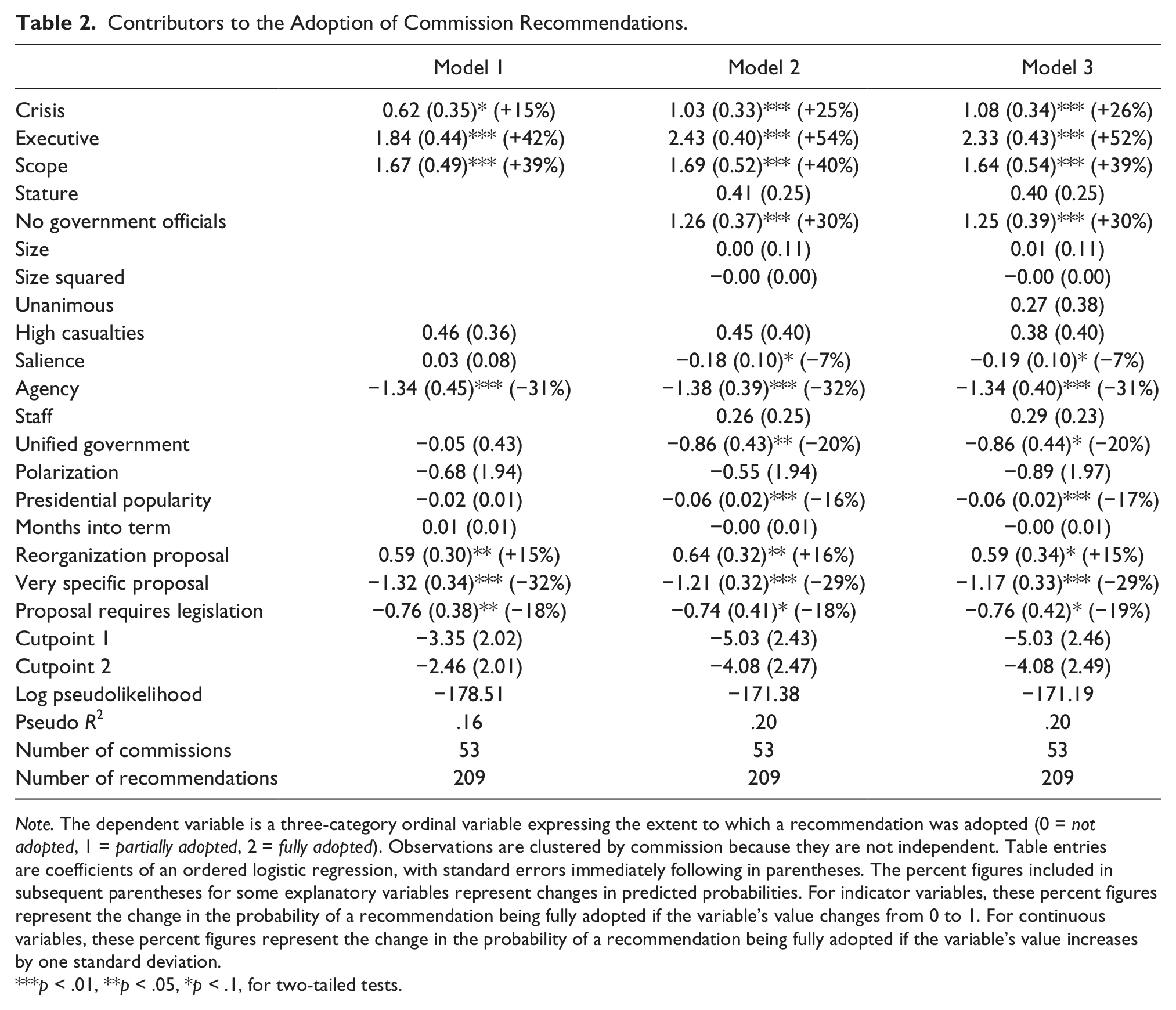
Note. The dependent variable is a three-category ordinal variable expressing the extent to which a recommendation was adopted (0 = not adopted, 1 = partially adopted, 2 = fully adopted). Observations are clustered by commission because they are not independent. Table entries are coefficients of an ordered logistic regression, with standard errors immediately following in parentheses. The percent figures included in subsequent parentheses for some explanatory variables represent changes in predicted probabilities. For indicator variables, these percent figures represent the change in the probability of a recommendation being fully adopted if the variable’s value changes from 0 to 1. For continuous variables, these percent figures represent the change in the probability of a recommendation being fully adopted if the variable’s value increases by one standard deviation.
p < .01, **p < .05, *p < .1, for two-tailed tests.
The results provide strong support for my hypotheses about a commission’s initial conditions. Crisis, executive authorization, and scope are all highly significant statistically in nearly every model, and also possess impressive substantive significance. If a commission is established in response to a crisis, its impact on a scale of 1 to 5 is estimated to increase by about .65—a large amount considering that the standard deviation of interviewee ratings, when clustered by commission, is .88—and the odds of one of its key proposals being fully adopted increase by 15 to 26 percent. When, as a robustness check, crisis is replaced with binary variables indicating whether a commission was formed in response to a disaster or in response to a scandal, each type of crisis is associated with significantly greater commission impact in most models—suggesting that scandals and disasters can open sizable windows for commission-inspired reform.
The results for executive authorization and scope also conform strongly to my expectations. If a commission is formed by the executive, rather than by Congress, its impact on the 1 to 5 scale is estimated to increase by about .75, and the odds of one of its key proposals being fully adopted jump by 40 to 55 percent. If a commission’s mandate is narrow, its impact is estimated to increase by about .65, and the odds of full adoption go up by about 40 percent.
The results involving variables related to commission membership are more mixed, but provide some support for my argument that the stature, independence, and bipartisanship of commissions give them powerful credibility. Stature, size squared, and unanimous are statistically significant in the expected direction in models using ratings as the dependent variable, but fall short of significance in models using adoption. By contrast, no government officials—my measure of independence—is statistically significant in the expected direction in the adoption models, but not in the ratings models. These mixed results reflect in part multicollinearity among several of the explanatory variables. Scope and unanimous, size and unanimous, and no government officials and unanimous have, respectively, bivariate correlation coefficients (r) of .30, −.46, and .26—supporting my argument that it is harder for commissions to reach agreement when they have a broad mandate, are large, or include government officials.
Regarding the type of change influenced by commissions, the results provide solid support for my argument that commissions have more impact on reorganization than on substantive policy. Reorganization proposal, which is only included when adoption is used since it is recommendation-specific, is statistically significant at the 5 percent level in two of the models and at the 10 percent level in the third. The results indicate that a proposal for reorganization is about 15 percent more likely to be fully adopted than a proposal for substantive policy change.
Further statistical analysis provides additional support for my argument about commissions and reorganization. Seventy-nine of the 213 key proposals of the commissions in my data set called for reorganization. Out of those proposals, 85 percent of them were highly specific, when specificity is defined as calling for a concrete and precisely described action. By contrast, just 60 percent of the other 134 proposals were highly specific. Moreover, there is a modest bivariate correlation (r) of .18 between unanimous and the proportion of a commission’s key recommendations that called for reorganization. These findings suggest that it is in fact easier for a commission to reach consensus on specific restructuring ideas than on specific proposals for policy change. 23
Additional Tests: Commission Impact on Public Debate
Since the results presented above concerning the importance of a commission’s stature, independence, and bipartisanship were not clear-cut—though they were generally consistent with my expectations—I tested other implications of my argument about the importance of political credibility by examining commission impact on public debate.
My argument implies that a commission’s proposals should attract more public support when they are unanimous and when the commission possesses greater stature and is fully independent of the government. Since public opinion surveys of commission proposals are rarely taken, I used editorial opinion in an ideologically diverse sample of prominent newspapers as a proxy for it. In particular, for each commission, I determined whether one or more editorial or op-ed articles was written about the commission’s final report during the ninety days after the report was issued in each of the following four newspapers: the Chicago Tribune, New York Times, Wall Street Journal, and Washington Post. (Whereas the Times and Post have relatively liberal editorial pages, the Tribune and Journal have relatively conservative editorial pages.)
I found that an average of 7.4 opinion articles was written about each commission report in these newspapers, and thirty-four of the fifty-five reports were the subject of at least one such article. For those thirty-four commissions, I then coded whether each opinion article praised the report without offering any criticism of it, and used that coding to calculate the proportion of opinion articles endorsing each commission. I label this variable, which ranges from 0 to 1, endorsements. Commissions issuing nonunanimous reports scored an average of just .33 on this measure, but commissions releasing unanimous reports scored an average of .67.
In an effort to control for other relevant variables, I estimated OLS models that use endorsements as the dependent variable and include the same other variables used in Model 3 of Tables 1 and 2. The first column in Table 3 presents the results, which show that unanimous is statistically significant at the 5 percent level and also has great substantive significance: if a report is unanimous, the proportion of supportive opinion articles jumps by 36 percent. By contrast, stature and no government officials are not statistically significant. Still, the striking significance of unanimity represents strong evidence of the importance of bipartisan political credibility in building support for reform proposals across the ideological spectrum.
Contributors to the Impact of Commissions on Public Debate.
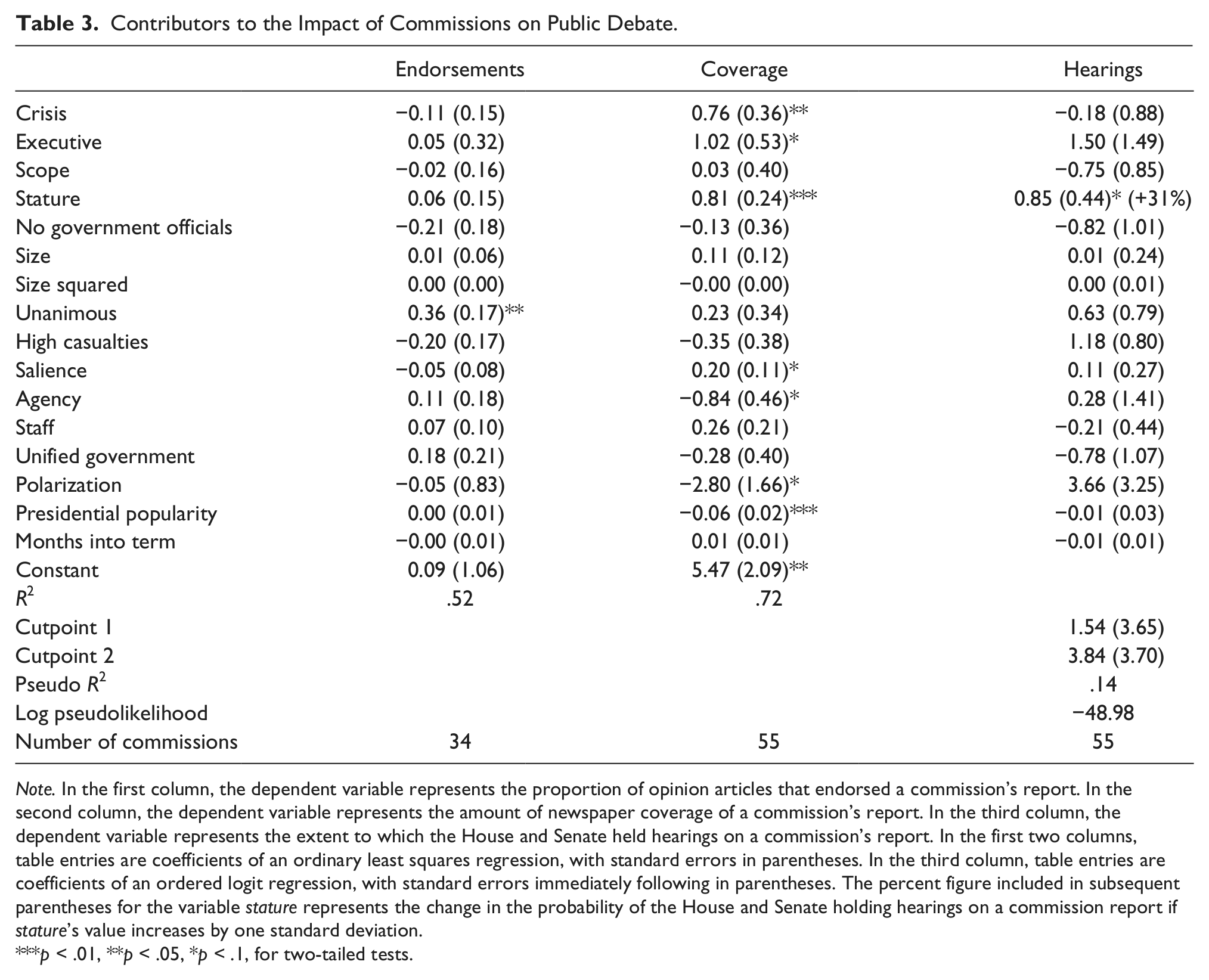
Note. In the first column, the dependent variable represents the proportion of opinion articles that endorsed a commission’s report. In the second column, the dependent variable represents the amount of newspaper coverage of a commission’s report. In the third column, the dependent variable represents the extent to which the House and Senate held hearings on a commission’s report. In the first two columns, table entries are coefficients of an ordinary least squares regression, with standard errors in parentheses. In the third column, table entries are coefficients of an ordered logit regression, with standard errors immediately following in parentheses. The percent figure included in subsequent parentheses for the variable stature represents the change in the probability of the House and Senate holding hearings on a commission report if stature’s value increases by one standard deviation.
p < .01, **p < .05, *p < .1, for two-tailed tests.
Other model estimations suggest that a commission’s stature is particularly important in generating attention for the commission’s ideas. I coded two other dependent variables: coverage, which represents the log of the number of articles in the same four newspapers mentioning the commission’s report in the ninety days after it was released, 24 and hearings, which is a three-category ordinal variable measuring the extent to which congressional hearings were held on the commission’s report (0 = no hearings, 1 = at least one hearing in the House or Senate, and 2 = at least one hearing in each chamber of Congress). 25 The second and third columns in Table 3 present results of regressions using coverage or hearings as the dependent variable and the same explanatory and control variables used in the earlier Model 3. (I use OLS for coverage and ordered logit for hearings.) The results using both dependent variables suggest that commissions receive significantly more attention when their members possess greater stature: stature is statistically significant in the expected direction at the 1 percent level when using coverage, and at the 10 percent level when using hearings. However, unanimous and no government officials are not statistically significant in these models.
Taken together, the results regarding dimensions of public debate suggest that a commission’s stature and bipartisanship contribute significantly to its impact. More specifically, they suggest that a commission’s stature helps to generate media and congressional attention for the commission, whereas unanimity shapes whether a commission’s ideas are widely endorsed. Since unanimous is also highly significant in regression models using ratings as the dependent variable, unanimity appears to be a particularly important driver of commission impact. However, the results do not provide clear evidence that commissions are more influential when they are more independent.
Conclusion and Implications
As a whole, this article’s empirical analysis strongly supports my argument that the political credibility of blue-ribbon commissions often enables them to drive the adoption of organizational reforms in the wake of a crisis. The findings show that unanimous commission reports often attract broad support and provide the blueprint for postcrisis restructuring, but that commissions usually have less influence on substantive policy. At the same time, the findings indicate that a commission’s impact can be greatly constrained by the conditions of its creation: it is much more difficult for a commission to spur reform if it is established in the absence of a crisis, formed by Congress rather than the executive, or given a very broad mandate.
Considered collectively, these findings challenge the popular view that policy makers always ignore commission recommendations, and they enrich our understanding of how and when commissions influence the policy process. My analysis also contributes more broadly to our understanding of crisis politics by showing how an advisory panel can help overcome obstacles to reform after a disaster or scandal. Since commission reorganization proposals are often designed to centralize or integrate executive branch policy making, this article further provides evidence that commissions should be considered valuable presidential tools not only for the deflection of political pressure (which is how commissions are commonly viewed), but also for the assertion of presidential power over agencies. Frequent presidential adoption of commission reorganization proposals suggests that chief executives see commissions in part as vehicles for making agencies more responsive to the White House after a perceived breakdown.
The findings suggest as well that a century-old tradition of reorganization planning designed to strengthen the presidency remains influential. From the Progressive Era to the 1970s, many presidents commissioned comprehensive reform plans aimed at boosting their office’s managerial capacity (Arnold 1998; Light 1997). Such comprehensive reorganization efforts subsequently fell out of fashion, but my findings indicate that commissions still typically aim to increase integration or centralization of policy making. Of the seventy-eight commission reorganization recommendations in my data set, fifty-two of them called for changes designed to foster more integration or coordination within or across agencies—in many cases, by creating a new high-level office with responsibility for managing a given issue.
It is also worth underscoring that my findings do not indicate that commissions never influence substantive policy; they only demonstrate that commissions shape policy less often than reorganization. Across my data set, 57 percent of policy proposals were fully or partially adopted. While this percentage is lower than the 69 percent rate for reorganization proposals, it indicates that many policy recommendations do also get adopted. Still, the lower success rate for policy proposals and the smaller impact of commissions with broad mandates underscore important limitations of commission influence: commissions tend to be more capable of spurring reorganizations of individual agencies than of resolving disagreements on broad policy issues.
Some readers might object that I have not shown that commissions catalyze changes that would not otherwise occur. Indeed, only process tracing and counterfactual analysis of individual cases can determine whether commissions were directly responsible for certain reforms. In other published work, I have used those methods to demonstrate that seven national security commissions did spur important policy or organizational changes (Tama 2011a).
A question that remains is, “Do organizational reforms inspired by commissions change government performance or policy outcomes?” Certainly, new agencies and offices with a mandate to promote integration are not always effective in carrying out this mandate. Indeed, scholars have concluded that reorganization efforts have not generally led to clear improvements in government performance (Light 1997; Seidman 1998). Those findings suggest that commission-inspired restructuring may also frequently fail to improve governance. Sometimes this may be because new agencies or offices are not given the authorities they need to compel other government units to act differently. Without such powerful authorities, organizational cultures can prove extremely resistant to change (Zegart 2007). In other cases, reorganization might be unhelpful because it complicates operations without addressing the everyday needs of officials (Betts 1978; Hastedt 2007). The upshot is that we must not jump from the knowledge that commissions often inspire organizational reforms to a conclusion that those reforms have a significant or positive effect on policy outcomes.
Nevertheless, most experts agree that greater integration and coordination across the government are desirable and necessary to deal with the complexity of many policy challenges (Dale, Serafino, and Towell 2008; National Commission on the Public Service 2003). Since commissions tend to promote integration and coordination, they will remain appealing vehicles for advancing these goals. It would therefore be worthwhile for future research to examine the extent to which past commission-inspired reforms have succeeded in changing government behavior.
It is also important to consider whether my findings might apply to commissions on domestic policy issues. Basic patterns of political behavior suggest that they should, on the whole. On domestic, as on national security, issues, a crisis often makes reform possible but does not ensure that it occurs, giving a commission the opportunity to establish the focal point that enables policy makers to reach agreement on change. Moreover, since policy makers have an incentive during nearly all crises to focus initially on highly visible substantive policy changes, a window of opportunity for reform—which a commission can seize—will tend to remain open longer on reorganization regardless of the issue.
However, there are also reasons to expect it to be harder for domestic issue commissions to influence reorganization. For the most part, domestic issues are subject to greater gridlock than national security issues (Binder 2003). Moreover, proposals to reorganize domestic policy agencies often have a greater ideological or partisan flavor than recommendations to reorganize national security agencies, and typically spur more powerful opposition from interest groups. Consider the frequent calls by conservative politicians to disband domestic agencies believed to promote a liberal agenda, such as the Department of Education or Environmental Protection Agency. These differences suggest that it might be more difficult to forge bipartisan consensus on domestic agency reorganization. Future research could probe whether this is the case.
The field is also ripe for more cross-national analysis of commissions. A recent edited book provides insightful case studies of national security commissions from a dozen countries and several international organizations (Farson and Pythian 2011). Future scholarship could probe the extent to which patterns of commission influence vary across international borders.
A final point concerns the role of commissions in an age of U.S. political polarization. For the twenty-eight commissions in my data set that were established by Congress, the correlation coefficient (r) between polarization and the number of commissions created per year is .29. This modest correlation suggests that Congress might create commissions more often when polarization is high, though the relationship falls just short of statistical significance when estimating a simple OLS model that controls for the existence of divided government and presidential popularity. 26 Relatedly, Paul Light has recently found that Congress is increasingly outsourcing major investigations to blue-ribbon panels (Light 2013). Taken together, these findings suggest that, as polarization makes it harder for Congress to act, lawmakers may be turning more often to commissions for a variety of purposes, including the performance of oversight and the generation of proposals that can attract bipartisan support. Further study of commissions is therefore timely.
Footnotes
Acknowledgements
I am grateful to American University, the Lynde and Harry Bradley Foundation, and the Woodrow Wilson School of Public and International Affairs for providing me with funding that supported the research for this article. I also thank Kate Tennis for excellent research assistance, and thank David Bosco, Jeff Colgan, Sikina Jinnah, Lael Keiser, David Karol, David Lewis, Sharon Weiner, and the peer reviewers for helpful comments on earlier drafts.
Declaration of Conflicting Interests
The author(s) declared no potential conflicts of interest with respect to the research, authorship, and/or publication of this article.
Funding
The author(s) disclosed receipt of the following financial support for the research, authorship, and/or publication of this article: This research was supported by American University, the Lynde and Harry Bradley Foundation, and the Woodrow Wilson School of Public and International Affairs.
Notes
References
Supplementary Material
Please find the following supplemental material available below.
For Open Access articles published under a Creative Commons License, all supplemental material carries the same license as the article it is associated with.
For non-Open Access articles published, all supplemental material carries a non-exclusive license, and permission requests for re-use of supplemental material or any part of supplemental material shall be sent directly to the copyright owner as specified in the copyright notice associated with the article.
