




Abstract
Research on local turnout has focused on institutions, with little attention devoted to examining the impact of campaigns. Using an original data set containing information from 144 large U.S. cities and 340 separate mayoral elections over time, our contributions to the scholarship in this field are manifold: we focus the literature more squarely on the impact of campaigns by examining the role of campaign effort (measured with campaign expenditures), candidates, and competition in voter mobilization; demonstrate the relative importance of challenger versus incumbent campaign effort in incumbent contests; and show that changes in campaign activities influence changes in turnout over time.
Introduction
Scholars, journalists, and policymakers have long expressed concern with the low levels of voter turnout that characterize U.S. elections, and nowhere is turnout lower than in local elections. In fact, some have even suggested that these low turnout rates signal a “crisis in American democracy” (Hajnal and Lewis 2003, 645). Wood (2002), for instance, finds an average turnout rate of 34 percent in city elections across fifty-seven cities. Similarly, Caren (2007) reports an average turnout rate of just 27 percent for mayoral elections across thirty-eight large U.S. cities. 1 Hajnal and Lewis (2003, 646) pinpoint an important concern with low levels of citizen engagement in local elections, noting that “at the local level where policies are most likely to be implemented and where a majority of the nation’s civic leaders are being elected, important public policy decisions are being made without the input of most of the affected residents.” Indeed, a number of studies have shown that local turnout patterns have important political consequences. Hajnal and Trounstine (2005) and Hajnal (2010), for example, find that low turnout in city elections reduces the representation of Latinos and Asian Americans on city councils and in the mayor’s office. Low turnout in city elections also appears to skew local spending policies (Hajnal 2010) and create opportunities for organized interests to influence public policy (Anzia 2011). These concerns highlight the importance of understanding what drives turnout at the local level. There are real consequences from low turnout, consequences that may matter a lot for representation and policies.
Recently, the issue of low turnout has captured the attention of local policymakers across the United States. New York City Mayor Michael Bloomberg, for example, proclaimed that “Voter turnout in elections for all levels of government is unacceptably low” (quoted in Reforms to Make Voting Easier 2010). In a 2011 interview on elections in his city, Memphis, Tennessee Mayor A. C. Wharton made this appeal to voters, “I beg them to get out and vote, council races, mayor races because this is where the action is going to be” (quoted in Wimbley 2011). In the same vein, Mayor Lee Leffingwell of Austin, Texas, pointed out in 2011 that Citizen participation is the lifeblood of a healthy democracy, and obviously this is something we value deeply in Austin. But unfortunately, when it comes time for our citizens to go to the polls in May and choose their representatives at City Hall, most of them simply don’t. (Leffingwell 2011, p. 1)
Some mayors have speculated about the causes of low turnout and a number of them have even proposed policy reforms aimed at boosting turnout in mayoral and city council elections. For instance, in his 2011 state of the city address, Mayor Leffingwell outlined several potential ways to increase local turnout, including changing the date of local elections so that they coincide with elections for higher level offices and enhancing the ability of local candidates to raise campaign funds, suggesting that local candidates need to be able to raise and spend “enough money to effectively reach anyone outside the small group of people who regularly vote in city elections” (Bernier 2011).
In this paper, we model the determinants of voter turnout in mayoral elections across the United States, focusing specifically on the influence of political campaigns and campaign spending on turnout. Previous research on turnout in local elections has focused primarily on the influence of political institutions, with virtually no attention devoted to the impact of campaign activities on voters, despite speculation by policymakers and scholars that political campaigns might matter a great deal to local turnout. 2 We anticipate that local elections are generally low-information affairs that create a context in which the key to understanding the difference between low and high turnout elections lies in concomitant differences in campaign intensity and spending that help to fill the information void. Using original data from 144 large U.S. cities (and 340 separate elections) over time, we provide one of the broadest analyses of voter turnout in U.S. mayoral elections to date. Our contributions to the scholarship in this field are manifold: we focus the local turnout literature more squarely on the impact of mayoral campaigns by explicitly examining the role of campaign effort (measured with campaign expenditures), candidates, and competition; demonstrate the relative importance of challenger versus incumbent campaign efforts; and also confirm previous findings regarding the importance of institutions in shaping turnout, especially the timing of local elections. We also push the analysis to place the findings on firmer causal footing and develop a dynamic model of local voter turnout in which changes in turnout from one election to the next are modeled as a function of changes in campaign activities. In the end, we show that turnout is driven by the configuration of political institutions in a city and by the activities of local political candidates.
Previous Literature on Local Turnout
Not surprisingly, much of the existing research on voter turnout has focused on presidential (Holbrook and Heidbreder 2010; Holbrook and McClurg 2005; McDonald and Popkin 2001; Tolbert, Grummel, and Smith 2001) and congressional elections (Caldeira, Patterson, and Markko 1985; Jackson 1996), with some research emerging on state-level offices (Hall and Bonneau 2008; Hogan 1999; Jackson 1997; Nalder 2007; Patterson and Caldeira 1983; Streb, Frederick, and LaFrance 2009). Explanations of national and state turnout have focused on socioeconomic characteristics, institutional arrangements, like state registration requirements, and political mobilization efforts, especially those from political campaigns. Despite the abundance of research on state and federal elections, there is a relative dearth of research on voter turnout in local elections. In fact, Bullock has noted that “Turnout in municipal elections has been so little studied that there is scant literature to review” (1990, p. 539). Almost thirty years ago, Karnig and Walter speculated, “One apparent reason for the shortfall of studies on local turnout patterns is the absence of any systematic collection of data on the subject” (1983, p. 492). More recently, Marschall (2010) and Marschall, Shah, and Ruhil (2011) have noted that when it comes to local elections, data collection efforts and methods of analysis still lag behind research on federal and state-level elections. This is especially true for data on candidate characteristics and campaign effort, for which most previous studies have focused not on turnout but on election outcomes in single cities or just a handful of cities (Arrington and Ingalls 1984; Gierzynski, Kleppner, and Lewis 1998; Krebs 1998; Lieske 1989).
To be sure, there is an important body of work on voter turnout at the local level, most of which has focused on institutional influences, a perspective that makes a good deal of sense given the rich diversity of local institutional contexts. 3 One important aspect of the work focuses on understanding the impact of Progressive Era reforms, such as nonpartisan elections, off-cycle elections, and the council-manager form of government, on turnout levels (Marschall 2010). In one of the earliest studies on local turnout, Alford and Lee (1968) found that cities with partisan elections had higher turnout than those with nonpartisan elections, and that cities with a council-manager form of government have lower levels of turnout than mayor-council or commission cities. Karnig and Walter (1983) provided an extensive follow-up to Alford and Lee, and reached similar conclusions, as did Wood (2002) in his study of administrative structure and local turnout. In an interesting work focusing primarily on ballot structure, Schaffner, Streb, and Wright (2001) found that nonpartisan elections depress turnout and lead voters to rely more heavily on incumbency as an information cue than they do in partisan contests. On a theoretical level, the findings from these studies make a great deal of sense. The lack of partisan cues makes it more difficult for voters to gather information about candidates and the implementation of professional administrators makes local governments less responsive to electoral forces and reduces the range of activities that could be considered political (Marschall 2010). Both of these things should reduce the incentives to participate in local elections.
In keeping with the institutional focus of turnout studies, Hajnal and Lewis (2003) used data collected from a survey of cities in California to examine how several institutions influence turnout in mayoral and city council elections, with a particular interest in the role of local election timing on turnout. Their analysis indicates that turnout is much higher in local elections when they coincide with national elections, which is very much in line with the theoretical expectation. Hajnal and Lewis also find that other institutions, such as the use of the mayoral-council form of government and contracting out for city services, influence turnout.
The study most relevant to ours comes from Caren (2007), who uses data from 332 mayoral elections in thirty-eight large U.S. cities from 1979 to 2003 to examine how socioeconomic factors, electoral timing, partisan elections, and local government form shape local turnout. Caren’s findings show that council-manager cities have lower turnout rates than cities without a manager and that holding local elections at the same time as national elections boosts turnout, which supports previous research. Caren doesn’t find statistically significant differences in turnout between partisan and nonpartisan contests after controlling for a range of other variables. One thing that sets Caren’s work apart from previous analyses is that he includes two measures related to the candidates involved in mayoral elections, namely, the margin of victory between the first and second place candidate and the presence of an incumbent on the ballot. Although there has been some research on the influence of candidate characteristics, like racial background, on turnout (see Barreto, Villarreal, and Woods 2005 for an analysis of how the presence of a co-ethnic candidate shapes turnout), we are not aware of any work that has explored the role of candidates’ campaign efforts in shaping voter turnout in mayoral contests. In short, while local turnout research has kept up with the socioeconomic and institutional elements of federal and state turnout models, local studies have not focused much attention on the effects of campaign mobilization.
Political Campaigns and Voter Mobilization
Although previous research on local elections has provided a useful baseline for understanding which factors—especially which institutional factors—are related to turnout, we know very little about whether or how campaigns influence mayoral turnout. This is unfortunate for a number of reasons. First, the study of political mobilization is a longstanding one in political science, and while much has been learned about the influence of political campaigns in mobilizing voters in Congressional and presidential elections (Holbrook and McClurg 2005; Jackson 1993; Jackson 1996), mayoral elections are different in many ways, and occur quite frequently in the United States. 4 Second, absent incorporating these important considerations, we have at best an incomplete picture of the determinants of local turnout; especially to the extent that campaign activities are connected to other institutional variables such as ballot type, form of government, and the schedule of elections. Finally, exploring the role of campaigns in shaping mayoral voter turnout represents an important additional test of idea that campaigns have meaningful effects on voters. The campaign effects literature has focused heavily on presidential campaigns, which are typically characterized by well-known candidates who have fairly equal resources and professional staffs, making it difficult to detect campaign influences, and “the information environment most likely to produce strong campaign effects is found in elections for state and local offices” (Holbrook 2010, p. 16). In short, local elections represent a useful context for identifying campaign effects because voters’ preexisting levels of information are generally quite low and because there is typically an asymmetry in competing (incumbent vs. challenger) information streams (Holbrook 2010).
Just to be clear, we think that campaign effort—measured here with spending data—translates into higher levels of turnout through two mechanisms: indirect and direct mobilization of voters. At their core, campaigns are information-generating organizations, and this function helps reduce the information costs associated with voting. Although there are multiple forms of influence on the decision of whether to vote, anything that helps reduce the information costs associated with voting—such as the generation of additional information—should increase the likelihood of voting (Downs 1957). And, importantly, local elections are generally low-information elections, exactly the context in which campaign-generated information might be expected to play an important role. While persuasion is the intent of much of the information provided by campaigns, we view the associated reduction in information costs as a form of indirect mobilization. Besides providing information on issues and candidate characteristics, campaigns likely also provide important partisan cues, even in some nonpartisan contests (Holbrook and Kaufmann 2012), which go a long way toward simplifying the vote decision. Of course, a substantial part of the campaign effort is also oriented toward direct mobilization of voters, via voter identification and get-out-the-vote (GOTV) activities. Our data do not allow us to discern between these two types of effects (nor can most existing studies), but the upshot of either effect is that campaign effort should be positively related to turnout.
It also is important to test for differential effects from campaign activities. Specifically, we expect that in incumbent contests, turnout is more responsive to spending on the part of challengers than to spending by incumbents. Again, this expectation is based on the role of information in elections. We expect that incumbents are generally better known than challengers, and that additional spending by incumbents is not likely to reduce information costs very much. However, spending by the challenger should have a more dramatic impact, specifically because they are at a severe informational disadvantage. In short, the marginal return in the reduction of information costs should be much greater for challenger expenditures than for incumbent expenditures. This expectation is in keeping with research on challenger spending at other levels of office (Caldeira, Patterson, and Markko 1985; Hogan 1999; Jackson 1997, 2002; Jacobson 1990; Patterson and Caldeira 1983).
Finally, we also use the gap in campaign expenditures as a measure the level of competition during the campaign. Rather than simply rely on a measure of the closeness of the outcome, it is important to consider how competitive the contest is before the votes are cast. While most studies rely on the closeness of the outcome to measure competition, the outcome occurs in time after turnout is determined. Our expectation is that the closeness of the outcome is a function of the intensity of the campaign, so we also opt to include a measure of campaign competition. Regardless of the overall level of spending, we think that campaigns in which both sides spend nearly the same amount of money are likely to be much more competitive than campaigns in which one candidate vastly outspends the other. In effect, this variable reflects an effort to capture the competitiveness of the election before Election Day. We expect that contests with small spending gaps will generate more interest among voters and will also signal greater potential importance to turn out to vote, as the outcome is likely to be closer than in contests where there is a substantial gap in spending. Clouse’s (2011) study of Congressional turnout used a similar measure of spending competition and found results similar to those we anticipate. To our knowledge, other than Clouse’s work, this type of preelection measure of competition has not been used in studies of turnout.
Should Local Elections Be Different?
Most of what we know about turnout in U.S. elections comes from studies of state and federal elections; and indeed the many of the elements of the models we test are derived from those studies. But should we expect local elections to “look like” state and federal elections? We argue that the answer to this question is “yes, and no.” Oliver, Ha, and Callen argue that politics at the local level might be expected to be different than at the state and federal level due to differences in the size of municipalities, the scope of government, and what they call the potential for biased distribution of resources (2012, p. 6). We think this is a strong argument, especially for small, relatively homogeneous communities in which the scope of government is relatively limited. For the most part, however, these are not the types of communities we analyze here, although our sample does display variance in these important dimensions.
Still, the local electoral context does differ considerably from that of statewide and federal elections; fortunately in ways that make localities more interesting to study. The local context provides important variation in institutional arrangements and rules of the game that are generally not found at other levels of government: partisan and nonpartisan elections, strong and weak mayor systems, extensive use of runoff elections, and wide variation in the timing of elections. We see these differences as representing a real opportunity to explore the influence of candidate and spending variables in contexts that are very different than those found in existing studies of campaign effects.
At the same time, we note important ways in which elections in large cities are very similar to elections at other levels of government: incumbents raise a lot more money than challengers; “quality” challengers tend to wait for open-seat contests; and incumbents are returned to office at a rate very similar to that of U.S. Senators (Holbrook and Weinschenk 2012). The question at hand, then, is whether campaign activities affect local turnout in that same way they affect turnout at other levels. In this paper, we provide the first comprehensive look at this question, and conclude that local campaigns have a substantial effect on voter turnout, even after taking into account the important influences of institutional differences.
Data and Hypotheses
One of the greatest challenges to doing research on local elections, especially over time and across cities, is that data on many of the variables of primary interest, including citizen voting age turnout and campaign activities, are very difficult and time-consuming to obtain. It is especially difficult to obtain campaign and candidate information, as localities differ in their campaign reporting requirements, as well as how long they keep records. While some cities post campaign finance reports on their websites, others require that a public information request be submitted to the city clerk to obtain the data, and some only provide the information in a hard-copy format. In short, gathering local elections data is a very labor-intensive process. Data gathering for this project began several years ago, and all of the elections in the sample used in our full model are from the 165 largest U.S. cities, based on the 2006 Census estimates. In total, we have data from 340 elections occurring in 144 cities from 1996 to 2011. The population sizes (2006 estimates) range from 143,801 (Kansas City, Kansas) to 8,214,426 (New York City), and the average population is 555,889. 5 Because of the greater availability of data for more recent elections, the data set contains many more observations from the past several years: 9 percent of our sample is from 1996 to 2000, 31 percent from 2001 to 2005, and 60 percent from 2006 to 2011. In addition to exploring previously untested hypotheses about the importance of local mayoral campaigns to voter mobilization, we collected data on the institutional variables used in previous studies, which enables us to reexamine hypotheses about the role of institutions in shaping mayoral turnout within a broader sample of cities.
Voter Turnout
To measure voter turnout in mayoral elections, we divide the total number of votes cast in each election by the city’s citizen voting age population (CVAP). Data to construct the CVAP measure were taken from various years of the U.S. Census. The CVAP gives us something very similar to the voting eligible population (VEP) (McDonald and Popkin 2001) but does not account for ineligible felons. 6 We expect that using CVAP as the dependent variable will produce findings very similar to those that would be produced with VEP (Holbrook and Heidbreder 2010). Figure 1 provides important information on the distribution of turnout in our sample of elections. First, as alluded to before, the typical level of turnout in mayoral elections is very low (M = 25.8%), especially in comparison with state and federal elections. It is worth pointing out that our estimate of the average level of turnout is very close to Caren’s (2007) estimate of 27 percent, though somewhat lower than Wood’s (2002) estimate of 34 percent. What is most important for this analysis is that although the mean level of turnout is low, there is a lot of variation around the mean, variation that we think is explained by host of campaign, institutional, and population variables described below.

The distribution of voter turnout in U.S. mayoral elections.
Campaign Factors
Our first campaign measure is based on the amount of spending per citizen voting age resident in constant dollars in each election. 7 We take the natural log of this, largely due to the influence of a handful of extreme values, and we also adjusted the spending data for inflation (1980-1982 dollars). Based on the assumptions we make (see above) about the indirect and direct mobilization effects, we expect that voter turnout increases as the amount of spending per capita increases. In addition to total spending, we use the same method to measure the separate amounts of spending by incumbent and challenger candidates when focusing just on contests that include an incumbent candidate.
As discussed in the theoretical setup, we also include a measure of the spending gap between the first and second place candidates to get a sense of the level of competition in the contest. This is constructed by subtracting the second place candidate’s proportion of the total amount of spending from the first place candidate’s proportion. Higher values indicate that there was a greater gap campaign spending, thus signaling a less competitive campaign. As mentioned before, we use this as a measure of the intensity of the campaign during the campaign. It is more conventional to include the margin of victory as a measure of competition. While the conventional measure in part surely reflects what went on in the campaign, the outcome itself is not known until after votes have been cast and cannot, therefore, have a direct effect on voters. Given our focus on campaign effort, we think it is important to include the gap in spending as a control variable; however, we see no reason why we should not also include the eventual margin of victory as another way of controlling for other unspecified aspects of the competitiveness of the contest. Just to be clear, though, we are including it because we think it reflects the competitive aspect of the campaign, not because of some sort of retroactive effect. We constructed a standard measure of competition—margin of victory—by subtracting the second place candidate’s vote share from the first place candidate’s vote share. Once again, higher values indicate less competition. The spending gap and competition measures correlate highly at .67 (p < .01), just as we would expect. Both the spending gap measure and the competition measure should have a negative effect on voter turnout, given that less competitive races should lead to less information and less interest in local politics, and reduce voter incentives to go to the polls.
Beyond these three measures, there are several other campaign-related factors that are potentially relevant to turnout. First, we include a measure of the number of candidates running in each election. This represents an additional indicator of how competitive a given election is, as well as a control for the number of campaign organizations likely to be engaged in GOTV efforts. We expect that voter turnout increases as the number of candidates vying for the mayor’s office increases. Second, we include a measure of how many council seats, if any, are up for election at the same time as the mayoral election. The expectation here is that the occurrence of several local elections at the same time may heighten attention to local politics and increase the number of GOTV efforts, thereby boosting turnout. Third, we include a dummy variable indicating whether an election was a runoff or not, coded 1 for runoff elections and 0 for nonrunoffs. We expect a positive relationship between this variable and turnout based on the idea that runoff elections are likely to signal more intense competition from the two candidates who were strong enough to emerge from the first round. Finally, we include a dummy variable measuring whether there is an incumbent on the ballot or not, which is coded 1 for the presence of an incumbent and 0 for open seat races. We expect a negative relationship between this variable and turnout, though many of the other campaign variables may account for the incumbency effect.
Institutions and Socioeconomic Characteristics
Above and beyond these variables, we include several institutional measures identified by past research. First, we include a dummy variable coded 1 when the election is partisan and 0 when it is nonpartisan. Due to the presence of an easily accessible information cue, as well as the likely involvement of party organizations, turnout should be higher in partisan than nonpartisan elections. Second, we include a dummy variable measuring the local government form. We code mayor-council cities 1 and council-manger and commission cities 0. Consistent with past research, we expect turnout to be higher in mayor-council cities due to the fact that the mayor tends to be a more visible political player in mayor-council systems and because the implementation of professional administrators should reduce the sphere of local activities that might be considered political (Hajnal and Lewis 2003; Marschall 2010). Third, we include a measure of the number of days before the election that a voter must register. More restrictive registration requirements should result in lower voter turnout. 8 The last institutional variables identify whether the election was held during November of a presidential year (coded 1 if yes, 0 if no), during November of a midterm year (coded 1 if yes, 0 if no), or during November of an odd-numbered year (coded 1 if yes, 0 if no). 9 Turnout should be higher in mayoral elections held during presidential years than during midterms, and during midterm years than in off-year elections. 10
We also control for a number of city-level demographic and socioeconomic attributes: owner occupancy rate, logged median household income (in 2008 dollars), percent (more than 25 years old) with a bachelor’s degree or higher, the natural log of the percent of the city’s Latino and Black populations, and the logged total population of the city. Owner occupancy should be positively related to turnout, as should income and education. The percent Latino and percent Black measures should be negatively related to turnout. For population size, there are mixed expectations. Oliver, Ha, and Callen (2012) note that levels of interest and engagement in local politics are greater in small communities, but at the same time, large cities are likely to attract experienced candidates and professionalized campaigns. One thing to note about many of these variables is that they can be thought of in terms of Oliver, Ha, and Callen’s framework of the size, scope, and bias of local government. In addition to population as a measure of size and potentially as a measure of potential bias, our measures of socioeconomic and racial characteristics, along with partisan elections may reflect potential bias; and the form of government and measures of size of government (see Note 8) capture the scope of government.
Analysis
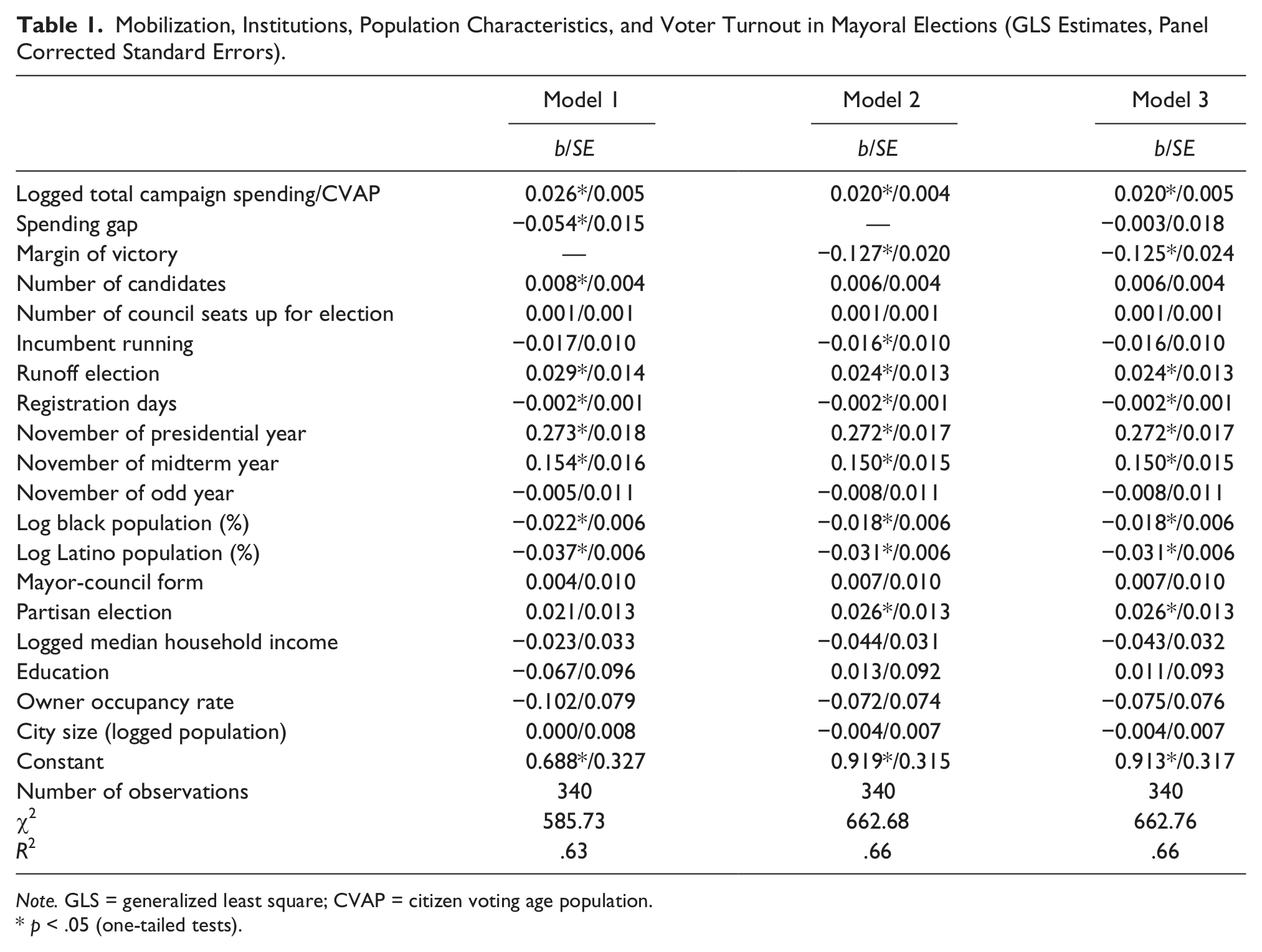
Our primary interest is in the influence of factors that have not been included in previous scholarship on local turnout; mainly those variables that measure campaign effort. Consequently, that is where our discussion of findings will focus. While there are multiple other interesting variables in the model, we will generally give those findings only very brief treatment. We begin our analysis of the determinants of turnout in mayoral elections by presenting three different versions of the turnout model in Table 1: one using the campaign spending measure of competition, one with the margin of victory as the measure of competition, and one with both measures included.
Mobilization, Institutions, Population Characteristics, and Voter Turnout in Mayoral Elections (GLS Estimates, Panel Corrected Standard Errors).
Note. GLS = generalized least square; CVAP = citizen voting age population.
p < .05 (one-tailed tests).
The variables measuring the campaign environment in each city provide mixed results, though the measures of campaign effort are generally significant. First to the null findings for campaign variables: In the presence of other control variables, there is no significant difference in turnout between incumbent and open-seat contests, and the number of city council seats up for election also has no effect. 11 Interestingly, the bivariate relationship for incumbency and turnout is significant; with incumbent contests averaging a turnout rate approximately 6.7 points lower than open seat contests. We assume that the diminution of the effect of incumbency in the multivariate model is because the measures of number of candidates, spending, and competition—all of which are related to incumbency—explain away its bivariate effect. Turning to the spending variables, we see that across all models, the amount of campaign spending has a statistically significant and pronounced effect on turnout levels. Generally speaking, and in keeping with previous research and our own expectations, turnout is higher in cities where candidates spend more money. This is not a simple linear effect, however, as we are using a logged version of the spending variable. As is frequently the case when studying the effects of campaign spending, at some point, there are limits to how high turnout reasonably can be expected to increase, and additional spending will produce smaller and smaller returns. Figure 2 presents this relationship, using the spending slope from Model 3 and a range in spending within two standard deviations of the mean. Here we see that there are relatively sharp increases in turnout when comparing contests with hardly any spending to about $10 dollars per citizen voting age resident, but returns from additional spending flatten out appreciably beyond this point. One of the challenges for increasing turnout in mayoral elections is that only about 20 percent of contests in our sample spent $10 or more per citizen voting age resident. Overall, the difference in predicted turnout between the lowest and highest spending contests is approximately 14 percentage points.
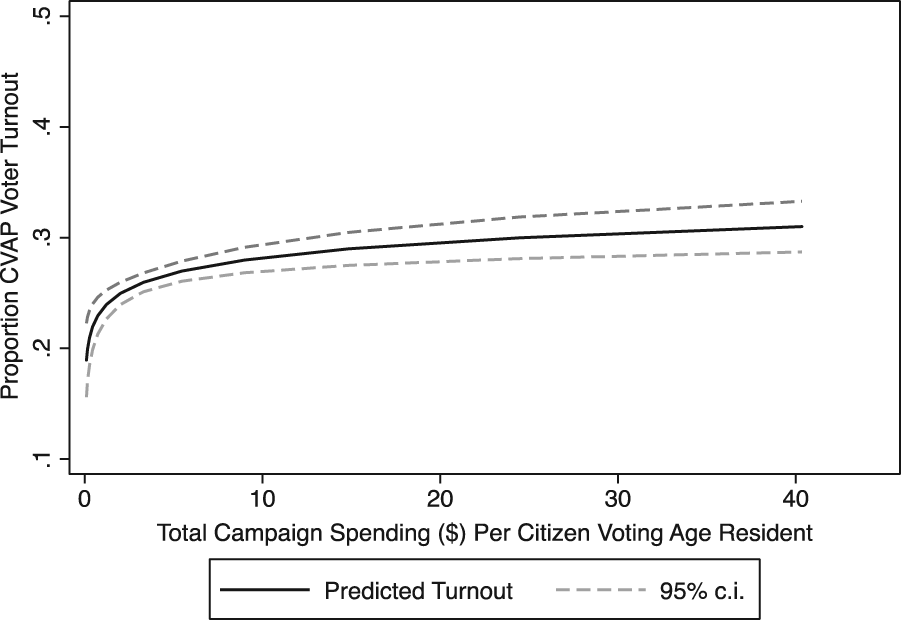
Effect of total campaign spending on voter turnout.
We also find significant influences from our measures of competition. As expected, turnout is generally higher in competitive environments than noncompetitive environments. The measure in which we are primarily interested—the gap in spending between the top two finishers—shows mixed results. In Model 1, which does not include a measure of the eventual margin of victory, the spending gap is significantly related to turnout, with a slope that indicates that the expected turnout level in contests in which only one candidate spent money 12 is predicted to be approximately 5.4 percentage points lower than one in which both candidates spent the same amount of money. However, when the eventual margin of victory is added (Model 3), the spending gap has no discernible effect, and margin of victory has a substantial effect: turnout in contests in which the margin was 100 percent of the vote (only 7 of the 340 cases in Table 1) is predicted to be a full 12.5 points lower than cities in which the outcome is a tie (two cases in our data set, due to rounding vote percent to three places to the right of the decimal point). This is an impressive effect and points to the importance of a competitive political environment in stimulating voters to turn out.
We favor the spending gap measure on theoretical grounds, as it is a direct measure of the campaign environment. Nevertheless, the margin of victory, while not a preelection measure, no doubt reflects aspects of the competitive campaign environment as well. Instead of “choosing” between the two variables, we prefer to emphasize how the level of competition in campaign resources—the spending gap and total spending—shapes the eventual margin of victory. Evidence of this effect is presented in Table 2, where margin of victory is modeled as a function of several campaign variables. In the absence of the spending variables (Model 1), it appears that competition is higher in runoff elections but lower in incumbent races, which makes a great deal of theoretical sense. However, once the campaign spending variables are added to the model, neither runoff elections nor the presence of an incumbent on the ballot have a statistically significant effect on the margin of victory. Instead, the election outcome is generally closer in elections where more money is spent and in elections where the gap in candidate spending is relatively small, with the effect of the spending gap being especially strong.
Campaign Determinants of Competition (Margin of Victory) in Mayoral Elections (GLS Estimates, Panel Corrected Standard Errors).
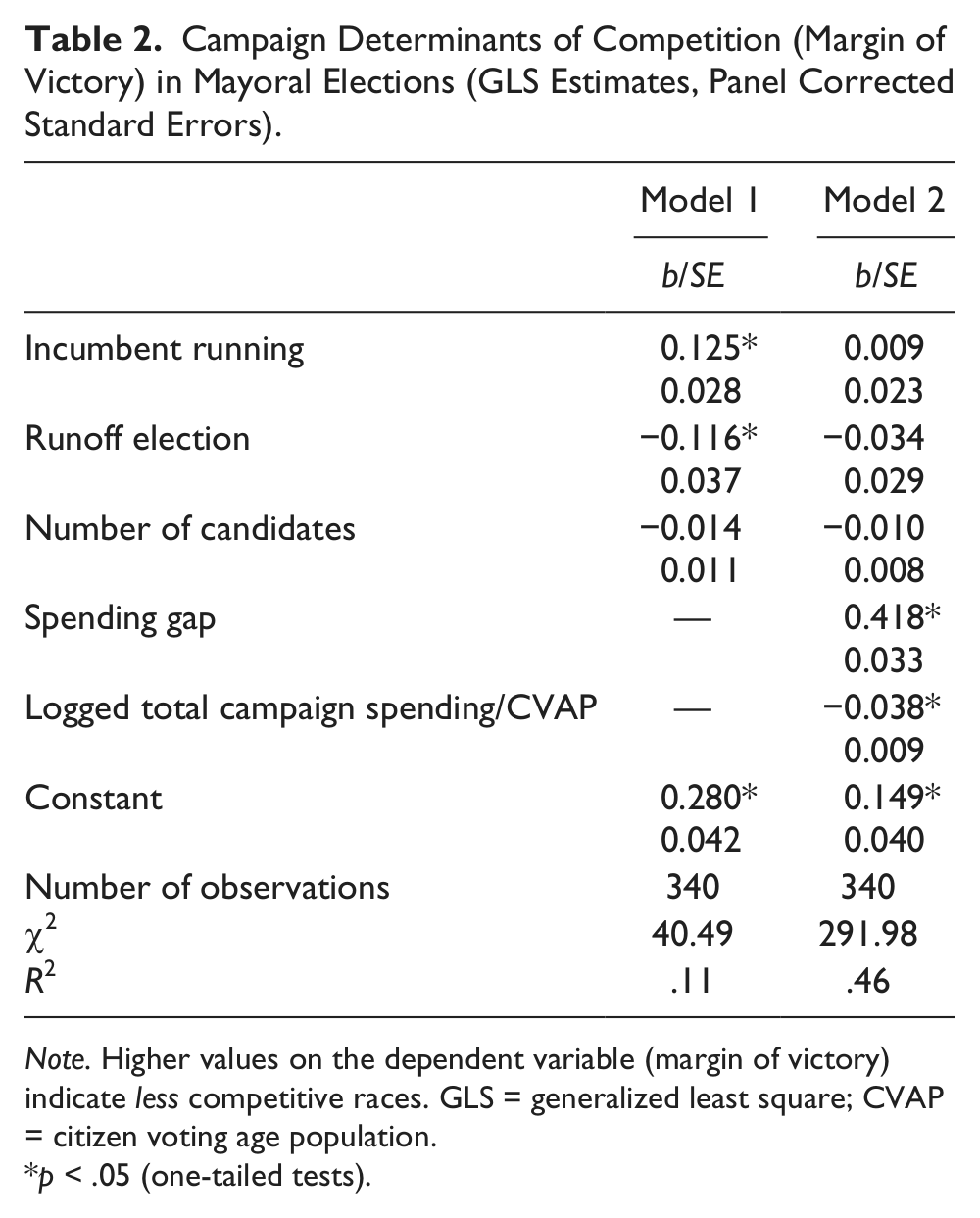
Note. Higher values on the dependent variable (margin of victory) indicate less competitive races. GLS = generalized least square; CVAP = citizen voting age population.
p < .05 (one-tailed tests).
We should note that the results in Table 1 also confirm many of the findings from other studies: turnout is higher in runoff elections, when elections coincide with presidential and midterm elections, and in cities with partisan ballots, but lower in cities in states with restrictive registration requirements and in cities with large Black or Latino populations. Of these effects, the impact of the timing of elections is particularly impressive: turnout is approximately twenty-seven point higher in elections that coincide with presidential elections, 13 and fifteen points higher in elections that coincide with midterm elections, compared with all other elections. When all other variables are considered, measures of socioeconomic status were not related to mayoral turnout 14 nor were there significant effects from size of population or form of local government.
One other interesting way to think about the influence of spending is to consider how the model changes when both spending variables are excluded. When the full model in Table 1 (Model 3) is reestimated without the spending variables, two variables that are traditionally tied to turnout but not significant in the presence of spending variables—incumbency and form of government—become statistically significant. Similar to the results reported in Table 2, this reflects the fact that total spending is significantly lower in incumbent contests (probably reflecting the anticipated odds of defeating an incumbent) and significantly higher in mayor-council contests (perhaps reflecting the value of the office).
The Differential Effects of Challenger and Incumbent Spending
We now turn our attention to a subset of contests, those involving an incumbent candidate, with a special focus on the relative impact of incumbent versus challenger spending. Recall that our expectation, grounded in ideas about information asymmetry between the two candidates, as well as previous literature at other levels of office, is that campaign spending affects turnout in incumbent contests but that challenger spending will matter a lot more than incumbent spending. The findings in Table 3 largely confirm this expectation. Focusing on overall spending (Model 1) first, we see a similar effect to that found in the full sample: as overall spending increases, so does the predicted level of turnout. 15 However, when considering incumbent and challenger spending separately (Model 2), we find that incumbent spending has no effect on turnout while challenger spending is closely tied to turnout. One other important thing to note about the two models is that the margin of victory is statistically significant and substantively important in the first model, but has no impact on turnout when considering challenger and incumbent spending separately. This reflects the fact that challenger spending is what is driving competition: the correlation between the margin of victory and incumbent spending is −.15, while the correlation between challenger spending and margin of victory is −.65.
The Differential Effects of Incumbent and Challenger Spending on Turnout in U.S. Mayoral Elections (GLS Estimates, Panel Corrected Standard Errors).

Note. GLS = generalized least square; CVAP = citizen voting age population.
p < .05 (one-tailed tests).
In Figure 3, we plot the slopes for incumbent and challenger spending, along with the 95 percent confidence intervals. There are a couple of things to note here. First, as with the findings from the full sample (Figure 2), there are diminishing returns to extra spending. Second, as suggested by their slopes, incumbent spending has no effect on turnout, while challenger spending has an effect very similar to that found for the full sample: moving from the lowest to highest levels of challenger spending increases the rate of turnout from .20 to .34, a gain of fourteen points. Finally, the end points for the challenger and incumbent plots illustrate a familiar finding: while the effects of spending are great for challengers, incumbents far outstrip challengers in overall levels of spending.
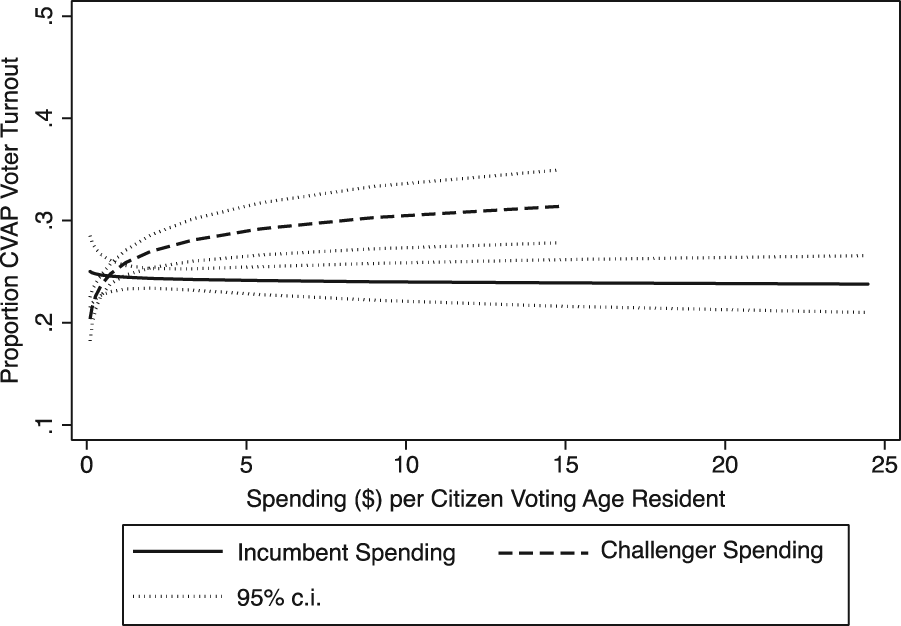
Differential effects of challenger and incumbent spending on voter turnout.
A Dynamic Model of Turnout
We now turn to a final, important contribution to the scholarship on turnout in mayoral elections: a dynamic analysis of change in turnout as a function of change in those independent variables that exhibit change over time. While many things, such as ballot type, form of government, demographic characteristics, and registration requirements change very little (or not at all) over time, other independent variables do change over time and provide an important opportunity to put the findings on firmer causal footing. Most aggregate studies of turnout are cross-sectional (or cross-sectional dominant in pooled data sets, such as ours) in nature and do not provide direct evidence of how much turnout actually can be expected to change for a unit change in a given independent variable. This is the type of inference we might like to make based on cross-sectional data, but the data typically do not incorporate actual changes in values of the dependent and independent variables. Incorporating a dynamic element into the model is perhaps especially important for those who are interested in the types of reforms that could lead to higher turnout—that is, those who want to know what can be changed to produce higher levels of turnout.
Table 4 presents the impact of changes in key independent variables (those that actually vary over time) on changes in turnout from the most recent election. To be clear, in this analysis the dependent variable is literally a measure of the change in voter turnout from the previous election and the independent variables are expressed as changes in their values from the previous election. We also include a lagged measure of turnout to control for possible regression to the mean effects. 16 Our primary interest in this paper is in the effects of changes in the campaign-related variables, so we begin there.
Dynamic Model of the Impact of Changes in Campaign Activities on Changes in Voter Turnout in Mayoral Elections (GLS Estimates, Panel Corrected Standard Errors).
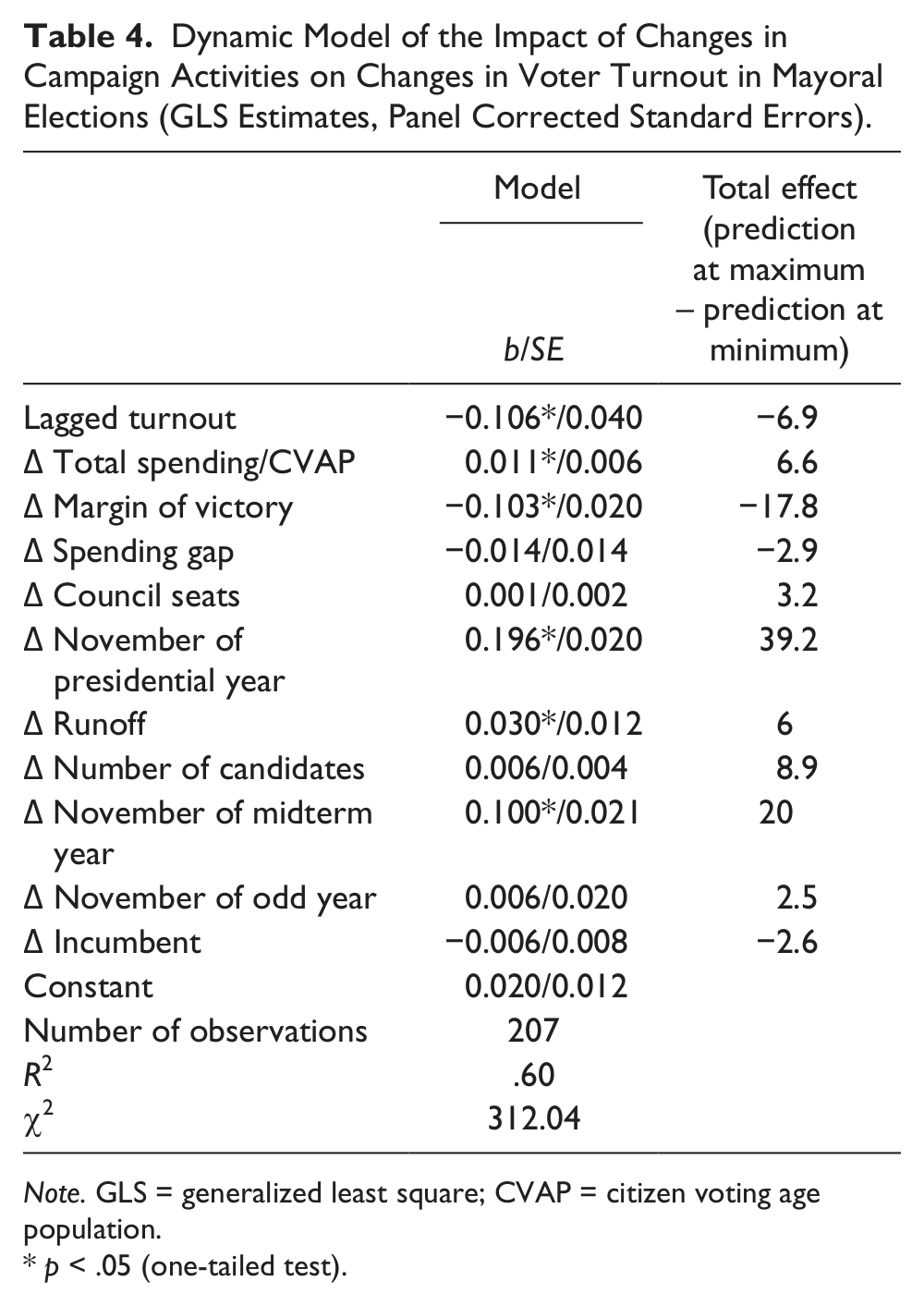
Note. GLS = generalized least square; CVAP = citizen voting age population.
p < .05 (one-tailed test).
First, change in logged per capita spending is positively and significantly related to changes in turnout and has potential to swing turnout from one election to the next by almost seven percentage points. Second, as we saw in the preceding analyses, change in the spending gap between the two leading candidates does not have a significant effect on changes in turnout when entered in the same model with change in margin of victory, while the change in the margin of victory has a much more profound impact. The impact of change in margin of victory is particularly impressive, showing a potential turnout swing of almost eighteen points. Once again, the null finding for change in the spending gap is due in part to the strong relationship between these two variables, which are correlated at .65 (p < .01). When the change in the margin of victory is dropped from the model, the change in spending gap is statistically significant, with a total effect of seven percentage points, and the effect of changes in total spending become more pronounced as well.
The results in Table 4 also provide dynamic support for many of the other variables in the model: moving mayoral elections to coincide with presidential or midterm elections increases turnout, as does moving to a runoff election. Shifting an election from a non–presidential year to November of a presidential year leads to an 18.5-point boost in turnout, on average. 17 Shifting from a non midterm election year to November of a midterm election year leads to an 8.7-point bump in turnout, on average. Once again, in the presence of campaign control variables, moving from an open seat to incumbent contest has no independent effect on changes in turnout. We should note that we are not able to develop a dynamic model to explore how changes in challenger and incumbent spending are related to turnout simply because, after we calculate change scores for challenger and incumbent spending, we are not left with a large enough number of elections where there is an incumbent running to perform reliable statistical analyses.
Summary
Both scholars of local turnout (see Karnig and Walter 1983) and policymakers across U.S. cities have suspected that in addition to institutions, local electoral campaigns may play a role in explaining mayoral turnout. Until now, though, research on local elections has not utilized direct measures of campaign effort—specifically, campaign spending data—to investigate how much campaign mobilization matters to local turnout. In this paper, we developed an original data set containing information on 144 large U.S. cities (and 340 separate elections) over time, and produced the first analysis of the influence of campaign spending across multiple cities and multiple years.
Above and beyond the collection of new data on local elections, we have made several contributions to our understanding of local voter turnout and campaign effects more broadly. First, our analysis clearly shows that local political campaigns matter to local turnout. The effect of the total amount of campaign spending on turnout is notable, consistent across models, and even exceeds the effects of some institutional variables commonly thought to be important to local turnout patterns (e.g., the use of a partisan ballot). The burden for low turnout, then, falls not just on institutional design but also on the nature of political contests and the factors that encourage or discourage intense, competitive campaigns. The importance of this finding should not be underestimated, especially for those who are interested in mechanisms for increasing turnout at the local level. Second, beyond spending levels, we show that competitive mayoral elections play an important role in getting voters to the polls on Election Day. Also, while the spending gap between candidates in mayoral elections does not exert an independent effect on turnout, our analysis shows that its effect is reflected in the level of electoral competition. In fact, once spending and total spending are taken into account, many of the variables that previously have been tied to electoral competitiveness (see Caren 2007), such as the presence of an incumbent on the ballot and runoff elections, become statistically insignificant—because their effects are encapsulated in campaign spending. Third, our analysis of the role of campaigns in incumbent contests shows that candidates’ campaign spending has differential effects on voter turnout. Consistent with our theoretical expectations and with previous research, challenger spending has a pronounced effect on voter turnout, while incumbent spending does not exert a statistically significant effect on turnout. Fourth, we offer a dynamic model of local voter turnout and show that changes in campaign activities have important effects on changes in mayoral turnout. This is a relatively unique and important contribution and helps place the conclusions on significantly stronger theoretical footing. Finally, and importantly, because we were interested in examining the role of campaign factors in shaping local turnout while controlling for key institutional and socioeconomic variables employed in previous studies, we were able to reexamine hypotheses outlined in previous local turnout studies in a broader sample of cities. Our results regarding the role of institutions and city socioeconomics mesh very well with previous accounts: the timing of local elections (Hajnal and Lewis 2003) and partisan ballots (Alford and Lee 1968; Karnig and Walter 1983; Schaffner, Streb, and Wright 2001) matter to turnout, while city level socioeconomic characteristics don’t play a particularly important role in shaping turnout patterns (Caren 2007).
Conclusion
We began this paper by pointing out that voter turnout in local elections is typically quite low, even when compared other elections that are characterized by low turnout (e.g., Congressional midterms), and that this is a cause for concern among some scholars and local officials. Given the ubiquity of local elections, and the fact scholars have repeatedly shown that patterns of local turnout have important consequences for political representation and the distribution of public resources (Hajnal 2010; Hajnal and Trounstine 2005), we view the study of local turnout as an important opportunity to learn more not just about local politics but about broader questions related to political participation. A number of scholars, policymakers and local elected officials have considered alternative ideas to address the chronic problem of low turnout in local elections. Indeed, a number of U.S. mayors have recently articulated their dissatisfaction with low turnout in local elections in their cities and in some cases have proposed reforms aimed at boosting voter turnout, arguably the most basic form of political engagement, in American cities. Thus far, institutions have been the primary suspect for explaining voter turnout in mayoral elections (see Hajnal and Lewis 2003; Wood 2002). We do not dispute the idea that political institutions matter a great deal to turnout in mayoral elections. In fact, our analysis showed that institutional arrangements like the timing of local elections and partisan ballots have important effects on voter turnout. It appears, however, that institutions are only part of the story when it comes to explaining mayoral turnout. Voter turnout in mayoral elections is driven by the configuration of political institutions in a city and by the activities of local political candidates.
Returning to the concerns about turnout voiced by local elected officials, our analysis points to some concrete, doable, actions that we are confident would result in higher turnout levels: implementing policies that help increase levels of competition and increase the amount of money spent on mayoral campaigns (especially the amount spent by challengers), switching to partisan elections, and moving mayoral elections so they coincide with presidential or congressional midterm elections would go a long way toward increasing voter turnout. Of course, these types of changes are unlikely to occur. Most elected officials are probably not interested in better-financed opponents or other mechanisms that would increase electoral competition; and in the case of Progressive reforms that result in low turnout (nonpartisan and off-cycle elections), the potential ills of low turnout need to be balanced against gains that are realized as a result of insulating local politics from national and partisan politics. There are clear trade-offs for policymakers to consider. But the important point it that low turnout is not a fixed characteristic of a city, reflecting some mix of socioeconomic or demographic characteristics; it is a result of choices made concerning institutional arrangements and the short-term political environment.
Footnotes
Declaration of Conflicting Interests
The author(s) declared no potential conflicts of interest with respect to the research, authorship, and/or publication of this article.
Funding
The author(s) received no financial support for the research, authorship, and/or publication of this article.
Notes
References
Supplementary Material
Please find the following supplemental material available below.
For Open Access articles published under a Creative Commons License, all supplemental material carries the same license as the article it is associated with.
For non-Open Access articles published, all supplemental material carries a non-exclusive license, and permission requests for re-use of supplemental material or any part of supplemental material shall be sent directly to the copyright owner as specified in the copyright notice associated with the article.
