




Abstract
This research capitalizes on the analytical opportunity created by mandatory retirement provisions to explore the nature of the electoral connection in state supreme courts and to illustrate how changes in institutional context can modify the decisional propensities of political elites and reshape their fundamental roles. Specifically, this work demonstrates that mandatory retirement obviates the representative function by disconnecting key mechanisms through which public preferences are translated into judicial votes: threat conditions that elevate the risk of electoral censure. In state supreme courts, popular votes are in part strategic and result from a complex interaction of goals, institutions, and external pressures.
Understanding linkages between citizens and government, particularly the connections brought about by the powerful force of elections, is fundamental to a science of politics. Central to this enterprise are institutional arrangements and other contextual contingencies that enhance or obviate the representative function and shape the impact of electoral politics in American democracy.
Beginning with classic studies of Congress (e.g., Mayhew 1974; Miller and Stokes 1963) through recent work on state legislatures (e.g., Hogan 2008), political scientists have established that the threat of electoral reprisal induces members who wish to retain their seats to take constituency preferences into account when casting votes on controversial issues. However, certain circumstances sever this connection, including lame-duck status derived from voluntary retirement, electoral defeat, progressive ambition, and term limits (e.g., Carey et al. 2006; Jenkins and Nokken 2008). Essentially, terminal terms break the “electoral shackles” (Rothenberg and Sanders 2000, 316) and produce a “Burkean shift” (Carey et al. 2006, 105) in elite behavior wherein members vote sincerely rather than strategically to appease constituencies. 1 Moreover, these concepts about legislatures appear to describe term-limited governors and their fiscal policies (Alt, Bueno de Mesquita, and Rose 2011).
In this project, I extend the focus on democratic politics and the role of institutions and other contextual forces in shaping the representative function to state supreme courts. Specifically, I use mandatory retirement provisions as an analytical device to examine how electoral politics forges a connection between public preferences and judicial votes. The fundamental argument is that electoral vulnerability provides a vital key for understanding linkages between citizen preferences and the bench. When reelection is a goal, the effects of electoral insecurity are observable, producing strategic votes that better comport with constituency preferences. However, terminal terms, which remove the electoral incentive, sharply attenuate these effects. In short, popular judicial decisions are the product of goals, institutional arrangements, and external threats.
In this regard, the states’ highest courts are intriguingly enigmatic. Unlike the other political branches, state supreme courts lack an explicit representative function and are steeped in normative expectations of independence and counter-majoritarianism. At the same time, the vast majority of justices must face voters regularly to retain their seats in elections that are at least as competitive as elections for many other offices in the United States (Dubois 1980; Hall 2001a, 2007a; Kritzer 2011). Moreover, these justices decide controversial cases within a significant range of alternative institutional settings and political contexts that have the potential to amplify or diminish external forces influencing individual and collective decisions, including pressures from the electoral arena (e.g., Brace and Hall 1995, 1997). Finally, extant research has demonstrated that elections affect choices in state supreme courts by promoting votes that reflect popular preferences, whether these preferences are measured as general ideological leanings (e.g., Brace and Hall 1997) or as specific opinions on issues (e.g., Brace and Boyea 2008).
In this project, I capitalize on the strong theoretical foundations of the American elections and judicial politics literatures and the analytical opportunity created by variations in mandatory retirement laws to assess whether state supreme court justices in their terminal terms have a greater tendency than their counterparts to cast unpopular votes, ceteris paribus. In doing so, I evaluate an important mechanism that serves to translate public preferences into judicial votes: conditions of electoral insecurity that raise the threat of electoral censure. In this inquiry, which estimates models of judicial choice on the death penalty, mandatory retirement laws are expected to figure prominently in the justices’ votes by shaping their goals and the extent to which external politics is relevant.
The primary data source for this inquiry is the State Supreme Court Data Project, which contains over 8,000 individual death penalty votes cast in state supreme courts from 1995 through 1998. 2 The death penalty is appropriate for this inquiry for three critical reasons. First, in its most basic political form, capital punishment in the United States is a product of electoral politics in state judiciaries. Thirty-one of thirty-eight supreme courts deciding death cases from 1995 through 1998 were elected, 3 and the justices in these elected courts cast 94.5 percent of all death penalty votes during this period.
Second, an intriguing group of case studies provides tentative evidence that justices deciding death penalty cases may act strategically to avoid electoral sanction (e.g., Hall 1987, 1992, 1995). Indeed, capital punishment is a highly salient issue, with strong public support that spanned the nation and transcended the partisan divide in the 1990s (Norrander 2000). Thus, if scientists are to evaluate whether mandatory retirement attenuates the representative function, responsiveness to constituencies must be present in the first place. In this regard, the death penalty, like mandatory retirement, is an excellent analytical device for hypothesis testing.
Third, public opinion on the death penalty was entirely unidirectional during the 1990s. Norrander (2000) shows that the least supportive of the fifty states in the 1990s still favored capital punishment by 61 percent, a figure almost identical to the 64 percent figure reported by Brace et al. (2002). 4 Analytically, this simplifies model specification relative to many other publicly salient issues. From a theoretical perspective, strong support for the death penalty, especially when considered in conjunction with the competitive nature of state supreme court elections, supports a central tenet of this work: that liberal votes have the potential to place the justices in electoral peril by giving ammunition to political opponents and by angering voters.
In fact, state supreme courts in some ways may be the quintessential democratic institutions. State supreme courts are closely connected to state electorates by competitive elections and by federalism that leaves criminal law largely to the states. Moreover, on the issue of the death penalty, justices lack any measure of agenda control that would allow them to sidestep this controversial topic. In the American states, death penalty cases proceed automatically on appeal from trial courts to state supreme courts, and the justices must review these cases knowing that their choices may become the next hot-button issues in their reelection campaigns. Indeed, intense electoral competition, combined with the inability to avoid position taking in politically salient cases, may constitute some of the most favorable conditions under which we are likely to see constituency effects and their subsequent diminution when electoral goals and the impact of electoral politics are altered by terminal terms.
On the Politics of State Supreme Courts
Perhaps the first obstacle to understanding the electoral connection in state supreme courts is the widely held yet inaccurate perception that until recently state supreme court elections have been sleepy affairs with an extraordinary incumbency advantage. Although campaign spending and televised advertising have increased since the 1990s (Bonneau 2007; Hall 2014; Hall and Bonneau 2013), competition in supreme court elections has met or exceeded competition for other important offices for decades. Dubois’ (1980, 50) seminal study of twenty-five states from 1948 through 1974 documented that defeat rates for incumbents seeking reelection were 19.0 percent in partisan elections and 7.5 percent in nonpartisan elections. The corresponding defeat rate in the U.S. House of Representatives was 8.2 percent (Abramson, Aldrich, and Rohde 2008). 5 These statistics are similar to those reported by Hall (2001a) for all states from 1980 through 1995, during which defeat rates averaged 18.8 percent in partisan elections and 8.6 percent in nonpartisan elections. The defeat rate for the U.S. House during this period was 6.5 percent (Hall 2001a). 6
These facts were not unfamiliar to an astute group of political observers in the 1980s. Schotland’s (1985, 78) iconic characterization of judicial elections as becoming “noisier, nastier, and costlier” was an observation about the 1970s and early 1980s. Likewise, after the 1986 and 1988 Ohio Supreme Court races, Hojnacki and Baum (1992, 944) described as “increasingly common” the “new style” campaigns that make “candidates and issues far more visible than in the average judicial contest.” Thus, competitive state supreme court elections are not new, and justices in the 1990s were not impervious to vigorous challenge or outright defeat.
Empirical Studies of State Supreme Court Elections
While descriptive statistics about state supreme court elections are informative, scientific studies of these elections are compelling. The consistent story, derived mostly from studies of elections held from the 1980s through 2000, is that supreme court elections work a lot like other important elections. These findings stand in stark contradistinction to the conventional wisdom, based largely on anecdotal evidence, that voters are plagued by “ignorance, apathy, and incapacity” (Geyh 2003, 63).
As empirical research (e.g., Baum and Klein 2007; Hall 2007b; Hall and Bonneau 2008, 2013; Hojnacki and Baum 1992) has demonstrated, voter apathy is not inherent in state supreme court elections. Instead, citizen participation is driven primarily by factors that increase the salience of these races and provide information to voters. Particularly effective as mobilizing agents are partisan elections, quality challengers, tight margins of victory, and big spending (Baum and Klein 2007; Hall 2007b; Hall and Bonneau 2008).
Similarly, state supreme court electorates make fairly informed choices. Overall, voters show a distinct preference for quality challengers, or challengers who already are judges rather than practicing attorneys (Bonneau 2007; Hall 2014; Hall and Bonneau 2006). Otherwise, electorates vote retrospectively on issues relevant to judges (Hall 2001a) and make specific issue-based choices even in nonpartisan elections (e.g., Baum and Klein 2007; Hojnacki and Baum 1992).
Elections and State Supreme Court Decision Making
One of the most abiding themes in empirical scholarship on state supreme courts is that the methods for recruiting and retaining justices have an impact on judicial choice. Indeed, the various selection schemes operating across the American states affect the justices’ votes on a variety of issues, including the death penalty (e.g., Brace and Hall 1995, 1997; Hall 1987, 1992, 1995; Hall and Brace 1994, 1996), criminal cases (e.g., Bonneau and Rice 2009), civil litigation between “haves” and “have-nots” (Brace and Hall 2001), and abortion (e.g., Brace, Hall, and Langer 2001; Caldarone, Canes-Wrone, and Clark 2009).
As empirical research has documented, state supreme court justices are not the mechanical appliers of law conceptualized by normative legal theory but instead are strategic actors deciding cases within a complicated environment of countervailing forces. Regarding democratic pressures, judicial elections interact with specific circumstances in the political environment, making these forces more or less relevant to the justices. Most pertinent to this inquiry is that elections bring about decisions that better comport with citizen ideology (e.g., Brace and Hall 1997, 2001) and public opinion (e.g., Brace and Boyea 2008; Hall 1987, 1992, 1995).
While previous research on state supreme courts is impressive, these studies nonetheless have two substantial limitations. First, the effects of elections (and other selection systems) have been measured in a blunt manner, typically by using system-level dummy variables to distinguish between elected and appointed courts (e.g., Bonneau and Rice 2009; Brace and Boyea 2008; Brace and Hall 1995, 1997). This broad approach to measurement certainly is appropriate for many important scientific inquiries but provides limited opportunities for systematically evaluating alternative conceptualizations of representation.
Second, the handful of studies (Hall 1987, 1992, 1995) that have effectively linked each justice’s electoral circumstances to their subsequent voting behavior were case studies of the 1980s and were based on small samples of states. Thus, we do not know to what extent these studies are generalizable or how the variables posited as critical to the electoral connection will perform in more complex models that capture the full range of forces affecting death penalty litigation across the United States.
In fact, scholars have missed an outstanding opportunity for comparative inquiry into how electoral politics affects the decisions of the individual justices. To gain leverage on this question, it is vital to distinguish between institutional and individual incentives, including each justice’s electoral strength. This nuanced approach (Hall 1987, 1992, 1995) has provided tentative evidence, consistent with the legislative politics literature, that electoral vulnerability creates specific conditions under which justices are likely to vote strategically to minimize electoral opposition. Hall (2001b) later extended this logic to voluntary retirements, finding that electoral insecurity also promotes decisions by justices to opt out preemptively rather than risk electoral defeat by seeking reelection.
In the models, I follow convention by measuring the system-wide effects of partisan, nonpartisan, and retention elections using dummy variables. In addition, I examine the interactions between mandatory retirement and various conceptually and statistically independent conditions of electoral threat. Overall, the primary means through which mandatory retirement should affect individual votes is by lessening the impact of the very factors that encourage justices to cast popular votes in the first place.
Thus, the models systematically compare justices who do, and do not, have reelection goals and who are operating in climates of varying electoral intensities. If mandatory retirement provisions condition the impact of various independent sources of electoral threat, this study will add to extant evidence that elections play a significant role in elected judiciaries. But more importantly, this study will provide valuable new insights into the nature of accountability and popular judicial decisions. While all justices in elected courts may have some incentive to adopt a representational role, popular decisions may be a more complex function of individuals with reelection goals responding strategically to pressures generated by their own electoral circumstances.
Mandatory Retirement in State Supreme Courts
In this research, the primary analytical device for examining representation in state supreme courts is mandatory retirement, which was an integral part of the reform movement that swept the American states in the 1960s. As with most political reforms, the states differed in their approach to this issue. Overall, thirty-two states (twenty-three of which also elect judges) opted to limit supreme court careers (National Center for State Courts 1996). Most typical is the requirement that justices retire at age seventy, but some states set the limit at seventy-two or seventy-five. Other states merely require election before the age of seventy.
When viewed in conjunction with term lengths and the lack of progressive ambition in state supreme courts, mandatory retirement takes on an interesting new dimension. Because terms of office range from four to twelve years, supreme court justices as young as fifty-eight in some states can be term limited. Moreover, state supreme courts represent the highest rung on the career ladder for most judges. Of the death penalty votes analyzed in this project, 29 percent were cast by justices sixty-five years of age or older, and the oldest justice in the data set is eighty-six.
Although states did not enact compulsory retirement laws to shape the judges’ decisions, this reform fundamentally altered the day-to-day operating environments of courts by changing the opportunity and incentive structures. In fact, state supreme court justices in their terminal terms should be quite willing to cast unpopular votes given the absence of sanctions for doing so. A simple cross-tabulation supports this notion. From 1995 through 1998, justices with reelection prospects voted to reverse death sentences 23.8 percent of the time. However, the reversal rate for justices in their terminal terms was 34.3 percent. 7 This significant difference merits further investigation.
Conceptual Framework and Research Design
This study conceptualizes individual votes on the death penalty as a trade-off between competing goals: the desire to have one’s own ideological preferences reflected in the institution’s decisions and the goal to retain office. 8 Generally, features of electoral politics specific to the individual, the court, and the state should be the primary mechanisms through which public preferences are translated into judicial votes. Moreover, the linkage between electoral politics and votes should be conditioned by mandatory retirement.
The logic of the research design is straightforward. If the justices are voting sincerely, their willingness to overturn death sentences will not vary across alternative strategic contingencies. On the other hand, if the justices are responding strategically to external conditions, their voting behavior will vary in predictable ways across contexts.
In the models below, I use two alternative measures of public preferences. First, following Hall’s (1987, 1992, 1995) example, I treat strong public support for the death penalty as a given and interact various conditions of external threat with the mandatory retirement variable while controlling for state citizen ideology. Second, I replicate the Brace and Boyea (2008) approach by including a measure of public support for the death penalty. Both are consistent with the strategic responsiveness hypothesis and provide an important robustness check on the central inferences in this project.
As mentioned, the primary source for this analysis is the State Supreme Court Data Project, which includes the decisions (and individual votes) of all state supreme courts from 1995 through 1998, as well as biographical data about the justices. To supplement these data, I added the justices’ electoral circumstances, as described below.
Model Specification
For proper model specification, I rely on the substantial body of work (e.g., Brace and Boyea 2008; Brace and Hall 1995; Hall 1987, 1992, 1995; Hall and Brace 1994, 1996) documenting the conditions under which state supreme court justices are willing to cast unpopular, or liberal, votes in death penalty cases. Table 1 contains a complete list of all of the variables included in the models and their exact measurement. Starting with the dependent variable, I code vote as 1 if the individual justice votes to overturn a death sentence in each case (a liberal vote), and 0 otherwise (a conservative vote).
Variable Descriptions for Electoral Models of Voting in State Supreme Court Death Penalty Cases.

Justices’ personal traits
In the models, various traits of the justices themselves should figure prominently in their votes. Of particular importance are the justices’ ideological preferences (judicial ideology), measured using Brace, Langer, and Hall’s (2000) party-adjusted surrogate judge ideology (PAJID) scores. PAJID ranges from 0 (most conservative) to 100 (most liberal) and significantly outperforms partisan identification, the leading alternative. In this analysis, observed values of PAJID range from 1.35 to 92.71, or almost the full range of the PAJID scale. 9
Of course, a primary focus of this project is on mandatory retirement, which distinguishes between justices in their terminal terms because of compulsory retirement laws and justices who are not. Generally, term-limited justices should be more likely to cast unpopular votes than justices with reelection goals. However, the most meaningful impact of mandatory retirement should be as a conditioning agent, modifying the impact of electoral threats on judicial votes.
Age is also a relevant concern, for model specification and for robust inference. Given the obvious fact that justices in their terminal terms are older than many of their colleagues, disentangling the effects of mandatory retirement from the effects of age is essential. Thus, the models include age, measured annually for each justice. Age also tests the proposition that justices may become more lenient after prolonged exposure to death cases and disillusionment with the process, as expressed in the U.S. Supreme Court by Justices Blackmun and Stevens. 10
The electoral context
In state supreme courts, the electoral context should be central. 11 Indeed, this is the principal proposition tested in this article. Various forms of electoral vulnerability should connect the justices to their constituencies, and mandatory retirement should dampen or obviate these effects. As extant research (Hall 1987, 1992, 1995) indicates, there are three distinct types of electoral threats: unsafe seats for individual justices, electorally competitive courts, and unified partisan control of state government. Thus, I include these variables and interact each with mandatory retirement. 12
Specifically, I include the variable unsafe seat to distinguish between justices who narrowly won their last elections by 55 percent of the vote or less (the standard definition of marginal seats) from those with more broad-based electoral support (e.g., Bonneau 2007; Dubois 1980; Hall 2001a). Following conventional practice, this variable is coded as dichotomous rather than continuous because of an anticipated threshold effect rather than a linear association. Theoretically, the effect of a change in previous vote share from 55 to 70 percent, for example, should differ from a 70 to 85 percent shift. Interestingly, margins of approval can be quite narrow in retention elections (e.g., Hall 2001a, 2007a).
Similarly, I include a measure of supreme court electoral competition for each state (competitive court). Following Hall’s example (2007b), I averaged the percentage of the vote received by challengers in supreme court elections from 1980 through 1994. Higher values indicate more intense competition. Overall, states with typically competitive races should be more likely to produce conservative death penalty votes. As with unsafe seat, numerous states using retention elections are more competitive on this dimension than states utilizing partisan or nonpartisan elections (Hall 2001a, 2007a). 13
Along these lines, the models take into account unified government, which raises the likelihood of overt criticism and political retaliation from the legislative and executive branches. This key feature of state government brought about by the electorate should be a vital concern for the justices. This variable is coded 1 when the statehouse and state legislature are controlled by the same political party (annually), and 0 otherwise.
State context
An integral contextual component of judicial choice is the specific ballot format used to elect the high court bench (e.g., Hall 1995, Brace and Hall 1997). Thus, the models include nonpartisan election and partisan election, with retention elections serving as the omitted baseline category. Following standard practice, states are coded by the method of reselection rather than initial selection. Generally, nonpartisan and partisan elections should diminish the likelihood of liberal votes relative to retention elections.
Also important is citizen ideology, measured using the Erikson, Wright, and McIver (2006) scores. Citizen ideology represents opinions aggregated across issues and reflects the overall climate of public preferences in each state. In state supreme courts, citizen ideology has been shown to influence the types of cases docketed (e.g., Brace and Hall 2001; Brace, Hall, and Langer 2001) and the justices’ votes on numerous issues, including capital punishment (e.g., Brace and Hall 1997). Thus, this study predicts that votes to overturn death sentences will be more likely in liberal states even though the states have endorsed capital punishment and strongly favor it as a matter of public policy.
Given the centrality of public preferences to this inquiry, I also estimate the models using Brace et al.’s (2002) state-level measure of the intensity of public support for capital punishment (public opinion). Brace and Boyea (2008) examined the statistical interaction between public opinion and elections to document that public opinion affects the justices’ death penalty votes only in states that elect justices.
Legal factors
In state supreme courts, among the most powerful influences on the justices’ decisions are the laws governing the dispute. While justices may be strategic actors, their explicit charge requires adherence to applicable law. In death penalty litigation, especially important are statutory aggravating factors structuring the sentencing process. Brace and Hall (1995, 1997; Hall and Brace 1994, 1996) have shown that capital murder cases involving rape, robbery, kidnapping, and child victims are more likely to result in votes to uphold death sentences. To capture these effects, I generate an additive index (aggravating factors) ranging from 0 to 4, with each aggravating factor equal to 1.
Similarly, the complexity of each appeal should affect the propensity to cast liberal votes. Appeals that throw in the proverbial kitchen sink tend to be less meritorious than focused arguments (Brace and Boyea 2008). Thus, I measure the number of issues raised on appeal (legal complexity), with the expectation that substantively succinct appeals improve the likelihood of reversal.
Two additional case-related factors merit evaluation. First is representation by public defenders, who lack financial incentives to invest in their clients and typically are burdened with huge caseloads and pejorative stereotypes of incompetence. Thus, trials in which defendants were represented by public counsel may be more likely to result in sentence reversals. A dummy variable (public defender) identifies these cases.
In addition, race may be a factor in death penalty cases. Critics charge that racism pervades the process, creating disparities between black and white defendants and tainting trials with bias manifested in a variety of ways. To test for this possibility, I include a variable (race) to identify cases in which any issue of race was raised on appeal. 14 Assertions of racial bias should promote liberal votes, other things considered.
Finally, I include time-point dummy variables in the models, to control for any temporal effects in the data. The models include dummy variables for 1995, 1996, and 1997, with 1998 omitted as the baseline category.
Because the dependent variable (vote) is dichotomous, I use probit to estimate the models. Furthermore, I use robust variance estimators clustered by justice to take into account the fact that each justice’s votes may not be independent in the strictest sense. 15
Results
Table 2 displays the results of estimating individual-level models of voting on the death penalty in state supreme courts. Model 2-1 measures public preferences as citizen ideology and Model 2-2 measures public preferences as the intensity of support for the death penalty. In this project, the confirmation or rejection of the primary hypothesis rests with the statistical performance of the product terms. Does mandatory retirement significantly alter the effects of the three types of electoral threats in the models? As both models in Table 2 clearly indicate, the answer is a definitive confirmation. 16
Electoral Models of State Supreme Court Justices’ Votes to Overturn Death Sentences (Liberal Votes).
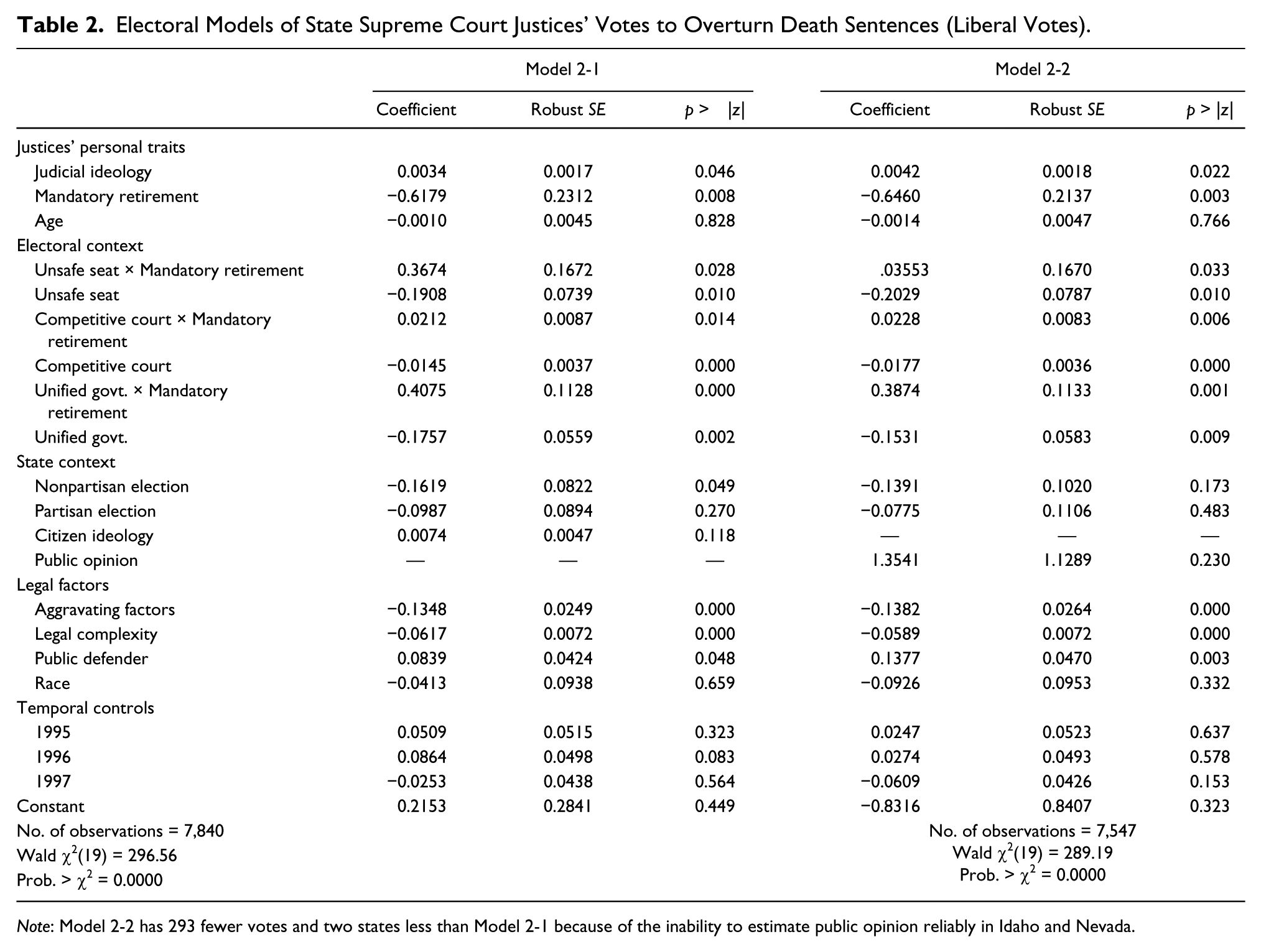
Note: Model 2-2 has 293 fewer votes and two states less than Model 2-1 because of the inability to estimate public opinion reliably in Idaho and Nevada.
Indeed, the results in both models show in a simple yet convincing fashion that the impact of all three types of electoral pressures—unsafe seats for specific justices, competitive supreme courts, and unified government—are conditioned by mandatory retirement. All three of the product terms are statistically significant in both models. Moreover, each of the three coefficients representing electoral threats to justices with reelection prospects is negative and statistically significant, but each corresponding coefficient is positive for justices in their terminal terms.
Predicted probabilities derived from Model 2-1 reveal the substantive power of these effects. 17 Unsafe seats for justices who are not in their terminal terms decrease the probability of a liberal vote by almost 6 percentage points while unsafe seats for lame-duck justices increase the probability by almost 11 percentage points. Unified governments reduce liberal votes for those with reelection prospects by just over 5 percentage points but increase them by 12 percentage points for the term limited. Regarding competitive courts, increasing supreme court electoral competition from the lowest to highest levels reduces the likelihood of a liberal vote by 19 percentage points for justices with reelection prospects but increases it by 35 percentage points for the term limited.
These are precisely the results to be expected if the justices are responding strategically to contingencies in the external environment. Otherwise, there should be no differences in judicial choice related to mandatory retirement for justices acting under various sources of electoral threat when alternative explanations are controlled.
The mandatory retirement coefficient, which shows the impact of compulsory retirement for justices not in unsafe seats, on competitive courts, or in unified state governments, supports the same story. The liberalizing effects of mandatory retirement laws appear to lie in their ability to modify the impact of external threats on the electorally vulnerable. Otherwise, when justices are electorally secure and factors promoting liberal votes are held constant in the models (i.e., the justices’ goals, ideological preferences, electoral context, and case facts), justices have a higher probability of voting conservatively. This is reinforced by the fact that death penalty cases are being decided on compulsory first review, and the pronounced tendency is not to find reversible errors in mandatory appeals (as with cases decided in intermediate appellate courts).
Also vitally important to the hypothesis tests is the fact that the various effects of mandatory retirement are apparent even when age is controlled. In fact, age is not statistically significant. However, other personal traits are influential. Model 2-1 shows that the justices’ ideological preferences are reflected in their votes, as a voluminous scholarly literature predicts. Other factors being equal, increasing ideology scores from most to least conservative raises the likelihood of a liberal vote by 9.7 percentage points.
Regarding ballots, nonpartisan elections reduce the likelihood of liberal votes by 4.8 percentage points relative to retention elections, the omitted baseline category. However, justices who must face voters in partisan elections are not statistically different from those in retention elections. These results comport well with recent work (Caldarone, Canes-Wrone, and Clark 2009) showing that justices selected in nonpartisan elections are more likely than justices in partisan elections to make popular decisions.
Also as predicted, case facts influence judicial voting behavior. Aggravating factors representing some of the most heinous crimes are associated with votes to uphold death sentences, which is precisely what aggravating factors in death penalty statutes are designed to do. Increasing aggravating factors from least to most reduces the likelihood of a liberal vote by 11 percentage points. In fact, the second strongest substantive impact in the models is case related. Complex cases (from least to most complex) decrease the likelihood of a liberal vote by 32 percentage points, a finding consistent with Brace and Boyea (2008). Also significant are cases involving public defenders. These cases increase the likelihood of a liberal vote by about 2.5 percentage points.
Notably, as Model 2-1 indicates, citizen ideology is not an influence on judicial voting behavior once the electoral context is taken into account. Similarly, claims of racial bias and the temporal variables are not statistically significant. Regarding race, the effects may be more subtle than what can be tested here, or absent altogether.
A comparison of Model 2-1 and Model 2-2 reveals that these results are stable across specifications and that the substantive inferences about strategic responsiveness are not biased by the way public preferences are measured. As with citizen ideology, public opinion is not significant once the effects of electoral politics are controlled.
This finding does not contradict Brace and Boyea’s (2008) contention that elected justices respond to public opinion. Brace and Boyea (2008) investigated differences between elected and appointed courts. This study shows that within elected courts, the exact mechanisms promoting this linkage are particular to the individual and political context and can be modified by institutional features like mandatory retirement. This nuance has tremendous import for understanding the electoral connection in state supreme courts and the specific mechanisms promoting democratic responsiveness. In short, this study provides a more complete explanation for the system-level connection expertly shown by Brace and Boyea (2008).
In fact, the only significant difference between Model 2-1 and Model 2-2 is in the performance of the coefficients for nonpartisan elections. Nonpartisan elections are not statistically different from retention elections in the second model. This is likely due to the fact that Model 2-2 is based on two fewer states (both nonpartisan) because of the inability to measure public support for the death penalty reliably in Idaho and Nevada.
To place in stark relief these intriguing results, I used Model 2-1 to calculate predicted probabilities of liberal votes for various combinations of the most theoretically important variables. Figure 1 displays these results graphically, showing the predicted probabilities of liberal justices chosen in nonpartisan elections in conservative states casting votes to reverse death sentences under various conditions of electoral threat. Specifically, the comparison groups are justices under the age of sixty, justices who are sixty years of age or older and eligible for additional service, and justices who are sixty years of age and older but in terminal terms. The age categories reflect the fact that the average age of the justices in these data is fifty-nine and justices starting at the age of sixty are lame ducks.

Predicted Probabilities of Liberal Death Penalty Votes Under Various Conditions of Electoral Competition.
These results lead to an immediate conclusion: Electoral politics penetrates courts only when reelection remains a goal. Otherwise, liberal justices in conservative states disregard constituency pressures and pursue their own ideological agendas to a greater extent than their colleagues. Alternatively, electoral competition strongly shapes the representative function in death penalty litigation as long as reelection is possible.
The effects of removing the electoral incentive are pronounced. Under only one condition of vulnerability (competitive supreme courts), the predicted probability of justices who are less than sixty casting a liberal vote is 0.276. For justices who are sixty or over but not term limited, the probability is 0.277. For the term limited, the probability is 0.343. However, when unified governments are added to the mix, predicted probabilities decline for both sets of justices eligible for continued service but increase for justices in terminal terms. When all three conditions of electoral threat are present, the differences in predicted vote are striking. In this scenario, justices who are not term limited have about a 0.173 to 0.174 probability of casting a liberal vote while justices in their terminal terms have a probability of 0.618 (i.e., these justices are predicted to reverse death sentences). In short, liberal justices in conservative states can face extraordinary electoral pressure to cast conservative votes but mandatory retirement attenuates these effects. 18
Conclusion
This project provides intriguing new evidence that mandatory retirement provisions and their abrogation of the electoral incentive facilitate ideological shirking in state supreme courts and fundamentally reshape the representative function. Specifically, mandatory retirement conditions the impact of the electoral environment, changing the ways in which external pressures influence judicial choice. Substantively, electorally insecure justices are more likely to make popular decisions on the issue of the death penalty when reelection is a concern, but in terminal terms, these otherwise electorally vulnerable justices are more likely to cast unpopular votes even under the most threatening circumstances.
Overall, this research provides the most direct systematic evidence to date about the nature of the electoral connection in state supreme courts, or the question how various aspects of electoral politics influence judicial votes. In this study, the state-level variation created by mandatory retirement provisions allows us to observe the impact of variables that threaten incumbents when reelection goals are, and are not, present. These results support the contention that electoral vulnerability is key to the representative function in state supreme courts. Indeed, the effects of electoral insecurity are readily observable when reelection goals are present but dissipate when reelection is precluded.
In this regard, this study moves the scientific literature considerably beyond the simple dichotomies of elected versus appointed courts for understanding democratic pressures on state supreme courts. The linkage between citizens and the bench is complex and is conditioned by various institutional arrangements that make reelection goals and various conditions of democratic politics more or less relevant to individual members. In essence, both institutional and personal incentives drive popular decisions in state supreme courts, at least on the highly salient issue of the death penalty. Future research will be essential for testing the generalizability of these findings to other issue areas, especially issues lacking the intensity and visibility of capital punishment.
This study also reveals remarkable similarities between state supreme courts and American legislatures. Indeed, the results in this project are consistent with theories of legislative representation that posit a strong link between specific electoral circumstances and the representative function, as well as theoretical precepts linking the ability of institutional contingencies like term limits to alter these connections. In legislatures and state supreme courts, representation is at least in part actual responsiveness to constituency preferences. Even so, terminal terms may be far more significant in state high courts than in legislatures. State supreme courts range in size from only five to nine members. In closely divided courts or in courts where several members are term limited simultaneously, vote shifts brought about by only one or two justices could have dramatic consequences on the dispositions of cases, legal precedent, and death penalty politics.
Finally, the implications of this study for normative accounts of judicial behavior merit comment. The fact that democratic pressures penetrate courts logically can be construed as an affront to the rule of law and fundamental due process. Scholars reasonably might argue that appellate review should never be influenced by voter preferences or the justices’ personal desire to retain office, especially in capital cases where judicial votes represent life or death choices. Indeed, interpreting these results as evidence for ending the practice of electing judges altogether comports well with traditional theories of the judiciary in American politics.
Remarkably, the opposite construction of these findings also is plausible. In cases lacking reversible error, electoral pressures may prevent justices from disregarding the law and imposing their own preferences that contradict the proper findings of juries and trial judges. In fact, the death penalty is law, and judicial independence has never been defined normatively as judges simply voting as they wish. Geyh (2008, 86) expertly describes the delicate balance necessary “to ensure that judges are independent enough to follow the facts and law without fear or favor, but not so independent as to disregard the facts or law to the detriment of the rule of law and public confidence in the courts.” In sum, we cannot necessarily assume that public preferences subvert the rule of law or that judges’ unchecked preferences are less dangerous than the threat of majority tyranny. Caution is essential when drawing normative conclusions from these findings, especially since we cannot ascertain what the objectively correct decisions are in these models.
Footnotes
Acknowledgements
I thank Chris Bonneau, Brent Boyea, Paul Brace, Michael Colaresi, Mark McKenzie, Chris Mooney, and Rob Robinson for their helpful suggestions, and Frederick Wood for his assistance in coding some of the data utilized in this project. Of course, any errors are entirely my own.
Author’s Note
Earlier versions of this paper were presented at the 2011 Meeting of the Midwest Political Science Association and the 2012 Conference on State Politics and Policy. The 2011 MPSA version of this paper received the 2012 SPPQ Award from the State Politics and Policy Section of the American Political Science Association for best paper on state politics and policy presented at any conference in 2011.
Declaration of Conflicting Interests
The author(s) declared no potential conflicts of interest with respect to the research, authorship, and/or publication of this article.
Funding
The author(s) disclosed receipt of the following financial support for the research, authorship, and/or publication of this article: Substantial portions of this research were generously supported by grants (SBR 9617190, SES 9911166) from the National Science Foundation.