



Abstract
Voters often make the effort to go to the polls but effectively throw their vote away by leaving their ballot blank or intentionally spoiled. Typically construed as anomalous or errant, we argue that blank and spoiled ballots are empirically differentiable and politically informative. We consider self-reported vote choice from a nationally representative survey following the 2011 Bolivian elections, in which 60 percent of votes cast were blank or spoiled. We estimate a multinomial logit model, finding that both blank and null voting were driven by political concerns, though null voting was more common among politically sophisticated individuals.
The prevalence of spoiled and blank votes across democracies today raises an important question: when the costs of voting have already been paid, why deprive yourself of the opportunity to affect the election? Considering the proportion of blank and spoiled ballots from elections around the globe, observers advance a myriad of plausible motivations, including voter apathy, voter confusion, or expressions of voter discontent (Power and Garand 2007; Uggla 2008). Scholars interpret blank and spoiled ballots as resulting from some combination of voter incapacity, where citizens lack the requisite skills or information to cast a valid ballot, and political motivations, when voters deliberately signal their malcontent. Steifbold (1965) identified two types of “invalid voters”: the “apathetic invalid” is akin to the voter who would wish to stay home; she submits a blank ballot on voting day for reasons of ignorance, ambivalence, or apathy. In contrast, the “highly politicized invalid” deliberately invalidates the ballot to signal dissatisfaction with the regime, incumbents, or the electoral process more generally. 1
Although scholars identify blank and spoiled voting as two types of vote invalidation, the two acts are often assumed to be equivalent (Power and Garand 2007; Power and Roberts 1995; Sinclair and Alvarez 2004; Steifbold 1965). Counting blank and spoiled votes as interchangeable “twins” (Uggla 2008) obscures the fact that blank and spoiled ballots may have fundamentally different origins; whereas a blank ballot may stem from voters’ ignorance or apathy, a deliberately invalidated ballot is a clear and costly signal of voter discontent. The inferential consequences are substantively important: misattribution of all blank ballots as contentious and deliberate demonstrations of dissatisfaction might lead scholars to overestimate political polarization or misread citizen confusion for deep-seeded antagonism. Worse yet, interpreting all intentionally invalidated ballots as individual voter errors could systematically underestimate voter dissatisfaction with incumbents, a particular regime, or democracy.
We consider an electoral environment that was both informationally limited and highly politicized, offering the ideal test for our hypotheses regarding the origins of blank and spoiled voting. In October 2011, Bolivian citizens became the first in the modern world to elect their national judges directly. 2 All political campaigning, party affiliation, and media coverage were prohibited in an attempt to depoliticize the electoral process and ensure voters weighed candidates’ merits without undue political influence. At the same time, the opposition campaigned to boycott the elections entirely. The result was an electoral process in which blank and spoiled ballots combined accounted for approximately 60 percent of the total votes cast. The government faulted the lack of information for this high rate of ballot spoilage, while the opposition decried the election outcome as delegitimizing to the government and national courts. We suggest both were partially correct: far from being errant or anomalous, spoiled votes are both deliberate and informative, providing critical insights into citizens’ evaluations of democracy. Blank voting, by contrast, also stems from political considerations, but also from voters’ limitations in accessing or processing electoral information.
Although extant research documents levels of blank and spoiled voting in other contests, few combine the characteristics necessary to distinguish between these two classes of vote invalidation, and none consider individual-level data such that this differentiation would be possible (Aldashev and Mastrobuoni 2013; Knack and Kropf 2003; McAllister and Makkai 1993; Power and Garand 2007; Power and Roberts 1995; Sinclair and Alvarez 2004). The Bolivian case is an ideal opportunity in this respect. The electoral environment was devoid of information, leaving open the possibility that blank and null voting stemmed from voter ignorance of the candidates and process. At the same time, the election was unquestionably polarizing, which allows for the equally real possibility that blank and null voting were driven by political considerations. As such, our research design permits the testing of hypotheses based on individuals’ varied access to what limited information was available and individuals’ varied political motivations.
We depart from the standard use of ecological data to investigate self-reported voter behavior at the individual level, analyzing a nationally representative public opinion survey conducted six months following the divisive and informationally limited electoral contest ( AmericasBarometer 2012). We corroborate our individual-level analysis with municipal-level vote returns to mitigate inferential obstacles that social desirability of survey responses might introduce. Our comparison between our individual- and aggregate-level analysis suggests that our individual-level results may be systematically understated.
Information, Politics and Vote Invalidation: Blank and Spoiled Voting
Recent history is replete with examples of elections where many ballots are returned spoiled or blank, an outcome increasingly common across the developing world. In Latin America, spoiled and blank votes have exceeded 15 percent of total votes cast in a third of the elections since 2000 (International Institute for Democracy and Electoral Assistance [IDEA] 2002). In Ecuador’s 2006 elections, nearly 4 million voters cast spoiled and blank ballots accounting for nearly 40 percent of total participation, exceeding the number of votes for the government party by nearly over 1.5 million votes. More than a quarter of Colombian voters invalidated their ballots in the 2010 legislative elections, with the spoiled vote garnering more votes than any party elected to Congress. In the most recent (2011) legislative elections in Peru, the null and blank vote exceed the governmental vote by more than 60,000 votes. Far from being an isolated phenomenon, blank and spoiled votes have accounted for a considerable percentage of total votes across the developing world, including Morocco (19%, 2007), Indonesia (14.5%, 2009), and Algeria (14.5%, 2007; IDEA 2002).
A small academic literature assesses this phenomenon in comparative perspective, systematically considering blank and spoiled voting in countries around the world. While a number of studies consider the rates of ballot invalidation in particular states or countries (Mott 1926; Steifbold 1965), increasingly scholars leverage subnational variation across electoral districts (Aldashev and Mastrobuoni 2013; Herron and Sekhon 2005; Knack and Kropf 2003; McAllister and Makkai 1993; Power and Roberts 1995; Sinclair and Alvarez 2004) or cross-sectional variance across countries and over time (Power and Garand 2007; Uggla 2008). This research typically differentiates between voter capacity and political motivations as reasons for invalid voting (Aldashev and Mastrobuoni 2013; Herron and Sekhon 2005; Knack and Kropf 2003; Mott 1926; Sinclair and Alvarez 2004; Steifbold 1965).
Informational explanations suggest that blank and spoiled ballots stem from voters’ lack of information about the candidates or a complicated institutional environment. In the American context, “under voting” or ballot roll-off is especially common in down-ballot or low salience races where voters may lack knowledge of candidates or are unfamiliar with the office itself (Hall 2007; Knack and Kropf 2003; Sinclair and Alvarez 2004; Streb and Frederick 2009; Streb, Frederick, and LaFrance 2009; Wattenberg, McAllister, and Salvanto 2000). Comparative scholarship emphasizes the institutional dimension of this problem, identifying institutional designs that increase the informational demands of voters (Mott 1926; Steifbold 1965). McAllister and Makkai (1993) compare vote invalidations in Australian House and Senate races, noting that blank and spoiled ballots are more common in the Senate contests owing to the relatively complicated single-transferable vote (STV) procedure. Power and Roberts (1995) and Power and Garand (2007) report that vote invalidation is more common in open list proportional representation systems in which many candidates are listed on the ballot, creating a comparatively noisy electoral environment. Where electoral rules provide heuristic cues to voters, such as partisanship or candidate pictures, voters’ informational needs decrease (Abramson and Aldrich 1982; Bonneau and Hall 2009; Hall 2007). Finally, comparative work documents that voter turnout increases when races are contentious and the informational environment highly saturated (Fornos, Power, and Garand 2008; Geys 2006; Hall and Bonneau 2013).
Even in rich informational environments, information is only useful provided voters fully comprehend. Innumerable studies report that educated voters are more likely to vote on election day (e.g., Powell 1986), and literate voters better evaluate candidate quality making them less likely to inadvertently spoil their ballots by mistake (Mott 1926; Power and Garand 2007). Empirical research verifies this assumption, reporting that blank and deliberately nullified ballots are more common in districts where illiteracy is high (McAllister and Makkai 1993; Power and Garand 2007; Power and Roberts 1995), or where ballot comprehension is limited due to linguistic or ethnic diversity (Herron and Sekhon 2005; Knack and Kropf 2003; McAllister and Makkai 1993; Sinclair and Alvarez 2004). Finally, urban environments are hotbeds of political campaigning where information is comparably easier to disseminate, and the close proximity to voting stations may reduce the costs of voting (Power and Garand 2007).
A second class of explanations pertain to political motivations for casting a spoiled or blank ballot. Academic scholarship suggests that blank and spoiled voting is a signal of protest, especially in systems where voting is compulsory (McAllister and Makkai 1993; Power and Garand 2007; Power and Roberts 1995). Steifbold (1965) first rejected blank and spoiled ballots were simply a result of voter error, reporting that blank and spoiled ballots increased following the prohibition of the Communist party in West Germany suggesting the options presented on the ballot were insufficient. Similarly, Brown (2011) documents that voters in Nevada are most likely to select the option “None of the Above” presented with few options on the ballot. Finally, protest votes are a reaction to government corruption, aggression or citizen outrage to a political crisis. Blank and spoiled ballots in Brazil peaked during the military government (Power and Roberts 1995); Power and Garand (2007) find blank and invalid voting in Latin America is highly correlated with revolutionary violence and inversely related to democratic quality. These results suggest casting blank and spoiled ballots serves an instrumental purpose by signaling one’s dissatisfaction with the political status quo.
Although many acknowledge the motivations for casting blank versus spoiled ballots are not necessarily the same (Power and Garand 2007; Power and Roberts 1995; Sinclair and Alvarez 2004; Steifbold 1965), few endeavor to disentangle blank and spoiled voting or the information-protest causal stories. 3 Whereas citizen engagement and political participation are the cornerstones of modern democracy, either inferential mistake is of real substantive import. 4 We take this opportunity to systematically compare the origins of self-reported blank versus spoiled voting in an electoral contest which was both informationally restricted and highly contentious, considering the 2011 judicial elections in Bolivia. Our focus on individual-level data sidesteps the usual quandaries associated with ecological inference (Herron and Sekhon 2005; King 1997; Tam Cho and Gaines 2004), while the contentious and informationally limited environment in which the elections took place make the Bolivian case an especially good test of our hypotheses regarding the origins of blank and spoiled voting, as either causal story is empirically plausible.
The Bolivian Judicial Elections of 2011
Since the beginning of the twenty-first century, Bolivian democracy has undergone a rapid transformation. The elite-based, traditional parties that maintained a “pacted” democracy for most of the twentieth century have proved incapable of maintaining their political relevance, and from the ashes of a now defunct party system emerged the Movement to Socialism party (Movimiento al Socialismo), or MAS, under the leadership of President Evo Morales (Alpert, Centellas, and Singer 2010; Centellas 2009; Gamarra 1997). Citing a long history of exclusion from mainstream politics, the MAS has organized indigenous and working class Bolivians on the basis of common ethnic heritage, successfully capitalizing on widespread disaffect for the traditional party system. 5
A central objective of the MAS political project has been the redrafting of the national constitution to “refound” Bolivia in the vision of this emergent majority. In a contentious constitutional process (Romero, Irahola, and Peñaranda 2009; Villamor 2008), a MAS-dominated constitutional assembly cited widespread distrust of the courts to justify the national courts system as a target for reforms. Advocates of direct elections claimed that judges would be selected on the virtue of their merits, as opposed to their political connections, and by “democratizing” the judiciary, public confidence in the justice system might be restored (Órgano Electoral Plurinacional [OEP] 2011). With those goals in mind, the 2009 constitution included a provision for national, nonpartisan judicial elections for each of the four national judicial institutions (Driscoll and Nelson 2013).
A noted challenge facing the constitutional reformers was ensuring that voters would be sufficiently informed about judicial candidates’ merits while avoiding overt politicization of the electoral process. The 2009 Bolivian constitution prohibits judicial candidates from declaring any party affiliation, and all campaigning for or against any individual candidate is prohibited. The national electoral court (OEP) is responsible for all voter education, and the production or distribution of any non-state information materials was explicitly forbidden on penalty of imprisonment or fines. To enable voters to weigh judicial candidates’ professional and personal merits in the inaugural contest, the OEP provided standardized voter information guides presenting the professional experience and biographical information of each candidate.
Unfortunately, this state-run media campaign fell decidedly short. In the days preceding the elections, judicial candidates protested that voters remained uninformed regarding both candidate merits and the electoral process (“Candidatos se quejan” 2011). Although the OEP claimed the diffusion of campaign materials was widespread, other reports suggested the official campaign materials failed to reach more than 30 percent of rural areas (“OEA recomienda” 2011; “TSE admite” 2011). One public opinion poll reported that 76 percent of respondents said they were uninformed regarding the candidates and voting process, results that are all the more striking given the urban concentration of survey respondents (Miranda 2011). On election day, voters remained woefully uninformed, a fact which President Morales conceded at the close of the polls (“Lamentablemente” 2011).
Meanwhile, constitutional regulations required the Plurinational Legislative Assembly to vet all candidates. Although judicial nominations had previously been fraught with contentious disagreement (c.f. Castagnola and Peréz-Liñán 2010), the super-majoritarian control the MAS enjoyed in the legislature made the candidate selection process as fait accompli. Although the government made attempts to ensure a transparent and meritocratic evaluation of candidates, the Organization of American States characterized the pre-selection process as highly politicized. The press identified a number of candidates as MAS affiliates for their experience as party organizers, legislative aides, or legal advisors (“Diputado del MAS” 2011) and the opposition alleged that the majority of MAS legislators knew little about the candidates but simply voted for judicial nominees as instructed by party leaders, a suspicion which was later confirmed by party insiders (“Diputado del MAS” 2011; “Masistas admiten” 2011).
Largely ostracized from the candidate selection process, the political opposition put in motion a campaign to boycott the judicial elections altogether. Sidestepping the prohibition that outlawed campaigns for or against individual candidates, the opposition lobbied voters to deliberately spoil their ballots. 6 The opposition campaign encouraged spoiled votes over mere abstentions as the only way to ensure blank votes could not later be filled in (“Qué harán con mi voto?” 2011). An example of these instructions, which were disseminated via publicly available Google Docs and Dropbox folders, is available on our Online Appendix, available at http://jedi.wustl.edu/data-bolivia-dataset.php.
What would become evident is that the politically charged environment characterized by uncertainty and limited information would have an appreciable effect on voters’ participation. In Figure 1, the average valid, spoiled, and blank votes for the judicial elections are listed in the far left column, along with each of the individual court contests listed as well. By comparison, we include the same figures for the valid, spoiled, and blank votes for the two national electoral contests preceding the judicial elections, which are typical rates of abstention and spoiled voting in Bolivian electoral races (Aguilar and Rojas 2010). The contrasts are stark. In the two nationwide electoral contests prior to the judicial elections, the percentage of spoiled votes typically hovered close to 2.5 percent in both contests with blank ballots accounting for 1.7 percent and 3.3 percent of the vote total, respectively. Overall, nearly 60 percent of the ballots cast in the judicial elections were spoiled and blank ballots. Spoiled and blank votes combined have not exceeded 13 percent in any election since 1980, and had not exceeded 7.5 percent in the twenty years leading up to the 2011 elections (Aguilar and Rojas 2010).
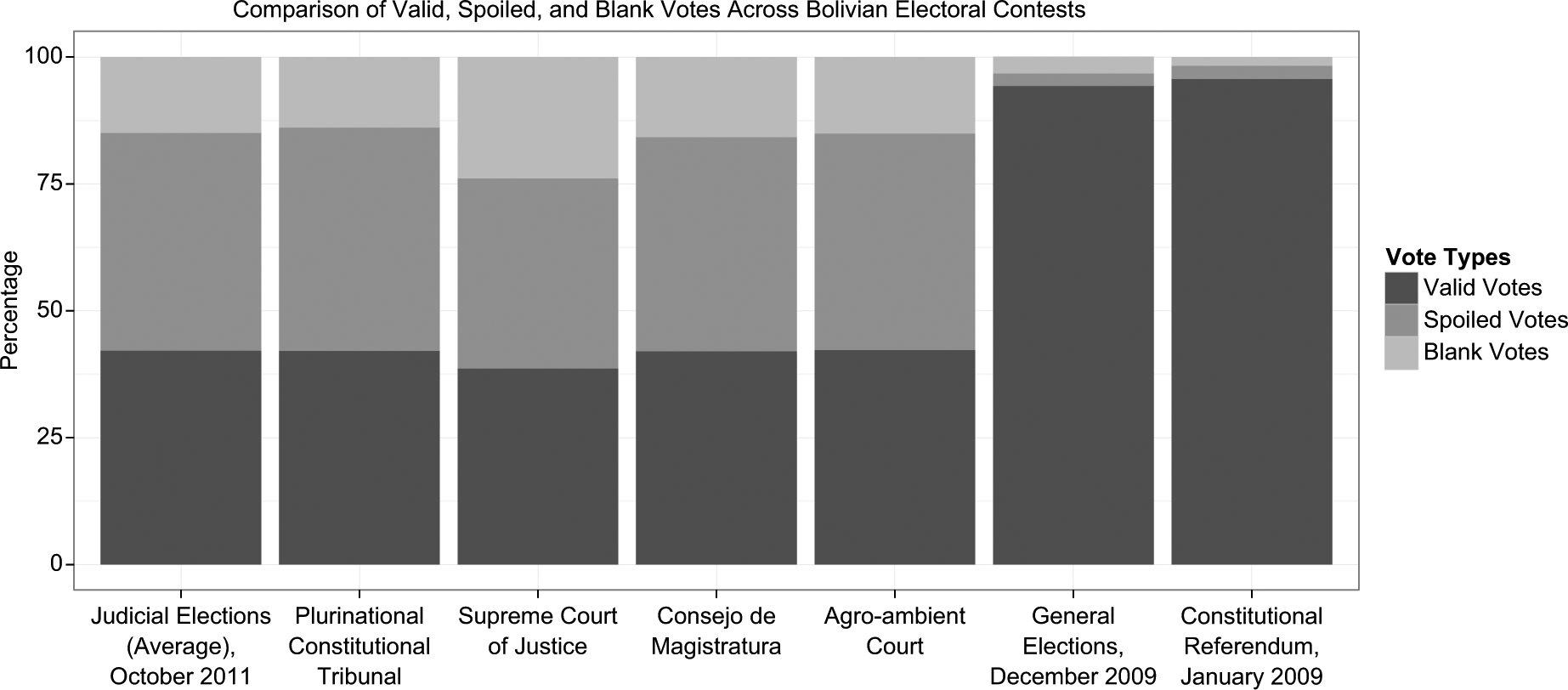
Comparison of valid, spoiled, and blank votes cast in the 2011 Bolivian judicial elections and two prior national elections.
The MAS later faulted the OEP and the lack of information for the widespread blank and invalidated votes. Chamber President Arce noted “The election was well organized, that is undeniable, but in the diffusion of information left much to be desired,” attributing the high levels of vote invalidation on lack of adequate information (“Para el oficialismo” 2011). President Morales emphasized the novelty of the election for Bolivian democracy and legitimacy of the courts, but confessed his own difficulty at deciding among candidates, citing his inexperience with the process. Predictably, the opposition painted the elections as a resounding win. Although these claims have been the subject of much political speculation, they have not yet been evaluated in such a way that these competing interpretations might be subjected to empirical scrutiny.
Hypotheses
Informational deficiencies and protest voting represent two competing explanations for citizens’ decisions to cast invalid votes on election day. Although the informational environment was tightly restricted, individuals also varied substantially in their access to and ability to comprehend what little information was available. Also, the circumstances surrounding this election provide a wealth of variation in voters’ motivations to vote in protest, both of which we leverage to assess these competing hypotheses. We argue that blank voting corresponds to informational theories; lacking sufficient information about the candidates or the electoral process, voters submit an unmarked ballot. Akin to pure abstentions, this action stems not from political efficacy, but rather voter ambivalence, confusion, or apathy. The spoiled vote, by contrast, is an unambiguous expression of voters’ discontent, one which may spill over to undermine citizens’ confidence in political institutions and democracy more generally.
Our first hypotheses pertain to Informational Scarcity, which we expect will relate to blank ballots. Personal characteristics of voters affect the information they have about the election and the country’s judicial system. One factor that affects any citizen’s ability to process the information they receive is their formal education. Individuals with little formal education may lack the ability to read and comprehend the instructions on the ballot, to understand and evaluate the information about candidates they have gathered, or to connect the information they have learned outside of the voting booth with their chosen candidate’s line on the ballot.
Regardless of voters’ level of education, it is indisputable that information was extremely limited in the inaugural judicial contest because candidates were prohibited from actively campaigning, and the information that was provided to the public was standardized by the government. Yet variation in citizens’ access to this information provides an opportunity to assess the effects of information on voter behavior. Citizens’ likelihood of exposure to this state-run informational campaign may have been affected by the periodicity of voters’ access to news and the relative accessibility of key information technologies, such as access to a radio, television, or the internet. Voters who lacked access to these technologies were at a comparative disadvantage to becoming informed and thus may display higher rates of blank ballots. Finally, the OEP reported limited penetration of the state-led campaign into rural areas of the country, meaning these voters were systematically less likely to have been informed about the candidates or the process.
With the aforementioned informational considerations in mind, we hypothesize the following:
However, if citizens spoil their ballots for reasons of Political Protest, then the likelihood of spoiled voting should be highest among those voters who are unsupportive of the majority party. This displeasure may show itself in multiple ways; here, we examine several. We expect that voters who are not MAS party members or who disapprove of the president’s performance will be more likely to spoil their votes. In addition, we use voters’ sociodemographic characteristics as predictors of vote choice: voters from the Eastern departments are generally more supportive of opposition candidates, while Bolivians of indigenous descent tend to affiliate with the government party (MAS).
Consistent with the claim that vote invalidations were driven by citizens’ desires to protest, we hypothesize the following:
Notably, these two hypotheses are not necessarily mutually exclusive. For example, Bolivian sociologist Lorenzo (2011) hypothesizes that upper middle class citizens, especially those in urban areas with access to information about the purported deficiencies of the process, favored the spoiled vote. He reasons that they may be untrusting of the process or simply unwilling to cast their ballots for candidates who are, in effect, mostly unknown to the population. In this sense, access to an abundance of information about the electoral process may lead voters to cast a protest vote. Thus, we assess all of our hypotheses simultaneously to account for the need to control for one explanation when estimating the effect of the other.
Outcome and Explanatory Variables
We test our hypotheses using two data sources: individual-level data taken from a nationally representative public opinion survey conducted six months after the judicial elections and municipal-level election returns. 7 Unlike analyses of voter participation which rely exclusively on aggregate data and must address the limitations of ecological inference, our use of individual-level data provides an inferential opportunity (Herron and Sekhon 2005; King 1997; Tam Cho and Gaines 2004).
Included in the 2012 AmericasBarometer surveys was a battery of questions regarding respondents’ self-reported participation in the recent judicial elections, directly asking whether they participated in the judicial elections, and if the respondent answered in the affirmative, whether they voted for a candidate, cast a blank or spoiled ballot. 8 We use the latter portion of this question to create a trichotomous variable, Self-reported Vote Choice, which we regress on a variety of covariates that correspond to both our informational and protest vote hypotheses. Because the dependent variable is trichotomous and unordered, we employ a multinomial regression with the baseline category corresponding to the likelihood of a respondent reporting that she cast a valid vote for a candidate. 9 Please note a summary of all descriptive statistics are shown in Table 1, with aggregate-level descriptive statistics (and cross-district covariance is presented in our Online Appendix).
Table of Descriptive Statistics of Individual-Level Predictors.
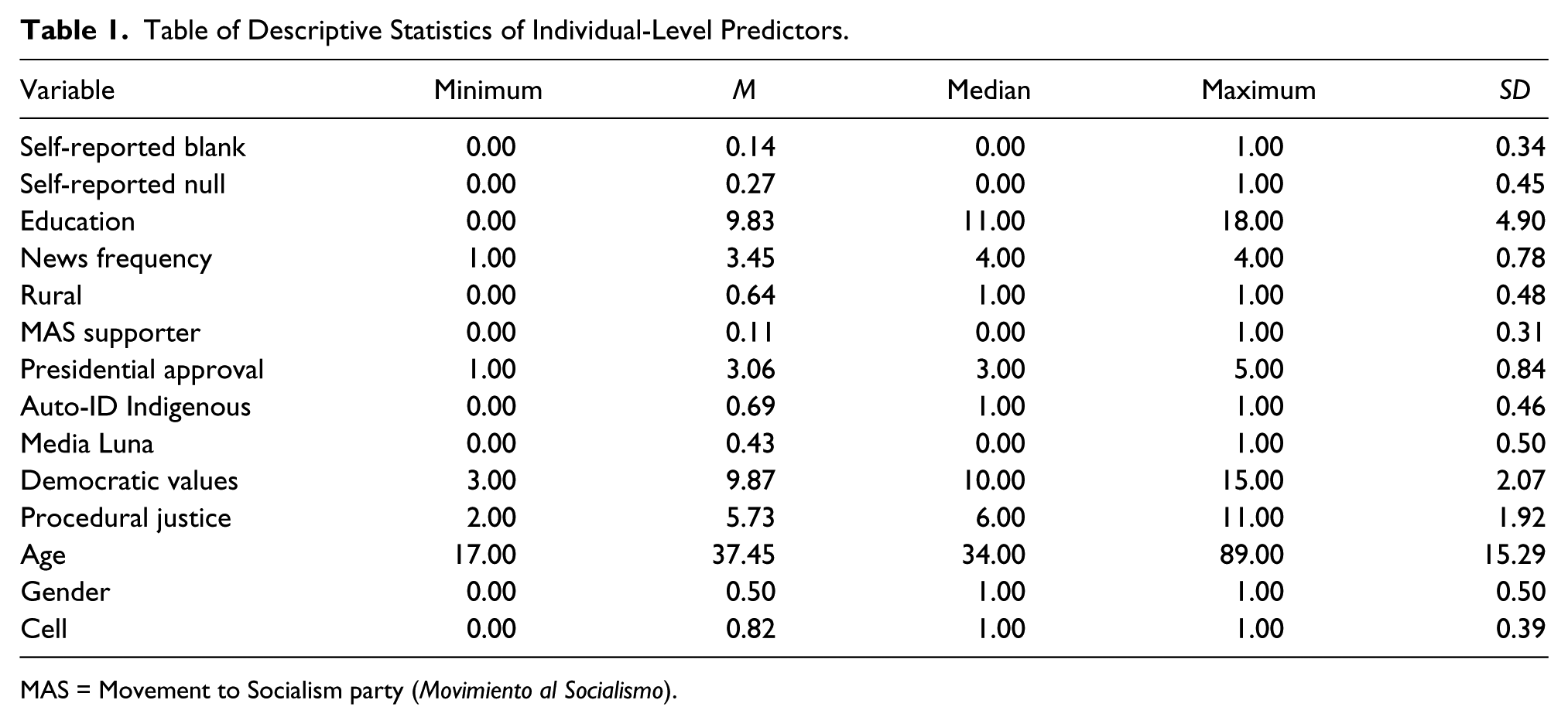
MAS = Movement to Socialism party (Movimiento al Socialismo).
Also from the LAPOP AmericasBarometer surveys, we collected demographic and political information regarding respondents’ lifestyle, education, attitudes, and political predilections. Our first set of covariates characterize conditions of Informational Scarcity that may have lead voters to cast a blank or spoiled ballot. First, we include the respondent’s level of Education, which we nominalize to account for any potential nonlinear effects. Specifically, we include indicators for whether an individual has a high school diploma (and no further education) and one to indicate whether the respondent has at least some postsecondary education. The baseline category includes those respondents with less than a high school diploma. Education and voter sophistication is widely known to increase the likelihood of turning out on election day (Blais 2006; Geys 2006), and aggregate research documents that district illiteracy correlates with higher percentages of blank and spoiled ballots (McAllister and Makkai 1993; Power and Garand 2007; Uggla 2008). Next, we create a measure of News Consumption, in which respondents describe the frequency with which they obtain news from any news source—never, rarely, weekly, or daily. Finally, the OEP acknowledged that the nationally run information campaign was unable to penetrate the most isolated areas (“TSE admite” 2011). As such, we expect that voters residing in Rural areas will be more likely to cast a blank ballot due to lack of information about the candidates and the electoral process.
To evaluate the hypotheses pertaining to motivations to express and subsequently report a protest vote, we first include a measure of Presidential Approval. Respondents were asked to rate the current (Morales) administration on a scale from one to five, with lower values being more positive, a scale which we invert for the ease of interpretation. Second, the 2012 surveys asked respondents about their party affiliations, and so we create a dichotomous indicator for all MAS supporters. Third, Bolivian politics scholars note that deeply held cleavages, caused in part by the distribution of indigenous and non-indigenous voters into the Western and Eastern parts of the country divide the country (Alpert, Centellas, and Singer 2010; Centellas 2009; Gamarra 1997). 10 Also, we consider the effect of Indigenous identity on voters’ reported blank and spoiled voting. In other contexts, Indigenous and ethnic minority voters have been shown to cast spoiled and blank votes at higher rates than other voters, due to linguistic obstacles or alienation from the political system (McAllister and Makkai 1993; Sinclair and Alvarez 2004). At the same time, indigenous voters are a known base of electoral support for the MAS, to whom President Morales directly appealed in advance of the election. As such, we included dummy variables for both of these predictors based on respondents’ self-identification as indigenous (as opposed to mestizo, white or black), and based on respondents’ department.
In addition, we control for several alternative explanations, our Online Appendix details the distribution and covariance of these variables. We measure respondents’ attitudes toward democracy by combining respondents’ affect for democracy generally and Bolivian democracy specifically. Finally, our measure of Procedural Justice combines respondents attitudes toward their assessment of the fairness judicial institutions. Finally, we control for a number of respondent-level demographic characteristics, namely their Age and Gender, and a measure of their wealth based on Cell Phone ownership.
Results
Table 2 presents the results of our multinomial logistic regressions to assess the likelihood of a self-reported blank or spoiled ballot opposed to a self-reported valid vote for a candidate. 11 Beginning with our Informational Scarcity hypotheses, the model provides no evidence that respondents’ self-reported blank voting behavior is driven by the voter’s comprehension of available information. However, the model provides some suggestive evidence that a respondent’s level of education affected the likelihood that she reported spoiling her ballot in the 2011 elections. Indeed, individuals with at least some college education were 11 percent more likely to report spoiling their ballot in the elections than were individuals who have not attained a high school diploma.
Multinomial Logistic Regression of Vote Choice in the 2011 Bolivian Judicial Elections.
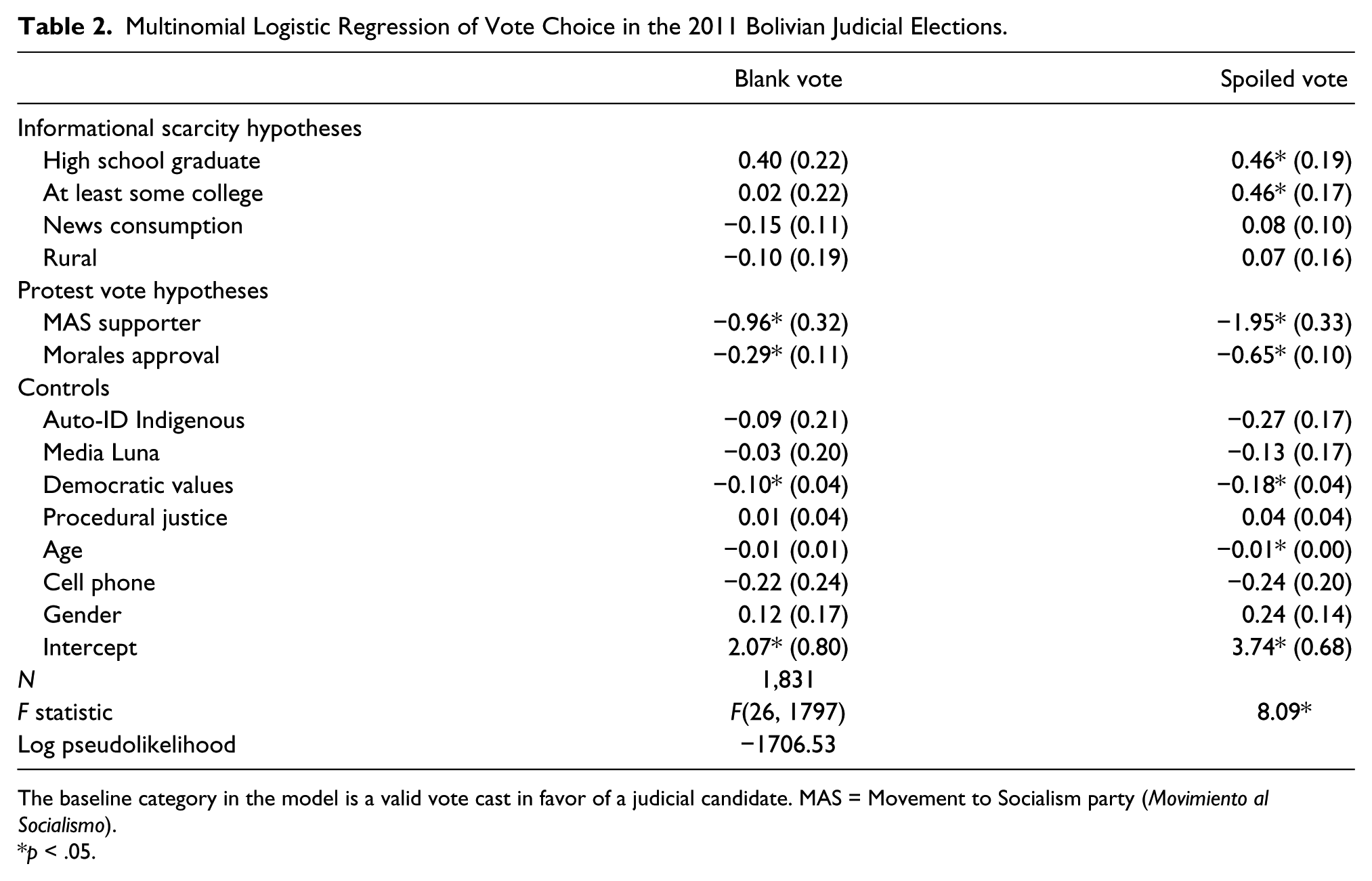
The baseline category in the model is a valid vote cast in favor of a judicial candidate. MAS = Movement to Socialism party (Movimiento al Socialismo).
p < .05.
In addition, we find strong support for our hypotheses that connect self-reported spoiled voting and political protest. MAS supporters and respondents who were supportive of President Morales were systematically less likely to have self-reported casting of either blank or spoiled votes; both of these variables are in the expected negative direction and are statistically differentiable from zero. For both MAS supporters and presidential approval, the spoiled vote coefficients are double the size of the blank vote coefficient.
We graphically represent the interplay of these two variables in Figure 2. Across all levels of presidential approval, non-MAS affiliates were 34 percent more likely to have reported casting a spoiled vote than their MAS-affiliated counterparts, though this likelihood decreased with presidential approval among MAS and non-MAS partisans alike. However, the combined effect of partisanship and presidential approval reveals a different effect on blank voting. Among MAS supporters, low presidential approval is associated with about a 21 percent predicted probability of self-reported blank voting, though this predicted probability decreases to about 14 percent as presidential approval reaches its maximum. MAS partisans who express at least a moderate level of presidential support are more likely to self-report having voted in blank as opposed to admitting to have spoiled their ballot. This is, perhaps, a desire to avoid being categorized as a vote of protest.
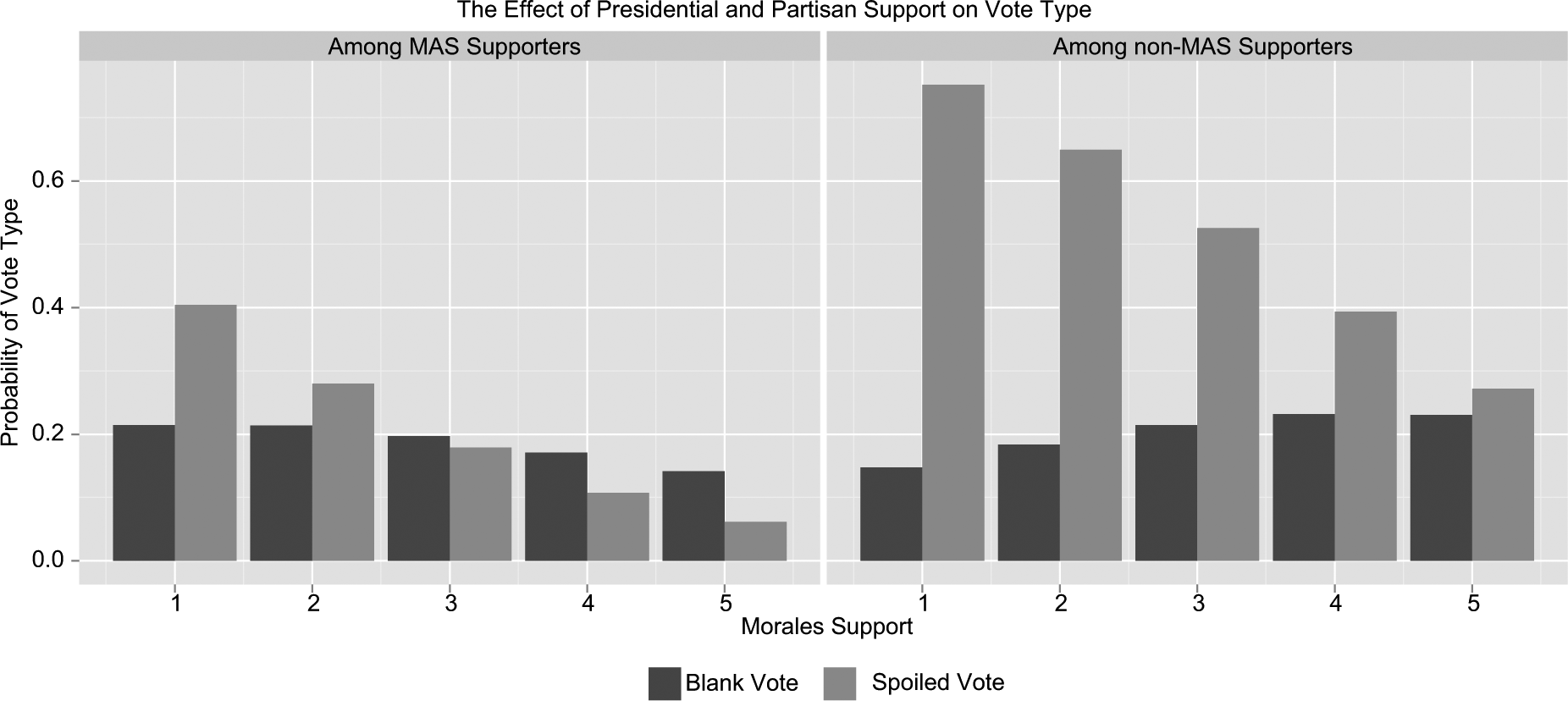
Probability of vote type in the 2011 Bolivian judicial elections.
This is not so for members of the opposition. Across all levels of presidential approval, non-MAS respondents reported spoiling their ballots at a rate which exceeded self-reported blank voting, though as support for President Morales increases among these respondents so does the likelihood these respondents would report blank voting, as opposed to spoiled. Again, not wanting their vote to be counted as one of protest, these voters may have reported casting blank ballots either due to lack of information or for reasons of actual ambivalence in decision-making. Nevertheless, these results clearly demonstrate the disparate origins of blank and spoiled votes and how both are conditioned by political considerations.
Table 3 gives additional insight into the impact of political covariates, as well as the impact of information in light of those differences. 12 We compare the predicted probability of self-reported blank, spoiled, and valid voting for individuals who were most likely and least likely to cast a protest vote based on their partisan affiliation and support of President Morales. Abundantly clear is the dramatic shift from one extreme to the other: non-MAS affiliates who did not support the president had a 75 percent predicted probability of a self-reported spoiled ballot, while MAS and Morales supporters had roughly equivalent, though slightly higher, predicted probabilities of a self-reported valid vote. These same differences hold with increased access to information: for the most part, information drives voters with certain political predilections from self-reported ballot spoilage to self-reported valid voting, or vice versa. These differences underscore the importance of differentiating between blank and spoiled votes, as spoiled voting in this election appears to be an intentional and instrumental expression of one’s dissatisfaction with the options listed on the ballot.
The Interplay of Partisan and Informational Forces in the Bolivian Judicial Elections.
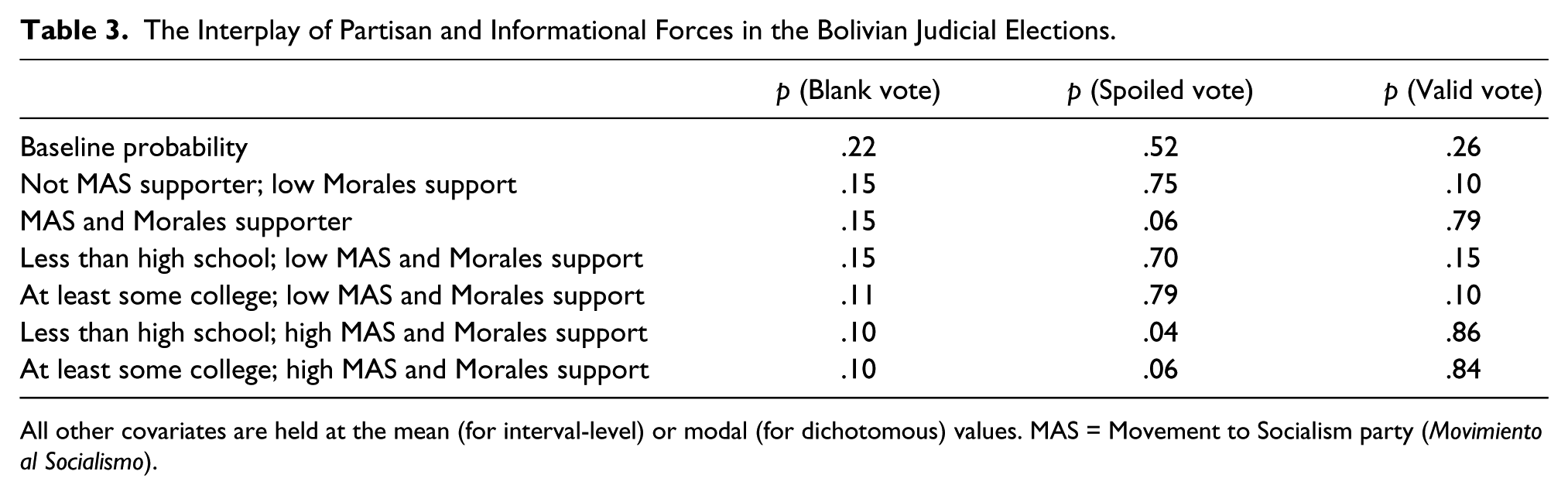
All other covariates are held at the mean (for interval-level) or modal (for dichotomous) values. MAS = Movement to Socialism party (Movimiento al Socialismo).
However, blank voting is strikingly stable across all combinations of political preferences. Behind the dramatic shifts between spoiled and valid votes, a relatively constant percentage of respondents confessed to having voted in blank, irrespective of political motivations. In light of the unique informational circumstances in which this election took place, we take this as preliminary evidence that the restricted informational environment was more influential than our analysis reveals. This percentage is remarkably high by Bolivian standards, where blank voting has never exceeded 7.5 percent since the 1979 transition to democracy, and has not exceeded 5 percent of the vote in the past twenty years (Aguilar and Rojas 2010). It is also remarkably stable across different covariate profiles, given the vast governmental resources invested in citizen education in advance of the election.
Corroborating Evidence from Aggregate Data
As noted above, our results regarding voter behavior drawn from individual-level survey data may be questionable due to social desirability bias, in which respondents may be reluctant to disclose behaviors for fear of public ridicule or punishment (Burden 2000; Katosh and Traugott 1986; Silver, Anderson, and Abramson 1986). Beyond the reluctance to reveal one’s true and possibly socially controversial behavior, the survey adds an additional obstacle to measurement, as it required voters to remember their action on an election day that occurred nearly six months prior. In our Online Appendix, we evaluate the correspondence between the survey’s individual data with municipal-level vote returns to assess the substantive meaning behind the discrepancies. 13 Here, we corroborate the findings of the previous section with revealed aggregate behavior using the municipal-level vote shares of blank and null votes in the judicial elections as reported by the OEP. 14
As a final validity check, we compare the municipal-level vote shares of blank and null votes in the judicial elections controlling for the blank and null votes cast in the most recent electoral contest for which municipal data are readily available. Our aggregate outcomes of interest are the percentage of spoiled and blank votes cast by Bolivians as a percentage of total votes cast in the race for the Constitutional Tribunal in 2011. 15 The data on the judicial elections are an original collection of vote returns collected by the authors from the OEP’s website shortly following the judicial elections, and is disaggregated to the level of the municipality. We multiplied this proportion by 100 to create a percentage. This generated interval variables ranging from 0.42 to 64.7 (spoiled votes) and 4.6 to 56.4 (blank votes) with a theoretical minimum of 0 and a maximum of 100. These data are roughly continuous with a median of 18.5 and a mean of 19 for blank votes, and a median and mean of 24.1 and 28.4 for spoiled votes, respectively. Next, we collected municipal-level election returns from the 2010 municipal elections taken from the Electoral Atlas of Bolivian Elections, 1979–2010 (Aguilar and Rojas 2010).
Our explanatory variables are municipal-level measures of ethnic and linguistic concentration, illiteracy rates, and household survey information on rural location and household technologies from the Bolivian census of 2001. 16 We use municipal Illiteracy Rates to measure municipal education levels, a measure of the municipality’s location in an Urban environment, and the percentage of homes with Radio Access to assess residents’ relative access to information. 17 Turning to our protest vote hypotheses, we measure the percentage of the municipality that voted for the MAS candidate in the most recent (2010) mayoral elections (Aguilar and Rojas 2010), which we characterize a Government Stronghold. As with the individual analyses, we evaluate a municipality’s location in the Media Luna, accounting for 101 of the 340 municipalities which tend to be opposition strongholds. To account for the impact of indigenous identification on the rates of vote invalidation, we include a measure for the % Auto-ID Indigenous of the municipality. Finally, to control for the possibility that districts may differ in their baseline level of spoiling ballots, we also include the percentage of ballots that were cast as either blank or spoiled in the 2010 mayoral elections, as well as for the municipal unemployment rate. Summary statistics of all the aggregate-level explanatory variables, as well as their covariance, are presented in the Online Appendix.
Because our outcome variable is continuous, we estimate linear regressions via ordinary least squares, which we adopt for convenience and ease of interpretation. 18 Our results of the Constitutional Tribunal vote shares are also robust to estimation via Poisson rate generalized linear models (GLMs), reported in our Online Appendix. Because these data are at the aggregate level and the municipalities vary in their size, we weigh the data by the size of the municipality. The results of these regressions are reported in Table 4.
Linear Regression Results for the Distribution of Spoiled and Blank Ballots in the 2011 Constitutional Tribunal Election.
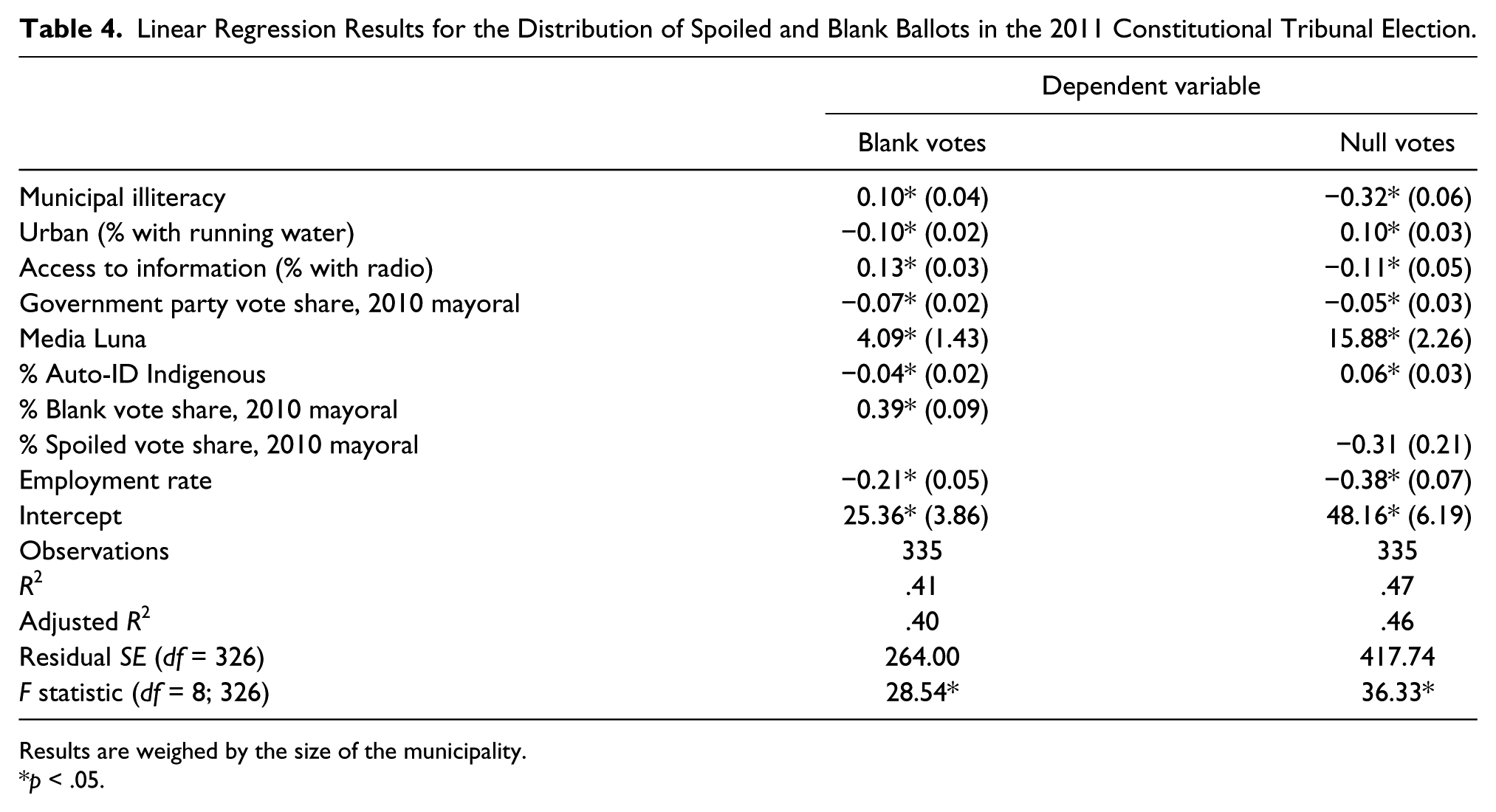
Results are weighed by the size of the municipality.
p < .05.
Our aggregate analyses support our findings described in the individual-level analysis and illustrate a noted limitation thereof. In these models, we find that municipalities with higher concentrations of illiterate voters reported much higher rates of blank voting. Yet the substantive effect is mild; an inter-quartile increase in the percentage of illiterate residents in a municipality is associated with about a 2 percent increase in the percentage of blank votes cast and a 5 percent decrease in the spoiled vote share in the district. Although we found no effect of Urban in the individual-level data, this variable has a differential impact on blank and spoiled voting: urban areas reported a lower concentration of blank votes and an higher concentration of deliberately nullified ballots.
The coefficients for the Government Stronghold and Media Luna variables are in the hypothesized direction and are statistically different from zero in both models. To illustrate the substantive magnitude of these effects, Figure 3 plots the predicted percentage of blank ballots by Government Stronghold and Media Luna in the left-hand panel and the predicted percentage of spoiled ballots by Government Stronghold and Media Luna in the right-hand panel. As discussed above, both coefficients are negative indicating an inverse relationship between these characteristics and the percentage of spoiled ballots. Also, the gap in spoiled ballots between those municipalities in the Media Luna and the Andean departments is particularly large with respect to spoiled voting. Districts in the Media Luna, all else equal, are predicted to have a 16 percent increase in the percentage of spoiled votes and between a 4 percent increase in the percentage of blank votes. This finding is all the more striking given the lack of significance at the individual-level data. This further suggests that our individual-level results are conservative estimates of true voter behavior.
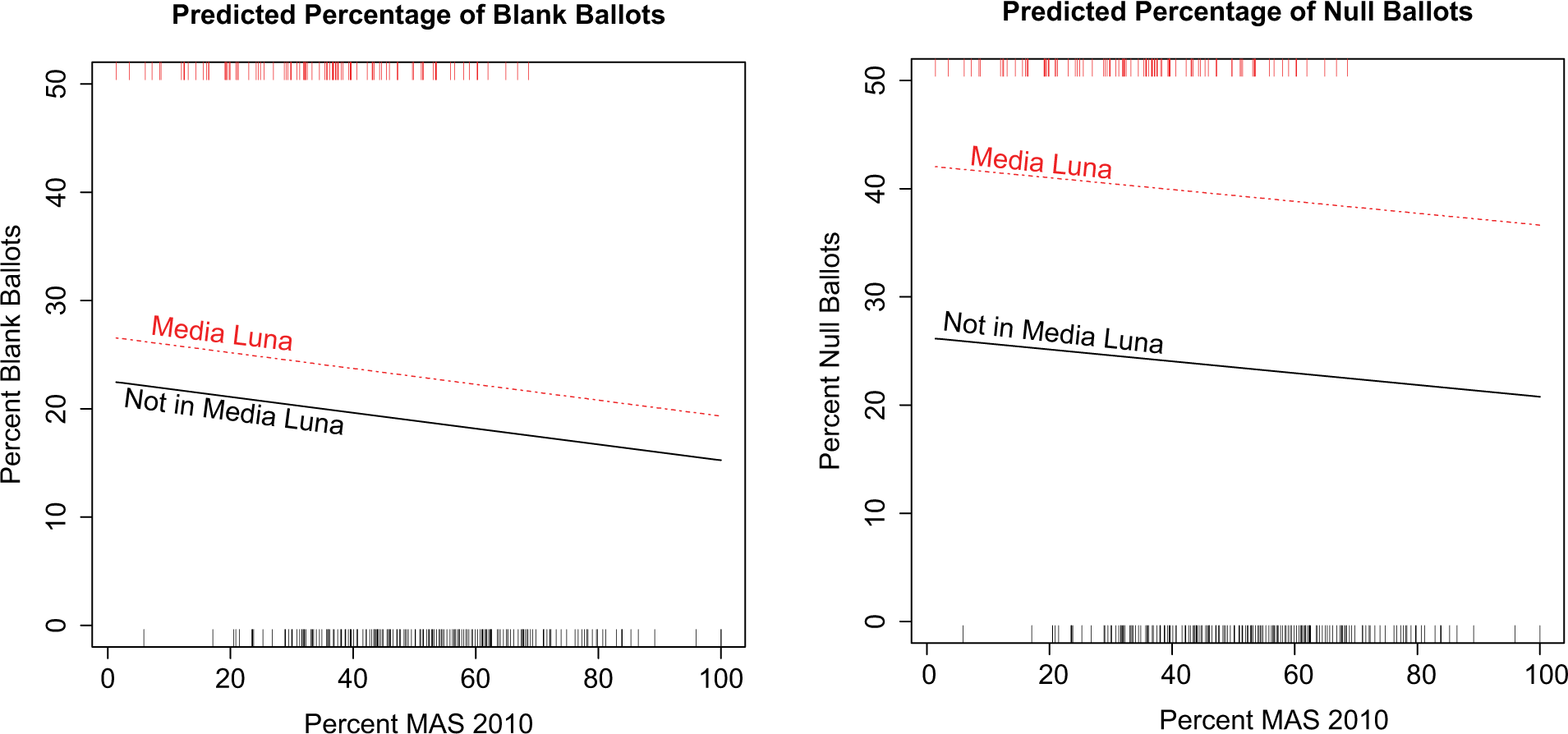
Predicted percentages of blank and spoiled ballots by residence in Media Luna and support for the MAS party.
Turning to the effects of % Auto-ID Indigenous, we find that, where indigenous populations are concentrated, reported levels of blank votes declined, suggesting that indigenous voters—who tend to favor the government party—opted to cast votes for candidates in the judicial elections. As with the effect of the Media Luna, this is a finding that was not discernible in the individual-level analysis. The differences may occur for a number of reasons: measurement error in the survey’s outcome variable caused by voters’ unwillingness to be candid to their interviewer about their vote choice in the election or the inability to control for covariates, such as contemporary individual-level evaluations of President Morales and individual-level values and attitudes. Still, the overriding message from the two analyses is clear: while informational concerns may have played a role, spoiled votes were driven primarily by political concerns.
Discussion
The informational restrictions and the highly politicized electoral environment of the 2011 Bolivian judicial elections provide an ideal opportunity to test theories of protest vote behavior. Although blank and null voting are commonly construed as interchangeable and generally anomalous, the circumstances surrounding the Bolivian elections allowed for either of these possible causal mechanisms to be plausibly supported and empirically differentiated. We found that while both blank and null voting stem from political considerations, deliberately nullified ballots appear to be instrumental voting decisions made by politically sophisticated voters.
Beyond these results is a much richer story of one nation’s pangs of democratization. The motivation to reform the national judiciary stemmed from a real and widespread concern for the state of the Bolivian judiciary; the direct election of judges promised to restore public confidence in their national judicial institutions, in light of the “electoral connection” between the emergent political majority and the judges elected to office. In this respect, this reform was successful: confidence in the Supreme Court increased among MAS and Morales supporters following the election, or those voters we have shown here to have cast their votes for judicial candidates. Yet this newly won confidence was not without cost. Far from an errant aberration, the opposition overwhelmingly chose to spoil their ballots as a signal of discontent with the electoral process and the government more generally. Confidence in the Bolivian judiciary has declined overall (“Cae la confianza” 2012), reflecting a mistrust of Bolivian institutions and democracy more generally. Although it is too soon to forecast the long-term consequences after only one election, we cannot conclude that judicial elections served as a panacea that advocates of judicial elections would have hoped. More ominously, the distrust manifested among voters who spoiled their ballots appears may have also permeated those citizens’ visions of the democratic process.
On the contrary, we show that these votes are intentional demonstrations of citizen dissatisfaction, signaling to elite voters’ disapproval of the electoral process. In light of the widespread and increasing use of null and spoiled votes in democracies across the developing world, we would caution elected officials against writing off these votes as anomalous, or risk losing the confidence of the citizens that brought them to power. Leaders are often quick to dismiss these votes, shifting the blame to poorly educated voters, misinformed publics, or widespread voter apathy. Our analysis suggests that by doing so, those leaders risk misinterpreting what may be a latent, possibly suppressed, dissatisfaction with the status quo. If blank and null voting is, as these results suggest, driven—at least in part—by voter satisfaction with the majority party, then the distribution of these votes actually serve as very informative signals to the ruling regime about where dissatisfaction with government is rampant and where they should coordinate their voter outreach efforts. In other words, though they do little to affect which candidate will take office, blank and null votes are still important electoral outcomes that provide politicians with key insight about voter satisfaction with party performance.
Further research is needed to substantiate these claims and to better understand the long-term consequences of deliberate vote invalidation. At a minimum, electoral authorities ought not conflate these two classes of deliberate voting, and academic researchers may do well to differentiate these two classes of voting in future empirical research. Whereas the civic act of voting is the cornerstone of democratic participation, it is important to fully understand the varied signals that different acts of voting can send. Doing so is imperative for understanding public contestation through vote participation, civil unrest, and democratization.
Footnotes
Acknowledgements
The authors would like to thank the Latin American Public Opinion Project (LAPOP) and its major supporters (the United States Agency for International Development, the United Nations Development Program, the Inter-American Development Bank, and Vanderbilt University) for making the data available

Declaration of Conflicting Interests
The author(s) declared no potential conflicts of interest with respect to the research, authorship, and/or publication of this article.
Funding
The author(s) received no financial support for the research, authorship, and/or publication of this article.