



Abstract
The responsiveness of individual legislators to their constituents creates an indirect electoral connection between the aggregate preferences of citizens and the behavior of legislative parties. In this research, I argue that legislators from moderate districts are the least likely to support their parties and most likely to vote moderately during roll call votes. I also argue that states with low ideological variance among citizens are the most likely to have moderate districts. Thus, states with ideologically heterogeneous populations are more likely to have homogeneous, extreme legislative parties. Using ideal point estimates and measures of party cohesion from state legislative parties, empirical evidence largely supports my expectations.
Following his 2012 electoral defeat to conservative Republican opponent Richard Mourdock, six-term Senator Richard Lugar (R-IN) issued a scathing appraisal of the legislative politics in the United States. In his farewell letter to his supporters and constituents, Lugar bemoaned not just the ideological polarization of the legislative parties in the Senate but also the profound degree of partisanship and party cohesion in legislative politics. As Lugar’s farewell letter (can be viewed at:http://firstread.nbcnews.com/_news/2012/05/08/11605668-lugars-goodbye) points out, ideological extremity and bipartisanship are not always in opposition to one another. Even ideologically polarized parties may find compromise if internal party cohesion is sufficiently weak. Indeed Lugar, who was consistently rated as one of the most conservative U.S. Senators, famously collaborated with liberal stalwart Edward Kennedy, working together on a variety of international relations programs throughout their years together in the Senate. While partisanship and polarization have been on the rise in the national legislature, many of the state legislatures in the United States have also become more partisan and polarized, though a great deal of the cross-sectional variance in legislative party cohesion and polarization remains unexplained. I offer an explanation for the variance in party cohesion and polarization across legislative chambers by linking legislative party behavior to the distribution of citizens’ preferences in each state.
The traditional median voter result stipulates that legislative candidates and political parties converge toward the median voter in an effort to win elections (Downs 1957). This need to capture the median voter to win elections and retain office generates the electoral connection between legislators and their constituents (Mayhew 1974). Legislators from districts with moderate median voters tend to behave moderately, while legislators from districts with more extreme median voters tend to behave more extremely. However, individual legislators are not only responsive to the ideology of their districts, but also internal party pressures. The leadership of legislative political parties in the United States is generally interested in implementing a policy agenda far from moderate and often wields the power to punish legislators who oppose that agenda (Cox and McCubbins 1993). This means that legislators from moderate districts may face competing principals. They can either satisfy their moderate constituency or satisfy their party leadership. As such, the distribution of legislative districts should play a crucial role in legislative party polarization and cohesion for many legislatures. Parties proposing an extreme legislative agenda are likely to have few supporters among the legislators elected from moderate districts.
In this research, I develop an account of aggregate legislative party behavior that asserts that legislators’ need to balance the potentially competing preferences of their districts and the leadership of their legislative party shapes their choices about roll call votes and bill sponsorships. In aggregate, this implies that the level of ideological variance in a state has a powerful effect on the level of party polarization and party cohesion in the legislative process. States with high ideological variance contain many more ideologically extreme legislative districts, which in turn elect more polarized, cohesive legislative parties. Using ideal point distributions and cosponsorship patterns from ninety-six state legislative chambers to construct measures of party polarization and cohesion, and survey data from the 2006 Cooperative Congressional Election Survey (CCES) to construct measures of state ideology, regression results largely support my theory indicating that increasing variance in state ideology increases both legislative party cohesion early in the legislative process and polarization during roll call voting.
The classic median voter result dictates that in a single dimension, two political candidates seeking a majority decision in their own favor will converge toward the median voter (Downs 1957). Accordingly, scholarship has long sought out a connection between legislative behavior and the median preferences of a legislator’s constituents (Clinton 2006; Miller and Stokes 1963; Snyder 1996). However, due to competing pressures and competing principals, legislative behavior is just only responsive to the median voter. Party leadership, primary constituencies, and political elites all place pressure on legislators to diverge from the median voter (Carey 2007; Lindstadt and Vander Wielen 2011). In addition, heterogeneity in the distribution of constituency preferences can have a number of effects on legislative behavior even when the preferences of the median voter are unchanged (Bishin and Dennis 2002; Bishin, Dow, and Adams 2006). Ensley (2012) observes that a need to mobilize a diverse constituency implies that increasing heterogeneity in the preferences of a legislator’s district might cause a legislator to move to the ideological extremes of their constituents’ preferences. Alternatively, several scholars contend that heterogeneity produces a noisy signal of constituent preferences to representatives, and thus provides legislators with a sort of ideological freedom (Bailey and Brady 1998; Gerber and Lewis 2004). Legislators can use that freedom to further their own ideological goals (Bailey and Brady 1998), to satisfy different sub-constituencies (Bishin 2009), or can result in a legislator weighting party goals more heavily (Harden and Carsey 2012).
While the pressure on legislators to behave in accordance with the preferences of their district is strong, there is also pressure for legislators to behave in accordance with their party leadership’s wishes (Carey 2007; Cox and McCubbins 1993). Members of legislative parties also feel certain institutional pressures for party cohesion such as the size of the party (Volden and Bergman 2006), the unity of their opponents (Lebo, McGlynn, and Koger 2007), and the distribution of key veto points in the chamber (Cox and McCubbins 2005). However, Carson et al. (2010) find that a legislator who votes too often with his or her party may suffer in subsequent elections for their party loyalty. Thus, legislators may face institutional reasons to develop a cohesive legislative party, while simultaneously feeling electoral motivations to develop a less cohesive legislative party.
Ideology, Heterogeneity, and Party Cohesion
To develop a connection between legislative parties and the distribution of citizen ideology, I begin by assuming that individual legislators wish to support their party’s efforts to pass legislation and to satisfy their district’s median voter by supporting policies that median voter prefers. In cases where a party’s preferred position is the same as a legislator’s district median voter’s preferred position, that legislator can satisfy both of these goals simultaneously. When these two preferred positions conflict, a legislator can satisfy only one of his or her goals. That is, he or she must choose between supporting policies his or her party prefers and supporting the preferred policy position of his or her district median voter. I further assume that political parties tend to be divided along ideological lines such that parties tend to propose policies that are to the left (Democrat) or right (Republican) of the status quo. This is not the same as suggesting the parties are ideologically extreme. It simply asserts that when the Republican Party in a U.S. legislature introduces a bill, that bill tends to move legislative policy in a conservative direction and likewise in a liberal direction for the Democrats. 1
Suppose then, that a state’s Democratic (Republican) Party leadership proposes a policy that is likely to be more liberal (conservative) than the current status quo. Each individual legislator in the Democratic Party must decide whether to support the party by supporting the bill through the legislative process and voting for the bill. Every legislator, attempting to balance the preferences of his or her district with his or her desire to support the party, calculates whether the proposed policy is closer to the preferences of his or her district’s median voter than the current status quo. Because new legislation proposed by the party tends to be to the left (right) of the status quo, the answer for legislators from districts with extremely liberal median voters is always to support the party. Legislators from extreme districts will rarely fail to support the party’s proposed legislation because the median voters of their districts prefer them to move policy in their ideological direction. Legislators with moderate median voters in their home districts potentially face a real tension. These legislators are more likely to face a situation in which the party proposes a piece of legislation less proximate to their district’s preferences than the status quo. Under these circumstances, legislators can satisfy only their district median or their party leadership but not both. As legislators from moderate districts are the only legislators facing this tension, this immediately implies that the legislators from districts with moderate median voters are the least likely to support a party’s agenda by signaling support for legislation. In addition, because these legislators have a higher tendency to vote against their party’s ideological policies, their roll call voting record also appears more moderate. 2
To drive this logic home, consider the conservative ideological space in Figure 1. In this figure, SQ refers to the legislative status quo, PP refers to the more conservative Republican Party proposal. De refers to the median voter’s preferences of a legislator from an extreme district, while Dm refers to the same quantity for a legislator from a moderate district. If legislators’ choices about supporting legislation are influenced by the distance between the proposed legislation, the status quo, and the preferences of their district, and parties propose legislation to move the status quo in a consistent ideological direction, then only moderate legislators will ever feel pressure from their home districts to favor the status quo over their party’s proposals. That is, for any legislator, i, |Di − SQ| can only be only smaller than |Di − PP| when Di is moderate.

So long as PP > SQ, only moderate Republicans have reason to oppose their own party’s proposals in favor of the status quo.
This individual-level account of legislative choices already has strong support in the legislative politics literature. Research has consistently demonstrated that legislators from moderate districts are cross-pressured by their constituents and their party (Canes-Wrone, Brady, and Cogan 2002; Carson et al. 2010) and that moderate legislators are less likely to support their own party (Minozzi and Volden 2013). Importantly, this potential cross-pressuring of legislators also implies a counterintuitive aggregate connection between the distribution of citizen preferences in a state and the level of legislative party cohesion in that state. Because legislators from moderate districts are least likely to support their party’s proposed legislation, any phenomenon that increases the number of districts with moderate median voters should both create a more ideologically moderate legislative party and also decrease the level of political party cohesion in a legislature by increasing the number of legislators in a political party being cross-pressured. One such phenomenon is the level of ideological heterogeneity among citizens in a state. When a state’s citizenry is ideologically homogeneous about its state median voter, the chances that any district in the state will have an extreme district median voter relative to the entire state are much lower than in a state with a heterogeneous distribution of citizen preferences. The chances of building an entire district of extreme voters decline as a state’s population becomes increasingly ideologically homogeneous.
As decreases in a state’s overall ideological variance decrease the number of relatively extreme district median voters, that decrease in variance also increases the number of legislators feeling some pressure to shirk their party’s proposed legislation and vote moderately during roll call votes. Thus, in aggregate, I expect that states with the most ideologically heterogeneous populations have the most internally homogeneous, ideologically polarized legislative parties and vice versa. Low levels of ideological heterogeneity among citizens in a state means there are many relatively moderate district median voters in a state, and many moderate district median voters means there are many legislators choosing between the competing pressures of their moderate district and their less moderate political party. Ideological heterogeneity among citizens in a state acts as a limiting factor on the sets of districts that can be drawn, which ultimately translates into the degree of polarization and cohesion in a legislative party. 3
To this point, my theory has been focused on the number of legislators who would be motivated to be disloyal to their party, but aggregate party cohesion is likely to be a function of both the number of legislators who could potentially be disloyal and the pressure parties put on legislators to induce cohesion. Aggregate party cohesion is a function of both the number of potentially disloyal legislators and the probability that each legislator will actually be disloyal. There is good reason to believe that the costs associated with a legislator being disloyal to his or her party are small when the policy goals of the two major parties are similar. When the two major legislative parties’ policy goals are similar, the parties have little incentive to whip their membership into line and punish legislators who do not support the party. 4 This is for several reasons. First, if a legislative party is moderate and is attempting to move the legislative status quo, it is likely to be attempting to move it less than a more extreme ideological party would be. To the moderate party, the costs of losing are smaller because the reversion point is more proximate to the moderate legislative party’s preferences than the extreme legislative party’s preferences. Second, when the two legislative parties are relatively proximate to each other, one party can more easily lure members of the opposing party into their coalition, and thus can afford defections from its own party more easily. In other words, when the policy goals of the two parties are similar, the cost to legislators of disloyalty is low. This implies that as the ideological distance between the two legislative parties grows party cohesion should increase. This conception of the connection between aggregate state ideological heterogeneity, legislative party polarization, and party cohesion implies several testable hypotheses.
Taken together, these hypotheses would indicate that legislators from moderate districts have less incentive to support their own party and vote more moderately during roll call votes, and as a result, states with ideologically homogeneous populations will have less cohesive, more moderate legislative parties. 5
Data and Measurement
To test my theory connecting the location of district median voters, aggregate variance in citizen ideology, and party cohesion and polarization in a legislature, I require a situation in which I can measure both the variance in citizen ideology and the behavior of legislative parties. Fortunately, advances in the size of national surveys and the increasing data availability on U.S. state legislatures make comparison of the U.S. states a useful approach to testing my theory. The CCES provides a sufficient number of survey responses per state to develop a reliable measure of the variance in citizen ideology in each state (Carsey and Harden 2010; Levendusky and Pope 2010), and data on both cosponsorship patterns and roll call voting behavior across state legislative chambers can be used to create measures of both the polarization and cohesion of legislative parties.
To measure citizen ideology and variance in citizen ideology, I use the state mood measures from Carsey and Harden (2010) and Harden and Carsey (2012) aggregating both to the Congressional District and state levels. A state or Congressional District’s mood is constructed by factor analyzing survey responses to social policy questions in the CCES and then calculating the mean response in each state or district. This provides a measure of the latent ideological preferences of the state or Congressional District. 6 I code mood such that low values represent conservative responses and high values represent liberal responses with zero representing perfectly moderate responses. Because I construct my measures of legislative polarization and party cohesion from 2007 state legislative sessions, I use survey responses from the 2006 CCES to construct my measures of citizen ideology. To measure the variance of ideology in a state’s population, I simply use the variance in state mood. To provide an idea of how ideological heterogeneity varies across the country, Figure 2 provides a map of the U.S. states in which darker states represent more ideological heterogeneous states. According to 2006 CCES survey responses, Oregon is the most ideologically heterogeneous state in the nation, while Nebraska, Idaho, and most of New England are rather ideologically homogeneous. 7
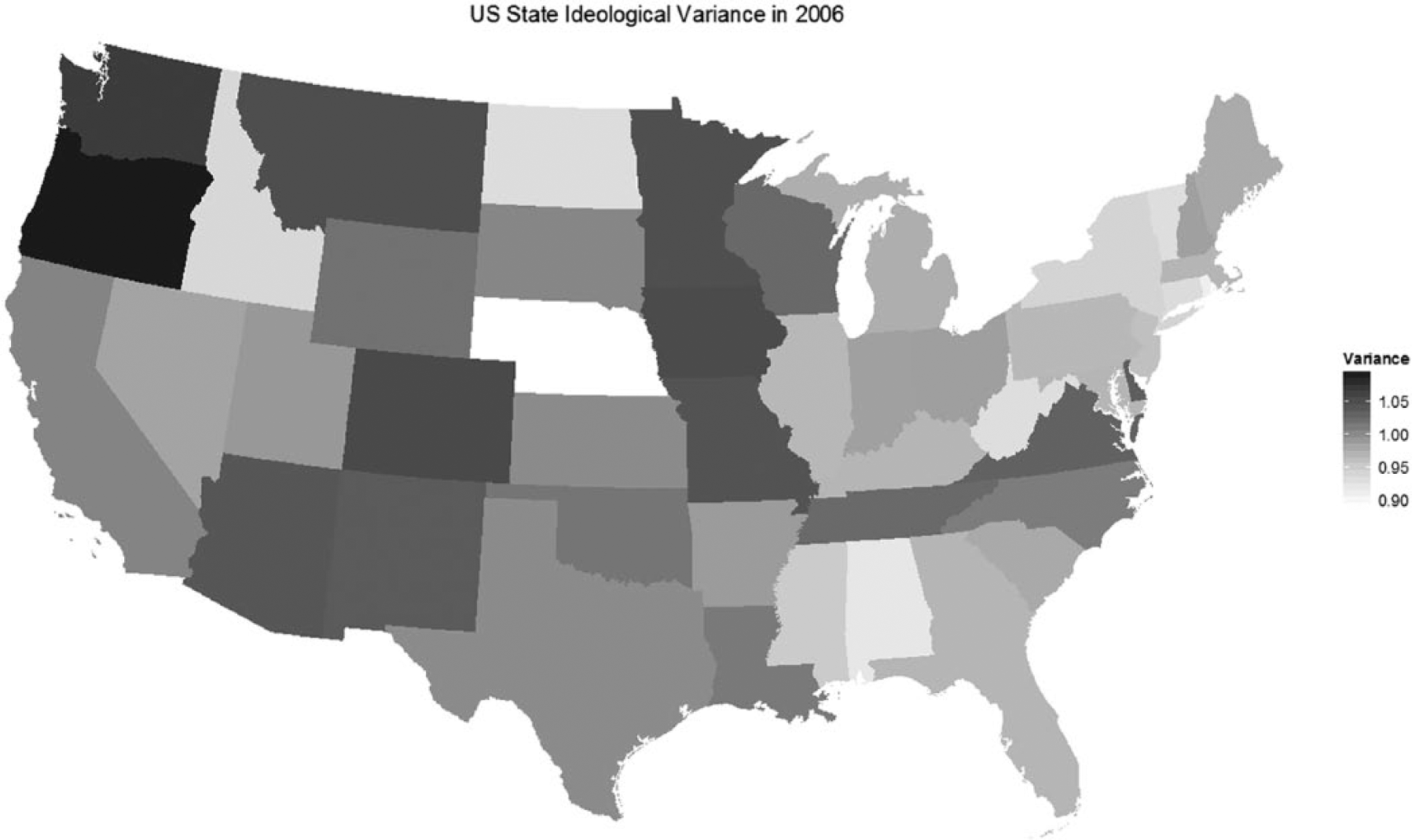
Map of U.S. states colored by ideological heterogeneity.
Having constructed a useful measure of ideological heterogeneity across states, I also require measures of aggregate legislative party behavior. In particular, I require a measure of the polarization of roll call voting and a measure of party cohesion in U.S. state legislatures. Under ideal circumstances, these measures would come from different legislative behaviors. If I were to measure polarization and party cohesion from the same roll call votes as is common in studies of each construct, and then subject the measures to repeated analysis, I would be testing my theory on two different aggregations of the same data. Thus, to craft distinct and meaningful measures of both legislative polarization and party cohesion, I rely on roll call votes to measure legislative polarization and patterns of cosponsorship across legislatures to measure party cohesion in the 2007 sessions of U.S. state legislatures (Kirkland 2011; Shor and McCarty 2011). Shor and McCarty (2011) use roll call voting patterns along with legislators’ responses to Project Vote Smart surveys to construct ideologically bridged ideal point estimates across U.S. state legislatures. Project Vote Smart responses provide the “bridges” necessary to place different chambers’ legislative ideal point estimates on the same ideological scale. Shor and McCarty scale legislative ideal points such that low values indicate highly liberal roll call voting while high numbers represent highly conservative legislative voting. From there, a variety of measures can be constructed to measure either the ideological distance between the parties or the heterogeneity of ideal points within a chamber. In my analysis, I estimate the influences of ideological heterogeneity among citizens based on responses to the 2006 CCES on the mean ideal point estimates in each legislative party representing those constituents from 2007.
Finally, to develop a distinct measure of legislative party cohesion, I use patterns in cosponsorship behavior across ninety-six legislative chambers. 8 In each chamber, I gather every instance of cosponsorship on any bills introduced in the calendar year of 2007. 9 From this data set, I construct cosponsorship networks in which a connection between legislators i and j exists if legislator j has cosponsored a bill sponsored by legislator i (Fowler 2006). 10 The act of aggregating many cosponsorship choices into a network serves to reduce the random or individual-level noise in cosponsorship decisions and helps clarify the cohesiveness of the legislative parties across thousands of pieces of legislation.
It is useful at this point to consider what a unified or cohesive legislative party might look like in a cosponsorship network. Cohesive legislative parties are parties that react to legislative proposals in a largely uniform way. That is, cohesive legislative parties encounter some legislative proposal and either uniformly support or reject the proposal, while divided legislative parties react to the same proposal in different ways with some members of the party offering support for the proposal while others in the same party fail to support the proposal. This does not imply that when a legislator introduces a bill every member of a party signs on to cosponsor the bill. Cosponsorship is, after all, a multidimensional decision driven by individual considerations beyond party (Koger 2003; Talbert and Potoski 2002). It does imply that over hundreds of legislative proposals, a cohesive party should appear more clustered in a cosponsorship network than a divided party because the cohesive party is more likely to react uniformly to proposals than the divided party is. When an individual bill is introduced, members of a cohesive party are more likely to come to the same decision about cosponsoring the bill than members of a divided party. Thus, the connections within a cohesive legislative party’s cosponsorship network should be stronger than the connections within a divided legislative party.
Using these networks of cosponsorship in U.S. legislatures, I generate a measure of legislative party cohesion using a community detection technique called the walktrap algorithm (Pons and Latapy 2005). 11 Community detection is the act of partitioning a graph into subgraphs with the goal of generating subgraphs that have dense connections between all the nodes within the subgraph and few connections leaving the subgraph. 12 In the context of cosponsorship, community detection routines are seeking to specify or define groups of legislators who commonly work together and rarely work with legislators outside the group. In other words, community detection routines are seeking to define dense clusters of legislators who cosponsor together, and therefore should be more likely to identify cohesive legislative parties as a group than divided legislative parties. Scholars have used community detection routines in a variety of social science settings like examining the spread of epidemics, clustering patterns in neural networks, and the ideological distribution of books on U.S. politics (Liu and Hu 2005; Newman 2006; Stam and Reijneveld 2007). 13
Among the many approaches to community detection, I use the walktrap algorithm for community detection for a variety of reasons, most important of which is its ability to handle weighted data. 14 The algorithm builds on the observation that a random walker is likely to get “trapped” in dense parts of a graph or network. At each time step in a walk of length t, the random walker is on a vertex i and moves to a neighbor of that vertex chosen randomly and uniformly, where the neighbors of vertex i are all the vertexes to whom i is connected. This makes the random walker much more likely to stay within a highly clustered set of actors (i.e., a community) than it is to leave that clustered group. Using the walktrap algorithm, I uncover the community structure that walktrap considers the best partition of a legislative chamber’s cosponsorship network. I do this by considering walks of length 2 to n − 1 and selecting the community structure that produces optimal division of the network. This implies that I have located the very best set of partitions of a cosponsorship network that walktrap is capable of uncovering. In each legislative chamber, both political parties have an identifiable “core” of actors that walktrap constructs as a single community. However, in some legislative parties, walktrap assigns party members to different cosponsorship communities than the majority of their party. That is, these members react to the slate of legislative proposals by cosponsoring a different set of legislation than the majority of their fellow partisans. To measure the party cohesion of state legislative political parties, I simply count the total number partisans not assigned to their legislative party’s cosponsorship “core” community. I refer to these partisans as “shirkers.” A high number of shirkers indicate that a party had many members not cosponsoring with their fellow partisans, and thus the party failed to coalesce around legislative proposals as well as a party with fewer shirkers from its cosponsorship network.
The left-hand panel of Figure 3 plots the Republican Party core and the seven party core shirkers from the Minnesota Senate. The large cluster inside the circle are legislators who were much more likely to cosponsor one another’s bills than they were to work those actors outside the circle. The shirkers from the Minnesota Senate Republican Party core include noted Republican moderates Julie Rosen and Dennis Frederickson. The right-hand panel of Figure 3 plots the distribution of shirkers from Democratic upper chamber parties in 2007. States high on the y-axis had many shirkers in their upper chamber Democratic Party, and thus had relatively divided Democratic parties. These states include places like Maryland, Louisiana, and Washington. Cohesive upper chamber Democratic parties with no shirkers from their party cores include Arizona, Colorado, North Carolina, and New York.
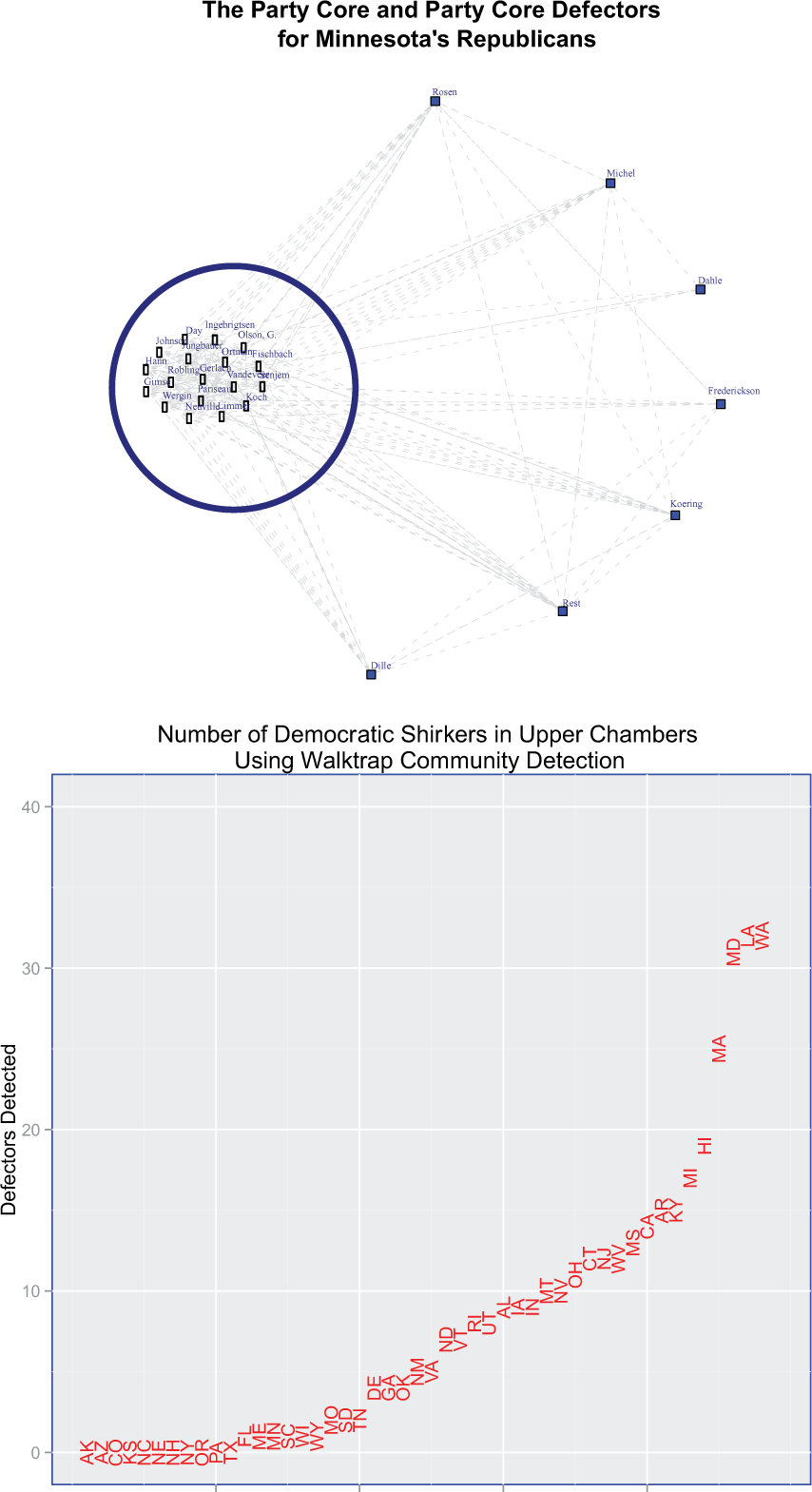
An example of the party core and party shirkers from Minnesota’s Senate Republicans and the distribution of Democratic Party core shirkers across legislative upper chambers.
To review the empirical expectations from earlier, I expect that individual legislators from ideologically extreme districts will be more likely to be cohesive with their legislative party and will have more extreme ideal point estimates based on roll call votes. I also expect that states with ideologically homogeneous populations will produce more moderate, less cohesive legislative parties because there are more moderate districts in those states. This produces more cross-pressured legislators, while ideologically heterogeneous states will produce highly cohesive, ideologically polarized legislative parties.
Ideological Variance and Polarization
My theory specifies that states with ideologically heterogeneous populations should have more cohesive, ideologically extreme political parties than states with homogeneous populations. 15 This is because homogeneous populations produce ideologically moderate districts, while heterogeneous populations allow for many more ideologically extreme districts. To demonstrate that ideological heterogeneous populations do produce extreme legislative districts, the supplemental appendices evaluate the relative ideological distance between each legislative district in a state and the overall ideological median in a state and find that, indeed, highly heterogeneous states have many more extreme districts than do homogeneous states (see supplemental appendices at http://prq.sagepub.com/supplemental/).
Because the ideological heterogeneity of citizens in a state influences the possible set of legislative districts in that state, it also influences the aggregate behavior of the legislators coming from those districts. In particular, because highly ideologically heterogeneous states produce many more extreme legislative districts than do ideologically homogeneous states, legislatures emerging out of ideologically heterogeneous states should exhibit more ideological polarization. States with ideologically heterogeneous citizens produce ideologically extreme legislative districts, which in turn elect ideologically extreme legislators, which in turn produce polarized legislative chambers. Even if the average ideology of two states is similar, the more ideologically heterogeneous of the two states ought to have a more polarized legislature.
To test this expectation, I use the distribution of ideal points of legislators serving in the two major legislative parties across all the state legislative chamber in 2007, which have been made available by Shor and McCarty (2011). 16 For each of the two major legislative parties in each legislative chamber, I measure the mean legislator ideal point. I then estimate the influence of the ideology of citizens in a state and the variance in that ideology in 2006 on the average party ideal point from 2007 legislative sessions using ordinary least squares (OLS) regression. Because increased ideological heterogeneity among citizens in a state should move the mean ideal point of legislators in the Democratic Party downward (implying more liberal legislative voting) and the mean ideal point of Republican legislators upward, I include an interaction term that multiplies state ideology and the variance in state ideology by a Republican Party dummy variable, allowing the ideology of citizens in a state to have different effects on the distribution of ideal points for each legislative party. Finally, I also include a dummy variable indicating whether or not the relevant observation is a legislative party in an upper or lower chamber. I also run a separate multilevel model that includes varying state intercepts to capture any unobserved heterogeneity in states’ ideal point distributions. The results of these analyses appear in Table 1.
OLS Models Predicting the Mean of Legislative Party Ideal Points in State Legislatures.
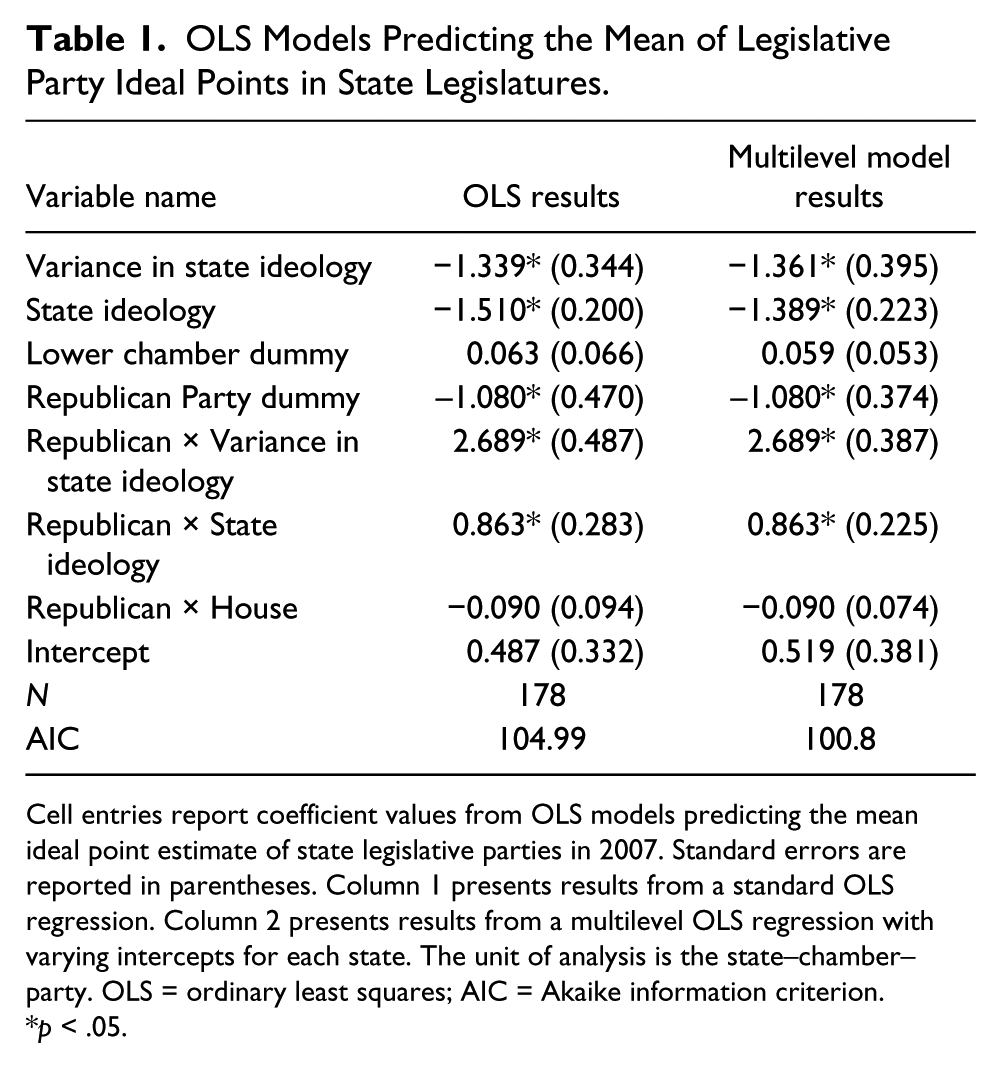
Cell entries report coefficient values from OLS models predicting the mean ideal point estimate of state legislative parties in 2007. Standard errors are reported in parentheses. Column 1 presents results from a standard OLS regression. Column 2 presents results from a multilevel OLS regression with varying intercepts for each state. The unit of analysis is the state–chamber–party. OLS = ordinary least squares; AIC = Akaike information criterion.
p < .05.
As the table shows, with and without varying state intercepts, and controlling for the average ideology of citizens in a state, variance in that ideology and its interaction term are significant predictors of the distribution of legislative ideal points for legislative parties. Increasing the variance in citizen ideology is associated with a decrease in the average ideal point of Democratic legislators. In other words, increases in the variance of citizen ideology in a state are associated with a more liberal and ideologically extreme Democratic Party. The marginal effect of the variance in citizen ideology on Republican Parties is a positive and statistically significant 1.35 (−1.339 + 2.689), implying that when the variance in citizen ideology increases, the average ideal point of Republican legislators shifts in a positive direction.
Because my models of the ideal point distributions of state legislative parties leverage interaction terms to allow the influence of citizen ideology on ideal points to vary for Democratic and Republican legislative parties, plotting the predicted values of each statistic is a useful way to demonstrate the effects of variance in citizen ideology for both legislative parties. Figure 4 plots the change in each of the average ideal point Democratic and Republican legislative parties as citizen ideological heterogeneity increases from its minimum to its maximum, holding average citizen ideology constant and setting the lower chamber dummy variable to one. As expected, as the variance in citizen ideology increases, the average ideal point estimates of Republican and Democratic state legislators diverge from one another.

The influence of heterogeneity in citizen ideology on the distribution of legislative ideal points.
At its minimum, variance in citizen ideology is associated with Democratic legislative parties with a mean ideal point of −0.399 and Republican legislative parties with a mean of 0.408. At its maximum, variance in citizen ideology predicted more polarized parties with an average Democratic ideal point −0.853 and an average Republican ideal point of 0.945. This change in polarization is roughly equivalent to the difference in polarization between the Illinois House of Representative and the Wisconsin House of Representatives. Rather than simply relying on these numeric estimates to convey the magnitude of the effects of citizen ideology, Figure 5 plots the distribution of ideal points from the Illinois and Wisconsin Houses. The darker shades represent Democratic and Republican Party ideal point distributions from the Illinois House, which are equivalent to the level of polarization implied by the model when the variance in citizen ideology is at its minimum, while the light shades represent simulated party ideal point distributions for the Wisconsin House, which exhibits polarization levels implied by the model when the variance in citizen ideology is at its maximum. As the figure shows, when variance in citizen ideology increases, the resultant distribution of ideal points of the two legislative parties becomes much more polarized and the roll call voting of the two parties becomes more extreme.
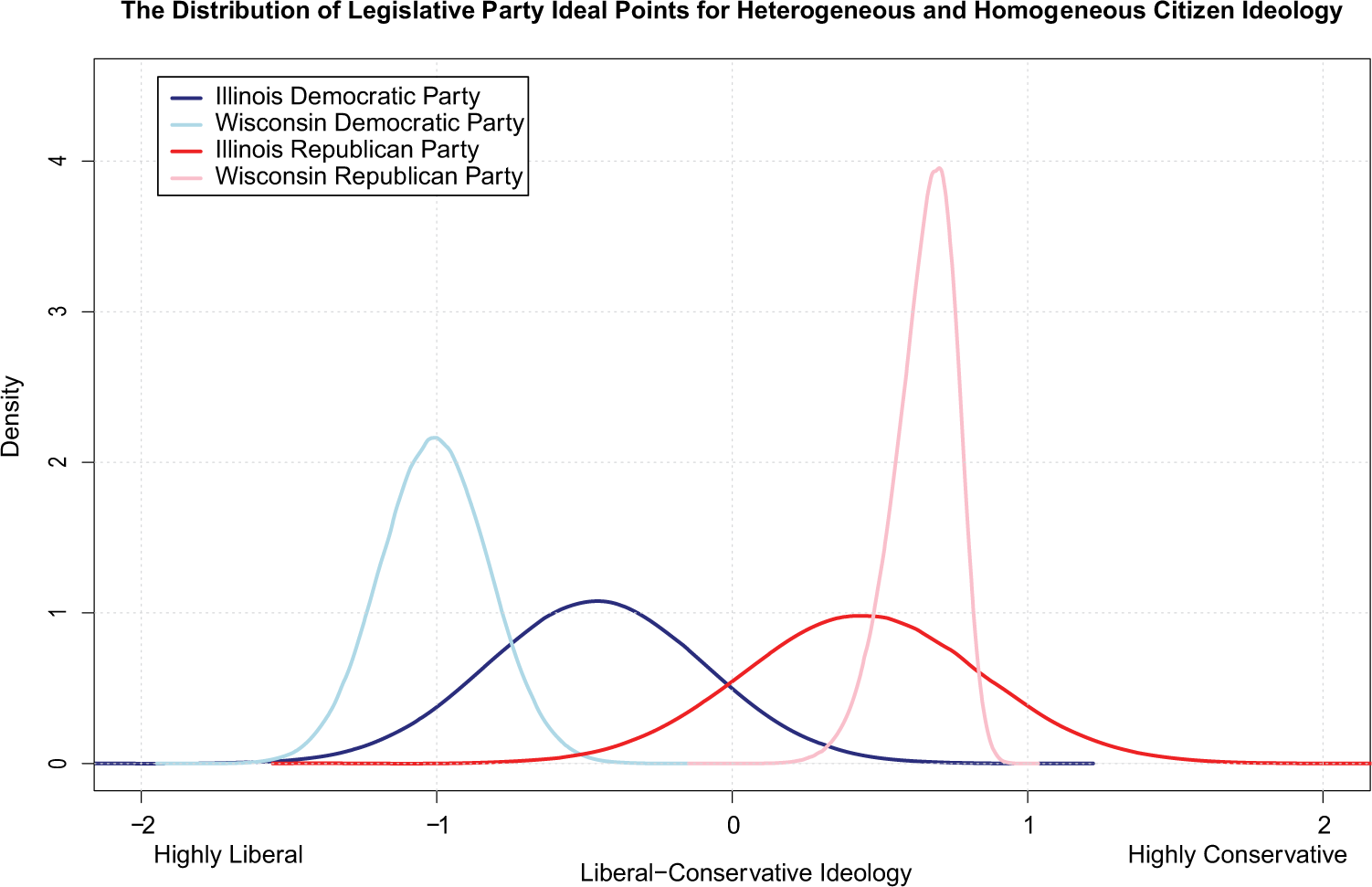
Simulated distribution of legislative ideal points as the heterogeneity of citizen ideology changes.
Ideological Variance and Party Cohesion
Variance in citizen ideology shapes party polarization, which itself ought to lead to more cohesive political parties. I argue, however, that ideological variance among citizens also exhibits a direct effect on party cohesion. Party polarization alters the potential pressure legislators feel from their parties with more polarized parties exerting more influence over their members to stay unified. Alternatively, variance in citizen ideology directly influences the number of legislators who might also be cross-pressured by their constituents and their party. To test this expectation, I use three different Poisson regressions to estimate the effect of heterogeneity of citizen ideology on the number of party shirkers as defined by the walktrap algorithm’s optimal community structure from state legislative cosponsorship networks.
To estimate this direct effect, I require a way to control for legislative party polarization. However, using estimates of legislative party polarization based on 2007 state legislative roll call votes as in my previous analyses will introduce post-treatment bias to my models. The roll call votes on which ideal point estimates are based follow cosponsorship decisions in the legislative processes of all fifty U.S. state legislatures. Were I to use summaries of roll call voting (ideal point estimates) to estimate cosponsorship choices (estimates of party cohesion), it would be tantamount to using the future to predict that past. Instead, I measure party polarization based on Shor and McCarty’s ideal point estimates for each legislature in 2006. The levels of legislative polarization in each legislature in 2006 should relate to the levels of legislative party polarization in 2007, while the 2006 estimates will be free from the post-treatment bias concerns that would plague 2007 measures. Thus, in addition to my measures of the variance in citizen ideology in a state, I include the distance between legislative party medians in each U.S. state legislature in 2006. I expect that as legislative party polarization increases, party cohesion also increases driving the number of legislative party shirkers down.
In addition, because my measures are counts of legislative party shirkers from party cosponsorship networks, I also incorporate measures of majority and minority party size. Patty (2008) suggests that large parties have increasing difficulty in maintaining party cohesion but that larger opposition parties mitigate this effect. I also incorporate a dummy variable coded one if an observation comes from a lower legislative chamber and zero otherwise, a dummy variable coded one if an observation is the minority party in the relevant state legislature and zero otherwise, and interaction effects multiplying this minority party dummy variable with both party size variables. This interaction allows each party’s size to both influence its own level of cohesion and that of its opposition. Table 2 reports the results from this set of Poisson regressions predicting the number of party core shirkers from forty-eight state legislative chambers. 17 Column 1 in the table is a standard Poisson regression. Column 2 is a quasi-Poisson regression that accounts for potential overdispersion in the data and corrects standard errors accordingly. Column 3 is a multilevel Poisson regression with varying state intercepts. Because my analysis contains four observations per state (minority and majority parties from upper and lower chambers), there may be unobserved state-level heterogeneity in the analysis that would otherwise bias my results. The multilevel model corrects for this possibility and helps control for potential state-level confounders. 18
Poisson Model Predicting the Number of Party Agenda Shirkers in State Legislative Chambers in 2007.

Cell entries report coefficient values from count models predicting the number of party cosponsorship shirkers from state legislative parties in 2007. Standard errors are reported in parentheses. Column 1 presents results from a standard Poisson regression. Column 2 reports results from a quasi-Poisson regression. Column 3 reports results from a multilevel Poisson regression with varying state intercepts. The unit of analysis is the state–chamber–party. The quasi-Poisson model indicates that the overdispersion parameter is 10.387 and is statistically significant at the .05 level. AIC = Akaike information criterion.
p < .05.
As the table indicates, across all three models, increases in the variance in citizen ideology in states are associated with fewer shirkers from state legislative party cosponsorship networks. Even after controlling for the level of partisan polarization, the influence of variance in citizen ideology is a negative and significant predictor of legislative party shirkers. In addition, as expected, increases in party polarization are associated with fewer legislative party shirkers and increased party cohesion. Thus, the variance in citizen ideology in a state has both a direct and indirect effect on legislative party cohesion. Greater variance in citizen ideology increases the levels of legislative party polarization, which in turn increases legislative party cohesion, while at the same time, greater variance in citizen ideology has a direct influence on party cohesion. This is because aggregate levels of legislative party cohesion are a function of two quantities, the number of legislators feeling some pressure to shirk supporting their party and the strength of that pressure. Party polarization influences the strength of that pressure while variance in citizen ideology influences the number of legislators feeling cross-pressuring between their party and their constituents. To demonstrate the magnitude of these effects, Figure 6 plots the predicted number of majority party shirkers along with 95 percent confidence intervals as both the variance in citizen ideology and the ideological distance between the legislative parties increases holding the other continuous variables at their means and setting the lower chamber dummy variable to zero. The effects are nearly identical with the estimated number of majority party shirkers decreasing from eighteen to nine as the variance in citizen ideology increases from its observed minimum to its observed maximum, and from eighteen to seven as the ideological distance between the legislative parties increases from its minimum to its maximum. Thus, for a legislative party of fixed size, as the variance in citizen ideology increases, that party has fewer members failing to collaborate on legislation early in the legislative process even after controlling for the ideological distance between the legislative parties.
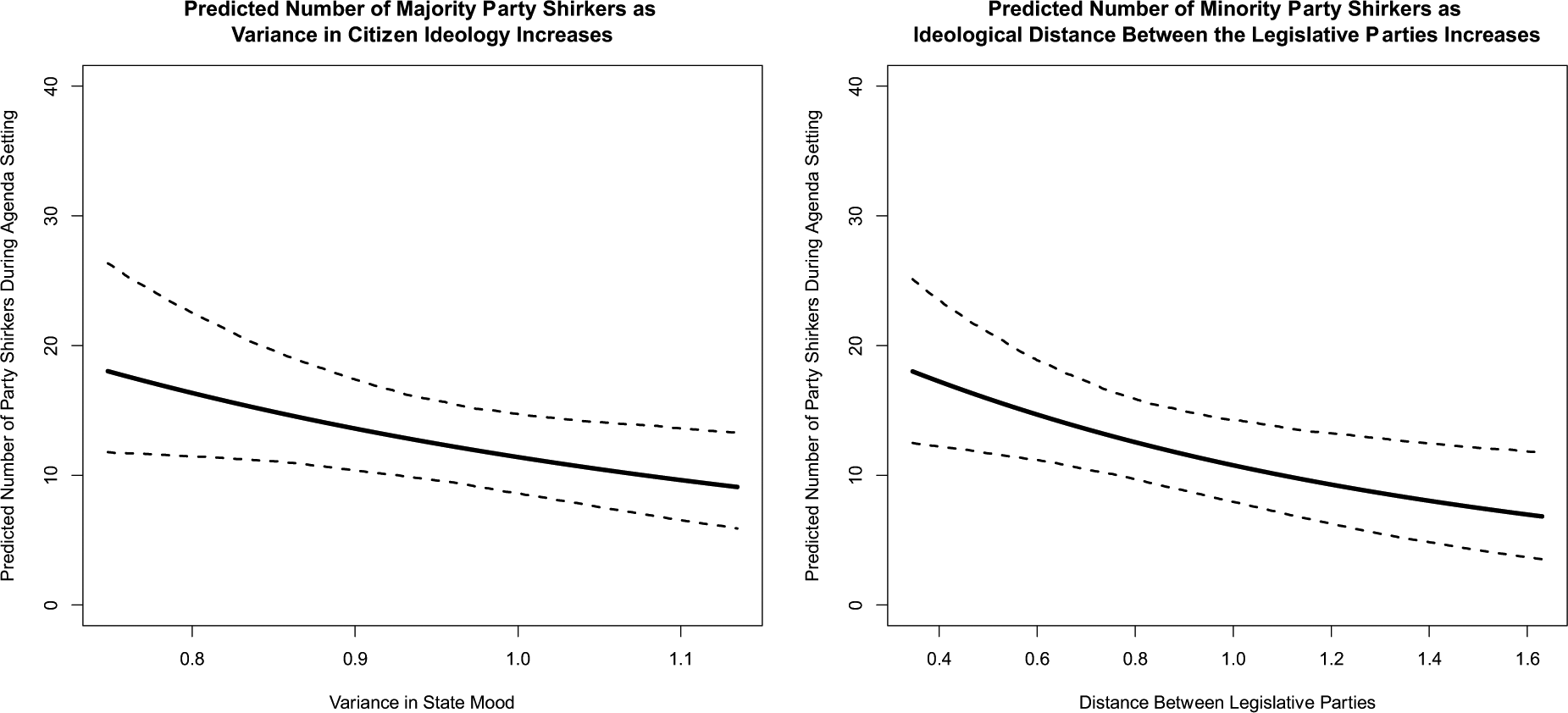
Predicted number of party shirkers as ideological heterogeneity among citizens and legislative party polarization increases. Dashed Lines represent 95% confidence intervals.
Discussion
Citizen approval of U.S. legislatures is at all-time lows. Most constituents cite partisan, hyper-ideological, gridlocked legislative environments as the primary reason for their dissatisfaction. Commentary on legislatures describes the legislative branch as “broken” and suggests that the performance of American legislatures is “worse than it looks” (Mann and Ornstein 2006, 2012). This research suggests that at least some of the blame for the polarized, highly cohesive legislative parties that drive the dysfunction of legislatures lies at the feet of the citizens legislatures represent. Elections force legislative parties to respond to their constituents through either adaptation or replacement. This electoral responsiveness implies that increasingly heterogeneous citizen ideologies are met with ideologically polarized, highly cohesive parties, which are the two critical components for legislative gridlock and dysfunction.
In this research, I have presented a theory linking citizens’ ideology, heterogeneity in that ideology, and the polarization and cohesion of legislative political parties. I have argued that legislators from moderate districts are the least likely legislators to support their party’s agenda and most likely to vote moderately during roll call votes, and that a state’s ideological variance affects the sort of legislative districts it draws. This in turn leads to the counterintuitive prediction that states with high ideological heterogeneity among citizens will have highly homogeneous, ideologically extreme legislative parties. Empirical evidence using both ideal point estimates from roll call votes and cosponsorship patterns in state legislatures along with measures of citizen ideology across states from the 2006 CCES largely supports my theory. Specifically, when citizens’ policy preferences are increasingly heterogeneous, legislative parties representing those citizens become more polarized during roll call votes, and more strongly clustered during cosponsorship. This suggests that both the agenda development stage and final passage stage of the legislative process are increasingly polarized for heterogeneous states, providing all of the requisite elements of legislative gridlock and inaction.
This aggregate connection between the distribution of citizen preferences and the behavior of legislative parties offers novel insights into the collective representation of citizens. While prior research has indicated that the location of a district median voter and the heterogeneity of district opinion both independently influence individual legislators, this study moves beyond this strict dyadic analysis of representation to also examine how these population-level characteristics influence party cohesion and polarization, and thus the conditions that encourage legislative gridlock throughout the legislative process. The collective representation of citizens is in many ways as important a benchmark of democratic effectiveness as the dyadic relationships between districts and individual legislators. Thus, the responsiveness of legislative parties to the distribution of citizens’ preferences is in some ways encouraging. That elections not only foster individual responsiveness from legislators but also collective representation by parties suggests that little about legislative politics in the United States is actually broken.
Pushing forward, my arguments have assumed a sort uniform institutional structure for the selection of representatives. Current scholarship suggests that the influence of electoral institutions like redistricting, primary elections, and campaign finance laws on polarization is somewhat limited (Ansolabehere, De Figueiredo, and Snyder 2003; Masket, Winburn, and Wright 2012, McGhee et al. 2014). Disentangling polarization from cohesion and dyadic representation from collective representation would allow scholars a more robust understanding of whether and how these institutions condition representation. In addition, my argument suggests that changing constituencies ought to lead to different behavior by legislative parties, but my tests concentrate on cross-sectional evidence. The increasing utility of CCES surveys for learning about constituency change ought to provide opportunities to test my hypotheses in a dynamic context. Observing dynamic adaptation by parties to changing constituencies will allow scholars a better understanding of both dyadic and collective representation.
Footnotes
Acknowledgements
I would like to thank Tom Carsey, Jeff Harden, John Patty, Jacob Montgomery, and Brendan Nyhan for feedback on earlier drafts.
Author’s Note
Supplemental appendices and replication materials can be found on the author’s website at www.jhkirkla.wordpress.com or on Political Research Quarterly’s (PRQ) website ( ).
).
Declaration of Conflicting Interests
The author(s) declared no potential conflicts of interest with respect to the research, authorship, and/or publication of this article.
Funding
The author(s) received no financial support for the research, authorship, and/or publication of this article.