




Abstract
This article uses the case New York City to examine why certain immigrant groups participated in the 2006 protest wave more than others and why the city mobilized less compared with other major immigrant metropolises. The findings indicate that certain immigrant groups participated more than others because of how the issue of “illegal immigration” was racialized and framed by the media, and because of the disproportionate impact the proposed legislation would have had on them. The data presented illustrate how the city’s heterogeneous population served to diminish its capacity to produce the magnitude of mobilization found in other large immigrant cities.
In her book The Trouble With Unity, political theorist Cristina Beltrán (2010) argues that one of the problems inherent in deliberately created political identities is that they not only imply a shared collective consciousness and mutual interests but can also erase the internal diversity of the groups being clustered. This is not to say that these groups cannot or do not have common preferences but that broadly constructed political identities have the potential to mask or suppress certain interests that may be unique to some of the specific groups within them. The case of New York City’s 2006 immigrant rights demonstrations shows us that the same is arguably true with regard to the political identity of “immigrant,” which over the past few decades, grassroots activists have attempted to construct under the banner of an “Immigrant Rights Movement.”
The dynamics of the 2006 protest wave in New York illustrate that the categories of “immigrant” and “illegal immigrant” are socially constructed and, of equal importance, that they are understood and adopted differently by the city’s diverse foreign-born populations. These differences of interpretation help explain the disparities in mobilization from one immigrant group to another, as well as the city’s relatively modest overall turnout in relation to New York’s large immigrant population and compared with other major immigrant metropolises. Certain immigrant groups did not turn out to protest at a mass scale not only because they lacked sizable numbers in the city but also because of their previous experiences in both the United States and their countries of origin. Moreover, rather than being passive bystanders waiting to “follow their leaders,” different immigrant groups often had their own opinions about their policy priorities; the degree of their participation in the protests reflected this.
The findings presented in this article suggest that Dominicans and Mexicans accounted for a larger portion of New York protesters (compared with other foreign-born groups) because larger percentages of their populations believed they had more to gain and lose from the proposed legislations. In addition, demonstrating how both the general American public and immigrants of color themselves adopt racialized notions of illegality—believing that “illegal immigration” is solely a “Mexican problem”—several non-Latino immigrant groups failed to mobilize to the same extent because many of them (often mistakenly) did not feel as threatened by the proposed nativist bill. Consequently, many non-Latino immigrants believed that their policy priorities were not being represented in the national legislative debate taking place.
These factors also help explain why New York underperformed (or at least did not reach its maximum potential) with regard to the size of the city’s protests. Even as New York’s diverse immigrant population contributed to the dynamic nature of the local movement, this same diversity may have limited the city’s ability to mass-mobilize. The distinct interests and priorities of different immigrant groups presented local activists with additional impediments that organizers in locations with a more homogeneous immigrant population did not have to overcome in their mass mobilization efforts. Thus, from the media outlets they had to target and the policy preferences they discussed at meetings, to the varied cultural frames and languages of the flyers they had to produce, immigrant rights activists in New York City faced greater obstacles to rapid mobilization than organizers in predominately Mexican immigrant cities.
Below, I first describe the proposed federal legislation that sparked the series of national demonstrations and explain the primary research questions that this study investigates. I then explicate my data collection methods before illustrating how and why the case of New York provides important insights about the manners in which perceptions of threat, the media’s framing of policy issues, and demographic diversity can inhibit the magnitude of group mobilization.
Context and Theoretical Puzzles
On December 16, 2005, the Republican-led U.S. House of Representatives passed legislation (H.R. 4437, also known as the “Sensenbrenner Bill”) that would have increased the penalty of being an undocumented immigrant from a civil violation to a federal felony. If enacted, the law would have also penalized (with monetary fines and incarceration) anyone who assisted undocumented immigrants in the most basic ways (Gonzales 2009), potentially criminalizing people and organizations from employers and churches to family members and service groups. In response to this proposed anti-immigrant legislation, during the spring of 2006, up to five million people participated in close to four hundred demonstrations across the nation (Zepeda-Millán and Wallace 2013; Wallace, Zepeda-Millán, and Jones-Correa 2014).
Individuals of various racial and ethnic backgrounds partook in the historic protest wave. Nowhere was this more apparent than in New York, where an array of immigrants—from Irish pub owners and Muslim cab drivers to African service workers and Filipina nannies—participated in several episodes of collective action. From the local movement’s campaign for non-citizen voting rights (Hayduk 2006), to the organizing of street vendors, restaurant workers, and families affected by immigrant detention (see Biju 2005; Jayaraman and Ness 2005; Kateel and Shahani 2008), New York has possibly the most diverse and certainly one of the most dynamic immigrant rights movements in the country. Yet the Empire City’s mass actions during the 2006 protest wave presented some noteworthy theoretical anomalies.
One important question concerns the demographic composition of the city’s demonstrations. Despite the diversity of their actions, local New York protest organizers contended that Mexicans accounted for a disproportionate share of rally participants, second only to Dominicans (by far the largest immigrant group in the city). Given that Mexicanos en Nueva York are notoriously underorganized (Hazan 2006, 211, 264), the extent of their turnout is intriguing because of the important role formal organizations are said to play in social movement mobilization processes (Ayoub 2010, 473; Clemens and Minkoff 2004; McCarthy and Zald 1977; Meyer 2007, 61). 1 Moreover, because of the strong relationship scholars have found between individual resources (e.g., income, education, etc.) and political participation (Verba, Schlozman, and Brady 1995), the fact that Mexicans have lower socioeconomic statuses than other New York foreign-born residents (Logan and Mollenkopf 2001, 25; New York City Department of City Planning 2000) makes the degree of their participation even more puzzling (also see Zepeda-Millán 2014).
As mentioned above, another interesting query has to do with the overall size of the city’s demonstrations. New York has the nation’s largest immigrant population, perhaps the longest history of immigrant activism, and arguably more immigrant rights organizations than any other city in the country—yet, the city arrived late to the series of national demonstrations (Foner and Waldinger 2013) and failed in its first few attempts to mass-mobilize its foreign-born residents (Confessore 2006; Gerson 2006). Even when it was able to produce large-scale immigrant collective action, several scholars of New York immigrant politics have pointed out that the city underperformed in terms of the size of its protests (Foner and Waldinger 2013; Hazan and Hayduk 2009).
Whereas places like Los Angeles (L.A.), Dallas, and Chicago boasted demonstrations of five hundred thousand to one million marchers (Bada, Fox, and Selee, 2006; McFadden 2006; Watanabe and Becerra 2006), according to the New York Times, New York’s largest turnout and first major mobilization put only one hundred thousand people on the streets during the April 10 “National Day of Action for Immigrant Justice” (Bada, Fox, and Selee 2006). For the second nationally coordinated day of protest, the May 1 “Day Without An Immigrant,” participation in New York’s noontime “Human Chain” action ranged from twelve thousand to twenty thousand participants (CNN 2006; Young, Hart, and Nyback 2006). Estimates of the city’s evening Union Square rally ranged from “more than 50,000 protesters” by the conservative New York Post (Mongelli, Mazor, and Winter 2006) to just “over 100,000” by the liberal New York-based radio program Democracy Now! 2 To be sure, the attendance of twelve thousand to over one hundred thousand people at any political event is an amazing accomplishment in itself. Nevertheless, according to local urban politics experts, given that “New York evidently promotes immigrant political participation . . . to a far greater degree than” other major immigrant cities (Mollenkopf, Olson, and Ross 2001, 63; also see Mollenkopf 1999), why New York underperformed during the historic protest wave calls for a detailed investigation. As a local longtime immigrant rights activist put it, “There is a question to be asked of New York, which is why wouldn’t we have had the largest . . . march in the country?” 3
Data and Method
Using the case of New York, this article examines the role that diversity played in a particular instance of large-scale immigrant collective action: the city’s 2006 immigrant protests. The primary data used in this study come from the U.S. Census’ 2006 American Community Survey (ACS) and in-depth interviews (n = 44) with local Muslim, Christian, African, Latin American, European, Pacific Islander, Caribbean, South and East Asian (U.S.- and foreign-born) immigrant rights activists who organized and participated in the city’s 2006 actions. The interviews were conducted throughout February and March of 2009 and ranged from twenty-five minutes to two hours and thirteen minutes, with an average length of fifty-seven minutes.
Key organizations and individuals were first identified by searching through local newspapers, protest flyers, and websites for reports and mentions of rally organizers and coalition leaders. As an active participant in the immigrant rights movement myself for over a decade, I also used contacts I had developed on the West Coast and East Coast to help me gain access to activists who played fundamental roles in the local actions. I then applied a “snowball” method of sampling to seek out additional key informants to interview.
The case of New York City is imperative to understand because existing studies on the unprecedented protest wave limit their examinations to marches that occurred in the West Coast and Midwest, and almost completely ignore the distinct dynamics of non-Latino—and arguably non-Mexican—participation in the series of demonstrations (see Gonzales 2009; Pallares and Flores-Gonzalez 2010; Voss and Bloemraad 2011). In addition, previous research also tends to disproportionally highlight the “extreme” cases of Los Angles and Chicago, two cities that hosted massive marches during the protest wave. Alternatively, this article’s focus on New York is unique because of the attention it pays to the issue of “non-participation” and to why activists’ and scholars’ a priori expectations about the city’s turnout were not realized. Thus, to date, this study presents the most comprehensive analysis of the role of organizational actors in New York City’s 2006 immigrant rights protest wave.
Immigrant Large-Scale Collective Action in New York
Several scholars have noted that the topic of immigration, particularly “illegal immigration,” has been socially constructed by politicians and the mainstream media as a predominately Latino issue—even more precisely, as a Mexican issue (Chavez 2008; Ponce 2012). But while Latinos (mainly of Mexican descent) have become the “face of illegal immigration,” other ethnic groups are also greatly affected by changes to the nation’s immigration laws. Nowhere in the United States is this more the case than in New York City, where more than eight hundred languages are spoken (the largest number in any city in the world) and where, “taken together, foreign-born residents and their offspring account for more than 55 percent of the city’s population” (Bernstein 2005; Roberts 2010). According to the U.S. Census, after Dominicans (378,384), in 2006, the second and third largest immigrant groups in New York were Chinese (303,462) and Jamaicans (174,861). Immigrants from Guyana (142,946) and Ecuador (128,623) followed closely behind those from Mexico (169,572). At over 17 percent of the city’s foreign-born population, Europeans (520,554) also made up a sizable portion of New York’s immigrants. 4 Thus, if judged by number and diversity, New York was and remains America’s biggest “Immigrant City.” However, as mentioned above, not every foreign-born group in the metropolis interpreted the immigration policy debate of 2006 as affecting them in the same manner. Many felt that the legislative disputes primarily affected immigrants from Latin America—more specifically, Mexico. As illustrated in the following section, my data show that the extent to which immigrant groups felt threatened by proposed anti-immigrant legislation, along with the details of the policies being debated, affected their levels of political mobilization.
Diversity and the Degree of Immigrant Group Mobilization
According to Ninaj Raoul of Haitian Women for Haitian Refugees (HWHR), due to the media’s portrayal of the issue, when Haitians in New York discussed the proposed changes to immigration laws, many believed they pertained only to Mexicans. She recalled, “There was a lot of confusion about that at the time.” Fallou Gueye, president of the Association of Senegalese in America, also explained that during the 2006 immigration debate, his organization had to constantly explain to its compatriots “that this was not only about them [Latinos], we are also part of this.” Mae Lee of the Chinese Progressive Association (CPA) remembered people in her community asking why her organization was taking part in the protests. They would question, “Why is the Chinese community here? Why should [we] be so concerned?” According to Artemio Guerra, an organizer with the Fifth Avenue Committee, such misconceptions were prevalent because “the immigration debate” was being “framed exclusively around Mexicanos,” which many New York organizers felt was problematic “because immigration is a much larger phenomenon.”
A local activist noted that “the perspectives of the different immigrant communities” in New York “come out in the pieces of legislation” that they believe affect them most. 5 Consequently, one reason non-Latinos felt that the immigration debate was a “Mexican issue” was that the legislative proposals being highlighted in the media—such as amnesty, guest worker programs, deportation, and border militarization—did not reflect their primary policy concerns. For instance, organizers in the Filipino and Chinese communities said that family reunification and clearing the visa backlog, not expulsion or legalization, were the most pressing issues for their communities. People in South Asian Muslim neighborhoods also did not believe the debate affected them significantly. As a result, local activists “had to do a lot of messaging about why the enforcement aspects of the bills,” particularly “the language around national security,” were going to negatively affect them. 6 According to Ninaj Raoul of HWHR, “Since people were hearing things in the press about guest worker bills and things like that,” immigrants in her community would often question whether they could benefit from participating in the protests. Thus, the degree to which specific immigrant groups felt immigration reform was important to them depended on the details of the policies under debate and who the media portrayed as most affected by them. How “illegal immigration” has been racialized in the United States played a vital role in this process.
Perhaps because Latinos are the quintessential “illegals” (Chavez 2008; Ponce 2012), many non-Latino immigrant groups with undocumented populations and/or who were also vulnerable to provisions in the Sensenbrenner Bill did not feel equally threatened by it. For example, according to Monami Maulik of Desis Rising Up and Moving (DRUM), H.R. 4437 “was very much seen as a Latino thing. . . . The media promoted it as a Latino thing . . . and even in that, only as a Mexican thing.” As a result, she believed that many non-Latinos ignored or “stayed away from” the issue. Haeyoung Yoon of the Committee Against Anti-Asian Violence (CAAAV) agreed and recalled many Chinatown residents erroneously believing, “Sensenbrenner . . . doesn’t really affect us.”
The degree to which immigrant groups felt threatened affected the level of their participation in the protest wave. Consequently, several non-Latino immigrant rights activists recalled that their communities did not participate in the marches to the same extent as Latinos, especially Mexicans. For instance, an organizer with the New York Immigration Coalition (NYIC) explained that while an estimated “50,000 Russians [in the city] . . . are undocumented,” when it comes to anti-undocumented immigrant rhetoric, “they don’t really feel those attacks apply to them.” Accordingly, the organizer remembered that these immigrants “didn’t come out” to the demonstrations. 7 Chuck Mohan of New York’s Guyanese-American Worker’s United agreed and gave another example of this dynamic. Despite the fact that New York had a similar number of Guyanese and more Jamaican immigrants in the city than those from Mexico, Mohan admitted, “The Caribbean groups were very disappointing, to be honest with you . . . I’m not saying that there might not have been sprinkles” of individuals from these groups who participated in the protests, “but for me to tell you that there were 5,000, I would be lying to you. . . . This goes for the English-speaking Caribbean in general. They do not come out when it comes to immigration issues.”
The different levels of protest turnout were also related to the particular “immigrant experience” of each foreign-born group. For example, Shaid Comrade of the Pakistan USA Freedom Forum believed that there was “less response and visibility” from Muslim immigrants because of the repression they had endured under the Bush Administration, specifically its “Special Registration Program” (see Bakalian and Bozorgmehr 2009; Nguyen 2005). He said that many feared being picked up by Homeland Security and getting accused of “being terrorists” if they participated in the protests. Another organizer in the Muslim community explained, “There was already so much fear that mass mobilization is not something that we’re ready for. It’s taken a couple of years after 9/11 just to get people to join political organizations, let alone get on the streets.” 8
Whereas many non-Latino immigrant rights activists felt that their communities did not participate in the protests to the extent that they would have liked, both Latino and non-Latino immigrant activists consistently pointed out that Mexicans and Dominicans mobilized to larger degrees than other Latino groups. Moisés Pérez of the Alianza Dominicana explained that because “Dominicanos are the largest immigrant group in the New York area,” they made up a substantial portion of the city’s protesters. But as Pérez quickly added, “There was a lot of Mexicans there, it was like, Whoa!” A South Asian organizer with the New York Civic Participation Project (NYCPP) also recalled that the crowd seemed surprisingly and significantly “Mexican, definitely Mexican—a lot of Mexican flags.” 9 What explains the mass turnout of Dominicans and Mexicans at the city’s protests? Was their degree of involvement merely the result of the size of their populations in New York? Although sheer numbers were a major factor, these two immigrant groups seemed to have more to gain and to lose from the policies being proposed, especially their legalization and deportation features.
Arguably, the most devastating aspect of being undocumented is the vulnerability to deportation that accompanies this status (De Genova 2002). Due to changes in immigration laws made in 1996, the Dominican immigrant community has become disproportionately susceptible to deportations. For example, between 1996 and 2007, thirty-six thousand to fifty thousand Dominican immigrants were deported. According to an analysis of the effects of these laws, “Of the top seven immigrant groups deported from the United States in 2007, Dominicans have the highest proportion of those deported for criminal convictions.” However, local activists and community residents were particularly enraged because many of the deported had only minor violations. The 1996 laws converted several minor infractions into newly deportable offenses, and to make matters worse, the changes were retroactive (Northern Manhattan Coalition for Immigrant Rights [NMCIR] 2009). As a result, thousands of law-abiding Dominican legal residents who were productive members of their communities were torn from their families and deported. Consequently, during the 2006 protests, Dominicans came out in larger numbers than other immigrant groups not only because they were the biggest foreign-born population in the city but also because they had much to gain from the possible changes to deportation laws that activists were calling for. As such, Dominican community organizers consistently stated that the possibility of altering the 1996 laws was the primary motivator behind the degree of Dominican mobilization. 10
The impetus for Mexicans in New York to mass-mobilize was more obvious: as continuously stated above, people of Mexican descent were at the time, and currently remain, “the face of illegal immigration.” Tellingly, a national survey of U.S. and foreign-born Latinos taken during the 2006 demonstrations showed that Mexicans not only had a more positive view of undocumented immigrants than other Latino groups but also were more likely to report feeling increasingly discriminated against as a result of the immigration debate taking place (Suro and Escobar 2006). In addition, despite composing a small fraction (6%) of the city’s total foreign-born population, not having the security of citizenship was a vastly more significant issue for Mexicans than for other immigrant groups in New York. As Table 1 indicates, 90 percent of foreign-born Mexicans lacked citizenship, compared with 47 percent of Caribbean, 50 percent of South American, 55 percent of Central American, 47 percent of Asian, 61 percent of African, and 36 percent of European immigrants. Moreover, according to Jeffrey Passel, a senior demographer at the Pew Hispanic Center, “virtually all” post-1990 Mexican immigration was undocumented, including in New York (Bernstein 2005). Given that 90 percent of Mexican immigrants in the city were not citizens, and that of these non-citizens, 83 percent of them came after 1990, it is reasonable to believe that almost all foreign-born Mexicans in New York were undocumented in 2006 (U.S. Census). 11 Thus, with the most to gain and lose from changes in legalization and deportation laws, more Mexicans (along with Dominicans) participated in the protests than other foreign-born populations.
New York City Foreign-Born (FB) Population.

Source. U.S. Census.
Not surprisingly, contrary to other immigrant groups, the Mexican immigrant community seems to not have questioned whether the issues being debated were going to have a profound effect on it. Whereas activists in other communities had to make an extra effort to explain to their specific immigrant groups how the laws being proposed would affect them, Mexican immigrants did not need anyone to explain to them that “anti-immigrant,” or specifically “anti-illegal immigrant,” meant anti-them. Consequently, they responded without hesitation. As Joel Magallán of the Asociación Tepeyac, the primary (and one of the few) community-based organizations to focus on Mexican immigrants in New York, remembered, May 1st wasn’t like one of our regular [attempts at] mobilization. Usually for us to organize a mobilization, we have to set up a meeting, explain to people in each community, in each church, what we’re going to do, why we want to do it, where we’re going to have it, all of that. But that year the motivation was already there . . . We didn’t have to mobilize . . . [Mexican immigrants] moved on their own.
Diversity and the Magnitude of New York City’s Mobilizations
Describing the size of New York’s demonstrations, May Chen of UNITE-HERE noted, “While they were large, they were nothing like Los Angeles.” Given that the city has the biggest immigrant population in the nation and arguably the most developed immigrant rights movement infrastructure in the country, to restate Aarti Shahani of Families for Freedom’s earlier query, why did New York not host the largest protest in the country? The answer is twofold. First, the cities with the biggest demonstrations had more homogeneous foreign-born populations with larger numbers of undocumented Mexican immigrants and people (U.S.- and foreign-born) of Mexican descent. Second, and closely related, because of New York’s heterogeneous foreign-born population, organizers had the more difficult task of organizing across multiple “borders” (e.g., linguistic, racial, ethnic, class, cultural, etc.) both between and within immigrant groups. Activists in cities like L.A., Dallas, and Chicago did not have to overcome these challenges (to the same extent) to produce mass mobilizations of five hundred thousand to over a million people.
According to a 2007 report by the Department of Homeland Security’s Office of Immigration Statistics, California, Texas, and Illinois all had larger numbers of undocumented immigrants than the state of New York (Hoefer, Rytina, and Campell 2007). Moreover, an analysis of 2003–2004 Current Population Survey (CPS) data found that in terms of the percent of Mexicans that made up these states’ undocumented populations, California (with 65%), Texas (with 79%), and Illinois (with 88%) all far exceeded New York, where the Mexican segment of undocumented residents was only 16 percent (Fortuny, Capps, and Passel 2007, 38). Furthermore, as Table 2 reveals, within the foreign-born populations of the New York, L.A., Dallas, and Chicago metro areas, the percentage of undocumented immigrants—and the percentage of these undocumented immigrants that were Mexican—was significantly higher in L.A., Dallas, and Chicago than in the New York. Hence, compared with New York, more Mexican people without papers in the former three locales had more to gain from acquiring their citizenship and more to lose from an increase in the criminalization of undocumented migration.
Characteristics of Undocumented Immigrants by Metro Area.
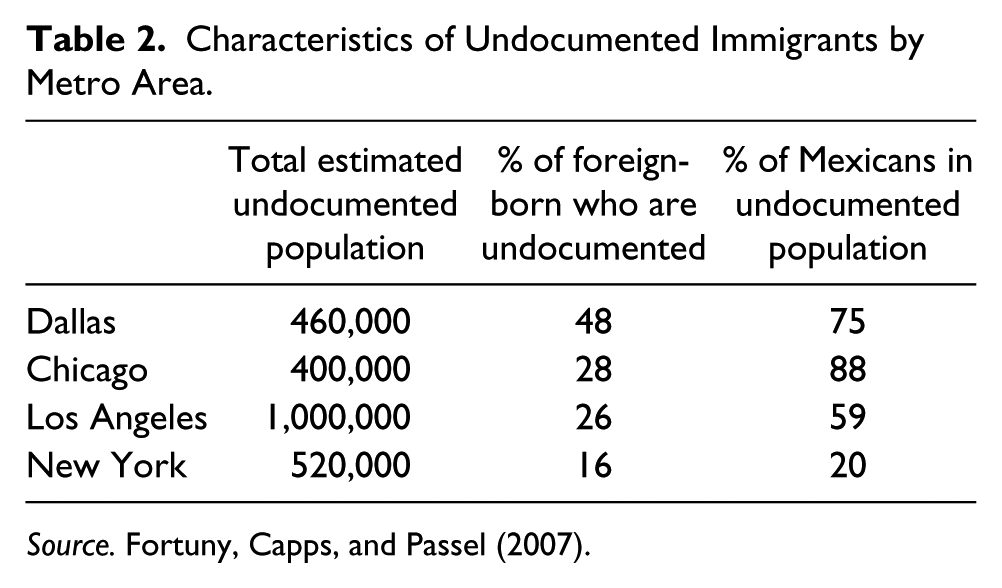
Source. Fortuny, Capps, and Passel (2007).
Furthermore, not only did Mexican immigrants make up a larger share of the city’s entire foreign-born population in L.A. (40%), Chicago (48%), and Dallas (73%) compared with New York (6%), but as Figure 1 makes clear, overall Los Angeles (1,276,870), Chicago (566,801), and Dallas (455,232) also had substantially larger Mexican-origin (U.S.- and foreign-born) populations than New York City (260,622).
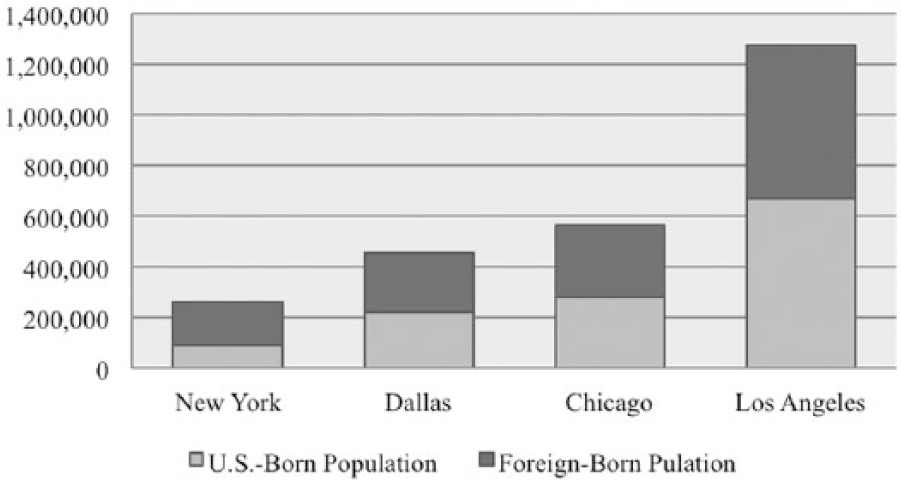
Size of Mexican-origin population by nativity.
These figures are important to note because since people of Mexican descent (U.S.- and foreign-born, documented and undocumented) were perceived as the primary targets of much of the country’s nativism at the time (Chavez 2008), a larger pool of people in the non-New York cities analyzed in this study would have felt targeted and had the motivation to take collective action. Hence, these compounding factors help explain why L.A., Dallas, and Chicago all had larger citywide demonstrations than New York.
As a result, a New York immigrant organizer, who was originally from L.A., explained that the disparities between the cities’ mobilizations were due to activists in L.A. having to reach out to fewer immigrant groups. She said, “In L.A., there’s a lot of Mexicans and Salvadorians. So if you get those groups and their leadership on board, you’re OK.”
12
Once the leaders of the L.A. Mexican immigrant, Mexican American, and Spanish media were on board, the Mexican masses followed (see Ramírez 2011; Zepeda-Millán 2011). The process of immigrant mass mobilization in New York was the opposite. As May Lee of the CPA explained, One of the characteristics of our city is that our immigrant communities are very diverse and very different so you can’t just have one blast announcement for everyone. You actually have to go into each community and have outreach in different languages and different ways that are more culturally appropriate . . . for different groups in different neighborhoods. Some have a long history of being involved, some may be new immigrants and their whole population is new to the country.
As illustrated earlier, organizing across different immigrant groups can be daunting, given their varying experiences in the United States. New York organizers faced the additional challenge of navigating the range of experiences that many immigrant groups brought with them from their countries of origin, which often affected their decision to partake in the protests. For instance, participation in the 2006 actions by immigrants from formerly Communist Eastern European countries was scarce. According to a local organizer in this community, “They didn’t support it,” their mentality was, “Fuck you. I’ve done my share of forced marching . . . I had to go to demonstrations as a kid . . . I’m not dealing with that protest bullshit anymore.” 13 Regarding undocumented Filipina domestic workers, AnaLiza Caballes of the Damayan Migrant Workers Association explained, “It was hard for them to come out” because many of them are older women who live with their employers and their “background in the Philippines is also middle class so their thinking is not really to go out and protest” when faced with a problem. Thus, New York organizers had to develop messaging and organizing strategies for immigrants with differing U.S. and home country experiences.
To further complicate matters, differences existed within some immigrant groups, such as when and the region from which they migrated. This “diversity within diversity” also affected immigrants’ levels of mobilization. As Haeyoung Yoon of CAAAV put it, different immigrant groups responded to the policy debate and calls for collective action “differently because it was affecting them slightly differently.” May Chen of UNITE-HERE provided an example of this dynamic within one immigrant community, explaining that whereas several Chinese immigrants supported the April 10 action, many did not come out for the May Day march because Taiwanese immigrants view “May Day as too radical . . . Some of them felt that May 1st was kind of like Communist China’s Labor Day.”
Mae Lee of the CPA concurred, pointing out how this divide also manifested in support that the local Chinatown coalition received from its ethnic business communities. She recalled that whereas both the long-established Chinese Consolidated Benevolent Association (CCBA) and the relatively newer Fujian Association of Businesses (FAB) (composed of more recent immigrants) supported the April 10 march, only the Fujianese businesses continued to assist with the May 1 actions. Speaking of FAB’s members, Lee stated that a lot of them were very supportive. They printed t-shirts, signs, and those kinds of things—they spent some money on it. They [even] had a big meeting with all of their business members and told them they had to come out.
However, because “China is a socialist country,” May Day “is celebrated” there “but not in Taiwan.” Accordingly, the CCBA was not as supportive because most of its members come from Taiwan.
As a result of this “diversity within diversity,” broad coalitions and an array of strategies and tactics were, not surprisingly, needed to mass-mobilize New York’s different immigrant populations. To produce large-scale collective action in a city with large and diverse immigrant populations, activists had to develop multiple frames and messages that resonated across linguistic, racial, ethnic, class, cohort, regional, and national “borders.” 14 Given these obstacles, that local activists were able to mobilize twelve thousand to over one hundred thousand immigrants was an amazing achievement. Despite not producing the nation’s largest protests, New York nontheless presented the protest wave’s most diverse demonstrations.
Conclusion
A foreign-born Latina who participated in and helped organize the city’s local actions contended that immigrants protested because they “understand very clearly . . . the connection between policies and their lives.” 15 The qualitative and quantitative findings presented in this article suggest a more complicated and nuanced relationship between immigrants and immigration policies. New York City’s 2006 protests illustrate that how the media frames immigration legislation, the political experiences immigrants bring from their countries of origin, and the different ways foreign-born groups and their descendants are racialized, can all impact the political engagement of immigrant-based communities in the United States.
Specifically, this article shows that the manner in which immigrant “illegality” is racialized can influence how, which, and to what degree different immigrant groups perceive and politically respond to policy threats. Given the demographic changes projected to occur in the United States over the next few decades, 16 these findings have important implications for comparative race and ethnic politics, media, and political behavior scholars, as well as for the social movement practitioners who will continue to attempt to mass-mobilize diverse immigrant communities.
Footnotes
Declaration of Conflicting Interests
The author(s) declared no potential conflicts of interest with respect to the research, authorship, and/or publication of this article.
Funding
The author(s) received no financial support for the research, authorship, and/or publication of this article.