




Abstract
Laws that regulate the financing of campaigns are one attempt to attenuate the role of money in politics and promote more egalitarian policy outcomes. Do states with stricter campaign finance regulations represent citizens’ interests more equally? Using data on state spending priorities from 1977 to 2008, this article finds that states with stricter campaign finance laws devote a larger proportion of their annual budget to public welfare spending in general and to cash assistance programs in particular. In contrast, there is no relationship between the strictness of campaign finance laws and spending decisions for non-redistributive policy areas. I also investigate possible causal mechanisms and uncover evidence that stricter campaign finance laws alter incentives for candidates to respond to wealthy constituents by lessening the proportion of contributions that originate from business interests. These results suggest that laws that regulate the financing of political campaigns can play an important role in promoting the interests of disadvantaged citizens and enhancing political equality.
Political equality is a cornerstone of democratic theory. As Sidney Verba (2003, 663) declares, “One of the bedrock principles in a democracy is the equal consideration of the preferences and interests of all citizens.” However, there is increasing concern among scholars, elected officials, and the general public that the preferences and interests of citizens with lower incomes receive relatively little consideration in government policy decisions compared with more affluent citizens (Bartels 2008; Flavin 2012; Gilens 2012; Gilens and Page 2014; Hacker and Pierson 2010; Kelly 2009; Winters and Page 2009). One common explanation for why the preferences and interests of citizens with lower incomes receive less attention in the policy decisions made by elected officials is that this group provides relatively few contributions (both in number and amount) to political campaigns (Bonica et al. 2013; Schlozman, Verba, and Brady 2012). Laws that regulate the financing of campaigns have been enacted, in part, based on the belief that they can help to attenuate the link between money and political influence and produce more egalitarian policy outcomes (Witko 2005).
Do jurisdictions with stricter campaign finance regulations represent citizens’ interests more equally? This question is difficult to answer at the federal level because one uniform set of policies governs races for federal office, and changes in laws that occur over time are contemporaneously correlated with many other changes in the political system. By comparison, the fifty states vary dramatically both across states and within states over time in terms of how much, or little, they regulate the financing of campaigns for state elected office (Primo and Milyo 2006; Witko 2005, 2007). For example, some states set no limit on the amount of money an individual can contribute to a single candidate while other states have instituted a public financing system that allocates money to candidates who agree to abide by strict spending limits. Several states have even oscillated back and forth between fewer and more regulations over time. As Milyo (2012, 6) observes, “In California, campaign contribution limits have been imposed, removed, and imposed; Missouri has experienced two such cycles; and public financing has been passed and repealed in Massachusetts and Kentucky.”
This article investigates the relationship between campaign finance laws and social welfare policy in the American states. To date, no study on the implications of campaign finance laws has focused specifically on redistributive policy outcomes such as public assistance spending despite evidence that these policies have the largest differences in public opinion between rich and poor (Gilens 2009), are critically important for the livelihood of low-income citizens (Franko 2013), and can help to reduce levels of poverty and economic inequality (Brady 2005; Kelly and Witko 2012; Kenworthy 1999). Using data on state spending priorities from 1977 to 2008, I find that states that more strictly regulate the financing of campaigns devote a larger proportion of their budget each year to public welfare spending in general and to cash assistance programs in particular. This relationship between stricter laws and greater spending holds even after accounting for differences in the ideology and partisanship of a state’s citizens and elected officials over time, as well as state and year fixed effects. As evidence that this finding is specific to public assistance spending, I demonstrate that there is no relationship between the strictness of campaign finance laws and spending decisions for non-redistributive policy areas. I also investigate possible causal mechanisms that explain the relationship and uncover evidence that stricter campaign finance laws alter incentives for candidates to respond to wealthy constituents by lessening the proportion of contributions that come from business interests. These findings suggest that laws that regulate the financing of political campaigns can play an important role in promoting the interests of disadvantaged citizens and enhancing political equality in the state policymaking process.
Background and Theoretical Expectations
Although political scientists have uncovered little evidence that campaign contributions can outright “buy” the roll call votes of policymakers (for a review, see Ansolabehere, de Figueiredo, and Snyder 2003), there is ample evidence suggesting contributions exert sway behind the scenes by influencing who legislators agree to meet with, what issues they focus on, and how they allocate their scarce time while in office (Baumgartner et al. 2009; Hall and Wayman 1990; Langbein 1986; Makinson 2003; Powell 2012; Schram 1995; Witko 2006). Given widespread concerns about unequal consideration of citizens’ preferences and interests in American politics, campaign finance regulations can potentially play an important role in helping to promote greater political equality.
To regulate the financing of campaigns, state governments typically use a combination of three tools: (1) requirements that campaigns disclose the identity of contributors, (2) limits on the amount individuals and organizations can donate to a campaign, and (3) public financing for campaigns on the condition that a candidate abides by spending limits 1 (Primo and Milyo 2006; Witko 2005, 2007). A growing literature has used the variation in these laws across the states to examine their impact on political campaigns. For instance, stricter contribution limits have been shown to lead to fewer uncontested state legislative races and more competitive elections (Hamm and Hogan 2008; Stratmann 2010; Stratmann and Aparicio-Castillo 2006). There is also evidence that public financing systems with spending limits lead to the emergence of more challengers and can help to lower the total costs of campaigns (Bardwell 2003; Eom and Gross 2006; Gross and Goidel 2001; Hogan 2000). Taking stock of this literature as a whole, there is wide-ranging evidence that campaign finance laws can have important effects on the behavior of political campaigns.
Beyond these campaign-specific effects, a handful of recent studies have begun to examine whether campaign finance laws have implications for political outcomes more generally and have uncovered mixed results. On one hand, there is evidence that state governments are less likely to pass antitakeover statutes that advantage management (at the expense of regular shareholders) when corporations are forbidden from making independent expenditures during campaigns (Werner and Coleman, forthcoming). On the other hand, there is little evidence that stricter campaign finance laws affect partisan control of government and incumbent reelection rates (La Raja and Schaffner 2014), or lessen instances of government corruption (Cordis and Milyo 2013). The fact that recent studies have arrived at differing conclusions about the possible effects of campaign finance laws suggests that this is a fruitful area for further investigation.
To date, there has been no consideration if stricter campaign finance laws are associated with more generous social welfare policy outcomes that specifically benefit low-income citizens. This is despite the fact that previous studies have documented the widest differences in opinions between the rich and the poor for social welfare policies, such as government spending on public assistance programs (Franko, Tolbert, and Witko 2013; Page, Bartels, and Seawright 2013; Rehm, Hacker, and Schlesinger 2012; Soroka and Wlezien 2008). For example, Gilens (2009) documents a “preference gap” of more than thirty percentage points between the rich and the poor for welfare spending, with poorer citizens (as expected) more supportive of greater spending on public assistance. 2 Given this stark divide in public opinion among different income groups, public assistance spending is a logical policy area for investigating the potential link between stricter campaign finance regulations and more egalitarian policy outcomes.
Why might stricter regulations on the financing of campaigns lead to better representation of the interests of poorer citizens, specifically through more generous social welfare spending? First, regulations on how much individuals and organizations can contribute to campaigns and/or a public financing system that limits candidate spending should lead to less total money being injected into the political system (Gross and Goidel 2001). One normative concern about campaign contributions is that they can unduly influence who legislators agree to meet with, what issues they focus on, and how they allocate their scarce time while in office (Baumgartner et al. 2009; Hall and Wayman 1990; Langbein 1986; Makinson 2003; Powell 2012; Schram 1995; Witko 2006). When there are no limits on how much contributors can give and/or no public financing systems with spending limits, it is almost assured that more dollars will flow to campaigns. A larger volume of campaign contributions necessarily means more money is needed to get elected/reelected and can lead to legislators and governors who are more beholden to contributors when making policy decisions while in office. Simply put, the more money in a state’s electoral system, the more likely it is that wealthier interests will dominate, and policies that benefit low-income citizens (such as public assistance spending) will receive comparatively less attention from policymakers. By reducing the total amount of contributions flowing to political candidates, campaign finance regulations have the potential to dampen the role of money in American state politics and allow for greater policy attention to disadvantaged citizens.
Second, campaign finance regulations can alter the composition of contributors to campaigns. It is well established that more affluent citizens (and the groups that represent their interests) are more likely to contribute to political campaigns than citizens with low incomes. For example, Schlozman, Verba, and Brady (2012, 160) find that citizens in the top income quintile are ten times more likely to donate to a campaign than citizens in the bottom income quintile. The disparity in the amount given is even more striking; nearly three-fourths of total campaign contributions come from people in the top quarter of the income distribution while only 2 percent come from people in the bottom income quintile (Verba, Schlozman, and Brady 1995, 194). 3
Given these well-documented differences in contribution patterns, it is sensible to conclude that state laws setting a maximum amount an individual or organization can give to a campaign are primarily limiting the giving capacity of affluent citizens as opposed to citizens with low incomes. If so, then regulations on how much individuals and organizations can contribute to campaigns may have the effect of “democratizing” giving (Eom and Gross 2007) and lessening the proportion of total contributions that come from wealthy interests. 4 This, in turn, means candidates will receive contributions from a wider cross-section of citizens and, if elected to office, may be more likely to focus their attention on social welfare spending and other policies that benefit the poor, as opposed to the policies most favored by their affluent constituents.
Third, in addition to affecting the amount and composition of campaign contributions, campaign finance regulations may impact who ultimately runs for office. Recent research reveals that citizens from working-class and low-income backgrounds are strikingly underrepresented in state legislatures across the nation (Carnes 2013). From a political equality and public policy standpoint, this underrepresentation is important because legislators from these backgrounds are more likely to pay attention to and vote for redistributive policies that benefit disadvantaged citizens. As Carnes (2013, 16) observes, Business regulations are more relaxed, tax policies are more generous to the rich, social safety net programs are stingier, and protections for workers are weaker than they would be if our political decision makers came from the same mix of classes as the people they represent.
One likely reason that citizens from working-class backgrounds are so profoundly underrepresented in state legislatures is because of the high entry costs of running for office. Most notably, to run and have a legitimate chance of winning a race for house or senate in most states, a candidate must be able to raise a significant amount of funds to publicize their campaign and reach out to voters. For a person from a low-income or working-class background, using their own money is likely not a viable option. In addition, it is unlikely that they can readily tap into a network of donors to finance their campaign as easily as someone from the professional class. However, regulations on campaign financing can potentially aid candidates from low-income backgrounds in two ways. First, lower limits on contributions mean that a candidate must seek out many smaller donations from a large group of citizens instead of simply relying on a few large donations from a small group of wealthy individuals or organizations. Second, states that have public financing systems enormously aid working-class candidates because they remove the requirement for them to raise large sums of money from outside donors. So, states that have more regulations on the financing of campaigns may have more state legislators from low-income backgrounds who, in turn, are more likely to support generous social welfare policies while in office (Carnes 2013).
In summary, there are several theoretical reasons to expect that regulations requiring disclosure of donor information, limiting how much individuals and organizations can contribute to campaigns, and public financing systems that require candidates to abide by spending limits will lead to a political environment where more attention is devoted to social welfare policies that primarily benefit citizens with low incomes. By empirically examining the relationship between campaign finance regulations and state public assistance spending, this study contributes to our understanding of the potential role that campaign finance laws can play in promoting the interests of disadvantaged citizens and enhancing political equality.
Data and Empirical Strategy
To investigate the relationship between campaign finance laws and policy outcomes, this study uses time-series cross-sectional data from the American states for 1977 to 2008. 5 The policy outcome of interest is how states prioritize their yearly spending (Jacoby and Schneider 2001). State spending priorities are operationalized as the share of a state’s annual spending that is allocated to a particular budget category, calculated by dividing the amount of spending in the budget category under consideration by the total amount of government expenditures in that state-year. Using the proportion of a state’s budget allocated to a particular budget category as opposed to total dollars spent (per capita) avoids two potential methodological problems. First, wealthier states and states that take in more revenue will have more money to spend in all areas of the budget, so comparing raw spending amounts does not accurately evaluate how spending priorities differ or how states make difficult decisions about trade-offs. Second, inflation requires a researcher to choose how to adjust raw spending amounts across years so they can be compared, with different accounting methods possibly leading to different substantive conclusions. By contrast, the use of a proportional measure of state spending avoids these two potential pitfalls and allows for meaningful comparisons across states and years.
State spending priorities are calculated using data from the U.S. Census Bureau’s (2010) “Historical Finances of State Governments” file, which provides detailed information on state spending by program area over time. I am interested in the relationship between state campaign finance laws and social welfare policy outcomes that benefit disadvantaged groups, which I measure in two different ways: first, the proportion of a state’s total spending in a given year that is allocated to Public Welfare, 6 and second, the proportion of a state’s total spending in a given year that is allocated specifically to “cash assistance payments” under the broader Public Welfare budget heading. In addition, as a check to ensure that regulations on the financing of campaigns are associated specifically with spending on social welfare policies and not state spending priorities more generally, I examine four other spending categories that are typically not considered redistributive and for which there is little theoretical reason to suspect that preferences about government spending vary systematically based on citizens’ incomes in the way they do for social welfare spending (Gilens 2009; Soroka and Wlezien 2008). The four other categories are the proportion of a state’s total spending in a given year that is allocated to Police Protection, Highways, Parks and Recreation, and Sanitation. 7 Together, these six different measures of state spending serve as dependent variables in the regression models presented below.
The degree to which states regulate the financing of political campaigns using a combination of disclosure requirements, contribution limits, and public financing is the independent variable of interest. As Witko (2005, 296) explains, While each of the three is intended to have specific effects on the behavior of various political actors, reformers believe they will work collectively to make elections and representation less subject to the manipulations of wealth, while being more competitive and democratic.
To measure the degree to which the financing of political campaigns is collectively regulated in a state, I compute an additive index using data compiled by Jeffrey Milyo (2012; also see Cordis and Milyo 2013; Primo and Milyo 2006). Specifically, each state-year is assigned a value that can range from zero to six, with higher values indicating more regulations placed on the financing of campaigns, based on whether or not it has the following laws in effect:
mandatory disclosure of contributor information,
limits on organization (corporation and, in most cases, union) contributions to state candidates,
limits on individual contributions to state candidates,
public financing for gubernatorial candidates conditional on abiding by expenditure limit,
public financing for state legislative candidates conditional on abiding by expenditure limit, and
public financing system is “clean elections” (participating candidates can raise no outside funds).
Fully thirty of the fifty states changed their value on the additive index (i.e., changed their combination of campaign finance laws) at least once during the time period under consideration, which offers additional analytic leverage through the examination of within-state effects. 8
State spending priorities (the proportion of a state’s annual spending allocated to a particular budget category) are regressed on this additive index of campaign finance regulations along with a series of state-year specific variables that are also expected to influence spending priorities. These control variables include measures of citizen and government liberalism, the percentage of seats in the lower house of the legislature controlled by Democrats, whether a state has a Democratic governor, and a measure of party competition, with the expectation that state-years with more liberal citizens, more liberal and Democratic governments, and more competition between the two parties will allocate a greater percentage of their budget to redistributive spending policies (Barrilleaux, Holbrook, and Langer 2002; Berry, Fording, and Hanson 2003; Hill, Leighley, and Hinton-Anderson 1995). 9 To account for state economic conditions and demographics, I also include a measure of the state’s unemployment rate with the expectation that there will be a greater need and demand for government assistance when unemployment rates are higher, 10 a measure of union density with the expectation that states with a stronger labor presence will have more generous public welfare policies (Radcliff and Saiz 1998), and the percentage of a state’s residents who are African American and Hispanic with the expectation that public assistance spending will be less generous in states with higher proportions of racial minorities (Soss et al. 2001). Because state budgets are typically deliberated about and adopted the year before they actually take effect, each independent variable included in the analysis is lagged one year. 11
The relationship between state campaign finance laws and spending priorities is estimated using ordinary least squares regression with panel corrected standard errors (Beck and Katz 1995). In addition to the covariates discussed above, all models include both state and year fixed effects. 12 State effects are included to account for all time-invariant unit effects such as history and culture (e.g., certain states might be more likely to both enact campaign finance laws and spend more on public welfare) and estimate the effect of campaign finance law changes within states over time. 13 Year effects are included to capture temporal trends in spending that uniformly affect all states in a particular year (e.g., changes in federal assistance policy that might alter the states’ funding role). Finally, it is important to note that although the regression models presented below include a series of control variables to account for possible alternative explanations for state spending decisions, it is still possible that any correlation between the strictness of state campaign finance laws and the generosity of a state’s social welfare spending is driven by an unobserved variable that simultaneously affects both variables.
Analysis
Do state spending priorities for public welfare vary systematically with the degree to which the financing of political campaigns is regulated? This question is evaluated using time-series cross-sectional data from the fifty American states for 1977 to 2008. Table 1 reports the results of six regression estimations, with the dependent variable under consideration (the proportion of a state’s annual spending allocated to a particular budget category) listed at the top of each column. For each model, the coefficient for the additive index of campaign finance laws is listed in the top row, and the coefficients for the state-year control variables are listed in the rows below. All evaluations of statistical significance for the coefficients are conducted using panel corrected standard errors and a two-tailed test.
Campaign Finance Laws and State Spending Decisions, 1977–2008.
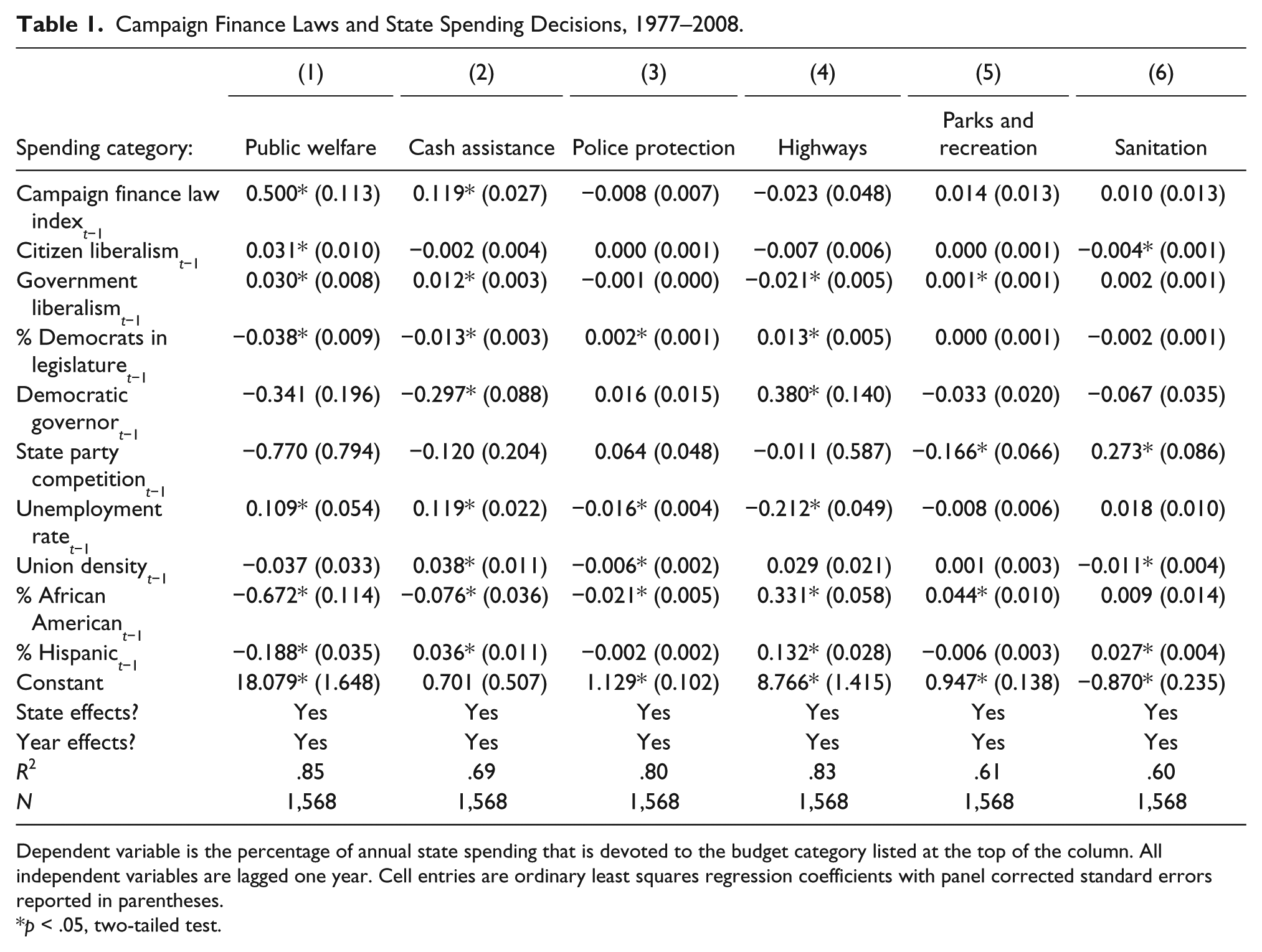
Dependent variable is the percentage of annual state spending that is devoted to the budget category listed at the top of the column. All independent variables are lagged one year. Cell entries are ordinary least squares regression coefficients with panel corrected standard errors reported in parentheses.
p < .05, two-tailed test.
The top row of Table 1 reveals that greater regulation of the financing of campaigns is associated with a greater proportion of a state’s budget devoted to public welfare spending in general (column 1) as well as to cash assistance payments in particular (column 2). In those two models, the coefficient for the additive campaign finance law index is positive and bounded above zero at conventional levels of statistical significance (p < .05). This finding suggests that state elected officials are more generous in their allocation of social welfare spending when operating in a political environment where the financing of political campaigns is more strictly regulated. Importantly, this relationship between the stringency of campaign finance laws and redistributive spending holds even after accounting for the host of state-year specific political, economic, and demographic factors discussed above. Turning to the state-year specific covariates in the model, column 1 reveals that (as expected) higher levels of citizen and government liberalism and a higher unemployment rate are associated with a greater proportion of a state’s budget allocated to public welfare spending, while a greater proportion of state residents who are African American or Hispanic is associated with less spending. Somewhat surprisingly, column 1 also reveals that (after accounting for the ideological liberalism of state government) states with a larger proportion of Democratic legislators allocate a smaller proportion of the annual budget to public welfare spending. 14
Substantively, the relationship between campaign finance regulations and spending is quite large when compared with other common predictors of social welfare policy. Figure 1 reports the predicted change in the percentage of a state’s annual budget devoted to public welfare when the variable specified is increased by one standard deviation. The figure reveals that the marginal effect of the campaign finance law additive index on welfare spending is larger than the effect for citizen liberalism and state unemployment rate and only slightly less than the effect of government liberalism. Simply stated, stricter regulation of the financing of political campaigns corresponds with a greater prioritization of social welfare spending above and beyond the effect of political, economic, and demographic factors. 15
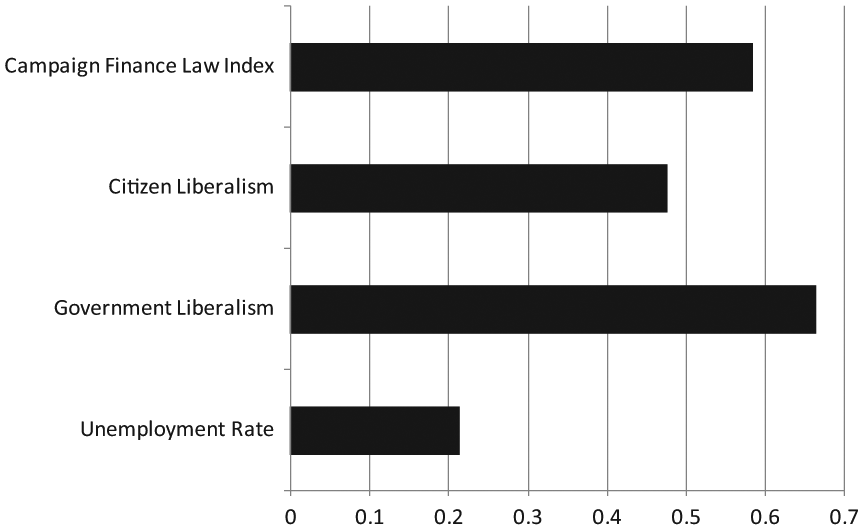
Substantive effects on public welfare spending.
To check and make sure that laws regulating the financing of campaigns are associated specifically with spending on social welfare policies and not state spending priorities more generally, I also conduct a series of placebo tests by examining the relationship between campaign finance laws and spending for four non-redistributive policies: police protection, highways, parks and recreation, and sanitation. The results of these four additional estimations are reported in columns 3 to 6 of Table 1 and reveal that there is no statistical relationship between campaign finance regulation and state spending for any of these four non-redistributive policy areas. These null results provide additional confidence that the relationship between the strictness of campaign finance laws and social welfare spending is not a statistical artifact or a function of a relationship between campaign finance laws and state spending more generally.
Investigating Causal Mechanisms
Why do stricter campaign finance laws lead to more generous public welfare spending? Above, I introduced and discussed three theoretical linkages that might explain why more regulations on the financing of campaigns lead to a greater priority placed on redistributive spending. To review, these three possible mechanisms are that stricter campaign finance laws (1) lessen the influence of political donations on candidates/elected officials by lowering the total amount of contributions given, (2) reduce the proportion (and, therefore, influence) of contributions that come specifically from wealthier constituents, and (3) lower entry costs for candidates from working-class and low social-status backgrounds who are more likely to implement policies that benefit low-income citizens if they are elected to office. In this section, I empirically evaluate each of these possible mechanisms.
First, I examine whether stricter campaign finance laws lower the total (per capita) contribution amount to campaigns for state elected office. As discussed above, the more money in a state’s electoral system, the more likely it is that wealthier interests will dominate and policies that benefit low-income citizens (such as public assistance spending) will receive comparatively less attention from policymakers. Data on campaign contributions to state campaigns are taken from the National Institute on Money in State Politics, with data available for every state beginning in 2000. 16 I take advantage of the fact that there are data on contributions and campaign finance laws over time to run a state fixed effects model for even-numbered years (when the vast majority of states hold their governor and state legislative elections) for 2000 to 2010. During that time span, annual per capita contributions range from slightly more than $0 (Louisiana in 2006) to $20.33 (Alabama in 2010), with a mean of $6.18. The annual per capita contribution amount is regressed on the 0–6 additive campaign finance index value for that state/year, and the result of this estimation is reported in column 1 of Table 2. The analysis reveals that the coefficient for campaign finance laws is not statistically different from zero, which suggests that stricter campaign finance regulations do not lower the total amount of money (relative to a state’s population size) flowing to political campaigns.
Investigating Causal Mechanisms Linking Campaign Finance Laws and Public Welfare Spending.

Dependent variable listed at the top of each column. Cell entries are ordinary least squares regression coefficients with panel corrected standard errors reported in parentheses.
p < .05, two-tailed test.
Second, I examine whether stricter campaign finance laws reduce the proportion of donations that come from wealthy interests. As discussed above, I expect wealthier citizens, who are less supportive of redistributive spending (Franko, Tolbert, and Witko 2013; Gilens 2009; Page, Bartels, and Seawright 2013; Rehm, Hacker, and Schlesinger 2012; Soroka and Wlezien 2008), to constitute the vast majority of contributions and exert undue influence on the policy decisions of elected officials in states with few regulations on campaign financing. In contrast, in states with stricter regulations on the financing of campaigns, candidates will be less reliant on large donations from wealthy donors and are instead likely to receive contributions from a wider cross-section of citizens. If elected to office, these candidates may be more likely to focus their attention on social welfare spending and other policies that benefit the disadvantaged as opposed to the policies most favored by their affluent constituents.
To evaluate the relationship between campaign finance laws and the composition of campaign donors, I calculate the proportion of total campaign contributions to candidates for state elected office for every state in even years from 2000 to 2010 that come from business interests, defined by the National Institute on Money in State Politics as general business advocacy associations (e.g., chambers of commerce) and individuals and groups engaged in business services, manufacturing, gambling and casinos, food and beverage hospitality, lodging and tourism, liquor and tobacco companies and sales, and retail sales. 17 During that time span, the proportion of total campaign contributions that come from business interests ranges from a low of 0.07 percent (in Louisiana in 2000) to a high of 34.43 percent (in Alabama in 2004), with a mean of 5.60 percent. The proportion of contributions from business interests is regressed on the campaign finance law index value for that state-year (along with state fixed effects), and the result of this estimation is reported in column 2 of Table 2. The negative and statistically significant coefficient indicates that states with greater regulation on the financing of campaigns have a lower proportion of campaign contributions that come from business interests. Substantively, moving one unit on the campaign finance law index reduces the proportion of contributions from business interests by about one percentage point, which is roughly one-quarter of a standard deviation. In short, the analysis suggests that campaign finance regulations can lessen candidates’ reliance on contributions from business interests, which, in turn, allows them more flexibility to prioritize laws and policies that benefit disadvantaged citizens (such as more generous public welfare spending) if elected to office.
Third, I examine whether campaign finance laws alter the socioeconomic composition of candidates and state elected officials. Above, I theorized that one possible effect of campaign finance regulations is lowering the entry barriers for candidates from working-class and low social-status backgrounds who are more likely to implement policies that benefit low-income citizens if they are elected to office (Carnes 2013). To evaluate this possible mechanism, I use data on the occupational background of state legislators compiled by Nicholas Carnes (2012) for 1979 from the Insurance Information Institute and for 1993, 1995, and 2007 from the National Conference of State Legislatures. Specifically, I measure the proportion of state legislators who come from a working-class background using legislators who are in the Labor Union occupational category or in the Business (non-manager) occupational category, which is defined as “blue collar, other white collar (clerical, sales etc.), and personal services (barbers, hairdressers, cashiers, etc.).” This measure ranges from a low of 0 percent (in five states scattered across three different years) to a high of 19.56 percent (in Maine in 1979), with a mean of 4.44 percent.
The proportion of legislators who are from a working-class background is regressed on the campaign finance law index using a state fixed effects model, and the result is reported in column 3 of Table 2. The coefficient of interest is not statistically different from zero, indicating that there is no statistical relationship between the stringency of campaign finance laws in a state and the proportion of working-class legislators. These results indicate that more campaign finance regulations do not appear to have the effect of promoting a more socioeconomically diverse state legislature.
Taking stock of the three possible causal mechanisms investigated in this section, the analysis suggests that campaign finance laws promote greater spending on redistributive programs by altering the composition of contributors for state elections. By reducing candidates’ reliance on contributions from business interests, campaign finance regulations alter elected officials’ incentives to respond to wealthy constituents, and instead give them more political flexibility to represent all of their constituents, including those who are the least able to donate to political campaigns (Schlozman, Verba, and Brady 2012).
Conclusion
Political equality remains an essential yardstick for evaluating the quality of a democracy, yet a growing literature documents that the preferences and interests of citizens with lower incomes receive relatively little consideration in government policy decisions, compared with more affluent citizens (Bartels 2008; Flavin 2012; Gilens 2012; Gilens and Page 2014; Hacker and Pierson 2010; Kelly 2009; Winters and Page 2009). One goal of laws that regulate the financing of political campaigns is to attenuate the influence of money and, by doing so, promote a wider consideration of citizens’ opinions and interests in the policymaking process. This study presents evidence that states that more strictly regulate the financing of campaigns devote a larger proportion of their budget each year to public welfare spending in general and to cash assistance programs in particular. This relationship between stricter laws and more spending holds even after accounting for differences in the ideology and partisanship of a state’s citizens and elected officials over time and, importantly, does not extend to policy areas that are not typically considered redistributive.
As referenced above, a large literature examines the effects of campaign finance regulations on the behavior of political campaigns, but few studies investigate the potential effects of regulations on political and policy outcomes more generally. This is unfortunate, because regulations on how campaigns are financed are one of the most visible ways in which the federal and state governments attempt to level out the political playing field and attenuate the link between affluence and influence in American politics. Therefore, future studies should explore if stricter campaign finance regulations are associated with other policy outcomes that favor the interests of disadvantaged citizens, such as a higher minimum wage, more expansive assistance for housing and early childhood education, and a more generous earned income tax credit program.
In addition, this article presents preliminary evidence that the causal mechanism linking stricter campaign finance laws and more generous public welfare spending is the fact that states with stricter laws tend to have a smaller proportion of campaign contributions that originate from business interests. In effect, campaign finance regulations “democratize” giving by promoting a wider cross-section of contributors as opposed to encouraging candidates to seek out large donations from business interests that tend to represent the opinions of wealthier citizens (Hacker and Pierson 2010). However, we still have an incomplete understanding about how this mechanism operates in the strategic decisions made by individual politicians seeking to maximize their chances for reelection. Accordingly, future research should further investigate how campaign finance laws alter the composition of donors to political campaigns and, by extension, impact the policy decisions made by state legislators while in office. One possible strategy for gaining analytical leverage on this question would be to engage in a detailed examination of the sources of campaign donations as well as the behavior (voting patterns, how time is allocated, issues focused on, etc.) of individual legislators before and after a major change in state campaign finance laws, such as the loosening or abolishment of limits on how much individuals and organized groups can contribute to political campaigns.
More broadly, the wide variation in laws, institutions, and public policy regimes across the states and within states over time provides a unique research opportunity to examine the causes of, and possible remedies for, unequal political influence and policy outcomes. As Ellis (2013, 785) points out, “Unequal representation is not necessarily endemic to the American political system, but it is rather exacerbated or diminished by particular institutional and contextual arrangements that affect the quality of representation that rich or poor citizens receive.” Recent studies of unequal political representation document consistent disparities in influence between the rich and the poor (Bartels 2008; Gilens 2012) but stop short of fully investigating and prescribing possible solutions to the problem. Although political scientists and pundits have speculated for decades about possible remedies for unequal political influence (e.g., Lijphart 1997), empirical examination of this topic remains startlingly limited. To further our understanding, future studies should incorporate additional institutional features in the states to investigate what conditions and arrangements might help lead to more equal consideration of the preferences and interests of disadvantaged citizens.
Footnotes
Appendix
Descriptive Statistics for State Data Used in Analysis for Table 1.
| Variable | N | M | SD | Minimum | Maximum | Data source |
|---|---|---|---|---|---|---|
| % spending on public welfare | 1,568 | 18.25 | 5.68 | 4.04 | 38.77 | (1) |
| % spending on cash assistance | 1,568 | 2.05 | 1.63 | 0 | 9.61 | (1) |
| % spending on police protection | 1,568 | 0.88 | 0.35 | 0.02 | 2.91 | (1) |
| % spending on highways | 1,568 | 9.10 | 3.23 | 2.69 | 23.15 | (1) |
| % spending on parks and recreation | 1,568 | 0.51 | 0.33 | 0 | 4.00 | (1) |
| % spending on sanitation | 1,568 | 0.34 | 0.47 | 0 | 3.55 | (1) |
| Campaign finance law index | 1,568 | 2.61 | 1.16 | 1 | 6 | (2) |
| Citizen liberalism | 1,568 | 48.43 | 15.36 | 8.44 | 95.97 | (3) |
| Government liberalism | 1,568 | 54.06 | 20.72 | 4.05 | 95.30 | (3) |
| % Democrats in legislature | 1,568 | 57.02 | 17.76 | 12.85 | 100 | (4) |
| Democratic governor | 1,568 | 0.53 | 0.49 | 0 | 1 | (4) |
| State party competition | 1,568 | 0.86 | 0.10 | 0.51 | 0.99 | (4) |
| Unemployment rate | 1,568 | 5.87 | 1.97 | 2.3 | 17.4 | (5) |
| Union density | 1,568 | 15.60 | 7.30 | 2.3 | 38.7 | (6) |
| % African American | 1,568 | 9.53 | 9.29 | 0.2 | 36.8 | (7) |
| % Hispanic | 1,568 | 5.45 | 7.63 | 0.3 | 42.1 | (7) |

Source. (1) U.S. Census Bureau’s (2010) “Historical Finances of State Governments.” (2) Jeffrey Milyo (2012; also see Cordis and Milyo 2013; Primo and Milyo 2006). (3) Richard Fording (http://rcfording.wordpress.com/state-ideology-data/). (4) Carl Klarner (http://www.indstate.edu/polisci/klarnerpolitics.htm). (5) Bureau of Labor Statistics (http://www.bls.gov/lau/rdscnp16.htm). (6) Union Membership and Coverage Database from the Current Population Survey (http://www.unionstats.org). (7) U.S. Census Bureau.
Data for state spending (dependent variables) are for 1977–2008. Data for independent variables are for 1976–2007 because all independent variables use values lagged one year.
Acknowledgements
Thank you to Dave Bridge, Rebecca Flavin, Jeff Milyo, Curt Nichols, Greg Shufeldt, John Stringer, and Chris Witko for helpful comments, and to Nick Carnes, Richard Fording, Carl Klarner, and Jeff Milyo for generously making available their data.

Declaration of Conflicting Interests
The author(s) declared no potential conflicts of interest with respect to the research, authorship, and/or publication of this article.
Funding
The author(s) received no financial support for the research, authorship, and/or publication of this article.
Notes
References
Supplementary Material
Please find the following supplemental material available below.
For Open Access articles published under a Creative Commons License, all supplemental material carries the same license as the article it is associated with.
For non-Open Access articles published, all supplemental material carries a non-exclusive license, and permission requests for re-use of supplemental material or any part of supplemental material shall be sent directly to the copyright owner as specified in the copyright notice associated with the article.
