



Abstract
This research examines how an attack ad’s sponsorship conditions its effectiveness. We use data from a survey experiment that exposed participants to a fictional campaign ad. Treatments varied the ad’s sponsor (candidate vs. group), the group’s donor base (small donor vs. large donors), and the format of the donor disclosure (news reports vs. disclaimers in the ads). We find that ads sponsored by unknown groups are more effective than candidate-sponsored ads, but disclosure of donors reduces the influence of group advertising, leveling the playing field such that candidate- and group-sponsored attacks become equally effective. Increased disclosure does not, however, advantage small-donor groups over large-donor groups.
Interest group involvement in political campaigns has skyrocketed in recent elections, thanks in large part to recent campaign finance decisions by the U.S. Supreme Court. Between 2008 and 2012, outside group spending in the presidential race rose from $286 million to $1.1 billion (Smith and Kimball 2013). A third of the advertisements in the presidential general election of 2012 were sponsored by outside groups (Fowler and Ridout 2012), with just over half of pro-Romney advertisements aired by such groups. Moreover, almost 30 percent of ads aired in U.S. Senate races in 2012 were sponsored by outside groups, up from 15 percent in 2010 and around 5 percent in the early 2000s (Franz 2012). At the same time, the type of interest group involved in electioneering has changed, moving away from traditional political action committees affiliated with long-standing interest groups and unions and moving toward 501c4 organizations, 527s, and super PACs—groups that raise and spend unlimited money on behalf of candidates but often have no real connection to any traditional organized interest (Franz 2012).
As the role of nonparty independent groups in electioneering has risen, scholars have started to investigate their influence. The emerging consensus is that interest group advertising, especially that by relatively unknown groups, is more effective than advertising sponsored by candidates (Brooks and Murov 2012; Dowling and Wichowsky 2014; Weber, Dunaway, and Johnson 2012). This scholarship suggests that voters hold candidates accountable for their attacks, lowering their approval of the attacking candidate, but do not similarly hold outside groups accountable for their attacks by reducing their evaluations of the favored candidate. 1
Some potential responses to this, such as regulating how much groups spend, how much they raise, or the sources of their donations, are nonstarters, as the U.S. Supreme Court has repeatedly affirmed that such regulations are unconstitutional. And recent court decisions in cases like Wisconsin Right to Life and Citizens United have only served to reduce the hurdles to independent group involvement in election campaigns. But one accountability provision that has, by and large, withstood court scrutiny is disclosure of donors.
In this research, we use a survey experiment to examine the extent to which disclosure influences the effectiveness of political advertising, varying the ad sponsor (candidate versus group), means of disclosure (in the ad itself vs. in the news media) and the type of group that is being disclosed (the large-donor groups commonly found today vs. a small-donor, grassroots group). We find that group-sponsored ads are more effective than candidate-sponsored ads, but disclosure does reduce the effectiveness of group-sponsored ads, making them as equally effective as candidate-sponsored ads. Interestingly, though, revealing that a group is supported by small donors does not make the group’s ad any more effective than an ad paid for by large donors.
Our research builds on existing scholarly research on the impacts of ad disclosure in several ways. First, it hones in on the small-donor versus large-donor distinction. By including a small-donor treatment, which has not been done before, we are able to examine whether group credibility can be enhanced, not just depressed, through disclosure. Second, our research uses a more realistic manipulation of the ad disclaimer than previous research has used.
Our research also speaks to policymakers. More specifically, if fuller disclosure—or certain means of disclosure—can influence the persuasiveness of group-sponsored advertising, this points to a credible (and constitutionally sound) policy strategy for campaign finance reformers who want to reduce the attractiveness of funneling large campaign contributions through outside groups.
Ad Sponsorship and Disclosure
An increasing number of studies have investigated the impact of sponsorship on the effectiveness of messages in a political race. Effectiveness is often defined as having two parts: persuasion and backlash. Persuasion refers to the ability of the ad to increase people’s evaluations of the favored candidate or increase people’s likelihood of voting for the favored candidate. Backlash refers to voters punishing candidates who attack others, either by lowering evaluations of that candidate or reducing the likelihood of voting for that candidate (Garramone 1985; Roddy and Garramone 1988). Backlash is thought to occur because voters transfer their professed dislike of political advertising to the sponsor of that advertising (Jasperson and Fan 2002). Thus, the total effect of an ad is calculated by subtracting backlash from persuasiveness.
Most studies of how the effectiveness of advertising varies by sponsorship have used an experimental approach. Scholars have examined a variety of message sponsors, including candidates, political parties, and interest groups. Almost without fail, studies have found that ads sponsored by interest groups are more effective (Brooks and Murov 2012; Dowling and Wichowsky 2014; Groenendyk and Valentino 2002; Johnson, Dunaway, and Weber 2011; Weber, Dunaway, and Johnson 2012). One reason given for this is that group-sponsored ads can be just as persuasive as candidate-sponsored ads, but they result in much less voter backlash (Brooks and Murov 2012; Dowling and Wichowsky 2014).
Some of these studies have further subdivided these groups into “known groups” (such as the National Rifle Association or the Sierra Club) and “unknown groups” (such as American Crossroads, a Super PAC that supports Republican candidates, or a hypothetical group). Unknown groups appear to be particularly effective because the success of known groups is conditioned by people’s pre-existing attitudes toward the group. For instance, Weber, Dunaway, and Johnson (2012) found that an ad sponsored by the NRA (National Rifle Association) was highly effective when people viewed the NRA positively, but it was much less effective among those who viewed the NRA negatively.
Another research focus is whether disclosure information about the group is provided and who is providing the disclosure, the ad itself or the news media. In an experiment, Dowling and Wichowsky (2013) find that disclosure of funding sources can limit—at least somewhat—the effectiveness of attack ads sponsored by interest groups. The greatest backlash against the sponsor occurred in a news article that talked about the anonymity of the sponsoring group’s donors. A big backlash also occurred when the ad itself carried a disclaimer listing the group’s five largest donors. When the media reported on the sponsoring group’s links to the oil industry, however, the backlash was no different than in the control condition.
Why are these attack ads, generally sponsored now by innocuously named 527, 501c4, and super PAC organizations, so effective? It could be that unknown groups, in being unaffiliated with a candidate in the minds of voters, simply shield ad sponsors and their favored candidates from backlash, as noted. Voters under this scenario are judicious in how they levy blame for an attack, and candidates are spared any dissatisfaction with a negative message.
Another related explanation is that unknown groups are perceived as more credible than candidates. More than a half-century of research has established the importance of source credibility as an antecedent to a message’s persuasiveness (Hovland and Weiss 1951; Sternthal, Phillips, and Dholakia 1978). Two of the main dimensions of credibility are expertise and trustworthiness, both generally having an influence on the degree of opinion change (Pornpitakpan 2004). Classic findings suggest that when the speaker’s intent to persuade is made clear, less persuasion takes places (Kiesler and Kiesler 1964). Translating this into the realm of political advertising sponsorship, Garramone (1985) and Weber, Dunaway, and Johnson (2012) suggest that one reason interest group advertising might be more effective is that the underlying electoral motive of candidates is obvious. With interest groups sponsors, however, their electoral motives are less immediately evident given that they often emphasize policy arguments and label themselves as “Citizens” or “Americans.” Viewers may perceive such groups as more objective. Indeed, Weber, Dunaway, and Johnson find that credibility mediates the relationship between sponsorship and ad effectiveness.
If credibility is an important mediator of ad persuasion, we should be able to manipulate it either through news reports about the group or in the ad’s disclaimer. Previous work has tested the impact of ads sponsored by unknown groups or groups with large donors, but no study has framed a group as a small-donor or grassroots organization. Such groups might be perceived as more credible than groups with a few large donors. Thus, appeals from small-donor or grassroots groups may be more persuasive than appeals from generic groups.
Analyses of advertising from known groups, such as the NRA (Weber, Dunaway, and Johnson 2011), are important, but the preponderance of ads in American elections is of the “unknown” type with little to no donor disclosure. Consider disclosure first. Table 1 displays interest group ad totals in federal races, and the distribution of those ads by disclosure type. There were more than four hundred twenty thousand “dark money” ads aired in 2011 and 2012. These were from sponsors like 501(c)4 nonprofits that do not disclose their donors to the FEC (Federal Election Commission). 2 Dark money ads amounted to nearly 14 percent of all ads aired in the 2012 cycle, and 47 percent of all interest group ads. They made up the majority of interest group ads in congressional elections (constituting over 60 percent in Senate races).
Interest Groups Ads in Federal Elections from 2011 to 2012.

Source. Wesleyan Media Project (2014)
“Full” disclosure indicates that the group is either a PAC (Political Action Committee) or a 527. No disclosure means the group is either a nonprofit 501c4 or a business or trade group. “Some” disclosure means the group has multiple organizational forms, some full and some nondisclosure. In this latter case, it is unclear in the data which organizational form funded the ad. Source on degree of disclosure is Center for Responsive Politics.
An additional two hundred forty thousand ads were sponsored by groups that only partially disclose their donors. These might be groups that maintain multiple campaign accounts, some of which might have disclosure mandates (such as a super PAC or traditional PAC) and some that might not (such as a 501c). This compares with two hundred thirty-seven thousand ads from groups that have full disclosure requirements such as super PACs.
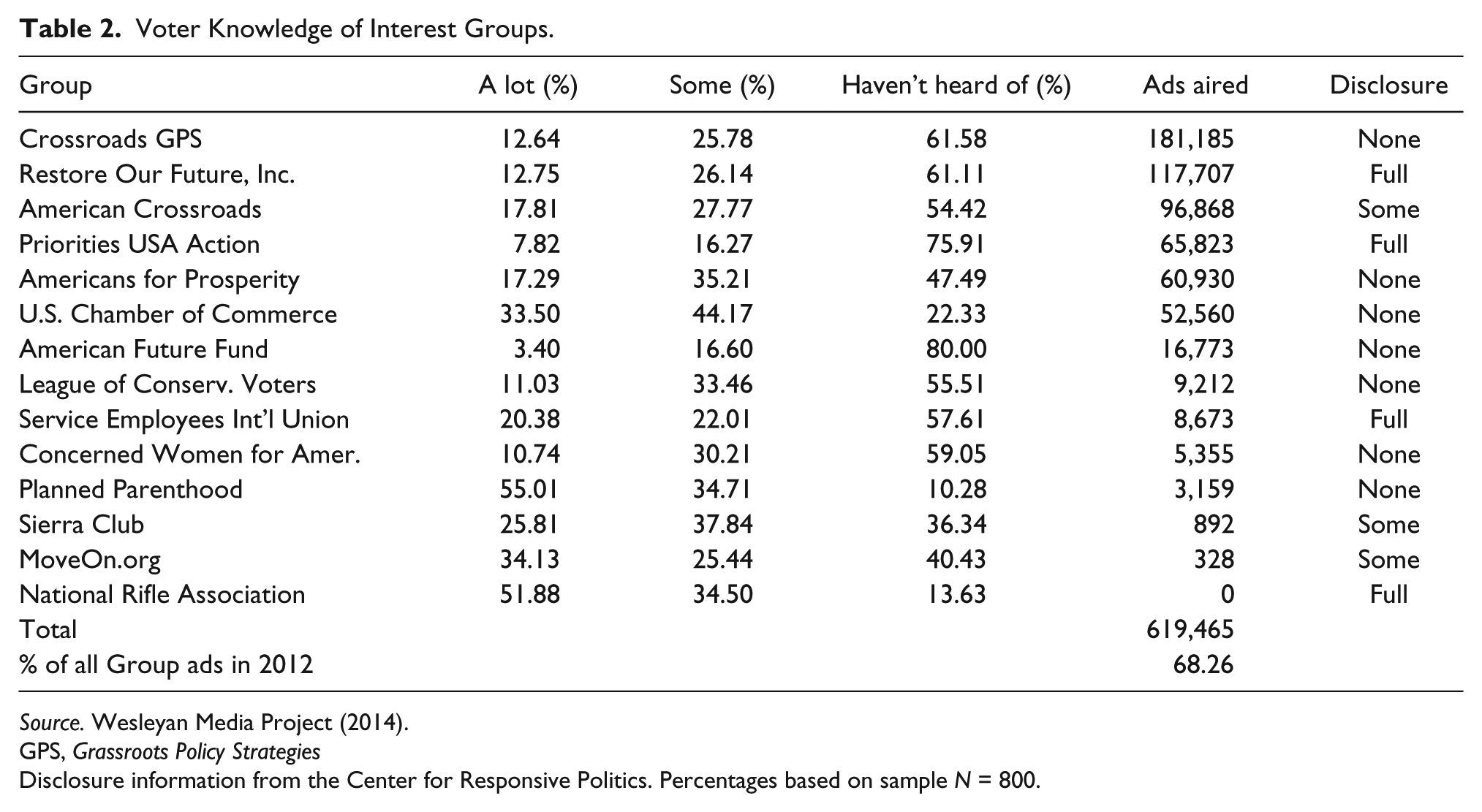
Disclosure is only part of the story, however. Many of the full-disclosure super PACs, whose donor base can be learned by the public through media reports, are still largely unknown to most voters. To see this more clearly, consider the evidence in Table 2. We fielded a short, nationally representative YouGov survey in the fall of 2012 3 that asked a subsample of eight hundred respondents how much they had heard about fourteen separate groups, some super PACs and some more traditional membership groups. 4
Voter Knowledge of Interest Groups.
Source. Wesleyan Media Project (2014).
GPS, Grassroots Policy Strategies
Disclosure information from the Center for Responsive Politics. Percentages based on sample N = 800.
The group that aired the most ads in 2012, Crossroads GPS, was familiar to roughly 38 percent of respondents, only 13 percent of whom had heard “a lot” about them. The remaining 62 percent claimed to have heard nothing of the group. Restore Our Future (organized to promote the candidacy of Mitt Romney) was second on the list, and despite being a full-disclosure super PAC, over 60 percent of respondents as of October 2012 claimed to have heard nothing about the group. 5 The group American Crossroads sponsored the third most ads, but 54 percent of respondents claimed to have heard nothing of the group. The most well-known groups, such as the National Rifle Association and Planned Parenthood—about which a majority of respondents reported hearing a lot—were far less active in the air war in 2012.
The most active “known” group in 2012 was the Chamber of Commerce, which sponsored fifty-two thousand ads in federal races. Seventy-seven percent of respondents reported having heard a lot or some about the group. The Chamber is also a nondisclosure group. There are no highly active groups on the list with a high degree of knowledge and a donor disclosure mandate. The message from Tables 1 and 2 is clear: well-known groups like the NRA, Sierra Club, or National Education Association are not the predominant sponsors of procandidate ads in contemporary American politics. Voters are much more likely to see ads from groups who are either unfamiliar to them or do not disclose donor information. 6
Data
To examine the impact of sponsorship and disclosure, we fielded a survey experiment using Amazon.com’s Mechanical Turk (MTurk) interface. We recruited one thousand two hundred respondents to participate in the study, which was in the field from June 17 to July 21, 2013. Although MTurk respondents do not provide a representative sample of the American population, the sample is demographically and geographically much more diverse than the commonly used sample of undergraduate students. Moreover, our goal is not to make inferences about a population but to establish the causal effect of experimental treatments, which is a fairly common and accepted use of MTurk samples (Berinsky, Huber, and Lenz 2012). Dowling and Wichowsky (2013, 2014) also employed MTurk in their experiments on ad sponsorship. As is the custom for MTurk studies, we compensated our respondents $0.25. 7
The experiment contained six conditions. These are outlined in Table 3. One featured a candidate-sponsored ad, while five featured a group-sponsored ad. In the first group-sponsored condition, only the group sponsor was noted, with no information about the group’s funding. In two other group-sponsored conditions, participants received additional information about the group’s funders from the news media. In the final two group-sponsored ad conditions, participants received information about the group’s funders within the ads themselves. 8
Experimental Conditions.

Our manipulation in these last two conditions had top donors listed legibly in the tagline, with their names read by a voiceover. This contrasts with Dowling and Wichowsky’s (2013) top-donor condition, which used a separate screen after the ad to highlight clearly (in the center of the shot) the top donors. That identification also attached the donor’s location and employer. Ads like this, however, are not currently aired, and they go beyond anything Congress has debated when considering campaign finance legislation. Under proposed legislation, top donors would be required to be listed in the disclaimer, but not on a separate screen. Nor would it be mandated that donor locations or employers be noted. Indeed, donation amounts are not even part of the recommended legislation. Four states already have similar mandates (Alaska, California, North Carolina, and Washington), but the rules vary across these states. In California, only donors giving more than $50,000 are noted. In North Carolina, the donor disclosure only applies to print media. Top donors in all of these states are often noted in the disclaimer but below the group information and in small print. Thus, the way we list donors is arguably the clearest presentation of top donors that would realistically result from any legislative mandates.
The experiment proceeded in five phases: First, participants were asked to read an overview of a state senate race between Sean Hanna and Todd Zink. Participants were told that the fictional article was recently published in a local newspaper. The article stated,
Incumbent State Sen. Sean Hanna and candidate Todd Zink will face off this fall in the campaign for the state’s 27th Senate District. The election is being waged over a range of issues, including the economy, taxes, and the size of government. This election is being closely watched statewide because the race is expected to be very competitive. Both candidates are working to convince voters that they can improve the state’s economy, which has suffered in recent years. Hanna has accused Zink of having too little experience. Zink is a local dentist who has never held elected office, and Hanna argues that experience in setting budgets is critical right now. Hanna has a record of working across the aisle, and he has emphasized that in his speeches. Zink, however, was motivated to run because of the state’s high debt, and he argues that incumbents have done too little to contain spending. Zink argues on the stump that fresh voices are needed in the state’s capitol.
Second, all participants were asked to rate both Hanna and Zink on a favorability scale ranging from 0 to 100. 9 Third, participants in the two “news report” groups (Conditions 3 and 4) received additional text prior to watching the ads. The information was presented prior to the ad because media coverage of an ad often occurs immediately after its launch, and thus citizens often have additional information about a controversial ad or outside group before seeing the bulk of airings on television. 10 Half of participants received news describing a group active in the race as a grassroots organization, while the other half received news about a few large donors who were funding the group. 11
All participants were assigned to watch one of four versions of an ad that attacked Sean Hanna for supporting a variety of tax increases. In reality, Hanna is a Republican, but the ad never references partisanship, which is one of the reasons we chose it. The text of the ad is reported in Online Appendix A (http://prq.sagepub.com/supplemental/). The four versions of the ad differed as follows:
Participants in the candidate condition watched an ad with a text disclaimer that stated “Paid for by Friends of Todd Zink.” It also included a voiceover that stated, “I’m Todd Zink and I approve this message.”
Participants in the group condition and participants in the two “media disclaimer” conditions watched an ad with a text disclaimer stating, “Center for American Democracy is responsible for the content of this advertising. Paid for by Center for American Democracy. Not authorized by any candidate or any candidate’s committee.” It also included a voiceover that stated “Center for American Democracy is responsible for the content of this advertising.”
Participants in the “small donations” condition watched the ad with the text:
Center for American Democracy is responsible for the content of this advertising. Paid for by Center for American Democracy and the 800,000 small donations from our nationwide membership of interested and passionate citizens. Not authorized by any candidate or any candidate’s committee.
The voiceover stated, “Center for American Democracy is responsible for the content of this advertising, which was paid for by the 800,000 small donations from our nationwide membership.”
Participants in the “top 4 donors” condition watched an ad designed to comply with some proposed legislation in Congress. The text reads,
Center for American Democracy is responsible for the content of this advertising. Paid for by Center for American Democracy and funded in part by: WMP Technologies, Inc. ($750,000); James Johnson, Jr. ($500,000); the Free Market Alliance ($450,000); the Citizens for Better Governments ($100,000). Not authorized by any candidate or any candidate’s committee.
The voiceover announcer stated, “Center for American Democracy is responsible for the content of this advertising, which was paid for by WMP Technologies Incorporated, James Johnson Junior, The Free Market Alliance, and Citizens for Better Government.”
Fourth, post treatment, participants rated both candidates again on a 0-to-100 favorability scale and indicated whether they would vote for Hanna or Zink. 12 They were also asked to rate the trustworthiness and credibility of the ad sponsor and to rate the ad itself in terms of its persuasiveness, fairness, and negativity. All responses were scaled from 0 to 100. See Online Appendix B (http://prq.sagepub.com/supplemental/) for question wording. Finally, we asked respondents their age, partisan affiliation, ideological leaning, marital status, education, income, and race.
The randomization of participants across conditions was successful. We estimated a multinomial logit model on experimental treatment, using demographics, partisanship, political interest, education, and income as predictors. None of these were significant predictors. Therefore, we simply report comparisons of means rather than estimates from a model that includes demographic controls.
Expectations
In line with existing literature, we start with the assumption that a sponsor’s credibility is key to persuasion. One dimension of that credibility is trustworthiness, which we conceive of as the extent to which a sponsor’s narrow electoral motives (as opposed to taking a broader, more objective point of view) are evident in its advertising. When candidates “approve” their own ads, they make it immediately clear that their goal is winning office. By contrast, interest groups, especially unknown or nondisclosure groups, are able to create a sense of detachment from the candidates by hiding behind their generic names. Their political motivations are unclear. Therefore, we hypothesize first that the ad sponsored by the unknown group (Condition 2) will be more effective than the ad sponsored by the candidate (Condition 1). Thus, participants who see the unknown group ad should provide higher credibility and trustworthiness ratings than participants who see the candidate ad, and the favorability of the attacked candidate, Hanna, should be lower among those who see the unknown group ad.
As previous research has suggested, however, disclosure of funders may make some of the group’s narrow political motives more evident. This should be particularly true when the funders represent narrow interests. Thus, we hypothesize that the “top 4 donors” ad (Condition 6) will be less effective than the nondisclosure group-sponsored ad (Condition 2). Participants in the nondisclosure group condition (Condition 2) should rate the ad higher on credibility and trustworthiness than participants in the large-donor disclosure condition (Condition 6), and Hanna favorability should decline more in the nondisclosure group condition (Condition 2).
Given the presumption in the literature that credibility can be reduced because of a large-donor profile, it stands to reason that a group more explicitly framed as funded by a wider swath of the electorate should be seen as more credible, and consequently their ads should be more effective. As such, in emphasizing a less self-interested aspect of the group, the “small donors” ad should be as effective as the group-sponsored ad with no disclosure and may even be more effective. Therefore, ratings of credibility, trustworthiness, and the impact of persuasion in the small-donor disclosure condition (Condition 5) should be similar to or greater than the ratings for the nondisclosure group ad (Condition 2). 13
When we consider the news media as the source of the disclosure information as opposed to the ad disclaimer, the most straightforward hypothesis is that the impact of the “large donors” (Condition 4) information and the “grassroots” information (Condition 3) will be greater than the impact of the ad disclaimers. One reason for this is that ad disclaimers are typically rushed while news reports are lengthier, allowing audiences to engage in processing of the information. Second, because ads are designed to persuade, people may perceive the news media as having less of a stake in the outcomes of the race than candidates, and thus news reports may be perceived as more credible (Johnson, Dunaway, and Weber 2011). As a consequence, information conveyed by news reports may have more impact on people’s attitudes than information conveyed by ads. 14 Thus, the small-donor news report (Condition 3) should increase credibility, trustworthiness, and ad effectiveness over the “no disclosure” ad in Condition 2, while the large-donor news report (Condition 4) should depress these measures relative to the “no disclosure” ad in Condition 2.
We have said little to this point about effects of our various treatments on the favorability ratings of the favored candidate, that is, the opponent of the attacked candidate. Indeed, credibility need not be the primary reason that interest group ads are more successful. If Zink (the favored candidate) suffers a backlash from attacking Hanna harshly, a backlash that only occurs when the candidate sponsors the ad, all of the interest group ads may end up as more successful than the candidate ad. In line with Dowling and Wichowsky’s (2013) findings, it is also possible that the large-donor news condition (Condition 4) and the large-donor ad disclaimer condition (Condition 6) could result in some backlash for Zink.
Results
Before reporting on our findings, we recap our expectations:
The no-disclosure group ad (Condition 2) will be more effective than the candidate ad (Condition 1), the large-donors news report (Condition 4) and the large-donors disclosure ad (Condition 6).
The no-disclosure group ad will be less effective than the small-donors news report (Condition 3).
The no-disclosure group ad will be as effective as the small-donors disclosure ad (Condition 5).
Participants completed a validation check (after answering eight questions tapping our dependent variables) to see how well they recalled the sponsor of the advertising. See Online Appendix B (http://prq.sagepub.com/supplemental/) for the complete wording of the questions. We asked whether the sponsor was Todd Zink, the Center for American Democracy, the Project for a Better America, or Zink for America PAC. Our validation check suggests that respondents were fairly accurate in their recall, but with some important exceptions. In the candidate-sponsored condition (Condition 1), for example, 60 percent of the respondents correctly identified Todd Zink as the sponsor. Thirty-two percent, however, reported not knowing. In the other five conditions, between 8 and 17 percent reported not being able to recall the sponsor, but correct attribution of the sponsor was higher than in the candidate-sponsored case: 66 percent for Conditions 5 and 6 (the small- and large-donor disclaimer conditions, respectively), 74 percent in Condition 2 (the nondisclosure condition), 82 percent in Condition 3, and 85 percent in Condition 4 (the news conditions).
The nontrivial number of respondents who mistakenly identified the sponsor or could not recall is an important reminder that voters may not pay close attention to the finer details of an ad. This ad was directly in front of viewers on their computer screens, but citizens generally experience ads on their television, while often doing other things. The message of the ad, coming packaged with slick visuals and music, may resonate, but the quickly disappearing disclaimers and paid-for-by lines may escape notice. At first glance, then, this may suggest possible limits to donor disclosure effects through disclaimers.
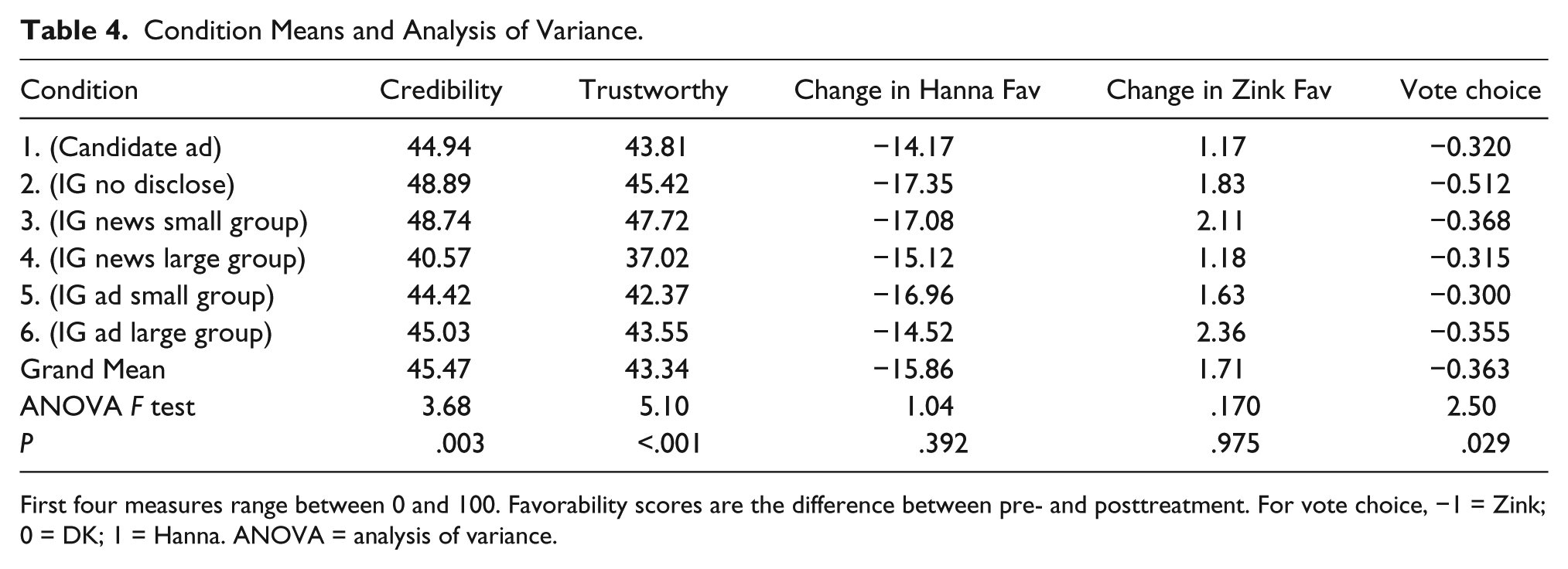
Table 4 reports mean scores for each of the six conditions on our measures of sponsor credibility and trustworthiness, on Hanna and Zink favorability, and on vote choice. An analysis of variance (ANOVA) F test reveals significant differences across treatments for credibility, trustworthiness, and vote choice, and thus we display graphically the means and 95 percent confidence intervals for these three variables (Figures 1–3). Although these figures allow us to see visually whether treatments had significantly different effects, we also report in Table C1 formal significance tests for each pairwise comparison on each of the five dependent variables. Because we have formal hypotheses, we rely upon t tests for our analysis and interpretations, but we report the more conservative Bonferroni multiple comparison tests in the table as well.
Condition Means and Analysis of Variance.
First four measures range between 0 and 100. Favorability scores are the difference between pre- and posttreatment. For vote choice, −1 = Zink; 0 = DK; 1 = Hanna. ANOVA = analysis of variance.
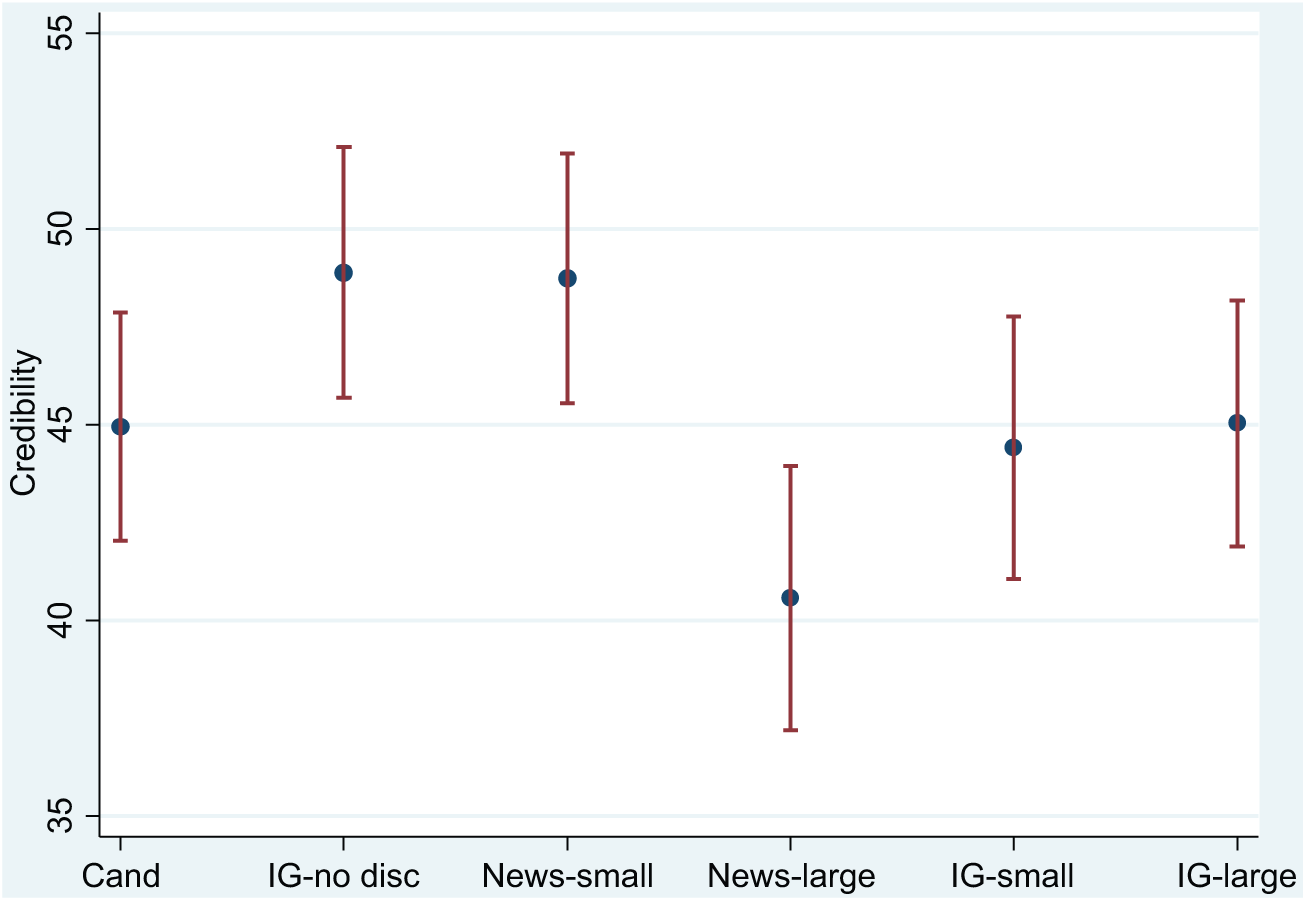
Impact of ad and disclosure type on sponsor credibility.

Impact of ad and disclosure type on sponsor trustworthiness.

Impact of ad and disclosure type on vote choice.
Figure 1 shows that the credibility of the sponsor is highest in Condition 2 (M = 48.89), where respondents saw the group-sponsored ad with no donor disclaimer, and in Condition 3 (M = 47.72), where the news report highlighted the group as a small-donor organization. In both of those conditions, credibility is ranked significantly higher than in Condition 4 (M = 40.57), where the media cued respondents that large donors funded the group.
Figure 2 speaks to the trustworthiness of the sponsor, which was rated lowest in Condition 4 (37.02), when participants were presented the large-donors news story. Trustworthiness in that condition was significantly lower than in all other conditions. Trustworthiness was rated highest in Condition 3, in which participants were given a news story that described the small-donor nature of the sponsoring group, and second highest in Condition 2, in which participants saw a group ad with no disclaimer. That trustworthiness would be lowest in Condition 4—where the news media reported on large donors—is not all that surprising given that the report not only mentions the group’s large donations but donor anonymity as well.
One surprise in these results was that the size of the donor base, when communicated by the group ad disclaimer, had little impact on the perception of the group’s credibility or trustworthiness. Sponsor trustworthiness (42.37 for the small-donor group and 43.55 for the large-donor group) and credibility (44.42 and 45.03, respectively) were essentially unchanged despite different cues about the size of the group’s donor base.
As for pre-to-post changes in the favorability of the targeted candidate (Hanna), the mean decline in his favorability score was 15.86 points, as Table 4 shows. All of the conditions saw declines in Hanna favorability that exceeded 14 points, but the differences across conditions were small. Overall, the ad was quite effective in lowering Hanna favorability.
This is in contrast to changes in reported favorability of Zink, the favored candidate. Zink experienced only modest improvement in his favorability, as Table 4 shows, but experienced virtually no backlash in any of the conditions. The lack of a backlash is not altogether surprising, though, as in all but the candidate-sponsored condition, Zink is not even mentioned. Indeed, this is exactly the point suggested by both Brooks and Murov (2012) and Dowling and Wichowsky (2013). By not drawing attention to the preferred candidate, interest groups can shield him or her from negative judgments.
While Zink does endorse the ad in the candidate ad (Condition 1), he only appears in the form of a small headshot in the bottom corner of the ad. And it was in this condition where respondents claimed the highest percentage of “don’t knows” on the sponsor validation. We will return to this point later, but it seems that variation across ad types (i.e., ad tone or ad content) might be the key to whether candidates sustain any damage to their favorability from negative advertising.
Figure 3 displays the impact of ad condition on vote choice. Recall that support for Zink, the favored candidate, is coded as −1, support for Hanna, the targeted candidate, is coded as 1, and “don’t know” answers are coded as 0. Clearly, the ad condition that moved vote choice the most was Condition 2, the no-disclosure interest group ad. This ad was most effective in moving voters toward Zink, the favored candidate, and away from Hanna, the targeted candidate, and t tests reveal its impact was significantly different from all other groups.
Although the ad does not contain a party cue, the ad is not completely free of ideological perspective as Zink is portrayed as someone fighting for smaller government. Thus, one might expect survey respondents to infer a party label for the candidates and that this party label might condition their responses. To examine this possibility, we used ANOVA on each of the dependent variables, using the treatment condition, the respondent’s party identification (Republican, Democrat, or independent) and their interaction as factors (full results available from authors). The treatment condition remained significant for credibility, trustworthiness, and vote choice. And, as one might expect, partisanship was also significant in each of the five ANOVAs (Republicans rated Zink more highly and were more likely to vote for him). However, the interaction of treatment and partisanship was not significant, suggesting that Democrats, Republicans, and independents reacted similarly to the different ad conditions.
To recap, we had expected to see the following:
The no-disclosure group ad to result in higher levels of sponsor credibility, sponsor trust and support for the favored candidate than the candidate ad. This is generally supported by the data.
The no-disclosure group ad to result in higher levels of sponsor credibility, sponsor trust, and support for the favored candidate than the group ad with the big-donors disclaimer. This is supported for credibility and vote choice, but not for the three other dependent variables.
The group ad with the small-donor disclaimer to result in equivalent or higher levels of sponsor credibility, sponsor trust, and support for the favored candidate than the no-disclosure group ad. This is not supported, in that the unknown group’s ad is actually seen as more credible and trustworthy, and its ad had a stronger effect on vote choice.
The small-donor news report on the group ad to result in higher levels of sponsor credibility, sponsor trust, and support for the favored candidate than all other ads. This is not supported, though the effects of this ad are indistinguishable from the no-disclosure group ad in all respects except vote choice.
The big-donor news report on the group ad to show the lowest levels of sponsor credibility and trust and have the weakest persuasion effects. These expectations are supported for the first two claims but are not found for favorability and vote choice.
Favored candidate evaluations to be lower (i.e., a backlash effect) in the candidate ad condition (and perhaps in the large-donor ad condition). This expectation was not supported.
Discussion
We draw a number of important insights from these results. First, like Weber and colleagues (2011), we show that different ad sponsors have different levels of credibility. When the attack ad was sponsored by the unknown group, the sponsor was rated as much more credible and trustworthy than when it was sponsored by a candidate. Moreover, the unknown group ad was more persuasive than the candidate ad, reducing the favorability of the attacked candidate more than the candidate ad and reducing the probability of voting for the attacked candidate more than the candidate ad. There is strong evidence, then, that the group ad without any disclosure information was more successful than the candidate ad. At the very least, these results serve as an important replication of one major finding of previous scholarship.
At the same time, disclosure did serve to reduce the effectiveness of many of the group-sponsored ads. Even when the group sponsoring the ad was portrayed as a small-donor, grassroots group, the ad was less effective with disclosure in terms of moving people to vote against the attacked candidate. Disclosure also tended to reduce evaluations of group credibility and trustworthiness, unless the disclosure came in the form of a news media report on a small-donor group. We do urge caution in generalizing these findings too far, however, as the group featured in our experiment was fictional and thus completely unknown to anyone.
A key point remains, though: even though disclosure reduced the effectiveness of the group ads, those ads still remained quite effective overall. 15 Some might find it troubling that group ads retain substantial persuasive power—even when the news media or disclaimers reveal that a few wealthy donors fund the group. In the absence of a Supreme Court more favorable to regulations on group funding, the one avenue that seemed fruitful for reducing the effect of large donors was to depress the credibility of the group (in line with Weber and colleagues 2011) or to induce voters to punish candidates that benefit from large-donor groups (in line with Dowling and Wichowsky 2013). Such effects require either a strong and enduring link between evaluations of credibility and persuasion, or a backlash against an ad’s message. Although credibility and persuasion are clearly linked, our results indicate that even when the credibility of the source is diminished (such as the media report of big donors to a group in Condition 4) a group’s advertising can still convince voters to change their opinions of candidates. Sometimes an ad is simply too powerful to ignore, and that holds regardless of the sponsor. In our experiment, we find the effect on vote choice to be roughly the same for the candidate-sponsored ad and group-sponsored ads with disclosure of any form. 16 In other words, disclosure does not, at least in this treatment, make a group-sponsored ad less influential than a candidate one.
Although disclosure only weakens—and does not undermine—the impact of ads sponsored by the unknown, large-donor groups that are currently in the spotlight, disclosure does seem to ameliorate the structural imbalance that favors “dark money” advertising. To the extent that a group’s donor base is made clearer to voters, group-sponsored ads lose some of their persuasive power, resulting in a more level playing field for candidates and groups. There is an important caveat, however. Although one can view candidates and groups as competitors for donors’ cash—most candidates would prefer that donations come to their campaigns—candidates also may steer wealthy donors who can contribute more than the individual maximum to Super PACs that are loosely affiliated with the candidates’ campaigns.
Framing these results relative to candidates ends up being quite important. It is notable that our candidate ad—contrary to the existing literature—did not induce any direct backlash to the sponsoring candidate relative to any of the interest group conditions, with or without disclosure. One advantage of group-sponsored negative advertising, according to recent studies, is that they are more likely to avoid a voter backlash than negative advertising sponsored by candidates. The existing literature seems to suggest, as a result, that candidates are at a structural disadvantage in the post–Citizens United electoral environment. Candidates either lose out because of lower credibility—which is a serious problem for candidates—or because they suffer more frequently from backlashes. A candidate who can leverage the support of super PACs or 501c organizations can have a higher chance of winning because of that. As Brooks and Murov (2012, 404) argue,
. . . candidates have every reason to hope for an unofficial division of labor, in which independent groups that are unaccountable to voters will do the dirty work of running these kinds of harsh attack ads that the candidates would rather not do themselves. To the extent that these kinds of ads can be outsourced to independent groups, candidates can best put themselves in a position to gain the benefits associated with this kind of harsh negative advertising while avoiding the costs.
This suggests that the outcome of elections might hinge on whether groups advertise on behalf of certain candidates. Thus, candidates may find it in their benefit to court outside groups, even to the point of skirting laws that ban coordination with outside groups. Indeed, many employees of super PACs are former associates of the candidates they promote (Skinner, Masket, and Dulio 2013).
Yet, as we demonstrated with our experiment, all negative ads need not result in a direct backlash against the favored candidate. Candidates can go negative and make forceful claims about their opponents without always suffering the ire of voters, though we keep in mind that much research has identified backlash effects of negativity (e.g., Brooks and Murov 2012; Dowling and Wichowsky 2014; Garramone 1985). Perhaps the ad in our experiment resulted in no backlash because it failed to make partisanship sufficiently salient in the minds of participants. Or perhaps the fictional race featured in the ad did not raise sufficient involvement among participants. Future research might examine not simply whether negative advertising results in a backlash but under what conditions backlash is most likely to happen.
Candidates today are competing more with outside groups for voters’ attention. This is true even in the case where candidates and supportive super PACs are closely affiliated (despite not formally coordinating). Candidates would prefer to control the issue narrative of a campaign, even if ads from outside groups are, all else equal, welcome. Competition for voters’ attention may be the true challenge of contemporary elections. One of the driving forces behind the emergence of candidate-centered politics in the second half of the twentieth century was the rise of television and the ability of candidates to speak directly to voters. Such a candidate-centered system is under threat when interest groups can speak as often or more often through political ads. Barring congressional action mandating disclosure, however, our results suggest an important role for the media in helping to draw attention to interest group donors. Exposing a group’s donors may not inoculate voters against an effective appeal from a 527 organization or a super PAC, but it may play an important role in leveling the playing field for candidates.
Footnotes
Acknowledgements
We especially thank Laura Baum, Matt Motta, and Alex Hunt for research assistance. We are grateful to Amber Wichowsky and Michael Wagner for their comments on an earlier version and to the editor and anonymous reviewers for helpful feedback.
Declaration of Conflicting Interests
The author(s) declared no potential conflicts of interest with respect to the research, authorship, and/or publication of this article.
Funding
The author(s) disclosed receipt of the following financial support for the research, authorship, and/or publication of this article: The Wesleyan Media Project’s real-time ad tracking was funded in 2012 through the generous support of The John S. and James L. Knight Foundation, the Rockefeller Brothers Fund and Wesleyan University.
1.
It might seem strange to expect voters to punish a candidate for an attack launched by an unaffiliated group. Indeed, this is the heart of the structural advantage potentially afforded such groups. It should be noted, though, that many groups in current American elections are staffed and run by close associates and former employees of the very candidates they promote.
2.
Working with research staff at the Center for Responsive Politics, we categorized groups into one of three disclosure types: none, partial, and full. Unions were categorized as full disclosure. In some cases, this may not be completely true, as a few unions maintain affiliated 501c4 accounts. As such, the totals from no or partial disclosure groups are likely underestimated.
3.
YouGov uses sample matching to generate representative samples from their panels (see Rivers 2007;  ) and weights certain respondents to ensure a representative sample. For our survey, YouGov interviewed 1,346 people, who were then matched based on gender, age, race, education, party identification, ideology, and political interest, resulting in a final sample of 1,200 participants, which was weighted using known marginals for the general population of the United States from the 2007 American Community Survey.
4.
The wording of the question was, “How much have you heard about the following groups? A lot, Some, or Have not heard of.”
5.
Because the survey was fielded in late October 2012, awareness of these groups should be at a high point. That so few respondents seem familiar with these active groups should make clear the stealth nature of their electioneering.
6.
It is true, however, that by virtue of advertising in a locale, the group may increase knowledge of itself among the public.
7.
As with other online surveys using video, we required respondents to watch a short video and answer questions about what sound was heard and what was pictured. Only respondents correctly answering these questions were allowed to proceed.
8.
The experiment uses “unknown” candidates and sponsors. Although we used the names of real candidates from state senate races (so as to be able to modify an actual ad from one of their campaigns), the two candidates did not run against each other, and they are from different states. The group sponsoring the ad in the study is fictitious.
9.
All of the questions used to evaluate the candidates, ads, and group were randomized so that the 0-to-100 scale either moved left to right or right to left.
10.
Of course, it is possible that receiving news reports about an ad after viewing the ad may have less of an impact because people would not be primed to think about the group’s background.
11.
The text from the grassroots condition was, “There have been a number of ads in the race for the senate seat. One recent ad was sponsored by the Center for American Democracy. According to the group and state campaign finance records, the Center was newly formed in 2010 and is primarily funded by small donors. It has a growing membership of over 800,000 citizens across the country motivated to elect candidates who fight for fiscal discipline in state governments. Members tout the group as a true grassroots organization.”
The large donor condition contained the following text: “There have been a number of ads in the race for the senate seat. One ad was sponsored by the Center for American Democracy. According to the group and state campaign finance records, the Center was newly formed in 2010 and is primarily funded by wealthy donors, including other non-profit groups. Many of these non-profits do not themselves disclose their donor base, leaving voters with very little knowledge as to what interests are behind the group’s larger agenda. Critics have argued that the group is merely a front for larger special interests.”
12.
We did not include a control group in our experiment (a group that saw no ad or an ad with no sponsor) because our key dependent variable is measured both before and after exposure to an ad.
13.
We are ambivalent as to whether a small-donor emphasis will lead to gains over the no-disclosure group. This is partly because there is no guidance in the scholarship about what a small-donor cue means for voters. If it evokes a movement with a broad base, it should be the most credible of all sponsors. But an interest group by definition is nonmajoritarian. As such, at the least it should perform better than a large-donor group.
14.
There is, however, a possible countervailing force, which is people’s general lack of trust in the news media nowadays (Ladd 2012). Furthermore, a hostile media phenomenon has been documented whereby audiences assume that news reports are hostile to their own points of view (), which should serve to reduce the effectiveness of the news.
15.
Two caveats are worth noting. First, the ad we chose for the experiment did not result in direct backlash, but further tests should manipulate the ad itself, to see if one can induce a backlash that depresses the persuasion effects of candidate ads. If so, this would further bolster the point we make above about stronger effects for group-sponsored ads. Second, we tested this ad in a very low-information context. This does mirror many of the elections that voters participate in, but we do not know how these dynamics translate to higher profile congressional and presidential elections.
16.
And, in this case, voters knew nothing about the candidates prior to the experiment. One might particularly worry, then, about the ability of less credible sources to persuade in low-information races.
References
Supplementary Material
Please find the following supplemental material available below.
For Open Access articles published under a Creative Commons License, all supplemental material carries the same license as the article it is associated with.
For non-Open Access articles published, all supplemental material carries a non-exclusive license, and permission requests for re-use of supplemental material or any part of supplemental material shall be sent directly to the copyright owner as specified in the copyright notice associated with the article.
