




Abstract
Do legislators from upper-class backgrounds behave differently from those from humble beginnings? Scholars of representation have made progress understanding the effects of a legislator’s social class on roll-call votes, but ideology is also understood to be shaped during adolescence. Using data from Nicholas Carnes’ White-Collar Government, I find that upper-class members of Congress with working-class parents are significantly more liberal than upper-class members with upper-class parents. This trend is particular to the Democrats; Republican voting records do not significantly differ with respect to parental class. Findings are robust to potential confounders, including race, gender, and district characteristics.
John Edwards’ story is the story of the American Dream—son of a mill worker. My dad was a milk truck driver. My father was a foreign student. He grew up herding goats. . . . In no other country is my story even possible.
Introduction
It is difficult to make it through a campaign event without a reference to the American Dream. Politicians routinely invoke the Dream in speeches, in thirty-second advertising spots, and on their websites. Above all, they aim to convince voters that they are superior stewards of it, often because they have experienced it themselves. If we are to take members of Congress at their word, the predominance of tales of grandparents, parents, and families pulling themselves up by their bootstraps suggests that social-class backgrounds and upward social mobility are primary drivers of legislators’ worldviews.
Although politicians’ humble beginnings are a popular theme in mass politics, little academic work has been devoted to the subject. Scholars have made strides in understanding the relationship between class and the behavior of members of Congress, but less attention has been devoted to the possibility that legislators of a particular social class behave differently based on their experiences during adolescence, just as members of the public do (e.g., Jennings, Stoker, and Bowers 2009). In this paper, I test the association between social mobility and the DW-NOMINATE scores of members of Congress. Because the competing influences of party and ideology are difficult to disentangle from DW-NOMINATE’s ideal points and interest group scorecards, I primarily focus on intra-party differences related to social-class backgrounds.
I begin by briefly reviewing the literature on descriptive and substantive representation in the legislative branch. I draw upon research on the influence of social class and mobility on legislators and the mass public to argue that the effects of social mobility on voters are also likely at work among members of Congress. Finally, I analyze data on the occupations of members of Congress and their parents from Carnes’ (2012, 2013) studies of the effects of legislators’ social class on roll-call votes. Previous research has utilized parental social class as an input variable in addition to legislator social class, neglecting the possibility that the influence of parental class is conditional on the legislator’s class. I find that upper-class members of Congress from working-class upbringings are more liberal than upper-class members who grew up in wealthy families, particularly in the Democratic Party.
Social class and social mobility should be included in two ongoing and related discussions. First, scholars have asked, what is the role of personal characteristics and experiences in substantive representation? And second, how do the social-class backgrounds of Republican and Democratic elected officials affect their behavior? Political scientists have made progress with both puzzles in recent decades, though largely overlooking social class and social mobility as potential causes and consequence of political and economic change. Such an analysis can improve our understanding of representation, redistributive policy, and the role of class and mobility in American politics.
Descriptive and Substantive Representation in Congress
The study of social class and legislative behavior must be understood in the context of the relationship between descriptive (i.e., a representative sharing constituents’ social identities) and substantive representation (i.e., a representative acting upon constituents’ interests). Recent research in political science has demonstrated that descriptive representation in Congress does indeed tend to coincide with substantive representation. The corresponding empirical implications are wide-ranging. The race of a legislator influences his or her voting patterns on civil rights and some economic policies (Grose 2011; Hardy-Fanta et al. 2005), as well as his or her level of action on casework for constituents of different races (Butler and Broockman 2011). Female members of Congress vote more liberally (Vega and Firestone 1995; Welch 1985), and participate more in women’s issues than their male counterparts (Celis and Childs 2008), though the gender gap among Republican legislators appears to have disappeared (Frederick 2009). Other life experiences and social characteristics influence legislators, too: Members of Congress who smoke are less supportive of bans on smoking, and those with children in public school are more likely to oppose voucher-based privatization (Burden 2007). Recent anecdotal evidence from Dick Cheney and Senator Rob Portman (R-OH) even suggests that having an immediate family member who identifies as lesbian, gay, bisexual, or transgender (LGBT) increases a politician’s support for gay rights, at least when such support does not come at a clear political cost. 1 As Carnes (2012) and Burden (2007) note, this is not to imply that members of Congress do not balance other pressures and influences. What these studies consistently show, however, is that legislators’ personal characteristics and experiences greatly affect their representation.
Like race, gender, and personal experience, social class affects descriptive and substantive representation, because individuals internalize the culture and norms of their social class and other identities through a process of socialization (e.g., Green, Palmquist, and Schickler 2002). I hypothesize that, all else equal, legislators who grew up in families with working-class breadwinners will be more liberal than legislators who grew up in well-to-do families.
The measurement of social class has been a topic of heated scholarly debate throughout the twentieth century. 2 One effective measure in this context is occupation. Occupational achievement encompasses other proxies for class, such as education and income. Meanwhile, other class measures tend to be difficult to interpret. As Carnes notes, testing the influence of educational attainment has produced conflicting results (e.g., Kaufmann 2002; Mariani and Hewitt 2008). Although income and wealth dominate public discourse, social scientists tend to find occupation a more accurate measure of socioeconomic status due to its centrality in the socialization of class-based identities and politics, especially in the United States (Hout, Brooks, and Manza 1995; Lareau and Conley 2008; Matthews 1954). At the same time, because occupation is more correlated with education than income, an occupational measure may actually downplay class differences among the public (Griffin and Kalleberg 1981). 3 Yet this is not a major concern for Carnes’ or my work, because the income and net worth of legislators are not particularly variable, 4 and they appear to have a limited effect on members’ votes on the floor of Congress (Carnes 2012). Finally, occupational social class takes into account the changing nature of social class in American society. For instance, during the Jim Crow era, many black Americans with sufficient education to join the upper class instead joined the Postal Service due to obstacles to employment in other industries (Boustan and Margo 2009). Proxies like education and even income would fail to fully account for the legal, social, and other barriers designed to keep marginalized groups out of elite circles.
Empirical work employing occupational measures of social class has yielded compelling results. Members of Congress with backgrounds in business sponsor more pro-business legislation and vote in a more pro-business direction on interest group scales (Witko and Friedman 2008). Recently, Carnes (2012) finds that representatives who were manual or service industry workers vote significantly more liberally than their counterparts, even when controlling for current wealth and income of the member of Congress and variation in district income, race, and ideology. In particular, Carnes (2012, 11) finds that “legislators from different occupational backgrounds differ in ways that mirror class divisions in mass opinion,” with those from working-class jobs being the most liberal, profit-oriented professionals the most conservative, and legislators from “non-profit professions . . . fall[ing] somewhere in between.” 5 I employ this tripartite categorization of occupational social class, separating groups into working-class, non-profit professionals, and profit-oriented upper class.
Social-Class Backgrounds and Political Behavior
As there is little research on the influence of parental class on legislators, it is important to use existing research on the effect of parental class on ordinary voters to inform my theory. The social identities I have hereto discussed are all powerful in influencing the political views of ordinary voters. Like in Congress, there exists a gender gap in the political attitudes of women outside the Capitol, with women again leaning leftward relative to men (Kaufmann and Petrocik 1999; Rosenthal 1995). Race is a powerful determinant of preferences and party affiliation (Bartels 2000; Hero 1992, 1998; Leighley and Vedlitz 1999; Verba et al. 1993), and physical proximity to people of other races may influence voting behavior (Carsey 1995). There is an ongoing debate about the exact effect of household income on voter preferences (Bartels 2008; Gilens 2012; McCarty, Poole, and Rosenthal 2006; Soroka and Wlezien 2008), but occupational social class has persisted as an important influence on political attitudes in the United States (Alford 1963; Hout, Brooks, and Manza 1995).
The effects of an individual’s and his or her parents’ class have often been analyzed through the lens of social mobility. Following de Tocqueville’s ([1835] 2012) conjecture that the higher rates of class mobility of the nineteenth-century United States relative to Europe explained its more limited economic redistribution, sociologists and comparativists focused on the relationship between mobility and attitudes toward redistribution. The experience of social mobility is likely most relevant to beliefs about economic redistribution and social policies like education, which an individual may or may not perceive as critical to his or her experience with social mobility (Piketty 1995).
As membership in a higher social class may exert a rightward pull (e.g., Carnes 2012; Evans 1999), scholars have argued that upwardly mobile individuals end up with intermediate political attitudes that sit between the more liberal influence of their working-class upbringings and more conservative influence of their current upper-class status (e.g., Barber 1971). 6 This suggests that parental class has a liberal effect on those who grew up working class, as I hypothesize. However, there are plausible theories of social mobility as a conservative (e.g., Lipset and Bendix 1959; Parkin 1972; Thorburn 1979) or a liberal influence on political attitudes (e.g., Piketty 1995; K. H. Thompson 1971). The conservative tradition, which emphasizes personal responsibility, and the liberal tradition, which stresses structural equality of opportunity, both employ social mobility as a key concept. Both traditions can speak to individuals who have experienced upward or downward mobility and inter-generational class stability. The upwardly mobile may oppose redistribution because they perceive their gains in social class to be purely a product of their individual initiative. Others with the same experience may favor redistribution because they credit exogenous factors in their rise in social class in addition to their personal choices. It is likely the case that an individual’s political interpretation of his or her story of upward mobility is influenced by one’s particular experiences and parents’ ideology.
Accordingly, socially mobile members of Congress appear ideologically diverse. Representative Dave Loebsack (D-IA), a relative liberal, prominently features his story of upward mobility (from poverty to a professorship in political science) on his website, implying that the experience influenced his political views in the liberal tradition:
Congressman Dave Loebsack, who grew up in poverty and was raised by a single parent, is living proof of how community support can make a difference in people’s lives . . . As a result, Dave has dedicated his adult life to helping people find opportunity and hope. (Loebsack “Biography”)
In stark contrast, Representative Jo Ann Davis (R-VA), who went from a childhood in a trailer park to owning a real estate company, ended up a conservative member of anti-tax and pro-military spending coalitions (di Vincenzo 1997). Comparing the roll-call voting patterns of upper-class legislators from upper-class families with those of upper-class legislators from working-class families can move our understanding beyond anecdotes toward a systematic estimation of the effects of social mobility and parental social class on legislative behavior.
Method
Carnes found weak associations between legislators’ parental social class and roll-call votes when including variables for parental class in a regression that includes legislators’ current class and a party control. The results are driven by the fact that working-class legislators vote much more liberally than upper-class legislators—but in recent years, only a handful of legislators have had working-class careers before entering Congress. Such analysis cannot uncover the potentially conditional influence of social class. Social class may exert a conditional influence in three ways. First, the influence of a legislator’s social class is conditional on his or her parents’ class simply because parents are strong predictors of their children’s social outcomes (e.g., Corak 2013). Second and inversely, the effect of parental class is conditional on the legislator’s class. Differences in family background may have little influence among legislators with working-class careers, but it is possible that corporate lawyers with corporate lawyer parents vote differently than corporate lawyers with working-class parents.
Finally, the effect of social class may be conditional on party. It is plausible that greater party discipline and selection pressures in Republican primaries limit variation in roll-call votes related to a variety of social identities. For instance, although the eight Latino Republican legislators in this sample had significantly more liberal voting records than those of white Republicans, Frederick (2009) finds that gender has ceased to be a significant predictor of voting patterns for the Republicans in recent Congresses. While the party can recruit candidates with humble childhoods for campaign reasons (Sadin 2012), it may be the case that social-class backgrounds explain more variation among Democrats than Republicans.
As with ordinary voters, legislators from working-class family backgrounds are likely to be more exposed to the social safety net during childhood and may have more economically diverse social networks than a similar legislator from a wealthy family. These upwardly mobile legislators should hold attitudes between those of their origin and destination classes. Specifically, like previous research in mass opinion, I hypothesize that among upper-class members of Congress, those with working-class parental backgrounds will have more liberal roll-call voting records than those with upper-class parents. The findings should hold when controlling for race and gender. Upper-class parental backgrounds may lead legislators to live and run for office in wealthier and more conservative districts, but the effect of parental class should be robust to these district characteristics.
I have obtained data denoting the occupations of the 783 members of Congress serving from the 106th through the 110th Congress (1999–2008) from Nicholas Carnes (2013), 7 including the occupations of the members’ parent(s), 8 which Carnes employs in White-Collar Government. Figure 1 displays the distribution of occupations of legislators in the sample (before they entered Congress), and Figure 2 shows their parents’ occupations. Appendix Table A2 reports the results of regression models replicating Carnes’ analysis of the effect of occupational social class on legislators’ DW-NOMINATE scores. 9 Working-class members are the omitted category, and legislators from all other occupations are significantly more conservative. 10
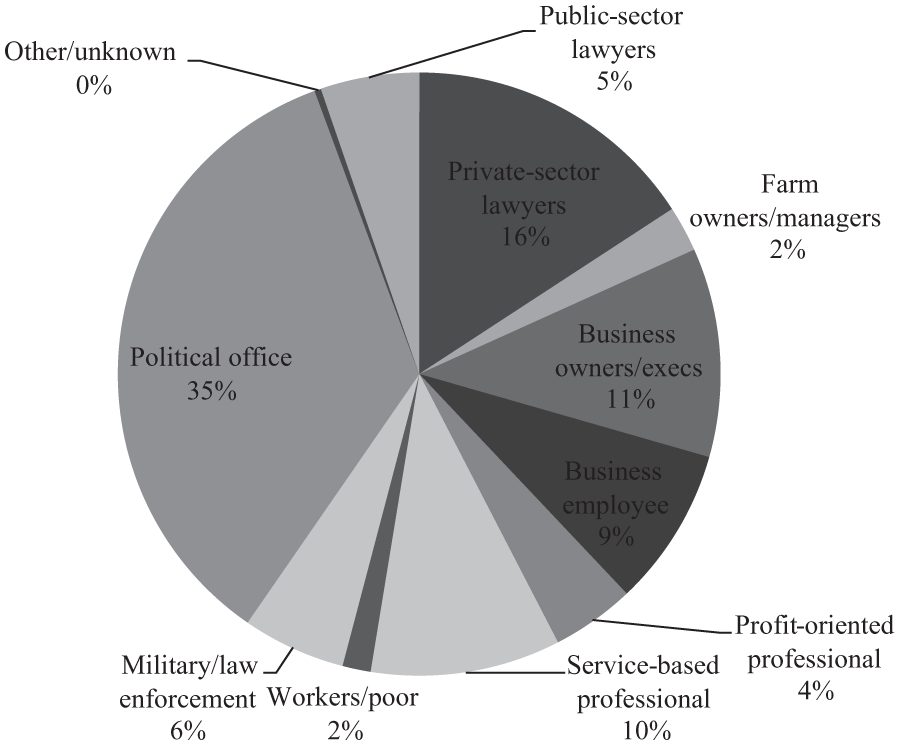
Occupations of members of Congress.

Occupations of parental providers.
Like Carnes, I divide the social classes of legislators into three groups. The first group, the profit-oriented upper class, is not only relatively wealthy but also primarily focused on the maximization of profit. Members of this group are likely to be economically conservative both at home and in the workplace. The second group, non-profit professionals, could also be relatively wealthy. However, while it is plausible that economically successful members of non-profit professions may prefer less redistribution than the working class, their occupational imperatives suggest a countervailing liberal influence. Finally, the smallest group in Congress is the working class, made up of manual laborers, service workers, and union employees. 11
Results
Carnes broadly predicted and found working-class legislators to be the most liberal, followed by non-profit professionals, and finally the upper class. In ordinary least squares (OLS) regressions measuring the effect of legislator and parental class on DW-NOMINATE scores, the effect of parental class vanishes when controlling for legislator partisanship and district characteristics including district median household income and presidential vote share. 12 These regression models are reported in Appendix Table A3. Such models have led scholars to believe that social-class backgrounds have little influence on roll-call votes relative to legislator class—but these models are insufficient to test the conditional influence of parental class on roll-call votes. Further tests should assess whether legislators of the same social class differ based on parental class, and whether that effect differs by party.
A first step toward understanding the conditional effects of parental class is to separate and group legislators by both their own occupational class and that of their family backgrounds. Table 1 displays the mean DW-NOMINATE score of legislators by the occupational class of the legislator and the legislator’s parents. For clarity, NOMINATE scores are rescaled to a range of 0, the most liberal, to 100, the most conservative. An individual is coded based on the occupational class category in which he or she spent the plurality of his or her career prior to entering Congress—in other words, the career in which the individual has spent the most time. 13 The pattern that emerges reflects Carnes’ findings on the effect of social class. However, parental social class also appears to play a role in voting. Legislators from the more elite upper-class professions have noticeably more liberal NOMINATE ideal points when they come from a working-class family. (No members experienced downward mobility to the working class.) 14
Mean DW-NOMINATE Scores by Social Class (N = 2,367).

CI = confidence interval.
Legislators with the same social class (the rows) differ by the social class of their parents (the columns). Critically, the difference between upper-class legislators with working-class parents (the bottom-left cell) and upper-class legislators with upper-class parents (the bottom-right cell) is significant at the p < .001 level in a difference-in-means t-test and an F test of coefficient equality. Non-profit professional legislators from working-class backgrounds (the middle-left cell) are also significantly more liberal than the same legislators from upper-class parental backgrounds (the middle-right cell), at the p < .001 level in a difference-in-means t-test. However, social class may have distinct effects for legislators of different parties, and class may influence party identification and legislative behavior differently. Further investigation is needed to assess voting behavior within each party.
Testing the Effects of Upward Mobility by Party
Descriptively, parental and legislator social class do indeed vary by party. Although the traditional distinction between the Democratic Party as reflecting labor interests and the Republican Party as business interests has become less clear-cut than in the past (e.g., Edsall 1984; Hacker and Pierson 2010; Lounsbury and Hirsch 2010; Vogel 1996), a class differential persists between the parties. Figure 3 displays the mean social class of legislators and parents of legislators from the two parties. Legislators in the Republican Party tend to come from higher parental and personal class backgrounds than do Democrats. In the aggregate, legislator class is greater than parental class for both parties.

Parental and legislator classes by party (1999–2008).
Although to what extent partisan differences in social class are a consequence of working-class liberalism, distinct candidate recruitment patterns, and other pressures is unknown, it is possible that class only influences legislators in their party identification. Because DW-NOMINATE measures partisan consistency, the significant variation I find may only arise from partisan differences in class backgrounds. However, the effects of parental and legislator class could also cause variation in roll-call voting among legislators of the same party.
Table 2 shows the average DW-NOMINATE scores of Democrats by their and their parents’ occupational classes. The top-left cell of working-class legislators from working-class family backgrounds remains unchanged, reflecting the fact that all working-class members of Congress during this time period were Democrats. The other class groups, however, appear much more liberal than those same groups in Congress as a whole (as shown in Table 2). The average NOMINATE score for the most conservative class mobility group, upper-class legislators with upper-class parents, is only 6 units away from the most liberal groups of Democrats. Much of the class-based variation in roll-call votes appears to be occurring between, not within, the parties—but do co-partisans differ based on class?
Mean DW-NOMINATE Scores of Democrats by Social Class (N = 1,172).
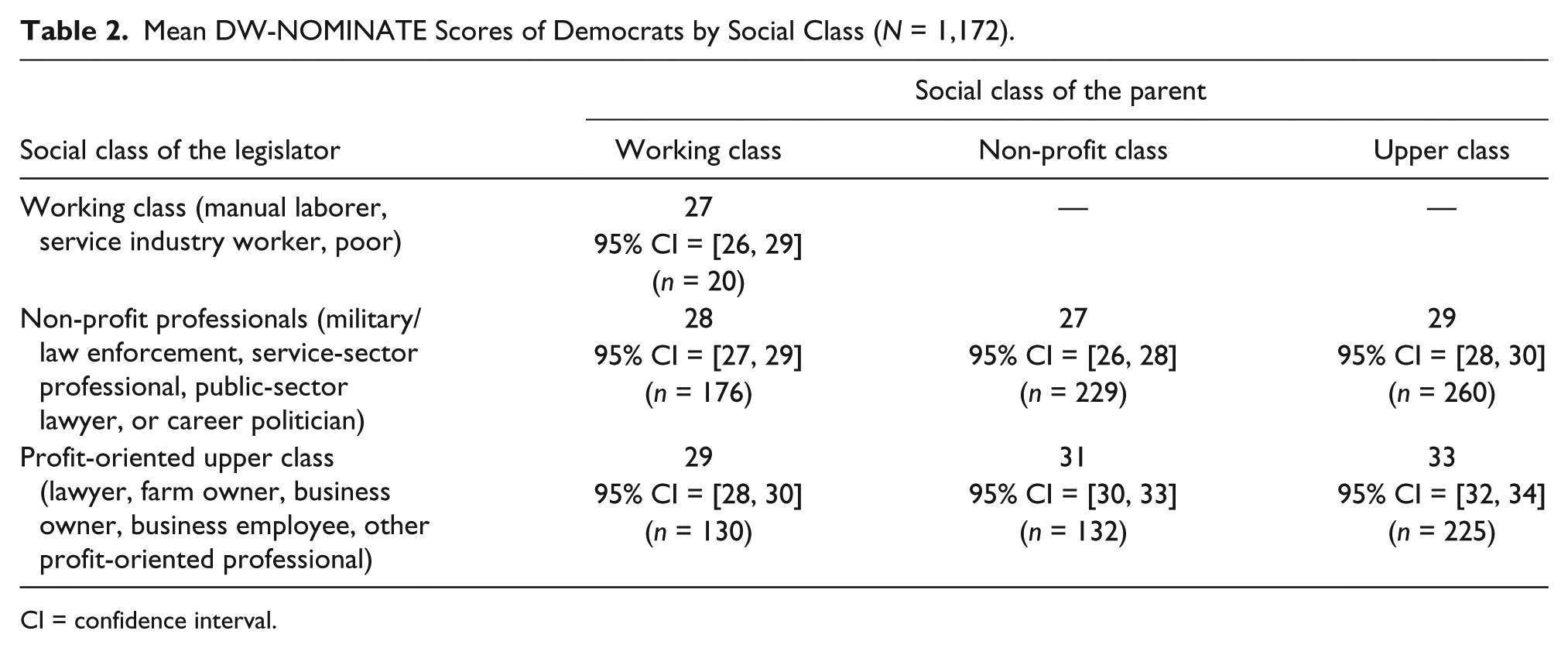
CI = confidence interval.
When restricting our focus to Democrats, a t-test shows that upper-class legislators with working-class parents are significantly (p < .001) more liberal than upper-class legislators with upper-class parents. In fact, the effect of a Democratic legislator’s own class (the rows) is insignificant when his or her parents are working class (the left column). Whereas Carnes finds the action in a legislator’s occupational class, it appears that parental class also influences Democratic roll-call votes. This relationship is more pronounced in roll-call vote scorecards issued by the Chamber of Commerce of the United States (Table 3), which rate legislators from 0 to 100 based on their votes on pieces of legislation important to the business membership of the industry group (with higher scores representing more pro-Chamber voting).
Mean Chamber of Commerce Scores of Democrats by Social Class (N = 1,172).
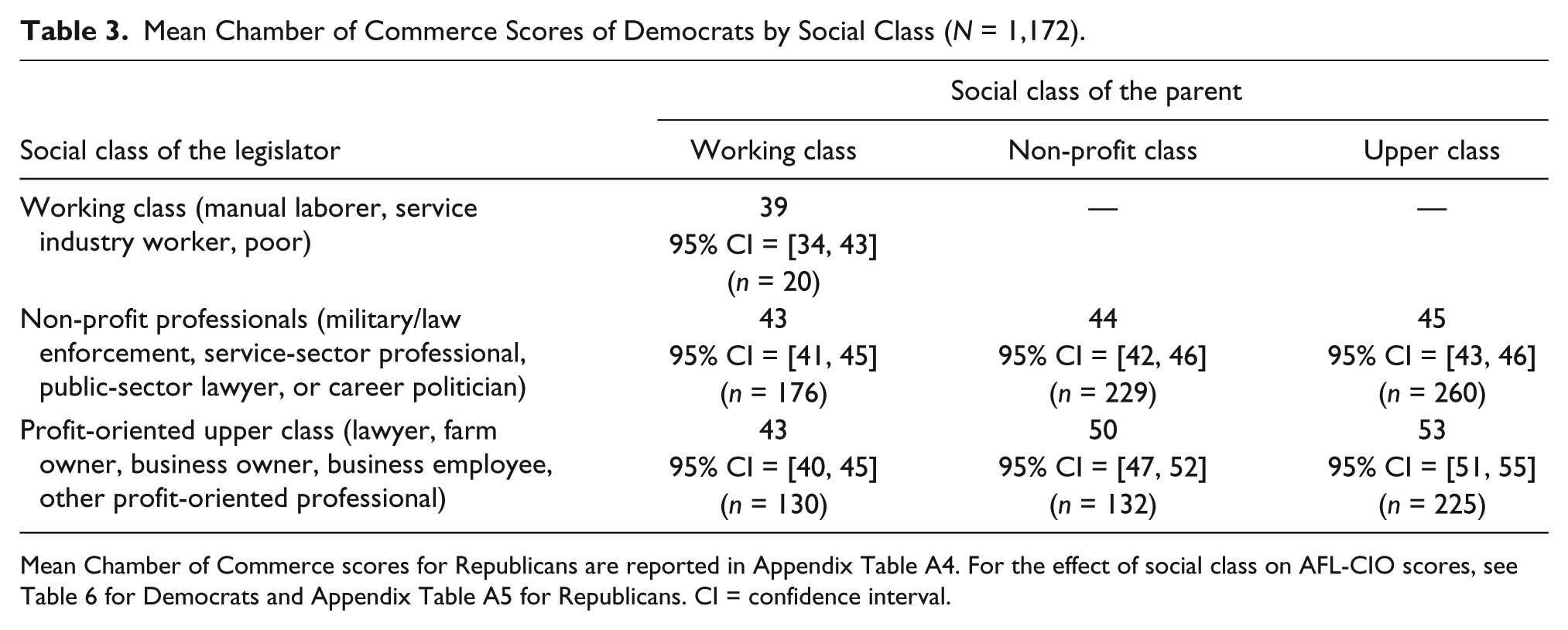
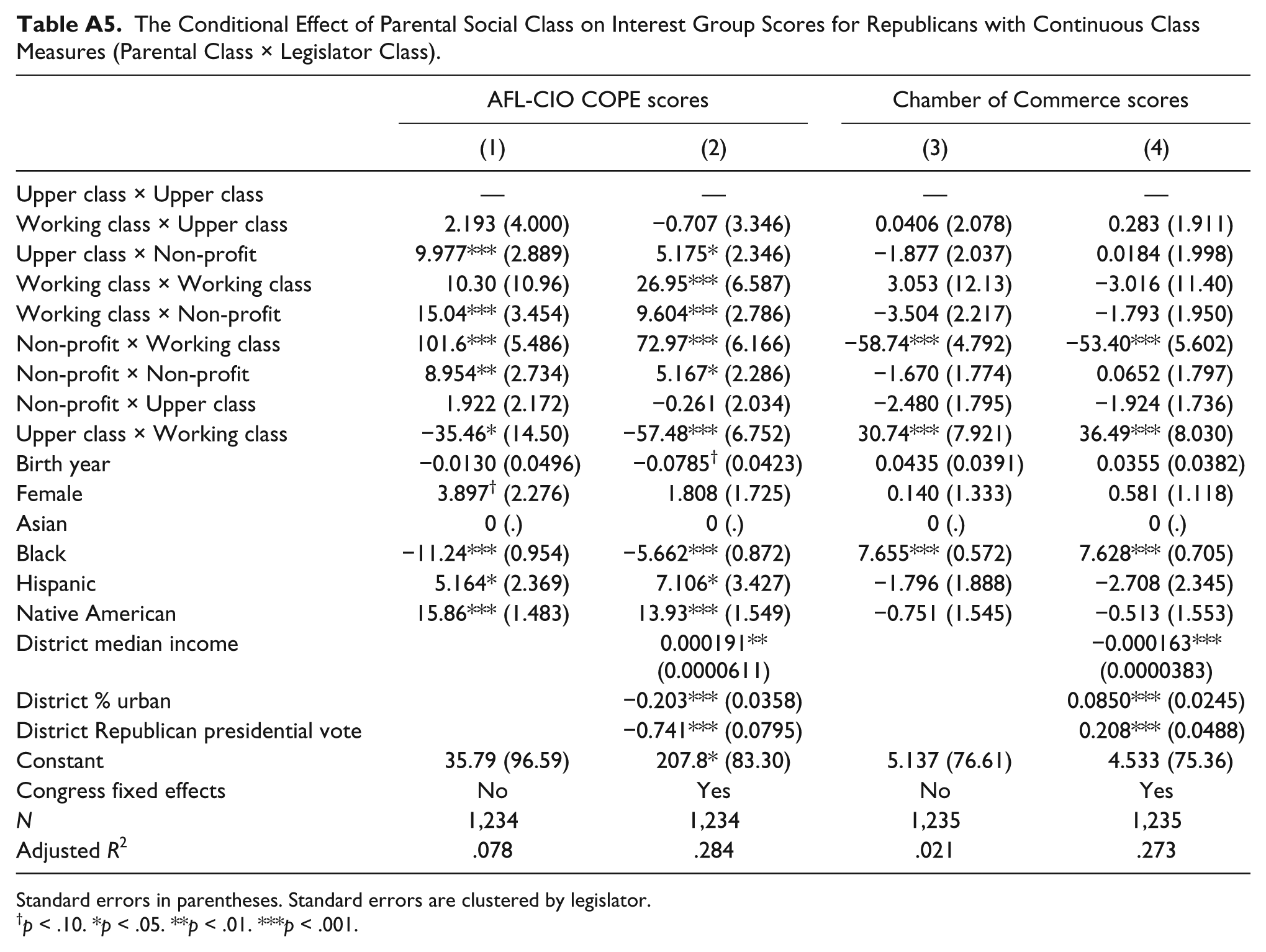
Mean Chamber of Commerce scores for Republicans are reported in Appendix Table A4. For the effect of social class on AFL-CIO scores, see Table 6 for Democrats and Appendix Table A5 for Republicans. CI = confidence interval.
Well known to scholars of asymmetric polarization, the GOP is not the mirror image of the Democratic Party (e.g., Butler 2009; Hacker and Pierson 2006; Mann and Ornstein 2012; McCarty, Poole, and Rosenthal 2006). Indeed, the Republicans in Table 4 appear more unified in their conservative roll-call records than the Democrats in their liberal ones. 15 Most importantly, while non-profit professional Republicans are significantly more liberal than their upper-class counterparts (p < .001), there are no significant effects for parental class.
Mean DW-NOMINATE Scores of Republicans by Social Class (N = 1,184).
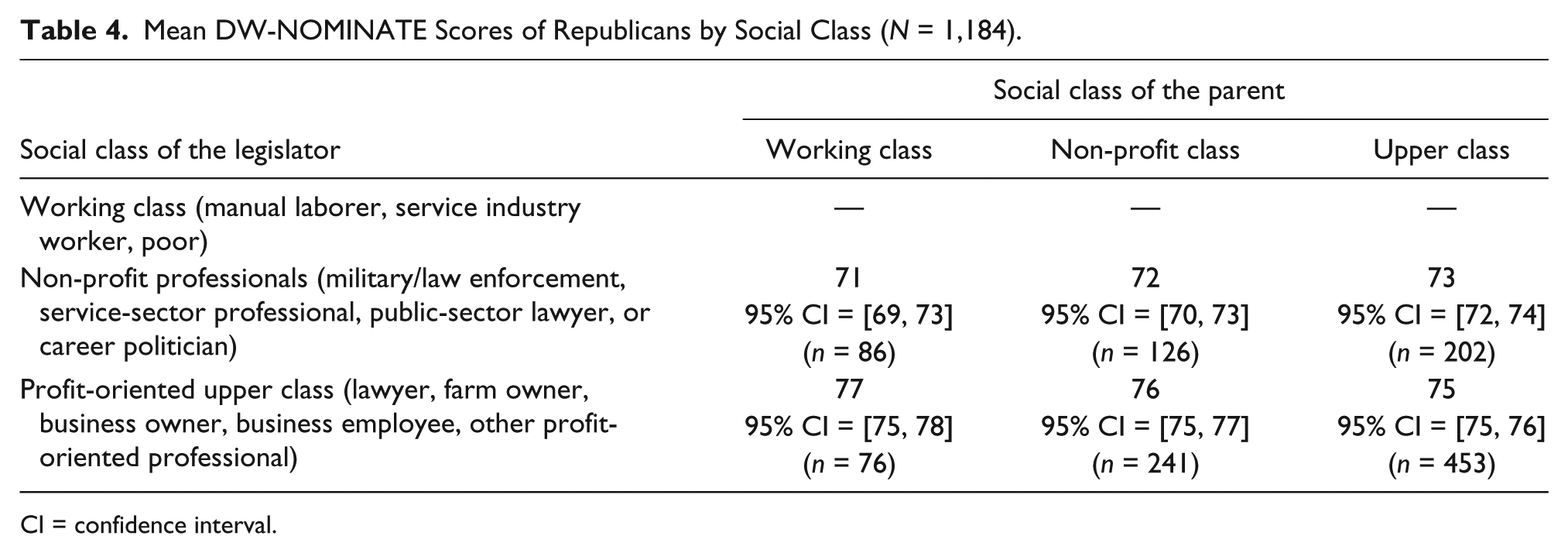
CI = confidence interval.
My hypothesis centered around the theory that among upper-class legislators, those with working-class upbringings would have been more likely to rely on public social programs, perceive redistribution to be beneficial, and see economic success as at least partly the result of processes outside of individual effort. In recent years, Republican office holders have nearly unanimously pursued policy that diminishes the redistributive capacity of the federal government. Disapproval of activist government, the social safety net, and redistribution can be considered a prerequisite of elite membership in the modern GOP. Unlike congressional Democrats, Republicans who make it to federal elective office appear less likely to significantly differ based on their class upbringings.
Robustness to Race, Gender, and Constituency
I have referenced a number of scholars who find that female and non-white legislators tend to have more liberal voting records. In addition, African Americans and Latinos have substantially less wealth and lower incomes than white Americans, and during this period, black and Latino legislators and their parents are disproportionately from the working class. Are my tests of the effect of social mobility picking up racial and/or gender differences that happen to be associated with social class? Although white male legislators (who, of course, have always represented the vast majority of members of Congress) are more conservative than Congress as a whole, white male upper-class legislators with working-class parents are still significantly (p < .001) more liberal than their counterparts with upper-class parents. However, this finding does not hold for non-profit professional members of Congress.
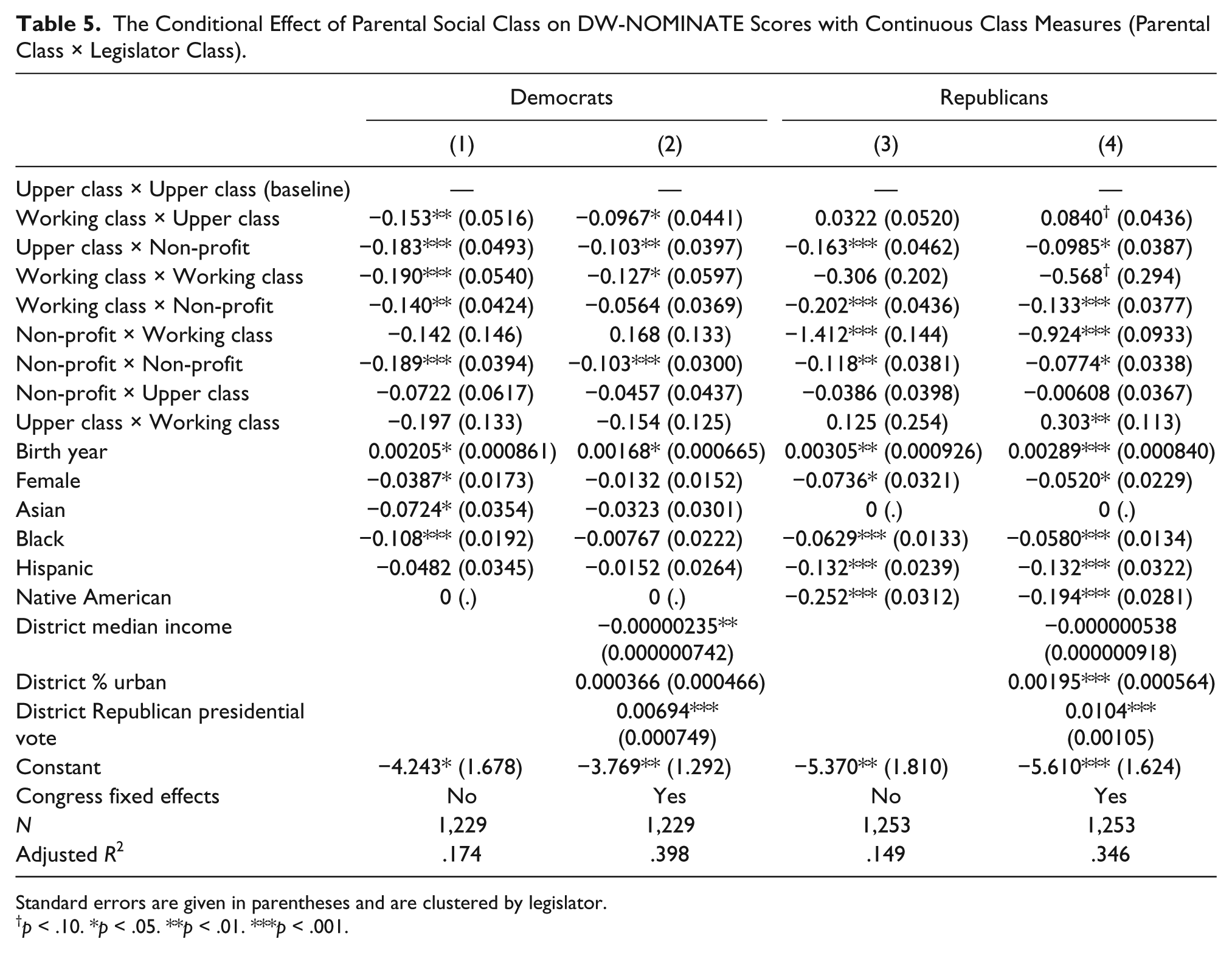
But are intra-party class comparisons robust to race, gender, and constituency? Figures 4 and 5 display the marginal effects of members of Congress (MCs) and parents spending a larger proportion of their career in different social-class groups (see Table 5 for full model specifications). Here I use Carnes’ continuous class measure based on the proportion of time legislators and their parental providers spent in working-class, non-profit professional, and profit-oriented upper-class professional careers. (The discrete class groups discussed thus far sorted individuals based on the class in which they had spent the most career time.) 16 At first glance, it may appear that these models contain interactions without including their constituent variables. However, although the variables are calculated by multiplying two other variables together, I treat the resulting variable not as an interaction but as “essentially a single variable” representing the effect of having a particular combination of parental class and legislator class (see Gill 2001, 2). Each of these class variables corresponds to a cell in the 3 by 3 tables presented earlier. Upper-class legislators with upper-class parents are the baseline category. The effect for “Working class × Upper class” thus represents the estimated effect on voting associated with having a working-class family background relative to an upper-class background—given that the legislator had an upper-class career, herself. 17

Marginal effects correspond to those from Model 2 of Table 5.

Marginal effects correspond to those from Model 4 of Table 5.
The Conditional Effect of Parental Social Class on DW-NOMINATE Scores with Continuous Class Measures (Parental Class × Legislator Class).
Standard errors are given in parentheses and are clustered by legislator.
p < .10. *p < .05. **p < .01. ***p < .001.
These conditional models find support for the main hypothesis among Democrats: upper-class Democrats with working-class parents are significantly more liberal than upper-class Democrats with upper-class parents when controlling for legislator race, gender, and age (p < .01). Significance drops to the p < .05 level with the inclusion of district controls (presidential vote share, median household income, and percent urban), as district household income and Republican presidential vote share are positively associated with the likelihood of having an upper-class legislator with upper-class parents.
The baseline group, upper-class legislators with upper-class parents, was expected to have the most conservative voting records, but this is not always the case. Non-profit Democrats with working-class parents vote more liberally than upper-class legislators with upper-class parents, but the coefficient is statistically insignificant. Working-class Democrats with non-profit parents actually appear more conservative than the baseline group, but this group is substantively insignificant (because for working-class Democrats, less than 1% of parents’ careers were spent in either non-profit or upper-class occupations).
Overall, a working-class parental background was hypothesized to have a liberal influence on voting patterns. However, there are two groups in which the influence of having working-class parents pulls in the opposite direction. First, non-profit Democrats with working-class parents vote more conservatively than non-profit Democrats with either upper-class or non-profit professional parents, though an F test shows that this difference is insignificant. Second, upper-class Republicans with working-class parents vote more conservatively than upper-class Republicans with upper-class parents when controlling for personal and district characteristics, but significance is only at the p < .1 level (see Model 4 of Table 5). As shown in Table 5, being a working-class Republican with upper-class parents also has a significant conservative influence compared with an upper-class Republican with upper-class parents, but again, this combination of occupational backgrounds is substantively insignificant as it represents only 0.2 percent of the GOP sample. No matter their parental class, Republicans with non-profit careers vote more liberally than upper-class Republicans with working-class or upper-class parents, reflecting Carnes’ findings on the effect of a legislator’s own occupational class. 18
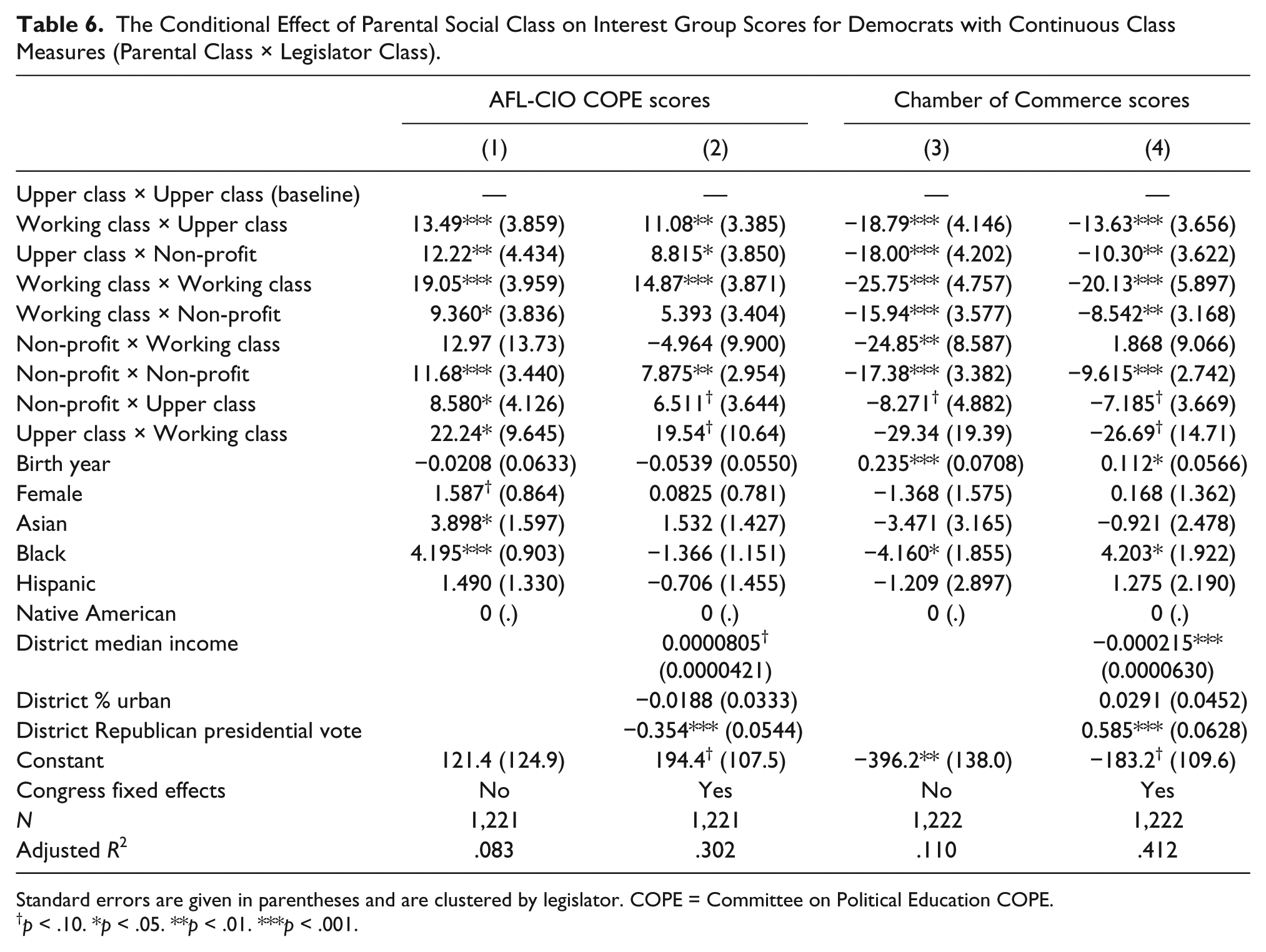
In contrast to the DW-NOMINATE scale, composite scorecards from organized interests like the American Federation of Labor-Congress of Industrial Organizations (AFL-CIO) and the Chamber of Commerce of the United States measure the extent to which legislators vote with the interest groups on votes they consider important to their labor and business constituencies, respectively. Table 6 reports regression models using AFL-CIO’s Committee on Political Education (COPE; Models 1 and 2) and the Chamber of Commerce of the United States (Models 3 and 4) scores as dependent variables, this time only for Democrats. Appendix Table A4 reports the results of these models for Republicans. Here, the difference between upper-class legislators with upper-class parents and upper-class legislators with working-class parents is relatively greater and quite robust when controlling for district characteristics. Note that both scales range from 0 to 100, with higher scores signifying voting more aligned with the group, hence the opposite effect signs in Models 1 and 2 versus 3 and 4. As with NOMINATE scores, there is an unexpected result in which non-profit Democrats with working-class parents vote (insignificantly) more conservatively than non-profit Democrats with upper-class parents.
The Conditional Effect of Parental Social Class on Interest Group Scores for Democrats with Continuous Class Measures (Parental Class × Legislator Class).
Standard errors are given in parentheses and are clustered by legislator. COPE = Committee on Political Education COPE.
p < .10. *p < .05. **p < .01. ***p < .001.
Let us review the findings. Upward social mobility appears to be a strong predictor of the voting patterns of members of Congress. Upper-class Democrats are significantly more liberal when they come from working-class family backgrounds as opposed to upper-class family backgrounds. This relationship is robust to the potential confounders of race, gender, age, and district characteristics. Although upper-class Republicans with working-class parents unexpectedly vote more conservatively than upper-class Republicans with upper-class parents, the relationship is significant only at the p < .1 level. As Carnes finds, non-profit professional Republicans are more liberal than those from the profit-oriented upper class, but upward mobility from a working-class parental background appears inconsequential for the GOP.
Conclusion
Family backgrounds matter. Among legislators from profit-oriented upper-class careers—the majority of recent members of Congress—those with working-class upbringings are significantly more liberal in their roll-call votes. These upwardly mobile legislators are more likely to have utilized public social programs and benefited from redistribution, and they may be less likely to see upward mobility as purely a function of lifting oneself up by the bootstraps. Their social networks may be more diverse in terms of income and wealth. While not as liberal as legislators from working-class occupations, upwardly mobile legislators may find issues of poverty, full employment, social welfare, and inequality more salient than those from upper-class family backgrounds. Memories of a working-class upbringing may help legislators hold more accurate views of the realities of American economic life, as evidenced by Mitt Romney’s assertion that “middle income is $200,000 to $250,000,” a range that actually represents the top 2 percent of earners (Blodget 2012).
The supply and demand sides of the causal chain are difficult to disentangle: parental social class likely can cause legislators to make their homes in wealthier and more conservative districts (supply), but wealthy and conservative districts also tend to recruit and elect conservative upper-class legislators (demand). If the supply-side story is much more consequential than the demand side, the inclusion of district characteristics like household income in statistical analysis could be considered post-treatment bias.
In addition, conservative views may make an individual more likely to select profit-oriented upper-class professions in the first place. Parents are key influences in the development of an individual’s political ideology, so parental providers’ decisions to pursue profit-oriented upper-class careers may reflect conservatism as well. This conservatism could be passed along to the child without much intervening influence of occupational social class. Especially when an individual comes from a politicized family, the effects of parental ideology and party identification are substantial (Green, Palmquist, and Schickler 2002; Jennings, Stoker, and Bowers 2009). However, as of yet there has been no systematic inquiry into the ideology and party ID of the ancestors of members of Congress. The interaction of parental political attitudes and parental social class may be an important predictor of how legislators could perceive and translate their inter-generational class mobility or stability into political attitudes in the “funnel of causality” of voting behavior (Campbell et al. 1960).
The influence of social class in Congress may go beyond roll-call votes. Because a working-class parental background implies lower social and economic capital to draw upon, upwardly mobile individuals could also be more effective careerists than individuals from upper-class dynasties all else equal. As many members of Congress loan their own campaigns large sums of money, do candidates from some social-class backgrounds have an advantage in fund-raising and winning elections in general?
There thus remain important questions about social mobility, parties, and elections. All working-class members of Congress between 1999 and 2008 were Democrats, as were the majority of those with working-class parents. The Democratic Party may (intentionally or unintentionally) recruit more upwardly mobile candidates than the GOP, which may in turn improve the party’s electoral prospects (Sadin 2012). Is the likelihood of being recruited by a major political party dependent on social class and social mobility? With the American Dream playing such a dominant role in political appeals, one could expect parties to place a premium on potential candidates with stories of upward mobility above those from upper-class dynasties. This fits into the ongoing trend of racial and gender-based diversification of congressional candidate recruitment in pursuit of electoral victory. As the parties represent distinct interests in American politics (Bartels 2008; Bawn et al. 2012; Hacker and Pierson 2006), do they operate differently with respect to candidates’ social-class backgrounds?
While this is but an initial foray into the effect of social mobility on legislative behavior, my analysis suffers from limitations. The dependent variable in this study, a scale based on roll-call votes, represents but one part of legislative behavior (Hall 1996), and the policy agenda is endogenous. In addition, with scholars going so far as to mark the “declining political significance of social class” (Clark, Lipset, and Rempel 1993), the dearth of literature on social class and mobility in political science limits discussion of the intricacies of social class in the American context.
Although it is beyond the scope of this paper, scholars may wish to compare across all Congresses of the postwar period to determine if a trend in the social mobility of members may have played a role in the inequality-inducing American social and economic policy of recent decades. Are legislators more or less likely to come from socially mobile families than ordinary citizens? Has this trend changed over time, and has it affected substantive representation in matters of economic policy? Do the “concentric circles” comprising different levels of constituencies differ for legislators who experienced inter-generational mobility (Fenno 1978)?
Footnotes
Appendix
The Conditional Effect of Parental Social Class on Interest Group Scores for Republicans with Continuous Class Measures (Parental Class × Legislator Class).
| AFL-CIO COPE scores |
Chamber of Commerce scores |
|||
|---|---|---|---|---|
| (1) | (2) | (3) | (4) | |
| Upper class × Upper class | — | — | — | — |
| Working class × Upper class | 2.193 (4.000) | −0.707 (3.346) | 0.0406 (2.078) | 0.283 (1.911) |
| Upper class × Non-profit | 9.977*** (2.889) | 5.175* (2.346) | −1.877 (2.037) | 0.0184 (1.998) |
| Working class × Working class | 10.30 (10.96) | 26.95*** (6.587) | 3.053 (12.13) | −3.016 (11.40) |
| Working class × Non-profit | 15.04*** (3.454) | 9.604*** (2.786) | −3.504 (2.217) | −1.793 (1.950) |
| Non-profit × Working class | 101.6*** (5.486) | 72.97*** (6.166) | −58.74*** (4.792) | −53.40*** (5.602) |
| Non-profit × Non-profit | 8.954** (2.734) | 5.167* (2.286) | −1.670 (1.774) | 0.0652 (1.797) |
| Non-profit × Upper class | 1.922 (2.172) | −0.261 (2.034) | −2.480 (1.795) | −1.924 (1.736) |
| Upper class × Working class | −35.46* (14.50) | −57.48*** (6.752) | 30.74*** (7.921) | 36.49*** (8.030) |
| Birth year | −0.0130 (0.0496) | −0.0785 † (0.0423) | 0.0435 (0.0391) | 0.0355 (0.0382) |
| Female | 3.897 † (2.276) | 1.808 (1.725) | 0.140 (1.333) | 0.581 (1.118) |
| Asian | 0 (.) | 0 (.) | 0 (.) | 0 (.) |
| Black | −11.24*** (0.954) | −5.662*** (0.872) | 7.655*** (0.572) | 7.628*** (0.705) |
| Hispanic | 5.164* (2.369) | 7.106* (3.427) | −1.796 (1.888) | −2.708 (2.345) |
| Native American | 15.86*** (1.483) | 13.93*** (1.549) | −0.751 (1.545) | −0.513 (1.553) |
| District median income | 0.000191** (0.0000611) | −0.000163*** (0.0000383) | ||
| District % urban | −0.203*** (0.0358) | 0.0850*** (0.0245) | ||
| District Republican presidential vote | −0.741*** (0.0795) | 0.208*** (0.0488) | ||
| Constant | 35.79 (96.59) | 207.8* (83.30) | 5.137 (76.61) | 4.533 (75.36) |
| Congress fixed effects | No | Yes | No | Yes |
| N | 1,234 | 1,234 | 1,235 | 1,235 |
| Adjusted R2 | .078 | .284 | .021 | .273 |
Standard errors in parentheses. Standard errors are clustered by legislator.
p < .10. *p < .05. **p < .01. ***p < .001.
Acknowledgements
The author wishes to express his gratitude to Nick Carnes for his gracious provision of data and scholarly encouragement. The author thanks seminar instructor Rob Van Houweling, as well as Gabe Lenz, Eric Schickler, Sean Gailmard, and David Broockman for input and guidance. The author also appreciates helpful comments from graduate students in the Department of Political Science at University of California, Berkeley.
Author’s Note
Please contact the lead author for replication data availability.
Declaration of Conflicting Interests
The author(s) declared no potential conflicts of interest with respect to the research, authorship, and/or publication of this article.
Funding
The author(s) received no financial support for the research, authorship, and/or publication of this article.