




Abstract
This study examines the relationship between political discussion on Facebook and social network location. It uses a survey name generator to map friendship ties between students at a university and to calculate their centralities in that network. Social connectedness in the university network positively predicts more frequent political discussion on Facebook. But in political discussions, better connected individuals do not capitalize equally on the potential influence that stems from their more central network locations. Popular individuals who have more direct connections to other network members discuss politics more often but in politically safer interactions that minimize social risk, preferring more engaged discussion with like-minded others and editing their privacy settings to guard their political disclosures. Gatekeepers who facilitate connections between more pairs of otherwise disconnected network members also discuss politics more frequently, but are more likely to engage in risk-tolerant discussion practices such as posting political updates or attempting political persuasion. These novel findings on social connectedness extend research on offline political discussion into the social media sphere, and suggest that as social network research proliferates, analysts should consider how various types of network location shape political behavior.
Informal political discussion is central to the marketplace of ideas and the democratic process (Mutz 2006). A growing literature examines the role of social networks in political discussion (e.g., Gil de Zúñiga, Jung, and Valenzuela 2012; Morey, Eveland, and Hutchens 2012; Moy and Gastil 2006; Valenzuela, Kim, and Gil de Zúñiga 2012), but questions about how network roles and context affect those discussions remain unaddressed. That research shows, for example, that individuals with more social connections discuss politics more often, but it is unclear whether this is equally true of different types of network locations, and how those relationships between network location and political discussion might manifest in various discussion venues. It is also understood that individuals who are located more centrally in a social network can influence more network members while those who are not as central have less structural influence (Borgatti, Everett, and Johnson 2013; Prell 2012). It is not clear, however, whether or not individuals discuss politics in ways that capitalize on their network-based potential to influence others.
This study examines the extent to which political discussion relates to individuals’ network locations, addressing effects on both discussion frequency and discussion practices. In the data analysis, we first calculate individuals’ centralities in an offline friendship network of college students. As social media increasingly facilitate political discussion and offer numerous communication options (Fernandes et al. 2010; Gil de Zúñiga, Jung, and Valenzuela 2012; Vitak et al. 2011), we then examine these students’ political discussion practices in the context of Facebook. We show that two variants of social network location—indegree centrality and betweenness centrality—positively predict political discussion frequency, but matter differently for how individuals engage in political discussion. Although both types of centrality endow individuals with greater potential for exerting political influence, indegree centrality predicts more risk-averse discussion practices, whereas betweenness centrality predicts more risk-tolerant practices.
Social Networks and Political Discussion
Whereas a sizable literature examines how the social networks around individuals relate to political discussion, studies have not yet accounted fully for how social network locations relate to political discussion. Research shows that social networks contextualize the role of personality and demographics in political discussion (Hibbing, Ritchie, and Anderson 2011), and that network size, tie strength, and network heterogeneity are important correlates of political discussion. Specifically, political discussion network size relates positively to discussion frequency (Moy and Gastil 2006). This association replicates online: the more people individuals talk with online, the more they engage in technology-mediated political acts, such as e-mailing politicians and posting on political blogs (Gil de Zúñiga, Jung, and Valenzuela 2012; Valenzuela, Kim, and Gil de Zúñiga 2012). Individuals tend to discuss politics and express political disagreement with strong-tie rather than weak-tie alters, although political discussion can take place with both (Morey, Eveland, and Hutchens 2012). And heterogeneous discussion networks—typically measured in terms of demographic or political diversity—are often associated with greater political mobilization offline and online (Eveland and Hively 2009).
Within this literature, the relationship between network location and political discussion remains underexamined because studies typically use the egocentric approach to measure social networks (e.g., Eveland, Hutchens, and Morey 2013; Gil de Zúñiga, Jung, and Valenzuela 2012; Huckfeldt, Johnson, and Sprague 2004; Mondak et al. 2010; Morey, Eveland, and Hutchens 2012; Mutz 2006). This is a useful strategy for testing theories focused on direct social ties because it assesses only the immediate networks that surround isolated individuals (i.e., egos). By deemphasizing the indirect ties that connect egos into a broader social network, the egocentric approach does not allow for the analysis of location within a larger network (Marin and Wellman 2011). The whole-network approach, in contrast, maps both direct and indirect ties between multiple egos in a single network. This allows analysts to understand how individuals fit into the web of social connections that surround them. For example, a whole-network approach shows how well connected certain individuals are in comparison to others in a community or to what extent they link disparate clusters of network members.
The present research focuses on the relationship between political discussion and two variants of network location, that is, network centrality. Centrality is used to understand not only locations in network structures but also how these locations privilege some members with potential social influence while disadvantaging others (Borgatti, Everett, and Johnson 2013; Freeman 1979; Prell 2012). Indegree centrality reflects the size of an individual’s network of direct connections. Analysts commonly treat it as representing individual popularity and capacity for direct personal influence in a network. Betweenness centrality indicates how much an individual brokers the shortest path between two other network members, meaning, to what degree an individual connects the otherwise disconnected. Betweenness centrality is commonly understood in social network research as the ability to be an influential gatekeeper between individuals who cannot directly influence each other. In this research, we examine how these two types of network locations differentiate political discussion practices.
While centrality stems from individual attributes and the behaviors they dictate (Marin and Wellman 2011), it also can shape communication practices. The finite set of actions and scripts in which individuals habitually engage as they interact and communicate with others shapes and maintains their network locations. But network centrality is not simply a stand-in for its demographic, psychological, or behavioral correlates; rather, centrality denotes a unique structural capacity to influence by virtue of where one is located in a network (Klein et al. 2004). Those higher in indegree centrality have greater potential to influence because they have more direct social ties. Those higher in betweenness centrality have a greater capacity for influence because they straddle structural holes in networks, that is, spaces that lack a direct tie between two alters (Borgatti, Everett, and Johnson 2013; Prell 2012).
We may expect centrally located individuals to engage in political discussions in ways that capitalize on their influential network locations. Compared across isolated egocentric networks, individuals with more social links and more heterogeneous links have more frequent political discussions, presumably because of their central, hub-like network positions (Eveland, Hutchens, and Morey 2013). It is unclear, however, whether the same is true for individuals who are central relative to other members of their networks. It is possible that when the larger context of a network is taken into account via a whole-network perspective, the more central members of a network do not always take the lead in discussing politics and influencing others. It may be that different types of network centrality relate individuals to political discussion in divergent ways.
Specifically, individuals with high indegree or betweenness centrality may not discuss politics in a manner consistent with their influential network positions because maintaining high centrality involves managing social risk. As politics can be divisive and talking politics is risky in settings that comingle those of disparate political orientations (Mutz 2006), individuals with high indegree centrality may engage in political discussions differently than those with high betweenness centrality. High indegree centrality requires wide social approval and popularity (Borgatti, Everett, and Johnson 2013; Prell 2012), and may favor low-risk communication practices. Achieving and maintaining high indegree centrality demands being outgoing and engaged, but that prominence imposes social constraints such as greater pressure to adhere to social norms to preserve one’s status (Valente and Fujimoto 2010). Given the potential divisiveness of politics, those who disclose political preferences are more likely to fragment their social networks than those whose politics are private. Thus, those with high indegree centrality may retain extensive network connections by being sociable while avoiding political divisiveness.
Meanwhile, individuals with high betweenness centrality connect otherwise unconnected or less directly connected network members. They act as gatekeepers by bridging those gaps, exerting influence over information flows in the network (Borgatti, Everett, and Johnson 2013; Prell 2012). Linked to a diverse subset of network members, those with higher betweenness centrality may be accustomed to negotiating disparate views within their networks, and they may be more tolerant of socially risky communication practices. They also may have a greater false sense of consensus in the network (Flynn and Wiltermuth 2010). In all, they may be less concerned than other network members about the social ramifications of engaging in political discussion.
In sum, individuals with high indegree centrality or high betweenness centrality may not approach political discussions in the same manner and thus capitalize equally on their influential network locations. Although both types of individuals may engage in political discussion more often than less well-connected persons, those high in indegree centrality may be less likely to embrace the social risk inherent in those discussions, whereas those high in betweenness centrality may be more tolerant of that risk. We consider next the associations between these centrality variants and political discussion practices on Facebook.
Political Discussion Practices on Facebook
Offline–Online Connection
Individuals’ general offline political discussion tendencies likely correspond to their political discussion tendencies on Facebook because Facebook relationships and behaviors replicate and extend non-Facebook relationships and behaviors. Although Facebook connects users with both strong- and weak-tie alters, users interact the most with their closest offline friends, their strongest ties (Jones et al. 2013). The social networks individuals construct on Facebook reflect the breadth and diversity of users’ offline networks (Birnbaum 2013; Hogan 2010; Litt 2013; Mehdizadeh 2010; Pempek, Yermolayeva, and Calvert 2009; Reich, Subrahmanyam, and Espinoza 2010; Robinson 2007). Young adults, especially, use social networking sites such as Facebook as supplemental tools for communicating with offline social ties (Jones et al. 2013; Mehdizadeh 2010; Reich, Subrahmanyam, and Espinoza 2010; Subrahmanyam and Smahel 2011; Vitak et al. 2011).
Growing evidence shows that users’ Facebook communication behaviors reflect their offline communication tendencies. These communication habits include information disclosure (Sheldon 2013) and political engagement (Macafee and De Simone 2012; Vitak et al. 2011). In general, individuals avoid creating online personas that are substantially different from their offline selves because they treat social media platforms as reflections and extensions of their offline selves (Birnbaum 2013; Grasmuck, Martin, and Zhao 2009; Hogan 2010; Litt 2013; Pempek, Yermolayeva, and Calvert 2009; Reich, Subrahmanyam, and Espinoza 2010; Robinson 2007). In line with this literature, we suggest that individuals’ locations in their college friendship network extend into their Facebook conduct and are reflected in their political discussion practices on Facebook.
Discussion-Stimulating Practices
In addition to a conventional measure of political discussion frequency, we focus on two sets of Facebook-specific political conversation practices—discussion-stimulating practices and response practices—that may relate to users’ network centralities. The first of these reflects common strategies for negotiating boundaries of shared information in networks, including “granting access and making disclosures,” “selective access and disclosure,” and “withdrawing and withholding” (Parks 2011, 373). Facebook users can stimulate discussion with political self-disclosure in status updates or by “liking” political pages. Both actions broadcast users’ political preferences to their friends’ newsfeeds.
Because disclosure is more likely when individuals anticipate supportive responses (Wyatt, Katz, and Kim 2000), uncertainty about others’ politics increases disclosure-related risk. Facebook users may prefer to engage in safe disclosure, which involves limiting political talk to friends whose politics are either known or consonant. Users also can employ targeted disclosure to increase disclosure support and minimize social risk by tailoring their privacy settings to block individual friends or subgroups of friends from viewing their political information.
Facebook users also can attempt to persuade their online friends. Attempted persuasion is more socially risky than self-disclosure as it suggests that others’ opinions are undesirable, creates oppositional and potentially unfriendly situations, and can make the target of attempted persuasion feel unwanted social pressure (Dillard and Knobloch 2011). Online political persuasion, however, is used infrequently (Vitak et al. 2011).
How does network centrality relate to these discussion-stimulating practices? As discussed, having more friends requires broader popularity and social approval. Accordingly, individuals with high indegree centrality likely engage in practices that yield a large number of social ties while minimizing social risks that might harm those connections. We expect that those high in indegree centrality (Hypothesis 1a [H1a]) will discuss politics more frequently on Facebook than those with low indegree centrality, given that larger personal networks positively relate to political discussion frequency (Gil de Zúñiga, Jung, and Valenzuela 2012; Moy and Gastil 2006; Valenzuela, Kim, and Gil de Zúñiga 2012). However, we expect that to reduce social risk in those discussions, higher indegree centrality individuals will be more concerned about managing boundaries around their political disclosures. Thus, they will be less likely to (Hypothesis 2a [H2a]) disclose political information on Facebook in ways that are more visible to their broader friendship networks, and more likely to prefer and engage in (Hypothesis 3a [H3a]) safe disclosure and (Hypothesis 4a [H4a]) targeted disclosure. They also will be more concerned about being offensive, and thus (Hypothesis 5a [H5a]) less likely to attempt political persuasion.
Concern about risk in political discussion may not be as pressing for high–betweenness centrality individuals. As discussed, they are used to gatekeeping structural holes between diverse and unconnected alters, and so may be more tolerant of social risk. Thus, we expect that those high in betweenness (Hypothesis 1b [H1b]) discuss politics more frequently than those low in betweenness, and (Hypothesis 2b [H2b]) are more likely to make political disclosures. They will also prefer and engage in (Hypothesis 3b [H3b]) less safe disclosure and (Hypothesis 4b [H4b]) targeted disclosure. And by brokering relationships, those with high betweenness will be more likely to present new information to those they connect and to convince them of its accuracy. Thus (Hypothesis 5b [H5b]), they will be more likely to attempt persuasion.
Discussion Response Practices
Rusbult (1987) identified four strategies for dealing with dissatisfaction in relationships: voice, loyalty, neglect, and exit. Facebook options for responding to political disclosure parallel these ideal types, and this typology may be applied to both agreeable and disagreeable communication. Voice and loyalty represent constructive practices (Rusbult 1987) that either continue political discussion or at least do not halt it. Facebook users can agree or disagree with a friend’s political opinion by posting a reply, thus allowing continued political conversation. Short of publicly voicing their positions, Facebook users also may practice loyalty to friends by following their links or by examining causes promoted by them.
Neglect and exit reflect conversationally destructive practices. Users may stop a friend’s attempt at political discussion and mute the online relationship by hiding the friend’s updates from appearing in their own newsfeeds. Users also may exit the relationship by unfriending, which means removing an individual from one’s friend list. Facebook users consider blocking and unfriending to be viable responses to Facebook statements that violate perceived standards of politeness, with blocking being appropriate for less severe violations than unfriending (Peña and Brody 2014). Users may engage in both constructive and destructive responses to increasingly connect with those who are politically consonant (Bello and Rolfe 2014).
Individuals in prominent network positions likely behave in ways that maintain these positions. Those higher in indegree centrality are likely to sustain their relationships and their prominent positions. Those higher in betweenness centrality also behave in ways that preserve a large and diverse network of connections. Thus, we expect that both (Hypothesis 6a [H6a]) indegree and (Hypothesis 6b [H6b]) betweenness centrality will be positively related to constructive Facebook responses. Conversely, as destructive responses harm network connections (Hypothesis 7a [H7a]), indegree and (Hypothesis 7b [H7b]) betweenness centrality will be negatively related to destructive political discussion practices on Facebook.
Method
Data
In 2010, we surveyed 5,726 students at The College of William & Mary, a medium-sized public U.S. university, about their social ties to other students, politics, and Facebook use. All students on the college master e-mail list were sent invitations with links to a web-based survey. Reminders were sent every two to three days for two weeks using varied participation appeals. As a response incentive, participants were eligible for a drawing for one of fifty $10 gift cards. We then targeted nonrespondents 1 by shortening the survey to network tie measures and demographics. The participation rate was 50.51 percent. 2
To map the student network, a name generator asked for the “names of up to five of your closest friends who attend” the university. This language is common in name generators used to construct general friendship networks made up of generic strong friend ties (Marsden 2011). In pretest focus groups and cognitive interviews we conducted, subjects consistently interpreted “closest friends” to mean “best friends.” Respondents were not asked to think specifically about offline or online communication in reporting their closest friends.
Name generators are the standard tool for measuring network links in surveys, and have been included in the American National Election Studies (ANES), the General Social Survey (GSS), the Framingham Heart Study, and Add Health, among others. Most past work on political discussion in networks is based on name generator data (e.g., Huckfeldt and Sprague 1995; Lake and Huckfeldt 1998; McClurg 2003; Mutz 2006; Sokhey and Djupe 2013). An objection to name generators is that they truncate network ties (Eveland, Hutchens, and Morey 2013), but capping respondents at five names is typical, especially when measuring ties in large networks (Marsden 2011). Indeed, limiting generators to just three names is common in such research. Because the average American using an uncapped name generator names between two and five close friends (Brashears 2011), caps such as ours are appropriate for measuring close friend networks.
Alternatives to capped name generators are impractical in large networks such as ours (i.e., N > 5,000). Although students can be asked to rate their relationship with every network member using an exhaustive list, or be given an uncapped name generator (Eveland, Hutchens, and Morey 2013), in large networks, both approaches are susceptible to respondent fatigue. In addition, some respondents may satisfice unlimited name generators by listing just a few close ties while others meticulously list even mere acquaintances. This can yield inequivalent networks that analysts nonetheless would treat as equally representing the universes of close alters. Thus, a three-to-five name limit ensures a standardized set of “close friends” across respondents.
The name generator yielded a dominant friendship cluster comprising 86.94 percent of the university’s students. An additional 7.43 percent of the students were in several dozen substantially smaller clusters. As is typical in social network analysis, we calculated centrality scores for individuals in the dominant cluster. We then assessed the relationships between these centrality scores and political communication practices on Facebook. Given the research cited above on social media networks mimicking offline friendship networks, we felt confident that the name generator data provided leverage over our respondents’ Facebook dynamics.
Measures
Centrality
Name generator links were used to quantify centrality scores of students in the largest network cluster. Indegree centrality was measured as the total number of alters that named each ego as a friend, bounded 0 to (N – 1), M = 4.67, SD = 2.80, reasonably proxying network popularity because higher scores require having other network members naming one as a friend. Betweenness centrality represented how much respondents connected otherwise directly unconnected individuals (standardized 0 – 1, 3 based on undirected ties; M = .002, SD = .004 4 ; see Prell 2012 for calculation details). Indegree and betweenness centrality correlated at a moderate .45, showing these to be distinct concepts that may relate to unique behavior patterns. 5
The longer survey version containing Facebook behavior items was not completed by all respondents; some respondents only answered the network and demographic items in the shorter survey. The following dependent variables are based on responses from 22.83 percent (N = 1,307) of the university’s students, those who completed the longer survey.
Political discussion (H1a/b)
Respondents indicated their frequency of discussing politics publicly on Facebook (from 1 = never to 5 = very often). They were cued to report public displays that may generate discussions on the site, such as status updates or posted links. See the online appendix (at http://prq.sagepub.com/supplemental/) for wording, coding, and descriptive statistics for all survey questions.
Self-disclosure (H2a/b)
Three types of political disclosures were dichotomously assessed: liking the official campaign page of a candidate in a recent local election, completing the “political views” field of one’s Facebook profile, and posting status updates about politics.
Safe disclosure (H3a/b)
Those who reported discussing politics publicly on Facebook at least “occasionally” were asked about typical discussion partners in those exchanges. First, we assessed closeness of partners, including “just family and close friends,” “any friends or acquaintances,” and “anyone, including people I do not know.” Second, we assessed partner opinion, including people who “generally agree with me,” “I don’t distinguish,” and people who “generally disagree with me.” Respondents also ranked their comfort level discussing politics with those they disagreed with and then those whose opinions they did not know.
Targeted disclosure (H4a/b)
Two dichotomous items assessed whether respondents engaged in blocking behaviors to prevent certain Facebook friends from seeing political content in their profiles: blocking specific friends from seeing parts of one’s profile (e.g., liked pages, “About” section) and blocking specific friends from seeing status updates.
Attempted persuasion (H5a/b)
Two dichotomous items assessed persuasive practices. First, respondents who reported liking political Facebook pages were presented with a checklist of possible reasons they liked those pages. Our interest was in one reason: “to influence the opinions of friends.” Second, respondents reported whether they posted an Election Day get out the vote (GOTV) message on Facebook supporting a candidate in a recent local election.
Constructive responses (H6a/b)
Three constructive responses to disclosures were assessed. Students reported a typical reaction to a friend’s political status update, regardless of whether they agree with the content of the update, including: skip it, read it, and both read it and then either comment on it or like it. They indicated a typical reaction when friends post political news or links, regardless of whether they agree with the content of those links, including: skip over it, read it quickly without usually following the link, and both read it and usually follow the link. They also reported if they have visited the Facebook page of a “candidate, group, cause, or something else political” because they saw that a friend had liked it on Facebook.
Destructive responses (H7a/b)
Destructive responses were measured with four dichotomous items: hiding someone’s status updates for posting too much about politics, hiding someone’s updates for posting political views contrary to the respondent’s views, unfriending someone for posting too much about politics, and unfriending someone for posting political views contrary to the respondent’s views.
Controls
All models controlled for academic year to proxy the limited variance of age and years of education, economic status, sex, race, frequency of Facebook use, general political interest, turnout propensity, partisanship, partisan strength, ideology, and ideological strength. Per Mondak et al.’s (2010) treatment of personality and political behavior, models included conscientiousness, extroversion, and openness measured via the Ten-Item Personality Inventory.
Results
Political Discussion Frequency
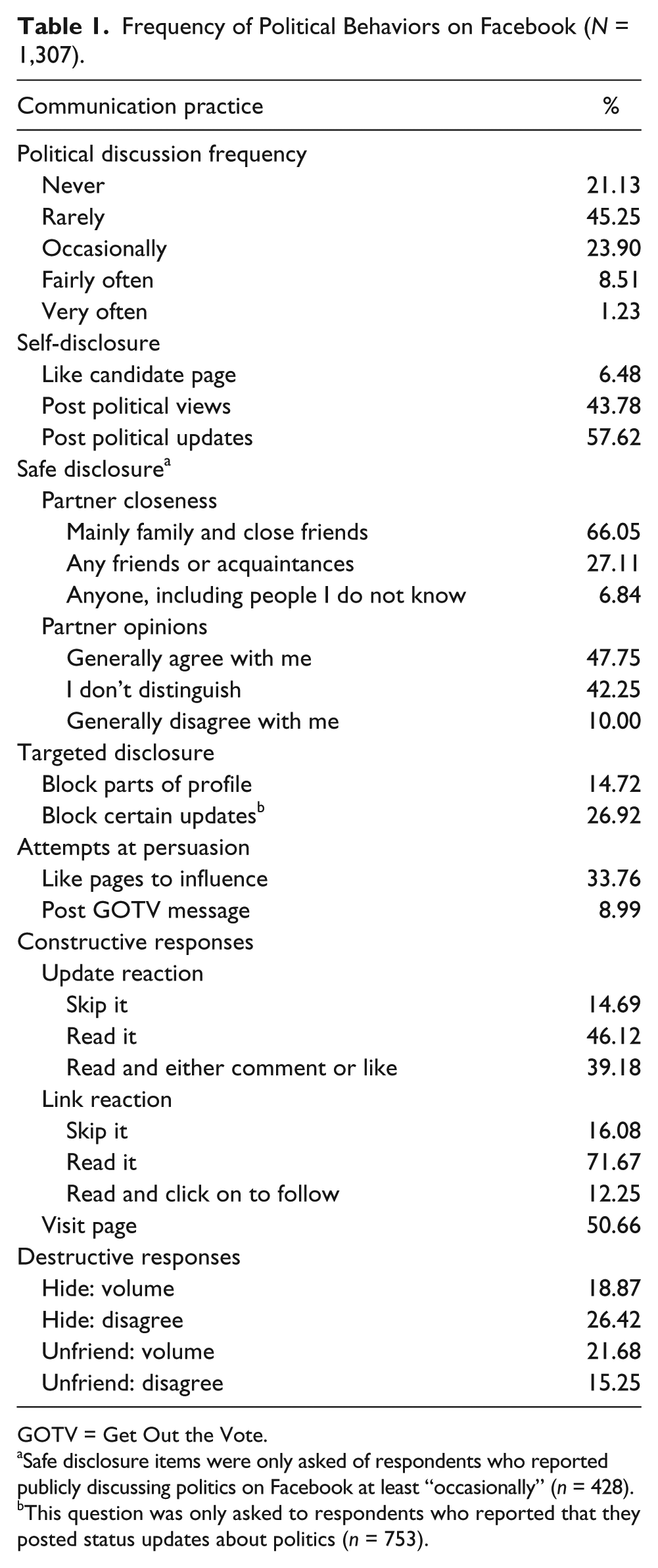
Table 1 reports frequencies for the political discussion practices measured in this study. Although our sample is a case study of one network, its discussion frequencies do not differ in a consistent direction from similar self-reports by general population samples in Pew studies (Rainie and Smith 2012; Smith 2011). Compared with Pew data, our participants engaged in discussion practices either at lower (e.g., liking candidate pages, posting GOTV messages) or similar rates (e.g., blocking/unfriending over politics, commenting on others’ political updates). Only for posting political updates did our participants report a higher rate than Pew’s general population sample. It is impossible to infer whether differences in these rates stemmed from college network peculiarities or question wording differences between this study and the Pew surveys. In all, no clear bias is evident in this network’s political discussion frequencies.
Frequency of Political Behaviors on Facebook (N = 1,307).
GOTV = Get Out the Vote.
Safe disclosure items were only asked of respondents who reported publicly discussing politics on Facebook at least “occasionally” (n = 428).
This question was only asked to respondents who reported that they posted status updates about politics (n = 753).
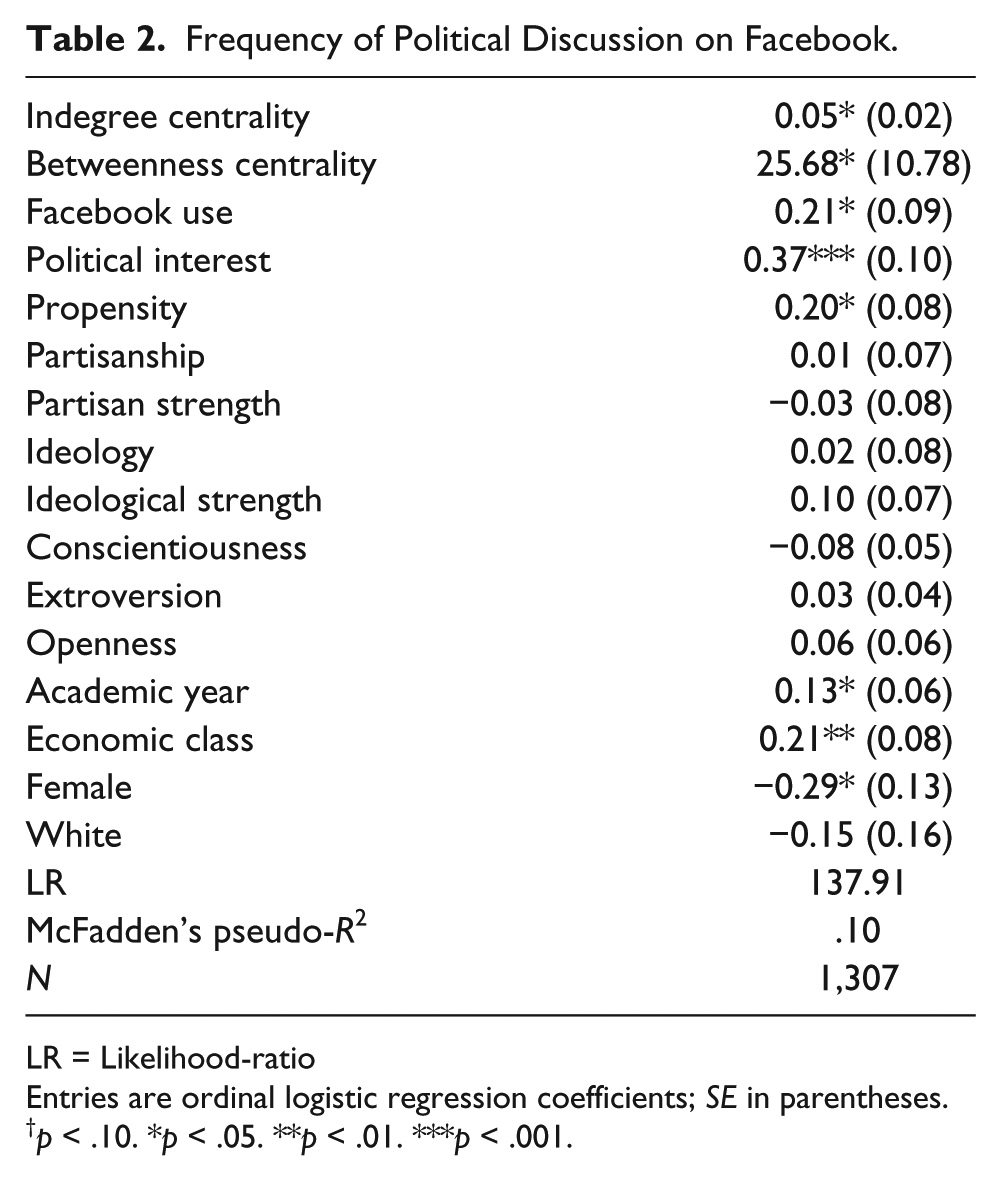
We predicted that indegree (H1a) and betweenness (H1b) centrality would relate positively to political discussion frequency on Facebook. Table 2 models discussion frequency as a function of the centralities and the control variables. Both centrality variants predicted greater frequency. Thus, the more friends one had in the network or the more one connected disparate individuals, the more often one talked about politics on Facebook. Moving from ±1 SD on indegree centrality (roughly 2 to 8 friends) increased the total probability of discussing politics on Facebook at least “occasionally” by 17.39 points (23.73 percent to 41.12 percent), all other predictors at their means. A similar shift in betweenness yielded an increase of 13.88 points (26.09 percent to 39.97 percent). Social connectedness generally, then, was tied to more frequent use of social media for political talk, supporting H1a and H1b.
Frequency of Political Discussion on Facebook.
LR = Likelihood-ratio
Entries are ordinal logistic regression coefficients; SE in parentheses.
p < .10. *p < .05. **p < .01. ***p < .001.
Partisanship and ideology were largely insignificant predictors in the models across our analysis. Their interactions with both indegree and betweenness centrality were also consistently insignificant and excluded from the final models. Thus, the centrality relationships reported here were not conditional on political predispositions, nor did those predispositions differentiate discussion practices. And although other controls reached statistical significance in certain models, we focus our analysis on the centrality variants as they are the core of our theory.
Practices That Stimulate Political Discussion
Despite their similar association with political discussion frequency, the two centrality variants did not correspond to the same political discussion practices. We expected higher indegree centrality to be associated with risk-averse practices but higher betweenness centrality to predict greater acceptance of social risk. We tested the effect of centrality on four sets of practices that could stimulate political discussion on Facebook: self-disclosure (H2a/b), safe disclosure with close or politically consonant partners (H3a/b), targeted disclosure through blocking (H4a/b), and attempted persuasion (H5a/b). Table 3 models these communication practices as a function of centrality and control variables.
Discussion-Stimulating Facebook Practices.
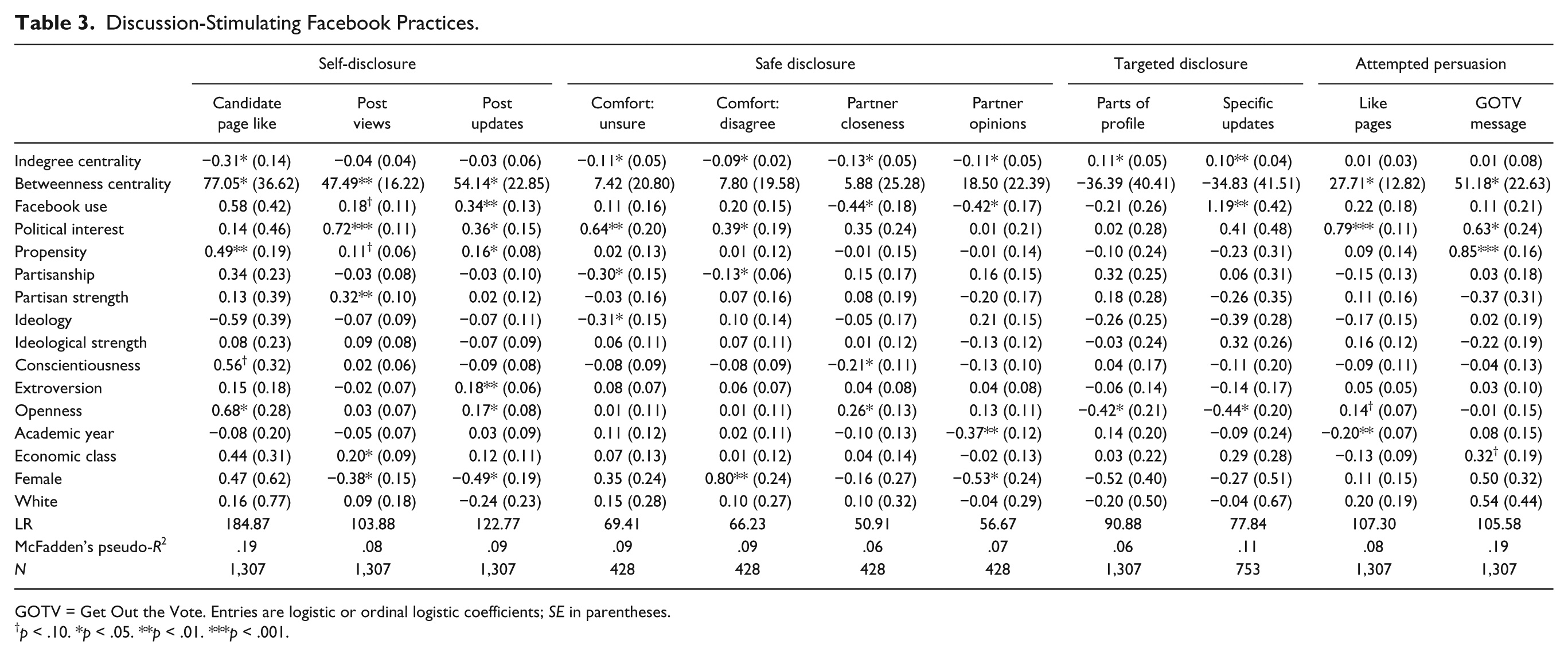
GOTV = Get Out the Vote. Entries are logistic or ordinal logistic coefficients; SE in parentheses.
p < .10. *p < .05. **p < .01. ***p < .001.
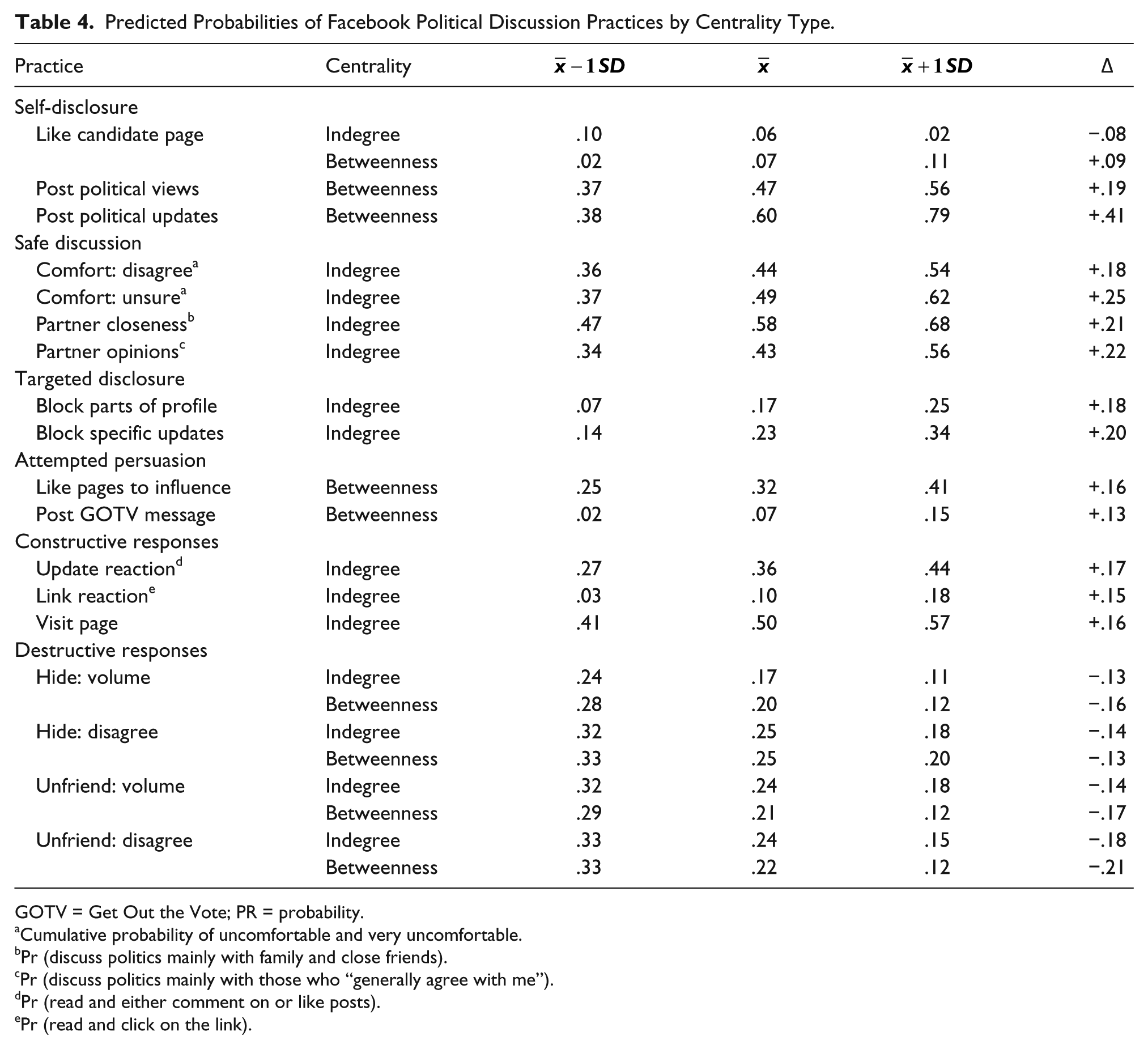
Table 4 gives predicted probabilities of discussion practices for models in which indegree or betweenness centrality were significant. These were calculated at ±1 SD from the mean of each measure, with the total probability change for each 2 SD shift shown in the last column.
Predicted Probabilities of Facebook Political Discussion Practices by Centrality Type.
GOTV = Get Out the Vote; PR = probability.
Cumulative probability of uncomfortable and very uncomfortable.
Pr (discuss politics mainly with family and close friends).
Pr (discuss politics mainly with those who “generally agree with me”).
Pr (read and either comment on or like posts).
Pr (read and click on the link).
Self-disclosures were some of the most common political activities students engaged in on Facebook. While only 6.48 percent liked the campaign page of a local election candidate, about 40 percent listed their political views and nearly 60 percent posted political status updates. Betweenness centrality consistently predicted making disclosures, with associated probability changes ranging from 9 percent to 41 percent for a 2 SD increase in this centrality. This supported H2b. We also posited that higher indegree centrality would predict a decreased likelihood of self-disclosure (H2a). This was true only for liking campaign pages. It was also the only discussion practice for which indegree and betweenness centrality worked significantly against one another. The typical pattern, instead, was for one centrality variant to be significant in the expected direction and for the other variant to be “correctly” signed per our hypotheses but statistically insignificant. Thus, even though indegree and betweenness centrality did not generally pull respondents in different directions on the same discussion practices as we posited, their effects did support our general hypothesized pattern of indegree centrality relating to risk aversion in political discussion and betweenness centrality relating to risk acceptance.
Although the data did not fully support H2a, further results supported the idea that indegree centrality was tied to socially safer discussion practices. Higher indegree centrality respondents were less comfortable with risky political discussions. Compared with those at −1 SD indegree centrality, respondents at +1 SD were 24.87 percent more likely to feel uncomfortable talking about politics publicly on Facebook with those whose political views they did not know, and 17.68 percent more likely to feel this way about talking with those with whom they disagreed (total respective probabilities of 56.68 percent and 48.40 percent). Betweenness was unrelated to discomfort, suggesting less psychological impetus for high-betweenness respondents to censor their public online discussion.
For conversation partner selection, respondents at +1 SD indegree centrality had a 66.47 percent chance of discussing politics only with family and close friends and a 53.84 percent likelihood of discussing primarily with others who agreed with them politically. These probabilities were about 20 percent higher than those of respondents at −1 SD on indegree centrality. This supported our expectation about safe disclosure in H3a. Although the expected negative relationship for betweenness in H3b was not supported, the lack of a significant association did differentiate indegree and betweenness centrality in the context of safe discussion.
Targeting political disclosures was not the norm among respondents, as only 14.72 percent blocked friends from sections of their profiles and 26.92 percent blocked specific updates. Comparing respondents on indegree centrality, those at +1 SD were about 20 percent more likely to block friends from seeing both specific sections of their profiles and specific status updates because of political considerations than those at −1 SD. Figure 1A illustrates these indegree centrality effects as an example of the centrality relationships in Table 4. These results supported the tailored disclosure hypothesis for indegree centrality (H4a), but not the negative expectation for betweenness (H4b).

Examples of centrality effects on discussion-stimulating Facebook practices.
Attempted persuasion was positively tied to betweenness centrality, reflecting a greater acceptance of risk and supporting H5b. Students with higher betweenness scores were more likely to say that they liked Facebook pages as a means to influence others. Those at +1 SD on betweenness were 16.21 percent more likely to select this as a reason for liking pages than those at −1 SD. Betweenness had no relationship to other reasons for liking political pages: learning about candidates or groups, getting political news, or “showing support, regardless of whether my friends pay attention or not.” Betweenness was also positively related to posting a GOTV status update. Figure 1B illustrates these betweenness centrality effects. In contrast, indegree centrality had no relationship to either indicator of attempted persuasion. H5a was not supported.
Political Discussion Response Practices
We expected indegree and betweenness centrality to be related similarly to response practices (H6a/b–H7a/b). Table 5 presents models testing this expectation, predicting discussion response practices as a function of centrality and the control variables.
Facebook Political Discussion Response Practices.
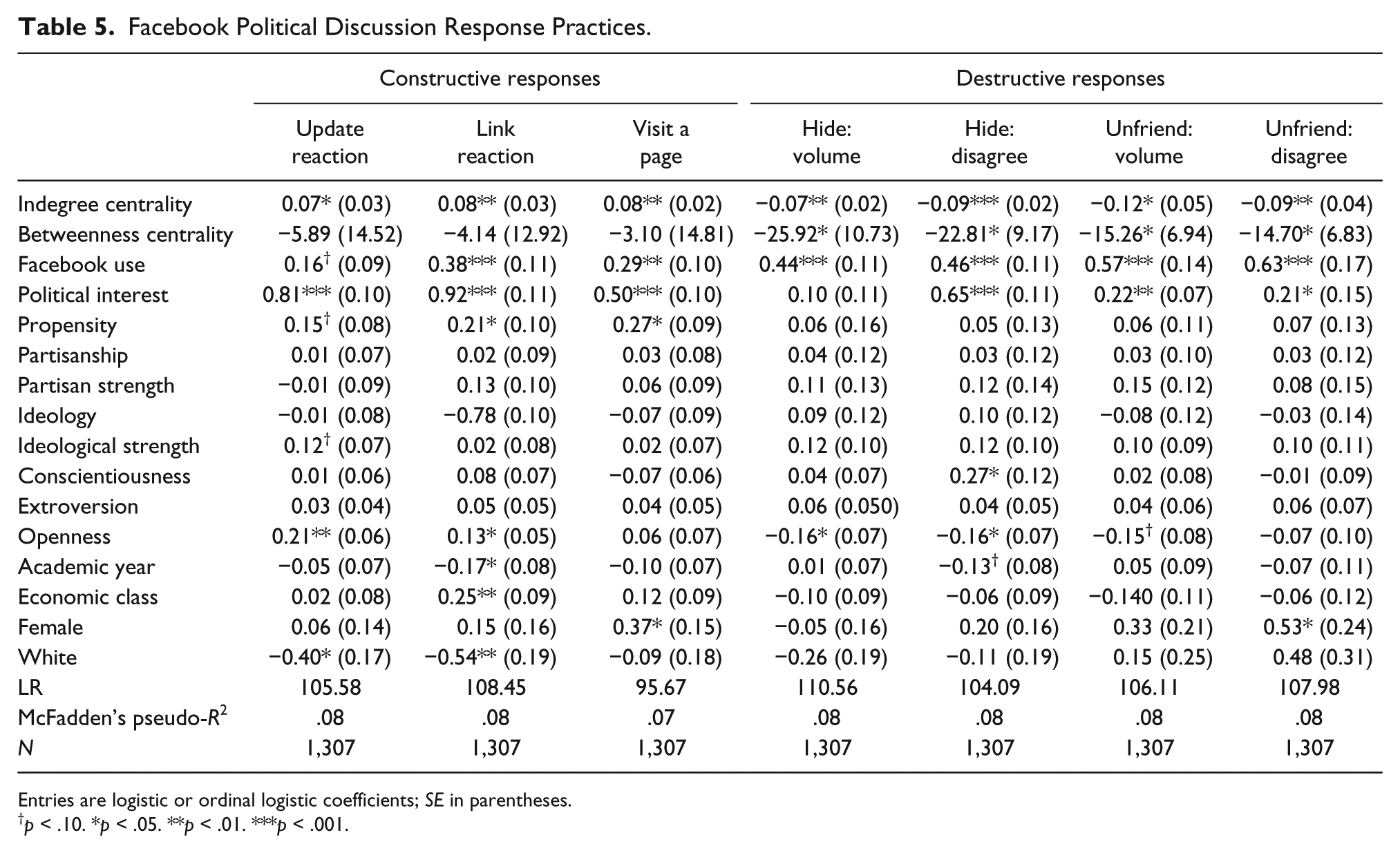
Entries are logistic or ordinal logistic coefficients; SE in parentheses.
p < .10. *p < .05. **p < .01. ***p < .001.
H6a was supported but H6b was not. Indegree centrality was a consistent positive predictor of constructive responses. 6 Comparing respondents at ±1 SD indegree centrality, there was a 17.01 percent difference in the predicted probability of reading and either commenting on or liking a friend’s political post. The comparable differences were roughly 15 percent for visiting a political Facebook page because a friend liked it, and for reading and clicking on a friend’s political link. When they chose to engage with others’ political disclosures, those with more friends were more likely to respond in ways demonstrating engagement with the content of those disclosures. Betweenness centrality, however, was not related to constructive responses.
Students practiced destructive responses infrequently. Only 26.42 percent reported unfriending someone because of political disagreement, and the other destructive behaviors were less frequent. Hypotheses about these destructive responses (H7a/b) were borne out, as shown in Table 5. Those higher in indegree or betweenness centrality were less likely than others to pursue these response tactics and shut down further political discussion. Although the predicted probability differences comparing those at ±1 SD were only about 15 points, proportion-wise, these represented substantial shifts given the infrequent occurrence of these actions.
Egocentric Networks and Political Engagement
Finally, to relate our sample to the findings of prior political discussion studies, we examined egocentric network size, heterogeneity, and political engagement as a function of network centrality. We used the self-reported number of Facebook friends as a proxy of online egocentric network size. 7 Respondents at +1 SD on indegree centrality had 92 more Facebook friends than those at −1 SD, controlling for our remaining predictors. Those at +1 SD on betweenness had 61 more friends than those at −1 SD.
To approximate political heterogeneity in respondents’ egocentric networks, we used the self-reported partisanship and ideology of respondents’ linked friends from the name generator. Students at +1 SD on each centrality variant were roughly 25 percent more likely to have immediate offline friend groups consisting of both Democrats and Republicans than those at −1 SD. Likewise, those at +1 SD on either centrality variant were roughly 30 percent more likely to have immediate offline friend networks consisting of both self-identified liberals and conservatives than those at −1 SD. On political engagement, respondents at +1 SD on indegree and betweenness centrality were respectively 29.45 percent and 23.03 percent more likely to have voted in at least one election than those at −1 SD. Together, these patterns suggest that higher-centrality respondents fit the mold of those who, in past studies, are more likely to discuss politics: they have relatively large and politically heterogeneous friend networks, and they are more politically engaged.
Discussion
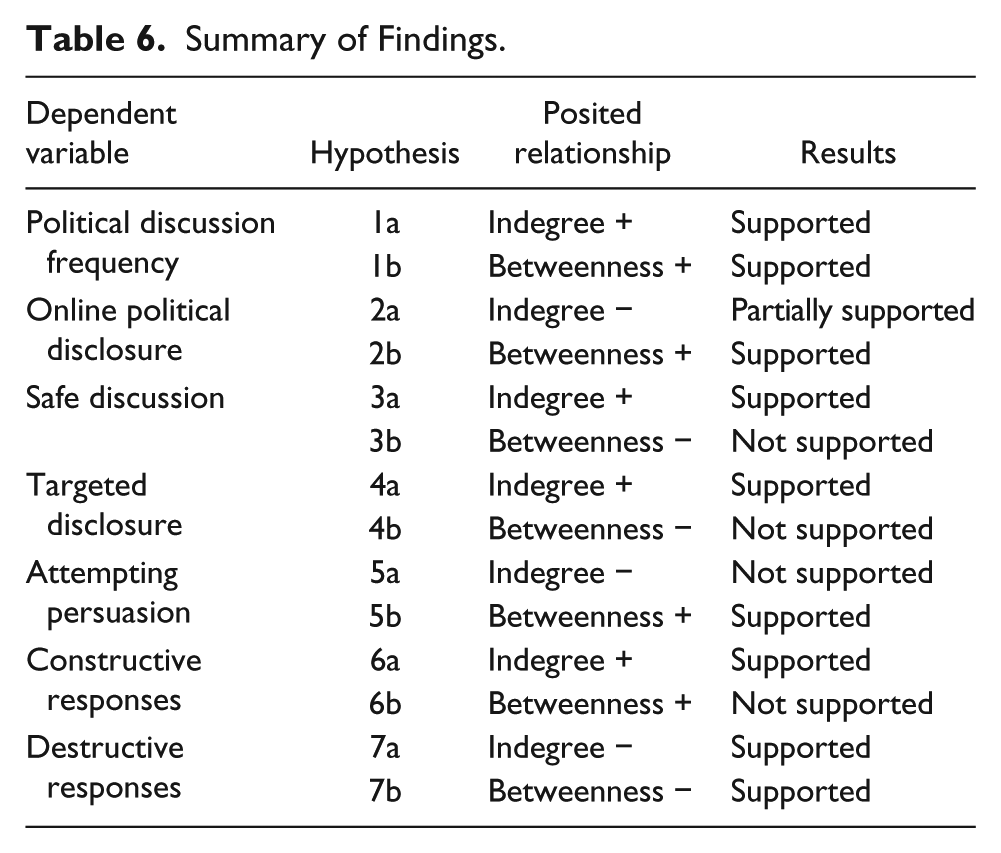
This study addresses an underexplored attribute of political discussion in the context of a social network. Namely, it uses a whole-network approach to assess how communication about politics relates to social network location. Because social media such as Facebook constitute venues for political discussion and offer myriad communication options (e.g., status updates, blocking), the study documents how these tools are used to communicate about politics. It examines effects on political discussion frequency, communication habits as they related to how more centrally located individuals in networks capitalize on their inherent potential to politically influence others, and communication practices in two categories: practices generating political discussion and those responding to political disclosure. Table 6 summarizes these findings.
Summary of Findings.
Individuals who are better connected to other network members discuss politics on Facebook more frequently, but the type of central location they occupy in the network shapes how they approach those conversations. Those with higher indegree centrality talk about politics on Facebook more often than those with fewer ties; however, they appear more risk averse in their political discussions, managing those conversations to preserve their broader network popularity rather than exploit their potential to influence others directly. They prefer close or like-minded discussion partners and tailor the audiences of their political disclosures. Since these individuals’ immediate links are more politically diverse, segmenting discussion partners may be a logical strategy for navigating this diversity, minimizing their reported discomfort with the social risks of political discussion but still enabling them to discuss politics more than less central individuals. Furthermore, when friends post something political, those higher in indegree centrality engage with the content by reading it, commenting on it, or following links. This greater engagement and their tendency not to hide or unfriend friends over politics likely contribute to these individuals’ more central network locations.
Those higher in betweenness centrality—individuals whose gatekeeping role in a network likely accustoms them to navigating divides between diverse and disconnected clusters of network members—also are unlikely to sever connections because of politics. Such behavior would be antithetical to their central locations. They are more likely to discuss politics on Facebook than those lower in betweenness, but are also more likely to engage in socially risky discussion practices: disclosing political views, endorsing candidates, and attempting political persuasion by liking political pages or posting GOTV messages. Individuals with higher betweenness centrality straddle network clusters and are surrounded by more politically diverse network members than their less central counterparts. Social media, which consolidates politically disparate network members in one place, may be an ideal tool for these more risk-accepting individuals to engage in opinion leadership and political influence.
These findings add a novel angle to how we understand the role of network location in political discussion. Social connectedness in a network promotes political engagement, in this case political discussion on Facebook. But centrality also denotes the potential to influence others in a network, and social network literature typically assumes that individuals—either as a conscious strategic choice or out of unconscious habit—capitalize on whatever structural influence they have in networks. Our research suggests that this is not always the case. Those higher in indegree centrality appear reluctant to fully exercise their political potential, preferring safer interactions that preserve their popularity but truncate their political sway. Those higher in betweenness, being more accustomed to navigating diverse structural holes, are more willing to act in ways that can influence their connections. These patterns reflect the tenet that individuals follow scripts and habits that maintain their network locations. Our findings suggest that these habits extend to political discussion practices in social media, with offline network locations shaping and being shaped by how individuals negotiate online political discussion’s social risks.
This study adds complexity to our understanding of how network size relates to political engagement. Past studies showed that those with larger egocentric networks are more politically engaged (Lake and Huckfeldt 1998) and discuss politics more often (Moy and Gastil 2006). Our work implies that the link between personal network size and discussion may depend on strategic management of political discussion boundaries. Those who discuss politics often and who are more politically engaged might maintain large networks only if they tightly control how and with whom they discuss politics. The most politically engaged, then, may not be the ones with the most network connections. They may be surpassed in network ties by those who moderate their political openness. Admittedly, the network size measure in past studies only approximates indegree centrality, so future work should compare how these two measures relate to discussion practices. Likewise, future research also may test whether safe and targeted political disclosure mediate the links between network size, discussion frequency, and political participation.
Past research also showed that heterogeneous networks predict greater political knowledge and participation (Moy and Gastil 2006; Valenzuela, Kim, and Gil de Zúñiga 2012). This study shifted the focus from heterogeneity to the influential role of individuals with high betweenness centrality. They appear disinclined to remain neutral; they are more likely to disclose political information and attempt persuasion. If those high in betweenness also are more politically knowledgeable and engaged, their communication practices may facilitate that knowledge and participation. Articulating opinions to potentially nonreceptive audiences or persuading others of specific positions may be how these individuals gain political knowledge and engagement.
Our work also sheds light on the politically motivated social media practices of blocking, hiding, and unfriending. Respondents engaged in these practices infrequently. Blocking friends from seeing one’s political information was practiced more by those high in indegree centrality. Hiding and unfriending were characteristic of those with low indegree or low betweenness centrality. These practices, then, tend to be performed by those with fewer connections or those surrounded by denser, more homogeneous network clusters. These socially destructive responses can serve to further isolate their practitioners from more prominent network positions.
It is unclear to what extent Facebook-specific habits drove our results. No exact equivalents to status updates or blocking exist in face-to-face conversation, although in offline discussion people do make and censor political self-disclosures. But online discussions are often asynchronous, allowing greater flexibility for articulating positions and responses. Facebook also does not easily convey tone or physical cues that supply context in face-to-face talk. That lack of cues may encourage risk-averse behaviors among high indegree centrality respondents. These individuals may be more comfortable engaging in riskier discussion practices face-to-face. This proposition begs further research comparing online and offline political discussion dynamics.
Our study’s limitations suggest avenues for future work. First, our research approach relied on research results that show online and offline networks and personas to overlap substantially. Future studies may find more nuanced relationships between network locations and political discussions by exploring political discussion in actual Facebook networks. Second, our study should invite replication work in divergent contexts. The whole-network approach necessitates convenience sampling of one network context. Thus, our study only speaks to political discussion in one specific general friendship network, not one that is explicitly political or whose culture alters the risk of political discussion. Network studies may be best thought of as case studies in which networks are selected for similarities and differences across contexts. Only replication can assess the generalizability of the patterns reported here.
Footnotes

Declaration of Conflicting Interests
The author(s) declared no potential conflicts of interest with respect to the research, authorship, and/or publication of this article.
Funding
The author(s) received no financial support for the research, authorship, and/or publication of this article.
Notes
References
Supplementary Material
Please find the following supplemental material available below.
For Open Access articles published under a Creative Commons License, all supplemental material carries the same license as the article it is associated with.
For non-Open Access articles published, all supplemental material carries a non-exclusive license, and permission requests for re-use of supplemental material or any part of supplemental material shall be sent directly to the copyright owner as specified in the copyright notice associated with the article.
