



Abstract
How do messages from political elites interact with individual traits of citizens to spur intergroup aggression? Building on research in social psychology, we expect that in places of protracted conflict, violent rhetoric from elites will be enough to mobilize antagonism toward an outgroup, especially among those who are generally less apt to be hostile toward the outgroup. We present results from two large survey experiments, the first conducted with young Jewish-Israeli adults across Israel and the second with a nationally diverse sample of adults in India. The results show that mild “fighting” words (e.g. “battle,” “fight”), combined with a reference to the outgroup, provoke significantly greater support for policies that harm the outgroup among some citizens. This effect is largest among individuals low in outgroup prejudice and low in aggressive personality traits, people who are usually less inclined to support policies that hurt the outgroup. Effects of violent rhetoric persist even with policies and rhetoric to help the outgroup. This work highlights the importance of considering both individual traits and contextual factors together to understand their full impact in the study of intergroup conflict.
Keywords
How do messages from political leaders interact with individual traits of citizens to spur intergroup aggression? Recent violence in the United States, Europe, and elsewhere has renewed questions about the impact of violent rhetoric on “real world” aggression. Does violent rhetoric provoke aggression against its targets? Under what conditions? And who aggresses? These questions have generated enduring attention in research on intergroup conflict, including classic works by Horowitz (1985) and Brass (2003) detailing effects of ethnic extremist rhetoric.
This article addresses these questions with experiments assessing the divergent effects of mild violent rhetoric on individual group members in protracted conflict in two distinct contexts: Israel and India. Drawing from social psychological research on intergroup animus and interpersonal aggression, we show how the impact of violent metaphors on policy aggression depends on the traits of individual citizens embedded in contexts of intense conflict.
We argue that in such contexts, violent language targeting an outgroup reminds individuals of the threat posed by the outgroup, which increases the accessibility of aggressive cognitive and emotional structures toward that group, particularly for individuals for whom these structures are not already accessible: those low in ethnocentrism and trait aggression. Thus, counter-intuitively, we predict that citizens who are normally less inclined to support policies that hurt outgroups will respond most aggressively to violent rhetoric, rather than those high in ethnocentrism and aggression who routinely support outgroup harm, as some previous research might suggest (e.g., Bushman 1995). The context of conflict intensifies the strength of aggressive language that would otherwise be weak in calmer contexts. 1
We find support for our predictions in cross-national data from two original, nationally diverse survey experiments in Israel and India: the first exploring policy support that would help/harm Palestinian citizens of Israel (PCIs), and the second for policies that would help/harm Muslim citizens of India. We show that the use of violent rhetoric increases support for harm toward the outgroup among people usually less inclined to take such positions. Replicating these findings in two very different political contexts is especially telling for the breadth of these effects.
This work contributes to research on intergroup conflict, political communication effects, and personality in politics by demonstrating the conditional nature of elite-level political communication effects: outcomes depend jointly on subtle features of the communication, the context in which it occurs, and on the individual traits of those receiving the message.
We begin by discussing violent metaphors in politics and the psychology of aggressive cues. Next, we describe traits that predispose citizens toward helpful or harmful outgroup policy attitudes. This leads to our theoretical discussion on the interaction between mild violent rhetoric and individual citizens’ traits, yielding our predictions. The remaining sections present research designs for both studies and our evidence that citizens least predisposed to support positions harming outgroups do so more when primed with subtle violent rhetorical cues. We conclude by discussing the import of these findings for intergroup conflict and future research.
Violent Political Metaphors
“Fighting words” enable leaders to shape public attitudes, although leaders’ intuitions about who responds to their appeals may be flawed. This is especially true when leaders use violent metaphors in calls to help, rather than harm, the outgroup, as leaders might reasonably expect these words to serve prosocial goals, particularly among audiences more generally favorable toward outgroups. We find otherwise.
From a universe of violent rhetoric that ranges from mild metaphors to literal violence, we focus on effects from subtle violent metaphors: figures of speech casting non-violent political behaviors in violent terms, portraying political leaders or groups as combatants, or depicting political objects as weapons. 2 This turns our attention toward seemingly innocuous language that appears regularly compared with rarer vitriolic rhetoric. In doing so, we pose a more stringent test for the effects of violent rhetoric, as stronger language could yield larger effects. However, subtle language could be more effective if it passes unnoticed, when explicit language would prompt conscious resistance (Gubler, Kalmoe, and Wood 2014; Kalmoe 2014; Mendelberg 2001). Either way, our focus on mild metaphors widens real-world implications of this study by testing effects of prevalent language.
Violent political metaphors are a cross-national phenomenon. Political leaders and groups regularly infuse communication with metaphors of fighting and war in non-violent contexts. Leaders promise to “fight” for noble causes, “combat” pressing problems, and declare “war” on social ills. News organizations wield these metaphors in reports that exaggerate conflict to draw larger audiences. This language may resonate especially in places of protracted intergroup conflict when focused on outgroups and related policies.
In Israel and India, our two cases for this article, violent metaphors are commonplace in rhetoric around outgroup-relevant policies. For example, in a 2013 speech, Israeli Defense Minister Moshe Ya’alon described non-violent actions to rid Israel of anti-Arab sentiment—to help the outgroup—in violent terms: “We have recently been witnesses to increasing racism and violence against Arabs—unacceptable, disgusting, and immoral phenomena—and it is up to us to fight these phenomena with a firm hand” (translated, emphasis added). 3 The Israeli branch of Amnesty International used similar language about housing discrimination: “Here in Israel . . . we are continuing our work of defending the rights of refugees . . . and to fight the continuing housing discrimination against the Palestinian Citizens of Israel” (translated, emphasis added). 4
Violent political metaphors involving Hindus and Muslims are also ubiquitous in India. Speaking of discrimination against “dalits” (the “untouchable class” in India), prime minister Manmohan Singh sought to help the outgroup saying,
I recognize, even after 60 years of Constitutional and legal protection and state support, there is still social discrimination against dalits in many parts of our country. The political, social, cultural and intellectual battle against such discrimination must continue. . . . The battle for social equality has to be waged and won in the minds of our people. (Emphasis added)
5
Not surprisingly, anti-Muslim rhetoric from Hindu nationalists often invokes violence in non-violent contexts—recent examples include the Hindu Nationalist Party (the BJP) leader urging party members to “win this war” against Muslim parties for seats in upcoming elections. 6 Even Mahatma Gandhi used violent metaphors as he explicitly rejected violence in his famous “Quit India” speech: “Ours is not a drive for power, but purely a non-violent fight for India’s Independence. A non-violent soldier of freedom will covet nothing for himself, he fights only for the freedom of his country” (emphasis added). 7
In keeping with a vast psychological literature on aggression, we conceptualize violent metaphors as a kind of threatening cue, bringing to mind aggressive conflict in its many forms. In operational terms, we expect this language to activate the same cognitive and emotional processes triggered by other kinds of violent imagery. Numerous studies using complementary methods demonstrate a causal link between violent cues from video, music, pictures, speech, and text and interpersonal aggression (Anderson and Bushman 2002b; Anderson, Carnagey, and Eubanks 2003; Zillmann and Weaver 2007), although there is some disagreement about the scope of effects (Ferguson 2009, 2011). Violent cues encourage short-term aggression via priming: they increase the accessibility of aggressive cognitive and emotional structures in memory, making aggressive responses more available among potential responses (Bushman 1998). This mechanism drives many political communication effects (Chong and Druckman 2007; Iyengar and Kinder 1987; Valentino, Hutchings, and White 2002), and it is consistent with priming literatures in other domains (Bargh and Pietromonaco 1982).
Scholars have increasingly examined political metaphor effects in general and their potency in changing opinions, but, surprisingly, no studies focus on violent metaphor effects despite their frequency in political rhetoric (Bougher 2012; Hartman 2012; Lakoff and Johnson 1980; Landau 1961; Lau and Schlesinger 2005; Schlesinger and Lau 2000; Zashin and Chapman 1974). Metaphor effects work through cognitive reframing processes (Lakoff and Johnson 1980; Lau and Schlesinger 2005), which persuade and add constraint to the preferences of less politically sophisticated citizens by making policies easier to understand (Hartman 2012), though effects are sometimes stronger among more knowledgeable people (Johnson and Taylor 1981). Here, we theorize and test the effects of violent metaphors on group-related policy attitudes for the first time.
Predispositions for Help and Harm
What individual traits might influence how citizens respond to violent metaphors? We focus on two influential predispositions: ethnocentrism and trait aggression. We use both factors to show the robustness of our results involving predispositions to help or harm outgroups. Our use of trait aggression introduces a new and important trait to intergroup aggression research in political science.
Our first individual factor—ethnocentrism—needs little explanation given its prominent place in research on group conflict. Ethnocentrism is “a predisposition to divide human society into ingroups and outgroups” and to favor the ingroup; it is “prejudice, broadly conceived” (Kinder and Kam 2009, 31, 9). Individuals with negative views about the outgroup relative to their own tend to support public policies that harm the outgroup and help their own group, while those with more balanced group evaluations are more open to helping the outgroup and more reluctant to hurt it through public policies (Kinder and Kam 2009). We expect to replicate these observational relationships here.
Our second individual factor—trait aggression—is relatively new to political science, and its relation with intergroup conflict requires more elaboration. Trait aggression differentiates individuals who are more or less likely to behave aggressively in everyday life, from argumentativeness and hostility to physical aggression, ranging from mild harm to violent criminality (Bushman and Wells 1998). We expect the general tendency to harm others in everyday life will increase support for policy harm against outgroups among trait-aggressive citizens. As trait aggression also decreases prosocial helping behavior in interpersonal contexts, we expect less help for outgroups among trait-aggressive individuals. Conversely, individuals low in trait aggression will be less willing to harm outgroups and more likely to support policies helping them. Trait aggression has been linked beyond interpersonal contexts to support for political violence (Kalmoe 2013, 2014), but it has received little attention as a predictor of group-related aggression and none in group-related policy contexts. Support for these hypotheses would be novel in intergroup aggression research.
In sum, we distinguish individual citizens by the extent of their ethnocentrism and trait aggression. We expect the following:
Our interest in this hypothesis is for validating the foundation for our interactive second hypothesis, which is our main contribution. However, the novelty of trait aggression in this area makes a supplemental contribution.
Although we expect similar effects from both traits, it is important to note that they remain theoretically and empirically distinct. Conceptually, ethnocentrism involves ingroup and outgroup attitudes affecting group interactions while trait aggression principally involves approaches to interpersonal interactions and the likelihood of aggression. Empirically, we will show weak correlations between the two measures in both studies.
Synthesis: Metaphor Effects through Traits
Like many communication effects, we expect the impact of violent metaphors to be conditioned by audience traits, namely, our two predispositions toward outgroup harm: ethnocentrism and trait aggression. Trait aggression, in particular, has been found to moderate violent cues in aggression research, making it a fitting candidate for moderating effects here (Bushman 1995; Kalmoe 2014; Marshall and Brown 2006).
From this point, however, our expectations take a counter-intuitive turn. Although citizens most predisposed to outgroup hostility might plausibly react most aggressively to violent metaphors, some past studies on the attitudinal impact of threat suggest otherwise. For example, Hetherington and Suhay (2011) show that the effect of threat on support for hawkish U.S. counter-terrorism policies is strongest among citizens low in authoritarian personality—those least likely to support such policies in the absence of threat. Similarly, Malhotra and Pope (2010) find that the hawkish impact of experimentally controlled threat perceptions is strongest among Democrats who believe a terrorist attack is likely to occur—people otherwise unlikely to support such policies compared with typically hawkish Republicans.
What accounts for these surprising effects? In both studies, the authors argue citizens predisposed to support hawkish positions are unaffected by threatening cues because they already express strong support for those policies, threat or no. In contrast, citizens less predisposed to support hawkish positions rethink their positions due to the aggressive cognitive frames activated from exposure to threatening cues.
When mild violent language occurs in a context of intense intergroup conflict, we expect similar results. These are places where threats of violence are woven into the fabric of everyday life, though the conflict may ebb and flow. Those citizens predisposed to harm the outgroup see the fight as unceasing, regardless of objective levels of threat. For them, mild threatening cues simply confirm what they already feel. However, for those less predisposed to conflict—those who perceive a lower state of threat generally—even mild cues will increase threat perceptions.
Ethnocentrism and trait aggression each independently captures the distinction between those who perpetually feel threatened and those who are provoked conditionally. These differences extend to expectations regarding aggression from others and perceiving ambiguous actions as hostile provocations, both aggression contributors (Anderson and Bushman 2002a). As mentioned previously, although some research suggests aggressive individuals react more to subtle provocative cues, the pattern reverses as threats strengthen (Marshall and Brown 2006). Protracted intergroup conflict magnifies even subtle cues into larger threats, explaining why we expect different interactions here than in some studies (e.g., Kalmoe 2014). Context matters.
In sum, we expect violent metaphors to increase support for outgroup harm among people least predisposed to support policy aggression against the outgroup: those low in trait aggression and ethnocentrism. For these individuals, the cueing of threat will increase the accessibility of aggressive cognitive and emotional structures toward the outgroup, thus increasing their likelihood of supporting harm toward the outgroup. Thus, in places like Israel and India with long histories of intergroup conflict, even mild violent metaphors can motivate these individuals to adopt more hawkish positions:
This is our primary hypothesis and main contribution, setting up our experimental tests.
Our expectations are straightforward for the effects of violent metaphors paired with rhetorical attacks on the outgroup. But many examples of violent political metaphors appear in efforts to help the outgroup. Do effects change when policy implications help rather than harm the outgroup, or does the mere pairing of violent language with outgroups hold effects steady? Both possibilities seem plausible, so we remain agnostic and await empirical tests.
Experiment Overview
To test our predictions, we designed and fielded two nationally diverse survey experiments in Israel and India. Both surveys began by measuring ethnocentrism and trait aggression, among other traits. Participants then answered policy questions affecting outgroup well-being. These questions came in two versions. The first (treatment condition) framed questions with mild violent metaphors, while the second substituted non-violent synonyms in the same policy questions. Participants were randomly assigned to view one version. Policy items covered several issues central to intergroup domestic politics in both countries (e.g., housing and employment discrimination, distribution of resources). Thus, they represent issues that participants have likely thought about and that have been subject to national discussion, not experimenter-manufactured issues, improving external validity. We designed violent metaphors with real-world examples used to frame policies in our studies. The treatments therefore reflect language citizens routinely encounter in political discourse.
The choice of two distinctive countries/cases also enhances the generality of our results. Despite different languages, culture, history, policies, and political structure, we identify consistent patterns across contexts. Moreover, the experimental approach increases internal validity, enabling strong claims of cause and effect. Experiments have proven particularly useful in political communication tests in the past (Chong and Druckman 2007; Iyengar and Kinder 1987; Nelson, Clawson, and Oxley 1997). By randomizing participants into controlled conditions, we can confidently attribute differences between treatment groups as causal effects due to the difference between treatments. In sum, we combine high internal validity with features that strengthen external validity for participants, treatments, issues, and study environments.
Study 1
Participants
Study 1 is a survey experiment that presents Jewish-Israeli participants within Israel’s pre-1967 borders with questions about policies affecting PCIs. It was conducted in Hebrew online in June 2010 by the Midgam Project, an online survey organization administered by Ariel Ayalon (2009). At the time, Midgam had a panel of over thirty thousand participants within Israel. We limited our sample to individuals aged eighteen to thirty for two reasons: first, research suggests this age group is most likely to support or engage in personal aggression against members of the outgroup (Urdal 2008), and second, this age group constitutes the political and social future of the Israeli–Palestinian conflict. Thus, our sample focuses on the current generation of potential combatants and the next generation of Israeli voters and leaders.
Using random stratified sampling of participants in this age group within the Midgam panel, we obtained participants representing every major demographic and geographic sector of the Jewish population within Israel. For details on sample representativeness, see the online appendix (http://prq.sagepub.com/supplemental/). A total of 888 participants (436 males and 452 females) completed the study.
Procedure and Measures
After consenting to participate, respondents answered ethnocentrism and trait-aggression questions. Ethnocentrism was measured with group feeling thermometers. Participants rated several social groups in Israel from 0° to 100°, with warmer temperatures indicating more group favorability. 8 The group list included Jewish sub-groups within Israel (secular, traditional, etc.) and non-Jewish groups within Israel (e.g., Druze and PCIs). PCIs were called Arab-Israelis in our survey, as this terminology is most common among Jewish-Israelis. We operationalize ethnocentrism as the difference between average favorability toward the Jewish groups (ingroup) and average favorability toward the outgroup, in this case Palestinian citizens of Israel. Responses were scaled 0 to 1 (0 = high outgroup favoritism, 1 = high ingroup favoritism). 9 Ethnocentrism is left-skewed (mirroring the Israeli polity) but contains individuals across the spectrum (M = 0.66, SD = 0.17).
Trait aggression is measured using the short form of the Buss–Perry Aggression Questionnaire (BPAQ; Bryant and Smith 2001; Buss and Perry 1992). The BPAQ is the most popular self-report measure in aggression research, validated across hundreds of studies (Bushman and Wells 1998). The BPAQ Short Form (BPAQ-SF; 12 items) exhibits excellent psychometric properties surpassing the original questionnaire (Bryant and Smith 2001). 10 Wording is presented in the online appendix. For each item, participants indicated whether the statement was true or false for them on a 6-point scale. The items load strongly onto a single factor and form an additive index with good reliability (Cronbach’s α = .72), coded 0 to 1 (M = 0.31, SD = 0.16).
Figure A1 in the online appendix presents distributions of ethnocentrism and trait aggression in Study 1. Consistent with distributions in representative samples from other countries (Gerevich, Bácskai, and Czobor 2007), most of our sample appears in the lower half of trait aggression. The median is 0.29, with 95 percent of all participants between 0 and 0.58. Only a handful of participants fall in the upper third.
To validate our claim that ethnocentrism and trait aggression correlate with threat perceptions, we asked participants to rate this statement on a 7-point agree–disagree scale, recoded 0 to 1 with 1 indicating strong agreement: “In my opinion, the majority of Arab-Israelis would destroy the State of Israel if they could.” The survey also asked political ideology; religious ideology (e.g., Orthodox, Religious, Traditional, and Secular); sex; and socio-economic status, district of residence, and whether they or their friends and family had negative experiences with the outgroup.
Finally, participants were randomly assigned to one question-wording condition, with roughly equal numbers of participants viewing the control or treatment. The Midgam executed the random assignment. Participants read five policy statements involving help or harm for the outgroup (PCIs) and were asked to rate agreement or disagreement on 5-point scales. Statements helping the outgroup were reverse coded. In the control, questions were worded like, “As part of the effort to provide equal opportunities for Israeli citizens, the government should spend more money to improve schools for Arab-Israelis.” In the treatment, participants saw the same questions, but with one word changed to frame policies in violent terms, for example, “As part of the fight to provide equal opportunities for Israeli citizens, the government should spend more money to improve schools for Arab-Israelis” (emphasis added). “Effort” is replaced with “fight.” This is done for all statements. Wording for each item in both forms is in the online appendix. We combined responses to the five statements in a reliable index of general support for policies harming PCIs (Cronbach’s α = .77). Participants were paid by the Midgam on completion of the survey.
Results: Ethnocentrism, Trait Aggression, and Threat
Before our key results, we examine the relationship between ethnocentrism, trait aggression, and outgroup threat perceptions. These empirics test our claim that both traits reliably distinguish those who continually feel high levels of threat and those who do not. We expect individuals with high ethnocentrism and trait aggression to perceive heightened levels of outgroup threat compared with their peers.
The data strongly support our expectations. The bivariate ordinary least squares (OLS) coefficient for ethnocentrism predicting responses to “the majority of Arab-Israelis want to destroy the state of Israel” is substantively and statistically significant (β = .99, p < .001). A similar relationship emerges between trait aggression and threat perceptions, though the size is smaller (β = .15, p < .05). This is expected as trait aggression is a broad personality trait measured without reference to the outgroup.
Table A1 in the online appendix presents correlations between our key measures. There is no correlation between ethnocentrism and trait aggression (r = −.02), suggesting each measure taps a unique motivator for threat perception, as our theory suggests. The strong relationships between threat perception and both ethnocentrism and trait aggression suggest both measures capture our distinction between those who continually perceive high levels of threat and those who do not.
Results: Subtle Language Enflames Policy Attitudes
We turn now to our main test: Do mild violent metaphors increase support for outgroup policy harm among individuals least disposed to support it? We estimate an OLS model regressing the outgroup policy harm index on ethnocentrism, trait aggression, an indicator variable for the violent rhetoric treatment (1 = treatment, 0 = control), and the separate interactions between the treatment and both individual traits. 11 We test whether chance generated an imbalance across treatment and control conditions for measured covariates using the omnibus test from Hansen and Bowers (2008). We found just one imbalance; including it in the model has no effect. For details, see the random imbalance plots in the online appendix.
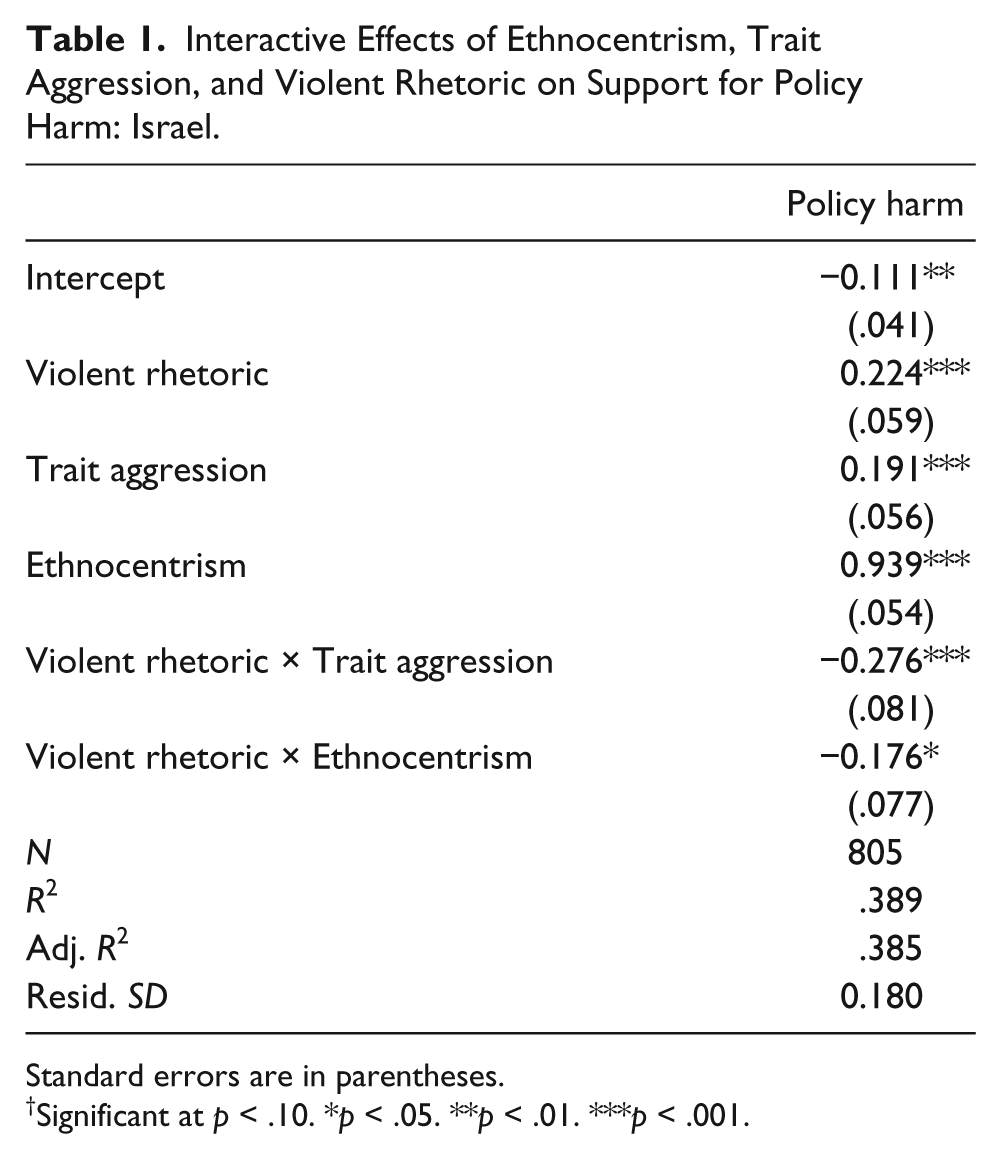
Table 1 presents the results. As interactive effects can be difficult to interpret in tables, we visually present results of using marginal effects plots, one for each interaction of interest: Treatment × Ethnocentrism and Treatment × Trait aggression (see Figure 1). 12 Figure 1 illustrates the marginal effect of randomized exposure to subtle violent rhetoric (a one word change from the control condition) on support for policies harming the outgroup (y axis), conditional on the participant’s ethnocentrism or trait aggression levels (x axis). All variables are recoded 0 to 1. Dashed lines show 95 percent confidence intervals for a two-sided t test.
Interactive Effects of Ethnocentrism, Trait Aggression, and Violent Rhetoric on Support for Policy Harm: Israel.
Standard errors are in parentheses.
Significant at p < .10. *p < .05. **p < .01. ***p < .001.
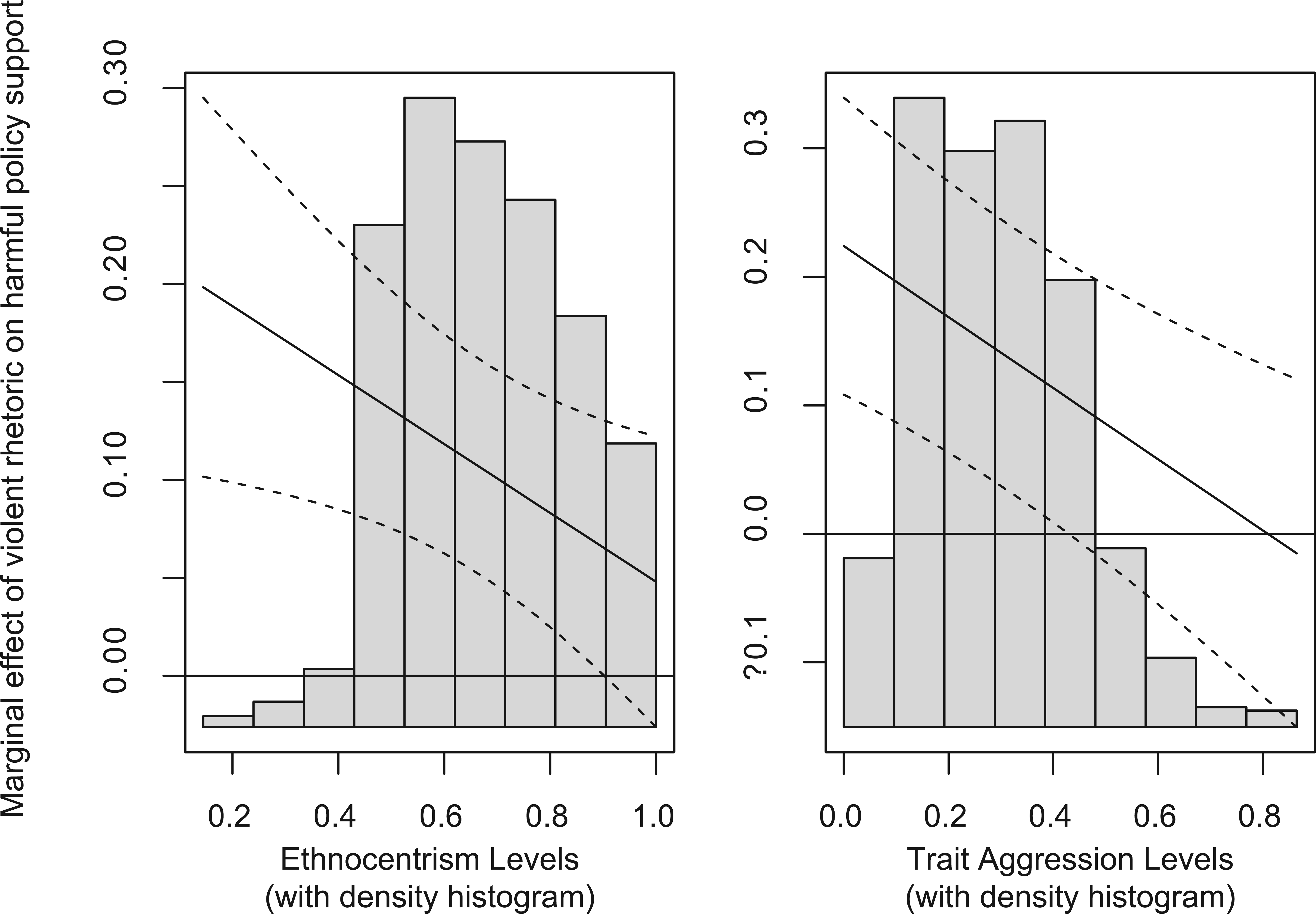
Ethnocentrism, trait aggression, and violent rhetoric: Marginal effect on support for policies that harm Arab-Israelis.
The results provide strong support for our predictions: exposure to subtle violent language significantly increases support for policy harm against PCIs, but the effect is found primarily among participants low in ethnocentrism and low in trait aggression. As both panes in the figure indicate, when these groups are exposed to mild violent rhetoric, we see a 20 percent increase in support for policies harming the outgroup. As our theory suggests, the effects diminish as we move toward individuals with higher ethnocentrism and trait aggression levels, becoming insignificant after crossing the 75th percentile of trait aggression, and remaining significant to the 90th percentile of ethnocentrism. Given the subtlety of the treatment—one mild word—the effect is striking. The strength of the effect is more impressive still given what we normally assume are hardened attitudes in group conflicts.
Importantly, these effects hold whether the stated policy benefits or harms the outgroup. We test this by stacking the data to treat the policy statements as a repeated measures factor, then estimating a random effects model that includes policy type (benefit/harm). As Table A3 and Figures A3 to A4 in the online appendix indicate, policy statement type does not significantly interact with violent rhetoric to predict policy support. 13 This suggests that simply including a “fighting word” in a statement referencing the outgroup increases support for harm against PCIs for low-aggression and low-ethnocentrism Jewish-Israelis, regardless of whether the statement calls to help or harm the outgroup.
Study 2
Given the potentially exceptional nature of the Arab–Israeli conflict, we conducted a second experiment to assess the extension of these results to other contexts of protracted intergroup conflict. For Study 2, we sought another region marked by conflict deep enough for our predictions, but perhaps not quite as deep as the Arab–Israeli context. India’s conflict between Hindus and Muslims is an ideal case. There, we replicated Study 1 with a nationally diverse sample of Hindu participants in India in 2012, with a few minor modifications.
Two changes in Study 2 enable us to address key points of interest arising from Study 1, beyond basic replication. First, we expand our sample to include adult participants of all ages. This allows us to assess whether older individuals respond like younger participants in Study 1. Second, in Study 2, we present participants with two separately randomized blocks of policy questions, shown on different screens. The first block presents policies that benefit the outgroup, framed positively in terms of equality. The second block contains policies that hurt the outgroup, framed against outgroup interests. (In Study 1, we presented a mixture of helpful and harmful policies in one block on the same screen.) This allows us to more incisively test the interesting finding from Study 1 that a “fighting word” coupled with a reference to the outgroup motivates an aggressive response even if the reference suggests fighting for the outgroup. The mixing of harmful and helpful policies in Study 1 did not allow us to test the possibility that harmful policies affected participants’ responses to helpful policies on the same page, despite being asked after. Study 2 allows us to definitively rule out this alternative. This design also lets us check for potential spillover effects from violent rhetoric in the first block on responses in the second.
Participants
We recruited participants for this experiment in September 2012 using Amazon’s Mechanical Turk. 14 Mechanical Turk participants include many Indian citizens, living in India, from a range of backgrounds reflected in the demographic and geographic diversity of our sample. In total, 693 Hindu Indians participated, 441 males and 252 females. Mechanical Turk does not allow recruitment based on religion or ethnicity. Consequently, our original sample included a small number of non-Hindu people, who were removed from analysis. 15 For details on sample representativeness, see the online appendix. All questions were asked in English, one of India’s official languages, and participants were paid forty cents on completion of the experiment.
Procedure and Measures
We asked nearly identical questions to those from Study 1 and followed the same procedures described there. To measure ethnocentrism, we asked participants to rate Hindus, Muslims, and other groups in India on feeling thermometers. We took the difference between the Hindu and Muslim thermometers and rescaled the outcome between 0 and 1 (M = 0.58, SD = 0.16). To measure trait aggression, we asked participants before the experimental manipulation to complete the BPAQ-SF. As in Study 1, participants’ responses load well onto a single factor and form an additive index with good reliability (Cronbach’s α = .86); we recoded this index from 0 to 1 (M = 0.44, SD = 0.17). Figure A2 in the online appendix presents distributions of ethnocentrism and trait aggression in our Indian Hindu sample.
As in Study 1, participants were asked their political ideology, religious affiliation, sex, socio-economic status, education, and state of residence. We also asked whether they lived in an urban or rural setting. Hansen and Bowers’s (2008) omnibus test found no random imbalances across treatment and control using these covariates (see the online appendix).
Next, participants were randomly assigned by Qualtrics’ random assignment algorithm to the question-wording treatment (a “fighting word” vs. a control word) for the initial block of four policies to help Muslims in India. We put these questions first, and in a separate block from policies that would harm Muslims, to test whether effects from Study 1 truly apply to “helping” policies. Participants indicated support on 5-point agree–disagree scales. These included statements like, “As part of the fight/effort to provide equal opportunities for Indian citizens, the government should spend more money to improve schools for Muslims in India.” As in Study 1, we combined participants’ responses in an index (Cronbach’s α = .63), rescaling responses from 0 to 1. For ease of comparison between Studies 1 and 2, we reverse code these items, such that a 1 on the scale indicates strong disagreement with these policies.
Last, participants were randomly assigned to the question-wording treatment for the second block of questions, three questions about policies to harm Indian Muslims. Participants responded on 5-point agree–disagree scales. We combined responses into an index rescaled from 0 to 1 (Cronbach’s α = .84). Finally, we created a third additive index combining items from both policy blocks (reverse-coding questions from Block 1), allowing us to assess average effects of violent rhetoric across both question types. The order of the policy blocks was not randomized, so all participants saw the helpful block before the harmful one. All question wordings are in the online appendix.
Combined Policy Results
We follow the same analytical procedures as in Study 1, estimating an OLS model that includes interaction terms with ethnocentrism and trait aggression as well as their constituent parts. We begin by considering the overall effects of violent metaphors across policies that help or harm Muslims in India, pooling across issue blocks. We also disaggregate results from each block separately below.
In this model, the treatment variable takes a value of 0 when both policy blocks are non-violent, 0.5 when either of the two policy blocks was framed with violent metaphors (but not both), and 1 when both blocks used violent language. This coding rests on the assumption, consistent with our theory and the results from Study 1, that average support for harmful policies toward the outgroup across both blocks of policies should be lowest among those who did not see any policies framed with violent metaphors, highest among those who saw all policies framed with violent metaphors, and middling among those who saw one violent and one non-violent block (in any order). To be sure, this coding has advantages and disadvantages: even though it allows us to assess the overall alignment of results with our predictions, it adds measurement error to treatment effects for responses to Block 1 questions when only Block 2 includes violent language for that participant, though this would tend to underestimate rhetoric effects. On balance, we think the advantages outweigh the disadvantages, noting however that potential ordering effects should be the focus of future studies on this topic.
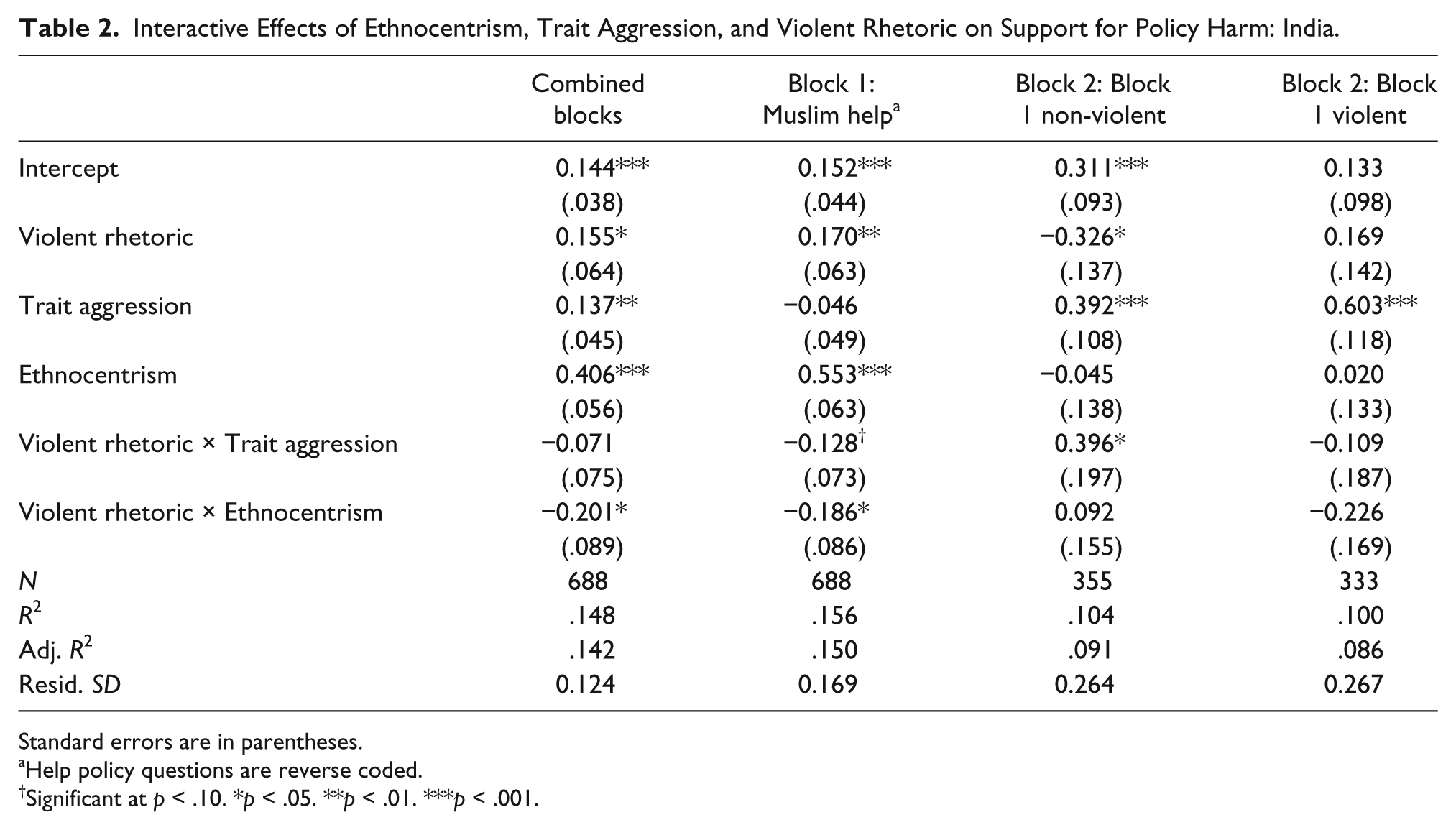
We regress an index variable that contains all policies from both blocks (eight in all, with policies from the first block reverse coded) on the treatment variable, ethnocentrism, and trait aggression, and the interaction between treatment and ethnocentrism, and treatment and trait aggression. All variables are coded 0 to 1. Figure 2 presents the results graphically; the first column in Table 2 presents the numeric results.
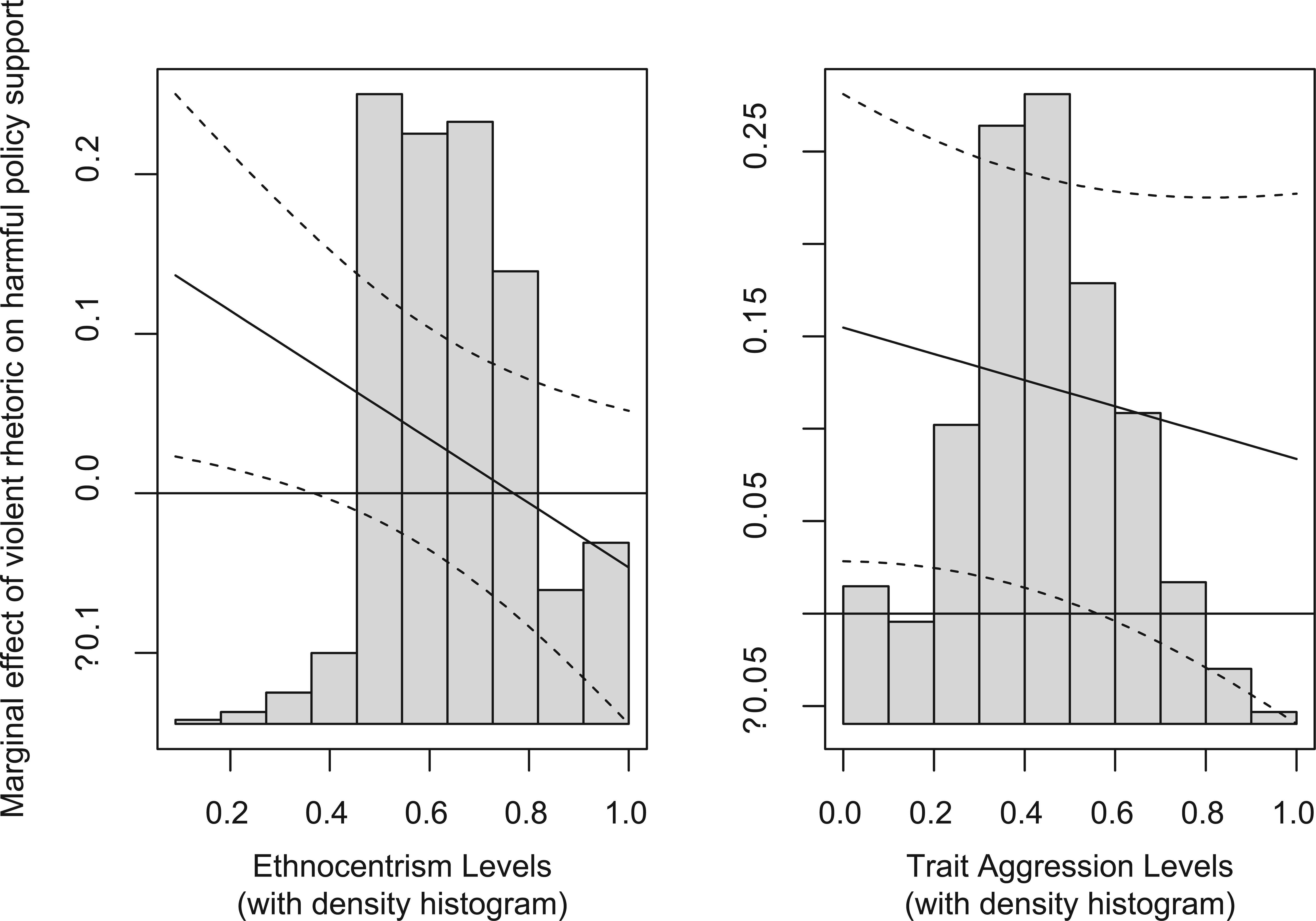
Ethnocentrism, trait aggression, and violent rhetoric: Marginal effect on support for policies that harm Muslims (combined blocks).
Interactive Effects of Ethnocentrism, Trait Aggression, and Violent Rhetoric on Support for Policy Harm: India.
Standard errors are in parentheses.
Help policy questions are reverse coded.
Significant at p < .10. *p < .05. **p < .01. ***p < .001.
The combined model strongly supports our predictions: on average, mild violent metaphors significantly increase support for policy harm against Indian Muslims among Hindus, but only among those normally predisposed toward less harmful policies.
Patterns are almost identical in India as in Israel, despite different participants, policies, and context. Indeed, the similarity is striking. Taken together with Study 1 (Israel), these results suggest a consistent pattern of attitude change, providing evidence that the findings from Israel travel well to other contexts. They also support our hypothesis that simply including a “fighting word” in a sentence that references the outgroup increases support for policy harm against the outgroup among some individuals.
Next, we decompose the index into its help and harm components to see whether the effects of violent metaphors are stronger for helping (Block 1) or harming (Block 2) policies and rhetoric.
Results: Helping Outgroups
We continue with tests for policies that help Muslims, an especially interesting finding from Study 1. We expect low trait-aggression and low-ethnocentric Hindus to respond with greater disagreement on policies that help Muslims in the violently worded (treatment) condition, even though the policies provide help not harm. The second column in Table 2 presents the results. We also present Figure 3 with the marginal effects plot of results.
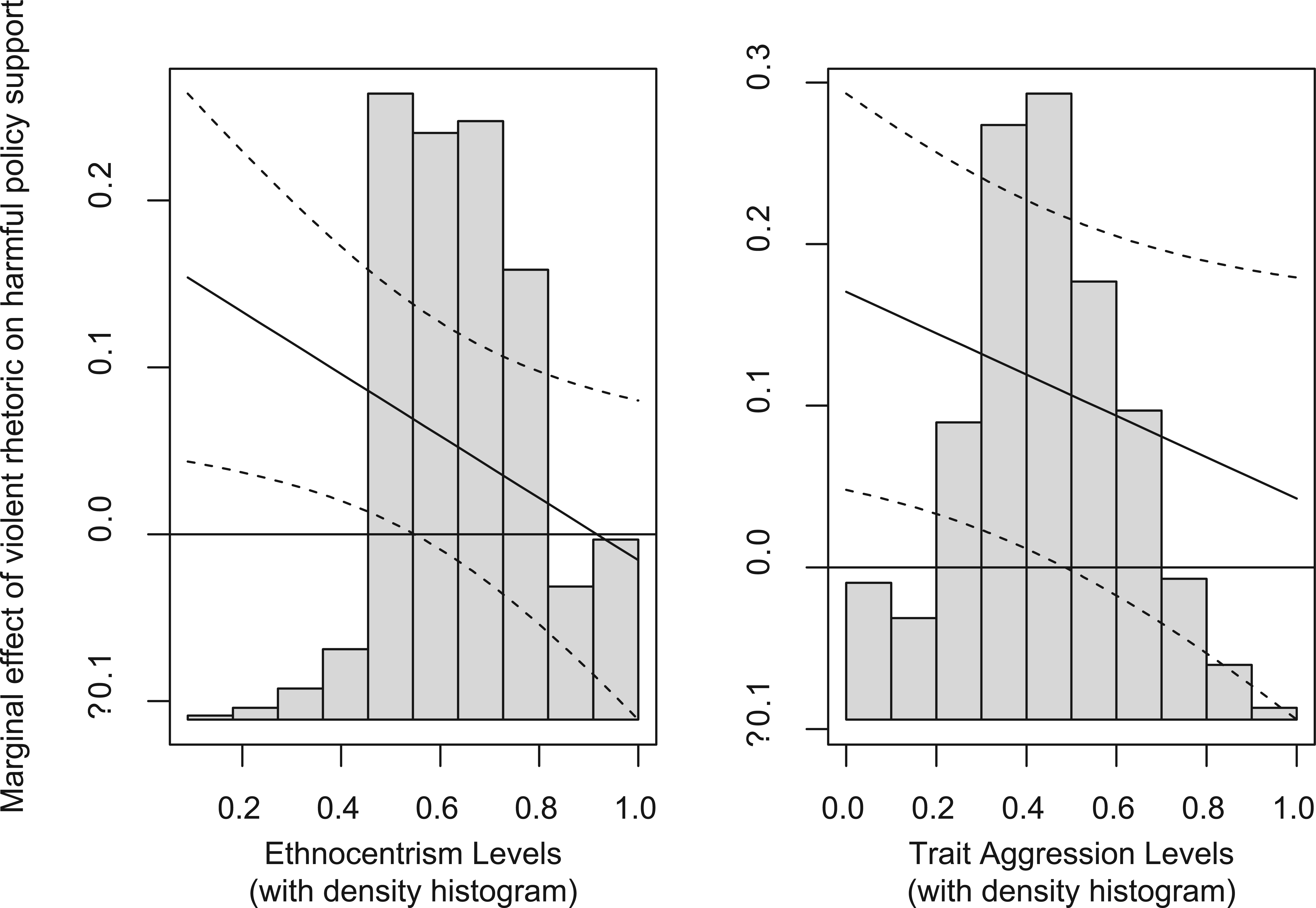
Ethnocentrism, trait aggression, and violent rhetoric: Marginal effect on disagreement with policies that help Muslims.
As in Israel, individuals with low ethnocentrism and low trait aggression assigned to the violent condition exhibit almost a 20 percent increase in disagreement with policies helping the outgroup. Additional analysis shows the effect holds across age groups (there is no significant interaction with age), so effects appear to extend beyond young adults. Likewise, results for individual helping items are not appreciably different than results using the combined helpful index. These results clearly show the impact of violent metaphors is felt strongly for rhetoric and policies aimed at helping outgroups. 16
Results: Harming Outgroups
Finally, we assess the outgroup harm policies of Block 2. Assessing these effects is more fraught given the potential spillover treatment effects from the first block, something we designed Study 2 to test. We estimate two models, separating individuals who saw non-violent language in Block 1 from those who saw violent language.
The third column in Table 2 shows when Block 1 is non-violent, low trait-aggressive individuals in Block 2 respond contrary to our expectations when treated with violent rhetoric, with lower levels of support for harmful policies. Instead, highly trait-aggressive individuals respond to the rhetoric with increased support for harm. We did not expect these results. In retrospect, however, we can identify the probable cause of these different results: unlike other blocks, we unwittingly began each sentence in this block with the phrase, “. . . to preserve India’s Hindu heritage. . . . .” As observers of Indian politics will know, this particular phrase has become a rallying cry used by the more violent factions of the Hindutva movement to justify violent anti-Muslim behavior in India. 17 We expect that our participants recognized this phrase in this context, which should repulse the doves and energize the hawks. Note that while the ethnocentrism effect is not significant, it also goes the same direction as the aggression effect.
Importantly, however, the fourth column suggests a relatively strong spillover effect of violent rhetoric from Block 1. When policies in the first block were framed with violent metaphors, low-aggression and low-ethnocentrism participants treated with violent metaphors in Block 2 respond to additional violent metaphors as we predicted and consistent with participants in Israel: with substantial increases in support for outgroup policy harm. This pattern is not statistically significant, likely due to the strength of the Hindutva phrase in these sentences, or due to the much smaller sample size of this subgroup. Regardless, the sign flip between the third and fourth columns underscores the significant power of violent rhetoric, even as the results raise new questions.
Thus, though generally supporting our results from Block 1 and the Israel experiment, these Block 2 results reinforce the point we discussed at the start of the paper: violent rhetoric interacts with context as well as individual traits to shape individual attitudes. We encourage future exploration of these interactions.
Discussion and Conclusion
How does the use of violent metaphors interact with context and the individual traits of citizens to affect intergroup aggression? We began this article by suggesting that in contexts of protracted intergroup conflict, citizens who are normally less inclined to support policies that hurt outgroups should (counter-intuitively) respond most aggressively to violent rhetoric, rather than those high in ethnocentrism and aggression who routinely support outgroup harm. We theorized that for these low-aggression/low-ethnocentric individuals, violent language targeting the outgroup would spur threat, which would in turn increase the accessibility of aggressive cognitive and emotional structures toward the outgroup, motivating an increase in support for policies harming the outgroup.
To test our theory, we presented evidence from two large, nationally diverse survey experiments, the first conducted with young Jewish-Israeli adults in Israel, and the second with a nationally diverse sample of Hindu adults in India. The results show that mild “fighting” words (e.g., “battle,” “fight”) combined with a reference to the outgroup provoke significantly greater support for policies that harm the outgroup among some citizens, even when the intended use of violent words is clearly rhetorical. Consistent with our theory but counter-intuitively for some, the messaging effect is largest among individuals low in outgroup prejudice and low in aggressive personality traits who are usually less inclined to support policies that hurt the outgroup. Just as surprising, the harmful effects hold even when the call is made to help the outgroup. In other words, allies hoping to aid outgroups through calls to “fight” for equality may unintentionally hurt their cause. This work reveals the conditional nature of outgroup aggression and the importance of considering both individual and contextual factors together in the study of intergroup conflict.
Both studies combine the natural strength of experiments (high internal validity) with several features bolstering their external validity. First, samples include broad cross-sections of adult participants from each country, not the college sophomores prevalent in many experiments. Although our participants are drawn from convenience and not probabilistic population samples, the key question for causal inference is whether the experimental effects observed in these diverse samples are akin to those we would see in the population, not whether demographic proportions are identical. Thus, though critiques of these samples are possible, they would need to explain how the causal effects we observe across diverse participants in both countries would differ with diverse but differently proportioned probability samples. Given the diversity of our participants and large sample sizes, we are comfortable with the generalizability of our findings. And to the extent our samples are populated by younger and more educated citizens, these groups might well be less susceptible to the appeals we test, providing more conservative estimates.
Participants in both studies were exposed to experimental treatments in natural environments at a time and place of their own choosing (e.g., home, work, school, cafe), thanks to the flexibility of Internet-based surveys. These are the environments in which they regularly receive political messages through television, Internet, email, print news, and mailings. Although the language is not embedded in a news segment and participants are aware they are being studied within the survey context, these elements mitigate some of the limitations inherent in lab-based experiments that struggle to create “real-world” conditions for their subjects.
This work makes a number of important contributions to the study of aggression and intergroup conflict. First and most importantly, we provide preliminary answers to the questions posed at the outset: (1) Does violent language increase policy aggression towards its targets? (2) Under what conditions? (3) And for whom? Although our results cannot speak to all contexts, they suggest that for individuals in societies marked by protracted intergroup conflict, the answer to the first question is a conditional “yes.” Individuals in our experiments responded with more aggression toward the outgroup following exposure to mild violent metaphors. However, effects depend on individual levels of ethnocentrism and trait aggression, with the strongest effects found among citizens who do not hold especially negative attitudes toward the outgroup and those who rarely exhibit aggression in everyday life, people who are ordinarily less likely to support policies that hurt the outgroup in the absence of provocation.
Second, this research contributes to the study of intergroup conflict, particularly ethnic conflict, by highlighting processes that motivate individual-level aggression against the outgroup in regions of protracted turmoil. With few exceptions, comparative work on ethnic conflict in political science focuses on macro-, or structural level factors that incentivize intergroup cooperation or conflict (Fearon and Laitin 1996; Posner 2004; Varshney 2002; Wilkinson 2004). Although these factors are undoubtedly important explanators of when and why groups engage in conflict, they at best constitute only half of the explanation. The other half lies in understanding the micro-level, or individual-level factors that motivate individuals to create and react to the macro-level conditions. Although this has traditionally been the domain of social psychology, some excellent recent work in political science (much of it from scholars in Israel) has begun to highlight some of these micro-level factors. For example, Bar-Tal et al. (2009) argue that a particular set of beliefs about the ingroup and outgroup, termed ethos of conflict, motivate individuals to act aggressively toward the outgroup when presented with various cues. Recent work by Halperin and co-authors (Halperin 2008; Halperin and Bar-Tal 2011; Halperin et al. 2011), Canetti (Canetti-Nisim et al. 2009), and Ginges et al. (2007), among others, highlights the effects of other beliefs on intergroup conflict. A more complete story of intergroup conflict and cooperation will include a careful analysis of the interaction between both the macro (structural) and micro (individual) levels of analysis. The research presented here begins to move in this direction, highlighting how macro-level cues and contexts interact with micro-, or individual-level characteristics to explain support for outgroup aggression. Other recent research on intergroup relations in political science by scholars like Habyarimana et al. (2009) takes steps in this direction.
To be sure, limitations stemming from our design suggest a need for further research. The rhetoric used in these experiments was quite mild—of the type commonly encountered in daily life. It will take further creative and ethically sensitive research to assess the impact of more extreme violent rhetoric on individual attitudes. Even so, the consistency of our results across groups and contexts suggests a pattern that should be carefully considered in societies marked by protracted group conflict. In such societies, even mild cues—as simple as a political leader’s use of the word “fight” in a speech—can call up threats that change the way listeners treat members of the opposing group, even or especially among the outgroup’s most likely allies, with consequences that reverberate in the contentious policies supported by citizens and adopted by states.
Footnotes
Acknowledgements
The authors thank Nancy Burns, Brad Bushman, Michael Findley, Kirk Hawkins, Don Kinder, Jessica Preece, Joel Selway, Nicholas Wheeler, participants in Brigham Young University’s Thursday group, three anonymous reviewers for this journal, and panel and audience members at the annunal meeting of the Midwest Political Science Association (MPSA) for valuable feedback on this project.
Authors’ Note
Data and replication files for this paper can be found at the authors’ websites: http://scholar.byu.edu/jgubler and  . This research was approved for the use of human participants by the University of Michigan (IRB HUM00029073).
Declaration of Conflicting Interests
The author(s) declared no potential conflicts of interest with respect to the research, authorship, and/or publication of this article.
Funding
The author(s) disclosed receipt of the following financial support for the research, authorship, and/or publication of this article: The authors thank the following organizations for funding this project: the Political Science Department and Rackham Graduate School at the University of Michigan, the U.S./E.D. Fulbright Foundation (grant P022A090001), and the National Science Foundation (grant 0921391).
Supplemental Material
Replication data for this article can be viewed at http://scholar.byu.edu/jgubler and .
Notes
References
Supplementary Material
Please find the following supplemental material available below.
For Open Access articles published under a Creative Commons License, all supplemental material carries the same license as the article it is associated with.
For non-Open Access articles published, all supplemental material carries a non-exclusive license, and permission requests for re-use of supplemental material or any part of supplemental material shall be sent directly to the copyright owner as specified in the copyright notice associated with the article.
