




Abstract
How does the threat of terrorism affect evaluations of female (vs. male) political leaders, and do these effects vary by the politician’s partisanship? Using two national surveys, we document a propensity for the U.S. public to prefer male Republican leadership the most in times of security threat, and female Democratic leadership the least. We theorize a causal process by which terrorist threat influences the effect of stereotypes on candidate evaluations conditional on politician partisanship. We test this framework with an original experiment:a nationally representative sample was presented with a mock election that varied the threat context and the gender and partisanship of the candidates. We find that masculine stereotypes have a negative influence on both male and female Democratic candidates in good times (thus reaffirming the primacy of party stereotypes), but only on the female Democratic candidate when terror threat is primed. Republican candidates—both male and female—are unaffected by masculine stereotypes, regardless of the threat environment.
Terrorist threat leaves profound imprints on publics in the United States and abroad. In the case of candidate evaluation and selection, threatened individuals seek out strong, charismatic, and hawkish leadership (e.g., Berinsky 2009; Gadarian 2010a; Merolla, Ramos, and Zechmeister 2007). This tendency has the potential for important down-stream consequences, one of which may be that terrorist threat disadvantages female candidates. 1 In fact, conventional wisdom holds that women tend to be less preferred in leadership roles in times of national security threat, and scholarship has documented this preference (e.g., Falk and Kenski 2006; Holman, Merolla, and Zechmeister 2011; Lawless 2004). However, we know little about the nature of this process. Does this result hold for candidates of both mainstream U.S. political parties? Furthermore, what drives relationships between terrorist threat and gender-relevant candidate evaluations?
We assert that the gender and partisanship of politicians combine in mass opinion in ways that place Democratic female candidates at a comparative disadvantage under conditions of terrorist threat. We demonstrate the relevance of politician gender and partisanship through an analysis of two national surveys. First, we identify a general tendency for the U.S. public to prefer male leadership in times of terrorist threat. Second, we show that politician partisanship conditions leadership preferences, such that Democratic females are least preferred in times of security threat.
We then consider two competing ways that terrorist threat and male stereotypes could combine to disadvantage Democratic female candidates. Male stereotypes most relevant to terrorist threat include the beliefs that men are stronger leaders and are more competent in the security arena. These particular stereotypes also overlap with party stereotypes, under which the Republican Party is perceived as stronger on leadership qualities and on national security issues. The application of these stereotypes in times of nonthreat, when parties are likely central, may harm Democratic candidates, both female and male, because of the party’s weakness on these dimensions. However, when a condition of terrorist threat increases the relevance of leadership strength, individuals ought to evaluate the candidate’s gender—not just his or her party—as a relevant, parallel piece of information. If so, conditions of terrorist threat may deactivate the negative effect that male stereotypes have for Democratic males, as their gender becomes more salient and counteracts their partisanship, while such stereotypes continue to harm Democratic females. This particular process is consistent with scholarship showing that party often exerts a stronger effect on evaluations of leaders than gender (e.g., Dolan 2014a, 2014b; Hayes 2011; Hayes and Lawless 2015).
A rival mechanism is that terrorist threat activates male stereotypes in evaluations of certain female leaders. In this case, the effect of male stereotypes on candidate evaluations would rise in prominence under conditions of terrorist threat, and this would be particularly harmful for Democratic females, whose gender and partisanship are both incongruent with male stereotypes. The negative effect of such stereotypes on candidate evaluations during times of terrorist threat would again be weaker for a Republican female and Democratic male, who each have one characteristic that counters the stereotype. Under this mechanism, these stereotypes would not be relevant during times of nonthreat.
Our results are consistent with the first perspective. With novel national experimental data, we document how Democratic males shed a disadvantage from male stereotypes in times of terrorist threat and even come to benefit from them, while Democratic females are just as disadvantaged by male stereotypes in times of threat as they are in “good times.” Meanwhile, partisan stereotypes shield male and female Republicans from any effect of male stereotypes across conditions of threat versus nonthreat.
These findings comport with a growing body of work that shows that the partisanship of a particular leader trumps gender during normal electoral circumstances (Dolan 2014a, 2014b; Hayes 2011; Hayes and Lawless 2015). However, rather than assuming uniformity in how gender stereotypes either do or do not affect evaluations of female leaders, our study shows how political context alters the influence of male stereotypes on candidate evaluations. As such, the argument and findings presented here bring a more nuanced perspective to research on gender and party stereotypes, as well as the consequences of terrorist threat for public opinion. This line of research is important because the threat of another terrorist attack continues to cast a shadow over U.S. politics. Given its persistence and relevance to all levels of government, it is important to understand how and why terrorist threat can affect evaluations of male versus female leadership. This line of work also has important implications for understanding the influence of gender stereotypes more broadly. To date, scholarship on whether gender stereotypes influence candidate evaluations has been mixed (e.g., Bauer 2015a; Brooks 2013; Dolan 2014a, 2014b; Holman, Merolla, and Zechmeister 2011). These findings are not just a result of different methodological approaches—studies of sitting female leaders find null effects for gender (Hayes and Lawless 2015), mixed effects (Dolan 2014a, 2014b), and significant effects (Holman, Merolla, and Zechmeister 2011). Rather, our study demonstrates that whether gender stereotypes influence candidate evaluations depends on a given electoral context (see also Dolan 2014b).
Gender, Security Issues, and Partisanship
In a survey of the American public, nearly one in three agree that “men make better political leaders than women,” while the other two-thirds do not. 2 One source of variation in preferences for male versus female leadership is differences in stereotype-relevant expectations regarding the traits, issue stances, and competencies that men and women might display in leadership positions. “Stereotyping is the process by which people, through either direct experience or other exposure, develop beliefs about [group] characteristics” (Dolan 2014b, 22). Stereotypic beliefs tend to be sticky and change slowly over time. Gender stereotypes, in particular, are pervasive, as gender structures much of social life and tends to be easily identifiable.
Gender stereotypes lead people to believe that female politicians are more compassionate and trustworthy, are better able to handle children’s and women’s issues, and are more liberal and Democratic (Bauer 2015a; Dolan 2010, 2014a, 2014b; Fridkin and Kenney 2009; Huddy and Terkildsen 1993a, 1993b; Koch 2000). Male politicians, in contrast, are seen as more assertive, stronger leaders, better able to handle foreign affairs and defense, and more conservative (Dolan 2004, 2014a, 2014b; Holman, Merolla, and Zechmeister 2011; Huddy and Terkildsen 1993a, 1993b; Lawless 2004; Sanbonmatsu 2002a).
Although voters might hold these abstract stereotypes about male and female candidates, whether and how they apply them to evaluations of political leaders depends on a variety of factors. For example, people may be less likely to apply stereotypes in the presence of other individuating information, especially if that information runs counter to the stereotype (Kunda 1999). 3 Individuals may be less inclined to apply gender stereotypes in the presence of other cues, such as incumbency status and partisanship, especially in an era of high partisan polarization, or as female candidates become less novel over time (Dolan 2010, 2014a, 2014b; Dolan and Lynch 2013; Hayes 2005, 2011; Hayes and Lawless 2015; McDermott 1997). In fact, research that has looked at the effects of gender stereotypes on actual candidates finds more limited effects than what scholars find when they run experiments with hypothetical candidates in which only gender is varied (Brooks 2013; Hayes, Lawless, and Baitinger 2014). 4
Another factor that influences the application of male or female stereotypes is context, that is, the nature of the information environment in a given election affects the extent to which voters privilege the traits and issue competencies that people ascribe to candidates by virtue of their gender. Some find that female leaders are judged by gendered standards when information is present that leads to the application of stereotypes (Bauer 2015a, 2015b; Holman, Merolla, and Zechmeister 2011; Krupnikov and Bauer 2014; Lawless 2004). Some contexts may advantage women, such as the “Year of the Woman” in 1992 or widespread interest in change (Brown, Diekman, and Schneider 2011; Dolan 1998). Other circumstances may lead to a preference for male characteristics and the application of male stereotypes (Holman, Merolla, and Zechmeister 2011; Lammers, Gordijn, and Otten 2009). In general, Bauer (2015a) finds that voters only apply gender stereotypes when they are activated by gendered information in a political campaign. Although scholars have certainly talked about the relevance of salient issues in different elections (e.g., Dolan 1998; Fridkin and Kenney 2009; Hayes and Lawless 2015), most research focuses on a single election (but see Bauer 2015a; Holman, Merolla, and Zechmeister 2011). In short, we lack much systematic evidence regarding how context matters, and whether its effects transmit evenly across candidates by their gender and partisanship.
In considering context, we single out terrorist threats. In times of national security crises, individuals seek out strong leaders who are perceived as competent at dealing with issues of national security (Berinsky 2009;Gadarian 2010a; Merolla and Zechmeister 2009, 2013), a characteristic associated with male stereotypes. Some scholarship has explored how this context affects support for female candidates. During war, individuals prefer masculine traits in candidates and are less willing to vote for female presidential candidates (Lawless 2004). Those who give priority to terrorism and other security issues prefer male candidates (Falk and Kenski 2006; Kenski and Falk 2004), and experimentally manipulated conditions of terrorist threat can increase the extent to which subjects prefer male versus female political leadership, in particular on the Democratic side of the aisle (Holman, Merolla, and Zechmeister 2011). We extend this work to explore how exactly politician gender and partisanship intersect under conditions of terrorist threat.
Preferences for Male (vs. Female) Leadership in Times of Threat
We begin by evaluating the robustness of extant findings with a survey that asked about concerns over terrorist threat and preferences for male versus female leadership. The Latin American Public Opinion Project’s (LAPOP) 2008 AmericasBarometer U.S. survey asked a nationally representative sample of voting age individuals, via a web-based study administered by YouGov Polimetrix, to indicate their level of worry about terrorist attacks over the next year. 5 On a 1 to 7 scale, where 1 was labeled “not at all” and 7 was labeled “a lot,” mean worry among the 1,498 (out of 1,500) respondents is 3.8. Respondents also indicated their agreement with the notion that “men make better political leaders than women” on a 4-point scale with higher values indicating more agreement (see Note 2). To assess the extent to which worry about terrorism predicts general preferences related to gender and leadership, we regress the latter on the former with a set of control measures (see Table 1).
Estimated Effect of Worry about Terror Threat on Preferences over Male Leadership (LAPOP Data, Ordinary Least Squares Regression Analysis).
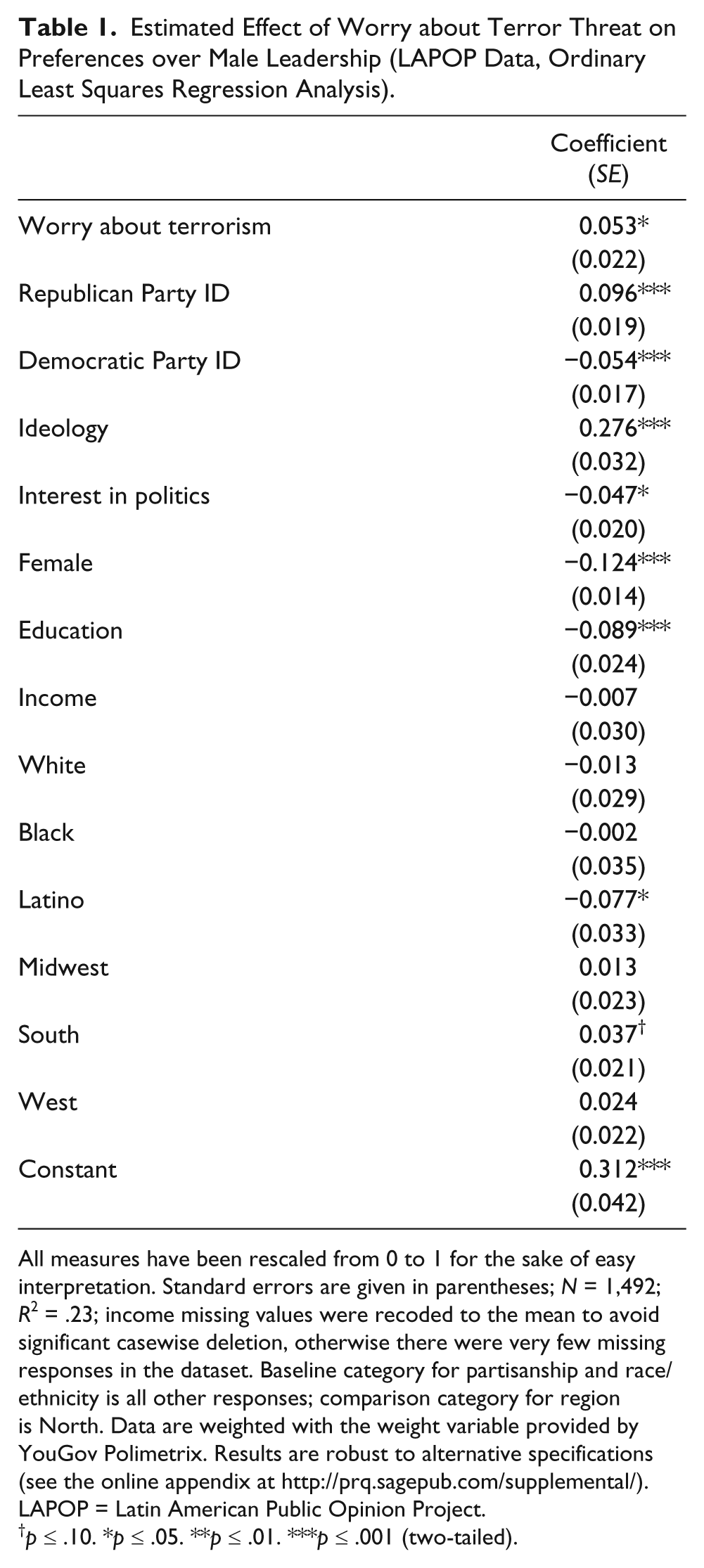
All measures have been rescaled from 0 to 1 for the sake of easy interpretation. Standard errors are given in parentheses; N = 1,492; R2 = .23; income missing values were recoded to the mean to avoid significant casewise deletion, otherwise there were very few missing responses in the dataset. Baseline category for partisanship and race/ethnicity is all other responses; comparison category for region is North. Data are weighted with the weight variable provided by YouGov Polimetrix. Results are robust to alternative specifications (see the online appendix at http://prq.sagepub.com/supplemental/). LAPOP = Latin American Public Opinion Project.
p ≤ .10. *p ≤ .05. **p ≤ .01. ***p ≤ .001 (two-tailed).
Worry about terrorism is positively related to general preferences over male versus female leadership and is statistically significant (p < .05, two-tailed). Although significant, the substantive effect is modest: the model predicts only a 0.05-unit change on the 0 to 1 dependent variable moving from the minimum to the maximum value on the terror measure. Thus, the results are in line with research suggesting that female leaders are disadvantaged when security threats are salient (e.g., Falk and Kenski 2006; Kenski and Falk 2004; Lawless 2004). However, we also see that—when considered through this generic lens—the effect is substantively small.
Party and Gender Stereotypes
We assert that one reason for a muted effect is that candidates from certain political parties may be less (or more) advantaged during national security crises, and this may intersect with gender. According to the issue ownership school, the public perceives the Republican Party as more competent at handling issues surrounding national security and war (Petrocik 1996, 832). Although issue ownership can shift over time (e.g., Petrocik 1996; Pope and Woon 2009), the Republican Party is persistently viewed as more competent in the realm of terrorist threat (Nacos 2007). This extends to candidates: Republican candidates are perceived as better leaders under a context of terror threat compared with Democratic candidates (Merolla and Zechmeister 2009, 2013). 6
As discussed earlier, individuals also draw gendered distinctions between the parties, which has consequences for candidate evaluations. Issue ownership evokes gendered stereotypes about the parties, so that voters see Republican candidates as stronger leaders, a more stereotypically masculine trait, whereas Democrats are seen as more compassionate, a more stereotypically feminine trait (Hayes 2005). Generally, individuals link notions of femininity to the Democratic Party and masculinity to the Republican Party (Schneider and Bos 2014; Winter 2010). These partisan characterizations may combine with individual gender stereotypes in important ways (Koch 2000; Sanbonmatsu and Dolan 2009; Schneider and Bos 2014). For example, a Republican female’s partisanship may counter gender stereotypes, in particular to the degree that partisan cues can trump gender cues (Dolan 2014a, 2014b; Hayes 2005, 2011; Matland and King 2002; McDermott 1997).
In the context of national security issues and threats, Democratic females tend to be most disadvantaged. For example, party and gender stereotypes combine to limit the ability of Democratic female senators to become leaders on defense policy; female Democrats, in particular, must “overcome the double bind of gender stereotypes and the Democratic party’s reputation for weakness on national security” (Swers 2013, 183). Moreover, Holman, Merolla, and Zechmeister (2011) show evidence that, in the context of terror threat, particular female Republican leaders (in that study, Condoleezza Rice) are able to avoid the lower evaluations that Democratic female leaders (Hillary Clinton) can experience in times of security crisis.
Although the scant research into terrorist threat, gender, and leadership preferences has focused on existing politicians, we test whether these findings also hold for general comparisons by candidate gender and partisanship. If Democratic female candidates are doubly disadvantaged by gender and party stereotypes on the issue of terrorism, we expect to find that individuals worried about terrorism will express lower evaluations of Democratic females relative to Republican males, who are doubly advantaged (Hypothesis 1a [H1a]). However, Democratic males (Hypothesis 1b [H1b]) and Republican females (Hypothesis 1c [H1c]) should be less negatively affected by terrorism concerns because each has another trait that counters the relevant stereotype (gender for the Democratic man and partisanship for the Republican female).
Partisan and Gendered Preferences in Times of Threat
We assess these expectations with data from another national public opinion survey, fielded by Angus Reid from January 19 to 20, 2010 to a sample of 1,006 online panelists (see the online appendix at http://prq.sagepub.com/supplemental/ for details). On that survey, we asked respondents to indicate what type of politician they believe is best capable of handling the issue of terrorism: (1) Republican female, (2) Republican male, (3) Democratic female, or (4) Democratic male. 7 The modal response (42.7%) is Republican male, which supports the prevailing wisdom that the public considers this candidate’s gender and partisanship as relatively more desirable in times of national security threat.
What interests us even more is the extent to which these evaluations of the most capable politician type vary by level of concern about terrorism. To approximate the salience of terrorism at the individual level, we asked respondents to indicate on a 4-point scale how worried they are that the United States will experience a terrorist attack in the near future. 8 Higher values indicate more worry. 9 Using multinomial logit analysis, we predicted the type of leader selected as most capable on the issue of terrorism with the worry about terrorism variable, plus a host of control variables. We use the Republican male as the baseline category given our expectation that this candidate is more comparatively advantaged by a context of terror threat.
Table 2 shows that worry about terrorism has a negative and significant effect on the likelihood of selecting the Democratic female (compared with the Republican male) response (p = .056; H1a). The coefficient for worry about terrorism is also negative, but smaller and not significant for the Democratic male outcome (p = .139; H1b), and it is actually positive but not statistically significant for the Republican female outcome (p = .128; H1c). In short, we find clear evidence that Democratic female leaders are considered less capable of handling terrorism when worry about terror is elevated. The substantive strength of the worry about terrorism measure is such that, holding all other variables constant at their means, the predicted maximum effect of worry about terrorism is an 11.3 percentage point decrease in the likelihood of selecting the Democratic female response option over the Republican male option. 10 We also find that while contexts of terror threat disadvantage Democratic females, Republican females can avoid the same detrimental shifts due to their affiliation with the party generally considered stronger on issues of national security. 11 These findings not only complement but also extend beyond research focused on specific female leaders (e.g., Holman, Merolla, and Zechmeister 2011). Although the results in Table 2 suggest that stereotypes are at play, we have not yet directly measured abstract gender stereotypes or assessed their application to evaluations of male and female leaders across contexts.
Estimated Effects of Worry about Terrorism on Candidate Type Selected as Best Able to Handle Terrorism (Angus Reid Data, Multinomial Logistic Regression Analysis).
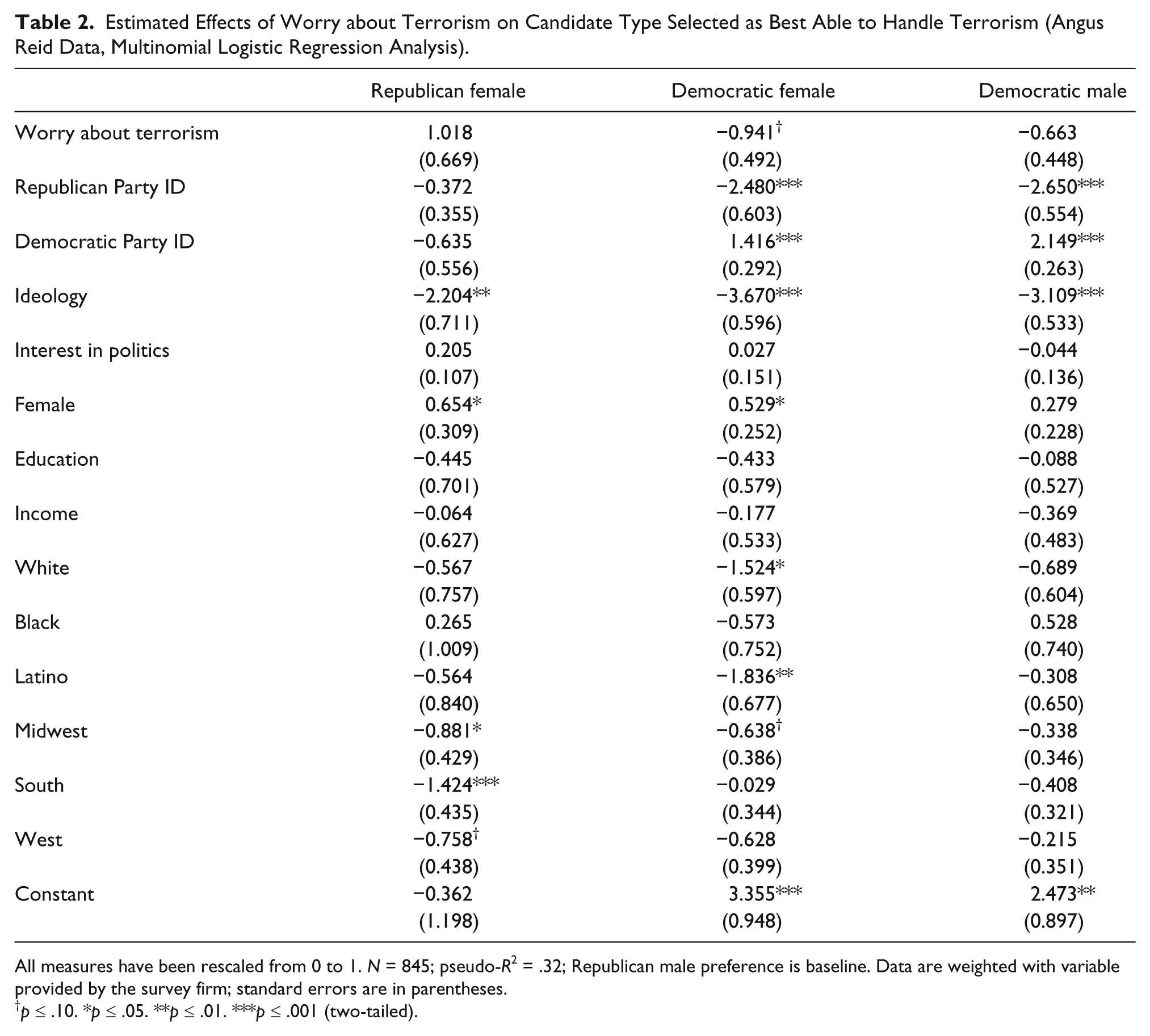
All measures have been rescaled from 0 to 1. N = 845; pseudo-R2 = .32; Republican male preference is baseline. Data are weighted with variable provided by the survey firm; standard errors are in parentheses.
p ≤ .10. *p ≤ .05. **p ≤ .01. ***p ≤ .001 (two-tailed).
Gender Stereotypes under Terror Threat
Why are Democratic female political leaders disadvantaged in times of terrorist threat? One mechanism concerns the moderating influence of male stereotypes under different information conditions. The core of our proposition is that the extent to which people apply male stereotypes to evaluations of political figures varies across contexts, due to dynamics of priming and stereotype application, and across parties, due to the information contained in that alternative cue.
Priming raises the salience of certain issues and makes related attitudes more available, accessible, or relevant (Iyengar and Kinder 1987; Krosnick and Kinder 1990; Miller and Krosnick 2000). As argued earlier, during times of terror threat, individuals come to place even more value on traits and capabilities that are stereotypically masculine (Little et al. 2007), and on which the Republican Party is perceived as better: strong leadership (Merolla and Zechmeister 2009) and competence on foreign policy (Gadarian 2010a). Threats like terrorism may make male stereotypes more applicable, but how do individuals apply these stereotypes to candidate evaluations when—as is the case in most general elections—candidates differ across both gender and party lines?
The notion that stereotypes about gender and party interact is consistent with the dual process framework (Kunda 1999). In the dual process model, various impressions work in tandem to help people form coherent conceptualizations of the world. Thus, a white person engaging in violent behavior may be seen as less threatening than a black person engaging in the same behavior because of stereotypes that associate race and violence (Kunda 1999; Macrae, Bodenhausen, and Milne 1995). When two cues reinforce each other, it is easier for individuals to form impressions compared with when two cues work in opposing directions (Dolan 2014b). We draw on this framework to identify two ways in which gender and party could intersect in influencing evaluations of candidates across conditions of terrorist threat, both of which result in a disadvantage for Democratic female candidates.
The first perspective stems from the notion that party labels themselves are ascribed masculine and feminine characteristics, which are relevant to candidate evaluations especially in party-centered electoral contexts. If partisan stereotypes have primacy and overlap with gender stereotypes, then male stereotypes will negatively affect both male and female Democratic candidates under normal conditions, as their party label conveys a weakness with respect to these qualities. This may particularly be the case in executive contexts, where masculine traits are privileged (Huddy and Terkildsen 1993a). Such stereotypes would not harm a Republican female candidate, as the party signal would counter the gender stereotype. Along these lines, Dolan (2014b) finds that male policy (not trait) stereotypes can harm evaluations of Democratic female and male candidates, while they have no effect on Republican female candidates. When a security threat is made salient, such that masculine traits become even more relevant, the Democratic female candidate, who has both party and gender working against her on these dimensions, will still be harmed by male stereotypes. The Democratic male, however, is difficult to evaluate given that there are two competing cues that are now relevant, party and gender, where the latter could counteract the weakness of the party on issues of leadership and national security. If this is the case, terror threat deactivates male stereotypes in evaluations of the Democratic male, such that the effect of male stereotypes on this candidate’s evaluations may diminish or completely wash away. The Republican female may also be more difficult to evaluate if gender becomes more salient in a context of terror threat; however, she may still be shielded from male stereotypes given that her party is perceived as strong on leadership and national security. In short, male stereotypes will have a negative influence on both male and female Democratic candidates in good or normal times, but the effect of the stereotype will diminish or wash away for the male Democratic candidate leaving negative evaluations for only the female Democratic candidate when terror threat is primed. The Republican female will not be affected by male stereotypes in a nonthreat context, but may or may not be in a condition of terror threat. We refer to this as the deactivation effect hypothesis (Hypothesis 2 [H2]).
A rival possibility is that terrorist threat activates the effect of male stereotypes on candidate evaluations, most strongly, and negatively, for the Democratic female relative to the other candidate types. It is possible that male stereotypes have little to no effect on candidate evaluations when things are going well (e.g., Bauer 2015a), but become particularly relevant during a context of terror threat, as individuals seek leaders with more masculine qualities, 12 that is, from this perspective, individuals apply male stereotypes only in a context of terror threat (as compared with good times). Under conditions of terrorist treat, Democratic females have two characteristics (gender and party) that place them at a disadvantage, and so male stereotypes should be comparatively more consequential for this type of candidate. For Democratic males and Republican females, their possession of one countervailing trait could counteract this activation effect. In this case, male stereotypes would have the largest negative effect on evaluations of the female Democratic candidate during times of terror threat relative to better times. We refer to this as the activation effect hypothesis (Hypothesis 3 [H3]). Both perspectives fit with recent scholarship on gender stereotypes and female leaders, which suggests that individuals do not apply gender stereotypes across all contexts or all people (Brooks 2013; Dolan 2014b; Hayes and Lawless 2015).
Experimental Design and Measures
To assess whether terrorist threat deactivates or activates the effect of male stereotypes on evaluations of male and female candidates for political office, we use data from an original experiment administered by Knowledge Networks from January 2, 2010 to January 18, 2010. 13 Our results are from the 1,074 panel members who completed the study (a 61.4% completion rate). Knowledge Networks uses probability-sampling techniques with weighting so that the final sample resembles the general U.S. population. 14
Subjects were asked to assume the role of citizens in a state holding a special election for Governor and were presented with an article describing the election and the context of the state. Participants were randomly assigned to read either a story describing terrorist threats in the state (Terrorism treatment) or one reporting that everything is going well in the state (Good Times treatment). Subjects were further randomly assigned to four different election scenarios, which varied the partisanship and gender of the candidates, producing eight experimental conditions (four election scenarios by two information contexts). Random assignment worked as intended: there were no significant differences on background variables (age, gender, race, income, education, partisanship, or ideology) across the eight conditions. After reading the article, participants filled out a survey about their evaluations of the candidates, political attitudes, and responses to traditional gender stereotype measures.
Subjects read one of four election scenarios: John McGuire versus Peter Harris (male Democrat vs. male Republican), John McGuire versus Pam Harris (male Democrat vs. female Republican), Jane McGuire versus Peter Harris (female Democrat vs. male Republican), or Jane McGuire versus Pam Harris (female Democrat vs. female Republican). 15 The treatment established the gender of the candidates through first names and gendered pronouns, and directly referenced each candidate’s party. As a manipulation check, we asked the respondents to identify the Democratic candidate by name; 89 percent answered correctly, with no significant differences across the conditions.
The articles varied with respect to the general context in the state. The Terrorism treatment was designed to increase the salience and perceived possibility of a terrorist attack. It emphasized recent attacks in the world, concern about terrorist attacks, and the vulnerability of the local area to terrorism. The treatment contained language indicating that the state was at risk for an attack: “A recent raid of a London terrorist hideout found evidence of detailed plans targeting the state’s transportation networks and threatening mass casualties.” In contrast, the Good Times treatment focused on positive news about the state. The news story focused on happiness among Americans, increased health and welfare of residents of the state, and a strong education system, for example, touting, “Recently, the state has received attention in the news about considerable improvement in the education system.” The content was drawn from various newspaper reports and edited together by the authors, an approach used in extant scholarship (Gadarian 2010b; Merolla and Zechmeister 2009). We use a governor’s race as the venue for testing our questions because it is an executive office that women have held and one that has some control over security and prevention. 16
Experiments gain internal validity in a trade-off with external validity; as such, the design we apply abstracts away from real-world elections. In an information-rich election, with many other pieces of information, individuals conceivably might be less affected by gender stereotypes, as some studies of gender stereotypes in actual elections find (Brooks 2013; Dolan 2014a, 2014b; Fridkin and Kenney 2009; Hayes and Lawless 2015). Yet, prior to determining whether other factors trump the application of gender stereotypes under differing electoral contexts, we must first establish whether and how such stereotypes are applied. In essence, we must first establish internal (causal) validity before we can move to questions of external validity (Morton and Williams 2010). The experimental design allows us to systematically assess the activation and deactivation effect hypotheses by holding everything constant about the candidates, save gender and party, and everything constant about the environment, save terrorist threat and nonthreat.
In considering candidate evaluations, we make use of two trait measures, one related to leadership evaluations and one related to trust, as well as feeling thermometers toward each candidate. First, we asked participants for their level of agreement on a 7-point scale with the following statement for the Democratic candidate McGuire and the Republican candidate Harris: “McGuire/Harris will provide strong leadership for the state” (Leadership). Second, we asked for their level of agreement with the following statement for the two candidates: “McGuire/Harris is trustworthy,” (Trustworthiness). Finally, we asked the 0 to 100 feeling thermometer (Feelings) question that is common to studies such as the American National Election Study. All measures are coded so that higher values reflect more positive assessments.
To account for trait and belief stereotypes, we asked four questions concerning whether the participants think that men or women tend to be more assertive, more compassionate, better at handling foreign affairs, and better at assisting the poor. Respondents were also given the option of selecting “No difference.” The questions are based on measures used frequently in existing scholarship (Bauer 2015a; Dolan 2010, 2014a, 2014b; Huddy and Terkildsen 1993b; Lawless 2004; Mo 2015). Using principal components factor analysis of these questions, we extracted a Male Stereotype Factor with higher values consistent with the stereotype (i.e., that men are viewed as more assertive and better at foreign affairs). 17 We only use the male stereotype questions because we have no expectations that feminine stereotypes will be activated during times of national security threat; it could be that an alternative context, such as an education crisis, would influence the application of feminine stereotypes. These questions were asked after the leadership, trust, and vote questions as the final opinion questions of the survey and were uninfluenced by the treatments; we tested and found no effect of the treatments on these questions.
Male Stereotypes and Candidate Evaluations
To test for either deactivation or activation of male stereotypes, we regress the dependent variables (the trait measures and feeling thermometers) on a dummy variable for whether the candidate is female (Democratic Female for the McGuire questions or Republican Female for the Harris questions, with male as the baseline category), a dummy variable for whether the subject was in the Terrorism treatment (Good Times is the baseline category), the Male Stereotype Factor, and a series of interaction terms for these three variables. These interaction terms enable tests of the moderating relationships expressed in H2 and H3. We conduct separate analyses for the Democrat and Republican candidates as the respondents separately evaluated both candidates running in the election. This approach is also sound given that our primary interest lies in determining how the effect of male stereotypes on candidate evaluations may shift for each candidate type in a context of nonthreat to terror threat. 18
Table 3 shows support for a conditional effect of male stereotypes on evaluations of the Democratic candidates. The p value on the coefficient for the Democratic Female × Male Stereotype Factor × Terrorism interaction is negative and highly significant for both trait dependent variables and it is negative and marginally significant for the feeling thermometer measure (on assessing interaction effects, see Kam and Franzese 2007). To interpret the interaction terms, we calculate the slope and standard error of male stereotypes on the three dependent variables for the male and female Democratic candidate across the two contexts of Terrorism and Good Times. The results for the trust and leadership measures are presented in Figure 1. To refresh, if the deactivation hypothesis (H2) is supported, then we would see that male stereotypes affect Democratic male and female candidates in the Good Times condition, but the effect of these stereotypes is diminished for the Democratic male in the Terrorism condition. If instead the activation hypothesis (H3) is supported, we would find that the negative effect of male stereotypes on evaluations is greatest for the Democratic female candidate in the terror threat condition, with little to no effect during Good Times.
Evaluations of the Democrat Candidate (Knowledge Networks Data, Ordinary Least Squares Regression Analysis).
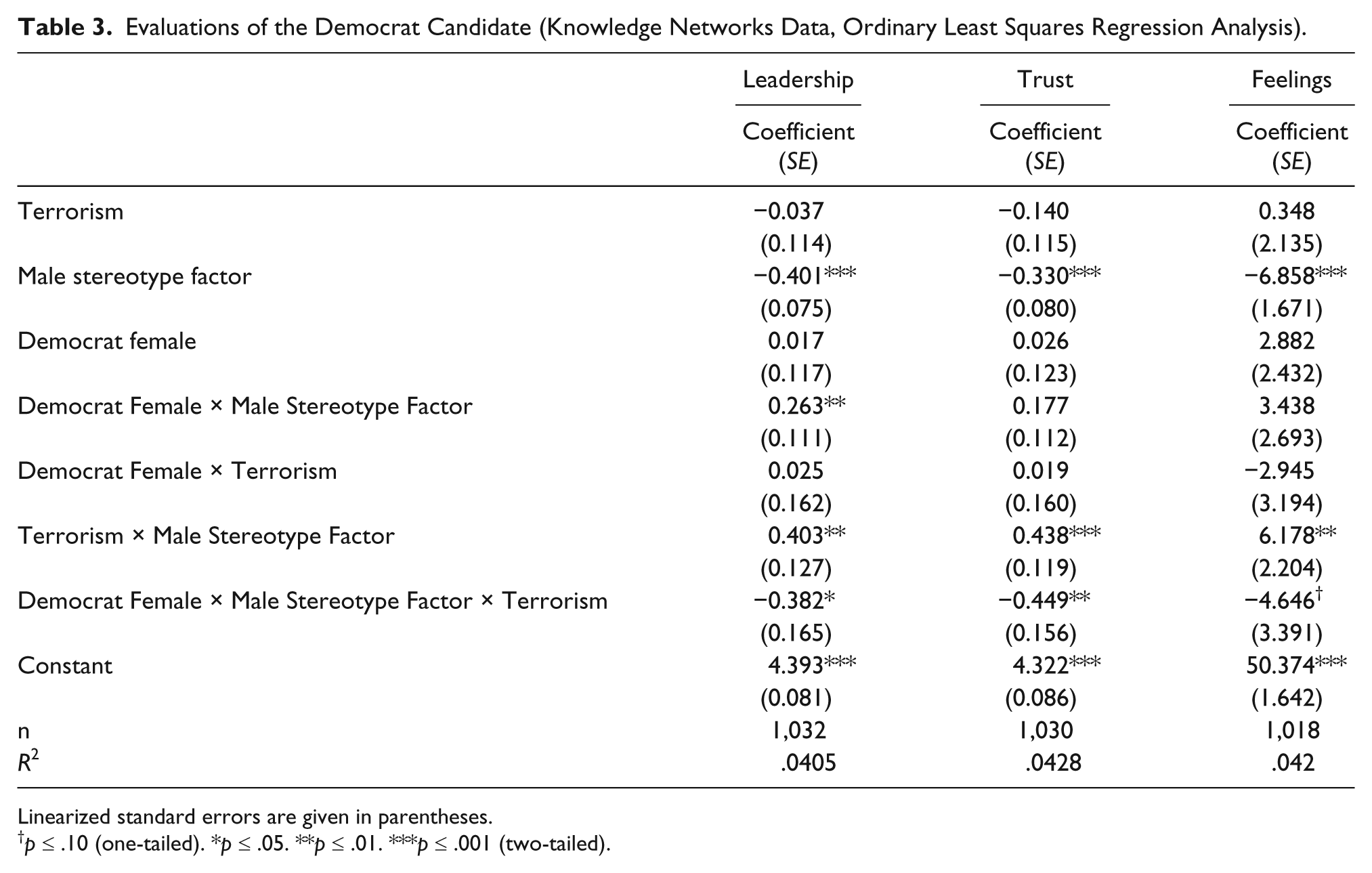
Linearized standard errors are given in parentheses.
p ≤ .10 (one-tailed). *p ≤ .05. **p ≤ .01. ***p ≤ .001 (two-tailed).
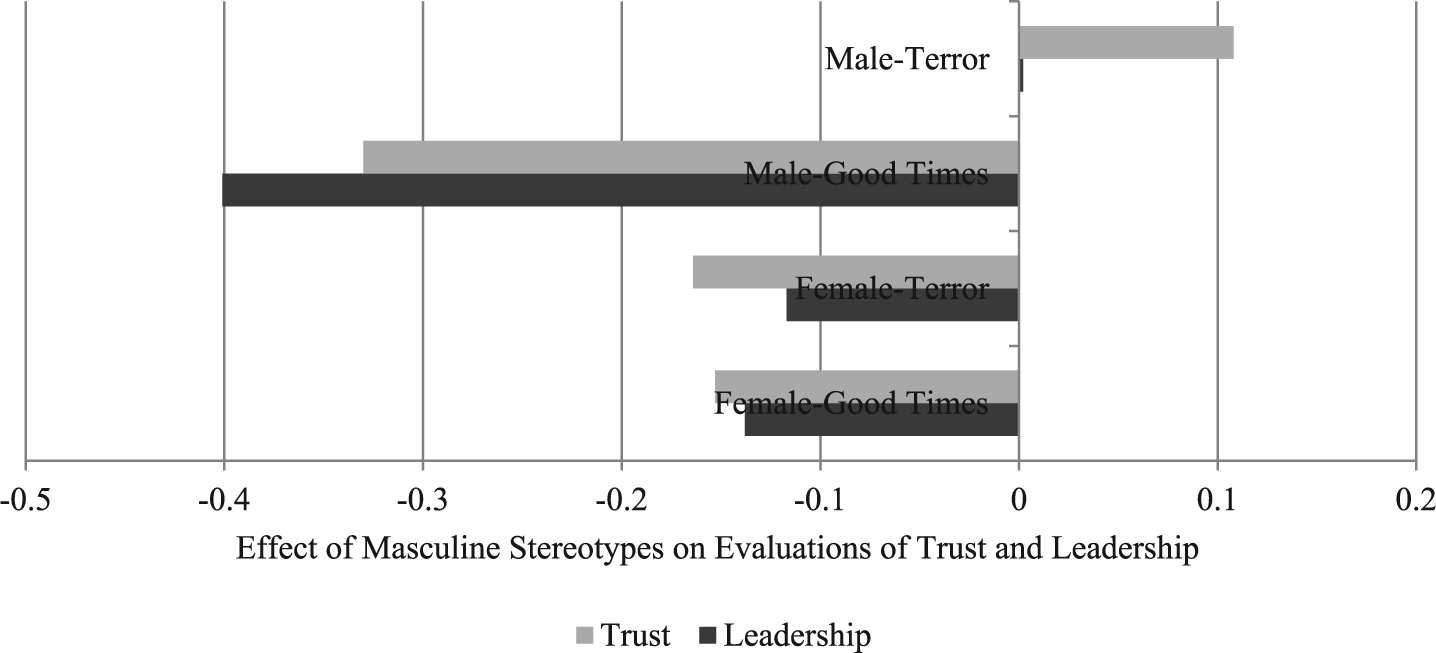
Estimated effect of male stereotypes on trait evaluations for the Democratic candidate, by gender of candidate and experimental condition.
We find clear support for the deactivation process. Figure 1 shows that a one-unit change in male stereotypes results in a .12 unit decline in leadership evaluations and a .16 unit decline in trust evaluations for the Democratic female candidate in conditions of terrorist threat. These are very similar to the effects for the female candidate in “good times”: a decline of .14 and .15 units for leadership and trust, respectively. All of these effects are statistically significant. Thus, the effect of male stereotypes on trait evaluations of the Democratic female candidate is quite comparable across contexts. The key difference is in how male stereotypes influence evaluations when gender changes for the Democratic candidate. Male stereotypes exert a significant negative effect on evaluations of the male candidate in the Good Times condition: a one-unit increase in male stereotypes leads to a .40 unit decline in leadership evaluations and a .33 unit decline in trust evaluations, effects that are stronger than those found for the Democratic female. However, there is no significant effect of male stereotypes on leadership and trust evaluations of the male candidate in times of terror threat: that is, the effect completely washes away. Therefore, on balance we find substantial support for the deactivation hypothesis. 19
The effects of the stereotypes on the feeling thermometer for the Democratic candidate are similar. The effect of male stereotypes on evaluations of the female candidate among subjects in the terror threat condition is −1.89 (p = .10, one-tailed). The comparable effect for those in the female Good Times condition is calculated at −3.42 (p = .11). Thus, the male stereotype factor has a similar effect for the Democratic female candidate in a context of threat and nonthreat. 20 Meanwhile, the male stereotype factor has a negative effect among those exposed to the male Democrat Good Times condition, −6.9 (p = .00) but has no significant effect among those exposed to the male Democrat terror threat condition, −.68 (p = .64).
We follow the same process for evaluations of the Republican candidate (Harris). As we argued earlier, we may not find any effect of male stereotypes on evaluations of Republican females, even in a context of terror threat, as their partisanship may counteract any negative effect. We would not expect to find any deactivation effect for the Republican male as male stereotypes should not harm his evaluations, regardless of context. As Table 4 shows, neither the male stereotype factor nor any of the interaction terms with the male stereotype factor is significant in any of the Republican candidate models. 21 Thus, we find that terror threat affects the public’s evaluations of male versus female candidates by deactivating the effect of male stereotypes on evaluations of Democratic male candidates. 22
Evaluations of the Republican Candidate (Knowledge Networks Data, Ordinary Least Squares Regression Analysis).
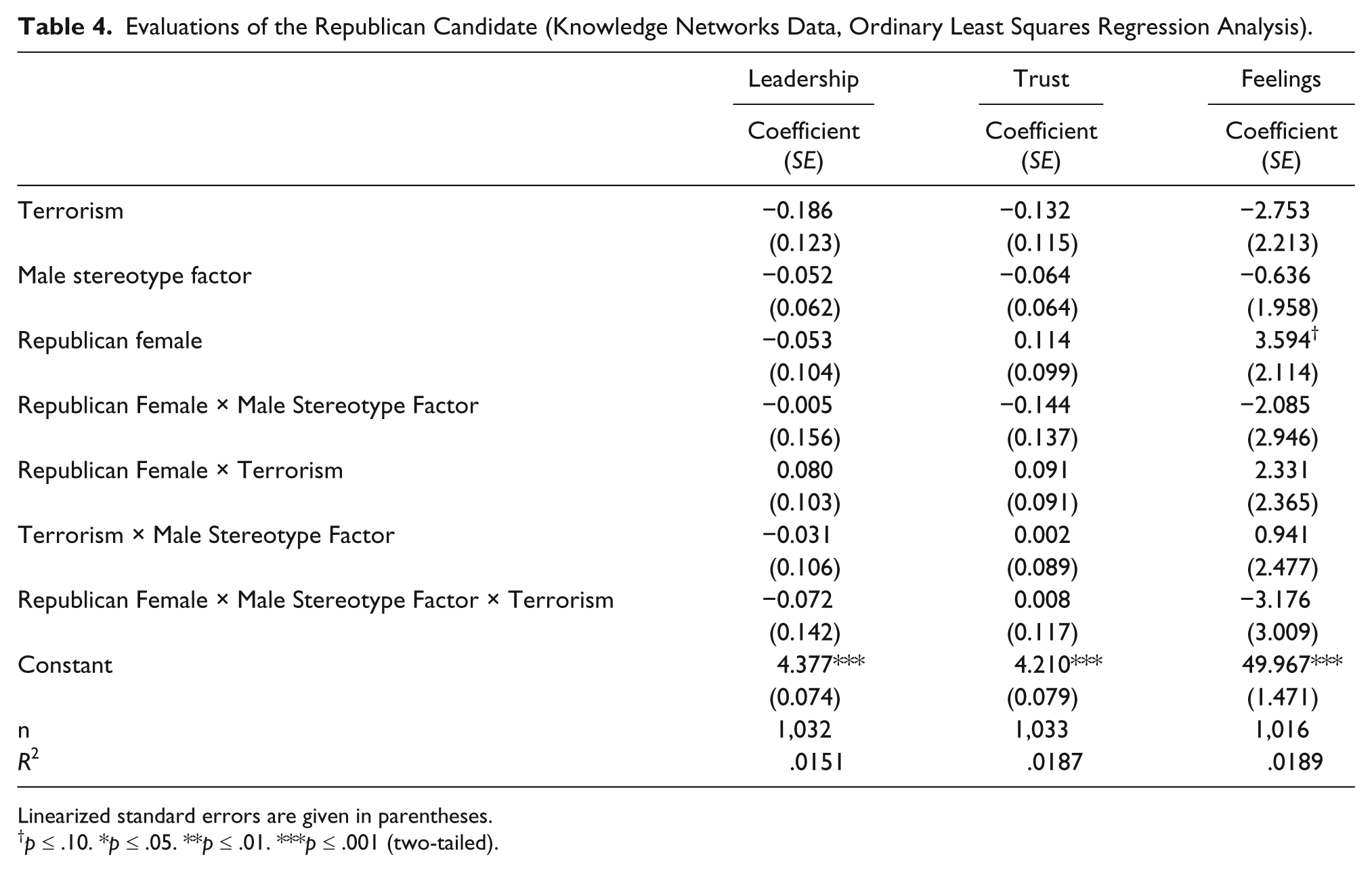
Linearized standard errors are given in parentheses.
p ≤ .10. *p ≤ .05. **p ≤ .01. ***p ≤ .001 (two-tailed).
Discussion and Conclusion
Contexts of terror threat can have negative consequences for Democratic female political leaders. With survey data, we affirm that when individuals are threatened by terrorism, candidate gender and partisanship combine to place Democratic female candidates at a relative disadvantage. With experimental data, we test whether deactivation or activation of male stereotypes helps to explain this disadvantage. The data and analyses support a deactivating process, through which Democratic females experience a disadvantage in times of terror threat because being male allows the Democratic men to overcome party stereotypes in times of threat, a benefit the female candidate lacks. The Republican female candidate was—all else equal—immune to these negative effects, a result in accord with our assertion that Republican partisanship counters the male stereotype.
That we find more support for the deactivation of the male stereotype for Democratic males fits in with existing work suggesting that party can be more important than gender to voter evaluations. For example, Winter’s (2010) work shows that the Democratic Party is linked with femininity, and Hayes (2011) demonstrates the permanence of party stereotypes over gender (see also Hayes and Lawless 2015). As we noted earlier, Dolan (2014a, 2014b) also finds evidence that certain gender stereotypes harm Democratic males. Extending beyond this work, in a manner that undergirds the originality of our contribution, we provide evidence that male stereotypes do not disadvantage Democratic males in conditions of terror threat, which suggests that party stereotypes can be overcome in some circumstances.
Our experimental design provides a crisp test of the effects of male stereotypes by candidate partisanship and gender during times of terrorist threat versus nonthreat. Although we focus here on hypothetical candidates, the generalizability of the results is buttressed by the fact that they are consistent with previous research that found that (in a period prior to her position as Secretary of State) Hillary Clinton was disadvantaged when terrorism was made salient, while John Kerry and Condoleezza Rice were not (Holman, Merolla, and Zechmeister 2011). Our findings have important implications for understanding the forces that may harm women’s electoral chances for executive office. The evidence suggests that, when terrorism is salient in the news, Democratic female candidates, compared with their male counterparts, may have lower success in primaries and general elections. This is particularly important to the degree that more women are likely to run under the Democratic ticket than the Republican ticket. At the same time, our results suggest that times of national security threat may give a comparative advantage to Republican women seeking these types of offices; interestingly, in recent times, there has been a growth of Republican females contesting and winning gubernatorial office (Center for American Women in Politics [CAWP] 2013).
We focus on terrorist threat, but it is quite possible that the processes we have documented here extend to other domains of national security, including unrest and military involvement in the Middle East. Our results leave open the notion that there could be other threat contexts, such as an economic downturn or health epidemics, that might be advantageous to women, particularly Democratic women, in their pursuit of political office. In these cases, feminine stereotypes could be activated or deactivated in a way that advantages the Democratic Party and doubly advantages Democratic women. Research on 1992 as the Year of the Woman suggests that women’s gains in representation relate to a context that supported the application of female stereotypes (Dolan 1998; Sapiro and Conover 1997). Fridkin and Kenney (2009) argue that part of the positive effects of gender on candidate evaluations in the 2006 Senate elections may have been due to corruption being salient during the campaign, which advantages women. Similarly, Kahn (1996) finds that issues that are consistent with women’s stereotypical strengths advantaged women seeking U.S. Senate seats. Indeed, rhetoric like in the 2012 election around the so-called Republican War on Women may have provided an atmosphere in which women’s candidacies were advantaged (Deckman and McTague 2015).
The objective of an experiment is to isolate a limited set of factors to observe their causal relationship in the absence of confounders. Many other factors are present in real elections besides partisanship, which may limit the effect of gender stereotypes on candidate evaluations, such as incumbency status, recruitment policies, and party structure, among others (Dolan 2014a, 2014b; Hayes and Lawless 2015), and some of these may advantage Democratic females over Republican females (e.g., Crowder-Meyer and Lauderdale 2014; Fox and Oxley 2004; Fridkin and Kenney 2009; Sanbonmatsu 2002b). An important question for future research is whether there are factors that diminish the effect of male stereotypes on Democratic females in general and/or during contexts of national security threat. That Republican women are relatively immunized against the effects of a terrorist threat given their party’s reputation in that arena suggests the possibility that other aspects of a candidate’s profile might serve a similar purpose. In particular, experience in foreign policy, defense, and international affairs may also deactivate male stereotypes for a Democratic female in times of national crisis. For example, while Holman and colleagues (2011) found that Hillary Clinton was disadvantaged in a context of terror threat, the study was conducted prior to her position as Secretary of State. In Clinton’s bid for president in 2016, her experience in that position could buttress against gender and party stereotypes in a climate of national security threat. Research along these lines would be consistent with the broader theoretical framework we have presented here, which posits that deleterious outcomes with respect to the images the public holds of female politicians in times of security threat apply only to the extent that some other characteristic of the candidate is unable to overcome that effect.
Footnotes
Acknowledgements
The authors thank all those who gave comments, especially Tiffany Barnes, Kathy Dolan, and David J. Andersen, as well as the editors and anonymous reviewers. Thanks to Ashley Grosse for access to data. The Knowledge Networks experimental data used in this paper were collected by Time-Sharing Experiments for the Social Sciences, NSF Grant 0094964, Diana C. Mutz and Arthur Lupia, principal investigators.
Authors’ Note
Previous drafts of this paper were presented at the International Society of Political Psychology Annual 2011 Meeting, at the American Political Science Association 2011 Meeting, and at Rutgers University.
Declaration of Conflicting Interests
The author(s) declared no potential conflicts of interest with respect to the research, authorship, and/or publication of this article.
Funding
The author(s) received no financial support for the research, authorship, and/or publication of this article.

Notes
References
Supplementary Material
Please find the following supplemental material available below.
For Open Access articles published under a Creative Commons License, all supplemental material carries the same license as the article it is associated with.
For non-Open Access articles published, all supplemental material carries a non-exclusive license, and permission requests for re-use of supplemental material or any part of supplemental material shall be sent directly to the copyright owner as specified in the copyright notice associated with the article.
